And I Thought the French Translation Would Help. Silly Me.
In order to understand the meaning of “head” as used by the apostle Paul, it is helpful to determine its meaning within the language spoken by Paul. The authors of works such as A Greek-English Lexicon by Henry G. Liddell and Robert Scott (Oxford: Clarendon Press 1968), or Theological Dictionary of the New Testament, edited by Gerhard Kittel (Grand Rapids: Wm. B. Eerdmans Publishing Company, 1965, 10 volumes) have thoroughly investigated biblical and contemporary extra-biblical writings and reported that the word kephale was used in the secular and religious Greek contemporary to Paul, with the meaning of source, origin, sustainer, and not of ruler. The second century B.C. translation of the Hebrew text of the Old Testament into Greek provides a case in point. The Hebrew word for head (ros), commonly used for leader, ruler, or supreme is translated in the Septuagint by a Greek word other than “head” (kephale) over 150 times. It was much later that the word kephale began to be used as “authority” under the pressure of Latin usage, as evidenced in the writings of some post apostolic church fathers. For Paul and his correspondents the use of the word kephale as a synonym for ruler or authority would have been as meaningless as attempting to do the same today with tete in French, or Kopf in German. – From Beyond Sex Roles by Gilbert Bilezikian, pp. 277-278, quoted at Just a Berean. Emphasis added.
Since I speak a little French, I began lately to wonder exactly how French Bibles did translate the Greek word for “head,” transliterated “kephale.” In English, “head” can mean “that thing on top of your neck,” or it can mean “ruler/leader.” It can also mean “bathroom,” and also “the thing above, on top or coming first” — as in “headstone” and “headwaters.” So it’s not all that difficult for us as English speakers to look at “Christ is the head of the church, which is his body” in Ephesians 5:23 or Colossians 1:18, and consider the idea that “head and body” here might be a metaphor which meant something other than “leader and follower” or “ruler and subordinate” in the original text. However, “ruler” or “leader” being a legitimate meaning of the word “head” in English, some people insist that this has to be what it means in these passages.
So I wondered if in a language where the word meaning “that thing on top of your neck” doesn’t contain the meaning “ruler” or “leader,” there might be less difficulty with this issue. I decided to look up the passages in my French Bible. I have an old La Bible de Jerusalem which I picked up in Paris when I visited it on a student tour right after my graduation from high school. I opened it and was pleased to find I could still read it fairly well.
And here’s the odd thing. In Colossians 1:18, the passage says, “Et Il est aussi la Tete du Corps, c’est-a-dire l’Eglise.” It does actually say “And He is also the “tete” (that thing on top of the neck) to the “corps” (body), that is to say the church.”
But when I turned to Ephesians 5:23, the word changed. “Le mari est chef de sa femme, comme le Christ est chef de l’Eglise, lui le sauveur du Corps.” Instead of “tete” (that thing on your neck), the translators actually chose “chef,” which means “chief; ruler.” Christ, then, according to the translation of this passage, is the “sauveur” (savior) of the Body– but not “head” to the Body. Instead, He is the “chief/ruler” of the Body — and the husband is the “chief/ruler” of the wife.
It seems, then, that while the translators of La Bible de Jerusalem in French were quite willing that the head-body metaphor should be accurately reflected in Col. 1:18, which is only about the Christ-church relationship, without the husband-wife relationship being in immediate view, they willingly jettisoned the head-body metaphor in Eph. 5:23, which is about husband-wife relations. Eph. 5:23 refers to the church as “du Corps” (the body), but Christ and the husband do not appear as “head” at all. They are, unequivocably, rulers.
I guess the translators were certain the word “kephale” there was supposed to mean “ruler,” so they simply substituted that and lost the metaphor. How is the French reader supposed to see a head-body metaphor in that passage at all? It turns out that the translators’ decision as to what the text means actually obscures any other possible meaning for the word “head,” and thus makes it harder, not easier, for a French speaker to see that Eph. 5:23 might not be speaking of husbands as rulers of wives.
I guess I’ve decided that the ability of the English word “head” to mean “ruler” isn’t such a problem after all. At least I get to still see that there’s a body, and a thing on top of its neck, in the Ephesians text.
Sigh.
doe or hart?
Another pesky Hebrew gender question. Here is the King James for the first verse of Psalm 42:
As the hart panteth after the water brooks,
so panteth my soul after thee, O God.
A hart, as everybody knows, 😉 is a male deer. And the Hebrew word looks like a masculine word. Jerome translated it:
quemadmodum desiderat cervus ad fontes aquarum
ita desiderat anima mea ad te Deus
As the buck desires springs of water,
so my soul desires you, O God.
He translated ‘ayel as cervus with a masculine ending. But Pagninus translated it cerva, with a feminine ending:
Quemadmodum cerva desiderat ad torrentes aquarum,
Ita anima mea desiderat ad te deus.
As the doe desires torrents of water,
So my soul desires you, O God.
And here is the ambiguous Hebrew:
כְּאַיָּל, תַּעֲרֹג עַל-אֲפִיקֵי-מָיִם–
כֵּן נַפְשִׁי תַעֲרֹג אֵלֶיךָ אֱלֹהִים
I have to confess that I don’t really know how to transliterate this smoothly into Roman letters, but here are the first two and most relevant words – Ke eyal ta’arog. The word eyal is considered masculine but the verb agrees with the feminine. And so the Septuagint translates it into Greek with a feminine noun and the New English Translation of the Septuagint translates it into English with a feminine:
ον τροπον επιποθει η ελαφος επι τας πηγας των υδατων
ουτως επιποθει η ψυχη μου προς σε ο θεος
Just as the doe longs for the springs of water,
so my soul longs for you, O God.
Here the Greek word elaphos, a Greek word of common gender, is preceded by the article in the feminine, indicating that it is a female deer. Here are the first two lines of the psalm in song.
What percentage of the opera audience is female?
I was struck by the following passage in an article in today’s Seattle Times on the Seattle Opera’s 2013 performance of Wagner’s Ring Cycle:
Women comprise 38 percent of the regular-season [Seattle Opera] attendees; 32 percent of the [attendees of the Seattle Opera’s] “Ring.”
Now, this pretty much goes against every experience I’ve had in attending operas (and I have to admit to attending quite a few both in Europe and North America): women inevitably form the majority of the audience. I have a difficult time believing that even for the über-masculine Wagner operas they comprise only a third of the audience. (I must confess that the stereotypical Margaret Dumont [Mrs. Claypool] character in the Marx Brothers’ A Night At the Opera sometimes even rings true.)
A 2008 National Endowments for the Arts study (see Figure 3-10 on page 21 – PDF page 29) on the subject claimed that 57.8% of the opera audience in the preceding twelve months was female.
So, I cannot make sense of the claim in the Seattle Times. The only theory I can formulate is that perhaps – given the economic realities of income distribution in the US (particularly in people over 45, who comprise the majority of opera goers – see the same NEA study), men form the majority of ticket buyers rather than total attendees of Seattle Opera performances.
PS: If you look at other columns in that same NEA table, you’ll notice that the only types of performances for which the male audience outnumbers the female audience is classical music and Latin music – and even then only by slim majorities (52.2% and 53.3%). Note also that among the performing arts listed in Figure 3-10, opera has the largest percentage of audience with graduate school education – which is undoubtedly related somehow to the high cost of opera tickets (perhaps this also explains why opera audiences tend to be so much more affluent than patrons of the other performing arts.)
How Can I Keep from Singing?
This post is meant to introduce myself as a new blogger on BLT: to express where I’m coming from, where my roots and foundations are, and where my passion lies. If you wanted to put labels on me (labels can be useful but also limiting, so I wear them only loosely), you could say I’m an idealist and a synthesist. I look at life not so much in terms of the way things are, but in terms of the way things ought to be: the ideal. At the same time, I have a fundamental urge to bring disparate or conflicting things/people together, to find ways they can relate, things they have in common. Sometimes the two work together: in an ideal world, opposition would not mean conflict, but mutual appreciation and harmony. Sometimes, though, my idealism and my synthesism are actually in opposition to one another. I can’t bring something that I feel deeply is fundamentally wrong, into harmony with the good which it opposes. I can only hope that someday the wrong will be made right.
The old song lyrics above represent my basic attitude towards life: a vision of the ideal carries me through opposition to ultimate harmony. My vision strives to be the vision of Jesus: the new creation, the kingdom of heaven, which has come, is coming, and will someday come in completion. The new creation is inaugurated through the New Covenant that Christ ratified with his sacrifice. In the new creation, we “no longer view anyone according to the flesh.” 2 Cor. 5:16-17. The new creation destroys the dividing lines of race, gender, class and economic status. The new creation is where idealism and synthesism meet and join hands forever.
This, then, is the light in which I try to live. This is the way I read the Bible: in terms of the grand sweep of God’s redemption through human history. God created humankind in God’s image– but humankind, given a choice whether or not to trust God, chose not. God established first an Old Covenant kingdom based on being led by law, into which to bring the Christ. Christ’s coming brought a New Covenant based on being led by the Spirit. Gal. 5:18. The New Covenant began to bring in the new creation, the kingdom of God– and I look at all of the Bible in terms of where each book and passage fits within that grand sweep. Galatians 3:28-4:7 are about far more than our equality in salvation. That passage is one of the central descriptions of what the new creation is all about. We are all “sons of God,” because we have all received the “adoption as sons.” That phrase “adoption as sons” (Gal 4:5) was understood by the original, ancient Greek audience to mean something special and specific– and what God inspired is the message that the original author wrote, as the original audience would have understood it. We can’t understand what it means to us, until we see what it meant to them. And what they understood was that to be “adopted as a son” meant the granting to an adoptee of full status as a male free-born citizen, with all the rights and privileges pertaining thereto. Paul did not say we were adopted as “sons and daughters,” because daughters had far less status, rights and privileges in that society– and Paul intended to convey that everyone in the groups he mentioned had the same status, the same rights and privileges. And what they all had — Jew and Greek, slave and free, male and female– was “adoption as sons.” That’s what the original audience would have understood, and that’s what we should understand now.
For too long some Christians have said to others, “We are the ones with the powers and privileges, the spiritual gifts and callings to leadership. You have salvation in Christ, and we are all equal in that– but if you desire the leadership gifts that belong to us, you’re out of your proper place; you’re overstepping your bounds. Be content with your salvation and don’t sin by thinking you can do what we do in the kingdom.” But this is not what the new creation, the kingdom of God, is about. Any interpretation of Scripture that contradicts the essence of the new creation, cannot be correct.
Much of the church is in conflict over this issue as it relates to women’s place in the church and home. My synthesistic heart grieves and wants us all brought together. But my idealistic heart will not rest until the kingdom comes as it was meant to be. “Through all the tumult and the strife” — and believe me, I have been attacked and opposed– I still hear the music ringing. The sweet, far-off hymn hails the new creation, and someday it will end the strife. But for now, we who desire the new-creation kingdom must stand (in love and a spirit of gentleness, but confidently) against all views that are according to the flesh– according to race, economic status or gender. And we will succeed.
How can I keep from singing?
~ Kristen Rosser
Kristen Rosser, the newest BLT co-blogger
Kristen Rosser is now posting also at BLT! You may have read some of her regular comments here.
And you may have read and re-read some of her smart and thought-provoking posts elsewhere. These include the following:
Kristen, Wordgazer, describes herself with these words:
I’m an idealistic and poetic sort, but with a strong streak of practicality. Officially, I’m a paralegal; unofficially, I’m an avid reader, a lover of walks in the woods, a student of theology and scripture, … the willing servant of two cats…. [and] mother of two, wife of 25 years, with a BA in English from the University of Oregon Honors College.
.
.
MLK’s little-girl voice
This post moves from “grammaire” to the gender of sound.
Let’s start by listening to Anne Carson. Here’s a little bit from her essay, “The Gender of Sound”:
We have noticed this combinatory tactic already throughout most of the ancient and some of the modern discussions of voice: female sound is bad to hear both because the quality of a woman’s voice is objectionable and because woman uses her voice to say what should not be said. When these two aspects are blurred together, some important questions about the distinction between essential and constructed characteristics of human nature recede into circularity. Nowadays, sex difference in language is a topic of diverse research and unresolved debate. The sounds made by women are said to have different inflectional patterns, different ranges of intonation, different syntactic preferences, different semantic fields, different diction, different narrative textures, different behavioural accoutrements, different contextual pressures than the sounds that men make…. But in general, no clear account of the ancient facts can be extracted from strategically blurred notions like the homology of female mouth and female genitals, or tactically blurred activities like the ritual of the aischrologia. What does emerge is a consistent paradigm of response to otherness of voice….
Next let’s look at what linguist Mark Liberman wrote on his Language Log yesterday:
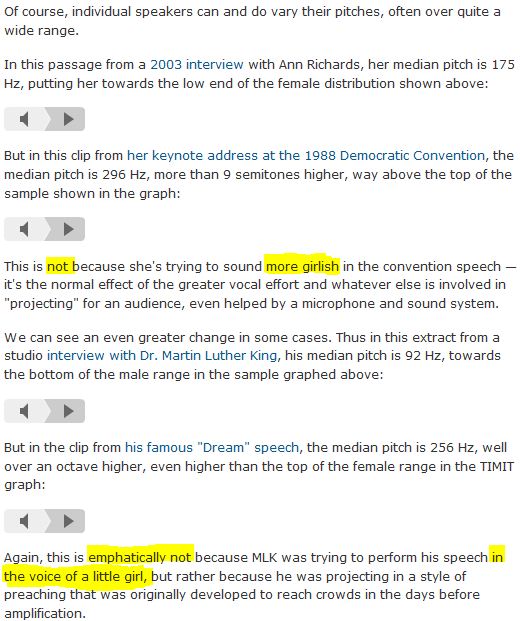
The highlighting is my attempt to show that Liberman is implicitly stating that sounding “more girlish” and speaking “in the voice of a little girl” is NOT something that either a grown up politician like Ann Richards or a big civil rights leader like the man Martin Luther King Jr. (in his dreamy “I Have A Dream” speech) would intend to do.
Let’s notice together Liberman’s implication also that the woman speaker is already “girlish” in her speech in ways that the male speaker is not at all girlish. In his parallel statements about Richards and King, Liberman stresses for King that he, this man, “is emphatically not … trying to perform.” He is neither girlish in the least nor attempting to come across like a little girl.
If you read the rest of what Liberman writes, it’s not surprisingly like what Carson writes of other men writing of women speaking so undesirably.
Liberman, for example, like Aristotle did, resorts to biology. Liberman has the distinct advantage of being able to resort more scientifically to the theory of evolution to explain. And yet he does provide a picture of the woman’s body part that sets it apart, as different, from a man’s body part.

And Carson early in her essay has noted:
High vocal pitch goes together with talkativeness to characterize a person who is deviant from or deficient in the masculine ideal of self-control. Women, catamites, eunuchs and androgynes fall into this category. Their sounds are bad to hear and make men uncomfortable. Just how uncomfortable may be measured by the lengths to which Aristotle is willing to go in accounting for the gender of sound physiognomically; he ends up ascribing the lower pitch of the male voice to the tension placed on a man’s vocal chords by his testicles functioning as loom weights.
Now, I think we need to make clear that no one is wanting anybody to be unscientific or to ignore the evidences of evolution or to call big men little girls (or vice versa) or any such thing that would make us blind – or deaf – to “difference.” What we are wanting to do is to pay attention to who is paying attention to the difference, what emotion (such as fear) that might evoke in them, and how they construct the world as a consequence.
(Anyone who wants to read Carson’s essay can find it online here and here and can buy it here. Liberman’s essay is here.)
“La Négresse blonde” and even “grammaire”
This post is a follow up to two by Suzanne. In the first, she addresses the question of “The gender of sin” particularly in the Hebrew of Gen. 3:16 and of Gen. 4:7, when the men-only translators and the men-only editors of the New English Translation (NET) Bible constrain it.
In her second post, Suzanne discusses the question of the gender in French (and in Greek) and in English. She writes of “grammatical gender” and of “biological sex.” For example, she says, “The word for ‘beast’ [in Madame de Villeneuve’s French] is a feminine word, even though the beast is male.”
I dare say that the point of issue of these two posts, at least for me, is not the inherent immutability of the Nature of Language. Rather, the point is that we human beings decide how to use language, and we struggle over who gets to say. Can men, can Nazis, decide that language means what it must surely mean in order to silence the Other?
As soon as I used the phrase “men-only” (which Suzanne did not use) and then “men,” and then “Nazis,” my language was charged. That is my intention. I want to draw attention to who is using language, often without notice, and is getting away with it.
So first things first. The title of my post is a reference back to one of the first BLT posts, by Theophrastus. He simply was asking “How should we translate the title of the artwork?” He shows a photo of a sculpture and then notes, “The original 1926 title of this artwork is La Négresse blonde, which SFMOMA [San Francisco Museum of Modern Art] translates as ‘The Blond Negress.'” Craig brought up “the n-word,” which, of course, is inappropriate in the United States. They also discussed Ἰουδαῖος, Ioudaios, a Greek word used by the writer of the gospel of John. Theophrastus stressed the importance of the question of how we should translate this Greek word, especially given how “a sophisticated Bible reader such as [the German Protestant Martin] Luther could so misread the text (and write the blueprint for the Holocaust)” of millions of Jews, by the German Nazis.
I believe we do well to ask the questions about what some believe to be the inherent Nature of language that would put them in positions over others. Sexists and racists all too often derive, without any questions, their authority for committing acts against women and minorities from the sure, unquestioned, meanings of words.
Now, let me run back to a post by Suzanne at another blog, where she is asking questions. It’s a rather playful post, “Is – sue?” The point that we might make out of it is that our language, if it’s English, is pretty meaning-fulL. And in general, I’d like to add, many other languages are so. I wrote, then, a little comment at the bottom of Suzanne’s post, saying:
Ha! How fun you also play with your name here in the title. This all reminds of the more serious word work of Hélène Cixous (with languelait, “a phonetic spelling of anglais /English/ which produces a pun combining langue /language/ and lait /milk/”), of Mary Daly (“the-rapist”), and of Luise Von Flotow-Evans (“pun-ishment”). Pun-ish is also play on the anglicized transliteration of the Hebrew for ‘man’ (ish) vs. ‘woman’ (ishshah), as Flotow suggests. (Here’s a bit of blogging on some of that.)
I was trying to show how women, feeling the sexist control by men, can use their language to re-play what these men are doing to them. And I linked to a post I’d written, where I showed also how some have read a few things that Cixous has done with French”
For example,
A play on grammaire and grand-mère with reference to the big bad wolf is given as “gramma-r wolf”
Why this is so very important, now, I think, is because the conversation after Suzanne’s first post, that one on “the gender of sin” in Hebrew, has resorted to a discussion of “grammar” as some sort of fixed Nature. It’s as if we all understand precisely the invariable Grammar of Hebrew as it impinges on the men-only NETS Bible meaning there in the text. I firmly believe language has much more play in it than that. Even grammar. Even the Hebrew grammar of the Bible.
It’s not, of course, that anything goes in language, in grammar. It is that we human beings constrain the meaningS of what we mean, and sometimes, for our very own purposes, especially when we are on top hoping to silence the Other unlike us on bottom, we will use our-only understanding and believe about Language to justify our Othering, unquestioned. I do believe it’s very good to ask questions of words and of grammar, of our language.
Beauty and the Beast
I was following up on Peter’s remark that gender can be variable in Hebrew, not as fixed as in some other languages. I had not been aware of that. I had expected a more fixed gender, and automatic gender agreement. There are lots of commentators that do think that gender is a problem in this verse, but I won’t belabour that. Having read through 20 commentaries on Gen. 4:7, I am prepared to let it lie.
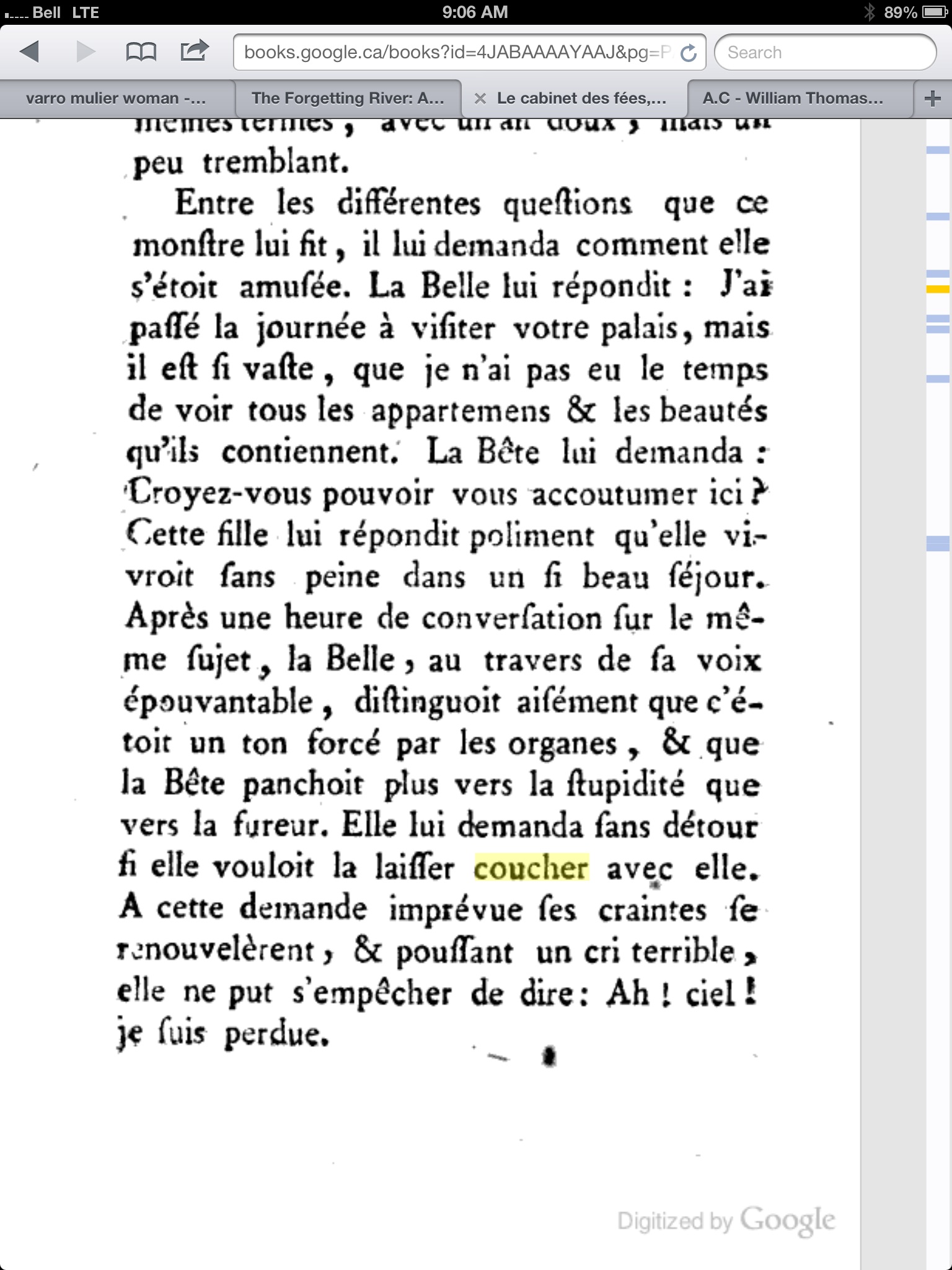
But here, in Beauty and the Beast, is a good example of my expectations. This is a passage from a recounting of the story by Madame de Villeneuve published in 1787,
Among the different questions that the monster addressed to her, he asked her how she was amusing herself. Beauty answered him, I have passed the day visiting your palace, but it is so vast that I have not had the time to see all the apartments and the beautiful things they contain. The Beast asked her: Do you think that you can grow accustomed to this place? The girl answered her politely that she would live without difficulty in such a beautiful place. After an hour of conversation on the same subject, Beauty, listening to the terrible voice of the Beast, distinguished easily that it was a tone forced by the vocal organs, and that the Beast leaned more towards stupidity that towards fury. She asked her directly if she would let her sleep with her. At this unexpected request her fears revived, and uttering an agonized cry, she could not prevent herself from saying: Oh! Heaven! I am lost!
Of course, nobody would actually translate it that way. But at least you get the idea. I do believe that the Beast asked Beauty to sleep with him, and not the reverse. The word for “beast” is a feminine word, even though the beast is male. The notion that masculine is male, and feminine is female is tenuous in gendered languages, because the language doesn’t really work that way. Perhaps the word for beast is feminine because it ends in an “e” – that’s all. But, the pronoun ought to agree with the gender of the noun. So sometimes elle is “the Beast” – a male. The question then becomes: does elle mean “she” in English. Well, sometimes yes, and sometimes no. And this situation happens in Greek as well. In languages with gender, the pronouns have gender, and they also relate to biological sex, but in a more remote way than in English. Their first allegiance is to grammatical gender.
Admittedly, in modern French, the pronoun would soon transition to masculine, an the gender of the pronoun would line up with the biological sex. But often there is a transition word to smooth things along. One could switch to another word like “le monstre” or “l’animal.” In any case, in older French, one would expect there to be an agreement in gender regardless of how the story goes.
A new edition of the Shakespeare Apocrypha
The New York Times features an article of great interest of research by Douglas Bruster (U. Texas) that uses material from handwriting and Shakespeare’s spelling to argue that the “Additional Passages” in1602 quarto edition of The Spanish Tragedy (traditionally attributed to Thomas Kyd) were by Shakespeare. The article is fascinating and I encourage you to read it and Douglas Bruster’s paper (available now in Internet preprint).
But I was even more excited to read of a forthcoming volume in the RSC Shakespeare series of the Shakespeare Apocrypha – plays that may have been at least partially authored by Shakespeare but were excluded from the First Folio. The book is entitled William Shakespeare and Others: Collaborative Plays and is edited by Jonathan Bate and Eric Rasmussen. Palgrave Macmillan has a web page devoted to it.
Here is the description of the book:
Among the plays staged at the Globe and published in Shakespeare’s lifetime were The London Prodigal by William Shakespeare, A Yorkshire Tragedy written by W. Shakespeare and Thomas Lord Cromwell written by W.S
Could Shakespeare really have written these plays? Why were they excluded from the First Folio of his collected works? As a companion to their award-winning The RSC Shakespeare: Complete Works, renowned scholars Jonathan Bate and Eric Rasmussen, supported by a dynamic team of co-editors, now present William Shakespeare and Others: Collaborative Plays.
This is the first edition for over a hundred years of the fascinatingly varied body of plays that has become known as ‘The Shakespeare Apocrypha’. Among the highlights are the whole text of Sir Thomas More, which includes the only scene from any play to survive in Shakespeare’s own handwriting; the history play Edward III, including a superb seduction scene by Shakespeare; and the domestic murder tragedy Arden of Faversham, in which Shakespeare’s hand has been detected by recent computer-assisted analysis. This is also the first ever Shakespeare edition to include the 1602 edition of Thomas Kyd’s pioneering The Spanish Tragedy, with ‘additions’ that the latest research attributes to Shakespeare. A magisterial essay by Will Sharpe provides a comprehensive account of the Authorship and Attribution of each play.
William Shakespeare and Others: Collaborative Plays has all the features of the bestselling RSC Shakespeare series: inimitable introductions by Jonathan Bate, rigorous textual editing led by Eric Rasmussen, key facts boxes with information on sources and the distribution of parts, on-page notes explaining difficult or obsolete vocabulary, and interviews with directors and actors who have staged the plays, including RSC Artistic Directors Terry Hands, Michael Boyd and Gregory Doran.
and here is the table of contents:
General Introduction; J.Bate
SHAKESPEARE AND OTHERS: COLLABORATIVE PLAYSFor each play:
Individual introduction by J.Bate
On-page footnote gloss which explains unfamiliar or obsolete words and classical, biblical or contemporary references where WS assumes audience knowledge
‘Key Facts’ box with: plot summary, major roles, date, linguistic medium, sources, textual notesArden of Faversham
Locrine
Edward III
The Spanish Tragedy (with Additions)
Thomas Lord Cromwell
Sir Thomas More
The London Prodigal
A Yorkshire Tragedy
Mucedorus (with Additions)
Double Falsehood; or The Distressed Lovers
Cardenio: The SourceAuthorship and Attribution; W. Sharpe
From Script to Stage: Interviews with actors and directors; P. Kirwan
For those who are surprised of the idea of Shakespeare working in collaboration with other authors, it may be interesting to learn that collaboration was quite common during the Elizabethan-Jacobean period. Thus, Gary Taylor and John Lavagnino’s Thomas Middleton: The Collected Works includes Macbeth, Measure for Measure, and Timon of Athens (as well as evidence of Middleton’s contributions to the final versions of each play); others argue that Middleton contributed to All’s Well That Ends Well.
In any case, the new Bate-Rasmussen volume looks to be an exciting collection of some very fine plays. The volume is available for pre-order from Internet sellers such as Book Depository and Amazon.
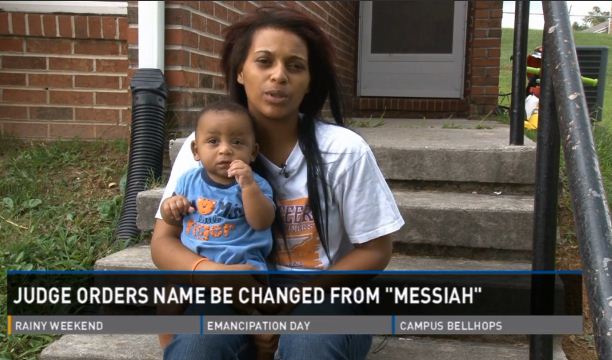
Judge Kills ‘Messiah’
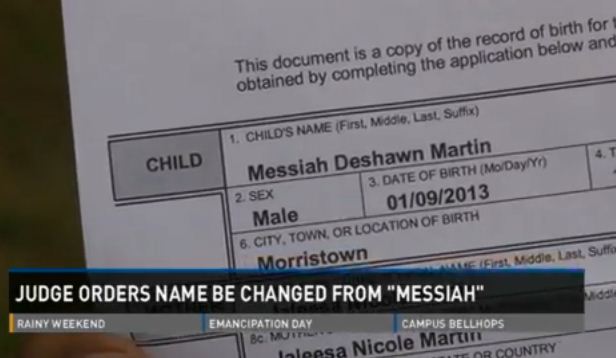
A privileged judge in Tennessee orders a child’s name to be changed from Messiah Deshawn Martin to Martin DeShawn McCullough. Yesha Callahan (and /or her editor) puts that this way: “Judge Orders Black Mom to Change Baby’s Name From ‘Messiah’.” And Tommy Christopher goes beyond the obvious by adding, “Aside from the obvious imposition of her own religion (‘Messiah’ is not a term exclusively reserved for Jesus), the judge’s actions evoke the sick specter of slave owners enforcing name changes on their slaves, while also resting on the dubious legal theory that a proper name that’s also a title must be earned.”
The judge says:
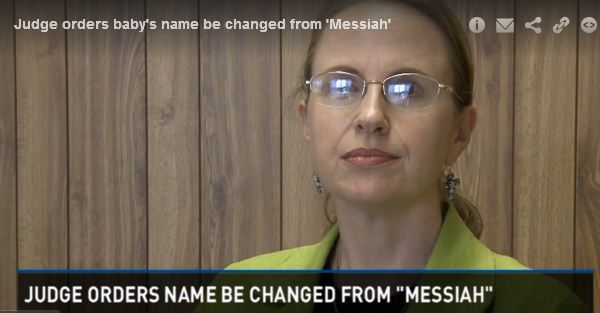
I saw it out into the future. The word Messiah is a title, and it’s a title that’s only been earned by one person, and that one person is Jesus Christ. That could put him at odds with a lot of people, and, at this point, he has had no choice in what his name is. Well, I thought about that [children are named /he suz/ Jesus] as well, um, and that’s not relevant to this case.
And Messiah’s mother responds by appealing:
I didn’t think a [state] judge could make me change my baby’s name because of her religious beliefs.
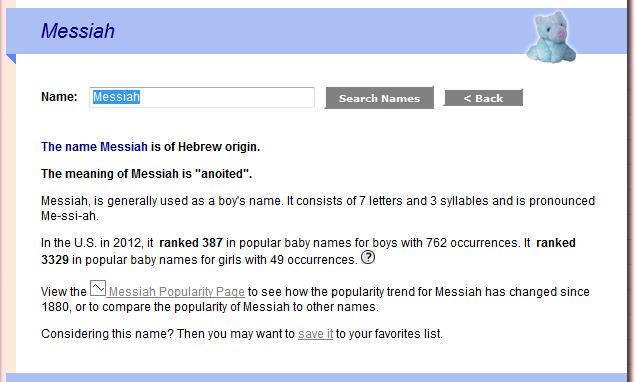
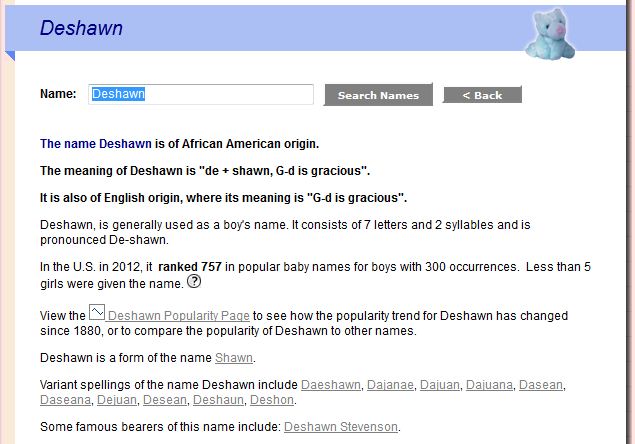
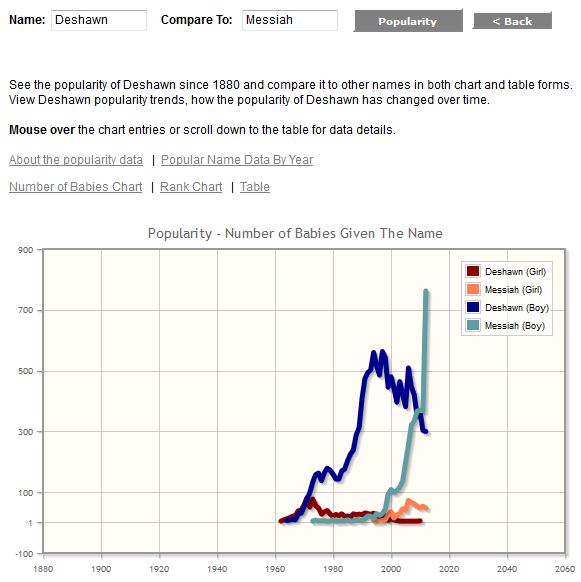
What is there to add except a few graphs showing how Americans (including some Tennesseans we presume) are naming their babies? The data are from the U.S. Social Security Administration and are charted via http://www.ourbabynamer.com.
Here is what we know about Messiah.
Here is what we know about Deshawn.
Here is Deshawn compared with Messiah.
Here is Jesus compared with Messiah.
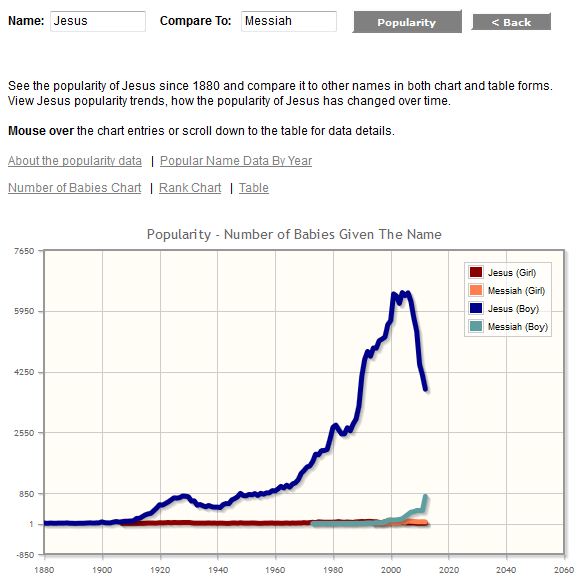
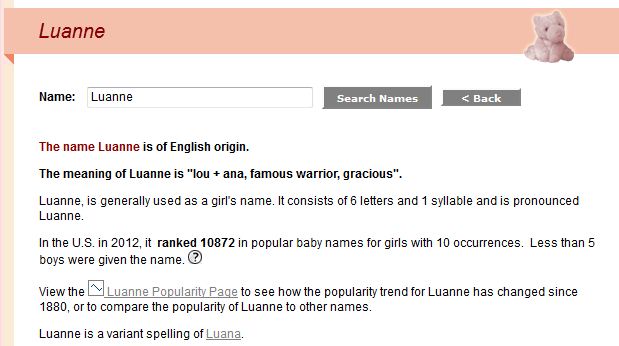
Here is the name the judge’s mother gave her.
Here is the name the judge’s mother gave her compared with the name that the judge took away from the baby of the other mother.
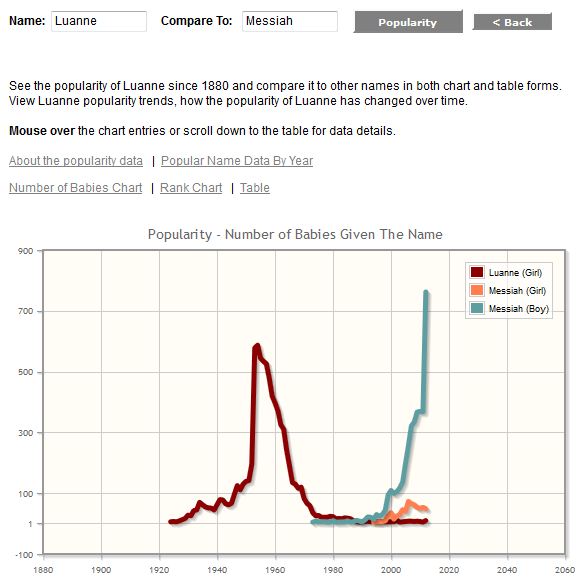
In case there’s any question, mothers in America are naming their baby boys Messiah at a rate so fast that it’s the fourth fastest growing name in terms of popularity. Lu Ann may decline in popularity, we predict.
The gender of sin
As it turns out “sin” is firmly feminine and that could make the whole house of cards fall down.
The argument goes like this. We don’t know exactly what it means when in Gen. 3:16 it says
and your desire shall be for your husband.
In fact, that phrase makes women look a whole lot nicer than they really are, so it can’t be the right interpretation.
The solution then is to investigate the meaning of Gen. 4:7,
sin is lurking at the door;
its desire is for you,
but you must master it.
We know what that means – sin is trying to have you/ruin your life. Perhaps it means “sin desires to control you.” Yes, that sounds right. Therefore, Eve desires to control Adam – this is also the translation found in the NET Bible, and the NLT – and according to the theologians of complementarianism a husband must assert his rulership over his wife.
Nothing knew here – moving right along – but not so fast. Apparently, Gen. 4:7 does not say
sin is lurking at the door
its desire is for you
but you must master it.
No, it says –
sin is lurking at the door
his desire is for you
but you must master him.
But sin is feminine, and so who is the “him” in this passage? Is it Abel? Perhaps it should read,
sin is lurking at the door
Abel’s desire is for you
but you must master him.
Or perhaps this is one of those texts whose original form has been lost. Here is the Hebrew. Please correct me if I am wrong – but isn’t sin feminine, and Cain is supposed to master something that is masculine?
לַפֶּתַח חַטָּאת רֹבֵץ;
וְאֵלֶיךָ, תְּשׁוּקָתוֹ,
וְאַתָּה, תִּמְשָׁל-בּוֹ.
So I ask you, is it fair to prove the nastiness of women from a text that nobody understands? Do you think it makes you look smart?
And, on top of it all, why think up another unpleasantness for the Song of Solomon? Some of us need hope, we need to think that that great love of our life could be around the next corner, a love that is reciprocal. But the NET Bible says no, don’t dream of that, because the lover(the guy) just wants to have his way sexually with her, that’s what it is all about. In the NET Bible, the women aren’t very nice, and the men aren’t very nice either.
Here is the relevant part of the NET Bible note for teshuqa, normally translated as “desire,”
Many interpreters conclude that it refers to sexual desire here, because the subject of the passage is the relationship between a wife and her husband, and because the word is used in a romantic sense in Song 7:11 HT (7:10 ET). However, this interpretation makes little sense in Gen 3:16. First, it does not fit well with the assertion “he will dominate you.” Second, it implies that sexual desire was not part of the original creation, even though the man and the woman were told to multiply. And third, it ignores the usage of the word in Gen 4:7 where it refers to sin’s desire to control and dominate Cain. (Even in Song of Songs it carries the basic idea of “control,” for it describes the young man’s desire to “have his way sexually” with the young woman.)
So, let’s deconstruct:
1) Any kind of behaviour can fit with “he will dominate you.”
2) A new factor has just been introduced, pain in giving birth
3) Gen; 4:7 is the great unknown
4) Now they have ruined Song of Solomon also, because the rest of us thought that it celebrated mutuality, but the NET Bible says “he wants to have his way with her,” and that’s a euphemism for not getting consent – according to Wiktionary anyway – “To have sexual intercourse with, especially without the consent of one’s partner.”
I wouldn’t let my kids read the NET Bible, it needs a warning on it.
Women or Female? This Woman says Women
Abram K-J and Kurk got into a bit of a discussion last week about how to describe scholars who are women. Abram wrote:
I know it’s becoming more accepted to speak of “women authors,” “women this,” and “women that,” but what we really want to say is “female scholars.” Just like we wouldn’t say “man scholar” but would say “male scholar.”
I generally use “woman,” not “female,” and I do so for two reasons.
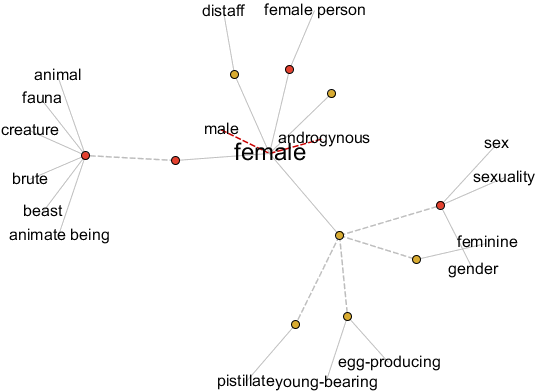
First, the two words have different connotations. Take a look at the semantic field of each word as rendered by the Visual Thesaurus:
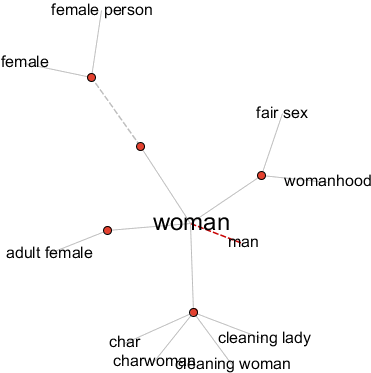
woman
female
A woman is an adult human being (a certain fondly-remembered Doonesbury strip notwithstanding). A female may be neither adult nor human. Little girls are female. Mares, hens, cows, vixens, and bitches are all female.
Given that sexism and misogyny are frequently expressed by infantilizing or dehumanizing women, I believe it is generally preferable to use the word that can only refer to adult humans — pedantry notwithstanding. 🙂 A descriptive, rather than prescriptive, approach to language might observe that the adjectival shift of this word is already well under way.
Another reason to use woman rather than female has to do with inclusive language and the distinction between sex and gender. Typically, female is understood to refer to sex, usually anatomical sex because we can’t actually determine a person’s chromosomal sex by looking at them. Non-op or pre-op trans women, who were assigned male at birth, don’t have female anatomy, but they still identify as women.
I agree that the corresponding forms “man scholar” or “men authors” sound awkward (the former more than the latter, for some reason) and are rarely used; but “male scholar” and “male author” are almost as rarely used, because of the andronormative assumption that scholars and authors (and doctors and lawyers and butchers and bakers and candlestick makers) are men unless stated otherwise.
New language forms frequently sound awkward at first, but sometimes it’s worth the awkwardness in support of a good cause. Although I don’t expect everyone to agree with me, I consider this to be such a case.
Catholic ESV Lectionary on hold
I previously reported on International Commission for the Preparation of an English-language Lectionary (ICPEL) to prepare a new lectionary (for use outside North America) based on the ESV translation. I remarked:
Third, and this is most surprising, the ICPEL has apparently chosen a translation that had no Catholic involvement at all. The ESV (which some jokingly call the Evangelical Standard Version or the Elect Standard Version) had a strictly Protestant (and largely Calvinist) translation team. (The Translation Oversight Committee and Translation Review Scholars were also all male.) The RSV Apocrypha was adopted by Oxford University Press and four male Protestant scholars to form the ESV Apocrypha. The ESV has never received approval as a Catholic Bible (as opposed to a Catholic Lectionary), and it is hard to imagine how it could be approved as Catholic Bible under Canon law 825. However, lectionaries are governed under a different Canon law (838), which is why in most jurisdictions (including the US) approved Bibles have different text than approved lectionaries.
Well, now, there are rumors that plans for a Catholic ESV Lectionary have been put on hold – or perhaps abandoned:
I found this out from the mouth of the man in charge of it all when I was at the “Great Grace” Conference in Sydney back in June. I could hardly believe it myself. It seems that this now sets back the entire lectionary project (they had the Sunday lectionary practically ready to go), as there was no agreement on which translation they should use as an alternative. Apparently there is a sizable body of opinion simply wanting to rework the Jerusalem Bible lections
HT: Tim
Thirlwell has selected 12 stories whose originals (which are not printed) are variously written in Danish, Spanish, Dutch, Japanese, German, Arabic, Russian, Serbo-Croat, Italian, Hungarian, English and Italian again. Ten stories are first translated into English, the other two into German and Spanish. The first translation is translated, and then the subsequent translation is translated again. The translators only see the preceding version of the story. The longest chains contain six translations, though every other version is in English. Thirlwell has corralled an illustrious international group of 60 novelist-translators into taking part and we end up with an intriguing literary version of Chinese whispers.
Lucian Robinson, for the Guardian, reviews “Multiples, a new book edited by the novelist and critic Adam Thirlwell, [that] seeks to undermine the idea of the original in literary translation.”
—
UPDATE – here is Thirlwell on the conception of this project, hinting at why it now is becoming a book (and is even published as an ebook). First, what motivated him –
In fact, I’m stealing this idea from David Bellos, a Princeton professor and, more importantly, translator of Georges Perec and Ismail Kadare. Around the time I was first putting this project together, the NYT asked me to review his new book on translation: Is That A Fish In Your Ear? and one of his arguments is that we have to stop thinking of translation as substitution
Second, the format (and hint about the later book) –
BLVR: Finally, you guys designed the issue so the far edges of the pages aren’t protected by firmer stock. Do you worry that the pages will get damaged? Or do you not care about damage?
AT: I do worry slightly about this. On the other hand it’s a very beautiful object. And also, if this project’s proved anything, it’s that we really don’t need to be so precious about endless and irreparable damage.
Hysminé’s Nostrils
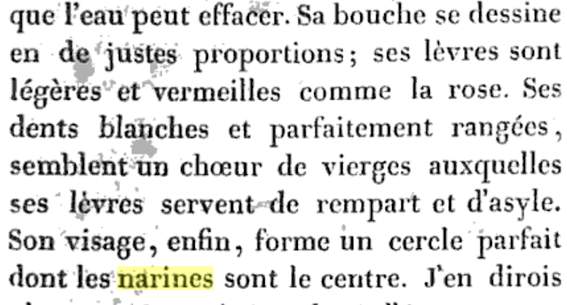
Now that Kurk has brought up Hysminé’s nostrils, I have to admit that this is even odder than the lack of Adam’s nose. If Adam’s nose is downsized to his face, then Hysminé’s nose is upsized to her nostrils. How odd! Would you translate like this? (BTW, I don’t have access to the Greek, or English, but am hoping that Kurk does.) But this is Hysminé.
Her mouth is drawn in exact proportion, her lips are light and vermilion like a rose. Her white and perfectly straight teeth look like a choir of virgins around which the lips serve as rampart and refuge. Her face, enfin, forms a perfect circle in which her nostrils are the centre.
I just couldn’t bear to translate “enfin” – it comes like a lover’s sigh and “finally” just wouldn’t do. But why narines – “nostrils” – instead of nose? According to LSJ, it is quite acceptable to translate τὰς ῥῖνας as nose, whether plural or not. Sometimes odd things creep into translation and then they stick.
Adam’s Nose
Yes, it’s true. I feel called back. I have been reading and want to say something as a female writer. But do I want to discuss female issues? Yes, always!
However, today my question is about Adam’s nose. What is it doing here, and why does nobody talk about it? Too polite, I’m sure.
בְּזֵעַת אַפֶּיךָ
תֹּאכַל לֶחֶם
In the sweat of thy face,
Thou shalt eat bread.εν ιδρωτι του προσωπου σου
φαγη τον αρτον σου
The word here is אף and not פּנים. There seems to be some kind of euphemistic reluctance to calling a nose a nose. Check out the different times it is called the “face.” Why not say that the ring was in her nose? Is face any better? Why not say that they bowed nose to the ground instead of face to the ground? Seems a little odd to me.
Perhaps, it wasn’t Adam’s nose that is in focus in Gen. 3:19. Maybe it is the hard breathing involved in tilling the ground, or how angry Adam felt, or whatever? It still seems like a copout to call a “nose,” that protruding member, the “face.”
With the dim hope of discovering more … female authors writing in Hebrew, the only path left for the Hebrew … feminist is treating issues of women and gender via the male-authored texts. Historians may try to reconstruct the actual life-experiences (Grossman 2001; Baskin 1991, 94–103; Assis 1988, 25–59) and the authentic voices (Kraemer 1995, 161–182) of real women captured in male-authored documents. The task of feminist literary critics, for their part, is to account for the ideological and symbolical functions designated to women in the male literary imagination; to map the positions of female figures and the positioning of their voices within the patterns of male discourse; to explore the artistic strategies of women’s presence/absence and the procedures of their signification.
— Tova Rosen
In seeking the meaning or connotation for El Shaddai I have come up with no answers but plenty of poetic allusions. Here are the three major connotations of El Shaddai – breasts and by association mountains, and destruction. These do not represent the known etymological roots of the word, but rather euphonic and associative connections.
In Genesis, El Shaddai is the God of Abraham and Isaac and Jacob. In Genesis 49:25, Shaddai, – שַׁדַּי the Almighty, is the one who blesses with the blessings of the heavens and the deep and the breasts שָׁדַיִם (the shadayim) and the womb.
— Suzanne McCarthy
The name or epithet Shadday (translated as “the Almighty”) derives its significance from … the pre-Mosaic patriarchal people…. However, the “etymology and primary meaning of the name [had] long since been forgotten” by the time of the LXX.
— Harriet Lutzky
My mother has been studying the biblical names of God and told me this week that Shaddai has signified Breast.
About that time, Abram K-J, blogger, was announcing a soirée. To use his words precisely, he’s “Announcing the Septuagint Studies Soirée.” In “the” party, he’s announced the “four Septuagint-related blogs” that he knows of. All men authored, these four, I see; and so I’m back to posting about the LXX, as a man. In a private conversation, Abram tells me he’s struck by how proportionally there seems to be more women doing scholarship on the Septuagint than on other biblical studies. He names Karen Jobes, Kristen de Troyer, Jennifer Dines. And I say not to forget Adele Berlin, Sylvie Honigman, Naomi Seidman. Or Ann Nyland, who has translated the Psalms, using (as many translators do) both the MT and the LXX as the sources.
Then I recall what the Septuagint translators did with Shaddai in Genesis 49. They were men, weren’t they? Yes, breasts are mentioned, and womb. These motherly wifely womanly female images are in the Hebraic Hellene. And absence, margin, lack is there. The men – as if Moses writing the blessings spoken by Father Jacob over Son Joseph – imagine Jewish voices in Greek. Their LXX translation even helps men translating the Hebrew later try to figure out what the original Hebrew must have meant. So what?
What does that signify about women? To women?
Below is the MT and the LXX side by side. And beside that is Sir Lancelot Brenton’s Englishing of the Greeking of the Hebrew.

Notice the name in the Hebrew that is missing from the Hellene.
Now here is how Everett Fox Englishes the Hebrew.
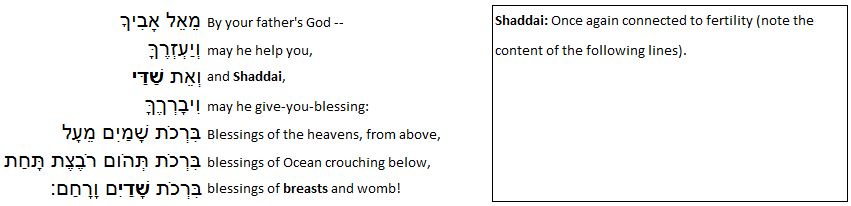
He transliterates Shaddai and includes a footnote (which I’ve put in the box above, to the right of his translation).
Now here is how Robert Alter puts the Hebrew into English. (His footnote is also included; I’ve again placed it to the right of his translation).
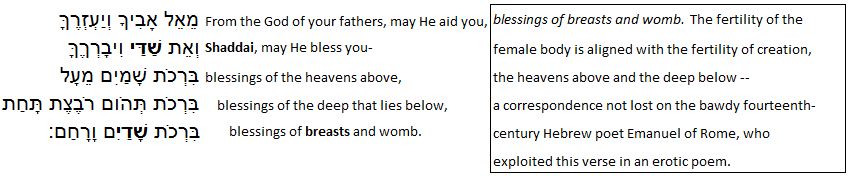
We should note that Alter is translating not only from the Hebrew MT but also from the Hellene LXX. And so he adds this footnote on the very next verse:
The Masoretic Text is not really intelligible at this point, and this English version follows the Septuagint for the first part of the verse, which has the double virtue of coherence and of resembling several similar parallel locutions elsewhere in biblical poetry.
That note brings us back to a quotation of Harriet Lutzky. She writes:
Verse 26: the absent mother
Immediately following [Genesis 49:25] is a highly ambiguous passage (verse 26a), whose Masoretic rendition “is obviously corrupt and cannot be restored”. There should be a line parallel to “blessings of breasts and womb”, with the form “blessing of x + y”. And, in fact, in some translations, after ’ā·ḇî·ḵā (your father) we find … καὶ μητρός σου (LXX) (and your mother).
And that brings us again to what Tova Rosen has said:
The task of feminist literary critics, for their part, is to account for the ideological and symbolical functions designated to women in the male literary imagination; to map the positions of female figures and the positioning of their voices within the patterns of male discourse; to explore the artistic strategies of women’s presence/absence and the procedures of their signification.
To have women scholars working on male texts that imagine women is critical. Would you agree? And what difference do women make when they talk about men talking about women? And God? And breasts?
Psalm 68: Conversation “Pieces through Time”
I have to thank our BLT co-blogger, Suzanne, for getting me, for drawing many of us, into blogging about the Bible. She humbly suggests that it was somebody else who asked her to blog on Psalm 68 some time ago; with some reluctance, Suzanne says, she began a commentary in a series of posts as a co-blogger at the old Better Bibles Blog. The post here this week that many of you have read and a few of you have taken some time to comment on recalls the conversations Suzanne started, as pieces through time.
Below are links to each of Suzanne’s posts in chronological order. And yet it seems good first to highlight, and actually to reproduce, what Suzanne identifies as her own hopes and intentions in writing about Psalm 68. She kindly gives me permission here to do this. As you’ll see, Suzanne has been quite interested in others’ views and has regularly taken us, her readers, to places where she herself was reading. And so without further ado:
Psalm 68: Commentary
It’s not going to happen anytime soon, but if and when I ever retire, I would love to write a book à la Wolters’ Song of a Valiant Woman. It would be on Psalm 68 and include excerpts or reprints of translations and commentary ever since it was written.
It would be filled with many languages and richly obscure and exotic prose in a form of English usually consigned to the past. It would include Julia Greswell, Neale, Mary Sidney and Erasmus, Luther,and Bucer, Marot and Beza, Pagnini and Vatable, and Kimhi, and Aquinas and everybody else that I haven’t met yet. I have just begun and will collect commentary on this psalm until it fills a book 6 inches thick.
It would include selections in several different writing systems. The psalm would be presented as prose, a poem, a song and a dance. There would even be a wordless version. A better bible is not always every word of the “canon” accumulated in one place. I would take a vertical slice and follow one piece through time.
All contributions are welcome. More on Ps. 68 soon. I am like a pig in mud.
And now the series for those who missed it or want to revisit it:
Psalm 68 Part l
I have put off for over a year a series which has been requested more than once. It is only with the utmost hesitation and reluctance that I embark on this series. It is about the names of God. Because I really am an old fashioned person, and reared in a very strict way, I feel a certain taboo in talking directly about God. It is like looking directly into the sun….
Psalm 68 Part 2
Tonight I want to write about Psalm 68 verse 4, the second line. Some of you might have noticed that it is translated in at least four significantly different ways….
Psalm 68 Part 3
Here is Psalm 68:4 in total. I will follow it with the KJV, which I have chosen arbitrarily for this study….
Ps 68: Pt. 4: A house full of children
Down the hatch with the chicken scratch. I am in a four way race and even though I got off the starting block first, I have lost the lead and John has pulled ahead. Dave is already pondering the “lovely lady”, Bob has provided the whole psalm en bloque, and I am slowly going to plod through one little word at a time….
Ps. 68: Part 5 The barren woman
Update: I have just looked at Bob’s image and noticed how he outlines the verse with the name of God in it. He also uses the very evocative phrase “bound in chains” instead of “captives” which I used. The shading really emphasizes the high density of the names of God in this psalm.
Lingamish has pointed out that Psalm 68 is the most difficult of all psalms. So I understand. Adam Clarke quotes Simon de Muis 1587-1644 saying,….
Ps. 68: Part 6: The heavens dripped
There are new posts on Psalm 68 by Lingamish, along with a fleet of comments, Bob offers commentary insight, some critical text analysis and alternative readings of verse 5, John brings in more musical background and J. K. joins the fray with a comparison of how Aristotle and Luther would read the psalm. J. K. quotes Luther writing,….
Ps. 68: Part 7: Reflections
J. K. Gayle had written on Psalm 68, picking up again my reference to the psalmist as possibly a woman. He comments,….
Ps. 68: Notes
Stefan has joined us on Psalm 68, writing about a few interesting features of the Greek version mentioned by J. K. Gayle…..
Psalm 68: Part 8: turns on a tent peg
Update: Bob has ventured into the next few verses.
Some readers might feel that by letting myself imagine the “background” to this psalm, I have left the text, as it is, and have added what is not there. On the contrary, it turns out that I have wandered into what really is there…..
Psalm 68: Pt.9: of one mind in an house
Iyov has provided access to Neale’s commentary on Psalm 68 through a new widget(thingy) on his blog. This certainly puts an end to all dire predictions that blogs will disable people from reading extended texts. Cyberspace is now enabling us all to read one copy of the same book at the same time…..
Hen Scratches 11-09-07
Just a few notes.
I did not mention yesterday that the 1662 prayer book psalter is basically the same as the Coverdale translation. I was surprised to see that these psalms are so dependent on the LXX and Vulgate tradition, at least what I have seen so far.
Recent posts on Ps. 68 around the blogosphere are Bob’s, Dave’s, Iyov’s, J. K.’s, John’s, and Stefan’s….
Hen Scratches 13-09-07
Chris Heard has joined the Ps. 68 blogabout with a post on the names of God. He demonstrates the need to differentiate LORD, meaning YHVH, and LORD meaning Baal…..
Hen Scratches 16-09-07
Lots of great blog posts around. First, a good post by Wade Burleson on the days when you could be accused of not believing in the doctrine of the infallibility of scripture if you protested against slavery. Hermeneutics: Slavery & Feminism by Mike Aubrey points to The Civil War as a Theological Crisis.….
I will return to Psalm 68 soon. In many ways we haven’t even touched on the more interesting elements. There is a ton of conversation between Lingamish, Peter, John, Bob, Doug et al. – I don’t think it needs pointing to, I don’t want to appear to be leaving anyone out, seems like everyone is there but me.
If someone has written a post that they would like to see mentioned here, please email me any time, I may have missed it. Ilona continues to blog on Hesed.
Ps. 68: Part 10
Update: John reviews Alter’s Psalter and Chris shares some impressions,
- Is it merely an entrance liturgy suitable for a variety of worship occasions, or is it specifically an entrance liturgy to be used in conjunction with the celebration of military victories?
I enjoy reading other people’s take on the psalm, and have no intention of being comprehensive here. I am indulging in my interest in the history of translation by following this psalm throughout two millenia.
Bob writes on Bright Wings, a reference to Gerald Manley Hopkins.
————–
In verse 11 of psalm 68, we meet women again…..
Psalm 68: part 11
Tyler has posted an excerpt from an interview with Alter on his Psalms.
I am taking a course in something called Spiritual Traditions. A rather vague title, but it involves reading something from Erasmus, Luther, Calvin, Bucer, etc. each week and is supplemented every week with singing psalms from the Presbyterian hymnbook and looking at rare books like an original Geneva Psalter or Vatable’s commentary on the Pagnini Psalter, etc. Right up my alley, in any case.
In exploring the Geneva Psalter, translated into French by Clément Marot and Théodore Beza, I have also discovered the Psalms of Mary Sidney, an English translation of the Geneva Psalter. Here is Katherine Larsons’s commentary on Sidney’s Psalm 68…..
Psalm 68, Pt 12: invitation to dance
I have to write this post to music! First, Lingamish and then John. I had already decided that I would write about verse 26, the remaining verse which mentions women, next….
Ambiguity and more humility
I can’t respond usefully to all the issues raised on this issue. However, I would like to point out that I have held this view since I came on this blog. I do not regard my views on translation to have any intellectual or spiritual superiority. Call it a wish list, if you will.
However, I have recently encountered two instances where after some research I have decided that the meaning of a word or verse in the Bible must remain obscure for me. First. Psalm 68:11. Who divides the spoil? Women, if we go back to Deborah’s song. But I have utterly no insights into what the Hebrew says in this verse, and I will have to leave it this way. It may or may not be a word meaning “women.”….
Psalm 68: scripture citing scripture
One of the most puzzling cases of a citation of the Hebrew scriptures in the Christian scriptures is found in Psalm 68:19. It is not only cited in Eph. 4:8, but it also contains a citation from Judges 5:12…..
Psalm 68: Breasts and Mountains
This cannot be the first time that someone has remarked that mountains resemble breasts and are a symbol of fertility.
In seeking the meaning or connotation for El Shaddai I have come up with no answers but plenty of poetic allusions. Here are the three major connotations of El Shaddai – breasts and by association mountains, and destruction. These do not represent the known etymological roots of the word, but rather euphonic and associative connections…..
Psalm 68: Shaddai cont.
I thought I gave Shaddai rather short shrift last time so I am going to continue with this topic. There are three derivations of Shaddai that I did not mention. In this comment on my previous post, ElShaddai Edwards addresses two of them…..
Psalm 68: Almighty
It is always nice these days to find something to say that hasn’t been already been said in greater detail in wikipedia. I note that the origin of the word Almighty does not fare too well there…..
Shaddai – Heavenly
I can’t find the meaning “Heavenly” for Shaddai mentioned anywhere but it is how Shaddai was translated in the Psalms of the Septuagint. Shaddai occurs only twice in the Psalms, once in Ps. 68:14 and once in Ps. 91:1. This verse forms such a lovely couplet in which we see varying types of alliteration and metaphor, that I can’t resist writing about it…..
Shaddai – Sufficient
Update: Mark comments,
Shaddai is also translated with hikanos in Job 21.15; 31.2; and 40.2.
A great tool for doing exactly what you hope to do in lining up the Hebrew with the LXX is the way Tov’s Parallel Aligned Hebrew and LXX is implemented in BibleWorks7. I’ve posted about it a couple times here and here.
————–
I finally found it. Apologies. I had no idea of this translation. In the Septuagint, in Ruth 1:20, Shaddai is translated as “sufficient” or “enough” – hikanos…..
Shaddai – reflections
The study of Shaddai has completely taken me by surprise. I had thought when I began that Shaddai meant Almighty. In fact, this is the meaning and translation that I have found most frequently on the internet and in other resources. However, now I see that “Almighty” comes from Lord of Hosts…..
Shaddai in Modern Translations
Here are a few modern translations of Psalm 91:1,….
Parallel Bibles: S. Bagster & Sons’
I take a risk in admitting that I have jumped into another series which will run in parallel to my continued exploration of Ps. 68 and the names of God…..
Shaddai in Ps. 68
This is a short post to round up the series on Shaddai. Shaddai in Psalm 68 is translated in the Septuagint as the “Heavenly One.”….
Hen Scratches 02-12-07
Here are the names of God from Psalm 68 along with their transliteration, an approximate translation and for some a traditional translational equivalent. I have written about Shaddai and I hope to write about adonai next…..
Psalm 68:20 Sovereign Lord
This post is terribly late. I was asked several months ago if there was an explanation for the use of “Sovereign” in the (T)NIV, when it does not appear in other translations. I have been taking my own sweet time in responding. Fortunately, it is fairly straightforward. Here is Psalm 68:20,….


 BLT
BLT 