Worst rhetorical question of the week
“Do we want a candidate who is a good, moral person — or one who is a born-again follower of the lord Jesus Christ?”
– Robert Jeffress, senior pastor of First Baptist Church in Dallas, at the Values Voter Summit
Monty, I think I’ll go with door #1!
(Source)
The ethics of blog comments
The past year has seen a sudden interest in the religious ethics of blog comments. Here is Yuval Sherlo’s advice in how to ask for forgiveness for over-the-top blog comments, and here is Shlomo Aviner’s advice to just avoid reading (and presumably writing) blog comments at all.
Despite the advice of these leaders, I hope that you, dear blog readers, will not stop commenting and reading comment on this blog.

Book Review: MetaMaus
Art Spiegelman’s Maus was arguably the first “graphic novel” to achieve wide respectability as literature – and the only graphic novel to win a Pulitzer award. Maus is an illustration of the Spiegelman’s father’s experience as a prisoner in a Nazi concentration camp, with the Jewish characters (except in one chapter) represented as mice. Maus is now freshly reissued in a 25th anniversary edition along with a remarkable book on the making, marketing, and after-life of Maus: the new book MetaMaus.


The majority of MetaMaus consists of a series of interviews of Spiegelman by Hillary Chute – in which Spiegelman presents his version of the history of Maus. There is no shortage of surprising stories here:
In 1985, somebody showed me an interview with Steven Spielberg that indicated he was producing a feature-length animated cartoon about Jewish mice escaping anti-Semitic pogroms of Russia to set up a new life in America. I believed that Don Bluth, the director, had seen the Maus chapters in RAW and I just imagined the story conference that led to An American Tale: “Okay. The Holocaust is kind of a bummer, you know, but maybe if we do a Fiddler on the Room thing with cuter mice we can make a go of it.” I was terrified that their movie would come out before my book was finished. Fred Jordan of Grove Press tried to console me, saying, “Why are you so upset? All they stole is your high concept and, frankly, your high concept stinks.” But the confusion could have left me being perceived as somehow creating a kind of twisted and gnarled version a Spielberg production rather than what I’m quite sure was the case: An American Tail was a sanitized reworking launched from the Maus concept. And just a few years ago my friend, [sic] Aline Kominsky told me that her mother had praised me: “That Art Spiegelberg, he’s such a talented boy! Not only did he do Maus, but he did E. T.!”
An artist friend, Bruno Richard, suggested I publish the first half right away. But Pantheon had no interest in that until something unprecedented happened: A critic named Ken Tucker wrote a glowing essay of [sic] Maus in the New York Times Book Review. They almost never covered work in progress, certainly not work in progress being published in a small press magazine, and decidedly not a work in progress being published in comics format. The review described Maus as probably the most important literary event of our times, or something like that, and the result was a deluge of letters to Pantheon asking when the book was coming out. Pantheon reconsidered and – fortunately for me – An American Tail ran into union problems with its animators … so Maus I came out first.


This excerpt has it all: Spiegelman’s overwhelming ego, his paranoia and neurosis, his insistence on name dropping (and the sloppy editing of the book). And yet, it is full still interesting – the most celebrated graphic novel of our time was rushed into print to beat out a Spielberg cartoon – showing the strained relationship between art and comics that Spiegelman attempts to bridge.
Spiegelman only hints at the central moral issue facing a critic in evaluating Maus – did Spiegelman exploit the Shoah to promote his comic?
Q: Why do you think that Holokitsch, as you call it, is so prevalent, and has Maus ever been accused of being it?
A: I coined the term quite a long back: somebody must have accused me of it by now. But why is it so prevalent? There’s a kind of kitschification in our culture in general. It’s that thing of trying to always go for the sentimental money shot whenever one can that informs our debates about abortion, informs our presidential races, informs much of our popular culture. It’s all got to be reduced to Good Guys and Bad Guys. After the fall of the Berlin Wall, Communists ceased to be as attractive as villains. I guess interest in the Holocaust really metastasized at that point: “This is the perfect hero/villain paradigm for movies.” It’s replaced cowboys and Indians. Maybe it’s convenient to have genocides displaced into the old country.
The Holocaust has become a trope, sometimes used admirably, as in Roman Polanski’s The Pianist, or sometimes meretriciously, like in Roberto Benigni’s Life is Beautiful. Almost every year there’s another documentary or fiction film up for some Academy Award in this category. Then there are lots of sentimentalized documentaries about life in the shtetl or World War II that keep appearing every time there’s a fundraiser on WNET to get the Jewish patron vote. Ultimately it becomes ripe for horrific parody, like Paul Verhoeven’s Black Book and Tarantino’s Inglourious Basterds. Nazis are fun. But maybe now that history stopped ending we can have Russian villains again, and Arab terrorists can be the Nazis.
While portions of MetaMaus are tedious (I did not need to read so many pages on why Spiegelman chose to draw mice and his artistic influences for his depiction of mice), overall, it should interest anyone who follows American publishing, American mass media, graphic novels, or contemporary Jewish-American. The most gripping part of the book is a transcript of Spiegelman’s interviews with his father over his concentration camp experiences. The book also contains interviews with members of Spiegelman’s family. Most of all, the book contains ample, ample illustrations, which keeps the entire presentation light – like an extended magazine article.
Physically, MetaMaus is quite handsome – its binding perfectly matches the new 25th anniversary edition of Maus. (The 25th anniversary edition of Maus is superior to previous editions of Maus; the reproduction clearly shows the roughness and primitiveness of Spiegelman’s drawing style for this comic.)
I have left my favorite aspect of MetaMaus for the last section of this review – an amazing DVD-ROM included in the book. In the 1990s, the Voyager Company produced a set of hyperlinked CD-ROMs and one of the best of those was a CD-ROM version of Maus. Unfortunately, these CD-ROMs were based on Apple’s Hypercard, and Steve Jobs personally killed the development of Hypercard. As a result, the Voyager CD-ROMs no longer play on contemporary machines. To celebrate the publication of MetaMaus, Pantheon commissioned a reconstruction of the Voyager CD-ROM on a DVD-ROM format (compatible with Windows and Apple operating systems) printed into the book. Since a DVD-ROM can hold 8 times the content of a CD-ROM, the content of this version is considerably larger (and improved) over the content of the original Voyager production. Among other items, the entire content of Maus is contained, hyperlinked to original sketches and audio content from Spiegelman, as well as the original recorded interviews between Spiegelman and his father. This DVD-ROM alone justifies the purchase of the book.
(Note: two customer reviews on Amazon of MetaMaus suggest that those customers received defective copies of the DVD-ROM. However, that was not my experience at all – in contrast, the DVD-ROM played perfectly.)
Harold Bloom’s name has come up three times now at the blog BLT. The first time, we found Bloom praising the King James Version of the Hebrew Bible especially and praising Herbert Marks for being the foremost literary critic of the KJV. The second time, we discovered Bloom meditating on the many places English translators in translating have bettered the Hebrew Bible and have improved on the aesthetics of the Greek of the New Testament. And most recently, we saw Bloom recognizing how Willis Barnstone, in particular, has with unparalleled eloquence restored the New Testament as a Jewish text.
Now, I want to consider Bloom’s line of thinking. How he has much to say about your thinking and mine! Especially when we start reading a text, the Bible for example, we show our tendencies to follow others in their thinking. Our epistemologies, whether we know it or not, derive from and descend down from and are developed by others, Bloom argues.
Now, immediately, you will want to be defensive. I feel the same way. Likewise, Thomas Ferrell seems defensive. But Ferrell is also grateful, is open to what Bloom has to say. Ferrell is very different from Bloom; Ferrell is a historian but a rhetoric scholar, not a literary critic like Bloom. Ferrell is Catholic; Bloom Jewish. And Ferrell, about Bloom, says this:
Harold Bloom is a [USA] national treasure to be cherished. I have always benefited from reading his books, even when I have found particular points to disagree with. In my discussion below, my disagreements with particular points that Bloom makes are highlighted. Despite my explicit disagreements, I am enormously thankful to Professor Bloom for having the courage of his convictions to say the very things with which I happen to disagree. If he had not said these things, then I could not disagree with him about them. For this reason, I am abundantly grateful to him for stimulating me to think about the very points with which I disagree. He has served as an excellent foil against which I have developed my own thinking about certain matters.
Now, I hope you see what I’m trying to do. Whether you are Catholic or Jewish or a-religious, I’m trying to get you, and me, to consider what Bloom sees. You cannot read Bloom, moreover, without taking what he says personally. Bloom gets us looking at who our influences are, and how those influences may have influenced us. And how they might influence us later today, or tomorrow, or next week, or next month, or next year. Another important question is who these influences are: “Who’s your daddy? Aristotle or Moses or Yahweh or Jesus?” And why not ask who your mother is? Bloom says when you read the Hebrew Bible you might want to ask.
So, without further ado, here’s Harold Bloom again:
“Whoever you are, you identify necessarily the origins of your self more with Augustine, Descartes, and John Locke, or indeed with Montaigne and Shakespeare, than you do with Yahweh and Jesus. That is only another way of saying that Socrates and Plato, rather than Jesus, have formed you, however ignorant you may be of Plato. The Hebrew Bible dominated seventeenth-century Protestantism, but four centuries later our technological and mercantile society is far more the child of Aristotle than of Moses.”
–Harold Bloom, Jesus and Yahweh: The Names Divine, 2005, page 146
“Frequently we forget one reason why the Hebrew Bible is so difficult for us: our only way of thinking comes to us from the ancient Greeks, and not from the Hebrews. No scholar has been able to work through a persuasive comparison of Greek thinking and Hebrew psychologizing, if only because the two modes themselves seem irreconcilable.”
–Harold Bloom, Ruin the Sacred Truths: Poetry and Belief from the Bible to the Present, 1991, page 27
“[T]he first author of the Hebrew Bible, the figure named the Yahwist or J by nineteenth biblical scholarship (the “J” from the German spelling of the Hebrew Yahweh, or Jehovah in English, the result of a onetime spelling error) . . ., like Homer, a person or persons lost in the recesses of time, appears to have lived in or near Jerusalem some three thousand years ago, well before Homer either lived or was invented. Just who the primary J was, we are likely never to know. I speculate, on purely internal and subjective literary grounds, that J may well have been a woman at King Solomon’s court, a place of high culture, considerable religious skepticism, and much psychological sophistication.”
–Harold Bloom, The Western Canon: The Books and School of the Ages, 1994, page 4
Barnstone’s “Saint Paul’s” Yom Kippur
Willis Barnstone’s The Restored New Testament is both an eloquent, fresh translation … and also a superb act of restoration…”
–Harold Bloom
“Barnstone’s new English version of the core texts of Christian scripture is almost startling in its freshness. Scraping away many centuries of stylistic fussiness and supersessionist distortion…”
–Robert Alter
Given Harold Bloom’s and Robert Alter’s comments about Willis Barnstone’s translation, what if anything might the New Testament say about Yom Kippur? Well, the Barnstone rendering only makes two mentions.
The first is explicit, at Acts 27.9, which deserves a footnote:


Since Barnstone, in the footnote, brings up how “Paul, a Christian Jew” is remembering “the holiest of Jewish holidays,” then Barnstone gives the Greek translation, and the English translation of that (i.e., “The Fast or Day of Atonement”).
That mention of “Atonement” brings us to the second mention in the New Testament, as Barnstone recognizes it. It’s the second mention of “Atonement,” not this time an explicit mention if possibly a Pauline, and Christian, suggestion of Yom Kippur. It’s at I Corinthians 6.20, now just imbedded in the footnote:
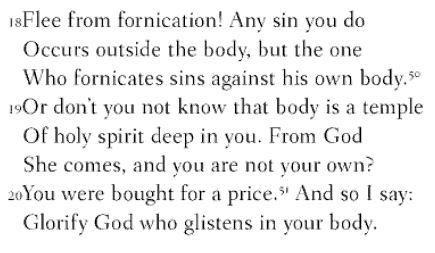

Now, “the prior reference to Eve and Adam” deserve some further discussion, just not in this particular post. The point Barnstone is making is that Christian Atonement through the death of Jesus was somewhere and somehow very distantly connected, by Paul, the Christian Jew, in the Greek and perhaps by some “inflated metaphor” of the New Testament.
(The only other thing I want to say in this post is that blogger Brian LePort is asking today, “What does Yom Kippur mean for Christians?” And some time ago, was it more than a year ago now, Theophrastus and I got into a discussion over the answer to Brian’s question, which you can still find here. At the time, I wasn’t even considering Barnstone’s answer.)
Sapir-Whorf and Michael Gove
 The BBC is reporting that British Education Secretary Michael Gove is calling for early training of students in foreign languages:
“Learning a foreign language, and the culture that goes with it, is one of the most useful things we can do to broaden the empathy and imaginative sympathy and cultural outlook of children.” He said learning languages improved people’s brain power. “Just as some people have taken a perverse pride in not understanding mathematics, so we have taken a perverse pride in the fact that we do not speak foreign languages, and we just need to speak louder in English,” he said. “It is literally the case that learning languages makes you smarter. The neural networks in the brain strengthen as a result of language learning.”
Huh? I’m all for learning foreign languages, but isn’t Gove’s reasoning simply a recitation of the Sapir-Whorf hypothesis?
Perhaps linguists were holding their tongues because they did not want to jinx the possibility of more resources being put into primary education. But certainly, Newcastle University went too far when it put out a press release claiming that “Education Secretary Michael Gove’s statement that learning languages makes people smarter has a sound scientific basis” and, in fact, explicitly crediting Sapir-Whorf:
Early last century linguist Benjamin Whorf was the first to say that western languages make us see reality in a set way, and therefore learning other languages could be beneficial because it would free our minds from such linguistic constraints.
Now I know that Whorf has a few modern defenders, but I thought that conventional linguistic thought was far more critical of Sapir-Whorf than supportive; and certainly it seems disingenuous to claim unqualified support for Whorf – as if there were no controversy at all.
In any case, if anyone out there knows the actual basis of Gove’s claim that “it is literally the case that learning languages makes you smarter” (whatever “smarter” means), I would certainly welcome hearing it.
 American men are at their nadir, according to Reagan-era Secretary of Education William J. Bennett.
And from whence comes the challenge? Is it from an increasingly competitive China and developing world? Is it from ultra-partisan “no-compromise” policy gridlock in Washington? Is it from the most unequal wealth distribution that the United States has ever seen? Is it from the fact that almost 20% of the nation’s children are in poverty?
No according to Bennett, the real danger is American women snapping (or rather, “snipping”) at American masculinity. What is Bennett’s solution? Get men to church and marry them off.
Bennett recites statistics to bolster his point:
In 1970, men earned 60% of all college degrees. In 1980, the figure fell to 50%, by 2006 it was 43%. Women now surpass men in college degrees by almost three to two.
Bennett’s statistics conveniently ignore the issue of what women are studying. A 2010 report by the AAUW put it directly: “Among first-year college students, women are much less likely than men to say that they intend to major in science, technology, engineering, or math (STEM). By graduation, men outnumber women in nearly every science and engineering field, and in some, such as physics, engineering, and computer science, the difference is dramatic, with women earning only 20 percent of bachelor’s degrees.” While women may earn more college degrees than men, they are essentially forced out of science and technology studies, and ghetto-ized.
Women’s earnings grew 44% in real dollars from 1970 to 2007, compared with 6% growth for men.
The statistics are clear enough. Full-time working average women’s wages per capita went from earning 59.4% of men’s in 1970 to 77.8% in 2007 (and have since dropped to 77.4% in the most recent figures). Had wages increased at the same rate, then a woman would only be 3/5ths of a man, rather than 3/4s of a man. (Question: Where have you seen the fraction “3/5ths of a man” before?)
In 1950, 5% of men at the prime working age were unemployed. As of last year, 20% were not working, the highest ever recorded.
Apparently, Bill Bennett has not heard that we are in the midst of a recession. Bennett then leaps to a non-sequitur conclusion: “Men still maintain a majority of the highest paid and most powerful occupations, but women are catching them and will soon be passing them if this trend continues.” Undoubtedly this is true. When a group goes from zero representation to a tiny percentage, that represents an advance. By Bennett’s logic, since we have gone from having 0% black US Presidents to 2.1% black Presidents after two centuries, we could say that “if this trend continues” then within a mere ten thousand years, all US Presidents will be black.
Men are also less religious than ever before. According to Gallup polling, 39% of men reported attending church regularly in 2010, compared to 47% of women.
The celebrated gender differences in church attendance have been commented on at least since Lenski’s study in 1953. See for example Argyle and Beit-Hallahmi’s 1975 classic, The Social Psychology of Religion. I am having trouble understanding why Bennett believes that this generation has seen a change – his assertions are unsupported by statistics.
Bennett has some “constitutional” advice for young men:
The Founding Fathers believed, and the evidence still shows, that industriousness, marriage and religion are a very important basis for male empowerment and achievement. We may need to say to a number of our twenty-something men, “Get off the video games five hours a day, get yourself together, get a challenging job and get married.” It’s time for men to man up.
You know, it is funny – I don’t remember reading anything by the founding “Fathers” on this subject in the Federalist Papers. What I do remember reading in the Federalist Papers is a lengthy defense of slavery and how much they count as persons – sympathetically quoting a hypothetical member of “our Southern brethren”:
In being compelled to labor, not for himself, but for a master; in being vendible by one master to another master; and in being subject at all times to be restrained in his liberty and chastised in his body, by the capricious will of another, the slave may appear to be degraded from the human rank, and classed with those irrational animals which fall under the legal denomination of property.
What is Bennett’s real agenda here? Bennett seems to be stating, between the lines, that women ultimately aren’t going to be fulfilled by their many successes – that they are really en masse on a husband hunt:
If you don’t believe the numbers, just ask young women about men today. You will find them talking about prolonged adolescence and men who refuse to grow up. I’ve heard too many young women asking, “Where are the decent single men?” There is a maturity deficit among men out there, and men are falling behind.
Bill Bennett’s article claims to be about the emasculation of American men and the need to “empower” them. But clearly, his ultimate motivation has to do more with the domestication of American women.
If you are Swedish, then you have good reason to be happy that Tomas Tranströmer won the Nobel Prize in Literature 2011. He’s the first Swede to win since 1974.
And you can enjoy his poetry not only in your native language but also, if you read them, in some 50 other languages into which his work has been translated. In English alone, you can choose between translations by more than a dozen translators. The most prolific of Tranströmer’s English translators are Robert Bly and Robin Fulton. The former introduced the poet to the English speaking world; the latter has sought to keep us reading the poems by, in some cases, improving on earlier translations.
So how would you compare the following two different translations of two three different poems by Tranströmer? Which would you think is the earlier one, by Bly? And which do you believe is the more recent one, by Fulton? How, then, do they reflect the craft of the Nobel Prize winner?
Here is the first pair:
Midwinter
A blue glow
Streams out from my clothes.
Midwinter.
A clinking tambour made of ice.
I close my eyes.
Somewhere there’s a silent world
And there is an opening
Where the dead
Are smuggled over the border.
—
Midwinter
A blue sheen
radiates from my clothes.
Midwinter.
Jangling tambourines of ice.
I close my eyes.
There is a soundless world
there is a crack
where dead people
are smuggled across the border.
—
Now here is the second pair:
AFTER A DEATH
Once there was a shock
that left behind a long, shimmering comet tail.
It keeps us inside. It makes the TV pictures snowy.
It settles in cold drops on the telephone wires.
One can still go slowly on skis in the winter sun
through brush where a few leaves hang on.
They resemble pages torn from old telephone directories.
Names swallowed by the cold.
It is still beautiful to feel the heart beat
but often the shadow seems more real than the body.
The samurai looks insignificant
beside his armour of black dragon scales.
—
After Someone’s Death
Once there was a shock
that left behind a long pale glimmering comet’s tail.
It contains us. It blurs TV images.
It deposits itself as cold drops on aerials.
You can still shuffle along on skis in the winter sun
among groves where last year’s leaves still hang.
They are like pages torn from old telephone directories–
the names are eaten up by the cold.
It is still beautiful to feel your heart throbbing.
But often the shadow feels more real than the body.
The samurai looks insignificant
beside his armor of black dragon scales.
—
Now here is a third if earlier pair:
Allegro
After a black day, I play Haydn,
and feel a little warmth in my hands.
The keys are ready. Kind hammers fall.
The sound is spirited, green, and full of silence.
The sound says that freedom exists
and someone pays no tax to Caesar.
I shove my hands in my haydnpockets
and act like a man who is calm about it all.
I raise my haydnflag. The signal is:
“We do not surrender. But want peace.”
The music is a house of glass standing on a slope;
rocks are flying, rocks are rolling.
The rocks roll straight through the house
but every pane of glass is still whole.
—
Allegro
I play Haydn after a black day
and feel a simple warmth in my hands.
The keys are willing. Soft hammers strike.
The resonance green, lively and calm.
The music says freedom exists
and someone doesn’t pay the emperor tax.
I push down my hands in my Haydnpockets
and imitate a person looking on the world calmly.
I hoist the Haydnflag – it signifies:
“We don’t give in. But want peace.”
The music is a glass-house on the slope
where the stones fly, the stones roll.
And the stones roll right through
but each pane stays whole.
—
How do you like that? Is one translated poem of the two more poetic than the other? Does one, or do both, make you want to read the Swedish original? Are certain lines, or images, more striking?
Well, is it important for you to know that in both three sets, I’ve arranged the translation by Robert Bly first with the one by Robert Fulton under it? Bly translated “Midwinter” in 2005, Fulton the year after. And Bly translated “AFTER A DEATH” in 1972; Fulton rendered “After Someone’s Death” in 2006. And Bly translated (or at least published) “Allegro” in 2001; Fulton earlier, in 1977.
Does anyone have the original poems by Tomas Tranströmer to share? Do you have another favorite by Tranströmer to discuss or show? If you write the poetry in comments (or email me), then I’ll be happy to update this post to show the Nobel Prize deserving work!
Bible Translation Review: New Testament TransLine
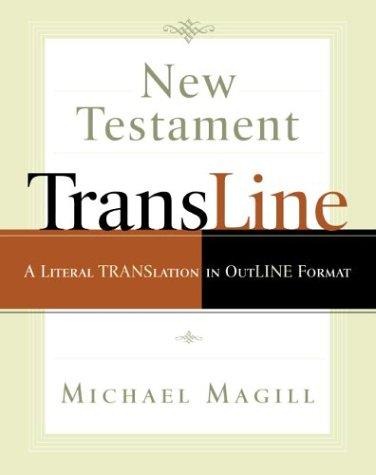 Michael Magill’s New Testament TransLine was published by Zondervan in 2002 and reprinted by Wipf & Stock in a two-volume paperback edition in 2008. (I have not seen the paperback edition, but it is also reported to contain a large number of corrections to the text and commentary.) The entire translation is printed in outline format with about two-thirds of the text being extensive commentary (the translation is also available online with no commentary). Magill has also self-published his translation with greatly shortened commentary and conventional paragraphing as the Disciples’ Literal New Testament (paperback (not seen), hardcover, online version with no commentary).
Format
It is perhaps easiest see what Magill is trying to do by looking at the samples of Ephesians (New Testament TransLine, Disciples’ Literal New Testament). I am going to be focusing on the TransLine in this review.
Magill begins with an outline overview (click for a larger image):

He then follows with an outline translation. The starting verse is indicated at the top, and on the left-hand side in gray is an outline description. Conventional verse numbering is on the right-hand side in gray. If a verse division occurs in the middle of single outline point, it is indicated with a grey dot. The text of the translation is in the middle, using the old tradition of marking “implied words” not found in the original in italics (similar to the convention used in the KJV) and “stressed words” in bold. Sometimes words are added for clarification in brackets. Compound words (e.g., below “caused-to-abound”) that are a “single word” in Greek are indicated with dashes. The text is annotated with two types of footnotes – lettered footnotes which refer to the commentary, and cross-references with letters. The cross-references are to word notes on the Greek found elsewhere in the commentary. Many translation pages are only half or two-thirds full, in order to accommodate the extensive commentary.
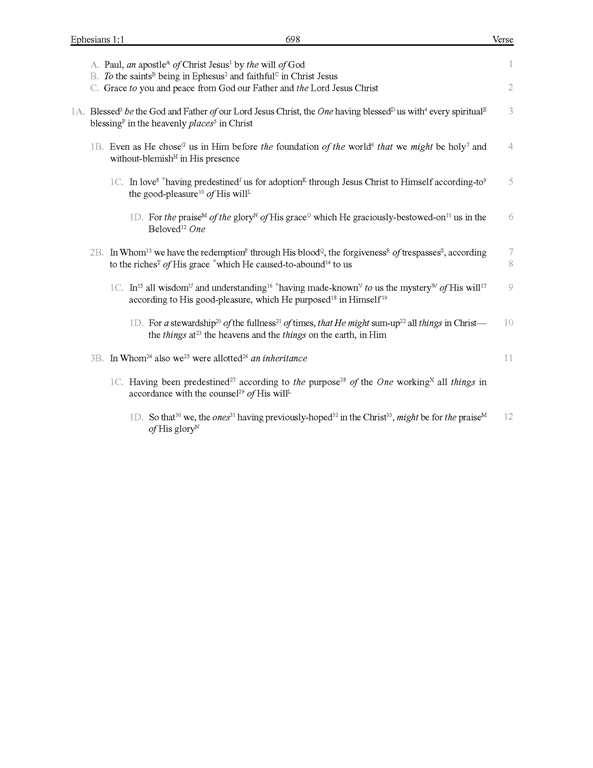
The commentary is in double-columns on the facing page. Magill indicates the Goodrick-Kohlenberger (GK) numbers of words he considers particularly important. Variants found in UBS4 are indicated with the grade level ({A}, {B}, {C}, {D}) marked in that text; variants found in NA27 but not UBS4 are marked {N}; variants found in the Byzantine text (particularly KJV source-text) are marked {K}. Other notes indicate Magill’s interpretation of the text.
Magill considers Ephesians 1:3-14 to be a single sentence, so I also show the next page of translation and matching commentary:
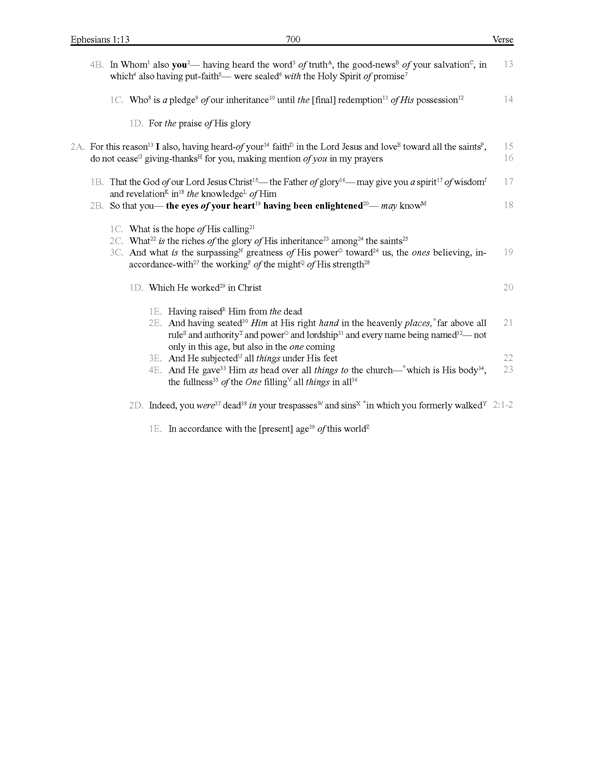
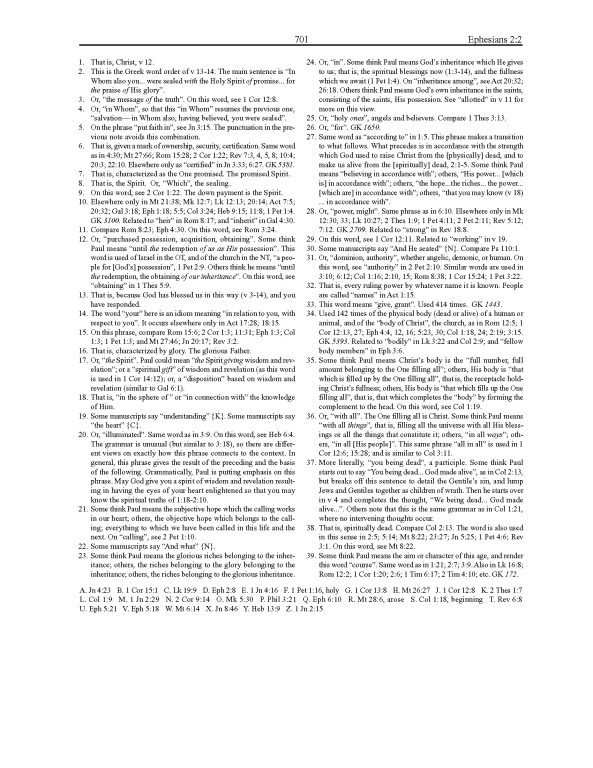
Translation philosophy
Magill aspires to make his translation as literal as possible, and is clearly heavily influenced by the NASB translation. He claims the following strategy in translating gender-based terms:
The gender issue. Words such as “sons,” “brothers,” “man,” and the pronoun “he” are often used in the New Testament when both men and women are in view, a custom also followed in English until recent times. Since the New Testament TransLine is reflecting the ancient Greek, these words are rendered as the biblical writers wrote them. Although this is not the modern gender-explicit or gender-neutral way of speaking, it accurately reflects the Greek point of view. The modern reader can easily make the transition between how the Greek states it, and how we in the 21st century prefer to state it. In the case of “brother” and “son,” the reader can discern from the context whether physical brothers/sons, fellow-members of Abraham’s physical family (Israelites, male and female), or fellow-members of God’s spiritual family (fellow-believers, brothers and sisters in the Lord) are in view. In the case of “man,” there are Greek words that always refer specifically to a male or a female, and they are translated as such. But there is another Greek word (anthropos, from which we get “anthropo”-logy) which means “man” in the sense of “male” and “mankind, a person, whether male or female.” In order to clearly reflect the writers’ intended meaning in English, this word is translated “man” only when a male person is intended. Otherwise, it is rendered “person, mankind, human.” This permits the English reader to see the meaning in places like Jn 6:10, which uses two different words to say that the “people” (anthropos) sat down to eat, and the “men” were counted.
I don’t find this explanation particularly satisfactory for a number of reasons, and in practice Magill is somewhat inconsistent in his treatment of gender.
Evaluation
On the one hand, it is impossible not to admire a plucky individual who has the sheer chutzpah to see his work appear in print, self-publishing it as necessary (Zondervan apparently did not support his translation, and it seems that there was only a single printing of his initial translation.) But on the other hand, this translation goes much further than most in overdetermining the meaning of the source text and imposing that meaning on the reader. The truth is that one can read the text of the New Testament, even in English, in a large number of different ways. Rather than celebrating that ambiguity, deliberate or accidental, Magill chooses to impose his own reading onto the text, even to the point of determining what the primary and secondary ideas of a text fragment are. Further, his highly organized outline form strips the text of its literary presentation and makes the Biblical text look rather like a PowerPoint presentation, or a rough-draft of a student paper. The effect is to make the text more distant, not closer.
In fact, I think that it might be a good idea for some readers to attempt to put the Biblical text – either in Greek or in translated language – into an outline format; but the value of doing that comes from the exercise of interpreting and organizing the text; I am skeptical that there is great value in reading another person’s outline-interpretation of the text.
While Magill’s notes on variants and word cross-references might be useful to many readers, his interpretative notes are somewhat idiosyncratic and personal, and exclude readings. They tend to carry a fair amount of theological baggage. Now perhaps this is inevitable for any commentary, but Magill goes somewhat further than most.
Further the commentary is largely isolated from historical-critical readings, even to the extent of ignoring important pre-existing philosophical notions or contrasting the New Testament text with Second-Temple Judaism. In that sense, the commentary is very old-fashioned; and tends to make the reading artificially self-complete, rather than seeing the text as part of an ongoing philosophical and theological tradition. This sort of reading might be attractive to some readers, but I do not think it fosters critical thought.
In short, although I think this book is physically attractive (and Magill’s formatting is not at all inelegant), I found the content of it to be intellectually smug and stultifying. Instead of opening thought and discussion, it presented a comic-book style presentation of the text. And its belief in “word studies through English,” this book hails back to crutches such as The KJV with Strong Numbers and The Amplified Bible (although those versions, lacking Magill’s outline format, are actually more intellectually engaging.)
I am afraid that I cannot recommend this translation except as a curiosity. While it goes quite far in giving “the Bible according to Magill,” it does not accomplish its goal of bringing the reader closer to the Greek text.
The painfully flawed writings of Adolf Hitler
The anti-woman, homo-phobic, and anti-Semitic writings of Hitler are painfully flawed and rather empty in their ideas and content. Nonetheless, those who study how he tried to write, to spell, and to type note that Hitler was an embarrassment to German education.
Here, for example, are notes from Timothy W. Ryback, from pages 71-73 of his research, Hitler’s Private Library: The Books That Shaped His Life:
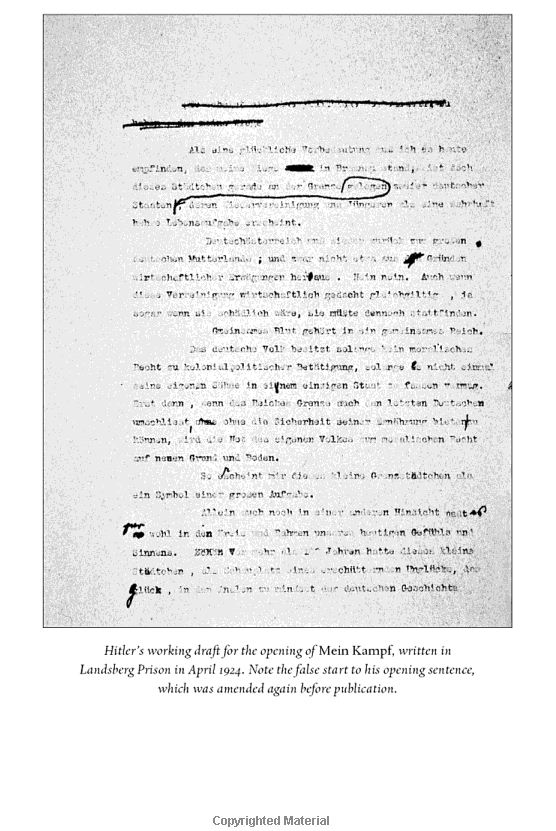
When Hitler boasted of his education at state expense, he not only flaunted his disdain for the Bavarian penal system but also exposed his meager understanding of serious education, a fact that is revealed in Mein Kampf both in terms of its vacuous intellectual content and its painfully flawed grammar. In the surviving bits of unpublished Hitler texts I found in archives across Europe and America, [Hitler] the collector-cum-author emerges as a half-educated man who has mastered neither basic spelling nor common grammar. His raw texts are riddled with lexical and syntactical errors. At age thirty-five, Hilter had not even mastered basic spelling. He writes “es gibt” — “there is” — phonetically rather than grammatically as “es giebt.” But the remnant pieces I studied, including Hitler’s original draft for the first chapter of Mein Kampf, as well as an eighteen-page outline to five subsequent chapters, demonstrate he took his writing seriously.
It has long been assumed that Hitler dictated Mein Kampf to his fellow prisoners, in particular his personal secretary, Rudolf Hess, and his chauffeur and bodyguard, Emil Maurice. In fact, Hitler had begun work on his manuscript before either one of them arrived in Landsberg. This first draft, typed in Pica with faded blue ribbon, shows a fitful start to the four-hundred-page book that was to follow. A single line is typed across the top of the untitled page, “It is not by chance that my cradle,” then breaks off, drops two carriage returns, and begins anew. “It must be seen in my opinion as a positive omen that my cradle stood in Braunau since this small town lies directly on the boarder of two German states whose reunification we young people see as a higher goal in life,” Hitler writes with an evidently measured cadence, though he misspells higher — hohre rather than höhere — before pulling two more carriage returns and plunging into an emphatic claim that this reunification is driven not be economic considerations — “Nein! Nein! he hammers — but by the common bond of blood. “Gemeinsames Blut gehört in ein gemeinsames Reich!” he writes. “Common blood belongs in a common empire.”
At some point in the opening paragraphs, Hitler paused, took a blue pencil, and went back to make amendments, striking out his first failed sentence, making one grammatical correction, but overlooking several others.
And here’s the last page of Hitler’s first letter, now “on permanent display at the Museum of Tolerance in Los Angeles”:

An anonymous commenter, so upset by the sloppiness of the Gemlich letter, which we all can see now, visited my blog Aristotle’s Feminist Subject today, and registered this complaint:
I am German and all I can say is, that this letter contains many errors, orthographic mistakes and even the signature has some very strange errors. The letter is typewritten, which is very strange. In 1919, Hitler was a young man and attested poor. To own a typewriter was luxury !
Space error, a lot of comma faults, use of smal and large words, the word UND in the beginning which is absolute not German style, the word UND after an comma which is absolute no German style, one sentence makes absolute NO sense and is too too long, the word Führernsicher does NOT exist in German language, sentences which are NOT German, but foreign script and style, some words to end a sentence are just missed !the writer was 100 % not a German and even misspelled the word Pogrom !!, and last but not least: The continental typewriter already had a German “ß”, “ä” and “ü”, but the writer of the letter didn´t use theese letters. My opinion as long time militariy collector. THIS letter is 100% FAKE !
While grateful for the careful attention to the painfully flawed writing in the letter, I was reminded that this is how Hitler actually cruelly butchered the German language. Alas, reading what Hitler wrote is always a terrible reminder of the pains of his pen, the wreck of his typewriter, and the horrors of his Reich.
—
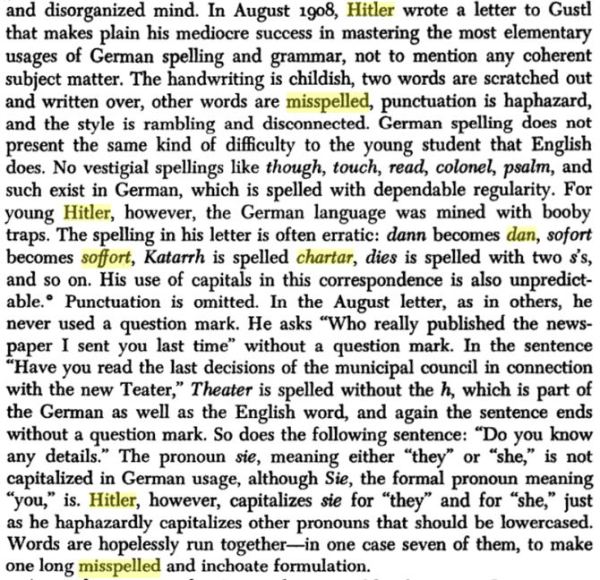
Here are just a few more examples from Eugene Davidson’s, The Making of Adolf Hitler: The Birth and Rise of Nazism:
Dissolving Gold in Fear
I would like to take this opportunity to congratulate the new Nobel Prize recipients. I would also like to take this opportunity to remember those for whom the Nobel Prize has brought pain.
Here is a story about how Nobel prizes had to be sold or literally dissolved in the interest of human rights:
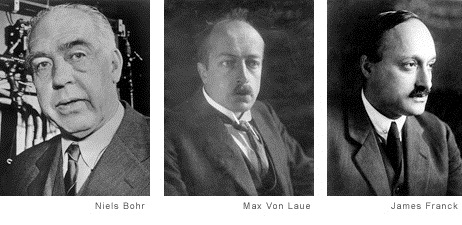
It’s 1940. The Nazis have taken Copenhagen. They are literally marching through the streets, and physicist Niels Bohr has just hours, maybe minutes, to make two Nobel Prize medals disappear. These medals are made of 23-karat gold. They are heavy to handle, and being shiny and inscribed, they are noticeable. The Nazis have declared no gold shall leave Germany, but two Nobel laureates, one of Jewish descent, the other an opponent of the National Socialists, have quietly sent their medals to Bohr’s Institute of Theoretical Physics, for protection. Their act is probably a capital offense — if the Gestapo can find the evidence….
On the day the Nazis came to Copenhagen, a Hungarian chemist named Georgy de Hevesy (he would one day win a Nobel of his own) was working in Bohr’s lab. He wrote later, "I suggested that we should bury the medal(s)," but Bohr thought no, the Germans would dig up the grounds, the garden, search everywhere in the building. Too dangerous. So Hevesy’s thoughts turned to chemistry. Maybe he could make the medals disappear. He took the first one, he says, and "I decided to dissolve it. While the invading forces marched in the streets of Copenhagen, I was busy dissolving Laue’s and also James Franck’s medals."…
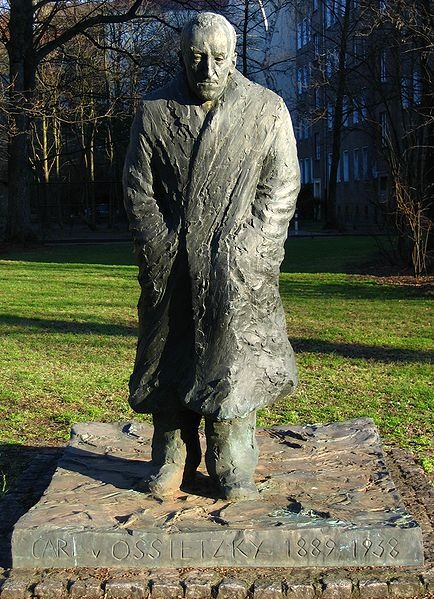
 These stories do have a happy ending, unlike von Ossietzky’s experience: he spent the most of the remainder of his life in concentration camps and died in police camps — even in 1992, the German Der Bundesgerichtshof (“Federal Court of Justice”) reaffirmed Ossietzky’s conviction for trying to alert the world to growing Nazi military menace.
September 2011 Biblical Studies Carnival
Scott Bailey has the latest “Biblical Studies Carnival” up and links to a number of interesting articles. I’d like to thank him for highlighting several articles at this BLT blog.
(Update: see also here for a pre-Carnival post.)
Lifeway Research ignores Luther and Calvin
Lifeway Research has published their recent Bible Readers Survey, showing that most Bible readers prefer a word-for-word translation and a literal translation of masculine words. They also prefer a translation with “total accuracy.” Unfortunately, the Lifeway Survey did not write the questions with “total accuracy.” For example, it says,
Bible readers are overwhelmingly opposed to gender-neutral translations of Scripture. A full 82 percent prefer a literal translation of masculine words that describe people in general rather than a more inclusive translation like “humankind” or “person.”
Study participants were told: “Bible translators have to make choices regarding gender issues. For example, the original Greek and Hebrew versions of the Bible often uses masculine words such as those literally meaning ‘man’ to describe people in general. Some translators think these should be translated literally as ‘man’ while others think they should be translated into gender-inclusive terms such as ‘humankind,’ ‘human being,’ ‘person’ or ‘one.’ Which do you prefer?”
Luther differentiated between “man” and “human” by using Mann and Mensch, as did Calvin, who used homo and vir. I am not sure why Lifeway wrote what they did, implying that the word that is translated as “human” by Luther and Calvin, really means “man.” I wonder if Lifeway finds the translations of Luther and Calvin to be untrustworthy or whether these men are simply ignored as translators.
There’s this common lore that Cornish died because speakers and readers of the language never had their own Bible. And so said a contributor to the wikipedia entry on “Christianity in Cornwall“:
In contrast to Wales, which produced Welsh Bibles, the churches of Cornwall never produced a translation of the Bible in the Cornish language, which may have contributed to that language’s demise.[citation needed].
And then today The Belfast Telegraph confirms a report from BBC Radio Cornwall:
One of the reasons we lost the language was because there was no Bible in Cornish. The Welsh had one (in Welsh) from the time of Elizabeth I, but the Cornish didn’t. As well as being the Hebrew and Christian Scriptures it is one of the defining books of our culture. Once you have the Bible you have created your literary heritage and I hope this book will be influential in the Cornish revival.
It’s Londoner N.J.A. Williams (aka Nicholas Williams) speaking. He’s telling of his new and newly finished translation of the Bible into Cornish. The story for Williams is this: he taught himself the language as a schoolboy; and now, as a professor and translator of the Celtic languages and literature retired from his post at University College Dublin, Williams has tirelessly worked on the translation of the Cornish Bible. He’s known for his Gerlyver Sawsnek-Kernowek (English-Cornish Dictionary) and for his controversial criticisms of varieties of Cornish (i.e., his essay, “‘Linguistically sound principles’: the case against Kernewek Kemmyn”, Cornish Studies, 4, (1997) and his collection of essays in his book, Writings on Revived Cornish).
To the BBC Radio Cornwall, Williams said he started on “boring bits first,” referring to Leviticus and the dietary law. Nonetheless, he’d already finished the New Testament for its publication in 2002. Williams’ entire An Beybel Sans: The Holy Bible in Cornish is available for purchase, and his very interesting introduction with notes on translation is available here online. What may be the case is that Williams rushed his “Old Testament”: he actually translated it from “the English Standard Version of 2001, though the original Hebrew text was consulted in all places of difficulty.” Was he hurrying it’s completion perhaps?
There is another ongoing translation of the Hebrew Bible into the Cornish language. It’s the one by The Cornish Bible Project, which completed the New Testament in 2004. The varieties of Cornish used were not the standard Williams promotes but are Common Cornish and Unified Cornish. The work is called An Bibel Kernewek, is “based firmly on the Greek and Hebrew originals,” and is available online for free here.
Earlier attempts at translation of the Bible into Cornish are noted in the wikipedia entry on “Bible translations by language“:
Two chapters of St Matthew’s Gospel survive from the hand of William Rowe of Sancreed (fl. 1650-1690). Henry Jenner translated John 5:1-14 , which was published in 1918, and in 1936 A. S. D. Smith produced his own translation of St Mark’s gospel, a revised edition being published by Talek (E.G. Retallack Hooper) in 1960. St Matthew’s Gospel was translated by D. R. Evans, appearing in 1975 and a version of St John’s Gospel was translated by John Page, published in 1984. Ray Edwards published his translation of Revelation and of a number of epistles in 1986, and St Luke appeared in 1989. Furthermore the Cornish version of the order for Evensong contains a translation of I Corinthians 13 by R. M. Nance.
Given the late and lack of focus on the Hebrew, one wonders whether it’s only the language that has been lost from Cornwall. I’ve requested through interlibrary loan Helen P. Fry’s, The Lost Jews of Cornwall : from the Middle Ages to the Nineteenth Century, to see if she’s recorded any history of translation of the Hebrew scriptures into Cornish any earlier. Will Bible translation help to revive this language?
sexist Roman slogan (and what Paul may do with it)
Kay Bonikowsky has a post up in which she suggests that “Paul was quoting a slogan” when writing in Greek to men and women in Korinth, Greece. Translator Ann Nyland, likewise, says the following, right in the middle of her translation of what we call Chapter 14 of Paul’s letter; Nyland says: “Paul now quotes from the letter sentto him by the Corinthian assembly.”
The Corinthian men had quoted the Law of the Roman empire at Paul. So how did that go? Well, in a bit, I’ll show you. First, I want to let Cheryl Glenn remind us about that Roman law:
A particular point of Roman male pride seems to have been the deliberate exclusion of women from civil and public duties; and in the first centuries of its history, Roman law reflected rigid legal inequalities between males and females. Cicero reportedly contemplated with utter dismay a society which “included women in assemblies” and which allowed women “soldiery and magistracies and commands.” “How great will be the misfortune of that city, in which women will assume the public duties of men” (Lactantius, Epitomes 33.[38.]1-5, ascribed to De re publica 4-5, qtd. in Hallett, Fathers 8)…. Over centuries, Roman law constructed and guaranteed the sexual distinction — and division — between males and females. The differential between the legal status of women and that of men was justified by the natural inferiority of women: their congenital weakness, limited intellectual faculties, and ignorance of law…. Roman women were perpetually restrained by law. [ Rhetoric Retold: Regendering the Tradition from Antiquity Through the Renaissance, pages 61-62, emphases mine: the red font the Roman exclusions, the blue the more liberal inclusions elsewhere.]
Glenn goes on from her research to discuss at great length the effects of the Law. The legal constraints applied to women more severely under Roman rule even more than they had under the old laws and customs of the Greek empire. The oppressive Law worked to silence women in Rome, in Athens, in Jerusalem and in Korinth:
Like the Greek matron, then, the Roman woman was oppressively busy managing her household and family [i.e., the Roman Domum as the counterpart of the Greek οἰκοδομή — the OIKO-DOMĒ — the domain of the home]…. Because the Romans clung to the ideal of the domina, of the strong privatized woman, they [i.e., the Roman men] often reacted with perplexity or disgust at the women who pursued intellectual or political aspirations. Unlike the very few Greek women who found acceptance and admiration in the public domain, no Roman woman seems to have succeeded in establishing herself as a public figure in her own right…. The Greeks and Romans [i.e., the men] regarded most women as ciphers, whose worth varied according to the property and family connections accompanying them. Women were to be traded among men. And historians — from the first — have had little more to say about these women, who were always, particularly in their exceptions, defined by the private, feminine sphere. The women in my study who passed into the public sphere, even if only temporarily, found themselves vulnerable to assaults on their families, their honor, their sexuality, their “feminine” influence. These women endured the closest of inspections and critiques by males and females alike, usually being disarmed of their influence and respect in the process. [ Rhetoric Retold, pages 63, 72-73, emphases mine: the red font the Roman exclusions, the blue the more liberal inclusions elsewhere.]
Okay, so what was the slogan, the Roman law, that the men of Korinth wrote to Paul? And how did he reply? Let’s look, first at their Greek, then at our English. (What my translation attempts is to show Paul’s play with “feminine” words, with HOME-DOMAIN and with SILENCE and with ALL-inclusion in the ASSEMBLY and with the creative, maternal words of BIRTH.) Here, hear:
Τί οὖν ἐστίν, ἀδελφοί;
Ὅταν συνέρχησθε ἕκαστος
ψαλμὸν ἔχει,
διδαχὴν ἔχει,
ἀποκάλυψιν ἔχει,
γλῶσσαν ἔχει,
ἑρμηνείαν ἔχει.
Πάντα πρὸς οἰκοδομὴν γινέσθω.
Εἴτε γλώσσῃ τις λαλεῖ,
κατὰ δύο ἢ τὸ πλεῖστον τρεῖς,
καὶ ἀνὰ μέρος,
καὶ εἷς διερμηνευέτω·
ἐὰν δὲ μὴ ᾖ διερμηνευτής,
σιγάτω ἐν ἐκκλησίᾳ·
ἑαυτῷ δὲ λαλείτω καὶ τῷ θεῷ.
Προφῆται δὲ δύο ἢ τρεῖς λαλείτωσαν,
καὶ οἱ ἄλλοι διακρινέτωσαν.
Ἐὰν δὲ ἄλλῳ ἀποκαλυφθῇ καθημένῳ,
ὁ πρῶτος σιγάτω.
Δύνασθε γὰρ καθ’
ἕνα πάντες προφητεύειν,
ἵνα πάντες μανθάνωσιν,
καὶ πάντες παρακαλῶνται·
καὶ πνεύματα προφητῶν
προφήταις ὑποτάσσεται.
Οὐ γάρ ἐστιν ἀκαταστασίας ὁ θεός,
ἀλλὰ εἰρήνης,
ὡς ἐν πάσαις ταῖς ἐκκλησίαις τῶν ἁγίων.
Αἱ γυναῖκες ὑμῶν ἐν ταῖς ἐκκλησίαις σιγάτωσαν·
οὐ γὰρ ἐπιτρέπεται αὐταῖς λαλεῖν,
ἀλλὰ ὑποτασσέσθωσαν,καθὼς καὶ ὁ νόμος λέγει.
Εἰ δέ τι μαθεῖν θέλουσιν,
ἐν οἴκῳ τοὺς ἰδίους ἄνδρας ἐπερωτάτωσαν·
αἰσχρὸν γάρ ἐστιν γυναικὶ λαλεῖν ἐν ἐκκλησίᾳ.
Ἢ
ἀφ’ ὑμῶν ὁ λόγος τοῦ θεοῦ ἐξῆλθεν;
Ἢ
εἰς ὑμᾶς μόνους κατήντησεν;
Εἴ τις δοκεῖ προφήτης εἶναι ἢ πνευματικός,
ἐπιγινωσκέτω ἃ γράφω ὑμῖν,
ὅτι κυρίου ἐστὶν ἐντολή
Εἰ δέ τις ἀγνοεῖ, ἀγνοεῖται.
Ὥστε, ἀδελφοί μου, ζηλοῦτε τὸ προφητεύειν,
καὶ τὸ λαλεῖν μὴ κωλύετε γλώσσαις·
πάντα δὲ εὐσχημόνως
καὶ κατὰ τάξιν γινέσθω.
In English, that goes something like this:
What is it, then, brothers?
When you meet together, each one may
have a Psalm,
have an Instruction,
have a Revelation,
have a Tongue,
have a Translation.
All gives birth to the Domain of the Home:
Whether it’s a Tongue that is uttered,
by two or at the most three,
both a Top Part,
and through to a Translation.
Should there, however, not be the Translation, then:
Silence in the Assembly!
To oneself, nonetheless, is an Utterance, and to God.
Prophesy, nonetheless, by two or three Utterances,
And the others through to a Judgement.
Should there come, in fact, some Revelation to another seated, then:
For the first one, Silence!
You all, in fact, are quite able:
One and all may Prophesy
So that all may be Apprenticed
And all may be Called to Encouragement.
And may the Spirit of a Prophecy
Be given Order Under Prophets.
There’s not, in fact, a God of Disruption,
but rather of Peace,
which is in all, in the Assembly, of the Holy ones.
Your women, in the Assembly, are to be Silent!
Give, in fact, to them no Turn to Utter anything there,
but rather give them their Order Under.just as the Law also states
If, however, some wish to be Apprenticed,
Then it’s in the Home where their own men are that these may Question.
It is shameful, in fact, for women to Utter anything in the Assembly.
What?!
Is that from you all, The Statement of God springing out like your baby?
What?!
Is this your special delivery?
If someone opines that they have so Prophesied, or are so Spiritual,
then let him understand what I have written to you all:
our Master is giving Commandments.
If, nonetheless, someone is without understanding, then he lacks understanding.
Therefore, my brothers, yearn to Prophesy,
and to Utter (don’t forbid it) a Tongue.
All, nonetheless, with Blessed Form
and according to Arrangement be birthed!
Stephen Mitchell does it to Helen, and to Homer, as he did it to the Bible
Stephen Mitchell has “translated”
Genesis: A New Translation of the Classic Bible Stories
A Book of Psalms: Selected and Adapted from the Hebrew
Tao Te Ching: A New English Version (Perennial Classics)
Gilgamesh: A New English Version
Bhagavad Gita: A New Translation
And now he’s taken on Homer: The Iliad: (The Stephen Mitchell Translation)
Now Alexandra Alter is calling him “the ‘rock star’ of translators” for calling Helen — who refers to herself as the “dog-eyed one” – a “bitch.” Alter goes on to say: “Mr. Mitchell cut about 7% of the poem—because he believes those passages were added by later poets. He dropped book 10, which describes a nighttime raid against the Trojans, entirely. He left out most of the stock character descriptions because he felt that while the phrases serve a rhythmic function in Greek, they add nothing in English. His next project: ‘The Odyssey.'”
Doesn’t it sound like some of the easy reader Bible translations already out? And can we wait to see what he calls the Cyclops?
It’s International Translation Day 2011
Imaginez un monde sans traducteurs : comment ferions-nous pour communiquer ? Avec près de 7 000 langues parlées dans le monde, les échanges commerciaux et culturels seraient impossibles. Les chefs de nations ne pourraient pas se parler. Les découvertes scientifiques ne seraient pas diffusées. Les l…
Imagine a world without translators: How would we communicate with each other? With nearly 7,000 languages spoken around the globe, trade and cultural exchange would be impossible. Leaders of nations could not talk to each other. Scientific discoveries could not be shared. Books could be read only by those who speak the author’s language. Cross-border traffic would come to a halt. Breaking news would reach only a select few. The Olympic Games could not be held. Nations in distress would not receive assistance from more fortunate ones.
The professional translators, interpreters and terminologists represented by FIT member associations build bridges between cultures and facilitate communication that creates prosperity and cultural enrichment. They are brokers of peace and mutual understanding. They open national literatures to the world. They make international assistance in disaster areas possible. They are the voice of politicians, religious and intellectual leaders, and all other people who influence our daily lives. They are gatekeepers of information. They are cultural ambassadors. They are absolutely indispensable.
Thanks to translators, interpreters and terminologists, peoples around the world can preserve their cultural heritage while being active participants in the “global village”. Cultural diversity makes our world a better place, but we have to understand each other in order to avoid international conflicts and to help each other in times of need. We have to understand each other to appreciate our cultural differences.
— a note from Fédération Internationale des Traducteurs/International Federation of Translators
Cherokee or Greek or English
Suzanne’s recent post, Navajo or Choctaw, provides contrastive translation situations in which two different Amerindian languages were variously translated into English. She then draws a helpful analogy between how bible translators must translate into English and how, variously, modern novelists may work with their translators to render the works of fiction into English. This made me think of the case of Cherokee and English in America in the late 1820s and the early 1830s.
The Cherokees started the first and the now longest-running bi-lingual newspaper in the USA. It is called the Cherokee Phoenix (ᏣᎳᎩ ᏧᎴᎯᏌᏅᎯ, Tsalagi Tsulehisanvhi) and is available as an English-only version online. Here’s how the front page of the first edition looked

You should be able to see that half of the paper is in English and the other half in Cherokee. You might also be able to notice that the Constitution of the Cherokee Nation is published under CHEROKEE LAWS on the left side. On the right side you will find the Cherokee “equivalent.” Now, I’m using the word equivalent in scare quotes because the Cherokees newspaper publishers got to decide just how equivalent the English and the Cherokee in the paper was. The publishers, all Cherokees were biliterate, bilingual speakers of Cherokee and English, but the majority of non-Cherokee readers, the Anglo American readers, were only literate in English. A close, but bilingual reading of the newspaper, emphasizes in some subtle but also some not so subtle ways, the superiority of Cherokee culture, language, government, and religion.
The new paper needed subscribers. Thus, to welcome in readers who could read English only (i.e., most citizens of the United States of America), the editors of the bilingual Cherokee Phoenix (ᏣᎳᎩ ᏧᎴᎯᏌᏅᎯ, Tsalagi Tsulehisanvhi) would do some interesting things. For example, in this first issue that you have seen here, the editors printed a back-page English article, “CHEROKEE ALPHABET.”
In addition, in that first issue, the editors included a Cherokee translation of “Lord’s Prayer” — from the Greek of Matthew’s gospel. Elias Boudinot (1804-1839), whose Cherokee name is Galagi’na Watie, was the translator. He was a student of Greek and was proficient in English and in Cherokee. He was also the first editor in chief of the newspaper. Boudinot includes the Cherokee Lord’s Prayer seemingly to demonstrate the Christianity of the Indians. Nevertheless, the multiliterate reader knows better. Neither all Cherokees nor all Pequots considered Anglo-American Christianity their friend. (Boudinot was friends with William Apess, a Pequot who was rather outspoken, from the pulpit and in his writings, against the abuses and oppressiveness of the USA churches; and Boudinot’s own “Address to the Whites” was just as critical.)
So the “Lord’s Prayer” appears in the inaugural issue of the Cherokee Phoenix (ᏣᎳᎩ ᏧᎴᎯᏌᏅᎯ, Tsalagi Tsulehisanvhi). And yet, the Cherokee translation is not what an English-only Anglo-American might expect. Elias Boudinot (aka Galagi’na Watie) asked his trusted friend (the bi-lingual Anglo-American) Samuel Austin Worcester to provide a back translation and commentary for English-only readers. I’ll show this at the end of the blog post. First, it’s worth noting how much Boudinot trusted his friend Worcester, and how together they worked on Cherokee-English translation. To another English-speaking friend, Boudinot recalled their work together:
. . . Every Sabbath we have preaching & I am generally the Interpreter. Mr. Worcester of Brainerd spent some time with us—while here we commenced systematizing the Cherokee language, & forming rules for the foundation of the Tenses. I presume the Cherokee verbs are the most complicated in the world—nothing like it in any language whether learned or Savage, unless we except those spoken by the Indians generally. You will form a slight idea of the almost infinite forms in the Cherokee verbs, when I tell you that we have discovered 29 Tenses in the Indicative mode, in all the verbs, & 30 in some; & that in the verb To tie, there are not less than 178 forms, only the present Tense indicative mode. Mr. Worcester however proceeds rapidly in acquiring the language—he intends to preach in it—the blessing of God attend him. (Theresa Gaul, To Marry an Indian, page 154)
Now that “Lord’s Prayer” from the Greek to the Cherokee to the English. I’ve reproduced it as it appeared in the paper Cherokee Phoenix (ᏣᎳᎩ ᏧᎴᎯᏌᏅᎯ, Tsalagi Tsulehisanvhi) and what you see is from a handout I made once for a conference paper. I do hope you’ll be able to make it big enough to read it:
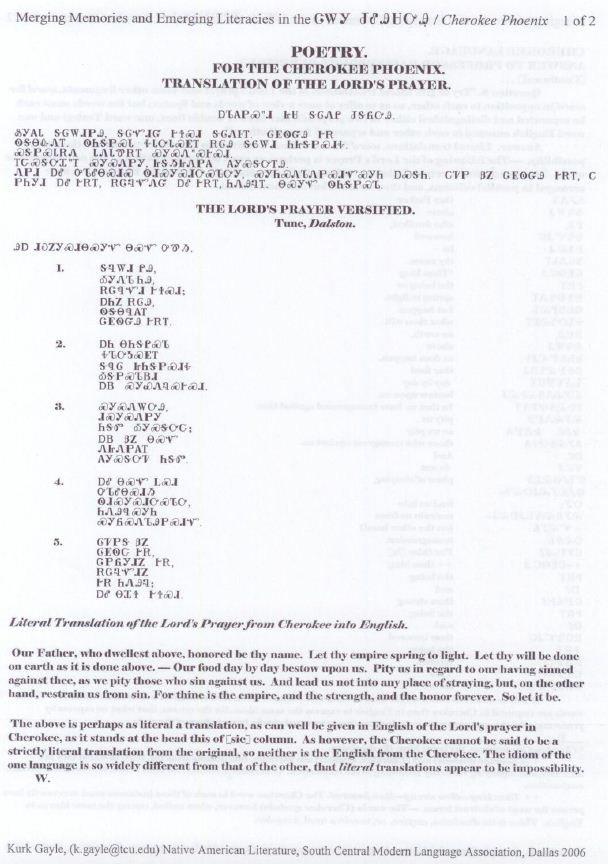
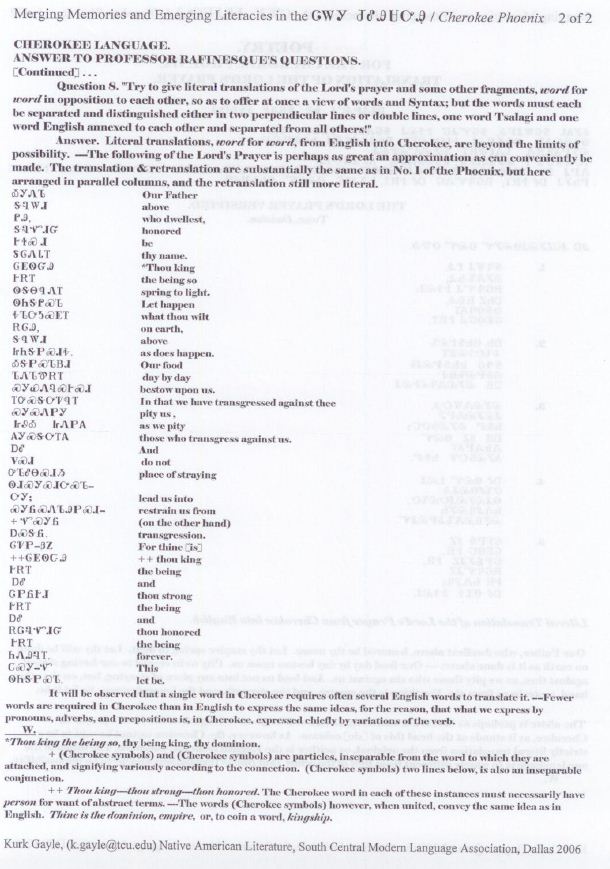
Differences in meaning are most striking in the multiple versions of “The Lord’s Prayer.” The material is clearly in two separate languages. What is unlike the bilingual content on the front page of the newspaper, however, is that there is no side-by-side visual comparisons to make. Rather, English frames the piece; there are general English language headers at the top of the piece and above the Cherokee passages, with general English-only commentary at the bottom of the text.
The two Cherokee passages are noticeably different from one another, the first having a horizontal orientation and the second a vertical one. As mentioned, The TRANSLATION OF THE LORD’S PRAYER in Cherokee is from the Greek. THE LORD’S PRAYER VERSIFIED is a transposition from the Cherokee prose (TRANSLATION) into a visually-and-audibly rhyming Cherokee hymn. This TRANSLATION (from the Greek) and the transposition (from one Cherokee form into another) and the composition (of the Cherokee headings) are very likely Boudinot’s work, although he would have been aided by Worcester.
Althea Bass (in her book Cherokee Messenger) notes that, “Shortly before Samuel Worcester’s arrival [to the Cherokee Nation], David Brown, a Cherokee, had translated the New Testament from Greek into the Cherokee language, and circulated it in manuscript form” (4). And yet, there was some question whether he “was able to translate much better from the Greek than from the English . . . [and] there were yet no types in existence for printing that language [of Cherokee]” (page 37). Thus, Worcester, “once settled, and with Elias Boudinot at hand to delve into the intricacies of language—Greek and Latin and English and Cherokee—daily with him, he believed he could accomplish his great end, the translation of the entire Bible into Cherokee” (page 240). Boudinot’s and Worcester’s first printing of some of their collaborative translation and work appears initially in Cherokee Phoenix (ᏣᎳᎩ ᏧᎴᎯᏌᏅᎯ, Tsalagi Tsulehisanvhi).
The trustworthy “W.” is the contributor of the English, though not necessarily the provider of the Cherokee. The English reader, then, is directed first to the fact that the Cherokee passages are “POETRY”: A) the translation “from the original [Greek scriptures]” and B) the versification to be sung a well-known hymn tune “Dalton.” These headers provide the English-only readers with some assurance that at least some of the Cherokees have been Christianized. And the authoritative reference to “the original” with the allusion to a familiar melody would encourage the Anglo-American members of the audience to sense that the Indians now are fully converted.
Then again, the commentary in English quite resists the literal notion of “translation.” I wonder if that could be some resistance to a figural translation of Cherokee converts into the kind of religion some Anglo Americans would enforce. What do you think? Certainly, the translation into English is from the Cherokee, so that English is last in the hierarchy and Cherokee is closest to the original, that is, it’s closest to the Greek. And in some sense, Worcester may even consider the Cherokee superior to any language: “‘There is’ Worcester wrote [elsewhere], ‘a peculiar definiteness about the Cherokee language, which compels us to settle many questions, which the English and Greek leave ambiguous.’” (Bass 92). Worcester had utmost respect for Boudinot’s abilities and wrote as late as 1851, “The fact that none of us preach in Cherokee, or are likely to, is indeed a difficulty, and the want of an adequate number of suitable interpreters is a greater one. And I think it now highly probable that no white missionary will hereafter acquire it” (Bass, page 93).
So it is worth noting how Worcester reads, or only attempts to “literally translate,” what he considers Boudinot’s good work. The Cherokee authenticity comes through. “Our Father” definitely connotes a patrilineage, but as already mentioned in his “Address to the Whites,” Boudinot says “my fathers sleeping” and “I am no longer like my fathers.” While this could be read as a rejection of his Cherokee heritage, the rejection of the father, even God in this case, may be what good Cherokee young men do to more embrace the matrilineal community. “Who dwellest above” and “lead us not into a place of straying” can be interpreted as a sense or a longing for the homeland and the Divine resistance to removal. “Thy empire springing to light” ties in with the Cherokee Nation’s emphasis on nationhood and nation building and enlightenment. “Pity” of sin rather than forgiveness suggests that Theda Perdue may be right in saying the “Christian concept of sin does not have a direct corollary in the Cherokee belief system: for Cherokees, sin involved violating basic categories, blurring the boundaries, and upsetting the equilibrium” (See her book, Cherokee Women: Gender and Culture Change, 1700-1835, page 28). In this way, translation could be seen as an act of sin. So when Boudinot and Worcester print The Lord’s Prayer, they are careful. Their beginning note in English is unequivocal: “Literal translations, word for word, from English into Cherokee, are beyond the limits of possibility.” And the ending, after the illustration line-by-line, is an English-language commentary on the lexical/semantic efficiency of Cherokee relative to English.
But what is truly revolutionary in Boudinot’s and Worcester’s presentation of their translations and transpositions of “The Lord’s Prayer” is not the explicit English statement denying translation. Nor is the line-by-line demonstration of the differences between Cherokee and English particularly radical, since even a mono-literate Anglo-American or possibly even an illiterate could actually see the differences. Rather, what’s revolutionary is Boudinot’s translation, his play with words across two languages that allows instant access (with validating inclusion) to the readers who are, as he is, multiply literate in the Cherokee alphabet with the English, as once the sole domain and dominion of the Anglo American.
Navajo or Choctaw
I am reading The Code Book by Simon Singh. He includes the stories of decoding the Rosetta Stone, and Linear B, as well as modern codes. When writing about the Navajo code talkers,he explains,
Before training could begin, the Marine Corps had to overcome a problem that had plagued the only other code to have been based on a native American language. In Northern France during the First World War, Captain E. W. Horner of Company D, 141st Infantry, ordered that eight men from the Choctaw tribe be employed as radio operators. Obviously none of the enemy understood their language, so the Choctaw provided secure communications. However, this encryption system was fundamentally flawed because the Choctaw language had no equivalent for modern military jargon. A specific technical term in a message might therefore have to be translated into a vague Choctaw expression, with the risk that this could be misinterpreted by the receiver.
The same problem would have arisen with the Navajo language, but the Marine Corps planned to construct a lexicon of Navajo terms to replace otherwise untranslatable English words, thus removing any ambiguities. The trainees helped to compile the lexicon, tending to choose words describing the natural world to indicate specific military terms. Thus, the names of birds were used for planced, and fish for ships. Commanding officers became ‘war chiefs,” platoons were “mudclans,” fortifications turned into ” cave dwellings” and mortars were known as “guns and squat.”
Even though the complete lexicon contained 274 words, there was still the problem of translating less predictable words and the names of people and places. The solution was to devise an encoded phonetic alphabet for spelling out difficult words. For example, the word “Pacific” would be spelled out as “pig, ant, cat, ice, fox, ice, cat,” which would then be translated into navajo as bi-sodih, wol-la-chee, moasi, tkin, ma-e, tkin, moasi. The complete Navajo alphabet is given in Table 12. Within eight weeks, the trainee code talkers had learned the entire lexicon and alphabet, thus obviating the need for codebooks which might fall into enemy hands. For the Navajos, committing everything to memory was trivial because traditionally their language had no written script, so they were used to memorizing their folk stories and family histories. …
At the end of training, the Navajos were put to the test. Senders translated a series of messages from English into Navajo, transmitted them, and then receivers translated the messages back into English, using the memorized lexicon and alphabet when necessary. The results were word-perfect. page 195-196
Later the code had to be refined, with an increased lexicon and several values for each of the frequent letters of the English alphabet so that frequency analysis could not be used on the place names.
Here are two different attempts to set up a code using an Amerindian language. In the first case, it was not successful. In the case of Navajo, a lexicon of equivalent terms was developed. When we think about translating the bible from ancient languages into modern, this resembles the Choctaw scenario rather than the Navajo. We don’t have a list of equivalent terms that we know for sure is accurate. We can translate, but we cannot eliminate ambiguity, or create a code book. We don’t have the necessary knowledge. Using a translation of the bible today as if it were an accurate instruction book would be like receiving Choctaw encoded instructions from an officer.
Translating the bible is quite different from the tranlation of modern literature like that of Pamuk or Xinran, who both dialogue with their translators to refine the work. But we can’t actuallly ask the authors of the bible what certain terms mean, and we don’t have a list of equivalent terms.
Is this the choice for readers of Bible translations?
Most American Bible readers prefer word-for-word translations of the original Greek and Hebrew over thought-for-thought translations, saying they value accuracy over readability, according to a new LifeWay Research study.
Imagine having to chose between accuracy and readability in a translation of Orhan Pamuk or Homer or Virgil. Well, that’s the either or choice in America, it seems, at least among those polled by the Southern Baptist publishing house. Here’s the report.
[update: Joel Hoffman has a post up in which he suspects the survey is not about translation or language really.. Is the survey more about the SBC beef with gender accuracy in the TNIV and then the NIV 2011? Lifeway is a Southern Baptist distributor of Bibles, told by a recent SBC resolution not to sell NIV 2011 bibles because they are gender inaccurate. This week at the largest SBC seminary there was another SBC conference to address gender and the Bible. Accuracy is in the Baptsit mind these days. The Lifeway survey just reflects that. Here is a link to a report on the SBC gender accuracy in bibles conference:


 BLT
BLT 