PublishYourSefer.com
I would like to draw your attention to Mississippi Fred MacDowell’s thorough review of PublishYourSefer.com (which recently lowered its prices) in conjunction with HebrewBooks.org. (Note: A sefer [plural: seforim] is a Jewish religious book, usually in Hebrew.)
MFM republished פני תבל and received his hard copy (including shipping time) in a week. The price of the 292 page book was $8.99 for a paperback and $16.99 for a hard cover.
MFM had previously reviewed the Espresso Book Machine [EBM] service in conjunction with Google Books.
His summary:
[Both the hardcover and paperback] books printed very nicely. The only difference was that the hardcover printed on a very white paper which was a little less nice than the softcover, which printed on a more cream colored paper that was pleasing to my eyes. Paper stock was fine in both cases. Both bindings were excellent – in fact superior to the EBM product (which is certainly very adequate)….
So what’s the bottom line? There’s nothing to complain about. It’s possible that EBM’s prices are a bit better. If that’s the case, then if you see a volume of the Aruch Hashalem that you want to print, by all means go through Google. But for tens of thousand of seforim which are on HebrewBooks.org but not Google Books – there is every reason to feel confident about using PublishYourSefer.com reprints (via Lulu.com ). It would be too much flattery to give it more than the 8 out of 10, which is what I rated EBM, but I’m almost tempted to give it a 9 simply because of how impressive it is that a small business with much creativity and technical prowess can produce a result as good as a much-hyped invention partnered with a corporate entity
Islamic Sources of the Renaissance
When I was quite young, still in elementary school, my mother read aloud to us children from an English translation of D’Aubigné’s History of the Great Reformation. This was for the purpose of raising us with an awareness of our Swiss protestant roots.
Since that time I have always been searching in some form or other for the antecedents to the Reformation, whether this was vernacular European literature in the Late Middle Ages, the migration of Greek scholars into Europe after the fall of Constantinople, translations of Kabbalah documents into Latin, or paper and later the printing press.
What I have been trying to break out of is the history of ideas as it has typcially been traced within our own tradition. The study of Isamic sources of the Renaissance, of increasing interest today, offers some insight in that direction. Friday evening I was able to hear George Saliba explain the mathematical formulas and diagrams that lead to the Copernican Revolution.
Here is part of an interview which presents much the same material as the lecture.
In the 12th and 13th centuries there was a massive translation movement in Europe, from Arabic into Latin. Traditionally, this is seen as the time when Europe was recapturing its own roots so to speak. It is said that the Greek texts could not be found, that’s why they were translated via Arabic.
But it is not true that those texts could not be found. They were actually found and translated directly from Greek later on, in the 15th and the 16th centuries. The question is, why did they translate them from Arabic when the same text existed in Greek?
The essence of my argument is that the European scientists used the bricks that were already formulated in the Islamic civilization to construct their very own and new science. It does not mean that the Renaissance is not a brilliant renaissance. That is indeed one of the most creative periods in history.
But note that the method of translation changed after the 14th century. In the 15th and 16th centuries, the Europeans were no longer treating those Arabic texts in the same way they were treated in the medieval period. Instead of hiring translators, the European scientists learned Arabic themselves.
Indeed, why should one assume that the Renaissance scientists were any less intelligent than our modern scientists? If you ask a contemporary scientist about what was said in physics fifty years ago, the answer would be that all of that is obsolete. Today’s scientists do not read what was written in their fields fifty years ago. They only go for the latest. Why should a Renaissance scientist go for a text written in Ancient Greece a thousand years before, when the same had been discussed, criticized, updated, in the Islamic domain?
The second part of the book deals with such issues.
I use the example of Copernicus, who literally picked up from Arabic texts almost all of the mathematical theorems he needed for the construction of his astronomy; these theorems were not found in the classical Greek texts.
When you mention Copernicus everybody gets a little jumpy, because we attribute to him the discovery of the earth moving around the sun. That Copernicus did not get from any Islamic astronomer that I know of. No Islamic astronomer I know of would believe in heliocentrism, or would allow a cosmology that is heliocentric. None of them, including Copernicus, had the ability to explain the physical structure of the universe—that explanation depended on an essential law that was yet to be discovered by Newton, a hundred years after Copernicus.
Yet, to explain how a planet moves around the sun, Copernicus needed the mathematical mechanisms that accommodate the movements of the planets. He needed a predictive model, to tell where the planet would be seen from the earth, at such and such a time. If you ask the question of where the planet will be seen from the earth, then you are already solving the problem for an earth-centered universe. And all of those answers were already found in the Islamic domain.
The question remains. Why did Copernicus do that? There are many people who answer that in so many different ways. But none of them is really cosmologically convincing. Because you would have to account for the force that holds the planets attached to the sun. Even Kepler, who comes after Copernicus, who should really be called the father of modern astronomy, even he was thinking that planets are attracting each other like magnets. Kepler used magnetism as a metaphor of that attraction because he still did not yet have Newton’s universal law of gravitation.
On the other hand, if you only think of it mathematically, it is irrelevant whether the center of the universe is at the sun or at the earth. This is how all the mathematics that was developed in the Islamic domain could be simply turned around and made heliocentric by Copernicus.
An ironic footnote to this lecture was a comment from the audience afterward querying why Saliba had called Avicenna, a Persian polymath, Arabic. But Saliba responded that Avicenna wrote in Arabic and so his documents are rightly referred to as Arabic.
I note, however, that he is a provocative speaker, and his stance is not without detractors. Nonetheless, his tracing of the diagrams which lead to the Copernican Revolution over several centuries was very powerful.
We are all of us influenced to validate our own heritage to the detriment of other traditions. I wonder if this in part explains why N. T. Wright has called Aramaic a dialect of Hebrew. Is there a habit among Christians of thinking that Hebrew was a major language from which the Aramaic of the gospels is derived? Do we elevate those languages that form part of our literary tradition to the exclusion of other languages?
All Hallows’ Eve
I don’t celebrate Halloween – although I don’t fault those who do. It seems to me that despite its obvious pagan affinities, it is more in the spirit of fun rather than serious devil worship. (And, after all, Jesus had his own zombie army awakened by his war cry– see Matthew 27:50-53.)
Still, to me, the end of October is associated with a little burst of Indian summer, not at all the dark days of the Winter Solstice when our mood becomes more grip (perhaps as a result of Seasonal Affective Disorder). I personally prefer my horror in literature (M. R. James or the Book of Enoch), or in the camera work of Hitchcock. But lest I be a complete spoilsport, let me at least include a brief excerpt of my favorite werewolf bar mitzvah song:
In the Matter of J. Robert Oppenheimer
I found another treasure for my bookshelves recently, and I want to talk about it on this blog.
One of my favorite books was published in 1954 by the Government Printing Office (for the US Atomic Energy Commission) in two parts:
- In the Matter of J. Robert Oppenheimer: Transcript of Hearing before Personnel Security Board (Washington DC, April 12, 1954 through May 6, 1954); and
- In the Matter of J. Robert Oppenheimer: Texts of Principal Documents and Letters of Personnel Security Board, General Manager, Commissioners (Washington DC, May 27, 1954 through June 29, 1954)
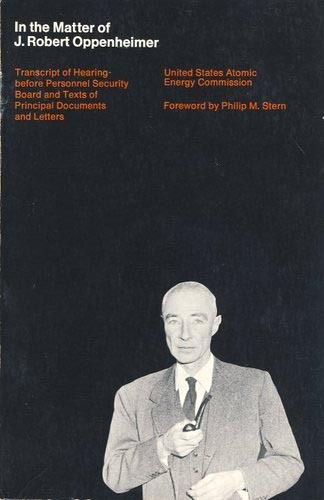 As I discuss below, these volumes quickly became rare, so MIT Press in 1970 republished them (photo-offset from the original GPO publication) in a single volume together with a preface by Philip Stern, a new index, and for materials from the second volume, a dual page numbering system (pages both as numbered originally and in continuous numbering from the start).
I have owned the MIT volume in paperback since I was in graduate school, and it has become an old friend – indeed, I wore out several copies; but I found a hardcover copy in nearly perfect condition, which should serve me for many, many years. (The image is of the MIT paperback edition.)
The volume is a record of a hearing held by the Atomic Energy Commission (AEC) on the security clearance for J. Robert Oppenheimer, a Berkeley physicist who was appointed the head of the secret Los Alamos laboratory that developed the atomic bomb in World War II (ultimately used against Japan.) After the war, Oppenheimer remained a consultant to the AEC (initially he was chair of its General Advisory Committee) where he opposed development of the hydrogen bomb – a recommendation that was not followed (indeed, then President Harry Truman personally ordered a crash program for its development.) Oppenheimer attracted many enemies, and during the McCarthy period he was attacked for indirect links with the Communist Party – his brother Frank and some of his students had been party members during the Depression. In a split 2 to 1 division, Oppenheimer’s security clearance was lifted, which removed him from government work.
Stern describes how the volume came to be printed by the GPO in the first place:
Initially, the transcript of the hearing was never intended for publication. Indeed, from the opening moments of the case, Chairman Gray both admonished and assured those present that the proceedings were to be kept strictly confidential. But … the existence of the trial became public knowledge on its second day, and the publication of both the AEC’s [Atomic Energy Commission] charges, and later, of the Gray Board’s adverse verdict caused wide-spread public controversy. The Gray Board opinion, in particular, came under particular fire for its apparent inconsistency in finding Oppenheimer both loyal and unusually discrete with secrets, but nonetheless a “security risk.” Shortly after that opinion became public, the AEC decided to publish the transcript, notwithstanding Gray’s assurance that this would not be done. This was rationalized in part by a purported fear that some extensive excerpts from the transcript, lost by one of the AEC Commissioners, might suddenly become public. But, since the missing document was recovered intact in a matter of hours, many believe that the AEC’s real motive was to soften the public criticism of its prosecution of Oppenheimer and, particularly, of the Gray Board opinion….
Although the Government Printing Office (which performed a printing miracle by typesetting, printing and binding this massive book in about 48 hours) …
Let’s stop there for a moment. Please recall that this book was published in 1948, so without any computer support, typesetting, printing, and binding the 1065 pages that form these two books was remarkable indeed (the MIT addition has about 35 pages of additional material).
Although the Government Printing Office (which performed a printing miracle by typesetting, printing and binding this massive book in about 48 hours) printed several thousand copies of the transcript and sold all of them, as the years went by the document became almost mysteriously fugitive. Although it was available in the public library, copies in the hands of private persons interested in the case almost always seemed to have disappeared, been thrown out or, often, lent to some forgotten (and forgetful person and never returned. I am told that the Editors of The M.I.T. Press even had difficult locating a copy from which to print this volume.
Now, I suppose I should here defend discussing this book on this blog – it clearly is not related to the Bible or Translation, so it must fall under the category of Literature. What is the literary merit of this volume?
The transcript of the hearing itself forms a type of natural literature. The story itself is a tragedy and parable on many levels, and seems to be as relevant today (even in our post-Cold War period) as it was in 1954 or 1970. Indeed, the material has received at least four adaptations that come to mind:
- Heinar Kipphardt’s play In der Sache J. Robert Oppenheimer translated into English by Ruth Speirs as In the Matter of J. Robert Oppenheimer. (So, in fact, there is a translation angle here.)
- Richard Polenberg’s version In the Matter of J. Robert Oppenheimer: The Security Clearance Hearing. (This short version [about 25% of the original] may be the best place to start reading about the subject – it is finely laid out and has photographs. It also happens to be on sale at Amazon currently for $9.58 – a remaindered price.)
- Peter Prince’s script for the BBC movie Oppenheimer: The Father of the Atomic Bomb (7 hours long) starring Sam Waterston. (I am impressed that it currently has 40 five-star ratings, 3 four-star ratings, and no three-star, two-star, or one-star ratings on Amazon.)
- Peter Goodchild’s radio play In the Name of Security (on 3 CDs – also includes episodes on the Alger Hiss and Julius & Ethel Rosenberg trials.)
Stern, in his MIT Press foreword, says that the volume may be important to various audiences:
It is of interest to the historian, for in these pages the reader will find remarkable insights into, if not miniature portraits of, three distinct and important periods of twentieth century American history: first, the depression-ridden thirties, with the attendant disillusionment about the American system and the attraction toward the Left; second, the immediate postwar period, when our “gallant wartime ally,” the Soviets, became our cold war adversaries and the political mood shifted sharply rightward; and third, the era of “McCarthyism,” at the height of which the Oppenheimer proceeding took place….
This volume also holds special interest for lawyers, for, as the only complete public transcript of a security hearing, it lays bare the procedural injustices inherent in the so-called loyalty-security system…. In particlar this hearing revealed in unique detail the shocking extent to which the United States government in the name of “security” can and does pry into the most intimate details of a citizen’s life. For eleven years Oppenheimer’s mail was opened; his telephone calls were monitored; his office and his home were “bugged”; his every movement was followed, even extending to a night spent with a former fiancée in Berkeley following the war. All of this official snooping is justified as protecting our “freedom” from totalitarian control.
Novelists (and, perhaps, psychologists too) may be drawn to the human elements of this trial – especially the portrait of that most remarkable and enigmatic man, J. Robert Oppenheimer. His intellectual brilliance is almost legendary; so, to a lesser extent, is his reputation for arrogance. Why, then, did he permit himself to be bested, cornered, browbeaten by Roger Robb, and finally driven, bent over, wringing his hands, to blurt out that he had been “an idiot” (page 137)? Oppenheimer’s self-deprecatory posture is the more remarkable when compared with his appearance, just five years earlier, before the House Un-American Activities Committee, when his self-assured answers to many of the same questions wholly persuaded the hard-bitten members of that Committee, including the then-Congressman Richard Nixon.
In short, the transcript of this hearing is drama of the first order – all the more remarkable when one considers it is a transcript of a hearing. It may be that for most readers this is too much (each page contains about 70 lines of tiny print with up to 20 words per line –- so the work is much more massive than its 1000+ pages indicate), and they may be better served by Polenberg’s abridgement (as mentioned before, a quarter of the size of the original and currently on sale at Amazon for less than $10.) But for me, I find myself drawn into the exciting details of the case and the transcript vividly evokes the personalities quoted inside it.
Petitionary prayer in the TiVo era
I was going to write another post in my series comparing simulacra to originals (see earlier entries here and here) – specifically in the area of sports and games — but I want to digress onto a side topic first.
Humor me by temporarily allowing some assumptions.
Let us assume that petitionary prayer is meaningful to God (not merely a psychological crutch to the person praying).

Let us further assume that petitionary prayer for the victory one’s favorite sports team is acceptable to God (and that our petitionary prayers somehow take precedence over those for the other side, and further that is not cheating to use Providential assistance to claim a few extra points on the playing field.)
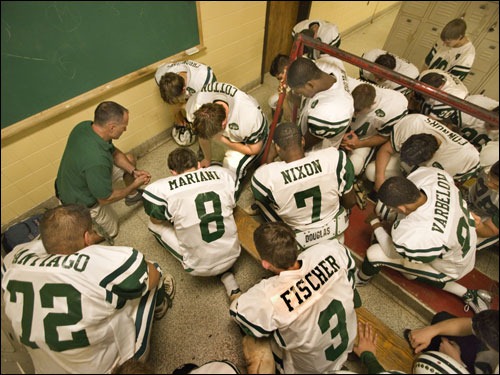
Now my question is – what is the status of prayer when one is watching a TiVo’d recording of a game? Perhaps the game is completed, but one is watching a recording and does not yet know the outcome. Does God, in His infinite wisdom, allow prayer after-the-fact to influence His assistance to one side or the other?
(Perhaps you know of the 1935 gedankenexperiment and paradox by Erwin Schrödinger called Schrödinger’s cat. Schrödinger considered a cat in a box that may or may not be dead, depending on the state of a quantum particle. According to the Copenhagen interpretation of quantum mechanics, the particle is a superposition of states which is not determined until the particle is measured. Schrödinger posited that the cat is both dead and alive until the state is measured.)

Is the state of the game – like a personal Schrödinger’s cat – undetermined until it is discovered by the viewer, so petitionary prayer for a particular team is efficacious? I could not watch the seventh game of the World Series, inconveniently broadcast on a Friday night, so could I pray for one team or another on Saturday evening until I knew the result?

Note that because of the way that digital television works (with additional error correcting signals being transmitted) that there is always a latency with live events – and it is typically around 20-30 seconds for sports broadcasts. (Similarly, with radio broadcasts, there is also latency – if only for the time it takes the broadcaster to formulate words. If you are listening to an Internet radio broadcast, the latency is even greater.) Thus if you just saw a questionable decision by a football referee and the play is under review, your petitionary prayer for the booth to rule one way or another is likely after-the-fact!

Now perhaps the example of sports-related petitionary prayer seems frivolous to you; so consider other examples; the LDS Church (Mormons) officially baptized Anne Frank (and other Jewish Holocaust victims) posthumously – which seems to me to be very much like after-the-fact petitionary prayer.
Let’s go back to the just concluded World Series. Co-blogger Kurk Gayle lives in the Dallas-Fort Worth area, so it is likely that he is a Texas Rangers fan. As you know, after one of the most exciting World Series ever, the Rangers lost to the Cardinals, and I would not be surprised if Kurk is still glum about it. (I notice, at least, that he has not posted since the ignominious defeat.) But if petitionary prayer is efficacious after-the-fact, maybe the problem is that Kurk is not praying hard enough today, tomorrow, and in the coming week for the victory of the Rangers.

Because, there is a paradox here. On the one hand, watching a game on TiVo (if one does not yet know the result) seems just as exciting as watching it live. And praying for one’s team (because one knows they are on the side of truth and justice) seems like an integral part of enjoying the game. But once one knows the result of a game (perhaps because of an injudicious glance at Facebook after the game was over but before one had watched the TiVo recording) prayer seems to be futile.
(I might try to answer this question by appealing to the many-worlds interpretation and claiming that the universe is branching into different timelines, depending on our prayer – but that hardly solves the problem because it only solves the paradox from a solipsistic perspective [my friend who knows the outcome of the game is presumably already in one timeline or another] and further, it is unsatisfying because it means that for every time that God hears my prayer for our team to smash the other guys, one of my parallel identities is having his prayer ignored.)

The paradox of course is amplified when it comes to games on the Sabbath, when one really should not be watching sports in the first place. Why would the One Above have arranged events for the TiVo to appear, if not to allow God-fearing sports fans to better observe the Sabbath?

KJV 400th anniversary news
Some news regarding the KJV 400th anniversary publications:
- The publication of the Norton Critical Edition English Bible King James Version (which I previously reported on here) edited by Herbert Marks and Gerald Hammond-Austin Busch has been pushed back to March 15, 2012. (Since the KJV is considered by tradition to have been published on May 2, 1611, this is still within the anniversary year.)
- Alan Levensen (Oklahoma) has published a somewhat regrettable essay entitled “Ambivalencies: Jews and the King James Version.” The essay largely repeats the facts recited by Leonard Greenspoon (Creighton) in his Jewish Study Bible essay about Jewish influences on the King James Version translation, but then notes that despite the KJV’s influence, it is ultimately not a Jewish translation. Levensen appears to conflate the KJV with the Revised Version (1885) and the American Standard Version (1901); he does not realize the old JPS translation of the Bible was a direct adaptation of the Revised Version.
- Some excellent books have appeared recently in honor of the King James Version. I hope to have time to review them in the future, but in the meanwhile, let me mention two commendable monographs:
- Robert Alter, Pen of Iron: American Prose and the King James Bible
- David Norton, The King James Bible: Short History from Tyndale to Today
- Hannibal Hamlin and Norman Jones, The King James Bible after 400 Years: Literary, Linguistic, and Cultural Influences
- David Lyle Jeffrey, The King James Bible and the World It Made
Shalom Paul’s commentary on Isaiah 40-66
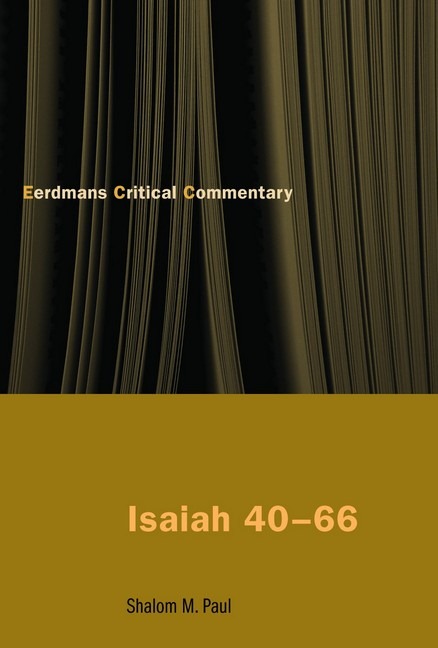 I’m so excited: Shalom Paul’s commentary on Isaiah 40-66 (in English) is scheduled to be released imminently. (Amazon price: $42.84; the Amazon description is mangled and includes the product description for John Oswalt’s commentary [which I consider to be poor.])
Shalom Paul’s English commentary is presumably an adaptation of his two-volume Hebrew commentary in the outstanding (Hebrew University) Magnes Press מקרא לישראל series. (I have not read the Hebrew edition.)
The 2008 Hebrew edition received favorable reviews; Igal German (Toronto) wrote:
Isaiah 40-66: Introduction and Commentary is an updated and extensive exegetical guide to interpreting the Book of Isaiah 40-66…. [It] combines strong scholarship and detailed exegesis of the biblical text. The author contends, on the basis of historical and linguistic criteria, that Isaiah 40-66 should be attributed to an anonymous prophet called Second Isaiah who prophesied in the mid-sixth century BCE, toward the end of the Babylonian exile and the early return of the nation to Israel some 150 years after the prophecies of Isaiah from the eighth century BCE collected in Isaiah 1-39…. Paul examines Isaiah 40-66 through a close (synchronic and plain) reading of the biblical text, offering a thorough exegesis of the historical, linguistic, literary, and theological aspects of the prophet’s composition. The book carefully examines the intertextual influences of earlier biblical and extra-biblical texts, primarily Akkadian and Ugaritic, which shed new light on many of the themes, verses, motifs, and expressions found in the oracles of Second Isaiah. Though the author is interested mainly in synchronic readings, he utilizes modern historical-critical notions in a reasonable manner…. [T]he author also draws on the rich spiritual legacy of the medieval Jewish commentators and their keen analysis of scripture. Paul extensively quotes from Rashi, Kimhi, Abrabanel and others as well. An example of their contribution to interpreting Isaiah 40-66 is the question of identifying the cryptic group that is called to comfort God’s people in Isaiah 40:1. According to some medieval interpreters (among them Rashi, Ibn Ezra, and Kimhi) the addressee of God’s calling is a group of prophets. This suggestion should be seriously considered in light of the exilic prophetic activity (85). Isaiah 40-66: Introduction and Commentary is to be highly praised, especially for its well-written introduction that includes a thorough bibliography (I, 3-80)…. In sum, Shalom Paul offers an excellent commentary on Isaiah 40-66. Indeed, it is a significant contribution to the Mikra Leyisra’el academic project undertaken by Israeli biblical scholars.
and Benjamin Sommer (Jewish Theological Seminary) wrote:
[T]he massive erudition behind Paul’s two-volume work does not weight it down or render it too detailed for practical use…. For almost every verse that appears in this corpus, Paul provides parallels to the use of individual words, phrases, and vocabulary clusters. These parallels come from Sumerian, Akkadian, Ugaritic, Aramaic, Qumranic, and rabbinic literatures, as well as from other passages in the Hebrew Bible itself…. The constant reference to these other literatures gives Paul’s commentary an intertextual, almost midrashic, feel. Yet Paul takes these parallels in a direction that differs significantly from midrash. Through his intertextual mode of exegesis. Paul in effect re-creates the world of discourse in which and through which the prophet under consideration engendered meaning. Paul leads his reader deep into the textual, linguistic, and cultural context of ancient Israel. Thus his approach is intertextual in the correct and narrow (rather than a sloppy and overused) sense of the word: his concern is not only to show us what texts Second Isaiah knew and alluded to in poems but to open up for us the larger sign systems in which Second Isaiah’s poetry functions…. Paul’s lively attention to questions of poetic form, and especially of word play and sound play (e.g., the repetition of sibilant consonants), renders this a fine literary commentary and allows the reader to revel in the plaisir du texte that Second Isaiah so consistently provides.
There is a real dearth of good commentaries on Isaiah – commentaries such as Oswalt’s are ultimately colored by Christological interpretation. Perhaps the best critical commentaries in English to date have been those of Brevard Childs and Joseph Blenkinsopp (volume 1, volume 2, volume 3); but neither of those primarily approach Isaiah as a literary work as Paul reportedly does. Similarly, I cannot think of a contemporary academic critical commentary on Isaiah in English from a Jewish perspective (there are several devotional commentaries on Isaiah, such as those published by Artscroll, Judaica Press, and Soncino.)
Some readers of this blog will know Shalom Paul as the former chair of the Bible department at Hebrew University or as the current chair of the Dead Sea Scrolls Foundations. You may also know him from his , his collected articles, his festschrift, his Studies in the Book of the Covenant in the Light of Cuneiform and Biblical Law (which argues that the Book of the Covenant [Exodus 21:2-23:33] represents a sharp break from other contemporary Near Eastern cultures), or his commentary on Amos (my favorite commentary on Amos by far.)
This looks to be an outstanding commentary on Isaiah for its concentration on the literary features of Isaiah 40-66 and its focus on that a single work.
Bible, literature, translation, and art in a museum catalogue: women’s work for the freedom of slaves, for the rights of all, and for the arts
“I would argue that for a broad variety of art museum exhibitions, reading a well-produced catalogue can be superior to visiting the actual exhibition itself.” So says Theophrastus. And if you agree, as I do, then you’ll want to read the
Souvenir of the Centennial exhibition
or, Connecticut’s representation at Philadelphia, 1876
compiled and written by George D. Curtis.

As a matter of fact, you will not be able to visit the mammoth Centennial exhibition any other way now. Now, it’s 2011. The museum, if you will, was in 1876. It was constructed for the 100th birthday of the USA and was taken down not long afterwards. At the end of this post, you will find links to where to buy or to read for free the work by Curtis. In the mean time, I invite you to appreciate what Curtis does in the way of “the women’s department.” (He writes of this exhibit area in his Part II of his section on the state of Connecticut’s exhibits.)
What it shows is how active American women were in the abolition of slavery and in the equal rights for all citizens especially women and especially suffrage. It also shows already some of the disagreements about the place of women in society, even disagreements among women. The agency of women, just a century in to the new democracy, was not unimportant.
Most of us will probably recognize two names, the names of the ones I’ve put in bold font below. They are Harriet Beecher Stowe and Julia Evelina Smith.
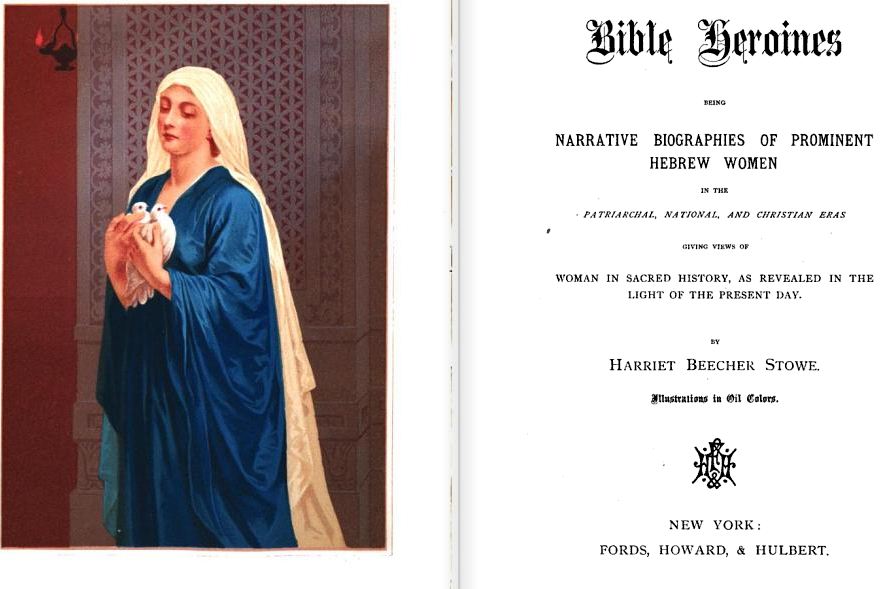
Most of us know Beecher Stowe for her anti-slavery novel Uncle Tom’s Cabin. Fewer of us, however, know of her as a feminist, for her views on the Bible and on biblical womanhood and her life as the daughter of a minister, an egalitarian spouse, and a would-be minister herself had she not become so famous for her literary works. She was also an artist, a painter of oils and of watercolors. She appreciated artwork and incorporated the pieces of others in her books. Below, for example, is one of the front pages of her book, Bible Heroines being Narrative Biographies of Prominent Hebrew Women in the Patriarchal, National, and Christian Eras giving views of Women in Sacred History, as Revealed in the Light of the Present Day. The painting (and the various paintings in the book), Beecher Stowe elaborates on in some detail in the Introduction. It’s one by one of her contemporaries, of England, one Fred Goodall — his painting of Mary the mother of Jesus, to correspond to her chapter on this Bible heroine. (The book is a follow-up to Beecher Stowes’ Woman in Sacred History, which also included biblical women.)
Most of us have heard of Julia E. Smith, because she’s the first woman to translate the entire Bible, by herself. Her Bible shown in the centennial exhibit was published, finally, when she was 80 years old. She had finished it after translating and re-translating, working from the Hebrew, the Greek Septuagint, the Latin Vulgate, and the Greek New Testament. Notice how Curtis identifies her womanly purposes for completing her work and for finally bringing it to publication.
Below, then, is the “Women’s Department” excerpted from the Curtis catalogue. If you read the entire catalogue in its entirety, or if you just go into the next department, into the United States exhibition, then you will find the Bible that Suzanne posted about here, the first American Bible, that one also that was the first published by a woman, Jane Aitken. Women were not strangers in this magnificent museum.
CONNECTICUT’S EXHIBITS.
PART II.The Women’s Department—Exhibition Of Evidences Of The
Skill And Industry Of The Ladies Of Connecticut—Arti-
Cles Both Useful And Ornamental — Art, Literature,
Household Industries, And The Trades Represented—The
United States Building—A Variety Of Interesting Exhib-
Its From The State—The Centennial Envelope Machine—
Iron And Steel Manufacturing—Representation Of The
Fishing Industries—Products Of Connecticut Mines And
Quarries, Etc., Etc.Next to the exhibits in the Main Building and Machinery Hall, Connecticut was most largely represented in the Women’s Pavilion, where the ladies of the State gave an extensive and widely varied showing of their ingenuity and industry. The ladies of the Connecticut Association report that in making the collection they were met by a difficulty, “which proved almost insuperable, of presenting women’s work as a separate exhibit. Women were found engaged in manufactures of almost every description; but in numerous instances their work was so interwoven with the work of the men that it was difficult to procure articles that could be rightfully classed as distinct work. This difficulty presented itself in every department of the Exhibition; and in the fields of art, in particular, many ladies preferred to exhibit their productions in competition with those of men, without permitting sex to come in as a factor in the consideration of the merits of their work. As a whole, in the Women’s Pavilion, as elsewhere, women’s work gave many indications of originality, excellence of execution, mechanical ingenuity, and inventive power.” Mrs. Gillespie, president of the Women’s Centennial Executive Committee, is reported as commenting on the exhibits by the women of the country: “The Exhibition has done an immense good in showing women how many avenues of work are open to them, and in stimulating many to follow where now a few are leading. This is, doubtless, one of its best results; for, although there were, melancholy failures in every department, notably in that of pictures, still, even there, there was enough decided ability, even marked success, shown, to prove that women need not be afraid to take hold of any work, and, working with the persistence of men, compete successfully with men.” However, Mrs. S. J. Cowen, president of the “Women’s Centennial Association of Hartford, who had large experience in obtaining and preparing the exhibits from that section of the State, takes a somewhat different view in her final report of the Centennial work of the association. She writes: “So far as the members of this society have expressed an opinion, it is unfavorable to this unnatural and necessarily incomplete division of the products of labor. . . . They unanimously agree that hereafter work should be judged without refer, ence to the sex of the worker, and hope that by the next Centennial women will be able to exhibit the products of their industry side by side with those of men, asking no favors, and fairly earning any praise they may receive. The tendency of women to painful and elaborate work upon useless objects, which had not even the merit of artistic beauty to recommend them, must have received a check from some of the exhibits in the Pavilion, which were fairly pathetic in their toilfully wrought ugliness.”
Among the Connecticut exhibits, art work and literary productions were noticeably prominent. In the number of books written by women Connecticut was second only to Massachusetts. Unfortunately for the authors, the literary section was placed where the visitor might pass it unnoticed, or, if especially sought, it could not be inspected with any degree of satisfaction. In the number of exhibitors of literary works Hartford took precedence, and Mrs. H. B. Stowe contributed a large number of the books whose popularity has won for her so brilliant a reputation in the world of literature. Prominent among these books was her “Uncle Tom’s Cabin,” a work of years ago, familiar in every household of to-day, honored by translations into European languages, and still further, by the important part it played in educating the North to an appreciation of the evils of slavery. A really remarkable work shown, and one which largely attracted the attention of visitors, was the literal translation of the Bible made by Miss Julia E. Smithof Glastonbury. Miss Smith studied Latin and Greek at school, and years afterward, when studying the Scriptures, she translated the Greek New Testament so as to get the literal meaning of every word. By using the same English word for the same Greek word Miss Smith was satisfied that she obtained a clearer understanding of the text. She next wrote out the Septuagint (which is older than any Hebrew copy extant), and afterward studied Hebrew, with the sole object of rendering the Bible into English from that original tongue. She enjoyed her work, and at intervals made five translations, two each from the Greek and Hebrew, and one from the Vulgate, the Vatican Bible. The translation that was finally printed was issued from the press of the American Publishing Company of Hartford, the Misses Smith paying the entire expense of $4,000 for 1,000 copies. To the surprise of the translator, the work received praise from quarters where it was least expected, and many copies were sold throughout the country. She has been identified with the women’s rights movement for some years, and a peculiarity of her Bible is that the text gives predit to women for acting in many instances where men only are distinctively mentioned in the ordinary version.That Connecticut authoresses have produced other works requiring patient research, and an exactness in writing not demanded in novels or poetry, was evidenced by a “History of Windham County,” written by Ellen D. Larned of Hartford, and histories of Norwich and New London, by Frances Manning Caulkins of the last-named city. Mrs. E. G. Barrett of New Haven, Rose Terry and Lucy C. Bull of Hartford, contributed volumes of poems, the latter sending a book of poetry for the little folks. Mrs. Julie P. Smith of Hartford, whose novels are yearly growing in popularity, exhibited nine volumes; and Mrs. “W. L. Gage of Hartford, a charmingly written work, “Helen on Her Travels.” The largest contributor in the department of literature was Mrs. Sigourney of Hartford, whose thirty-four volumes gave proof of the versatility and earnest work of the authoress, rewarded, it it gratifying to note, not only by the praises of her hosts of readers, but by fair remuneration for her labor. The above are mentioned without any purpose of discrimination, but merely as illustrations of the varied character of the works. The full list of authors and their books will be found at the close of this chapter.
Art was represented by numerous paintings and water-colors, a few by professional painters, but the majority by amateurs. The art section included two fine oils, the “German “Wedding” and the “Valley Farm,” both by Hartford amateurs. Mrs. James H. Brush of Greenwich, exhibited two good landscapes in oil; Mrs. Farnham of Hartford, the “Camp;” Miss L. P. Graves of New Haven, two excellent flower pieces—pond-lilies and fuchsias; Miss A. Pomeroy of Hartford, pond-lilies; Miss Rebecca T. Porter of New Haven, a well executed interior, in oil; and Mrs. Henry Webster of Hartford, a study of game. The display of watercolors was larger than that of oil-paintings, the artists exhibiting, as a general thing, studies of fruits and flowers. Mrs. C. M. Badger of Madison, exhibited two pretty works, apple blossoms and night-blooming cereus; Mrs. W. C. Badger of New Haven, a volume of wild flowers, drawn and colored from nature; Mrs. Mary H. Burton of Hartford, a charming grouping of autumn field flowers; Mrs. H. B. Washburn of East River, a study of apples; Mrs. S. E. Barney, New Haven, hollyhocks and fleur de lis; Mrs. Warner of Hartford, a charming bunch of daisies, while Mrs. H. B. Stowe established her ability with the brush as well as the pen, by a study of yellow jessamines. Others essayed a different class of subjects: Mrs. Corson of Hartford, a street scene in Belgium (a charming bit of coloring); Mrs. L. B. Newcomb of New Haven, illuminations in water-colors; Mrs. G. W. Hooker of that city, an illuminated design; and Miss Minnie G. Lockwood, text, illuminated border. The decorative furore prevailing during the Centennial year was manifested in the exhibition of several beautifully decorated vases, fans, tiles, shells, etc., by Miss H. D. Andrews, Miss Hodge, and Miss Terry of Hartford, Miss A. H. Bradford of New Haven, Miss Dunning of Canaan, and others, the last-named exhibiting a prettily painted glove-box. Colored photographs were shown by Miss F. M. Griffin, a young lady who achieved a high reputation in Hartford for that delicate artistic work. Mrs. 0. H. Whitmore of nartford, exhibited a finely ornamented glass screen, which was given a prominent place in the art section. In addition to water-colors, Miss Tuthill of Hartford, had on exhibition two excellent pencil sketches, “Venus de Milo ” and “Marble Madonna of Milan;” and Miss C. Collins, a fine pen-and-ink etching, in which the effects were capital. A belle of ’76 and portrait of a boy were the subjects of two well-executed crayons by Miss Pec’.c of Hartford.
Classed with the pictures were photographs of the Russell Library at Middletown, and Memorial Chapel at Indian Hill, contributed by Mrs. Samuel Russell of Middletown, and three colored photo, graphs, two exterior, and one interior, of the Church of the Good Shepherd at Hartford, the latter showing the Easter decorations. These were contributed by Mrs. Samuel Colt. The Memorial Chapel, Berkeley Divinity School at Middletown, was also represented by photographs, presented by Mrs. Dr. Mutter of that city. A large photograph of the New Haven Orphan Asylum was supplemented by a chart which gave a short history of the institution, in three languages.
Embroideries, and work of a similar nature, were represented by a beautiful specimen of ecclesiastical embroidery, an altar cloth, by the ladies of St. John’s Guild, New Haven (this received an award); a rich specimen of tapestry-work, a worsted rug, by Mrs. T. R. Pickering of Portland; a child’s creeping rug, by Edith Beach of Hartford, and a mat of pansies in wool, by Mrs. Candee of New Haven.
In the Pavilion the illustrations of women’s handiwork in the trades was meager, being limited to some very creditable specimens of printing, by Miss Addie Pickering of Portland, and a number of brass bird-cages made by the women in the employ of Hendryx & Bartholomew of Ansonia. In other branches of the exhibition, however, it was represented by specimens of etching and engraving, from the Meriden Britannia Company; plain and ornamental stationery from the Plimpton Manufacturing Company of Hartford; two hundred specimens of braid from the Novelty Works, Hartford, and metallic elastics and armlets from F. Armstrong, Bridgeport. Carpets, woolen cloths, silks, clocks, and many other articles shown by Connecticut exhibitors, were in part the results of women’s labor, but so intermingled was their work with that of the men, that in seeking to give credit it would be difficult to establish the division line.
The charitable associations of the State conducted by ladies were represented by reports from Hartford, New Haven, Middletown, Bridgeport, and Stamford, showing the origin of the several societies, their progress, and their systems of operation. However, these were of slight practical benefit, for amid the attractions of the Pavilion, and of the great Exhibition itself, few visitors would have had an opportunity to examine the reports with the care merited, even if they had desired to.
The Connecticut exhibits in the Pavilion were the subject of earnest care by Mrs. T. R. Pickering of Portland, who gave her best services to their proper display in the space allotted to Connecticut. Each article was readily distinguished by a blue card placed upon it, bearing the name of the State, the miscellaneous articles being shown in the Connecticut case, the paintings and drawings in the art section, and the books in the library. Upon the close of the Exhibition, the articles were carefully packed and returned to their owners, and it is worthy of remark that in no instance was there occasion for complaint of injuries sustained in the shipment to and fro, or during the many weeks that the articles remained in the Pavilion.
The following is a list of the exhibits by the ladies of Connecticut:
Amateurs, Hartford: Miniature on porcelain; two painted fans; two painted doorstones; Turin, a water-color; German Wedding, an oil painting; Valley Farm, an oil painting; Italian Peasants, two water-colors.
Miss II. D. Andrews, Hartford: Chocolate pitcher, painted; four earthen tiles,
painted.
Miss Carrie Atwater, New Haven: Paper cut ornamentally with scissors.
Delia Bacon, New Haven: Volume—Tales of the Puritans.Mrs. C M. Badger, Madison: Apple-blossoms and Night-Blooming Cereua, watercolor.
Mrs. W. C. Badger, New Haven: Volume, Wild Flowers, drawn and colored from Nature.
Mas. E. G. B. Barrett, New Haven: Volume of poems.
Mrs. 8. E. Barney, New Haven: Hollyhocks, water-color; Fleur-de-Lls, water-color. Edith Beach, Hartford: Child’s creeping rug.
Mas. J. S. Beach, New Haven: Nine numbers of “Spirit of Seventy-Six.”
Miss Catherine E. Beecher: Nine volumes: The Housekeeper’s Manual, Housekeeper and Health-keeper, Physiology and Calisthenics, Educational Reminiscences and Suggestions, Letters to the People, Principles of Domestic Science, Religious Training of Children, The Bible and the People, An Appeal to the People.
Miss C.collins, Hartford; Pen-and-ink Etching.
Mrs. Samuel Colt, Hartford: The Church of the Good Shepherd at Hartford, represented by three colored photographs, two exteriors and one interior, the latter showing the Easter decorations.
Miss n. M. Cooks, Hartford: Volume, “Gold Threads.”
Rose Tesrt Cooks and Annie T. Slobson, Hartford: Compilation entitled “Easter Lilies.”
Mrs. A C. Corson, Hartford: Street Scene in Belgium, water-color.
Martha Dat, New Haven: “Literary Remains.”
Miss Dunning, Canaan: Glove-box, painted; Tiles, painted.
MissE. W. Davenport, New Haven: Heliotropes, water-color, on silk; Clematis and Cardinal Flowers, water-color; Tile, painted. Silhouette. Mrs. Farnham, Hartford: “Camp, oil-painting. Mr^. W. L. Gage, Hartford: Volume, “Helen on Her Travels.” Miss F. M. Qripmn, Hartford: Colored Photographs.
Miss L. P. Graves, New Haven: Pond Lilies, oil painting; Fuchsias, oil painting; Caudles, painted. Miss Goodwin, Hartford: Specimen Autumn Leaves.
Mrs. Hawks, Hartford: Two Volumes, Memoir of Mrs. Van Lennep, Memoir of Brskine J. Hawes. Miss Mary Hillhouse, New Haven; Two Volumes. Lydia Huntley, Hartford: Two Volumes.
Mns. G. W. Hooker, New Haven: Illuminated deBign, water-color.
Mrs. Hodge, Hartford: Shell, painted.
Mrs. B. E. Hooker, Hartford: Two Volumes.
Miss Mary Keep, Hartford: Ear of Corn, water-color.
Ellen D. Larned, Hartford : History of Windham County, 1 vol.
Miss A. P. Lloyd, Hartford: Receipt for ” ‘Lection” Coke, 1 vol.
Miss Minnie O. Lockwood, New Haven: Text, Illuminated border, water-color; Grasses and Lobelia, water-color.
Mrs. Dr. Mutter, Middletown: Memorial Chapel, Berkeley Divinity School at Middletown, represented by two photographs.
Mrs, L. B. Newcomb, New Haven : Three Illuminations, water-colors.
Mrs. II. K. Olmstku, Hartford: Three water-colors.
Miss Peck, Hartford: Belle or'”16,” crayon; Portrait of boy, crayon.
Miss Addie Pickerins, Portland: Speciuieus of Printing.
Mrs. T. K. Pickering, Portland: Worsted Kug, tapestry-work.
Miss Anna Plato, Hartford: 1 vol. Proeuand Poetry.
Miss Ellen Pomeroy, Hartford: Pond Lilies, oil painting.
Mils. Porter, Hartford: Portrait of Italian woman.
Miss Rebecca T. Porter, Now Haven: Interior, oil painting.
Miss Rose Porter, New Haven: Five Volumes.
Mrs. Samuel Hussell, Middletown: The Russell Library at Middletown, and Memorial Chapel at Indian Hill Cemetery, represented by photographs.
Miss F. M. Sherman, New Haven: Madonna and Child, lithograph.
Mrs. Sioourney, Hartford: 37 Vols.—Huntley &, Hyde, Connecticut Forty Years Since, Poems, Si^ounicy’s Poetical Works, Gleanings, Daily Counsellor, Man of Uz, Western Homes, Post Meridian, Letters of Life, Zinzendorf, Letters to Mothers, Letters to Young Ladies, Selections from Various Sources, Poems, Poems for the Sea, Water-Drops, Pleasant Memories, Scenes In My Native Land, Poems, Pocahontas, Letters to My Pupils, Examples of Life and Death, Memoir of Mrs. II. M. Cook, Faded Hope. Myrtles, Select Poems, Whisper to a Bride, Olive Buds, Lovely Sisters, Transplanted Daisy, Poems, Weeping Willow, Biography, Boys’ Reading Book, Girls’ Reading Book.
Mrs. Julie P. Smith, Hartford: 7 Vols., The Widow Goldsmith’s Daughter, Chris and Otho, Shiftless Folks, The Widower, Ten Old Maids, Courting and Farming, the Married Belle.
Miss Julia E. Smith, Glastonbury: New translation of the Bible, literal.
Mrs. Stevens, New Haven: CecropiaMoth, painted 70years ago, water-color.
Ladies Of St. John’s Guild, New Haven: Ecclesiastical Embroidery (altar cloth).
Mrs. H. B. Stowe, Hartford: 30 Vols. In uniform binding, and special case, viz.: The May Flower, Uncle Tom’s Cabin, Pearl of Orr’s Island, Agnes of Sorrento, Dred, a tale of the Dismal Swamp. Minister’s Wooing, Queer Little People, Pussy Willow, Old Town Folks, Old Town Fireside Stories, Pink and White Tyranny, Little Foxes, Household Papers, Lady Byron Vindicated, My Wife and I, We and Our Neighbors, Palmetto Leaves, Betty’s Bright Idea. Mrs. Stowe also exhibited a water-color (jessamine).
Miss Jennie Terry, Hartford: Painted Fan.
Rose Terry, Hartford: Poems, 1 vol.
Miss Tuthill. Hartford: Wreck, water-color: Sketches,water-color; Venus de Mllo, pencil sketch: Marble Madonna of Milan, pencil Bketch. Mrs. Mary Spring Walker, Hartford: Five Volumes. Mrs. Geo. Warner, Hartford: DalBles, water-color. Mrs. H. B. Washburn, East River: Study of Apples, water-color. Mrs. Henry Webster, Hartford: Game, oil painting. Mrs. O. II. Whitmore, Hartford: Glass Screen.
THE UNITED STATES BUILDING.
The entire Souvenir of the Centennial exhibition can be found here
http://openlibrary.org/books/OL24430908M/Souvenir_of_the_Centennial_exhibition
and here
Samuel Beckett, the Resistance, and the Jews
The latest issue of the Forward has a fascinating article about Samuel Beckett and the Jews. Here are a few quotes from the article, which is well worth reading in its entirety:
Like his mentor, James Joyce, Beckett was unusually philo-Semitic among European modernist writers, and he joined the Résistanc e… soon after Joyce’s Jewish friend and amanuensis, Paul Léon, was arrested in Paris (Léon would later be murdered in Auschwitz)….Taking us from wartime to the early part of the author’s great achievements, Cambridge University Press has just published The Letters of Samuel Beckett: Volume 2, 1941–1956 following the first volume in 2009. This adds to insight gleaned from Samuel Beckett’s German Diaries 1936–1937, released in June by Continuum…. Together, these books underline how profound Beckett’s ties were with the Jewish people. Some literary studies have suggested how, as Irish writers in self-imposed exile, Beckett and Joyce identified intellectually with Jews as people of the Diaspora. Moreover, “otherness,” a sense of apartness and singularity, was a motivating force in both writers’ work, as explored in such studies as Marilyn Reizbaum’s James Joyce’s Judaic Other (1999) from Stanford University Press. Yet Beckett’s attraction to Jewishness was more than just metaphoric otherness — it was inspired by family unity.
Beckett’s beloved Aunt Cissie married a Jewish art dealer, William Abraham Sinclair, known as “Boss.” Following Boss’s death, in 1937, his brother Harry Sinclair sued a Dublin writer, Oliver St. John Gogarty, for libel after passages in a book referred to him and Boss as “Two Jews in Sackville Street” and to their grandfather as an “old usurer.” Beckett, quiet and retiring by nature, made a special trip to Dublin from Paris, where he was by then based, to testify on behalf of the plaintiffs. Beckett was fond of Sinclair, and writes to a friend about Boss, “His last words to me were an apology for his poor company.” Beckett added in a letter to a friend, condemning St. John Gogarty and idle bystanders alike, “There are limits to scurrility, & to cynical laissez-faire.”
This moral statement marks an emotional turning point in Beckett’s life. He took a strong public stance, contrary to his own withdrawn and diffident nature, soon after his first exposure, in 1936, to Nazi Germany. Writing from Hamburg to a friend, he noted: “All the lavatory men say ‘Heil Hitler.’” …
Beckett was drawn to Germany’s Jews, such as the eminent Polish-born art historian Rosa Schapire, who would escape to England in 1939. With typical prescience, Beckett wrote to Irish poet Thomas McGreevy in 1937 that the Nazi “campaign against ‘Art-Bolschevism’ is only just beginning.” To see the paintings of the once acclaimed German-Jewish modernist painter Max Liebermann, Beckett had to obtain permission to visit the Museum of Hamburg basement where they were then hidden from view….
In 1938 he wrote to a friend and fellow philo-Semite, Arland Ussher, author of The Magic People: an Irishman Appraises the Jews (1951). The book likens Ireland to Israel for having a “sense of some special destiny, which enables her to bear her discomfitures with fatalism and secret pride” and praises Jews for holding firm to the belief that “tachlis (purpose) and not tragedy… is the meaning of life.” Beckett informed Ussher of a lunch in a London restaurant with a group that included the “green-foaming” Irish doctor, Edward Morrison, whose “rather anti-Semitic” comments made Beckett flee….
Selah
The question is whether or not it is fair to leave “selah” to the footnotes as the NIV 2011 has done. The conversation started here with Rod Decker who wrote in defense of the NIV 2011,
Selah is a bit mysterious, but probably is a musical notation that may have indicated a rest/pause. When reading Scripture orally, it should never be read and it should certainly not be made into a matter of exegetical or homiletical significance. (I’ve often heard it used as an indication that some statement is particularly significant: “think of that!” is the usual idea that I’ve heard.) To do so would be a bit like singing these actual words in the Hallelujah Chorus: “Hallelujah! rest Hallelujah! rest Hallelujah! rest Hallelujah! rest Hallelujah! rest.” I doubt Handel would be pleased!
Jim Hamilton responded here, saying,
When I read an ancient text from a different culture, I don’t want to look into a linguistic mirror. I would like for that text to feel a little foreign, to feel a little ancient. I don’t want it only telling me what I already know. This word Selah occurs over and over all across the Psalter and into Habakkuk 3. One of the challenges of reading and understanding the Bible is paying attention to all the things the Bible says that we don’t understand, studying those things, and trying to come to a place where we begin to learn what the biblical authors were talking about and how they talked about it.
In a comment on this post Hamilton writes,
The presence of something in the footnotes is NOTHING like it being in the text. Most people don’t read the footnotes at all, and if they do, they probably assume that what’s in the text is what matters and what’s in the footnotes is there because the editors and translators have decided it doesn’t really belong in the text.
This is fascinating since the translators of the ESV have been adamant that having “brothers and sisters” in the footnote for adelphoi should be enough for women to consider themselves included in the common form of address found in the epistles.
Rod Decker responded to Hamilton with this,
Then you say that the NIV has “removed” Selah from the text. But that isn’t the case at all. Every instance is clearly marked, both in the Psalter and in Hab 3. It is not presented in the notes as a textual variant, suggesting that it isn’t original. I don’t have any access to the mind of the CBT as to why they’ve done this. Perhaps they’ve discussed it somewhere. My assumption, however, is that they have acted consistently with the normal view that it is a musical notation—one that was relevant when originally sung, but which serves no equivalent function in English translation. Rather than simply delete it, however, they have been careful to maintain it since it is part of the text. They certainly do not “remove it from consideration.” By putting it in the note they encourage what I would consider a proper practice: not reading ancient musical notation when reading the Psalter! You obviously disagree, but let’s not make accusations about tampering with the text when that’s not the case at all.
Perhaps the most significant and disturbing feature of this exchange is found in a final comment by Jim Hamilton,
I don’t think it’s extreme to conclude that a translation that removes a word from the text to the footnotes has failed to present the text faithfully.
I think the CBT should reverse itself and put Selah back where it belongs. If they won’t, it would seem to me that a discussion about Article 10 of the Chicago Statement is warranted.
I was raised in a Christian community which practiced excommunication, and as I read these words, I feel my chest tighten and my heart beating faster. This statement comes across as a very thinly veiled threat. Yikes.
There are a few additional considerations. This concern about the NIV 2011 has as its focal point, 1 Tim. 2:2, and whether women can exercise authority in the church. This puts all women in a rather unhappy circumstance as the focus of such immoderate dialogue.
A second consideration is that the Latin Vulgate did not include selah in the text. I am not aware of whether it has been added to the recent revisions. From what I have studied, it seems that Pagninus was the first translator to add selah into a translation. I now ask myself if the Vulgate would also be labeled “unfaithful,” or does Hamilton already regard it as such.
Museums as art-lite
Do art museums really foster understanding of art? I wonder.
If you’ve ever bought a CD or music download from Amazon, you know that Amazon offers 30-second snippets of recordings to sample before downloading. Imagine listening to Beethoven’s Ninth Symphony that way – each of the four movements probably has its own track, so our hypothetical user would finish sampling it in two minutes.
Similarly, if you’ve used the “look-inside” feature at Amazon, you know that a user can read a few pages from a book to see if she want to buy it or not. Imagine reading War and Peace that way – since Amazon limits the number of “look-inside” pages a user can display, our hypothetical user would finish sampling it in just a few minutes
Now, we probably would not claim that our hypothetical user had really experienced Beethoven’s Ninth (which usually requires 70+ minutes) or War and Peace (which usually requires 20+ hours). Sure, she may have picked up a slight understanding of the symphony or novel, but she had not really experienced it, and we would consider this inadequate.
But somehow, we tolerate analogous conditions when we visit an art museum. We rush through the museum, as if we were riding a bicycle. There may be a several hundred or even more than a thousand paintings on display at a large museum, but we think it is reasonable to “finish” the museum in a few hours. How did we get to this point? Sure, we may have picked up a slight understanding of some paintings, but we have not really experienced it, and we should consider this inadequate.

I thought about this while reading twin sets published by Tianjin People’s Fine Arts Publishing House in 2008 on the 清明上河圖 – The Riverside Scene at Qingming Festival scrolls– the “Mona Lisa” of China. Each book set features a bilingual beautifully illustrated volume explaining the artworks, and then a reproduction of the scroll that folds out. The first book set covers the original Song-dynasty version painted by Zhang Zeduan (1085-1145) in the (Beijing) Palace Museum, the second book set covers on the Qing-dynasty version (1737) held by (Taipei) National Palace museum. And the reproductions of the scrolls are beautiful – the Song-dynasty scroll is reproduced at 100% size and the Qing-dynasty scroll (which is quite a bit larger) is reproduced at about 80% size.

Because of the fragility of these pieces, they are only sometimes on display. When they are on display you can count a half-day wait to see them. Wait periods of 4 hours in line to see them are not uncommon.When you finally get to the front of the line, you’ll only be pushed along in a crush of people. Worse, the works are long and skinny (the Soon-dynasty version is 10 inches by 17 feet; the Qing-dynasty version is 12 inches by 37 feet) and it is all about the detail. (The Qing-dynasty version is so detailed that it took five artists to complete).

The scrolls are quite important because they feature unusually accurate depictions of day-to-day lives in for people of a broad variety of social classes, ages, and occupations in the Song, Ming, and Qing dynasties. It has long been recognized as a primary source for understanding Chinese history (see, for example, Valerie Hansen’s essay.) More than 4000 individuals are depicted in the Qing-dynasty scroll – this is not a work that can be appreciated in a minute or two – it demands a full day or more of study.

The volumes I was re-reading today, it seems to me, brought me far closer to the scrolls than actually viewing them. (For online glimpses of the scrolls, look here or here or here.)
Now, you may think this is an extreme case – but I claim that it is extreme only in degree, not in type. I would argue that for a broad variety of art museum exhibitions, reading a well-produced catalogue can be superior to visiting the actual exhibition itself.
So what exactly is happening at the museum? I do not think it is art appreciation. Instead it may serve different functions:
- A social function (going to the museum with friends, or to meet people, etc.)
- For personal satisfaction (knowing that one has seen a famous artwork with one’s own eyes.)
- Bragging rights
- To hope to catch an aspect of the work, even though one can’t hope to be impressed by all or even most of the aspects associated with the work.
Now clearly, there many times when a catalogue just will not do – after all, no matter how good the photography and printing is, it never exactly matches the color of the original, and three dimensional aspects of art (thing about van Gogh’s brush strokes) are lost (although one of my favorite art books in my personal library, Harry Garner and the Asia Society’s amazing four volume Chinese Art in Three Dimensional Colour uses 180 ViewMaster reels to present a three dimensional view of artwork – you can get a two dimensional partial glimpse here.) Detail is lost in a reproduction – and so is the sense of awe one gets from large works (certainly, seeing a picture of the Giza pyramids hardly compares to seeing them in person.)
But it seems to me that modern museums are so focused on crowd management that often their education mission takes second place. And I must confess – as a regular museum-goer – that many has been the time that I reviewed a catalogue of an exhibition that I saw – and I found myself wondering if I had actually seen the piece in person or not. The demands of seeing a hundred pieces or more (for example, in a large, crowded exhibition) in an hour and a half strained my memory, and it was only when I reviewed the catalogue that I actually found myself actually integrating and understanding what was going on in the exhibition.
(This is an ongoing post in a series on simulacra versus originals – see here for an earlier post)
Jewish Annotated New Testament: Hey Jude
In honor of Tim’s study of the Book of Jude (here and here), below is the Oxford Jewish Annotated New Testament introduction and annotations to Jude.
Other links: I have previously mentioned the Jewish Annotated New Testament here and here. The Baker Book House blog discusses it here.
The study Bible uses the NRSV translation; here is NRSV Jude.
For added materials, the study Bible uses a sans serif font, so I have tried to capture that by using Arial.
The notes use standard references for Biblical books (Gen=Genesis; Lev=Leviticus; Num=Numbers; Ezek=Ezekiel; Dan=Daniel; Mk=Mark; Lk=Luke; Rom=Romans; 1-2 Cor=1st and 2nd Corinthians; 1 Cor=1 Corinthians; Gal=Galatians; 2 Thess =2 Thessalonians; 2 Pet=2nd Peter). Less familiar abbreviations are 1 En=1 Enoch; Ps1QS=Sefer Hayahad or Rule of the Community from Qumran Cave 1; Gk=Greek; Heb=Hebrew; T. Moses=Testament of Moses; Tg. Ps.-J.=Targum Pseudo-Jonathan. Translators’ note g to is to verse 7 unnatural lust and states “Gk went after other flesh.”
———————————————————————————————————————-
THE LETTER OF JUDE
Author and Date
The last letter of the New Testament claims to be written by Jude (or Judas) "brother of James." Mark 3.6 lists both Judas and James as brothers of Jesus. By the second century, Judas Didymus Thomas (Didymus and Thomas meant "twin" in Greek and Aramaic, respectively) was associated with extra-canonical documents such as the Gospel of Thomas and Acts of Thomas (the latter sees him as Jesus’ twin brother; e.g. 11, 23, 45). By referring so obliquely to a Judas who may be Jesus’ brother, this letter’s authority may have been attempting to reclaim the figure of Jude from other Christian groups who claimed his authority. some scholars suggest that the epistle may actually have been written Jesus’ brother in the 50s. Others insist that the letter is later (perhaps early second century) and pseudonymous; the reference (v. 17) to "the apostles" as established authorities suggests institutional hierarchies already in place.
Context
The letter warns of immoral "intruders" who laxity challenges institutional authority. Echoes of Paul’s opponents in Corinth (see 1-2 Cor) and Gnostic libertine groups suggest ongoing conflicts over how to understand God’s gift of salvation from sin ("grace," v. 4). Some Christians taught that, thanks to God’s salvation, they were no longer bound to earthly authority and morality. Thus they could not imperil their salvation by any action, since spiritually they were safe. It is also possible that vague and stereotypical accusations of "licentiousness" rhetorically echo prophetic literature, which equated sexual license with impiety generally (see, in a well-known passage, Ezek 16).
Cultural Influences
The letter draws heavily on popular, late Second Temple Jewish cosmic narratives (e.g., 1 Enoch) to shape its understanding of the moral order of the universe. The Torah was elaborated in this period by creative narratives filling in the words and deeds of the patriarchs and great leaders of the Israelites (for instance, in Jubilees, which consists mostly of instructions to Moses from an angelic presence on the mountain at the time of the giving of the Torah.) The author refers, for instance, to a story of the angel Michael and the devil battling over Moses’ corpse. Particularly the focus on angels as historical and moral agents (vv. 6, 8-9) ties this letter to patterns of thought common among first-century Jews. The vast collection of stories known as 1 Enoch, cited directly in v. 14, created an elaborate angelology and promoted apocalyptic expectations. This book interpreted the "sons of God" in Gen 6.2 as fallen angels whose interactions with humanity initiated a division between godly and godless humans, which would last until the end of the world. The author of Jude couples this Jewish apocalyptic worldview with the more stabilizing "predictions of the apostles of our Lord Jesus Christ" (v. 17), thereby linking it to Christian tradition. Nonetheless, the prophetic language and angelic outlook of this letter attach it closely, almost intimately, to the Jesus movement’s Jewish roots.
The author of 2 Peter used substantial portions of Jude, particularly the idea that present-day religious divisions are simply the latest act in a cosmic drama pitting the pious against their devious and immoral opponents. Jude and 2 Peter remain certain that, as in the past, present, and future, participants in this struggle will receive appropriate rewards and punishments.
Notes
1-2: Salutation. Jude (Heb "Yehudah"), lit. "Jewish man" or "Judean," the name of several NT figures, including Judas Iscariot (Mk 3.19) and another "Judas" who, along with James, is listed as one of the brothers of Jesus (Mk 6.3). Lk 6.16 and Acts 1.13 refer to "Judas son of James"; although this phrase is normally understood as "son of James" it could also be translated as brother of James, if James is a sufficiently well-known figure. The letter writer refers to himself only as the servant (lit. "slave") of Jesus; yet since James was well known as "the Lord’s brother" (Gal 1.19) and the leader of the Christians in Jerusalem (Gal 4; Acts 15), it is likely the author is also indirectly claiming to be Jesus’ brother. Beloved … kept safe … love, the standard letter salutation is expanded with blessing and prayers for well-being of the recipients.
3-4: Reasons for the letter. An otherwise commendable community must be warned against devious intruders. The community is "saved" from being ungodly and from licentiousness, but also for the faith … entrusted to the saints. Salvation we share, communal salvation was a hope shared in this period by Jews (whose covenant bound them through history and followers of Jesus (who understood God’s saving acts as binding them together as a new people.) Long ago … designated for this condemnation, as in many apocalyptic communities, like that at Qumran (which divided humanity into "children of light" and "children of darkness," 1QS 1.9-11), humanity has already been divided into camps of saved and condemned. Licentiousness, accusations against the intruders are vague but suggest sexual immorality.
5-7: Disobedience is punished. Reminders of divine punishment from sacred history; cf. 2 Pet 2.4-6. 5: Destroyed those who did not believe, see Num 14.35. 6: And the angels, refers to common legends of the “fall of angels” based on Gen 6.1-4 (see Introduction). 7: Sodom and Gomorrah, Gen 19:4-11, ties disobedience to licentiousness and fiery punishment. Although this passage has traditionally been take as a condemnation of homosexuality, it may in fact be a further denunciation of unhealthy spiritual practices; unnatural lust, Gk “sarkos heteras,” “other flesh” (see translators’ note g) referring to those who had, or wish to have, intercourse with angels. In the Tanakh, the “sin of Sodom” was seen as injustice and economic exploitation (e.g., Ezek 16.49).
8-13: Accusations against intruders. 8: Dreamers might imply that the false teachers have replace apostolic authority (see v. 17) with personal visions and revelation. Glorious ones (or “glories”), possibly angels, understood as intermediaries (e.g., Dan 9.20-22) between the divine and human realms, and conveyers of insight, moral exhortation, and steadfastness among Second Temple Jews. 9: Michael contended with the devil, the story of Moses’ body probably drawn from the T. Moses, an incomplete text giving Moses’ last words to Joshua. As it stands the text does not depict the assumption, that is, taking Moses bodily into heaven. The legend that the angel Michael and the devil had fought over Moses’ body has no known clear source. It is used here to combine references to good and bad angels (see vv. 6,8) with overall concern for authority, morality, and truth. 11: Three villains from the Tanakh: Cain, fratricide (Gen 4.1-6), also considered in Jewish midrash (Tg.Ps.-J.; Gen 4.1) a son of Eve and the devil; Balaam (Num 22), a false prophet; Korah (Num 16), a rebel against Moses. 12-13: These intruders are selfish blemishes, fruitless, destructive, and misleading; cf. 2 Pet 2.17-18. Love-feasts, eucharists that may have included meals for the community (cf. 1 Cor 11.20-21); they were presumably intended to increase the bonds of love in the community. Twice dead, those baptized who have fallen away; they have died once in baptism (cf. Rom 6.3), and again by betraying their faith.
14-19: Intruders foretold. 14: Enoch, descendant of Adam (Gen 5:18-24); his prophecy comes from 1 En. 1.9. Jude takes “the Lord” to be Jesus. 17-18: Predictions of the apostles, otherwise unattested (though perhaps meaning those such as 2 Thess 2.3); the last time reinforces the author’s apocalyptic world view (cf. 2 Pet 3.3).
20-23: Exhortation. The recipients should hold firm, trust in their reward, and keep those wavering from following the defiling teaching of the enemies. 20: Faith, the teaching of the community, not a relationship of trust. Pray in the Holy Spirit, perhaps a reference to the worship practice of ecstatic utterance of words presumed to be from God (cf. 1 Cor 12.3,10). 21-22: Mercy … eternal life, the love of God as expressed in the compassion of Jesus brings the believers into the kingdom (eternal life, the life of God). Have mercy, show mercy as you are yourselves shown mercy.
24-25: Doxology. An extended, concluding praise of God (cf. Rom 16.27). Without blemish, language of sacrifice, in which both those serving in the Temple (Lev 21.17-18) and the offered animal (Lev 22.20-21) must be free from defect. God … Savior, through Jesus Christ, God saves by the agency of Jesus; the text may reflect views of the status of the messiah that do not yet see him as divine.
N. T. Wright’s translation philosophy: “Kingdom New Testament”
 N. T. Wright gives his translation philosophy in the Preface to his new single-volume Kingdom New Testament. What do you think of Wright’s philosophy towards translation? Is this a volume you would want to read?
——————————————————————————————————————–
The first thing that happened in the life of the church was translation. On the day of Pentecost, God’s powerful wind swept through Jesus’s followers, filling them, like the sails of a great oceangoing sailing ship, so that they could take God’s good news to the ends of the earth. And they found themselves speaking other languages, so that everyone in the crowd could understand.
Part of the point of Jesus’s message, after all, is that it’s about God coming to people where they are, not sitting back sternly and waiting for them to come to him. Not for nothing does John call Jesus “the word of God.” There’s no point speaking a word that nobody can understand.
So right from the start, they translated. Sometimes it happened, as at Pentecost, by the direct action of the holy spirit. Mostly, though, it was through people eagerly turning the message into other languages. Much of the time, Jesus himself spoke Aramaic, an updated dialect of Hebrew, but the gospels were written in Greek. Greek was everybody’s second language at the time, a bit like English in many parts of our world today. So, since the message was designed to be good news for everyone, not just native speakers of one language, it was important to translate it. Once begun, the process continued.
It took fifteen hundred years for the whole Bible to appear in English, but once that had happened – particularly through the work of one of my lifelong heroes, William Tyndale (d. 1536) – the idea caught on quickly. Several translations appeared during the sixteenth century, culminating in the King James (“Authorized”) Version at the start of the seventeenth. And in the twentieth century, too, there have been several new English versions. some have been quite strict translations, almost word for word; others have been paraphrases, trying to convey the message in a looser, less formal way.
Two questions, then. Is this new version really a translation, or a paraphrase? And why do we need yet another one?
It’s a translation, not a paraphrase. I have tried to stick closely to the original. But, as with all translations, even within closely related modern European languages, there are always going to be places where you simply can’t do it word by word. To do so would be “correct” at one level and deeply incorrect at another. There is no “safe” option: all translation is risky, but it’s a risk we have to take.
This is particularly so when the language in question is, in the technical sense, “dead.” Nobody today speaks first-century Greek, so we can’t simply phone a native speaker and ask what is meant by a particular phrase. Even if we could do so, there’s no guarantee that the person we called would necessarily understand all that a New Testament writer had put into a word, phrase, or sentence. The New Testament, after all, is telling a story which is deeply rooted in the ancient scriptures of Israel. Often its key technical terms mean something more like their equivalents in Hebrew than their regular usage in secular, non-Christian Greek.
Greek often goes quite easily into English, but not always. A couple of examples may help, one about little words and one about big ones.
Greek often uses little words to join sentences together; English often makes do with punctuation. (That last sentence is a good example: I could have written “but English often makes do with punctuation,” but the semicolon does the job more elegantly.) St. Paul, in particular, uses the little word gar a great deal to connect his sentences, and English version often translate it as “for” in the sense of “because.” But people today don’t often use the word “for” in that way. It sounds formal and stilted, especially if you repeat it over and over as Paul does. People don’t say it much in conversation, and a lot of the New Testament is more like conversation than like a great literary work. So, on various occasions, I have don it differently. “If by the Spirit you put to death the deeds of the body you will live,” writes Paul in Romans 8:13-14 in the New Revised Standard Version translation, “for all who are led by the Spirit of God are children of God.” I decided, instead of that “for” to put in the colloquial English, “you see”: “all who are led by the spirit of God, you see, are God’s children.” Or, sometimes, I have linked the two points by asking a question and answering it: “There is no condemnation for those who are in the Messiah, Jesus! Why not? Because the law of the spirit of life in the Messiah, Jesus, released you from the law of sin and death” (Romans 8:1-2). That “Why not? Because…” is how I’d say it, if I were Paul giving a lecture.
Or take the bigger words. Some of the great New Testament words are like ships loaded with several different kinds of cargo, and we simply haven’t got words that can carry all that freight today. Thus, for instance, the English word “righteousness” has been a technical term in theology for many years, and has often been used to translate the Greek dikaiosyne. But for many English speakers today it means self-righteousness: it’s become a proud, “churchy” sort of word. So what are the alternatives? We simply haven’t got them. We want a word that can pack “justice,” “covenant faithfulness,” and “right standing or relationship” all into the same hold, and can set off, with this cargo safely on board, to sail around the world. There isn’t such a word. So I have done my best to bring out the different flavor which dikaiosyne seems to carry in this or that passage. I have done the same Christos: most translations simply say “Christ,” but most English speakers assume that the word is simply a proper name (as though “Jesus” were Jesus’s “Christian” name and “Christ” were his “surname”). For all sorts of reasons, I disagree, so I have experimented not only with “Messiah” (which is what the word literally means) but sometimes, too, with “King.” These experiments are risky. But they also present a glorious opportunity.
It’s an opportunity (here is the answer to the second question, why yet another translation?) because translating the New Testament is something that, in fact, each generation ought to be doing. This is a special, peculiar, and exciting point about the very nature of Christian faith. Just as Jesus taught us to pray for our daily bread, our bread for each day, we can never live on yesterday’s bread, on the interpretations and translations of previous generations. To be sure, we can and must learn from those who have gone before us in the faith. But they themselves would tell us that living faith requires that we do business with God for ourselves. Inherited spiritual capital may help to get you started, but you need to do fresh work for yourself, to think things through, to struggle and pray and ponder and try things out. And a new translation, as carefully faithful as it ought to be also open to new possibilities as it needs to be, is a key tool for that larger task.
There are two ways to use a tool like this. First, it’s good to read right through chapters, sections, and entire books at a single setting. The “books” which make up the New Testament weren’t meant to be read in ten-verse sections at a time; imagine what would happen if you tried to listen to a symphony that way, or to read a novel at the rate of a single page once a week. I hope this present translation will make it easier for people to do this, to feel the flow and pull, the energy and power of larger chunks at a time.
But, second, it’s always worth sitting down with a short passage and studying it intensely , trying to work out precisely what is meant by each sentence, each phrase, each word. And for that (even if you know Greek itself, but especially if you don’t) you should always have at least two English translations open in front of you. No one translation – certainly not this one – will be able to give you everything that was there in the Greek. But I hope this one will take its place as one of the two or three that will help the next generation do its own homework, to acquire its own firsthand, rather than secondhand, understanding of what the New Testament said in its own world, and what it urgently wants to say in ours.
That sense of urgency, indeed, has pushed me into a less formal and academic, and a more deliberately energetic, style Most of the New Testament isn’t “great literature” in terms of the high standards of the day. Mark’s gospel is more like a revolutionary tract; Paul’s letters, though capable of poetic brilliance, often seem to reflect the kind of animated discussion you might have after a lecture in a crowded room. Again, it has seemed to me more important to convey that sense of excitement than to imitate the more formal, somewhat stately English prose we know from the traditions of the King James or Revised Standard Versions, good in their way though have been.
This has affected all kinds of decisions: for instance, how to reproduce Jesus’s discussions and debates. We simply don’t say, in today’s English, “Jesus answered and said to them, ‘Go and Tell John what you have seen and heard.’ ” As with a novel, we’d be much more likely to say, “ ‘Go and tell John,’ replied Jesus, ‘what you’ve seen and heard.’ ” So that’s how I’ve done it. I think it makes quite a difference as to how we hear, and feel, the whole story.
In particular, this translation was made originally to accompany a set of “guides” or popular commentaries on the New Testament. This series (Matthew for Everyone and the rest) was itself designed for people who would never normally read a “biblical commentary,” but who just wanted some help to get into the text for themselves. People like that might well have been confused if I’d always been saying, “Well, the RSV says this, the NIV says that, but I’m telling you something different.” I wanted to comment on a text without having to make that kind of remark all the time. Equally, as with all translations ever made, I have taken a particular view on point after point of interpretation, and my understanding of the many controversial passages in the New Testament shows up, naturally enough, in the translation as well.
A couple of final comments. First all translations of the New Testament depend on other people’s work in producing editions of the Greek New Testament from the literally thousands of manuscripts that have survived from the first few centuries. From time to time, I have had to make tricky decisions about which text to follow, but in a work of this sort I haven’t wanted to distract the reader by inserting notes saying, “Other ancient authorities say ….” For that you will have to elsewhere. In the same way, sometimes whole verses were added to biblical manuscripts, often by scribes who remembered (say) the equivalent passage in Mark to the one they were transcribing from Matthew or vice versa. Thus, for instance, Matthew 6:15 has crept into into some manuscripts of Mark 11, creating an extra verse (26). Modern editions leave these “extra” verses out, because they aren’t there in the best and earliest manuscripts. But occasionally this means that the verse-numbering has to skip, since the numbering was done several centuries ago, before these much better manuscripts turned up. Again, translations which include footnotes will make this clear. There are two extra “endings” for Mark’s gospel. They are not found in the best manuscripts. Most likely the original version was damaged; this often happens to scrolls. (Some think Mark intended to stop with 16:8, but I consider this less likely.) Then, some time later, two copyists decided to and “endings” to round the story off, and these found their way into the manuscript tradition. The shorter of these two endings (printed in double square brackets) doesn’t have a verse number. The second is known as Mark 16:9-20.
Finally, I have tried to use gender-neutral language throughout when referring to human beings. Sometimes this has been, to put it mildly, quite difficult. I have often had to use what some people regard as an ugly and ungrammatical form, saying “they” rather than “he or she.” This is a classic example of what happens when a language is going through a time of change. That can’t be helped. Indeed, it is because languages are constantly changing that we regularly need fresh translations.
My hope and prayer for this book is that many people will discover through it just how exciting and relevant the New Testament really is. If it helps the church as a whole, and individuals within it, to be refreshed in their faith reinvigorated to take forward God’s mission in tomorrow’s world, I will be delighted. I have had the amazing privilege of spending the best years of my life studying and teaching the New Testament both church circles and academic settings, and I hope that this translation will enable that work to reach a wider audience.
[Wright then gives a paragraph of acknowledgement and a paragraph dedicating the work to his family.]
——————————————————————————————————————–
The volume itself is nicely presented in hardcover (one of the nicest mass-market hardcovers I have seen from HaperOne) with an attractive single-column paragraph layout, section headings printed in bold large sans-serif type in the generous margins, and 39 black and white maps (all but four of them accompanying Acts). I did not notice any footnotes while skimming the volume.
I should also mention that Wright has another volume out today, Simply Jesus, which I hope to read soon (although I am a bit backlogged on my reading queue just now.) Also, of the two final volumes in Wright’s popular “… for Everyone” commentary series, Early Christian Letters for Everyone has appeared, and Revelation for Everyone is scheduled for release at the end of the moth.
Was Gertrude Stein a poseur?
In an over-the-top attack piece, Washington Post culture critic Philip Kennicott vilifies Gertrude Stein:
She began perpetrating one of the longest and most successful literary frauds in cultural history. As an author, she wrote reams of gibberish, either in a singsong style that one critic aptly described as “literary baby talk” or in a hermetically sealed private language that she absurdly considered an analog of cubism. As an art collector, she often showed remarkably bad taste, especially after the early years of her alliance with Picasso. Her theater work, either unintelligible or profoundly clichéd, survives because other people set it to music or choreographed it. Even her moral reputation — courageously living with her female partner, Alice B. Toklas, championing a woman’s right to be eccentric — has been sullied by recent scholarship showing that she while she rode out World War II in a French country house, she was protected by a particularly unsavory and anti-Semitic official of the collaborationist Vichy government…. Stein modeled a familiar figure still swanning the galleries of cultural capitals around the world: Intellectually infantile, cheerfully amoral, profoundly insecure and nakedly ambitious. She is the patron saint of every mediocrity who woke up one day and realized, I want to be an artist.
This is just a small representative of Kennicott’s bile, which hints that Stein (who was of course, Jewish) was anti-Semitic (huh?) and that she was a fascist and Hitler supporter (huh?). Perhaps his most astounding non sequitur is that she was somehow not a “real lesbian” because she escaped Vichy France and almost certain death at the hands of the Nazis. I suppose that by Kennicott’s reasoning, all of the Jews who escaped the Holocaust (consider, for example, Albert Einstein) don’t deserve a “moral reputation.”
I’ve seen both of the shows that Kennicott mentions, Seeing Gertrude Stein (Contemporary Jewish Museum & National Portrait Gallery) and The Steins Collect (San Francisco Museum of Modern Art, Grand Palais, Metropolitan Museum of Art) and have read both the catalogues (Seeing Gertrude Stein, Steins Collect) (in fact, I think that the catalogues were actually better than seeing the museum shows – but that is a subject for another post.)
 While it is true that Gertrude Stein was at the center of a creative circle (and, indeed, the entire Stein family was close to the Parisian artistic community in the first part of the twentieth century). While the case of Stein does raise interesting questions, Kennicott’s hatchet job certainly misrepresents both Stein’s legacy and the particular museum shows.
First, Stein was an important literary figure – her novel The Making of Americans was finished in 1911 and published until 1925 – much earlier than many of the classics of modern literature (in particular, the mature works of James Joyce and Virginia Woolf.) Kennicott compares her unfavorably to Joyce and Woolf, mocking: “Stein’s literary innovation was simplistic and mechanical. She had one linguistic trick and like Yoda it was.” But Kennicott’s reading is uncharitable, harsh to the point of inaccuracy, but most of all, anachronistic. To understand the impact of The Making of Americans, one must read it with the eyes of someone in 1911 or 1925 – someone who has yet to read Ulysses or To The Lighthouse. I think the libretto Stein wrote for operas are by themselves sufficient evidence of her literary skill .
Second, although it is certainly name-dropping, narcissistic, and in part fabricated I think we need to acknowledge Stein’s book (written under her lover’s name) The Autobiography of Alice B. Toklas for capturing a certain type of sensibility that remains influential even today. One does not need to approve of this perspective to appreciate Stein’s accomplishment.
Third, I think one needs to acknowledge Stein’s success in view of her personal struggles. Holland Cotter (who gives a fair and balanced account of Stein’s strengths and weaknesses) writes
There is evidence that Stein had a history of depression. Being brainy, bulky and gay must have made her feel like a misfit pretty much everywhere she went. And writing, which she had begun to do, can be a lonely occupation, particularly if you’re inventing a mode that gives you little hope of readers. “I write for myself and strangers” is a repeated refrain in ”The Making of Americans,” which was composed in part before Stein and Toklas met.
Now there is a question of whether Stein turned a blind eye towards the early Nazi excesses, a point forcefully raised by Janet Malcolm’s biography (which itself is highly flawed and tabloidish). But this does not detract from Stein’s contribution, as both part of the social network that shaped early modernism, as an author by herself, and as someone who helped document a certain style and time. Kennicott’s odd essay seems to betray some hidden anger about Stein’s sexuality – he has in the past written essays calling out homophobia but then he seems to think that homosexuality is a special calling – that, for example, homosexuals betray their sexuality if they try to save their lives by fleeing from the Nazis.
Love her or hate her, Gertrude Stein was so significant that her works continue to be in print 85 years after publication; that her operas continue to be performed; that biographies continue to explore her life; that she has inspired two major museum shows in a single year with stops in major cultural centers: Paris, New York, Washington, San Francisco. I have to wonder whether Kennicott’s beef with Stein is not one, ultimately, of jealousy.
Bellos on “War and Peace” as Russian (and French) in English
Theophrastus would like to know what David Bellos feels about what Orlando Figes says about War and Peace as translated by Rosemary Edmonds and by Richard Pevear and Larissa Volokhonsky. Bellos cherishes Edmonds’ translation more than any other; but Figes trashes it while calling Pevear’s and Volkhonsky’s translation far better and even “excellent.” (See Theophrastus’ question for Bellos and his full comment with helpful hyperlinks here.)
We hope Bellos can find the time to respond. Until then, I’d like to suss out what may have motivated Figes to make disparaging comments about the Edmonds translation in the first place. And we can review several things that Bellos has written about War and Peace as a Russian – and French – book in English — as both Rosemary Edmonds and the team of Richard Pevear and Larissa Volokhonsky have rather differently translated the work by Leo Tolstoy. We’ll turn again to Is That A Fish In Your Ear?, the wonderful new book on Translation and the Meaning of Everything, by Bellos.
As Theophrastus notes (and quotes from), Orlando Figes reviewed the Pevear-Volokhonsky translation of War and Peace in November 2007. Figes’ review came out in the New York Review of Books the year after another translation of the novel was published: the translation by Anthony Briggs, touted by Viking Press as “faithfully reveal[ing] Tolstoy’s art in stirring prose, clearing up ambiguities that have plagued many modern translations.” Of course, Figes wrote the afterward for Viking publication of the Briggs translation. And very strangely and curiously the New York Review of Books online review, by Figes, provides an amazon.com hyperlink not to the Pevear-Volokhonsky translation that Figes is reviewing but to the Briggs translation for which Figes wrote the Afterward.
Understanding these coincidences makes one want to pay attention a little more to what Figes writes about the Briggs when praising the Pevear-Volokhonsky while trashing the Edmonds. Whew!
Before we get to that, we might also note what Briggs himself had written in the introduction to his translation. The Briggs translation is the one that Figes wrote the Afterword for, the Briggs-Figes book that the Figes’ review links to despite the review being a review of a different translation altogether. Hmm! Michael Katz observes what Briggs wrote:
Most intriguing, Briggs argues that previous versions [of War and Peace] had been done by women of a “particular social and cultural background” (this is not entirely true, of course: consider Nathan Haskell Dole and Leo Wiener), and not only in the rendering of the battle scenes, but even in the dialogue “among soldiers, peasants and all the lower orders,” these “feminine” translations, in Briggs’s view, suffer from an “excess of niceness and exactitude.” Having scrutinized the translations and written about the book for the last forty years, I [Katz] confess that this is not something that I had ever observed, nor am I convinced that the claim is accurate.
One of the “’feminine’ translations” that “women of ‘a particular social and cultural background’” had produced, of course, is one that Briggs wanted his translation to supplant: namely the one by Rosemary Edmonds. This is important because — when you read what Briggs says in his own introduction of his own Briggs translation — you find some of the things that Figes (who wrote the Afterward for the Briggs) says about the Briggs. Figes — in his review that trashes the Edmonds and praises the Pevear-Volokhonsky — uses the Briggs as the standard, as the translation by which to measure the other two. And did I already say that curiously and strangely, the Figes review of the Pevear-Volokhonsky hyperlinks to the amazon.com page of the Briggs (and not to the Pevear-Volokhonsky, and of course not to the Edmonds)?
Before we continue on to look at the perhaps legitimate concerns with the Edmonds translation that Figes expresses, I’d like to fast forward a bit from his review in the New York Review of Books of November 2007 to look at something else. That something else is the pretend reviews — the trashing reviews — that Orlando Figes wrote in 2008 on amazon to disparage others’ works. One of the others was Rachel Polonsky, who had written Molotov’s Magic Lantern: A Journey in Russian History, about which Figes wrote: “the sort of book that makes you wonder why it was ever written.” The only problem was that Figes had written this as a pseudonymous amazon review, and he had written it in order to help his own book do better. “It is better to go to Figes’s The Whisperers,” he wrote; then he lied about ever writing it to the point of blaming it on his wife. Finally he confessed, blaming the whole incident on his depression caused by spending too much time reading and researching about Stalin. Several news outlets reported the Figes review scandal. Polonsky had her say. And, eventually, Figes agreed to pay libel damages to those whose books he’d trashed. This all happened, of course, after Figes trashed Rosemary Edmonds’ translation of War and Peace while praising (and getting a link to amazon for) the translation he’d written the Afterward for. At the time of Figes’ statements about the Edmonds, I’m not sure anyone was suspecting him of disparaging her work to promote his own. I suspect that now.
So, what was Figes’ perhaps legitimate concern about Rosemary Edmonds? Well, she “follows Garnett closely.” And Constance Garnett follows “close to the English sensibility, [which] ensured that her translations would remain for many years the authoritative standard.” She has “ironed out” all “of Tolstoy’s literary style, in War and Peace in particular, awkward bumps and angularities.” That’s what he, Figes, says about these two women. These two, Edmonds and Garnett, are two of those “women of ‘a particular social and cultural background’” that colleague Anthony Briggs had complained about for their “’feminine’ translations” with their “excess of niceness and exactitude.”
Like Theophrastus, I myself have not yet read the Edmonds translation to see all that Briggs and then Figes were complaining about. Like Michael Katz, I’m not convinced that the Briggs and Figes concern is a legitimate one.
What, then, might David Bellos say? Well, he’s said he charishes Rosemary Edmonds’ translation of War and Peace and places it among his select favorite translations.
In Is That A Fish In Your Ear?, Bellos suggests that he likes how, in Edmonds’ translation, “Platon Karataev speaks a generic folk dialect of English vaguely indebted to Yorkshire” (page 348). Bellos is noting Edmond as an “exception” to what most literary translators tend to do in consciously or not producing a rendering that “eradicates regional variation in the source” pushing “written representations of dialectal speech toward the center” (page 194). For us English readers, Bellos shows this as a potential problem; he gives the following example:
An obvious case of movement toward the center occurs in Charles Baudelaire’s translation of Edgar Allan Poe’s “The Gold Bug.” The African American slave in the story, Jupiter, is represented as speaking in this manner: “Dar! dat’s it!—him never plain of notin—but him berry sick for all dat.” Baudelaire doesn’t try to find a dialect of French to fit, he just says what Jupiter means to say in standard French: Ah! Voilà la question!—il ne se plaint jamais de rien, mais il est tout de même malade.
Edmond resists the movement toward the center. She matches the folk dialect of Russian that Tolstoy gives his Karataev with a different folk dialect of English. This, then, hardly irons out Tolstoy’s style but rather accentuates it to some degree.
So what of the French in Tolstoy’s Russian novel? What does Edmonds do with that? I’m not really sure. Figes complained this way (but seems to have failed to mention Edmonds explicitly on the point about needing to translate the French somehow):
Most translators have followed Garnett in cutting all but a few words of the French, retaining just enough to give a sense of the bilingual nature of the Russian aristocracy. Briggs cuts the French altogether. Pevear and Volokhonsky are the first and only ones to retain all the French (with translations in footnotes). They are absolutely right. Cutting out the French makes the text much easier to read but it misses an important element of Tolstoy’s irony and meaning in the portrayal of his characters, which relates to a broader discourse—between Tolstoy and his readers—about the relationship between Russia and Europe that runs through the pages of War and Peace. That the diplomat Bilibin, for example, speaks by preference in French and says in Russian “only those words he wanted to underscore contemptuously” marks him out as a well-known cultural stereotype that readers would have easily recognized: the Russian who would rather be French.
Bellos discusses at great length the general issue of translating texts that have two different languages to be translated. With reference to War and Peace specifically, he doesn’t say what Edmonds does, but Bellos does offer this:
Translation is usually thought of as a process involving only L1 and L2, or source and target tongues. But, as we’ve seen, sources typically include smaller or larger amounts of L3, a language that is not either of translation’s traditional twins. When L3 is L2 (as in the case of War and Peace translated into French), it is inevitably rubbed out, but when it is not (in a Swedish translation of Chabon’s novel, for example), it’s not at all obvious how it should be handled. Mind-boggling though they may seem, these problems are not marginal to the way language is commonly used and therefore not irrelevant to translation, either. However convinced we may be that different languages are different things and not to be confused with one another, in practice we never stop muddling them up. The borderline between, say, English and French is more ragged and foggy than grammars and dictionaries would have us believe. “Sayonara, amigo!” may not be an officially English way of saying farewell, but few English speakers have any trouble knowing what it means. [page 201]
And this:
The borderline between translating and rewriting is in fact no more wiggly than the one between source and target language in the case of many extended texts. Tolstoy’s War and Peace is an oft-quoted example of this. In the Russian original, parts of the novel are in French. This reflects the language practice of its characters—Russian aristocrats of the early nineteenth century used French for much of their social and intellectual lives. Indeed, when challenged by a Freemason to speak of his hopes and desires, Pierre Bezukhov found himself unsure of how to answer, “being unaccustomed to speak of abstract matters in Russian.”
Translating War and Peace into French is both impossible and easy. Reproduced without alteration in French, the French speech of Russian aristocrats loses all its meaning as a marker of class, and there is no way of indicating by linguistic means alone that a sentence spoken in French is different from the other sentences that are (by force of translation) in French as well. The title page of the French translation may well say Traduit du russe, but that is only partly true. It is “translated” from French as well. [page 199, my emphases]
What does Bellos say about how Pevear and Volokhonsky handle the Russian differently from the French in their English translation? Bellos does not say directly, but from the following statement, we might infer that he finds their efforts not to be taken with complete seriousness. He writes the following, beginning with a quotation of Pevear himself:
“One subliminal idea I started out with as a translator was to help energize English itself,” Richard Pevear stated in an interview in The New Yorker [David Remnick, “The Translation Wars,” November 7, 2005]. That creative, writerly project rests on a wish to share with readers some of the feelings that Pevear has when reading a Russian novel. He has also often said that he is not a fluent speaker of the language and relies on his partner [Volokhonsky] to provide a basic crib that he then works into a literary version. Something similar may be true of other proponents of awkward and foreign-sounding translation styles. The project of writing translations that do the least “ethnocentric violence” to the original thus runs the risk of dissolving into something different—a representation of the funny ways foreigners speak.
The natural way to represent the foreignness of foreign utterances is to leave them in the original, in whole or in part. This resource is available in all languages and has always been used to some degree in every one of them.
It is not easy to represent the foreignness of foreign languages in complete seriousness. It takes the wit of Chaplin or Celentano to do so for comic effect without causing offense. [pages 58-59]
Bellos has not come right out to say that Pevear’s translation causes readers offense; and yet when mentioning how Pevear translates — by rworking his native speaker partner’s basic crib “into a literary version” — Bellos cites in an endnote his source for learning about Pevear’s method: Gary Saul Morton, who writes an article entitled, rather pejoratively, “The Pevearsion of Russian Literature.” And Bellos notes that Morton “takes a much harsher line” than he does.
Let me make one more observation before bringing this post to a close. Since Figes mentions Nabokov’s criticisms as the bases for his own claims about the inadequacies of Edmonds’ translation, we may want to pay attention to what Bellos says about Nabokov’s criticisms. What Nabokov says of Russian, of the impossibility of literary translation of Pushkin, Bellos deconstructs brilliantly. (See Chapter TWELVE of Is That A Fish In Your Ear?). Maybe that could be the subject of another post here, eventually. My point is that Figes’ use of Nabokov does not take into account the contradictions of Nabokov on translation.
One gets the sense that the translators are indeed at war over just how War and Peace (Russian and French and Tolstoy’s style and his character’s dialects) might best be translated. It’s a war of words over literary translation theory and literary translation practice.
I miss Spalding Gray redux: a ray of hope from Vincent van Gogh
 I previously wrote about missing Spalding Gray. But my reading this week has given me a bit of hope.
Spalding Gray reminds me on several levels of Vincent van Gogh, who is likely a hero to most of us. Despite all the dross, van Gogh is not only a hero because of his stunning art work, done at a breakneck pace, but because of the brilliance of his letters to his brother Theo. (You can readily read the letters on an excellent annotated and illustrated online web site, but if you have the money, I recommend buying the new, six-volume, heavily illustrated printed book edition to enjoy the full aesthetic experience. The printed book contains no information not on the web site, but it is infinitely more enjoyable to read the words from a printed book than a glowing LCD screen. (If you are still having doubts about this purchase, read here.)
 Van Gogh has been on my mind recently because of the publicity for the new book by Steven Naifeh and Gregory White Smith. Now I certainly did not lack van Gogh’s presence on my bookshelves before (I have more than 40 books devoted to him.) But the Naifeh-Smith biography is especially handsome and well-written and tastefully illustrated (without being an art book) and voluminous (in fact, so voluminous that the notes are banished to another web site).
But here is the best part. Naifeh-Smith have a theory. The traditional theory is that van Gogh died by shooting himself; he admitted that to the police while he was still conscious. But Naifeh-Smith say this is all wrong: van Gogh did not commit suicide – he was accidentally shot as a prank by some young boys, and he died telling the authorities not to prosecute them – protecting them on the basis of their youth. Naifeh-Smith marshal a great deal of circumstantial evidence for their theory, but I am not sure it will convince historians. It does, however, convince me, because it is so sweet and full of hope. How many depressed people , one wonders, have been thought to have committed suicide, but in fact died in the all the pedestrian ways that people die. “He was depressed, he gave up,” people say, but I like to think that in contrast, van Gogh struggled and rose to his greatest moment. Van Gogh was famous for being misunderstood in life; how ironic that we misunderstand him so deeply in death too.
 We have tedious lists of amazing creative, sensitive, intelligent – but also depressed – people who all lost their struggles. But I prefer to believe that many of them rallied, and it is nothing but accidents of circumstance that thinks their own hands turned against them. Naifeh-Smith makes me believe a bit more in people, a bit more in van Gogh, and a bit more in Spalding Gray.
And if these rambling words have no effect on you, I should also mention: it is quite a good book too.
Rimmer’s Syllabic font
 This is Jim Rimmer’s sample page of the Cree Syllabic font which he developed and cast as a metal font in 2006. Rimmer modified the original shapes of the syllabary to take on a calligraphic character.
I was able to buy this page which was found in a box in Jim’s workshop after he died. I knew that he had been working on this project and regret that I did not visit him to hear his story of how he became interested in this font.
Cree syllabics are comprised of shapes that are for the most part identical to the Moon Sytem for the blind first publicized in 1843 in England. The system is most likely derived from a form of shorthand that was prevalent in England before Pitman Shorthand became the standard system in the 1830’s. At the same time that the Pitman system gained popularity, James Evans, a Methodist minister, adapted this shorthand for writing Cree.
Evans found that it was difficult to teach reading and writing to a nomadic population with the Roman alphabet, but the shorthand system caught on quickly among a nomadic population without formal training. Evans printed a hymnbook in Cree and soon native Cree speakers were using the system to write letters to each other. This was truly case of the Cree resisting the alphabet and adopting an alternative system. it is typically assumed that it is the syllabic character of the script that caused it to be adopted so easily. Perhaps also the basic geometric shapes contributed to it adoption, as they are well suited for writing with rough materials.
In the 1860’s William Mason printed a complete Cree Bible translation, the first complete Bible translation into a First Nations language in Canada. The translation was recognized as a collaborative effort between Mason, his wife Sophia, a native Cree, and Henry Steinhauer and John Sinclair, also Cree.
Dynamic unEquivalence: Nida v. Buber and Rosenzweig (per Bellos)
The following is a discussion of the Bible-translation difference between Eugene Nida and Martin Buber with Franz Rosenzweig. The generous and astute observations are from David Bellos, from excerpts of his book, Is That A Fish In Your Ear?: Translation and the Meaning of Everything (reviewed here).
(I say these notes from Bellos are “generous” because he evaluates Nida on his own terms. And yet Bellos must be critical of Nida’s approach for its “damage done to other cultures by lopsided translation flows”; in a chapter following his discussion of Nida, Bellos says: “Christian fundamentalists who converted the Bosavi people may indeed believe they enriched the language of the souls they have saved…. But the fact is that attitudes toward language change induced or accelerated by translation are not motivated exclusively by feelings about language or about translation. They arise from deeply seated and far less tractable ideas…. The value you [as a missionary facilitator of Bible translation, for example,] attach to the linguistic traces of such [lopsided] flows [nonetheless] is subordinate to your need or desire for the material that the translations in question make available for the first time.” [pages 188-89]. I’d urge you to read Bellos’ book for yourself and, for that reason, have not included in the quotations below his insightful theory about translating UP and translating DOWN, which helps with his brilliant analysis of Nida and of Buber-Rosenzweig and of others. In other words, I’m not giving too much away, and Bellos says more about Nida by way of explaining the missionary translator approach in terms of UP and DOWN. I’ve posted on Nida v. several others, here.)
Despite its roots in ancient and medieval times, in quantitative terms Bible translation is a preponderantly twentieth-century affair. Throughout many decades of that era, much of it was overseen by one man, Eugene Nida, who has long been the most respected authority on Bible translation in the world. Nida never translated the Bible himself. He worked as linguistic consultant to the United Bible Societies, helping to exercise quality control over a great number of Bible translation projects that arose after the Second World War. In that capacity, he lectured all over the world and sought to explain in layman’s terms some of the contentious issues of language and culture that have been tackled from a different perspective in chapters of this book. Nida made a distinction between two kinds of equivalence in translation: formal equivalence, where the order of words and their standard or common meanings correspond closely to the syntax and vocabulary of the source; and dynamic equivalence (later renamed functional equivalence), where the translator substitutes for source-text expressions other ways of saying things with roughly the same force in the culture of the receiving society. He was an unashamed proponent of the view that, as far as the Bible was concerned, only dynamic equivalence would do. In that sense he was renewing the translator’s defense of the right to be free and not “literal.” Nida’s overriding concern, which is also that of the United Bible Societies, is that the holy scriptures be brought to all people—and that what is brought to them be the scriptures, as nearly as can be managed. A Bible that makes no immediate sense in the target language, or Bibles that can be read or understood only by trained theologians or priests, are not well suited to missionaries’ aims. Nida’s preference for dynamic equivalence was in the first place an encouragement to translators to sacrifice whatever was necessary to “get the message across”….
[T]wentieth-century Bible translation ought to be the largest case study we have of translating … from a language of prestige to a local idiom, from a “general language of truth” to a specific vernacular. However, the majority of Bible translations that Nida oversaw were not from Greek or Latin (and Hebrew even less) but from the American versions of the Bible in English, and from two influential Spanish versions, the Reina-Valera of 1909 and a simplified text called Dios Habla Hoy (“God Speaks Today”)….
Bible translation into non-European languages, which began with European colonial expansion as early as the seventeenth century, was highly inventive from the start…. Where the Dutch version of Matthew talks of a fig tree, [Albert Cornelius] Ruyl’s version has pisang—which means a banana tree in Malay. The substitution was justified by the fact that there were no figs on Sumatra…. Ruyl initiated the principle of cultural substitution that Nida would theorize and promote three centuries later.
Nida reports examples of even more extensive cultural transpositions he encountered and approved. In many parts of Africa, he says, casting branches in the path of a chief expresses contempt, whereas in the Gospels it is done to mark Jesus’s return to Jerusalem as a triumph. Similarly, fasting is not easily seen as a form of devotion in many parts of the world—it is more likely to be understood as an insult to God. Revision of the Gospel’s account of Palm Sunday and of the role of fasting in the Old Testament is both absolutely necessary to avoid giving the wrong message to African readers and at the same time impossible without profoundly altering the story being told. Nida’s job was to help produce texts that were functionally equivalent to the Bible considered not as sacred script but as the repository of a sacred story.
Nida also promoted the use of native speakers of indigenous languages as full partners and, wherever possible, as prime movers in Bible translation projects. That’s because reliable judgments about the appropriateness of cultural substitutes are not easily made by L2 speakers. If acceptability is the paramount aim, then L1 speakers are in a much better position to invent and adapt. Their intuitions about acceptability are the ones that count.
Nida’s insistence on adaptive translation can be understood in two ways. First, it follows from the beliefs he shares with other Christians that a religious truth must be accessible to all humans, whatever their culture and language. Equally important, however, is Nida’s wish to respect the cultures that Bible translators inevitably affect and alter by their work. Adaptive translation is a compromise between these two contradictory aspirations. It helps the receiving culture accept and integrate something completely new by using terms that are already familiar….
[The] reasons for making these [new terms and cultural] substitutions are as complicated as Nida’s approval of cockatoo in place of snow….
—
The technique that seems furthest removed from cultural substitution [by Nida’s approach] is the intentional alteration of the target language…. [Such] follows in the footsteps of Martin Buber and Franz Rosenzweig, Jewish theologians who retranslated the Old Testament into German in the 1920s so as to restore what they saw as the poetic, religious, and communal characteristics of their faith as it was in the beginning….
Both Nida and Buber were concerned with translating from a “language of truth” into a vernacular … as were Luther, Ruyl, and King James’s translators. One major difference among them lies … [in] what the translators thought their respective audiences needed and desired. For Ruyl, seventeenth-century Sumatrans needed to learn the story [of Matthew] and its overall meaning [which allowed for figs in the Jewish context to become bananas in the Indonesian world]; but in Buber’s mind, what German Jews in the Weimar Republic needed to learn was what the authentic, original community of Jews had believed….
Buber’s “foreignizing” approach is characteristic of those major programs of translations … from Greek into Syriac, Italian into French, and Latin into most Western languages—that have left lasting imprints on the receiving language. Ruyl’s and Nida’s strongly adaptive approach, on the other hand, is obviously more often found in translations … from vernaculars, be they regional or exotic, into central languages that don’t want to know too much about the source…. Both methodologies seek to pay respect where respect is due: there is no conflict in overall motivation. But where Buber has little respect for the linguistic norms of contemporary German, Nida doesn’t think that the specific qualities of snow matter very much when set beside the overriding aim of getting the message across.
Initial Impressions: Koren Mesorat Harav Siddur
 In the mail today I received a number of interesting books, DVDs, and CDs, which will take me sometime to read and comment on. One item which was widely anticipated on a number of blogs is the Koren Mesorat Harav Siddur (Jewish prayer book according to the teacher [Joseph Soloveitchik].) (Here is an advertisement for the new prayer book and here is an excerpt.)
This siddur adopts the basic structure of the standard Koren Siddur (Jewish prayer book), and that standard edition is well described here and here. The dimensions and design are nearly identical except that Mesorat Harav Siddur is slightly thicker. (Standard prayerbook: 49 pages front material, 1244 pages main text; Mesorat Harav: 85 pages front material, 1304 pages main text.)
The main difference is that the Mesorat Harav omits the essay by Jonathan Sacks (“Understanding Jewish Prayer”) and the commentary by Jonathan Sacks. Instead it includes an essay by Aharon Lichtenstein (“Prayer in the Teachings of Rav Soloveitchik”), a different essay by Jonathan Sacks (“Rabbi Joseph Soloveitchik on Jewish Faith and Prayer”), an essay by Julius Berman (“The Rav: A Personal Reminiscence”), front matter from the editor (Arnold Lustiger), general editor (Menachem Genack), and publisher (Matthew Miller), a list and explanation of Soloveitchik’s prayer customs (“Hanhagot Harav” – literally “spiritual teachings of the teacher [Soloveitchik]”), a summary of the shiurim (lectures) given by Soloveitchik on the legal aspects of prayer (“Reshimot”), and annotation primarily on spiritual aspects of prayer based on the teachings of Soloveitchik.
I haveo only skimmed this new material, but it is clearly less voluminous than the annotations in the Soloveitchik machzorim (prayer books for the Jewish New Year and Day of Repentance). On the other hand, Soloveitchik had a special interest in teaching about those holidays, so there may be more source material to draw on.
A brief comparison of this siddur (Jewish prayer book) with the standard Koren siddur or the ArtScroll siddur indicates that this Soloveitchik siddur is designed for those experienced with the basics of Jewish liturgy and underlying philosophy and laws – it is not a good choice for beginners. But on the other hand, it seems that the Soloveitchik siddur has more to teach for those with basic knowledge of prayer. Someone who has already studied a Koren or Artscroll siddur will still find much useful information in the Soloveitchik siddur.
I hope to be able to post a longer review sometime in the future.
Annotated Jewish New Testament–first impressions
 Update 10/27/11 : See also this post.
Well, I have the (Oxford) Jewish Annotated New Testament in my hot little hands this afternoon. It is formatted in the style of New Oxford Annotated Bible, 4th edition – the Biblical text (NRSV) is set in a double-column serif font that is not right-justified, the annotations and commentary are set in a single-colum sans-serif font. I have elsewhere complained about the readability of this format, but for this volume, the paper is thick, substantially improving readability (although it is not as handsome as the New Oxford Annotated Apocrypha, 4th edition – which is laid out in the same style.
Here is a table indicating some of the differences physically and in content between the three volumes:
| New Oxford Annotated Bible (4th edition) |
Jewish Annotated New Testament | New Oxford Annotated Apocrypha (4th edition) | |
| Width of text block | 4.3 cm | 3.0 cm | 2.0 cm |
| Page count (including front and back matter) | 2412 pages + 32 pages color maps | 672 pages | 412 pages |
| Width of single sheet of paper | 0.035 mm | 0.089 mm | 0.097 mm |
| Pages become wavy? | No | Yes | No |
| Opacity | Minimal (extensive bleed-through) | Good | Excellent |
| Maps, Charts, Sidebar Essays, and Diagrams | 15 in New Testament + color maps | 5 | 73 |
| Essays at the End of Volume | 69 pages | None | 87 pages |
| Concordance | Yes | No | No |
| Timeline | Yes | Yes | Yes |
| Chronological Table of Rulers | Yes | Yes | Yes |
| Tannaitic Rabbis/Amoraic Rabbis | No/No | Yes/Yes | No/No |
| Calendar | Yes | Yes | Yes |
| Weights and Measures | Yes | Yes | No |
| List of Parallel Texts | Yes | Yes | No |
| Table of Canons | Yes | Yes | No |
| Chapter/Verse Differences between Christian & Jewish Bibles | No | Yes | No |
| List of Translations of Ancient Texts | Yes | Yes | No |
| Divisions and Tractates of Mishnah, Talmud, and Tosefta | No | Yes | No |
| Glossary | Yes | Yes | No |
| Index (study materials) | Yes | Yes | No |
| Percentage of biblical text page devoted to annotations | Roughly 25% | Roughly 40% | Roughly 25% |
| Amazon price | $23.95 | $26.23 | $13.59 |
The list of contributors is star studded (essays are italicized):
- Alan J. Avery-Peck (Holy Cross C.): 2 Corinthian
- Herbert Basser (Queens U.): James
- Daniel Boyarin (U. California, Berkeley): Logos, A Jewish Word: John’s Prologue as Midrash
- Marc Zvi Brettler (Brandeis U.): Editor; The New Testament between the Hebrew Bible (Tanakh) and Rabbinic Literature
- Jonathan Brumber-Kraus (Wheaton C., Mass.): 3 John
- Shaye J. D. Cohen (Harvard U.): Galatians; Judaism and Jewishness; Josephus
- Michael Cook (Princeton U.): Philippians
- Pamela Eisenbaum (Iliff S. Th.): Hebrews
- Michael Fagenblat (Monash U.): The Concept of Neighbor in Jewish and Christian Ethics
- Charlotte Elisheva Fonrobert (Stanford U.): Judaizers, Jewish Christians, and Others
- David Frankfurter (Boston U.): Revelation
- David M. Freidenreich (Colby C.): Food and Table Fellowship
- Julie Galambush (William & Mary C.): 2 John
- Aaron M. Gale (West Virginia U.): Matthew
- Joshua D. Garroway (Hebrew Union C.): Ioudaios
- Barbara Geller (Wellesley C.): Philemon
- Gary Gilbert (Claremont McKenna C.): Acts
- Martin Goodman (Oxford U.): Jewish History, 331 BCE – 135 CE
- Leonard Greenspoon (Creighton U.): The Septuagint
- Michael R. Greenwald (St. Lawrence U.): 2 Peter; The Canon of the New Testament
- Adam Gregerman (Loyola U., Maryland): 2 Thessalonians
- Maxine Grossman (U. Maryland, College Park): Ephesians; The Dead Sea Scrolls
- Susannah Heschel (Dartmouth C.): Jesus in Modern Jewish Thought
- Martha Himmelfarb (Princeton U.): Afterlife and Resurrection
- Tal Ilan (Free U., Berlin): 2 Timonthy
- Andrew S. Jacobs (Scripps C.): Jude
- Jonathan Klawans (Boston U.): The Law
- Naomi Koltun-Fromm (Haverford C.): 1 Timothy
- Jennifer L. Koosed (Albright C.): Titus
- Ross S. Kraemer (Brown U.): Jewish Family Life in the First Century CE
- Shira Lander (Rice U.): 1 Corinthians
- Daniel R. Langton (Manchester): Paul in Jewish Thought
- Rebecca Lesses (Ithica): Divine Beings
- Daniel B. Levenson: Messianic Movements
- Amy-Jill Levine (Vanderbilt U.): Editor; Luke; Bearing False Witness: Common Errors Made about Early Judaism
- Lee I. Levine (Hebrew U.): The Synagogue
- Martin Lockshin (York U., Toronto): Jesus in Medieval Jewish Tradition
- Michele Murray (Bishop’s U.): 1 John
- Mark D. Nanos (Rockhurst U.): Romans; Paul and Judaism
- Adele Reinhartz (U. Ottawa): John
- David Fox Sandmel (Catholic Theological Union): Thessalonians
- David Satran (Hebrew U.): Philo of Alexandria
- Daniel R. Schwartz (Hebrew U.): Jewish Movements of the New Testament Period
- Naomi Seidman (Pacific S. Religion): Translation of the Bible
- Claudia Setzer (Manhattan C.): 1 Peter, Jewish Responses to Believers in Jesus
- David Stern (U. Pennsylvania): Midrash and Parables in the New Testament
- Geza Vermes (Oxford U.): Jewish Miracle Workers in the Late Second Temple Period
- Burton L. Visotzky (Jewish Th. Seminary): Jesus in Rabbinic Tradition
- Lawrence M. Wills (Episcopal Divinity S.): Mark
- Peter Zaas (Sienna C.): Colossians
I have only skimmed the volume so far, but my initial impressions are that the volume seems intriguing, is clearly more heavily annotated than the New Oxford Annotated Bible, and seems to have extensive coverage of philosophical and historical matters. I previously mentioned the volume here, and I hope to post a review in due course.


 BLT
BLT 

