Marvin Sweeney argues for Jewish biblical theology
I have begun reading Marvin Sweeney’s Tanak: A Theological and Critical Introduction to the Jewish Bible, which appeared today. (I previously mentioned this book here). In it, Sweeney argues for something quite subversive, a Jewish biblical theology. Judaism usually views itself as having no theology at all; and further Sweeney (correctly) acknowledges Christianity as the originator of the field of biblical theology.
Sweeney is directly taking aim at Jon Levenson’s famous thesis, expressed in his essay “Why Jews are Not Interested in Biblical Theology” (printed here and here). Levenson argues biblical theology is inherently Christian and further that much of its teaching is antithetical to Judaism (if not outright anti-Jewish.) In contrast, Sweeney argues
To a certain degree, [Levenson] is correct. Biblical and Old Testament theology are quintessentially Christian theological disciplines designed to address questions of Christian theological thought, particularly the interrelationship between the biblical text as read in Christianity and the formulation of dogmatic or systematic Christian theological teachings that play such an important role in Christian life and thought. Judaism does not rely on systematic theology or doctrines in quite the way that Christianity does. Instead, Jewish interpreters pay close attention to the details of the biblical text in an effort to discern the various aspects of its meaning and its impact on Jewish life and thought. Nevertheless, Christian biblical and Old Testament theology provide a model of systematic interpretation of the Bible from which Jewish biblical interpretation may benefit…. for Jews, biblical theology provides the means to incorporate the interpretation of of the individual passages of the Tanak into an overarching scheme that will facilitate fuller understanding of the interpretation of the Tanak at large. Such an effort has the potential to provide Judaism with a fuller reading of its foundational scriptures.
I am skeptical but the book looks interesting regardless of whether Sweeney can demonstrate his thesis or not. Perhaps I will post some thoughts as I work through Sweeney’s book.
I don’t mean to start book review with a review of another book review, again. But there are several good reviews of Anne Carson’s Nox, which was released long ago in April 2010, in part her now-well-known translation of Catullus‘ poem “CI [or, 101]” (a poem, his gift to his dead brother’s ashes), and you need to know what The New Yorker reviewer Meghan O’Rourke told us:
“Carson soaked her typescript of the poem overnight in tea.”
That’s certainly not anything Carson herself told us readers. Nor did anyone at New Directions, the publisher of this book, tell us this is what Carson did. I think we all may have seen how the New Directions legal staff have their say before Carson can write a word, when they print out in fine print black and white: “All rights reserved. Except for brief passages quoted…, no part of this book may be reproduced in any form or by any means, electronic or mechanical, including photocopying and recording, or by any information storage and retrieval systems, without permission in writing from the Publisher.”
What Carson is showing, more than the lawyers must say, is that “no part of this book may be reproduced.” She gets no permission from Catullus to type his poem, or to soak “her” typescript of it so reproduced, at night, in tea. (I do not, yet, have permission, not in writing, to reproduce what she reproduced without permision. More on that in a moment.)
What’s that look like? Well, take a look:
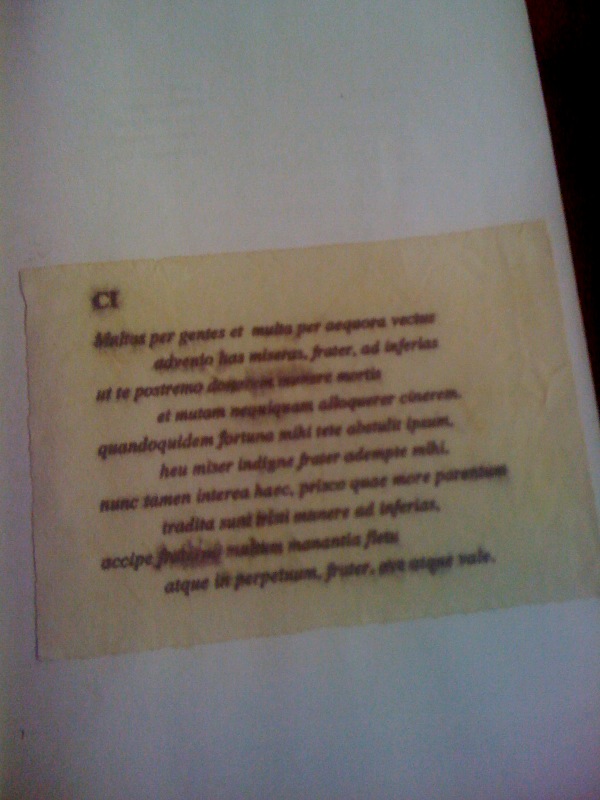
So what? Isn’t this old news? Didn’t New York magazine reviewer Sam Anderson say the following so long ago?
“It is, very deliberately, a literary object—the opposite of an e-reader designed to vanish in your palm as you read on a train.”
Yes, that’s right. And it was Craig’s wonderful BLT post, “Medium as Message,” not too long ago that made me want to say more.
So let me try to retract a few things first:
maybe what Carson has produced, has re-produced too, is no book.
Haven’t the New Directions editors (not in legalese but in promotionese) said as much? What’s that look like? Well, take a look:
Notice how it’s “in the form of a book, a facsimile of.” Notice the scare quotes around “book” as in “this illustrated ‘book’.” Notice how whateveritis is in “Clothbound edition” and is not reproducible in any other way, no, not in any other way.
So know that this is not another book review really. Sort of mid-way through Carson’s non-book without pages or page numbers with its sense of unendingness, she writes this, which I reproduce (but not really because there’s this dark shadow across several of the lines, which also continue beyond another fold of the long single page of the non-book). Carson writes of reproductions, of translations, of death and of night (which is English for the Latin “nox”):
7.1. I want to explain about the Catullus poem (101). Catullus wrote poem 101 for his brother who died in the Toad. Nothing at all is known of the brother except his death. Catullus appears to have travelled from Verona to Asia Minor to stand at the grave. Perhaps he recited the elegy there. I have loved this poem since the first time I read it in high school Latin class and I have tried to translate it a number of times. Nothing in English can capture the passionate, slow surface of a Roman elegy. No one (even in Latin) can approximate Catullan diction, which at its most sorrowful has an air of deep festivity, like one of those trees that turns all its leaves over, silver, in the wind. I never arrived at the translation I would have like to do of poem 101. But over the years of working at it, I came to think of translating as a room, not exactly an unknown room, where one gropes for the light switch. I guess it never ends. A brother never ends. I prowl him. He does not end. Prowling the meanings of a word, prowling the history of a person, no use expecting a flood of light. Human words have no main switch. But all those little kidnaps in the dark. And then the luminous, big, shivering, discandied, unrepentant, barking web of them that hangs in your mind when you turn back to the page you were trying to translate.
Now, I’m encroaching on fair use, no? I’ve reproduced nearly 300 words, yes? No, Carson’s point, and the lawyers’ too: “no part of this book [or whatever it is] may be reproduced.” There is Catullan originality here, Carsonian diction, that cannot really be reproduced. Carson is doing so much here. She’s dealing with the death of her own brother by dealing with the death of Catullus’ brother. She gives us her readers (on various of the un-numbered non-pages, in a sequence) a reproduced page from a Latin-to-English dictionary: the sequence of one word of CI, the poem 101, at a time.
So what’s that look like? Well, take a look:
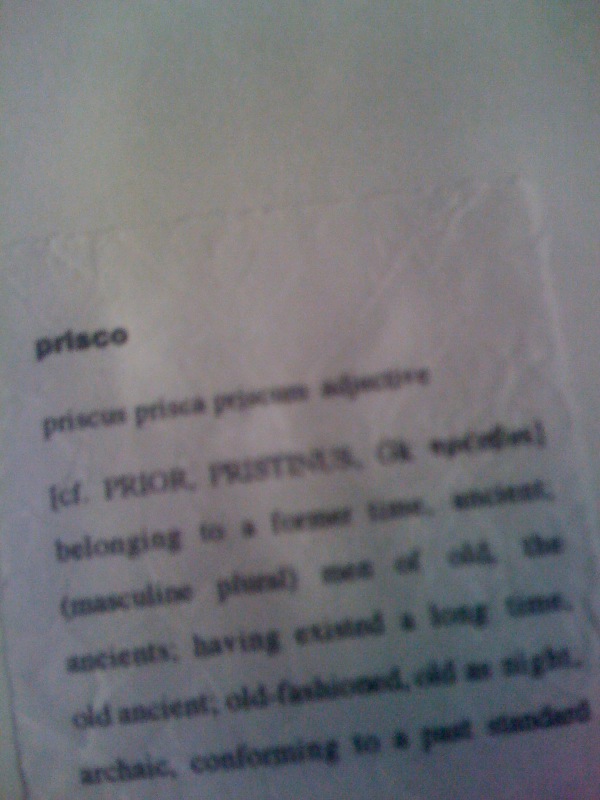
It’s too much, an endless amount of meanings, of words, of connotations, of denotations, of darkness, of light, of shadows, of nox. Translation never gets the original. And what was prisco, what was the original? Carson tries.
What’s that look like? Well, not an ebook. “The medium is the message.” A trying. Take a look:

I’ve read lots of books by Anne Carson. They’ve even influenced some, no, a good amount of, how I read the Bible, other literature, and translation. Nox — not really a book, or is it? — gives new dimension to all of that. Something ancient that may not be reproduced gives new dimension.
Forthcoming book: George Steiner’s “Poetry of Thought”
More than two years ago, on George Steiner‘s 80th birthday (April 23, 2009), The Times announced: “He is researching a book about how great philosophy gets itself written, called The Poetry of Thought.” As we all know, it’s been some time since the prolific Steiner has published a book. However, in just days (November 22, 2011), you’ll be able to purchase your copy of The Poetry of Thought: From Hellenism to Celan.

The publisher’s blurb goes like this:
From the distinguished polymath George Steiner comes a profound and illuminating vision of the inseparability of Western philosophy and its living language.
With his hallmark forceful discernment, George Steiner presents in The Poetry of Thought his magnum opus: an examination of more than two millennia of Western culture, staking out his claim for the essential oneness of great thought and great style. Sweeping yet precise, moving from essential detail to bracing illustration, Steiner spans the entire history of philosophy in the West as it entwines with literature, finding that, as Sartre stated, in all philosophy there is “a hidden literary prose.”“The poetic genius of abstract thought,” Steiner believes, “is lit, is made audible. Argument, even analytic, has its drumbeat. It is made ode. What voices the closing movements of Hegel’s Phenomenology better than Edith Piaf’s non de non, a twofold negation which Hegel would have prized? This essay is an attempt to listen more closely.”
And Thomas McGonigle thinks “it no accident that Steiner was now being published by New Directions since that publishing is one of the very few that is still engaged in publishing what is genuinely of interest in terms of literary originality.” McGonigle (whose “only contact with Steiner was in a classroom— too many years ago— at Columbia”) was able to preview at least some of the lines in Steiner’s new book. I haven’t been able to find anyone else who’s been privy to what Steiner writes there. Maybe there’s a hint in what he told The Guardian‘s Christopher Tayler:
“No culture has a pact with eternity,” he says. “The conditions which made possible the giants of the western poetic, aesthetic, philosophic tradition no longer really obtain.” Steiner doesn’t believe “there can be a Hamlet without a ghost, a Missa Solemnis without a missa”, and if you say that the questions addressed by religion are “nonsense or baby talk or trivial, I don’t believe that certain dimensions will be available to you. Particularly today, when the atheist case is being put, if I may say so, with such vulgarity of mind.” Most writing “seems to me too often, in this country, at the moment, a minimalist art. Very, very non-risk-taking. Very tight – often admirably, technically….”
I’ve always appreciated what Steiner has written about poetry (and he’s written some himself), and how that’s influenced our thinking generally. In fact, this very morning one of my daughters was telling me how her high school honors English teacher had given the class ways to analyse and to appreciate poetry. Although Steiner’s name had not been dropped, the rubric sounded suspiciously like his brilliant discussion On Difficulty in poetry. What might we find in this new work on ancient thought, and poetry?
Brandeis eliminates Hebrew major
Here is a sign of the rough times in American higher education; America’s leading liberal Jewish University, Brandeis, is eliminating its major in Hebrew to cut costs. From New Voices:
Faced with the increasing financial challenges of the ongoing economic crisis, Brandeis announced in 2010 the termination of the Hebrew Language and Literature Major, beginning with the students of the class of 2015, who began school this semester. The cut came as only one of many faculty and departmental changes that administrators estimate will save the university $3.8 million per year.
Though students will still have the option of pursuing a Hebrew language track within the Near Eastern and Judaic Studies major, which also offers concentrations in Judaic Studies and Bible and Ancient Near East, options are now more limited for students seeking a Hebrew-intensive curriculum. While some students are able to fill most of their requirements with the courses taught in Hebrew, the track allows students to take up to five of the 10 course requirements in English. And with one faculty member cut this year, just five Hebrew professors are left to cover the 14 Hebrew courses offered this semester.
“They were looking at programs that do not have enough volume in order to see if we can cut faculty from them,” said Vardit Ringvald, the director of the Hebrew Language Program who has taught Hebrew at Brandeis for 27 years.
“So it’s true that we don’t have a lot of majors in Hebrew, but we have a lot of students who are taking the language,” she said. Over 100 students are enrolled in Hebrew courses this semester with similar enrollment for next semester. While some are simply looking to fill their language requirement, others are looking to explore their Jewish identity and connection to Israel through the language.
“One vital contribution to my decision to apply early to Brandeis was its offer of intensive Hebrew classes, a Hebrew major and a Hebrew minor,” said Doreen El-Roeiy, an undergraduate departmental representative for the major. “I felt that the Hebrew Language and Literature major at Brandeis University was something unique, a major that could offer me a flexible degree, which could be applied to many career paths,” she said
“For a school that advertises their Judaic studies field, it’s a disappointment for people to come and not be allowed to further their Hebrew knowledge through the variety of courses they used to have in the Hebrew major,” said Michelle Sinnreich. Sinnreich, a junior majoring in Hebrew, chose the major during her sophomore year after seeing bigger improvements in her fluency in just two years of study in the Brandeis Hebrew department than she had during the several years she spent studying Hebrew in a Jewish day school and during a gap year in Israel.
But despite student interest in the Hebrew courses, the University cut a faculty member this year along with the major. The change has made it increasingly difficult for the Hebrew department to offer all the courses they want for those who are still interested in studying Hebrew without the major.
“We have to compensate. And we’re trying. We’re very creative and we’re trying to do it,” Ringvald said. “But we work extra hard, extra hours. We take advantage of what the university is offering us in order to be able to really tell the students [they] can still have a wonderful program here.”
The department has worked to redesign the program so that they can still offer the same courses and provide students with the options they want. To avoid cutting courses from the curriculum, each of the five remaining Hebrew professors now teaches five and a half courses per year instead of only five. Certain classes that used to be offered every year are now being offered every other year or every two years so the faculty is able to cover all the original options. Some class sizes increased to accommodate all the students taking Hebrew courses within what is now a smaller department.
While 14 Hebrew language courses are being offered this semester, including upper level classes focused on conversation and writing skills, Ringvald believes that the lack of students who choose to major in Hebrew is a result of the former major’s structure, which required students to take Near Eastern and Judaic Studies classes taught in English. Those classes include a foundational course in Judaic Studies and options such as Biblical Hebrew, Rabbinic Hebrew and Modern Hebrew literature. Though they often analyze Hebrew texts, such courses often serve as deterrent to students looking for total Hebrew immersion.
(HT: Jim Davila)
Lincoln and the Mormons
Here is a bit of history that I did not know: the story of Lincoln and the Mormons during the US Civil War. From the New York Times Civil War “Disunion” blog:
Mormons had been running away from the United States for some time. Practically since the The Church of Jesus Christ of Latter-day Saints was founded in 1830, its disciples had been on the lam, and for good reason, as they encountered brutality in one place after another….
Hence, a series of westward migrations, in a modern version of the Book of Exodus, that took them from upstate New York to Ohio to Missouri, and to Nauvoo, Ill., where the founder of Mormonism, Joseph Smith, was executed by a violent mob in 1844. Finally, the Mormon remnant escaped all known jurisdictions, and in 1847 arrived in the valley of the Great Salt Lake, where Brigham Young said, “This is the place.”…
Hence, a series of westward migrations, in a modern version of the Book of Exodus, that took them from upstate New York to Ohio to Missouri, and to Nauvoo, Ill., where the founder of Mormonism, Joseph Smith, was executed by a violent mob in 1844. Finally, the Mormon remnant escaped all known jurisdictions, and in 1847 arrived in the valley of the Great Salt Lake, where Brigham Young said, “This is the place.”
From the moment of their arrival in Utah, the Mormons set up a
government of their own, with no connection whatsoever to the United States. This shadow state, called Deseret, was presided over by Brigham Young, and administered law and morality in the way of the biblical patriarchs. Like many of those patriarchs, they defined marriage with a convenient elasticity — in this case, through the right of a God-fearing Mormon to take as many wives as he chose — and that was another reason Mormons often fell afoul of government officials.But the United States also sought to govern its new territory, rapidly growing in relevance, even if nine out of 10 of its inhabitants were Mormons and highly skeptical of distant federal officials. In 1858, a Utah Expedition, under General Albert Sidney Johnston, was dispatched to bring submission; instead, it caused hundreds of deaths, cost $15 million and accomplished none of its objectives. Modern Mormon histories still refer to this episode as “the occupation.” An uneasy standoff lingered throughout the election of 1860 and the outbreak of war.
These facts added up to an unusual predicament for Abraham Lincoln in the fall of 1861. Most Americans were thinking about the North and South; but the West was on his mind as well. With the rebellion raging, Lincoln needed as many allies as he could find, and both his government and Jefferson Davis’s coveted the west for its minerals and its access to the Pacific. Could he count on the Mormons?
There was plenty of room for doubt. Like the Confederates, the Mormons had a strong aversion to federal control, favored a peculiar institution (polygamy) that had been likened to slavery, and had been denounced by Lincoln’s party. The Republican platform had specifically ridiculed polygamy and slavery as “twin relics of barbarism.”
At the same time, most Mormons came from northern states, and were deeply religious. Even if their beliefs contradicted Christianity in certain ways — a fact that continues to animate attacks on Mormonism as a cult — they had no great love for slavery. To the extent that they even thought about politics back east, the arrival of a bearded president with the name of a biblical patriarch must have been welcome. Some Mormons thought that the rebellion signaled the beginning of a holy war that would remake the world and end in the second coming of Christ.
Fascinatingly, Joseph Smith had prophesied in 1832 that an immense civil war would someday transform America, and that it would start in South Carolina.
On Oct. 20, 1861, a vital piece of the Utah puzzle was solved, as the final lines of a telegraph were strung together, linking the Atlantic seaboard to the Pacific, through an office in Salt Lake City. On that auspicious occasion, which spoke so loudly of union, Brigham Young remarked,“Utah has not seceded, but is firm for the Constitution and laws of our once happy country.” Those were words guaranteed to warm Lincoln’s heart. Two days later, more good news, as General J. Arlington Bennett wrote him to ask if he could recruit 1,000-10,000 Mormons to fight for the Union.
But the question was far from solved, and on Nov. 18, Lincoln attacked the Mormon question in a most Lincolnian way. Instead of ordering an invasion, Lincoln ordered information. Specifically, he asked the Library of Congress to send him a pile of books about Mormonism, so that the aggregator-in-chief could better understand them. These included “The Book of Mormon” in its original 1831 edition, and three other early studies of the Mormons, with extensive, lurid chapters covering their polygamy. For some reason, he also ordered a volume of Victor Hugo, in French, a language he could not read.
Fortified by his reading, Lincoln came to a great decision. And that decision was to do nothing. Sometimes that, too, can be a form of leadership — what Churchill called “a masterly inactivity.”
Typically, Lincoln reached his decision through a homely parable, told to a Mormon emissary:
When I was a boy on the farm in Illinois there was a great deal of timber on the farm which we had to clear away. Occasionally we would come to a log which had fallen down. It was too hard to split, too wet to burn, and too heavy to move, so we plowed around it. You go back and tell Brigham Young that if he will let me alone I will let him alone.
That parable is about as much as we will get in the way of a formal explanation, but it is enough. To his generous store of common sense, we might also add the freshness of Lincoln’s memories of the bloodshed at Nauvoo in 1844, when angry mobs had killed the Mormon leaders, with elected officials standing by and doing nothing. And the centrality of Utah to the grand vision of a transcontinental republic, embraced fully by America’s most western president to date.
The U.S.-Mormon relationship never was perfect. Throughout the Civil War, it was tested on both sides. A Republican Congressman, Justin Morrill of Vermont, introduced legislation banning polygamy in Utah in 1862. Lincoln signed it, but in another sign of masterly inactivity, did not choose to enforce it. Tensions flared up between the U.S. army (stationed around Salt Lake City to protect the telegraph and stage lines) and the locals in 1863. Nor were the Mormons exactly model citizens. Throughout the war, when they referred to “the president,” they usually meant Brigham Young, and the not-quite-legal state of Deseret continued to hold meetings of its officers until 1870. Young disliked abolitionists and “black-hearted Republicans,” and it was not until 1978 that African-Americans were invited to join The Church of Jesus Christ of Latter-day Saints.
But ultimately, sanity prevailed, for the good of both the Mormons and the United States. In 1869, when the final spike of transcontinental railroad was driven into the ground, that happy act of union took place in Promontory, Utah. Lincoln had authorized that route, way back in 1862.
Wette faces
I have just read this recent National Geographic article on the King James Bible by Adam Nicholson. The publication date is December 2011, but I suppose we should be used to this kind of dating. Future dating.
After a lengthy discourse on what the Bible has meant to different people, communities and cults, from “loving authority” to “oppression,” Nicholson concludes,
The King James Bible has always cut both ways. It had its beginnings in royal authority, and it has been used to terrify the weak. It has also brought an undeniable current of beauty, kindness, and goodness into the lives of rich and poor alike. Its origins were ambivalent—for Puritan and bishop, the great and the needy, for clarity and magnificence, to bring the word of God to the people but also to buttress the powers that be—and that ambivalence is its true legacy.
Pain and beauty, forever and ever, amen. I agree.
I do have a pragmatic question, however. What would be the origina of the translation of Ecclesiastes 11:1 in the Bishop’s Bible?
Lay thy bread vpon wette faces,
Here are a few other translations for comparison,
Sende thi breed on watris passynge forth Wycliff
Cast thy bread upon the running waters Douay Rheims
Sende thy vytayles ouer the waters Coverdale
The Hebrew seems to be uncomplicated, שַׁלַּח לַחְמְךָ, עַל-פְּנֵי הַמָּיִם using the same phrase as is found in Genesis 1:2, usually translated “the face of the waters.” However, the Latin Vulgate, mitte panem tuum super transeuntes aquas, appears to be translating a different Hebrew original, while the Bishop’s Bible translation remains obscure. Any thoughts?
Changing literature
Steve Bellovin (Columbia) complains:
To avoid carrying too much, I got some ebooks to read on the plane; to make sure I could read something when jet-lag had scrambled my brain, I made sure I had some light reading; in particular, I borrowed ebooks of Isaac Asimov’s original Foundation series, since I know them more or less by heart and they don’t take much concentration. It worked well; I was indeed able to read a great deal of it, despite being mostly unconscious — until I found that someone had tinkered with it.
I wasn’t certain about the first anomaly I spotted: “Could Anacreon supply us with adequate quantities of plutonium for our nuclear-power plant?” But Asimov didn’t use the word “nuclear;” I was pretty sure he used “atomic.” Later on, when the Time Vault is about to open, the ebook spoke of a “computer” and a “muon beam/” I was quite certain that these words were not in my copy.
I confirmed that today. My paperback (the 1972 Avon printing) speaks of atomic power, and the Time Vault is controlled by a “speck of radium” and a “tumbler.” Why the changes? To make the text more “modern”? To “translate” the book into modern English? Thanks, but no thanks. One reason I enjoy reading older works is precisely to enjoy the older language, and to meditate on how language has evolved with the times. Making gratuitous changes like these reminds me of a line from E.M. Forster’s “The Machine Stops” where he speaks of people who “will see the French Revolution not as it happened, nor as they would like it to have happened, but as it would have happened, had it taken place in the days of the Machine.”
Bellovin refers to Forster’s “The Machine Stops,” a dystopian short story that many say anticipates emerging behavior on the Internet. Next Bellovin speculations on whether Asimov himself may have changed the text of his book, which case he concludes it was “legally-induced.” (He further suspects that the change might have been made to “enable renewal of copyright,” but my understanding of the law at that time is that copyright renewal would be possible with no change to the text.)
Another interesting question is when the change took place. I suppose that the Avon edition might already differ from the original 1951 Doubleday version, but I think it more likely that it was the Bantam 1991 paperback that had the change, or perhaps their 2004 hardcover. The copyright notice on the ebook says "1951, 1979" — was the change made by Asimov himself to enable renewal of the copyright? If so, that’s a case of legally-induced tinkering. Regardless, I don’t like it.
This reminds me of a number of incidents:
- Agatha Christie’s mystery novel And Then There Were None was originally entitled Ten Little N* (where “n*” is a racial epithet used for black people – an epithet that was previously common [Abraham Lincoln frequently used it] but today is highly offensive) and includes reference to a nursery rhyme by the same name. The story was later rewritten to have the nursery rhyme refer to “Ten Little Indians” and was titled the same, and then later rewritten again with its current title And Then There Were None and changes the nursery rhyme to “Ten Little Soldier Boys.”
- Charles Darwin revised his Origin of the Species multiple times; ultimately six editions appeared with substantially different content. A online variorum is here, and in-print here. The changes were substantial – Darwin changed about 75% of his text, and the final version is 150 pages longer than the first. However, in these later editions, Darwin spent much time interacting with his various scientific critics, and in the fifth edition, he substantially downplayed the role of natural selection, and thus the first edition is nearly universally preferred today. (My favorite version is the Harvard annotated edition, which presents a facsimile of the first edition together with substantial annotations.)
- Alan Gribben’s NewSouth edition of Mark Twain and Huckleberry Finn made a number of editorial changes: substituting “slave” for the “n-word,” substituting “Indian Joe” for “Injun Joe,” changes to some skin color description, insertion of a usually deleted passage, and modernization of punctuation.
I have to say that I have somewhat mixed feelings about these changes. In general, I dislike them, although I cannot say they are without reason (for example, Alan Gribben’s edition may be useful in some types of classroom use, although I greatly prefer to read uncensored editions.) I also have to say that my opinion changes depending on the nature of the text; I do not think of Christie’s book as serious literature, and do not mind the updates there. On the other hand, Twain went to substantial trouble to record regional language as actually spoken in that period, and I am more offended by the changes to his text. I’m upset by the changes to Asimov’s and Darwin’s texts, even if they were done by the authors themselves.
What do you think?
Forthcoming book: Willis Barnstone’s “The Poems of Jesus Christ.”
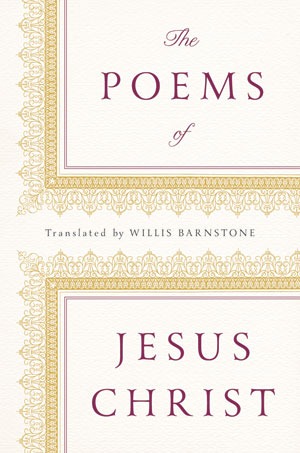 I note from this brief bio of Willis Barnstone (noted in my previous post) that he has a forthcoming book, The Poems of Jesus Christ. The Amazon blurb states:
The words of Jesus Christ are restored to their original poetic form in this extraordinary volume.
Jesus Christ, whose teachings have been on the lips of millions for two millennia, is revealed here as one of the greatest poets of all time. What happened to deafen us to the poetic nature of his words? In migrating from Aramaic speech into written Greek translation, and later into English translation, the lyrics got locked up as prose.
In The Poems of Jesus Christ Willis Barnstone unveils the essential poetry of the Gospels by taking the direct speech of Jesus from Mark, Matthew, Luke, and John, and lineating and titling Jesus’s words as individual poems. Jesus’s poems are wisdom lyrics and narrative parables, rich with garden, animal, and nature imagery. Austere and poignant, they carry the totality of the Gospels’ message through the intensity of a single voice––the Gospel of Jesus.
From this brief description it seems like this will be an excerpt of the “red letter parts” of his Restored New Testament. (For the record, Barnstone’s Restored New Testament does not actually contain any text in red letters.)
Reinterpreting 1 Peter
I feel some reluctance to come back to the topic of female submission. However, there are few enough women blogging on the interpretation of the Bible, so I think I should respond. Rachel Held Evans asked Mary Kassian to blog about submission. I can’t possibly take on her many points, but her first point really got me thinking.
Before discussing the content of her post, let me say that I appreciate that Mary Kassian provides a model of a strong Christian woman with both a husband and family, and a career. I see her as athletic, sporty and career-oriented, whereas I am a single mother, and more oriented to being a provider, regardless of how exciting or unexciting my occupation is. I like my job, but I don’t think of it as a “career.” I think of myself as more homey, and enjoy puttering around the house wishing I was knitting or embroidering. I used to do all those things when I was younger, but now I feel quite busy keeping my house and yard in shape. I just wanted to record how I see Mary and myself as women, so this won’t be a contest between a “feminist” (me) and Mary, a “biblical woman”.
It will be enough to examine Mary’s first of seven points. Here it is,
The biblical directive to submit applies to Christians—not to those outside the faith community. People without the indwelling power of the Holy Spirit have neither the discernment nor the power to live out submission and authority in a godly manner.
It seems to me that this is in some way a reinterpretation of 1 Peter. If we look at this epistle, we can see that the author was writing about a behaviour which was expected by all members of society at that time. There were already established instructions to members of society to submit to the government, and to slaves and wives to submit to masters and husbands. The difference is that Christians would endure injustice, they would in some sense “bear up.”
Slaves, in reverent fear of God submit yourselves to your masters, not only to those who are good and considerate, but also to those who are harsh. 19 For it is commendable if someone bears up under the pain of unjust suffering because they are conscious of God. 20 But how is it to your credit if you receive a beating for doing wrong and endure it? But if you suffer for doing good and you endure it, this is commendable before God. 21 To this you were called, because Christ suffered for you, leaving you an example, that you should follow in his steps.
There is no sense, in my view, that the Bible suggests that there are different expectations and standards of behaviour regarding submission for Christians and non-Christians, except in attitude. I believe that the Bible is talking about the basic patterns of submission and authority that were already established by society, and that all members of society were bound to, at that time. However, Christians would be able to endure the suffering that this arrangement necessarily entailed because they could keep the example of the Lord’s suffering before them and look up to that as a model.
So, Christians, as those in submission, bear suffering by thinking of Christ on the cross. On the other hand, Christians as leaders, in government, as masters and slave owners, (this included men and women) and as husbands, were to lead by example, as Christ did.
Be shepherds of God’s flock that is under your care, watching over them—not because you must, but because you are willing, as God wants you to be; not pursuing dishonest gain, but eager to serve; 3 not lording it over those entrusted to you, but being examples to the flock. 1 Peter 5:2-3.
However, it may be that Mary Kassian is saying that the behaviour of a wife would be the same, whether Christian or not, – a wife sometimes has to say “no” and draw boundaries – but that a Christian wife would have a particular attitude of heart in doing so. This seems consistent with the text.
When Mary says “People without the indwelling power of the Holy Spirit have neither the discernment nor the power to live out submission and authority in a godly manner,” I think she rightly sees the problem. Human beings cause those under their authority to suffer, unless there is some restraint. She suggests that the power of the Holy Spirit will provide the necessary restraint, and that we should promote relationships of submission and authority.
I, on the other hand, doubt that Christians behave according to the power of the Holy Spirit in their everyday dealings with those in subordination under them. Sometimes they do, and sometimes they don’t. Even among Christians, relationships of submission and authority entail suffering.
Instead, since godly behaviour cannot be controlled and enforced, the Christian ethic of treating others as we would be treated, has promoted the institution of accountable government, and likewise, ought to promote the institution of accountable marriage, a relationship of mutual accountability. Within this institution of mutual accountability, I agree with Mary, that a wife should be agreeable, and not be ‘critical, impatient, defiant, and “snarky”.’
For myself, I would look at the role of a woman and wife in our society today, under our present law, and I would emphasize that women have equal responsibility under the law and as Christians, to protect, provide and make wise decisions for our children, ourselves, and often aging parents. No matter how much the law protects us, or how wealthy we are, life will always entail suffering and disappointment, from unhappy relationships with spouse, children or other members of our family, or from illness and loss.
The Christian woman fulfills the spirit of 1 Peter by having a gentle attitude towards others in her life, even when these things go wrong. We may not have the same patterns of submission and authority in our lives today as there was in the New Testament era, but we can still fulfill the instruction of the scripture to endure the circumstances of our life with a gentle attitude.
Both Mary and I are reinterpreting 1 Peter. In spite of this, can we derive the same values from this passage? I think we can.
Xi Xi’s “The Body’s Language”
Xi Xi (西西) is a celebrated Hong Kong author, with four of her books translated into English, and numerous stories and essays translated in journals and anthologies. (Xi Xi is a pseudonym, her original name is Zhang Yan 張彥.)
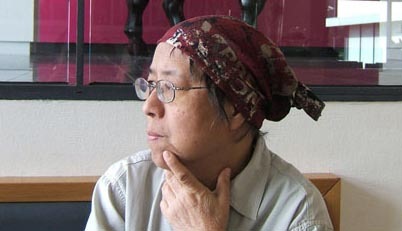
the Johnnie To Hong Kong movie 2 Become 1.
I do not know of a complete English translation of Mourning for the Breast, but various essays from it have appeared in several anthologies and journal articles. Esther Cheung in the journal Studies on Asia translates a key chapter, “The Body’s Language.” In this essay, Xi Xi develops an extended analogy between translation and our relationship to our body; but in doing so, she also gives hints as to her own theory of translation.
I recommend reading the entire essay, but here are some excerpts (I have substantially revised the translation):
After receiving a decade or more of education, we become creatures who value the mind first. And, after leaving school, we often pursue intellectual nourishment — reading books, watching movies, buying art books and musical recordings. These activities are all are food for the mind. But our teachers fail to teach us what kinds of food we should buy for our stomach. No one tells us whether we should or should not drink milk, whether we should or should not eat less salt and sugar. We regard our intellectual and spiritual concerns as magnificent and dignified, while matters of the body become mean and lowly. Going to a museum to view paintings is an dignified habit, and when an art exhibition includes a David or a Venus, we consider them to be beautiful. However, this kind of beauty seems separated from the body and can exist independently from it. The beauty becomes spiritual —purely spiritual. We regard going to the food market as a chore, something that illiterates and children can do. We have a body, but we feel more and more alienated from it….
My body makes more and more noise, as though it foments a revolution inside itself and is protesting loudly. Is it calling for a strike? Is it requesting a leave? Is it fighting for special allowances? I do not know what it really wants. I have never had a good conversation with my body in the past, and now I can only listen to its utterances. The question is — what is it talking about? Are my white blood cells in decline? Is my body suffering for a shortage of certain vitamins or minerals? Interpersonal communications is already difficult, but communications ourselves and our bodies is even more difficult. The body has so many parts and each part petitions with its complaints. There is not even a single language of the body: the bone speaks the bone’s language; the muscle speaks the muscle’s language; the nerve speaks the nerve’s language. We recapitulate the Tower of Babel and have trouble communicating.
Since my tumor first appeared, my body has made many warning signals, but even my doctor cannot fully understand them, and I am completely at a loss at interpreting them. I am illiterate in the language of my own body. At school, we learn languages foreign languages, lest we be illiterate in all other tongues. We often further study foreign languages even after our formal education, so we can communicate with the broader world, so we can understand other people. It is true: understanding other people helps us understand ourselves. But, other than doctors, who can understand the language of the body?
I love literature, and while I can read English works in the original, I rely on Chinese translations of novels from Italy, Germany, and other countries. But how much of the spirit in the original versions can we comprehend from the translations? Does the translation Proust’s Remembrance of Things Past show the proper tenses? Can we tell from the translation of Mario Vargas Llosa’s Captain Pantoja and the Special Services whether the characters speak colloquial or formal language on the streets and lanes?
Open the Chinese translation of Thomas Mann’s The Magic Mountain and you will read the translator’s preface: “Having compared the work’s English translation with its Japanese one, I found that there were many problems in the translations; in particular in the English translation where mistranslations and under-translations were rather common.” In recent years, the chorus of complaints about translations have grown: mistranslations, misinterpretations, under-translations, adaptations. There are not only unconscious misunderstandings, but also deliberate simplifications, and even rewritings. It seems that to understand an original work thoroughly, we need comparatively read multiple translations, in the hope that different translators will elucidate different aspects of the work; or we simply need to learn the original language of the work.
Please do not assume that I am ever looking for the most perfect possible translation. I am not. There is no single predefined, immutable “absolute spirit” in any book. Translations are interpretations. We can find multiple interpretation in a single text. Each interpreter can claim: “I am Madam Bovary,” and we will not pause to worry that there are too many Madam Bovarys. For the body’s language, we understand biologists and doctors to be the professional translators, and so their translations appear to be more scientific and objective. However the human experience, with its wide diversity of experiences and practices generates different interpretations and readings. Misreading, re-translation, these have become second nature to us. I can posit that it is impossible to have an exclusive, absolute version of translation, now and in the future….
The body can speak. Its language includes not only sounds, but images as well. Its written languages are signs on our bodies that we can discover through electrocardiograms, ultrasonic imaging, X-ray fluoroscopy. The body is fluent and articulate in its own language. We are fortunate when we have doctors who can understand this language….
The subject of language has fascinated most of the great thinkers of the twentieth century, and understanding its mysteries has become critical to philosophy’s scientific turn. We are born both with a mouth and two ears – it is not enough for us to express ourselves (on and on), we must also listen sensitively. We should not allow our mouth to swell too much with words while our ears are shrink day after day.
And our Earth, it is a much greater body, I believe. It too is sending many language signs, is it not? If we human beings refuse to listen to it, sooner or later we will lose this ultimate body on which we depend for life.
Catawampus
I am inordinately fond of etymologies, particularly etymological puns.
One of my favorites is in Genesis, when the serpent is introduced to Adam and Eve. Most translations say, correctly, that the woman and the man were both naked but unashamed, but totally miss the pun in the next line, where it says that the snake was the most cunning of all the animals that YHWH had made. The word “naked” (עָרוֹם) literally means smooth, as in unclothed skin; spelled almost exactly the same is עָרוּם, which is usually translated “cunning” but literally means smooth in the metaphorical sense, the way we would call someone “a smooth operator.” Adam and Eve were smooth, but the snake was smoother. Alas, some puns don’t translate very well.
I love how a “clue”—our key to solving difficult puzzle—comes from “clew,” a ball of yarn, harkening directly back to the story of Theseus and the Minotaur. (Ariadne, daughter of King Minos, gave Theseus a ball of red yarn to help him find his way out of the labyrinth, only to have Theseus abandon her on the island of Naxos so he could marry her sister Phaedra instead. Such gratitude!)
I love how our English word “clew” comes from a Proto-Germanic word meaning “ball,” which comes from a prefix meaning “to conglomerate,” and is akin to the Old English word for “clay”—and is similar to the Ancient Greek γλία and the Latin glūs (both meaning “glue”).
I love how our word “key” comes from the Old English cǣġ, meaning “key, solution, experiment.” I like that the French words for “key” (clé) and “nail” (clou) both come from the Latin clāvis, which meant key, which came from clāvus, which meant nail, because the first keys were long nail-like hooks that were passed though a keyhole to catch the bolt on the other side.
But maybe my favorite etymology, and perhaps pun, is the phrase found right at the start of the Bible: “In the Beginning, God created the heavens and the earth. But the earth became tohu va-bohu (תֹ֙הוּ֙ וָבֹ֔הוּ) and darkness came over the face of the Deep—yet the Spirit of God was brooding over the surface of the waters.” Tohu va-bohu is usually translated something like “formless and void.” The closest English rendering of the Hebrew, both in meaning and in the playfulness of the words, might be “topsy-turvy”—and every other time the phrase is used in the Bible, it describes a scene of ruination and desolation. In Hebrew Myths: The Book of Genesis (1963), Robert Graves and Raphael Patai pointed out the linguistic connection between tohu, or chaos; tehom, the word here translated “the Deep”; and the Babylonian goddess Tiamat:
What “Tohu” and “Bohu” originally meant is disputed. But add the suffix m to Tohu (thw) and it becomes Tehom (thwm), the Biblical name for a primitive sea-monster. Tehom, in the plural, becomes Tehomot (thwmwt). With the same suffixes, Bohu becomes Behom and Behomot (bhwmwt), a variant form of Job’s Behemoth, the dry-land counterpart of the sea-monster Leviathan. Leviathan cannot be easily distinguished from Rahab, Tannin, Nahash, or any other mythical creatures that personify water. The story underlying Genesis 1:2 may therefore be that the world in its primeval state consisted of a sea-monster Tohu and a land-monster Bohu. If so, Tohu’s identity with Tehomot, and Bohu’s with Behemoth, has been suppressed for doctrinal reasons….Moreover, that tehom never takes the definite article in Hebrew proves it to have once been a proper name, like Tiamat. Tehomot, then, is the Hebrew equivalent of Mother Tiamat, beloved by the God Apsu.
The phrase tohu va-bohu occurs only here in Genesis and in Jeremiah 4:23-26 (“I looked at the earth—it was tohu va-bohu. I looked to the heavens—their light was gone. I looked to the mountains—they quaked, and the hills swayed back and forth. I looked—I saw no one. Nothing! All the birds had flown away. I looked—the fertile land was desert. All its towns laid waste before YHWH, before God’s fierce wrath”), though it’s almost used in Isaiah 34:10-11 (“Generation after generation it will lie waste, and it will be impassable forever. The jackdaw and the desert owl will possess it; the great owl and the raven will nest there. YHWH will stretch out over Edom the measuring line of tohu and the plumb line of bohu”).
Clearly this isn’t formlessness and voidness (yes, I just made up that word). It’s chaos and destruction. Tohu is elsewhere used to describe something worthless or useless—“empty” in the figurative sense, or perhaps empty of inhabitants, but not empty as in a vacuum.
Which brings me to my Word of the Day: catawampus, which is another fine way to render tohu va-bohu. Also spelled catawampous, cattywampus, catiwampus, and, as I learned it, caterwompus. It means “off-kilter,” “askew,” or more broadly, “all messed up.”
“Cater” means “diagonally,” from the French quatre, meaning “four (cornered).” This in turn comes from the Indo-European root kwetwer– (four), which also gave us four, square, cadre, quadrant, and quarantine (literally, period of forty days). “Wompus” is related to the Scottish “wampish,” a verb that means “to wriggle, twist, or swerve about.” Or, says etymonline.com, perhaps it is
simply the sort of jocular pseudo-classical formation popular in the slang of those times, with the first element suggesting Gk. kata-. Earliest use seems to be in adverbial form, catawampusly (1834), expressing no certain meaning but adding intensity to the action: ‘utterly, completely; with avidity, fiercely, eagerly.’ It appears as a noun from 1843, as a name for an imaginary hobgoblin or fright, perhaps from influence of catamount. The adjective is attested from the 1840s as an intensive, but this is only in British lampoons of American speech and might not be authentic. It was used in the US by 1864 in a sense of ‘askew, awry, wrong’ and by 1873 (noted as a peculiarity of North Carolina speech) as ‘in a diagonal position, on a bias, crooked.’
I just can’t get enough of this stuff.
Five versions of a well-known passage from the Summa Theologiae
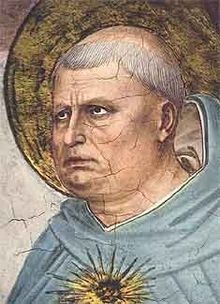 I have wanted to long do a comparison of different English editions of the Summa Theologiae. I will not do that in this post, but rather will use a short passage from the Summa to represent the Latin and four approaches to translation.
The Summa carries special difficulties for translation,
- first because the repetition and formal structure of Thomistic Latin, which forms a style that can even be regarded as elegant in the original, sounds so poor when formally translated into English; and
- second, since the Summa is a work of exposition, the top priority for a translation is arguably clarity, rather than literal precision, in the same way we might demand of a translation of mathematics book. (Nonetheless, literal precision remains a priority, and this may be a real issue for some translations – the topic of this post is ask the importance of that priority.)
For me, one special characteristic of the the Summa is the seriousness with which Thomas sets up the various objections to the arguments. A standard trick philosophers, dating back at least to Plato, is to set up straw man arguments which he can then easily shoot down. But Thomas does something different in the Summa; he takes the objections seriously.
I have great fondness for the Summa, and not merely out of philosophical interest, but because it so evokes the medieval spirit for me. Thomas’s careful recording of both sides of the argument gives one the feel that one is in the halls of the University de Paris in the 13th century, listening to the back and forth of an argument. The effect is powerful and compelling, and while Thomas is certainly no Cicero, his unique Latin style creates a powerful force – although it becomes quite strange when literally translated into English.
Now let us consider a well-known passage from the Summa, discussing the “first mover” argument:
(1) Here is the passage in Latin from the Summa:
Omne ergo quod movetur, oportet ab alio moveri. Si ergo id a quo movetur, moveatur, oportet et ipsum ab alio moveri et illud ab alio. Hic autem non est procedere in infinitum, quia sic non esset aliquod primum movens; et per consequens nec aliquod aliud movens, quia moventia secunda non movent nisi per hoc quod sunt mota a primo movente, sicut baculus non movet nisi per hoc quod est motus a manu. Ergo necesse est devenire ad aliquod primum movens, quod a nullo movetur, et hoc omnes intelligunt Deum.
(2) Now to get a sense of the literal meaning of these terms, here is the translation as rendered by Google Translate (note that the stylistic limitations of Thomistic Latin make Google Translate’s version relatively lucid compared to most computer translations):
Therefore, whatever is in motion must be moved by another. Therefore, if that which it is moved from the in motion, there must be also very moved by another and that by another. But here we do not proceed to infinity, because then it would not be a first mover, and consequently neither is any other mover, because the second movers do not move except by the fact that they are moved by the first mover, as a stick does not move except by the fact that he is moved by hand. Therefore it is necessary to arrive at a first mover, moved by no other, and this everyone understands to be God.
(3) Here is the 1911 Laurence Sharpcote translation (sometimes called the “Benzinger Summa,” after its initial publisher.) Regrettably, Sharpcote is unacknowledged as the translator in the text, which is merely attributed to “the Fathers of the English Dominican Province.” The version linked claims to be a “second and revised edition” of 1920:
Therefore, whatever is in motion must be put in motion by another. If that by which it is put in motion be itself put in motion, then this also must needs be put in motion by another, and that by another again. But this cannot go on to infinity, because, then there would be no first mover, and, consequently, no other mover; seeing that subsequent movers move only inasmuch as they are put in motion by the first mover; as the staff moves only because it is put in motion by the hand. Therefore, it is necessary to arrive at a first mover, put in motion by no other; and this everyone understands to be God.
(4) Now below is the same passage in my favorite complete edition of the Summa, the so-called “Blackfriar Summa,” edited by a team of scholars (not all of whom were Dominican despite the “Blackfriar” moniker), and edited by Thomas Gilby (Cambridge). This1960s-1970s version is uneven, because it was translated in 60 volumes (with a further index volume), but it contains extensive additional material – annotations, appendices, introductions, glossaries, and the full Latin text (since there is no critical edition of Thomas, this was determined by the individual editors working on each of the volumes) displayed across from the English on each page spread. The set weighs in at nearly 15 thousand pages. Its value is really in these supplements (which vary in quality depending on the editor, at one end “Baltimore Catechism”-style perspectives that appear to pre-date Vatican II; at the other end acute philosophical contributions that would deserve publication separate from the translation.) The Blackfriar Summa is much freer in representing Thomas’ style, but still closely tracks Aquinas:
Consequently, a thing in process of change cannot itself cause that same change; it cannot change itself. Of necessity therefore anything in process of change is being changed by something else. Moreover, this something else, if in process of change, is itself being changed by yet another thing; and this last by another. Now we must stop somewhere, otherwise there will be no first cause of the change, and, as a result, no subsequent causes. For it is only when acted upon by the first cause that the intermediate causes will produce the change: if the hand does not move the stick, the stick will not move anything else. Hence one is bound to arrive at some first cause of change not itself being changed by anything, and this is what everybody understands by God.
(5) Brian Davies (Fordham) revised this translation for his marvelous 2006 Cambridge publication of most of questions 1-26. Note how clear Davies’ text is, and how naturally it reads in English, but also how much it deviates from Thomas’s style:
So, something in process of change cannot itself cause that same change. It cannot change itself. Necessarily, therefore, anything in process of change is changed by something else. And this something else, if in process of change, is itself changed by yet another thing. But there has to be an end to this regress of causes, otherwise there will be no first cause of change, and, as a result, no subsequent causes of change. For it is only when acted upon by a first cause that intermediate causes produce change (if a hand does not move the stick, the stick will not move anything else). So, we are bound to arrive at some first cause of change that is not itself changed by anything, which is what everybody takes God to be.
(As an aside, let me compare the prices of these versions:
- the online Latin version and Sharpcote versions are free – a price point that is quite hard to beat.
- The Davies version is just a fraction of the Summa, and is currently priced at $39 by Amazon.
- The Blackfriar Summa is frightfully expensive with a current $2,310 price by Amazon. (I was able to purchase it when it was first reissued by Cambridge University Press for about a third of that price, but even with that discount, it is sufficiently costly to deter most would-be purchasers. Nonetheless, for a serious student, I would recommend consulting a library to access this edition because of all the useful extras.)
- If one wishes to experience the Latin and English on the same page and is willing to give up the voluminous [and useful] additions from the Blackfriar edition, then you may be interested in the ongoing translation being produced by NovAntiqua. Currently five of a projected ten volumes are available.)
Which translation is best? I would argue that in terms of meaning, all of these translations are reasonable renditions of Thomas. But in terms of fidelity to Thomas’s style, the ordering is:
Google Translate > Sharpcote > Blackfriar > Davies
while in terms of ease-of-understanding, the order is exactly inverse:
Davies > Blackfriar > Sharpcote > Google Translate
So, does style matter to the typical reader of the Summa? The Summa can hardly be said to be poetry; in Latin, Thomas seems most concerned with communicating his meaning as clearly and simply as possible. Which translation is most true to Thomas; that which preserves his words or that which preserves his pedagogical intention?
Rita Ferrone on the translation philosophy of the New Roman Missal
Starting November 27, the English Roman (Catholic) Missal will change everywhere in the English speaking world. The English Missal is translated from the Latin Novus Ordo missal; the new missal is the fruit of an extended translation that followed a complex 2001 instruction from the Vatican called Liturgiam Authenticam which requires “the exact rendering of each word and expression of the Latin, the use of sacral vocabulary remote from ordinary speech, and reproduction of the syntax of the Latin original whenever possible.” Rita Ferrone in Commonweal has some critical comments on the new translation – here are some brief excerpts:
We come to you, Father,
with praise and thanksgiving,
through Jesus Christ your Son.
Through him we ask you to accept and bless +
these gifts we offer you in sacrifice.
We offer them for your holy catholic Church….
So begins the first Eucharistic Prayer of the Roman Missal as it has been prayed by English-speaking Catholics since 1973. When the new Missal goes into effect in November, Catholics throughout the English-speaking world will hear these words instead:
To you, therefore, most merciful Father,
we make humble prayer and petition
through Jesus Christ, your Son, our Lord:
That you accept
and bless + these gifts, these offerings,
these holy and unblemished sacrifices
which we offer you firstly
for your holy Catholic Church.
The current translation is simple and direct. It follows the speech patterns and rhythms of contemporary spoken English. It flows easily off the tongue. Its meaning is clear. The new translation, on the other hand, is mannered and complex. We arrive at the subject of the sentence only after we have heard the dative “to you”; the conjunction “therefore”; a superlative adjective “most merciful”; and a noun in apposition, “Father.” The new translation is wordy. In place of “these gifts,” we offer “these gifts, these offerings, these holy and unblemished sacrifices.”
Having offered these gifts, offerings, holy and unblemished sacrifices firstly for the church, you might be thinking there is a secondly coming along in a paragraph or two. If so, you would be wrong. There is no secondly. So what does firstly mean in this context? It’s not clear that it means anything at all….
There are many places in the new translation where the words simply don’t make sense in English. On the First Sunday of Advent, we pray that we may “run forth with righteous deeds.” What does that mean? Many expressions sound pompous: “profit our conversion,” “the sacrifice of conciliation,” “an oblation pleasing to your almighty power.”
Some prayer texts are simply bewildering, such as this one from Preface VIII for Sundays in Ordinary Time:
For when your children were scattered afar by sin,
through the Blood of your Son and the power of the Spirit,
you gathered them again to yourself,
that a people, formed as one by the unity of the Trinity,
made the Body of Christ and the temple of the Holy Spirit,
might, to the praise of your manifold wisdom,
be manifest as the Church.
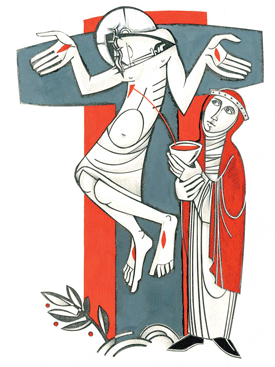
(An illustration from one of the editions of the New Roman Missal)
What is the main point? It is hard to tell. We are wandering in a dense forest of theological and biblical allusions here. There are traps for the unwary, too. If the speaker is not careful to separate the first line from the second and join the second with the third, separating them from the first, he ends up suggesting that the Blood of Christ and the power of the Spirit are instrumental in scattering God’s children. Even read well, this prayer will likely lose all but its best-educated and most highly attentive hearers.
The new translation includes sentence fragments, odd locutions, opaque expressions, and redundancies. There are also historical oddities preserved for no good reason. Here is an example from Eucharistic Prayer I:
For them and all who are dear to them
we offer you this sacrifice of praise
or they offer it for themselves
and all who are dear to them.…
Enrico Mazza, in his magisterial work The Eucharistic Prayers of the Roman Rite, explains that this mid-eighth-century addition (“or they offer it for themselves…”) was originally a rubric, providing alternative wordings depending on whether those who requested the Mass were present or absent. The translators of the 1973 translation (and the 1998 version) spared us the useless puzzlement caused by such a text. The translators of the text we are about to receive did not. Why? Each word of the Latin had to be accounted for….
Overall, the length of the sentences in the new translation is staggering. The longest sentence of the Eucharistic Prayers has 82 words, the second longest, 72. All but one of the sentences in Eucharistic Prayer I are more than 40 words long….
Rita Ferrone’s full essay is well worth reading, for an insight into the dramatic effects that translation philosophy can have.
The Meaning of the Bible
The Meaning of the Bible: What the Jewish Scriptures and Christian Old Testament Can Teach Us by Douglas A. Knight and Amy-Jill Levine was published Nov. 8, 2011.
In this lively and fresh introduction to the scriptures of ancient Israel (what Christians call the Old Testament and Jews call the Tanakh), two preeminent biblical scholars, Douglas A. Knight and Amy-Jill Levine, combine their passion and expertise to examine not just what the Bible says but what it means. Through their eyes we see anew the Bible’s literary brilliance, moral profundity, historical settings, and implications for our faiths and our future.
Passed down for generations, compiled between 500 and 100 BCE, and finalized around the time of Jesus, the various accounts in the Hebrew Bible took shape under a variety of cultures. Drawing on their extensive biblical scholarship, Knight and Levine explore this diverse history and equip us with the critical tools necessary to understand what the ancient texts originally meant. With long experience in teaching candidates for the ministry as well as undergraduate and graduate students, they also explore the possible meanings the texts hold today for churches, synagogues, and anyone interested in the Bible’s legacy.
Knight and Levine begin with the broader biblical story—its historical context, literary artistry, and geographical setting. They then turn to the major biblical themes with which modern readers continue to wrestle: law and justice, human evil and God’s response, belief and practice, chaos and creation, war and peace, gender and sexuality, politics and economics, practical wisdom and apocalyptic vision. For each topic, they provide both general overviews and specific analyses of select biblical passages, explaining how and why their approaches reveal new insights and offering various strategies for informed interpretation.
Throughout, Knight and Levine inspire us to ask new questions and develop a deeper understanding of one of the greatest collections of literature known to humankind—as illuminating today as it was two thousand years ago.
As a followup to this publication, Knight and Levine blogged at the Huffington Post earlier today,
The culture wars over family values have yet to reach détente and will not until the messiah comes (or returns, depending on the reader’s affiliation). Battles continue over women’s equality vs. a wife’s graceful submission, no-fault divorce vs. attempts to strengthen marital bonds, the ordaining of gays and lesbians and the legalization of “gay marriage” vs. exhortations to “love the sinner but hate the sin,” birth control and abortion, private sexual expression vs. public interest….
People who read the Bible often find themselves on the opposite sides of many of these issues. This does not mean that they are necessarily reading their texts incorrectly. Indeed, before we even ask, “What does the Bible say?” we need to ask, “Whose Bible?” Canons – and so, cannons – differ among various Christian churches as well as between Jews and Christians, as do translations. Moreover, the Bible is open to multiple interpretations: we need to determine what is metaphor and what is to be taken literally, what is case specific and what is timeless, what is a matter of personal choice and what should be legislated.
How then do we read in a manner that is grounded and thoughtful rather than uninformed or soporific? Here are five general guidelines.
On sodomy, they write,
For example, the first interpreter of the story of Sodom and Gomorrah, the prophet Ezekiel, condemns Sodom not for homosexuality but for “pride, excess of food, and prosperous ease” and for failing to “aid the poor and needy” (Ezekiel 16:49). Nor does the story suggest that homosexuality is the problem. The Hebrew of Genesis 19 tells us that all the people of Sodom sought to “know” the two visitors: the people would have included the women, and they, like the men, died in the conflagration that destroyed their city. The problem is sexual violence, not homosexuality; attempted rape, not love.
I think it is important to keep in mind exactly what influences are being brought to bear on the evangelical community on this issue. Robert George, Princeton professor of Jurisprudence, will be participating in the ETS conference this week, presenting on the topic Ethics in an Age of Relativism. He has written intensively on the subject of human sexuality in What Sex Can Be: Self-Alienation, Illusion, or One-Flesh Unity by Patrick Lee and Robert P. George. On sodomy, George and Lee write,
By “sodomy” here is meant (1) anal or oral intercourse between persons of the same sex, or (2) anal or oral intercourse between persons of opposite sexes (even if married), if it is intended to bring about complete sexual satisfaction apart from penile-vaginal intercourse. If a couple use their sexual organs for the sake of experiencing pleasure or even for the sake of an experience of unity, but do not become one organism, then their act does not actually effect unity. If Susan, for example, masturbates John to orgasm or applies oral stimulation to him to bring him to orgasm, no real unity has been effected. That is, although bodily parts are conjoined, and so there is juxtaposition and contact, the participants do not unite biologically; they do not become the subject of a single act, and so do not literally become “one flesh”. They may be doing this in order simply to obtain or share pleasure. In that case the act is really an instance of mutual masturbation, and is as self-alienating as any other instance of masturbation. However, they might intend their act as in some way an expression of their love for each other. They might argue that this act is no different from the penile-vaginal intercourse they performed two nights before, except that this one involves a merely technical or physical variation–a rearrangement of “plumbing”.
However, in sodomitical acts, whether between persons of the same sex or opposite sexes, between unmarried or married persons, the participants do not unite biologically. Moreover, an experience of pleasure, just as such, is not shared. Although each person may experience pleasure, they experience pleasure each as an individual not as a unit. For a truly common good, there must be more than experience; the experiences must be subordinated to a truly common act that is genuinely fulfilling (and as such provides a more than merely instrumental reason for action). If, on the contrary, the activities are subordinated to the pleasurable experiences, if the physical stimulation administered to one another is merely a means to attain what are (and can only be) individual, private experiences, then unity is not achieved.
Christians need to join with Knight and Levine in stating that the Bible does not support such views on sexuality.
Abraham Joshua Heschel on worship
If God were a theory, the study of theology would be the way to understand Him. But God is alive and in need of love and worship. This is why thinking of God is related to our worship. In an analogy of artistic understanding, we sing to Him before we are able to understand Him. We have to love in order to know. Unless we learn how to sing, unless we know how to love, we will never learn how to understand Him.
— Abraham Joshua Heschel, God in Search of Man (p. 281)
(This quote is taken from study materials for today’s “Global Day of Jewish Learning” which is focused on the “Shema” prayer. This particular quote is item 9 on the “introduction” handout.)
Haruki Murakami and Janacek’s Sinfonietta
I’ve been reading the English translation of Haruki Murakami’s “big book” 1Q84 (the one that some critics in Japan think is part of his campaign for a Literature Nobel Prize. It is a novel set in an alternate universe (a Tokyo with two moons) and is an extended and existential detective novel. The protagonist, an assassin and physical trainer Aomame is stuck in traffic, and slips out of her cab, only to completely change the universe.
The English translation came out two weeks ago and most of the reviews have been glowing and some have been negative. Janet Maslin’s review was notably negative, but Maslin tends to dislike highly literary and complex works. (One review puzzle: I wonder how the NPR web editors can claim that the book has “been masterfully translated” when they show no evidence of having read the Japanese edition and NPR’s own reviewer does not make that claim.)

I also enjoyed Sam Anderson’s interview with Murakami which began “I prepared for my first-ever trip to Japan, this summer, almost entirely by immersing myself in the work of Haruki Murakami. This turned out to be a horrible idea. Under the influence of Murakami, I arrived in Tokyo expecting Barcelona or Paris or Berlin — a cosmopolitan world capital whose straight-talking citizens were fluent not only in English but also in all the nooks and crannies of Western culture: jazz, theater, literature, sitcoms, film noir, opera, rock ’n’ roll.”
But the thing I like best about Murakami’s novels is that they come with a soundtrack. In the case of 1Q84, it is a piece of music that deserves to more widely heard: Janacek’s Sinfonietta. Anderson visits Murakami in his office:
Murakami took me upstairs to his office — the voluntary cell in which he wrote most of “1Q84.” This is also, not coincidentally, the home of his vast record collection. (He guesses that he has around 10,000 but says he’s too scared to count.) The office’s two long walls were covered from floor to ceiling with albums, all neatly shelved in plastic sleeves….
I asked if we could listen to a record, and Murakami put on Janacek’s “Sinfonietta,” the song that kicks off, and then periodically haunts, the narrative of “1Q84.” It is, as the book suggests, truly the worst possible music for a traffic jam: busy, upbeat, dramatic — like five normal songs fighting for supremacy inside an empty paint can. This makes it the perfect theme for the frantic, lumpy, violent adventure of “1Q84.” Shouting over the music, Murakami told me that he chose the “Sinfonietta” precisely for its weirdness. “Just once I heard that music in a concert hall,” he said. “There were 15 trumpeters behind the orchestra. Strange. Very strange. . . . And that weirdness fits very well in this book. I cannot imagine what other kind of music is fitting so well in this story.” He said he listened to the song, over and over, as he wrote the opening scene. “I chose the ‘Sinfonietta’ because that is not a popular music at all. But after I published this book, the music became popular in this country. . . . Mr. Seiji Ozawa thanked me. His record has sold well.”
I have not heard Ozawa’s version of the the Sinfonietta, and with the price trending upwards of $80, perhaps I will not hear it soon. The version I am familiar with is Neeme Järvi’s. But since most people are not familiar with this “strange, very strange” music that “fits very well” in 1Q84, here is a Youtube rendition (poor audio, but good enough for you to feel the weirdness of this music):
Now it may seem gimmicky for Murakami to tie his book to a piece of music, but if it makes this remarkable music better known, then all the better.
The Cornish Bible
While parts of the Bible have been translated into Cornish over the centuries, the complete Bible in Cornish has only been published in August, 2011. It is translated by Nicholas Williams and edited by Michael Everson. Here is a description,
This is the first translation of the entire Bible to be published in Cornish. The translator of the Cornish Bible is Professor Nicholas Williams, the foremost present-day translator into the language. The first draft of his translation was based on the original languages together with a collation of several other versions. Next the translation was reviewed by a number of competent Cornish speakers, whose comments helped improve the readability of the work. Thereafter the translator searched the Middle and Late Cornish texts — miracle plays, homilies, and portions of scripture, to find all those passages where native Cornish renderings could be used in the translation. Such passages by speakers of traditional Cornish have been incorporated throughout the Cornish Bible, and add to its authenticity. Wherever possible, personal and geographical names are those attested in traditional Cornish. The volume contains ten maps, in which all the place-names appear in Cornish form. An Beybel Sans is written in Standard Cornish.
This translation in a language that has not been spoken as a mother tongue for 2oo years, raises an important question: to what extent can a Bible translation contribute to language maintenance? Nicholas Williams told BBC Radio Cornwall:
“One of the reasons we lost the language was because there was no Bible in Cornish.
“The Welsh had one (in Welsh) from the time of Elizabeth I, but the Cornish didn’t.
“As well as being the Hebrew and Christian Scriptures it is one of the defining books of our culture.
“Once you have the Bible you have created your literary heritage and I hope this book will be influential in the Cornish revival.”
Here is another reaction,
But a lecturer in Cornish studies, Dr Bernard Deacon, believes there are more relevant ways to attract new Cornish speakers.
He said: “There could be an argument that the time might have been better spent translating Harry Potter perhaps. Having a bible in Cornish is an interesting feat but whether it will do much for spoken Cornish, one is left in doubt.
Touching the Internet
In September, Craig blogged about the wonderful physicality of books. The Internet also has a physical presence, a fact that we likely to forget since so much of it is out of sight (this is particularly true when we use wireless communication, since radio waves seem so ethereal (despite Michelson-Morley) . 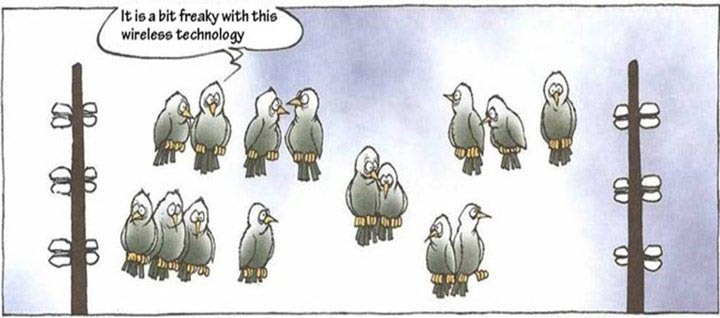 Ben Mendelsohn recently set out to address this issue with a short documentary film on 60 Hudson Street that comprises his master’s project for the New School. If you are not familiar with Internet routing, this may be surprising to you. Ben’s film is quite engaging.
(HT: Brain Pickings)
The Translator
I blogged about Half the Sky by Nicholas Kristof on my previous blog, as one of a list of books I am reading in my women’s book club. So far we have read Infidel, Nomad, Stones into Schools, Racing Against Time, The Blue Sweater Project, White Man’s Burden. Books on the list for future reading are Collapse of Civilizations and Better Together. Alongside this list, I have enjoyed Half a Yellow Sun, The Enchantress of Florence, and Islamic Science and the Making of the European Renaissance. Of this list, I highly recommend Half the Sky and The Blue Sweather Project as books everyone should read.
I mention this list as context for the book I read yesterday, The Translator. This is the memoir of Daoud Hari, Sudanese translator for Nicholas Kristof and other journalists in Darfur. We don’t often get to listen to the voice of the translator, that person who is caught between cultures, experiencing the pain of one culture from the viewpoint of another. It is a book of both sorrow and courage, and incredibly also of humour and obstinancy in the face of beatings and torture. But you will appreciate the way Daoud Hari has told a deeply human story. Hari was eventually assisted in coming to the US, where he wrote this book. His work as a translator had made him a man without a country.
One interesting incident is when the journalist, Paul Salopek, believes that Hari has called him a spy because of his use of the term hawalya. But Hari exclaims that it only means “white man.” Paul does not know whether to believe him or not and for some time refuses to speak to Hari until he has it confirmed in court that hawalya does not mean “spy.”
In court the attorney general told the guards to untie the hawalya.
Paul jumped up: “Why do you call me a spy? You know very well that I am no spy.”
The attorney general corrected him with a smile: “Hawalya? Sir, it means, well, it just means ‘white man.’ A white fellow. It’s a good word, almost affectionate.”
Paul looked like a man who sees a beloved brother come home after being a long time lost to him. He came over to me and apologized and we laughed.
“You are my brother,” I said to him. “I would never say thing to harm you.” He shook my shoulders and closed his eyes and said he knew that.
He seemed more recovered in the next hour than in all the time since ending his fast.
It had been a pretty good day, considering that the three of us were looking at fifteen to twenty years in a very bad prison. But what, not counting family, is more important than friendship? (page 171)
This passage calls to mind the Hebrew word רֵ֫עַ “friend, companion, fellow” sometimes weakly translated as “neighbour” in our English Bibles.


 BLT
BLT 