Harpagmos II: Denny Burk’s Subordinationism
I want to be very clear that I am not trying to sensationalize this discussion through the use of an inflammatory title. I am working directly from Burk’s articles and trying to comment on what seems most significant in them. If Burk’s primarly application to humans for Phil. 2:6 is that wives obey their husbands, what is the implication regarding the trinity? Here is his explanation from his paper of 2000. He seems quite aware that finding subordinationism in this passage is new and not grounded in the history of interpretation. The bolding in the following is mine,
If aJrpagmov” be understood according to the above analysis, then Christ is said not to have snatched at or grasped for equality with God. Though he was himself true deity existing in the form of God, he did not try to grasp for this other aspect which he himself did not possess—namely, equality with God. On the contrary, Christ emptied himself. This emptying consisted in taking the form of a bond-servant, and being made in the likeness of men (v. 7). Therefore, the contrast between verses six and seven is made very clear. Christ, the second Person of the Trinity, did not try to snatch at an equality with God which properly belongs only to the first Person of the Trinity. On the contrary, Christ embraced those duties which were appointed for the second Person—taking the form of a servant and being made in the likeness of men. In this way, Christ did not attempt to usurp the peculiar role of the first Person of the Trinity, but in submission he joyfully embraced his own in the incarnation.
Theological Implications
I think this interpretation opens the way for us to see an orthodox subordinationism within the Godhead.41 Although the Father and Son are one in their essence (that is, both of them existing in the form of God), they are distinct in their persons (that is, they each respectively fulfill certain roles and functions that are peculiar to their own Person).42 The character of this intra-Trinitarian relationship is what makes redemption possible. According to the Father’s predetermined plan (Acts 2:23), the Father sends the Son into the world as a man and as a servant.43 The Son does not try to abdicate his role by grasping for functional equality with the Father (Phil 2:6). On the contrary, the Son obeys the Father and enters onto the stage of human history (Phil 2:7). In this sequence of events, we see that the Son not only obeys the Father in his incarnation but that he also obeys the Father from all eternity. For this reason, if the Son were not obedient to the Father’s sending him into the world and if he were not distinct from the Father in his Person (and thus in his role and function), then redemption would have been impossible, for the Son never would have obeyed the Father, and there never would have been an incarnation.
What Burk does not say is whether the Son is subordinate for eternity to come. This is not found in any of his articles, but I have found a defnitive statement on the CBMW website relating to subordinationism which I presume Burk would assent to. It reads,
let us state the doctrine:
The eternal subordination of the Son means that Jesus Christ is eternally the Son of God, equal in essence and in eternal divine nature with the Father, that the Father exercises eternal authority over the Son in function, and the Son eternally submits to the authority of the father.
To quote Ware in summary, “There is, then, an eternal and immutable equality of essence between the Father and the Son, while there is also an eternal and immutable authority-submission structure that marks the relationship of the Father and the Son.”
This doctrine is rejected by some scholars, including many who hold the egalitarian position regarding gender roles in the home and church, but it is has been affirmed among many evangelical scholars and teachers throughout the history of the church as will be seen later in the series.
According to this statement, the father-son relationship is immutable and is one of subordination for eternity to come. It is crucial to establish this in order to make any sense of the different positions on harpagmos laid out by N. T. Wright in The Climax of the Covenant and it is the writing of Wright, here and elsewhere, which Burk interacts with and is eager to rebut. (I found that in the series on the CBMW website, “teachers throughout the history of the church” were mentioned but no citations or evidence was offered.)
Here are three major positions regarding the meaning of harpagmos from The Climax of the Covenant by Wright, pages 64,65. These are the first two,
Lightfoot distinguished two senses of the key clause, that of the Latin Fathers (properly called res rapta, in which Christ is said not to have regarded his divine equality as something obtained by snatching, i.e. to have regarded it as being his by eternal right) and that of the Greek Fathers (properly, though not usually, called res retinenda, in which Christ is said not to have regarded his divine equality, already possessed, as something greedily to cling on to).
and the third is that of R. P. Martin,
Christ existed eternally in the form of God, but refused to snatch at the further honour of world sovereignty (‘being equal with God’), choosing instead to receive it as the result of obedient suffereing and death.
In each of these views Christ is equal with God for eternity to come. The reason for this does not reside in one’s view of harpagmos, in verse 6, but rather in the fact that verse 11 cites Isaiah 45:23,
22Look unto me, and be ye saved, all the ends of the earth: for I am God, and there is none else.
23I have sworn by myself, the word is gone out of my mouth in righteousness, and shall not return, That unto me every knee shall bow, every tongue shall swear.
Christ is the God who speaks in Is. 45. He is God and fully equal to God for eternity to come. This is what the author of Philippians 2 is saying. Dr. Burk believes that there is a way to introduce a new orthodox theology of subordinationism because just possibly Christ was not equal to God in Phil. 2:6. But Christ’s equality to God, as Lord, is proclaimed in Phil. 2: 9-11
9Wherefore God also hath highly exalted him, and given him a name which is above every name:
10That at the name of Jesus every knee should bow, of things in heaven, and things in earth, and things under the earth;
11And that every tongue should confess that Jesus Christ is Lord, to the glory of God the Father.
I cannot make Burk’s and the CBMW view of the eternal subordination of the Son line up with anything in the history of interpretation. More about the grammatical point that Burk makes later.
Crossway’s physical Bible design: perfection not yet reached
When a man with such excellent taste as Mark Bertrand gets excited about a Bible, I take notice. And Mark is clearly excited by a new Bible design: the Single Column Legacy ESV. I bought the TrueTone Brown/Cordovan “Timeless” Design, which is currently available at $31.49 at Amazon. Here are some of the things Mark and Randy Jahns, VP of Sales for Crossway, say about the Bible in Mark’s blog post:
Jahns: The original project was conceived under the working title of “Reader’s Thinline Bible.” The goal was to create a single-column, text-only, reader’s edition that focused on an inviting readable page and beautiful design. Our Bible typesetter relied heavily on Canadian typesetter Robert Bringhurst’s The Elements of Typographic Style as he developed the page design. Essentially, we tried to follow the “Renaissance Ideal” or “perfect page” layout. This layout refers to a set of principles called the “canons of page construction” that all focus around a 2:3 ration of page geometry….
Bertrand: For a lot of people in the Bible Design Blog community, this looks like the one we’ve been waiting for….
Jahns: One of the things you can’t see in the sample PDFs is the effect of the “line on line” typesetting, which we use for the Single Column Legacy and several other ESV Bible editions. To achieve this, we employ a set typesetting grid, which allocates a full line of space for each line of Bible text. This effectively “lines up” each line of Bible text with a line of text on the opposite side of the page. This eliminates some of the show-through and helps make the printed page look cleaner. It also increases the readability and visual appeal….
Bertrand: Can you fill out the colophon on the Legacy ESV for us?
Jahns: …Font: Lexicon, 9 pt / 10.75 pt; Paper: 36 gsm Thincoat Plus….
Bertrand: Might there ever be a dedicated wide margin edition? …A hardcover edition?
Jahns: …These options are not currently on the schedule….
Bertrand: You’ve set a fine standard in Bible publishing, and with the Single Column Legacy ESV, it appears you may have done some of your best work yet.
(In this review, I will not comment on the ESV translation itself, but will simply restrict my comments to issues of book design for the Single Column Legacy ESV [SCL-ESV].)
On paper, this should be an outstanding ESV. But it is far from perfect, and indeed, is hardly even the nicest ESV I have seen to date. I would say that the ESVs from Cambridge University Press (in particular, the Pitt Minion, Wide Margin, and especially the Clarion designs) are much better (albeit at a considerably higher price.) The basic problem with the Crossway SCL-ESV is that it can’t make up its mind on what it is – a wide margin Bible, a reading Bible, or a thinline Bible.
The paper itself is thinline paper. Thincoat is used for thinline Bibles and 36 gsm (gsm = an unofficial abbreviation for grams per square meter) is one of the thinnest versions of thincoat available. Typical thin “Bible paper” might be 40 gsm or 45 gsm. Typical paper that you may use in a photocopy machine (20lb paper) is typically 75 gsm. Paper in a fine book could be 100-200 gsm (or even more for some art books). The result is that the opacity of this paper is similar to that of thinline Bible, and like a thinline Bible, it is hard to write in it.
It is true that by using a typesetting grid, the lines on the paper line up on both sides, but this is not uncommon for high-end Bibles. For example, one of the Bibles I used as a comparison, the New Oxford Annotated Bible (NOAB-RSV) Extended Edition RSV (1977) (still in print in hardcover and leather), uses the same feature, as do most Cambridge Bibles I have seen.
The SCL-ESV uses nine-point Lexicon while the NOAB-RSV uses ten-point Times Roman (or some similar font). The interline spacing makes them both have about a similar number of lines per vertical inch, but the skinnier and smaller Lexicon is more bunched-up horizontally. To me, it makes the text less comfortable to read. The SCL-ESV is laid out in a single column, but the column width is a bit too long for me for my taste. At about 70 characters per line, the single column format of the SCL-ESV should in theory be nearly perfect for reading (it is widely claimed that 66 characters per line is the most readable text) but somehow it seems to me to be too scrunched. The wide margins add to the illusion, making the text seem more cluttered than it really is.
The oddest thing about the SCL-ESV is that it is essentially a wide-margin Bible (with margins of an 1.2 inches on the bottom and outer margin and .75 inches on the top) and yet it is on such thin paper that it is hard to write on it without bleed through. (In my experience, most users of wide-margin Bibles prefer thicker paper. Also, since some users of wide-margin Bibles prefer hardcover, the absence of the publication in that binding is also unfortunate.)
It may be a matter of taste, but I found the section headings (in the outer margin, as if in a textbook) to be distracting. I was also puzzled by the inclusion of a mini-concordance (72 pages) in what is essentially a thinline format.
Especially disastrous is the laying out of textual notes in the SCL-ESV – they are printed in a tiny sans-serif font with very poor readability.
For me, the SCL-ESV most shined in its layout of poetic passages – with those wide margins and clear separations between stanzas, it really looks like poetry.
While the SCL-ESV is a huge step forward in book design for Crossway, it cannot compare with classic beautifully typeset Bibles (such as one can find in the King James) or even many editions from Cambridge University Press. For me, the NOAB-RSV is much more readable than the Crossway, although their textblock dimensions are similar (the NOAB-RSV is a bit thicker, with a textblock width of about 1.4” as opposed to the 1.2” textblock of the SCL0ESV, although the NOAB-RSV also contains a lot more material – an extended apocrypha, notes, more maps, supplementary materials).
Two final comparisons: today’s mail also brought me a copy of Harvard University Press’s new Annotated Emerson, a particularly handsome book. This is certainly an apples and oranges comparison (not least because the Harvard volume is physically larger while having much less text – less than 600 pages – and being in color), but I cannot help but notice how much more readable the Harvard volume is than the Crossway volume. Another comparison – I took out my old copy of Oxford’s ESV with Apocrypha and that was also more readable than the the new ESV-SCL, even though the Oxford volume “breaks the readability rules” by using a sans-serif font and double-column format. I simply do not think that Crossway’s book use superior typesetting.
Now of course, my opinion is subjective, but I would like to caution a potential purchaser to seek out the SCL–ESV volume in the library, a friend’s collection, or the bookstore before buying this volume. It seems to me that by trying to simultaneously be a thinline, a reading Bible, and wide-margin Bible, the SCL-ESV has turned out to be something of a Frankenstein design. If the ESV is your favorite translation, I would check out options from Cambridge and Oxford before buying this volume.
(A postscript: The ESV is not my favorite Bible translation, and I have a lot of concerns about the design of this SCL-ESV edition. However, I continue to be impressed with how well Crossway supports its Bible translation. For example, I note that Crossway will be publishing a diglot Old Testament with the Biblia Hebraica Stuttgartensia [BHS] text facing the ESV translation. While Jewish diglot Bibles are common, Christian diglot Bibles are more scarce – and I cannot right now recall any diglot that used the BHS page with full apparatus. Interestingly, this volume is appearing before an ESV-Greek New Testament diglot – perhaps because there already is a perfectly serviceable NA27-RSV diglot.)
Mnesilochus:
Darling, do me this favour! Let me wail on my own, will you please? There’s a good girl! Now, please stop!
Echo:
…girl! Now please stop!
Mnesilochus:
Argh! To the crows with you, woman!
Echo:
Argh! To the crows with you, woman!
Mnesilochus:
What IS it with you?
Echo:
What IS it with you?
Mnesilochus:
Babble, babble, babble!
Echo:
Babble, babble, babble!
The above are the funny lines from Aristophanes’ play “Θεσμοφοριάζουσαι,” which is also pronounced in transliterated English as: “Thesmophoriazousai; meaning Women Celebrating the Festival of the Thesmophoria, sometimes also called The Poet and the Women”
Although it’s a dramatic play, Aristophanes is using wordplay in Greek here at line 1079a and 1079b. I mean wordplay in at least three ways. First, the clause Βάλλ’ ἐς κόρακας is performed in repetition: Βάλλ’ ἐς κόρακας.
Second, the Greek words are playful. There’s the persistent and nagging echo, a mocking of if not simply a reinforcement of the Greek notion that women just talk and talk and, incessantly, babble and babble.
And third, there is hermeneutic play: interpretive wiggle room for interpretive spin. You might laugh differently if you were one of the audience members watching one of the first performances of the play — depending on whether you were a woman or a man. The actors — who would have been men playing women — might have been more or less authentic in their womanlinesses, depending on the effects they were going after. Would they exaggerate the babble, to make it stereotypically female, for example?
And notice this: even English translators of Aristophanes’ would-be womanly Greek get to play with how this sounds today. Eugene O’Neill, playwright and Nobel laureate in Literature, interprets Βάλλ’ ἐς κόρακας / Βάλλ’ ἐς κόρακας as “Go and hang yourself! / Go and hang yourself!”
But it’s the interpretation of George Theodoridis, B.A., M.A. (Prel.), Dip.Ed. (Univ. of Melbourne, Australia), that you first heard above: for “Βάλλ’ ἐς κόρακας / Βάλλ’ ἐς κόρακας” we get from Theodoridis: “Argh! To the crows with you, woman! / Argh! To the crows with you, woman!”
Again, the Greek clause has hermeneutic play in it. There’s no need for some literal, one dimensional, “Throw to crows / Throw to crows.” Both O’Neill and Theodoridis are picking up on the play in the words, how they suggest a dialectic, a mock dialogue, an appearance of back-and-forth conversation that is really mere babble.
And yet, Theodoridis gets that the Greek also has the idea of tossing the other to the crows.
So, all of that is an introduction to a possible blog series on what’s lost in translations of the Greek of the texts of the Septuagint. In this Part I, this particular post, I want to look at the Greek phrase or clause, ἀποσκορακίζω, or literally “crow-ward thrown” or somewhat more figurally something like “thrown from somebody toward the crows.” It’s only used four times in all the Septuagint, or the Greek translations of the Hebrew Bible.
In Psalms 26:9 (numbered 27:9 in its Hebrew counterpart), the clause ἀποσ κορακίσῃς has been rendered thusly:
- to “damn” by NETS translator Albert Pietersma
- to “forsake” by translator Sir Lancelot C.L. Brenton
In Isaiah 17:13, the clause ἀποσ κορακιεῖ has been rendered thusly:
- to “damn” by NETS translator Moisés Silva
- to “drive away” by translator Sir Lancelot C.L. Brenton
In Isaiah 66:15, the phrase ἀποσ κορακισμὸν has been rendered thusly:
- a “repudiation” by NETS translator Moisés Silva
- a “rebuke” by translator Sir Lancelot C.L. Brenton
In I Maccabbees 11:55, the clause ἀπεσ κοράκισεν has been rendered thusly:
- to “fight against” by NETS translator George Themelis Zervos
- to “fight against” by RSV translators
The important questions are these:
- Why did the Jewish translators of their Hebrew texts, from Hebrew into Hellene, use this Greeky playful word, ἀποσ·κορακίζω?
- Especially in the Psalms, where NETS translator Albert Pietersma rightly notes that the Greek is used more as a literal gloss, as an interlinear of the Hebrew, why depart from the Hebrew literalness here for some sort of interpretative spin and literary spark instead?
- Since Pietersma notices that ἀποσ·κορακίζω is an interpretive spin and a literary spark, and a rare one at that, then why does he stop the spin with his English and dowse the spark with his translation? And why does he seemingly advise Silva and Zervos to do the same?
- Would this be such a bad translation of Psalms 26:9 from the Greek?
μὴ ἀποστρέψῃς τὸ πρόσωπόν σου ἀπ’ ἐμοῦ,
μὴ ἐκκλίνῃς ἐν ὀργῇ ἀπὸ τοῦ δούλου σου·
βοηθός μου γενοῦ, μὴ ἀποσκορακίσῃς με
καὶ μὴ ἐγκαταλίπῃς με, ὁ θεὸς ὁ σωτήρ μου.
Do not turn your face away from me,
Do not bend out in anger away from your slave:
My helper be, do not throw me away from you
nor throw me like a theosmophorian woman to the crows;
and do not leave me to the rest of them, O God my savior.
Now, for the rest of this post, here are a couple of salient statements from Pietersma. In these statements, the NETS translator and translation project chief seems to recognize how, in of all places – in the Greek translation of Psalms where the intention is simply to retain Hebraisms, the Jewish translators are exercising agency. There are Hebraic Hellene “Interpretive Spins” and “Literary Sparks” (which the NETS nonetheless, by English translation, seems to ignore).
.
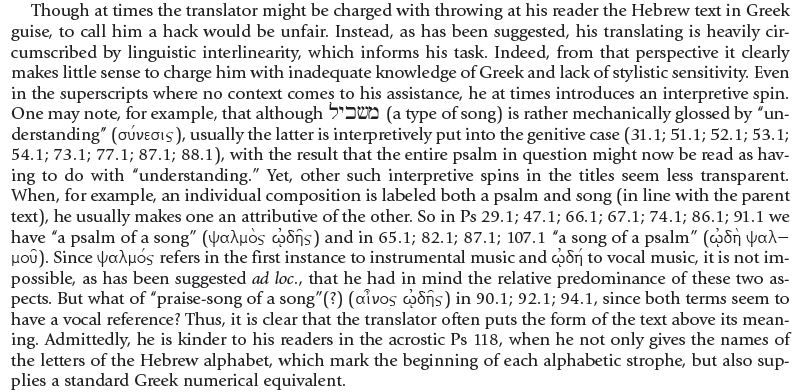
And here’s that bit on “to throw the crows” (simply in the NETS English as a gloss, “to damn”) with perhaps more to blog about later:

M. L. King and intellectual property law
Martin King was a master orator. His speeches still have the power to move us today. And in the tradition of preaching (including among those outside the African-American tradition), King borrowed some of his material from others, putting it together in new ways.
King used his oratory to construct common ground, drawing on references to political and religious morality that spoke to both blacks and whites. But the rules of preaching are in profound conflict with the rules governing intellectual property. King himself copyrighted the I Have a Dream speech in 1963. He directed all proceeds to the Civil Rights movement. But since his death, his estate, first his widow and now his children, have struggled with how to apply the law to King’s legacy.
Here is a transcript of interesting report from NPR/WNYC’s On the Media. You can also listen to the audio (13 minutes) and I recommend that you do.
Here is the blurb for the show:
Martin Luther King Jr.’s sermons frequently relied on improvisation – King drew on sources and references that were limited only by his imagination and memory. It’s a gift on full display in King’s ‘I Have A Dream’ speech, but it also conflicts with the intellectual property laws that have been strenuously used by his estate since his death. OTM producer Jamie York speaks with Drew Hansen, Keith Miller, Michael Eric Dyson and Lewis Hyde about King, imagination and the consequences of limiting access to art and ideas.
BROOKE GLADSTONE: Late in the afternoon of August 28th 1963 a young preacher stepped to the podium on the steps of the Lincoln Memorial and looked out over the assembled crowd. Then, Martin Luther King, Jr. did what many preachers do, but never so memorably. Using a blueprint he’d prepared in advance, he built a sermon.
[CROWD HUBBUB/DR. KING SPEAKING] The circumstances were exceptional, 250,000 people, a time tactically chosen, a show of strength and purpose, an implicit threat. But for King, it came down to a moment and a process he’d spent a lifetime learning. On the Media’s Jamie York anatomizes the process that made the moment.
JAMIE YORK: Working for his notes, King started moving quickly through themes and invocations he’d used many times before, starting with the Emancipation Proclamation and the Gettysburg Address, a reference to the Gospel of Matthew and, by the fourth paragraph, the idea of the uncashed check. This was an idea invoked most recently by James Baldwin and Malcolm X, the check uncashed, a debt still owed.
DR. MARTIN LUTHER KING, JR.: In a sense we’ve come to our nation’s capitol to cash a check. When the architects of our republic wrote the magnificent words of the Constitution and the Declaration of Independence, they were signing a promissory note …
[SPEECH UP AND UNDER]
JAMIE YORK: Then King moved on, deploying the full range of his voice through a series of references to Gandhi’s soul power, back to the Bible, repeating key phrases and pausing to hear the crowd’s response, so he could react accordingly. In those pauses, he came to grips with the conclusion he’d outlined in his notes, and around minute 11 he decided to improvise.
DREW D. HANSEN: He’s able to sit there, listen to what the crowd is saying and realize that his conclusion is terrible. I mean, it’s not gonna work.
JAMIE YORK: Drew D. Hansen is author of an analysis of the speech entitled The Dream.
[AUDIENCE CLAPPING]
DREW D. HANSEN: And so right there he’s looking out at the crowd. Mahalia Jackson’s behind him, saying, tell them about the dream, Martin, tell them about the dream, Martin.
[DR. KING SPEAKING/UP AND UNDER] And he just – he looks up from his text and says, “And so, I say to you today, my brothers, that even though we must face the difficulties of today and tomorrow –
DR. MARTIN LUTHER KING, JR.: I still have a dream!
DREW D. HANSEN: – I still have a dream.
WOMAN: Yes!
DR. MARTIN LUTHER KING, JR.: It is a dream deeply rooted in the American dream.
DREW D. HANSEN: And Clarence Jones who’s one of his aides, one of his speechwriters, is looking at him and he’s following along with the text, and he looks up at that point and goes, he’s off now. He’s on his own now. And he just flies.
DR. MARTIN LUTHER KING, JR.: – that my four little children will one day live in a nation where they will not be judged by the color of their skin but by the content of their character. I have a dream today!
[APPLAUSE]
JAMIE YORK: On the one hand, King had acted on a spark of inspiration and, on the other, was employing a skill he’d practiced and honed.
[DR. KING SPEAKING] What many scholars believe King did in that moment was to abandon his written remarks and draw on one of hundreds of ideas, references and sources that he’d committed to memory. In this case, an idea he’d been workshopping in front of audiences, the idea of a dream, a prophecy, joined with a riff on the song, America, My Country ‘Tis of Thee, with lyrics Samuel F. Smith wrote in 1831.
DR. MARTIN LUTHER KING, JR.: This will be the day when all of God’s children –
MAN IN CROWD: Yes.
WOMAN IN CROWD: Yes!
DR. MARTIN LUTHER KING, JR.: – will be able to sing with new meaning – My country ‘tis of thee.
WOMAN: Yes.
[RESPONSES]
DR. MARTIN LUTHER KING, JR.: Sweet land of liberty, of thee I sing!
[RESPONSE FROM WOMAN]
DR. MARTIN LUTHER KING, JR.: Land where my fathers died, land of the pilgrim’s pride.
[DR. KING SPEAKING/UP AND UNDER]
JAMIE YORK: There was a tradition of referencing the song’s irony in the face of racism. Ida B. Wells and W.E.B. DuBois had both done it. But King wasn’t going that far back. King was recalling a speech black judge and clergyman Archibald Carey had given 11 years prior at the Republican National Convention, another memorable riff on America by Samuel F Smith.
DREW D. HANSEN: There’s no question, you look at the two together, King’s depending on that as his source. I mean, in some speech, King talks about how he gets this line from quote, “a great orator,” close quote. I mean, he doesn’t try to hide it. But then you look at what King does, and the material’s totally different. I mean, Carey talks about the green mountains and white mountains of Vermont and New Hampshire. Well, that’s a handful of words, if you ever saw one. King makes it “the prodigious hilltops of New Hampshire” right? He gets the internal rhyme on the short “i” of prodigious and hilltops. It’s this nice, quick little phrase. I mean, there’s no repeated phrase in Carey’s original. Well, King takes it and he puts in “Let freedom ring” –
DR. MARTIN LUTHER KING, JR.: Let freedom ring!
MAN: Yeah!
WOMAN: Amen!
MAN: – “from the prodigious hilltops of New Hampshire.”
DR. MARTIN LUTHER KING, JR.: From the prodigious hilltops of New Hampshire!
WOMAN: Ah-ha!
DR. MARTIN LUTHER KING, JR.: Let freedom ring from the mighty mountains of New York. Let freedom ring from the heightening Alleghenies of Pennsylvania.
[RESPONSES FROM CROWD] Let freedom ring from the snowcapped Rockies of Colorado!
[SPEECH CONTINUES IN BACKGROUND]
DREW D. HANSEN: He’d spent his entire life studying techniques of preaching. And for the rest of his life, I mean, he and his friends from seminary kept on this running correspondence about the preacher’s art. I mean, one of them would write to him and say, hey, I tried the ladder sermon, where you take an idea and you gradually increase the level of your examination at it, or the jewel sermon, where you look at a theme from a number of different angles, like facets of a jewel. Rabbit in the bushes, where if you start going on an idea and you feel the audience responding, then you keep shootin’ at it, just like a hunter would keep shooting at the bushes –
DR. MARTIN LUTHER KING, JR.: – free at last, free at last.
DREW D. HANSEN: – when he sees them rustle to see if there’s a rabbit in there.
DR. MARTIN LUTHER KING, JR.: Thank God almighty, we are free at last!
[LOUD CHEERS AND APPLAUSE]
JAMIE YORK: But what are the ethics of constructing your sermons from the raw material of any ideas you encounter? Keith Miller is the author of Voice of Deliverance: The Language of Martin Luther King Jr., and Its Sources.
KEITH MILLER: There were hundreds of books and sermons published by liberal Protestants before 1950, 1960, and in my research I traced not only King’s use of sources, but these, these preachers were borrowing from each other. So you can read one book of sermons and there’s a quotation from Shakespeare, and you – and you might think that the person was staying up all night reading Shakespeare, but actually the same quotation from Shakespeare shows up in book after book after book of sermons by different people.
JAMIE YORK: And that’s just the references found in the published sermons of white and black preachers. King, of course, came out of a parallel oral tradition of African-American preaching.
KEITH MILLER: There’s a long tradition of African-American folk preaching starting in slavery. Most slaves were forbidden by law to learn how to read and write, so they developed this oral tradition of songs and sermons. And the sermons – some of the sermons during slavery were still being preached in the ’30s, ’40s and ’50s and were recorded on blues labels and sold. Somebody would find an unusual piece of scripture that people hadn’t used much before and then they’d float from one book of sermons to another and one imagines from one oral sermon to another in different contexts.
DREW D. HANSEN: King saw the whole world as his sourcebook. He didn’t make some great fine distinctions between what was his originally and what was someone else’s. He would take the material and he would transform it into his own, no matter where it came from.
JAMIE YORK: Preaching then is an art, whose first and foremost aim is to exalt God and move those in the pews. King used his oratory to construct common ground, drawing on references to political and religious morality that spoke to both blacks and whites. But the rules of preaching are in profound conflict with the rules governing intellectual property. King himself copyrighted the I Have a Dream speech in 1963. He directed all proceeds to the Civil Rights movement. But since his death, his estate, first his widow and now his children, have struggled with how to apply the law to King’s legacy. Lewis Hyde is the author of Common as Air: Revolution, Art and Ownership. He says it’s a real puzzle deciding how to treat Martin Luther King, Junior’s famous speech.
LEWIS HYDE: Whether it should be a public – like a public park open to all of us or whether it’s a piece of private real estate that it’s appropriate to charge fees to enter. I guess I first knew about this because it came up in regard to the famous Civil Rights documentary Eyes on the Prize, and in that instance, you find one case in which people wanted to use Martin Luther King’s speaking and image and found it difficult to clear the rights for a reasonable amount of money.
JAMIE YORK: Eyes on the Prize is but one example of King’s estate monetizing and restricting access to King’s written words, speeches and likeness. Likewise, the estate has sued or demanded steep fees from academics, journalists and news organizations, charging intellectual property violations and, almost without exception, they’ve won.
LEWIS HYDE: Martin Luther King’s heirs have treated his created work as a commercial property. They have used King’s work, sold it to advertisers. One example is a cellphone company.
[EXCERPT FROM SPEECH: FREE AT LAST!] [MUSIC UP AND UNDER]
JAMIE YORK: A cellphone ad from 2000 in which King’s speech is juxtaposed with Kermit the Frog –
HOMER SIMPSON: DOH!
JAMIE YORK: – and Homer Simpson.
LEWIS HYDE: And [LAUGHS] so this is a reformulation of King’s image and message, moving it from the political and spiritual sphere in which it began into a completely commercial sphere.
[CLIP]:
MALE ANNOUNCER: Before you can inspire.
DR. MARTIN LUTHER KING, JR.: We hold these truths to be self-evident –
MALE ANNOUNCER: Before you can touch.
DR. MARTIN LUTHER KING, JR.: – that all men are created equal.
MALE ANNOUNCER: You must first connect. And the company that connects more of the world is Alcatel, a leader in communication networks.
DR. MARTIN LUTHER KING, JR.: I have a dream!
[CHEERS/APPLAUSE][END CLIP]
JAMIE YORK: Hyde makes the point that the snippet of that speech that was sold to Alcatel is only 65 percent King’s. The rest of the words are Thomas Jefferson’s. No one I spoke to disputes that the King family have every legal right to make a living from the estate they’ve inherited, and where the line of commercialism should be drawn is a complicated debate. A 2008 study found that the speech was more recognizable to Americans than any other, and 97 percent of American teenagers recognized the words as King’s. But authors like Michael Eric Dyson, author of I May Not Get There With You: The True Martin Luther King, Jr., fear that the recognition is actually counterproductive if documentarians, journalists and researchers are denied reasonable access to the rest of King’s legacy.
MICHAEL ERIC DYSON: As a scholar and as interested citizens, certainly I think that it would serve Dr. King’s ultimate interests for the broader public to have access to his intellectual vision, and I think that’s critical if we’re going to combat some of the vicious mythologies about Dr. King that prevail.
JAMIE YORK: Lewis Hyde thinks the risks are greater still, that King’s speeches, the tradition he comes out of makes an even larger point about how ideas and ownership enable or disable certain ways of being human.
LEWIS HYDE: And in particular, I’m interested in collective being. I’m interested in making it easier for people to be public and social selves, as Martin Luther King certainly was. The risk is that if we turn everything into private property, it becomes harder and harder for us to have these common or collective selves, which is something we need. In anthropology, there’s an interesting resurrection of an old word, which is the word “dividual.” So we live in a nation that values individuality; we live in a nation of individuals. But a dividual person is somebody who’s imagined to contain within himself or herself the community that he or she lives in. So it would be nice if we began to have a better sense of how to own and circulate art and ideas, such that we could be present in our dividuality, as well as our individuality.
JAMIE YORK: King was a genius as an activist, poet and preacher who, to [LAUGHS] borrow a phrase, made hope and history rhyme. But for Hyde, genius like King’s can only be fully realized when it has access to the world of art and ideas that King swam in and sampled from. This is our public selves, where our unique gifts contribute not simply to our individuality, but to better our community. And for Hyde, this potential is lost when we confuse categories and place ideas like King’s, ideas he himself thought were divinely inspired, solely into the category of commerce.
Did you catch the quotes from these Bible verses?
- Amos 5:24 (NIV): “But let justice roll on like a river, righteousness like a never-failing stream!”
- Isaiah 40:4-5 (KJV): “Every valley shall be exalted, and every mountain and hill shall be made low: and the crooked shall be made straight, and the rough places plain….”
King makes more subtle references to at least two other Bible passages as well. Did you notice these?
- Psalm 30:5 (NIV): “…weeping may stay for the night, but rejoicing comes in the morning.”
- Galatians 3:28 (NIV): “There is neither Jew nor Gentile, neither slave nor free, nor is there male and female, for you are all one in Christ Jesus.”
http://www.biblegateway.com/blog/2011/08/bible-references-in-the-i-have-a-dream-speech/
Dr. King dreamed of a day when America lives up to its creed, when all people sit together at one table, and when freedom and justice reign. His famous “I have a dream” speech reaches its highest point with echoes of the prophet Isaiah: “I have a dream that one day every valley shall be exalted, every hill and mountain shall be made low … and the glory of the Lord shall be revealed, and all flesh shall see it together.”
In words of the prophet Micah, he hoped that one day all persons elected to public office will “do justice, love kindness, and walk humbly with [their] God.” His hope for an end to war was rooted in Isaiah’s vision that people will “beat their swords into plowshares, and their spears into pruning hooks.” Biblical promises of “peace on earth and goodwill toward all” were Dr. King’s antidote to despair.
http://www.ncccusa.org/newbtu/lullking.html
Ratzman ends his lecture with a short video clip of King giving his final speech in Memphis, on April 3, 1968, the day before he was assassinated. He shows it not only because King planned to go to a Passover seder at Heschel’s home the following week, but also for its eerie prophecy and infusion of Hebrew Bible imagery.
“Like anybody, I would like to live a long life,” King says, pausing amid sporadic shouts from the crowd. “Longevity has its place,” he continues. “But I’m not concerned about that now. I just want to do God’s will. And he’s allowed me to go up to the mountain. And I’ve looked over. And I’ve seen the Promised Land. I may not get there with you,” he pauses, amid more shouts. “But I want you to know tonight, that we, as a people will get to the Promised Land. I’m not fearing any man. Mine eyes have seen the glory of the coming of the Lord.”
http://www.thejewishweek.com/arts/herschthal_arts/king_and_jews_beyond_heschel
All over the world, like a fever, the freedom movement is spreading in the widest liberation in history. The great masses of people are determined to end the exploitation of their races and land. They are awake and moving toward their goal like a tidal wave. You can hear them rumbling in every village street, on the docks, in the houses, among the students, in the churches, and at political meetings. Historic movement was for several centuries that of the nations and societies of Western Europe out into the rest of the world in “conquest” of various sorts. That period, the era of colonialism, is at an end. East is meeting West. The earth is being redistributed. Yes, we are “shifting our basic outlooks”. These developments should not surprise any student of history. Oppressed people cannot remain oppressed forever. The yearning for freedom eventually manifests itself. The Bible tells the thrilling story of how Moses stood in Pharaoh’s court centuries ago and cried, “Let my people go.” This is a kind of opening chapter in a continuing story….
We have inherited a big house, a great “world house” in which we have to live together – black and white, Easterners and Westerners, Gentiles and Jews, Catholics and Protestants, Moslem and Hindu, a family unduly separated in ideas, culture, and interests who, because we can never again live without each other, must learn, somehow, in this one big world, to live with each other.
This means that more and more our loyalties must become ecumenical rather than sectional. We must now give an overriding loyalty to mankind as a whole in order to preserve the best in our individual societies.
This call for a worldwide fellowship that lifts neighborly concern beyond one’s tribe, race, class, and nation is in reality a call for an all-embracing and unconditional love for all men. This oft misunderstood and misinterpreted concept so readily dismissed by the Nietzsches of the world as a weak and cowardly force, has now become an absolute necessity for the survival of man. When I speak of love I am not speaking of some sentimental and weak response which is little more than emotional bosh. I am speaking of that force which all of the great religions have seen as the supreme unifying principle of life. Love is somehow the key that unlocks the door which leads to ultimate reality. This Hindu-Moslem-Christian-Jewish-Buddhist belief about ultimate reality is beautifully summed up in the First Epistle of Saint John19:
Let us love one another: for love is of God; and everyone
that loveth is born of God, and knoweth God.
He that loveth not knoweth not God; for God is love.
If we love one another, God dwelleth in us, and His
love is perfected in us.Let us hope that this spirit will become the order of the day.
— Martin Luther King, Jr. in his speech:
http://www.nobelprize.org/nobel_prizes/peace/laureates/1964/king-lecture.html
and in his book:
Harpagmos I: Preview
This is a first attempt to respond to a question regarding the Greek word harpagmos translated as “robbery” in the KJV of Philippians 2:6. On Jan. 5, here, I received this request,
Suzanne,
I don’t think this is the correct place to ask this, but I would be interested in your take on some of the hyper-complimentarian positions regarding the eternal subordination of Christ.
Denny Burk tried to argue in the last issue of CBMW that Jesus the Son is eternally subordinate from God the father, by using Phil. 2:6. He is arguing specifically against Erickson, who is an egal.
http://www.cbmw.org/Journal/Vol-16-No-2/Christ-s-Functional-Subordination-in-Philippians-2-6-A-Grammatical-Note-with-Trinitarian-ImplicationsBut my understanding is that the historical view of this particular passage SUPPORTS the fact that Christ was fully equal with the Father in eternity, but laid aside his right to equality, so that he could submit to the Father in the incarnation.
John Calvin on Phil. 2:6-8 “The consideration of the divine grace and wisdom herein the apostle proposeth unto us, Phil. 2:6-8 . . . Adam being in the form–that is, the state and condition–of a servant, did by robbery attempt to take upon him the ‘form of God,’ or to make himself equal unto him. The Lord Christ being in the ‘form of God’–that is, his essential form, of the same nature with him–accounted it no robbery to be in the state and condition of God, to be ‘equal to him;’ but being made in the ‘fashion of a man,’ taking on him our nature, he also submitted unto the form or the state and condition of a servant therein. He had dominion over all, owed service and obedience unto none, being in the ‘form of God,’ and equal unto him–the condition which Adam aspired unto; but he condescended unto a state of absolute subjection and service for our recovery. This did no more belong unto him on his own account, than it belonged unto Adam to be like unto God, or equal to him. Wherefore it is said that he humbled himself unto it, as Adam would have exalted himself unto a state of dignity which was not his due.”
Would you be interested in addressing Burk and others’ false view of the trinity? Thanks!
Jeff subsequently provided a link to a piece he wrote on the topic. And yes, Deb, any place is the right place to ask questions!
As Deb indicates, this discussion can be focused on the two separate poles – at one end, the Christ who is fully equal to God, who does not think it robbery to be equal with God; at the other end, the subordinate Christ who does not go after being equal with God. Calvin sets forth the first option,
being in the ‘form of God,’ and equal unto him
and Denny Burk the second,
although Jesus actually possessed an identical characteristic of his Father with respect to his deity (i.e., “he existed in the form of God”), he did not want to grasp after another role that was not his – namely “equality with God.”
Here is the relevant passage from Philippians 2,
5Let this mind be in you, which was also in Christ Jesus:
6Who, being in the form of God,
thought it not robbery to be equal with God:
7But made himself of no reputation,
and took upon him the form of a servant,
and was made in the likeness of men:
8And being found in fashion as a man,
he humbled himself, and became obedient unto death, even the death of the cross.
9Wherefore God also hath highly exalted him,
and given him a name which is above every name:
10That at the name of Jesus every knee should bow,
of things in heaven, and things in earth, and things under the earth;
11And that every tongue should confess that Jesus Christ is Lord,
to the glory of God the Father. KJV
5 τοῦτο [e]φρονεῖτε ἐν ὑμῖν
ὃ καὶ ἐν Χριστῷ Ἰησοῦ,
6 ὃς ἐν μορφῇ θεοῦ ὑπάρχων
οὐχ ἁρπαγμὸν ἡγήσατο τὸ εἶναι ἴσα θεῷ,
7 ἀλλὰ ἑαυτὸν ἐκένωσεν μορφὴν δούλου λαβών,
ἐν ὁμοιώματι ἀνθρώπων γενόμενος·
καὶ σχήματι εὑρεθεὶς ὡς ἄνθρωπος
8 ἐταπείνωσεν ἑαυτὸν γενόμενος ὑπήκοος μέχρι θανάτου, θανάτου δὲ σταυροῦ·
9 διὸ καὶ ὁ θεὸς αὐτὸν ὑπερύψωσεν,
καὶ ἐχαρίσατο αὐτῷ [f]τὸ ὄνομα τὸ ὑπὲρ πᾶν ὄνομα,
10 ἵνα ἐν τῷ ὀνόματι Ἰησοῦ πᾶν γόνυ κάμψῃ ἐπουρανίων καὶ ἐπιγείων καὶ καταχθονίων,
11 καὶ πᾶσα γλῶσσα ἐξομολογήσηται ὅτι κύριος Ἰησοῦς Χριστὸς εἰς δόξαν θεοῦ πατρός. SBLGNT
In preparing to write on this topic and respond to Denny Burk’s article, I was substantially surprised by three seaprate things. The first is that there is a rich and diverse literature on the word harpagmos which does not give itself to a binary interpretation, an either/or debate between orthodoxy and heresy. There is much to be gained from scanning these historical commentaries. Some of the relevant commentaries are listed at the end of this post. There are significant contributions from both sides of the grammatical argument which Denny Burk presents in his article, and these are not easily lined up as either correct or false.
In order to respond in a fresh way, and in a way that will distance us from highly charged theological language, I propose a discussion of Iphegenia and Alcestis, two women in Greek tragedies who emulate the sentiment of this hymn. The former is a princess who offers herself as a sacrifice for her people, and the other a wife who dies for her husband. Well-known male literary works which deal with this theme are Prometheus Bound, The Dream of the Rood, and the poetry of Wilfred Owen.
Second, in the article which Deb links to there is no mention of gender roles. Dragging gender roles into the discussion may seem like derailing the analysis of a grammatical and exegetical issue with purely theological implications. However, Dr. Burk’s article as published in the JBMW Volume 16 No. 2 (Fall 2011) on the CBMW website is the third version of this article. The second version was published in the Tyndale Bulletin 55.2 (2004) 253-274 and the first version was presented at the southwestern regional meeting of the Evangelical Theological Society in spring 2000.
In the most rhetorically restrained and academic form of the article, published in 2004 in the Tyndale Bulletin, the conclusion reads,
In conclusion, my argument can be summed up as follows. Many commentators and grammarians see ‘form of God’ and ‘equality with God’ as semantic equivalents. This semantic equivalence is based in part on the erroneous assumption of a grammatical link between ‘form of God’ and ‘equality with God’. This supposed grammatical link consists of an anaphoric use of the articular infinitive, ‘the being equal with God’ (τὸ εἶναι ἴσα θεῷ). What I have shown is that this link has little grammatical basis and should be discarded. The exegetical result is that it is grammatically possible to regard ‘form of God’ and ‘equality with God’ not as synonymous phrases, but as phrases with distinct meanings. Therefore, if N. T. Wright and others want to link these two phrases as two ways of referring to the same thing, they will have to do so on other grounds.
In the 2011 version, in the JBMW, the paper includes “theological implications” (this section is not found in the Tyndale version of the paper). The theological implication is found here. No mention of gender.
In his preexistent state, Jesus decided not to pursue “equality,” but to pursue incarnation. Paul argues here that in his pre-incarnate state, Christ’s existed as qeo,j[theos]. Yet in this pre-incarnate existence, Christ Jesus did not seek to be like qeo,j [theos] in every respect. Paul pictures Christ Jesus (Cristw|/ vIhsou|/) as identified with God (qeo,j) in one respect, but distinguished from Him in another respect. Christ, before all time, preexisted in the form of God, but he did not forsake his unique role in order to be like God the Father in every way. The pre-incarnate Christ shared the Father’s deity, but he did not try to usurp the Father’s role. The Father would send the Son, and the Son would submit to being sent. In eternity past, the Son submitted to this plan.
However, in the original version of the paper, presented in 2000, we can read,
There are some ecclesiological ramifications that emerge from this view of the Trinity. First of all, it is neither unbiblical nor disrespectful to say that men and women fulfill different roles in the church and in the home. Because the great apostle has said elsewhere that the relationship of God the Father to God the Son is the paradigm for the relationships that exists between husband and wife in the home and men and women in the church (1 Cor 11:3), there is a great dignity in fulfilling the role that God has appointed for each individual. Just as the Father and Son are One in essence but distinct in their Persons, so there is a corresponding reality in earthly relationships between men and women. For instance, though wives are commanded to fulfill a role of obedience to their husbands (1 Pet 3:1), redeemed husbands and wives are one in their standing before God; they are fellow heirs of the grace of life (1 Pet 3:7). There is no essential inequality here, only a functional one. In this understanding, the man is no more superior in worth or significance over his wife than the Father is over Christ. On the contrary, the fulfilling of the roles appointed by God is ultimately a very glorious thing (Phil 2:11).
It surprised me that this application was made explicit by Burk. But you have his word for it. To my knowledge this is the first time in the history of interpretation that this passage has been used to enjoin wifely obedience rather than humility for all Christians.
The third thing that I discovered – it surprised me and it didn’t, at the same time – is that Burk wrote this article as his Th. M. thesis while he was an intern of Dan Wallace, with data supplied by Dr. Wallace. This explains the many similarities between this study and the Junia article, which I could not help but notice. Dr. Wallace is also the author of the Biblical Gynecology papers which present man and woman in the home as leader and responder. Dr. Wallace is senior New Testament editor of the NET Bible. He is also the executive director of the Center for the Study of New Testament Manuscripts.
What follows is a list of resources I expect to use in writing on this topic, although it may be a while before I can commit to further posts.
Chrysostom
Augustine
Calvin
John Owen
Lightfoot
Beet
Metzger
R. W. Hoover (I hereby make a plea for help in getting access to this article.)
Rod Decker’s summary of Hoover’s position
Craig Blomberg
Denny Burk 2000, 2004, 2011
M. L. King and the American revolution
Many people consider our newest national holiday, MLK Day, to not be a “real” holiday. perhaps is too new, or just seems marginal for them. In Saul Steinberg’s celebrated “holiday” New Yorker cover, we have Washington and Lincoln, Santa Claus and the Easter Bunny (ready to eat a hardboiled egg!), symbols of Thanksgiving and Halloween, and even Lady Liberty (representing perhaps Independence Day, Memorial Day, etc.) and an American Indian (representing perhaps Columbus Day). But there is no Martin King.
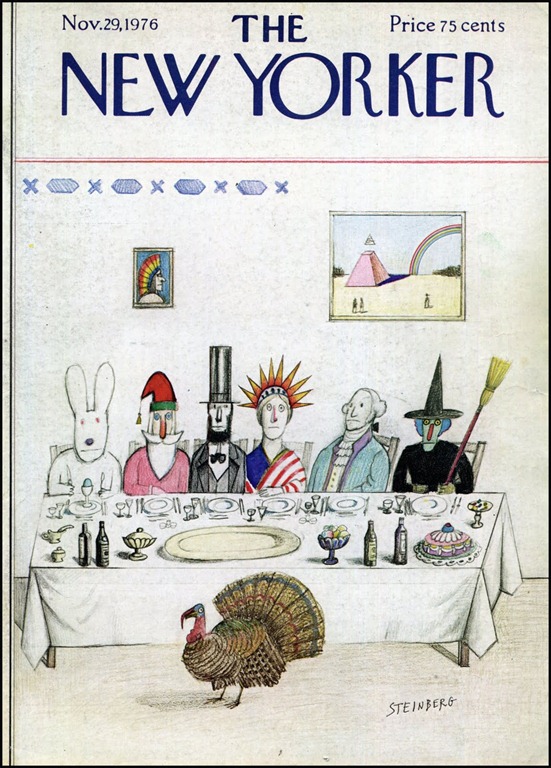
Now, to be fair to Steinberg, MLK Day was not made a Federal holiday until 1986 (legislation was signed in 1983), so seven years earlier when Steinberg drew his cover, he could not have been expected to to draw in a representative of MLK Day. But in 2012 – our 27th national MLK Day, the holiday is only partly observed in the private sector.
But I find MLK Day to be a serious holiday. Most history books argue that the American Revolution did not end in 1783, when the Treaty of Paris officially ended the Revolutionary War, or in 1787, when the US Constitution was signed. It did not even end in 1865, when the worst American war finally ended over unsettled issues in the US Constitution. It did not end in Reconstruction.
Certainly, in the 1960s, when inequality was a de facto policy in large parts of the US, the American Revolution was not finished. King, as a brilliant rhetorician, was crucial in gathering diverse parties together to help address the unsettled issues. But more than that, King was crucial in setting down the basic parameters of discourse – unlike the 1860s, the 1960s were not to be time of mass violence. King showed us how we can have revolutionary cultural and political change without violence.
Of course, the 1960s saw violence – and King lost his life to violence – but the basic pattern was set as non-violence. and compared to the US experience during the previous century – or to any number of other locations, US dialogue remains remarkably non-violent. Contra Robespierre (and those who later quoted him – Taft, Trotsky, etc.), it turns out that you can make an omelet without breaking some eggs.
It is popular today to mention King’s personal shortcomings: he may have plagiarized part of his doctoral dissertation; he had extramarital affairs. I do not think this in anyway subtracts from King’s contributions. King was not an academic or a scholar – he was a social leader. And if our history books were to be purged of all our “founding fathers” who engaged in sexual improprieties, we would have very few individuals remaining. King’s core contribution his successful leading of a non-violent campaign for civil liberties is as much a part of the American revolution as Thomas Paine, George Washington, Thomas Jefferson, James Madison, and Abraham Lincoln. King is a founding father of America.
A coda: In 2011, I visited the King Memorial in Washington DC. I cannot say that I liked it – while the setting was beautiful, on the Tidal Basin, the way it presented King was unpleasant and encompassed an aesthetic of triumphalism rather than reflecting King’s philosophy. Particularly upsetting was the way that King’s words – his great legacy to us – were altered. An AP story explains how the quotation was altered and how it will be fixed:
A quote carved in stone on the new Martin Luther King Jr. memorial in Washington will be changed after the inscription was criticized for not accurately reflecting the civil rights leader’s words.
The inscription currently reads: "I was a drum major for justice, peace and righteousness." The phrase is chiseled into one side of a huge block of granite that includes King’s likeness emerging from the stone. It became a point of controversy after the memorial opened in August.
A spokesman for the U.S Department of the Interior said Friday that Secretary Ken Salazar decided to have the quote changed.
The phrase is modified from a sermon known as the "Drum Major Instinct," in which the 39-year-old King explained to his Atlanta congregation how he would like to be remembered at his funeral. He made the February 1968 speech just two months before he was assassinated in Memphis.
In the speech, King’s words seem more modest than the paraphrased inscription: "Yes, if you want to say that I was a drum major, say that I was a drum major for justice. Say that I was a drum major for peace. I was a drum major for righteousness. And all of the other shallow things will not matter."
Poet Maya Angelou previously said the truncated version made King sound like "an arrogant twit," because it was out of context.
Salazar gave the National Park Service a month to consult with the King Memorial Foundation, which led the effort to build the memorial, as well as family members and other interested parties. The committee is supposed to come up with a more accurate alternative to the quote.
Things get weirder with English Catholic lectionaries
The situation with English lectionary for Roman Catholics has gotten weirder.
As we discussed last month, Mark Coleridge, , Archbishop of Canberra and Goulburn, the chair of the ICPEL English lectionary project wrote:
Some years ago, I was asked to chair a commission which would prepare a new English-language Lectionary, using a modified form of the NRSV and a revised Grail Psalter. That seemed straight-forward enough, and the expectation was that the new Lectionary would be ready for publication at the same time as the Missal.
However, we struck problems with the copyright holders of the NRSV and have had some difficulties in our dealings with the Holy See. All of this so becalmed the project that there is now no hope that the Lectionary or any part of it will appear at the same time as the Missal. In fact, we have decided to move away from the NRSV and to prepare the Lectionary using a modified form of the English Standard Version (ESV), still with the revised Grail Psalter.
On this new basis, the project has progressed well; and the hope now is to have at least the first volume of the Lectionary (Sundays and Solemnities) ready for publication as close as possible to the appearance of the Missal.
The note is not obviously dated, but was written at the end of 2011 – so it likely appeared in late November or early December.
[UPDATE: The web page from where this quote come appears to be inaccurate. Please see this comment below from the SACBC Communications Office.] Meanwhile, in Pretoria, the Southern African Catholic Bishops’ Conference (which comprises the bishops of Botswana, South Africa, and Swaziland) they have adopted the NRSV are implementing it effective Lent 2012. In a note last updated on November 30, 2011, they write:
Phase 3 of the new translation process will see the introduction of the new Lectionary with its different translation of the Holy Scriptures….
The Catholic version of the New Revised Standard Version (called the Catholic version because it includes the few books of the Bible used since apostolic times by the Catholic Church but excluded by some of the Protestant churches), commonly referred to as the “NRSV”, has been approved by the Catholic Church for some years. The quality of the language and the scholarly accuracy of the translation have contributed to this. In addition, the NRSV has also been gradually adopted by the Anglican, Methodist and Lutheran churches and by a number of other larger Protestant churches. It was decided that the quality of the translation, its wide acceptance by Christians of all denominations (with its consequent contribution to Christian unity) and its scholarly accuracy make it the appropriate translation to use in future.
The English translations of the psalms used during Mass and also during the “Prayer of the Hours” (also known as the Divine Office) have been drawn from a newly revised Grail Edition that has been carefully developed to provide both accuracy and also a rhythmic word pattern that will lend itself to singing, chanting and reciting.
The new Lectionary and the new versions of the Psalms will be introduced in Lent 2012. The Sunday and Daily missals for use by worshippers assisting in the congregation at Mass will also be available in time for Lent 2012.
If the Vatican’s Congregation for Divine Worship (which has approval over lectionary translations) can approve the NRSV for Southern Africa, why not for the ICPEL?
Meanwhile, Joseph Fessio, a Jesuit priest and the founder of Ignatius Press, has been announcing that several African dioceses will adopt Ignatius’s adapted version of the RSV, the “second Catholic edition” as a lectionary. However, Ignatius has meanwhile discontinued its lectionary and has instead remaindered all copies to one of the new Anglican Ordinariate parishes, which is redistributing the text to other Catholic Anglican Use parishes.
Meanwhile, in the United States, the disparity between the Lectionary and printed Bibles has increased. The US Catholic New American Bible saw a major revision last year – the NABRE or New American Bible Revised Edition. But the approved US lectionary uses a version of the NAB that was never published as a Bible and the disparity is increased with the NABRE.
What is going on? Is the NRSV an acceptable basis for the Catholic lectionary or not? Will Australia and England really turn to the ESV for a lectionary? Has the RSV-2CE really been adopted anywhere in Africa, and if so, who will print RSV-2CE lectionaries? Will we ever see a version of the NAB in which the text of the lectionary matches what parishioners can find in their personal Bibles?
For such an important aspect of the Catholic liturgy, the situation with Catholic lectionaries is perfectly murky. This cannot possibly be a good thing for developing high-quality learning materials and helping lay Catholics who want to study the Bible.
Found in Athens, lost in translation and in lore: Lyceum
Found in Athens on this very day, fifteen years ago, was the lost Lyceum. The old web page of the Greek Embassy in New York still has this announcement:
“Important Archaeological Sites, Aristotles’ Lyceum And Cave Of Euripides, Found in Greece Archaeologists Say / 14 January, 1997”
The opening – tentative – paragraph went like this:
Three days after archaeologists claimed they had finally found the cave where Euripides retreated to write his classic tragedies, construction works for a modern art museum unearthed a large ancient complex yesterday, complete with a central yard and a wrestling arena approximately 600 meters from Parliament – which, according to initial assessments may be the famed Lyceum where Aristotle is believed to have taught.
That and the rest you can still read here. If you visit the Lyceum site today, it looks like this:

This is downtown Athens, where the dig continues. The website where you find the photo of this now-public archeological site gives this fairly typical lore and history:
The Lyceum, named after its 6th century BC sanctuary to Apollo Lyceus (the “wolf-god”, from the word “lykos”, or wolf), had long been a place of philosophical discussion and debate, and had had been the meeting place of the Athenian assembly before the stablishment of a permanent meeting area on Pnyx hill in the 5th century BC.
But the Lyceum is mostly renowned for the philosophical school founded there by Aristotle upon his return to Athens in 335 BC after being the private tutror of the then young prince Alexander of Macedon, the future Alexander the Great, since 343 BC.
After his return to Athens in 335 BC and up to his death in 322 BC, Aristotle rented some buildings in the Lyceum and established a school there where he lectured, wrote most of his philosophical treatises and dialogues, and systematically collected books that comprised the first library in European history. Since Aristotle liked to walk around the grounds as he lectured, surrounded by his students, the philosophical school he founded was called Peripatetic (from ‘peripatos’, which means stroll or walkabout in Greek).
Similarly, the wikipediaists expand on some of these speculations and facts, to talk about the Lyceum before Aristotle (naming philosophers who taught there) and to mention the Lyceum of Aristotle after Aristotle (naming Theophrastus in particular, whose name is the pseudonym of one of the BLT bloggers here). In the historiography, the unearthed facts in the lore, I only want to recover just one thing.
This thing is something related to Euripides (whose cave coincidentally was also re-discovered 15 years ago this month): the ancient Greek word, Λύκειον, “Lykeion,” didn’t necessarily have anything to do with “Apollo Lyceus.” Now, it’s true that Aeschylus, in his play Suppliant Women (line 686), has his dancing Chorus refer to Apollos as ὁ Λύκειος. But Euripides does something else with the word. In the play Rhesus, Euripides has his character Dolon declare:
λύκειον ἀμφὶ νῶτ’ ἐνάψομαι δορὰνκαὶ χάσμα θηρὸς ἀμφ’ ἐμῷ θήσω κάρᾳ,
I will fasten a wolf-skin about my back,and over my head put the brute’s gaping jaws;
The Etymologicon: Mark Forsyth
The Etymologicon is a beautiful book all about the strange connections between words in the English language. It explains the link between film buffs and buffaloes, monks and monkeys, science and going to the lavatory.
This morning I’ve been reading a book by an author I’m calling “the Etymologicon” but since that’s the title of his book I probably should correct that and call him, Mark Forsyth, the etymologician, which sounds more magical or at least logical. Anyway, he’s first a blogger.
And at his blog the inky fool is already making his own corrections:
http://blog.inkyfool.com/2012/01/crorections.html
So let me add one. Early in his book, Forsyth writes, “This book is the papery child of the Inky Fool blog, which was started in 2009.” That may be true, but there’s little papery or childish if there’s much paperish with sophisticated child’s play in the ebook version I’m enjoying very much. (Furthermore I should add – not to rip him off but – the book author’s kindle edition is now being sold at amazon.com for a mere $1.99, which I say is both extremely cheap and nearly priceless. It’s well worth the many pennies and the minutes or hours you’ll spend with it. I’ve laughed out loud a lot already and learned even more.)
Now I’ll just end this short review before I’ve finished the papery pages by sharing my favorite quotation so far:
“The greatest joy a human being can achieve in this sorrowful world is to get one up on his or her fellow man or woman by correcting their English.” – what sort of correct English is that Mark Forsyth? Your turn. Greatly enjoy.
translating the woman’s “NO to War”
The story translated below is part of the information Isfahani offers about the acclaimed pre-Islamic poet Zuhair bin Abi Sulma. One of the latter’s most beautiful and best-known poems – and indeed one of the most famous exemplars of the early Arabic qasida (metrical ode ) – praises the generosity of Harith bin ‘Auf and Harim bin Sinan of the Bani Dhubyan tribe. The two undertook to pay a large sum of blood money as compensation for the deaths of members of a rival tribe, thereby putting an end to a bloody war of four years, which had originally broken out between the two tribes because of a horse race.
The story translated here from “The Book of Songs” is not about Harim bin Sinan – the philanthropist who joins up with the protagonist of the story, Harith bin ‘Auf – but rather about his brother, Harija bin Sinan. In any case, the following translation is dedicated to the woman in the story, Bahisa, who in her own way resisted stubbornly and said no to war.
— Ilana Hammerman
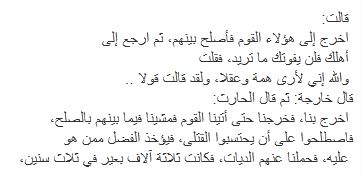
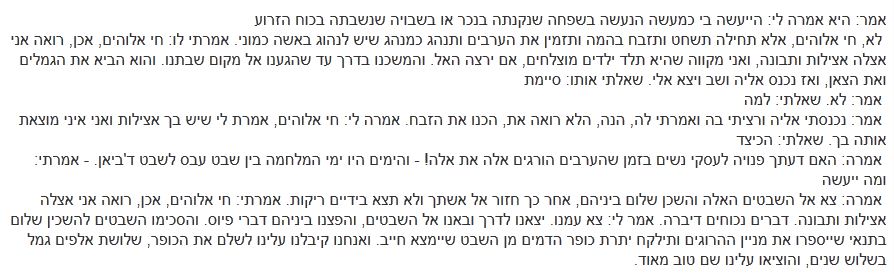
Let me start this post with a spoiler alert. Here is the way the story ends, the story of the peace-making Bahisa. First, you’ll read the final lines in Zuhayr‘s Arabic, where Bahisa speaks that mother tongue. Next, you’ll find the same in Ilana Hammerman‘s Hebrew translation of that. Finally, you’ll read how the story ends in Vivian Eden‘s English translation of Hammerman’s Hebrew. Below all of that, you will have the links to pages where you may read the entire story;
Hammerman suggests that the woman’s story, Bahisa’s story, is a source of the beginning of peace.
——————————–

—————————-

a Browning poem: not the light?
Today, my spouse emailed me the following lines from Robert Browning’s Paracelsus. We first met when working as docents in a Robert Browning and Elizabeth Barrett Browning museum and library, where I’d read the long poem years ago. What I noticed is that one of the phrases (in the version my wife sent) had been updated. (And I’ve restored the original phrase below, from “may escape” to how Browning put it, “may dart forth”). But then I saw something I’d never seen before. And Browning’s words have me asking whether he’s intending, ironically, for his readers (and namely the symbolic readers as listeners within his poem — “dearest Michal” and “dearest Festus”) to let his words enlighten us. Or are his words simply to rip open the carnal mesh of gross flesh? What’s in this poem? And what’s in you? Is it what the words suggest that is within? What is there to know? And how are you to know that? Have a listen:
Truth is within ourselves; it takes no rise
From outward things, whate’re you may believe.
There is an inmost center in us all,
Where truth abides in fullness; and around
Wall upon wall, the gross flesh hems it in.
This perfect clear perception — which is truth
A baffling and perverting carnal mesh
Binds it and makes all error and “to know”
Rather consists in opening out a way
Whence imprison’d splendour may dart forth
Than in effecting entry for the light
Supposed to be without.
Canadian Climate Scientist gets hate mail
From the Globe and Mail,
She once was a science-minded undergrad who spent her nights minding the telescopes on the top floors of the University of Toronto’s McLennan building.
Katharine Hayhoe is now a figure of some fame and controversy in the United States, for her sin is that she is an evangelical Christian who is also a climate scientist trying to convince skeptics that climate change is for real.
Dr. Hayhoe made headlines after the Republican presidential hopeful Newt Gingrich came under pressure and dropped plans to have her write an opening chapter on climate change for his upcoming book.
Now, her teaching duties at Texas Tech University have resumed and the sting from the Gingrich snub is fading. But the hate mail is still pouring in, dozens of insulting e-mails every morning.
“It’d be a lot easier to stay home. It’s not easy having people standing up and screaming at you. It’s not easy opening your mail in the morning and seeing a hundred e-mails, each one more hateful than the last,” Dr. Hayhoe said Monday, in her first interview with a Canadian news outlet.
“That’s not easy. And it’s not the science that motivates me. It’s what comes from the heart.”
That introduction to the sharp-elbowed world of politics was the latest blow for the 39-year-old, who already had a taste of hostile audiences from public speaking at Christian schools, seniors homes, farmers’ group and book clubs.
She was prepared to deal with emotional, unfriendly reactions. But she wasn’t expecting what came with the name recognition, she said.
“There’s a well-organized campaign, primarily in the United States but also in other countries, including Canada and Australia, of bloggers, of people in the media, of basically professional climate deniers whose main goal is to abuse, to harass and to threaten anybody who stands up and says climate change is real – especially anybody who’s trying to take that message to audiences that are more traditionally skeptical of this issue.”
It was even more shocking because she didn’t see herself as a “Godless, tree-hugging activist” but a scientist who also happened to be a member of an evangelical Bible church. She is also married to a pastor.
“The attacks’ virulence, the hatred and the nastiness of the text have escalated exponentially. I’ve gotten so many hate mail in the last few weeks I can’t even count them.”
On one occasion, after appearing on Bill O’Reilly’s show on Fox TV, she received nearly 200 hate e-mails the next day.
She sees her work almost like a pastoral mission, where she frames the issue as doing the right thing for the love of one’s children and neighbours.
“My own faith is the Christian faith and in the Christian faith we are told to love our neighbours as much as ourselves. And our neighbours, especially the poorer ones, are already harmed by climate change.
Most of her family still has roots in the Toronto-area. Her father is a retired science co-ordinator for the Toronto District School Board. An aunt is a sinologist at the Ontario Institute for Studies in Education.
Her parents were also missionaries and between the ages of nine and 18 she spent much time with them at a school where they worked in Colombia.
She graduated from the University of Toronto with a degree in physics and astronomy. With her father and a sister and another professor, Dr. Hayhoe co-authored a grade 10 Ontario textbook on climate change.
While doing graduate studies at the University of Illinois, she met her husband, a linguist.
Six years ago, the couple moved to Lubbock, after he got tenure at Texas Tech. Her husband is also the pastor of a local evangelical church.
Dr. Hayhoe says she had never met people who didn’t believe in climate change until she moved to the U.S. and began her public work.
Because she framed her concerns with optimism rather than doom, she was approached four years ago by Terry Maple, who was co-editing Mr. Gingrich’s book, to pen an opening chapter.
Mr. Gingrich, however, has struggled with some core Republicans who accuse him of harbouring environmental sympathies.
And thus, in mid-December, Marc Morano, a conservative activist, derided the planned book co-operation with Dr. Hayhoe, saying that it proved Mr. Gingrich was a “committed greenie” and a “warmist.”
Mr. Morano is a former Fox News contributor and his item was picked up by radio host Rush Limbaugh.
On Dec. 28, Mr. Gingrich was approached by a female supporter at an Iowa campaign stop. A video posted by the weekly The National Journal shows the woman telling Mr. Gingrich she wanted to talk about “Rush” and the global-warming book chapter.
Mr. Gingrich stopped her in mid-sentence. “It’s not going to be in the book. We didn’t know that they were doing that and we told them to kill it.”
“Good, that’s all I needed to know,” the woman said.
Afterward, Mr. Gingrich signalled to an aide. “Remind me when we’re back in the bus: ‘Rush’ and ‘global warming’,” he told the aide.
Dr. Hayhoe’s learned of the decision from the media.
“Nice to hear that Gingrich is tossing my #climate chapter in the trash. 100+ unpaid hrs I [could have] spent playing w my baby,” she wrote on Twitter.
She says that she now feels no grudge against Mr. Gingrich and that the incident is just proof of the acute polarization that has affected what should be a scientific debate.
“Attacking me and my colleagues and trying to intimidate us and trying to smear us is not going to change the facts of the situation.”
The story of Job starts with simultaneous views in heaven and Uz. Let us begin our comparison in the heavenly setting (verse 1:6), and later, we will come back and examine the setting in Uz for verse 1:1. (In this post and future posts, I will use a number of abbreviations – see the second post in my series for a list of abbreviations.)
Verse 1:6 is mysterious – it introduces God, his divine assembly, and ha-Satan. But how do the translations we are reading describe these?
Different translations render God’s name (the Tetragrammaton) in different ways. Some as Driver, NJB, Pope, and Scheindlin spell it out with a possible (but not certain) romanization. IBFET uses the consonants only, akin the Hebrew spelling. (I do not write out God’s name, so I’ve denoted in the table below as Y-H.) Others use “the Lord” or “the LORD.” Eisemann follows Orthodox Jewish custom in rendering it as HASHEM, which in Hebrew means “the name.”
An interesting question is the rendering of b’nei ha-elokim, which can be literally translated as “sons of the gods.” Elokim, though it is plural, is a common rendering for the singular “God” in the Hebrew Bible, so a better rendering may be “sons of God.” Ziegler in Greek (and NETS in English) has “the angels of God.”
Besides being of interest in own right, the translation of this phrase stands in counterpart to the question of the phrase often translated as “son of man.” If “son of man” is the translation of ben adam, consistency would seem to require that b’nei ha-elokim be translated “sons of God.”
Eisemann justifies “angels” on the basis of a reference to Nachmanides and extends the court metaphor, where ha-Satan is a prosecuting attorney and:
Metzudos thinks that the B’nei HaElokim are those angels charged with presenting the merits of the accused.
Alter claims in his commentary:
The celestial entourage is a literary vestige of the pre-monotheistic notion of a council of the gods and is reflected in several of the canonical psalms (perhaps, most notably, in Psalm 82).
The NET has a footnote stating:
The “sons of God” in the OT is generally taken to refer to angels….In the pagan literature, especially of Ugarit, “the sons of God” refers to the lesser gods or deities of the pantheon.
Pope elaborates with:
Literally “sons of the gods.” These are lesser members of the ancient pagan pantheon who are retained in later monotheistic theology as angels; cf. Job 38:7; Genesis 6:2, 4; Psalms 29:1, 89:7. In Psalm 82:1 they are called simply “gods.” The Ugaritic mythological texts give us vivid glimpses of the meetings of the gods; cf. EUT, pp. 47–49. Y-H as king of the gods holds court as in the vision of Micaiah ben Imlah, 1 Kings 22:19–23, surrounded by his divine entourage of counselors and servants.
Scheidlin (who as we will see in later posts, believes that Job is a non-Jewish book about a gentile Job) shocks with his direct rendering “the lesser gods,” his note saying
Ancient Mediterranean literatures, both Semitic and Greek, abound in descriptions of the councils of the gods; a similar picture is found in 1 Kings 22:19-22. In the narrative of Job, in line with the monotheistic principle, Y-H is the absolute master of the other gods, who report to Him. But by calling them lesser gods (literally, “sons of gods”) rather than angels, the author strengthens the impression that the story is told by and about pagans, outside the sphere of Israelite religion.
The largest diversity in the translations, though, is over the role and terminology of ha-Satan. KJV, NEB, NET, and NJB seem to directly relate this to the Satan of the New Testament. NET (“the slanderer”) has the most direct comparison with the New Testament, defending its rendering as follows, with a note :
The word means “adversary” or with the article “the adversary” – here the superhuman adversary or Satan. The word with the article means that the meaning of the word should receive prominence. A denominative verb meaning “to act as adversary” occurs. Satan is the great accuser of the saints (see Zechariah 3 where “Satan was standing there to ‘satanize’ Joshua the priest”; and see Rev 12 which identifies him with the Serpent in Genesis). He came among the angels at this time because he is one of them and has access among them. Even though fallen, Satan has yet to be cast down completely (see Revelation 12).
NJB (“Satan”) also associates ha-Satan with the New Testament Satan:
When preceded by the article, as in Zechariah 3:1-2, the term is still not a proper name. According to Hebrew etymology, it means “the adversary” or “the accuser.” The Satan is an equivocal figure, distinct from the sons of God, skeptical as regards human beings, anxious to find fault in them, capable of unleashing all sorts of disaster on them and even of impelling them into sin…. If he is not deliberately hostile to God, he is also nonetheless skeptical about God’s success in creating humanity. Besides the cynicism and cold, malicious sarcasm, lurks a pessimistic being, whose hostility to human being is based on envy. The text, however, does not elaborate on the reasons for his attitude. The foregoing characteristics relate the Satan to other sketches or portraits of the spirit of evil, particularly to that of the serpent … from which he will ultimately become indistinguishable. See Wisdom 2:24, Revelation 12:9, 20:2, as the incarnation of diabolic power, see Luke 10:18.
NABRE is a bit weaker (translating as “the satan”), but still draws a New Testament connection, although only in “later biblical traditions”:
Literally, “adversary” (as in 1 Kings 11:14). Here a member of the heavenly court, “the accuser” (Zechariah 3:1). In later biblical traditions this character will be developed as the devil (Gk. diabolos, “adversary”).
Eisemann, who uses “the Satan” compares the entity with the evil impulse (yetzer hara).
[Maimonides] in [Guide of the Perplexed] makes the the point that the our phrase seems to imply that Satan is not part of the [divine council]. He comes along with them, but does not really belong among them. In [Maimonides]’s understanding of our passage, the Satan represents the physical force which drags man downward, as opposed to his spirituality (the [divine council]) which alone has the right to stand before [God].
Driver, Eisemann, and Pope translate as “the Satan” while other translations use “the Adversary,” “the Accuser,” “the Accusing Angel.” Some translations try to have it both ways: Message – “Satan, who was the Designated Accuser”; NRSV – “Satan,” but has “the Accuser” as an alternative translation; REB – “the Adversary, Satan.”
Pope (“the Satan”) has a long explanation, relating ha-Satan to Persian secret police:
Note the definite article, as in Zechariah 3:1–2, which shows that the term is a title and not yet a proper name. The figure here is not the fully developed character of the later Jewish and Christian Satan or Devil. It is not expedient here to attempt a detailed discussion of the origin and development of his Satanic majesty, but some comment is in order since here in the Prologue of Job we have one of the principal passages in the OT in which the Satan appears in a clear-cut role. The Satan is one of the members of the divine court and comes with other attendants to present himself at the celestial court and report on the fulfillment of his duties. The picture of the celestial court with Yahweh enthroned as king is presented in 1 Kings 22:19; Isa 6; and Zechariah 3–4. In Zechariah 4 there is some rather bizarre symbolism. God is the lampstand and the seven lamps are his “eyes” which range through the whole earth, Zechariah 4:10b. Tur-Sinai has made the attractive suggestion that the figure and role of the Satan derives from the Persian secret service. Herodotus tells us that the royal secret police in Persia were called “the eyes and ears of the king.” Both in the present passage and in Zechariah 4:10 the verb used for the action of the Satan and of the roving eyes is šûṭ “roam, rove,” which is probably more than a mere wordplay. S. D. Luzatto has already suggested that the title Satan is derived from this root and that the Satan was a kind of spy roaming the earth and reporting to God on the evil he found therein. Since he must have appeared to men as their enemy and accuser, they renamed him śāṭān from a verb “to accuse”; cf. Tur-Sinai, p. 41, n. 1. (The shift from š to ś, or the reverse, presents no impediment since these are mere dialectal variants of a single consonant distinguished only by diacritical marks in the Masoretic system.) Tur-Sinai’s idea was arrived at independently and carries greater conviction because of the specific connection with a mundane royal court. As a roving secret agent, the Satan stood ready to accuse and indict his victim and serve as prosecutor, as in F3:1; cf. Psalm 109:6. If the roving investigator found nothing to report, it might occur to him to assume the role of agent provocateur, as in 1 Chronicles 21:1. Thus, the diabolical character of the figure finds rationale. The origin of the concept of the Satan from the analogy of the security system of the Persian Empire would quite naturally explain the later development of the concept of the Adversary and Tempter (cf. Tur-Sinai, pp. 38–45). The vast Persian Empire, as organized by the genius of Darius the Great, depended in great measure for its security on the well-developed system of highways and communications which linked the provincial capitals, and on an efficient intelligence agency which kept the powerful governors under surveillance to detect and prevent sedition and rebellion. Some of these inspectors or master spies were known as “The King’s Eye” and “The King’s Ear.” “The Eye of the King” appears to have been an officer in constant attendance on the king (cf. W. W. How and J. Wells, A Commentary on Herodotus, 1928, I, p. 108). The effectiveness of this spy system is reflected in Xenophon’s quotation of the proverbial saying, “The King has many ears and many eyes” (cf. A. J. Arberry, ed., The Legacy of Persia, 1953, p. 9). But certainly the Persians did not invent spying and secret police and informers which must have evolved very early in the prehistoric stage of politics. The Persian court may have contributed something to the idea of the Satan, but the background is much older, as reflected in the divine court scenes of more ancient Near Eastern mythological literature.
However Alter argues strongly with Pope, and has a more nuanced view, pointing out the rivalry between God and ha-Satan:
The Hebrew is hasatan, and invariably uses the definite article because the designation indicates a function, not a proper name. The word satan is a person, thing, or set of circumstances that constitutes an obstacle or frustrates one’s purposes. Only toward the very end of the biblical period would the term begin to drop the definite article and refer to a demonic figure. Marvin Pope imagines hasatan here as a kind of intelligence agent working for God, but the dialogue suggests rather an element of jealousy (when God lavishes praise on Job) and cynical mean-spiritness.
Gordis strongly rejects any notion of duality, and supports a strict monotheistic interpretation:
It cannot be stressed too strongly that in all periods of Jewish thought, biblical and rabbinic, “the Satan” or “Satan” is not co-equal with God, but is subservient to Him. There is no Hebrew equivalent for the phrase “the kingdom of Satan.”
Here are the renderings in each of the twenty translations. (In some cases, I have reproduced notes from the translations):
| Translation | Name of God | Divine Assembly | ha-Satan |
| Alter | the LORD | the sons of God [see note above] | the Adversary [see note above] |
| CEB | the LORD | the divine beings [note: Or children of God] | the Adversary [note: Heb hassatan] |
| Driver | Y-H | the sons of the gods | the Satan |
| Eisemann | HASHEM | the angels [see note above] | the Satan [see note above] |
| Gordis | the Lord | the sons of God | Satan [see note above] |
| IBFET | Y-H (consonants only) | the heavenly court | Satan [note: a common noun (literally, “the satan”) which means “the adversary” or, in a legal context, the “prosecuting attorney.”] |
| KJV | the LORD | the sons of God | Satan |
| Message | GOD | the angels | Satan, who was the Designated Accuser [later in Job: Satan] |
| Mitchell | the Lord | the angels | the Accusing Angel [later in Job: the Accuser] |
| NABRE | the LORD | sons of God [note: members of the divine council; see Genesis 6:1-4; Deuteronomy 32:8; Psalm 82:1] | the satan |
| NEB | the LORD | members of the court of heaven | Satan |
| NET | the LORD | sons of God [see note above.] | Satan |
| NETS | the Lord | the angels of God | the slanderer |
| NIV11 | the LORD | the angels [note: Hebrew the sons of God] | Satan [note: Hebrew satan means adversary.] |
| NJB | Y-H | the sons of God [note: These are superhuman creatures who make up God’s court and council. They are identified with the angels. Septuagint translates “the angels of God.”] | Satan [see note above] |
| NJPS | the LORD | the divine beings | the adversary [note: ha-Satan] |
| NRSV | the LORD | the heavenly beings [Heb sons of God] | Satan [note: Or the Accuser; Heb ha-satan] |
| Pope | Y-H | the gods | the Satan [see note above] |
| REB | the LORD | members of the court of heaven | the Adversary, Satan [later in Job: the Adversary] |
| Scheindlin | Y-H | the lesser gods | the Accuser |
(What) might we learn from Adolf Hitler and from Otto Weininger?
Is there anything, any way, to learn something, somehow, worthwhile from a racist and from a sexist? From a Hitler and a Weiniger? From R. Crumb and Aristotle?
Guest blogging at Rachel Held Evans’s blog, Laura Ziesel got me thinking about these things, again. She writes:
St. Augustine was a misogynist and Martin Luther was an anti-Semite. It’s true that the errors in those men were serious. They are full-blown sins. But these sins do not single-handedly render all of their teachings irrelevant or incorrect. St. Augustine and Martin Luther were right about many things. Pastors today who are misogynists or racists should absolutely be confronted on those sins. But, as much as it goes against my natural bent, I can still learn from them in some ways.
“I can still learn from them in some ways.” See my questions at the start of this post. Any answers?
Here’s a little fun. After I’ve read the New Testament in Greek too long, and then jump over to a translation like the ESV, then I find myself to start imaging how the ESV team might render the Greek of the Septuagint (as) if it were their New Testament.
Joshua 3:1 would start like this:
And Jesus resurrected [καὶ ἀνέστη Ἰησοῦς]
And Joshua 9:2b (which is numbered 8:30 in the Hebrew Bible) would continue like this:
Then Jesus built an altar to the Lord, the God of Israel, on mount Gaebal, as Moses, the servant of the Lord, commanded the Sons of Israel,
as it is written in the Law [νόμῳ, nomos, not Torah] of Moses,
“an altar of whole [ὁλοκλήρων, holos] stones, on which iron had not been laid.”
And he drew up there whole burnt offerings [ὁλοκαυτώματα, holos] to the Lord, and a Sacrifice of Salvation [θυσίαν σωτηρίου, Thusias Soterios].
And Jesus wrote Deuteronomy [δευτερονόμιον, “the second book of the Law”] — the Law [νόμον] of Moses — upon the stones; he wrote it in front of the Sons of Israel.
And all Israel, and their Presbyters [πρεσβύτεροι, or “official Elders”], and their Judges, and their Scribes, passed on one side and on the other side of the ark its opposite.
And the Priests and the Levites took up the ark of the Old Testament [διαθήκης, not covenant so much] of the Lord, and so did the Proselytes [προσήλυτος, or “converts”], even the Locals, half near mount Garizin, and half near mount Gaebal,
as Moses the servant of the Lord commanded,
to bless the Laity [λαὸν], at first.
And after these things, Jesus read all the words of this Law — the blessings and the curses — according to all things written in the Law [νόμῳ] of Moses. There was not a word of all that Moses commanded Jesus, which Jesus did not read not into the ears of all “The Church [ἐκκλησίας, ecclesia] of the Sons of Israel,” to the husbands, and to the wives, and to the little children, and to the Proselytes [προσήλυτος, or “converts”] who went on over to Israel.
Twenty translations of Job part 2: abbreviations
Here are a list of abbreviations used in my series on different translations of Job. I will try to update the list of abbreviations to include all abbreviations used in my series.
I will not analyze all of these translations – the translations I will compare are listed here.
11QtgJob = Targum Job from Qumran – 11QtgJob.
4QtgJob = Targum Job from Qumran – 4QtgJob.
AB = Anchor Yale Bible.
Alter = The Wisdom Books. (May also refer to the author, Robert Alter.)
ASV = American Standard Version.
BHS = Biblia Hebraic Stuttgartensia.
BJ = La Bible de Jérusalem.
CEB = Common English Bible.
Driver = A Critical and Exegetical commentary on the book of Job: Together with a new Translation. (May also refer to the author, Samuel Rolles Driver.)
Eisemann = Iyov: A New Translation with a Commentary Anthologized from Talmudic, Midrashic and Rabbinic Sources. (May also refer to the author, Moshe Eisemann.)
Gordis = The Book of Job: Commentary, New Translation and Special Studies. May also refer to the author, Robert Gordis.)
Gordis65 = Book of God and Man: A Study of Job.
Gordis78 = The Book of Job: Commentary, New Translation and Special Studies.
HSB = HarperCollins Study Bible, 2nd edition.
IBFET = The Inclusive Bible: The First Egalitarian Translation.
JB = Jerusalem Bible.
JPS1917 = Jewish Publication Society Version (1917).
JSB = (Oxford) Jewish Study Bible.
KJV = King James Version.
LRCSB = Little Rock Catholic Study Bible.
MSG = The Message.
Mitchell = The Book of Job. (May also refer to the author, Stephen Mitchell.)
MT = Masoretic Text.
NAB91 = New American Bible (1991).
NABRE = New American Bible Revised Edition.
NASB = New American Standard Bible (1995).
NCEEB= Norton Critical Edition: The English Bible, King James Version: The Old Testament.
NEB = New English Bible.
NEB-OSE = Oxford Study Edition (New English Bible).
NET = New English Translation.
NETS = New English Translation of the Septuagint.
NISB = New Interpreter’s Study Bible.
NIV11 = New International Version (2011).
NIV84 = New International Version (1984).
NJB = New Jerusalem Bible (full edition).
NJPS = New Jewish Publication Society Tanakh.
NOAB-RSV = New Oxford Annotated Bible (1977)
NOAB4 = New Oxford Annotated Bible, 4th edition (2010)
NRSV = New Revised Standard Version.
Pope = Anchor Bible: Job, 3rd edition. (May also refer to the author, Marvin Pope.)
REB = Revised English Bible.
REB-OSB = Oxford Study Bible (Revised English Bible)
RSV = Revised Standard Version (1977).
RV = Revised Version.
Scheindlin = The Book of Job. (May also refer to the author, Raymond Scheindlin.)
TNIV = Today’s New International Version.
WB = The Wisdom Books.
Y-H = The Tetragrammaton. (May also refer to the Tetragrammaton as it is written out in romanization.)
Ziegler = Vol. XI, 4: Iob. Vetus Testamentum Graecum. Auctoritate Academiae Scientiarum Gottingensis editum.
Beauty is only pixel deep
On the peculiarity of CBA Bible best-seller lists
 A strange sort of mentality grips some people involved in biblio-blogging. They have a fondness for a certain Bible translation, which develops in an identification with that translation, almost like supporting a sports team. One wants to see one’s own favored translation “battle it out” with opposing translations and end up on top. While there are any number of potential forums for this kind of battling, sales numbers provide one sort of convenient proxy.
Of course, it must be said right at the outset that there is no necessary relationship between sales figures and the underlying merits of the books being evaluated. (If there were, then the Da Vinci Code would be the best book of 2003. And 2004. And 2005.)
But besides the obvious illogic of comparing translations on the basis of sales figures (which might better reflect “excellence in marketing”), there is another problem as well. There are no good statistics on Bible sales. The statistics that are used are from an organization called CBA (that used to stand for the Christian Bookseller Association, although it now describes itself as “The Association for Christian Retail.”) CBA produces lists of bestsellers – in two groups: individual Bible titles (subdivided into Biblical Studies/Theology/Ministry, Children’s Bibles, and Study Bibles/Specialty Bibles) and Bible translations (subdivided into ranking by dollar sales and unit sales).
 But these lists do not appear to be very accurate. First, as we all know, Amazon and other large retailers now account for a huge fraction of sales. Especially in the case of Bibles, which are often expensive and heavily discounted by Amazon, one would expect that purchasers are migrating their purchases to Amazon or other e-tailers. (Indeed, one can find all sorts of anti-Amazon vitriol among the CBA web pages.)
Other bestseller lists maintainers (such as the New York Times) have been careful to include Amazon sales in their calculations for book bestsellers. Clearly, CBA has not.
The problem here is that Amazon buyers may represent a different demographic than CBA buyers. For example, Amazon buyers have access to the Web and use it, so they may tend to be include a larger proportion of better educated and more affluent consumers than CBA purchasers. For this reason CBA’s figures cannot necessarily be accurately extrapolated to give insight into broader purchase trends.
 Second, CBA bookstores are not very representative even among those who patronize book stores. Large bookstores (such as the Barnes and Noble chain) and independent secular bookstores (such as the famous Powell’s bookstore in Portland) are not represented in the list. Indeed, CBA does not even represent religious bookstores very well. Only a few Catholic bookstores are included among CBA members; and as far as I know, no Jewish bookstore is included. CBA bookstores seem to be aimed at a particular type of (mostly) Evangelical buyer.
Third, CBA bookstores and disproportionately located relative to population centers. They tend to have heavy concentration in the “Bible belt” – roughly corresponding to the Southeastern United States. Now, it is said that more Bibles are sold in this area; but I am not at all certain that this is the case. We don’t have statistics supporting that, do we?
Fourth, CBA is dominated by two large chains: Lifeway (which also owns B&H Publishing Group) and Cokesbury (which is owned by Abingdon Press). In other words, Christian retail has become vertically integrated. The danger here is that these large chains are under tremendous pressure to goose up the sales numbers for their owner’s book series. We can see strong evidence that this tends to happen – for example the current top four books (as well as #6) in the Biblical Studies area are all published by Abingdon Press or B&H.
So, as much fun as it is to root for your favorite Bible translation on the CBA lists, they seem to be somewhat arbitrary and not particularly useful. I think we would be better off discussing actual merits of individual translations, instead of playing popularity games with badly flawed statistics.
Different by Design
One of my friends just happened across the fact that Google personalized search results, thereby creating a viewer bias. This didn’t exactly surprise me, I routinely search through pages of search results with different terms. But I wouldn’t mind hearing from others – does Firefox operate in a similar way, should we be concerned, can we counter this?
Normally I wouldn’t do a double take but this evening I thought that my browser had been invaded by some form of intelligent (??) design. I had been reading a post at the CBMW blog, and I will discuss this later. But directly after CBMW, I opened my browser to view this! 
I had to ask myself if CBMW had left a cookie that affected the way I view Firefox! Did I need to throw the “different by design” cookie cutter out? Should I wipe history? Delete recipe trails? Should I empty my cupboards of all cookie dough ingredients? Should I take up deep breathing to alleviate the palpitations?
Back to CBMW. According to this study cited on the CBMW blog, women have more sensitivity, warmth and apprehension, (oh yeah) and men have more emotional stability, dominance, rule-consciousness and vigilance. (Read that twice.) This is because, as we know, women are moral relativists, and men are rule-bound absolutists – so I was once told.
The study affirms that if a characteristic is typically female, then only 18% of men will have that characteristic. I am now wondering if I need to take the temperature of the men around me. Women are warm, so only 18% of men are warm. Only 18% of men are sensitive, talkative, passionate, emotive, social, nurturing, caring …. hmmm.
Now my question is whether the browsers of men and women take on different interfaces. Perhaps no man updating Firefox today saw the “different by design” interface that I saw. Perhaps it was only me. Perhaps only women. Perhaps that is because men are more vigilant and women more apprehensive. The men saw it but they didn’t care, being too emotionally stable to be freaked out by a browser interface.
Are only 18% of women emotionally stable, because emotional stability is a male trait? And if women are not typically mechanical, does that mean that 82% of men are mechanical geniuses?
Later in the study, we find that these profound conclusions came from a survey of self-assessed characteristics. What I really want to know is if some hypervigilant male can tell me whether this study was simply a joke.


 BLT
BLT 