
David Bellos, author
When I reviewed Is That A Fish In Your Ear?: Translation and the Meaning of Everything by David Bellos, he stopped by the blog and also let us know of “the French edition of the book” coming out this year. Well, it’s out:

I don’t yet have my copy, but you can see the cover art and French translated title and the author’s name above. Bellos announced some time ago that Daniel Loayza is the translator. Here he is:

Daniel Loayza, translator
I must say I’m excited to see what Loayza has done!
In my review of Bellos’s book in English, I noted how he observes, “Sexist language has been the object of long and mostly successful campaigns in France.” Bellos goes on in his book to discuss the history of such campaigns, particularly how “[i]n 1789, the new revolutionary regime in France drew up its famous declaration of the rights of man and called it the Déclaration des droits de l’homme et du citoyen“; but the author went on to erroneously claim that “no one had yet thought of enfranchising women, [because, as Bellos claimed,] the use of a masculine term, homme, was not just a convenience of language—it was what the declaration meant to say.” Thus, I suggested that his book should not neglect but really ought to remember “Olympia de Gouges, who did think of enfranchising women and who did re-write the first declaration as Déclaration des droits de la Femme et de la Citoyenne to make everyone else think of enfranchising women, and who went to the guillotine and there was beheaded because of such thoughts.”
And that’s when Bellos promised that the omission of “Olympe de Gouges— has already been noticed and integrated into the French edition of the book.” Here she is:

Marie Olympe de Gouges, enfranchiser of women as "homme"
What Bellos is doing with the French translation, then, is recovering Ms. Olympe de Gouges’s role in making meaning, in using language and recovering language for human rights. (Let me just add that what Olympe de Gouges did in France with French so courageously encouraged Elizabeth Cady Stanton and others in the USA, where the clause “all men are created equal” in the Declaration of Independence was reinterpreted explicitly and inclusively as “all men and women are created equal” in the Declaration of Sentiments, written, read, and signed in 1848.) Bellos has also allowed Loayza the French translator of his book a great deal of agency, of generous creativity to make meaning.
If you compare just the titles, the English and then the French, then you begin to see how the two “match,” but how the one is not either a formal equivalence or the dynamic equivalence of the other.
For Bellos, writing in English, the title is: Is That A Fish In Your Ear?: Translation and the Meaning of Everything.
And, for Loayza, translating in French the title is: Le poisson et le bananier. Une histoire fabuleuse de la traduction (which back-translated into English means The Fish and the Banana Tree: A Fabulous History of Translation).
In a recent interview with Nataly Kelly, Bellos explains:
The fish of the English title refers to the Babel Fish, from Douglas Adams’s Hitchhiker’s Guide to the Galaxy, which is not widely known in France. In order to keep “fish” in the French title, we added a whole page (and a picture from the British TV serial) to explain the idea of the Babel Fish. The banana tree of the French title refers to an anecdote told in Chapter 15: in the first translation of the Gospel of Matthew into Malay, the parable of the fig tree was transformed into the parable of the banana tree (figs being unknown in Sumatra at that time). So the French title joins together the impossible fantasy of a universal automatic translation device with the historical reality of cultural substitution.
Notice how a whole page was added by the author and the translator together, to explain by the French that English reference to a book little read in France. And the French title adds the allusion to a Bible translation problem.
There were other additions I am delighted to learn of. When Kelly asks if Bellos had had any disagreements with Laoyza, he replies:
Yes, of course, and they were all resolved without difficulty. Most often Daniel accepted my version and sometimes I gave in to him. For example, he thought my translation and explanation of St. Jerome was wide of the mark, and he was right — his Latin is much better than mine. I thought his tone was sometimes too chatty, and I asked him to make it sound a bit more tight-lipped, which he did. To avoid using the French word équivalence to translate “pattern-matching skills,” I wrote a three-page addition in French to explain “pattern,” “match,” and “skill,” none of which have simple “equivalents” in French. Almost all of this was done by email, but we did meet on I think three occasions, in Paris and in Princeton, to talk through various issues — especially the title.
Now, Bellos feels compelled to add three additional pages to help Loayza explain his punny English metaphor for translation: “match” (not “equivalence”). Did I say I’m delighted? In a Post Script on my reply to Bellos here, I asked him how much control he might exercise over the French-translation project. Somewhat rhetorically, playfully, I’d asked, “Is a ‘match’ a game in French?”
It seems Laoyza has understood. Bellos told Spencer Huddleston (in this interview):
I have had tremendous fun working with a brilliant translator, Daniel Loayza, to transform the book into something that we hope is as interesting for French readers as the English seems to be for you! Translation rights have also been sold in Spain, Greece and Korea.
Here Fanny Pradier reports on the two, Bellos and Laoyza, having fun discussing how their respective views and practices in translation match and don’t: « tout est traduisible » (“Everything is translatable,” they agree. sort of.)
It seems that Bellos is letting translation mean the meaning of everything. And he’s allowed Laoyza to take the first shot, by French and in French, at practicing what he’s preached.
————
(Loayza’s French translation of the Bellos book is available for purchase online via www.amazon.fr. There don’t seem to be plans to publish it in ebook versions, such as for the Kindle or Nook. As soon as we learn of the Spanish, Greek, and Korean translations, we’ll post about them here.)
Crossway lays an egg: remarks on the ESV–Hebrew diglot
I received today Crossway’s new ESV-Hebrew diglot. The Hebrew text is the standard fifth edition of the Biblia Hebraica Stuttgartensia (BHS). The English text is the English Standard Version (ESV).
The book is mediocre in every sense. Here is the obvious shortcoming of the book – it was issued in a single volume, with approximately 3200 pages. This means that the pages bleed through to an extreme extent – not only showing the text on the back of the page, but on several page. The effect is that when one reads one page, one actually sees through at four-sides of pages of text superimposed.
The actual quality of the book is incredibly sloppy. For example, on page xi, entitled “explanations of features included in this edition begins by explaining that it is specifically directed to the “Old Testament”:
The Hebrew English Old Testament Edition of the ESV Bible includes a number of valuable feature [….]
However, the editors seem to have a strange idea of what features are necessary for an “Old Testament.” Thus in the same page, on point (2d), the text amazingly explains:
Notes that indicate the specialized use of a Greek word, such as: “brothers,” translating the Greek word adelphoi (see, e.g., the extended note on Rom. 1:13, corresponding to the first occurrence of adelphoi in any New Testament book, and the abbreviated note, e.g., on Rom. 7:1, corresponding to subsequent occurrences of adelphoi in any New Testament book); and “sons,” translating the Greek word huioi (see, e.g., Rom. 8:14). See also the discussion of adelphoi and huioi in the Preface.
The mind boggles. Even the most dimwitted resident of Wheaton, Illinois should have been able to catch this boo-boo. Has Crossway now completely abandoned proofreading?
There is then a tedious page entitled “Explanation of Page of Breaks” which give elaborate rules on how the English text was broken between pages to match the Hebrew, although the word order of these two languages is necessarily different. (This edition so sloppily executed that it is easy to find many counter-examples to these elaborately stated rules, however.)
However, the editors of the ESV text made no effort at all to make the English text match the Hebrew. For example, as is well-known, the Hebrew verse numbering in the BHS is different from the traditional “English verse numbering” as found in editions such as the King James or ESV. Now, if one really wanted to make a useful edition, one would expect that this edition would include verse numberings in the English translation that match the Hebrew verse numbering. At least, one would expect that both verse numberings would be used. But this edition offers no such help to reader. Someone who reads the Hebrew verse Psalm 30:13, for example, and goes to look for the corresponding English verse Psalm 30:13 will be plain out of luck. One needs to instead use a table that that maps Hebrew verse numbering to English verse numbering. No such table is to be found in this volume, however.
Worse, the ESV includes “section headings” that “identify and interpret important themes and topics throughout the Bible.” The problem is that there nothing at all on the BHS page that matches these section headings.
The value of the BHS, of course, lies in its extensive apparatus, and its reproduction of Masoretic notes. These notes are not translated or indicated.
In fact, the editors of this edition even force a different paragraph structure in the English than the “pei” and “samech” divisions of the Hebrew. Similarly, in the Torah, the BHS carefully notes parshah divisions, which are not at all indicated in the English.
The English text text itself seems to be the standard ESV text without modification. Now, most readers of this blog probably already have formed their own opinions of this translation. The ESV slavishly translates the Hebrew in a Christological fashion; that is, it uses the New Testament quotations of the Hebrew Bible to “correct” the Hebrew. There are no special notations or footnotes that alert the reader to this changes in the text. Instead, a reader will need to read the text critical notes in the BHS (which are not translated), figure out that an alternate translation has been used, and make her own note in the text (however, I must point out that the pages are far too thin and fragile to take notes.)
As for the setting of the text itself – it is so ugly as to defy the imagination. To reduce costs, the paper is not wide. However, the designer still decided to layout the English text in double column (although the Hebrew is in single column). Worse, the English text is all crammed together – almost always at the top of the page. The inner margins fall into the gutter of the book, so one needs to break the binding to read the complete text. This problem could have been easily solved by applying the most basic principles of page layout. Sadly, this work did not apply them.
The pagination of all BHS volumes of a given edition are similar – except for this edition. Rather than using the standard BHS page numbering (so that the Hebrew went from page 78 to page 79 to page 80, with the English having a matching page number) for some bizarre reason the editors decided to repaginate this edition. (Thus the Hebrew goes from page 78 to page 80 to page 82.) This means that if one is attempting to follow a reference with people using a standard BHS, page number references will not be useful. Indeed, page numbering is only useful to people having this exact ESV-BHS edition.
This is among the worse Bibles I have seen. It is simply not useful for serious work. Rather than having the English explain the Hebrew, the Bible is set out in such a way that a reader will need to play hide-and-seek just to find a matching translation of a Hebrew verse. The physical book itself is of such poor quality that it is likely to fail after a few months of use. I would recommend that readers requiring both Hebrew and a translation use a different diglot, use two volumes, or use an electronic edition. Crossway laid an egg in this edition.
Facebook: we own the word “book”
From Threat Level:
Facebook is trying to expand its trademark rights over the word “book” by adding the claim to a newly revised version of its “Statement of Rights and Responsibilities,” the agreement all users implicitly consent to by using or accessing Facebook. […]
The newly revised user agreement reads as follows (emphasis ours): “You will not use our copyrights or trademarks (including Facebook, the Facebook and F Logos, FB, Face, Poke, Book and Wall), or any confusingly similar marks, except as expressly permitted by our Brand Usage Guidelines or with our prior written permission.”
“Book” is an unregistered trademark (it seems unlikely that the USPTO or EU will grant a trademark on “book”), but if you use Facebook, you supposedly have legally agreed to Facebook’s “Statement” terms and theoretically open yourself up to the possibility of civil litigation.
So, all you Facebook users, I hope you don’t talk about “books” anymore without prior written permission from Facebook. To avoid accidentally using this forbidden and taboo word, it is best if you just read magazines – or, even better, just spend all your time on Facebook. Who needs b**ks, anyway.
and the winner of the Barnstone Translation Prize is…
And the winner of the 2012 Willis Barnstone Translation Prize is…. There are actually two winners, and I am not one of them.
I did enter three poems (translated into English), all at the last minute. The first was my nasty translation of a nasty Spanish sonnet by Francisco de Quevedo, the one originally entitled “Que tiene ojo de culo es evidente,” which Barnstone himself had translated more benignly (as “That Your Ass Has a Nether Eye is Clear”) in Six Masters of the Spanish Sonnet: Francisco de Quevedo, Sor Juana Ines de la Cruz, Antonio Machado, Federico Garcia Lorca, Jorge Luis Borges, Miguel Hernandez. My second translated poem was a rendering of Psalm 114, an attempt at a sort of play on the wordplay, as Everett Fox so wonderfully achieves such in his English translation of parts of the Hebrew Bible.
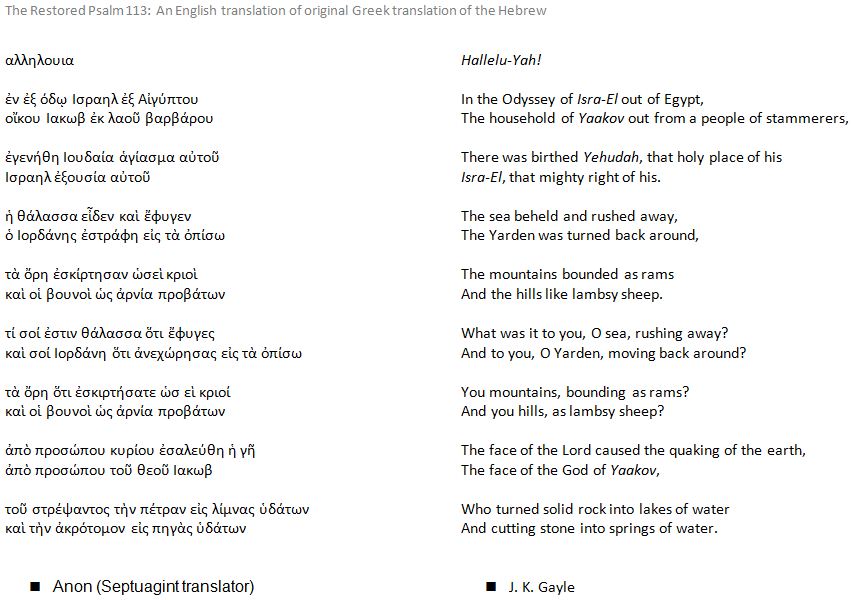
And my third entry was the following. I imagine Barnstone didn’t like it because it’s my imagination of “restoring” the Greek, not of the New Testament as he so incredibly restores it, but of the Septuagint translator(s) of the Psalms. I was trying to play with restoring what the restored New Testament in English might look like. (To be clear, “Psalm 113” is the name and the number of what we refer to as the Greek translation of what we now call the original Hebrew “Psalm 114.”) I was hoping to get at some of those Hebraic-and-or-Hellene literary sparks in translation I’ve blogged about a bit. Mine is an English translation of a Greek translation of a Hebrew poem, if you will. You might notice that I struggled with whether the first line should begin “In the ExOdus of…” or, rather, as I began it, thusly:
What just came to me in the mail is this announcement of the winners, and congratulations go to Alexandra Berlina and to G. J. Racz:

As soon as we learn of how we might find and post the winning entries, we’ll update this post to share them here.
If you entered translated poems in this most recent contest and want to share your poem, then we’d be honored if you’d link to it or even post it here.
Putting narrative into dialogue through translation (part 2)
In part 1, I discussed how one opportunity open to translators is to convert narrative to dialogue.
Below, I would like to discuss three books I recently read which do this – with varying degrees of success.
 The first book I just received this week – it is a “translation” of the Bible called The Voice. It attempts to put all the “spoken” words (even “spoken” words that are only thought, or which are meant to be said in a mystical fashion – like the words of God) in dialogue form. The translators tout this feature:
The Voice identifies the speakers within the stories. This format helps readers understand quickly who the characters are and what the relationships are between them. These identifications also provide natural divisions for group readings of Scripture.
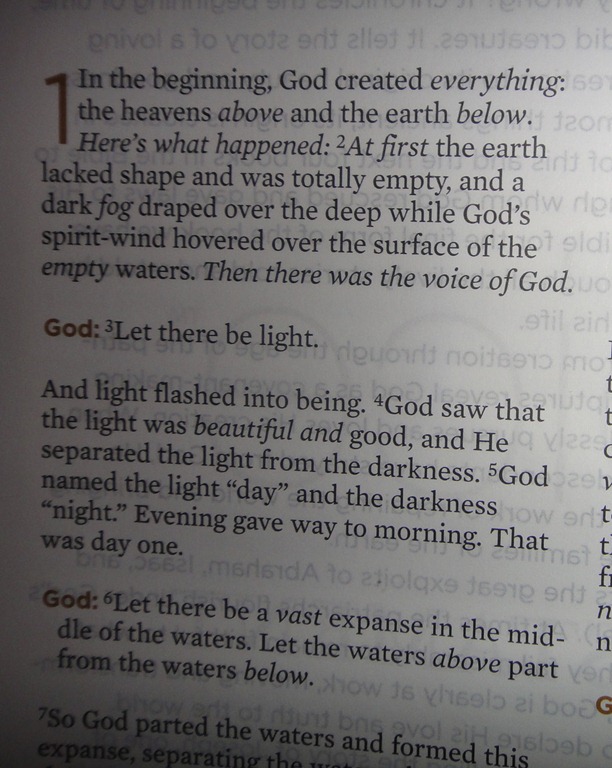
To put it briefly, this may be one of the worst Bible versions of recent time. To see why it is so bad, look at this page from Genesis 1) – and I apologize in advance for the poor photographic quality:
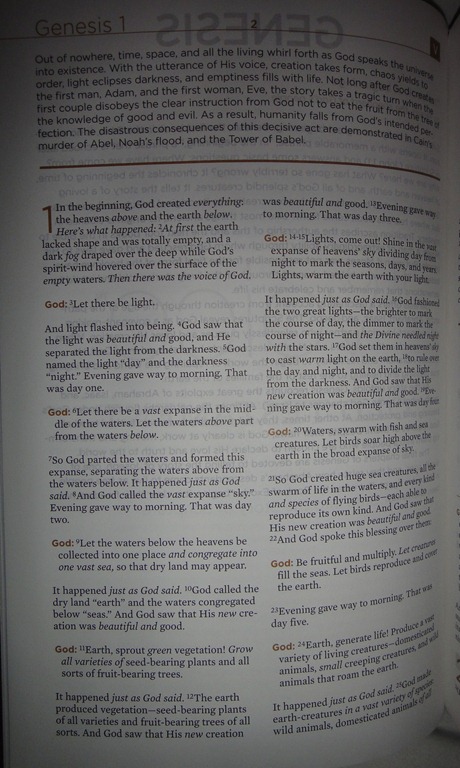
Now, in case that image is not clear enough, let’s zoom in at the first few verses:
Or, if you aren’t horrified yet, look at Job 1:5. First, let’s remember how the King James renders this verse:
And it was so, when the days of their feasting were gone about, that Job sent and sanctified them, and rose up early in the morning, and offered burnt offerings according to the number of them all: for Job said, It may be that my sons have sinned, and cursed God in their hearts. Thus did Job continually.
Now, let’s see how The Voice renders this:
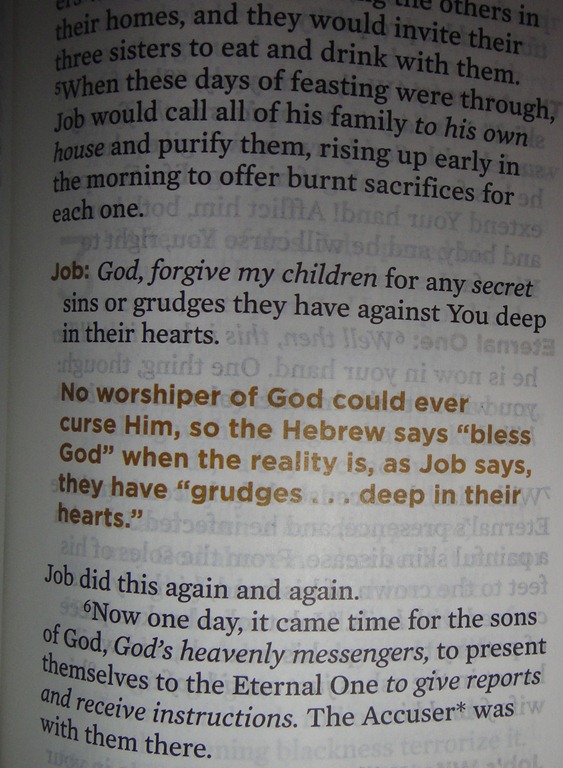
I am sorry to say this, but only someone who is completely tone-deaf to Hebrew and English could possibly believe that the English should be scripted out in this way. The corruption is so total that it gives the reader a completely misleading idea of the Hebrew. In converting to dialogue form, the translators have distorted the original to the point of corruption.
One of the peculiarities of The Voice is that while it is supposed to be an easy-reading version, it adopts the approach of many settings of the King James translations of using italics to identify “additions” to the text. This is odd because italics normally represent stressed text in contemporary layouts of English – and this feature is one of the most commonly criticized layout decisions of King James editions.
I wish to make a note about the physical quality of this Bible. My copy, at least, was of poor physical quality. Like many other Bibles bound by Thomas Nelson, this edition has bad binding. Worse, my copy had pre-creased pages. The book claims to be “guaranteed for life,” but as I previously mentioned (see the last paragraph of this post) about another Nelson Bible, this appears to be merely a crude attempt to get people to sign up for mailing list; and there is contradictory information on the so-called guarantee.
This is a translation that seems to be entirely without merit (except, perhaps, for novelty value.)
(I do want to note that I did not read The Voice translation in its entirety – my opinion is based on sampling of passages.)
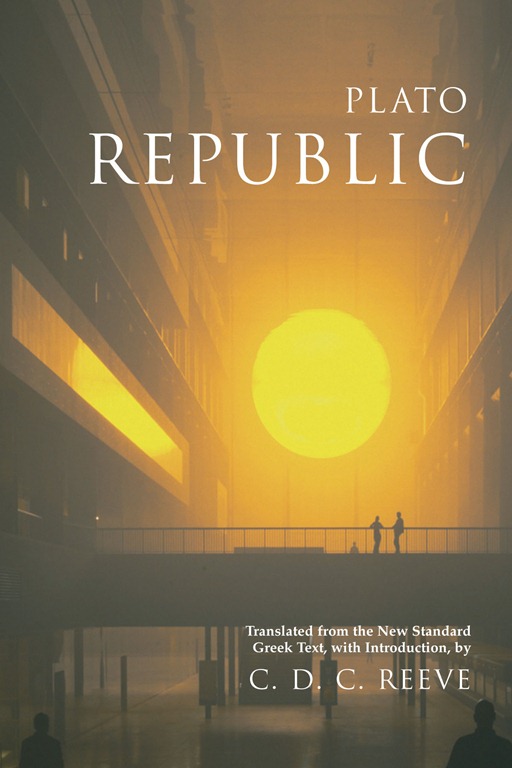 Now, let me consider a second example where the translator has converted text to dialogue – much more successfully. In C. D. C. Reeve’s second translation of the Republic (his first translation was a revision of Grube’s translation) he unapologetically put Plato in dialogue form. He justifies it as follows:
Every translation, even the most self-consciously and flat-footedly slavish, is somewhat interpretive. But I have tried to make this one as uninterpretive and close to the original as possible. One conscious deviation from strict accuracy, however, will be obvious at a glance. The Republic is largely in reported speech. Socrates is relating a conversation he had in the past. But I have cast his report as an explicit dialogue in direct speech, with identified speakers. In the Theaetetus, Plato has Eucleides adopt a similar strategem. “This is the book,” he says to Terpsion; “You see, I have written it out like this: I have not made Socrates relate the conversation as he related it to me, but I represent him as speaking directly to the persons with whom he said he had this conversation.” Decades of teaching the Republic have persuaded me that the minimal loss in literalness involved in adopting Eucleides’ stratagem is more than made up for in readability and intelligibility.
Here is what Reeve’s translation looks like on the printed page:
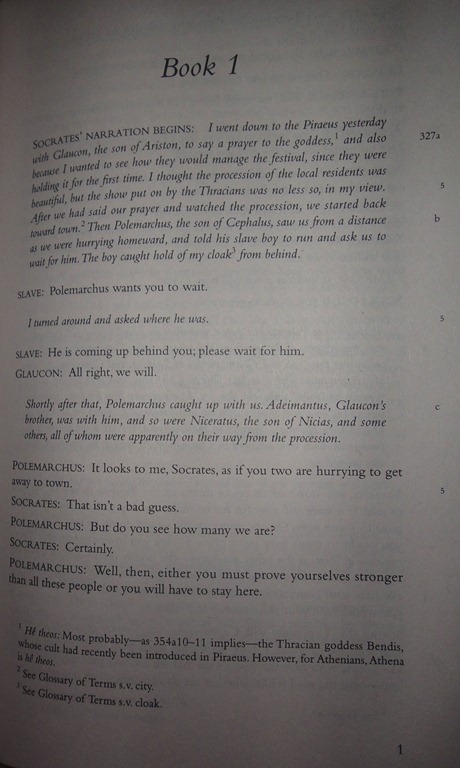
I have to say, this is a brilliant presentation. Why does Reeve succeed while The Voice translator’s fail? I think it is perhaps because The Republic is not a text of action, but one of ideas. It is almost totally a description of dialogue, and so converting it to dialogue form does minimal damage to the text. And, as Reeve correctly states, it does make it easier for students (and everyone else) to read.
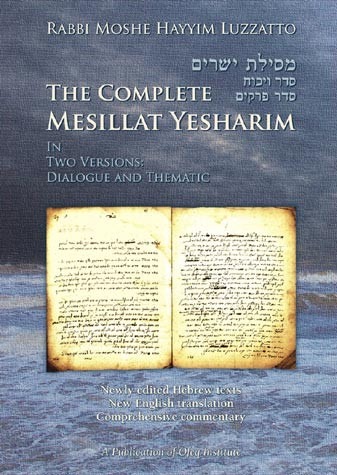 The final example I wish to give is the Cleveland-based Ofeq Institute’s The Complete Mesillas Yesharim (Path of the Upright). Ramchal’s book is considered to be the primary modern text of mussar (Jewish ethical teachings) literature. The Ofeq Institute’s version must be considered authoritative, because the editors use a recently discovered manuscript from the Moscow State Library in Ramchal’s own hand. This is believed to be an earlier draft of Mesillas Yesharim. However this version is put in the form of a dialogue between a hakham (wise man) and a hasid (pietist). This convention really makes the book sparkle. Perhaps because of its wide use in yeshivos, Mesillas Yesharim has a reputation of being a tedious book in some circles. But the earlier draft is somewhat livelier, and certainly makes the book easier to read.
The Ofeq Institute version includes the Hebrew and a heavily annotated English version of both the manuscript Mesillas Yesharim and the first printed version (with printer’s errors corrected using hints from the manuscript version.) Here is a sample:
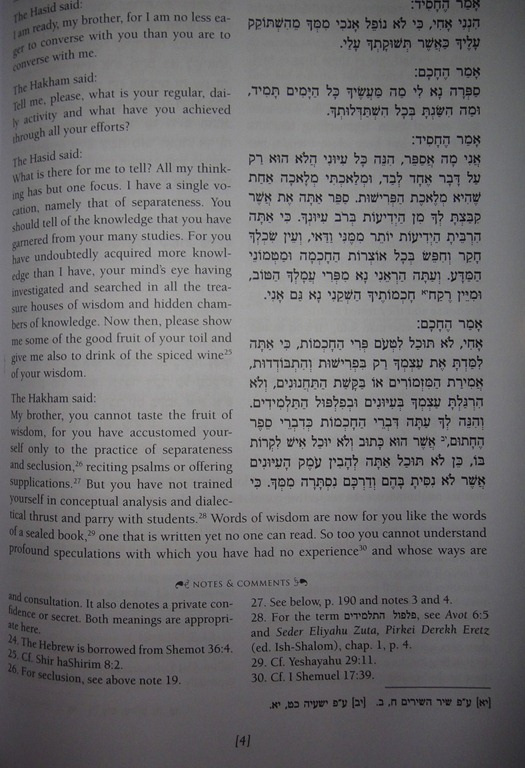
Now, this may seem like a ringer – since the author himself put the text in dialogue form. But nonetheless, the Institute’s courageous decision to print the unpublished draft together with the final version makes for a much more enjoyable reading experience.
As with the Republic, Ramchal’s text is not a text of action, but rather a text of ideas, and thus particularly well suited to being cast in dialogue form.
Putting narrative into dialogue through translation (part 1)
One choice open to a translator is to reformat material. In many cases, this is required: different languages have vastly different conventions for punctuation, paragraphing, etc. And this is particularly necessary with ancient texts, where conventions are so different.
In part 2 of this series want to talk about three books from recent years (one only came out this week) that have made the choice to putting narrative into dialogue.
But in this part, I want to be clear about what I mean by “putting narrative into dialogue.” What I mean is to put the spoken text into a form similar to a play. For example, I could change this passage from Jane Austen’s Mansfield Park from its original
“I begin now to understand you all, except Miss Price,” said Miss Crawford, as she was walking with the Mr. Bertrams. “Pray, is she out, or is she not? I am puzzled. She dined at the Parsonage, with the rest of you, which seemed like being out; and yet she says so little, that I can hardly suppose she is.”
Edmund, to whom this was chiefly addressed, replied, “I believe I know what you mean, but I will not undertake to answer the question. My cousin is grown up. She has the age and sense of a woman, but the outs and not outs are beyond me.”
“And yet, in general, nothing can be more easily ascertained. The distinction is so broad. Manners as well as appearance are, generally speaking, so totally different. Till now, I could not have supposed it possible to be mistaken as to a girl’s being out or not. A girl not out has always the same sort of dress: a close bonnet, for instance; looks very demure, and never says a word. You may smile, but it is so, I assure you; and except that it is sometimes carried a little too far, it is all very proper. Girls should be quiet and modest. The most objectionable part is, that the alteration of manners on being introduced into company is frequently too sudden. They sometimes pass in such very little time from reserve to quite the opposite—to confidence! That is the faulty part of the present system. One does not like to see a girl of eighteen or nineteen so immediately up to every thing—and perhaps when one has seen her hardly able to speak the year before. Mr. Bertram, I dare say you have sometimes met with such changes.”
“I believe I have, but this is hardly fair; I see what you are at. You are quizzing me and Miss Anderson.”
“No, indeed. Miss Anderson! I do not know who or what you mean. I am quite in the dark. But I will quiz you with a great deal of pleasure, if you will tell me what about.”
“Ah! you carry it off very well, but I cannot be quite so far imposed on. You must have had Miss Anderson in your eye, in describing an altered young lady. You paint too accurately for mistake. It was exactly so. The Andersons of Baker Street. We were speaking of them the other day, you know. Edmund, you have heard me mention Charles Anderson. The circumstance was precisely as this lady has represented it. When Anderson first introduced me to his family, about two years ago, his sister was not out, and I could not get her to speak to me. I sat there an hour one morning waiting for Anderson, with only her and a little girl or two in the room, the governess being sick or run away, and the mother in and out every moment with letters of business, and I could hardly get a word or a look from the young lady—nothing like a civil answer—she screwed up her mouth, and turned from me with such an air! I did not see her again for a twelvemonth. She was then out. I met her at Mrs. Holford’s, and did not recollect her. She came up to me, claimed me as an acquaintance, stared me out of countenance; and talked and laughed till I did not know which way to look. I felt that I must be the jest of the room at the time, and Miss Crawford, it is plain, has heard the story.”
“And a very pretty story it is, and with more truth in it, I dare say, than does credit to Miss Anderson. It is too common a fault. Mothers certainly have not yet got quite the right way of managing their daughters. I do not know where the error lies. I do not pretend to set people right, but I do see that they are often wrong."
“Those who are showing the world what female manners should be,” said Mr. Bertram gallantly, “are doing a great deal to set them right.”
“The error is plain enough,” said the less courteous Edmund; “such girls are ill brought up. They are given wrong notions from the beginning. They are always acting upon motives of vanity, and there is no more real modesty in their behaviour before they appear in public than afterwards.”
“I do not know,” replied Miss Crawford hesitatingly. “Yes, I cannot agree with you there. It is certainly the modestest part of the business. It is much worse to have girls not out give themselves the same airs and take the same liberties as if they were, which I have seen done. That is worse than anything—quite disgusting!”
“Yes, that is very inconvenient indeed,” said Mr. Bertram. “It leads one astray; one does not know what to do. The close bonnet and demure air you describe so well (and nothing was ever juster), tell one what is expected; but I got into a dreadful scrape last year from the want of them. I went down to Ramsgate for a week with a friend last September, just after my return from the West Indies. My friend Sneyd—you have heard me speak of Sneyd, Edmund—his father, and mother, and sisters, were there, all new to me. When we reached Albion Place they were out; we went after them, and found them on the pier: Mrs. and the two Miss Sneyds, with others of their acquaintance. I made my bow in form; and as Mrs. Sneyd was surrounded by men, attached myself to one of her daughters, walked by her side all the way home, and made myself as agreeable as I could; the young lady perfectly easy in her manners, and as ready to talk as to listen. I had not a suspicion that I could be doing anything wrong. They looked just the same: both well-dressed, with veils and parasols like other girls; but I afterwards found that I had been giving all my attention to the youngest, who was not out, and had most excessively offended the eldest. Miss Augusta ought not to have been noticed for the next six months; and Miss Sneyd, I believe, has never forgiven me.”
“That was bad indeed. Poor Miss Sneyd. Though I have no younger sister, I feel for her. To be neglected before one’s time must be very vexatious; but it was entirely the mother’s fault. Miss Augusta should have been with her governess. Such half-and-half doings never prosper. But now I must be satisfied about Miss Price. Does she go to balls? Does she dine out every where, as well as at my sister’s?”
“No,” replied Edmund; “I do not think she has ever been to a ball. My mother seldom goes into company herself, and dines nowhere but with Mrs. Grant, and Fanny stays at home with her.”
“Oh! then the point is clear. Miss Price is not out.”
To
MARY CRAWFORD (to Edmund): I begin now to understand you all, except Miss Price. Pray, is she out, or is she not? I am puzzled. She dined at the Parsonage, with the rest of you, which seemed like being out; and yet she says so little, that I can hardly suppose she is.
EDMUND BERTRAND: I believe I know what you mean, but I will not undertake to answer the question. My cousin is grown up. She has the age and sense of a woman, but the outs and not outs are beyond me.
MARY CRAWFORD: And yet, in general, nothing can be more easily ascertained. The distinction is so broad. Manners as well as appearance are, generally speaking, so totally different. Till now, I could not have supposed it possible to be mistaken as to a girl’s being out or not. A girl not out has always the same sort of dress: a close bonnet, for instance; looks very demure, and never says a word. You may smile, but it is so, I assure you; and except that it is sometimes carried a little too far, it is all very proper. Girls should be quiet and modest. The most objectionable part is, that the alteration of manners on being introduced into company is frequently too sudden. They sometimes pass in such very little time from reserve to quite the opposite—to confidence! That is the faulty part of the present system. One does not like to see a girl of eighteen or nineteen so immediately up to every thing—and perhaps when one has seen her hardly able to speak the year before. Mr. Bertram, I dare say you have sometimes met with such changes.
TOM BERTRAND: I believe I have, but this is hardly fair; I see what you are at. You are quizzing me and Miss Anderson.
MARY CRAWFORD: No, indeed. Miss Anderson! I do not know who or what you mean. I am quite in the dark. But I will quiz you with a great deal of pleasure, if you will tell me what about.
TOM BERTRAND: Ah! you carry it off very well, but I cannot be quite so far imposed on. You must have had Miss Anderson in your eye, in describing an altered young lady. You paint too accurately for mistake. It was exactly so. The Andersons of Baker Street. We were speaking of them the other day, you know. Edmund, you have heard me mention Charles Anderson. The circumstance was precisely as this lady has represented it. When Anderson first introduced me to his family, about two years ago, his sister was not out, and I could not get her to speak to me. I sat there an hour one morning waiting for Anderson, with only her and a little girl or two in the room, the governess being sick or run away, and the mother in and out every moment with letters of business, and I could hardly get a word or a look from the young lady—nothing like a civil answer—she screwed up her mouth, and turned from me with such an air! I did not see her again for a twelvemonth. She was then out. I met her at Mrs. Holford’s, and did not recollect her. She came up to me, claimed me as an acquaintance, stared me out of countenance; and talked and laughed till I did not know which way to look. I felt that I must be the jest of the room at the time, and Miss Crawford, it is plain, has heard the story.
MARY CRAWFORD: And a very pretty story it is, and with more truth in it, I dare say, than does credit to Miss Anderson. It is too common a fault. Mothers certainly have not yet got quite the right way of managing their daughters. I do not know where the error lies. I do not pretend to set people right, but I do see that they are often wrong.
TOM BERTRAND (gallantly): Those who are showing the world what female manners should be, are doing a great deal to set them right.
EDMUND CRAWFORD (less courteously): The error is plain enough. Such girls are ill brought up. They are given wrong notions from the beginning. They are always acting upon motives of vanity, and there is no more real modesty in their behaviour before they appear in public than afterwards.”
MARY CRAWFORD (hesitatingly): I do not know. Yes, I cannot agree with you there. It is certainly the modestest part of the business. It is much worse to have girls not out give themselves the same airs and take the same liberties as if they were, which I have seen done. That is worse than anything—quite disgusting!
TOM BERTRAND: Yes, that is very inconvenient indeed. It leads one astray; one does not know what to do. The close bonnet and demure air you describe so well (and nothing was ever juster), tell one what is expected; but I got into a dreadful scrape last year from the want of them. I went down to Ramsgate for a week with a friend last September, just after my return from the West Indies. My friend Sneyd—you have heard me speak of Sneyd, Edmund—his father, and mother, and sisters, were there, all new to me. When we reached Albion Place they were out; we went after them, and found them on the pier: Mrs. and the two Miss Sneyds, with others of their acquaintance. I made my bow in form; and as Mrs. Sneyd was surrounded by men, attached myself to one of her daughters, walked by her side all the way home, and made myself as agreeable as I could; the young lady perfectly easy in her manners, and as ready to talk as to listen. I had not a suspicion that I could be doing anything wrong. They looked just the same: both well-dressed, with veils and parasols like other girls; but I afterwards found that I had been giving all my attention to the youngest, who was not out, and had most excessively offended the eldest. Miss Augusta ought not to have been noticed for the next six months; and Miss Sneyd, I believe, has never forgiven me.”
MARY CRAWFORD: That was bad indeed. Poor Miss Sneyd. Though I have no younger sister, I feel for her. To be neglected before one’s time must be very vexatious; but it was entirely the mother’s fault. Miss Augusta should have been with her governess. Such half-and-half doings never prosper. But now I must be satisfied about Miss Price. Does she go to balls? Does she dine out every where, as well as at my sister’s?
EDMUND BERTRAND: No, I do not think she has ever been to a ball. My mother seldom goes into company herself, and dines nowhere but with Mrs. Grant, and Fanny stays at home with her.
MARY CRAWFORD: Oh! then the point is clear. Miss Price is not out.
This example shows an advantage and a disadvantage of putting narrative into dialogue. In the original, it is all too easy to get confused between Edmund’s and Tom’s words, and the person speaking is much clearer in dialogue. At the same time, one loses a lot by rearranging terms. For example, in going from
“The error is plain enough,” said the less courteous Edmund; “such girls are ill brought up.”
to
EDMUND CRAWFORD (less courteously): The error is plain enough. Such girls are ill brought up.
we have clearly changed the author’s meaning and the nuance of the text – and in the case of Austen, this is simply inexcusable.
Survivors’ Talmud
Tzvee reprints an Erica Brown article in the Algemeiner comparing the demise of the Encyclopaedia Britannica (which Brown misspells as “Encyclopedia Britannica”) with the survival of the Talmud. The article is not very good, and includes all sorts of errors (e.g., “In 2010, Rabbi Adin Steinsaltz, who translated the Talmud from Aramaic to English, added punctuation and divisions and commentary completed his entire 45-year project.” [emphasis added])
However, the article does contain reference to what was certainly one of the most remarkable Talmud printings ever: the Survivors’ Talmud. The Survivors’ Talmud was an official US Army publication on the behalf of Jewish displaced persons after World War II. (The Nazi destruction was so great that it is believed that no complete Talmud set survived in Central Europe after the war; and they were even scarce in the US, which traditionally relied on Polish-printed Talmud sets.)
The following dedication appears in English in tractate Berachos:
In 1946 we turned to the American Army Commander to assist us in the publication of the Talmud. In all the years of exile it has often happened that various governments and forces have burned Jewish books. Never did any publish them for us. This is the first time in Jewish history that a government has helped in the publication of the Talmud, which is the source of our being and the length of our days. The Army of the United States saved us from death, protects us in this land, and through their aid does the Talmud appear again in Germany.
This edition of the Talmud is dedicated to the United States Army. The army played a major role in the rescue of the Jewish people from total annihilation and after the defeat of Hitler bore the major burden of sustaining the DPs of the Jewish faith. This special edition of the Talmud published in the very land where, but a short time ago, everything Jewish and of Jewish inspiration was anathema, will remain a symbol of the indestructibility of the Torah. The Jewish DPs will never forget the generous impulses and the unprecedented humanitarianism of the American forces, to whom they owe so much.
You can read about the history of the Survivors’ Talmud here.
The title pages of the Survivors’ Talmud are remarkable. Here is the title page from tractate Berachos. Note the dramatic change from the barbed-wire death camp scenes at the bottom to palm trees and images of Jerusalem:

Many claim that among classical Chinese novels, Dream of the Red Chambers is the most difficult to translate. The text uses an unusually wide variety of styles (both classical and vernacular language; including many quotations from classical poetry), literary allusions, class references, and vocabulary ranging from the elevated to the taboo.
Here is spoken dialogue from Chapter 9 that is highly vulgar in the original:
Original text: 「我們肏屁股不肏屁股,管你籴舻相干,橫豎沒肏你爹去罷了!」
It is interesting to see how cultural norms for translation and expression have resulted in highly different treatments of this text. Below are five translations – one from the Victorian period, one by a non-native English speaker, one under communist supervision, one by a contemporary translator, and one by a machine.
1892: H. Bencraft Joly – a Victorian translation. (Joly was British consul in China; he was an English native speaker):
“What we do, whether proper or improper […] doesn’t concern you! It’s enough anyway that we don’t defile your father!”
1958: Chi-Chen Wang – a non-native English speaker translation. (Chen was a Chinese native speaker):
“Hey, you son of the Kin clan, what business is it of yours whatever we choose to do? You should be glad we haven’t violated your own father.”
1978: Xianyi Yang and Gladys (Taylor) Yang – a communist translation. (Xianyi is a native Chinese speaker; Gladys is a native English speaker. They were imprisoned, each in solitary confinement, during the Cultural Revolution. They were assigned to translate the book, under strict Chinese government supervision, as part of their penance for release):
“What we do is no business of yours.”
1973: David Hawkes – a contemporary translation. (Hawkes is a native English speaker. I have partially obscured certain English vulgar words; the original prints the full words):
“Whether we f*** ar**holes or not, […] what f***ing business is it of yours? You should be bl***y grateful we haven’t f***ed your dad.”
2012: Google Translate (the text appears exactly as Google Translate presents it):
“We f # # k ass f # # k ass, pipe down and buy thee henashi coherent, if they had not
f # # k your father went to nothing!”
Which of these translations do you prefer?
Odd Gospel Greek: Didn’t Jesus Snort?
On the morning of my father’s memorial service, my eldest brother confessed to me that he was afraid he might cry. He’d been up into the earlier hours of the morning, planning what he would say, and didn’t have much emotional reserve. Our mother had asked him, and the rest of us her children, to speak; but she’d also asked us to control our tears because, as we all knew, there would be people at the memorial service from various cultural backgrounds who would be made extremely uncomfortable by public weeping.
I tried to reassure my brother. I was to follow him in speaking at the memorial, after all. So here’s what I said (and thought):
“Just be yourself.” (I said this knowing I myself might cry.)
“Only Herakles and the gods wouldn’t cry; they couldn’t.” (I’d been reading Anne Carson’s Grief Lessons when our father’s death was imminent.)
“‘Jesus wept,’ you know.” (I quoted the gospel of John, chapter 11, which I had also read that very morning, hoping to give us each permission to weep if we had to.)
“The gospel of John even says, twice, that ‘Jesus groaned’ and the Greek verb the writer uses is ‘snorted,’ like horses snort.” (I couldn’t really be sure of that meaning but I said it anyway.)
“Just be a real human, a creature, be an animal.” And then I made this sound. (Go ahead, click and listen).
Later, here’s what I learned. The odd gospel Greek is odd indeed, but there’s no consensus that Jesus snorted and lots of conjecture about what he must have meant by whatever he did.
Here’s the KJV, suggesting some sort of sound [with the Greek inserted]
33 When Jesus therefore saw her weeping, and the Jews also weeping which came with her, he groaned in the spirit [ἐνεβριμήσατο τῷ πνεύματι], and was troubled.
34 And said, Where have ye laid him? They said unto him, Lord, come and see.
35 Jesus wept.
36 Then said the Jews, Behold how he loved him!
37 And some of them said, Could not this man, which opened the eyes of the blind, have caused that even this man should not have died?
38 Jesus therefore again groaning in himself [ἐμβριμώμενος ἐν ἑαυτῷ] cometh to the grave. It was a cave, and a stone lay upon it.
Something just as odd is in Vincent’s Word Studies in the New Testament, which I found in my father’s study. There’s this entry to interpret the “groan” as something against others:
He groaned in the spirit (ἐνεβριμήσατο τῷ πνεύματι)
ἐμβριμάομαι The word for groaned occurs three times elsewhere: Matthew 9:30; Mark 1:43; 14:5. In every case it expresses a charge, or remonstrance, accompanied with a feeling of displeasure. On this passage there are two lines of interpretation, both of them assuming the meaning just stated. (1) Τῷ πνευ.ματι, the spirit, is regarded as the object of Jesus’ inward charge or remonstrance. This is explained variously: as that Jesus sternly rebuked the natural shrinking of His human spirit, and summoned it to the decisive conflict with death; or that He checked its impulse to put forth His divine energy at once. (2) Takes in the spirit, as representing the sphere of feeling, as [John] 13:21; Mark 8:12; Luke 10:21. Some explain the feeling as indignation at the hypocritical mourning of the Jews, or at their unbelief and the sisters’ misapprehension; others as indignation at the temporary triumph of Satan, who had the power of death.
The interpretation which explains τῷ πνεύματι as the sphere of feeling is to be preferred. Comp. [John] v. 38, in himself. The nature of the particular emotion of Jesus must remain largely a matter of conjecture. Rev. renders, in margin, was moved with indignation in the spirit.
I hope you’ll see with me the oddities. On the one hand, there’s the imagination that Jesus is “rebuking” his own humanness or is “checking” it by his Divinity. On the other hand, there’s the attribution to Jesus certain of feelings of horror against another: the feelings of a racist (i.e., “indignation at the hypocritical mourning of the Jews … or at their unbelief”) or of a sexist (i.e., “indignation … at … the sisters’ misapprehension”) and these as the same horrible feelings a messiah might have against the chief devil (i.e., “indignation at the temporary triumph of Satan”), which puts “the Jews” and the women next to Satan as candidates for Jesus’s ill will and anger for the Other, the arch enemy, so unlike Himself.
We should notice that John’s gospel only uses this Greek word, so oddly, in this context. Mark’s gospel uses the word twice, Matthew’s once, and Luke’s never. “In every case it expresses a charge, or remonstrance, accompanied with a feeling of displeasure,” so says Marvin R. Vincent. And so we look elsewhere. Once in the Septuagint, in one of the versions of Daniel (the “Old Greek” not the “Theodotion” text), in verse 11 of chapter 30, there’s this as NETS translator R. Timothy McLay renders it [with the Greek inserted]: “And the Romans will come and will expel him and rebuke [ἐμβριμήσονται] him….” Now, the odd gospel Greek of John does go on after talking about Jesus weeping to say that “some of the Jews” go to the Pharisees, who gather a council with the chief priests and say: “If we let him thus alone, all men will believe on him: and the Romans shall come and take away both our place and nation.” So maybe Mark, and Matthew, and the Old Greek translator of Daniel, and John are all in agreement, when we consider “the Romans” as threats. Maybe Vincent and maybe McLay have it exactly right. Maybe Jesus is expressing a charge or remonstrance, a rebuke.
Or maybe we can look beyond the Bible at this very rare and somewhat odd Greek verb to find something else.
Indeed, in Aeschylus‘s, Seven Against Thebes, here’s what we find as translated by Herbert Weir Smyth [with Aeschylus’s rare, odd Greek inserted]:
Scout
Now I will tell you about the man who next drew station at the gates. The third lot leaped out of the upturned bronze helmet for Eteoclus, [460] to hurl his band against the Neistan gates. He whirls his horses as they snort [ἐμβριμωμένας] through their bridles [ἐν ἀμπυκτῆρσιν], eager to fall against the gate. Their muzzles whistle in a barbarian way, filled with the breath of their haughty nostrils. [465] His shield is decorated in great style: an armored man climbs a ladder’s rungs to mount an enemy tower that he wants to destroy. This one, too, shouts in syllables of written letters that even Ares could not hurl him from the battlements. [470] Send a dependable opponent against this man, too, to keep the yoke of slavery from our city.Eteocles
I would send this man here, and with good fortune.Exit Megareus. Indeed, he has already been sent, his only boast in his hands, Megareus, Creon’s seed, of the race of the sown- men. [475] He will not withdraw from the gate in fear of the thunder of the horses’ furious snorting [φρυαγμάτων βρόμον]; but either he will die and pay the earth the full price of his nurture, or will capture two men and the city on the shield, and then adorn his father’s house with the spoils. [480] Tell me about another’s boasts and do not begrudge me the full tale!
And in Aristophanes‘s, Knights, here’s what we find as translated by William James Hickie [with Aristophanes’s rare, odd Greek inserted]:
Sausage-Seller
Stop at your bucklers, for you have given me a handle. For you ought not, if indeed you love the people, purposely to have let them be dedicated together with the handles. [850] But this, Demus, is a device, that, if you wish to punish this fellow here, it may not be in your power ; for you see what a troop of young tanners are with him ; and around these dwell sellers of honey and sellers of cheese. Now this body is leagued together ; [855] so that if you were to snort with anger [βριμήσαιο], and look [καὶ βλέψειας] ostracism [ὀστρακίνδα], they would pull down the bucklers by night, and run and seize the entrances for importing your barley.
So was the odd gospel Greek of John just from the odd Greek of Mark and of Matthew and of the Old Greek of the Daniel translation? Or did they all perhaps read the tragedy by Aeschylus and the comedy by Aristophanes? Did they hear the sounds, the snorts? People cried, and twice, both before and after Jesus wept, he maybe like a creature snorted. Isn’t that what the odd gospel Greek is saying? In any case, odd stuff.
As it turns out, I think I heard my brother choke back his tears as he spoke. I’m sure I cried some. And I afterwards remembered and said these things to my brother, some other wise words: “Blessed are those who mourn, for they will be comforted.” And “There’s a time to cry and a time to laugh, a time to mourn and a time to dance.” So he snorted, and then we laughed. Some comfort.
At speeds even he could barely imagine, Albert Einstein’s private papers and innermost thoughts will soon be available online, from a rare scribble of “E = mc2 ” in his own hand, to political pipe-dreams and secret love letters to his mistress.
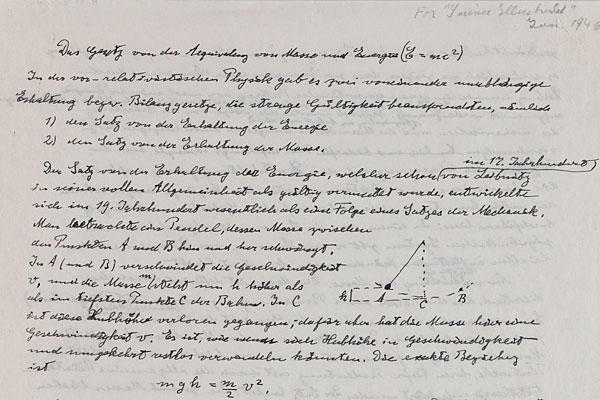
This image distributed by the Hebrew University of Jerusalem, shows a page from one of only three existing manuscripts containing Einstein's famous formula describes the relationship between energy, mass, and the speed of light.
Hebrew University of Jerusalem/AP
Check out this short clip of Albert Einstein in 1951, talking about his support for the Hebrew University of Jerusalem. Einstein became a founder of the Hebrew University after visiting Israel in 1919.
—————
(source:)
Ari Rabinovitch, Reuters / March 19, 2012
Whose emic? Mine, Yours, Theirs?
“The emic structure of a particular system must, I hold, be discovered.” – K. L. Pike
Yesterday, I deleted the post I’d written, one with the title “Whose emic? Mine, Yours, Theirs?” I deleted it because it was, I felt, too personal. It was too much of an insider essay.
Today, I want to try again. I’d like readers to grapple with the personal nature of our observations about things. And my hope is we can share knowledge. So what about emic? What does “emic” mean?
The word emic is the coinage of Kenneth Lee Pike. He invented it as one of a pair of terms, “emic and etic.” The neologistic couple of phrases, since their invention, has been used by many people in many academic disciplines in many helpful ways. Let me show you some of that. Then I’ll tell a bit more.
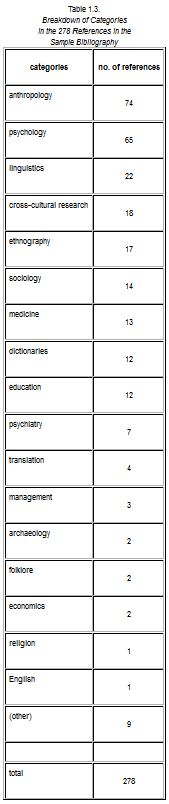
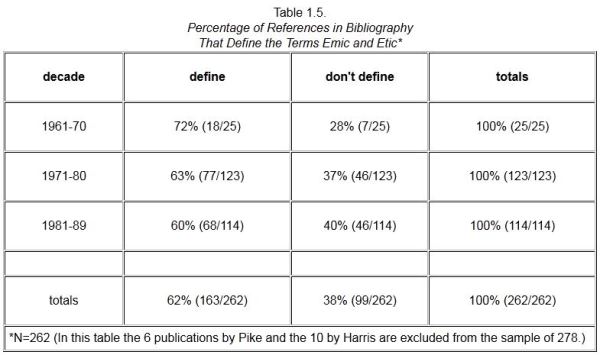
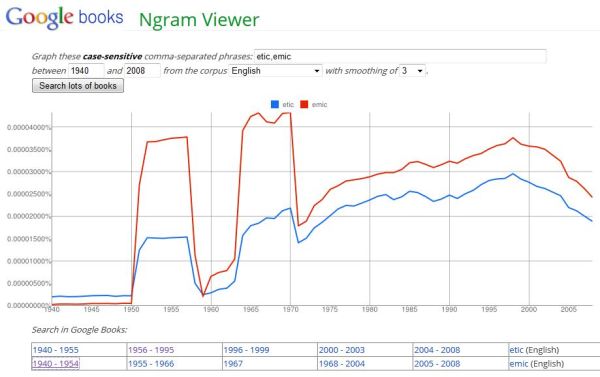
Look at these 4 images first: 1. a table of references to emic and etic by discipline (up through the late 1980s); 2. a table of published implicit and explicit definitions of the terms (up through the late 1980s); 3. a chart showing reference to this pair of terms in books digitized by google; and 4. the Oxford English Dictionary (online) full definition of emic.
1.
2.
3.
4.
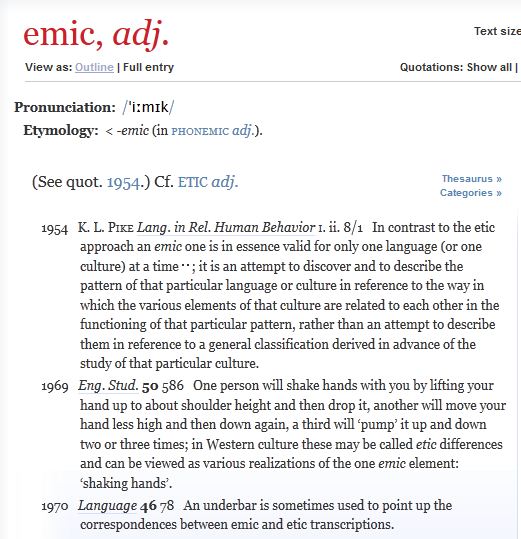
Now, let me tell you that if you’re having trouble with the OED definitions given here, then not to worry. Pike wrote a 762-page tome where that first definition appears, and the intent of the entire book was to explain emics and etics as part of a method of knowing that relates “language” to “human behavior.” All of Pikes many essays, articles, lectures, classes, seminars, and books after Language in Relation to a Unified Theory of the Structure of Human Behavior somehow related to what he meant by “emic and etic.” His fellow linguists, notably Evelyn Pike (his wife), Eunice Pike (his sister), Robert Longacre (his colleague in linguistics), and Thomas Headland (his colleague in linguistic and cultural anthropology) also worked with him on and with “emics and etics.” And, while they were working, others began to use the term. If click on the first 2 images above, then you get Headland’s discussion of a debate Pike had with anthropologist Marvin Harris over the terms and their definition and their use.
Although Pike first coined the terms in 1954, the origins have deeper roots. One of his teachers, linguist Edward Sapir, in 1933, published “La réalité psychologique des phonèmes” [The psychological reality of phonemes] in Journal de Psychologie Normale et Pathologique. This thought that reality is also psychological was a thought that profoundly influenced Pike as he studied the reality of sounds a person makes when speaking. Pike, as a teacher, would often talk of “talked-about reality” as the only reality we can really talk about. The reality of phons, allophones, and phonemes for the linguist dealing in phonetics and phonemics gave Pike the language he needed, the neologistic metalanguage he needed, to begin discussing various ways of talking about reality.
If you think that that’s sort of a family and academic-insider discussion, then you’re right. So what? So what does that have to do with you?
Well, for starters, you’re reading my post here. And you’ve scrolled down this far. You’re obviously wanting to know what else I might tell you about emic. So let me tell you something else personal. Suzanne, one of my co-bloggers here at this blog you’ve been reading, has said that Pike is a scholar who’s had an “immediate and lasting influence on how [she] read[s] the Bible.” She said that when, at a different blog of hers, she was noting that I also view Pike as an immediate and lasting influence on how I read the Bible. I can’t speak for her, but for me it’s Pike’s concepts of “emic” and “etic” that are so very helpful.
To me, emic refers to insiderness, etic to outsiderness. The former notion is more like subjectivity, the latter a bit more like objectivity. To be emic with a language is to be a native speaker of a mother tongue and to have (often unexplained) “native speaker intuition” about what “sounds right,” whether the rightness is “grammar” or “word choice” or “pronunciation” or the like. Let me keep this personal, then. Let me talk with you as if you and I are face to face, or at least as if our language together here at the blog were something we more shared, as insiders together. Let me be personal with you as we discuss this abstraction of a word.
As I get into the things, the ideas, let me try to come back now to the person, the personal. Pike was my linguistics teacher, and I studied also with Evie Pike, Eunnie Pike, and Bob Longacre in the late 1980s for a graduate degree in linguistics. My spouse and I have eaten a meal with the Pikes in their home (they were so very hospitable); Ken Pike and I had numerous conversations; and I took a graduate seminar with him on his linguistics theory with only a few other individuals from various humanities backgrounds. (There was only one other linguistics student in the seminar besides me, and the others included a painter, a philosopher, a classical pianist, a clergy person, and a historian). Pike guided me through my seminar paper on the emics and etics of shame, guilt, and fear in the context of Christian missionary evangelism to the nonChristianized. (I’m not sure he discovered all of the reasons for my doing that paper except for the fact that my own parents were in the employ of the Foreign Mission Board of the Southern Baptist Convention in Vietnam the last decade of the war there and were in Indonesia after that for a longer period up to the time when I was researching in the seminar). Tom Headland, who you’ve already heard about, wrote three different obituaries for Kenneth Pike (for American Anthropologist and for the National Academy of Sciences and for the Summer Institute of Linguistics); and he is a more recent friend of mine. What we have in common is an interest in the fact that Pike’s work is largely ignored today, among the Bible translation organization he worked for, in the discipline of linguistics, in anthropology where emic and etic are still used, in composition studies and rhetoric. (Pike published numerous articles in composition studies journals and, with anthropologist Alton Becker and rhetorician Richard Young, he co-wrote a once-acclaimed book, Rhetoric: Discovery and Change.) For me, there’s another personal thing about “emic” and “etic.” Their roots seem gendered. As I began dissertation research on sexism, feminism, and Aristotle’s Rhetoric, I was startled to learn of resistances to word coinages, even and especially those that used the suffix -ic. Without naming her at the time, I wrote a blog post at another on that for the professor on my committee who’d objected to my use of the word, feministic. Carolyn Osiek had objected, wondering if I, a man using the term as a feminist, might be objectifying feminisms somehow. What I was learning when I wrote the post is that scholars of Greek rhetoric have been recently discovering how Plato and then much more Aristotle had invented Greek terms using the suffix, ική;this was their insider marker of something they were objectifying. Only then did I start to connect what they’d done to what Pike, as a Western language insider scholar, was doing, emically, with language. An emic view is the rather un-investigated perspective of the system of thought of us insiders.
When we laugh involuntarily at an inside joke, that’s emic. When we have to explain why we laughed, or have to explain the joke, to the outsider who didn’t get it, then that’s etic. Pike said that scholars, observers, not only need both, but we use both perspectives. In fact, he says that both used together allows for dimensioned views, sort of the way two eyes allows a stereoscopic 3-D view and two ears allows listening in stereo.
Now, I want to come back to the personal again. I think I said somewhere already for blog readers that I’m a missionary kid. I believe I’ve kidded around at one blog profile once upon a time saying “I’m still growing up.” At no time has that fact come home to me more than recently. A few days ago, my father died. My mother planned a memorial service for him, a beautiful remembering. Their children, my siblings and I also spoke publicly. Literally hundreds of people attended the service, and many now are remembering my dad. There are emic remembrances and etic ones. Especially after Dad changed so much in many positive ways in his final months, there are discussions and meanings and talks and significances for us who were with him then that are emic. Insider stuff. I think I was the only one, of all the speakers at his memorial service, to recall (and I said this while my mother and I looked at each other, I on the platform and she on the front row) that he was not always easy to love. And yet I find as I miss my father profoundly, I want to hear what others knew about him, how they saw him, understood him, even if they looked at him differently. Etic stuff for me. I eavesdrop. I listen in. I overhear. Then I want to compare, to dialogue, to remember together with others, to correct, to adjust, to investigate, to complicate, to nuance. That’s the stereoscopic view that Pike, with his “emic and etic,” encouraged. So I’ve also read books my Dad read, read them in his study (where I was forced to sleep only because there were too many other overnight guests in the other rooms of Mom’s home after he passed on), read what he underlined and highlighted and what he marked in the margins. This is personal, and this is emic. He was not one personage but was still the same person. I’m trying again to be a blogger, blogging in “the world of things and the world of persons.” That last line is one from one of my Dad’s books, from his copy of Edwin Hudson’s English translation of Paul Tournier’s Le personnage et la personne.
Tournier’s book, my father’s book by this medical doctor, has helped me understand better Dad in various ways. It’s helped me think about insiderness, about emic, about the personal talked about realities. So if you’re still reading, then let me share just a bit more of what I’m discovering from a few lines from Tournier, who like my father who worked much of his life helping orphans was himself an orphan. I’ll add that my father’s father passed on when he was just five years old; and my father passed on when I was fifty years old, and in fact it was on my 50th birthday when he died. How do I discover what it’s like to be an orphan like my Dad? Tournier writes (near the beginning and then near the end of the book) the following:
I was three months old when my father died, so that I know him only from the biography written by one of his friends, from obituary notices, from the poems he left, from articles, letters, photographs, and from stories about him, told me long afterwards…. And yet, when a man describes to me his father — a father with whom he spent his whole childhood, I cannot be sure that the portrait he paints is any more faithful than the one I have of mine.
The person is something very different from a nice, round fully-inflated balloon. Rather it is an imponderable, an inner experience which can take place in sickness as well as in health. It is a germ that develops. What is a grain of wheat? You have not defined it when you have weighed it, measured it, and submitted it to chemical analysis and microscopic examination. It contains a whole plant which you cannot yet see. What is a silkworm? You cannot define it without seeing in advance all its metamorphosis. What is a child? You cannot describe him without thinking of the whole life of the man, with all its unknowns, for which he is preparing.
I just want to end this post with a tribute to my father. He helped many people and taught many of us many things many mostly toward the end of his own life as he battled cancer. It was in learning that he taught most, and he learned much. In his final months, he learned how to reconcile with family friends and enemies; he made amends, insisted on loving those most different from himself, neither harbored nor allowed resentments, and demonstrated incredible interest in, curiosity about, and gratitude for each individual he talked with. But he didn’t do any of that because he was sure he would die soon. Rather he fought to live and followed the doctors’ orders and held out hope and prayed earnestly for healing. I have not defined him though I’ve tried to share him with you some. There is much yet about this father of mine that I hope to remember, much yet to discover. This is emic, personal, I hope you’ll discover, to me.
Thomas Pynchon in the NY Daily News?
It seems everything I know about New York newspapers is wrong. The online website of the New York Daily News is reporting on a Thomas Pynchon – Crying of Lot 49 graffito in a Brooklyn bathroom:

Now, I’m not quite sure how this is news, but it certainly does not fit in with the stereotype I have of New York Daily News readers.
Zaftig
Israel has passed a law forbidding models who are malnourished by World Health Organization standards.
The new law requires models to produce a medical report no older than three months at every shoot for the Israeli market, stating that they are not malnourished by World Health Organization standards.
The U.N. agency relies on the body mass index, calculated by factors of weight and height. WHO says a body mass index below 18.5 indicates malnutrition. According to that standard, a woman 1.72 meters tall (5-feet-8) should weigh no less than 119 pounds (54 kilograms).
Also, any advertisement published for the Israeli market must have a clearly written notice disclosing if its models were made to look thinner by digital manipulation. The law does not apply to foreign publications sold in Israel.[…]
The law won support from a surprising quarter: one of Israel’s top model agents, Adi Barkan, who said in 30 years of work, he has seen young women become skinnier and sicker while struggling to fit the shrinking mold of what the industry considers attractive.
“They look like dead girls,” Barkan said.
In the United States, such a law would likely be ruled unconstitutional under the First Amendment. But I do not want to debate the freedom of speech issues raised by this law. Instead, I want to acknowledge the tragedy that it was necessary for the Israeli Knesset to pass such a law in the first place. The unhealthy effects of commercial fetishization of girls has been at the subject of some heated debate here at BLT (example: here.) According to this article:
In Israel, about 2 percent of girls between 14 and 18 have severe eating disorders, a rate similar to other developed countries, experts said.
This state health report (which reports on US national statistics) is equally grim:
* Eating disorders have the highest mortality rate of any mental illness
* A study by the National Association of Anorexia Nervosa and Associated Disorders reported that 5 – 10% of anorexics die within 10 years after contracting the disease; 18-20% of anorexics will be dead after 20 years and only 30 – 40% ever fully recover
* The mortality rate associated with anorexia nervosa is 12 times higher than the death rate of ALL causes of death for females 15 – 24 years old.
* 20% of people suffering from anorexia will prematurely die from complications related to their eating disorder, including suicide and heart problems.
And there seems little doubt that adolescent girls are particularly vulnerable to this sort of pressure:
* Anorexia is the 3rd most common chronic illness among adolescents
* 95% of those who have eating disorders are between the ages of 12 and 25
* 50% of girls between the ages of 11 and 13 see themselves as overweight
* 80% of 13-year-olds have attempted to lose weight
I think that pressuring girls to live up to wildly unrealistic expectations is the sign of a cultural mindset that is unhealthy.
Imagine if instead, we read that 80% of 13 year-old girls (and boys) were attempting to master mathematics, or science, or foreign languages, or advanced rhetorical skills, or history, in the hopes of going onto college and become professionals. What we have today is a culture where malnutrition (in the form of anorexia) is a leading cause of death for adolescent girls and presidential candidates claim that it is snobbery to have children aspire to college education.
We live in a society that encourages mental disease and academic underachievement – particularly among girls.
1493
I was a skeptical reader of 1491, but fascinated by 1493. While I found the initial treatment of Columbus as an anti-hero a bit too predictable, Mann warms to his topic and each subsequent chapter improved in complexity, presented with enthusiasm and from a new and challenging perspective. 1493 is about ‘“the Columbian Exchange” — the transfer of plants, animals, germs and people across continents over the last 500 years.’ NYT review.
From a review in the Guardian,
Mann avoids [Niall] Ferguson’s trademark triumphalism by giving an often critical account of his central topic – namely, the free and forced migration of peoples, plants, quadrupeds and parasites in the so-called “Columbian Exchange” inaugurated by the Spanish conquest of the Americas. Chapters of this story have been told before by Fernand Braudel, Pierre Vilar, William McNeill and others, but Mann can report new findings.
He does not supply a very detailed account of the “great dying” of the native peoples, but instead dwells on less well-known antecedents and consequences of Columbus’s voyage in 1493. He makes a strong case for the role of the sweet potato and of the common-or-garden potato in helping Europe and China to mitigate, if not avoid, the “Malthusian trap” of overpopulation and famine. The book’s extensive discussions of Chinese agriculture and manufacture are a strong feature even where they don’t quite convince. Mann’s account of the wilful blunders of China’s rulers down the ages helps to explain recurrent disasters.
If there is a rival candidate for the event that changed the course of history then it would have to be industrialisation, with its extraordinary impact on urbanisation, life expectancy, productivity and resource depletion. Mann sees the slave plantation as a forerunner of industrialism and notes the role of plantation products such as sugar, tobacco and coffee in stimulating mass consumer demand. In fact, he sees the discovery of the Americas as the prelude to the rise of industry but his case would have been strengthened by giving space to US cotton, a raw material easily adapted to industrial methods.
Mann is possessed of an intense curiosity rather than being driven by pattern-seeking. He gives a good account of Africans’ resistance to slavery without asking why it stopped plantation growth in some cases (São Tomé and Hispaniola) and not in others (English Jamaica and French St Domingue). The contrast probably reflects a stronger commercial impulse. Likewise he pays welcome attention to the Haitian revolution (1791-1804) but stresses its effects on the planters of the Americas. Slaveholders in lands where there was a slave majority were “terrified” into accepting abolition. But in the 19th-century US South, Cuba and Brazil, territories where slaves were outnumbered by the free population, the planters exploited fear of bloody slave revolt to build new slave systems and rally non-slaveholders behind them.
In 1493, Mann emphasizes the role of the potato and sweet potato in helping Europe escape the Malthusian trap. In addition, he cites 1845 as the date for the introduction of significant amounts of guano to England in a revolutionary increase in nutrient exchange.
This contrasts oddly with Sylvia Nasar’s discussion of 1845 – a date she identifies for when infant mortality began to plummet. She cites Schumpeter, “The capitalist process, not by coincidence but by virtue of its mechanism, progressively raises the standard of life of the masses.” For Schumpeter, and seemingly for Nasar, a nation’s development depends not so much on its resources, but on “innovation, entrepreneurs, and credit.” Nasar. Grand Pursuit. page 189-190.
I am glad that I read both books – they are on completely different topics after all. And they will keep me questioning if success or failure in any one case, is dependent more on human factors or available resources. I enjoyed this book enormously and was sorry to finish. It’s a book about ecology that doesn’t whack you over the head with agenda, presents pros and cons, engages with story and has a fascinating final chapter on the Maroon culture. For that reason alone it is worth a read.
Fodder for doodles: drawing Bugs Bunny
Whenever I read about folks who take detailed notes in their books (like this or this or this) I am a little jealous. I am afraid that I only doodle in my books.
But as a doodler, I still want to improve my art. That’s why I am so excited that Chuck Jones is teaching us how to draw Bugs Bunny. Here is a chance to learn from a master doodler
If you’d like more Chuck Jones’s lessons, here is a link.
Your Brain on Fiction
A great article in the NYT this morning. Here is a salient excerpt,
The brain, it seems, does not make much of a distinction between reading about an experience and encountering it in real life; in each case, the same neurological regions are stimulated. Keith Oatley, an emeritus professor of cognitive psychology at the University of Toronto (and a published novelist), has proposed that reading produces a vivid simulation of reality, one that “runs on minds of readers just as computer simulations run on computers.” Fiction — with its redolent details, imaginative metaphors and attentive descriptions of people and their actions — offers an especially rich replica. Indeed, in one respect novels go beyond simulating reality to give readers an experience unavailable off the page: the opportunity to enter fully into other people’s thoughts and feelings.
The novel, of course, is an unequaled medium for the exploration of human social and emotional life. And there is evidence that just as the brain responds to depictions of smells and textures and movements as if they were the real thing, so it treats the interactions among fictional characters as something like real-life social encounters.
Raymond Mar, a psychologist at York University in Canada, performed an analysis of 86 fMRI studies, published last year in the Annual Review of Psychology, and concluded that there was substantial overlap in the brain networks used to understand stories and the networks used to navigate interactions with other individuals — in particular, interactions in which we’re trying to figure out the thoughts and feelings of others. Scientists call this capacity of the brain to construct a map of other people’s intentions “theory of mind.” Narratives offer a unique opportunity to engage this capacity, as we identify with characters’ longings and frustrations, guess at their hidden motives and track their encounters with friends and enemies, neighbors and lovers.
The UCLA Angel Study Center?
Ides of March – time to thrust the knife in our beloved tales.
Tzvee first pointed it out to us:
No, visions of angels were not perceptions of anything real according to recent studies. They were the products of lucid dreams.
The UK paper the Daily Mail reports that, “Recorded Biblical angels and religious encounters may have just been lucid dreaming suggests a new sleep study that claims the historic stories were merely ‘out of body experiences.’”
Now this immediately pegged my skepto-meter. Tzvee’s story appeared today, but the original story appeared on December 24th, 2011 (nittelnacht!) This part really caught my eye:
the researchers taken from the University of California Los Angeles….
The Out-Of-Body Experience Research Center in Los Angeles….
Now, a careful re-reading of those phrases does not indicate that this was UCLA research. Rather, there was a researcher who claimed to be from UCLA (perhaps a student or graduate of UCLA). And indeed, here is the center. The “Out-Of-Body Experience Research Center” is just nuts about lucid dreaming, and the web site has that “crank” look about it. And there is someone named Dodd Stolworthy, indeed, from Los Angeles. Here is his photo:

Now, one should probably judge a book by its cover, but that seems like a bit of an odd photo for a professor. And a Google search reveals no obvious link between Stolworthy and the UCLA faculty.
But the story gets better in the retelling. For example, the dubious publication LA Weekly, when it printed up its report, found fit to refer to “Santa Clause.”
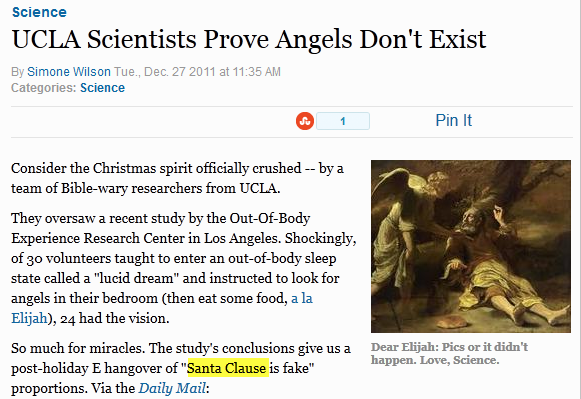
Maybe the author Simone Wilson was unconsciously channeling the Marx Brother’s Night at the Opera, when Groucho and Chico have this back and forth:
Fiorello (Chico): Hey, wait, wait. What does this say here, this thing here?
Driftwood (Groucho): Oh, that? Oh, that’s the usual clause that’s in every contract. That just says, uh, it says, uh, if any of the parties participating in this contract are shown not to be in their right mind, the entire agreement is automatically nullified.
Fiorello (Chico): Well, I don’t know…
Driftwood (Groucho): It’s all right. That’s, that’s in every contract. That’s, that’s what they call a sanity clause.
Fiorello (Chico): Ha-ha-ha-ha-ha! You can’t fool me. There ain’t no Sanity Clause!
It is really not clear that there is anything in from the “Out-Of-Body Experience Research Center” that is not already addressed in William James’s Varieties of Religious Experience. So, in the meanwhile, go ahead and believe in prophecy and mysticism. As far as UCLA is concerned, it is at least as valid as the sanity clause.
Postscript: On second thought, perhaps a UCLA connection would fit right in; after all, Carlos Castenada received his doctorate from UCLA based on the research described in his shaman Don Juan Matus books.
“Pale Fire” without Charles Kinbote
Pale Fire is arguably Vladimir Nabokov’s funniest novel – written in the form of an extended commentary by a madman “Charles Kinbote” on a poem written by poet “John Shade.” The novel includes the 999 line poem “Pale Fire” which forms the target of the Kinbote’s out-of-control commentary.
I would encourage everyone to read the novel Pale Fire. But what are the merits of the poem “Pale Fire”? Brian Boyd and Jean Holabird think we should take it seriously. They have created an art book that presents the poem several ways: as a chapbook, as a “facsimile” of the “original” (famously written on eighty index cards), and in a pamphlet of essays entitled Pale Fire: Reflections.

The whole thing is taken very seriously, but I have to believe it is a put-up job. Just a quick glance at the “facsimile” index cards show that tongue is firmly-in-cheek. Here are twelve of them, as reproduced on the Ginko Press site:
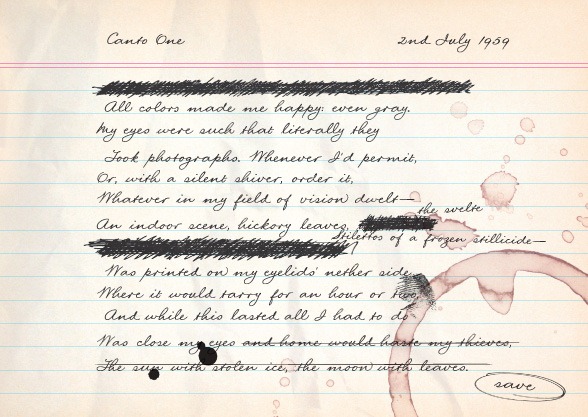
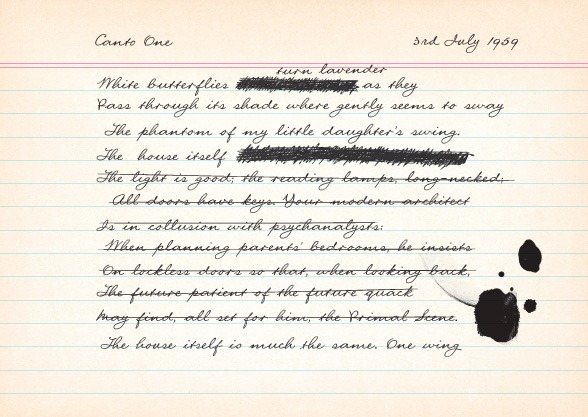
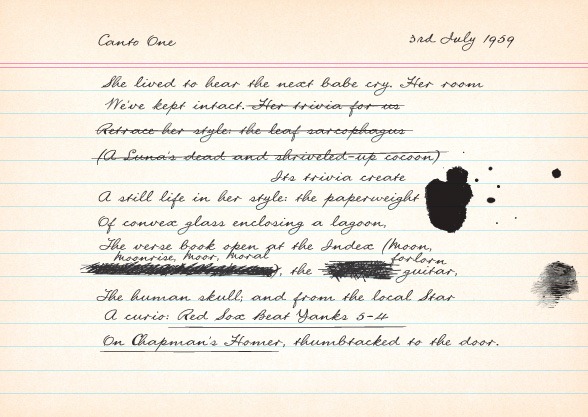
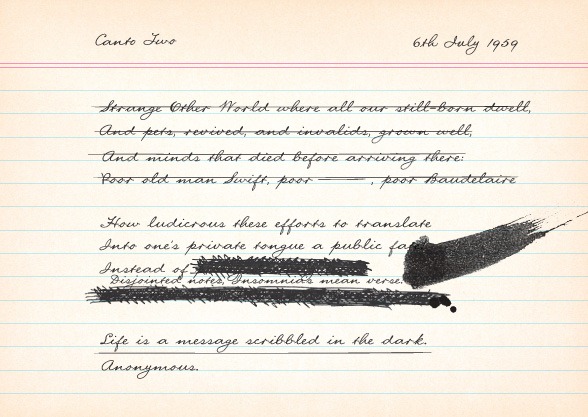
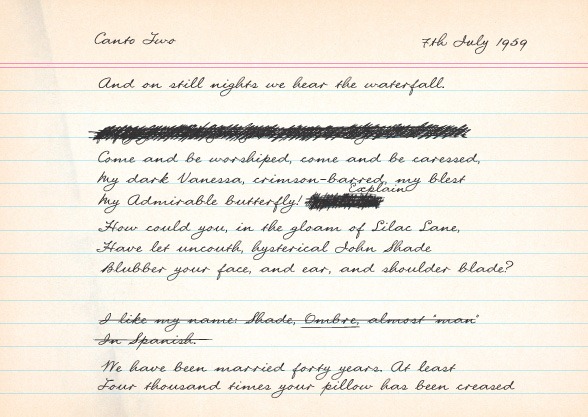
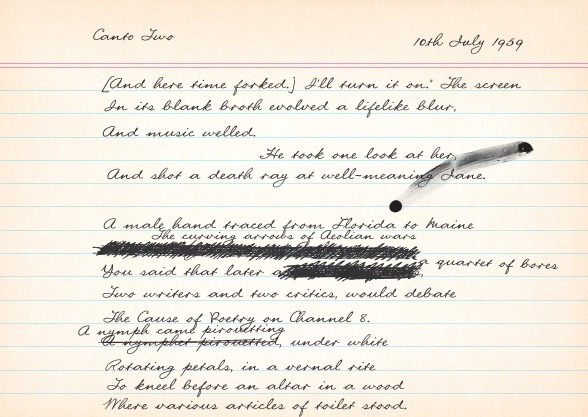
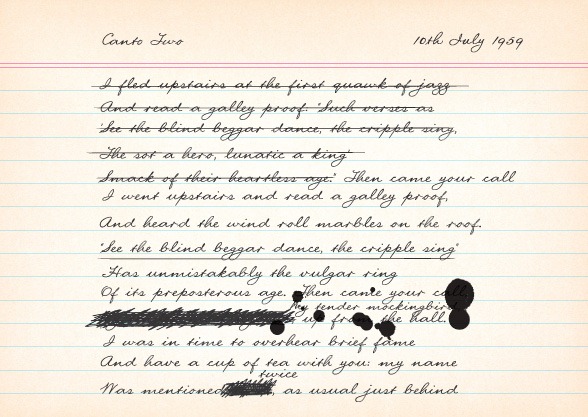
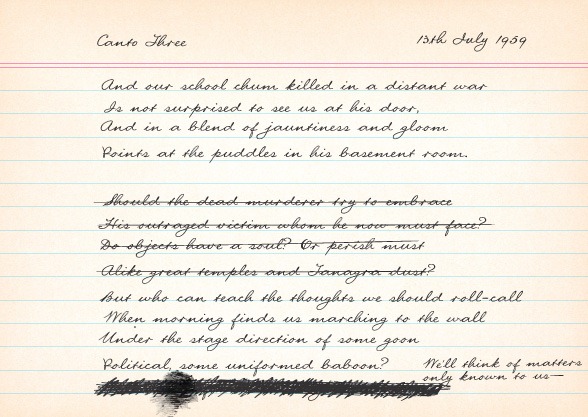
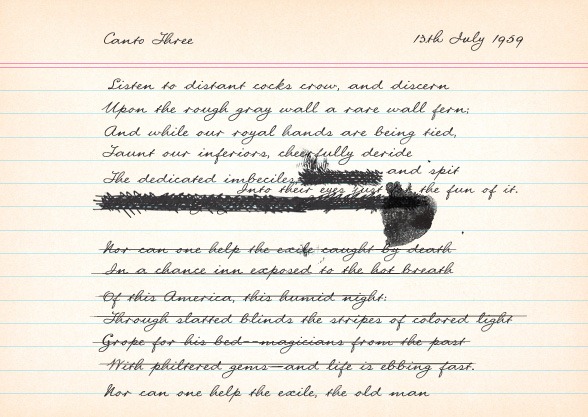
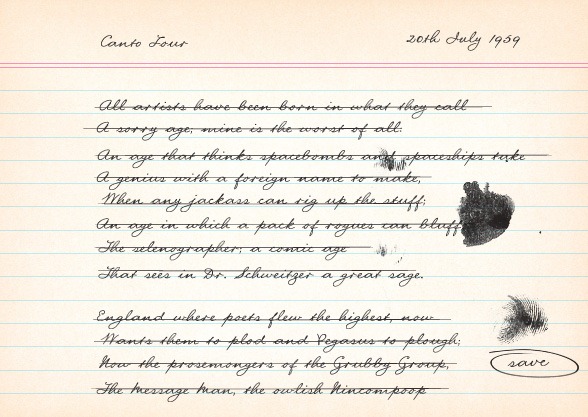
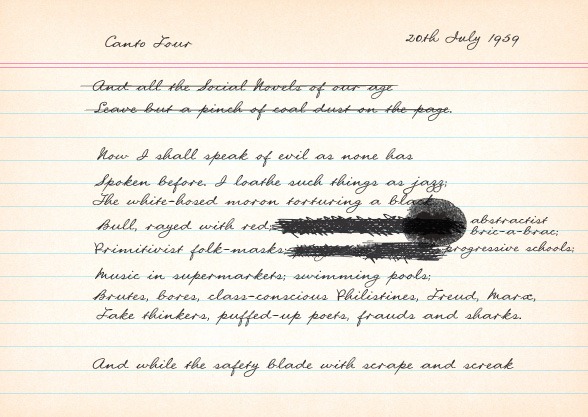
I can’t help but laugh when I read these, especially in the earnest “original facsimile” style, clearly parodying books like T. S. Eliot facsimile The Waste Land: A Facsimile and Transcript of the Original Drafts Including the Annotations of Ezra Pound. And, of course, the text itself is hilarious; note, for example, the third notecard which describes the room of the deceased Aunt Maude:
Its trivia create
A still life in her style: the paperweight
Of convex glass enclosing a lagoon,
The verse book open at the Index (Moon,
Moonrise, Moor, Moral), the forlorn guitar,
The human skull; and from the local Star
A curio: Red Sox Beat Yanks 5-4
On Chapman’s Homer, thumbtacked to the door.
(If you don’t get the joke, then you are not a baseball fan – you might want to check the Wikipedia entry for Ben Chapman. In one phrase, Nabokov satirizes baseball, Keats, and George Chapman.)
The deadly “seriousness” of Ron Rosenbaum’s self-indulgent review (with a lengthy description of how he could not find the Reflections book) just adds to the satire:
Brian Boyd originally shocked many readers by adopting the claim originally made by Andrew Field that the poet John Shade, author of "Pale Fire," was actually the (fictional) author of the novel Pale Fire. This view, that Shade had made up his own mad annotator in Kinbote, who existed only in Shade’s imagination, at one point had so many adherents they were called "Shadeans." (I’m still convinced by the argument Mary McCarthy made in her original brilliant review of Pale Fire—"A Bolt From the Blue" in a 1962 issue of the New Republic—that a deceptively minor character, a faculty colleague of Shade, one V. Botkin, is the "real" Kinbote.)
Then, 10 or so years ago, Brian Boyd, in a complete switcheroo that had heads spinning including mine, wrote an entire book about who wrote the "Pale Fire" poem, claiming it wasn’t John Shade but rather the ghost of his dead daughter Hazel, whose death is at the sorrowful heart of the poem.
Now, in what appears to be another switch, Boyd seems—in the 30-page essay that accompanies Mo Cohen’s edition—to completely abandon his Hazel Shade’s shade theory of the poem’s authorship (such changes of mind are endemic to open-minded Nabokov scholars). And if he doesn’t name a substitute, he argues that the poem ought to be read for its own intrinsic merits and makes clear he believes Nabokov intended us to believe Shade, not his dead daughter, wrote the poem. Or rather, that Nabokov wrote the poem and it’s time to claim it for him.
Giles Harvey at the New Yorker joins in the fun, debating Nabokov’s intentions in writing
I have my doubts about the one-armed bloke
Who in commercials with one gliding stroke
Clears a smooth path of flesh from ear to chin,
Then wipes his face and fondly tries his skin.
Is this a sincere metaphysical observation? Or is it just “a pretext for the burnished ingenuity of Nabokov’s description?”
At Booktryst, Stephen Gertz complains that Rosenbaum is unaware of the limited edition Arion Press version of “Pale Fire” on index cards and complains that Rosenbaum is “shilling for his friend, Mo Cohen of Gingko Press,” point out conspiratorially that
What remains puzzling about this is that every Nabokov fan on the planet was likely aware of the Arion Press first separate edition of 1994 […]
(OK, Nabokov fans – here is your chance to vote – were you aware of this edition?)
Here are the parallels from Arion Press – you decide whether you like it better than Gingko Press’s edition.

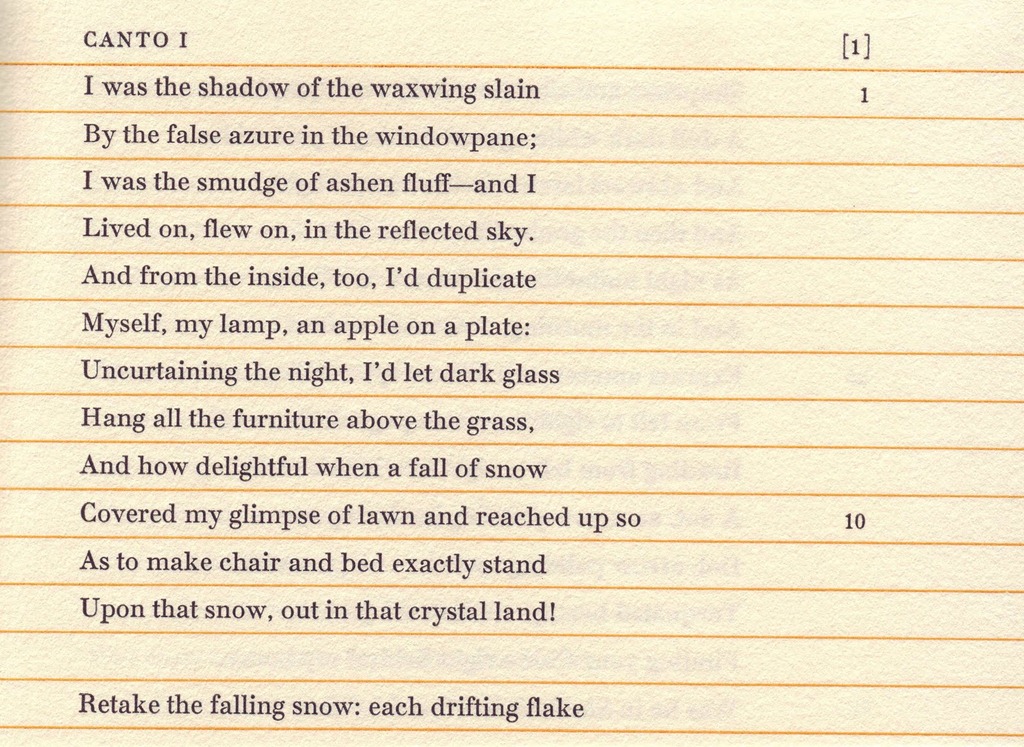
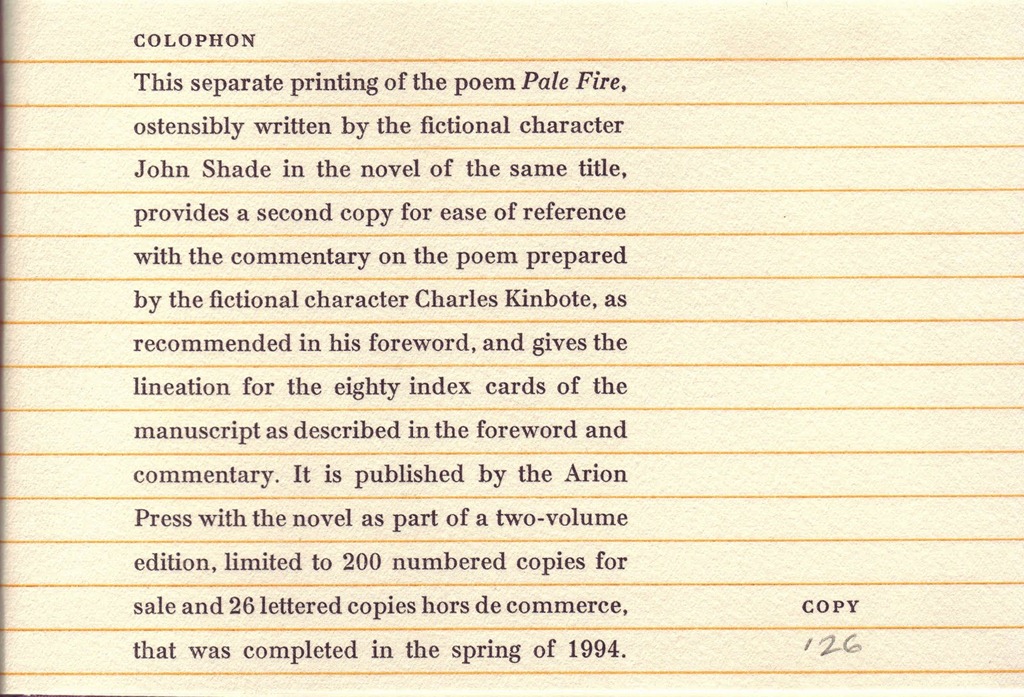

All of this makes for high satire worthy of a David Lodge novel – or maybe even a Vladimir Nabokov novel.
You can buy the Gingko Press version of “Pale Fire” at Amazon for about $25. Or, if you prefer the Arion Press edition, you can pick it up used for about $4000 (item #5 on this list). Or you can just read the poem online for free.
Postscript: The Gingko Press edition is fun and handsome and will bring considerable enjoyment to Nabokov fans. Even though I am sure most Nabokov fans already have a copy of Pale Fire (if not, consider buying the Library of America edition), I think they would enjoy the Gingko Press version, if only to giggle at the facsimile reproduction and marvel at Jean Holabird’s illustrations.
Carta Bible Atlas Fifth Edition
The fifth edition of the Carta Bible Atlas (also known as the Macmillan Bible Atlas) has started shipping in the US. A cursory examination indicates that it is a relatively small revision from the fourth edition – although there are nine more pages. Maps are in two colors only, but contain significantly more data than most other Bible atlases that I have used. I believe that this continues to be the most academic of the widely used Bible atlases on the market today.


 BLT
BLT 