BLT co-blogger J. K. Gayle has some keen insights into the way that the holiday known in Hebrew as “Shavuos” came to be called in Greek Pentecost.
But, of course, there is more to the story. The problem is with the dating.
There was a sect active from about 24 BCE known as the Boethusians – who are somehow related to the Sadducee sect. The had a significant controversy over the dating of Shavuos. To get to it, let’s remember that Shavuos, is celebrated after the 49 days of Omer counting, as related in Leviticus 23:15-16. But let us remember what that says. Here are some portions of Leviticus 23 from Everett Fox’s discussing the date of Passover and Shavuos (I have slightly modified his translation and also added emphasis in the form of color):
The LORD spoke to Moshe, saying:
Speak to the Children of Israel and say to them:
The appointed-times of the LORD, which you are to proclaim to them (as) proclamations of holiness—
these are they, my appointed-times:
For six days may work be done,
but on the seventh day (is) Sabbath, Sabbath-Ceasing, a proclamation of holiness,
any-kind of work you are not to do.[…]These are the appointed-times of the LORD, proclamations of holiness, which you are to proclaim at their appointed-times:
on the first New-Moon, on the fourteenth after the New-Moon, between the setting-times
(is) Passover to the LORD.
On the fifteenth day after this New-Moon
(is) the pilgrimage-festival of matzos to the LORD:
for seven days, matzos you are to eat!
On the first day
a proclamation of holiness shall there be for you,
any-kind of servile work you are not to do.[…]Now you are to number for yourselves, from the morrow of the Sabbath, from the day that you bring the elevated sheaf,
seven Sabbaths-of-days,
whole (weeks) are they to be;
until the morrow of the seventh Sabbath you are to number—fifty days,
then you are to bring-near a grain-gift of new-crops to the LORD.
Now what is “the morrow of the Sabbath” highlighted in red above? One possibility is to read the first day of Passover, when work is forbidden, as a Sabbath, so the counting of the Omer begins on the second day of Passover. This is the interpretation taken by the Rabbis (and presumably, by the Pharisaic party in late Second Temple Judaism).
However, there was another interpretation offered by a group called the Boethusians, who are now somewhat shadowy in history, but were clearly associated with the Sadducaic party. They read “the morrow of the Sabbath” as meaning the day after the first Sabbath day (seventh day of the week – e.g., Friday night and Saturday day) following the first day of Passover.
Here is a entry for “Boethusians” from the second edition of the Encyclopedia Judaica (2007 edition, with emphasis added):
BOETHUSIANS, a religious and political sect which existed during the century preceding the destruction of the Second Temple. According to rabbinic tradition the Boethusians and the Sadducees were named after two disciples of Antigonus of Sokho , Zadok and Boethus. They misinterpreted the maxim of their teacher, “Be not like servants who serve their master in order to receive a reward” as meaning that there was no reward for good works, and thus they denied the doctrine of resurrection and the world to come. They thereupon established the two sects named after them (Avos de Rabbi Noson 13b).
Modern scholars however consider this account to be legendary and they ascribe the origin of the Boethusians to the high priest Simeon b. Boethus who was appointed high priest by Herod the Great in 24 B.C.E. (Jos., Ant., 15:320), in succession to Joshua b. Phabi, in order to afford him a suitable status, as he desired to marry Herod’s daughter, Mariamne II. Although in their theological views they closely resembled the Sadducees, some scholars regard them merely as a branch of them […], and are always mentioned together with them, they did not share their aristocratic background, and whereas the Sadducees supported the Hasmonean dynasty, the Boethusians were loyal to the Herodians. It is they who are apparently referred to in the New Testament as Herodians (Mark 3:6; 12:13). The Boethusians were regarded by the Talmud as cynical and materialistic priests. They hired false witnesses to delude the Pharisees about the new moon (RH 22b; TJ, RH 57d; Tosef., RH 1:15). They maintained that the Omer (Men. 10:3) was to be offered on the first Sunday after Passover, and not on the morrow of the first day and, as a result, differed as to the date of Shavuot which according to them must always fall on a Sunday (Ḥag. 24). They held special views on the preparation of incense on the Day of Atonement (TJ, Yoma 1:39a; Tosef., Yoma 1:8). In terms of the Sabbath ritual, they were not even considered as Jews (Eruv. 68b). The high priestly “House of Boethus” is criticized in the Talmud for its oppression, “Woe is me because of the House of Boethus, woe is me because of their staves” (with which they beat the people – Pes. 57a; cf. Tosef., Men. 13:21).
Other Boethusian high priests included Joezer and Eleazar b. Boethus (Jos., Ant., 17:164, 339), Simeon Cantheras (ibid., 19:297), Elionaeus b. Cantheras (ibid., 19:342), and Joshua b. Gamala.
Now given that Boethusians are apparently mentioned in Gospel of Mark, it seems likely that at least some of the figures mentioned in the New Testament were keenly aware of the dispute over the dating of Shavuos.
The Christian dating of Easter (and thus of Pentecost) was at least determined by the Council of Nicea in 325 CE. (By this point, of course, Pharisaic Judaism had evolved into Rabbinic Judaism).
It is not clear that at this point the Nicean Council members were aware of the Pharisee/Boethusian dispute; since Easter was decoupled from Passover, they probably established the date from their reading of the Septuagint, which is less amenable to the Rabbinic reading than the Hebrew. And thus, with translation as one wedge (and of course vastly different customs and mutual antipathy which had evolved by the 4th century), comes yet another point of difference between the Christians and Jews.
When It Was Counting 7 Weeks (the 50th Day), not anything like the algebra of ש (or Π).
Earlier this week my co-blogger Theophrastus announced the coming of this Day, the arrival of the so-called “Shavuos and Pentecost.” The difference between these two is generally taken today, that is in this day and age, as the difference between the arrival of the Torah, celebrated in Judaism, and the arrival of the Holy Spirit, celebrated in Christianity.
But the borrowing of Hebrew (and Aramaic) and Greek terms in transliteration (that is, in English spelling to try to retain the sounds of the original terms) obscures. Transliterating שבועות as simply “Shavuot” and Πεντηκοστή as merely “Pentecost” loses much. The whole emphasis of the holiday, the remembrance, is on counting. And yet in English, the now proper-nouns Shavuos and Pentecost, retain none of the numeric focus on the passage of time that the Hebrew and the Hebraic Hellene had. We might as well just use Algebraic variables: S and P, or better ש and Π.
When translators only simply merely transliterate, then footnotes are required to expand the original meanings. For example, Willis Barnstone, translating the New Testament Greek and “restoring” it into its Hebraic meanings, gives this footnote:
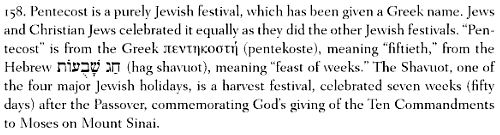
Barnstone gives this footnote after translating I Corinthians 16:8, this bit from Paul’s letter to Greek reading diaspora Jewish Christians in Korinth. Paul’s Greek goes like this:
Ἐπιμενῶ δὲ ἐν Ἐφέσῳ ἕως τῆς Πεντηκοστῆς
The King James Version translates that like this:
But I will tarry at Ephesus until Pentecost.
And Barnstone then attempts to restore that like this:
Yet I will stay in Efesos till Shavuot.
This, to me, seems confusing. The Greek reader in Korinth would have read it more like this:
Yet I will stay in Ephesus till the “Fiftieth.”
And the Greek reader would have understood this as a reference (in Hebraic Greek) for the (Hebrew) holiday of counted days, of the “Weeks.”
One of the earliest texts that ties these two terms together is The Book of Tobit (Chapter 2, verse 1). In the Hebrew of the Dead Sea Scrolls, there is the reference to the festival, to the counted on holiday and festival, to the “Weeks.” Likewise, in the Greek of the Septuagint, there’s the reference, but the reference to the more specific counting of the days up to the “Fiftieth.”
If the King James Version translators had had access to the DSSs, then likely they would have simply transliterated. The apt phrase rendered from Hebrew into their English would have gone something like this:
…. on the day of the feast of Shavuot …
The same KJV translators did find the Greek to translate (i.e., ἐν τῇ πεντηκοστῇ τῇ ἑορτῇ ἥ ἐστιν ἁγία ἑπτὰ ἑβδομάδων), but they did indeed simply merely only transliterate, like this:
… in the feast of Pentecost, which is the holy feast of the seven weeks …
A better translation of the Hebrew to English is the one by Florentino Garcia Martinez, who refuses to transliterate but does translate like this:
… on the day of the Feast of Weeks …
I still haven’t found a true translation of the Hebraic Hellene (which is the same in both Greek versions) into English. A good one, I think, would go like this:
… in the feast of the “Fiftieth,” which is the holy feast of the seven weeks …
Clearly, the LXX translators are giving a bit more explanation of the Day counted, the significance of the weeks and the number of them. And wouldn’t English translators of the Hebrew also, and of the Hebraic Hellene too, do so well?
Reading and Writing about Paul
This summer I’m doing an independent study course with Dr. Michael Gorman on Catholic, Protestant, and Orthodox Perspectives on Paul, starting with an overview of the undisputed Pauline letters and then focusing specifically on the issue of justification. I’m particularly looking for conversation partners from Protestant and Orthodox faith traditions to chat with me about any of what I’m reading and writing.
Related to this, I was fortunate enough to be able to attend an informal colloquium given by N. T. Wright at the Ecumenical Institute of Theology on 10 May. He gave us a (necessarily, extremely compressed and) brief overview of the “big book on Paul” on which he has been working.
I’ve also written about Paul’s interesting literary figures involving faith, love, and hope in 1 Thess, and I expect I’ll be posting lots more about Paul this summer.
Shavuos and Pentecost
As I have mentioned previously, the Shavuos and Pentecost holidays, which will start Saturday night and on Sunday respectively, are pretty close to the BLT charter. Shavuos, the holiday celebrating the receiving of Torah, is often celebrated by staying up all night long studying (tikkun leil shavuos).
Pentecost, the holiday celebrating communication, is close to our hearts given our interest in translation, and it has its own study traditions!
And for our secular friends, there are always the attractions of Memorial Day weekend: the beginning to the summer holidays, the parades, the motor races(Indy 500, Coca-Cola NASCAR 600, and Formula One Monaco Grand Prix), the 35th anniversary of Star Wars, and the college graduations . (If by the way, you are interested in a funny and silly college address, I can recommend this one by Andy Samberg to Harvard students, although it contains a significant amount of vulgar language.)
To all a happy occasion, and apologies in advance if our posting rate slows down (or stops) for the next few days. I’m sure things will pick up again by middle of next week.
Lost, but not in translation: cross-cultural humor
 I saw the following blog post by Peter Savodnic about stand-up comics in Qatar:
In this Sunday’s [New York Times]magazine, I have an article about Stand Up Comedy Qatar, a group of amateur comedians that emerged in the wake of the Arab Spring. They tell jokes about traffic, KFC and suicide bombers. And sometimes despots, too.
The trick, and it’s not a simple one, is knowing what or who is permissible to skewer. Hosni Mubarak, the fallen Egyptian despot, is O.K. So is the late Libyan dictator Moammar Gaddafi. Of course, just because you can make fun of someone doesn’t mean you can make people laugh. A brief despot-themed sampling of jokes that the S.U.C.Q. comedians like to tell:
- Hosni Mubarak is really old. You know how old he is? He’s as old as the pyramids.
- Libyans are the most fashionable people in the Middle East. But Gaddafi is the worst dresser in the world. That’s why the Libyans revolted against him — because he’s unfashionable!
- So, Saddam Hussein is dead . . .
And, as a bonus, one nondictator joke.
- When I asked my teacher how many kids he had, he told me he had two daughters — both girls!
Now, these jokes are so unfunny that it is to discern what the humorous premise would have been. You may think that perhaps the problem lies in a faulty translation – the jokes must have been funnier in the original Arabic.
But it seems that there may be no translation – these jokes may have been performed in English.
Kamal, like the other members of SUCQ, at first performed only in English. “In Arabic, the grammar is different, so it’s very difficult to have a setup and a punch line,” Kamal said. “You have to tell the punch line while you’re still doing the set up — they get mixed up.” But there’s another reason too. The comedians say they want to perform in front of bigger audiences — their monthly shows usually draw at least 70 people — but many still perform in English, partly because they remain worried about who might be attending and how their material will be interpreted.
Is this an example of culturally-specific humor – jokes that los their comicality when transplanted out of the country? Or is the spectacle of stand-up comics so novel in Qatar that anything can get a laugh?
Even though this appears not to be a case of translation (or mistranslation), it still poses a question for translators: should translators take liberties when translating humorous material so that it is still funny in to the target audience?
Men without hats: Anachronism in Daniel 3:21
 The footnote I quoted here got me wondering how different translations handle וְכַרְבְּלָתְה֖וֹן in Daniel 3:21. Sadly many of them use “hats” – although we can be sure that the headgear worn in the Babylonian Captivity most certainly was not a hat.
- hats: ESV, GW, KJV, NAB (1970 & 2011)), NEB, NJPS, NRSV, RSV.
- caps: D-R, GNT, NASB95.
- turbans: Amplified, Lexham, NCV, NET, NIrV, NIV (1984 & 2011), NLT, NKJV, TNIV, YLT.
- headdresses: Inclusive, REB.
- Other choices:
CEV (“all of their clothes still on, including their turbans”),
HCSB (“head coverings [footnote: the identity of these articles of clothing is uncertain]”),
NJB (“headgear”). - Avoids the issue:
ASV (“their hosen, their tunics, and their mantles, and their other garments”),
CEB (“still dressed in all their clothes”),
Darby 1890 (“their hosen, their tunics, and their cloaks, and their garments”),
Emphasized (“their trousers、 their tunics, and their cloaks”),
JPS 1917 (“their cloaks, their tunics, and their robes, and their other garments”),
Living Bible (“fully clothed”),
Message (“fully dressed from head to toe”).
Knox Seminary Programs – limited to men?
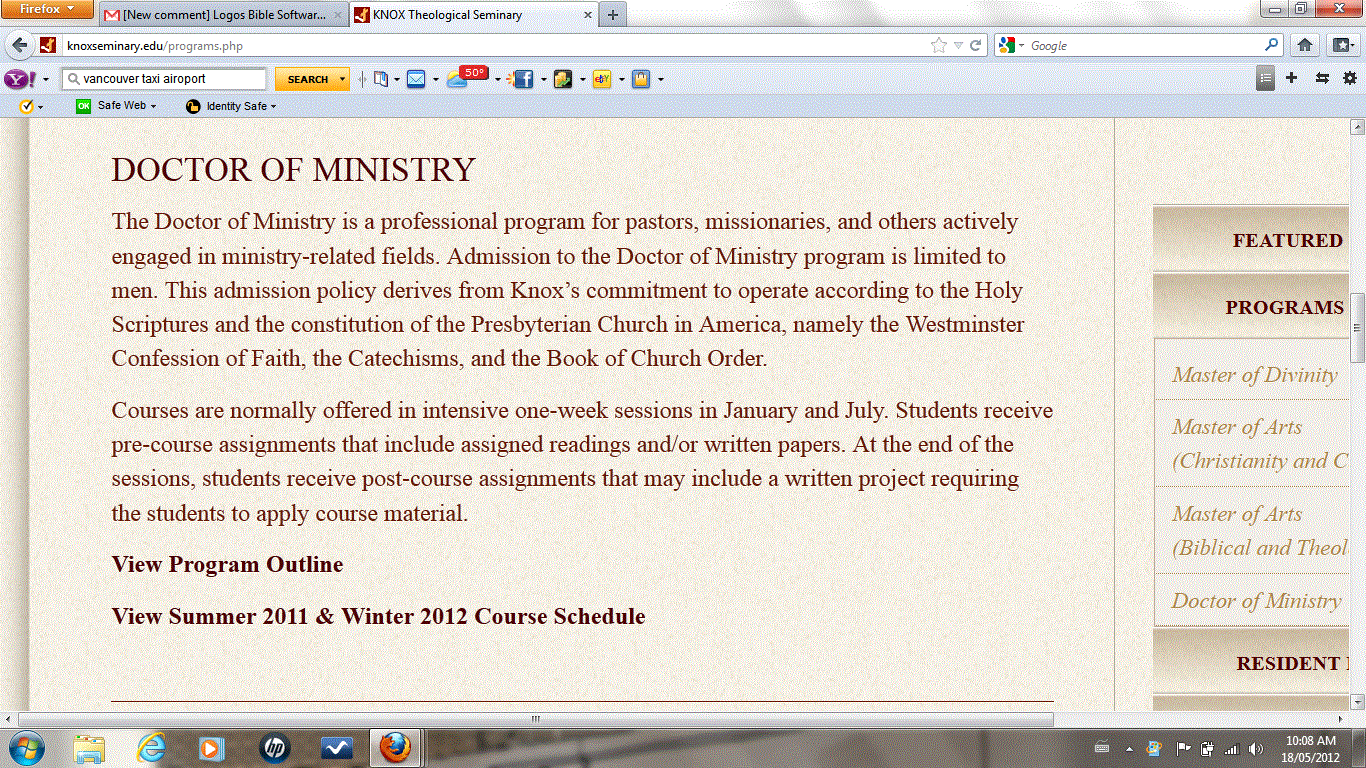 Theophrastus originally noticed and blogged about the fact that the Doctor of Ministry degree jointly offered by Knox Seminary and Logos Bible software might be limited to men, since this was phrase was found in the D. Min. program description on the Knox Seminary website.
I remarked off the cuff in a comment,
“That seems consistent with the view of the PCA that women cannot be preachers, elders or deacons, but can only serve as assistants to deacons.”
The phrase “limited to men” was subsequently removed from the page that Theophrastus linked to.
I then commented that another page – which I captured as a screen shot last week – on the Knox Seminary site explained their policy in greater depth. It read,
“The Doctor of Ministry is a professional program for pastors, missionaries, and others actively engaged in ministry-related fields. Admission to the Doctor of Ministry program is limited to men. This admission policy derives from Knox’s commitment to operate according to the Holy Scriptures and the constitution of the Presbyterian Church in America, namely the Westminster Confession of Faith, the Catechisms, and the Book of Church Order.”
Was this simply a stray page from a previous version of the website? Did this apply last year and not this year? I did not download the entire site, nor did I save a site map, so I can’t say. However, going to their website today, I also noticed that another document seems to have been moved or removed, refering to the M. Div. program and its restrictions to men also. In some way, I could understand that. I could understand that they would be reluctant to train women for a position that a woman cannot hold. But restricting the D. Min. program to men seemed more like withholding academic expertise from women so they would not have access to the same exegetical tools that the men could have.
This disturbs me, in view of the fact that nobody has ever proffered lexical evidence that the word in 1 Tim. 2:12 so often translated as “to have authority” actually means that, rather than meaning “to lord it over” as is suggested by the way in which it was translated by Jerome. I simply don’t think that there is a Bible verse which states in so many words in Greek that women cannot possess authority, whether academic or spiritual. So, no, I don’t think that it is necessary to restrict doctoral level studies to men only in order to operate in accordance with the Holy Scriptures. But maybe this is all last year’s policy …
And, if this program is now open to women, then I am happy for that.
Naomi Tadmor’s Social Universe of the English Bible
 Translations matter. That’s the message of Naomi Tadmor’s stunning book The Social Universe of the English Bible: Scripture, Society and Culture in Early Modern England.
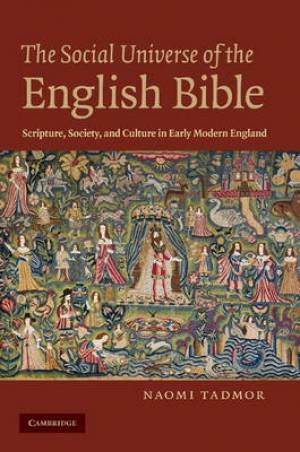 Tadmor, who grew up in Israel and received her undergraduate degree from Hebrew University, but later studied history at Cambridge and is on the faculty at Lancaster, takes as her topic the major translations of the Bible from 1530 to 1611: Tyndale, Coverdale, Matthew, Great Bible, Geneva, Bishops’ Bible, and Douai, and KJV translations – with particular emphasis on the KJV. (She also considers the late medieval Wycliffite translations.) She introduces her thesis thus (I’ve converted her writing to American spelling, although I’ve left her Bible quotations in original spelling):
One additional reason for the during success of the English Bible, I suggest, was that it was not only beautiful and accurate, widely propagated, and deeply revered, but that it was – at least in some ways – Anglicized. The biblical text was not simply translated into English “worde for word,”as Tyndale said), but also transposed, slightly molded, or otherwise rendered in terms that made sense to people at that time and invoked certain notions and ideas.[…] One synomym of the verb “to translate” in early modern England was indeed the (by now obsolete) verb, “to English.” As the Bible was rendered into the vernacular, I propose, subtle and overt “Englishing” also took place, which in turn played a role in the widespread propagation of the English Bible. When early modern artists sketched biblical scenes, they often clothed the ancient figures in contemporary garb or placed them amidst familiar settings; likewise, when people in early modern England ventured overseas, they often understood the cultures they encountered in their own terms. Similar processes, this book suggests, happened with the rendition of words.
Tadmor starts by considering some relatively trivial examples:
Indeed, diverse transpositions in the meanings of biblical words are well known and widely recorded. Adam and Eve famously appear in the Geneva Bible wearing “breeches” (Gen. 3:7).
A long footnote at this point includes this:
In a similar way, in the King James Bible at Dan. 3:21, the three men cast into the furnace are described as being bound in their “coats, their hosen, and their hats.” The words “head attire” of the Bishops’ Bible have been erased and replaced with the more conventional yet possibly less accurate English description.
Tadmor’s main text continues:
In one version “high priest” becomes “hed bischop,” “wise men” are called “wizards,” and “gentiles,” re-designated as “heyns” [heathens], are glossed in a side note: “strangers,” such as those called by the Greeks “barbarous” and by “our old Saxons … welschmen.” Already in the Wyclifite Bible, the word “cider” (“sidir”) appeared to designate the biblical strong drink, “able to make drunkun.” When Tyndale notably insisted on using “love” rather than “charity,” “elder” instead of “priest,” or “congregations” instead of “church,” he was willing to risk his life.
Biblical dictionaries and encyclopedias furthermore reveal how numerous ancient words were prone to shifts, both subtle and overt, and including important terms and mundane words devoid of any heavy theological baggage. Dwelling room and stately office were described as “chamber,” canopy as “closet,” thus invoking familiar special settings. Kesef was at times rendered not as “silver” but as “money,” better to depict economic transaction. Whereas Hebrew men assemble to eat lechem (bread and generic for food), in English they dine on “meat”; the English biblical maiden thus “dresses meat” while her Hebrew counterpart prepares cakes. The English rebel Absalom is caught not among the twigs of the Mediterranean terebinth but in the majestic branches of an oak. In other contexts birds and insects are given English names (no fewer than five different biblical birds, for example, are identified as “owl”).
Tadmor indicates that the same process took place with much more important concepts, and lays out the general outline her book:
“Englishing” the Hebrew Bible, however, this book proposes, went beyond instances such as these: the semantic shifts and transpositions, which took place in the process of translation, affected not just individual words but the construction of a social universe. This story of the creation of the English Bible and its relation both to the ancient Hebrew original and contemporary contexts has attracted relatively little attention, and least of all from social historians. It is this textual and contextual story that this book seeks to pursue. The four chapters of this book thus set out to explore different realms of Anglicization in the wording of the Hebrew Bible: each relating to a set of social relations, each bearing on a historical field, and each pertaining to a historical approach.[…] The formulation of the English biblical language, important in itself [can be tied with] some of the most central processes of its time, including state formation, changing community relations, the consolidation of marriage and gender roles, and changing labor relations.
Tadmor’s first chapter focuses on Hebrew words with special emphasis on the root for “neighbor” רע
The first chapter [traces] how the Hebrew “love thy friend” or thy “fellow man” evolved to become the English “love thy neighbor.” Expanding from this to the social history of neighborliness in early modern England, this chapter investigates the significance of the increasingly Anglicized notion of “love thy neighbor” in early modern print culture and in the context of community relations and the “politics of the parish.”
Tadmore then looks at the roots for “to take” לקח and “to give” נתנ which are often used in terms of male-female unions (e.g., Genesis 27:46, “if Jacob take a wife of the daughters of Heth” and Genesis 29:19 “It is better that I give her to thee, than that I should give her to another man.”)
The second chapter examines notion of gender and the ways in which conceptions of marriage have crept into the vernacular biblical versions over time. This chapter also traces the broad resonance of biblical notions of gender, from enhanced ecclesiastical and state policies regarding marriage to conduct literature and popular print culture. Textual readings, social history, and biographies of individual translators are brought together to suggest links between histories of marriage, the church, print culture, and the English Bible.
Tadmore next looks at the word for “slave” עבד and how it was translated, most dramatically, in the KJV, which removed ever occurrence of “slave” except one at Jeremiah 2:14. (Co-blogger J. K. Gayle pointed out a eerie example of the ESV translators taking parallel actions here.)
The third chapter focuses on labor relations and how the Hebrew ‘eved (or ‘ebed, literally slave) has evolved to become the English “servant.” This chapter also traces biblical notions of “service” from medieval England to colonial America, and the ways in which they were consolidated, promoted, and tested over time.
The fourth chapter examines the word “prince” נסיך and other titled terms, as well as “eunuch” סריס and how they were translated into a complex variety of English terms, reflecting the highly stratified English social system. Tadmor concludes in a virtuosic tracing of the reaction of the politicians and philosophers to this terminology. The latter discussion is especially fascinating to me: I still remember my shock when I first read John Locke’s first Treatise on Government and discovered it was largely about Hebrew exegesis!
Lastly, the fourth chapter investigates notions of office and rule manifested in the consolidation of a range of English biblical terms through diverse renditions, including “prince,” “captain,” “lord,” “duke,” “sheriff,” and “chamberlain” (this sanitized term employed in some contexts for designating the Hebrew saris, meaning eunuch.) This last chapter starts with explorations of the early modern biblical idiom of office, and ends with its deployment by proponents and opponents including Charles I, Oliver Cromwell, Thomas Hobbes, and John Locke.
The book is relatively compact (about 170 pages of text) which allows Tadmor to make her arguments directly and effectively. It has some fascinating black and white illustrations and is heavily footnoted.
Tadmor effectively shows that the tedious Bible translation wars that we have been forced to live through (e.g., in issues of gender in translation) is hardly a new phenomenon – society shapes the translation at least as much as Scripture shapes society. I highly recommend her work.
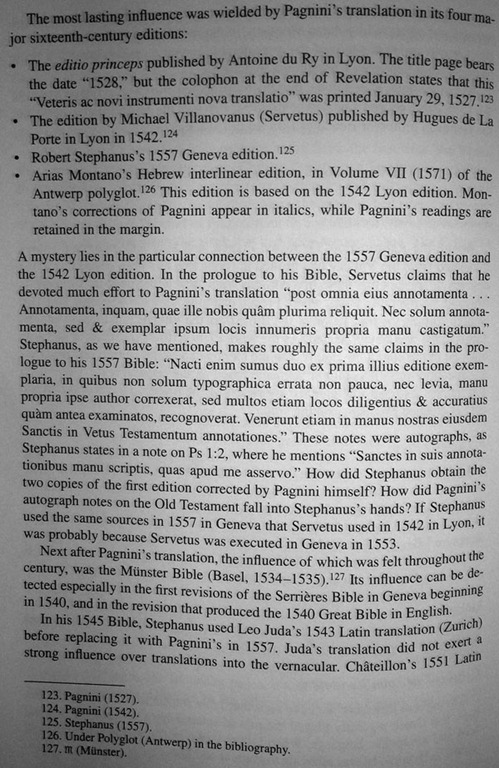
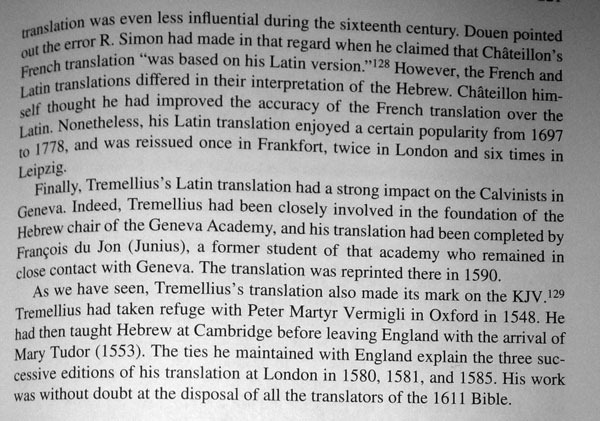
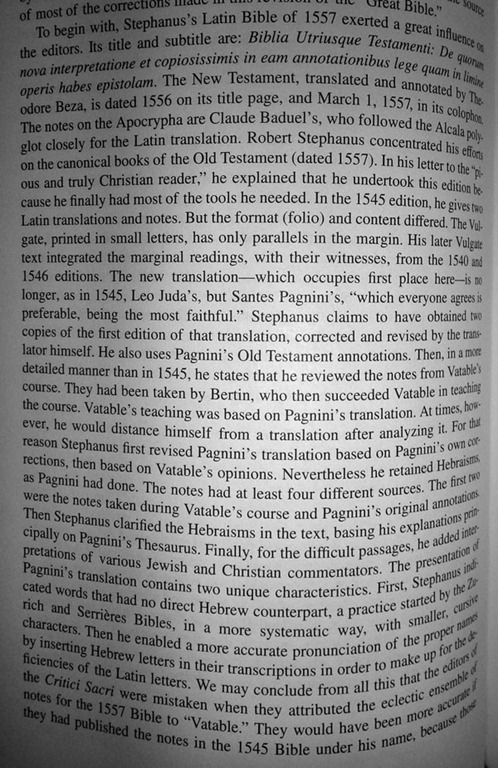
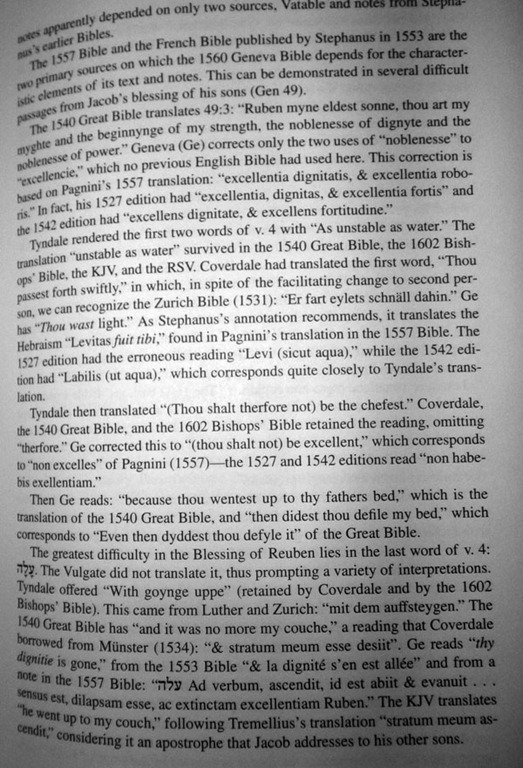
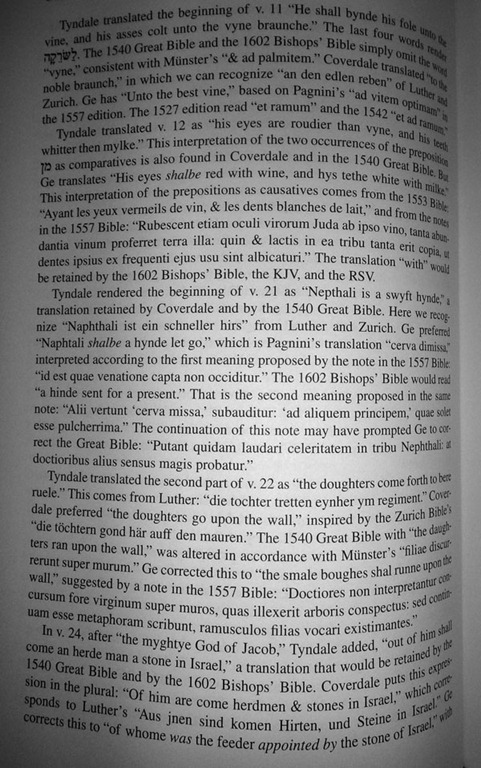
Yesterday, I talked about Dominique Barthélemy’s newly-translated book on Hebrew text criticism, Studies in the Text of the Old Testament: An Introduction to the Hebrew Old Testament Text Project (STOT).
Suzanne added a comment to my post, expressing her concern that modern scholars often ignored the work of Santes Pagnini and Arias Montano. This may be an issue for some books, but certain not for Barthélemy’s work, who for example discusses Pagnini in over a dozen separate passages, some of them up to four pages long. Indeed, as I was reading this book, I thought it would be especially appropriate for Suzanne given her academic interests.
Below are just a few (there are many more) of the examples, tracing the influence of different translations.
I must beg forgiveness in advance for the poor quality of the images. The book itself is quite beautiful, but I was not able to properly photograph it.
First, here is a general discussion of early modern Latin translations:
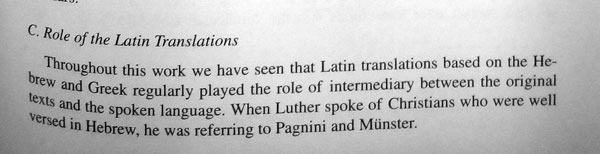
Now a discussion of some specific passages influenced by Pagnini in early English Bible translation.
… I guess the other way would be to put on better performances
Opera News, 76 years old and one of the leading classical music magazines in the country, said on Monday that it would stop reviewing the Metropolitan Opera, a policy prompted by the Met’s dissatisfaction over negative critiques. The decision by the magazine, which is published by a Met fund-raising affiliate, the Metropolitan Opera Guild, and which freely reviews companies around the world, troubles some opera experts. It is also the latest sign of sensitivity from the Met under its general manager, Peter Gelb, in the face of criticism over its productions.[…] Mr. Gelb said in an interview on Monday that the decision was made “in collaboration with the guild” but that he never liked the idea that an organization created to support the Met had a publication passing judgment on its productions. Worse yet, he said, is a publication that “continuously rips into” an institution that its parent is supposed to help.[…]
“As of the June 2012 issue, Opera News is not reviewing Metropolitan Opera productions,” F. Paul Driscoll, the magazine’s editor in chief, said in a terse telephone interview. He declined to elaborate but acknowledged that no other opera company had been banished from its pages.[…]
In the April issue, a review by Fred Cohn criticized the staging of Götterdämmerung, the final work in the “Ring” cycle. The productions of the four operas, which finished their run this month and were directed by Robert Lepage, were the subject of much critical scorn, although they had many fans too. Mr. Lepage’s huge piece of machinery used for all the operas functioned as a lightning rod. “The physical scale of Robert Lepage’s ‘Götterdämmerung’ may have been immense, but its ambitions seemed puny,” Mr. Cohn wrote.
An essay in the May issue by Brian Kellow, the features editor, may have spelled the end. It read, “The public is becoming more dispirited each season by the pretentious and woefully misguided, misdirected productions foisted on them.” Mr. Gelb singled out the line in Monday’s interview. Such negative comments from a publication that is part of a Met support organization “certainly would not be in the best interests of the Met,” he said.[…]
In an earlier post, I mentioned that Shalom Paul English commentary on Isaiah 40-66 would be forthcoming. After some delay, it has at last appeared. The delay associated with the volume can easily be measured – the back cover of the volume (and the preface) mentions that David Noel Freedman is the general editor of the series in which it appears – although Freedman died back in April 2008!
Paul is not modest in describing the features of his commentary:
What is unique about this commentary is the exegesis of the Hebrew text with its emphasis on the philological, poetic, literary, linguistic, grammatical, historical, archaeological, ideational, and theological aspects aspects of the prophecies, in which every word, phrase, clause, and verse is examined and explicated, and, in addition, aided by both inner-biblical allusions, influences, and parallels, and extrabiblical sources, primarily form Akkadian and Ugaritic literature. The Septuagint, as well as the Isaiah scrolls from Qumran – especially the complete Isaiah scroll, IQIsa-a – are of paramount significance and are adduced when they shed light on the verses or deviate from the Masoretic text.
Quite an extravagant claim! But based on a preliminary reading of this commentary, this seems to be exactly the case. Paul has indeed addressed every single phrase of Deutero-Isaiah in this commentary. It is an exhaustive accounting, and far more detailed than any commentary I have read. Paul has produced an exceedingly close modern reading of Deutero-Isaiah, and it is coherent and convincing. Paul does spend much time debating those who read Isaiah differently than he does – rather he simply states his own views and presents his evidence. Thus, Paul’s commentary is more effective at addressing the primary source material than the secondary material on Isaiah. Nonetheless, Paul’s approach of intertextuality (addressing the book from all linguistic parallels) considerably strengthens the work. Although it is hardly its intention, in English this commentary, in particular, forms an excellent advanced lesson on Biblical Hebrew.
As an example, here is a sample passage – I chose Isaiah 45:16 because of its reference to idolatry, a topic that co-blogger Craig raised today. Paul translates this verse as
All of them are confounded and put to shame.
To a man they slink away in disgrace,
Those who fabricate idols.
Paul first presents commentaries on the first two phrases. Turning to the third phrase he writes:
Those who fabricate idols – The Targum (צַלְמִיָא) and many of the medieval commentators translate צירים correctly as “idols.” This hapax legomenon is related to Akk. uṣurtu, which denotes “design” and also refers to idols (Assyrian Dictionary of the Oriental Institute of the University of Chicago, vol. U-W: 292).(C.f. Heb. צורה, “design,” which appears four times in Ezek. 43:11 in connection with the Temple. For צורה as referring to idols in Rabbinic Hebrew, see m. ‘Abod. Zar. 3:3 and the discussion in b. ‘Abod. Zar. 42b.) Moreover, צירים in the present context is polysemous, since it can also denote “travail”; see isa. 13:8: “They shall be seized by pains (צירים) and throes, writhe like a woman in travail.” (Kimchi; Ibn Balaam; Ibn Ganaḥ, Shefer ha-Shorashim, 429; and Luzzatto).
I’m impressed – he manages to reference the Targum, Akkadian, the Mishnah, the Babylonian Talmud, Radak, Ramchal, Ibn Balaam, and Ibn Janah. It is remarkable to find a modern reference work so seriously referencing medieval grammarians.
Psalm 1 and Poetic Forms
Psalm 1 was one of the scriptural texts that I was assigned in my first exegesis class. While engaging with this text, I discovered to my surprise and delight that much of what I had learned about the explication of poetry (primarily from the good folks of Eratosphere, from whom I also learned almost everything I know about translating poetry) was directly applicable to the structural and detailed analysis of scriptural texts. And, just like explicating a poem, the practice of this kind of analysis generates not only a deeper understanding of the text but also a sense of fond familiarity, similar to encountering a piece of choral music that I’ve sung. Out of that fondness, I thought I’d share what I learned of Psalm 1.
First, a structural analysis, informed by my informal study of formal poetry. Formal, metrical poetry is rather out of vogue these days, compared to free verse, but its craft is very rewarding. Formal, metrical poetry takes advantage of received poetic forms (sonnets, rondelets, limericks, and the like) as well as metrical patterns of verse (iambic pentameter, double dactyls, and so on) to create rhetorical and aural structure that sets up an expectation in the reader (or, really, in the listener, as all poetry is really meant to be heard). The craft of such poetry is to effectively build those structures and expectations; the art is to satisfy, foil, or play off those expectations. In this way, the form of a poem really does convey more than the words alone.
Parallelism and symmetry are common structural elements in poetry, and the chiasm or envelope form (ABBA, as in the rhyme scheme of a Petrarchan sonnet) is a common type of symmetry especially for poems that want to compare or contrast something, as psalm 1 contrasts the just and the wicked. What I see in psalm 1 is an interestingly broken chiasm, followed by a moral. In the NAB translation,
(A) Happy those who do not follow the counsel of the wicked,
Nor go the way of sinners,
nor sit in company with scoffers.(B) Rather, the law of the LORD is their joy;
God’s law they study day and night.(C) They are like a tree
planted near streams of water,
that yields its fruit in season;
Its leaves never wither;
whatever they do prospers.(C’) But not the wicked!
They are like chaff
driven by the wind.(A’) Therefore the wicked will not survive judgment,
nor will sinners in the assembly of the just.(M) The LORD watches over the way of the just,
but the way of the wicked leads to ruin.
(Although the NAB translates Torah as “law”, in general I prefer to leave this powerful Hebrew word untranslated, as it seems to carry as many rich connotations in Judaism as “gospel” does in Christianity, so that no single English word can do it justice.)
Part A uses multiple images to present a multitude of unrighteous people (“wicked,” “sinners,” “scoffers”). The “happy” (NAB) or “blessed” (NIV, RSV) ones are to avoid the company of these people.
Part B provides a contrast: happy people spend time with the Torah rather than with sinners, and the Torah is what makes them happy.
Part C describes the result of living in the way of the Lord. Nourished by their Torah study, they are not only fruitful and prosperous, but their lives are firmly grounded (“like a tree planted”). This is the largest part of the psalm, which implicitly emphasizes the abundance that will be experienced by the blessed ones who keep God’s law.
In contrast, the corresponding C’ is shockingly brief. The wicked are like chaff – worthless husks, producing nothing, light enough to be blown about by the wind (perhaps the winds of change, or fashion). There is nothing more to say about them.
Thus, there is no corresponding B’: the Torah is entirely absent from their lives.
In part A’, we see sinners attempting to survive God’s judgment by hiding among a multitude (“assembly”) of the just. While the just must avoid contamination from sinners, sinners cannot hope for a reverse contamination to save them; God will find and judge them. The company of the just presented here is smaller than the company of the wicked presented in part A, suggesting that the psalmist might be writing for a people surrounded by unbelievers (either Gentiles or lapsed Jews).
The psalm closes with a moral that explicitly compares the way of the just with the way of the wicked: God knows the former, but the latter leads to doom.
This psalm is a cautionary tale, presenting an appealing picture of a faithful, Torah-following person on the one hand, and a pitiless picture of the wicked on the other. “Wicked” is implicitly defined here as “non-Torah-following;” there is no appeal to an external standard of morality, on which people of many religions might be able to agree. The just are those who live by the Torah; the wicked are everyone else. The hearer is exhorted to keep apart from the wicked, and hold fast to the Torah.
You can see why in this analysis, I find the briefer form of verse 4 in the Hebrew text more poetically compelling than the expanded form in the Greek: whereas the Greek underscores the annihilation of the wicked with words, the Hebrew does so with silence.
Now let me go back for a detailed look at one word in part B, the verb hagah. This is rendered in the NAB translation above as studies, and by the RSV, NIV, and NASB as meditates. But the more poetic sensibility of the NJB renders this verb as murmurs. This verb frequently has a meaning of quiet speech elsewhere in the Bible; that meaning here would reinforce the aural imagery of the “streams of water” in v3. The gentle sounds of a flowing stream are like the blessed one murmuring over the Torah (as Catholics today murmur over the rosary, or Muslims the Qu’ran), and it is this constant, quiet meditation on the Torah that gives life.
Winterreise (Winter Journey)
 It is with great sadness that I read today of Dietrich Fischer-Dieskau’s passing on Friday. Like many of us, I grew up with Fischer-Dieskau’s interpretations of Schubert’s Winterreise. and I think of Fischer-Dieskau’s understated but perfectly controlled singing as the standard for male vocal excellence. For me, Fischer-Dieskau defined German song.
Winterreise is so demanding on the singer and listener – its lyrics apparently vapid and empty, but its song technically, emotionally, and melodically difficult. The escape in the night of the jilted lover, and his despair, longing for death, and ultimate reconciliation to loneliness are among the most affecting music ever scored. The underlying story of its composition is also filled with tragedy: Schubert’s suffering from late stages of syphilis (to what would lead to his death at age 31 the next year.) The problem for most singers is that they play the song too emotionally – creating an unrealistic effect (and in particular, one unfit for the utter nullity of the underlying songs). Fischer-Dieskau’s recitals were neither too emotional or too cold – rather he seemed to be able to completely transcend himself and become one with the complete and utter bleakness in his recitals.
Some resources:
- Fischer-Dieskau 1965 recording of Winterreise with Joerg Demus
- Fischer-Dieskau 1979 video of Winterreise with Alfred Brendel
- Fischer-Dieskau’s 1985 recordings of Schubert Lieder (including Winterreise) with Gerald Moore (a bargain at $32.51 for 24 hours of song)
- The Fischer-Dieskau Book of Lieder (with original German and English translations by George Bird and Richard Stokes)
- Susan Youen’s Retracing a Winter’s Journey: Franz Schubert’s “Winterreise”
- Schubert’s Complete Song Cycles (Score with English and German)
- A tenor version of Winterreise (Werner Guera)
Let’s Talk Idolatry (An Invitation to Dialogue)
I grew up in a very Protestant household. Not terribly devout, but steadfastly Protestant. In third grade, all the kids were invited to wear something green for St. Patrick’s Day. My father insisted I wear orange instead, because we didn’t want to be seen supporting the papists.
My father’s biggest problem with “the Catholics” (and he always used a definitely article; it served to make them a cohesive group, one he could distance himself from even further) was not their “slavish obedience” to the pope, though that irked him mightily. It was that they were “idolaters, every one of them!” He saw the religious iconography, and particularly the many statues which, especially in that era, decorated Catholic churches and homes as being nothing short of idol-worship. When, many years later, I tried to express the notion of veneration as being distinct from worship, or of using an object as a means of focusing one’s attention and faith, it fell on deaf ears. My father, who was nearly a reprobate in most respects, could prooftext on idolatry with the best of them.
As I moved into Episcopal circles, I found a curious balance between the Protestant and the Catholic. Some Episcopal parishes were “low church” (fairly austere and unflowery in their liturgy) and some were “high church” (lots of “bells and smells,” rife with liturgical excess and theater). A priest once told me, “As long as Catholics keep marrying Baptists, there will always be Episcopalians.”
The church I attended was a mixture. Our 8 a.m. service was low church, our 11 a.m. was high. And there were some seasonal services which only a few people attended, like the Veneration of the Cross during Holy Week, which were so “Catholic” that they made me feel a tad uncomfortable. These special services were mostly staffed and promoted by a coterie of Anglo-Catholics in the congregation, one of whom was a retired Episcopal priest known for his overwhelming devotion to Mary—nearly to the exclusion of all other religious sentiment. It was joked that when he died, Jesus would meet him with a smile and a handshake and say, “Father George, so nice to meet you at last! Mother has told me so much about you!”
Many of my neopagan, or at least pagan-ish, friends have small altars in their homes on which they place objects and images that have some spiritual resonance for them. This week I suddenly flashed on the notion of household gods—not so much the deities, but the small statues or shrines that people in nearly every culture on earth have used. They seem, in my postmodern way of looking at things, not as actual objects of worship, any more than people might worship the household deities themselves. The spirits were helpers, connections to Spirit, tools to grease the wheels of fate or luck, and the images were simply a touchpoint. As such, they seem mostly benign.
Which made me start wondering about the tremendous antipathy toward idolatry that Judaism and Islam have. The apocryphal tales of Abraham almost always seem to be about his crusade to smash polytheism and establish monotheism—sometimes in rather violent ways.
The Decalogue is interesting in this regard. Various traditions have numbered the ten commandments in different ways. The Philonic division (from the writings of Philo and Josephus in the first century) has the First Commandment as the call to have no other gods besides, or at least in primacy over, YHWH, with the Second as the prohibition against the making or worship of graven images. The Talmudic division (third century) combines them into a single commandment, which seems to reflect the understanding that the prohibition is really about worshiping the image instead of the reality, of getting caught up in the concrete instead of seeing the truth as being ineffable. It is, to borrow the Zen koan, the finger pointing at the moon: people spend so much time looking at the finger that they forget all about the beauty that lies behind and beyond.
So my question for our readers, and especially for my fellow commentators, is this: Is the ancient prohibition against idolatry nothing more than one tribal people’s attempts to distance and distinguish themselves from the polytheist cultures that surrounded them? Is the veneration of objects as a spiritual practice what the anti-idolatry commandments were all about? If we lived plain and austere lives, without Things that drew our attention, would we be more focused on God? Idolatry is such a huge deal in the Bible, yet we either dismiss the emphasis on chopping wooden idols to bits as belonging to a primitive past, or else spiritualize it beyond recognition and talk about “putting God first.”
All right, that wasn’t one question but several. I just need to know if I should get rid of my statue of Ganesh. And that carving of Buddha.
New York Public Library redux
I’ve already mentioned the challenges facing the New York Public Library in this post. I’d like now to mention a “Room for Debate” feature at the New York Times on the planned changes.
Here is a summary of the proposed changes:
The project would convert the main library, now strictly a reference operation, into a hybrid that would also contain a circulating library, many computer terminals and possibly a cafe. The Mid-Manhattan branch and the Science, Industry and Business Library would be sold and their operations folded into the main building. To accommodate the new services, up to half of the three million volumes in the stacks under the main reading room would be moved into storage in New Jersey.
Critics say that the money would be better spent refurbishing deteriorating branch libraries, and that the changes will diminish the library’s role as a leading reference center, essentially turning it into a glorified Starbucks. Of particular concern: how long it will take the library to retrieve books from storage.
“The library is being repositioned less as an institution that thinks of research and scholarship than as a kind of fashionable place for intellectuals that is more about entertainment than depth of knowledge,” said Ilan Stavans, a professor in Latin American and Latino culture at Amherst College[….] “Research is going to pay a heavy price with this change,” he added.
Monica Strauss, an art historian, said: “The age of the book is not yet over. It may be over in 40 years, but it’s not over now.” […]
Designed by the British architect Norman Foster, the renovation is to be financed with $150 million from the city, proceeds from the sale of the two libraries and private donations.
Joan Scott, a social science professor at the Institute for Advanced Study, who helped draft the letter of opposition, called the plan disturbing.
“The idea that these reforms are going to make it more democratic doesn’t make sense to me,” she said.
Critics question how users of the libraries to be sold will fit inside the main building (its number of annual visitors — 1.6 million — is expected to more than double) and whether books moved to New Jersey really will be available within 24 hours, as the library has promised. Off-site books currently often take longer than that to obtain.
From the Debate page, here is Caleb Crain’s submission (Caleb’s blog has long been in our blogroll):
Research Will Be Delayed and Impaired
Caleb Crain is the author of "American Sympathy,” a study of friendship between men in early American literature. He blogs at Steamboats Are Ruining Everything.
May 17, 2012
Until recently, there were about 5 million books in the New York Public Library’s 42nd Street building (the one with the lions in front). To walk up the stairs was to enter a universe of written information, and a visitor could zip from one end to the other with dizzying speed.
Want to read Herman Melville’s Moby-Dick? A librarian was able to bring it to you in minutes. How about the treatises on whaling that Melville read while writing his novel? Sermons by the minister who offered to help Melville’s wife escape her marriage? The navigational charts that Melville mentions in chapter 44? A compilation of letters that Melville’s great-grandson exchanged in the 1980s with a graduate student? All you had to do was fill out a call slip.
Research will become slower and far less improvisational if the library’s administrators bulldoze ahead with their plan to ship 3 million books to a storage facility in New Jersey.
Curious about a book you only learned of a few minutes ago? They’ll be able to get it for you in a day or two. Or three.
The number of books published each year has exploded, and a certain amount of offsite storage is inevitable. But downgrading from 5 million books onsite to 2 million is like downshifting from a car’s engine to a lawnmower’s. Or like trying to drive a car in Manhattan with an engine located in New Jersey.
Online publishing has changed the way researchers read, but because of copyright law, the vast majority of books ever published are not available online. Unless Congress writes a new law (don’t hold your breath), they may never be.
It may even turn out that researchers of the future will prefer to read some kinds of books in tangible form. We just don’t know enough yet, and it’s too soon for the New York Public Library to say goodbye to ink and paper.
Weird Bibles 3: Playful Puppies Bible
It has been too long since an installment in my “weird Bibles” series. So, let’s get things kicking again with this fine entry from Zondervan:
Playful Puppies Bible
If you love puppies, you will love this Bible! Inside you will find 12 color pages of adorable puppy photos with inspirational thoughts that will encourage you day after day. The Playful Puppies Bible is just the right size to take along wherever you go. Features include: * Presentation page for gift giving * Ribbon marker * Words of Christ in red * 12 pages of adorable puppy photos, Scripture references, and inspirational thoughts * The entire Bible in the New International Version (NIV)
Here are some images for you:




Previous posts:
Weird Bibles 2: Etymological New Testament
Weird Bibles 1: Archaic Aramaic script
An Orthodox translation


 BLT
BLT 