Topics in Early Church History?
My fall semester class on Early Church History started last night. My prof is very enthusiastic: this is her favorite period of history and her favorite class to teach. So that should be fun! We have 12 people in the class, from a wide variety of Christian traditions, at various places in our degree programs.
For this class, I will be writing two 6-7 page papers. They can be on any topic that can be explored in the context of the first five centuries of Christianity for which there is primary source material available – and she’ll work with us to find appropriate primary sources. (And “available” here effectively means “available in English.”)
So that’s a wide open field, and I’m taking suggestions. Is there something you’ve always been curious about? Convince me it’s really interesting, and maybe I’ll research it for you. 🙂
Some ideas I have so far:
Read the rest and post your suggestions over at Gaudete Theology.
Using the bible to maintain control
After reading so much on the vocabulary of power and authority, I decided to reread Hebrews 13:18 in several translations. I am not surprised.
In the Wycliff Bible it was translated as “Obey ye youre sovereigns.” Luther translated this phrase in a way that can be represented in English as “Listen to your teachers.” In Tyndale’s translation it appears as “Obeye the that have the oversight of you,” but in the King James Bible, it has been changed to “Obey them that haue the rule ouer you.” By way of contrast, the Douay-Rheims translation has “Obey your prelates.” In this was one simple phrase was used to engage compliance with either secular or spiritual authorities.
“Oversight” was used for spiritual leadership and authority, while “rule” was reserved for monarchs. There is a clear split between the translations. In fact, all translations from Tyndale to the Bishop’s Bible had “oversight” and not “rule.” The switch to “rule” in the King James Bible stands out as peculiar. It appears to be a change of language to serve the interests of the monarch.
There are arguments for and against each of these translations. Translators choose between an array of possible alternatives when they translate. In this way, a bible can be shaped in a way that promotes the power of a particular institution. I wish it weren’t so.
Labo(u)r Day blog posts
Today is Labor Day in the USA. On this holiday last year, here at BLT I linked to a little history from a US Department of Labor webpage (and to some bible pages). Today, Bob MacDonald at his blog Dust gives an English and Hebrew series of rhetorical questions on Labour and links to an article on Labour Rights history in British Columbia, Canada. And today, my BLT co-blogger Victoria Gaile Laidler at her blog Gaudete Theology tells of the patron saint of labor (of her childhood) and links to several Catholic articles.
Also today, this Labor Day, I thought you might be interested in the history of Mary Harris, who at age 83 was called by the President of the USA at the time, “the most dangerous woman in America.” She and her family were first Irish before they immigrated first to Canada and then to the USA. They were Catholics, and then she was somewhat of a feminist, this Mother Jones.

Here’s how Ani DiFranco and the late Utah Philips remember her:
August 2012 Biblical Studies Carnival
Phillip J. Long “keeper of the carnival list” has announced the August 2012 carnival for blogs posting on biblical studies. There he adds:
Next month’s carnival will be hosted by Tim Bulkeley at Sansblouge, feel free to send him nominations for the September Carnival. J. K. Gayle at BLT (Bible * Literature * Translation) will be hosting the October Carnival. Abram K-J from Words on the Word is on tap for the December Carnival.
I only want to offer this clarification: It is not only me but it is also all the BLT co-bloggers — namely Craig R. Smith, Suzanne McCarthy, Theophrastus, and Victoria Gaile Laidler — who will be hosting the October Carnival. We are looking forward to this one, actively talking over the posting to come. And we want you to post and to post your best in biblical studies in October for us to consider for this monthly event! And keep your eye on what your favorite biblical studies blogger is doing in October, then let us help you share it!
Chronological or Canonical?
Interesting post over at Reading Acts on Reading the New Testament: Chronological or Canonical?, engaging with an article by Marcus Borg on the subject.
Certainly I grew up believing that the canonical order was pretty much chronological, because it’s chronological with respect to the world inside the text. And that makes sense: if you’re presenting the story of Jesus and the church, you would present it in story-order, not the order in which the “chapters” were written.
Click to read the rest at Gaudete Theology.
Was Paula a bible translator?
Jane Barr has written a very interesting paper demonstrating that Jerome’s translation of Genesis is uneven, and when the subject matter relates to female issues, the translation is notoriously paraphrastic, supplying phrases not in the original Hebrew. I looked at her references – the stories of Dinah and Tamar – and decided to try out one of my own. Here are two lines from when Rachel dies in childbirth, Gen. 35:16,17,
וַיְהִי בְהַקְשֹׁתָהּ, בְּלִדְתָּהּ
ob difficultatem partus periclitari cœpit (Jerome)
By reason of her hard labour she began to be in danger (D-R)
Quumque difficultatem pateretur in pariendo (Pagninus)
And it came to pass, when she was in hard labour (KJV)
And as she was having great difficulty in childbirth (NIV 2011)
וַיְהִי בְּצֵאת נַפְשָׁהּ, כִּי מֵתָה
Egrediente autem anima præ dolore , et imminente jam morte (Jerome)
And when her soul was departing for pain, and death was now at hand (D-R)
Fuit autem egrediente anima eius (nam mortua est) (Pagninus)
And it came to pass, as her soul was in departing, (for she died) (KJV)
As she breathed her last—for she was dying (NIV 2011)
In both cases something is added by Jerome to his Latin translation. In the first case “danger” and in the second “pain.” On the other hand, one might suggest that the King James Version has underplayed the difficulty of childbirth. The women in the scriptures lived in a different time than us, and every pregnancy endangered their life. But childbirth is greatly desired in the Hebrew scriptures nonetheless.
I cannot help but think of Paula, the widow and mother of five children, who refused to marry again. She studied with Jerome and provided for him. She established a monastery and convent, providing manual support and scribes for his work. She also learned Hebrew and sat and discussed and edited his work.
Is it not possible that Paula influenced his translation, that she assured Jerome that childbirth was dangerous and painful? What was her role as patron, assistant and editor? Can we consider her to be on occasion also a co-translator?
However, in Gen. 3:16, Jerome, who had no difficulty discussing the most learned theological points with women, placed the wife squarely under her husband, writing sub viri potestate eris – “you will be under the authority of your husband.” He knew very well that this was not a translation of the Hebrew since in Gen. 4:7, he translated sub te erit appetitus ejus.
It is true that Jerome did sometimes add adverbs to his Latin translation to make the translation accord with his notion of good Latin style. Still, this does not seem to explain his eratic translations on all matters relating to women.
ETS and the trinity: conclusions
With respect to the ETS doctrinal statement and the trinity, several historic creeds and commentaries say that the Son is equal to the Father in Macht (exousia) and potestas (exousia), and others say that the Son was equal to the Father in potentia (dunamis). The English word “power” is used to translate both exousia and dunamis. Therefore, the ETS doctrinal basis could mean that the Son is equal to the Father in either exousia or dunamis or both. It is sufficiently vague in English to mean any of the above, and as such functions well as a creed for a diverse group of Christians.
The Bible alone, and the Bible in its entirety, is the Word of God written and is therefore inerrant in the autographs. God is a Trinity, Father, Son, and Holy Spirit, each an uncreated person, one in essence, equal in power and glory.
We believe that the sole living God who created and rules over all and who is described in the Bible is one Triune God in three coeternal, coequal Persons, each Person being presented as distinct yet equal, not as three separate gods, but one Godhead, sharing equally in honor, glory, worship, power, authority, rule, and rank, such that no Person has eternal primacy over the others.
In reviewing various creeds, as they were written in Greek, Latin and German over the past 2000 years, I cannot find any creed which explicitly says that the Son was equal to the Father in both “power” and “authority.” Nor can I find any creed which says or implies that the eternal Son was “under the authority of” the Father.
However, it is my view that many creeds do imply that the Son is “ranked” second to the Father – the Greek word is taxis. Therefore, I feel that the Trinity Statement is not a useful replacement for the doctrinal basis of the ETS.
Having said this, I find the notion that a Father would plan and direct his totally subordinate Son to die on the cross, by means of his will dominating over the will of his Son, to be a repugnant metaphor and even more repugnant as a metaphor for marriage. I could not happily participate in fellowship with people who evoke these violent images about human relationships.
Paula on living in Jerusalem
I have been thinking a lot about Erasmus and how he and the first generation of humanist scholars learned Greek and Hebrew. Many of them studied with Greek scribes who offered their services as language instructors. But today you can study Greek without ever interacting with a native speaker. Here Paula writes some good advice on the topic,
Paula’s letter to Marcella pleads with her old friend that she leave Rome, called in the letter a “Babylon,” and come to Jerusalem and its Holy Places.3 It describes Paula’s pilgrims to all these Holy Places in such a way as to have Marcella participate in their sacred journeying, mentally, and vicariously, in her imagination. Paula and Eustochium begin their letter by stating that, although the Crucifixion may have made Jerusalem an accursed place, there is ample scriptural justification for Christians to return to that holy city. Paula relies not only on the Scriptures but also upon Cicero for this argument, describing both St. Paul speaking of his need to return to Jerusalem and Cicero speaking of his need to learn one’s Greek not only in Sicily but in Athens, one’s Latin not in Lilybaeum but in Rome. She adds, in a capstone to her argument, that Jerusalem is “our Athens.” She then quotes Virgil’s First Eclogue on the great distance of the British Isles from Rome in noting that Christian Gauls and Britons all make haste to come, not to Rome, but to far Jerusalem.4 Paula movingly contrasts the wealth of Rome and the poverty of Bethlehem:5
Ubi sunt latae porticus? ubi aurata laquearia? ubi domus miserorum poenis et damnatorum labore vestitae? ubi instar palatii, opibus privatorum extructae basilicae, ut vile corpusculum hominis pretiosius inambulet et quasi mundo quicquam possit esse ornatius, tecta magis sua magis quidquam velit aspicere, quam caelum? Ecce in hoc parvo terrae foramine, caelorum conditor natus est, hic involutus pannis, hic visus a pastoribus, hic demonstratus a stella, hic adoratus a Magis . . . In Christi vero . . . villula tota rusticitas, et extra psalmos silentium est. Quocumque te verteris, arator stivam tenens, alleluia decantat. Sudans messor Psalmis se avocat, et curva attondens vitem falce vinitor aliquod Davidicum canit. Haec sunt in hac provincia carmina, hae, ut vulgo dicitur, amatoriae cantationes. Hic pastorum sibilus, haec arma culturae. Verum quid agimus, nec quid deceat cogitantes, solum quod cupimus hoc videmus?[Where are spacious porticoes? Where are gilded ceilings? Where are houses decorated by the sufferings and labours of condemned wretches? Where are halls built by the wealth of private men on the scale of palaces, that the vile carcase of man may move among more costly surroundings, and view his own roof rather than the heavens, as if anything could be more beauteous than creation? . . . . In the village of Christ . . . all is rusticity, and except for psalms, silence. Whithersoever you turn yourself, the ploughman, holding the plough handle, sings Alleluia; the perspiring reaper diverts himself with psalms, and the vine-dresser sings some of the ballads of this country, these are the love-songs, as they are commonly called; these are whistled by the shepherds, and are the implements of the husbandman. Indeed, we do not think of what we are doing or how we look, but see only that for which we are longing.]
Paula has written a Christian Georgics, a Christian pastoral, though as if through the eyes of Karl Marx, Simone Weil, and Frantz Fanon.6 Her style is shaped by Cicero and Virgil, Horace and Juvenal; her social thought is shaped by the Prophets and the Gospels.
In contrast to this letter, Jerome’s account of the pilgrimage Paula made is almost barren of references to classical authors. He writes it after Paula’s death, giving her vita to her virgin daughter, Eustochium.7 The letter waxes most sentimental about her parting from her family members, describing her as torn between the love of her children and her love for God. He does, however, mention the “fables of the poets,” de fabulis Poetarum, in giving the tale of Andromeda chained to a rock, as happening at Joppa, which he notes was also the harbor of the fugitive Jonah. He had earlier cited some lines of the Aeneid concerning the Greek Isles. But, unlike Paula, he does not show off his classical learning. He is here being more Christian than Ciceronian. (We recall his dream in which he is chided, or chides himself, by being told, “Thou art not a Christian. Thou art a Ciceronian.”8) He mentions Paula as visiting the tomb of Queen Helena, famed in Jerusalem for having given wheat during a famine to the populace. (This Queen Helena in pilgrim legends may have become conflated with the Empress Helena.) He notes Paula’s deep piety at the Cross and the Sepulchre in Jerusalem, and at the cave and church in Bethlehem.9
Jerome even notes Paula telling him that she realizes that the Hebrew means not Mary, mother of God, “her,” but God, “him,” in Psalm 132: “Behold, we heard of her/him in Ephratah, and found her/him in the fields of the wood,” because he has corrected her on this matter of the Hebrew “zoth.”10 A woman, reading of that apology, can sense its pain. It is a male rebuke to her feminist reading of the text, and she, rather than he, may be correct. There was not yet a Dame Julian to console her as there would be for the later Dame Margery concerning such male rebuffs.
What women really want … according to the National Review
 For those of you who give credence to evolutionary psychology, here is a reductio ad absurdum courtesy of Kevin Williamson at the National Review:
What do women want? The conventional biological wisdom is that men select mates for fertility, while women select for status….
You want off-the-charts status? Check out the curriculum vitae of one Willard M. Romney: $200 million in the bank (and a hell of a lot more if he didn’t give so much away), apex alpha executive, CEO, chairman of the board, governor, bishop, boss of everything he’s ever touched. Son of the same, father of more. It is a curious scientific fact … that high-status animals tend to have more male offspring than female offspring…. Have a gander at that Romney family picture: five sons, zero daughters. Romney has 18 grandchildren, and they exceed a 2:1 ratio of grandsons to granddaughters (13:5). When they go to church at their summer-vacation home, the Romney clan makes up a third of the congregation. He is basically a tribal chieftain.
Professor Obama? Two daughters. May as well give the guy a cardigan. And fallopian tubes.
From an evolutionary point of view, Mitt Romney should get 100 percent of the female vote. All of it. He should get Michelle Obama’s vote. You can insert your own Mormon polygamy joke here, but the ladies do tend to flock to successful executives and entrepreneurs….

Rape is wrong
It seems to me, from what I understand from doctors, that [pregnancy from rape] is really rare. If it’s a legitimate rape, the female body has ways to try to shut that whole thing down.
— US Representative Todd Akin (Missouri 2nd District) (also Senatorial candidate)
I misspoke one word in one sentence on one day.
The mistake I made was in the word I said, not in the heart I hold.
Bryan Fischer, director of issue analysis for the American Family Association, a conservative Christian group, defended Mr. Akin on his program “Focal Point”…: “In other words, ladies and gentleman, Todd Akin was exactly right.”
New York Times report on Bryan Fischer’s (American Family Association) defense of Todd Akin.
But here’s the problem. Mitt Romney may have called the Akin quote insulting and inexcusable, but how far is it really straying from GOP doctrine on women’s issues? … Rep. Paul Ryan, Mr. Romney’s choice as running mate, was co-sponsor of a bill that proudly used the term “forcible rape” in limiting the exceptions to the rule against federal funding for abortions. “Legitimate rape” and “forcible rape” sound pretty closely related, and both seem suspiciously like they must have been coined by people who believe women are prone to lying about being violated in the most humiliating way possible…. And just this week in Tampa, the party’s platform committee approved a plank calling for a Constitutional amendment [the “Akin Amendment”] banning all abortions with no exception for rape and incest mentioned.
Undoubtedly, Todd Akin is sincerely sorry that his statement got the attention it has received. But it seems that he believes his mistake is limited to his using the phrase “legitimate rape” as opposed to “forcible rape.” After all, as he went out of his way to say, his original statement only included “one word” that was misspoken; and his statement did accurately reflect the “the heart [he] hold[s].” And conservative Christian groups are claiming that Akin was right on science.
Rape is the ultimate way of demonstrating male domination over females. Culture has long endorsed rape as a “legitimate” way of forcing females to obey and even as a creative source of new societies, as in the rape of the Sabine women, the rape of Persephone, the rape of Draupadi, the rape of Tamar (2 Samuel 13 – which led to the Davidic and messianic lines), or the rape of the unnamed concubine (Judges 19 – resulting in the rape victim being cut into 12 parts – one for each of the 12 tribes.) Indeed, rape can even be a way for a man to claim a new bride – the biblical punishment for rape being forced marriage (Deuteronomy 22:28-29, Exodus 22:16-17). At Yale, the frat boys boys at Delta Kappa Epsilon chant “‘no’ means yes; ‘yes’ means anal.”
The idea ultimately behind Akin’s sentiment – is that woman who is pregnant somehow must have willed the pregnancy: that she must ultimately bare responsibility for the act. “Rape” is not necessarily rape – if the rape results in pregnancy, it is not really a “forcible” (or “legitimate”) rape but rather must have been approved – even if the victim was too young to consent or was violated by a relative.
As for me, I prefer to focus on another biblical passage: the rape of Dinah (Genesis 34). In that story, Shalem, the prince of Shechem, raped Dinah. In response, all of the males of the city were executed. How can this disproportionate response possibly be justified? There is midrash that all of the men of the city were judged guilty, because they condoned Shalem’s rape.
To my mind, when a member of the US Congress condones some types of rape (distinguishing between “legitimate rapes” and other types of rape) and suggests that women bear responsibility for rape (as proven by the fact that they become pregnant) he places himself with the men of Shechem. (This is of course, a metaphorical assertion: no one would ever advocate violence against Akin. It would be sufficient that voters be made aware of his views.)
In a pluralistic society, we properly tolerate a wide variety of views – from libertarian to statist, from liberal to conservative. I believe we can have serious discussions, and we are richer for the spirited back-and-forth of differing views. And, I must admit, the belief that rape is often “legitimate” or that a woman bears responsibility for rape has a long history in Western (and Eastern) culture.
But I do not want leaders for this country who casually talk about “legitimate rape” and make statements that are medically absurd. I do not want religious leaders who defend those statements. And I cannot begin to fathom how our national dialogue has been so disrupted that this statement has now become controversial:
Rape is wrong.
Pindar’s Poetry: Pythian 8 (Englished)
φιλόφρον Ἡσυχία, Δίκας
ὦ μεγιστόπολι θύγατερ,
βουλᾶν τε καὶ πολέμων
ἔχοισα κλαῗδας ὑπερτάτας,
Πυθιόνικον τιμὰν
Ἀριστομένει δέκευ.
τὺ γὰρ τὸ μαλθακὸν ἔρξαι
τε καὶ παθεῖν ὁμῶς
ἐπίστασαι καιρῷ σὺν ἀτρεκεῖ:
Friendly-minded Tranquility, of Justice
who the majestic-Polis makes, her daughter, of
wishes and of battles also
possessing the latches uppermost:
Pythias-victory honors of
Aristomenes are to be received.
Thou, indeed, the softnesses accept
And alike her sympathies also
Set up with timed exactitudes together.
I ended a post last week with the lines above, so I just thought I’d start another with them. And then render them, english them, as they appear, in greek, to me. What particularly jumps off the page, the proverbial page, at me is the call to Tranquility, the daughter of Justice, (i.e., to Ἡσυχία, the daughter of Δίκας) to get involved in the honors of the political wars of men. In other words, the above is my attempt at formatting and at translating the poetic lines of Pindar. It’s rather jarring, that Greek syntax and the morphophonemics. I’m inspired, I confess, by translator Anne Carson, whose beautiful book Antigonick I just read recently.
FRIENDLY-MINDED TRANQUILITY, OF JUSTICE
WHO THE MAJESTIC-POLIS MAKES, HER DAUGHTER, OF
WISHES AND OF BATTLES ALSO
POSSESSING THE LATCHES UPPERMOST:
PYTHIAS-VICTORY HONORS OF
ARISTOMENES ARE TO BE RECEIVED.
THOU, INDEED, THE SOFTNESSES ACCEPT
AND HER SYMPATHIES ALIKE ALSO
SET UP WITH TIMED EXACTITUDES TOGETHER.
Calling All Preachers
If you are a current or former pastor, preacher, or minister in any Christian tradition, would you please consider responding to this ten-question survey?
Responses received by Monday, 27 August will be most helpful as I’ll be able to incorporate them into my term paper.
Please also consider forwarding the link to any current or former preacher, pastor, minister, or priest of your acquaintance who might be willing to participate. I’m especially interested in making sure I include Christian traditions that are smaller and/or outside the mainline.
Thanks for supporting graduate education in theology! 😉
More Equal Female Status: Our Books, Our Society
The books we read, the books we have written, parallel “women’s status and changing trends in gender equality over the generations.” This is the very interesting conclusion of the very important research, recently published, by Jean M. Twenge, W. Keith Campbell, and Brittany Gentile.
In the abstract of their study, they summarize their findings:
From 1968 to 2008, the use of male pronouns decreased as female pronouns increased. The gender pronoun ratio was significantly correlated with indicators of U.S. women’s status such as educational attainment, labor force participation, and age at first marriage as well as women’s assertiveness, a personality trait linked to status. Books used relatively more female pronouns when women’s status was high and fewer when it was low. The results suggest that cultural products such as books mirror U.S. women’s status and changing trends in gender equality over the generations.
The study is titled, “Male and Female Pronoun Use in U.S. Books Reflects Women’s Status, 1900–2008.”
What are the implications for Bible reading in the original languages, in early Greek and Latin translation, and in English translations today?
What does it mean that the ratio of female to male pronouns may parallel our sexist and/or our more feminist or more egalitarian outlooks in our society?
ETS and the trinity: more creeds and more languages
When I set myself on the way to understand the source of the doctrinal statement of the ETS, I had no idea where it would lead. To read all posts in this series click on ETS in the top right hand corner.
This is the doctrinal basis of the ETS,
The Bible alone, and the Bible in its entirety, is the Word of God written and is therefore inerrant in the autographs. God is a Trinity, Father, Son, and Holy Spirit, each an uncreated person, one in essence, equal in power and glory.
The history of this statement, according to my rather rough research, appears to me to be as follows:
The Augsburg Confession, 1530, drafted by Luther, revised by Melanchthon and others,
there is one divine essence which is called and is God, eternal, without body, indivisible [without part], of infinite power, wisdom, goodness, the Creator and Preserver of all things, visible and invisible; and that yet there are three persons of the same essence and power, who also are co-eternal, the Father, the Son, and the Holy Ghost.
The first of the 39 articles of religion of the Church of England, developed in 1536 and following.
There is only one living and true God, who is eternal and without body, indivisible and invulnerable. He is of infinite power, wisdom and goodness. He is the maker and preserver of all things both visible and invisible. Within the unity of the Godhead there are three persons who are of one substance, power and eternity – the Father, the Son and the Holy Spirit.
From the Westminster Confession, 1646,
There is but one only living and true God, who is infinite in being and perfection, a most pure spirit, invisible, without body, parts, or passions, immutable, immense, eternal, incomprehensible, almighty, most wise, …. In the unity of the Godhead there be three Persons of one substance, power, and eternity: God the Father, God the Son, and God the Holy Ghost.
We know from the King James Bible that the word “power” was used to translate both the Greek words exousia and dunamis. But we don’t have any of the above creeds or confessions in Greek. We do have them in Latin and German. The Latin uses potentia, which Luther elsewhere says is best for dunamis. However, when he says this, he is not relating it to the creeds. In fact, Luther himself drafted the articles later encorporated into the Augsburg Confession, and the German words he used are Macht and Gewalt, which he uses regularly to translate exousia and NOT dunamis.
The Augsburg Confession was written in both German and Latin at the same time, – at least, so it is recorded – but we imagine Luther jotting down his notes in German, not Latin. In any case, it was first read out loud in public in German. Therefore, I believe that the German version is more authentic. If we take the German version of the Confession as the original, then the Son is of “the same essence and authority,” that is, einigen Gottlichen wesen, gleich gewaltig, later updated to einen göttlichen Wesen sind, alle drei gleich mächtig.
From rather extensive reading in English, Latin and German documents related to this issue, I cannot discern that any writers during the Reformation translated the Greek words exousia and dunamis in a consistent fashion in Bible translation or any other context. The English overwhelmingly uses “power” for both, the German uses Macht and Gewalt as well as numerous other words to translate exousia, and the Latin – although at that time nobody spoke Latin as a first language – had potentia, supposedly for dunamis, and NOT exousia. This seems rather tenuous, I don’t feel I have adequate evidence for it. However, Augustine, who did speak Latin, used potestas, which is clearly a translation of exousia, to state that the Son was not unequal to the Father.
So, in short, the English doctrinal basis of the ETS, using “power” is ambiguous, but the Augsburg Confession, in German, using Macht, and Augustine’s De Trinitate in Latin, using potestas, both clearly state that the Son is same as the Father in “authority.” On the other hand, a Latin translation of the Augsburg Confession uses the word potentia, which some thought was better as a translation of dunamis, so the Son is equal in “power,” but not necessarily in “authority.”
Which of the above has more authority, Augustine and Luther in their first language, or the Latin translation of Luther? How do we determine what the ETS doctrinal basis was originally intended to communicate?
Those Greek words
First, read Victoria’s post here at BLT, “Those -oo Verbs.” Ookay. Noow we seee hoow it’s aboout Greeek not Engliish. Rather, Victoria’s post is about “the verb dikaioo … in ordinary Greek.” Actually, it’s about not those verbs at all but instead about the one: “δι^και-όω , Ion. impf.” No, really. It’s about Catholics and Protestants. Wrong again. It’s about Romans and Paul’s intentions and getting that right and N. T. Wright.
I’m being silly. But really. What I’m trying to point out is that our reading — our readings together — yield all sorts of interpretations and meanings. Did I call this hermeneutics? No, I didn’t. But somebody might use that Greek word. Right. It’s not Greek is it? Yes, it’s transliteralized Greekish English. But to talk together, to read and write together, we forgive soo very much. Or not.
We hold tight to our pronounced understandings. Second, then, read Theophrastus’s post here at BLT, “Tintin like bin-bin?” Now we’re not transliteralizing Greek but rather French, or is it Belgian (in which case it must be French, if it’s not Flemish, right), or is it something a native American (from the USA or, perhaps if we’ll allow, from Canada) would say? Would we allow it “in Anglicised pronunciation” or in written Japanese [in kata-kana only please] as タンタン or in Chinese as 丁丁? Is this how it sounds? Or in German it really must change to just Tim, but in Holland he’s Kuifje. But all that matters less than Greek. Those Greek words matter more.
Third, then, read Nick Norelli’s post at Rightly Dividing the Word of Truth, “Lahgahs vs. Logos.” See what Theophrastus said there in the comments. No, really. What I meant is “Listen to” what Theophrastus “wrote,” the video of different people pronouncing a Greek word differently. The word? Yes, that’s right: λόγος. It’s λόγος from one of “those -o verbs,” now with an English wiki about it’s etymology. Oh, and “etymology” is Greek too, not that it matters. What matters is what Paul meant. What he wrote, what he said, what he intended. Didn’t he mean “Rightly Dividing the Word of Truth”? Well, the SBL Greek New Testament rendition is ὀρθοτομοῦντα τὸν λόγον τῆς ἀληθείας. And the key verb, or logos, in this saying, uh, written phrasing, is orthotomeó. And if we rightly divide it, etymologically or otherwise, we get one of “those -eo verbs.” See how important it is to understand how rightly or wrongly divided the Protestants are, or were, from the Catholics? All over Greek.
So those Greek words. Fourth, then, read Greek as Hebrew. That’s right “Genesis.” Sounds like the beginnings of Aristotle’s “Generation of Animals,” which reads something like “Fifty Shades of Grey Among the Species.” Sounds like Hesiod’s “Theogony.” In the Beginning, the Jews translated for the Egyptians for the Greeks. And quickly we come to these words, those Greek words:
καὶ ἐπίστευσεν Αβραμ τῷ θεῷ,
καὶ ἐλογίσθη αὐτῷ εἰς δικαιοσύνην.
Let’s pronounce them right, divide them right, these words of Truth.
kai episteusen Abram to Theo,
kai elogisThe auto eis dikaiosyne
Immediately, however we said them, we see them now soo clearly as pist words and theo words and Lahgas or Logos words. And of course we see something we must get right (if we’re Martin Luther, before or after his Catholicism and before or after his German Protestantism). We must get right those dikaioo verbs, even in noun forms. Is it righteousness or justice or something else Greeky? What did Paul sooo originally intend by these words, writing them, saying them to the Romans, uh, to the Jews first and then to the Greeks in Rome, in Greek, written in Greek not in Hebrew first or ever in Latin or even in Latinized Englishized transliterations. Oh, that was a question? You missed my question mark, because I forgot to write one. You forgave me, didn’t you?
Fifth, then, read Aristotle’s Rhetoric. It arrives slightly before the Septuagint. And it pronounces all of the words of Genesis soo differently. Pist means proof and Logos means something that Logic fixes. And there’s Dike.
She’s a girl.
What if we might intend something different by her? I mean, really. Justice? Righteousness conferred by Jesus Christ, if we rightly read our Protestant Bibles in English? What did Paul mean by her, according to N. T. Wright, if any Caesar ever read that out loud? She has a “PARENTAGE & FAMILY” as we all know. She has a “PARENTAGE & FAMILY OF DIKE,” and here that is, as much of it as we can take:
Hesiod, Theogony 901 ff (trans. Evelyn-White) (Greek epic C8th or C7th B.C.):
“Next he [Zeus] led away bright Themis (Divine Law) who bare the Horai (Horae, Seasons), and Eunomia (Good Order), Dike (Justice), and blooming Eirene (Peace), who mind the works of mortal men.”
Pindar, Olympian Ode 13. 6 ff (trans. Conway) (Greek lyric C5th B.C.):
“Eunomia (Good Order) and that unsullied fountain Dike (Justice), her sister, sure support of cities; and Eirene (Peace) of the same kin, who are the stewards of wealth for mankind–three glorious daughters of wise-counselled Themis (Divine Law).”
Pindar, Pythian Ode 8. 1 ff:
“Hesykhia (Hesychia, Tranquility), goddess of friendly intent, daughter of Dike (Justice).”
Aeschylus, Libation Bearers 939 ff (trans. Weir Smyth) (Greek tragedy C5th B.C.):
“In very truth daughter of Zeus . . . we call her Dike (Justice).”
Aeschylus, Seven Against Thebes 659:
“Dike (Justice), Zeus’s maiden (parthenos) daughter.”
Pseudo-Apollodorus, Bibliotheca 1. 13 (trans. Aldrich) (Greek mythographer C2nd A.D.):
“With Themis, the daughter of Ouranos, he [Zeus] fathered his daughters the Horai, by name Eirene (Peace), Eunomia (Order), and Dike (Justice).”
Orphic Hymn 43 to the Horae (trans. Taylor) (Greek hymns C3rd B.C. to 2nd A.D.):
“Daughters of Zeus and Themis, Horai bright, Dike (Justice), and blessed Eirene (Peace) and Eunomia (Lawfulness) right.”
Pseudo-Hyginus, Fabulae 183 (trans. Grant) (Roman mythographer C2nd A.D.):
“The names of the Horae, daughters of Jove [Zeus], son of Saturn [Kronos], and Themis, daughter Titanidis, are these: Auxo, Eunomia (Order), Pherusa, Carpo (Fruit), Dice (Justice), Euporia, Irene (Peace), Orthosie, Thallo.”
[N.B. These appear to be three distinct groupings of three Horai.]
That’s all rightly copied, word for word, from here. Well, I confess to adding a space and making the names into bold font and noticing “Fruit” and “Dice” together as a funny, nearly punny English, coincidence in the last translation where Jove and Saturn appear, Latin or English among the Greek. And I also confess to liking Pindar’s poem the best among these. Or to divide the word rightly, I intended to say, or to write, how I like Pindar’s Ode, the Pythian one, best among those Greek words. But then I really meant to find those Greek words, to do them Justice:
“Hesykhia (Hesychia, Tranquility), goddess of friendly intent, daughter of Dike (Justice).”
Pay attention to the intent, the friendliness intended, born of rightness this tranquility.
Here’s how Diane Arnson Svarlien does them Justice, has made them right, those Greek words:
Kindly Peace, daughter of Justice, you who make cities great, holding the supreme keys of counsels and of wars, receive this honor due to Aristomenes for his Pythian victory. For you know both how to give and how to receive gentleness, with precise timing.
φιλόφρον Ἡσυχία, Δίκας
ὦ μεγιστόπολι θύγατερ,
βουλᾶν τε καὶ πολέμων
ἔχοισα κλαῗδας ὑπερτάτας,
Πυθιόνικον τιμὰν Ἀριστομένει δέκευ.
τὺ γὰρ τὸ μαλθακὸν ἔρξαι
τε καὶ παθεῖν ὁμῶς
ἐπίστασαι καιρῷ σὺν ἀτρεκεῖ:
The lookout
Wind blows free
As we gaze across the gorge
To the distant mountainside
Where serried ranks of fir
And grass brown slopes
Beckon
We look down on cone laden spruce
And red madrone bleeding into gray
Fingers stretched toward the sky
And the lichen draped skeleton
Of a long dead larch
Rock cathedrals hover over
Still pools of water
Lying in the hollow
Of the nave
As we pick our way back
Down the needled path
The bitter scent of bracken
Fills the air
And we step aside
To avoid the fresh bear scat.
Those -oo Verbs
In his commentary on The Thought of St. Paul, Roman Catholic scholar William Most makes an etymological argument against the traditional Protestant understanding that the verb dikaioo has a strictly declarative meaning that God pronounces a person innocent:
Protestants like to point to the verb dikaioo and to say in ordinary Greek it means only “declare just” — for a human court could not do more. . . . But God is not so limited, He can make one just, not in the sense of making it true that the man never sinned, but in eradicating the effect of sin. Sin leaves a soul incapable of the vision of God in the next life; justification, as we saw above, makes one capable, gives him a participation in the divine nature. This is a radical interior transformation, not just something legalistic and extrinsic. (As to that verb dikaioo, other verbs that have the -oo ending mean to make one to be what the root indicates. E.g., leukos is white, leukoo means to make white; delos is clear, deloo means to make clear. So it is only that no human can make one just that causes the shift from the usual meaning of -oo verbs in the case of dikaioo.) — p35, emphasis mine
What do you think? Is this a reasonable argument?
Fully Adam
(I am going away for a few days, and I won’t be able to summarize my recent series until I get back. I want to leave you with this song of the earth, this ballad of communion and community between men and women.)
Lying in the woods with
A sprinkle of snow on the moss
Salal cushions the twigs
And hard earth.
Splayed towards the sky
Surrounded by firs
Watching trunks tower in parallel lines
Narrowing to a meeting point
Just beyond my view – infinity
Crowns spray like black fireworks
Thrown against the winter lemon sky
Wandering those paths in August
Leaning underneath the lacy branches
Of high huckleberry
Tart red berries tiny to the hands
Are collected in the pail
And musky salal berries
Stain the fingers
With their dark bitter fruit
Cast along with sharp
Mouth puckering Oregon grape
Whose lemon yellow sprigs
Herald late winter.
Wilderness berry jam
Brings the woods inside.
But often I think of lying
On the warm dirt path
With duff scuffed away to humus
And cedar roots exposed
Fungus in the air
Overwhelmed by the smell
Of pungent needles, sage and saxifrage.
I want to lie spread eagle down
And drink in the scent of earth
All are Eve open to the sky
And harvesting the woods
But she is fully Adam facing down to dirt
Embracing that return.
More poetry here.
ETS and the trinity: Augustine and “one will”
Fortunately this is the last of my language research posts on this topic. I will have some thoughts later on the value of linguistic research relating to the trinity. However in this post I will simply remark the fact that the trinity has “one will” – una uolentas, if you wish to google this in Latin. The Son is equal to the Father in potestas (exousia), in fact, he is one with the Father in exousia, and he is also one with the Father in will, and in working. Here is Augustine in De Trinitate, Book II, 9,
He will reply, I suppose, if he has a right sense in these things, Because the will of the Father and the Son is one, and their working indivisible. In like manner, then, let him understand the incarnation and nativity of the Virgin, wherein the Son is understood as sent, to have been wrought by one and the same operation of the Father and of the Son indivisibly; …
For perhaps our meaning will be more plainly unfolded, if we ask in what manner God sent His Son. He commanded that He should come, and He, complying with the commandment, came. Did He then request, or did He only suggest? But whichever of these it was, certainly it was done by a word, and the Word of God is the Son of God Himself. Wherefore, since the Father sent Him by a word, His being sent was the work of both the Father and His Word; therefore the same Son was sent by the Father and the Son, because the Son Himself is the Word of the Father. For who would embrace so impious an opinion as to think the Father to have uttered a word in time, in order that the eternal Son might thereby be sent and might appear in the flesh in the fullness of time?
And in De Trintate Book IV, 19,
In such wise that, whereas four things are to be considered in every sacrifice—to whom it is offered, by whom it is offered, what is offered, for whom it is offered,— the same One and true Mediator Himself, reconciling us to God by the sacrifice of peace, might remain one with Him to whom He offered, might make those one in Himself for whom He offered, Himself might be in one both the offerer and the offering.
In this way, the Son was sent to take on mortality die, but this is not a metaphor of a father exerting his authority and killing his submissive son, but rather the story of a God who himself became mortal and experienced death. The Son is one with the Father in will and working. He is both sent and sender, both priest and offering. There is no subordination here, but indivisibility of will. I will present some complementarian responses to this tomorrow.
To view all posts in this series click on the ETS tag at the top right.
.
ETS and the trinity: Augustine and una potestas
This is one more story that never ends! I have to trash the details in order to make any headway at all. I am finding no consistency at all in the translation of words in the domain of “power” and “authority.” Since “power” is a catch all in English, I have been working in French and German, but not finding consistency there either. In French, potestas is pouvoir, and potentia, puissance, usually but not consistently. Au(c)rtoritas, does occur, and is translated into French as autorité but this does not have the meaning of “authority over” in English. It, rather, refers to an authoritative source of knowledge, something that has integrity, but has no actual power to act over others. Therefore, authority was not used in the creeds with reference to the trinity. The expression was always potestas or potentia, pouvoir or puissance, and power, as an expression of both exousia and dunamis. English lacks two seprarate words to fill this domain.
We will go with what we have. English translations of Latin and Greek – either the scripture or the church fathers – use “power” indiscriminately. It means either power (might) or power (authority over) or both at once. But Erasmus and Luther both designate the Latin potestas for exousia, and potentia for dunamis. This is something tangible.
The phrase una potesta, “one power” and by definition in English, “one authority over” is recurring throughout the centuries, and, of course, has its origin in Augustine, – his sermon 215, to be exact, an exposition on the creed. Here is section 8.
This is from the sermon in English. Where is says “one might” that is th translation for una virtus, the common translation for the Greek dunamis, and where it says “one power” that is una potestas the translation for the Greek exousia.
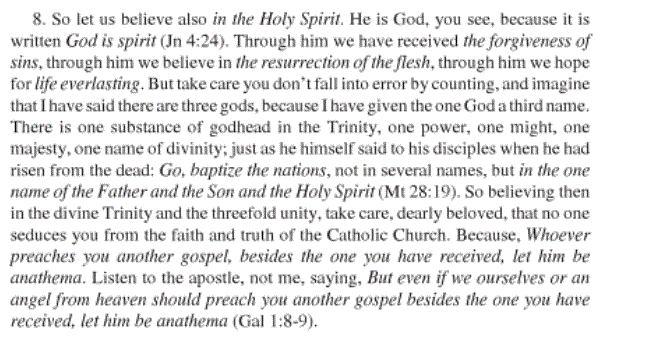
I have to say unequivocally that, according to Augustine, those who teach that the Son is under the potestas of the Father, and is therefore of lesser authority than the Father, are anathemitized. Ware writes of the “inherent authority of the Father, and inherent submission of the Son” Father, Son and Holy Spirit, page 80.
I do know that many try to reconcile this, to say that the Father and the Son are one in authority vis-a-vis humanity, but are in an assymetrical relationship in inner trinitarian relations. But it seems to me that we only know what God is vis-a-vis humanity. If we argue that God is quite different within the trinity than He appears to us, we are certainly arguing from ignorance.
If the Westminster Catechism and the doctrinal basis of the ETS in any sense, refers back to Augustine’s exposition on the creeds, then it appears that “power” means “authority over.” However, we have no proof of that. It remains open.
To read all the posts in this series, click on the ETS tag at the top right. More tomorrow.


 BLT
BLT 