‘Twas the Night Before Hanukkah
 The story of how Christmas was elevated from a minor holiday into the major celebration of the calendar year – and the role that Dickens’s masterful ghost story A Christmas Carol played in that transformation has been often told (for example here or here). But how did Hanukkah ever become corrupted?
Hanukkah was always a minor post-biblical holiday. Yet it is far more prominent in the public imagination even than many of the major five festivals of the Jewish calendar (e.g., Shavuos, Sukkos). Hanukkah is universally recognized, despite the fact that the ancient writings that describe the Maccabean war and rededication of the Temple were not accepted into the Hebrew Bible canon (although they survive in the Christian Deuterocanons). Hanukkah boosters prominently exclaim that Hanukkah has eight days of gift-giving (still a poor runner-up to Christmas’s twelve days) despite there being no Talmudic requirement for gift giving (Christianity might claim a tradition for Christmas gift-giving based on the gifts of the magi). Meanwhile the Jewish holiday of Purim does require gift giving (both to the poor and to non-poor) is largely neglected – at least by main-stream society.
Hanukkah is by far the best known Jewish holiday – so much so that the second most common “symbol” of Judaism is perhaps a Hanukkah menorah (only after a star of David), rather than, say, a shofar rams horn or tefillin phylacteries or shabbos candles or challah bread or a havdalah candle. So how did this “runner-up” to Christmas become so prominent?
That’s the task that a new CD set from the always fascinating Idelsohn Society for Musical Preservation takes on. The extensive (and wonderfully illustrated) liner notes explain a bit of the history:
As soon as Christmas was declared a national holiday in 1870, the competitive campaign to beef up Hanukkah – a relatively minor, unheralded Jewish holiday – went into high gear: not only will we celebrate Christmas, we will create a rival holiday of our own to celebrate as well! You have only one day of presents, we will have eight nights!
The roots of the reclamation lay in the creative minds of a small band of New York City-based youths who called themselves “The American Hebrew.” In the wake of the Civil War when American popular imagination had been captivated by the twin obsessions of militarism and masculinity, the Hebrews believed that the Maccabean themes of Hanukkah offered the opportunity to prove they hailed from warrior-stock as much as the next American. They created an ambitious campaign for the “Grand Revival of the Jewish National Holiday of Chanucka in a manner and style never before equaled.” Their explicit goal was to rescue this “national festival from the oblivion into which it seemed rapidly failing.” After persuading the Young Men’s Hebrew Association to sponsor a Hanukkah military program, the race to build a bigger, better, stronger holiday was on. The festival was soon replete with its own Hanukkah songbook. Rabbi Gustav Gottheil kicked it off before the turn of the 20th century by giving an Americanized makeover to an older Hanukkah song, “Ma’oz Tzur,” and turning it into “Rock of Ages.” Songs about dreidels, gelt, and candles soon followed.[…]
In late 19th century New York, large scale holiday spectacles were all the rage. At New York’s Academy of Music in 1879m 100 cymbal-bearing maidens, along with “Jewish soldiers, trumpeters, banner bearers, Syrian captives and young women with harps,” took to the stage in what Frank Leslie’s Illustrated Newspaper, called a “grand work of realistic art.” Filling the eye as well as the ear, the American Hanukkah was initially an exercise in pageantry.
A generation or so later, Hanukkah developed into an opportunity to “shower Jewish children with gifts” or so exhorted What Every Jewish Woman Should Know, a popular guidebook to Jewish ritual celebration. “If ever lavishness in gifts is appropriate, it is on Hanukkah,” the text told its readers, hastening the holiday’s transformation form a grand public event into an intimate, domestic phenomenon centered on exchange. Meanwhile, the commercialization of Hanukkah and its pleasing association with material things accelerated further when advertisements in the early 1900s harnessed the holiday to the consumption of newfangled food products. Blending “Chanukah Latkes with Modern Science,” the manufacturers of Crisco, among others, made a point of touting the virtues of both tradition and modernity. Little wonder, then, that Hanukkah became more and more attractive to contemporary American audiences. The holiday was increasingly hard to resist.
Still, it was not until the postwar era that Hanukkah really took off. A number of factors, both domestic and global, came together at the time to propel the millennial movement into the elevated ranks of popular American Jewish holidays. For one thing, affluence combined with the baby boom of the 1950s to generate lots of interest in childhood and in appurtenances. Against that background, Hanukkah seemed tailor-made to appeal to kids and their increasingly attentive parents. For another thing, postwar America was awash in sentiments of “cultural one-ness,” which granted Jewish forms of religious expression a kind of parity with Christian ones. The winter holiday of Hanukkah benefited mightily from that ecumenical spirit even if, at times, it resembled too closely what one disgruntled American Jewish parent disparaged as a “competitive winter sport.” More pointedly still, the rise of the State of Israel, whose embattled latter-day Maccabees saved the day, offered yet another incentive – and a highly relevant one, at that – for embracing Hanukkah. Once consigned to the history books, these brave warriors of yesteryear re-emerged as modern-day heroes.
The musical expression of Hanukkah was particularly fascinating, and this collection documents it, with songs form Woody Guthrie’s “Hanukkah Dance” to “Sevivon, Sov, Sov, Sov.” But mixed in these songs are painful reminders of the way that Hanukkah became “important” – with songs like the Klezmatics “Hanukah Tree” or Stanley Adams and Sid Wayne’s “’Twas the Night Before Hanukkah.” A New York Times review of the set says:
[T]he track that perhaps best captures the paradox the album explores is “The Problem,” a 1967 song from the comedy album “Have a Jewish Christmas … ?” by Ray Brenner and Barry E. Blitzer. Set to the tune of “Jingle Bells,” the song finds humor in the mixed feelings a religious Jew feels at Christmastime: “Jingle Bells, Jingle Bells, if Santa Claus is true/His joy is fun for everyone, but what’s a Jew to do?”
You can hear “The Problem” (which is on the “Christmas disk” of the set) here.
The second disk of the set features Christmas songs sung by Jewish singers: Lou Reed, the Ramones, Mel Torme (who sings his famous “The Christmas Song”), Bob Dylan, Theo Bikel (who mixes some Hebrew into his rendition), Richard Tucker, Dinah Shore, Benny Goodman, Larry Harlow, Danny Kaye, Eddie Cantor, Sammy Davis Jr., the Ames Brothers, Eddie Fischer, Herb Albert and the Tijuana Brass, and Mitch Miller. Sadly, no tracks from Elvis (who some claim was Jewish, and who reportedly wore a Star of David along with a Cross, to cover all possible bases) or Barbara Streisand’s two Christmas albums or Phil Spector, the producer of the most famous Christmas album of all time.
Today, the Jewish influence on Christmas has turned into some bitterness – for example in Garrison Keillor’s infamous anti-Semitic diatribe:
This is spiritual piracy and cultural elitism and we Christians have stood for it long enough. And all those lousy holiday songs by Jewish guys that trash up the malls every year, Rudolph and the chestnuts and the rest of that dreck. Did one of our guys write “Grab your loafers, come along if you wanna, and we’ll blow that shofar for Rosh Hashanah”? No, we didn’t. Christmas is a Christian holiday — if you’re not in the club, then buzz off. Celebrate Yule instead or dance around in druid robes for the solstice. Go light a big log, go wassailing and falalaing until you fall down, eat figgy pudding until you puke, but don’t mess with the Messiah.
It turns out that Keillor was more of a originalist-Lutheran than we realized.
But the secularization of Christmas has long provided an OK for at least some Jews outside the entertainment business to give a nod to the holiday – thus Theodore Herzl had a Christmas tree as did the young Gershom Scholem. (That last link points to an article which has since been expanded to full book from Rutger’s University Press.)
In any case, fans of American pop music or students of Jewish assimilation are likely to enjoy this fascinating CD set.
In October, we noticed that somebody for the Jean and Alexander Heard Library of Vanderbilt University has created an online research guide for the Hebrew Bible with a list of “Blogs about Hebrew Bible and Related Topics.” BLT is included, and we bloggers here are delighted to serve as a resource!
Today, the individuals at Theology Degrees Online listed BLT among their “100 Exceptional Websites for Christian Theologians.” BLT — described aptly as “a scholarly blog, [where] the material … can take Bible students deeper into understanding the scriptures” — is 9th on the list of websites for “Bible Study.” We want to thank this group for including our blog with a few other truly exceptional sites.
We are honored and gladly post the badge TheologyDegreesOnline.com has issued to us:

Because my blog Aristotle’s Feminist Subject is also included in this longer list of websites (in the list of “General Christianity” websites), I’ve written a post there at that blog to join with others noting “Exceptional and Exceptionalism: Recovery from Sexism Yet to Do.”
—
UPDATE: Mary for TheologyDegreesOnline.com has left us this comment here at our About page to explain the processes she and her colleagues used to determine which 100 sites to list:
The sites on the list were selected through a rigorous campaign of research and nomination-seeking. We feel that each site on this final list offers prime examples of high-quality Christian thought and research being published online. Our readers studying Christian theology will undoubtedly benefit from these sites!
Edith Grossman’s Translation of Gabriel García Márquez without “-ly”
Edith Grossman compromises, and contradicts, and does all the wonderful things good translators of good literature must do when they are asked to promote a particular theory of translation that gets at how they practice translation. So this is, in part, what I was hoping to show in “A Translated Stew of ‘Griefs and Sorrows’.”
In this post, I’d like to give more examples. For instance, to an interviewer not long ago, Grossman asserts:
I see my work as translating meaning, not words.
Nonetheless, her work has been the translation of words as the example of Cervantes’s Don Quioxte shows.
One of Grossman’s most important confessions, I believe, is the one she makes to the same interviewer; Grossman must declare (in her interview with Maria Cecilia Salisbury) the following:
general rules [of translation] cannot be applied in an invariable way.
And when deciding to take on the translation of El amor en los tiempos del cólera, that famous novel by Nobel Prize-winning Colombian author Gabriel García Márquez, she heard from him directly. He was very explicit to her about not only his words but also his literary forms. He was very directive about the forms he avoids and the sorts of forms she, likewise, would do well to avoid.
And so she recalls something interviewer Adriana V. López has noted, quoting Grossman:
“I knew this Colombian writer was eccentric when he wrote me saying that he doesn’t use adverbs ending with -mente in Spanish and would like to avoid adverbs ending in -ly in English.” She remembers thinking, what do you say in English except slowly? “Well, I came up with all types of things, like without haste.”
And so we all notice. Gabriel García Márquez, in El amor en los tiempos del cólera, has refused for his own literary form reasons not to use the word precipitadamente. Instead he writes, he prefers his readers to read, the phrase más de prisa.

And Edith Grossman, in Love in the Time of Cholera, has so refused for her own literary translation practice not to use the word hastily. Instead she writes, she has chosen for her readers to read, the phrase “with more haste.”
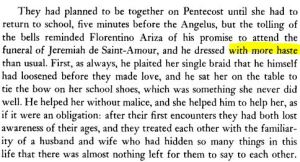
Could Grossman not have honored Marquez since she’s in theory not into translating words but more their meanings? Well, of course. But then again, Grossman is a good literary translator in practice and also in the not-always-consistent theory she promotes.
Might translators of the Bible be as good?
“it entirely eclipses the sundry ‘study Bibles’ now in circulation”
I’ve been so busy for the last few months that I am just now catching up on all my reading. I’ve spent most of the last few months working on a book – in the end, Bible translation helped provide the sentimental edge in choosing my publisher – I decided to have Cambridge University Press publish the book.
In the interval, quite a bit has appeared, and I’m going to have lots of fun in December catching up on many things I’ve let slipped past me in the last few months. .
First up: Robert Alter’s review of the Norton Critical Edition of the King James Bible. I’ve been quite enthusiastic about this, as you’ll note from my posts here, here, here, here, and here. Well, the Norton Critical Edition of the King James Bible has been out for a few months now, and I haven’t had a chance to post a review yet. That’s still on my every-lengthening to-do list, but in the meanwhile, Robert Alter has published a glowing review in The New Republic, saying “the editors of this new KJV have taken the format of the Norton Critical Edition and raised it to the second mathematical power.” Alter likes it, Harold Bloom likes it – if it is good enough for them, by golly, maybe it should be good enough for you.
Here is some of what Robert Alter says – note his usual engaging combative and witty style – and also notice that Alter’s primary focus is on the Hebrew Bible (which, as you will read below, Alter views as more literary than the Christian Greek scriptures):
This past year, the four hundredth since the initial publication of the King James Bible, was marked by a spate of celebratory commemorations on both sides of the Atlantic. After all, our canonical translation of the Bible is, as Herbert Marks observes in the preface to his extraordinary edition of the KJV Old Testament, “by far the most influential English book ever published, a formative presence within the history of English literature, high and low, and within the very weave of the language.” The pervasive ineptitude of the sundry English versions produced in the second half of the twentieth century by Jewish, Protestant, and Catholic scholarly ecclesiastical committees reminds us through sheer contrast of how fine was the work of the learned divines convened by King James in 1604.
Yet all the paeans delivered last year could not conceal the sad fact that the KJV has rapidly been slipping out of our cultural grasp. At the tri-centennial celebrations a hundred years ago, when the King James Version was praised by such figures as Theodore Roosevelt and Woodrow Wilson as the sublime foundational book of English-speaking culture, it was still the version of the Bible that was almost universally familiar. But by now it has been largely replaced in homes, churches, and even in many English department courses on “the Bible as literature” by more recent translations that are deemed more accurate and, above all, more “accessible.” Accessibility seems to be a fixation in current American thinking about the Bible. Its ultimate manifestation may be a recent translation by a pastor named Eugene H. Peterson, who calls what he has done not the Bible or the Holy Bible but The Message. God, in his version of the creation story, enjoins the plants to “Green up!” and the petitioner in the Lord’s Prayer asks not for “daily bread” but for “three square meals.” The Message, not surprisingly, has been selling like hotcakes in Evangelical circles.
One must grant that there are patent problems in making general use of the KJV in the twenty-first century. The most obvious one is that the English language has changed in the course of four hundred years, so that some of the words used by the seventeenth-century translators are no longer intelligible to the general public or have shifted in meaning. Syntactic inversion and other poetic or quasi-poetic features of style are now less familiar and perhaps even disorienting to some readers. But the continuing popularity of Shakespeare’s plays on the stage, in film, and in the classroom may suggest that this linguistic archaism need not be an insuperable barrier, although modern religious leaders, unwilling to imagine even minimal literacy in their followers, tend to assume that it is.
The KJV also abounds in inaccuracies, especially for the Hebrew, because there have been enormous advances in the understanding of the biblical language since the seventeenth century, and even in its time such understanding was rather uneven in Christian Hebraist circles in comparison with the medieval and early modern Hebrew exegetes. And there is a further problem with the KJV that probably goes unnoticed by most readers, or at least is not consciously noticed. The seventeenth-century version is famously eloquent (as its twentieth-century successors egregiously are not), but the eloquence is more intermittent than we usually choose to remember. By and large, the KJV does very well with the narrative prose, in part because it emulates biblical syntax and diction, and some of its renderings of the poetry are splendid. Yet many lines of verse stumble into arrhythmic sprawls, sometimes using three or four times as many words and syllables as the beautifully compact and strongly cadenced Hebrew. This is an intrinsic structural defect that one has to live with. Also in the poetry, the KJV sometimes deploys polysyllabic Latinate terms with a certain ecclesiastical burnish (the translators were, after all, clergymen) that are alien to the concrete directness of the Hebrew. At least semantically, these are susceptible to correction through annotation, something that Herbert Marks often does.
The framework of the Norton Critical Editions, a series that has provided a valuable college classroom resource for decades, becomes in the hands of these three extremely able editors the occasion for rescuing the King James Version for general use and for serious study. The Norton Critical Editions of major literary texts aim to make them accessible—but not through the strategy of “Green up!”—by offering critically informed introductions, annotations of unfamiliar terms and significant allusions, and generous appendices that include source materials for the works, contemporaneous reviews, modern critical assessments, and other relevant documents. In all these respects, the editors of this new KJV have taken the format of the Norton Critical Edition and raised it to the second mathematical power. Whereas the Norton Critical Edition of Moby-Dick or Crime and Punishment has one or two brief notes on a page and sometimes no notes for several pages, every page of the Norton Critical KJV is crowded with annotation, and often the notes are quantitatively far more of a page than the biblical text proper is. In this respect, as well as in the appended materials, it entirely eclipses the sundry “study Bibles” now in circulation.
What is accomplished through the generous annotation is quite remarkable. First, the notes offer a succinct guide to the precise meanings of seventeenth-century English words. Terms that have become somewhat archaic or altogether obsolete are helpfully glossed: many readers are liable to think that “froward” is a typo, so the term is explained; others probably need to be informed that “ward” means “custody,” that “wotteth not” means “give no thought to,” that “meat” is a general term for food and does not imply having come from a butcher shop. Using such annotations is hardly onerous: confronted with a linguistic perplexity, you glance down the page and can immediately see what is going on in the English of the translation.
Another pervasive issue addressed in the notes is mistakes in construing the original. The KJV abounds in misunderstandings of the original, many of them minor but some of them real howlers. When, for example, the King James translators at Job 3:8 have “who are ready to raise up their mourning,” they have badly mistaken livyatan, or “leviathan,” for an exclusively post-biblical homonym that actually means “funeral.” Herbert Marks discreetly and succinctly corrects the error, going on to explain in a few words Leviathan’s role in Canaanite mythology. The process of correcting the errors of the King James Version began in 1885 with the Revised Standard Version, but tinkering with the language of the 1611 version and slightly modernizing it were concomitant with taking away more than a little of its stylistic grandeur, and the use of corrective annotation seems a wiser strategy.
But much more is going on in these notes than glossing and correction. For both the Old Testament and the New, we are given in these important volumes a wealth of contextual information—extra-biblical sources drawn on by the writers, intra-biblical allusions, concepts and practices of the ancient Near East and of Late Antiquity that are manifested in the biblical texts, theological notions that are adumbrated in the texts, comments on the formal configurations of the texts. The three editors bring together a wide range of expert knowledge in carrying out this Herculean task of annotation. Herbert Marks is a polyglot professor of comparative literature at Indiana University with interests ranging from Homer, Virgil, and Dante to Joyce and Elizabeth Bishop, and equipped with an excellent knowledge of biblical Hebrew and of the wide field of biblical scholarship. Gerald Hammond, emeritus professor of English at the University of Manchester, has written finely on English translations of the Bible (he contributes an excellent essay on that subject to the Marks volume) as well as on sixteenth-century poetry. Austin Busch, an assistant professor of early world literatures in the English department at the State University of New York at Brockport, has a thorough grounding in classical literature and a manifest mastery of New Testament scholarship. Of the three, Marks appears to be the most deeply literary, and so there is a good deal of literary interpretation, some of it quite remarkable, in his introductions and notes. That is an aspect of the Norton Critical Old Testament that deserves closer attention, and I shall turn to it presently.
Each of the two volumes begins with a preface of more than four thousand words explaining what kind of ancient anthology is embodied in the Testament in question and, in the case of Marks, what are the issues of translation in reading the King James Version. Busch’s preface puts special emphasis on the backgrounds of the scriptural texts, providing lucid and balanced guidance to what he calls “the matrices” of the New Testament—the Hebrew Bible, the sundry Jewish communities of faith of Late Antiquity, the Greco-Roman world with its literary genres and conventions. The notes, which were evidently written collaboratively by Busch and Hammond (no explanation of the collaboration is given, though it appears to be the case that Busch played the principal role), are similarly strong on issues of context as well as on theological and thematic questions.
In each of the two volumes, the preface is followed by introductory essays on the major divisions of the Testament and then brief introductions to each of the biblical books. The Busch-Hammond essay on “New Testament Narratives,” or the four Gospels and Acts, is a model of expository clarity. It lays out the two competing theories for the compositional history of the Gospels and offers incisive accounts of the differences among the three Synoptic Gospels and then of the differences between the Synoptics and John’s Gospel. With their firm sense of historical context, Busch and Hammond make a series of plausible proposals for how the evolving relationship of Jesus’s followers to the Jewish community and to the Roman empire are reflected in the differing themes and attitudes of the four Gospels. This, in sum, is exactly what any reader—student or otherwise—would need in order to enter into the world of the New Testament.
The introductions and notes for each volume are complemented by hundreds of pages of appended texts—for the Old Testament, an abundance of ancient Near Eastern materials, Hellenistic, rabbinic, and Islamic exegesis, philosophical reflections, modern philological and literary discussions, relevant poems and parables; for the New Testament, a spectrum of Late Antique texts, patristic commentary, modern critical and literary exegesis, poems, and a sampling of English translations spanning five hundred years.
Marks’s preface and introductions exhibit similar virtues to those of Busch and Hammond. Like them, he seems to be fully abreast of all the current developments in biblical scholarship and makes judicious use of them. Only one choice strikes me as somewhat eccentric, and it concerns the compositional history of the Pentateuch…. Marks has chosen to embrace a revisionist theory more popular in German biblical studies.
In this new account, there is no clear-cut distinction between J and E. Instead, we are invited to see a contrast between the Priestly writings and a Lay narrative. Part of the latter is imagined to be the product of the Babylonian exile, perhaps even as late as the Persian period, which draws on literary documents and fragments carried into exile but is essentially a new composition. Marks speaks of “a reactive or revisionist J” in Genesis 2-4 who is responding polemically to P. This view strikes me as implausible on two grounds. J is in many ways archaic, his God palpably anthropomorphic and entrammeled in myth, especially in Genesis, and one does not readily imagine such a conception of the deity emerging in the sixth or fifth century among Judean exiles living in the age of the loftily monotheistic Second Isaiah. A writer who was active relatively early in the First Temple period seems a far more likely candidate for all of J. The other problem with the theory is linguistic, an issue to which the German scholars have paid scant attention. Biblical Hebrew, like any language, evolves through time. The Hebrew prose written in the exilic period, and especially under the Persians, demonstrably differs from the Hebrew prose of the first two or three centuries of the Davidic monarchy, and it strains credence to imagine that J’s classic style would have been fashioned in the exile, half a millennium after David.
In any case, Marks’s promotion of the two-document hypothesis for the first four books of the Torah is no more than a local oddity. Otherwise, like his two New Testament colleagues, he deploys a fine sense of balance in explaining the historical contexts, addressing the often vexed issues of dating particular books, and sifting through biblical scholarship in ways that are likely to be quite helpful to the general reader. Yet what is most impressive about his introductions and notes is their illumination of the literary aspects of the Hebrew Bible. It should be stressed that such commentary is by no means a special offering for courses on the Bible as literature, but an engagement with an essential feature of the biblical texts.
Literary power is abundantly evident in both Testaments, but the narratives of the New Testament work with a structural limitation in their representation of character and motive because the Gospels tell the story of a more-than-human protagonist who is variously set at a distance—in John, an altogether ontological distance—from his rather less interesting followers. The Old Testament, by contrast, gives us, in the stories of Jacob and David, two of the most subtle and profound representations in ancient literature of character evolving through time and shifting circumstances, and it provides many insights elsewhere into the conflicts, the perplexities, the unfathomability, and the sheer vividness of human character. It furnishes brief but probing inside views of the characters, and invents a form of revelatory dialogue that would not be equaled in literature until the advent of the novel. Moreover, biblical poetry at its best—Job, many of the Psalms, Isaiah, Jeremiah, the Song of Songs—ranks among the greatest poetry composed in the ancient Mediterranean world.
I mention all this not to promote the Hebrew Bible, but simply to register a crucial fact about its formal status: these religiously impelled writers chose, for the most part, to cast their vision of God, creation, and covenantal history in narrative and in poetry, much of it remarkably artful and formally intricate. If you want to read the Hebrew Bible competently even with an intended focus on it as a set of religious documents, you have to follow closely its literary articulations, and this is what Marks’s commentary does with considerable flair.
He has learned from the various literary analysts of the Bible active over the past three decades, but many of his interpretive insights are quite original, reflecting a grasp of the narratives and the poems that is subtle and deeply meditated. Alongside the flagging of intra-biblical allusions and parallels and the tracing of formal symmetries and structural elements, Marks repeatedly puts forth ideas that throw light on the thematic and conceptual underpinnings of the biblical texts. Here is his comment on Genesis 12:1, God’s call to Abram to go forth from his land and his birthplace and his father’s house: “Like cosmic creation, sacred history begins with an act of division or separation.” In the next chapter, noting the moment when Abram and Lot decide to go their separate ways, Marks beautifully observes: “Prompted to ‘lift up his eyes,’ Lot predictably looks down to the luxurious cities of the plain (v. 10), whereas Abram lifts his eyes to the hill country of Canaan (v. 14) and eventually to the stars (15:5, cf. 22:4, 13).” On the cloud that covers the tabernacle and God’s glory that fills it, which are reported in Exodus 40:34, Marks sensitively comments: “A paradoxical figure of permanence in mobility, the tabernacle here assumes the function as well as the appearance of the fiery cloud through which the divine majesty first made itself visible at the start of Israel’s ‘journeys’ (see 13:21-22).”
As all of these examples illustrate, Marks is especially good at identifying connections within the biblical texts that bring their underlying thematic design into sharp focus. Arguing for a set of parallels between Jacob and Moses, he remarks: “Like Jacob, Moses flees after committing a crime, meets his future wife at a well, serves his protector as a shepherd, fathers offspring, has a vision and receives a promise of divine protection and a command to return home, endures supernatural attack and a genital wound, is reunited with his fraternal rival, and finally returns, this time as the leader of an incipient nation, to the site of his original solitary vision, where God addresses him once more.”
Marks’s strength as a critic is not merely in locating parallels, but also in making excellent interpretive sense out of them. The allusions to the Abraham story in the Book of Ruth have been observed by others, but Marks draws from them an incisive interpretive conclusion: “As often in the Bible, such parallels serve to highlight ideological differences. The future great-grandmother of David represents a sharp swerve from Abraham’s exclusionary insistence on marriage within the tribe. Hers is a story not of rupture, isolation, and exclusion, but of community and ‘ingathering.’” With his ample sense of the broad expanse of literature, Marks goes on to say that Ruth’s “brief chapters combine the two principal archetypes of Western narrative: the Abrahamic myth of definitive rupture, the journey forward into a world unknown; and the Odyssean myth of ultimate return, the journey home.” This is an intuition that Joyce, who reflected on these matters in Ulysses, would have relished.
Perhaps motivated in part by the constraints of space of the annotations and the brief introductions, Marks often exhibits a kind of epigrammatic incisiveness in formulating his perceptions. Thus, on Saul flung to the ground naked when seized by a devastating prophetic ecstasy and David exposing himself as he cavorts before the ark, Marks writes: “If Saul lies before us rigid in his nakedness, David’s nakedness is a dance.” One could scarcely state more precisely and evocatively the antithesis between Israel’s first two kings. Commenting on what he calls the “ritual present” of the cultic laws in Leviticus, he observes: “Set amid the flow of narrative, it offers a timeless vantage point from which identity turns not on a unique act of election or redemption, but on the continuous circulation of holiness.” Introducing the biblical histories, and with an eye to the broader ancient literary context, Marks produces a pointed aphorism: “Ancient historians, whose aim was generally didactic or apologetic, recorded ‘events’ not because they were true but because they were significant.” Again on David and Saul, he writes aphoristically: “The one seems to embody the enigma of human freedom, the other the inevitability of human fate. While the elusive David remains unpredictable, Saul’s every step only brings him closer to his predetermined end.” In keeping with this perception of David’s elusiveness, Marks tellingly observes (as I think no one before him has) that over half of David’s speeches “are built around questions.”
This commentary on the Old Testament is finely attentive to the details of the stories and the poems, but it also exhibits an enlarging richness of exegetical perspective. Here are the two concluding sentences of the introduction to Genesis: “Home for the ancestors remains a promise; what they have in its place is the desire for home, which ensures they are constantly becoming, constantly turned toward the future. In the language of Genesis, such desire is known as ‘the blessing.’” Contrasting the different challenges to the dominant biblical worldview of Job and Ecclesiastes, Marks concludes, again in his aphoristic mode, that “If Job is the Bible’s response to the despair born of privation, Ecclesiastes is the response to the despair born of affluence. Where suffering gave rise to urgent protest, ease and privilege give rise to skepticism and a caustic equanimity.”
Marks, Busch, and Hammond have done splendid jobs in giving their readers an enlightened orientation to Scripture and an invaluable explication of the terms and references of the King James translation. Marks goes a step beyond his New Testament colleagues in the illuminating literary interpretations that he offers. Until this point in his career, the criticism he has published had been limited to a series of brilliant articles on the Bible and on modern literature. Now, in the somewhat unlikely vehicle of a Norton Critical Edition, he has produced a major work of literary criticism.
The series in which these two hefty volumes appear is primarily intended, of course, for the college classroom. Both volumes should be eminently usable in that setting; they certainly ought to be the text of choice for university courses on the Bible as literature. But I hope that they find a wider readership. This ambitious undertaking takes the King James Version out of the museum display-case to which it has been largely relegated, making it vividly readable again. More than any other English Bible, it gives readers the tools to understand the historical and cultural contexts of the biblical books, the debates about their nature and dating, and even what they have led to in later Western culture. But the greatest gift to readers may be Herbert Marks’s deeply instructive guidance to the meaningful literary shaping of the Hebrew Bible and its reverberating resonances in the tradition of narrative and verse from Homer to Joyce.
A Translated Stew of “Griefs and Sorrows”
One of the most recent English translations of Don Quixote is the one by James Montgomery in which the second sentence goes like this (with a footnote):
A daily stew consisting of more beef than mutton, hash almost every evening, “grief and sorrows”* on Saturdays, lentils on Fridays, and a pigeon or so on Sundays consumed three-fourths of his income….
*In Spanish: duelos y quebrantos (a popular name for “eggs and bacon”).
We might all see here how Montgomery has told the English reader — using his scare quotes — exactly what Cervantes surely means by duelos y quebrantos. This raises the questions, of course, of 1) just how Montgomery knows and 2) whether “griefs and sorrows” must be all English readers get.
I want to suggest that Montgomery doesn’t know everything. And that English readers and Spanish readers may get more than this one translator gives.
We get much more when translators play with language, when they recognize the play in language. Unfortunately, especially in the discussions of Bible translation, there’s the “either / or” binary of “Dynamic Equivalence” v “Formal Equivalence.” What gets glossed over all too often is how rich language is, and how translation best conveys this.
For example, at the Better Bibles Blog, Wayne Leman has read an amazon.com reader-reviewer talking about Edith Grossman’s book Why Translation Matters. In his post, “Why (Bible) translation matters,” Leman gives a quotation from the book and concludes: “Anyone concerned about full-throated accuracy in Bible translation, including accuracy at literary levels, must take seriously the principles of translation that Grossman promotes and practices.”
It’s so important that Leman wants blog readers to look at Grossman’s practices. And I want us all to consider what she “promotes” by way of translation theory in light of what she practices.
Grossman does not at all shy away from wordplay, in practice. Let me get to how she translates the second sentence of Don Quixote. But first I just want to show how Grossman carefully attends to the wordplay of Cervantes. The following is a page from her translation:
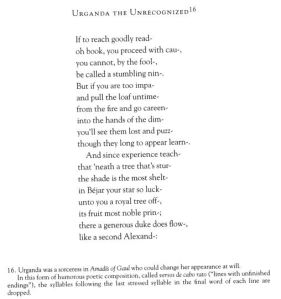
Now here’s how I started into the BBB conversation. The hope is to move us all to more of an awareness that the literary (whether in the Bible or any other book Grossman would translate) includes wordplay. Translation can move beyond the “either/ or” binaries Bible-translation discussions often get bogged down in.
What Grossman practices is what’s fascinating. Can it (always) be a product of what she promotes (i.e., the translation theory that would favor target language and context over the literary forms of the source)? Or have we, from the snippet quote above, really understood Grossman?
Let’s look at the second sentence of Don Quijote by Cervantes. Then let’s compare the English translations of this sentence and the phrases therein offered by three translators, Pierre Motteux (1700), Walter Starkie (1957), and Grossman (2003).
Una olla de algo más vaca que carnero,
salpicón las más noches,
duelos y quebrantos los sábados,
lantejas los viernes,
algún palomino de añadidura los domingos,
consumían las tres partes de su hacienda.His diet consisted more of beef than mutton; and with minced meat on most nights, lentils on Fridays, eggs and bacon on Saturdays, and a pigeon extraordinary on Sundays, he consumed three quarters of his revenue;
His stew had more beef than mutton in it and most nights he ate the remains salted and cold. Lentil soup on Fridays, ‘tripe and trouble’ on Saturdays and an occasional pigeon as an extra delicacy on Sundays, consumed three-quarters of his income.
An occasional stew, beef more than lamb, hash most nights, eggs and abstinence on Saturdays, lentils on Fridays, sometimes squab as a treat on Sundays – these consumed three-fourths of his income.
Does any of these three translators do a better job of attending “not to lexical pairings but to context–the implications and echoes of the first author’s tone, intention, and level of discourse”?
It should be clear that Grossman’s intended improvement over the two former translators is that she actually attends to lexical pairings of the Spanish of Cervantes and of his readers and her English for her readers. What the protagonist eats on Saturdays, for example, is served up to readers with a literary flare. The what is clearly a pair of things, which Motteux renders as two literal food items (e.g., “eggs and bacon”) but which Starkie and Grossman both read as a literal and a metaphorical food. Talk about mixing metaphors.  Notice how Starkie, more than Grossman, suggests wordplay by Cervantes. Here isn’t the pair “duelos y quebrantos” rather marked as rhyme since the other food items in this list don’t seem to play together as well, in the very short context of this single sentence? Starkie uses English alliteration to suggest a poetry and marks the phrase with scare quotes: ‘tripe and trouble’. Grossman’s “eggs and abstinence” suggests humor, wordplay, (i.e., How can one’s stew on Saturdays include “abstinence”?), but she loses what Starkie gains, I think. The important point to make here is that each translator is interpreting, is deciding how much of the literal, how much of the metaphorical, how many of the various meanings in the literary, to convey. “Basic English” or simply ostensibly clear readings of the text would do it violence, would rob it, would lose much for the readers.
For Sundays’ fare, there’s “algún palomino de añadidura” in the soup. It’s a pigeon (either “extraordinary” or “occasional”) for Motteux and Starkie respectively. But Grossman, in this context, seems to want to pair her English lexis with Cervantes’s Spanish lexis more tightly than her two counterparts do. So she makes it “sometimes squab.” This is clever – because the English reader and the Spanish reader see and hear what’s literary: the marked alliterations in the phrase. Grossman here, likewise, is using an English culinary term (i.e., “squab”) to match other terms for meat (i.e., “beef” and “lamb”). Otherwise, I think most “natural” English readers would be just fine with “pigeon.” Grossman also lexically pairs her “sometimes” with Cervantes’ “algún” – and this is so very important to her (and to her readers) because Cervantes has started in this way – “Una olla de algo” – which lexically ties the pigeon to how the sentence opens; Grossman starts “An occasional stew.”
This raises the question of whether James Montgomery knows everything about the ingredients of the stew and if English readers, on the Saturdays, have to get it merely as “griefs and sorrows.” The whole discussion raises other questions:
Does Grossman pull off in translation practice what she would promote in theory? To understand just exactly what Grossman means to promote, isn’t it instructive to look at how closely, in practice, she does attend to “lexical pairings” and is also “faithful to words”?
November 2012 Biblical Studies Carnival
Bob MacDonald at his blog Dust has up the latest “Biblical Studies Carnival” and links to a number of interesting articles. He’s kindly included some links to a few BLT articles; thanks!
 Dating AI is one of those marvelous and weird books written that can only be written a dilettante. The author, who works as the head of bioinformatics and medical IT at a research clinic in Moscow, has written a dating manual for human-machine love affairs. Zhavoronkoff writes from the perspective of the mid-21st century, when artificial intelligence has become ubiquitous, and his work is largely structured after self-help relationship books of our era, including lengthy quotes from both humans and AIs that are often hilarious.
This framework gives Zhavoronkoff an opportunity to comment on the human condition, on science fiction clichés, on philosophical issues raised by philosophy of mind and the AI program, as well as oblique references to odd human idiosyncrasies. It is, to my mind at least, a lot more fun than reading Hubert Dreyfus!
Zhavoronkoff’s inspiration for writing the book is the well-known phenomenon of people entering into romantic “virtual relationships” in online gaming settings such as World of Warcraft. Zhavornkoff points out that this is hardly the only common type of relationship between human and non-human.
We can form deep attachments to many things other than people. An example is the relationship many have with God. Such a relationship, often framed in terms of love, is a matter of faith. That is what most religions teach us. A similar belief in a valuable relationship with various forms of AI, representatives of a global artificial intelligence, is already forming. Many people worldwide understand the inevitability of AI and have started preparing for it. I am one of them.
This book is a winner on many different levels, dripping with ideas and irony and intelligence.
Here is the blurb on the publisher’s web site:
A satirical “how-to” book about future relationships (and even marriage!) with robots and avatars.
Dating AI is “a meditation on how to prepare for the unknown,” a thought experiment designed to stimulate new ideas about issues that are important now as well as in the future. Fictional descriptions of human-android romances are interspersed with commentary about the varying differences between people and AI (Artificial Intelligence), and methods for breaching the chasm between machine and human experience. Chapters tie speculation into contemporary life, drawing parallels between current human interactions with machines.
Dating AI is an entertaining, sexy, humorous exploration: not only of a possible future, but also of our rapidly changing present relationships with other people and technology. Discerning readers will be compelled to utilize their imaginations, again and again, in an attempt to depict the Psychology of the Future, which looks to be significantly different from anything Freud might have considered.
Section 1, "Are you ready to fall in love with a machine?" explains what you’ll need to know to engage romantically with AI (including similarities and differences). Section 2, "You are ready, now what?" helps interested humans prepare to date AI. Section 3, "Establishing a relationship" covers the complicated mix of human and AI needs in a relationship, including power dynamics and acceptable behavior. Section 4, "Getting over a breakup (or merger)" explains some of the legal and economic fallout that could result from the demise of an human-AI breakup.
To quote the visionary writer J.G. Ballard, "Sex times technology equals the future." Just as almost nobody predicted the Internet until it suddenly seemed to have ensnared all within its grasp, so the technology of AI may, sooner than we think, come to be as natural as breathing, and inevitably, perhaps deeply, ensconced in our unconscious — to be revealed in our dream life as we fall asleep at night.
Dreams reveal truths far beyond what the rational mind might consider "tolerable." It is only at the borders of acceptability where our future freedoms reveal themselves, adumbrating and perhaps incubating a society of the future, where science and art seamlessly integrate themselves, and where poetry and technology are no longer alien domains but a vast cultural continuum where play and discovery create new language and, ahem, acceptable behaviors! We shall see…
Richard Blum on the reception history of Aristotle
Paul Richard Blum has a new book out, and a new video supporting that book, on the reception history of Aristotle entitled Studies in Early Modern Aristotelianism. I have just ordered the book, but have not read it, but his interview makes it sound quite fascinating.
Apologies
I’d like to apologize to my fellow co-bloggers and to the readers of this blog for my extended absence over the last few months. I’ve been negligent all around – in participating in posting and commenting here (and elsewhere on the Internet) – and even to responding to comments left for me.
It was an exceptionally busy time for me – I finished writing another book (but this one was a Franken-book that fought back at me as I struggled to tame it!) and I had an unusually heavy load of teaching.
I’m back swinging now, and hope I can share some interesting material over the next few weeks and months – until the next big project sweeps me up.
Denny Burk corrects Tom Wright: not his best moment
Denny Burk is taking on himself to criticize Tom Wright on the topic of 1 TIm. 2:12. In order to maintain that Wright is wrong, Denny has to prevent people from knowing that there is no evidence for authentein meaning “to lead in church” or to have authority in a positive sense. It is now 6 years since I asked this question on the internet, and many people used to claim that they would email Andreas Kostenberger and get back to me with an answer, but nobody has done that.
I have had long email exchanges with Al Wolters and Dan Wallace on this topic. Nothing of substance in those exchanges. In view of the lack of evidence for the meaning of authentein, I vote that Denny Burk stop saying some of the things he does about Wright.
Below are three examples of the use of authentein, one centuries after the NT, one is a vague fragment, and one a non-existant fragment. Yes, I think Wright is correct in saying,
The other lie to nail is that people who “believe in the Bible” or who “take it literally” will oppose women’s ordination. Rubbish. Yes, I Timothy ii is usually taken as refusing to allow women to teach men. But serious scholars disagree on the actual meaning, as the key Greek words occur nowhere else. That, in any case, is not where to start.
“Therefore, everyone will walk according to his won desire, and the children will lay hands upon their parents, a wife will hand over her own husband to death and a man his own wife to judgment as deserving to render account. Inhuman masters will authentein their servants and servants shall put on an unruly disposition toward their masters.” 3 cent. AD) Hippolytus (d. AD 235) On the End of the World. De consummatione mundi, in Hippolyt’s kleinere exegetische und homiletische Schrften, ed. H. Achelis in De griechischen christlichen Schriftsteller, 1.2 (Leipzig: Himrichs, 1897), 239-309.
Can authentein mean “to lead in church?” – lots of discussion in this post
BGU 1208 in this fragment the meaning is to “force” or “compel” someone with whom one is having a disagreement.
Philodemus Fragment – it is difficult to tell if authentein occurred in this fragment, or what it meant if it did occur here, or if this fragment ever existed, since we only have a recent copy
Women in the dominant tradition
In light of the predicament of the Church of England, now that the vote for female bishops did not get the two thirds majority it needed among the laity, here are a few positive words about the ministry of women. I wrote a few years ago about the strong tradition of women ministering in the interior of British Columbia. There is also a strong positive tradition of ordained women in British evangelicalism which Steve Holmes writes about at length at Shored Fragments. He concludes,
[T]he dominant tradition of British spirituality from (at least) 1870-1930 was a tradition that was aggressively and counter-culturally positive about the full ministry of women, and about female ordination. This is well established and straightforward historical fact.
In recent – very recent; I suspect the crucial turning point comes in the 1980s – years, there has been a strand of British evangelicalism that has been particularly unhappy with women teaching or exercising authority in the church, and that has tried to elevate that unhappiness into a defining point for the tradition; I do not doubt the sincerity of such people, but I do think honesty should compel them to acknowledge that their position is not ‘conservative’ but profoundly revisionist: it is a direct reversal of a settled and lasting evangelical tradition.
To be a ‘conservative Anglican’ might involve a desire to resist the elevation of women to the episcopate; a ‘conservative evangelical’ however, if words retain any meaning, should necessarily be actively committed to promoting the equal ministry of women and men at every level of church office.
Eavesdropping on Dinah’s rape
This short, sweet and sad story of Dinah, in Gen. 34, sounds quite different in the Latin of Jerome and Paula, and the Latin of Pagninus.
וַיַּרְא אֹתָהּ שְׁכֶם בֶּן-חֲמוֹר, הַחִוִּי–נְשִׂיא הָאָרֶץ; וַיִּקַּח אֹתָהּ וַיִּשְׁכַּב אֹתָהּ, וַיְעַנֶּהָ.
וַתִּדְבַּק נַפְשׁוֹ, בְּדִינָה בַּת-יַעֲקֹב; וַיֶּאֱהַב, אֶת-הַנַּעֲרָ, וַיְדַבֵּר, עַל-לֵב הַנַּעֲרָ.
And Shechem the son of Hamor the Hivite, the prince of the land, saw her; and he took her, and lay with her, and humbled her.
And his soul did cleave unto Dinah the daughter of Jacob, and he loved the damsel, and spoke comfortingly unto the damsel. JPS
But the Latin of Jerome has additional information. He has commented on the story giving his take, and since we know he discussed his translation line by line with Paula, we have to take that into account also. Sometimes, in reading Jerome’s translation, one has the feeling of eavesdropping on a conversation between two people as to what exactly happened to Dinah. But one gets quite a different experience reading Pagninus as we shall see later.
Here is the Vulgate and the Douay-Rheims translation of the Vulgate,
Quam cum vidisset Sichem filius Hemor Hevæi, princeps terræ illius, adamavit eam: et rapuit, et dormivit cum illa, vi opprimens virginem.
Et conglutinata est anima ejus cum ea, tristemque delinivit blanditiis.
And when Sichem the son of Hemor the Hevite, the prince of that land, saw her, he was in love with her: and took her away, and lay with her, ravishing the virgin.
And his soul was fast knit unto her; and whereas she was sad, he comforted her with sweet words.
In this version, Shechem falls in love with Dinah, he takes her and in Latin, rapes her and oppresses her. But then she is sad, and so he speaks tenderly to her. We know what happens next. He asks to marry her.
Here is Pagninus Latin version,
Et videt eam Sechem filius Chamor Chiuuaei principis terrae, et tulit eam, et concubuit cum ea et afflixit eam.
Et haesit anima eius Dinah filiae Jahacob, et delixit puellam. Et locuts est ad cor puellae.
There are few English translations that stick this close to the Hebrew. “Shechem the son of Hamor the Hivite, saw her and took her and slept with her, and afflicted her. And his soul was attached to the daughter of Jacob and he loved the girl. And he spoke to the heart of the girl.”
And then, as before, he asks to marry her. The most striking thing about this story is the sharp contrast with the story of Tamar and her half brother, Ammon. Ammon spent a long time being “in love with” Tamar, but when he had raped her, he wanted nothing more to do with her, although she pleaded with him to ask permission to marry her.
In the case of Dinah, Shechem loves her, but the story in Hebrew suggests that he really falls in love with her after he has slept with her, and that is when he asks to marry her. However, Jerome’s translation suggests a different sequence. It seems that Shechem is in love with Dinah, he takes her by force, and then she is sad – this detail is not in the original Hebrew. At this point, he speaks tenderly to her and asks to marry her.
The differences are subtle, but the question remains, what did Jerome see in this story that Pagninus did not. It is relatively easy to see that Pagninus sticks to his goal of delivering a literal translation that lets us see what is written in Hebrew. This was his gift to the Reformation. I haven’t yet figured out why Jerome’s translation reads more like a commentary, but his letters suggest that he often worked through his translation line by line with Paula. Did they disagree at this point, and not come to a simple translation but left in place some added commentary on the basic plot?
Update: Here is the Septuagint for this passage.
34:2 και ειδεν αυτην συχεμ ο υιος εμμωρ ο χορραιος ο αρχων της γης και λαβων αυτην εκοιμηθη μετ’ αυτης και εταπεινωσεν αυτην
34:3 και προσεσχεν τη ψυχη δινας της θυγατρος ιακωβ και ηγαπησεν την παρθενον και ελαλησεν κατα την διανοιαν της παρθενου αυτη
2 And Sychem the son of Hemmora the Chorrite, the ruler of the land, saw her, and seizing her he lay with her and humbled her.
3 And he attended to the person of Dina the daughter of Iakob, and he loved the maiden and spoke with her according to the maiden’s mind.
Pagninus Latin Bible online
I am very excited about being able to read the Pagninus Latin Bible, 1528, online – many thanks to Mark for putting the link into a comment yesterday!
The only other copy that I have seen was printed about a century later, and is located in Toronto. So this copy is much appreciated. The Pagninus Bible is, in my view, the most influential of all Bible translations of the Reformation. Erasmus’ Latin translation of the Christian scriptures was also important, but Pagninus translated the whole Bible. It was from the Pagninus Bible, along with the Vulgate and Luther’s Bible, that Coverdale made the first complete translation of the Bible in English.
 Click on the image to get a full size version. There are many reasons why this Bible may not be well known today. It stands well outside the Prostestant tradition. Not only was the translator a Roman Catholic, but also a Hebraist and Christian Kabbalist. This edition also includes two letters from Pico della Mirandola to the translator. Della Mirandola was a well-known Christian Kabbalist and humanist.
Pagninus himself stayed officially well within the boundaries of orthodoxy. However, his main interest in the Hebrew Bible was that Hebrew was the original language, and therefore of enormous philosophical significance.
About Pico della Mirandola, we can read the following,
Because he died so young, Pico finished very little and published less: the vernacular Commento was neither completed nor published by him; the Conclusions are just bare statements of theses; half of the rushed Apology was lifted from the unpublished Oration; On Being and the One is a small piece of a larger effort to harmonize Plato and Aristotle; and Gianfrancesco found the unfinished Disputations Against Astrology bundled with his dead uncle’s papers. Unless we count the two epistolary essays on poetry and philosophical language, the only substantial and completed work that Pico gave to the world in his lifetime was the Heptaplus (1489), a Cabalist commentary on the first 26 verses of Genesis. …
Cabalists regard the meaning of God’s sacred speech, the Hebrew text of the Bible, as infinite, finding significance even in its smallest particles—not only the divine words but also their letters (which are also numbers) and even the shapes of those letters. The most powerful words are God’s names, the holiest of which, the Tetragrammaton, cannot be uttered; written as YHWH, it is pronounced Adonai, a spoken name like Elohim, Ehyeh, El Shaddai and others used of God in the Hebrew Bible. Other words of great power are the names of the Sefirot, which are unknown, as such, to the Bible; they are names not of God but of aspects or manifestations or emanations of divinity.
Pico was the first Christian to treat knowledge of Cabala as valuable. Flavius Mithridates, his most prolific Jewish informant, translated (and mistranslated) thousands of pages of Cabala into Latin for him. Large portions of the Oration, drawing on these texts, are also informed by Cabala in ways that no contemporary Christian could have detected—least of all a Christian who lacked the clues provided by theConclusions. The esoteric intention of Pico’s thought, proclaimed emphatically in the Oration, is the feature that most distances it from the whole project of post-Cartesian philosophy in the West and also from earlier philosophies outside the Platonic tradition. Wishing not just to mystify but also to provoke, Pico succeeded and paid the price of the Church’s censure.
Theology, spirituality and philosophy—all in the broadest sense—are the main topics of Pico’s Cabala, which shows (or hints) how God reveals himself in the Sefirot, the divine names and the words of scripture. In the 72 Cabalist theses at the end of the Conclusions, this revelation becomes Christology and Trinitarian theology. From a Cabalist point of view, the Sefirot and the divine names are actors in dramas of theology, cosmology, anthropology and angelology whose major themes are exile, death, atonement and redemption, stories that Pico transposes onto the Christian Trinity, with Jesus Christ, the Messiah, as the saving hero.
Certainly Kabbalah was distasteful to Erasmus, Luther and likely many other influential leaders during this era. Many people even today might not welcome this association between an influential Bible translation and the Kabbalah. I took a course in Kabbala on finding this out, and sat down and read the Sefer Yetsirah in Hebrew. I don’t have a spiritual interest in Kabbalah, but I refuse to overlook the important role that rabbinical literature, the Kabbala and Jewish scholarship played in the history of Bible translation, and as predecessors to the Reformation.
Geeky!
My esteemed co-blogger Suzanne, in her engaging post on Chapter and Verse, mentioned in passing that
In my experience, when somebody refers to someone – ostensibly to themselves – as a “geek”, they imply that they actually are not informed in the usual manner, but just picked up this information casually.
I have a very different experience of this word.
In the circles in which I move, the unadorned term “geek” describes a techy or mathy/sciency geek. This was the original context of the term in modern American culture: geeks, like nerds, wore pocket protectors, carried slide rules or calculators, and messed around in science or computer labs. For hours. At every possible opportunity. For fun.
It is this depth and intensity of interest, including a tremendous attention to detail, that characterizes the geek. Geeks may very well, and very often do (at least in some fields, and circumstances permitting), go on to obtain formal training and perhaps even employment, but it’s the depth and intensity that motivate them to do this in the first place: because who wouldn’t want to go to school for, and then have a job in, something that you’d spend hours doing anyway because you love it?
The default geeks are geeky about computers or other STEM fields, but this interest is often enough coupled with gaming, science fiction and fantasy, comics, medieval re-enactment, and similar interests that are somewhat out of the mainstream that these hobbies, too, are often described as geeky, without further qualification.
I commend to your attention, for example, the Geek Feminism blog and associated wiki. From the wiki,
Geek Feminism is an umbrella term for a range of activities and efforts around women in geek communities which are explicitly feminist.
and the blog describes its focus as
1. geeky discussion about feminism
2. feminist discussion about geekdom
3. geek feminist discussion about other things
However, as evidenced by the quote in Suzanne’s post, it has become increasingly common to use the term together with a domain specifier to indicate a particular area in which one is deeply and intensely interested.
Stereotypical geeks are assumed to have poor social skills, presumably because they were busy playing with science and technology while their peers were learning to socialize. I suspect that at least some of this reputation is due to the inherent awkwardness of a conversation between two parties about a subject in which one party is deeply and passionately and exhaustively interested, and about which the other party knows little and cares less.
Geek was originally a pejorative term, and when used as a self-descriptor, it often carries a slightly self-deprecating nuance, indicating a good-humoured awareness that one does, indeed, get thoroughly absorbed in the subject to a degree that bores the socks off most people. It also conveys informality, and when used in community, it indicates a sense of bonding around both the subject and the intensity level.
I started calling myself a “theology geek” about ten years ago, without having previously encountered the term; I was tickled to realize what a good description it was. I could use it in conversations in which I’d gotten carried away to concisely and humorously explain what had just happened: it’s not that I’m showing off or being a bore, it’s just that this is really interesting, really interesting, ISN’T THIS ABSOLUTELY FASCINATING oh wait. Oh, sorry, for a moment there I forgot that normal people don’t think so. 😉
I actually started going to school for theology partly in order to find other theology geeks to talk to. (It’s a lot harder to find other theology geeks than F&SF geeks or gamer geeks or computer geeks.) At this point in my degree program, I actually am pretty well “informed in the usual manner,” but I am no less geeky about it.
One of the splendid things about the internet is that geeks of non-obvious geekiness can find each other! And here at BLT, a bunch of us Bible, Literature, and Translation geeks have found each other, so that we can have gloriously geeky conversations about obscure translations, playful interpretations, variant versifications, and anything else that tickles our fancy. Deo Gratias!
Inclusive Language Standards: Coming to a Seminary Near You?
I recently came across the very comprehensive APA Guidelines for Non-Sexist Use of Language. The APA in this case is the American Philosophical Association, though this document was modeled on those of the American Psychological Association. Not only do these guidelines prescribe usage conventions: they also provide the rationale for avoiding the generic use of “man” and “he”, complete with references to the studies that empirically demonstrate that “regardless of the author’s intention the generic ‘man’ is not interpreted gender neutrally.”
These guidelines include three sections of rationale, and two more practical sections:
Read the rest and join the conversation over at Gaudete Theology.
Chapter and verse
Biblegateway blog introduces an amazing new Biblical Studies resource! According to Biblegateway Blog, HT James McGrath, HT The Biblical World, we know who introduced verses into the Bible because wikipedia says so. Biblegateway blog states,
But while chapters are a useful organizational tool, the ability to refer to specific phrases within those chapters would make the system even more usable.Robert Stephanus (aka Robert Estienne) created a verse numbering system in the mid-16th century and was the first person to print a Bible with verse numbers in each chapter.
But, did the author of the Biblegateway blog read what else is written in wikipedia? This is written about Pagninus,
The merit of his Veteris et Novi Testamenti nova translatio (Lyon, 1527) lies in its literal adherence to the Hebrew, which won for it the preference of contemporary rabbis and induced Leo X to assume the expenses of publication until his death. This version is also notable for introducing verse numbering in the New Testament, although the numbering system used there is not the same as the system used in modern bibles.[1]
It seems that the Biblegateway author did not see this entry. The author of the blog continues,
The history of Bible reference numbers may be interesting in its own right (at least to Bible scholars and history geeks), but it’s also had an important influence on the ways that each of us reads the Bible today. Not everyone is happy with the chapter/verse numbering system—and in fact, it’s worth taking a moment to consider some of the implications of this familiar system.
In my experience, when somebody refers to someone – ostensibly to themselves – as a “geek”, they imply that they actually are not informed in the usual manner, but just picked up this information casually. Reader beware.
One of the reasons that nobody knows about the Pagninus Latin Bible is that apparently nobody in the bible software world knows about it. And yet they should. I emailed Mike Heiser and asked him if it could be included in some software. I haven’t heard back. In fact, the Pagninus’ Latin Bible is arguably the most influential of all Bible translations after the Septuagint and Jerome and Paula’s translation. Pagninus’ Latin Bible was used by almost all translators at the time of the Reformation. (Zwingli would likely not have had access to it.)
The topic is worthy of further research, because I read that LeFèvre DÉtaples printed a Psalter with verses. And all of this makes me recall that the Masoretic text had verse divisions. But somehow Robert Stephanus won the Bible verse lottery. I don’t know how.
Here is some good commentary on the situation from The Reformed Presbyterian and Covenanter, Volume 10 By John W. Sproull, Thomas Sproull, David Burt Willson, James McLeod Willson. page 42. While the verses are not the same as those of Robert Stephanus, nonetheless, the Latin Bible of Pagninus, 1528, was the earliest complete Latin to introduce verses, as far as I have heard so far.

a blt Biblical Studies Carnival
 Now, with all that complaining out of the way, we’d like to invite you to sit and to read. And to be very good at it.
 If September was the month of Jesus wife, then October was the month of her passing, her obituary reported by James McGrath, James Tabor and Mark Goodacre, here, here, here and here. Writing on the Talpiot “Jesus Tomb” are Tabor and Goodacre, also here in dialogue with Richard Bauckham and others. The tomb now has its own website. Loren Rosson reflects on the passing of “Q”.
Claude Mariottini writes about the Jehoash Inscription. Steven Caruso is blogging again on The Aramaic Blog and posts on a gospel pun in Galilean Aramaic in He who lives by the Sword. Timothy Law brings attention to a video of Sebastian Brock speaking on the Syriac tradition in Christianity. Brian Davidson writes about Echoes of Cain in the Story of Jonah. Brian LePort is blogging on The Evolution of Adam by Peter Enns.
Several bloggers, Mark Goodacre, Bob Cargill, Thomas Verena, Jim Linville, Chris Heard and James Tabor, write in support of Christopher Rollston, who may be subject to discipline at his institution for expressing views on the marginalization of women in the Bible. Paul Blower responds here and Timothy Law provides a reflective roundup here. Anthony Le Donne writes about bible blogging on the new Jesus Blog by Keith and Le Donne. Michael Pahl is also leaving his institution. Jim West provides a list of responses. It’s clear that this is a crisis of some proportion and my heart goes out to those affected in such a way. Phil Snider asks Americans to stand on the right side of history. HT Scotteriology.
In historical and literary commentary, Phil Long writes on the Triumphal Entry and Palm Branches, Deane Galbraith cites the article, Bitenosh’s Orgasm on the “double seed” theory of conception and Chris Heard cites the Hebrew poem, My Heart is in the East.
As noted, Rachel Held Evans releases A Year of Biblical Womanhood; it’s reviewed by Kelly Youngblood, Peter Enns, Pam Hogeweide, Ashleigh Slater, Sarah Flashing, Allie Compton, Beverly Molyneaux and Mark Baker-Wright. Libby Anne contributes to a similar discussion in her posts on Who Owns the Bible? and A Few More Thoughts on the Bible. Nijay Gupta is reading a new book on biblical literalism, with a relevant illustration!

Judy reports on Tim Bulkeley’s book Not Only a Father. Stephen Cook brings Hebrew to the blog in chant and song, also in three different transliterations. I really enjoyed this video, chuckling at how it feels to hear the song of Miriam in the voice of a male professor and a male chanter/ cantor. I welcome posts about women written by men. I just wish there w ere more women blogging in this arena as well.
Kait Dugan, a graduate student in theology at Princeton, writes about her exit from complementarianism in one of the best posts on feminism and theology that I have read recently. On the Good of Self-Possession by Erin Kidd, at Women in Theology, confronts the intersection of theology and trauma. Lorie Winder, at Feminism and Religion, blogs on the TV documentary Half the Sky. women blogging in this arena as well.

More posts and books that inspire and intrigue – Peter Enns on Forgiveness, W. E. B DuBois: American Prophet by Edward Blum HT Political Jesus, Ivy Helman on Teshuvah, also Is This Not the Carpenter, Coptic Biblical Fragments and The Color of Christ, HT Political Jesus. Judith Shaw writes on Why are we drawn to the Black Madonna.

The survival of a statue inspired this post by James McGrath, Breezy Point Theology, which in turn inspired Bob MacDonald to remind us of Lamentations 1:1 in song.

The fall of another statue inspired Bob Cargill to write about The “Will of God” and the Fallen Idol.
The annual bibliobloggers dinner venue is announced here. Four upcoming colloquia on the Biblical Studies List are announced here.
And there are so many many things to remember and to make meaning of. Rod the Rogue Demon Hunter (formerly known as Rod of Alexandria) is re-reading Clement of Alexandria and he looks at those “family values” that Dinesh D’Souza was tempted to follow. The bible blogger known as perfectnumber628 continues her series on the gospel of Matthew recalling the temptations there (even in a new comic book version). Amanda Mac goes from Buffy the Vampire Slayer to the Apocalypse. Kristen Rosser remembers with us Sor Juana Ines de la Cruz, one of the Forgotten Women in Church History, and she calls into question Al Mohler’s view of Atonement bringing in the views of James McGrath. Joel Watts looks at the “biblical values” of one Richard Mourdock. Deane Galbraith looks at just one word as the possible means for the invention of the biblical King Og.
Speaking of words…
 What would a biblical studies carnival be without good posts on translation of words and phrases and paragraphs and passages? It’d be like a BLT sandwich without ντομάτες, עגבניות, tomatoes, toemahtoes.
A Bible Specifically for Black Women“).

Bertha Pappenheim, Freud and complementarianism
Did a form of complementarianism set Freud on the road to analysing female psychological dysfunction?
Bertha Pappenheim, founder of the League of Jewish Women, committed her life to rescuing Jewish women from sex slavery and prostitution. She founded homes for single mothers, illegitimate children and orphans. She also translated the Yiddish Women’s Bible into German. She engaged with Buber and Rosenzweig on translation issues among other things,
In 1920, she was recruited by Martin Buber and Franz Rosenzweig to teach at the Freies Jüdisches Lehrhaus, a center for Jewish studies they had founded in Frankfurt and where she mingled with Siegfried Kracauer, Shmuel Yosef Agnon and Gershom Scholem.
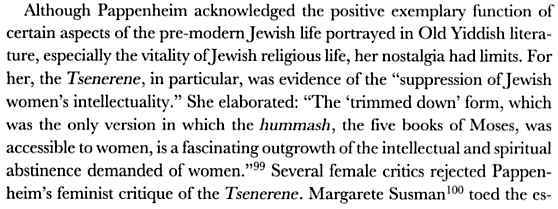
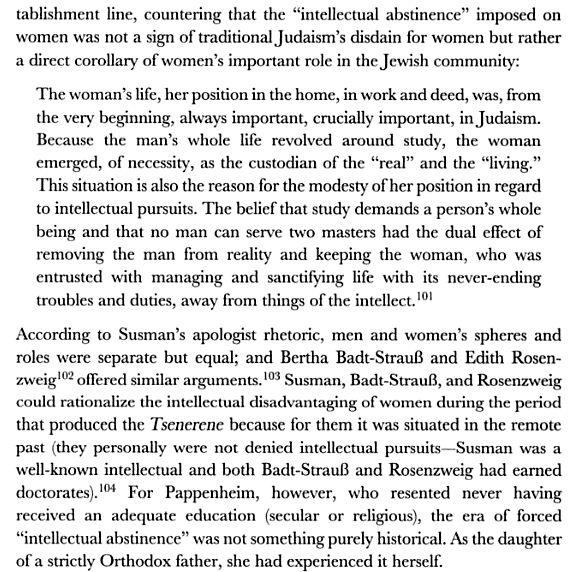
She was also the mysterious young woman, Anna O., on whose treatment psychoanalysis was founded. And she was, I will suggest, also a crusader against complementarianism, the belief in “separate but equal” roles for women. The question we can ask is whether the complementarianism that Bertha Pappenheim experienced brought about the origin of psychoanalysis. Was the hysteria that she exhibited a result of the complementarian upbringing and environment that she endured? (Daniel Boyarin expresses his view and nuances the question here, arguing that it was not the restrictions in education that were her lot as a Jewish girl, but rather, the restrictions in career opportunities as a young woman in Vienna, which contributed to her trauma.)
In Let Me Continue to Speak the Truth: Bertha Pappenheim As Author and Activist by Elizabeth Loentz, pages 47 and 48, we can read about the disagreement between Bertha Pappenheim, who felt unfulfilled by her education or by her career prospects as a woman, we are not sure which; and Edith Rosenzweig, Franz Rosenzweig’s wife, who had a doctorate and did not consider that she experienced intolerable restrictions as a woman.
Mary Kassian on Rachel Held Evans’ Year of Biblical Womanhood
While many people have responded to Kathy Keller’s review of the Year of Biblical Womanhood, I have not seen any responses to Mary Kassian’s review of this book. So I am going to contribute a bit of personal research, and I note that Kurk has researched the same details. Perhaps we have the same memories of Edith Schaeffer, someone our mothers looked up to.
First, this is from Kassian’s review,
I’m glad she clarified who exactly she means by “evangelical complementarians.” She’s talking about my people. I’ve been with that movement from the start. She’s walking into my backyard. Her book is specifically aimed at the particular brand of evangelical complementarity of which I am a part.
A few sentences later, I had my first and best laugh of the whole book. “Evangelical complementarianism,” claims Rachel, “[is] a movement that began as a reaction to second-wave feminism and found some of its first expressions in the writings of Edith Schaeffer (The Hidden Art of Homemaking, 1971) and Elisabeth Elliot (Let Me Be a Woman, 1976).” Rachel goes on to explain that complementarianism rests on the “uncompromising conviction [that] the virtuous woman serves primarily from the home as a submissive wife, diligent homemaker, and loving mother.” (p. xix).
Seriously? “The Hidden Art of Homemaking???!!” I just about fell off my chair. That book was written seventeen years before the inception of CBMW and about twenty years before we adopted the term “complementarian.” I have never even heard of it. I highly doubt whether John Piper and Wayne Grudem—the founders of CBMW—have read it. So to cite it as the first expression of evangelical complementarianism is hardly defensible. Complementarians would certainly not identify it as such.
A Year of Biblical Womanhood and I were not off to a good start.
Not a good start indeed! Like many other women of Mary Kassian’s age, I met and was deeply influenced by both Elisabeth Elliot and Edith Schaeffer. I have read their books, and not in a critical spirit. I have read Held Evans’ book, and Mary Kassian’s book. And I would like to set the record straight in defence of Rachel Held Evans’ reference to Edith Schaeffer and Elisabeth Elliot,
Dorothy Patterson claims both these women as mentors, in an interview in 2007,
HOWARD: Who has been your mentor through the years?
PATTERSON: In honing my ministries to women with the pen and through the public platform, I was encouraged by my friendship with Elisabeth Elliot and Edith Schaeffer.
Susan Hunt wrote ,in Spiritual Mothering: The Titus 2 Model for Women Mentoring Women, published in 2009, page 4,
Other Proverbs 31, such as Elisabeth Elliot and Edith Schaeffer are also my heroines …
Nancy Leigh DeMoss wrote in Biblical Womanhood in the Home, 2002, page 31,
As many people were brought to the Lord through Mrs. Schaeffer’s cinnamon buns as through Dr. Schaeffer’s sermons.
Frank Schaeffer, Edith Schaeffer’s son, in Sex, Mom and God, 2012, page 166-167, writes,
Nancy Leigh DeMoss happened to be the daughter of a former friend of my mother’s, Nancy DeMoss, who was instrumental in my parents’ rise to Evangelical superstardom. … I worked closely with Nancy on several projects. … When Nancy’s daughter (the aforementioned Nancy Leigh DeMoss) took Pride’s ideas to a bigger audience than Pride could have imagined, she was just taking the next logical step begun by my mother. Like my sister’s and I, the DeMoss siblings found themselves in their parent’s orbit. The DeMoss children became coworkers in the “cause,” much as I filled that role in my family.
Kathryn Joyce in Quiverfull: Inside the Christian Patriarchy Movement, 2009, page 42, writes about Hidden Art by Edith Schaeffer,
perhaps unintentionally, a landmark book for proponents of biblical womanhood.
How fascinating that Mary Kassian would say she didn’t know Schaeffer’s The Hidden Art of Homemaking and would attack Rachel Held Evans for linking it to Kassian’s own Council for Biblical Manhood and Womanhood as an early expression also of the Danvers Statement. Kassian has read Held Evans’s book, but did she not read Quiverfull: Inside the Christian Patriarchy Movement by Kathryn Joyce, who seems to have read both the CBMW stuff and Edith Schaeffer’s books and has noted how women, and men, in recent Christianity have constructed the hierarchical man over woman relationship out of them?
In a response to others parts of Mary Kassian’s review of Rachel Held Evans’book, A W Sanderson November 12, 2012 at 4:42 pm comments on Dennyburk’s blogpost,
Kassian appears to be out of the complementarian loop. She seems to be completely unaware that Patterson’s words quoted by RHE and included in her review are from RBWM ed 1991 AND *2006*. (Info can be found in an online search.) That is hardly “wiping the dust off” arbitrary antiquated quotes. If complementarianism is new and is notpatriarchy as Kassian claims but a new ideology of only about 20 years, what else does one have to work with but their literature of the last 20 years or so? Regardless, the volume she quoted was republished with Patterson’s contribution in 2006? How is that not recent? Also, Kassian wants to disassociate with the term patriarchy and considers that isolated to the “fringe” groups like Vision Forum. She seems to be oblivious that Denny Burk, Owen Strachan, and CBMW all folks in “her backyard” equate complementarianism with patriarchy.
Kassian writes, “I pointed out [to Rachel] that though complementarians agree on the principle of complementarity, we often differ as to its application in the home and the church. I emphasized that even those involved in CBMW have a divergence of opinion as to the specifics of how to apply the principles of manhood and womanhood. Even Nancy and I don’t land in exactly the same place on every point of application.” Isn’t this what RHE says is the point of the book?
Perhaps I should clarify that Nancy Leigh DeMoss, Dorothy Patterson and Susan Hunt, are the three other women most involved in the development of “complementarianism”, alongside Mary Kassian. One does have to wonder how Mary did not become familiar with the books of a woman who was so influential in her coworkers’ lives. No doubt, when Kassian remarks that John Piper and Wayne Grudem have probably not read Hidden Art by Edith Schaffer, she is being accurate. I concede this point. But what does this say about the inception of this movement? Are John Piper and Wayne Grudem the measuring stick of biblical womanhood above the life experience of the movement’s most well-known female leaders, Dorothy Patterson, Susan Hunt, and Nancy Leigh DeMoss?
In any case, I hope this provides evidence that Rachel Held Evans did her homework, and should not be made to “write lines” or some such thing, by Mary Kassian.
Update: Tim Challies has linked to Mary Kassian’s review also. Unfortunately I am unable to comment there at the moment. I don’t know if that is intentional on Challies’ part or not. [ I am now aware that there is a delay in displaying comments on his blog. My bad!]
Never Again
Canadians across the country and around the world honoured the nation’s veterans today, a tribute to the men and women who fought for — and in many cases died for — the freedoms cherished by all.
Thousands of people gathered in Ottawa for the Remembrance Day ceremony at the National War Memorial at Confederation Square on Parliament Hill.
The ceremony began with the singing of Canada’s anthem, followed by the lonely bugle call of the Last Post as the crowd stood silent for two minutes, broken by the blast of artillery and then the mournful playing of a bagpipe. Soon after, a pair of CF-18 fighter jets flew overhead, followed by speeches and a 21-gun salute.
“Today, we feel keenly the pain and sorrow around us,” intoned Brig. Gen Karl McLean, chaplain general of the Canadian Forces.
The laying of the wreaths, lead by Gov. Gen. David Johnston, was then backed by a full pipe band playing Amazing Grace and a children’s choir.
Rabbi Reuven Balka, the honorary chaplain of the military command, was given the responsibility of the event’s benediction: “May those who die be remembered lovingly. May those who were injured be healed in body and spirit. May those who serve and continue to serve live their lives in a world free of terror and suffused with tranquility.”
Balka ended his speech by urging the crowd to shout out “Thank you veterans” — which the crowd did.
‘It was hell’
“Marvelous, marvelous,” one elderly veteran in a wheelchair told CBC News in describing his feelings at the ceremony.
Asked about his time battling enemy airplanes in the south of England during the Second World War, Mervin Jones —who was part of an artillery unit and only in his early 20s at the time — still wonders how he survived: “I can’t understand why I’m here. It was hell, hell. But it wasn’t my time.”
Jones also made a promise: “You know I will be back here next year, eh?”
Among those in attendance was Roxanne Priede, who is this year’s National Silver Cross Mother. Her son, Master Cpl. Darrell Jason Priede, died in a helicopter crash in Afghanistan in 2007. Priede wept as she laid a wreath at the base of the war memorial.
Roxanne Priede was selected by the Royal Canadian Legion to attend the national service in Ottawa on behalf of all Canadian mothers who have lost children in the service to their country.
The ceremony was completed with the Governer General greeting and shaking hands with veterans in the crowd as hundreds of veterans did a march past around the memorial.
Overseas, Prime Minister Stephen Harper attended a Remembrance Day ceremony in Hong Kong at the Sai Wan Bay War Cemetery.
During the Second World War, nearly 2,000 Canadians took part in the Battle of Hong Kong, which raged for 18 days in December 1941.
“By their deaths, they made possible the freedom we enjoy, the democracy by which we govern ourselves, and the justice under which we live,” Harper said.
Harper recalled the heroics of William Lore, who died recently at age 103, and the “courageous, desperate and bloody defence” of Hong Kong.
Lore, then a sub-lieutenant, led a platoon of marines to free Canadian, British and Hong Kong prisoners of war from the notorious Sham Shui Po Camp in August 1945.
The prime minister and his wife Laureen laid a wreath at the memorial and were joined by Arthur Kenneth Pifher, 91, a veteran of the battle of Hong Kong who was held in a Japanese prisoner of war camp for 3½ years.
“In the 21st century, war has taken on a different character, but it is no less war, and no less damaging to those who fight it, and those at home who are affected by it,” said a statement released by Defence Minister Peter MacKay and Associate Defence Minister Bernard Valcourt. In a surprise visit, MacKay joined Canadian and U.S. troops at Kandahar Airfield on Friday for a Remembrance ceremony.
In London, the Queen was joined by Prince Philip and other members of the Royal Family as she laid a wreath at the Cenotaph memorial. Prince Charles and his wife Camilla laid a wreath in Auckland, where they are on a tour of New Zealand.
Commemoration across the country
Provincial capitals as well as smaller cities and towns held commemorative events.
In Atlantic Canada, those attending the ceremony in Corner Brook, N.L, found two new additions at Remembrance Square, a pair of statues honouring those who served in the First World War and those who fought in Afghanistan.
A Wabush woman whose son died in Afghanistan says people should make a special effort of remembrance on Sunday. Kay Kennedy’s son Kevin, 20, was one of six Canadian soldiers killed in a roadside bomb blast in 2007.
“Our soldiers were in trenches, and I mean look at what they went through. I think people should make an effort and get out and honour our soldiers,” said Kennedy.
“The loneliness will never, ever, ever go away for Kevin. My heart is broken and it will never be mended.”
In Charlottetown, Prince Edward Islanders remembered the day at the city’s cenotaph.
Haligonians collected at the Sailors’ Memorial in Point Pleasant Park, overlooking the entrance to Halifax Harbour, to pay special tribute to the sacrifice made by Canadian sailors in defence of Canada.
In Saint John, N.B., the city’s major event was held at Harbour Station.
In Quebec City, a ceremony was held at the Cross of Sacrifice in the Grande allé.
The City of Toronto had several events, including a wreath-laying ceremony at Old City Hall and at each of the civic centres across the city: East York, Etobicoke, North York, Scarborough and York. Services were also held at Fort York.
On Saturday, a memorial dedicated to troops killed in Afghanistan was unveiled near CFB Trenton, Ont.
‘By their deaths, they made possible the freedom we enjoy’—Prime Minister Stephen Harper
Winnipeggers had several sites to pay their respects, including the city’s Convention Centre. Events were also held at several other venues. About 3,500 people attended the service at the convention centre.
In Regina, dignitaries including Saskatchewan Lt.-Gov. Vaughn Schofield took part in a ceremony at the Brandt Centre.
Edmontonians had several events to choose from, including an indoor service at the University of Alberta Butterdome or Van Vliet Centre. Lt.-Gov. Donald Ethell presided
In British Columbia, thousands of sailors, soldiers, airmen, airwomen and cadets took part in numerous ceremonies on Vancouver Island, a military spokesman at CFB Esquimalt said. The largest contingent attended the main ceremony on the lawn of the legislature in Victoria.
Separate ceremonies were also held in Vancouver at the Japanese Canadian War Memorial in Stanley Park, and for Chinese-Canadian veterans in Chinatown.
Vancouver’s largest Remembrance Day event is the annual parade and ceremony at Victory Square Park.


 BLT
BLT 