Should Mormon women wear pants to church?
“Death threats.” From the New York Times:
A call for Mormon women to wear pants to church, begun this month by a small group of women, has stretched across the globe, but not before creating a backlash and even generating death threats.
“Wear Pants to Church,” an event on Sunday, was meant to draw attention to the role of women in the Church of Jesus Christ of Latter-day Saints, using attire as a symbolic first salvo in a larger struggle over gender inequalities.
Though the Mormon Church has no official policy against women wearing pants to church, many say they feel peer pressure to wear a dress, particularly in the Western United States, organizers said. So on Sunday, thousands of Mormon women arrived at church in pants in places like Cambridge, England; Heidelberg, Germany; Austin, Tex.; the Marshall Islands; and Kotzebue, Alaska. A number of the women posted their photos on Facebook and other Web sites. Others said they could not participate because they were fearful of ridicule or reprimand….
At a suburban church in Green Valley, Nev., less than 10 miles from the Las Vegas Strip, women filed into church on Sunday morning, most wearing dresses (most men wore coats and ties). Bishop Michael Durham was somewhat dismissive of the pants idea. “I think wearing pants is not liberating,” he said. “Liberation comes from inside. I’m not sure they have a clear understanding of the church’s position on gender.”
Soraya Cordeiro said she wore pants because she had to take a long bus ride to her job at the Venetian hotel after church and found wearing a dress to be “a hassle.” She said she had never faced rebuke for her choice of attire.
On Monday, a private All Enlisted Facebook page had collected about the same number of “negative experiences” as “positive experiences” from women across the country. Julie Tuovi Baker Hansen, a lawyer in Burbank, Calif., who participated while visiting a Salt Lake City suburb, said she was surprised to see a man raise his hand and say, “Women who want to wear pants, they just don’t know how to follow the Lord.” …








As we end the latter half of December 2012, it is an opportunity to look back over the year and assess its cultural and scholarly peaks and valleys. A publishing low point was arguably reached with a truly awful study from Aberdeen: Why are Women More Religious than Men? The Aberdeen authors make broad impressionistic claims that women are more “caring” than men (because they have babies – see page 97), and thus more religious. Yep, that’s their thesis.
Extra bonus points for badness because the book begins with this sentence: “We will introduce our problem by describing four photographs of chapel front doors from County Durham, in the north of England.” If I were writing a book, I’d use this opportunity actually show the four photographs. This book could have simply shown the photographs, but instead prefers to give a written description of the photographs.
The book is frozen in a 1950s view of women that I thought had completely disappeared from academic discourse. Apparently, in these authors’ world, June Cleaver is still passively waiting for Ward to come home from work.
The book largely ignores religions other Christianity (and in particular, religious culture in the Far East and Middle East). It feeds directly into my belief that most of those who engage in scholarship on sex differences thrive on superficial stereotypes.
I cannot even recommend this book for use as kindling or for personal hygiene – the paper seems to be slightly coated so it is unlikely to burn as well as newspaper or to be as comfortable as a roll of double-ply.
Codex Sinaiticus on sale
Just a quick note for the bibliophiles out there: Hendrickson’s beautiful facsimile of the Codex Sinaiticus is now on sale for $200 from CBD. (If you call up CBD, they’ll offer you a coupon for free shipping too.) This is a real discount – the best price I have seen previously on this volume is around $600 (the list price is $800).
This is a superior volume which offers the closest experience that most of us can have with the original text. Of course, images of the Codex Sinaiticus are available online at an outstanding web site. Still, nothing can compare with the actual experience of holding the printed page.
Of course, this work will be of interest to those who are interested in the early Christian Bible, as well as in Septuagint studies. But this huge volume (21.2 x 18.7 x 6.5 inches) is not only a reproduction of a central manuscript of Late Antiquity; Codex Sinaiticus is a key artifact in the history of Western book-making.
Courtney Druz’s “The Light and the Light”
Courtney Druz, a regular contributor here at BLT, has just published a new volume of poetry: The Light and the Light which she describes as “an encounter with the writings of Paul Celan in the presence of the Book of Ezekiel and the place of the Temple in Jerusalem.” I’ve been meaning to post a review of some of Courtney’s previous poetry volumes before – and that is still on my to-do list. In the meanwhile, this new volume (which I have not yet read) looks very exciting.
More details (and excerpts) are available on Courtney’s web site, and she has prepared this introductory video:
I am very much looking forward to reading this volume!
Is there a quota on Asian-Americans at Ivy League colleges?
This study gives some fairly impressive statistical claims that the Ivy League schools have imposed a de facto quota on Asian-American undergraduates.

Are we getting smarter? (And are women smarter than men?)
Here are James R. Flynn’s claims in brief:
Here is part of Nicholas Kristof’s take:
The average American in the year 1900 had an I.Q. that by today’s standards would measure about 67. Since the traditional definition of mental retardation was an I.Q. of less than 70, that leads to the remarkable conclusion that a majority of Americans a century ago would count today as intellectually disabled.
The trend of rising intelligence is known as the “Flynn Effect,” named for James R. Flynn, the New Zealand scholar who pioneered this area of research. Countless other scholars worldwide have replicated his findings, and it is now accepted science — although there is still disagreement about its causes and significance.
The average American I.Q. has been rising steadily by 3 points a decade. Spaniards gained 19 points over 28 years, and the Dutch 20 points over 30 years. Kenyan children gained nearly 1 point a year.
I’m fairly skeptical (in part because I believe the underlying theory behind IQ measurements – a belief in “the g factor” is unsupported) , but will reserve judgment until I actually read Flynn’s book.
Le Nouveau Testament traduit en Suisse 1849
I just received a copy of this New Testament, from a family member. It was published in Lausanne in 1849, and curiously contains notes made in a very fine pen, which includes numerous crossing outs of the original French text and, it seems, corrections. It doesn’t say who translated this text, so I have found the following information,
LE NOUVEAU TESTAMENT DE NOTRE-SEIGNEUR .JÉSUS-CHRIST, TRADUIT EN SUISSE PAR UNE SOCIÉTÉ DE MINISTRES DE LA PAROLE DE DIEU. Version dite de Lausanne. Chez Georges Bridel, Lausanne. Première édition, 1839. Réédité en 1849, puis, sous le même titre, sauf les mots en Suisse, en 1859, 1872 et 1875. Les deux dernières éditions contiennent des variantes de texte et de traduction, celle de 1872 en appendice, celle de 1875 au bas des pages. La traduction est faite sur le texte reçu.
La traduction de l’ANCIEN TESTAMENT suivit celle du Nouveau. Les psaumes parurent en 1854, et furent réédités en 1862. Les autres livres parurent (y compris une seconde réimpression des psaumes) de 1861 à 1872.
Dans la traduction du Nouveau Testament, les deux hommes dont l’influence a été prépondérante furent, au début, Gaussen, et, à la fin, Louis Burnier. Les auteurs de cette version, partant de la conviction que le texte des Écritures nous donne la pensée même de Dieu, se sont attachés à le rendre littéralement, traduisant toujours, autant que possible, le même mot par le même mot, et évitant de rendre la traduction plus claire que le texte, de peur d’ajouter à celui-ci. De plus, ils se sont proposé de traduire de telle façon que le Nouveau Testament français fût aujourd’hui pour les lecteurs français ce que, au premier siècle, le Nouveau Testament grec était pour des Grecs. Ils ont dépouillé certains mots du sens convenu, technique, qu’ils ont pris en passant par le latin. Ils ont dit Bonne Nouvelleet non Évangile, envoyé et non apôtre, assemblée et non église, voie et nondoctrine ou secte, etc.
[In the translation of the New Testament, the two men whose influence was strongest was, in the beginning, Gaussen, and at the end, Louis Burnier. The authors of this version, parting company with the conviction that the text of the scriptures gives us the very thoughts of God, committed to rendering it literally, translating always, as much as possible, each word by the same word, and avoiding making a translation clearer than the text, for fear of adding to it. In addition, they proposed to translate in such a way that the French New Testament would be today for French readers what, in the first century, the Greek new Testament was for the Greeks. They took away certain technical words of conventional meaning, which they had taken in passing from the Latin. They said Bonne Nouvelle and not Evangile, assemblée and not église, voie and not doctrine or secte, etc.]
Quoi qu’on puisse penser des principes adoptés et de leur application, parfois arbitraire, parfois excessive (*1), cette version n’en est pas moins une oeuvre intéressante et remarquable. Elle met en une mesure le texte original, dont elle est une sorte de décalque, sous les yeux de ceux qui n’y ont pas accès. Elle a enrichi le vocabulaire du Nouveau Testament de quatre cent trente mots environ, étrangers à la version d’Ostervald (*2).
(*1) Maris, pareillement, cohabitez pour la connaissance comme avec un vase plus faible, le féminin. (1 Pierre 3, 7).
Et quant à la cour qui est hors du temple, jette-la dehors (Apoc. 11, 2).
Tout hommage qui sera cuit au four et qui sera apprêté à la poêle… tout hommage pétri à l’huile et sec… (Lévit. 7, 9-10).Ces bizarreries — on pourrait dire ces énormités — ont jeté sur cette version un ridicule que, dans son ensemble, elle est loin de mériter. Il nous paraît intéressant de noter à ce propos l’opinion de Vinet en fait de traduction. Après avoir condamné le littéralisme absolu, il s’exprime ainsi :
Il y a entre deux langues, à quelque distance qu’on aille les prendre, une masse de rapports suffisants pour nous autoriser, nous obliger même, à essayer d’abord de la littéralité : toutes les fois qu’elle est possible, elle est nécessaire; mais à quelle condition est-elle possible, si ce n’est à la condition de rendre, avec la pensée de l’écrivain, l’écrivain lui-même, je veux dire son intention, son âme, ce qu’il a mis de soi dans sa parole, et ensuite de satisfaire, par la pureté du langage, sinon les méticuleux puristes, du moins les hommes d’une oreille exercée et d’un goût délicat ?…
Pour nous résumer, le système de fidélité est bon et vrai sauf l’excès. Tous les faits bien examinés, il est rationnel de partir des mots et de la phrase de l’original, comme de l’hypothèse la plus vraisemblable; ainsi procède celui qui cherche à se rendre compte des phénomènes naturels; et il en est d’une hypothèse qui explique toutes les parties d’un fait comme d’une forme qui conserve toutes les parties de la pensée et toutes les intentions de l’écrivain. Cette hypothèse et cette forme se vérifient à cette épreuve (Études sur la littérature française. t. 1, p. 559, 572. Toute cette remarquable étude sur ce que doit être une traduction est à lire).
(*2) Voir: La version du Nouveau Testament dite de Lausanne, son histoire et ses critiques (1866), et Les mots du Nouveau Testament dans les versions comparées d’Ostervald et de Lausanne (1871), par Louis Burnier, deux brochures qui traitent avec une grande compétence des questions relatives à la traduction du Nouveau Testament.
La traduction de l’Ancien Testament est supérieure à celle du Nouveau, ce qui s’explique par la construction plus simple de l’hébreu. M. Segond disait que de toutes les traductions qu’il consultait après avoir étudié le texte, celle de Lausanne venait la dernière, et qu’il était presque toujours d’accord avec elle.
Fortunately, I have blogged about this Bible before, and now I have a copy.
What the editors of the QJB didn’t change of the KJV
What We Didn’t Change
We didn’t change anything else to create this edition of the Queen James Bible. The Queen James Bible resolves any homophobic interpretations of the Bible, but the Bible is still filled with inequality and even contradiction that we have not addressed. No Bible is perfect, including this one. We wanted to make a book filled with the word of God that nobody could use to incorrectly condemn God’s LGBT children, and we succeeded.
The discussion of homosexuality in the Bible is great and far-reaching and we encourage all to study it more. Our website http://queenjamesBible.com/ has resources for further study.
Yours in Christ,
The Editors
The above is the statement that those producing the “Queen James Bible” have made concerning what they did not change of the “King James Version” of the Bible. Here’s their statement about what they did change:
http://queenjamesbible.com/gay-bible/
How does this compare with Ann Nyland’s GLBT Study Bible? Have the QJB editors been successful in their stated aim? What do you think? Given the horrible history of homophobia, we ask you to express your opinions with kindness and reason.
Synonymous phrases
The comparison of Isaiah 2 with Micah 4 brings up the question of whether there are any absolute synonyms, or whether there is always some difference and a translation should reflect the different structure or choice of words in the original. Here are two phrases which appear to be synonymous. They translate the identical words in Hebrew and they are translated into identical phrases in English. But in Greek, they are different. Should a translation reflect this difference?
בְּאַחֲרִית הַיָּמִים,
ἐν ταῖς ἐσχάταις ἡμέραις Isaiah 2:2
ἐπ᾽ ἐσχάτων τῶν ἡμερῶν Micah 4:1
in the last days
These two Greek phrases seem to be synonymous, without any meaningful difference. Is this possible? Here is another similar example,
ὁ δὲ μείζων ὑμῶν Matt. 23:11 (genitive)
the greatest among you
ὁ μείζων ἐν ὑμῖν Luke 22:26 (en plus dative)
the greatest among you
These two seem to be synonymous phrases. There would be little point in making the English reflect the difference in English. However, there are exegetes that use differences like this to establish or reinforce certain theological doctrines. For example, regarding ἐπίσημοι ἐν τοῖς ἀποστόλοις Dr. Wallace asks,
would we not expect ἐπίσημοι τῶν ἀποστόλων if the meaning were “outstanding among the apostles”?
And my answer would be “Heck, no!” Is there a word for overexegeting, and if there were, would hyperexegeting be a synonym for this, or would we have to create a doctrine around the difference between these two?
Update: Kurk has added a great post on WOMBman’s Bible which also involves synonyms. What do we make of the translation of dabar as logos, and torah as nomos?
computing Ada
If you sat at your computer today, if you googled, then you saw this image, this google doodle:
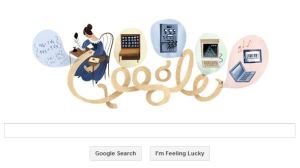
You have the person pictured in the image to thank, in part, for your being able to use that computer. And you have Shelby Knox to thank, in part, for seeing the google doodle of this person today.
It was already over half way through 2010, when Knox noticed that not even nearly half of all the google doodles were of women and that far more than half were of men. So Knox blogged, in part saying:
Google, I’ve got some suggestions for you. What about Ada Lovelace, the woman who was the world’s first computer programer and, conveniently, has a whole day dedicated to her celebration? If the guy who created the first nuclear facility in China gets a doodle, Marie Curie certainly deserves one. If you honored the birth of realism, you should also honor the (flawed, yes) godmother of feminism, Mary Wollstonecraft. What about some of the women behind the great social movements in the United States, like Harriet Tubman, Rosa Parks and Dorothy Height?
Women also make art and music and write, and not just in the United States. What about Italian Baroque painter Artemisia Gentileschi, the first woman to gain entry into the Accademia di Arte del Disegno in Florence? Bengali writer Ashapoorna Devi wrote appeals for gender and religious equality in widely read novels for both children and adults. Why not honor Miriam Makeba, known as “Mother Africa,” for her cultural role in ending apartheid in South Africa?
Looks like Google is starting to take Knox‘s suggestions. Here’s the 2011 google doodle for Marie Curie and the December 2010 google doodle for Rosa Parks (both posted by art making google doodler Jennifer Horn). And today, December 10, 2012, we find the google doodle for Ada Lovelace.
And well before you visited this blog and read this post today at your computer, it’s very likely that you’ve already read the news of the google doodle today for Ada Lovelace. In fact, the momentum for this day was building a good bit before, when blogger technologist activist Suw Charman-Anderson started Ada Lovelace Day somewhat reluctantly.
For those still learning about Ada Lovelace, here is a timeline of her life; a short bio with references to three full length biographies; and her published notes with her translation work that have made her famous and have aided, in part, our sitting at our computers googling.
A city and a mother in Israel
In response to the study of Isaiah in Greek, I will try to dash off a few words. But I don’t expect to be converted to facebook overnight. Of course, I do use facebook, but only as a mother. I am, in fact, a “mother in facebook” It is the way I can lurk on my kids activities. I know they are alive without having to phone them every single night. But I don’t used facebook for much else.
Anyway, I noticed that in Isaiah 1:26, there is an expression μητροπολις πιστη σιων the “faithful metropolis of Zion.” But it is much better translated as “the mother city of Zion” as is done in the NETS, since this ties it in with the notion of both the city and the people as being the “mother.” In 2 Samuel 8:1, there is a phrase, not a place, but a phrase metheg ammah, the “bridle of the mother” understood by some translators as the “capital city.” Often Jerusalem is the “mother,” sometimes the divorced “mother” or the “adulterous” mother – unfortunately. But also Deborah is a “mother in Israel” bringing peace and justice, as prophet and judge.
The expression has lasted over the millennia, and today there is still the expression,
ir va’ em be’yisrael
עיר ואם בישראל
a city and mother in Israel
This refers to a Jewish “mother-city” a cultural centre for the Jewish people. Some Jewish mother cities outside of Israel are Thessaloniki, Minsk, Prague and Krakow.
The symbol of “mother” does not mean that every woman must be a mother. Many famous women in the Hebrew Bible were not. Nor is it that women are the matriarchal original leaders. It is about metaphor, and understanding that metaphor is just that, metaphor. It is also about how powerful gender, and grammatical gender, are in the poetry of a language.
When being a woman no longer means that some Christians somewhere are busy trying to build a wall around you, then I will dance with the poetry of language. Take me up on it!
Update:
Yesterday, William Verner mentioned that 2 Samuel 20:19 has the expression “a city and mother in Israel.” Thank you.
יט אָנֹכִי, שְׁלֻמֵי אֱמוּנֵי יִשְׂרָאֵל;
אַתָּה מְבַקֵּשׁ, לְהָמִית עִיר וְאֵם בְּיִשְׂרָאֵל–
לָמָּה תְבַלַּע, נַחֲלַת יְהוָה
We are of them that are peaceable and faithful in Israel;
seekest thou to destroy a city and a mother in Israel?
why wilt thou swallow up the inheritance of the LORD? JPS
group reading of Greek Isaiah
Abram K-J, blogger at Words on the Word, has started a group reading “Greek Isaiah in a Year.” He has invited others to participate via social media:
Greek Isaiah in a Year on Facebook is the central place for discussion, helpful files, questions, companions, etc. Come join in!
In addition to the Facebook group, Abram has also provided “the reading plan, free online LXX texts, and more resources“; his related blog posts can be found at http://abramkj.wordpress.com/tag/septuagint/.
Today ends week 1 of 52, with discussions and posts over the first 25 verses winding down. There are more than 160 members in the fb group with a few observations made there. And there are so far just a few blog posts such as Brian LePort’s “Reading the Book of Isaiah, LXX: 1:1-25” and my own “language of generation in 1:1-25 of Ἠσαῒας for ישעיה” and “plethora and plenty, the pronounced primary Pi.” LePort is mainly looking at lexical difference between the MT and the LXX; I’m keying in on the literary differences the Greek makes (such as using ambiguous generative metaphors and marking the Hellene Isaiah as Homeric, with alliterative playful pronunciations using the initial letter /voiceless bi labial stop / π).
If you know of more posts for this week, then please feel free to leave a comment below, and I’ll update this post with the links. From time to time, through the remaining weeks of this reading year, I’ll try to give further updates with general observations. Especially as the New Testament quotes LXX Isaiah (moving from Judaism to Christianity), the comments will likely be fascinating and important.
[UPDATE: Suzanne, here at BLT, has jumped right in on the week 2 – day 6 – reading with a post up entitled “A city and a mother in Israel” in which she examines the maternal translator metaphor μητροπολις. You can find all the BLT Greek Isaiah posts here.]
Weird Bibles 5: Jamaican Patois Bible
Well, you’ve probably seen the news articles today – the Bible Society is now selling the New Testament (“Nyuu Testiment”) in Jamaican Patois (“Jamiekan Patwa”). Pretty impressive for a dialect which has no standardized written language! “Kaa, yu si, Gad lov di worl so moch dat im gi op im wan dege-dege Bwai Pikni so enibadi we chose iina im naa go ded bot a-go liv fi eva.”
You can listen to “Di Gud Nyuuzbout Jiizas azkaadn tu Luuk” here, you can listen “1 Korintiyan13” here and listen/read many more samples here.
Here are some samples highlighted by the Bible Society:
1. Matthew 1: 23 The prophecy of Jesus birth: ‘Lisn op! Di uman we neehn slip wid no man a-go get beibi…’ rather than, ‘Behold a virgin shall be with child’.
2. Matthew 2: 11 The wise men give Jesus their gifts of gold, frankincense and myrrh, reads, ‘Dem tek out di present we dem did bring, an gi di pikni – guol, frangkinsens an mor.’
3. Mark 1:16 Jesus calls his first disciples saying, ‘Fala mi’, rather than ‘follow me’.
4. Mark 4: 39 Jesus calms the storm. In English it reads, ‘Jesus stood up and commanded the wind, “Be quiet!” and he said to the waves, “Be still!”. In Patois this now reads, ‘ So Jiizas get op an taak chrang tu di briiz, an tel di sii fi sekl dong.’
5 Luke 1: 28 The Angel Gabriel tells Mary that she will give birth to Jesus. Read in church services every Christmas as, ‘Hail though that art highly favoured, the Lord is with thee: blessed art thou among women.’ This now reads, ‘Mieri, mi av nyuuz we a-go mek yu wel api. Gad riili riili bles yu an im a waak wid yu all di taim.’
6. Luke 2: 7 Mary wraps Jesus in ‘swaddling clothes’ when he is born. In Patois this is now, ‘Shi rap im op iina biebi blangkit ‘.
7. Luke 6: 27 ‘Love your enemies’ becomes ‘lov unu enimi’
8. John 2:3 Mary tells Jesus that the wine has run out at the wedding in Cana, before he turns water into wine in his first miracle. In English this reads, ‘They have no more wine’. In Patois it now reads, ‘Dem na’av no muor wain lef’.
Now, it might rightly be argued that this is not weird Bible at all – that this is merely a translation into a spoken dialect (that, among other things, helps take a snapshot of that dialect). While that is arguably the case (and this is certainly a project pursued with earnestness) it is not an unnatural reaction for speakers of American or British (or Canadian, New Zealand, or Australian) smile. The translators defend their choice thusly:
Q: Won’t translating the Bible into Jamaican cause more laughter than seriousness?
A: "Sun a shine but tings no bright;
Doah pot a bwile, bickle no nuff;
River flood but water scarce, yawl
Rain a fall but dutty tough." –Ms Lou (Dutty Tough)No one who reads the except above would find it funny; Jamaican can be used to convey hardship, tragedy, love and a wealth of other emotions without being humerous. BSWI and its partners are very serious about what they are doing. They believe the Bible is a respectable book and that persons who read or hear it must be able to identify it as a book that is to be taken seriously. The Bible will be translated with this in mind. Also, the translation will be tested in locations on the island before it is published.
Previous posts:
Weird Bibles 4: Digital Handwritten Bible
Weird Bibles 3: Playful Puppies Bible
Weird Bibles 2: Etymological New Testament
Weird Bibles 1: Archaic Aramaic script
An Orthodox translation
See also here.
A not-so-biblical page or two from the big Judeo-Christian holidays
Today, why not read a page from two authors living biblically around the big Judeo-Christian holidays? Or why not give the whole books as gifts this season, if you’re into that (kind of biblical)?
Here’s page 121 of A. J. Jacobs’s The Year of Living Biblically: One Man’s Humble Quest to Follow the Bible as Literally as Possible:
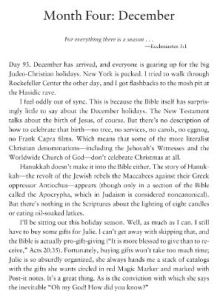
And here’s a page of Rachel Held Evans’s A Year of Biblical Womanhood: How a Liberated Woman Found Herself Sitting on Her Roof, Covering Her Head, and Calling Her Husband “Master”:

Latin abbreviations
James Dowden asks,
This is brilliant. I’m now trying to work out quite which word the abbreviation “ȹ” stands for (as in the middle of the last line of Psalm 94(95)). Quia? Quod? Quoniam?
Here is the verse in question in the Pagninus Bible online,

אֲשֶׁר-נִשְׁבַּעְתִּי בְאַפִּי;
אִם-יְבֹאוּן, אֶל-מְנוּחָתִי
Propterea iuraui in furore meo,
quod non introibunt in requiem meam
so I swore in my wrath
that they shall not enter into my rest.
According to this site, ȹ means qui or quod but I am pretty sure it can also stand for quia. I think it is quod “that” in this case, but I am no expert.
John Piper and fitness girl
Here are two citations from John Piper, years apart, the first in 1991 and the second a few weeks ago. He has undergone a certain kind of conversion, but I am not sure what it means.
“Consider what is lost when women attempt to assume a more masculine role by appearing physically muscular and aggressive. It is true that there is something sexually stimulating about a muscular, scantily clad young woman pumping iron in a health club. But no woman should be encouraged by this fact. For it probably means the sexual encounter that such an image would lead to is something very hasty and volatile, and in the long run unsatisfying. The image of masculine musculature may beget arousal in a man, but it does not beget several hours of moonlight walking with significant, caring conversation. The more women can arouse men by doing typically masculine things, the less they can count on receiving from men a sensitivity to typically feminine needs. Mature masculinity will not be reduced to raw desire in sexual relations. It remains alert to the deeper personal needs of a woman and mingles strength and tenderness to make her joy complete.” page 41 Recovering Biblical Manhood and Womanhood. 1991
“Neither has a car, so he suggests they walk to Maria’s Café down on Franklin Avenue, about 10 minutes from the church. As they walk he finds out that she has a black belt in martial arts, and that she is one of the best in the state. At 19th Street two men block their way ominously and say, “Pretty girl friend you’ve got there. We’d like her purse and your wallet. In fact, she’s so pretty we’d like her.” The thought goes through his head: “She can whip these guys.” But instead of stepping behind her, he takes her arm, pulls her back behind him, and says, “If you’re going to touch her, it will be over my dead body.”
When they make their move, he tackles them both and tells her to run. They knock him unconscious, but before they know what hit them, she has put them both on their backs with their teeth knocked out. And a little crowd has gathered. The police and ambulance come and she gets in the ambulance with the young man. And she has one main thought on the way to the hospital: This is the kind of man I want to marry.
The main point of that story is to illustrate that the deeper differences of manhood and womanhood are not superior or inferior competences. There are rather deep dispositions or inclinations written on the heart, albeit often very distorted. Notice three crucial things.
First, he took the initiative and asked if he could sit with her and if she would go to lunch and suggested the place and how to get there. She saw clearly what he was doing, and responded freely according to her desires. She joined the dance. This says nothing about who has superior competences in planning. God writes the impulse to lead on a man’s heart. And the wisdom to discern it and enjoy it on a woman’s.
Second, he said that he wanted to treat her to lunch. He’s paying. This sends a signal. “I think that’s part of my responsibility. In this little drama of life, I initiate, I provide.” She understands and approves. She supports the initiative and graciously accepts the offer to be provided for. She takes the next step in the choreography. And it says nothing about who is wealthier or more capable of earning. It is what God’s man feels he must do.
Third, it is irrelevant to the masculine soul that a woman he is with has greater self-defending competencies. It is his deep, God-given, masculine impulse to protect her. It is not a matter of superior competency. It is a matter of manhood. She saw it. She did not feel belittled by it, but honored, and she loved it.” Desiring God 2012
So now it is okay for a woman to be fit and athletic. That does not disqualify her from marriage. It did before but now it doesn’t. This man pretends to be a theologian, but he communicates clearly that God did not want women to be athletic in 1991, but in 2o12 it is fine and good to have a black belt as long as you let your boyfriend get punched out before you let on that you have this training.
Problems with translating for meaning
In some recent posts and subsequent discussion, there has been a spirited debate over the merits of translating for meaning vs. attempting to translate wordplay.
I want to illustrate the difficulties with translating only for meaning.
I took the first stanza of Edgar Allan Poe’s The Raven, which I remember being taught a schoolchild:
Once upon a midnight dreary, while I pondered weak and weary,
Over many a quaint and curious volume of forgotten lore,
While I nodded, nearly napping, suddenly there came a tapping,
As of some one gently rapping, rapping at my chamber door.
“ ‘Tis some visitor,” I muttered, “tapping at my chamber door –
Only this, and nothing more.”
I used the Bing translation engine to translate this from English to Chinese (results in the comments) and then the Google translation engine to translate it back from Chinese to English (again, results in the comments). I manually corrected the obvious errors to reflect “plain meaning.” Here was the result:
Once bored at midnight, while I pondered weak and weary
Quaint and curious volumes of forgotten knowledge,
I nodded, almost nearly to a nap, and suddenly there came a tapping,
As if someone were gently playing, the chamber doors were rapping.
“ ‘Tis some visitor,” I muttered , “who is causing my chamber door-tapping –
Only this, and nothing more.”
I would argue that this “translation” preserves most of the meaning and none of the charm of the original text.
The Bride of Christ: a feminist reading
The image of the church, or the soul, as the Bride of Christ is a longstanding one in Christian theology, and can be seen as complementary to the image of the church as the Body of Christ. The traditional reading of this image, grounded as it is in a patriarchal understanding of marriage and an essentialist understanding of women and men, is problematic from the perspective of feminist theology. Some might argue that it should therefore be discarded, but I think that it is of ancient enough tradition and beautiful enough associations to be worth preserving and re-imagining.
In an earlier discussion, Audrey suggested that “the mystical tradition . . . is the only valid lens through which to view this image.” But the primary grounding I have for this image is the liturgical lens: the triple plunging of the pillar Easter candle into the baptismal font, the utero ecclesiae (womb of the church), during Easter Vigil, the “night truly blessed… when heaven is wedded to earth, and we are reconciled with God.”
Audrey continued,
The church- indeed all creation- each of us- must assume a feminine stance in relation to the Holy Mystery- a total and absolute ‘fiat’.
I don’t find this a helpful reading of the symbol, if “feminine stance” is meant to imply receptivity and submission, which is how I usually see it read….
Read the rest over at Gaudete Theology.
How doth the little crocodile
A few years ago, I suggested on a blog that early English Bibles were translated more from Latin and German than from Greek and Hebrew. Hmm. I am not exactly sure of my exact wording and perhaps that is too strong. But I wanted to emphasize the important role of the Vulgate, the Pagninus Latin Bible and the Erasmus Latin New Testament in the translation process of Tyndale, Coverdale and the many other translators involved in this tradition.
Why do you have such a thing about 16th century Latin translations, repeatedly trying to insist that translations into other languages are based on them and not on the Greek and Hebrew? I have never seen anyone else even suggest this as a possibility.
I thought ever since that I would have to find an error introduced by the Pagninus Bible in order to establish its role in the English translation tradition. Of course, it is rather difficult to do this without a copy of the Pagninus Bible, so I didn’t get very far. I did take photographs of Genesis, but ultimately they were difficult to scroll through and I did not find a clear case where an error was introduced into English from the Pagninus Bible.
However, now that the Pagninus Bible is online it is somewhat easier to look things up. When Theophrastus cited Robert Alter on the Norton Critical Edition of the King James Bible, it reminded me of Alter’s lecture on the crocodile in Job which I heard last spring. Theophrastus cites Alter on Job 3:8,
Another pervasive issue addressed in the notes is mistakes in construing the original. The KJV abounds in misunderstandings of the original, many of them minor but some of them real howlers. When, for example, the King James translators at Job 3:8 have “who are ready to raise up their mourning,” they have badly mistaken livyatan, or “leviathan,” for an exclusively post-biblical homonym that actually means “funeral.” Herbert Marks discreetly and succinctly corrects the error, going on to explain in a few words Leviathan’s role in Canaanite mythology. The process of correcting the errors of the King James Version began in 1885 with the Revised Standard Version, but tinkering with the language of the 1611 version and slightly modernizing it were concomitant with taking away more than a little of its stylistic grandeur, and the use of corrective annotation seems a wiser strategy.
A quick check was enough to find that it was most likely through Pagninus that this error, “mourning” instead of “leviathan” was introduced into the English Bible. Here is a bit of trivia,
הָעֲתִידִים, עֹרֵר לִוְיָתָן
who are ready to rouse up leviathan – JPS 1917
qui parati sunt suscitare Leviathan – Vulgate 405
qui parati sunt suscitare luctum suum – Pagninus 1528
those that be ready to rayse vp Leuiathan – Coverdale 1535
that be redy to rayse vp mourning – Bishop’s Bible 1568
being readie to renue their mourning – Geneva Bible 1560
zu erregen den Leviathan – Luther 1545
I would have guessed that Coverdale had cribbed from Pagninus but it appears not. It might have been the Geneva Bible, 1560, that first introduced this inaccuracy into English from Pagninus.
No version of the Bible is translated from the original languages without reference to every major preceding translation. That is my guess, until someone proves otherwise. These kinds of things should help us to better understand the reality of the translation process. It is not about taking A in the SL, asking what it really means, and turning it into B in the TL and all that stuff. That’s what people think. But really it is about sitting at a desk, or rather large table, that it what it was like, and surrounding oneself with as many of the significant previous translations as one could get one’s grubby little mitts on.
But I remember interviewing Dr. Packer on the initial stages of the ESV revision. He doesn’t even use email, or so he told me then, but he recalls Dr. Grudem coming to Regent and placing a computer in his room, with all the relevant Bible translations that they were going to reference, already installed on it. So, of course, nowadays, that’s how it’s done, one way or another. Through electronic text.
But in other memories, I remember being taken down to the basement of the Vancouver School of Theology, and having pages and pages of photocopies and photographs of original Bibles in various languages put in front of me, and being asked to identify them. I was told electronic text is worthless, only a facsimile version is valid. But I use electronic text all the time.
Anyway, you get the drift. There is lots to the backstory of translation, and it isn’t all about going from the SL to TL* without chasing the weasel round the mulberry bush on the way.
* Source Language to Target Language


 BLT
BLT 