A One-Volume LXX-NT
UPDATE: a link below to Abram K-J’s review.
The best readings of the texts of the New Testament come out of readings of the texts of the Septuagint. Likewise, seeing how the Septuagint texts have been received and appropriated through the centuries necessarily includes how the New Testament writers seemed to read them. Probably because not many are convinced of the value of reading the two sets of texts together, no single volume LXX-NT has been published. And wouldn’t it really take several volumes to handle all of the pages?
One of the rare works to explore the relationships between the NT and the LXX is Rodney J. Decker’s wonderful Koine Greek Reader: Selections from the New Testament, Septuagint, and Early Christian Writers (Kregel 2007). Last summer, Abram K-J posted a quick review with some of the pages from Decker’s work.
Then just yesterday, Abram K-J posted the following exciting announcement of:
a Greek Old Testament (LXX) and Greek New Testament (NA28) under one cover. Here’s the product page. The thing is more than 3,000 pages and expensive. And those dimensions of 18.4 x 13.3 … are likely in centimeters.
We look forward to hearing more and to seeing such a volume. As you have updates and opinions, please feel free to post them in comments here. We’ll do the same.
UPDATE: here’s the link to Abram K-J’s review.
The Inferno lines that went astray
Will the real John Ciardi translation please stand up?
1
Midway through our life’s journey I went astray
from the straight road and awoke to find myself
alone in a dark wood.
2
Midway in our life’s journey, I went astray
from the straight road and woke to find myself
along in a dark wood.
3
Midway in our life’s journey, I went astray
from the straight road and woke to find myself
alone in a dark wood.
Today, there are a number of internet reports (here, here, here, here, here, here, here, here, here, and here, for example, that quote the version 1 option above). It seems to be Ciardi’s, but is it? Well, we all knew it was supposed to be. For Slate’s blog “Brow Beat,” Aisha Harris had already scooped the Mad Men episode 6 story way back in October of 2012, to ask, “Why Is Don Draper Reading The Inferno?” And she observed exactly which translation:
A few photos from the filming of the sixth season of Mad Men hit the web today, and one of them showed Don Draper indulging in a not-so-light beach read alongside his wife, Megan. The book? Dante’s The Inferno. The version in Don’s possession is John Ciardi’s English translation—specifically, the paperback version, which was first published in 1964. (The hardcover came out a decade before.) Ciardi’s version remains highly respected and is still in print. So why is Don reading it? And when?
Today, after watching the first episode, we can hear “Executive Producer Matthew Weiner and the cast discuss how the characters of Mad Men have changed from last season.” The video clip is here: http://www.amctv.com/mad-men/videos/inside-episode-601-602-mad-men-the-doorway. So that may help us get some of the intended allusion to Dante in the tv series premiere episode of the season. We may get answers, or infer the answers, to Harris’s questions. But is version 1 quoted many different places in cyberspace today really the Ciardi?
Maybe it’s version 2 above. Version 2, as you can see, has a different preposition in the first line, and it adds a comma. Moreover, it has a different verb in the second line and an odd word in the third that sounds a little like a typo (i.e., “along” mistakenly typed for “alone”). Version 2 above is given by two different university professors, respectively. Each gives version 2 here as part of a compiled and a comparative list of various English translations of the opener of Dante’s Inferno, here and here.
And then there’s version 3. If you watched the episode of Mad Men (or if you do watch it), then this version is the one you hear Don Draper reading aloud as you watch him reading it on the beach silently. The cover of the paperback he’s holding proves it’s John Ciardi’s translation. And yet is what you hear the real Ciardi?
Easily, you should be able to use the Internet, a google search, or the download of an ebook, to find the correct answer. Or you could go to the library or the bookstore or your own collection of books. But, after researching a little, I think, you’ll not only be able to find the right Ciardi; you should also be able to see just how a few famous lines went astray.
Margaret Thatcher, inventor of soft-serve ice cream?

Remembering a woman who shattered many glass barriers ….
TheAtlantic.com is reporting that Margaret Thatcher may have helped invent soft-serve ice cream:
Margaret Thatcher died this morning at the age of 87. While some of her achievements over her long career have been and remain controversial, there is one accomplishment that has proven purely and Platonically beneficial — to Britons, to Americans, to lovers of dairy the world over. Margaret Thatcher, the legend goes, helped invent soft-serve ice cream.
Yes. The Milk Snatcher, who was also an ice cream inventor. The Iron Lady of Soft Serve. Thatcher, you see, before she was a politician, was a research chemist. The future prime minister, then Margaret Roberts, received a degree in chemistry from Oxford in 1947. And she put it to use first in work at a glue factory, and then with a research job at food manufacturer J. Lyons and Company, a "foodstuff conglomerate" in Hammersmith. Thatcher’s task in that role? To help figure out a way to whip extra air into ice cream using emulsifiers — so that the ice cream could be manufactured with fewer ingredients, thereby reducing production costs. (And so that, additionally, the dairy-y result could flow from a machine rather than being scooped by hand.) While Thatcher’s exact contribution to the effort remains, in a way that would foreshadow her future political career, a matter of controversy, her team ultimately succeeded. And the work resulted, ultimately, in the swirly stuff we know today as soft serve. (Or, if you’re in Britain, "soft scoop.") J. Lyons’s airy dairy was served from ice cream trucks — under the brand Mr. Whippy — in Great Britain. And then, as soft serve is wont to do, it quickly spread.
The problems with MOOCs 2: WeTakeYourClass.com
For an introduction to this short series, see part 1.
WeTakeYourClass.com is a site dedicated to helping students with online classes. I’m sure you are here because you are wondering “how will I have time to take my online class?” It may be that one class such as statistics or accounting. We know some people have trouble with numbers. We get that. We are here to help. We offer an affordable solution, which includes having a tutor take your class for you. Whether it’s one test, homework, project, or whole class we are there
for you when you need us.
Dictionary of American Regional English in trouble
The Dictionary of American Regional English (DARE) is a valuable resource for those interested in Americanisms – a much more complete and scholarly approach to the territory most famously imagined by H. L. Mencken in his The American Language. You can read Ben Zimmer’s take on it here. The DARE page at Harvard University Press has a large number of linked press notices.
But it seems the project is in trouble. Both Zimmer and John McIntyre have made appeals for financial support for DARE following this e-mail sent by editor Joan Hall:
On the heels of our recent triumphs, DARE is experiencing a serious financial crisis. The situation is the result of a number of factors: we were not awarded federal and private grants we had anticipated receiving; private gifts have declined precipitously; a major foundation that has provided a large gift annually for twenty years has decided it must move on to other worthy projects; the UW has endured grave reductions in state support, and the College of Letters and Science is unable to provide assistance.
This leaves us in a very distressing situation, in which I have been obligated by University personnel rules to send layoff notices to the whole staff as of July 1, 2013. (My own position is in layoff status as of January 1, 2014, because I have a slightly different classification.)
I have spent most of my time in recent weeks writing appeals to former DARE supporters—foundation and individual—as well as potential new contributors. No luck yet.
What I hope that you will do is to help publicize our plight and let language mavens and fans of DARE know that if they’d like to help us, it’s easy to do. The home page of the DARE website (www.dare.wisc.edu) has a “Donate” button. It will take readers to a secure University of Wisconsin Foundation site through which tax-deductible gifts can be given to DARE.
We’re on the verge of publishing the digital edition, and we can’t fail now!
The problems with MOOCs 1: Robo-essay grading
Massively Open Online Courses (MOOC) are all the rage in 2013 academia. These are free courses offered on the Web designed to be taken by tens of thousands of students at a single time – offered at no cost to the student. There is much that is desirable about the MOOC model – in the same way that public libraries are desirable. But the quality of the total educational experience is dubious.
Several of the MOOC providers are for-profit. (How will they make money? Perhaps by selling certificates attesting to students’ participation in MOOCs.) But arguably the most aggressive and prestigious MOOC consortium is EdX – it currently offers courses from Harvard, MIT, and UC Berkeley; and beginning in Fall 2013, it will expand to include more schools from the US (U. Texas, Rice, Georgetown, Wellesley), Canada (McGill, U. Toronto), Europe (TU Delft, EPFL) and even Australian National U. I’ve been focusing my attention on EdX – both because of the prestige of member schools and because it is non-profit.
As I will report in subsequent posts, I’ve discovered some questionable pedagogy in several courses I’ve examined. But before discussing my own investigations, I’d like to point to a news story from yesterday – John Markoff’s New York Times report that EdX is releasing software to allow MOOC instructors (or a conventional college instructor) to have computers auto-grade essays.
There are many problems with auto-grading essays – contemporary automated graders cannot actually “understand” the essay, so instead it must depend on superficial features – features that can be gamed. In particular, automated graders cannot address the underlying logic, factual assertions, or actual meaning of a student essay. MIT’s Les Perelman has demonstrated this repeatedly. The BLT blog previously reported how a nonsense essay by Les Perelman (quoted in red here) received the maximum possible grade from automated grading software. (Perelman gives a good critique of studies of automated grading software here.)
Using automated grading software in an online environment will allow students, as they repeatedly use the software, to learn what superficial features (e.g., “use big words”) cause the automated grader to give high grades. We will not be teaching students skills in critical thinking or cogent writing, but rather conditioning them to successfully “game” automated grading software.
I’m simply stunned that EdX member institutions are taking this seriously. But, according to Markoff’s report, they are:
[T]he growing influence of the EdX consortium to set standards is likely to give the technology a boost. On Tuesday, Stanford announced that it would work with EdX to develop a joint educational system that will incorporate the automated assessment technology.
Indeed, one of the founders of one of the commercial MOOC provider argues that this training students to “game” the grader is actually a benefit, since it will make learning fun:
“It allows students to get immediate feedback on their work, so that learning turns into a game, with students naturally gravitating toward resubmitting the work until they get it right,” said Daphne Koller, a [Stanford] computer scientist [professor] and a founder of [for-profit MOOC provider] Coursera.
Teaching good writing is admirable. Teaching critical thinking is admirable. But the MOOCs are proposing something different: teaching students to submit and resubmit an essay until a student learns the idiosyncrasies of the automated grading software and is able to regularly “trick” it into giving good grades.
Weird Bibles 6: A “Sophisticated” Presidential Prayers Bible (plus another with “personal” reflections)
As part of our irregular series on Weird Bibles …
As part of election fever in 2012, Zondervan released the Presidential Prayers Bible with the following blurb:
Experience the purpose, power, and impact of the prayers from our nation’s presidents in the NIV Presidential Prayers Bible. This sophisticated Bible features 12 pages of prayers from former U.S. Presidents: prayers at inaugurations, prayers of thanksgiving, as well as other events that have shaped us as a nation. In these pages, you will be inspired and pleased to read about the dedication and devotion to the Christian faith that our founding fathers demonstrated in their prayers.
I can only imagine this must have been a dig at Mitt Romney (as a Mormon, he who would use the special LDS Bible) and the Vice-Presidential candidates Joe Biden and Paul Ryan (who as Catholics would presumably not use a Bible lacking Deuterocanonical books.) And certainly, this Bible would not apply to Kennedy (another Catholic) or Jefferson (who made his own version of the Bible). Indeed, one struggles to understand how the NIV could have been the basis of Presidential prayers before Richard Nixon, since the NIV did not being to appear until 1973. And of course, there is the little detail that America’s fathers (and mothers), under the influence of the Enlightenment, were often as not Deists.
Most of all, it is a bit hard to believe that this Bible is “sophisticated” when the blurb contains faulty grammatical parallelism and (“12 pages of prayers from former U.S. Presidents: prayers at inaugurations, prayers of thanksgiving, as well as other events that have shaped us as a nation”) and dangling modifiers (“in these pages”).
Continuing with Zondervan’s presidential Bibles, we come next to the the NIV Lessons from Life Bible: Personal Reflections with Jimmy Carter. Now first, of course, I can only wonder how “personal” Carter’s reflections can be when he has published them in a book. I do understand that Carter regularly teaches Bible class at his local church, but I’ve read some transcriptions of those sermons, and guess what: Carter preaches from the KJV (or paraphrases the text himself!) So you can guess how “personal” this Bible can be. (But one presumes that Carter is definitely open to sponsored endorsements – as in Carter’s notorious remark that the United Arab Emirates was “almost completely free and open” after the UAE government donated $500,000 to the Carter Center.)
Previous posts:
Weird Bibles 5: Jamaican Patois Bible
Weird Bibles 4: Digital Handwritten Bible
Weird Bibles 3: Playful Puppies Bible
Weird Bibles 2: Etymological New Testament
Weird Bibles 1: Archaic Aramaic script
An Orthodox translation
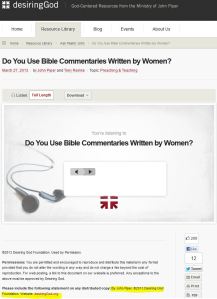
Christian men should NOT listen to a woman, of course, when she presses on men in an authoritative and a direct way. They must not listen to her even if she were telling them that they must listen to the podcast by John Piper linked below. That is too direct. That is too personal. That is contrary to the way God made us in biblical manhood and in biblical womanhood. That would be permitting a woman to teach or have authority over men. That would not be listening to the biblical man, Paul, writing to the biblical man, Timothy, and teaching all men. That would not be following I Timothy 2:12.
On the other hand, all Christian men reading this post should not be concerned when reading the following John Piper podcast transcription. Even if it were transcribed rather directly by the female hands of a woman, not to worry: the format “takes away the dimension of her female personhood.” All “writing” puts “her out of my sight,” oh man. Books written by biblical women are safe for biblical men to read from, to learn from, to quote from in a sermon. The same is true of this blogged transcription of the podcast, whether a woman typed it or not. Read on.
The John Piper Podcast Transcription:
A pastor writes in to ask – quote –
Pastor John,
Would a pastor who uses a biblical commentary written by a woman be placing himself under the biblical instruction of a woman. If so, would this not go against Paul’s instruction in I Timothy 2:12?It might be. Uh. He may feel it that way. And if he does, he probably’s not gonna read it. He shouldn’t read it. It doesn’t have. It doesn’t have to be experienced that way I don’t think. And here, here’s my reasoning.
The point of Paul in I Timothy 2:12 where he says, don’t permit, I don’t permit a woman to teach or have authority over men. That’s a key text. I Timothy 2:12. I don’t permit her to teach or have authority. And those two things together, I think, constitute the eldership office. Teaching and authority. And so there should be men – elders in the church, who are spiritual and humble and kind and loving and Christlike in their servant heart toward the men and women in the church.
So, I think the point of that text is not to say that you can never learn anything from a woman. That’s just not true. It’s not true biblically, and it’s not true experientially, because the reason for saying that I don’t permit a woman to teach or have authority over men here is not because she’s incompetent. It’s not because she can’t have thoughts. In fact, the women in your church, and the woman in, the woman you are married to, have many thoughts that you would do well to know. [laughs] And to know, and learn, and to learn from. And so the issue there is not that she doesn’t have thoughts that you wouldn’t benefit from. Or that she can’t, uh, teach you anything.
The, the issue is one of how does manhood and womanhood work. What is the dynamic between how men flourish and women flourish as God designed them to flourish when an act of authority is being exerted on a man from a woman.
And so I distinguish between personal, direct exercises of authority that involve manhood and womanhood.
Because it’s personal. She’s right there. She’s woman. I’m man. And I’m being directly, uh, pressed on by this woman in an authoritative way. Should she be doing that? Should I be experiencing that? And my answer’s, No; I think that’s contrary to the way God made us.
So those two words: Personal and direct.
Here, here would be an example of what I mean. A drill sergeant that gets in the face and says, Hut One, Hut Two, Keep Your Mouth Shut Private, Get Your Rifle Up Here, Turn Around Like I Said. I don’t think a woman ought to be doin’ that to a man – because it’s direct, it’s forceful, it’s authoritative, it’s compromising something about the way a man and a woman were designed by God to relate.
Uh. The opposite would be where she is a city planner. She’s sitting in an office at a desk drawing which street should be one way and which street should be two way. And thus she’s gonna control which way men drive all day long. That’s a lot of authority, and it’s totally impersonal, and indirect, and therefore has no dimension of maleness or femaleness about it, and therefore I don’t think contradicts anything that Paul is concerned about here.
So I would put a woman writing a book way more in that category of city planner than of a drill sergeant. So that the, the personal directness of it is removed. And the man doesn’t feel himself, and she wouldn’t feel herself, in any way compromised by his reading that book and learning from that book.
So that, that’s the way I’ve tried to think it through, so that, in society, and in in academic efforts, and in the church.
So that, that’s reading and benefitting from a woman’s exegesis in private.
Would you have any reservations about quoting from that commentary by a women in a public sermon?I just think that’s an extension of the same principle.
You know there, here’s truth. A woman saw it. She shared it in a book. And I now, I now quote it.
Uh. Because I’m not having a direct, authoritative confrontation. She’s not lookin’ at me, and, and confronting me, and authoritatively directing me, as woman. There’s this, there’s this interposition of this phenomenon called “book” and “writing” that puts her out of my sight, and, in a sense, takes away the dimension of her female personhood.
Whereas if she were standing right in front of me, and teaching me, as my shepherd, week in and week out, I couldn’t make that separation. She’s woman. And I am man. And she’s becoming to me my shepherd week in and week out, which is why I think the Bible says that women shouldn’t be that role in the church.
Thank you Pastor John. And thank you for listening to this podcast. Please email your questions to us…. I’m your host Tony Reinke. Thank you for listening.
The John Piper Podcast:
A Few Other Bloggers on the John Piper Podcast:
Rachel Held Evans, woman yes, but writing here [which takes away the dimension of her female personhood], so feel free to read on: “The Absurd Legalism of Gender Roles: Exhibit C – ‘As long as I can’t see her…’”
Henry Neufeld, a man, but how biblical can he be accusing John Piper, “Convoluted Reasoning on Women Writing Commentaries“?
Scot McKnight, also a man, if clearly lacking as an “exegetical gymnast” when posting “Using Commentaries by Women: John Piper’s Response“
Biblica kills online TNIV and NIV-1984
I am not a fan of the NIV and TNIV translations. But this shocks me:
In February, Biblica (the International Bible Society) officially killed all online versions of the TNIV and NIV-1984. (For some of you this may be old news, but I somehow missed this news when it originally came out, and was surprised to find this out today.)
The versions have been purged from BibleGateway.com. They have been purged from the Biblica.com website. Logos.com no longer stocks the older translations.
Apparently, the older versions are no longer needed – even though the Biblica website readily admits that while 450 million copies of the (T)NIV have been sold, only 11 million are of the new edition.
Now, here is the rich part. You’ll remember how Biblica and Zondervan decided to stock both the NIV-1984 and the TNIV simultaneously – seeing a need for both volumes. But now, in an Orwellian announcement it seems that the TNIV never even existed because there is “There is only one NIV.” (The irony is only increased since the year of the “disappeared” translation is 1984.)
The announcement makes a mention of the possibility that at some distant point in the future, Wheaton College may put some of the older versions online (“for research purposes”), although with restrictions (“access will be in accordance with the Wheaton College Archives & Special Collections guidelines.”)
The entire situation is absurd. The NIV has the best-selling English translation for decades. There are people who grew up reading the 1984 edition of the NIV. For better or worse, the translation has been influential. The TNIV never caught on the same way (it was never really supported by its publishers) but it certainly provoked serious discussion about English Bible translation. If it was not a commercial success, it was certainly an important milestone.
In fact, the TNIV is still in print at Biblica’s most important publishing partner, Zondervan. The brightest commercial success of the TNIV was Zondervan’s audio version with an African-American cast, The Bible Experience. There is no danger of that going out of print: there is still money to be made! The recording is actively being sold in digital and physical formats (and it even has a co-branded physical book in print.)
Zondervan will gladly sell you a TNIV concordance or an interlinear Greek New Testament with parallel TNIV text. And other publishers have TNIV-based titles in print: the TNIV-based Norton Critical Edition of Paul’s writings is readily available. You can even buy the NTIV in a parallel edition. (Analogous remarks apply to the NIV-1984, which remains in print in multiple editions.)
But online, the TNIV and NIV-1984 no longer exist.
Spooky.
Paul Tillich asks Martin Buber a question
I shared this anecdote over in a discussion thread at Nick Norelli’s blog; but I think some BLT readers might enjoy it too. It appears in David Novak’s Talking with Christians. It describes the relationship between Paul Tillich and one of Tillich’s most significant intellectual influences, Martin Buber.
I heard [this story] from someone who was in attendance at a lecture [Martin] Buber delivered at Union Theological Seminary in New York in 1952, during his first visit to America, a visit that made a profound impression on American intellectual circles. At the end of the lecture, Buber indicated that he would entertain questions from the audience. From the back of the crowded lecture hall, Paul Tillich arose and quite respectfully (as was his usual manner) addressed a rather complicated question to Buber. According to my reliable informant, Buber looked up from his text and said, “Ah, Paulus, it is you.” The he walked down the aisle and stood directly in front of Tillich, who was considerably taller than he, raised his index finger up at Tillich’s startled face and said, “Paulus, Paulus, you asked me the same question in Germany thirty years ago. Don’t you remember what I answered you then?!”
Forthcoming Book on Translating Finnegans Wake
 With the recent publicity over the Finnegans Wake translations recently into Polish and Chinese (first third of book only) being added to the existing translations in Dutch, French, German, Italian, Japanese (twice!), Korean, Portuguese, and Spanish, it is certainly timely for a book studying the approach translators have used towards Finnegans Wake.
Arguably, Finnegans Wake is already in a blended language, so perhaps an Esperanto translation is unnecessary, but clearly a translation into Klingon or Dothraki would be a nice addition.
Patrick O’Neill has studied translations of James Joyce’s works in his excellent Polyglot Joyce (review here) and promises to study the translations of Finnegans Wake in Impossible Joyce: Finnegans Wakes. The descriptions of the two books are interesting:
James Joyce’s writings have been translated hundreds of times into dozens of different languages. Given the multitude of interpretive possibilities within these translations, Patrick O’Neill argues that the entire corpus of translations of Joyce’s work (indeed, of any author’s) can be regarded as a single and coherent object of study. Polyglot Joyce demonstrates that all the translations of a work, both in a given language and in all languages, can be considered and approached as a single polyglot macrotext.
To respond to, and usefully deconstruct, a macrotext of this kind requires what O’Neill calls a “transtextual reading,” a reading across the original literary text and as many as possible of its translations. Such a comparative reading explores texts that are at once different and the same, and thus simultaneously involves both intertextual and intratextual concerns. While such a model applies in principle to the work of any author, Joyce’s work from Dubliners to Finnegans Wake provides a particularly appropriate and challenging set of texts for discussion. Polyglot Joyce illustrates how a translation extends rather than distorts its original, opening many possibilities not only into the work of Joyce, but into the work of any author whose work has been translated.
James Joyce’s Finnegans Wake has repeatedly been declared to be entirely untranslatable. Nonetheless, it has been translated, transposed, or transcreated into a surprising variety of languages – including complete renditions in French, German, Portuguese, Dutch, Japanese, and Korean, and partial renditions in Italian, Spanish, and a variety of other languages. Impossible Joyce explores the fascinating range of different approaches adopted by translators in coming to grips with Joyce’s astonishing literary text.
In this study, Patrick O’Neill builds on an approach first developed in his book Polyglot Joyce, but deepens his focus by considering Finnegans Wake exclusively. Venturing from Umberto Eco’s assertion that the novel is a machine designed to generate as many meanings as possible for readers, he provides a sustained examination of the textual effects generated by comparative readings of translated excerpts. In doing so, O’Neill makes manifest the ways in which attempts to translate this extraordinary text have resulted in a cumulative extension of Finnegans Wake into an even more extraordinary macrotext encompassing and subsuming its collective renderings.
Now, this all sounds very fun, but let me pose a question to you: is it more difficult to translate the wordplay in Finnegans Wake than other wordplay, for example, in Shakespeare? It is not at all obvious that it is (or should be).
I want to make another point about O’Neill’s “transtextual reading.” An analogy can be made between “transtextual reading” and the way that Jew or Catholics and Eastern Orthodox read Scripture. While there is a concrete Written Torah in Judaism (or Holy Scripture in Catholicism and Eastern Orthodoxy), it holds equal weight with the continually evolving Oral Torah (or, in Catholicism and Eastern Orthodoxy, Tradition). In this way, Judaism can be said to have a “transtextual reading” of Written Torah and Catholicism and Eastern Orthodoxy have a “transtextual reading” of Holy Scripture.
And what of Protestants? While they may hold to the principles of Sola Scriptura, they heavily depend on translations of Bible into vernacular languages (whereas Judaism prefers the original Hebrew, Greek Orthodox prefer the Septuagint and original Greek New Testament, other Orthodox also read the Bible in ancient translations [e.g., Slavonic], and pre-Vatican II Catholicism had a marked preference for the Vulgate). I’ve heard some Evangelicals express the believe that all (or almost all) Scriptural translations are inspired, so they too have a sort of “transtextual reading” to the extent that the believe that whatever inspiration exists in the original text is at least partially reflected in translation.
Moreover, this brings me next to James Kugel’s famous caustic criticism of literary readings of the Bible (such as Robert Alter’s celebrated project). (Alternatively, see Alan Cooper’s remarks.) Kugel admits that reading the Bible as literature may enriching in the same way that reading “midrash” has value (note that Kugel acknowledges Oral Torah, but is ultimately dismissive of its ultimate value) but should not be mistaken for a description of what the Bible is actually doing. Kugel argues that literary of readings of the Bible project generic categories (poetry, comedy, etc.) and aesthetic properties (ambiguity, irony) from our own age that are alien to the culture that produced the Bible. By analogy, for Kugel, presumably, Joyce’s original Finnegans Wake should stand alone, and we should not acknowledge that perhaps a majority of the worlds readers of Finnegans Wake will read it in (what are ultimately adaptive and interpretive) translations.
In the case of Joyce, Kugel’s approach clearly fails. Even for those of us who read Finnegans Wake in English, the wordplay and complexity of the text require that each of us bring a different “transtextual reading” to Finnegans Wake that takes into account our own personal linguistic and literary knowledge. Finnegans Wake is precisely designed so that my reading of it cannot be the same as your reading of it. If Kugel views Alter’s reading of the Bible as anachronistic, then of necessity, every reading of Finnegans Wake is necessary anachronistic.
Now for me, the remarkable thing about a position such as Kugel is that he does suppose (through his work as a scholar) that it is possible for a contemporary scholar to read the Bible in the way that the authors wrote it. To me, that seems to be a conceptual leap that goes far beyond Alter’s (and others) literary readings of the Bible.
If, as I posited above, it is as difficult to translate Shakespeare’s wordplay as Joyce’s, then perhaps we can believe it is even more difficult for a contemporary reader to understand the Bible in the same mindset as it was written than it is for us to understand Joyce’s Finnegans Wake in the same mindset as it was written.
I say, bring on the translations. Bring on the interpretations. Bring on the “transtextual readings.” And, as soon as it comes out, bring on Impossible Joyce.
1
2
3
4
5
6
7
————
* Above, here, the third and fourth translations (of the first and last stanza) are the same. However, the translator changes the original “English” name “Jabberwock” from the “French” “Jabberwoc” to the presumably more French “Bredoulochs.”
HarperOne’s Bible e-book sale
HarperOne has e-book versions of some of its Bibles on sale for $1.99 to $3.99 each through April 8th.
The Bible versions included are the NRSV (in four formats: with Apocrypha, Catholic Edition, without Apocrypha, and “Green Bible”), N. T. Wright’s The Kingdom New Testament, and the NABRE (which is the New American Bible with the 2011 revision to the Old Testament.)
E-book formats supported include Kindle, Nook, Apple iBook, Google book, and Kobo.
HT: Tim McCormick
Alter’s Latest Biblical Translations
Robert (Uri) Alter is continuing with his project to translate the Hebrew Bible into English using the literary principles he described in his Art of Biblical Narrative and Art of Biblical Poetry. (These books have been among the most successful academic publications of recent times; with The Art of Biblical Narrative selling close to 100,000 copies and being the subject of an entire issue of a notorious issue of Prooftexts in 2007.)
His latest volume is entitled Ancient Israel and is a translation and commentary of the former prophets (books of Joshua, Judges, Samuel, and Kings). My copy is in the mail (and I hope to share comments on it with this blog later); but I will be especially interested to see if Alter made revisions (“alter”-ations) to his earlier translation of the book of Samuel in his David Story.
To date, I believe Alter’s translation project encompasses the following:
Torah
- Genesis
- Five Books of Moses (Genesis, Exodus, Leviticus, Number, Deuteronomy)
Prophets
- David Story (Samuel)
- Ancient Israel (Joshua, Judges, Samuel, Kings)
Writings
- The Book of Psalms
- Wisdom Books (Job, Proverbs, Ecclesiastes)
Alter also wrote the Afterword to Ariel and Chana Bloch’s translation of Song of Songs (which I recommend buying only in its hardcover format; the paperback abridges the material somewhat); and in some ways, the Blochs’ translation is somewhat in the style of Alter’s technique.
So, using the traditional book division of the Hebrew Bible into 24 books, Alter has now translated 12 of the 24 books, and has given his “imprimatur” to a 13th. Let us hope more of his translations are forthcoming soon.
Odd Gospel Greek: love me three times
Love me one time
I could not speak
Love me one time, baby
Yeah, my knees got weak
But love me two times, girl
Last me all through the week
Love me two times
I’m goin’ away
— Jim Morrison, and The Doors
Ἐλυπήθη ὁ Πέτρος
ὅτι εἶπεν αὐτῷ τὸ τρίτον,
Φιλεῖς με;
Peter was grieved
because he said unto him the third time,
Lovest thou me?
— odd gospel Greek, and the KJV translation of John 21:17
When we come to the end of the non-syn-optic yet canonical gospel of John, we have already read about lots of love. What is notable in John 21:17 is there is a concentrated amount of it. There is love questioned and love repeated. The writer is telling, or rather is showing, the reader that Jesus had already asked Peter, and three times, “Lovest thou me?” The way the Greek reader gets it is Φιλεῖς με;
And, sure enough, the reader goes back to see what Jesus asked, three times:
λέγει τῷ Σίμωνι Πέτρῳ ὁ Ἰησοῦς, Σίμων Ἰωνᾶ, ἀγαπᾷς με πλεῖον τούτων; – 21:15
Λέγει αὐτῷ πάλιν δεύτερον, Σίμων Ἰωνᾶ, ἀγαπᾷς με; – 21:16
Λέγει αὐτῷ τὸ τρίτον, Σίμων Ἰωνᾶ, φιλεῖς με; – 21:17
And Peter’s consistent reply is “You know ὅτι φιλῶ σε.”
Now, if the writer had Jesus asking Peter, just two times, then that would have been something. And maybe a single word for the two times of love asking, and answering, would have sufficed. But here it’s “love me three times.” Doesn’t the style, the show of the questions of love, three times, go better with two different synonyms for love? Should I ask it again? And again and again?
Well, I’m really glad that some time ago at another blog, my BLT co-blogger Suzanne asked:
Should agape and philia be translated differently in the scriptures? Should we have a different translation for the two verbs in the exchange in John 21?
Her questions got me rereading a couple of other questions, ones asked in the Odyssey:
Why, my beloved child, has this intention come into
your mind? Why do you wish to wander over much country,
you, an only and loved son?
The answers, of course, are found elsewhere. Pardon me if I send you away to those other places, but, if you’re asking such questions about the three questions of love in John, and the question of two loves, and the question of the style of odd gospel Greek, then you’ll want to read more here, and perhaps here.
Odd Gospel Greek: a few notes on Μαρία ἡ Μαγδαληνὴ
Below are a few notes on Μαρία ἡ Μαγδαληνὴ and other Greek phrases in the 20th chapter of the gospel of John. The KJV is given [with a few, sometimes odd gospel Greek phrases interpolated]. The notes follow that.
—-
1 The first day of the week cometh Mary Magdalene [ἡ Μαγδαληνὴ] early, when it was yet dark, unto the sepulchre, and seeth the stone taken away from the sepulchre.
2 Then she runneth [Τρέχει], and cometh to Simon Peter, and to the other disciple, whom Jesus loved, and saith unto them, They have taken away the Lord out of the sepulchre, and we know not where they have laid him.
3 Peter therefore went forth, and that other disciple, and came to the sepulchre.
4 So they ran [Ἔτρεχον] both together: and the other disciple did outrun Peter, and came first to the sepulchre.
5 And he stooping down, and looking in, saw the linen clothes lying; yet went he not in.
6 Then cometh Simon Peter following him, and went into the sepulchre, and seeth the linen clothes lie,
7 And the napkin, that was about his head, not lying with the linen clothes, but wrapped together in a place by itself.
8 Then went in also that other disciple, which came first to the sepulchre, and he saw, and believed.
9 For as yet they knew not the scripture, that he must rise again from the dead.
10 Then the disciples went away again unto their own home.
11 But Mary stood without at the sepulchre weeping [κλαίουσα]: and as she wept [εκλαιεν], she stooped down, and looked into the sepulchre,
12 And seeth two angels [ἀγγέλους] in white sitting, the one at the head, and the other at the feet, where the body of Jesus had lain.
13 And they say unto her, Woman, why weepest thou [Γύναι, τί κλαίεις;]? She saith unto them, Because they have taken away my Lord [τὸν κύριόν μου], and I know not where they have laid him.
14 And when she had thus said, she turned herself back [ἐστράφη], and saw Jesus standing, and knew not that it was Jesus.
15 Jesus saith unto her, Woman, why weepest thou [Γύναι, τί κλαίεις;]? whom seekest thou? She, supposing him to be the gardener [ὁ κηπουρός], saith unto him, Sir [Κύριε], if thou have borne him hence, tell me where thou hast laid him, and I will take him away.
16 Jesus saith unto her, Mary. She turned herself [Στραφεῖσα], and saith unto him, Rabboni which is to say, Master [Ἑβραϊστί Ραββουνι ὃ λέγεται, Διδάσκαλε].
17 Jesus saith unto her, Touch me not [Μή μου ἅπτου]; for I am not yet ascended to my Father: but go [πορεύου] to my brethren [τοὺς ἀδελφούς μου], and say [εἰπὲ] unto them, I ascend unto my Father, and your Father; and to my God, and your God [τὸν πατέρα μου καὶ πατέρα ὑμῶν, καὶ θεόν μου καὶ θεὸν ὑμῶν].
18 Mary Magdalene came and told [ἀπαγγέλλουσα] the disciples that she had seen the Lord, and that he had spoken these things unto her [ταῦτα εἶπεν αὐτῇ.].
19 Then the same day at evening, being the first day of the week, when the doors were shut where the disciples were assembled for fear of the Jews, came Jesus and stood in the midst, and saith unto them, Peace be unto you.
20 And when he had so said, he shewed unto them his hands and his side. Then were the disciples glad, when they saw the Lord.
21 Then said Jesus to them again, Peace be unto you: as my Father hath sent me, even so send I you.
22 And when he had said this, he breathed on them, and saith unto them, Receive ye the Holy Ghost:
23 Whose soever sins ye remit, they are remitted unto them; and whose soever sins ye retain, they are retained.
24 But Thomas, one of the twelve, called Didymus, was not with them when Jesus came.
25 The other disciples therefore said unto him, We have seen the Lord. But he said unto them, Except I shall see in his hands the print of the nails, and put my finger into the print of the nails, and thrust my hand into his side, I will not believe.
26 And after eight days again his disciples were within, and Thomas with them: then came Jesus, the doors being shut, and stood in the midst, and said, Peace be unto you.
27 Then saith he to Thomas, Reach hither thy finger, and behold my hands; and reach hither thy hand, and thrust it into my side: and be not faithless, but believing.
28 And Thomas answered and said unto him, My Lord and my God.
29 Jesus saith unto him, Thomas, because thou hast seen me, thou hast believed: blessed are they that have not seen, and yet have believed.
30 And many other signs truly did Jesus in the presence of his disciples, which are not written in this book:
31 But these are written, that ye might believe that Jesus is the Christ, the Son of God; and that believing ye might have life through his name.
1 Magdalene [ἡ Μαγδαληνὴ] – The first time the gospel uses this proper-noun phrase to identify this particular Miriam is just a few sentences earlier, when there is the scene of a few named women around the cross of Joshua. Readers of this non-synoptic gospel (without the syn-optics) would not necessarily know anything about her prior to this mention.
2 she runneth [Τρέχει] – This is the first instance in the whole gospel of anybody running. She gets the two men she is talking with running (see v. 4 – they ran [Ἔτρεχον])
11 weeping [κλαίουσα]: and as she wept [εκλαιεν] – Another Miriam, the sister of Lazarus, wept in grief at his tomb in an earlier passage, perhaps a foreshadowing of what this particular Miriam would do around the tomb of Joshua.
12 angels [ἀγγέλους] – These two messengers are seen, not by the two disciples earlier when they peer in the tomb, but rather by this Miriam. She does the angelic message delivery to these men a bit later, so the Greek noun here and verb there [v 18] may be significant.
13a Woman, why weepest thou [Γύναι, τί κλαίεις;]? – This term for the woman is the one that Joshua uses for his mother Miriam, when he beholds her from the cross. Joshua does not use a gendered counterpart phrase [such as Ἀνήρ] when directly addressing the man with his mother standing by the cross. Why there is a marked term for women directly addressed is not clear. Joshua does verbatim repeat the angels’ vocative address to Miriam of Magdala in v 15.
13b my Lord [τὸν κύριόν μου] – Miriam refers to Joshua with the possessive pronoun, somewhat differently than when she addresses him directly as a stranger in v15 as Sir [Κύριε] .
14 she turned herself back [ἐστράφη] – The repeated action of turning herself shows agency and responsiveness to the angels, to Joshua in v16, and to their respective messages.
15 the gardener [ὁ κηπουρός] – Miriam’s mistake is reasonable given the context, the location of the tomb in a garden presumably and the first day of the work week. However, the gospel writer’s Greek is odd. This is a hapax legomenon, the only use of this word in all of the NT or the LXX. Readers may want to read Plato’s dialogue Minos [316e] where he has his Socrates some explicate gardeners’ laws, κηπουρικοὶ νόμοι. Is the gospel’s rare word here somehow alluding to this? Would a gardener be inclined to move a corpse as is suggested by Miriam’s address here to Joshua? How would a woman know this work of men? Is the writer just showing how the woman is merely speculating about the work or the action of the supposed gardener? Notice how she offers to remove the body if only this stranger allegedly supposedly having laid it somewhere would just tell her where it is.
15 Sir [Κύριε] – This is the address to the stranger. It is in contrast to Miriam’s more personal reference concerning Joshua, my Lord [τὸν κύριόν μου], in v13 when answering the angels about him.
16a She turned herself [Στραφεῖσα] – The repeated action of turning herself shows agency and responsiveness to the angels in v14, to Joshua in v16, and to their respective messages.
16b Rabboni which is to say, Master [Ἑβραϊστί Ραββουνι ὃ λέγεται, Διδάσκαλε] – Much secondary literature has offered copious commentary on this phrase. The KJV translators were working from MSs that lacked Ἑβραϊστί, which is a Johnnine term for a Hebraic language (whether Hebrew or Aramaic can’t be determined just by the Greekish word here). Ραββουνι is likely Greek-lettered Aramaic, an attempt to sound out what Miriam uttered in surprise. The Greek translation is given as Διδάσκαλε, which suggests a trainer in a school, a disciplined educator, in Greek contexts. The Hebraic and the Hellene terms are not literally or even dynamically equivalent. In the gospel of John, the other uses of the Greek term in the vocative perhaps only coincidentally have it associated respectively with some rabbinic rendering and with the context of judging a woman: Jn 1:38 and Jn 8:4.
The point the gospel narrative makes here is that a woman, this woman, sees herself as a disciple, a talmid, of this man, this rabbi.
17
Touch me not [Μή μου ἅπτου] – Of course the response from Joshua suggests that Miriam has been touching him or at the very least seems about to touch him. The very strange thing is that later on he invites the men to touch him even before his ascencion, which is the reason he gives to the woman to prohibit her touching him.
go [πορεύου] / say [εἰπὲ] – The woman is the first to be sent, the first evangelist, the first apostle.
to my brethren [τοὺς ἀδελφούς μου] – This sister is to evangelize the brothers.
my Father, and your Father; and to my God, and your God [τὸν πατέρα μου καὶ πατέρα ὑμῶν, καὶ θεόν μου καὶ θεὸν ὑμῶν]. – The KJV English cannot show the plurality of the pronoun ὑμῶν, which makes clear in Greek that Joshua is equating his Father, his God, with the Father and God of all the sisters and all of the brothers. The odd thing about the Greek language here is how it is a personal, anthropomorphic, familial universal identification with a god.
18
told [ἀπαγγέλλουσα] – The Greek verb here can be transliterated ap-angel-lousa, and implicitly it shows that the woman is functioning exactly as any angel would, to and for the men. She is the first to see the resurrected man and to tell the others about him.
he had spoken these things unto her [ταῦτα εἶπεν αὐτῇ]. – Joshua not only shows himself to this woman, making her the first witness, but he also speaks things to her, and her testimony to the others, to the male disciples, to the brothers, is how the good news is broken to them.
19 – 31
The woman disappears from the narrative at this point. No woman is included in the story through the rest of the gospel, which continues on beyond v31. The woman is not required to believe, as the men are; Joshua draws no attention to her belief or unbelief as he does to that of the men. The inference is that the woman’s witness and testimony to what she’s seen, touched, and heard has fallen flat on the men. The last verse, v31, seems to be directed at male readers. Even if it is more universal, a message of the need to believe for not only men but also for women readers, the Greek text here centers this woman, Miriam of Magdala, at the end of the story, as a key figure.
Odd Gospel Greek: drama around women around the cross
I just re-read Anne Carson’s translations of the Greek in An Oresteia: Agamemnon by Aiskhylos; Elektra by Sophokles; Orestes by Euripides. In one of these dramas, her English renders the following:
MENELAOS Yet it’s not surprising, given your crime.
ORESTES But I have one escape.
MENELAOS Don’t say death, that would be stupid.
ORESTES No I mean Apollo, who assigned me to kill / my mother.
That’s her translation of the not-so-odd Greek of Euripides.
But I’d been reading the gospel of John yesterday, and these four lines sent me back to that odd gospel Greek. I read chapter 19:25-27 as the following drama. My translation is first, and then that Greek.
—
There they were, standing by the cross of Joshua:
Mother of Joshua,
The sister of Mother of Joshua,
Miriam the wife of the man of K’lofah,
and Miriam of Magdala.
Joshua beheld them:
Mother
and Talmid, standing by, who was beloved
He declared to Mother of Joshua:
Woman behold:
Son of Mother of Joshua
Then he declared to Talmid:
Behold:
Mother of Talmid
From that Hour he
took her,
Talmid did,
as his own Mother
εἱστήκεισαν δὲ παρὰ τῷ σταυρῷ τοῦ Ἰησοῦ,
ἡ μήτηρ αὐτοῦ,
καὶ ἡ ἀδελφὴ τῆς μητρὸς αὐτοῦ,
Μαρία ἡ τοῦ Κλωπᾶ,
καὶ Μαρία ἡ Μαγδαληνή.
Ἰησοῦς οὖν ἰδὼν
τὴν μητέρα
καὶ τὸν μαθητὴν παρεστῶτα ὃν ἠγάπα
λέγει τῇ μητρί αὐτοῦ
Γύναι ἰδοῦ
ὁ υἱός σου
εἶτα λέγει τῷ μαθητῇ
Ἰδού
ἡ μήτηρ σου
καὶ ἀπ’ ἐκείνης τῆς ὥρας
ἔλαβεν αὐτὴν
ὁ μαθητὴς
εἰς τὰ ἴδια


 BLT
BLT