Bloomsday 2013 recordings
Happy solstice.
2013 June 16th was a great Bloomsday – the traditional day for celebrating and reading James Joyce’s Ulysses (the novel is set on 1904 June 16th).
The New York Times had a great piece on Bloomsday memories, here are two of my favorites (slightly censored):
The novelist Colm Toibin recalled a June 16 several years ago when he took a break from working at home in Dublin to food shop. Forgetting it was Bloomsday, he came across a group of literary celebrants outside a pub. “I had two plastic bags of groceries,” Toibin said. “When the crowd asked me who I was, I expressed puzzlement. They presumed I was masquerading as a character from the book, and were trying to think who had two bags of groceries in Ulysses. In the end, I used a term with which Joyce might have not been familiar — I called them ‘a shower of […]’— and slowly made my way home and got on with my day’s work.”
Colum McCann, the author, most recently, of TransAtlantic, called Bloomsday “one of my favorite days of the year,” contrasting it with “all the crass paddywhackery” of St. Patrick’s Day. For the past 10 Bloomsdays, he has organized readings at Ulysses’, a pub in Lower Manhattan. “We stand out in the cobbled street and read parts of the novel, including the naughty parts from Molly’s soliloquy. You should see the look on the faces of the Wall Street crew as they walk past.”
Pacifica radio organized a terrific Radio Bloomsday, which can be downloaded here:
Part one
Part two
Part three
Part four
Part five
Part six
Note also the preview interview and music program (download here) that aired earlier that day on WBAI’s Next Hour.
Over at Symphony Space, despite the sad death of Isaiah Sheffer, his annual Bloomsday on Broadway celebration was held, and can be watched here (the video quality is poor, and the audio is mediocre, but it is still entertaining. Using Audacity I cleaned up the recording and transformed it into MP3.
And, in what I believe is a new (or at least quite recent) move, some are celebrating Blumesday instead of Bloomsday.
Here and here, I complained about the poor quality of Gregory Nagy’s “MOOC” online course on the Ancient Greek Hero.
Today, I received the newly published textbook that Nagy wrote for the (traditional) course he regularly teaches. Despite the poor quality of the online course, the printed book appears adequate (this is not a full review, as I have only read part of the book; but my initial impression is that it is a “two and half star” book out of four stars). This might at first appear to be surprising, since pre-publication versions of the book were available as part of Nagy’s online course.
So, how is it that a book can be adequate while the course is so poor?
I think that a few things account for it:
- Nagy’s online course has abysmal “homework” and “quizzes.” The book does not suffer from this problem.
- Nagy’s online course has distracting videos, which are rather over-produced. The book, of course, is a much more traditional affair.
- Nagy’s online course is not linear, but branches out in multiple directions (forums! videos! supplementary texts!); while a book is more linear. While being linear may seem like a restriction, for course learning, it has significant advantages.
But most of all, I think that there is something about the medium of reading online. We are taught to read and concentrate for hours with books, but reading online is necessarily distracting. It is nice to “unplug” and concentrate on a book; but that is not going to happen with an online course.
It is not about the nail
Questions: what can we learn from this video? What stereotypes does this video assume? Is it about the nail after all?
Have high school literature classes retrogressed?
The verdict is in from NPR: young people read crap. Another story from the same source: audiences have lost their manners. Yes, apparently NPR is so starved for news that it now imposing its judgment on middlebrow commuters across the land: the world is going to hell in a handbasket.
Lynn Neary’s “younger generation poised to be the most stupid ever” story is notable for being almost entirely based on anecdotal reports:
“Like I just read Anna Karenina … I plowed through it, and it was a really good book.”
Walter Dean Myers […] is surprised by his own fan mail. “I’m glad they wrote,” he says, “but it is not very heartening to see what they are reading as juniors and seniors.” Asked what exactly is discouraging, Myers says that these juniors and seniors are reading books that he wrote with fifth- and sixth-graders in mind.
[Anita] Silvey teaches graduate students in a children’s literature program, and at the beginning of the class, she asked her students — who grew up in the age of Harry Potter — about the books they like. “Every single person in the class said, ‘I don’t like realism, I don’t like historical fiction. What I like is fantasy, science fiction, horror and fairy tales.’ ”
Professor emerita of education at the University of Arkansas, [Sandra] Stotsky firmly believes that high school students should be reading challenging fiction to get ready for the reading they’ll do in college. “You wouldn’t find words like ‘malevolent,’ ‘malicious’ or ‘incorrigible’ in science or history materials,” she says, stressing the importance of literature. Stotsky says in the ‘60s and ‘70s, schools began introducing more accessible books in order to motivate kids to read. That trend has continued, and the result is that kids get stuck at a low level of reading.
Hold on a moment Sandra! First of all, why did you choose those words: “malevolent,” “malicious,” “incorrigible”? Bad week, perhaps? More to the point, these words show up all the time in science and history readings. Don’t believe me? Check it out at Google Scholar. In fact, those words show up regularly in the newspaper. (At the New York Times, there were four hits on “malevolent,” 621 hits (!) on “malicious,” and one hit on “incorrigible” in the last 30 days.)
The one piece of non-anecdotal evidence cited in this puff news piece is a citation to a report from Renaissance Learning that claims
In conducting our review of high school required reading from 1907 to 2012, we noticed a tremendous amount of change, with very few titles demonstrating staying power by authors not named Shakespeare. Also, the complexity of assigned texts has sharply declined, from about 9.0 in the early 20th century to just over 6.0 in the early 21st century.
Now this is just silly. First, there is no good test of reading complexity. As an example, Renaissance Learning claims that Alice in Wonderland is at the 7th grade reading level – but I first encountered the book long before I was in 7th grade (as I think many people have), and I most recently read the book six months ago. I still get something out of reading Alice in Wonderland. Second, the sampling was not representative. But third, the methods used to track reading materials in 1907, 1923, 1964, 1989, and 2010 and in this most recent survey were wildly different. In fact, there is wide variation between the cited 2010 study [Stotsky, Traffas, Woodworth] and the current 2012 study. (Yes, that is the same grumpy Sandra Stotsky who was quoted for the NPR story.) If these studies were even slightly comparable, one would have expected a greater degree of agreement between the Stotsky et al. and Renaissance Learning reports.
Amazingly, despite the breathless prose of most of the Renaissance Learning report (and Neary’s wildly irresponsible story), Renaissance Learning acknowledges that these studies are not comparable:
Caveats
Please note: Caution should be exercised in making inferences about the changing nature of assigned texts over time, because for the most part, the surveys involved different methodologies, instruments, and target populations. Only Applebee (1989) sought to replicate Anderson’s (1964) methods. Furthermore, only the Anderson (1964), Applebee (1989), and Stotsky et al. (2010) studies attempted to create representative samples of U.S. high schools by creating stratified random samples. The other studies used samples of convenience, and two of those (Tanner, 1907 and Hudelson, 1923) were relatively small. Although the 2012 Renaissance Learning survey sample is fairly sizable and broad in geographic terms, it is a convenience sample of Accelerated Reader users and may not be representative. If all of the instruments and methods had remained consistent over the years, the results presented here may have been different.
Caution is out the window though, as Renaissance then proceeds to draw all sorts of dire conclusions from its dubious data.
Lynn Neary claims:
But in 1989, high school students were being assigned works by Sophocles, Shakespeare, Dickens, George Bernard Shaw, Emily Bronte and Edith Wharton. Now, with the exception of Shakespeare, most classics have dropped off the list.
How misleading! According to the 2010 study, Sophocles, Dickens (two entries), and Shakespeare (four entries) were still among the 40 most assigned readings in high school. Meanwhile, a new heavyweight joined the list: Homer.
Besides the authors mentioned above, the new Common Core requirements which will influence curricula at high schools throughout the US include writings by Cervantes, Chaucer, Dostoyevsky, Kafka, Melville, and Voltaire.
I fail to see any support whatsoever for the conclusions being promoted by Neary.
Perhaps her strongest point is to mention that The Hunger Games was the most popular book last year among youth. However, I suspect that most observers would consider The Hunger Games to be sophisticated literature compared to the most popular book among adults last year: Fifty Shades of Grey.
Oh, and by the way, in case you were wondering, Lynn Neary’s puff piece weighs in at the sixth grade reading level, according to the sort of automated tools that Renaissance Learning used to conclude that high school literature levels have declined.
New Yorker on MOOCs
In a recent post in my series on the problem on MOOCs, I mentioned how bizarre the multiple choice questions in Gregory Nagy’s course CB22x: The Ancient Greek Hero have been. Now, I find from a perceptive in-depth report in the New Yorker that the multiple choice questions are purposely strange, because Nagy has a belief that these sort of questions are deeper than writing essays:
A little later, Nagy read me some questions that the team had devised for CB22x’s first multiple-choice test: “ ‘What is the will of Zeus?’ It says, ‘a) To send the souls of heroes to Hades’ ”—Nagy rippled into laughter—“ ‘b) To cause the Iliad,’ and ‘c) To cause the Trojan War.’ I love this. The best answer is ‘b) To cause the Iliad’—Zeus’ will encompasses the whole of the poem through to its end, or telos.”
He went on, “And then—this is where people really read into the text!—‘Why will Achilles sit the war out in his shelter?’ Because ‘a) He has hurt feelings,’ ‘b) He is angry at Agamemnon,’ and ‘c) A goddess advised him to do so.’ No one will get this.”
The answer is c). In Nagy’s “brick-and-mortar” class, students write essays. But multiple-choice questions are almost as good as essays, Nagy said, because they spot-check participants’ deeper comprehension of the text. The online testing mechanism explains the right response when students miss an answer. And it lets them see the reasoning behind the correct choice when they’re right. “Even in a multiple-choice or a yes-and-no situation, you can actually induce learners to read out of the text, not into the text,” Nagy explained. Thinking about that process helped him to redesign his classroom course. He added, “Our ambition is actually to make the Harvard experience now closer to the MOOC experience.”
Interview with Ada Palmer, historian and author/composer of Sundown: Whispers of Ragnarok
As I wrote a few weeks ago, Sundown: Whispers of Ragnarok is a song cycle, an album, and a musical play that retells the history of the world according to Norse mythology, focusing especially on the relationship between Odin and Loki, and the death of Baldur. The Sundown Project is the work of Sassafrass, a singing group of mostly women performing original a capella pieces that weave together multiple lyrical and musical lines set in close harmony, mostly with fantasy, mythological, and science fiction themes. Take a listen to part of the finale, Longer in Stories than Stone:

Ada Palmer (as Loki)
The premiere of Sundown at Balticon over Memorial Day weekend was a great success, and Ada Palmer, the author and composer of Sundown, graciously agreed to be interviewed about some of the historical, literary, and translation issues behind the work that would be of interest to our readers.
BLT: Can you situate the eddas for us in context: when, where, and under what circumstances were they written? Do we have a sense of the social settings for which the oral predecessors of these texts would have been composed?
Ada: Viking cultures in the Middle Ages had a strong tradition of public performance of poetry. Myths and histories were set to complicated meters, and performed by skalds, poets most of whom were courtiers in the employ of lords and kings, who wanted them to immortalize their names and deeds in verse. Skalds would perform at courts and public gatherings; they may have been accompanied by instruments but it is uncertain. Memorization and the ability to speedily regurgitate complex information in quiz-like riddle contests were highly prized, so verses were transmitted orally. As is common in such situations, the poems were written down only late, when the keepers of the tradition felt threatened by changes and foreign incursions, in the form of the advance of Christianity.
The Poetic Edda (also called the Elder Edda) collects verses, many fragmentary, difficult to date and certainly composed at different times, but probably before the 10th century, but they may have been transmitted for centuries before then. The Prose Edda (or Younger Edda) was composed by Snorri Sturlson (1179-1241), a very late skald and political figure prominent in the last days of the Icelandic republic just as it fell under the control of Norway.

Snorri Sturlson, seated to the left of his nephew, who has come north to learn from his renowned uncle. Standing to the left is the Seeress. The dialogue among these three characters provides the framing story for the play.
Snorri wanted to preserve both the old stories and the methods for composing traditional poetry. The primary part of his book depicts a riddle contest between Gylfi and Odin in disguise, which reviews many myths and names and comments on excerpts from the Poetic Edda; the second half explains the techniques and meters of Icelandic poetry, with numerous detailed examples.
BLT: How do the prose and poetic eddas differ from each other? Can you compare them with some other texts with which our readers might be familiar?
Ada: Neither Edda really resembles the familiar epic poem tradition. The individual poems in the Poetic Edda are mainly no more than sixty short verses, and many have long sections missing. Some tell stories, while others are lists of advice, or lists of spells. The meaning of the poems is often opaque as well because they are filled with kennings, poetic ways of referring to objects and people, such as “swan-road” for the sea, or “he whom all gods hate” for the Fenris wolf. The bulk of Snorri’s book is a competition in which the characters try to stump each other with mythological questions, a framing story which strings together stories and facts. Both are quite meandering, presenting puzzle pieces rather than a narrative. If you can imagine trying to piece together a history of the Roman gods from the brief and out-of-order stories told in Ovid’s Metamorphoses, or a contiguous history of England from only the parts depicted by Shakespeare with no other help, you can understand how challenging it is to stitch together a coherent story of the Norse cosmos from the Eddas and the few glimpses we have from other sagas.
BLT: Tell us a bit about the issue of contamination, and the implications for understanding these texts.
Ada: We will never be able to detangle all the contamination in the Eddas. They were drafted very late, after a great deal of interaction with southern influences. This issue is amplified by the fact that Vikings traveled far more widely than many people imagine. In addition to raiding the British Isles and France, Vikings sailed down rivers deep into Russia, down to the Mediterranean, and we have records of Vikings in the Holy Land during the First Crusade. A glance at the beginning of Snorri’s Edda, where he explains that Thor was king of Troy, instantly shows how deeply things are tangled. The elements where the possibility of contamination is most intriguing lie in the similarities between the Crucifixion and the stories of Odin hanging himself on the tree, and of Loki and the murder of Baldur. The fact that Baldur’s birthday was celebrated Dec. 25th is particularly striking. Etymological evidence shows Loki in a more positive role in early myths, possibly identical with Odin’s brother Lodur, and if so his transformation from trickster in some myths to evil traitor in others may reflect the arrival of the Satan narrative. When dealing with texts from the twelfth century containing stories that evolved over the centuries beforehand, from a culture that experienced frequent and repeated contact with Christianity over that entire period, it is impossible to tell whether individual similarities were generated when stories absorbed Christian ideas, or whether the stories evolved from them like a game of telephone, or whether the similarities are chance, or derive from some even older archetypes in European mythology.
BLT: You mentioned that while Christianity struggles with the problem of evil, the Norse myths face a rather different issue. Tell us about that.
Ada: Christianity and the Greco-Roman religions emerged around the Mediterranean, where life was basically good: the climate is comfortable, the earth is fertile, and there is an abundance of plants and animals for food. In these surroundings, where the world was basically good, the gods too are conceived of as basically good, thus giving rise to the question “if the gods are good, then why is there evil in the world?” But in the far north, where Viking culture emerged, the world was a very different place: the earth is more often frozen than not, plants and animals are rare, and even the gods have to fight and scheme for survival in a fundamentally inhospitable cosmos. In Norse cosmology, the basic elements of creation are ice and fire: dangerous elements that are intrinsically hostile to life. In such a world, the basic question that emerges isn’t “why is there evil in the world”: it’s “why is there anything good in the world at all?”
BLT: In what language were the eddas written? Is that language still spoken and/or written today? If we learned our Nordic runes from the Futhark song, what would we be able to read with them?
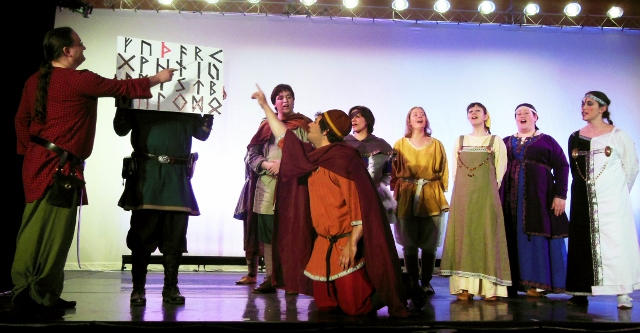
Ada: The Eddas are in Icelandic. As with any living language, the modern form of Icelandic differs from its medieval ancestor, much as modern English differs from Chaucer. The Runic Alphabet as taught in the Futark song is very archaic. It was used for writing (from around 150 to 800 AD, and some variants as late as 1200 or 1500) but it was already fading out of use, displaced by the Roman alphabet, by the time the surviving manuscripts of the Eddas were written. Thus even the Codex Regius is in Roman script, with a few special characters (like Thorn). In the modern era, reading the Runic alphabet is mainly useful for reading runic inscriptions on tomb markers and other runestones which survive in many parts of Northern Europe touched by Viking cultures.
BLT: From what translations did you work? Did you do any of your own translations from the original language?
Ada: I have never studied Icelandic but I have studied some related languages, and Icelandic shares some roots with English, so if I have several translations in hand it is easy to cross-compare them with the Icelandic and identify the meaning and nuance of each word. Thus, if I want to quote a passage directly, I usually work by comparing many translations, and then developing something of my own. My favorite translation of the Poetic Edda is the Carolyne Larrington translation. I have no favorite for the Prose Edda.
BLT: What literary or poetic techniques, sonic effects, wordplay, or allusions are characteristic of the eddas? Did you try to find a way to render such language-play in Sundown, either in the text or in the musical composition?
Ada: The poetry in the Eddas is very compact, with short lines and a strict scheme using patterns of syllables and consonants more complex than simple rhyming. It also uses a lot of very periphrastic language, referring to things by titles instead of names. Both these things make eddic language rather opaque, so I didn’t want to imitate it closely in music intended to help people understand the stories in a digestible way. One thing I do that reflects the language somewhat is my frequent use of half rhymes and imperfect rhymes. I end lines with words with the same type of sound but that very frequently aren’t proper rhymes in the English sense. This gives the music a sense of pattern and regularity that is different from standard English rhymed poetry, and in which the beginnings of words and the patterns of what is in them is as or more important than the ends of the words. That’s what produces lines like:
“Ice and fire,/ ice and terror,/ ice and murder,/ mixing with the/ ice and fire/ ice and horror/ ice and hunger/ warring with the ice.”
When examined directly it’s clear that “simple” and “equal” don’t rhyme, nor do “rule” and “you” but they work when the rhythm and structure of the music are behind them.
BLT: There’s a bit in the play where Snorri starts to expound on the etymology behind Loki’s name, but he gets hushed by the other characters. Tell us about that.
Ada: The word “Logi” means wildfire, and a being called Logi (which might be Loki in disguise) appears in the Utgardsloki myth. Linguistic shift means that G often turns into K over time. Separately, Lodur is Odin’s brother responsible for creating the warmth of the human body. Lodur, Odin and Hoenir are the three brothers, but Lodur drops out of the myth and pretty-much never appears after the creation, but there are several stories of Loki, Odin and Hoenir traveling together. Loki seems to take Lodur’s place, or it could be that they were originally one figure which branched into two as Loki absorbed more of the “evil brother” notions and eventually was turned into a blood-brother. Lodur and Loki are less etymologically bound, but Logi as heat and Lodur as heat does form a vague connection. In addition, Loki has two Jotun brothers, one of whom is called Helblindi, which is one of Odin’s names. Are these figures the same? No. Are they mythologically and etymologically tangled? Very.
BLT: There are bits in Sundown that are very funny. How much humor is there in the original?
Ada: There is humor in the originals, though it’s not easy to tell which things are supposed to be funny and which aren’t. Humor doesn’t tend to last well over time, so it’s actually hard to answer that. There are many elements of the stories which are funny, and can be told aloud in ways that are very funny, but it’s difficult to tell whether we were intended to take them as funny, and there are probably other bits that are jokes we don’t get. One example is the story of Thor and Loki traveling to the hall of Utgardsloki, where Thor gets tricked repeatedly, and it can be told in a way that’s hilarious, but Snorri introduces it by saying it’s a story we usually don’t tell because it’s rude to talk about Thor looking foolish. Similarly I’ve had delightfully hilarious times reading the Lokasenna aloud, the section of the Poetic Edda where Loki is drunk and insulting everyone, and with the right gestures and tone of voice it’s roll-on-the-floor funny, but it’s also a terrible argument between the gods in which Odin and Loki are torn apart and Baldur’s murder is revealed, dooming the world, so was it intended to be funny? Hard to say. I use humor because I find humor in the original stories, and also because when the tone is so dark you need some humor to pep you up from time to time. It’s also a fun way to make Snorri’s character endearing, and the points where there is humor between him and the Seeress about bits that are missing from the Eddas is my chance to remind the audience that there are holes in what we know without turning it into a boring lecture.
BLT: There are places in Sundown that seem to bring the Norse myths into conversation with 21st century sensibilities. That struck me as a form of cultural translation, providing a bridge between Norse culture and ours. Is that what you were doing?
Ada: Because my audience consists of modern people with modern knowledge, assumptions and beliefs, it is impossible not to create a dialog between this era and the Viking one when I present these stories. None of us can look at how Hel is treated without feminist issues popping up in our minds, nor the strife with Jotunkind without thinking of race relations, nor the way family members treat each other without the modern nuclear family in mind, rather than the family of the Viking era with its servants and slaves and vassals and inheritance tensions and hostages and all that. In the play I aim to bring as much of the Viking era to the fore as I can but then to invite people to think about it from a modern perspective, and to try to understand the differences between period mindsets and our own. No Viking of Snorri’s era would ever have thought Loki and Odin and Baldur and Hel felt as I have them feel in the play, but no modern person can look at the stories and not start asking the questions and feeling the tensions that I introduce. The goal is to present balance, and show that, while these feelings that the gods voice are not in the Eddas, they are authentic to the content of the Eddas as we can understand it now.
BLT: One of the heart-rending themes of the play is the anguished wondering of whether there really was no other way to resolve the conflict among the gods than the all-out war of Ragnarok. *Could* there have been another way? Is that even a fair question for us to ask of these texts?
Ada: Treating the texts as historical artifacts and as religious texts, it isn’t a reasonable question in many ways, since these are stories which evolved over time and whose structure was intended, not as entertainment, but as a way of explaining and understanding the world. We can ask “What about Norse culture made it feel right to them that there was no other way?” and thereby learn about the ethical and cosmological mindset behind the stories. However, from a modern standpoint, we think about the stories and characters as we would a modern piece of fiction, then it becomes an unavoidable question. Every piece of modern fiction based on the Norse Cosmos gets to take a different approach, and look at what other options might have been open. It’s easy for me to speculate about many different potential alternate ends for the Norse Cosmos. I didn’t explore any in Sundown, not because they don’t excite me, but because I intended this project to stimulate people to think about it themselves. I wanted to present the stories in the unfinished form in which we received them, and ask the question, so those who watch and listen can wrestle with the issue for themselves.
BLT: The costumes for the play had many period-accurate details. What can we learn from such artifacts, whether authentic or replicas, about the texts?
Ada: For me at least, the costumes remind me powerfully of how barren the world was, and how close to starvation Vikings often were. Viking clothing is generally extremely simple and practical. We are used to the lavish brocades and curving gowns and tailored doublets we associate with medieval garb, but Viking clothing is pretty basic, rectangles, the occasional triangle, everything loose so it can be worn over many years even if the body changes shape, and the materials are simple, wool, linen, so that stripes or simple embroidery are about as lavish as it gets.
A lot of people, when they first see the type of apron dress worn by Viking women, think it looks Native American, rather than European, because of something in its simplicity and aesthetic, and I like that reminder that medieval France is not the primary peer we should be thinking of when we look at Vikings. We tried to make the costumes for the chorus members (i.e. humans) be at a very realistic tech level, and use the duller dyes that were realistically available.
The gods are in lavish costumes, but lavish doesn’t mean silks and satin s and glittering golden cloth, it means red, blue, purple, fur trim, with embroidered decoration instead of simple woven trim, and a tiny touch of gold thread on Odin and Baldur. This is not a world of decadence. It is a world of survival, even for the gods.
BLT: The cast is made up mostly, but not entirely, of women. Is that simply an artifact of the group’s history, and/or is there some artistic significance?
Ada: That’s an artifact of the group’s history, and who has asked to join since. Sassafrass started at Bryn Mawr, a women’s college, which I attended, not because I cared about the single-sex environment, but because I wanted its great classics program. That meant the original members were female, and those who have joined since have been whatever friends happened to express an interest. That said, I do think about the fact that I’m working with mainly female voices when I design and cast songs. It’s very rare for composers to do much with the low alto range of female voices, since the tenor is preferred in the same range. That means that my music sounds a bit strange, almost foreign, compared with what we are used to hearing, and, while Vikings certainly didn’t have low female a cappella singing, it is good that it feels “different.” It also lets me do things like have Hel provide the base line for the pieces she sings with Odin, Loki and Baldur. If they were played by men, the female voice would have to be on top, but with all women she can be the bottom, which is eerie, and a reminder of her grim underground kingdom. It also means that I know there is a striking change whenever the male voice comes in, and I use it carefully, for moments like Gift of Life where he starts singing when humans are created, making the chorus suddenly feel full when the Earth is finally fully populated.
BLT: What’s next for the song cycle? Might you someday expand it with additional pieces to include more from the eddas? Or would that be a completely different project?
Ada: I do have a couple more Norse songs brewing in my mind: one about Thor and Mjollnir, one about Frey and Freya, one about witchcraft. I don’t know if they’ll mature – it usually takes six months to a year for a song to mature in my mind, often longer. If they do then we may occasionally perform an extended Sundown with one of them added in if they fit, or they may be separate. But with such a big project freshly complete, right now my focus is on recording and performing it, not yet on the next thing.
BLT: Thank you very much, Ada, for taking the time to share all this with our readers! It’s all fascinating, and Sundown is such a terrific project. We wish you the very best of luck with the recordings, and with all your work.
And let me remind our readers that it’s not too late to help support this ambitious project, and thereby preorder the audio and/or DVD recordings: the Kickstarter remains open for one more week. Although the Kickstarter quickly made its original fundraising goal and has reached several of its stretch goals, every dollar raised will make it more likely that it can be performed again – maybe in a city near you!
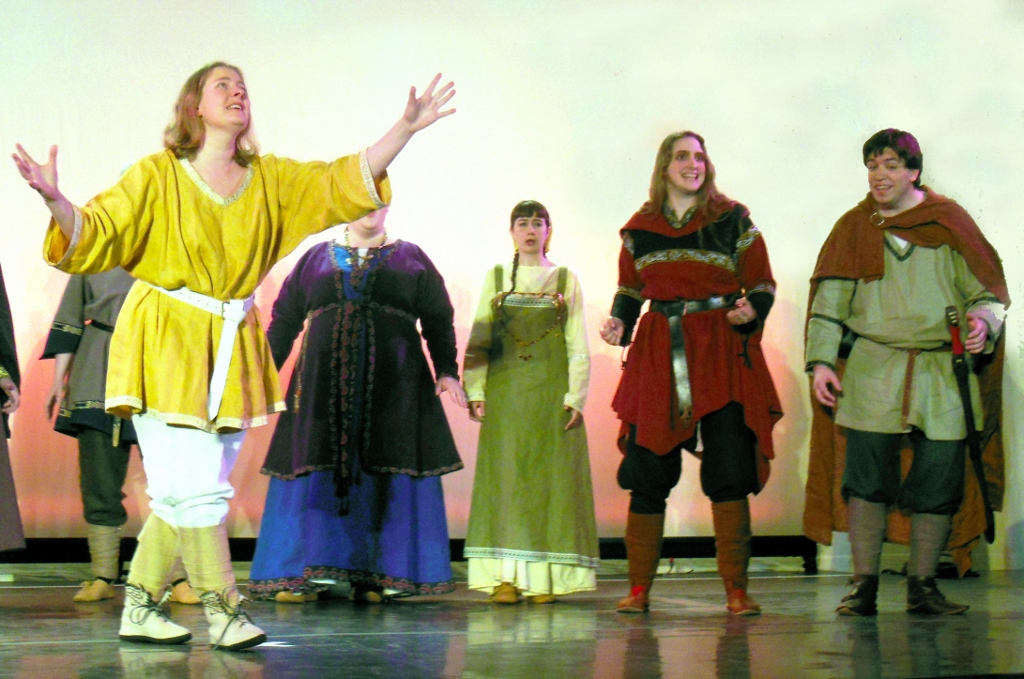
There are also more photos and music samples available from the Sassafrass website and Bandcamp page.
Ada Palmer is an historian, teaching at Texas A&M university. She works on the Italian Renaissance and on the long-term history of ideas, especially Machiavelli, and the relationship between religion, science, heresy, atheism and the classics. She does research in Europe, mainly at the Vatican Library; she also works extensively on mythology and literature, and on the history of books, technology, and costume. Her first scholarly book, on the reception of Lucretius, atomism and secular science in the Renaissance, is due out from Harvard University Press in 2014.
She has studied instrumental music including violin, piano, mandolin, guitar, recorder and various medieval instruments, but her compositions are primarily vocal. She completed the Peabody music theory program at Maryland Hall for the Creative Arts, and took advanced music theory courses at Simon’s Rock College of Bard. She has sung in numerous vocal groups, including the Bryn Mawr Renaissance Choir, which focused on original and unpublished fourteenth through sixteenth century pieces.
Ada also researches Japanese pop culture, focusing on early post-WWII manga, especially the “God of Manga” Osamu Tezuka, as well as gender in manga and anime, Japanese folklore, cosplay and otaku culture. She founded TezukaInEnglish.com, has published scholarly articles on manga, and done consulting work for publishers including ADV, Funimation and Tezuka Productions.
Recent Acquisition
Last weekend, I picked up a button/badge that says,
Lingua mortua sola lingua bona est
which is Latin for
“The only good language is a dead language.”
Tee-hee! I’m planning to wear it around bookstores, cafes, and the like, in hopes that it will function as a recognition signal for certain types of language geeks. 🙂
Interpretive Spins in the Ψαλμοὶ: Out of Aeschylus
In 2012, I wrote a series of posts on the literary sparks and the interpretive spins in the Hebraic-Hellene translation called “the Psalms.” From this Septuagint, we actually get this name “Psalms,” from the Greek word, Ψαλμοὶ. Quite literally, this means something like Pluckings or Strummings [as in the activity of a musician playing a stringed instrument while singing the lyrics of poetry].
In 2013, just today, I want to write a very brief post on some of Psalm 8.
I do not want to imply that there is not much to see in this Psalm or, consequently, that there must not be much to say about it. Rather, in my re-reading of it this morning, there came just a few things that sparked my attention for the first time. I recognized a few words from one of the plays of Aeschylus. This made me wonder whether the translator(s) might have been thinking of the Greek literature. Was the reader or listener being signaled to a larger or different context of some sort? Was there an attempt to place this poem in a particular genre of interpretation? We might only speculate.
And yet, on this particular Psalm, even only in the Hebrew original, there has been much much speculation over the years. In the very first line, for example, there is a Hebrew phrase that nobody knows today. גִּתִּית What does this mean? Robert Alter reads this (literally reads it aloud on National Public Radio) as “on the gittith.” Sometime later, when he’s published his English translation of the entire Psalm in his wonderful work, The Book of Psalms: A Translation with Commentary, he explains in a footnote: “This is another musical instrument that has eluded persuasive identification.” There has been so much elusion of identification of this Hebrew word that often the English translator looks to the Hellene, to the Greek, of the Jews in Alexandria, Egypt for possible clues to the meanings. Ann Nyland translates the Hebrew, like Alter does, as a transliteration (“According to the gittith“); but her footnote also explains her translation of the Greek translation of the Hebrew: “The Septuagint has, ‘… concerning the wine presses…’.” Then, in verse 5 of the Hebrew, there is אֱלֹהִים, which the King James Version translators make “angels,” presumably because the Septuagint has ἀγγέλους. Alter translates this “the gods” and offers a footnote on the possible meanings of “the ambiguous Hebrew”; and Nyland transliterates again (as elohim), explaining the following by a footnote: “a divine name, also used for rulers, heavenly beings, divine possessions. Not translated here as referent unknown.” We might go on at length about the gendered language in verse 5. We might see it somehow contributing to the debate Geza Vermes participated in, when writing “The Present State of the ‘Son of Man’ Debate,” a chapter in his book Jesus in His Jewish Context. (Regrettably, Vermes insisted that the phrase “‘the son of man’ [with the definite article] is not a Greek phrase, but Aramaic,” and he seems to have overlooked the fact that this Septuagint Psalm does indeed translate the Hebrew, not Aramaic, with the Greek, ἢ υἱὸς ἀνθρώπου, which the New Testament writers, especially the gospel writers, seem to flaunt.)
Let’s read the Psalm in Greek, before the New Testament context. What then do we see?
First, let’s just look at the entire Psalm in Greek. Then let’s read Albert Pietersma’s English translation of the Greek translation of the Hebrew. Then we might consider some of the literary spins and “nuggets” and “sparks” that seem to come out of the play of Aeschylus. (Although Pietersma is the one who mentions such nuggets and sparks in the translations into Greek, he does not identify them.)
1 εἰς τὸ τέλος ὑπὲρ τῶν ληνῶν ψαλμὸς τῷ Δαυιδ
2 κύριε ὁ κύριος ἡμῶν ὡς θαυμαστὸν τὸ ὄνομά σου ἐν πάσῃ τῇ γῇ ὅτι ἐπήρθη ἡ μεγαλοπρέπειά σου ὑπεράνω τῶν οὐρανῶν
3 ἐκ στόματος νηπίων καὶ θηλαζόντων κατηρτίσω αἶνον ἕνεκα τῶν ἐχθρῶν σου τοῦ καταλῦσαι ἐχθρὸν καὶ ἐκδικητήν
4 ὅτι ὄψομαι τοὺς οὐρανούς ἔργα τῶν δακτύλων σου σελήνην καὶ ἀστέρας ἃ σὺ ἐθεμελίωσας
5 τί ἐστιν ἄνθρωπος ὅτι μιμνῄσκῃ αὐτοῦ ἢ υἱὸς ἀνθρώπου ὅτι ἐπισκέπτῃ αὐτόν
6 ἠλάττωσας αὐτὸν βραχύ τι παρ’ ἀγγέλους δόξῃ καὶ τιμῇ ἐστεφάνωσας αὐτόν
7 καὶ κατέστησας αὐτὸν ἐπὶ τὰ ἔργα τῶν χειρῶν σου πάντα ὑπέταξας ὑποκάτω τῶν ποδῶν αὐτοῦ
8 πρόβατα καὶ βόας πάσας ἔτι δὲ καὶ τὰ κτήνη τοῦ πεδίου
9 τὰ πετεινὰ τοῦ οὐρανοῦ καὶ τοὺς ἰχθύας τῆς θαλάσσης τὰ διαπορευόμενα τρίβους θαλασσῶν
10 κύριε ὁ κύριος ἡμῶν ὡς θαυμαστὸν τὸ ὄνομά σου ἐν πάσῃ τῇ γῇ
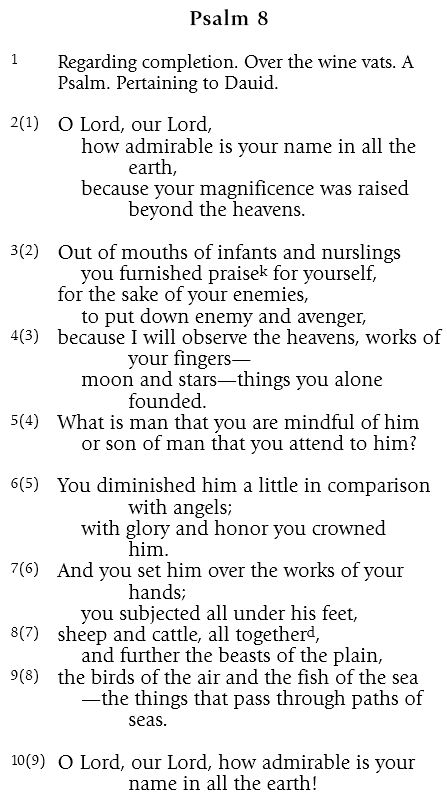
Now let’s focus on what jumped out at me this morning. It was something in the third verse (which in Hebrew is the 2nd). What is there? And why?
3
ἐκ στόματος νηπίων
καὶ θηλαζόντων
κατηρτίσω αἶνον
ἕνεκα τῶν ἐχθρῶν
σου τοῦ
καταλῦσαι ἐχθρὸν
καὶ ἐκδικητήν
The Greek declensions, the grammatical endings, form the rhymes. Roughly in English we might render that as this:
3
Out of the mouth of a child
And of a nurseling so mild
There is a praise so restyled
For an enemy reviled
By you
The enemy’s now reviled
And out of justice’s now riled
If the English of mine sounds a little forced, then please imagine that the Hellene representing the Hebrew sounds this way a bit too. Much much later, when the Greek gospel of Matthew has Jesus quoting the first these lines (exactly from the Greek Septuagint), there’s this odd exchange. The ones reviling him and trying to get him riled are asking rhetorically: “Do you hear what they are saying?” And the Greek writing Matthew has his Greek speaking Jesus having all (of us) Greek readers reading his reply: “Ναί οὐδέποτε ἀνέγνωτε”?! “Yes, have you never read“?! The implication is that they (and us) would read: ἐκ στόματος νηπίων καὶ θηλαζόντων κατηρτίσω αἶνον. It’s rather poetic in the Greek, and it’s certainly there with a flair:
Out of the mouth of a child
And of a nurseling so mild
There is a praise that’s restyled
But we are getting way too far ahead of ourselves. Yes, I was only wanting to show that at least somebody at some point looked back and considered this Greek poetry something to read. But I think we might go as far back as the plays of Aeschylus. What sparked my interest reading the Hellene translation of the Hebrew Psalm this morning was hearing in it this short exchange between Prometheus and Hermes in “Promethius Bound.”
Here is the English translation of Herbert Weir Smyth with the Greek of Aeschylus inserted within the brackets:
Hermes
Better, no doubt, to serve this rock than be the trusted messenger [ἄγγελον, angelon] of Father Zeus!Prometheus
[970] Such is the proper style for the insolent to offer insult.Hermes
I think you revel in your present plight.Prometheus
I revel? Oh, I wish that I might see my enemies [ἐχθροὺς] revelling in this way! And you, too, I count among them.Hermes
What! You blame me in some way for your calamities?Prometheus
[975] In one word, I hate all the gods [τοὺς πάντας ἐχθαίρω θεούς] that received good at my hands and with ill requite me wrongfully [ἐκδίκως, out of Justice].Hermes
Your words declare you stricken with no slight madness.Prometheus
Mad I may be—if it is madness to loathe one’s enemies [ἐχθροὺς].Hermes
You would be unbearable if you were prosperous.Prometheus
[980] Alas!Hermes
“Alas”? That is a word unknown to Zeus.Prometheus
But ever-ageing Time teaches all things.Hermes
Yes, but you at least have not yet learned to keep a sober mind.Prometheus
Or else I would not have addressed you, an underling.Hermes
It seems you will answer nothing that the Father demands.Prometheus
[985] Yes, truly, I am his debtor and I should repay favor to him.Hermes
You taunt me as though, indeed, I were a child.Prometheus
And are you not a child and even more witless than a child if you expect to learn anything from me? There is no torment or device by which [990] Zeus shall induce me to utter this until these injurious fetters are loosed. So then, let his blazing lightning be hurled, and with the white wings of the snow and thunders of earthquake let him confound the reeling world. [995] For nothing of this shall bend my will even to tell at whose hands he is fated to be hurled from his sovereignty.
In several of the plays by Aeschylus, the role of the Herald (or the one bearing news like an Angel) is important. Likewise, the gods are important. The agency of mortal humans to speak and the question of whether children in a family’s hierarchy have any agency is a minor part of the lines of the play I’ve quoted above. And the Greek phrases for enemies [ἐχθροὺς] and for wrongfully [ἐκδίκως, out of Justice] are chosen both by Aeschylus’s Prometheus and by the Septuagint translators’ David.
Now, before anyone too strongly objects that the LXX translator(s) couldn’t possibly have been thinking of the play(s) of Aeschylus, I’m just going to say again that very little of certainty is known yet of this Psalm, either in Hebrew or in its Hellene counterpart here. If nothing else seems obvious, then there does seem to be wordplay and poetry and literary nuggets and sparks and spins.
learning from … Memorial Day
Some twenty-eight black workmen went to the site, re-buried the Union dead properly, and built a high fence around the cemetery. They whitewashed the fence and built an archway over an entrance on which they inscribed the words, “Martyrs of the Race Course.”
Then, black Charlestonians in cooperation with white missionaries and teachers, staged an unforgettable parade of 10,000 people on the slaveholders’ race course. The symbolic power of the low-country planter aristocracy’s horse track (where they had displayed their wealth, leisure, and influence) was not lost on the freedpeople. A New York Tribune correspondent witnessed the event, describing “a procession of friends and mourners as South Carolina and the United States never saw before.”
At 9 am on May 1, the procession stepped off led by three thousand black schoolchildren carrying arm loads of roses and singing “John Brown’s Body.” The children were followed by several hundred black women with baskets of flowers, wreaths and crosses.
The above is from recent research of Yale historian David W. Blight. He is recalling the very first Memorial Day in the United States, calling it “unknown.” It is unknown, that is, “until some extraordinary luck” helped him uncover the facts.
What I want to highlight here are the facts of who. Who were these “twenty-eight”? How have they been so unknown? How is it that these and the other unnamed “several hundred” have not been remembered easily in the books of history, relatively recent history?
I’m asking these questions on Memorial Day 2103. I’m asking them some as a way to respond to a series of blogposts around a set of contentious blogposts earlier this month.
The series is over at the blog, Political Jesus. For some time now, my blogger friend and friend in real life, Rod, has been asking the very important question, “Can The Subaltern Blog?” In the most recent installment, he points us to blogger Caryn Riswald’s post, where she is calling out an ostensibly sexist blogger for his invitation to the Other, as his others: “If you are a Christian (or post-Christian, or non-Christian) feminist (or womanist), I hope that you will consider contributing a post [here at my, now-safe-and-uncensored, blog].” There’s a lot to take in here. It is worth, as Rod says, to read what Riswald says. I’m only going to repost a bit here for some context. But then I want to come back to Rod’s additional questions before asking some of my own.
In her post, “A Blog of Her Own,” Riswold is responding to “Fellow Patheos writer Tony Jones.” Now, Jones, he is a fellow. That is, he is a man trying to be seen as a male, as a Christian male, as a Christian male blogger, and as a white male Christian blogger, who has made his blog “safe” to visit, “If you are a Christian (or post-Christian, or non-Christian) feminist (or womanist).” Riswold, rather, suggests to Jones, who would bring a “feminist (or a womanist)” over to his blog, that there’s something, “Ick,” or “voyeuristic,” about his invitation. She, then, not only gives an invitation but Riswold also, to any and all who read her blog, issues this strong observation that “some of us” whom Jones is inviting to speak uncensored at his blog already have a blog of their own. She shows where Jones can go:
Here are a few links to religious feminist and womanist voices online. Comments are wide open for you all to post links to the many more that are out there. I’ll do a follow-up post with a fuller blogroll if I can:
You can also head on over to Dianna Anderson’s blogroll, or this Muslim feminist blogroll, or do your own quick searches for the religion or nonreligion of your choice….
Riswold issues this strong recommendation: SO READ THEM. She encourages, “and get busy reading. Do the work. It’s more than worth it.”
Now Rod reads what Riswold writes by inferring a number of questions asked:
Why should womanist and feminist Christians be concerned to “teaching” Jones and his audience what they are doing wrong? Why is this their responsibility, their burden to bear? Why should the experience of Jones and his audience be placed at the center? Isn’t that the problem to begin with?
Read all of Rod’s post here: “Can The Subaltern Blog? Part 3: On “Invitations” And Safe Spaces”
Rod does not out me as a male, a white male. But he has very kindly suggested that the “Rhetorical Listening” advocated by me, this white male, is important. As a white male, blogging here, I think I’ve already advised you here, O reader, whoever and whatever constructed race and sex you are:
If you like, you can read from your own position how Rod must do his “Reading [of] Rob Bell’s Velvet Elvis from the Margins.”
At that post where I gave you my advice, didn’t we also notice, from Rod, his own self-identities and where that left him reading Rob Bell, who assumes the unmarked (and therefore the no-reason-to-bother-anybody-with-his-maleness-and-whiteness) majority position; I think I said something Rod has had to contend with all of his life now (my emphases on my own words, which are Rod’s words for himself too):
This “black” scholar recently, for example, read a book by Rob Bell and noticed how the privileged author “denies his own whiteness, his own story as a …”
If you, reader, are having trouble keeping up with the rhetoric here, then let me try to summarize or at least highlight the rhetorical point I’m attempting.
“Black-ness” and “wo-manness” are marked categories of social construction.
When white male historian David W. Blight recalls the first Memorial Day, it is important that the “Some twenty-eight … workmen” and the “three thousand … schoolchildren” and the “several hundred … women” are all “black.” It is important to remember that because in white history, these have been forgotten until recently. Not one of us white folk know who these many many people were. We have forgotten not only their deeds but also their individual names. We only, now, can identify them by numbers of groups, “women” at the end of the procession, all of them “black.”
This is an important way to read, for example, Rob Bell. Why has he forgotten his whiteness? Rod doesn’t forget Rob’s “color” and he has remembered his name.
Then we come to Tony Jones wanting “feminist and womanist authors” to come to his blog. They will validate the fact that he, a male, is not a misogynist or a gynephobe or a sexist. Their coming (at least the womanists’ coming) will show the world that he is not a racist either. Notice how Tony does not say he is male, or white, because of course this must be assumed.
But what do we make of Riswold? Pardon my pun, but can Rod really give her a pass? She reads a black woman, quotes her, by saying:
I think this is one instance where I’m totally with Audre Lorde (okay, not the only one…):
Notice, nonetheless, that Caryn Riswold is self-idenifying as many things and among her many voices is included her blogger voice at http://www.patheos.com/blogs/carynriswold/, which is also named feminismxianity. For her engagement with Tony Jones, her “Fellow Patheos writer,” the categories shared with this “fellow” are white and Christian and writer. “The Master” is “Tony Jones” for “Caryn Riwold.”
But is she as such really listening to and attune to Lorde? The latter finds important these marked categories:
the crucibles of difference — those of us who are poor, who are lesbians, who are Black, who are older
How much of what Riswold wants to deconstruct of Jones is constructed on the backs of such marginalized peoples, so very very different?
How many of the “several hundred … women with baskets of flowers, wreaths and crosses” on the first Memorial Day only very luckily and very relatively recently recalled were “poor”? Were any “lesbians”? Were any “older”? Weren’t each and every one of them “Black”? And how important is their color if Riswold’s own color gets a pass? How if her economic class gets assumed and unmarked as middle or upper middle? How if her sexual orientation need not be named? How if she’s not “older”?
Rod kindly linked to a blogpost of mine where I a white male was describing what I had been learning from Jacqueline Jones Royster. In that particular post, I was quoting a number of powerful and profound sentences from Royster, historian. It is her history, her sisters’ history, their history together. I had not quoted from her very important essay, “When the First Voice You Hear is Not Your Own.” Now Rod has quoted this essay of Roysters when struggling to read Rob Bell:
Womanist understandings of human subjectivity, from writers like bell hooks and Jacqueline Jones Royster, teach us that acknowledging, affirming, and celebrating difference is essential to embracing the Stranger’s humanity.
In mentioning hooks and Royster, Rod is noticing their difference, from him. What Rod has learned from others who celebrate difference is not that difference is to be called on, at whim, by those who are at the center of their society. hooks, who is not Korean or Korean American, does describe an example of what can, and does too often happen, in situations of remembering and of learning and of teaching. In her book Teaching to Transgress, she writes:
Often, if there is a lone person of color in the classroom she or he is objectified by others and forced to assume the role of “native informant.” For example, a novel is read by a Korean American author. White students turn to the one student from a Korean background to explain what they do not understand. This places an unfair responsibility onto that student.
Who bears responsibility, then, in remembering the past?
My daughter, who is white, has been reading in her public school, in the South, in the United States, as an assignment, the novel The Help. The teacher is a female, a white person. The school is majority hispanic, latino/latina. What my daughter is only now coming to realize is that her own daddy (that would be me) was born to parents in the South, in the United States, before the Jim Crow laws were overturned. Her late grandfather (that would be my daddy) recalled to our family before he died the name of the help in our household in 1962 and 1963. As he fought terminal cancer, we would recall our earliest memories and the people who we first remembered. To him I recalled “Nancy,” and he quickly remembered her family name. He reluctantly admitted he never met her family. When reviewing the film “The Help,” I recalled some of this very recent history of ours; I wanted us to listen to bell hooks retelling, recounting, remembering. In writing this blogpost on Memorial Day 2013, I wish we could remember how we have forgotten. I believe our forgetfulnesses have all too often led to those material circumstances for others that neglecting our own differences (while looking only to the Other’s glaring and marked Differences) has caused. Here, in these United States, bell hooks has had to remember the daughters of those several hundred black women with baskets of flowers, wreaths and crosses.
With them, we do well to remember:
Their lives were not easy. Their lives were hard. They were black women who for the most part worked outside the home serving white folks, cleaning their houses, washing their clothes, tending their children — black women who worked …, whatever they could do to make ends meet, whatever was necessary. Then they returned to their homes to make life happen there. This tension between service outside one’s home, family, and kin network, service provided to white folks which took time and energy, and the effort of black women to conserve enough of themselves to provide service (care and nurturance) within their own families and communities is one of the many factors that has historically distinguished the lot of black women in patriarchal white supremacist society form that of black men. Contemporary black struggle must honor this history of service just as it must critique the sexist definition of service as women’s “natural” role.
Aren’t there a few things that may be worth remembering and learning from … Memorial Day.
blogpost wishlist
As my BLT co-blogger Theophrastus noted a few days ago, our “posting will be light” this month. We are definitely excited about a few things, and I’m glad my co-blogger Victoria posted about Sundown: Whispers of Ragnarok and then promptly updated as she got more news on it. Our other co-bloggers, Suzanne and Craig are away doing many other important things.
I myself am afraid I’m terribly busy with things in real life that take me away from writing blogposts. However, as if this might prompt me some day soon, here are the items I wish I could blog about:
- The Great Gatsy film (both in 2D and 3D) – I’ve seen both versions and disagree with most of the critics who have panned the novel’s movie adaptation that came out this month.
- The Book of Imaginary Beings by Jorge Luis Borges – It’s a translation into English by Andrew Hurley of the Spanish originals: Manual de zoología fantástica (“Handbook of Fantastic Zoology”) and then El libro de los seres imaginarios. The whole effort is fantastic as both a rendering from one language into another and also a re-editing of two originals as a third original by the original author with all of his intentions. And then there’s the content and the rhetoric of Borges to talk about.
- A Tale for the Time Being by Ruth Ozeki. This is one of the best novels I’ve read in a long long time. It is part history; part loose autobiography; interwoven stories told by various protagonists in multiple voices and media; mostly English, much varied Japanese, and some literary and some vulgar French; science and religion; East and West; male and female. I’ve both read the book and listened to Ozeki reading the audiobook version. I highly recommend either or both, and I’d love to blog a review.
- Political Jesus has posted its third in a series asking, “Can The Subaltern Blog?” Rod has kindly included something I’ve blogged some time ago, and I would love to comment at length on his asking these important questions he’s asking.
Thanks for being patient as we get to the BLT blogposting.
Sundown: Whispers of Ragnarok
I’m terrifically excited about the Sundown project, and I figured a number of BLT readers would be as well. After all, where else can you possibly find
Viking-themed a cappella music telling stories of the Norse Gods, focusing on Odin, Loki, the murder of Baldur, and Snorri Sturlson.
Historian and composer Dr. Ada Palmer has set English translations of these Norse eddas to beautiful, complex a capella music, beautifully performed by the filk group Sassafrass under her direction.
I have heard Sassafrass before, and they are fabulous. Their vision for this project is terrific: not just a CD of the song cycle, but a play performed in period costume, with storytellers to link the songs together. They’re raising money now via Kickstarter to support a CD, a live performance, and a professional videorecording of the performance to be made available on DVD. Watch the video below to hear Ada’s enthusiastic pitch for the project, as well as some background and previews.
Then consider tossing in a few bucks (or more… check out those donor gifts) to help bring this unusual creative vision to fruition.
(Don’t see a video? Click on this link instead.)
UPDATE: Wow, they made their minimum goal in less than 2 days! That’s exciting. But it’s still worth pitching in a few bucks because
At $8,000, our composer Ada Palmer will add several pages of notes to the libretto discussing Viking culture, Norse mythology, and the ideas behind the songs. At $9,000, we will expand the libretto even further, with more notes and a better binding.
At $10,000, Nebula- and Hugo-award winning author Jo Walton, friend of the group, will compose an Odin-themed poem set in the world of Sundown: Whispers of Ragnarok, and post it for free on her Livejournal! At $14,000, Jo will respond to her Odin poem with a Loki poem, which will ONLY be available in an update sent to backers!
Oh, and they just put another update out:
We’re actually already very close to our first stretch goal of $8,000! If we reach that goal, Ada will expand the libretto with several more pages of explanatory notes. (The libretto is available as a backer reward and will also be for sale in the future.) She’s already written a brief Author’s Note on the play’s sources, its historical context, and its cosmology . The additional notes could concern any of a variety of topics, ranging from “The Eddas, Their Origins and History” to “The Allfather’s Names” to “The Elves and Vanir and why we don’t know anything about them”. We’re considering opening the choice of topic up to YOU, our backers! If we do this, we would ask for suggestions of topics you’d like to know more about, and hold a vote to determine which ones make it into the final product. We also may make the extra notes available to some backers, so that this isn’t just of interest to those who are getting the libretto. Does this sound interesting to you? Already got ideas for topics? Let us know what you think in the comments!
So be a supporter, and help bring Viking culture and Norse mythology to the masses (and get some for yourself, too)! 🙂
Brief hiatus
First, a happy Shavuos (celebrating the giving the of the Torah at Mt. Sinai) to all those celebrating and a happy Pentecost (celebrating the Holy Ghost descending on the early Christian apostles) to all those celebrating.
These holidays are sometimes celebrated through study, and especially to those of you who are studying, I wish that you enjoy full fruits of your study and that your study brings understanding and wisdom.
I’m going to try to be offline through the end of the weekend, and I think several other BLT bloggers are travelling or occupied this week, so posting will be light – but I look forward to resuming our exchange of ideas here soon!
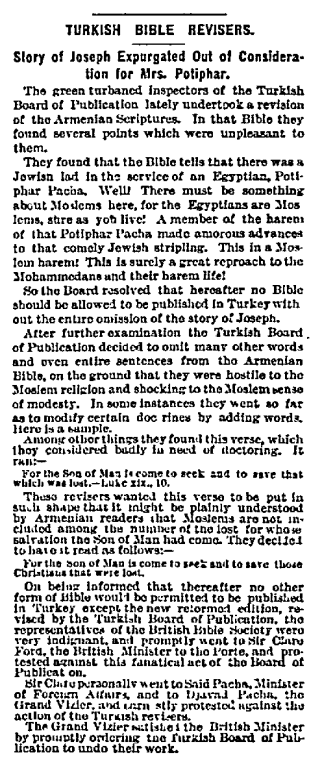
To amuse you until we return with our regularly scheduled programming, here is an article from 1893 dug up by the formidable blogger who goes by the pseudonym Mississippi Fred MacDowell, on a proposal by the Turkish Board of Publication to remove the story of Joseph from the Armenian Scriptures “out of consideration for Mrs. Potiphar.” MFM is careful to point out:
It must be noted – since not everyone reads to the end – that on protest by the British, the Grand Vizier reversed the order.
Geoguessr: An addictive Internet geography game
Geoguessr is an Internet game in which you are plopped somewhere in the world – with only Google Street View to guide you. You need to look around and try to guess where you are. It is surprisingly fun – and even a bit addictive.
“and may the change abound”: RIP Dallas Willard
Dallas Willard passed away this morning after battling cancer. His last words were, “Thank you.”
Many of his words, I think, are going to have a lasting impact on a lot of us. For many Christians, he’s a speaker and author who has critiqued the church and has promoted life transformation in the most positive ways. For many college students and philosophy colleagues, Dr. Willard is one who got them interested in phenomenology and particularly in how Edmund Husserl founded phenomenology. For readers of Husserl’s works, he is their translator.
For me, Dallas Willard is one who helped me engage ideas with my own father. The two men went to college together and took a course in Logic together. (Coincidentally, when I was an undergraduate student, I went to the same college and took the same course in logic and took it from the same professor who had taught my father and Dallas Willard; I have mentioned a bit of this little factoid in a blogpost elsewhere.) When I started reading some of what Dallas Willard wrote (when my mother gave me one of his books for my birthday some years ago), there was new reason for me and my father to talk. Both he and Dallas Willard were Southern Baptist ministers, and former classmates of course, and the former for that respected the latter. Besides all that, Willard challenged my thinking and pushed me and my father to think more, together, about our differences, about logic, for example, and much about Christianity and Southern Baptist life.
Others in the blogging world now are beginning to remember Willard. For example, Rachel Held Evans is calling on her readers to recall their favorite quotations of the writer. (A couple of my favorite Willard quotations are here, fwiw.) T. C. Robinson quotes the Christianity Today blog and also links to one of his own earlier posts on him. And Alan Fadling (from the blog “Notes from an Unhurried Life”) has written a tribute to Dallas Willard, noting his indebtedness to the speaker/author, who lived and said, “ruthlessly eliminate hurry from your life.” [UPDATE: Brian LePort has posted a round up of tributes to Dallas Willard and to Geza Vermes here.]
If there’s one thing this man was about it was about transformation of life. He was committed to changes for the better. And so I’ll just leave us with his last words from the Forward he wrote for How I Changed My Mind about Women in Leadership: Compelling Stories from Prominent Evangelicals:
So the issue of women in leadership is not a minor or marginal one. It profoundly affects the sense of identity and worth on both sides of the gender line; and, if wrongly grasped, it restricts the resources for blessing, through the Church, upon an appallingly needy world. The contributors to this volume have served well in allowing us to see the paths of study and experience through which their minds were changed, and may the change abound.
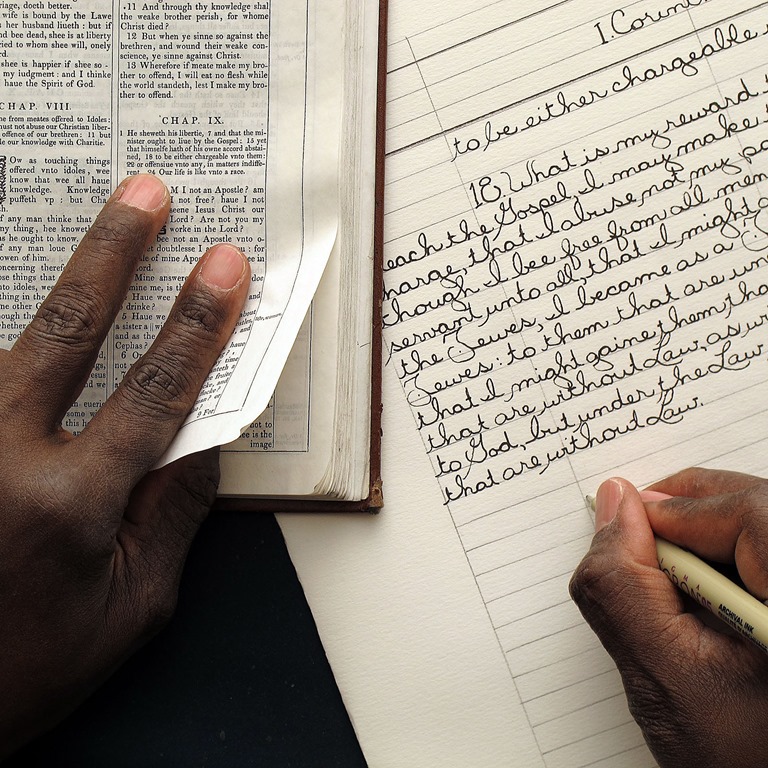
Phillip Patterson’s handwritten Bible
Phillip Patterson, struggling with AIDS, has taken four years out of his life to handwrite out a King James Bible. See the article here, a blog here, and a set of photographs here.
For Bible nerds out there, it appears he is using the Hendrickson facsimile of the Oxford University Press 1833 Roman type transcription of the 1611 KJV.
See also here.



On misunderstanding the kiss, the handshake, the warm greeting between a man and a woman
A few recent blogposts are up – describing the handshake in general and the handshake in same-sex or cross-sex situations in particular. These posts have taken me back to what Bible translator Eugene Nida said a while back. He said the following (respectively in 1964 and then again in 1984):
One of the modern English translations, which, perhaps more than any other, seeks for equivalent effect is J. B. Phillips’ rendering of the New Testament. In Romans 16:16 he quite naturally translates “greet one another with a holy kiss” as “give one another a hearty handshake all around.”
In Romans 16:16 he has translated “give one another a hearty handshake all around,” rather than employing a literal rendering such as “greet one another with a holy kiss.” One can well understand the reason for such actualizing, since the phrase ‘holy kiss’ is likely to be misunderstood.
Nida was implying that giving a hearty handshake is less likely to be misunderstood.
It’s time we understood some of the nuance here. There are subtle significances in what is written in the Greek of the New Testament. But there may be subtle sexism and racism and sect-ism and ethnocentricies in our behaviors today too.
Often the translator will not account for these behaviors, the unlikely “to be misunderstood” habits. When trying to make “them yesterday” dynamically equivalent to “us today,” there’s rarely any acknowledgement of the questions of exclusion, of lack of equivalence, between persons in our own context. Who is included in one’s group, and who left out, by how two bodies touch in public, in greetings? Did Paul the man and the woman Junias in Romans 16 ever greet one another ἐν φιλήματι ἁγίῳ? Did he also greet the woman Priscilla this way? How about “Phoebe, our sister, a deaconess of the Church at Cenchrea”? Did J. B. Phillips greet the women around him this way? His translation suggests this to be the case: “Shake hands for me with Priscilla and Aquila…. A handshake too for Andronicus and Junias my kinsmen and fellow-prisoners; they are outstanding men among the messengers and were Christians before I was.”
(Well, we see that the Phillips translation considers Junias to be a man, and Priscilla not a man; but my question is whether the instruction to “give one another a hearty handshake all around” equally applies to men and to women and to men with women equally all around. This is the question brought out in those recent blogposts I’ve read. More on that in a moment.)
I’d like us to consider more the significances of the kiss, the handshake, and the warm greeting — as symbols of inequalities not only in religious contexts but also in male-female contexts. I’d just like to recall how J. B. Phillips translated other such things in the New Testament. I’d like to recall also how Nida said nothing about the Phillips translation on these other such things.
For example, Phillips has Judas kissing Jesus in betrayal. Here is Luke 22:48 –
“Judas, would you betray the son of Man with a kiss?” said Jesus to him.
That kiss of course for Phillips, for Jesus, for Judas, is significantly different from “a hearty handshake all around.” And yet the translator finds that his English readers, like Luke’s Greek readers, had no real misunderstanding of the cultural implications of the kiss.
And here is Matthew 26:47-48 in the Phillips –
And while the words were still on his lips, Judas, one of the twelve appeared with a great crowd armed with swords and staves, sent by the chief priests and Jewish elders. (The traitor himself had given them a sign, “The one I kiss will be the man. Get him!”)
Again, there is no attempt by Phillips here to make Judas betray Jesus with a hearty handshake. The kiss is clear enough. What is more, in this Matthew passage, Phillips actually adds his own literary flair by noting that Jesus had fresh words on his lips (like a kiss). Jesus’s words on his lips are signaling some things; Judas’s kiss with his lips is signaling other things. My guess is that this literary spark is accidental and an unconscious addition by the translator. In the Forward to his New Testament, on his on principles of translation, he discusses just how Nidan he is intending to be:
I feel strongly that a translator, although he must make himself as familiar as possible with New Testament Greek usage, must steadfastly refuse to be driven by the bogey of consistency. He must be guided both by the context in which a word appears, and by the sensibilities of modern English readers. In the story of the raising of Lazarus, for example, Martha’s objection to opening the grave would be natural enough to an Eastern mind. But to put into her lips the words, “by this time he’s stinking,” would sound to Western ears unpleasantly out of key with the rest of that moving story. Similarly, we know that the early Christians greeted one another with “an holy kiss”. Yet to introduce such an expression into a modern English translation immediately reveals the gulf between the early Christians and ourselves, the very thing which I as a translator am trying to bridge.
So we catch Phillips himself talking like this — “into her lips the words.” This is his idiom. He puts this idiom of his on Luke’s Jesus this way: “the words were still on his lips.” This rendering does seem not a very conscious thing for him to do (which is why I can only guess that his Matthew 26:47-48 has that added literary flair).
Nonetheless, there are other parts of language that Phillips does not appear to be aware of. I’m interested in how his words here betray perhaps-unconscious separations. There seems to be an ethnocentric presumption. What’s in “an Eastern mind” must not fall on “Western ears.” The woman, Martha, might indeed be — in her Eastern mind — thinking the following: “by this time he’s stinking.” But the man, J. B. Phillips, for the Western and Christian ears of his own modern English readers must render that — as if entirely pleasantly in-key — the following way: “By this time he will be decaying.” Phillips has to pre-suppose difference. He presumes to stand for all who use modern English in the Western world who are modern Christians who will not stand for the Eastern “sound … [so] unpleasantly out of key.” Then he has to bridge the dissonance. Thus, as a translator, he is working actually to erase the differences “between the early Christians and ourselves [the later Christians].” If the “out of key” can just be silenced, then the bridge backwards to these different others can be constructed.
The modern Christian part is interesting. Phillips does not seem to be thinking of the very differences among various Jews that are flaunted by the Greek text of “the story of the raising of Lazarus.” Phillips, by his translation, actually erases an important phrase that punctuates a textual and a contextual contrast. His modern English for late Christian readers has this for John 11:8 – “Master!” returned the disciples, “only a few days ago, the Jews were trying to stone you to death….” The Greek, of course, has something different, and notably different – λέγουσιν αὐτῷ οἱ μαθηταί· Ῥαββί, νῦν ἐζήτουν σε λιθάσαι οἱ Ἰουδαῖοι. Admittedly, this is odd gospel Greek that is not easy for any to understand entirely; however, other translators have not had to erase “Rabbi” with “Master!” just bridge some gulf “between the early Christians and ourselves [the later Christians].” Willis Barnstone, for example, brings out the oddity of the Greek for readers of English; in his footnote, Barnstone writes:
The conjunction of “rabbi” with “the Jews” here is an anomaly whose contradiction in identity befuddles the purpose of making the Jews appear abhorrent. In like passages in Matthew and Luke, “rabbi” [in the Greek text] has been changed to “master,” “teacher,” or “Lord,” [in the Greek text] and so the anomaly is less apparent.
It would seem that in this context, the word “Rabbi” in the Western and Christian and modern English ear of Phillips does “sound … unpleasantly out of key.” The solution to this problem is to erase the word, to supplant it with another.
What, then, of the male-female differences flaunted by the Greek text of John 11? What does the Phillips translation do with these in “the story of the raising of Lazarus”? The Greek narrative highlights these facts:
- that the women in it speak freely to the man Jesus as a lover (φιλεῖς),
- that this man does in fact love (ἠγάπα) these women and their brother,
- and that one of these women (Μαριὰμ) has loved him back in ways that are easy to misunderstand and that are far more than a “a hearty handshake.”
What we notice is how consistent Phillips is to his translation principle to “steadfastly refuse to be driven by the bogey of consistency.” In this case, this is a good thing. We all can see how the Phillips translation of John 11 (“the story of the raising of Lazarus”) does not entirely lose all of the male-female differences that the original text highlights. The modern translation does not erase the fact, for instance, that “Mary [was the woman] who poured perfume upon the Lord and wiped his feet with her hair.” There she is in her “Eastern mind.” And, presumably, she’s acting as if any late-Christian Western woman would. Moreover, Phillips, the translator, does seem aware that this bit of text (ἦν δὲ Μαριὰ[μ] ἡ ἀλείψασα τὸν κύριον μύρῳ καὶ ἐκμάξασα τοὺς πόδας αὐτοῦ ταῖς θριξὶν αὐτῆς) is elaborated on in another gospel. At the very least, John’s gospel and Luke’s record something very similar. And the Phillips translation does treat both John 11 and Luke 7 consistently, even if both are inconsistent with the translation treatment Romans 16. In both John 11 and Luke 7 of the Phillips, there the woman publicly loving the man is not giving him “a hearty handshake.” The point of the gospels in this context is, in part, that this is a woman, not a man, greeting the other as a woman might however shocking that is but certainly not as a man would.
In Luke’s account, the woman is giving a man stinky kisses.
Here is Luke 7:36-50 in the Phillips –
Then one of the Pharisees asked Jesus to a meal with him. When Jesus came into the house, he took his place at the table and a woman, known in the town as a bad woman, found out that Jesus was there and brought an alabaster flask of perfume and stood behind him crying, letting her tears fall on his feet and then drying them with her hair. Then she kissed them and anointed them with the perfume. When the Pharisee who had invited him saw this, he said to himself, “If this man were really a prophet, he would know who this woman is and what sort of a person is touching him. He would have realised that she is a bad woman.”
Then Jesus spoke to him, “Simon, there is something I want to say to you.” “Very well, Master,” he returned, “say it.”
“Once upon a time, there were two men in debt to the same money-lender. One owed him fifty pounds and the other five. And since they were unable to pay, he generously cancelled both of their debts. Now, which one of them do you suppose will love him more?”
“Well,” returned Simon, “I suppose it will be the one who has been more generously treated,”
“Exactly,” replied Jesus, and then turning to the woman, he said to Simon, “You can see this woman? I came into your house but you provided no water to wash my feet. But she has washed my feet with her tears and dried them with her hair. There was no warmth in your greeting, but she, from the moment I came in, has not stopped covering my feet with kisses. You gave me no oil for my head, but she has put perfume on my feet. That is why I tell you, Simon, that her sins, many as they are, are forgiven; for she has shown me so much love. But the man who has little to be forgiven has only a little love to give.”
Then he said to her, “Your sins are forgiven.”
And the men at table with him began to say to themselves, “And who is this man, who even forgives sins?”
But Jesus said to the woman, “It is your faith that has saved you. Go in peace.”
What is notable about the Phillips translation here is how he does not erase the sexism, the contrast in behaviors between the man and the woman that puts the men over women.
What we might also note is how Phillips erases the failure of the one man to kiss the other. Perhaps for the modern English Christian Western ears of Phillips and his targeted readers this is just too much. The Greek of Luke clearly has “φίλημά μοι οὐκ ἔδωκας” and refers to the lack of a kiss by the man in contrast to the constant warm kissing by the woman. But the Phillips renders that as follows:
There was no warmth in your greeting, but she, from the moment I came in, has not stopped covering my feet with kisses.
Phillips seems to be implying the lack of an expected hearty handshake man to man. But at least the sexist difference is not erased. Men shake hands heartily. Men allow women to kiss them. There is a question about whether men ought to kiss each other or women in public. There is a question about when women ought really to do the handshake as do men with men.
And so that brings us to some recent blogposts. Well, the first doesn’t so much point to sexism as it does to other constructions of difference around a hearty handshake.
A while ago (in 2012), “Rod the Rogue Demon Hunter, Preacher of Hope | Black Scholar of Patristics | Writer for Nonviolent Politics… Destroyer of Trolls… that angry puppy” shared the following “image of a handshake superimposed upon a Greek cross.” This is easy to misunderstand despite the fact that it’s no image of kissers superimposed on, say, a Roman cross. So, let’s understand. Rod was flaunting the fact that some blogs [including this one, sigh] — but not others — based on rather spurious criteria were deemed “exceptionally Christian.” Here’s that image:

As Rod’s post was posted, a scientific study came out that other blogposts (earlier in 2012) were reporting. For example, an unnamed writer for sciencedaily.com reported one of the scientists publishing the study as saying:
[B]e aware of the power of a handshake. We found that it not only increases the positive effect toward a favorable interaction, but it also diminishes the impact of a negative impression. Many of our social interactions may go wrong for a reason or another, and a simple handshake preceding them can give us a boost and attenuate the negative impact of possible misunderstandings.
And Lisa M.P. Munoz, for cogneurosociety.org, also reported with quotations from this same scientist, Sanda Dolco:
Handshakes have been proven to increase the perception of trust and formality of the relationship, and a handshake initiated by a female has been shown to increase the perceived feeling of security when making risky financial decisions. Yet, the study of interpersonal and emotional effects of handshake, and the associated neural correlates, has been largely neglected.
The respective posts were accompanied by these pictures:


And Steve McGaughey, for the Beckman Institute that was sponsoring the study, posted the following picture (of “Beckman Institute researcher Florin Dolcos [on the right] and Department of Psychology postdoctoral research associate Sanda Dolcos [on the left]”):

The visual rhetoric here is that a female engaging in a hearty handshake with a male may “attenuate the negative impact of possible misunderstandings” and definitely will “increase the perceived feeling of security when making risky financial decisions.” It takes twenty-first century science to prove these things.
Sometimes we in the Western world understand the hearty handshake as something men do that women don’t initiate much or do as well or even need to do with men. So three more recent blogpost cases of that:
Brian LePort in his (2012) review of one of Rachel Held Evans’s books, at his blog Near Emmaus, writes this:
Throughout the book the reader is introduced to Rachel’s husband Dan through journal entries he wrote during the course of the book’s development. Let me tell you something: Dan challenged me to be a better husband to my wife far more than any literature from Focus on the Family or Desiring God could ever do. Dan is the ultimate team player. He supports Rachel. I gain from the book that he makes Rachel a better person and she makes him a better person. One can critique egalitarian marriages, but the fruit of the Spirit seems to be blossoming in the midst of their relationship, so do what you will with that. As I read his thoughts he made me ask myself if I am doing all that I can do to help Miranda become all that God has made her and whether I have supported my wife in her giftedness. Someday I’d like to meet Dan, give him a big handshake, and thank him for existing.
What is interesting is how LePort does not express any desire to give Held Evans a big handshake or to have her and his wife give one to each other. The context, of course, is a discussion about how Mr. Evans supports Mrs. Held Evans in their most egalitarian marriage.
Casey Quinlan in her (2013) critique of Gentleman Scholar‘s post for slate.com starts in this way:
You see a business associate at a conference. You meet a new co-worker at the plant. Your boss wants to meet with you for a second.
But there’s a complication! The person in question is a woman. Tricky stuff. What do you do?
Hold out your hand. Shake it two to three times firmly whilst making eye contact. All fingers, yes. Smile and continue with business.
Shaking hands with a member of the opposite sex should be that simple, but unfortunately others don’t see it that way.
What is interesting is how Quinlan has to remind, at the end of her post, “At the end of the day, women are human beings.”
Grace Yia-Hei Kao in her (2013) post to women, concludes “by quoting Dr. Karen Kelsky of the ‘Professor Is In’ blogsite… from her helpful post entitled ‘The Six Ways You’re Acting Like a Grad Student (And how that’s killing you on the job market)’”:
“And lastly, the handshake. Oh my god, the handshake. If you do nothing else from this post, please, I beg you, do this. Get up from your computer, go find a human, and shake their hand. Shake it firmly. Really squeeze! Outstretch your arm, grip their hand with all your fingers and thumb, look them firmly in the eye, smile in a friendly, open way, and give that hand a nice, firm shake. Repeat. Do this until it’s second nature. If it doesn’t feel right or you aren’t sure if you’re doing it right, find an alpha male in your department, and ask him to teach you. Seriously, grad students, butch it up.”
Good advice for all of us.
What is interesting is the way Kao must emphasize the gendered difference in the handshake.
What is interesting to think about is how Romans 16, in the Greek, is perhaps written by a Roman citizen. But as J. B. Phillips would translate it, this same letter to the young church in Rome would be written by “a true Jew, [… a male] circumcised on the eighth day, … a member of the tribe of Benjamin, … in fact a full-blooded Jew.”
What is interesting is to try to understand the φιλήματι ἁγίῳ or the holy kiss or even the hearty handshake as being applied by so many men, with so many women also named, equally here. Did men back then need to learn this from women? Do men now have anything to learn from women?
How dynamically equivalent are all of our equivalencies? Doesn’t erasure of difference by the translator, when the difference is the difference of the Other, presume that there is no dynamic equivalence in the translation?
Welcoming More Women of WIT
The Women in Theology blog introduces five new authors: Amaryah Shaye, Brandy Daniels, Janice Rees, Maria McDowell, and Elissa Cutter join Bridget, Elizabeth, Julia, Katie Grimes, and Sonja in this collaborative blog which provides an online space for graduate student “women in theology . . . to dialogue critically and creatively, with and for each other.”
Each new author brings some particular perspective and expertise that is sure to broaden and enrich the theological perspectives of this already excellent Christian ecumenical feminist blog. So head on over to learn about the new bloggers and give them some love.
Nation-State Sponsored Translation Awards
This month has seen the announcements of two different sets of state sponsored translation awards.
One set of awards has been established to strengthen relations between peoples of the Republic of Estonia and the Republic of Lativia, the two Baltic nations that share much already including close geographic proximity. The Baltic Course online offers these details on the reasons for the translation prizes:
With the translation prize, the Estonian and Latvian foreign ministers hope to inspire the translation of Estonian-language literature into Latvian and vice versa. The Estonian-Latvian and Latvian-Estonian translation award emphasizes the importance of the Estonian and Latvian languages as well as cultural exchange in order to advance the professionalism of translators of literature as well as political, popular science, historical, sociological, memoirs and other texts.
The jury will contain representatives from the foreign ministries of the two countries and the director of each nation’s literature information center. The monetary value of the award is 3 000 euros, to which both sides are contributing equally.
The agreement that established the Estonian-Latvian and Latvian-Estonian translation award was signed by Estonian Foreign Minister Urmas Paet and Latvian Foreign Minister Maris Riekstins on February 18, 2009. The idea for the creation of the award came from Estonian Ambassador to Latvia Jaak Joeruut and Latvian Ambassador to Estonia Karlis Eihenbaums, who presented a joint letter proposing the implementation of the idea to the foreign ministries of both countries at the end of 2008.
The other set of awards is more international in scope. The Saudi Gazette online gives a few notes on the goals of the Kingdom of Saudi Arabia sponsored translation prizes:
Prince Abdulaziz said that translation opens windows to other cultures and civilizations. He said that the Translation Award achieved a great success within a few years of its institution by King Abdulaziz Public Library in implementation of the directives of Custodian of the Two Holy Mosques King Abdullah.
It is associated with historical initiatives for dialogue among followers of religions and cultures, including the King Abdullah Bin Abdul Aziz International Center for Interreligious and Intercultural Dialogue in Vienna, Prince Abdulaziz said.
He stressed that this Award delivered a clear message from the Kingdom that Islam encourages and supports positive dialogue and cooperation, away from the defamation of religions and detests attempts to blur the identity of civilizations and cultures.
The full articles here (“Winner of Estonian-Latvian translation prize announced“) and here (“8 individuals, one institution win translation award“) name the winning translators and the works of various authors translated.
Troubles with Syllabi
Some of the faculty members who work with me this week got into that tired argument again over whether the plural of syllabus is correctly “syllabuses” or “syllabi.” (I think I’d said “syllabuses” out loud in a conversation earlier, and just a few minutes after others had overheard this phrase of mine their argument was full blown.) I don’t really want to continue the debate here.
But wouldn’t we like to see some of what’s behind the English word, these English words? How Greek and how Latin? How fake and how real?
How right our uses of them and how wrong? How educated and how pretentious? How novel and how historical?
syllabus, syllabuses, syllabi
Here’s what the google ngram viewer shows us of how others before us have varied in the uses of them in print, the plurals never ever nearly as popular as that singular and those two used in equal measure only but a few moments in time:
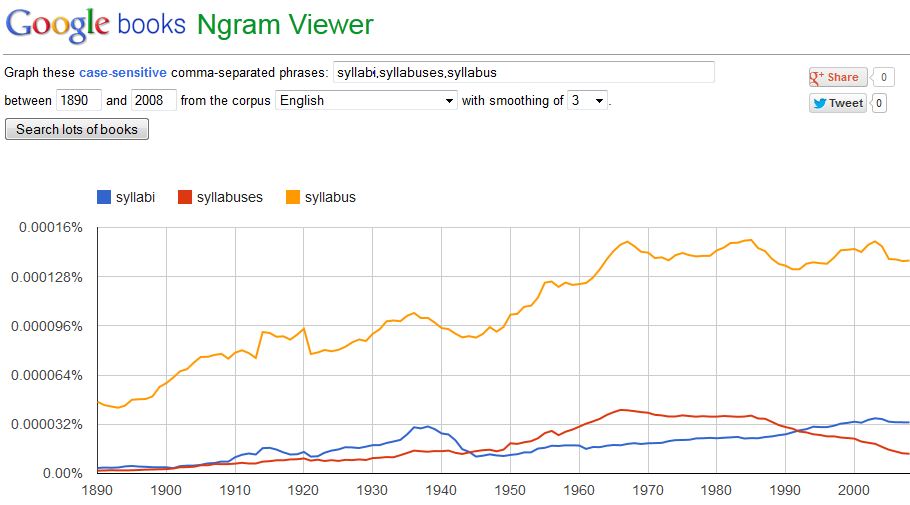
Here’s what a few blogging experts say about the phrases. For example, here’s a medieval philosopher, a former literary editor, a part-time tv commentator, a widely published essayist and poet, and “[t]he author of bestselling Kindle Singles,” Dr. Joseph Bottum starting off a post “Loose Language” (my emphases):
The plural of syllabus is syllabi. Or is it syllabuses? Focuses and foci, cactuses and cacti, funguses and fungi: English has a good set of these Greek and Latin words—and pseudo-Greek and Latin words—that might take a classical-sounding plural. Or might not. It kind of depends.
There’s pretension, no doubt, in using fancy plurals: a hangover from the days when class distinction could be measured by the remnants of a classical education. But we’ve all been carefully trained to mock such pretensions (on the grounds, as near as I can tell, that it’s terribly lower class to affect the traits of the upper class). And the most prominent use of such plurals nowadays is for comic effect, puncturing a stuffy occasion.
And then there’s linguist Dr. Mark Liberman replying in a blogpost “Bottum’s plea”; it concludes (again my emphases added):
So the debate has never been about whether there are or should be any rules of usage, or even about whether linguists should help people to figure out what those rules are, relative to a given context or style of speech or writing. The contested question is what credence to give to the “rules” that self-appointed experts attempt to impose on the rest of us, especially in cases where these “rules” are inconsistent with the practice of elite writers, and are justified by illogical appeals to logic, historically false appeals to history, or unsupported assertions about ambiguity and other aspects of readers’ uptake.
Is the “will of custom” sometimes equivocal? Of course; the mansion of the English language has many rooms. Is it appropriate to limit this variation by imposing a “house style” on particular publications? Sure, if you want to. Will terrible things happen if your favorite style guide fails to constrain some optional choice, like “syllabuses” vs. “syllabi”? Surely not.
And Liberman had referenced history in an earlier post “What’s the plural of syllabus?” At least, he’s shown how he at one point believed the following as he appeals to the logic of the assertions of the unnamed compilers and editors of the Oxford English Dictionary (and once more I emphasize):
The thing is, the word is a fake to start with, a misinterpretation due to scribal error. Here’s what the OED sez:
Now I’m writing my own blogpost. I’m merely a linguist with but a Master o f Arts in the discipline, just dabbling in statistically significant data of human subject research called socio- linguistics. Not much of an authority myself, Dr. J. K. Gayle holds the most advanced degree in English, in classical rhetoric, while working more professionally with post-puberty learners of English as a language and their teachers and confessing to chronically private interests in how any of us ever learns “English.” (I have my mother to thank for encouraging me.) So here’s my own rather subjective emphasized read of “what the OED sez:”

My eye is drawn to the alleged mere connections from our English “syllabus” to the ancient Greek’s “συλλαμβάνειν, to put together, collect.”
I am as fascinated by the OED editor’s collection of early quotations of the in print uses of this word and its English meanings. Take a look for yourself (if you’ll pardon once again my emphases):
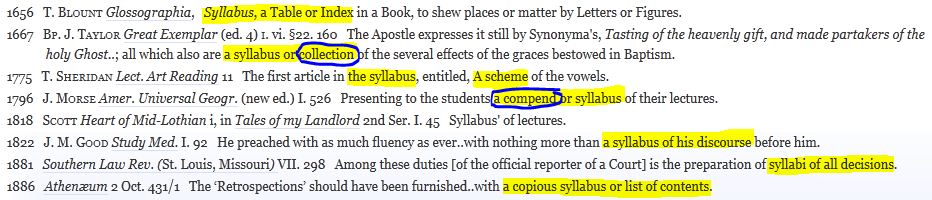
The question we must quickly ask is whether Taylor calling a syllabus a collection in 1667 was a mistake, the appropriation of a fake and graecized Latin word, a misinterpretation, a spurious deduction? Was he using bad English way back then? Why then does the OED editor choose to include that now? Am I asking too many questions?
Let’s take a look at other dictionary makers’ look at the Greek word allegedly causing all of the confusion. Click here for the full entry on συλλαμβάνω and collection of uses by Henry George Liddell and Robert Scott. The old verb in Greek is not too far off from the newer English noun syllabus, is it? “The syllabus, including [collected] links to lecture notes and homework assignments, can be found here,” writes Dr. Liberman and his co-instructor here.
I’d like the end this post with uses of forms of syllabus or the like (may we call these syllabuses or syllabi?) that we may find not yet collected, though they do exist somewhere between the Liddell-Scott and OED entries and well before the google ngram records and our own various contemporary uses of such “English.”
These are translational uses of the old Greek forms. They are generative. They are not easily contained or collected by our expert opinions about which is fake and what must be true.
The first is from the very first use of the Greek phrase in question by the translator(s) in Alexandria, Egypt, rendering the Hebrew Bible into Hellene. It’s the Greek Genesis 4:1 –
Αδαμ δὲ ἔγνω Ευαν τὴν γυναῖκα αὐτοῦ
καὶ συλλαβοῦσα ἔτεκεν τὸν Καιν
καὶ εἶπεν ἐκτησάμην ἄνθρωπον διὰ τοῦ θεοῦ
It’s the first recorded “conception,” the conceiving of the first human being by his mother.
The second syllabus-related Greek phrase I’d like to end this post with is from the New Testament. It’s from the gospel of Luke, itself sort of a syllabus or a collection of the accounts of the gospel on hand. Before I say more, let me just announce this (as if any of us needs to hear it): these two syllabi, or syllabuses, have been the cause of many troubles (and I link to my own elsewhere-blogged troubles with the plural of that last word below). Now, here’s the announcement of the immaculate conception as a unique instance of what we tend argue over as fake or as real as spurious or as historical as literary or not in our collections of understandings (as syllabi). Here’s Luke 1:31 –
Καὶ ἰδού συλλήψῃ ἐν γαστρί
καὶ τέξῃ υἱόν
καὶ καλέσεις τὸ ὄνομα αὐτοῦ Ἰησοῦν


 BLT
BLT 