Allah for Christians in Malaysia
Yesterday, The Malaysian Insider continued to publish strong and public responses to news earlier this month that a “Malaysian appeals court has upheld a government ban against the use of the word ‘Allah’ to refer to God in non-Muslim faiths, overruling claims by Christians in this Muslim-majority nation that the restriction violates their religious rights.”
For instance, Bob Teoh writing in English to convey a conversation he had had with a Christian pastor in Kuching – presumably in English – talks in terms of war. The pastor and even Teoh himself are alluding to passages from the Hebrew Bible, in English translation. The Christian leader in Kuching paraphrases, saying:
Brother, the battle belongs to the Lord. The enemies are all confused now.
Although Teoh doesn’t explain to his English readers of The Malaysian Insider, the pastor is making a clear reference to 2 Chronicles 20:15 –
Listen, all you people of Judah and Jerusalem! Listen, King Jehoshaphat! This is what the Lord says: Do not be afraid! Don’t be discouraged by this mighty army, for the battle is not yours, but God’s.
I’ve quoted the Bible directly from the New Living Translation in English. I’ve done that here because it’s what Teoh does in his post, “Allah, lost in translation.” Toeh goes on to elaborate his points about biblical “war” by quoting the following way:
The world may rely on Sun Tzu’s “Art of War” but the Bible actually has its own principles for going to war.
One of it is found in the fifth book by Moses (Musa in the Quran) in the Christian Old Testament or the Jewish Bible:
Regulations concerning War
“When you go out to fight your enemies and you face horses and chariots and an army greater than your own, do not be afraid. The Lord your God, who brought you out of (captivity from) the land of Egypt, is with you! For the Lord your God is going with you! He will fight for you against your enemies, and he will give you victory!” (Deuteronomy 20:1,4 New Living Translation).
What Teoh does not do is to use Malaysian. He, of course, could have quoted from a translation of the Bible into Malay or into Indonesian which Malay readers understand. And then readers of The Malaysian Insider would read of Allah there. For example, from a Christian Bible (Old Testament) online, one may read the above two passages as follows:
2Tawarikh 20
15. dan berseru: “Camkanlah, hai seluruh Yehuda dan penduduk Yerusalem dan tuanku raja Yosafat, beginilah firman TUHAN kepadamu: Janganlah kamu takut dan terkejut karena laskar yang besar ini, sebab bukan kamu yang akan berperang melainkan Allah.
and
Ulangan 20
1. “Apabila engkau keluar berperang melawan musuhmu, dan engkau melihat kuda dan kereta, yakni tentara yang lebih banyak dari padamu, maka janganlah engkau takut kepadanya, sebab TUHAN, Allahmu, yang telah menuntun engkau keluar dari tanah Mesir, menyertai engkau.
4. sebab TUHAN, Allahmu, Dialah yang berjalan menyertai kamu untuk berperang bagimu melawan musuhmu, dengan maksud memberikan kemenangan kepadamu.
Most Malaysian readers of English would be well aware of how their Bibles in Malay already include Allah as one of the references to God in the Malaysian language.
The allusion to God is not restricted to the Christian Old Testament but is also found in the New Testament. Thus, another writer for The Malaysian Insider, Rama Ramanathan, quotes the Lord’s Prayer, in English first and then in Malay:
“Our Father in heaven, hallowed be your name. Your kingdom come, your will be done, on earth as it is in heaven. Give us this day our daily bread, and forgive us our sins, as we also have forgiven those who sinned against us. And lead us not into temptation, but deliver us from evil. Amen.”
“Ya Bapa kami yang di syurga, Engkaulah Allah yang Esa, semoga Engkau disembah dan dihormati. Engkaulah Raja kami. Semoga Engkau memerintah di bumi, dan seperti di syurga, kehendakMu ditaati. Berilah kami makanan yang kami perlukan pada hari ini. Ampunkanlah kesalahan kami, seperti kami mengampuni orang yang bersalah terhadap kami. Janganlah biarkan kami kehilangan iman ketika dicubai, tetapi selamatkanlah kami daripada kuasa si Jahat. Engkaulah Raja yang berkuasa dan mulia untuk selama-lamanya. Amin.”
Also quoted are a number of allusions to Allah in Christian liturgies in Malaysia. Ramanathan’s post is entitled “Allah judgment: What the Special Branch saw on Sunday,” and you can read it here.
BLT readers might be interested, likewise, in seeing the tradition of using Allah in Indonesia by the Christian minority, whose language is very very similar to Malaysian. Here’s a site that compares various translations of numerous popular passages:
http://sejarah.co/bagan/perbandingan_ayat_alkitab_bahasa_indonesia.htm
Chicago Opera Theater’s censored version of Giovanna d’Arco
I am off to a super-slow start on my problematic composers series (Britten, Verdi, Wagner), but to illustrate some of the tensions, I wanted to point to Garry Wills’s insightful post at the New York Review of Books blog on Chicago Opera Theater’s using censored texts to present Verdi’s Giovanna d’Arco (Joan of Arc). (NB: I did not see this production).
Note that the Chicago Opera Theater was putatively basing its performance on the absolutely stunning new Verdi edition published by University of Chicago, but as Wills describes it, did not seem to have read it very carefully.
Like all of Verdi’s early operas, the seventh one, Giovanna d’Arco (Joan of Arc) (1845), has been revived and given multiple recordings in recent years. In this bicentennial year of Verdi’s birth, it has been performed in Salzburg with Placido Domingo in one of his new baritone roles as Giovanna’s father. On September 21, the Chicago Opera Theater presented what it billed as the first performance from the new scholarly edition in the great University of Chicago Verdi series, this one edited by Alberto Rizzuti. In recent decades, this once-popular opera has been newly appreciated.
Yet there is no denying that the work tugs against some of a modern audience’s values. When, for instance, Giovanna is accused of witchcraft, she is unable to deny it because she has fallen in love with the Dauphin she is striving to make King. Why does she feel that a love for an unmarried Christian man, one not even sexually satisfied, must paralyze her with guilt?
Schiller’s play, Die Jungfrau von Orleans (1801), which gave Temistocle Solera, Verdi’s librettist, much of his material, is more convincing on this point. Schiller’s Johanna falls in love with a soldier in the English army she is fighting. This adds an element of betrayal to her country, and explains her guilt. His Johanna purifies herself from this lapse into love for the enemy and goes on to die fighting for her cause.
What then are we to make of Verdi’s Giovanna, guilty merely of feeling love for her fellow leader in the good cause? The Chicago Opera Theater director, David Schweizer, decided that the only way to be convincing about such an obsession with sexual purity is to make the opera show “the perpetual heart-rending consequences of religious fanaticism.” So he frames the opera as one presented by a group of American evangelicals. When we entered Chicago’s Harris Theater, earnest young religious types passed out fliers thanking us for joining their meeting. Then we saw the meeting begin onstage, the cultists assembling under their pastor, who will play Giovanna’s faith-healing father, Giacomo, in the opera. The cultists, who have come with folding chairs, sit on them during Verdi’s orchestral prelude, watching clips from the 1948 Victor Fleming movie, with Ingrid Bergman as Joan. The evangelicals make ecstatic mourning gestures as Joan is seen burning at the stake, but cheering ones as she goes into battle with shining armor.
At a University of Chicago symposium before the production, David Schweizer was asked why he chose Fleming’s over other films about Joan (by Dreyer or Bresson, for instance). He answered that he wanted to show the shallowest and “most Hollywood” images he could find. The film is geared to the fanatics’ capacities. The way Schweizer was stacking the deck came out in the symposium when Philip Gossett, the eminent editor in chief of the Verdi editions, asked a question. The Joan of the production, soprano Suzan Hanson, had just sung (to piano accompaniment) her early prayer for armor. Gossett, following along with the new score, noted that she sang the version that had been censored for Austrian audiences in the nineteenth century, which omitted the person being prayed to, though Verdi’s original text, just re-edited, names “Vergin Maria.” Why desert the new text now that they have it and claim to be presenting it?
The conductor of the Chicago production, Francesco Milioto, said they kept the old text because they are depicting Fundamentalist fanatics who do not pray to the Virgin Mary. He said he was not mocking real (non-fundamentalist) religion. “Our reason is not the same as the Austrians. We’re not shying away from religion—and neither were the Austrians.” But the Austrians were, in fact, shying away from what they considered an illegitimate use of religion, as Maestro Milioto could have learned from the new edition. It cites an important article by the scholar of nineteenth-century opera Francesco Izzo, showing that Solera and Verdi made unusual use of Mary in the brief time (the 1840s) when she was seen as a Risorgimento patroness of liberty—like an Italian version of the French Marianne.
The Church of Pius IX was in collaboration with the Austrians, and it was shocked that “their” meek and mild Virgin could be glimpsed on the other side of the barricades. This was made strikingly clear when, during the brief liberation of Milan in 1848, three years after Verdi’s opera, the radical Princess Cristina Belgioioso (a friend to Verdi’s circle) led 160 troops into Milan. She was costumed, at the head of her little army, as Joan of Arc. Marianne, indeed! (The Chicago company’s program lists ten women in history who wore armor with the troops, but does not mention the most relevant—Princess Belgioioso.)
These are not matters incidental to the opera. Verdi’s Joan does not stay virgin because she feels that all sex is sin, but because she is the living representative of the Virgin. That is why she can redeem herself by rededication to her mission, and die, as in Schiller’s play, gloriously fighting for the cause. Neither in Schiller nor in Verdi is she a victim burned at the stake. But Schweizer’s production, responding perhaps to its own shallow clue given by Ingrid Bergman, gives her a quasi-incineration. In both play and opera, she is imprisoned with chains after being captured by the English. Here the cultists lift her onto a stake and stack their folding chairs as to form the pyre under her. Yet her pastor-father hears her praying to the true God and brings her down from the stake by a miracle (this pastor was earlier seen faith-healing English soldiers).
The Virgin Mary does show up in this staging, but not as an object of Giovanna’s devotion. When the Dauphin has a vision of the place where he can give up his armor, it is at a shrine to Mary. Here the kitchiest kind of Marian image pops up, with lots of candles burning in front of it as in a Catholic church. This is a Mary of the Fundamentalists’ horror, doing the devil’s work. No wonder her father concludes from the shrine that she is leagued with hell, and tells both the French and the English that she should die. But once convinced that she is praying to the proper God, on her pyre, he sends her back into battle.
She was not allowed to pray to Mary herself, because that is not her infidelity. Sexual desire is. In its grip, she thrashes in the convulsions of diabolical possession. Verdi gave the devils offstage voices, but the Chicago production brings them on as dancing demons (the people in the audience near me tittered). At the final scene, of her death from battle wounds, she is no longer in the guerrilla war garb she wore earlier, but clothed in glittering armor—the same Ingrid Bergman was seen wearing in the prelude. With her restored purity she ascends to a true believers’ heaven, while her cultists turn semi-automatic weapons on the audience, heavy-handedly linking Giovanna to terrorism.
I doubt that Verdi will do much damage to the jihadists of the world. […]. This is another case of Verdi’s music triumphing over a director’s most energetic pretzel-twistings. Verdi always rewards the ears, no matter what tricks are being played on the eyes.
Emily Dickinson archive live
The Emily Dickinson archive, containing high-resolution images of Emily Dickinson’s original handwritten manuscripts, is now live.
Emily Dickinson Archive makes high-resolution images of Dickinson’s surviving manuscripts available in open access, and provides readers with a website through which they can view images of manuscripts held in multiple libraries and archives. This first phase of the EDA includes images for the corpus of poems identified in The Poems of Emily Dickinson: Variorum Edition, edited by R. W. Franklin (Cambridge: Belknap Press of the Harvard University Press, 1998).
PS: I apply for having been so tardy in replying to many fine comments and posts on this blog. I am completely swamped with work just now.
“ἄρσεν καὶ θῆλυ” in “Aristotle,” “Moses,” and Paul
Quick History of a Greek Frozen Phrase
Around 300 years before Jesus, the phrase “ἄρσεν καὶ θῆλυ” showed up in written Greek as something Aristotle supposedly wrote.
Half a century later or so, the phrase “ἄρσεν καὶ θῆλυ” showed up in the Bible as the Hellene translation for the Hebrew זכר ונקבה, a recurring phrase in the first of the five books of Moses.
After a couple of centuries of “ἄρσεν καὶ θῆλυ” being biblical, the phrase shows up in the gospel of Mark and in the gospel of Matthew as Jesus quoting Genesis.
A few decades later, Paul writes to some of his fellows in the assemblies in Galatia to play on the phrase “ἄρσεν καὶ θῆλυ.”
Some English Frozen Phrases Illustrated
In this post, I’ll say just a bit more about the specific points of Greek literary and translational origins picked out so far. Now, I’d like us to look at how English phrases sometimes are used as “frozen phrases.”
Here are some on the tip of my tongue, just off the top of my head, like “bread and butter,” “peanutbutter and jelly,” “stars and stripes,” “boys and girls,” “cats and dogs,” “Jack and Jill,” “Tom and Jerry,” “Ben and Jerry’s,” “Bonnie and Clyde,” “pen and paper,” “planes, trains, and automobiles,” “Father, Son, and Holy Ghost,” “man and wife,” “husband and wife,” “Lucy and Ricky,” “horse and carriage,” “love and marriage,” “war and peace,” “the good, the bad, and the ugly,” “facebook and twitter,” “stocks and bonds,” “highs and lows,” “ups and downs,” “God and country,” “nickel and dime,” “heart and soul,” and “so forth and so on.”
The frozen phrases I’m rapidly recalling here all include the conjunction and. And I’m only wanting to suggest that these are imprinted in my brain, in my ears and in my eyes, from how I’ve encountered written English and spoken English.
And I’m trying to make only the necessary observations here. First, for example, it should be clear that there is no necessary gender order to this when there are gendered pairs. “Lucy and Ricky” has her coming first; “Jack and Jill” has him coming first. Second, the positive term sometimes comes first as in “highs and lows” while the negative term comes first at other times as with “war and peace.”
Third, it should be obvious that reversing the nouns in any of these frozen phrases makes for a very odd sound. Fourth, written English reinforces, further freezes, what sounds right. To illustrate, we might use the google ngram viewer that allows us to check the phrases written in books that are in the library, or corpus, of google books.
The frozen phrases “bread and butter” and “stars and stripes” and “peanutbutter and jelly” appear in print with the nouns in a very predictable and set or frozen order. Nobody has published “jelly and peanutbutter” in print in a way that the ngram viewer will show:


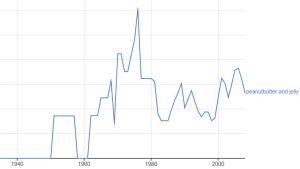
“Male and Female” as a Frozen Phrase Relative to Others
So in English there are “male and female” gendered frozen phrases, like that frozen phrase “male and female.” I seem to recall at Joel Hoffman’s blog a conversation about whether “man and wife” or “husband and wife” is most prominent, and thus I’m including those two frozen phrases in my google ngram viewer illustration below too.
What I’m more interested in is how equal or unequal the sexes appear to show up in the phrases. The noun “wife” does get used, for example, as a counterpart to “husband.” This makes the phrase “man and wife” arguably a little stranger. Nobody says “wife and man” or “man and husband” or even “woman and husband.” We could speculate all day as to why not or when we might want to say those phrases.
Since we bring up “woman” I do want to comment, again (since I say it a lot), that “wo-man” is a marked noun in English. So is “fe-male.” So is, when we spell it out, the word “s-he.” The unmarked nouns “man” and “male” and “he” get marked with a pre-fix to change the meaning to the feminine version of the default masculine root noun. In frozen phrases such as “male and female” and “men and women” there’s an inherent imbalance that suggests the masculine default unmarked root is the essential noun in the phrase, and the complementary feminine version is, while “equal” to the male counterpart, is just supplemental and simply, well, a subordinate complement. It’s good, then, for us to think about these things, and to talk about them, lest they are under the surface of our consciousness. For some of us language seems or feels somehow to reflect Reality or Nature or God’s Design. It doesn’t.
And our language tends to freeze in phrases. It’s just the way it is. So let’s look at how we tend to read the “male and female” related phrases:

Some of the frozen phrases are clearly more popular than others. Some were more popular at different points in publishing history. (I took out of the mix here one frozen phrase with plural nouns – “men and women” – because it is so much more frequently used than the others – as you’ll see if you click here.)
As my son and my daughters grow into adulthood more in this world, I long for English counterpart terms like the Greek ἄρσεν καὶ θῆλυ and the Hebrew זכר ונקבה. These phrases do not have a default sex for the sex, the gender, of adult human beings the way our English “men and women” and “male and female” do. So I do tend to try to use “boys and girls” even when referring to adults, even though I always have to explain what I mean since the term applies to children not grown ups. I also like “masculine and feminine” since the phrase includes equal counterparts that does not place one over the other. (Unfortunately, “masculine and feminine” in English is not nearly as often used as “boys and girls” is, and click here to see that fact).
“ἄρσεν καὶ θῆλυ” in “Aristotle,” “Moses,” and Paul
Fortunately, many ancient Greek texts are today digitized by many different scholars, just as much more contemporary English texts are by google, so that we can view frozen phrases as they develop and evolve. It seems the first instance, at least one of the first uses, of “ἄρσεν καὶ θῆλυ” appears in “Aristotle’s” Physiognomonics. It’s a treatise that tries to sound a lot like Aristotle, as he might make judgments about the Nature of Things in themselves. The Aristotle-like author writes (on what are Bekker pages 809a – 809b) the following:
Νυνὶ δὲ πρῶτον πειράσομαι τῶν ζῴων διελέσθαι, ὁποῖα αὐτῶν προσήκει διαλλάττειν πρὸς τὸ εἶναι ἀνδρεῖα καὶ δειλὰ καὶ δίκαια καὶ ἄδικα. διαιρετέον δὲ τὸ τῶν ζῴων γένος εἰς δύο μορφάς, εἰς ἄρσεν καὶ θῆλυ, προσάπτοντα τὸ πρέπον ἑκατέρᾳ μορφῇ. ἔστι δὲ ὅμοια…. τὰ δὲ ἄρρενα τούτοις ἅπασιν ἐναντία, τὴν φύσιν ἀνδρειοτέραν καὶ δικαιοτέραν εἶναι γένει, τὴν δὲ τοῦ θήλεος δειλοτέραν καὶ ἀδικωτέραν.
This was put into English under the direction of W. D. Ross as follows:
I WILL now first attempt to make a division of animals I by the marks in which they are bound to differ if they are respectively brave or timorous, upright, or dishonest. We have to divide the whole animal kingdom for this purpose into two physical types, male and female, and to show what mental attributes are congruous with each of these types…. The male is the opposite of all this: his is the braver and more upright nature, whilst the female is the more timid and less upright.
One reason this sounds so much like Aristotle is because Aristotle wrote a whole lot about animal sex, and he divided the various species of animals and compared and contrasted them with human beings, always keeping separate males and females, men and women. Another reason the writer of this particular Greek text sounds like Aristotle is the method of writing; there is division, the binary, the constant essentializing of Nature by separation which serves to map out the hierarchy inherent in Nature. A male and female may be equal in species but the female is always inferior, or at the very least under the male in role. (And just to be clear for all those learning Greek and its translation into English, I’m pretty sure that the Pseudo Aristotle is not intending θῆλυ as “breast” as if that part of her anatomy is opposite the male’s somehow.)
What the pseudo Aristotle is writing when writing “ἄρσεν καὶ θῆλυ” is that there are two different kinds, non overlapping, that can and should be mapped out separately in Nature, by Nature. There is the binary. There is the dichotomy. There is fundamentally opposition, essentially difference.
In the context, the pairing is more akin to “light and darkness” and “good and evil” and “highs and lows” and “ups and downs,” than it is to “heart and soul” or “peanutbutter and jelly” or “bread and butter” or “stars and stripes.”
Then, much later in history, a good bit far from Athens, in Alexandria the Great City named after Alexander the Great, there comes a real shift in the meaning of “ἄρσεν καὶ θῆλυ.” The shift is Semitic. It comes with the first book of Moses. Of course, as mentioned, in Hebrew we read the phrase זכר ונקבה. There is the emphasis not on separation but on relation. The focus on sex is not on difference so that there is procreation. Rather it is on difference in mixture in conjoinment, so that there is procreation and creation. It’s less obvious science and much more akin, it would seem, to art. The Greekiness becomes less Aristotelian-like and much more Hebrewish. I’m talking now about the Septuagint. The Hellene in the translation of the Hebrew Bible is much more poetic, much more epic, more Homer and Sappho and Hesiod than like that of the patriarchal Socrates, Plato, Aristotle, and Alexander. The method for language, for naming, is substantially unlike the Aristotelian binary.
The result is that there is what we call Genesis 1:27, 5:2, 6:19-20, 7:2-3, 7:9, and 7:16 respectively, as below here. If we listened to the Greek read aloud, then we’d hear the poetry. Even the verb of Genesis 1:1 is poetry, literally: ἐποίησεν /ePOIEsen/. When we see it we might view the creativity:
καὶ ἐποίησεν
ὁ θεὸς τὸν ἄνθρωπον
κατ’ εἰκόνα θεοῦ ἐποίησεν αὐτόν
ἄρσεν καὶ θῆλυ
ἐποίησεν αὐτούς
ἄρσεν καὶ θῆλυ
ἐποίησεν αὐτοὺς
καὶ εὐλόγησεν αὐτούς
καὶ ἐπωνόμασεν τὸ ὄνομα αὐτῶν Αδαμ
ᾗ ἡμέρᾳ ἐποίησεν αὐτούς
ἄρσεν καὶ θῆλυ
ἔσονται
….
κατὰ γένος αὐτῶν
δύο δύο ἀπὸ πάντων
εἰσελεύσονται πρὸς σὲ
τρέφεσθαι μετὰ σοῦ
ἄρσεν καὶ θῆλυ
…ἑπτὰ ἑπτά
ἄρσεν καὶ θῆλυ
…δύο δύο
ἄρσεν καὶ θῆλυ
…ἑπτὰ ἑπτά
ἄρσεν καὶ θῆλυ
…δύο δύο
ἄρσεν καὶ θῆλυ
δύο δύο
εἰσῆλθον πρὸς Νωε εἰς τὴν κιβωτόν
ἄρσεν καὶ θῆλυ
καθὰ ἐνετείλατο αὐτῷ ὁ θεός
καὶ τὰ εἰσπορευόμενα
ἄρσεν καὶ θῆλυ
ἀπὸ πάσης σαρκὸς εἰσῆλθεν
καθὰ ἐνετείλατο ὁ θεὸς τῷ Νωε
καὶ ἔκλεισεν κύριος ὁ θεὸς
ἔξωθεν αὐτοῦ τὴν κιβωτόν
The frozen phrases in the Hebrew of the first book of the five books of Moses, and then in the Hellene of the same, make together as a unit the two.
The emphasis on unity is illustrated when two Greek gospel writers have Jesus quoting Genesis 1:27. Mark 10 and Matthew 19 make the emphasis very strong by literary, rhetorical means. The context is on whether the words of Moses allowed for marital separation. Joshua or Y’Hosea (or Jesus, a Greekified version of the nickname Moses gave his assistant), speaking Greek, would have Greek readers go back to the words of Moses on how humans were created unified: ἄρσεν καὶ θῆλυ.
Paul picks up this frozen phrase in a rather startling way. He invokes the name of this Jesus/Joshua/Y’Hosea to say:
οὐκ ἔνι
Ἰουδαῖος οὐδὲ Ἕλλην,
οὐκ ἔνι
δοῦλος οὐδὲ ἐλεύθερος,
οὐκ ἔνι
ἄρσεν καὶ θῆλυ·
πάντες γὰρ ὑμεῖς εἷς ἐστε
ἐν χριστῷ Ἰησοῦ.
This is what we call Galatians 3:28. Of course, Paul’s not translating from Hebrew to Greek. Rather his Hebraic Hellene is minimizing any difference in the language. Writing in Greek, he’s sounding Semitic. The emphasis is not on separation but on relation, not on division but on unity. He goes so far to deconstruct any difference that Greek readers might sense in and within the frozen phrase ἄρσεν καὶ θῆλυ.
The Reception of “ἄρσεν καὶ θῆλυ” in Contemporary Sexist Theology
In English translation, the frozen phrase gets used a lot today by people writing about home and church roles. In English, it is “male” / “fe-male” that gets discussed.
Those with a complementarian theological bent like Wayne Grudem, for example, will quote Moses and then Paul writing it. Here’s his emphasis on pages 256-57 and 458-59 of his magnus opus, Systematic Theology:
Because God in himself has both unity and diversity, it is not surprising that unity and diversity are also reflected in the human relationships he has established. We see this first in marriage. When God created man in his own image, he did not create merely isolated individuals, but Scripture tells us, “male and female he created them” (Gen. 1:27). And in the unity of marriage (see Gen. 2:24) we see, not a triunity as with God, but at least a remarkable unity of two persons, persons who remain distinct individuals yet also become one in body, mind, and spirit (cf. 1 Cor. 6:16-20; Eph. 5:31). In fact, in the relationship between man and woman in marriage we see also a picture of the relationship between the Father and Son in the Trinity. Paul says, “But I want you to understand that the head of every man is Christ, the head of a woman is her husband, and the head of Christ is God” (1 Cor. 11:3). Here, just as the Father has authority over the Son in the Trinity, so the husband has authority over the wife in marriage. The husband’s role is parallel to that of God the Father and the wife’s role is parallel to that of God the Son. Moreover, just as Father and Son are equal in deity and importance and personhood, so the husband and wife are equal in humanity and importance and personhood. And, although it is not explicitly mentioned in Scripture, the gift of children within marriage, coming from both the father and the mother, and subject to the authority of both father and mother, is analogous to the relationship of the Holy Spirit to the Father and Son in the Trinity.
But the human family is not the only way in which God has ordained that there would be both diversity and unity in the world that reflect something of his own excellence. In the church we have “many members” yet “one body” (1 Cor. 12:12).
….
Equality in status among God’s people is also emphasized by Paul in Galatians. “For as many of you were baptized into Christ have put on Christ. There is neither Jew nor Greek, there is neither slave nor free, there is neither male nor female; for you are all one in Christ Jesus” (Gal 3:27-28)
… If human beings are to reflect the character of God, then we would expect some similar differences in roles among human beings, even with respect to the most basic of differences among human beings, the difference between male and female. And this is certainly what we find in the biblical text.
Paul makes this parallel explicit when he says, “I want you to understand that the head of every man is Christ, the head of a woman is her husband, and the head of Christ is God” (1 Cor. 11:3). Here is a distinction in authority that may be represented as in figure 22.1.
Just as God the Father has authority over the Son, though the two are equal in deity, so in a marriage, the husband has authority over the wife, though they are equal in personhood. In this case, the man’s role is like that of God the Father, and the woman’s role is parallel to that of God the Son. They are equal in importance but have different roles.
The quotations of Genesis and of Galatians above are from the Revised Standard Version. In Grudem’s most recent book (discussed here at BLT here, here, and here), he quotes the same excerpts but from the English Standard Version that he has so much contributed to. The main alteration with respect to these couple of verses is only for Galatians, where the ESV has “there is no male and female” instead of “there is neither male nor female” of the more literary RSV. Of course, Grudem does not need the literary of the Hebrew Bible or of Paul’s Hebraic Hellene letter. He does not need the phrase “ἄρσεν καὶ θῆλυ” as a unity without separation or difference. He needs difference, a hierarchical binary, where “male and fe-male” has the one in the default position as head of household and as leader of the church. The Other he has to have as the complement to the unmarked one. This is God-ordained and is as Natural as the divisions of Aristotle, even a fake Aristotle.
Wayne’s World Without Women Pastors
Wayne Grudem’s and Barry Asmus’s book may fall into the hands of women who are church leaders, even pastors, in poor nations.
If you’re one of those, how should you then read it?
The male authors, both respective church leaders (and heads over their respective wives too), are on a mission, out of their own wealthy nation, to save the world from poverty. Suzanne introduced BLT readers to their new book here (and I followed up yesterday here); but, really, to whom is this work written?
And for whom is it not intended? Here’s what the two men write on pages 31 and 32:
Written to leaders, especially Christian leaders [who are just men not women], but also those who are not Christians [who might be either men or women]
Our primary audience for this book is [male] Christian leaders in poor nations (but also non-Christian leaders [whether male or female]— see below). We are writing especially for Christians who believe the Bible and are willing to follow its principles for economic development. And we are writing to leaders, because they are the ones who can bring about the necessary changes in their countries.
By “leaders” we mean government leaders, business leaders, education leaders, non-governmental organization (NGO) leaders, charitable organization leaders, and certainly [male-only] church leaders, especially [only men] pastors (because their preaching and teaching can eventually change a culture). We also hope that some who read this book will be inspired to seek to become leaders in their nations so that they can begin to implement the changes we outline.
However, we also hope that Christians in more prosperous nations will read this book, because many of them can have influence on poor nations through mission organizations, mission trips, friendships, development organizations, and denominational networks. We hope that some readers in wealthy nations might even be moved to devote their lives to helping poor nations escape from poverty in the ways we outline here. (Also see some practical suggestions at the end of chapter 5.)
If you are reading this book and do not consider yourself to be a Christian, or do not think of the Christian Bible as the Word of God, we still invite you to consider what we say here. Many of our facts and arguments are taken from economic history, not from the Bible. As you read the parts that are based on the Bible, we invite you to at least think of the Bible’s teachings as ideas that come from a valuable book of ancient wisdom, and consider whether the ideas seem right or not.
Now, lest women who are church leaders, even pastors, in poor nations be confused, let’s see what Wayne Grudem means for the world. If you’re one of those, how should you then read it?
With John Piper (another of his wealthy-nation male-pastor husband-head-of-wife co-authors), Wayne Grudem has clarified:
As we move out from the church and the home we move further from what is fairly clear and explicit to what is more ambiguous and inferential…. When it comes to all the thousands of occupations and professions, with their endlessly varied structures of management, God has chosen not to be specific about which roles men and women should fill…. For this reason we focus (within some limits) on how these roles are carried out rather than which ones are appropriate.
That’s from “An Overview of Central Concerns,” in Recovering Biblical Manhood & Womanhood.
So it’s fine to be an economist, if you’re a woman like Dambisa Moyo, whom both Wayne Grudem and Barry Asmus have listened to and have read and quoted from and have learned from.
And It’s fine to be a political royal in power, like the exemplary of “Biblical Womanhood,” Queen Esther, whom both Wayne Grudem and Barry Asmus valorize in their new book (on page 40) as a particularly responsible leader:
The responsibility of leaders
Leaders in poor nations have a special responsibility and a special opportunity in this regard. Sometimes one courageous leader, with the help of God, can change the direction of an entire nation…. Queen Esther’s courageous intervention before King Ahasuerus saved the people of Israel from destruction (Esther 5-9)…. If you have a leadership role [even if you’re a woman] in any nation on earth, the Bible is very clear about the purpose for which God put you in this position: it is to do good for your nation.
But it’s just not okay to be a leader in your home in your poor nation, not if you are the wife (much less a daughter). Wayne Grudem makes this clear, in his wealthy nation, where he writes against those dangerous evangelical feminists. He writes in [both his first and his latest November 7, 2012 reprinted edition of] Evangelical Feminism and Biblical Truth: An Analysis of More Than 100 Disputed Questions:
But the Old Testament never approves women taking authority over their husbands.
The godly women portrayed in the Old Testament are always seen as submissive to the leadership of their husbands. In fact Peter sees a pattern in their behavior that Christian wives should imitate, for he says, “For … Sarah obeyed Abraham, calling him lord….”
Instances where women seized ruling authority over God’s people in the Old Testament are always viewed negatively.
Queens such as Jezebel … led the people into evil when they gained power.
There were wise queens such as Esther, a wonderful example of a godly woman, but she did not rule as a monarch, since the authority rested with [the man] Ahasuerus the king, and she was not queen over Israel, but over Persia.
God used Sarah and Esther — just as he will use all Christian wives who obey their husbands and call them “lord” (or if he’s king “king”), and these women were leaders in their poor countries. But the Bible, both the Old Testament and the rest of it for Christians, does not allow headship in the home. If you’re in a poor country, and if you find Wayne Grudem’s and Barry Asmus’s book in your hands, then please understand that it is not intended for you to use it as some sort of justification for your leadership over your husband (much less your father).
And it’s not at all okay to be a church leader in a poor country, if you are a woman. You’ll have to find your leadership elsewhere (not in your home, not in your church) to let this rich book educate you about the poverty of your nation.
As Wayne Grudem writes with such sense in Making Sense of the Church: One of Seven Parts from Grudem’s Systematic Theology, page 121, there are indeed some evangelical feminists who may “point to women who had leadership positions in the ancient church.”
But we have to educate ourselves about the Pre-Paul Time-Table and the Aquila-Authority Husband-Headship; and so we can read what he writes further:
Paul was writing to [men in] Ephesus, which was the home church of Priscilla and Aquila [where he not she would have been the head, the authority]… It was in this very church at Ephesus that Priscilla [because of asking her husband of course] knew Scripture well enough to help instruct Apollos in A. D. 51… Then she had probably learned from Paul himself… No doubt many other women in Ephesus had followed her example and also had learned [from their own husbands and] from Paul. Although they later went to Rome, we find Aquila and Priscilla back in Ephesus at the end of Paul’s life… about A. D. 67. Therefore, it is likely that they were in Ephesus in A. D. 65, about the time Paul wrote 1 Timothy (about fourteen years after Priscilla had helped instruct Apollos). [In other words, Priscilla got schooled by Paul a little late, otherwise she would not have presumed to lead and to teach a man.] Yet Paul does not allow even well-educated Priscilla or any other well-educated women at Ephesus to teach men in the public assembly of the church. The reason was not lack of education, but the order of creation which God established between men and women.
To put a fine, conclusive point on it, Wayne Grudem shares his own teaching with men and also with women, since he can, since he is a man; here’s one of his conclusions from Making Sense of the Church: One of Seven Parts from Grudem’s Systematic Theology:
My own conclusion on this issue is that the Bible does not permit women to function in the role of pastor or elder within a church.
You must conclude, then, if you are a woman leader within a church in a poor country (or even in a wealthy one) that you, in said role, must not read Wayne Grudem’s and Barry Asmus’s book. God’s established order of creation prevents Wayne Grudem and Barry Asmus from writing to you and for you. Wayne Grudem’s own Biblical Conclusion prevents him.
Get outside your home, get outside the church, then lead. Now will you buy it?
The Ψαλμος and Aristotle: Ps. 33(34)
When I read Psalm 34 in the Greek (aka the Septuagint’s Psalm 33), I have lots of questions. For example, does the psalmist have a possibly-pregnant female soul? Aristotle would not have gone for that, even if Plato might have.
And does this particular Hellene translation of the Hebrew add any literary sparks and the interpretive spins?
There are at least four peculiar changes from the Semitic text to the Greek:
1. In the very first part, the prelude, where David’s relationship with Abimelech is mentioned, there’s an added emphasis on τὸ πρόσωπον, or “the face,” which the Hebrew does not have. This seems to stress how David acts like God, when he does not favor Abimelech with his face as God does not shame the faces of those who draw near to him (in Hebrew verse 5, which is Greek verse 6: τὰ πρόσωπα ὑμῶν). Likewise, David is turning his face against Abimelech the way the LORD turns his face away from evil and evil doers (in Hebrew verse 16, which in Greek 17 has this: πρόσωπον δὲ κυρίου ἐπὶ ποιοῦντας κακὰ).
2. There’s an odd pause, a διάψαλμα /dia-psalma/, a “strum through” line, usually indicating the Hebrew Selah. This comes after the Greek verse numbered 11, but it’s absent from the original Hebrew or at least the Masoretic Text.
3. What is Greek verse 10 (Hebrew v 9) seems to add a phrase that is gendered. Let me bold it and transliterate it:
φοβήθητε τὸν κύριον, οἱ ἅγιοι αὐτοῦ,
ὅτι οὐκ ἔστιν ὑστέρημα τοῖς φοβουμένοις αὐτόν.
It’s in English letters hysterma.
This makes us recall Aristotle’s explication of the uterus or the womb in his copious notes on animal copulation. He mentions the male penis as the present penetrating organ, and he suggests the female hysteria is the complement, the counterpart, the lack.
What is unusual is that the Hebrew verse 9 does not really require such a Greek construction. And the translator also had other Greek words to choose from. And, as we see in Greek verse 11 (Hebrew 10) there’s ἐλαττωθήσονται / elattothesontai/ which suggests lack and want.
4. Finally, Greek verse 11 removes the young hungry lions from the Hebrew (v 10) and replaces it with πλούσιοι ἐπτώχευσαν καὶ ἐπείνασαν, or “rich people who are poor and hungry.” We may recall that in Aristotle’s writings about lions, he makes this observation: “The lion, while he is eating, is most ferocious; but when he is not hungry and has had a good meal, he is quite gentle.” Is there some sort of motivation by the LXX translator to remove the explicit Hebrew reference to the hungry lions?
To compare the Hebrew and the Greek side by side, with the RSV and the Brenton English translations, you can visit Paul Ingram’s great website Kata Pi which produces this page here.
The only other interesting thing about this Greek translation called Psalm that I want to say is this: It seems to have had some reception in the reading and the writing and editing of Matthew’s gospel. At least, the Greek phrase τοὺς ταπεινοὺς τῷ πνεύματι “the lowly in spirit” seems to be part of Jesus’s beatitudes: οἱ πτωχοὶ τῷ πνεύματι “the poor in spirit.”
Dangerous, Biblical, Quranical Words
I’m an Orthodox Jew who is interested in your “living biblical womanhood” project…. My husband is a rabbi and he actually debated a complementarian evangelical once. The guy totally expected him to have him on his side, but he was wrong!
— Ahava, quoted by Rachel Held Evans in A Year of Biblical Womanhood
The germ of the idea [for my year of living biblically] came from my own family: my uncle Gil…, quite possibly the most religious man in the world…. He started his life as a Jew,… turned into a born-again Christian, and, in his latest incarnation, is an ultra-Orthodox Jew in Jerusalem…. At some point along his spiritual path, Gil decided to take the Bible literally. Completely literally.
— A. J. Jacobs, The Year of Living Biblically
That’s not a Marxist talking, it’s a mystic. And a good Muslim, at heart. I believe in the man who spoke those words. He moves me. I’ve never had a personal meeting with him, but I feel a lot in common. Sukarno and I are the same astrological sign, you know. Sometimes I almost feel we share the same identity. I could have been him.
— Billy Kwan, in Christopher J. Koch’s novel The Year of Living Dangerously
[“A Year of Living Dangerously” is the title of the public address by Sukarno] the President of the Republic of Indonesia, August 17, 1964, English translation by Antara News Agency, Djakarta, p. 10. The speech was distributed in pamphlet form as a supplement to Harian Rakjat of August 19, 1964. Its Indonesian title is [TAVIP] “Tahun … Vivere Pericoloso,” a slightly ungrammatical reminiscence of Mussolini’s slogan, Vivere Pericolosamente, inspired, in turn, by Nietzsche.
— Guy J. Pauker, footnote 74, “Indonesia: The PKI‘s ‘Road to Power’”
I’m reading a diary of sorts by a blogger named Gul Makai. But let me back up and say that I’ve read this week the post “Will the real complementarian please stand up?” by the blogger Rachel Held Evans. Their writings have to do with the power of words.
The latter in her post, for example, insists “1) complementarianism is not a word.” In writing her book, A Year of Biblical Womanhood: How a Liberated Woman Found Herself Sitting on Her Roof, Covering Her Head, and Calling Her Husband Master, in fact, she decided never [to] use the word “complementarian.” She does use the word biblical.
So does A. J. Jacobs. And when I blog about her book, I also like to mention his, as I’ve done previously here (where the word was a taboo one, the V-word) and here (where a couple of December biblical holiday names were mentioned). At any rate, it’s high time we also acknowledge Christopher Koch’s novel that the title of Jacobs’s book plays off of. I was a high school student living in Jakarta, Indonesia when The Year of Living Dangerously came out. It was, as you may remember, banned by the Indonesian government as it won Australia’s Age Book of the Year Award the same year and the National Book Council Award for Australian Literature the next. Its words were “dangerous” those years in that place especially. I had to find it and read it in Singapore. Some of the back-story of the title Koch chose is some of the dangerous wordplay of the previous Indonesia administration. If you read that forth epigraph above for this blogpost of mine here, and if you follow some of the hyperlinks, then you get just a bit more context. Guy Pauker notes how President Sukarno champions Indonesian communism, Italian fascism, and German philosophy with his Bahasa Indonesia – Italiano / English words. It’s a move made pericolosamente indeed.
So there’s the choice not to use a word. Then there’s the choice to use a word. Words may be dangerous. Who is to say?
There’s a way to read the Bible. There is much to pick out of it and much to choose from it to consider one’s reading biblical. Who is to say?
And, so, now I want to move on to what’s Quranical. Who is to say? And what power! The parallels between the fights over the Bible and the fights over the words of the Quran are striking.
So, what if a woman reads the Quran and effects change, good change, political change, peaceable change? Would that be a Quranical reading?
The blogger I’ve been reading is named Gul Makai. She suggests that some readings of the Quran are better than others.
You may have read her blog too. It’s also in English, on the BBC website, here. The blogger, this reader of the Quran, tells what inspired her, who inspired her, and some how she was inspired, by which words. We notice that it was another diarist, and a folk-story heroine, and indirectly Shakespeare, and more directly a fictional reading of the Quran. The blogger explains how she started using her own words, telling her own story, as another with the name, the chosen pseudonym Gul Makai:
I had never written a diary before and didn’t know how to begin. Although we had a computer, there were frequent power cuts and few places had Internet access. So [news reporter] Hai Kakar would call me in the evening on my mother’s mobile. He used his wife’s phone to protect us, as he said his own phone was bugged by the intelligence services. He would guide me, asking me questions about my day, and asking me to tell him small anecdotes or talk about my dreams. We would speak for half an hour or forty-five minutes in Urdu, even though we are both Pashtun, as the blog was to appear in Urdu and he wanted the voice to be as authentic as possible. Then he wrote up my words and once a week they would appear on the BBC Urdu website. He told me about Anne Frank, a thirteen-year-old Jewish girl who hid from the Nazis with her family in Amsterdam during the war. He told me she kept a diary about their lives all cramped together, about how they spent their days and about her own feelings. It was very sad, as in the end the family was betrayed and arrested and Anne died in a concentration camp when she was only fifteen. Later her diary was published and is a very powerful record.
Hai Kakar told me it could be dangerous to use my real name and gave me the pseudonym Gul Makai, which means “cornflower” and is the name of the heroine in a Pashtun folk story. It’s a kind of Romeo and Juliet story in which Gul Makai and Musa Khan meet at school and fall in love. But they are from different tribes, so their love causes a war. However, unlike Shakespeare’s play their story doesn’t end in tragedy. Gul Makai uses the Quran to teach her elders that war is bad and they eventually stop fighting and allow the lovers to unite.
You may now have recognized that this is from a book recently released. In the book, an autobiography, the author, in parts, tells of the struggles over words, over what’s Quranic, over who can say. She says:
I am proud that our country was created as the world’s first Muslim homeland, but we still don’t agree on what this means. The Quran teaches us sabar— patience— but often it feels that we have forgotten the word and think Islam means women sitting at home in purdah or wearing burqas while men do jihad. We have many strands of Islam in Pakistan. Our founder Jinnah wanted the rights of Muslims in India to be recognized, but the majority of people in India were Hindu. It was as if there were a feud between two brothers and they agreed to live in different houses. So British India was divided in August 1947, and an independent Muslim state was born. It could hardly have been a bloodier beginning. Millions of Muslims crossed from India, and Hindus traveled in the other direction. Almost two million of them were killed trying to cross the new border. Many were slaughtered on trains which arrived at Lahore and Delhi full of bloodied corpses. My own grandfather narrowly escaped death in the riots when his train was attacked by Hindus on his way home from Delhi, where he had been studying. Now we are a country of 180 million and more than 96 percent are Muslim. We also have around two million Christians and more than two million Ahmadis, who say they are Muslims though our government says they are not. Sadly those minority communities are often attacked.
Continuing writing about her own nation, community, and family, she recounts interactions between a Quran “expert” and her own family members. Her father questions his reading.
“I am representing the Ulema and Tablighian and Taliban,” Mullah Ghulamullah said, referring to not just one but two organizations of Muslim scholars to give himself gravitas. “I am representing good Muslims and we all think your girls’ school is haram and a blasphemy. You should close it. Girls should not be going to school,” he continued. “A girl is so sacred she should be in purdah, and so private that there is no lady’s name in the Quran, as God doesn’t want her to be named.” My father could listen no more. “Maryam is mentioned everywhere in the Quran. Was she not a woman and a good woman at that?” “No,” said the mullah. “She is only there to prove that Isa [Jesus] was the son of Maryam, not the son of God!” “That may be,” replied my father. “But I am pointing out that the Quran names Maryam.”
The mufti started to object, but my father had had enough.
Her mother and maternal grandmother show her what living quranically looks like:
I was confused by Fazlullah’s words. In the Holy Quran it is not written that men should go outside and women should work all day in the home. In our Islamic studies class at school we used to write essays entitled “How the Prophet Lived.” We learned that the first wife of the Prophet was a businesswoman called Khadijah. She was forty, fifteen years older than him, and she had been married before, yet he still married her. I also knew from watching my own mother that Pashtun women are very powerful and strong. Her mother, my grandmother, [was her example].
The writer’s story, her blog, her book are powerful. The book in particular is written with a Western audience in mind. Its message is compelling as we readers in the West consider how the Bible and how the Quran and how other literature is read.
If you haven’t already read it, I would heartily recommend I Am Malala: The Girl Who Stood Up for Education and Was Shot by the Taliban by Malala Yousafzai. Let me warn, however, that for an author who was also nominated for the Nobel Peace Prize her words may seem to some certain readers very dangerous.
Grudem recants everything he has said about women
Update: Grudem recants everything he has said about women well almost everything … This makes me cry to think of how so many of us lived without these freedoms and now so easily, poof, all that reasoning is gone. We can now have all of this. A little late for some of us.
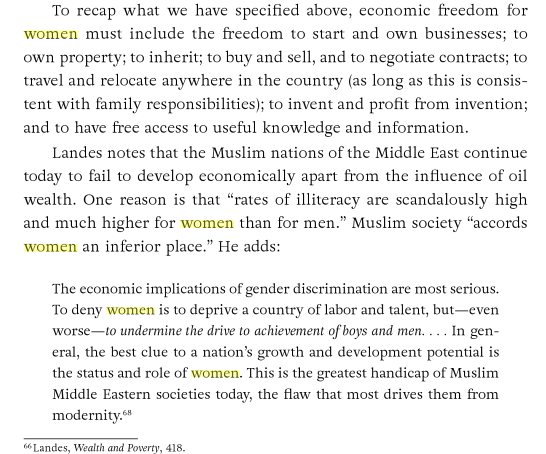
Believe it or not, he really has. In his new book, Poverty of Nations, coauthored by Barry Asmus, Grudem takes a strong position on equality for women. First he lists the freedoms of men,
1. Freedom to own property
2. Freedom to buy and sell
3. Freedom to travel and transport goods anywhere within the nation
[freedoms 4 and 5 are not available in google books.]
6. Freedom to start businesses
7. Freedom from excessive government regulation
8. Freedom from demands for bribes
9. Freedom for a person to work in any job.
10. Freedom for workers to be rewarded for their work
11. Freedom for employers to hire and fire
12. Freedom for employers to hire and fire employees based on merit
13. Freedom to utilize energy resources
14. Freedom to change and modernize
15. Freedom to access useful knowledge, freedom of information
Then he writes, or Asmus writes,
If a nation truly wants to move from poverty towards greater prosperity, it must ensure that all of the freedoms that we have discussed up to this point in this chapter are available to women as well as to men. page 292
Women must have the above mentioned freedoms available to them as well as to men. But in the past, no women had any freedoms at all that were not given to her by her husband. She only had the freedoms accorded under his leadership. Now a woman has all these freedoms. As someone who lived without most of these freedoms, it is very emotional for me to read this. Of course, I gave up complementation restrictions some time ago, but nonetheless, now complementation women have the freedom to own businesses, to do all that a business entails, to make decisions, to change and modernize, to have access to any education or information they want.
In the past, Grudem summarized complementarian practice as “boys and girls both educated, but different preferences, abilities, and sense of calling respected.” What different abilities?? Oh brother! Grudem also had a list of about 80 things that women could or could not do, all of them things that men could do. Grudem also said that a women as a boss had to nurture men in leadership according to their gender. Women as boss was a little touchy because this emasculated men, so he seemed to say in RBMW, page 43,
The God-given sense of responsibility for leadership in a mature man will not generally allow him to flourish under personal, directive leadership of a female superior.
But here is what Grudem and Asmus write in Poverty of Nations,
Weird Bibles 7: Tyndale in original pronunciation
The British Library has published David Crystal’s recording Tyndale’s translation of St. Matthew’s Gospel. (I found the cheapest price – about $14 – by ordering from bookdepository.co.uk from a UK proxy). This goes perfectly with the British Library’s splendid edition of Tyndale’s New Testament in original spelling. (The British Library edition being in standard type, is much easier to read than the facsimile edition published by Hendrickson.) (From a review in the Contemporary Review: “Forget the fourth Harry Potter book, the publishing sensation of this year is the second edition of William Tyndale’s New Testament first published in 1526. This is an original spelling edition edited for the Tyndale Society by W. R. Cooper and published by the British Library. […] It has, astonishingly, in its first week, outsold Joanne Rowling’s Goblet of Fire in the British Library bookshop.)
I’ve written before about David Crystal’s “Original Pronunciation Movement” – and while I have some issues with Crystal’s web business practices, I’m very happy to see this edition – even though it seems to run against the usual raison d’être for audio Bibles: to make the Bible more accessible to a wider audience. In contrast, this is an audio Bible as a performance, pronounced in a dialect of English that has not been spoken for centuries. This work gets us closer to hearing Tyndale’s literary genius as a contemporary might have heard him.
Tyndale was midway between Chaucer’s Middle English and Shakespeare’s Early Modern English. While it is easy to find recordings of Beowulf or Chaucer or even Shakespeare in original pronunciation (and these are merely exemplary recordings – there are many more available), recordings of Tyndale in original pronunciation are much rarer – this is the only example I am aware of!
Many of our previous “weird Bibles” posts have had at a least a hint of opprobrium about them; but not in this case. This original pronunciation audio edition is now my favorite recording of the New Testament in English, replacing my previous favorite.
Previous posts:
Weird Bibles 6: A “Sophisticated” Presidential Prayers Bible (plus another with “personal” reflections)
Weird Bibles 5: Jamaican Patois Bible
Weird Bibles 4: Digital Handwritten Bible
Weird Bibles 3: Playful Puppies Bible
Weird Bibles 2: Etymological New Testament
Weird Bibles 1: Archaic Aramaic script
An Orthodox translation
The Iranian Talmud
The Book of Doctrines and Opinions recently posted
An Interview with Dr. Shai Secunda about The Iranian Talmud that I thought might be of interest to BLT readers, particularly including the historical review at the beginning of the post:
The contextual study of the Talmud has generally focused on the Greco-Roman historical context. Asher Gulak in the field of Mishpat Ivri compared Roman and Talmudic Law, Boaz Cohen as a Talmudist compared concepts, and historian Shaye Cohen of Harvard situates Rabbinic family law in Roman context. In contrast, Chief Rabbi Herzog rejected the very idea of comparison. However for many, there was a standoff for decades between Erwin R. Goodenough who saw Judaism entirely enculturated in pagan Greco-Roman culture and Saul Lieberman who limited the influence to legal terms. Now, with the turn to cultural studies, Daniel Boyarin and others return the field to situating Rabbinics as part of a Greco-cultural world.
But what of Babylonian influence on the Talmud? Technically, we are speaking of the Sasanian dynasty that took power from the Parthians in 226 CE. It was bureaucratically centered in Mesopotamia which had a majority of Aramaic speakers, including Jews, Christians, and Mandeans, but also a ruling Persian speaking population. Their religion was Zoroastrian. Most scholars of the Talmud only made brief note of the context, leaving the discussion mainly to those in the field of religion.
They either saw Zoroastrian religion as polluting the pure ethics of the prophets or a conduit of perennial wisdom. They attributed much of the worldview unique to the Babylonian Talmud to this influence, including Talmudic magic, sorcery, angelology, demons as well as menstruation and purity laws. They also noted that Adam and Eve in the Bavli reflect the Iranian Mashya (man) and Mashyana, the Iranian Adam (man) and Eve. R. C. Zaehner, a professor of Eastern religions, argues for Zoroastrianism’s direct influence on Jewish eschatological myths, especially the resurrection of the dead with rewards and punishments.
The Hungarian Alexander Kohut, who edited and vastly expanded the classic 11th-century talmudic dictionary, the Arukh, and filled it with Persian etymologies, and was fascinated by the world of Zoroastrian angelology and demonology, charted many correspondences between the Persian system and its Jewish counterpart. The Austrian talmudist Isaac Hirsch Weiss was drawn to parallels between Zoroastrianism and the Talmud; he listed a number of critical areas in which, he argued, the rabbis had adopted Persian practices. Just as interesting, in other places Weiss claimed to have found signs of resistance—instances in which rabbis established practices specifically as a means of precluding certain “Persianisms.”
Although “in general, the Iranian element has been relatively slighted,” this seems to be changing in recent years. In 1982, E. S. Rosenthal “urged the mastery of Middle Persian, the Sassanian lingua franca, as a gateway to Talmud study” (emphasis mine).
Dr. Secunda is publishing a book giving an introduction to the Iranian situated Talmud, titled The Iranian Talmud. This semester, he is teaching a class on Women, Ritual and Religion in Late Antique Judaism at the Hebrew University of Jerusalem. His second book will be based on the topic of his dissertation, a study of the Babylonian rabbinic law of menstruation in relation to corresponding Zoroastrian texts, and he has a forthcoming article on Zoroastrian and Rabbinic ‘Genealogies’ of Menstruation: Medicine, Myth, and Misogyny. In an excerpt from this article, he observes that
The gender politics of textual production dictate that for the most part, ancient religious works which have survived into modern times were produced by and for men. When women are the subject of these texts, it is always through the male gaze. Hence female physiological processes, like menstruation, are often interpreted via male physiognomy, and the normative body is usually the male body. When we look at the way menstruation is depicted in male-authored texts, we find that at the very least the phenomenon is a source of wonder, if not always revulsion and misogyny.
For Sasanian rabbis and Zorasterian dadwars, menstruation was a physiological phenomenon accompanied by a set of prohibitions and purification practices.
Do click through to read the interview, in which Dr. Secunda discusses what the Iranian context adds to the study of the Babylonian Talmud, how his approach relates to Gemara and halakha, the relationship between the Talmud, Sasanian law, and Greco-Roman law, the inclusion of feminist perspectives in the study of rabbinic texts, and more.
Oxford Journals Halloween Collection
Ends and the Nature of Things
I was half-listening to a lecture by Alasdair MacIntyre this evening in which he talked about inferring the ends (as in telos) of things based on their natures. For example, the proper end of a frog is to be fully a frog, to achieve the fullness of frogness. (He said it more elegantly, but that’s the basic idea.)
This is fairly standard natural law reasoning, and I’ve heard it before. But as I listened to it tonight, I realized that this notion of “the nature of a frog” tacitly assumes that there is some essence of “frogness” – but this is inconsistent with the statistical nature of how species (in particular, and things in general) actually work. We humans define a category called “frog” and we classify individual animals as in or out of that category. But if we measured all the relevant froggy characteristics of each animal, they’d show a normal (Gaussian) statistical distribution.
So what is the essence of “frogness”? Is it the mean (peak) of the distribution? Are those frogs more froggy than the frogs that are a half-sigma away from the mean? That doesn’t make any sense… and it would have some pretty vile implications if extended to human beings.
It doesn’t have much room for the notion of evolution of species, either. Was the proper end of Homo erectus to be a protohuman, or to evolve towards Homo sapiens?
Furthermore, this reasoning involves, in Daniel Silvers’ memorable phrase, the valorization of the normal. James Keenan reflects on this in a 1999 paper:
we inadvertently “valorize the normal” (Silvers, 1999), because lacking the notion of end or perfection we have no other standard for what humans ought to be other than what they normally are. Of course, one reason that we valorize the normal is because we rightly fear whatever else we might endorse in the absence of an adequate anthropological vision. In this “endless” context, we classify persons with disabilities as not normal and therefore we believe that they will not become full human beings until they become normal. This prejudicial assumption is based in part simply on the fact that we have failed to articulate what it is that all human beings ought to aim at becoming. Is having hearing, four limbs, and being at least five feet tall what we consider what all humans ought to become? Hopefully not, but in lieu of any discussion of an anthropological goal, i.e., what the generations prior to us called perfection, we continue to live with unexamined presuppositions that valorize uncritically the normal. In turn, the normal emerges as an undynamic but definitely biased standard which enjoys tacit approval.
— James F. Keenan, ‘“Whose Perfection is it Anyway?”: A Virtuous Consideration of Enhancement’, Christian Bioethics 5:104-120, 1999
I’m lifting his argument a bit out of context here: he’s intending to show that for human beings, our proper ends ought to be conceived of as more than simply physical, because we are rational and spiritual creatures that can make choices and so forth. But I think the underlying argument doesn’t depend on the distinctive properties of humanity: valorizing the normal makes no biological or physical sense. The normal is simply the most common expression of the distribution: don’t we usually valorize the exceptional, rather than the common?
Anyway, all of this leads me to doubt the validity of this approach of inferring ends from nature, because it seems to be built on a metaphysical notion of nature that is inconsistent with the actual nature of Nature.
Some Thoughts on Some Things Pope Francis has Said
…and on things other people have said in response.
I’ve been horribly busy over the past few months, but I’ve managed to write a few pope-centric posts at Gaudete Theology that might be of interest to BLT readers. Here are the titles and initial excerpts of those posts, in chronological order; please click through to read the rest and join the conversation.
(And thanks, Theophrastus, for encouraging me to crosspost!)
– Papal Interview: “Disjointed Multitude of Doctrines”:
In the excerpts of the papal interview I’ve been seeing, this one leaped out at me (emphasis mine):
The dogmatic and moral teachings of the church are not all equivalent. The church’s pastoral ministry cannot be obsessed with the transmission of a disjointed multitude of doctrines to be imposed insistently.
because it reminded me of something I blogged about earlier, when discussing Roger Haight’s Systematic Ecclesiology:
Haight’s analysis demonstrates that the common pejorative “cafeteria Catholic” (wielded in both directions) is not only unfair, but inadequate, to describe what’s really going on. It is not a matter of cherrypicking items out of a coherent body of teachings based on personal preference. The fact is that the body of teachings is not presently coherent: faced with this situation, many Catholics are, with great integrity, constructing a self-consistent theological system, resolving contradictions by applying (what they understand to be) the core values of the gospel.
It also resonated very strongly for me with an experience I had as a young adult. I moved “back home” after college for about six months, and was singing with my parish choir during that time. It so happened that my last night to sing with the choir before moving out of town again was Ash Wednesday, which is a fast and abstinence day for Catholics (no meat, no snacks between smaller-than-usual meals).
After mass, up in the choir loft, there was a little farewell party for me, and one of the women brought out a cake that said “Good Bye and Good Luck” on it. To which my immediate, internal response was:
Oh no! It’s Ash Wednesday, I can’t eat this! It’s a fast day. We just started Lent!
followed immediately by the realization that…
– The Pope and the Atheist:
This was a fascinating interview that I wish I had time to blog further, but this was my favorite part:
The Pope comes in and shakes my hand, and we sit down. The Pope smiles and says: “Some of my colleagues who know you told me that you will try to convert me.”
It’s a joke, I tell him. My friends think it is you want to convert me.
He smiles again and replies: “Proselytism is solemn nonsense, it makes no sense. We need to get to know each other, listen to each other and improve our knowledge of the world around us. Sometimes after a meeting I want to arrange another one because new ideas are born and I discover new needs. This is important: to get to know people, listen, expand the circle of ideas. The world is crisscrossed by roads that come closer together and move apart, but the important thing is that they lead towards the Good.”
And I smile when I read the next line, because this is how my conversations with my atheist friends always go, too…
– “Your Christianity will be Personal, or it will be Bullshit”: Beneath Grisez’s Critique of Francis:
In response to Francis’ recently published interview with an atheist, Germaine Grisez had some startling criticism:
I’m afraid that Pope Francis has failed to consider carefully enough the likely consequences of letting loose with his thoughts in a world that will applaud being provided with such help in subverting the truth it is his job to guard as inviolable and proclaim with fidelity. For a long time he has been thinking these things. Now he can say them to the whole world — and he is self-indulgent enough to take advantage of the opportunity with as little care as he might unburden himself with friends after a good dinner and plenty of wine.
Katherine Mahon over at Daily Theology has some thoughtful reflections about the interview that also, I think, implicitly engages with the substance of Grisez’s critique, but I want to focus on the subtext, the assumptions, beneath this critique, which I find far more disturbing.
Grisez affirms that the Pope’s job is to to guard [the truth] as inviolable and proclaim [it] with fidelity. The truth we’re talking about here is the truth of the gospel, the truth which was entrusted to the Church.
He then criticizes Francis for being open and honest in saying what he really thinks and how he really feels.
The underlying assumption is that popes, bishops, and preachers have a responsibility to conceal any personal thoughts, feelings, or opinions that might potentially be interpreted as inconsistent with any element of the formal teachings of the church. …
Canadian surprise
Before this morning, if I were asked to name the best contemporary Canadian author in English*, I would have responded, without hesitation, Robertson Davies (yes, I know he died in 1995, but for me, he is still a vital author). If pressed for another example, I would have mentioned Margaret Atwood. If pressed for a third example, I would have named Michael Ondaatje. If asked for a fourth example, I would have called out Mordecai Richler (died 2001). I might at some point have referred to Leonard Cohen, whom I consider to be a Canadian poet.
We would have gone fairly far down the list before I would have named Alice Munro.
(*I regret that I am woefully ignorant of contemporary Canadian authors in French or other languages.)
Marg Mowczko’s Post on 1 Clement
A few days ago Marg Mowczko’s Blog New Life had this to say about Clement’s use of the Greek word for “head” (transliterated “kephale”) in the letter known as 1 Clement:
This passage in 1 Clement is not about leadership or authority, even though the word kephalē (head) is used here. In fact, if “head” is inferred as meaning “authority” the meaning of this passage will be lost. Similarly, I believe that the meaning of passages in Paul’s letters are lost when “head” is assumed to mean “authority” (e.g. Eph. 5:23).
Rather than authority, this passage in 1 Clement is about mutual submission, unity and harmony in the Church. It’s also about helping the disadvantaged, the weak and the poor. Clement does not go as far as Paul does in his teaching about body ministry; Clement seems to perpetuate social distinctions whereas Paul aimed to lessen the distinctions between the haves and have nots. Paul’s goal was equality (Gal 3:26-28; 1 Cor. 12:13; 2 Cor. 8:14 NIV).
The overriding aim of Clement’s letter was to resolve some issues about leadership in the church at Corinth; yet, nowhere in his letter is the word kephalē (head) used in the context of leadership.
Marg also has this to say about Clement’s attitude towards women:
Sadly, the passage quoted above is directed to men (andres adelphoi) (1 Clem. 37:1). In fact, Clement addresses most of his letter directly to the men (andres adelphoi) rather than to all the believers in Corinth, both men and women. Unlike Jesus and Paul, Clement was not a champion of women; however, Clement recognized and honoured biblical women such as Rahab. . .
The scope of Clement’s letter is limited. His primary concern was for harmony and peace in the Corinthian church and, to that end, he encouraged mutuality and mutual submission among the men. However, it is apparent that he did not regard women as the equal of men, or as colleagues in Christian ministry. This is in contrast to Paul. The letters that Paul wrote to churches were not addressed to the men only.
I noticed that Clement had to use “andres adelphoi” to specifically mean “male brothers” as distinguished from just “adelphoi,” which is how Paul usually addressed the church as a whole in his letters. It does make me wonder about the people who are so up in arms about the word “adelphoi” in the New Testament needing to keep being translated “brothers” rather than “brothers and sisters.” Obviously if “adelphoi” alone meant “male brothers,” Clement would have had no reason to qualify it with the word “andres.”
It’s also interesting that Paul specifically did not use “andres adelphoi” in those passages where biblical hierarchalists believe he intended to exclude women, such as in 1 Corinthians 14:26: “What is the outcome then, brethren? When you assemble, each one has a psalm, has a teaching, has a revelation, has a tongue, has an interpretation.” (Emphasis added) Since in verse 34 Paul supposedly constrains all women to silence, and in 1 Timothy 2:12 forbids them to teach, the word “adelphoi” in verse 26 really ought to have been written “andres adelphoi.” Writing only 30 or so years earlier than Clement, Paul could thus have made it perfectly clear in 1 Corinthians that women were not to give “teachings.” If that were what he meant, the way to clarify the gender of the “adelphoi” to whom he was speaking was readily available in the language Paul was writing in. Why didn’t he use it? Why did he use the same unqualified “adelphoi” that he used a few verses later in Chapter 15 verse 1, which says “I want to remind you of the gospel I preached to you,” and which could not possibly have been intended to exclude women?
I’m sure that in ancient Greek, just as in modern English, it was not customary to change back and forth between one sentence and the next, who you were addressing using the same form of address.
And why didn’t Clement use the word “kephale” in the sense of “authority” in a letter which was about resolving questions on leadership authority in the church? Clement clearly did want to exclude women from the whole conversation, and yet his writing does not support in any manner that it might be possible to translate “the kephale of the woman is the man” from 1 Corinthians 11: 3, as “men are in authority over women.”
Marg concludes:
1 Clement is an interesting read, albeit long-winded at times, as it gives us a glimpse into church life at the end of the first century, but, because of its male bias, I am glad that it was not included in the New Testament. On the other hand I am very glad that Paul’s letters – with his encouragement of mutual submission amongst all believers and support of women ministers – were considered inspired and authoritative, and were included, even if a few verses in them are genuinely difficult to exegete.
It’s interesting to me how men such as Clement (despite the inclusiveness of Paul’s letters) chose to be exclusive against women so soon after Paul’s writings. Paul really was swimming against the current! That’s what makes it so odd that Christians today are so convinced that it’s necessary to be counter-cultural against female inclusiveness today, not understanding that the New Testament’s counter-cultural teachings were actually pro female inclusiveness.
It is human nature, and the desire of those with traditional power to hold onto it, that has remained the same. Those who support male-only leadership are really simply going with the long-established flow.
In all our sons’ (?) command
The Canadian national anthem was written originally in French and had no reference to sons. The translation is not particularly literal, and so in English the phrase “in all our sons’ command” does not reflect any similar phrase in French. This anthem was written in 1880 and did not become the national anthem until 1960 when it replaced “God save the queen.”
Now there is a move to make the anthem’s wording closer to the original and remove the word “sons’.” Notable signers of the petition are the mother of Nichola Goddard, the first Canadian woman killed in combat, and Senator Vivianne Poy, a former student of my sister’s, as it happens. I hope this effort goes forward. We don’t need the rewriting of original texts in order to prioritize men. In a brief reminder, Luther’s Bible, so key in the Reformation, never did use the German equivalent of “sons of God.” His Bible only referred to “children” or “Kinder.” There needs to be a movement to restore the original inclusive language of the Bible.
Holy Gadoly: Great Women Leaders
Bonnie St. John with her daughter, has written a book called How Great Women Lead. She also has an amazing story of her own. But this leads to the problem of how “great women” are translated from Hebrew into English. What happens to the “great women” of the Hebrew Bible. Here is a brief translation history of a woman who was gadol in Hebrew or “great,” in 2 Kings 4:8.
And it fell on a day, that Elisha passed to Shunem, where was a great woman; and she constrained him to eat bread. And so it was, that as oft as he passed by, he turned in thither to eat bread. King James
One day Elisha went on to Shunem, where a wealthy woman lived, who urged him to eat some food. So whenever he passed that way, he would turn in there to eat food. ESV
One day Elisha went to Shunem. And a well-to-do woman was there, who urged him to stay for a meal. So whenever he came by, he stopped there to eat. NIV 2011
But what about men who are gadol? What does Bible translation do for them?
Now the king’s sons, being seventy persons, were with the great men of the city, which brought them up. King James
Now the king’s sons, seventy persons, were with the great men of the city, who were bringing them up. ESV
Now the royal princes, seventy of them, were with the leading men of the city, who were rearing them. NIV 2011
It may seem a detail, but great men morph into “leaders” and a great woman morphs into a “wealthy” or “well-to-do” woman. If you have a firm belief that women are not really “leaders” this is a helpful transition. This also reinforces the notion that men are one thing, and women are something else. Of course, nothing wrong with being wealthy, but nonetheless, women need to be represented as the leaders that they were. Examples of women who were leaders in the Hebrew Bible are Deborah, the judge, and most likely Jael as a judge also; and the wise woman of Abel and the wise woman of Tekoa, both clearly the leaders of their community.
The Bible continues to be used as a well from which one can draw stories to illustrate issues of our day. Malcolm Gladwell has just written David and Goliath: Underdogs, Misfits, and the Art of Battling Giants. Women also should be able to draw on the Hebrew Bible as a source of leading women, of women who come out from under as David did. We should think of Esther, not as a beauty queen, but as a politician and saviour of her people. She was clever and calculating and successful.
Homeland and Fatherland
Let me tell you about a language faux pas I once made. I was at a conference in Singapore, and speaking in Mandarin with some researchers from mainland China. Our conversation drifted to the topic of the Mandarin dialect itself. Because I learned Mandarin primarily from teachers and materials from Taiwan, I used the term 國語 (guoyu, literally “national language”) instead of 普通話 (putonghua, literally “common speech”). A Mandarin-speaking Singaporean listening to our discussion kicked me and harshly whispered in my ear “other side, other side!”
As I understand it, not only was the term 國語 uncommon to the mainlanders, but it actually carried harshly negative overtones, much like the term “fatherland” once did to English speakers. “Fatherland” sounds distinctly like the German vaterland – as in the now infamous German national anthem:
Deutschland, Deutschland über alles,
Über alles in der Welt, …Deutsche Frauen, deutsche Treue,
Deutscher Wein und deutscher Sang….…Blüh’ im Glanze dieses Glückes,
Blühe, deutsches Vaterland
My understanding is that in the postwar Federal Republic, only the last stanza is sung, so that German citizens no longer declare that “Germany, Germany is over all else – over all else in the world” or express their devotion to “German women, German loyalty, German wine and German song.” Nonetheless, they do pray for the German fatherland to flourish.
While the phrase “fatherland” is completely comprehensible to native English listeners, it chills many listeners because of its Nazi overtones. (Note, for example, that native English listeners do not have nearly the same degree of negative reaction to the word “motherland” [in Russian Родина-мать.]) My understanding that is that 國語 is similarly jarring to mainland Mandarin listeners.
But, I am no longer certain that I can use “fatherland” as an example. The truth is that the word “fatherland” no longer affects me the way it once did. I have become gradually acclimated to it – not through repeated use of the phrase “fatherland,” but through repetitions of the word “homeland” and the phrase “homeland security.” The fact that so many people can utter these “homeland” phrases with absolutely no trace of irony at all has somehow taken the edge off the term “fatherland.”
At the same time, the phrase “Homeland Security” still makes me strikes as a bit ominous (in a way, for example, that “Department of the Interior” does not.) In fact, I have to wonder whether that ominous effect was a deliberate choice. Perhaps the architects of the “Department of Homeland Security” (DHS), created in the wake of the 9/11 terrorist attacks, desired to project a level of severity. It certainly seems that agencies belonging to DHS have sometimes chosen threatening names. Perhaps the most evident example is the US Immigration and Customs Enforcement agency (which was created by the same legislation that created DHS), which prefers to be known by the acronym ICE – apparently a calculated “chilly” effect.
In any case, the term “fatherland” no longer upsets me the way it once did. Are Americans, who live under the jurisdiction and watchful eye of Homeland Security, really in a position to disapprove of those who profess devotion to the Fatherland?


 BLT
BLT 