weak women and womanish men like Jesus in Mark
In “Cliché, Binary Readings of Jesus in Mark,” I read the mixture of verbs describing Jesus (in two sets of variant manuscripts for Mark’s gospel) against the binary epistemology of Aristotle. In other words, Mark’s gospel has two different – seemingly contradictory – Greek words for the emotions of Jesus. The “either / or” binary makes readers choose either the one Greek word or the other. And to make the choice, readers might find a binary set of categories by which to naturally classify the seemingly opposed Greek words for the emotions of Jesus. There is either the mere human set or there is the definitely divine set. So, given the binaries, readers can decide on the variant texts. Either the one variant is original or the other variant is. There can be no mixing here. Or so goes the binary rule.
This morning in my reading of the next chapter of the gospel of Mark, I come to a verb used for Jesus. It’s a rare verb. In the New Testament, only the gospel of Mark has it and only this once. In the LXX, it is used in Greek Isaiah just once and in the Psalms just once. Outside the NT and the LXX, it is rarely used anywhere else. Aristotle uses it once in his Nicomachean Ethics.
I don’t know if the writer of the gospel of Mark read Aristotle. I do have a little more certainty that Aristotle named this work of ethics of his after either his manly father named Nicomachus or after his own manly son conceived with Aristotle’s concubine, his male offspring whom Aristotle named Nicomachus. (Aristotle was able to have a child with his wife, but she was a female offspring, therefore a botched human; and Aristotle never named any treatise of his in honor of a woman, not either his mother or his daughter. Both his wife and her daughter were named Pythias.) By the time the gospel of Mark is written, Aristotle’s manly student Alexander the Great has conquered the world and has set up his namesake Polis called Alexandria in the Mediterranean seaport of Egypt, where not too long afterwards the lackey king called for the translation of Hebrew Bible into the imperial lingua franca Greek. This is an important event, the translation that becomes known as the Septuagint, because the Jewish translators of their own Scriptures into Greek seems subversive. This is the narrative according to the Talmud, as Naomi Seidman points out. And, as Sylvie Honigman points out, the translators do not follow an Alexandrian paradigm in their work on their text but rather a Homeric paradigm. There seems to be a battle over what sort of Greek language to use. One is politically correct. The other is politically subversive, tricky, sophistic, rhetorical, translational, womanish even. “Avoid ambiguities,” and use “good Greek” is how Aristotle taught Alexander. In Alexandria, the Jews who seemed to know their Greek could choose and did choose. In Jerusalem, Mark using Greek also seems to choose. How conscious is he of this political struggle over Hellene? Surely he was at least aware of the political need to contain good Greek as opposed to ambiguous Greek. Surely this is in view even still:
the Aristotelian view of how “not males” used language and how manly men were better when they practiced the ethics of manliness, including manly language and manly relations with his manly friends.
So let’s now get to Aristotle’s use of the rare Greek word in question. Then let’s look at this single New-Testament use of this same rare Greek word as the gospel of Mark applies it when describing Jesus.
Here’s from the Nichomachean Ethics (at 1171b) translated into English in the early 20th century by one H. Rackham; [I’m interpolating the Greek word / and my transliteration of it / in the context]:
Yet the pleasure that the company of friends affords seems to be of a mixed nature. It is true that the very sight of them is pleasant, especially in time of misfortune, and is a considerable help in assuaging sorrow; for a friend, if tactful, can comfort us with look and word, as he knows our characters and what things give us pleasure and pain. But on the other hand to see another pained by our own misfortunes is painful, as everyone is reluctant to be a cause of pain to his friends. Hence manly natures shrink from making their friends share their pain [συλλυπεῖν /syl-lypein/], and unless a man is excessively insensitive, he cannot bear the pain that his pain gives to them; and he will not suffer others to lament with him, because he is not given to lamentation himself. But weak women and womanish men like those who mourn with them, and love them as true friends and sympathizers. However, it is clear that in everything we ought to copy the example of the man of nobler nature.
And here’s from the gospel of Mark (at Chapter 3) translated into English in the mid 20th century by one J. B. Phillips; [again I’m interpolating the Greek / with a transliteration/ in the context]:
Then he said to them, “Is it right to do good on the Sabbath day, or to do harm? Is it right to save life or to kill?” There was a dead silence. Then Jesus, deeply hurt as he sensed their inhumanity [συλλυπούμενος /syl-lypoumenos], looked round in anger [ὀργῆς /orges/] at the faces surrounding him, and said to the man, “Stretch out your hand!” And he stretched it out, and the hand was restored as sound as the other one.
Now, let’s compare.
Aristotle is writing concerning what is ethical for men, and to be very specific he’s writing about what is ethical for manly elite Greek men in the Polis of the coming Greek Empire. He’s writing about the ethics of friendships. He’s saying that it is not natural for manly men to have the sorts of emotions in friendships that not-manly-men have. Manly men do not share their pain with other manly men; they do not like weak women and womanish men do show any grief. Manly men are of a nobler nature. That’s the lesson.
Mark is writing with profound ambiguities concerning what Jesus. In Chapter 2, in one of two different variant readings, he has Jesus showing the emotion of anger. Or, if we must choose the other variant reading, then he has him showing gut-wrenching compassion. Are these really so different? Here in Chapter 3, there’s no mixed up variant texts to sort out. Rather, there are two emotional descriptions for Jesus that may seem to contradict one another. One the one hand, Jesus is sharing pain (like a weak woman would and like womanish men do, according to Aristotle), and he’s treating those men he’s confronting with two rhetorical questions as a false binary choice as friends for whom and/or with whom he grieves. There hearts are hard, Mark goes on to explain after the excerpt given above; and Jesus seems upset and perhaps compassionate towards them about that. And then, on the other hand, there’s the anger again. Could these by synonymous? Ambiguities not avoided in the description of Jesus? A mixed nature unsorted out into convenient categories by a strict binary? A womanish man? A womanish son of Humanity? A wo-man-ish male offspring of God?
70th Anniversary of D-Day

D-Day is such a tragic and heroic event of our present history that it is difficult for me to come fully to terms with it. This photographic exhibition from The Guardian helped; it shows images from 1944 that morph into the same view of the present day when clicked.
Wilson argues that, even as he has come to affirm same-sex behaviors and relationships, the issue need not divide congregations or Christians.
Pastor Cortez cited Wilson’s argument as foundational to the position he and his church are now taking — “agree to disagree and not cast judgment on one another.”
But, there is no third way. A church will either believe and teach that same-sex behaviors and relationships are sinful, or it will affirm them….
There is no third way on this issue. Several years ago, I made that argument and was assailed by many on the left as being “reductionistically binary.”
But, the issue is binary.
— Dr. R. Albert Mohler Jr., “president of The Southern Baptist Theological Seminary – the flagship school of the Southern Baptist Convention and one of the largest seminaries in the world.”
Well, let’s not assail Dr. Mohler’s old argument. He’s re-articulated it anew here.
It would not take too much research to go back just a little further in Southern Baptist Convention history to find lines drawn, crossed, and then erased. For example, in 2010, there was this:
RESOLVED, That we call on our churches to proclaim God’s mercy and grace to all people—including those who have been divorced without biblical grounds—due to the truth that the blood of Jesus can atone for any sin and can cleanse any conscience;
And, for instance, in 1999, there was this:
Many of our Southern Baptist forbears defended the right to own slaves, and either participated in, supported, or acquiesced in the particularly inhumane nature of American slavery. . . .
Be it further RESOLVED, That we lament and repudiate historic acts of evil such as slavery from which we continue to reap a bitter harvest, and we recognize that the racism which yet plagues our culture today is inextricably tied to the past; and
Be it further RESOLVED, That we apologize to all African-Americans for condoning and/or perpetuating individual and systemic racism in our lifetime; and we genuinely repent of racism of which we have been guilty, whether consciously (Psalm 19:13) or unconsciously (Leviticus 4:27); and
Be it further RESOLVED, That we ask forgiveness from our African-American brothers and sisters, acknowledging that our own healing is at stake; and
Be it further RESOLVED, That we hereby commit ourselves to eradicate racism in all its forms from Southern Baptist life and ministry….
Divorced people got a bit more grace. African-Americans got a bit more of a welcome. The former got that because there was more and more acknowledgement of more and more divorce among the SBC members. The latter got a bit more of a welcome because more and more of the majority Euro-American SBC members were acknowledging more and more how out of step their churches were with a more and more intentionally inclusive South, where governments and neighborhoods and other churches perhaps were more intent on race reconciliations. The capital letter RESOLVED is just to mark the watershed moment where a majority at the Convention can publicly agree on a statement. It is progress if not so progressive given the late date in human history and given the surrounding culture relative to the SBC culture.
But, really, the legacy of the SBC and many other Baptist groups is to be decentralized and to allow the local congregants and members to take their own positions along a theological, and political (i.e., church polity), and “biblical” hermenuetic spectrum.
When it comes to marriage and sexuality, there are lots of Baptist views allowed. There is even this ironically-consistent Baptist-culture belief that allows for variation, difference. The SBC may be a Convention that tries to articulate for all Southern Baptists what must be practiced, followed, and believed. But the “either / or” and “in” or “out” mentality is counter to the history. I’m tempted in writing this blogpost to run through the Bible like a William J. Webb. It sure is helpful to notice the variation in the Bible on marriage and on sexuality. It flies in the face of an Aristotle-like insistence on some “A is not NOT-A” formula applied to biblical ethics.
Let me just end by linking to a blogpost of American Baptist minister Rev. Robin Lunn. I heard her preach Jubilee from the Bible last summer at the Old Cambridge Baptist Church in Massachusetts. I was so impressed that I went looking for things she’d written and found what she’d posted just three days earlier:
The day Rev. Lunn posted this, somebody named Darryl drags the SBC into the conversation with this comment:
The Southern Baptist Convention dominates what people think about Baptists in general, and the SBC is where most of the KJV-only fundie crowd lies. The Baptist part of Christianity is generally a heavy Free Church tradition, with emphasis on personal revelation, so Baptists will range throughout the theological spectrum.
The tradition and culture of the SBC is the one I’m most familiar with. My parents were SBC missionaries, and I grew up an SBC MK (the K standing for “kid”). (I’m still growing up.) My spouse grew up an SBC PK (the P standing for “preacher’s”), and my father-in-law is still an SBC ordained minister. There are pressures from Dr. Mohler and the like to make sure there is no middle ground on sexuality and on marriage and on purity and the like. If SBC history proves anything, nonetheless, it’s that there may be lines drawn, and crossed, and then erased. Hopefully the SBC can be less “binary” and more varied, more biblical. Hopefully there will be no big huge public need for a RESOLVED about the regrets of the SBC because of Baptist misbehaviors towards persons, church members even, who are LBGTQIA persons.
Cliché, Binary Readings of Jesus in Mark
Reading through Mark’s Greek gospel, I’ve tried to resist some of my own tendencies to read it through those well-worn cliché tropes. For me anyways, in Southern Baptist Sunday School, I got little summaries of the books of the Holy Bible. There was the rationalization of the substantial variations in and between the four canonical gospels, for example. “Mark wants to show us Jesus as the Miracle Working Christ. It emphasizes His Divinity.”
More often than not, the method of reading, the interpretive method, the “Hermeneutic,” is Aristotle’s principle of non-contradiction. The middle is excluded. It’s the “either / or” binary. Once a “book” can be summarized, and classified, it can be distinguished from the other books. The questions of the canon, then, can be dealt with. “The Gospel of Thomas”? Definitely NOT canonical, unless you’re going to be one of those Jesus seminar types, who includes the unincludable. (Well, the Jesus Seminar scholars don’t get a pass from playing Aristotle’s game. “This is EITHER something Jesus said OR it’s not. Now, tabulate the votes and grade with colors.”)
So is Jesus in Mark Divine? Or is Jesus in Mark Human?
Greek readers have a problem from the get-go since there are different texts to choose from. Either “that one” is the original and right and correct reading. Or “that other one” is. And we see this in Chapter 1. Verse 41 has this verb for Jesus (depending on the text you correctly choose):
Either
σπλαγχνισθεὶς
or
ὀργισθεὶς
The context has Jesus responding to another Human being who has what Mark seems to be describing as leprosy. The narrative has Jesus stretching out his hand and touching this unnamed person. The text also has Jesus doing this action with some sort of emotional motion.
Either it’s
gut-wrenching compassion
or it’s
raging indignation
Fair enough. We have two sets of Greek variant texts we must choose from. This results in two different text meanings,two different translations. Either the one or the other.
What I don’t get when reading how some readers read these variants is why one seems more human and the other must seem less human and therefore more divine. Can you guess which tends to be interpreted which way? The one way or the other?
A quick googling gets us this pattern of “either / or” reading:
Maybe Jesus was angry, indignant, annoyed. We might rather not think so, but the theology of the church is that he was not only fully divine, but also fully human. And the man was not dispassionate, he did have a temper, remember how angry
and
No doubt, he was tired of the crowds and of the exercise of power without any authority so that in a very human moment, Jesus was angry. I think that this reading helps to solidify the humanity of Jesus in this first half of Mark whereas the variant would only gloss over his humanity.
The cliché here seems to be that the human Jesus gets angry, that flying off the handle in indignation is not something God would do. Humans are emotional this way. Gods are more dispassionate.
And so the syllogism follows the major premise (Humans are given to weak shows of emotion). There’s the minor premise (Jesus was fully human). Here’s the conclusion – the Mark text original surely has ὀργισθεὶς since it does not “gloss over his humanity” but rather flaunts it.
I’m not trying here to protest this argument. Rather, I’m just trying to present it as based on binary thinking.
But what if our tight categories leaked a bit? What if gods and goddesses and perhaps even the G-d of the Universe were able to be annoyed by others or by situations? And what if human beings, even those created in God’s image, albeit a little lower than the angels, were able to have divine gut-wrenching compassion for one another and perhaps even for a Deity? What if the historical accident of our having different texts to interpret helps us to open up to possibilities of interpretation that are not so tightly binary? What if the original writer of the gospel of Mark had both phrases, the two verbs, together for the one Jesus? Now wouldn’t that have been something?
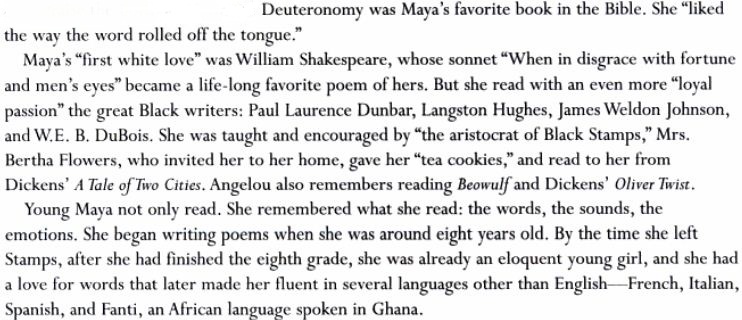
Edwin Graves Wilson, for young readers, compiled some of the poems of Maya Angelou, his friend, into a book. He also wrote an introduction that showed the biblical, literary, and translational influences on this poet friend of his. In part, that goes like this:
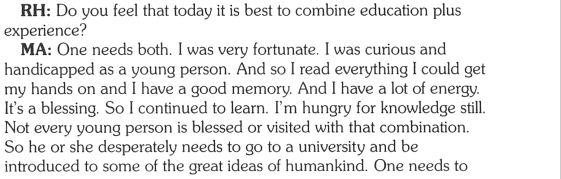
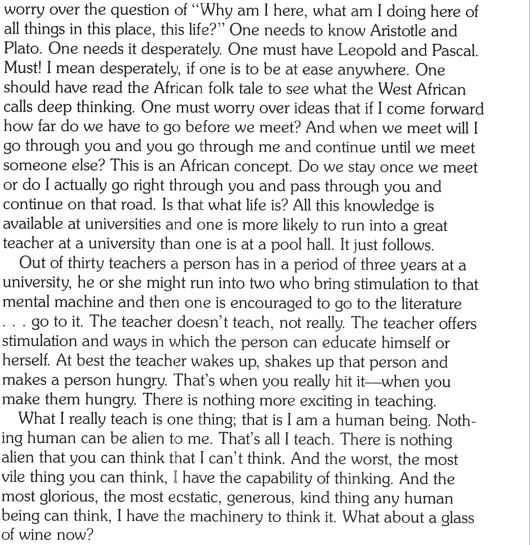
Once upon a time, in a Ph.D. dissertation I wrote on Aristotle, I quoted the grown-up Maya Angelou. She was talking with Russell Harris and encouraged not only a higher education but also learning from experiences. Aristotle would be her teacher, also, but clearly not the only one. Here’s what she said in full (that I quoted in part):
One of the last things Maya Angelou said, before she passed away last week, was what she tweeted last. In case you missed it:

part 3: the Gender Inclusivity of Jesus in Mark
In this 3rd part of posting on the Gender Inclusivity of Jesus in Mark, I’m going to offer my own English translation of the Greek translation. What came out of the mouth of Jesus, in Greek, was this:
Τὸ σάββατον διὰ τὸν ἄνθρωπον ἐγένετο
καὶ οὐχ ὁ ἄνθρωπος διὰ τὸ σάββατον·
ὥστε κύριός ἐστιν ὁ υἱὸς τοῦ ἀνθρώπου
καὶ τοῦ σαββάτου.Shabbat was, for the Human Being, generated as in a breeding,
and the Human Being was not born and bred for Shabbat.
So he, the Human Male Offspring, is Master
and of Shabbat.
The Hellene takes readers back to Hesiod’s Theo-Gony, to the LXX’s Genesis, to Aristotle’s Generation of Animals. The gods are making the heavens and the earth and the sea. God is making Human Beings in His Likeness. This is the Nature of Procreation, with animal species like but certainly lower than the Human species.
The most Hebraic phrase of all, the Hellene-letters σάββατ*, takes readers back to Greek Exodus, to the Decalogue in the Pentateuch. Moses in Alexandria, Egypt among the Jewish community there speaks Greek and relays the Ten Commandments of Kurios, of Master. The one is that the variety of species, animals, and the Human in all its gendered diversity, must observe Shabbat. It was born and bred for them. It is the Nature of things. The Master himself observed Shabbat, is Master of all, and of Shabbat. (This most holy high Hebrew, this phrase of Moses, of G-d. In Alexandria, Egypt sometime around 260 BCE, the Jews living there rendered it into Hebraic Hellene. A century later, suggests historian Sylvie Honigman, this Greek version of Moses became “as sacred – at least as sacred as the Hebrew original.” The readers of the Greek gospel of Mark hear this, remember it, make it as holy.)
The frozen phrase υἱὸς τοῦ ἀνθρώπου takes readers back to the wordplay of the “Psalmoi” in Greek and then the rest of the Scriptures for Greek reading. We speculate, with a certain plausibility, that the Alexandrian Jews knew their Greek. They seemed to enjoy wordplay in Hellene. Those translating the Psalms seem to have engaged in literary sparks as notes Albert Pietersma reading the Greek for the NETS Septuagint.
In one Psalm, what we refer to as Psalm 8, there’s the hierarchy of Master over all creation. It’s middle lines bring forth an anthropos (ἄνθρωπος) under heaven, out of earth, lower than an angel, above the animals of every species in every place. The LXX translator has Greek readers hearken back to the Hellene Genesis creation story again.
Once I tried to convey, to render, to translate, to bring across some of this Greek into some English. It goes like this:
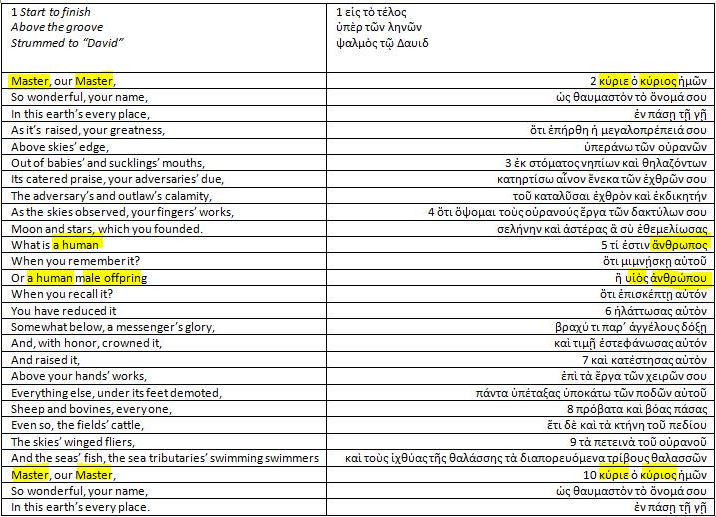
The hierarchy constructed, and then deconstructed, by the movement of the Greek Psalm here is important. The classes of things in Nature, constructed and deconstructed, is important.
This sort of wordplay, the literary sparks and interpretive spins here, play against the tight classes of Aristotle. Aristotle keeps the various natural categories pure, separate, stratified.
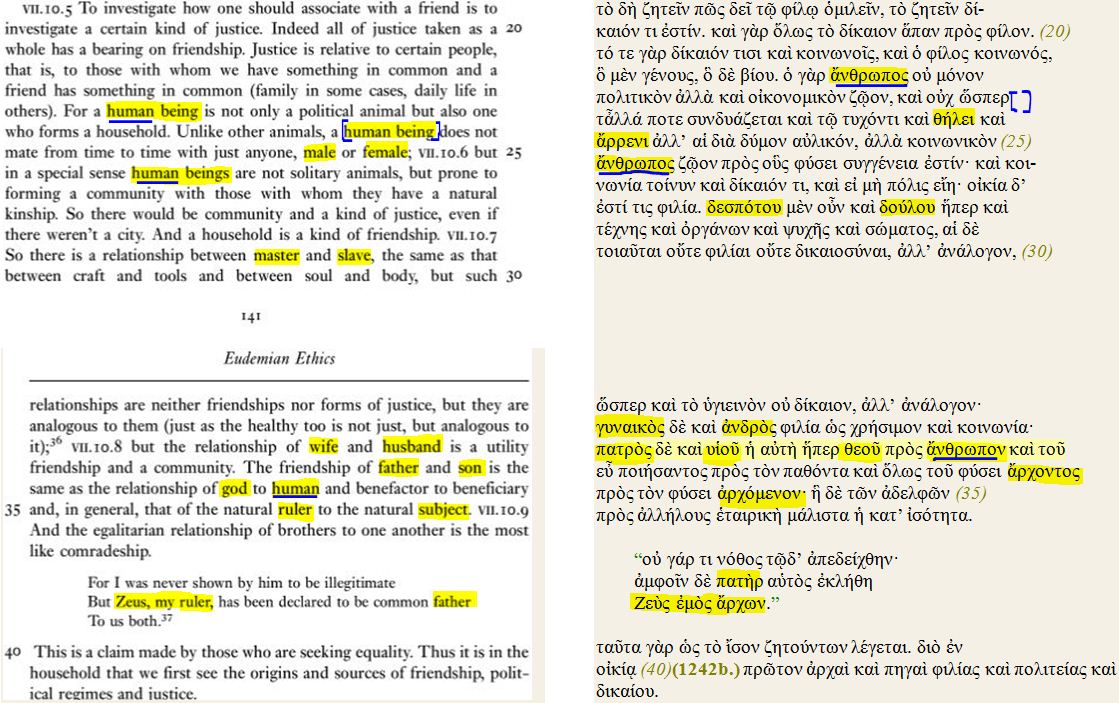
Below is Aristotle writing his Eudemian Ethics. Towards the end of the excerpt, he quotes a playwright, Sophocles (whom Aristotle disparages for his confused rhetoric elsewhere); those who would make unequal classes equal are like the playwright who would have Zeus not just a master ruler but some sort of fathering father of all offspring, of everybody, as if everybody is equal with everybody else. As I did above with my English and the LXX Greek of the Psalm, I’ve highlighted the concordant phrases, putting the English on one side and the Greek on the other. The following fine English translation is by Brad Inwood and Raphael Woolf. Very clearly these translators show Aristotle’s attempt to work classes and categories in binary “either / or” pairs, the one over the other. A close reading of the phrases shows what Mark, the gospel writer, might have been working with. At the very least, I hope readers of this post will see the gender inclusivity of Jesus in Mark. Now here’s Aristotle:
part 2: the Gender Inclusivity of Jesus in Mark
In part 1 of my posting on the gender inclusivity of Jesus in Mark, we compared the LXX Exodus with Mark’s gospel. We also compared Robert Alter’s and Everett Fox’s respective translations of a bit from Exodus with Willis Barnstone’s and Ann Nyland’s respective translations from another bit from Mark. Of course, the Septuagint translation team and the writer of the gospel did not work together in time or in place. And Alter and Fox focused primarily or exclusively on the Five Books of Moses; and Barnstone and Nyland worked on the New Testament.
In part 2, let’s look at other very good translations in which the translator team and the translator render, in a single volume, both the Hebrew of Exodus and also the Hellene of Mark into English . Below is what has been published respectively. It is Exodus 20:8-11 and Mark 2:27-28. It is this pair of passages as translated by the team for the New Revised Standard Version, and by the team for Today’s New International Version, and by my co-blogger Craig R. Smith for The Inclusive Bible: The First Egalitarian Translation.
NRSV –
8 Remember the sabbath day, and keep it holy. 9 Six days you shall labor and do all your work. 10 But the seventh day is a sabbath to the Lord your God; you shall not do any work—you, your son or your daughter, your male or female slave, your livestock, or the alien resident in your towns. 11 For in six days the Lord made heaven and earth, the sea, and all that is in them, but rested the seventh day; therefore the Lord blessed the sabbath day and consecrated it.
27 Then he said to them, “The sabbath was made for humankind, and not humankind for the sabbath; 28 so the Son of Man is lord even of the sabbath.”
TNIV –
8 “Remember the Sabbath day by keeping it holy. 9 Six days you shall labor and do all your work, 10 but the seventh day is a sabbath to the LORD your God. On it you shall not do any work, neither you, nor your son or daughter, nor your male or female servant, nor your animals, nor any foreigner residing in your towns. 11 For in six days the LORD made the heavens and the earth, the sea, and all that is in them, but he rested on the seventh day. Therefore the LORD blessed the Sabbath day and made it holy.
27 Then he said to them, “The Sabbath was made for people, not people for the Sabbath. 28 So the Son of Man is Lord even of the Sabbath.”
Inclusive Bible –
8 “Remember the Sabbath day and keep it holy! 9 For six days you will labor and do all your work, 10 but the seventh day is a Sabbath for YHWH. Do no work on that day, neither you nor your daughter nor your son, nor your workers–women or men–nor your animals, nor the foreigner who lives among you. 11 For in the six days YHWH made the heavens and the earth and the sea and all that they hold, but rested on the seventh day; this is why YHWH has blessed the Sabbath day and made it sacred.
27 Then Jesus said to them, “The Sabbath was made for people, not people for the Sabbath. 28 That is why the Chosen One is ruler even of the Sabbath.”
the Gender Inclusivity of Jesus in Mark
This morning, I’m reading the gospel of Mark, chapter 2, and come to this Greek translation of something Jesus said and find that this translation is gender inclusive. Some may object that the Greek gospel writer is not really translating; rather, they would correct me to say that he’s simply narrating in Hellene, using Greek to tell the story for readers to read.
At the very least, I think we might all agree that he’s at least transposing; that is, he’s putting spoken Greek into written form. And at the very least, I don’t believe anyone would have trouble thinking of the quotation attributed to Jesus as including some transliterating; that is, he’s having Jesus say a Hebrew phrase (שַׁבָּת) as if he’s pronouncing it with this Greek accent (σάββατ*). This is the very thing that the translators in Alexandria, Egypt do when translating the Hebrew scriptures, Torah, into Hebraic Hellene, the Pentateuch; this is what we all know as the Septuagint (or LXX to use the Latin numbers to describe this translation by some 70 translators, according to the lore). For example, the LXX translators made what we call Exodus 20:10 include the Hebrew sounds with Greek letters for a particular word. When we use the English Standard Version to see the meanings of the Hebrew, then that verse goes as follows:
but the seventh day is a Sabbath (שַׁבָּת) (σάββατ*) to the LORD your God.
On it you shall not do any work,
you, or your son, or your daughter,
your male servant, or your female servant,
or your livestock, or the sojourner who is within your gates.
Where the ESV translators put Sabbath, the LXX translators put σάββατα. Presumably, Moses is speaking a demotic Hebrew to the people. Presumably, Moses too has written this down in high holy Hebrew (not so demotic). So if the Masoretic Text has his words right, then what readers really hear is something the phrase already mentioned, as best as anyone can say it today: שַׁבָּת.
So we fast forward a century and, notes historian Sylvie Honigman, “[w]ith time, familiarity with the [Greek] text grew.” And she goes on, saying, “Alexandrian and Egyptian Jews would slowly come to hold the LXX as sacred – at least as sacred as the Hebrew original.”
So there are Hebraisms in the Hellene, and these are read as holy. It’s the Greek translation of the Law or the Teachings of Moses. And the little bit we already looked at is already pretty inclusive language. We’ve only really looked at it in the English Standard Version. Let’s look now at the LXX sacred version, sacred for the Alexandrian and Egyptian Jews, about one century after the translation of the Hebrew of Moses. When it’s seen as sacred, it’s probably around 160BCE. This would also be about two centuries before Mark quotes Jesus and uses Greek to do so. When Mark writes, it’s probably still sacred in Alexandria among the Jewish community there. It goes like this:
τῇ δὲ ἡμέρᾳ τῇ ἑβδόμῃ σάββατα κυρίῳ τῷ θεῷ σου
οὐ ποιήσεις ἐν αὐτῇ πᾶν ἔργον
σὺ καὶ ὁ υἱός σου καὶ ἡ θυγάτηρ σου
ὁ παῖς σου καὶ ἡ παιδίσκη σου
ὁ βοῦς σου καὶ τὸ ὑποζύγιόν σου καὶ πᾶν κτῆνός σου καὶ ὁ προσήλυτος ὁ παροικῶν ἐν σοί
So let’s just fast-forward to Jesus speaking English Standard (as translated from Mark’s Greek, which may be influenced by the LXX, which is clearly a translation of some Hebrew like the MT):
The Sabbath was made for man,
not man for the Sabbath.So the Son of Man is lord
even of the Sabbath.
What’s striking is how gender inclusive the ESV-speaking Moses is (in Exodus) but how gender exclusive the ESV-speaking Jesus is (in Mark).
When we read in Hebrew, however. When we read in Hebraic Hellene, nonetheless. When we get this in English, otherwise, then something remarkable happens. Jesus sounds as gender inclusive as Moses.
Behold. Listen:
Τὸ σάββατον διὰ τὸν ἄνθρωπον ἐγένετο
καὶ οὐχ ὁ ἄνθρωπος διὰ τὸ σάββατον·ὥστε κύριός ἐστιν ὁ υἱὸς τοῦ ἀνθρώπου
καὶ τοῦ σαββάτου.
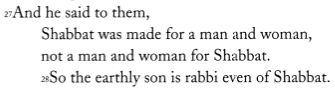
Now look. Hear as Robert Alter and then Willis Barnstone respectively render into English the words of Moses and the words of Jesus:

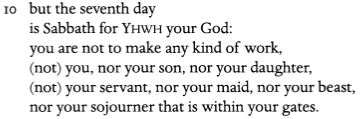
Then see. Give ear to how Evertt Fox and then Ann Nyland respectively translate the Mosaic scripture and the Markan gospel:

If you’ve visited this blog before, then you know how my co-bloggers and I tend to be interested in this Greek word, ἄνθρωπος /anthropos/. It shows up here in the Greek gospel of Mark, in the mouth of Jesus. The men of the ESV translation team make Jesus say “man.”
Barnstone makes him say “a man and woman” and “the earthly son.” This is to show both the inclusivity of Moses and also the inclusivity of Homer. It’s the gender inclusivity of Mark’s Jesus.
Nyland makes him say “the person” and “the Human Being.” This is to show the inclusivity of the Hebrew and of the Hellene.
Nyland, like Barnstone does, recognizes the humility of the Greek phrase ἄνθρωπος too; the writer Mark and the speaker Jesus are not referring to gods or to G-d. They’re not referring to deity until he is called “Master,” and Barnstone thinks they may even only be referring late to “rabbi.”
And so my point is that English can bring out the humanity, the maleness and also the femaleness, that Jesus is referring to when he refers to the people that “Sabbath” or “Shabbat” is made for, that he is in Mark’s gospel rabbi or Master of.
I don’t remember what year it was or exactly how old I was when it happened. The kids were young: that much I remember, so I must have been in my mid-40s. It was summer– I remember that, too.
I was standing in our tiny back yard behind the kitchen door, under a sky filled with stars. I think it was about 10 or 11 pm. I was alone. For some reason more stars were showing than usual; maybe some of the street lights were out. It was very quiet.
I looked up into the stars and thought of God.
And then. . .
Something indescribable fell away from my ordinary sense of things. Perhaps it was the careful, reasoned categories I was accustomed to use to frame my thoughts. I had a sensation of being lifted up and up, though I also knew I was still standing solidly in the night-sweet grass. Over the horizon the moon swept up; it was a gibbous moon, about two-thirds full. And I saw.
Saw that all things were part of a serene and purposeful whole. Saw that I myself was a valued and necessary part of that whole, as were the trees, the grass, the stars, the moon, and the minuscule flying creatures that brushed my face. Felt a tender, loving purpose guiding it all towards some unknowable but beautiful end.
“All is well. All is one. I am here.”
It wasn’t a message spoken in words, but an indescribable knowing that was frankly impossible to doubt or question. I didn’t question it. I breathed quickly, flutteringly– completely astonished yet completely at ease, completely accepted and accepting.
Slowly, slowly the feeling faded, drained away. I was left there in the dark grass again, myself again, and I turned and drifted back through the door and into bed and sleep.
But I have never forgotten, and I have never been the same. The memory of joy– joy present in part now and expectant of fullness in time to come, has ever since held in peace the foundations of my soul.
————-
“There is no proof of your god.”
Several years before the experience I have shared above, I had a crisis of faith. In my early 40s I encountered on the Internet people who knew a lot more about science than I did and who insisted that if something was real, science would support that it was real. I found I didn’t know how to answer them. “There is no proof,” the atheists said, and I knew they were right. Anything that seemed to me to be a good enough reason to believe, was never going to be enough for scientific rationalism. So what if they were right, and I was wrong? Supposing I was only deluding myself about the existence of God?
I remember my frustration, how I cried to the heavens, “God, couldn’t you just give one incontrovertible proof? Something so we could be sure?”
But there was no answer. God, it seemed– if he existed– felt no need to answer such a prayer. Or maybe he couldn’t, because he wasn’t really there. . .
For months I struggled, suspended between faith and doubt. And then an online friend directed me to the Doxa website. “Doxa” means “glory,” and the website author, scholar/theologian Joe Hinman (who calls himself “Metacrock” online) showed me that the real problem was that I was letting the skeptics determine the rules of engagement, playing the rationalists’ game on their own playing field.
They said my God was a big imaginary friend in the sky. They made it sound so silly. But Doxa helped me see that I didn’t– and needn’t– believe in that little straw-man deity anyway.
The scientific rationalists said I needed to question all my assumptions. But I began to understand that they were leaving most of their own assumptions unquestioned. Could their assertion that everything that is real can be scientifically verified, itself be scientifically verified?
If I must doubt my faith, couldn’t I also doubt their skepticism?
“Why should I mistrust my own experiences of God’s presence?” Joe Hinman taught me to ask. After all, we don’t mistrust other things we experience. We don’t doubt that the chair we’re sitting in will hold us, unless we have some good reason to think something has gone wrong with our senses. We don’t have to accept the self-proclaimed expert in science as an expert in metaphysics. Nor need we accept the standard of “absolute proof” in terms of scientific categories that may be inadequate for the phenomenon in the first place. We can have good, reasonable reasons — what Hinman calls a “rational warrant” to believe. His newer website, The Religious A Priori, explores belief and rational warrant from a number of different angles.
And now Joe Hinman has encapsulated some of his best thinking into a new book: The Trace of God: A Rational Warrant for Belief.
The Trace of God is a scholarly work, but written in a style that a layperson can follow. Its main point is that experiences like the one I describe above (called “religious experiences” or “peak experiences”*) do constitute good evidence, even from a scientific point of view, of the existence of God.
God can’t be absolutely proven, Hinman says, because God is “not just another thing in the universe.” God is the source and foundation of everything material and empirical; God is not material himself, nor is the sense of God conveyed in human empirical senses such as sight or hearing. Instead we must look for the “co-determinate”:
The co-determinate is like. . . a fingerprint. The trace is the sign that always accompanies the thing itself. In other words, you can’t see the invisible man, but you can see his footprints, and wherever he is in the snow his footprints will always follow. We cannot directly observe God, but we can find the “trace,” the co-determinate, the effect of God in the world. [p. 67]
Religious experience, and especially “peak” experience, is that footprint in the snow. Hinman spends several chapters detailing the methodology and findings of the many careful scientific/sociological studies that have measured and quantified religious experience. He details the real, empirical effects of these studies on those who experience them, in terms of their “ultimate, transformative effects”:
The effects of these experiences are dramatic, positive and long-term. . . There is data to suggest that religious experience has enabled addicts to get off of heroin, alcoholics to stop drinking and even helps people quit smoking. . . [there is] a clear feeling of meaning in life. Many speak of losing their fear of death. [p. 85]
Hinman goes on (pp. 88-89) to highlight the findings of several studies showing that those who have peak experiences:
- Are less likely to value material possessions and money or status
- Give greater value to work for social change, solving social problems, helping the needy
- Are reflective, inner-directed, self-aware, self-confident
- Are less authoritarian and dogmatic**
- Exhibit integration, allocentrism
- Exhibit psychological maturity
- Show self-acceptance, self-worth
- Exhibit autonomy, authenticity
- Experience increased love and compassion
Hinman then spends several more chapters exploring the views of dissenting thinkers and alternate explanations for these transformative effects, and explaining why authentic experience of the divine is the explanation that most reasonably fits the phenomena. For instance, the fact that children often have spontaneous peak experiences precludes the idea that this is a specialized state of mind caused by the self-discipline of meditation.
Finally, at the end of the book he addresses how his understanding of religious and peak experience (which can and does occur in all religious traditions and even happens at times to the non-religious) fits into a Christian viewpoint. Hinman is himself an orthodox Christian, though he does not identify with the evangelical tradition.
I found the book enlightening and uplifting, and was also intrigued to find that the incident in my backyard under the stars was a quintessential “peak experience.” It certainly has had transformative effects on my life! I am less fearful of the future, more anchored and confident, and better able to navigate the trials of life (not that I never doubt or have disappointments in my faith, but that my memories of that time are something I can always fall back on).
As Hinman puts it:
[R]eligious experience enables us to know who we are and where we are going, fills us with purpose and gives us the sense that our lives are on track. . . It also enables us to face life’s trammels and bitter experiences. The upshot of the argument is that RE [religious experience] works for navigation in the world. . . it helps us live and make choices and keep going in a complex world. . . . [ p. 100]
I was honored to be one of those who got to preview this exciting book (which is now available for purchase). I hope many others will enjoy it too
———————–
*Note: Hinman uses the term “religious experience” to describe a variety of experiences on a sliding scale from the frequently felt sensation of a presence in prayer or worship, to the more rare, apex-type experience (what happened to me in my backyard is an example). This latter type he calls “peak experience” after Abraham Maslow’s “M-scale” studies; see for instance p. 86.
**Note: The Trace of God is not concerned with cultic, authoritarian or spiritually abusive forms of religious involvement; indeed, my only real criticism of the book is that I think Hinman should have spent a little more time on the existence of this type of religious practice and its nearly opposite, negative effects, in order to differentiate this from normative religious experience. However, he does briefly mention (as I myself have experienced) that often it is genuine religious experience that helps people endure and move out of authoritarian religious control.
The Last Adam’s Nose
The Vision of Christ that thou dost see
Is my vision’s greatest enemy.
Thine has a great hook nose like thine,
Mine has a snub nose like to mine.
Thine is the Friend of all Mankind;
Mine speaks in parables to the blind.
Thine loves the same world that mine hates;
Thy heaven doors are my hell gates.
Socrates taught what Meletus
Loath’d as a nation’s bitterest curse,
And Caiaphas was in his own mind
A benefactor to mankind.
Both read the Bible day and night,
But thou read’st black where I read white.
— William Blake, from “The Everlasting Gospel”
I was thinking to do another Odd Gospel Greek post, since it’s only in John 5:21 and in John 6:63 where there’s this Hellene phrase ζῳοποιέω /Zoe – Poie / which means something like Life Creator, or Giver of Life, if it were a Proper Noun. Without too much of a stretch, Greek readers could hear a hearkening back to the poetry of Genesis. Without too much of a stretch, it could be read as Jesus speaking Greek (made into English) this way:
ὥσπερ γὰρ ὁ πατὴρ ἐγείρει τοὺς νεκροὺς καὶ ζῳοποιεῖ,
οὕτως καὶ ὁ υἱὸς οὓς θέλει ζῳοποιεῖ.
(So as, in fact, Abba raises the corpse even as Eve’s Poetry,
so also the Child to whom he wishes makes Eve’s Poetry.)
And
τὸ πνεῦμά ἐστιν τὸ ζωοποιοῦν, ἡ σὰρξ οὐκ ὠφελεῖ οὐδέν·
τὰ ῥήματα ἃ ἐγὼ λελάληκα ὑμῖν πνεῦμά ἐστιν καὶ ζωή ἐστιν.
(The Spirit is the Poetry of Eve. The Flesh does not at all profit.
The words that I speak to you all, they are Spirit, and they are Eve.)
Some may ask, Why does the English translator have to over specify? Yes, we all get the fact that the Septuagint translator made the Hebrew into Hellene this way:
καὶ ἐκάλεσεν Αδαμ τὸ ὄνομα τῆς γυναικὸς αὐτοῦ Ζωή,
ὅτι αὕτη μήτηρ πάντων τῶν ζώντων.
(And Mortal called the name of his wife Life,
because she was the mother of all living.)
To be very clear, this is odd Greek perhaps. In the Odd Gospel Greek of John, it’s not the usual. None of the synoptic gospel writers use the phrase ζῳοποιέω /Zoe – Poie / which means something like Life Creator, or Giver of Life, if it were a Proper Noun. There’s no gesturing there that this refers to Eve, to a Birth woman, to the first Mother, to that Mother of All Living.
To be sure, the phrase is used in interesting ways in ancient Greek literature before it goes into the Septuagint. That’s another story.
Let’s fast forward to one way Paul the writer of much in the New Testament used it, after all that ancient Greek literature and the Greek translation of the Creation story with Eve.
Paul, for instance, writes to his Greek readers in Korinth to say this:
οὕτως καὶ γέγραπται
Ἐγένετο ὁ πρῶτος ἄνθρωπος Ἀδὰμ εἰς ψυχὴν ζῶσαν·
ὁ ἔσχατος Ἀδὰμ εἰς πνεῦμα ζωοποιοῦν.
He’s sort of riffing off of the Greek translation called Genesis, adding a few words here and there. Go here to see the changes.
The big deal here is that Adam is a human (the first ἄνθρωπος), a living soul. The last Adam is an Eve Poet, or Life Creator.
Here’s a translation of the Greek translation of the Hebrew:
So it is written [in the Greek Genesis]:
The first human the First Mortal became a Soul [like Eve] Living;
the Last Mortal became a Spirit of [Immortal Life Giving], of Poet Eve.
Well, that’s too much this time, isn’t it? It’s absolutely over specified. Paul couldn’t possibly have been thinking of or intending Eve. Nor would his Corinthian readers. So why be so ridiculous with the over reach?
It’s like paying attention to the nose of Jesus. Yes, it’s probably even that offensive. Why mark a body as a particular race? Why stereotype? Why be a racist here, an anti-Semite like Poet Blake? Jesus was a human. Why over specify?
Why not talk about the Last Mortal, the Last Adam, in terms of his nose so specific? So stereotyped? So raced and so marked?
These are the sorts of questions, of course, that aren’t usually asked when translators over specify ἄνθρωπος , anthropos, or human, or Mortal, as a male human, as a man, as a person with a particular body part between his legs. Yes, that’s it. Who cares if it’s over reaching?
(Related: Today, at Richard Beck’s wonderful blog Experimental Theology, there’s this wonderful post of his on Open Theology and how it can make a bit of sense if seen in terms of human relationality. Does he over reach in specifying how Jesus was a man, a limited male? One of his commenters thinks so. What do you think? Is he being sexist? He does give an answer for himself.)
Watching Suor Cristina Dance
I’ve read that in the early and medieval church, describing a woman as a virgin wasn’t so much about the state of her hymen as her autonomous personhood. Especially in a patriarchy, for a woman to be other-than-a-wife set her outside the patriarchal family structure. It meant she was not under a man’s name, authority, roof: she had a separate independence. She was not defined by her relationship to men. She owned herself.
Watching Suor Cristina dance reminded me of this.
In case you missed it, Suor (Sister) Cristina is an Italian Catholic nun who appeared as a contestant on the Italian version of “The Voice” to the complete astonishment of the judges and the utter delight of the audience.
…Read the rest and watch the videos over at Gaudete Theology.
Chavah, Zoë, Eve, Life
I have written so often of Adam and Ish, claiming a portion of these domains for women. So when I write of Eve, I will not exclude men. Men are Life too, investing in the next generation, caring and nurturing. I know it! Rashi knew it, and when the Hebrew of Gen. 3:16 says,
הַרְבָּה אַרְבֶּה עִצְּבוֹנֵךְ
I will increase, yes increase your sorrow
This refers to the pain of child rearing.
Men and women, both, rear children, invest, divest, laugh and weep over their children. So for me, Adam and Eve are the prototypical parents, and metaphorically between the two of them, represent mortality and life, earth and sky, fate and hope, all those pushes and pulls of life. But mortality and life are not meted out one for men and the other for women, not at all! Women die and men give life. So now back to the story, Gen. 3:20-24,
20 καὶ ἐκάλεσεν Αδαμ τὸ ὄνομα τῆς γυναικὸς αὐτοῦ Ζωή,
ὅτι αὕτη μήτηρ πάντων τῶν ζώντων.
21 Καὶ ἐποίησεν κύριος ὁ θεὸς τῷ Αδαμ καὶ τῇ γυναικὶ αὐτοῦ χιτῶνας δερματίνους
καὶ ἐνέδυσεν αὐτούς. –
22 καὶ εἶπεν ὁ θεός Ἰδοὺ Αδαμ γέγονεν ὡς εἷς ἐξ ἡμῶν τοῦ γινώσκειν καλὸν καὶ πονηρόν,
καὶ νῦν μήποτε ἐκτείνῃ τὴν χεῖρα καὶ λάβῃ τοῦ ξύλου τῆς ζωῆς
καὶ φάγῃ καὶ ζήσεται εἰς τὸν αἰῶνα.
23 καὶ ἐξαπέστειλεν αὐτὸν κύριος ὁ θεὸς ἐκ τοῦ παραδείσου τῆς τρυφῆς ἐργάζεσθαι τὴν γῆν,
ἐξ ἧς ἐλήμφθη.
24 καὶ ἐξέβαλεν τὸν Αδαμ
καὶ κατῴκισεν αὐτὸν ἀπέναντι τοῦ παραδείσου τῆς τρυφῆς
καὶ ἔταξεν τὰ χερουβιμ
καὶ τὴν φλογίνην ῥομφαίαν τὴν στρεφομένην
φυλάσσειν τὴν ὁδὸν τοῦ ξύλου τῆς ζωῆς.And Mortal called the name of his wife Life,
because she was the mother of all living.
21 And the Lord God made for Mortal and his partner garments of skin [of dead animals],
and clothed them.
22 And God said, Behold, Mortal is become as one of us [Immortal], to know good and evil,
and now lest at any time he stretch forth his hand, and take of the tree of Life
and eat, and [so] he shall live forever– [like us Immortals]
23 So the Lord God sent Mortal forth out of the garden of Delight to cultivate the [decaying and mortal] earth
out of which he was taken.
24 And God cast out Mortal out and caused him to dwell outside the garden of Delight,
and stationed the cherubs
and the fiery sword that turns about to guard the way of the tree of Life [from Mortal and Life.]
And here is the beginning of chapter 4,
Αδαμ δὲ ἔγνω Ευαν τὴν γυναῖκα αὐτοῦ,
καὶ συλλαβοῦσα ἔτεκεν τὸν Καιν
καὶ εἶπεν Ἐκτησάμην ἄνθρωπον διὰ τοῦ θεοῦ.And Adam [Mortal] knew Eve [Life] his woman
and she brought together and gave birth to Cain
and she said, “I have created a [another] Mortal with [the help of] God [the Immortal.]
In fact, Adam, the mortal, took Life with him, out of the garden, and Mortal and Life made another Life together with the help of the Immortal.
DeYoung, CBMW and women: in heaven as on earth
I will publicly eat my words, with a little horse radish to disguise the taste. I misjudged Kevin DeYoung rather seriously. I had at first suggested that since he was using this title – The Beauty of Differences – on Heaven and on Earth for the April 8, 2014 CBMW Conference, he would preach on the eternal subordination of women. But then, after reading somebody’s rough notes on his speech, I assumed that he had not referred to the eternal subordination of women and he was, in my view, absolved. Oh, silly me! What a mistake.
DeYoung’s talk is now online, and he does indeed believe that women are designed to have an “eager posture” to be “helpers” and “willing to be led” by men for eternity. What does it mean to have an “eager posture” towards men for eternity? What needs are men going to have for eternity and how burdensome could this become? Actually DeYoung proved himself to be something of a poet as he tied up his talk with these words,
The river of divine design is at our backsand the wind of the spirit is in our sailsthere is something nowand there will be something even in heavenjust as the Father, Son and Holy Spiritwill continue to be three distinct persons,so man and woman will be distinct personsin the world to comethese differences should not be eradicated but celebratednot confused but clarified,not shamefully embarrassed but happily embraced.
Now Adam knew Eve his wife, and she conceived and bore Cain, saying, “I have gotten a man with the help of the Lord.”
Jesus knew that they wanted to ask him, so he said to them, “Is this what you are asking yourselves, what I meant by saying, ‘A little while and you will not see me, and again a little while and you will see me’? Truly, truly, I say to you, you will weep and lament, but the world will rejoice. You will be sorrowful, but your sorrow will turn into joy. When a woman is giving birth, she has sorrow because her hour has come, but when she has delivered the baby, she no longer remembers the anguish, for joy that a human being has been born into the world.”
The above are respectively Genesis 4:1 and John 16:19-21 as translated by the men who delivered to the world the English Standard Version.
These men who have gotten their language with the help of one another have also declared their manly standard in the area of gender language:
In the area of gender language, the goal of the ESV is to render literally what is in the original. For example, “anyone” replaces “any man” where there is no word corresponding to “man” in the original languages, and “people” rather than “men” is regularly used where the original languages refer to both men and women. But the words “man” and “men” are retained where a male meaning component is part of the original Greek or Hebrew. Likewise, the word “man” has been retained where the original text intends to convey a clear contrast between “God” on the one hand and “man” on the other hand, with “man” being used in the collective sense of the whole human race (see Luke 2:52).
So what are the original languages that render for readers the language of Eve and the language of Jesus respectively? My co-blogger Suzanne has already pointed out the following Hebrew and then its original rendering into Greek that makes Bereshith or Genesis 4:1 –
קָנִיתִי אִישׁ אֶת-יְהוָה
I have gotten an ish from God.
Ἐκτησάμην ἄνθρωπον διὰ τοῦ θεοῦ
I have acquired a human being through God.
Let’s point out the following original Greek that makes John 16:21 –
ἡ γυνὴ ὅταν τίκτῃ λύπην ἔχει, ὅτι ἦλθεν ἡ ὥρα αὐτῆς· ὅταν δὲ γεννήσῃ τὸ παιδίον, οὐκέτι μνημονεύει τῆς θλίψεως διὰ τὴν χαρὰν ὅτι ἐγεννήθη ἄνθρωπος εἰς τὸν κόσμον.
When a woman [like Eve the first woman] is giving birth, she has sorrow because her hour has come, but when she has delivered the baby [like Cain the first baby], she no longer remembers the anguish, for joy that a human being has been born into the world.
So now we human beings may want to ask,
If we get why, when Eve speaks the English Standard Version, she calls her baby “a man”, then
how can we understand why, when Jesus speaks by the same standard, the same version, the same English, he calls a woman’s baby “a human being”?
Is Jesus exemplary of Biblical Manhood, or isn’t he?
Is John’s odd gospel Greek translating what Jesus said somehow worse than the Hebrew of Moses or the Greek of the Septuagint translators?
The Shack: black Mack, Oprah God?
This post is my review of the film The Shack, the movie version of the book.
In case you hadn’t read the popular summary of the book, on wikipedia, it begins just like this today:
The Shack is a Christian novel by Canadian author William P. Young, a former office manager and hotel night clerk, published in 2007.
For what it’s worth, here’s my review of that initially self-published rather-private now-best-selling-and-very-overly-public-and-much-reviewed work of fiction (after trying to listen to the audiobook version on a long road trip with my family and after reading it alone in print):
the story is wonderful, but the storytelling not so much.
Now, let me review the reviews. The worst is by a Southern Baptist minister and seminary president who is a board member of Focus on the Family and also a member of the Council on Biblical Manhood and Womanhood who gets tripped up on the theology and gets all freaked out that people are reading and re-conceiving (of) God. Al Mohler, for instance, goes on and on and on a whole lot more, and yet he says this as with some fear and trembling:
While the literary device of an unconventional “trinity” of divine persons is itself sub-biblical and dangerous, the theological explanations are worse.
Before we talk about what the Mohler review misses, let’s look at what other much better book reviews get.
Read in the United States and in Canada, where men have privilege over women and where white persons have privilege over persons of color, there is much to get to in The Shack reviews.
And so Elizabeth Lemmons, a religion professor who seems more sensitive to matters of race than Mr. Mohler, and who shows much more sensitivity to matters of gender generally and of women and of “queer” individuals particularly, goes about reviewing this way:
Using feminist scholarship, critical whiteness theory, and an analysis of Evangelicalism’s troubled history of race, I will show that the structures of whiteness are fundamental for American Evangelicalism’s culture and theology. Born in Canada, William P. Young grew up in a missionary family in New Guinea. Young’s inspiration for The Shack came from his own spiritual struggle, which resulted in part from encountering sexual abuse he underwent as a child, as well as an extramarital affair with his wife’s best friend. Spiritually working through these struggles in his personal life inspired him to write a work of fiction for his family and friends that would explain his newfound understanding of Christianity (Bethune 2008).
It’s a review well worth reading even if I give away the ending here:
The divine multiculturalism in The Shack served only to benefit the white reader, for it is void of any real comment on inequality. Ultimately God proves his transcendence through his white [cisgender] masculinity, and Young reinforces the very stereotypes he proclaims to challenge.
To be clear, Lemmons makes only a passing reference to the possible slighting of the LBGT readers, and I’ve added in the cisgender privilege in the quotation of her here, which suggests Young is proclaiming to challenge the notion of a straight, male, white patriarchal god while, in The End, he only solidifies this construct of God.
The best blogged review of The Shack is by h00die_R. My full disclosure is that we are friends in real life and have been online friends for a long, long time. That said, his review of the novel is the best review you can read at any blog. The balance is evident when you also read his positive reviews of The Shack Revisited by C. Baxter Kruger and of The Shack: Reflections For Every Day Of The Year by Wm. Paul Young (here and here).
The blogged review of the novel itself is a series of reviews. I would encourage you to read each blogpost:
Sex In the Trinity: Wm. Paul Young’s The Shack, part 1/6, part 2/6, part 3/6, part 4/6, part 5/6, and part 6/6.
What happens when a white male author uses the black Mammy stereotype, the anti-Semitic Jew stereotype, the Orientalist’s Asian stereotype, as figures for the one God in the Christian Trinity? What happens when an angel is figured as a hot Latina who evokes “delicious tingles everywhere” in the body of the white male protagonist (and presumably in the readers of this white male writer’s book)? What happens when God the Father appears in blackface or as a dragqueen? What happens to all of us reading when this:
William P. Young’s The Shack reveals liberal Protestant Christianity’s blindspot to racist histories….
Fortunately, h00die_R gets us asking and talking (and he himself engages in the conversation).
Now, the very best review of The Shack is written by someone who is very like Paul Young. Antje M. Rauwerda is not white, she’s not male, who knows if she’s religious or a Christian, and yet she is very like Young. The two are “third culture kids” (TCKs). A TCK “is a person who has spent a significant part of his or her developmental years outside their parents’ culture.”
Rauwerda is a scholar who researches and teaches literature and literary criticism. When we read her CV, her professional work interests, then we get how she attends to multiculturalism, to post-colonialism, to matters of women and to matters of whiteness in what persons write and read. Because of her being a TCK, she also attends to matters of some individual’s divorce from a first culture (i.e., that of their parents and of their extended family) and from a second set of cultures (i.e., that of their friends and neighbors they grow up among), such that a third culture is experienced (where there is privilege and guilt feelings due to the privilege and where there are feelings of homelessness and abandonment very very often).
Rauwerda’s profound and most sensitive review of The Shack can be found in her book The Writer and the Overseas Childhood: The Third Culture Literature of Kingsolver, McEwan and Others. There, she shows how Young’s novel belongs in the largely-ignored genre of fiction written by other TCKs like Barbara Kingsolver, Ian McEwan, Yann Martel, Pearl S. Buck, and Ted Dekker.
Young, Buck, and Dekker are peculiar kinds of TCKs, since they are missionary kids (MKs). Thus, says Rauwerda, their fiction tends to exhibit certain tropes and thematic concerns of writers whose parents were Christian missionaries. Young, for example, gets at the themes of childhood dislocation or abandonment and of parental shame. Here’s a longer excerpt:
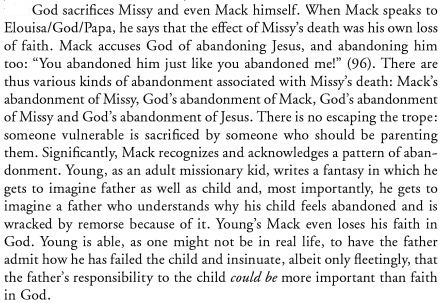
The issue of familial relationships is huge. The patriarchy is huge. And reflecting on Paul Young, the writer, the issue of his being Canadian, and a white male, are things he must be unsure of because of his peculiar relationship with his own father and his own fatherland and his own father’s whiteness. These are TCK matters. H00die_R is right to say, “Whether Young knows it or not, he is depending heavily upon the mythology of ‘Mammy’ which was popular in the Antebellum South. Mammy was ‘a well-taken-care-of house servant whose activities in the house of her owners’ who personified the possibility of Victorian womanhood for heathen black women.” And yet, what Young knows is this:
He’s a third culture kid, a missionary kid, who finds himself a grown-up in a culture he didn’t grow up in, his dad’s and his mom’s culture, majority white Canada. Caught in an adult crisis of his own making (caught in adultery with his own wife’s own best friend), Young is abandoned by his own white church and his own (white father) God. The first person who comes to him in a different representation of God, in mercy, is a black woman.
Wayne Jacobsen, who worked with Young to write The Shack, explains who this person is in real life (and she’s not a stereotype):
https://www.youtube.com/watch?v=4wmJo43xOOs
There’s more to hear about the story of Young himself in his own words, when he, for instance, was first aware of his own whiteness and when he was first abandoned and when he had to bridge two cultures, neither of which he felt he could claim as his own. This takes him back to sex (sins and abuse) that as a child Young himself perpetrated. The lines between parent and child, between faithful spouse and unfaithful, between cultures, between abuser and abused, sinner and forgiver, all blur for this TCK, MK, writer:
https://www.youtube.com/watch?v=lCL36ErvBBE
This privileged “Canadian” “Christian” “white” “male” writes his story, sexist, racist, abusive, abandoning, abandoned, as The Shack. Or is that really the best way to read him and his characters? What of his Dani family? What of how they regard color and human flesh and sexuality and God-as-Trinity?
Now, many have enjoyed the book The Shack and have found it compelling. Some have found it heretical. Some have exposed its whiteness and maleness and cisgenderness and its various privilege therein. Many of us have not especially liked it for how poorly written it is as “literature” (about which we might go on and on). Few of us have considered the human story of the author, struggling to communicate with his family, the struggles and sins of his family.
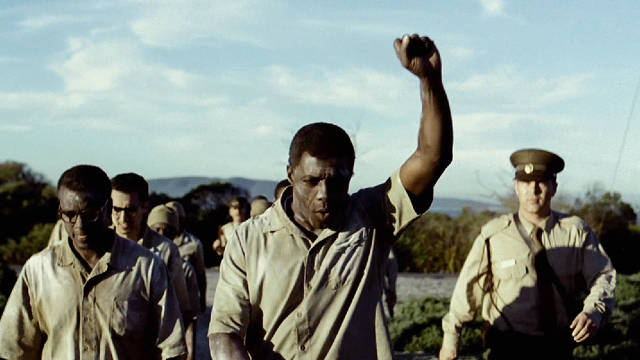
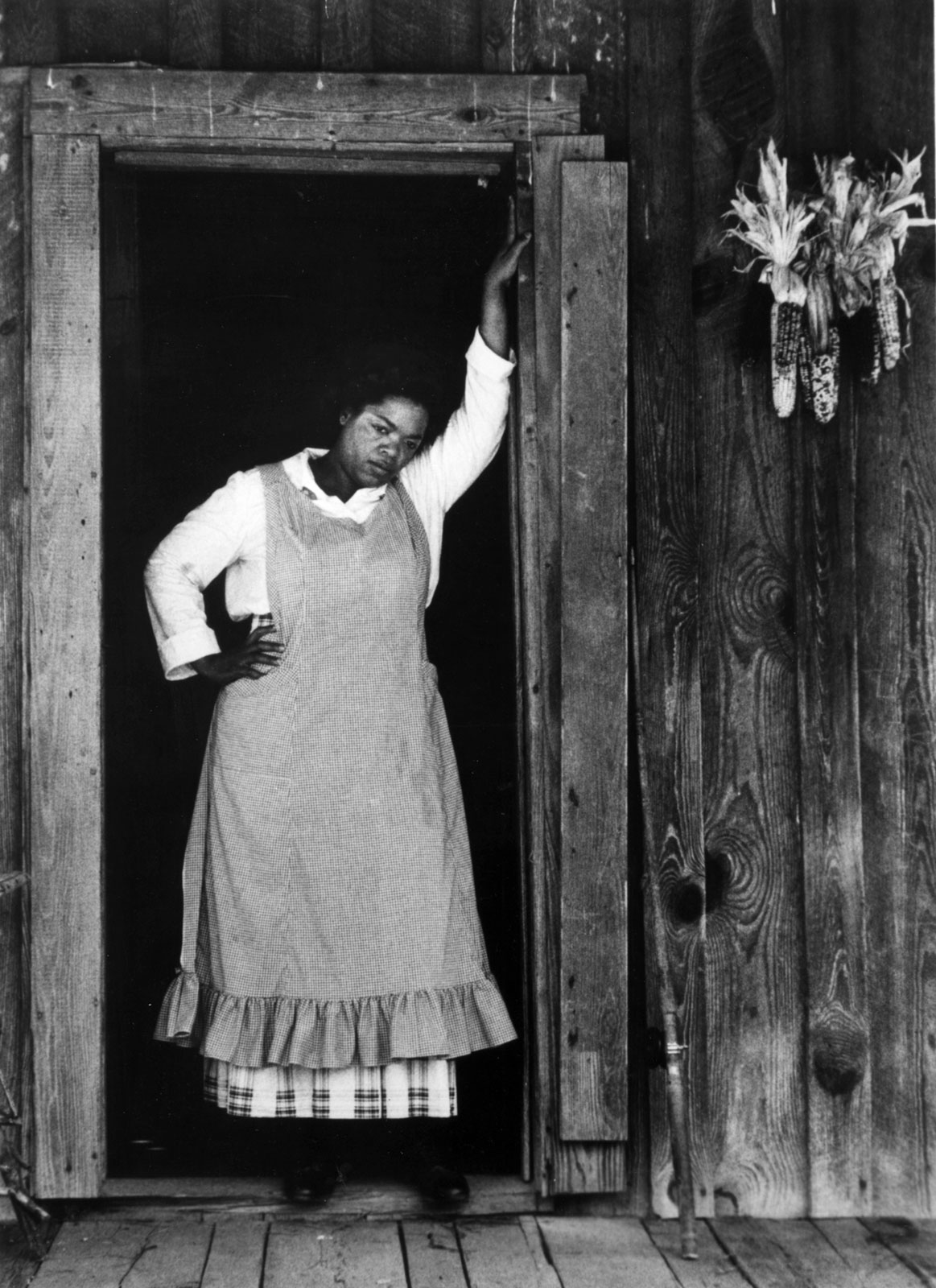
Then comes the news that a film version is being made. John Franco and Forest Whitaker are the screenplay writers. Idris Elba is being cast as the protagonist (not white Mack as Young identified him in his book as from a Midwestern farm and as having Irish-American roots). Oprah is going to play a role, we hear.
Now that changes everything, doesn’t it? If white, male, cisgender Mack of The Shack is not a TCK or an MK (though the book writer is), then how will things play if Mack is black? Will Oprah fall into a stereotypical Mammy role, Papa as God, who along the way joins a cast of colorful trinitarian characters all the constructs of anti-Semitic-ism and Orientalism and Homophobia and such? Will Franco and Whitaker write like men who were sexually abused and abusive boys raised largely by cannibals whose whole societal relations depended on the othering of human flesh, to sex and to eat? Can they acknowledge the abuses of MK boarding schools, the abnormality of being an adult in one’s father’s land? Mustn’t the film, shown in North America deal with the chronic issues of white privilege, racial tensions, sexual dominances? What are the biblebelters, especially southern baptist seminary presidents, going to do with its theology? Is trinity to be a concern?

I almost wrote this post as “Whose The Shack? Mine, Yours, Theirs?,” as one in a series of posts on whether or not changes to and /or variations in a work or an idea cause you, and me, and them, to abandon it once the difference is attended to.
I confess I myself am a TCK, an MK. I empathize and sympathize with those who can’t easily or simply express all of the complications of such a peculiar upbringing. I admire writers, autobiographers, who struggle with such an odd thing. I like how Pearl S. Buck (aka 賽珍珠, Sài Zhēnzhū) has described herself as “mentally bifocal.” I get how Barack aka “Barry” Obama finds himself in Chicago, after living on Waikiki Beach, telling “stories of Toot or Lolo or [his] mother and father, of flying kites in Djakarta or going to school dances at Punahou.” I see how Madeleine Albright (née Marie Jana Korbelová) had as a “goal in writing this book” (i.e., one of her autobiographies) “to learn more” about others. There’s lots to glean here.
As I watch The Shack written by Whitaker, I will watch as one who is guilty, or at least often feels that way, over inherited privileges. I’ll view, and review, with bias. I’ll see the film as one who grew up in cultures not really my first (among peoples of Vietnam, Thailand, and Indonesia) and traveled to places of the culture of my parents which is not really my second culture (in Arkansas, Hawaii, Texas, and Virginia), residing at a total of thirty-three different addresses on the planet by the time I was thirty-three years of age. I read a whole lot of books and watch lots of movies, written by all kinds of writers, comparing them with one another in highly critical ways. My review of The Shack by Young is much colored this way.
In Kurk’s discussion of Sarah Palin’s equation of baptism with water torture, he pointed out that there were medieval precedents in ecclesial discourse for such juxtapositions and even equivalences. I commented,
most of the examples you cite that conflate or juxtapose the symbolism of baptism with water-based torture are from the medieval era. Yet, my impression from various reading and conversation is that the ecclesial self-understandings of most Reformation or post-Reformation era churches, and their members, don’t own those actions: they ascribe them to the bad old corrupt Roman church which had abandoned the faith of the apostles. In many cases, the ecclesial narrative of these communities weaves their history smoothly from the apostolic or subapostolic or patristic generation directly to the Reformation generation.
In his responding comment, he confirmed my general impression of these narratives, but associated them with scapegoating and hypocrisy, which surprised me a bit, because it’s not quite to the point I was making about ecclesial identity. So let me elaborate on that.
(Content note: torture, killing, ethnic cleansing)
It is as true of communities as it is of persons, that if you do not own up to your past failures, then you will be likely to repeat them. This is because you cannot learn from your failures if you do not acknowledge them and really own them as something that you did.
The Roman Catholic church cannot escape from the historical evidence that it has engaged in horrific practices that perpetrated evil, and that it did so in the name of God.
That is not an easy thing to think about. We don’t like to think about it. We don’t dwell on it. We believe that we have learned better now; that we would not, today, perpetrate a crusade or a pogrom or an inquisition. That we would not, today, torture accused heretics in order to force them to confess or coerce them to conversion. That we would not, today, burn people alive and rationalize that we were doing so in order to save their souls from eternal hellfire. That we would not, today, expel a minority population from a nation unless they converted; and even after they converted, treat them and their descendents as second class civil and ecclesiastical citizens. That we would not, today, kill people because they didn’t believe what we believe about God.
There is no escaping that the Roman Catholic church has done all those things in the past, and that the Roman Catholic church today exists in continuity with the church that did those things: it is the same historical institution. All these things are part of our story, our history. They are things that we now confess as sins and ask forgiveness for, but we cannot pretend that they didn’t happen, and that we didn’t do them.
This forces us to come to grips with the reality that good Christians, good Catholics, people who are doing their best to be good Christians and good Catholics, can be so utterly misled as to commit such evil acts in the mistaken belief that these acts are pleasing to the God of Jesus Christ. It means that we have access to an awareness of how profoundly we can be misled in our discernment of good and evil. And, perhaps, it gives us a particular horror of the identification of water torture intended to coerce confession with water baptism: because we know this is not mere rhetoric. We know, it is part of our history, our ecclesial self-understanding, that we have done such things, and that they are profoundly wrong.
It is not popularly well known that a Catholic reformation movement had already begun and had made some progress by the time the Protestant Reformation was undersay. Some historians argue that the reason the Protestant Reformation did not take hold in still-Catholic Spain is that some of the worst excesses of the Catholic church had occurred in Spain (think “the Spanish Inquisition”), and had already provoked a reforming movement, which had already begun to curb and correct the worst excesses. The Catholic ecclesial self-understanding includes a chapter in which we did these things, which were wrong; we realized they were wrong; and we stopped doing them.
The Protestant ecclesial self-understanding, because it is woven from the apostolic, subapostolic, or patristic era directly to the Reformation era, omits that chapter. Protestants define the Reformation church in ecclesial continuity with the pure, good church of those earlier times. Such a history defines the ecclesial identity so as to exclude the crusades, pogroms, and inquisitions. Protestants don’t own those things, and so have not had to come to terms with them in the same way that Catholics have.
I see exactly the same dynamic at work in the less morally fraught domain of science and religion. Protestants don’t own the Galileo affair. Catholics do, and it embarrasses the hell out of us. The Roman Catholic church clearly, clearly ended up on the wrong side of history when it rejected Copernican cosmology as inconsistent with the Bible and therefore to be condemned. It took us 400 years to make a formal, institutional apology for that error, and it makes us very, very cautious about rejecting science on the grounds that it is inconsistent with the Bible or with any other church teaching. We have learned our lesson. Protestants can indulge in a bit of smug self-righteousness over not having made that mistake; but because they didn’t make the mistake, they didn’t learn the lesson, either. The mistake that Catholics made 400 years ago with heliocentric astronomy is being made today by many Protestant ecclesial communities with respect to evolution and cosmology.
I do not claim that the Roman Catholic church has been perfectly reformed as a result of this experience, nor that it no longer perpetrates acts which are evil in the mistaken belief that these acts are pleasing to God. But we know that we can, because we know that we have.
Greek “Baptism” in Plato and the Old Testament
The English word baptism comes from early English Bible translators attempting to carry over the sounds of a Greek word using the English alphabet. Here is an example:
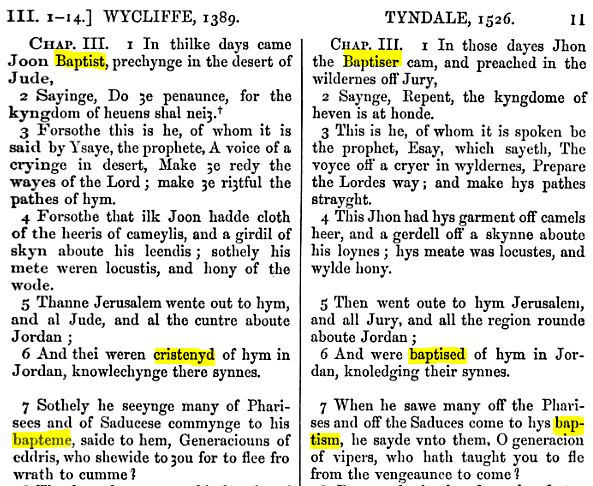
Or perhaps the English Bible translators were just copying from the Latin Bible translators. It is not always clear how to translate Greek into Latin, after all. And in matters of the church, one might do well not to change the letters too much. Here is the Vulgate version of the passage given in English above:
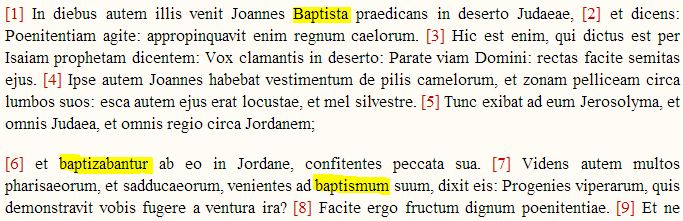
There are just four Old Testament occurrences of the Greek word getting transliterated baptism in the New Testament. Before we even get to them, however, let’s look at the two occurrences of this same Greek word in Plato’s dialogues.
Here’s from The Symposium (176b) translated respectively by Benjamin Jowett (1871) and by Harold N. Fowler (1925):
I entirely agree, said Aristophanes, that we should, by all means, avoid hard drinking, for I was myself one of those who were yesterday drowned in drink [βεβαπτισμένων].
On this Aristophanes observed: “Now that, Pausanias, is a good suggestion of yours, that we make a point of consulting our comfort in our cups: for I myself am one of those who got such a soaking [βεβαπτισμένων] yesterday.”
And here’s from The Euthydemus (277c-d) translated respectively by Benjamin Jowett (1914) and by W. R. M. Lamb (1967):
Euthydemus was proceeding to give the youth a third fall; but I new that he was in deep water [βαπτιζόμενον], and therefore, as I wanted to give him a respite lest he should be disheartened, I said to him consolingly
Euthydemus was proceeding to press the youth for the third fall, when I, perceiving the lad was going under [βαπτιζόμενον], and wishing to give him some breathing-space lest he should shame us by losing heart, encouraged him…
Now, here’s the Greek Old Testament. This is from 4 Kings 5:14, Sirach 34:25, Isaiah 21:4, and Judith 12:7. The translations are from Lancelot Brenton (1800s). As I did above, I’ll include the Greek. Also, I’ll include the Latin the Vulgate uses. And I’ll also include the English for the Greek that the New English Septuagint Translation translators use for the four passages, respectively translated by Paul D. McLean, Benjamin G. Wright, Moisés Silva, and Cameron Boyd-Taylor (2007).
So Naiman went down and dipped himself [ἐβαπτίσατο] [lavit] [immersed himself ] seven times in Jordan according to the word of Elisaie: and his flesh returned to him as the flesh of a little child and he was cleansed.
If a man washes [βαπτιζόμενος] [baptizatur] [bathes] after touching a dead body, and touches it again, what has he gained by his washing?
My heart wanders and transgression overwhelms [βαπτίζει] [stupefecerunt] [overwhelms] me; my soul is occupied with fear.
So Holofernes commanded his guards not to hinder her. And she remained in the camp for three days, and went out each night to the valley of Bethulia, and bathed [ἐβαπτίζετο] [baptizabat] [bathed] at the spring in the camp.
It would be strange to use baptize to translate Plato’s Greek. It would be strange to say that Naiman or Judith or Isaiah’s transgression or a man touching a corpse got “baptized.” But for the ecclesiastical stakes, there’s baptism.
Sarah Palin’s waters of biblical immersion
“Well, if I were in charge, they would know that waterboarding is how we’d baptize terrorists,” exclaimed Sarah Palin to rounds of applause this weekend.
You know this already, since there’s already been over reporting of this very statement in the news, as if it’s something new, as though it’s a surprise. But these are the waters of biblical immersion, the culture of Sarah Palin.
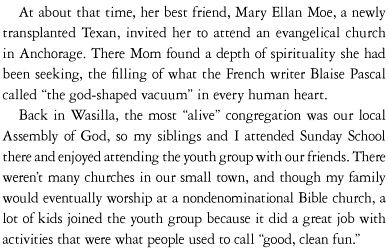
In her book, Going Rogue: An American Life, she describes her own baptism and those who influenced her along the way (i.e., her mother, whose best friend from Texas got the family going to church; Pascal; Sunday School & youth group; a pastor; and the Scriptures):
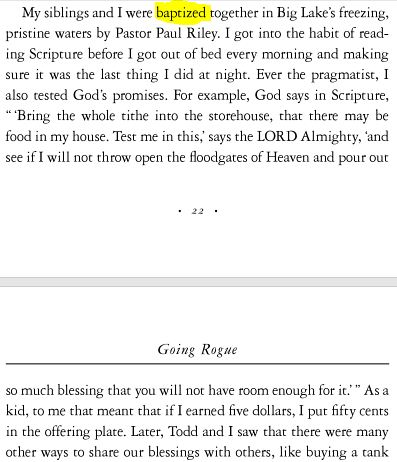
The website GodVoter.org explains that she was 12 years old. And she herself describes the immersion and her new habit of reading and testing the Scriptures, which immediately followed:
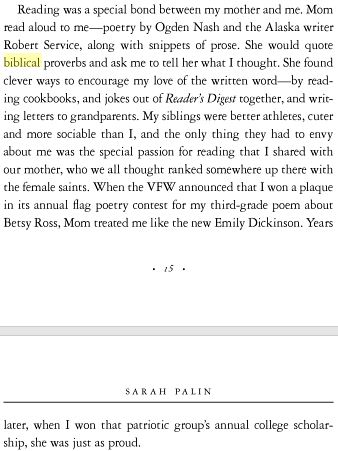
Early on, she came to appreciate what was in her world “biblical” and “literary”:
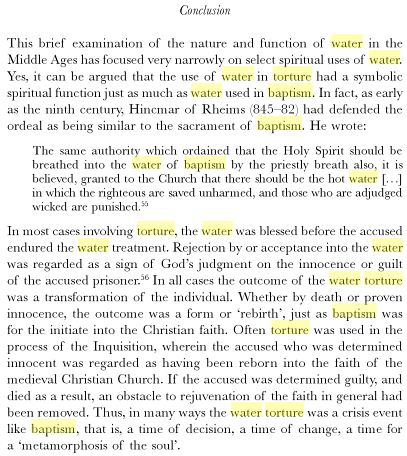
Somewhere along the way, from her being a young person to her being baptised to her statement comparing waterboarding by her government with water immersion by her church, there was a legacy. In other words, Sarah Palin seeks to appeal to a culture of people that she seems rather immersed in. And this culture has a history.
Historian Charles W. Connell, in his essay “From Spiritual Necessity To Instrument Of Torture: Water In The Middle Ages,” gives more than a glimpse into the connections between water torture and water baptism. (The report is in the book The Nature and Function of Water, Baths, Bathing and Hygiene from Antiquity through the Renaissance, edited by Historian Cynthia Kosso with Medievalist Anne Scott). Here is a history that continues as the present and the future of Sarah Palin:
A decade ago, during the very public discussions and disputations about whether waterboarding is torture, the history of water torture was rehearsed rather thoroughly. There were not, if I recall correctly, many comparisons of waterboarding with baptism of the sort that Sarah Palin has made a few days ago.
And yet such a history exists. Historian Stephen F. Eisenman, in his essay “Water-boarding — A Torture both Intimate and Sacred,” makes the comparisons. (This is in the book Speaking about Torture, edited by English and Comparative Literature scholars, Elizabeth Weber and Julie A. Carlson). Here’s a clip from the Eisenman essay:
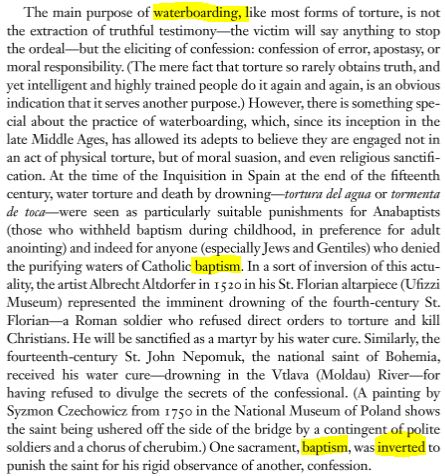
And the connection of the past with the present is made:
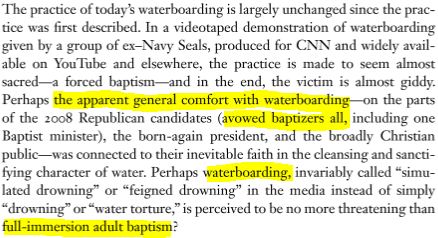
The comfortable cultural waters that Sarah Palin is immersed in would not see waterboarding as torture. It, rather, is akin to water baptism, which would be, by the same culture, biblical.
Hers is a culture where women are equal to men, when it comes to being tough, to owning firearms and using them. Sarah Palin is even tough enough to call herself a “feminist,” noting in her book that she must reject “the radical mantras of that early feminist era, but reasoned arguments for equal opportunity definitely resonated with me.” (This she does, much to the chagrin of Feministing.com blogger, Jessica Valenti, who is not part of Sarah Palin’s culture.)
And this culture with its history and Sarah Palin with her reading, and her reading of the Scripture, makes me wonder how she reads the seemingly unequal opportunities between men and women when it comes to the water ordeal mentioned in Numbers 5. This particular passage requires a culture to interpret it rightly. Especially when the Hebrew Bible is translated, say into Greek, it may involve wordplay that seems like an insider’s interpretation. Could this really be a feminist passage?
For Sarah Palin, these waters do seem to run together.

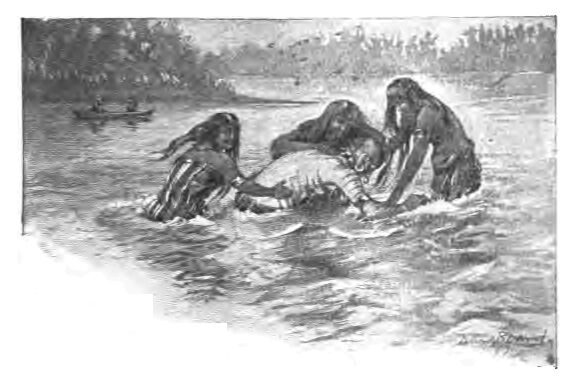
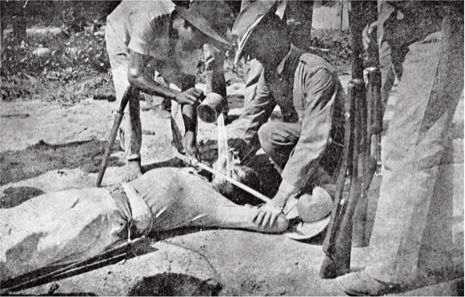



Go back to what our founders and our founding documents meant — they’re quite clear — that we would create law based on the God of the bible and the ten commandments. What in hell scares people about talking about America’s foundation of faith? It is that world view that involves some people being afraid of being able to discuss our foundation, being able to discuss God in the public square, that’s the only thing I can attribute it to.
Hebraic Hellenisms and Human Epistemological Places
Suzanne is making some pretty important observations about our human classifications for humans. She has noted, for example, specific places where the Hebrew Bible writer(s) won’t necessarily keep separate the (1) male humans from the (2) not male, or female, humans. The writer(s) will have the 2 together as variants or types or kinds of just 1 humankind.
She also shows that, when switching to Hellene, translators of that same Bible do the same thing. In other words, Hellene, or Greek if you will, becomes a variant language of the (Hebrew) Bible. And that Bible, then, does the same thing. It lets the first human (named “Life”) give life to another human, without regard for female and male difference, saying, “I have created a human, through the Creator-God.”
What I want to show with this post is how arbitrary our human classifications can be. Yes, as we all know, scientists as early as Aristotle and as recent as Simon Baron-Cohen can show us in excruciating detail the male and female differences between humans. But why not treat men and women and boys and girls the same anyway? As variants of humankind?
And we all know there are differences between pears. There are differences between winters. And there are differences between pears and winter. And there are differences between towns. And so what? When there’s life, and when humans like us know it.
Shall we just take a few moments to illustrate?

pears

winter

pears

Why, when we’re talking about how we humans construct knowledge out of categories, do we need to show how we all tend to have a high tolerance for difference?
Let’s keep Jews and Greeks different. Let’s keep men and women different. Hebrew and Hellene. Different. Pears and winter. Yep. Different.
Anne Carson and Eve. Eve and David. David and Anne. Moses and David. Prose and Poetry. The original text and its translation. Different. Different. Different. Different. Different. Different.
Well, let’s back up and exercise our high tolerance again. Let’s look again at one of the Anne Carson poems that has made the rounds in the Best Of poetry volumes since its initial publication in her collection entitled, Plainwater. Here’s a version online. A version in book form, yes also online. A version in musical score by Carl Schimmel. Wait now! Isn’t he a man. Anne Carson is not a male, is she? No, she cannot be. Different.
Well, we slipped again. So, let’s back up and exercise our high tolerance again. Look what happens, Anne Carson, writing, tells us when one reader “takes a different position” than another. We’re all forced to ask, “But what about variant readings?”
What when “the world is, as we say, an open book”?
What when “you [and I] will stand and see pear and winter side by side”?
“What if you get stranded in the town where pears and winter are variants for one another?” What if you and I are not so different? Or what if in our differences, so obvious to scientists and scholars, we really are variants of humanity of kinds of kindnesses of humankindness, where we, you, I, we back up and exercise our high tolerance again?
Ish and zokar
What does it really mean when Eve said, ‘I have gotten a man with the help of the LORD.’
Of course, what she really said was,
קָנִיתִי אִישׁ אֶת-יְהוָה
I have gotten an ish from God.
Did she mean that she had born a male child? But an ish is usually an adult. Did she mean that although God had drawn her out of ish, now God has drawn an ish out of her? But what is an ish? A male, a human being, or a member of community?
I always assumed it meant that Eve had born a male child. But I don’t think so now. I think she meant that she had born a new member of the human family. Here is why. In Leviticus 18:22, the Hebrew reads
וְאֶת-זָכָר–לֹא תִשְׁכַּב, מִשְׁכְּבֵי אִשָּׁה
With a male you must not lie, as you would with a woman.
But every English translation produces parallel constructions, like this,
Thou shalt not lie with mankind, as with womankind: KJV
or this,
You must not have sexual intercourse with a man as you would with a woman; CEB
Why does English produce parallel phrasing when the Hebrew distinctly says male/woman, and not man/woman?
Because, in my view, ish does not mean “man.” We know this already from here, Abraham circumcised,
כָּל-זָכָר, בְּאַנְשֵׁי בֵּית אַבְרָהָם
every male among the ish (plural) of the house of Abraham.
But English translations usually have,
every male among the men of Abraham’s house
Just in case some of the men weren’t actually male? No, because ish are not unambiguously men. Ish are members of the house of Abraham, male and female. Even the male slaves were circumcised, so ish does not refer to the status of the men, it doesn’t refer to “men” as in “males” at all. Sometimes it does, but maleness is not an essential core meaning of the word ish.
This confusion is perpetuated by the Colorado Gender Guidelines, which claim that ish should ordinarily be translated as “man/men.” Well, if some people don’t want to know what is in the Bible, so be it.
Here is the LXX,
Ἐκτησάμην ἄνθρωπον διὰ τοῦ θεοῦ
I have acquired a human being through God.
Surprise, surprise, the Greek translators did not think that ish meant “man” a male, but rather a “human being.” But the NETS mistranslates it,
“I have acquired a man through God.”
Most English translations say “man” but the Latin Vulgate got it right, with “homo” and not “vir.”
possedi hominem per Dominum
Another thing you see in Greek, and I think in Hebrew too, is the connection between the word “acquire” and the word “create.” It sounds as if Eve has said,
“I have created a human being through God.”
In Greek ktaomai, acquire and ktizw create, sound similar in this tense, and could be related. In Hebrew too, קָנָה sounds like Cain’s name and means “to get, acquire, create, buy, possess.” In fact, Strong’s concordance says clearly that with reference to God, the word means “create” but with reference to Eve, the word means “acquire.” Too funny! Let us just write into the Bible, that women will not ever be treated fairly in translation. Sometimes you just have to laugh at this.
But going back to the Hebrew, Eve may be saying,
I have created the next member of the human family through God.
After all, when she was drawn from the human,and an ishah, a female member of community was created, adam, a human being, became a member of community too, an ish. This was done by God. But the next ish, the next member of community, was drawn by God out of ishah. The circle is closed.
There is an expression that reading the Bible in translation is like kissing your bride through a veil. But some days it feels more like kissing someone through a brick wall that has to be torn down, brick by brick.
Now, on a different topic, does this verse I used in opening,
With a male you must not lie, as you would with a woman.
have something relevant to say about homosexuality today? This is listed with incest, infanticide, adultery and having sex with your wife when she is having her period. Incest and infanticide are crimes, adultery and having sex during one’s period are topics I never discuss in public, and are nobody’s business, and that is how I treat homosexuality. It is a private function, and in the Hebrew Bible, to me it rates with some prohibitions, which, like having sex during menses, had some primitive mysterious meaning we don’t acknowledge today. It is something like mixing linen and wool. I go a long way now to shop at stores that mix cashmere and linen blends, thank you very much. Yarn blends, I talk about, sexual activities, I don’t.


 BLT
BLT 