100 Great Jewish Books
Rabbi Lawrence Hoffmann (author of Beyond the Text and of the Prayer of Awe and the People’s Prayerbook series) announced at his blog today the availability of his newest book:
One Hundred Great Jewish Books: Three Millennia of Jewish Conversation
We give a tip of the hat to Joel Hoffman for bringing this to our attention. Dr. Hoffman adds: "I may be biased, but it seems to me that if you buy only one book about Judaism this year, it should be this one."
It will be interesting to see how Rabbi Hoffman’s list compares with the list of the "Top 100 Jewish Books" by Rabbi Miriam T. Spitzer.
Update by Theophrastus:
Here is Hoffman’s Table of Contents, which may give some hint as to his list:
- The Bible: The Conversation is Launched
- Genesis
- Isaiah
- Psalms
- Job
- Ecclesiastes (Kohelet)
- The Jewish Study Bible – Adele Berlin and Marc Zvi Brettler (editors)
- The Rabbis: The Conversation is Transformed
- From Politics to Piety – Jacob Neusner
- The Mishnah: Pirkei Avot
- The Babylonian Talmud
- Midrash Rabbah (“The Great Midrash”)
- Aspects of Rabbinic Theology
- As a Driven Leaf – Milton Steinberg
- The Responsa Literature – Solomon B. Freehof
- Modern Jews Engage the New Testament – Michael J. Cook
- The Middle Ages: The Conversation Broadens
- The Rabbinic Bible (Mikra’ot G’dolot)
- The Jewish Prayer Book (Siddur)
- Duties of the Heart – Bachya ibn Pakuda
- The Kuzari – Judah Halevi
- The Itinerary of Benjamin of Tudela – Benjamin of Tudela
- Guide for the Perplexed – Moses Maimonides
- Principles of the Jewish Faith – Louis Jacobs
- The Zohar – Moses de Leon
- Hebrew Ethical Wills – Israel Abrahams (editor)
- Enlightenment, Emancipation, and Traditionalism: The Conversation Explodes
- The Life of Glückel of Hameln – Glückel of Hameln
- Jerusalem – Moses Mendelssohn
- Tormented Master – Arthur Green
- An Autobiography – Solomon Maimon
- The Nineteen Letters – Samson Raphael Hirsch
- Reminiscences – Isaac Mayer Wise
- Tevye the Dairyman – Sholem Aleichem
- Stories – Isaac Loeb Peretz
- The Wise Men of Helm and Their Merry Tales – Solomon Simon
- In My Father’s Court – Isaac Bashevis Singer
- The Yeshiva – Chaim Grade
- The Penguin Book of Modern Yiddish Vers – Irving Howe, Ruth R. Wisse, Khone Smeruck (editors)
- The Pity of It All – Amos Elon
- Turn of the Century: The Conversation Divides
- The Diaries – Theodor Herzl
- The Zionest Idea – Arthur Hertzberg
- Selected Essays – Ahad Ha-am
- Moses and Monotheism – Sigmund Freud
- My Life as a Radical Jewish Woman – Puah Rakovsky
- Poems – Hayyim Nahman Bialik
- Why I Am a Jew – Edmond Fleg
- The Jewish Gauchos of the Pampas – Alberto Gerchunoff
- The Brothers Ashkenazi – Israel Joshua Singer
- The Complete Works of Isaac Babel – Isaac Babel
- From Berlin to Jerusalem – Gershom Scholem
- The American Experience to World War II: The Conversation Expands
- American Judaism – Jonathan D. Sarna
- The Promised City – Moses Rischin
- Bread Givers – Anzia Yezierska
- Jews Without Money – Michael Gold
- Awake and Sing! – Clifford Odets
- Passage From Home – Isaac Rosenfeld
- The Holocaust and Israel: The Conversation is Focused
- The War Against the Jews 1933-1945 – Lucy S. Dawidowicz
- The Night Trilogy: Night; Dawn; Day – Elie Wiesel
- Survival in Aschwitz; The Reawakening – Primo Levi
- Eichman in Jerusalem – Hannah Arendt
- Badenheim 1939 – Aharon Appelfeld
- Maus – Art Spiegelman
- Israel – Martin Gilbert
- Only Yesterday – Shmuel Yosef Agnon
- Poetry and Stories – Yehuda Amichai
- Letters to an American Jewish Friend – Hillel Halkin
- From Beirut to Jerusalem – Thomas L. Friedman
- A Tale of Love and Darkness – Amos Oz
- The American Experience after World War II: The Conversation is Renewed
- Peace of Mind – Joshua Loth Liebman
- Gentleman’s Agreement – Laura Z. Hobson
- Protestant-Catholic-Jew – Will Herberg
- Conservative Judaism – Marshall Sklare
- The Complete Stories – Bernard Malamud
- The Tenth Man – Paddy Chayefsky
- Goodbye, Columbus – Philip Roth
- New York Jew – Alfred Kazin
- Jewish People, Jewish Thought, Jewish Destiny Today – The Conversation Continues
- Choices in Modern Jewish Thoiught – Eugene B. Borowitz
- Judaism as a Civilization – Mordecai M. Kaplan
- The Sabbath – Abraham Joshua Heschel
- Eclipse of God – Martin Buber
- My Name is Asher Lev – Chaim Potok
- Haggadah and History – Yosef Hayim Yerushalmi
- Community and Polity – Daniel J. Elazar
- A Guide to Jewish Religious Practice – Isaac Klein
- When Bad Things Happen to Good People – Harold S. Kushner
- Halakhic Man – Joseph B. Soloveitchik
- On Being a Jewish Feminist – Susannah Heschel (editor)
- The Gate Behind the Wall – Samuel C. Heilman
- Sacred Survival – Jonathan S. Woocher
- Jewish Literacy – Joseph Telushkin
- Hasidic People – Jerome R. Mintz
- The Book of Blessing – Marcia Falk
- The Book of Jewish Food – Claudia Roden
- The Puttermesser Papers – Cynthia Ozick
- Bee Season – Myla Goldberg
- Like Everyone Else .. But Different – Morton Weinfeld
- Entertaining America – J. Hoberman and Jeffrey Shandler
- The Jewish Life Cycle – Ivan G. Marcus
- Synagogue Architecture in America – Henry Stolzman and Daniel Stolzman
- The Rabbi’s Cat – Joann Sfar
- To the End of the Land – David Grossman
- Start-Up Nation – Dan Senor and Saul Singer
- American Jewish Yearbook – American Jewish Committee
- Book Notes
- Index
- Acknowledgements
A few quick notes – the Table of Contents is mostly focused on works in English or available in translation (except, strangely, for The Rabbinic Bible.) Also, not all works in the list are by Jews.
And finally, to answer the question that I am sure Kurk wishes to ask me; the answer is 71.
BLT of David Bellos: A Book Review of “Is That A Fish In Your Ear?”
[UPDATE: David Bellos has kindly corrected a mistake I made in the following review of his book. See his comment here, where he also announces a French translation of the book, available for purchase in January. I hope to review that edition here as well, as the author is already improving the book.]
I don’t mean to start a book review with a review of another book review. But the Kirkus review of the new book, Is That A Fish In Your Ear?: Translation and the Meaning of Everything, by David Bellos gets a couple of critical things just wrong. Whoever wrote the review claims that Bellos “has a broad definition of translation: in general, the ability of the human mind to convert stimuli into meaning.” This is hardly his definition at all, and what Bellos says about translation is better described as rich, studied, deep, nuanced, and still as extremely accessible for both novices and experts alike. It’s hardly, as the Kirkus review asserts, “[e]rudite and occasionally dense.”
So let me reiterate. The strengths of the book are its depth, its richness, and its accessibility for novices and for experts alike. (I’ll mention the weakness at the end of my review).
THE STRENGTHS
Anyone who is interested in the Bible, in translation, and in literature (the topics we tend to address at this blog) will find what Bellos writes to be wonderfully informative, interesting, and illuminating (to use one adjective that the Kirkus review does get right); at some points for some readers the book might even be inspirational.
The author confronts numerous common sense notions about translation, and he masterfully gets his readers re-thinking them. For example, Bellos challenges reductive, binary thinking when considering what it means for any of us to have a mother tongue or to know a language natively:
The paths by which speakers come to feel at home in a language are far too varied for the range of their abilities to be forced into merely two slots (‘native’ and ‘nonnative’) however broad or flexible the definitions of those slots may be. [page 66]
Similarly, he gives clear and simple definitions only to show how further nuanced they must be to account for what translators really do and must do. Here’s how Bellos starts his chapter SEVEN, “Meaning Is No Simple Thing”:
Whether done by a speaker of L[anguage]1 or L2, an adequate translation reproduces the meaning of an utterance made in a foreign language.
So far so good. And yet Bellos complicates what seems, at first, so simple. Then he goes on to make his complication into a problem that translation can, and does, solve:
That [functional definition] sounds straightforward enough…. But it doesn’t provide an adequate understanding of what translation is, because the meaning of an utterance is not a single thing. Whatever we say or write means in many ways at once. The fact is, utterances have all sorts of “meanings” of different kinds. The meaning of meaning is a daunting topic, but you can’t really study translation if you leave it aside. It may be a philosophical can of worms — but it’s an issue that every translation actually solves. [page 69]
The book has thirty-two short chapters (in 384 pages), which, as you can figure, would seem to make for a fairly quick read. Nonetheless, this is Bellos writing. Each chapter is extremely rich, a delightful combination of both education and — if you’ll pardon my cheap adjective — entertainment. As you read the book, you’ll know you’re learning from a master at his crafts (a best-selling author and best-selling literary translator who is Princeton University’s Director of the Program in Translation and Intercultural Communication, who also serves there as a Professor of French and Italian and Comparative Literature). And you’ll have great fun doing it.
THE SCOPE
If you haven’t yet bought Is That A Fish In Your Ear? and if you haven’t yet read it, then you may want a sample by watching this video and listening to Bellos go on a bit. Here:
The tremendous thing about Bellos is that he considers everything in his book. Well nearly everything.
When he subtitles the book, Translation and the Meaning of Everything, you may want to know that he’s playing with language, specifically with ambiguity as we have it in English. And what he means by using the word and there in the subtitle could very well be this: “Translation really is the meaning of everything.”
Not surprisingly, then, you find Bellos and yourself asking in chapter ONE – What Is a Translation? Well, I’ve already given away the answer, haven’t I? Translation is everything; or is it? The answers to the titular question are followed by chapter TWO, another question, “Is translation avoidable?” What do you think? Well, if translation is everything, where might one avoid it, and how? Next the author reflects in chapter THREE with us readers — asking “Why do we call it ‘translation’?” — before he has us remembering “Things People Say About Translation” [chapter FOUR]. The things people say are some of the very things which we have said at this blog, although after reading Bellos there is good reason to question our ever saying them again. Towards the end of the book, you’ve already read all about what translators do — translate the Bible, translate literature, translate poetry, translate law, translate in the UN, translate for imperial purposes, translate comics, translate the news, translate spoken bits in film and television with captions and dubbing, translate literally, translate metaphorically, translate by machines, translate by simultaneous interpretation, and more. And just when you’ve exhausted all of the possibilities, or so you think, the author startles you with the title, “What Translators Do” [chapter TWENTY-EIGHT]. That near to ending chapter is rounded out, finally, with a chapter that tries to get us to declare, “What Translation is Not.” Three more chapters including “A Parable of Translation” do bring the book to a close, but not before Bellos subjects us to his “Afterbabble: In Lieu of an Epilogue.”
The tour Bellos gives his readers is a tour de force. His own theory of language is delightfully dimensioned. Nevertheless, he walks readers through a review of the theories of the likes of Noam Chomsky, of Leonard Bloomfield, of Edward Sapir, of Ferdinand de Saussure, of Jacques Derrida, of Ludwig Wittgenstein, of George Steiner, of Vladimir Nabokov, and of Benjamin Whorf. But not in that order, and Bellos is not just dropping names. Although the book never gives a heavy dose of these theorists or their theories in a single chapter, Bellos brings the most abstract of the abstract down to earth in narratives that flesh out the flow and the concerns of his book. He deals with the translation theories of men such as Eugene Nida and Lawrence Venuti and Friedrich Schleiermacher and the translation practices of men such as Sigmund Freud and Augustine and Septuagint and King James Bible translators. Bellos does a compelling job of showing readers his own robust and substantial theory of translation. What might he mean when he deals with translation and the meaning of everything in just a few hundred pages?
Visitors to and commenters at this blog might be most interested in chapters relating to Bible translation, namely “The Myth of Literal Translation” (note the English ambiguity in this title); and “Bibles and Bananas: The Vertical Axis of Translation Relations” and “Translation Impacts.” In these sections of the book, Bellos considers Jewish translation, Christian missionary translation, and the effects of translation when translators are translating “UP” and when they are translating “DOWN.” You may have noticed, if you watched the youtube video above, that these English prepositions figure into Bellos’ discussion. When you read his book, you get how integral the directional metaphors are to parts of his theories on translation and on the intended and unintended impacts of Bible translation in particular.
Literature scholars and critics and aficionados will appreciate all that Bellos brings to light about “Translating Literary Texts.” Though that’s the focus (and the title) of chapter TWENTY-SEVEN, it’s the discussion through much of the book. Bellos is himself a literary translator, winning awards for his translations of Georges Perec and of Ismail Kadare, and for his work on of Honoré de Balzac. Bellos opens Is That A Fish In Your Ear? with puzzlers in literary translation. And some the most delightful discussions are about literary translation, in the chapters on “Foreign Soundingness”; on “Translation as a Dialect”; on “The Awkward Issue of L[anguage]3”; on “Custom Cuts: Making Forms Fit”; and on “Translating Humor.” The literary perspectives in the book show that Bellos is not just a linguist, not only a historian, not merely a translator, not simply an expert on the Bible, not just a theorist about translation but also a writer, a rhetor, a user of English and other languages, and a literary critic as well.
A SAMPLING
Bellos gives readers examples and more. For example, he shows twelve different ways that the following Chinese “shunkouliu” (politically motivated slippery jingle)
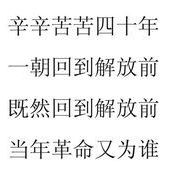
can be translated:
1. Translated character for character
Hard hard bitter bitter four ten years
One morning return to untie release before
Already thus return to untie release before
Just-at year change fate in-fact for whom?
2. Translated group for group
Strenuous, strenuous forty years
One morning return to before Liberation
Given that return to before Liberation
In those days revolution in fact for whom?
3. Explanation, sense for sense
An extremely strenuous forty years
And one morning we [find ourselves having] returned
to before Liberation
And given that we’ve returned to before
Liberation [We might ask] who, in fact, the revolution back in
those days was for.
4. Plain translation
An extremely strenuous forty years
And suddenly we’re back to before Liberation
And given our return to before Liberation
Who, in fact, was the revolution for?
5. Adding some rhythm
An extremely strenuous forty years
And suddenly we’re back to ’forty-nine,
And since we’ve gone back to ’forty-nine
Who, in fact, was it all for?
6. Matching words to Chinese syllables
For forty long years ever more perspiration
And we just circle back to before Liberation
And speaking again of that big revolution
Who, after all, was it for?
7. Adding rhyme
Forty long years crack our spine
Back we go to ’forty-nine
Since we go to ’forty-nine
Back then who was it all for?
8. First polish
Forty years we bend our spine
And just go back to ’forty-nine
And having gone to ’forty-nine
Whom back then was this for?
9. Adaptation, with double rhyme
Blood sweat and tears
For forty long years
Now we’re back to before
Who the hell was it for?
10. As a word rectangle (6 × 4)
We had sweat, toil, and tears
For more than forty bloody years
Now we’re back to square one
For whom was it all done?
11. Isogrammatical lines (21 × 4)
Blood sweat and tears
Over forty long years
Now it’s utterly over
Who stole the clover?
12. Sounded out in Chinese
Xin xin ku ku si shi nian
yi zhao hui dao jie fang qian
ji ran hui dao jie fang qian
dang nian ge ming you wei shui
Bellos explains how this “barbed rhyme about New China’s old guard” can be– as translation, in translation — “a pleasing and meaningful shape in a language completely unrelated to its original tongue.” He shows it, and then he explains it, in various pleasing and differently meaningful ways.
AN OVERSIGHT
So what’s the weakness of Is That A Fish In Your Ear? The disappointment of Bellos’ book is that it gives women the short shrift. That’s not to say that Bellos himself is anti-female. (He may be a feminist.) And it’s not to suggest that he ignores sexism in language and in translation. (He doesn’t.) In fact, he seems quite aware of the problems of masculinist language (reductive binaries and gyne-phobic metaphors). Take for example how Bellos, in good way, exposes misogyny at one point:
Translations, this saying goes, are like women. Si elles sont belles, elles sont infidèles, mais si elles sont fidèles, elles ne sont pas belles—“If they are good-looking, you can’t trust them to be faithful, and if they stick by their mates, it’s because they’re old frumps.” That’s a fairly free translation by conventional standards, but it is exactly what the adage implies (while also being translatable in its other dimension as “Aesthetically pleasing ones are adaptive, and nonadaptive ones are just plain”). The shadow of such sexist nonsense falls even today upon a French publishing house with an otherwise admirable list of translated works—Les Belles Infidèles.
Sexist language has been the object of long and mostly successful campaigns in France as in the English-speaking world, but only rarely has it been observed that outside the context of politeness as it was understood in the French seventeenth century, les belles infidèles, whether used as a three-word catchphrase or in the longer adage that was built from it, is an insult to women. Most people let it pass because they think it is a statement about translation. It is not. It’s about male anxiety—to the point of misogyny. It applies to translation, I suspect, only because, like other versions of the betrayal motif, it says just how frightening translation can seem. [page 130]
But Bellos fails to take the opportunity to discuss what linguists and rhetoricians such as Hélène Cixous and Luce Irigaray might say — and have said — about phallogocentricism in language and in translation (about French in French no less).
The book does discuss some gender configurations of some languages; here’s a note on French again:
In 1789, the new revolutionary regime in France drew up its famous declaration of the rights of man and called it the Déclaration des droits de l’homme et du citoyen. Its purpose was to sweep away the religious and feudal underpinnings of the legal system inherited from the monarchy and to establish, under the authority of a Supreme Being who could not be called God lest that be seen as a sop to the Catholic Church, the basic rights of the citizen in his relationship to the new French state.
There was no question of these rights being accorded to any who were not fully emancipated citizens. As no one had yet thought of enfranchising women, the use of a masculine term, homme, was not just a convenience of language—it was what the declaration meant to say. It established and made explicit the rights of male subjects who were also citizens. [page 222]
Well, Bellos in saying “no one had yet thought of enfranchising women” completely forgets Olympia de Gouges, who did think of enfranchising women and who did re-write the first declaration as Déclaration des droits de la Femme et de la Citoyenne to make everyone else think of enfranchising women, and who went to the guillotine and there was beheaded because of such thoughts. Bellos might have mentioned Simone de Beauvoir and her Le Deuxième Sexe; he might have discussed how Canadian women coined Madelle, and how French women are hoping similarly to revolutionize their language. The book is current, and the oversights therefore are curious.
SUMMARY
If you want a rich discussion of translation, then David Bellos’ book is it.
POST SCRIPT
Bellos doesn’t make it real obvious where he comes up with his title Is That A Fish In Your Ear?. If you’d like a hint, then (after reading Douglas Adams’ Hitchhiker’s Guide to the Galaxy in English) turn to page 270. You’ll find it there.
50th Anniversary Editions of “The Phantom Tollbooth”
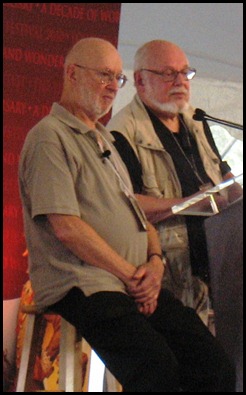 Suzanne is mulling over a $1200 Sandwyk-illustrated edition of The Wind in the Willows. In a comment to her post, I noted that the Sandwyk edition of the book is available – albeit without the quarter vellum binding – for $60 new and $20 used; and that there are two attractive and inexpensive illustrated and annotated editions of The Wind in the Willows.
Mention of wonderfully illustrated children’s literature and annotated editions provides a wonderful opportunity to mention that Knopf is publishing two new editions of another children’s classic, The Phantom Tollbooth. Not the least of the points deserving praise of The Phantom Tollbooth are the remarkable illustrations by Jules Feiffer.
Tomorrow Leonard Marcus’s annotated edition appears (Amazon price $17.60), as well as a 50th anniversary edition“with a series of short essays by notable readers about the effect the book has had on their lives” (Amazon price $16.32, 5% off if ordered with annotated edition).
Adam Gopnick writes about these two editions in the New Yorker – some excerpts:
Our cult of decade anniversaries—the tenth of 9/11, the twentieth of Nevermind—are for the most part mere accidents of our fingers: because we’ve got five on each hand, we count things out in tens and hundreds. And yet the fifty-year birthday of a good children’s book marks a real passage, since it means that the book hasn’t been passed just from parent to child but from parent to child and on to child again. A book that has crossed that three-generation barrier has a good chance at permanence. So to note the fiftieth birthday of the closest thing that American literature has to an Alice in Wonderland of its own, Norton Juster’s The Phantom Tollbooth—with illustrations, by Jules Feiffer, that are as perfectly matched to Juster’s text as Tenniel’s were to Carroll’s—is to mark an anniversary that matters. (And there are two new books for the occasion, both coming out this month from Knopf: The Annotated Phantom Tollbooth, with notes by Leonard Marcus; and a fiftieth-anniversary edition, with a series of short essays by notable readers about the effect the book has had on their lives.)
This reader, from the first generation, received a copy not long after the book appeared, and can still recall its curious force. How odd the first chapter seemed, with so little time taken up with the kind of persuasive domestic detail that fills the beginning chapters of the first Narnia book or From the Mixed-Up Files of Mrs. Basil E. Frankweiler or Mary Poppins. We’re quickly introduced to the almost anonymous, and not very actively parented, Milo, a large-eyed boy in a dark shirt—a boy too bored to look up from the pavement as he walks home from school. Within paragraphs, a strange package has arrived in his room. It turns out to be a cardboard tollbooth, waiting to be assembled. Milo obediently sets it up, pays his fare (he has an enviable electric car already parked by his bed), and is rushed away to the Lands Beyond, a fantastical world of pure ideas. The book breaks the first rule of “good” children’s literature: we’re in the plot before we know the people.
It’s a commonplace of scholarship to insist that children’s literature came of age when it began to break away from the authoritarian model of the moralizing allegory. Yet The Phantom Tollbooth is an old-fashioned moralizing allegory, with a symbolic point at every turn. Milo finds that the strange land on the other side of the tollbooth is sundered between words and numbers, between the land of Azaz the Unabridged, the King of Dictionopolis, and his brother the Mathemagician, the ruler of Digitopolis. The only way to reunite the kingdoms is for someone—why not Milo?—to scale the Mountains of Ignorance, defeat the demons, and release the banished princesses of Rhyme and Reason from their prison. (They were banished because they refused to choose between words and numbers, thereby infuriating the kings.) Along the way, each new experience makes funny and concrete some familiar idea or turn of speech: Milo jumps to Conclusions, a crowded island; grows drowsy in the Doldrums; and finds that you can swim in the Sea of Knowledge for hours and not get wet. The book is made magical by Juster’s and Feiffer’s gift for transforming abstract philosophical ideas into unforgettable images. The thinnest fat man in the world turns out to be the fattest thin man; we see them both. We meet the fractional boy, divided in the middle of his smile, who is the “.58 child” in the average American family of 2.58 children. The tone of the book is at once antic and professorial, as if a very smart middle-aged academic were working his way through an absurd and elaborate parable for his kids. The reality is that when Juster wrote The Phantom Tollbooth he was a young architect in Brooklyn, just out of the Navy, unmarried and childless, and with no particular background in writing or teaching, working out a series of jokes and joys for himself alone.
This became clear the other day, when the two creators of The Phantom Tollbooth were briefly sequestered in a Manhattan living room to talk about their work, and why it has lasted. Feiffer and Juster, both born in 1929, are like a pair of wryly benevolent uncles, with Norton the dreamy, crinkle-eyed, soft-spoken uncle who gives you the one piece of good advice you never forget, and Jules the wisecracking uncle who never lets up on your foibles but was happy to have you crash on his couch that night you just couldn’t bear going home. They interrupted, teased, and shpritzed each other as they recalled having blundered into a classic.
“Five thousand bucks you got!” Feiffer interjected.
“Was it that much? Anyway, I was up to my ass in worries and notes and couldn’t get it done. And so I took a vacation with friends, at the beach, Fire Island.”
“Probably with me!”
“No, it wasn’t you, Jules,” Juster added, though he explained that they already shared a roof. Stationed at the Brooklyn Navy Yard in 1956, Juster had found a garden apartment—“That’s what they call a basement room in Brooklyn,” Feiffer noted—in the Brooklyn Heights building where Feiffer was living, two floors up….
What does make the enduring magic of The Phantom Tollbooth? As with every classic of children’s literature, its real subject is education. The distinctive quality of modern civilization, after all, is that children are subjected to year after year after year of schooling. In the best-loved kids’ books, the choice is often between the true education presented in the book—say, Arthur’s through animals at the hands of Merlyn, in The Sword in the Stone—and the false education of the world and school. The child being read to (and the adult reading) is persuaded that self-reliance is a better model for learning than slavish obedience.
Each story of self-education has, to be sure, its period slant. Lewis Carroll’s Alice learns to resist the world’s nonsense, however seductively dressed as logic, but she also learns, Victorianly, that manners matter. In The Wind in the Willows, Mole is educated by Rat to mess around in boats and prefer the river to the burrow, but he’s also taught, as schoolchildren were in Edwardian England, to accept communality as the highest of virtues, and standing out too much, pushiness, as the worst of sins (particularly as displayed by the obviously outsider Mr. Toad). In the colonial French Babar, the elephant is educated in how to be a colonial Frenchman. In the Mary Poppins books, which first appeared in the thirties and forties, the Banks children are educated by their upright-seeming but poetic nanny in the Dionysian joys—they learn that the stars come down to go Christmas shopping, and you get the moon if you wish for it….
The Phantom Tollbooth is not just a manifesto for learning; it is a manifesto for the liberal arts, for a liberal education, and even for the liberal-arts college. (Juster, who, knowing that he had started out with a classic, went on to publish sparingly, if beautifully—his visual romance The Dot and the Line is his best-known later work—spent most of his career as an architect and as a teacher at Hampshire College.) What Milo discovers is that math and literature, Dictionopolis and Digitopolis, should assume their places not under the pentagon of Purpose and Power but under the presidency of Rhyme and Reason. Learning isn’t a set of things that we know but a world that we enter.…
Charles Van Sandwyk
I had not heard of this Vancouver illustrator until I met him yesterday at the Alcuin Society Wayzgoose, but he is the author/artist of many exquisite books, with the illustrations also sold as cards. He recently illustrated the 2005 Folio Society Edition of Wind in the Willows. Since I am not familiar with book collecting, I find the price out of my range for buying one of these books as a birthday or Christmas present. I am also wondering if one has to reserve a copy of Sandwyk’s next book now, although it will not be published for another two years.

To my delight and anticipation, he will be illustrating Alice in Wonderland next. Although I am fond of the original drawings of John Tenniel, especially the white knight and the red queen, I look forward to what Sandwyk will offer. (Images of Alice by a variety of artists.)
In Sandwyk’s artwork, the detail is exquisite, and the tenderness of expression in the faces and inclination of the creatures is fascinating. (See the goats below.) This next one of the frogs, is a healthy antidote to the dating couple in the last post. Illustrations of this sort offer the timelessness that literature demands.

(I am immersed in Alice these days, as I am working on several chapters of Wonderland, turning them into short plays for a reader’s theatre production for grade 4/5 students. The play on language is sometimes over their heads but the portrayal of adult illogicality is hilarious and much appreciated. As always there are those students whose reading level is not in the appropriate range for them to be sent to my class, and the object of the game is to make these students regret that fact.

How teen-age girls should discuss literature with boys
From R. N. Wilder’s Date Talk (Scholastic, 1968):
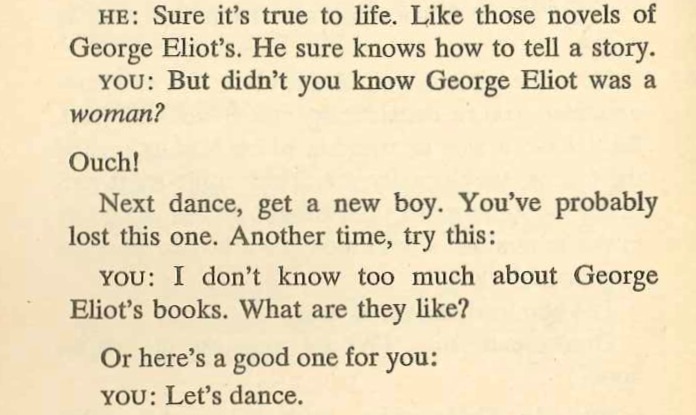
More here. Including this valuable ice-breaker for the puberty set:
“Well, friends, we’ve talked about everything here except what’s really on our minds. What do people think of high school education in the U.S.S.R. compared to ours?”


Another hero felled by words
 It is H. P. Lovecraft’s 120th birthday, and of course we all know him as the author of stories of pure evil. Well, it turns out that his private writings were just as evil too. Another authorial great blemished; the next thing you know, they’ll be saying that Emily Dickinson’s “genius” was just epilepsy. (HT: JPS blog).
First American Translation of the Bible
I am thinking of the first translation of the Bible specifically into the English language made in America. The first translation of the Bible in America was into an Algonquian language in 1663 by John Eliot. But the first translation of the Bible into English made in America was from the Greek text of the Hebrew Bible and this makes it the first English translation ever of the Septuagint, the Greek version of the Hebrew Bible. The full text is now online here and, scrolling down the page, also in facsimile as a pdf.This Bible is also significant in the history of Bible translation as it was referred to by scholars working on the English Revised Version of 1881 in England.
 The translator, Charles Thompson, had been the secretary of US Congress from 1774 until 1789, when he retired to work on his translation of the Bible. When it was complete, he chose Jane Aitken as the printer. She is the first, and perhaps only woman in America, to have printed an English Bible.
Jane Aitken’s father, Robert Aitken, had been the printer responsible for the first printing of an English Bible in America in 1782. This was the King James Version. Up until this time Royal License had restricted the printing of the King James Bible to the Oxford and Cambridge Presses in England. After the American Revolution, the US Congress authorized the printing of the Bible by Robert Aitken, the printer for the Journal of Congress.
When Robert Aitken died, his daughter Jane, who had remained unmarried, took over his business. Here is a description of Jane Aitken and her skill as a printer and book-binder.
Jane Aitken (1764-1732) was a longtime citizen, bookbinder, and printer of Philadelphia, the eldest daughter of Robert and Janet (Skeoch). She was born on July 11, 1764, in Paisley, Scotland, where her father ran a stationer’s store and circulating library until 1771 when he moved his wife Janet, Jane, and second daughter Margaret, to Philadelphia. She is known for her extraordinary skill as a printer and a bookbinder, the only great woman bookbinder of the early American republic. Her greatest printing achievement was the Thomson Bible of 1808.
Her father Robert Aitken was a talented printer and bookbinder. Within one month of his arrival in Philadelphia, he had established a large and successful bookstore. In 1773, he published Aitken’s General American Register, and the Gentleman’s and Tradesman’s Complete Annual Account Book, and Calendar…for the Year of Our Lord, 1773 which proved his proficiency in the book arts. Based on her own proficiency and the similarity and continuity of bookbinding and printing styles sustained long after her father’s death, Aitken must have learned the bookbinding and printing trades at an early age.
Despite Robert Aitken’s hard work and established reputation he died leaving to his daughter Jane an enormous amount of debt of $3,000. Aitken’s debts, as revealed in the Aitken-Vaughan papers, were largely those incurred by Jane’s late brother-in-law Charles Campbell, a clock and watchmaker, for whom Robert Aitken had signed a number of notes. The debts did not, as was long believed, result from the printing of the Aitken Bible of 1782—the first English language Bible printed in America.
Aitken was thirty-eight years old, when she inherited the family printing and bookbinding business. Like her father, Jane Aitken was an extremely talented and prolific printer and bookbinder. She was responsible for printing a number of publications after she took over her father’s business, including contracts from the American Philosophical Society, the Philadelphia Female Association, and the Philadelphia Society for Promoting Agriculture, to name just a few. At least sixty of her published works are known from the period 1802 to 1812. Her most important work, according to the contemporary historian of printing Isaiah Thomas, was the four-volume Thomson Bible of 1808, which firmly established Jane’s Aitken’s reputation. This Bible was a new translation prepared by Charles Thomson, former secretary of the Continental Congress, the first English translation from the Septuagint (the Greek version of the Hebrew Scriptures or Old Testament). It is also likely that it was the only Bible ever printed by a woman in America. The typeface Aitkens used for the Thomson Bible was an attractive and utilitarian type developed in 1796 by two Scotsmen named Binney and Ronaldson at their Philadelphia type foundry. It is a Transitional typeface, between Old Style and Modern.
Jane Aitken never married. Although her youngest sister Mary Ann managed to get married and have children, Jane’s single status might have had more to do with her independent and ambitious nature than a lack of opportunity. A lack of marriage prospects also might have resulted from the family’s financial instability. Also, as the oldest and the second most experienced printer in the Aitken family Jane might have decided to remain unmarried in order to better assist her father with the printing business. At any rate, Jane spent the entirety of her adult life struggling to contend with her father’s legacy: a solid reputation for printing, enormous debt, and the responsibility of two younger sisters, one recently widowed with three children. It is unknown whether Jane’s mother, Janet, was still alive at her father’s death in 1802. Jane also had an older brother Robert Aitken Jr., a printer, whom her father had disinherited some time before his death in 1802. Considered only a minor talent, Robert Aitken Jr. was apparently incapable of providing assistance to his overburdened sister.
One person who did provide assistance for many years after her father’s death was her friend the American Philosophical Society’s Librarian John Vaughan (1756-1841, APS 1784). Nevertheless, the relationship between him and Aitken is ambiguous. Although he is described as a tireless supporter of Aitken, Vaughan couldn’t – or wouldn’t — prevent her printing equipment from being seized and sold at a Sheriff’s sale in 1813. Afterward, he bought most of her equipment and leased it back to her, albeit on advantageous terms. In spite of continuous printing work, Jane was sometimes forced to rely on bookbinding for her livelihood. The extant bound editions of her work include some four hundred volumes for the American Philosophical Society, a number of author’s presentation copies of her imprints and the first receipt ledger for the Athenaeum of Philadelphia. The bindings of these volumes reveal extraordinary skill and taste. Also, the similarity of these bindings to those issued from her father’s shop from the 1780’s to 1802 raises the possibility that she was responsible for much of the bindery output, in design, if not production. The quality of the examples of her bindings qualifies Aitken as a distinguished practitioner in the history of American bookbinding; in fact, the only woman bookbinder with such skill known from this period.
Aitken’s great skill, hard work, and even Vaughan’s generosity as a benefactor were not enough to overcome the burden of her inherited debts, because in 1814 Jane served time for her debts in a Norristown, Pennsylvania, prison. While it is uncertain exactly how long the prison term lasted, Aitken is recorded as doing binding work in 1815. After 1815 the record of her activities becomes very sparse. The 1819 city directory lists her as “late printer,” and she died on September 5, 1832 at the age of sixty-nine. It is difficult to determine exactly when and why Aitken finally retired from printing and bookbinding; but this appears to have been shortly after 1815 for the health-related reasons given in her obituary. It reported that she died after a “long and painful illness.”
This post is for Alanna Simenson, bookbinder extraordinaire, who I met today at the Alcuin Society Wayzgoose.
Making Faces

I have just come from viewing Making Faces by Richard Kegler. This film about a local type caster, Jim Rimmer, documents the design and production of the Stern font, the first font to be produced simultaneously as a digital and metal font. The film follows the process from free-hand drawing, to computer assisted design with Ikarus, and by use of the pantograph engraving machine, the production of a metal font.
On one level this was a film about an exacting and unique process that Jim Rimmer had perfected. But on another plane, this was about the integral relationship between a concrete reality and a simultaneous digital product. Rimmer’s achievement was not only in the peculiar skill level that he brought to the task, but that he united the physical process of creating a cast metal font with digital font production. For Rimmer the font has an intensely physical reality and the fact that it also exists as a digital object does not diminish this.
This film about the creation of an alphabet font, the building blocks of written language, serves as a metaphor for viewing digital communication in its many forms, as a parallel system that enhances but does not replace the concrete reality of physical interaction, of friendships based on shared experiences and geographic communities. While online activity may replace the local community for some, for others it provides a facet of communication that runs alongside a deeply valued sense of the local community and the pursuit of a tangible art or craft, as well as a commitment fo family, friends and lovers.
Nabokov was wrong
 Apparently, Vladimir Nabokov was wrong when he famously declared “literature is not a dog carrying a message in its teeth.” And if you doubt Nabokov was wrong, then just look at a fairy tale.
That is the message given by Marina Balina, of Illinois Wesleyan in her book, Politicizing Magic: An Anthology of Russian and Soviet Fairy Tales. Balina and her co-editors (Helena Goscilo did most of the translations, Mark Liederman [under the pen name of Mark Lipovetsky] edited the last section of the book) analyze the evolution of Russian fairy tales – from traditional folkloric tales to Soviet-era socialist realism tales to wonderfully subversive “fairy tales in critique of Soviet culture.”
In apparent aping of Francis Xavier’s “give the me the child until he is seven and I will give you the man,” Soviet era fairy tales are just as heavy-handed as the Revolutionary (Chinese) eight model operas. At the same time, they are also a bit wonderful, as all children’s literature is. Soviet fairy tales had an uncertain future, after the influence of the library scientist and education specialist Nadezhda Krupskaya (better known as Vladimir Lenin’s widow) who as chair of the Glavpolitprosvet (Central Committee on Political Education) issued a manual ordering that all fairy tales should be banned. Only four years later, the infamous pedagogical volume We Are Against the Fairy Tale of 1928, which argued on the ground of “empirical, scientific discipline” that it was necessary that children’s literature have “class-oriented content.” But this was merely the echo of the well-known effort of the proletarian political writers in the 1920s Weimar Republic to create a new type of fairy tale “in which workers’ struggles, their lives and their ideals are reflected.”) And so things seemed dim for “the genre that spotlights princes and princess, kings and queens, and beautiful palaces into which the fairy-tale simpleton moves after successfully committing difficult tasks.” But the fairy tale was rehabilitated by no less than Maxim Gorky with his August 1934 speech at the First Soviet Writers’ Congress which argued that folkloric characters belonged to the working class, mentioning characters such as Vasilisa the Wise and “the ironically lucky Ivan the Simple” “to be meritorious individuals, and [praising] both folklore and the folktale for their lack of pessimism and their participation in the struggle for the renovation of life.” The fairy tale returned to the arsenal of Soviet literary genres, but not as a free agent, but as a “builder of communism.”
The most fun, of course, is reserved for the smart-ass. Satiric literature, mocking totalitarianism while masquerading as a fairy tale is reserved for the last third of the book. While perhaps not reaching the heights of Mikhail Bulgakov’s Heart of a Dog, this literary form used the fairy tale as a way to lampoon Soviet political and economic life. “All these texts were published in Soviet journals or performed in Soviet theaters. Soviet censors were no fools. Their tolerance of such works most likely involved some kind of unannounced etiquette: as long as the writer did not violate the conventional rules of the fairy-tale plot and placed his characters and events outside of the concrete world of Soviet life, he remained under the protection of fantasy. As soon as the author violated this unspoken agreement, he walked a dangerous road. Of the many reasons for this etiquette, the most important is that the authorities, by permitting fairy-tale discourse, hoped to create a ‘steam-valve’ for criticism. It was safe enough, since the artistic design of fairy-tale parables had to be rather sophisticated, providing multiple layers for interpretation. Therefore, the readership of these texts was inevitably limited to the well-educated intelligentsia. Such concessions also created a peculiar kind of unwritten agreement that led to trust between the intelligentsia elite and the totalitarian authorities, a trust beneficial for both sides.”
I thoroughly enjoyed this book, although I could not help but wonder if in the selection of works for the anthology, and the translation of the stories, the editors had not themselves been guilty a bit of heavy-handedness. Still, this volume was enjoyable on the surface, as a collection of tales, enjoyable as nostalgia for the “bad old days” of the Soviet era, and unconsciously raising questions about American capitalist production of fairy tales (one particularly thinks of contemporary princess-consciousness.)
 Perhaps Protestant prayer books with scholarly annotation are not rare, but I have not encountered many (a significant exception is Blunt’s 1866-1872 Annotated Book of Common Prayer). Thus it is a special delight for me to open Brian Cummings’ new The Book of Common Prayer: The Texts of 1549, 1559, and 1662. Here is a prayer book – actually three prayer books in original spelling and some original artwork, with 74 pages of prefatory material including a full, detailed introduction, over 100 pages of notes, a glossary (including words in medieval or early modern spellings that may be unfamiliar) and appendices including the “black rubric” of 1552, and additional orders of service from 1662-1685, the 39 articles of religion, and a table of consanguinity forbidden for marriage (big surprise for me: the Anglicans apparently forbid levirate marriage.)
The volume is printed in original spelling, right up to the medieval crosses copied from the Sarum missal used in “bl✠esse and sanc✠ifie” (p. 30.)
Besides including Cranmer’s classic phrasings, this volume also includes a particularly elegant presentation of the Coverdale Psalter.
Simply watching the evolution of prayer in the volume is fascinating – for example the evolution from the Purificacion of Weomen in 1549 (“nygh unto the quier door”) to the Thankesgeving of Women after Childe Byrth in 1559 (“nyghe unto the place where the table standeth”) to the Churching of Women (“shall come into the Church decently apparelled, and there shall kneel down in some convenient place.”) A note explains that “decently apparelled” “is not some etiquette of dress code, but refers to the common practice of wearing a veil for this service; Cosin’s first draft read ‘decently vayled.’ Puritans, however, considered wearing the veil a sin, as an unnecessary ceremony; the veil also revealed the origins of the service as a form of ritual purification, rather than a thanksgiving (as in the changed wording of 1552)” and continues to discuss the various places were women were permitted ending with the “churching stool.”
Although my copy was flawed with an improper page; I trust that Amazon will be replacing my volume soon. For me, this volume is merely informative, but for those who wish to pray out of it, there is a ribbon included and the volume is hand-sized and open easily. I would recommend this to anyone interested in English liturgy or the evolution of English in the 16th and 17th centuries.
(Note: I previously mentioned this book here.)
I miss Spalding Gray
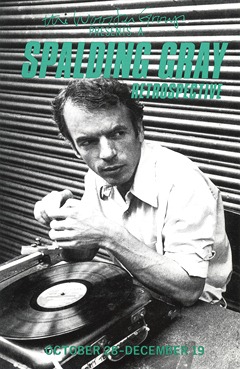
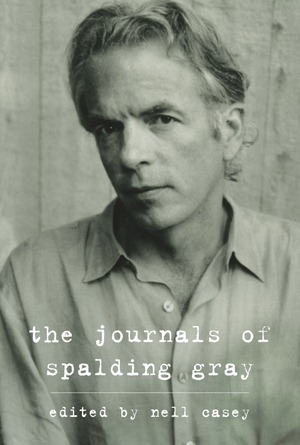 Despite the public mourning over various public figures in the last few years (Steve Jobs, Michael Jackson, Princess Di), I must say that only a few deaths of public figures have emotionally touched me. The big exception to this rule was Spalding Gray’s suicide in 2004. I first saw one of his monologues when I was only 16, and I have been a big fan ever since. I used to frequently see Gray attending some of the same performances I did in New York. I even met him personally twice.
Fortunately, Gray at least left a brief body of work for us to continue to enjoy – and thanks to the efforts of Steven Soderbergh, even gave us a new performance last year (in the form of a Spalding-narrated autobiographical film, now available on DVD.)
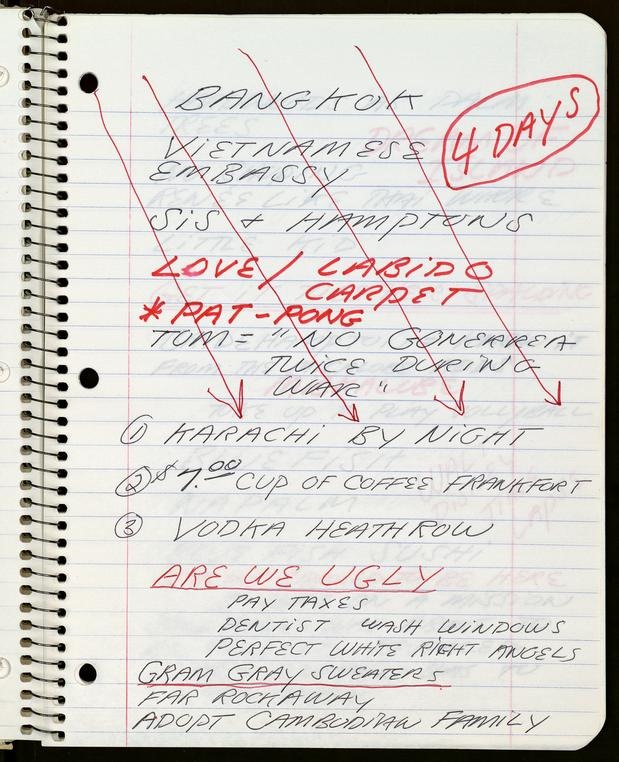 Today, Gray left us a new book, The Journals of Spalding Gray. I don’t think it is his best book, but anything from this voice we have missed is welcome. In homage to aleatoricism (a word I learned from another public figure I miss, John Cage), I randomly opened the book and came across page 262, where I read these two entries:
November 18, 1998
DREAM: That I was waiting in line to be guillotined, have my head cut off, and Woody Allen was the guy next to me.
November 18, 1998
I no longer know the difference between intuition and paranoia; the truth attacks the lie and the lie eats the truth; they are so close now they suck each other’s tail soon to the catch the body, eat it and become one.
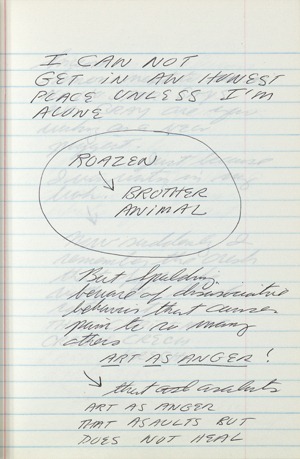
If you wish to read more of Gray’s journal, an excerpt was published in the New York Times.
Where good ideas come from
April DeConick speaks passionately in defense of maintaining and deepening individual disciplines in the Humanities. This is a useful counterbalance against the move towards interdisciplinarity. However, she also supports working across disciplines. She writes,
I think that we have to look at this for what it is. I think we need to take the discourse back to a healthy constructive place. I think interdisciplinarity is healthy, as long as we have real disciplines that are interacting and sharing knowledge. I think that disciplines and departments are not only necessary, but foundational. You need strong healthy disciplines in order to work across them successfully.
I happened to pick up Steven Johnson’s Where Good Ideas Come From recently and wanted to share this with you. I guess this helps explain why I have been spending more time recently outside of the field of biblical studies.
Bible Reading and Liberalism
Perhaps some of you may enjoy reading this article: “Survey: Frequent Bible Reading Can Turn You Liberal,” Aaron B. Franzen, Christianity Today.
Forthcoming movies about literary analysis
Here is a movie I want to see:

It’s said that academia is a famously back-stabbing place owing to its small-potatoes stakes. “Footnote” sets out to reveal the navel-gazing elements behind the pursuit of arcane knowledge while laying bare the storms it creates when ego and father-son rivalry play their parts. Scripter-helmer Joseph Cedar shifts sympathies back and forth as frequently as he changes tone from jokey to bitter, skewering ivory tower blindness with some wit and, just occasionally, emotion. A tendency to overbake may distance some, as could the immersion in obscure corners of Judaica scholarship, though Sony Classics’ early Cannes pickup shows noteworthy confidence.
Target auds will undoubtedly be Jewish viewers and college towns, a not insignificant demographic, yet “Footnote” is unlikely to find the same kind of heavy “fest play as Cedar’s Silver Bear winner “Beaufort.” Academic researchers rarely make for dynamic screen material (unless there’s sexual hanky-panky involved), so Cedar goes to great lengths — indeed, too great — to turn editing and music into the driving force behind the pic’s liveliness.
Professor Eliezer Shkolnik (Shlomo Bar Aba) worked for decades in semi-obscurity comparing corrupted manuscripts of the Jewish texts collectively known as the Talmud, with the near-impossible goal of preparing a version as close to the original ancient writings as possible. While Eliezer devotes himself to the minutiae, burying himself in the library or his study and barely publishing, his son Uriel (Lior Ashkenazi) produces book after book on broad Talmudic culture. Father looks with disdain on his son’s intellectual pursuits as much as on Uriel’s constant need for the limelight.
In many ways Uriel is a more human companion to Michael Sheen’s pedant in Woody Allen’s “Midnight in Paris”: he loves to lecture, he soaks up the adoration of students and colleagues alike, and he needs to be right, at all times. While Eliezer toils away with little recognition apart from a lone footnote in a multi-tome work, Uriel has honors heaped upon him, which he accepts with a faux-humility calculated to set his father’s teeth on edge.
The script nails academic gobbledygook along with the viciousness of professorial rivalries, nicely realized not only via the father-son conflict but between Eliezer and peer Yehuda Grossman (Micah Lewesohn, pitch-perfect), the latter a self-righteous, two-faced SOB who saw his career flourish by deliberately sidelining Eliezer. The pic’s best scene occurs in a tiny office into which Uriel is called after Eliezer gets news that he’s receiving Israel’s most prestigious award, the Israel prize. The awards committee is chaired by Grossman, and Cedar’s aim is unerring as he targets the insularity of the academic world along with the secret pacts and betrayals regularly concocted to keep rivals down. Tellingly, the scene is also one of the very few not propelled by music.
The sequence comes after a key though not unexpected plot twist, whose reveal occurs around the 40-minute mark. Uriel’s subsequent behavior shifts his character from merely a pompous egoist to more of what wife Dikla (Alma Zak) calls him — a nice guy who avoids confrontation. Viewers feel a surge of satisfaction when he finally does go on the attack, for the right reasons, which makes the character a far more rounded figure than originally presented.
With all his flaws, at least Uriel moves forward, unlike his father, whose recondite pursuit of an elusive ur-text is ultimately presented as blind intellectual masturbation no more useful than Mr. Casaubon’s unachieved “great work” in “Middlemarch.” Cedar’s impatience with Eliezer’s pursuits are crystallized in a well-written speech he puts in the mouth of the old scholar, in which the cataloguing of potsherds as opposed to the study of the vessel itself is proven to be all means and no end.
Despite the presence of Dikla, along with Eliezer’s wife Yehudit (Alisa Rosen), “Footnote” is a decidedly male-centric film. Structurally, the pic is divided into named chapters that make for cute markers but give it the not-entirely satisfying feel of a jaunty satire. Bouncy editing is intimately tied to Amit Poznansky’s score, the latter sounding like Stravinsky at his most playful and competing far too much with characters and themes. As in Cedar’s past films, corridors and doors play a key role, with Yaron Scharf’s tight lensing subtly responding to the notion of dividers and passageways.
Here is a movie I plan to skip:
Film festivals are always filled with “passion projects.” Films that directors, producers or screenwriters have spent years or even decades trying to get made. This year’s festival season has more then recent memory including Glenn Close scripted “Albert Nobbs” and David Cronenberg’s “A Dangerous Method” which playwright Christopher Hampton has been trying to get made for over 15 years. A more peculiar entry to that club debuted this afternoon at the 2011 Toronto International Film Festival in the Roland Emmerich revisionist thriller “Anonymous.”
A curious detour from his usual end of the world genre flicks, Emmerich has tried to get the Elizabethan era period piece made since at least 2006. As he cobbled up enough financing for it he ended up continuing his blockbuster run with “The Day After Tomorrow,” “10,000 B.C.” and “2012.” Many critics or moviegoers may wince at the idea of Emmerich fashioning a tale centered around the creation of Shakespeare’s greatest works (subtly has hardly been his strong suit), but it soon becomes apparent he’s not the problem with the picture nor why it took so long to get produced. Simply, the screenplay by John Orloff centers on such a ridiculous scenario that no performance or direction can save it from the whole concept being just plain silly.
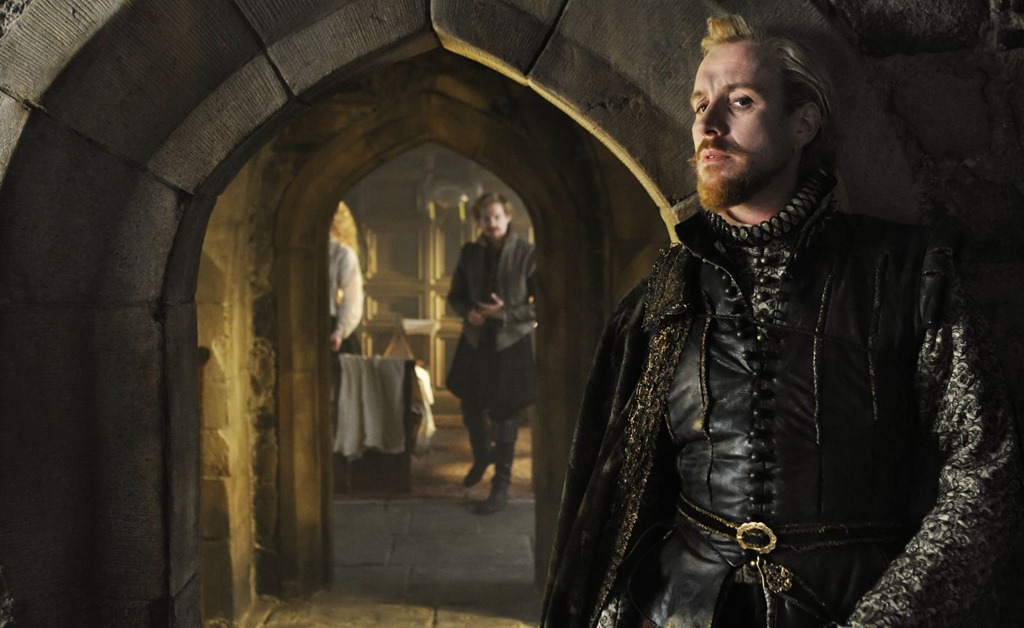
“Anonymous” takes the conceit that Shakespeare never wrote his famous plays, but instead was the frontman for Edward de Vere, Earl of Oxford, played by an almost unrecognizable Rhys Ifans. The artistically inclined De Vere, it seems, has been blackmailed by the infamous William Cecil (David Thewlis) advisor to Queen Elizabeth (Vanessa Redgrave) and also his father-in-law, from ever putting his name on his works or writing in public (Cecil believes theater is a sin in the eyes of god). Itching for the world to hear his work, de Vere approaches middlebrow playwright Ben Foster (relative newcomer Sebastian Armesto) be the “name” on his plays (plus he gets paid for it). At least that’s the plan until the charismatic and overbearing actor William Shakespeare (Rafe Spall) decides to steal the credit (although, to be fair, Foster was hardly enthusiastic about the “job”). As “Shakespeare” becomes more popular over the years, de Vere is able to enjoy his success as his own. Unfortunately, Orloff has concocted a grand and completely unbelievable conspiracy that ties in de Vere, Cecil, Cecil’s hunchback heir Robert (Edward Hogg ready to race up and ring Notre Dame’s bells), the Earl of Essex (Sam Reid), the Earl of Southhampton (Xavier Samuel) and a long lost romance centered around the Queen.
In theory, Emmerich and Orloff could have fashioned an entertaining thriller, but within 20 minutes the entire picture’s storyline has become completely implausible. Shakespeare is played as such a dufus, such a braggart, such a fool, such a 16th century frat boy that it’s impossible that anyone would ever believe he could write a letter let alone pen some of the greatest tomes in the English language. It’s simply ludicrous and makes the entire movie mostly a joke. And I won’t spoil it here, but an unnecessary “revelation” to de Vere at the end of the picture is stunningly even more ridiculous.
Among the actors, Ifans does his best to give de Vere a soul, but most of the ensemble can’t elevate the melodramatic nature of the material. The only one who escapes with her dignity completely intact is Redgrave. We’ve seen a lot of different version of the Virgin Queen over the past 20 years on screen and on television. From Cate Blanchett in both “Elizabeth” features to Judi Dench’s Oscar winning cameo in “Shakespeare in Love” to Helen Mirren’s calculating queen in the HBO mini-series “Queen Elizabeth I,” but Redgrave give us something else entirely. Her Elizabeth, in the final years of her life, is slowly losing her mind as dementia creeps in. One moment she’s aware of both Cecil’s devious scheming and another she’s bordering on insanity. It’s a finely nuanced performance that only helps to put the spotlight on just how obvious and bombastic the rest of the picture is.
On one last positive note, Emmerich and his crew (including notable costumes by Lisy Christl) make the approximately $30 million picture look like it cost closer to $100 million. And yes, that’s a compliment of some sort.
“Anonymous” opens nationwide on Oct. 28.
Elie Kaunfer: Core issues in prayer (part 2)
Yesterday, I posted the first segment of the first lecture of Elie Kaunfer. Please refer to that post for introduction and context. Here is next segment of Kaunfer’s lecture:
———————————————-
In the academic world the inspiration for this approach is Reuven Kimelman, who is a professor at Brandeis. He really takes prayers and he looks at the literary themes within the prayers, and he connects them with the texts that that stands behinds the prayers. Kimelman writes:
Source 3: “[T]he meaning of the liturgy exists not so much in the liturgical text per se as in the interaction between the liturgical text and the biblical intertext. Meaning, in the mind of the reader, takes place between texts rather than within them.” (Reuven Kimelman, “The Shema’ Liturgy” in Kenishta, Vol. 1 (2001) p. 28)
Now what Kimelman is saying in plain English is that you can never examine a text on its own. You have to always look at the other texts, the intertexts, that stand behind the texts of the prayerbook, and by juxtaposing them you create meaning. Now while Kimelman represents a modern representative of this approach, the idea is quite old. I want to look at two stages of development going backwards. The first will be the medieval stage, and I will identify the R”I bar Yakar (Rabbi Yehuda bar Yakar), who was the teacher of the Rambam (Maimonides) and Abudraham. These were two medieval commentators, the prior one living in the thirteenth century, and Abudraham in the fourteenth century. They constructed book length commentaries on the siddur (prayerbook), essentially dedicated to finding the biblical intertexts of prayer. I brought for you a source for Abudraham; I will read it in English:
Source 4: “You should know that the language of prayer is based on the language of Scripture. Therefore you will find written in this commentary on every word a verse like it or relating to its essence. There are a few words that did not have a biblical basis, and therefore I will bring for them a basis from the Talmud.” – (Abudraham HaShalem, p. 6)
Abudraham’s whole project here is to say that there is a text that is in dialogue with the text of the siddur (prayerbook). Abudraham drew on the work of the R”I bar Yakar’s less known commentary and he actually copied whole swaths of this book (in the good whole days where plagiarism was a compliment), but the methodology even extends back earlier than the medieval period. And that’s something that’s illustrated by Talmud itself. For this I want to read story about someone who prayerd the Amidah prayer from the Talmud, not to look at the theological implications of this, which are profound, but to look at the methodological implications of interpretation:
Source 5: “There was once one who prayed (the Amidah prayer) before Rabbi Hanina and said: ‘The great, mighty, awesome, powerful, strong, courageous God.’ Rabbi Haninah said to him: ‘Have you exhausted all the possible praise of your Master? Were it not that they were written by Moses in the Torah and affixed by the Men of the Great Assembly, we would not even dare to utter those three [descriptions]! But you go on adding all of these?! It may be compared to a human king who had thousands upon thousands of gold coins, and people praised him for owning silver. Isn’t that a terrible degradation of him?’ “ (Babylonian Talmud Megilah 25a)
So now again, breaking the theological of Rabbi Hanina (which I may or may not get back to), what is he saying methodologically? The only way that I can pray is by noticing that the words of prayers are written by Moses in the Torah. Indeed, if Moses had not written them, I would not be able ascribe adjectives to God. So when you look for the Biblical intertext, it opens up (I want to argue) some possibilities. And just to see that intertext does exist, look at what Moses wrote in the Torah:
Source 6: “For God your God is the God of gods and the Lord of lords. The great, mighty, and awesome God who shows no favor and takes no bribe; who does justice for the orphan and widow, and loves the stranger, providing him with food and clothing – You too must love the stranger, for you were strangers in the Land of Egypt.” (Deuteronomy 10:17-19)
Now the context here of this phrase, ha’el hagadol hagibor v’hanora (the great, mighty, and awesome God), is totally different from the one in the Amidah prayer which we may have associated with a more cosmic God. Right? A creator God. A God who was going to be great, might, and awesome by dint of the fact that God created the universe. But here we have a different context in which God is acting in an ethical way towards people who are most vulnerable. Now this, I would argue, opens up some possibilities of interpretation which I am not going to go into now (see my previous lectures), but the methodology is one that I want to focus on. Even as early as the Talmud, Rabbi Hanina is pointing out that you have another text that stands behind the prayer.
Now that we’ve established a methodology of connecting biblical texts to the liturgy, the religious question creeps back in. What is the interpretative advantage of linking texts one to another. And here I am going to receive the question as a religious one. What do I do when I encounter a prayer that is troublesome? Or to ask it somewhat less provocatively, what do I do when I encounter words that I simply do not connect to, that are uninteresting to me, or that I cannot find a way into?
There is a rabbi named Rabbi Pinchas of Koretz who claimed that the words of prayer are, drawing on the imagery from Vayikra (Leviticus), “weavings of gold” that need to be filled with kavvanah (prayerful intention). But what if I cannot fill the words with kavvanah? They are meant to be filled, but I cannot do it. How am I supposed to approach that problem? Ultimately, the academic approaches are lacking. The philological and the form criticism method offer little assistance. As Hoffman notes in his critique of them, every liturgist has thus been in the uncomfortable position of lecturing on the origin of this or that prayer, only to be asked by a lay person why we prayed in the first place. In other words, it does not matter how old the prayer is or when it was written or if it is the original one, if you cannot tell me why I have to say it. What does it mean? What does it mean religiously? The alternative is simple textual archeology, which may be of scholarly interest, but has nothing to do with our interest here, which is a religious one. Even Hoffman’s approach of holism, while much wider in scope, sets aside the thorny issue of the text and it instead analyzes deeper anthropological issues about the people who are saying the text, but leaves the interpretation of the text for an unanswered question.
Now I want to speak a little bit of how modern movements have dealt with this question of interpretation or difficult issues in text before coming to our methodology and putting it into use.
All the modern movements have had one of three reactions to the question of what to do with a difficult text or a text that one cannot connect to. I’ll lay them out here: Number one, cut. Number two, rewrite. Number three, interpret. Now, some of these are somewhat obvious associations with various movements and so we do not have to belabor that point. I did want to bring one from the early Reformers which I think is just fascinating from a process standpoint.
In the Seventh Session of the First Rabbinical College, which took place in Brunswick in 1844, there was a vote that was held about the Kol Nidrei prayer (a Yom Kippur prayer where all vows in the coming year are declared null and void.) And we have here the minutes of the discussion:
Source 7: “The discussion is declared concluded. The question is now asked:
1) Should the Conference declare that the oath of a Jew, invoking the Name of God, is binding without any further ceremony?
Unanimous Response: Yes!2) Does the Conference declare that Kol Nidre is unessential? And will the members of the Conference, in their spheres of jurisdiction, work for its abolition, already in time for next Yom Kippur?
Yes!”(Jakob Petuchowski, Prayerbook Reform in Europe, p. 336)
So we have the cutting recorded in the minutes from 1844. And while this approach is obviously popular particularly among Reform and Reconstructionist liturgies, some of which we will look at in a minute, it also shows up in Conservative and even Orthodox liturgies or liturgical approaches.
How Daniel Matt translates
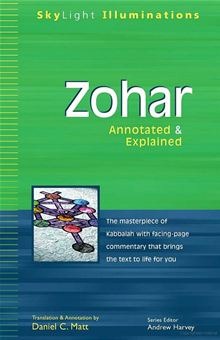 Bob MacDonald expressed interest in Daniel Matt’s translation of Zohar. Matt translates the Zohar as poetry. Here is a small part of the translation from Matt’s book of selections from the Zohar:
Rabbi Shim’on said,
“Woe to the human being who says
that Torah presents mere stories and ordinary words!
If so, we could compose a Torah right now with ordinary words,
and better than all of them!
To present matters of the world?
Even rulers of the world possess words more sublime.
If so, let us follow them and make a Torah out of them.
Ah, but all the words of Torah are sublime words, sublime secrets!“Come and see:
The world above and the world below are perfectly balanced:
Israel below, the angels above.
Of the angels is written: He makes His angels spirits (Psalm 104:4)
But when they descend they put on the garment of this world.
If they did not put on a garment befitting this world,
they could not endure in this world
and the world could not endure them.“If this is so with angels, how much more so with Torah,
who created them and all the worlds,
and for whose sake they all exist.
In descending to this world,
if she did not put on garments of this world,
the world could not endure.…
“Woe to the wicked who say that Torah is merely a story!
They look at this garment and no further.
Happy are the righteous who look at Torah properly!
As wine must sit in a jar, so Torah must sit in this garment.
So look only at what is under the garment.
All those words, all those stories are garments.”
Festival of Booths
Tonight, the Festival of Booths begins. This is the Thanksgiving pilgrimage festival, and it is unique in a number of ways.
It is one of three major Biblical festivals (along the Festival of Passover and the Festival of Weeks). Together with two major Biblical holidays (the New Year and the Day of Atonement) post-Biblical (more specifically, post-Pentateuchal) holidays (e.g., Festival of Lights, Purim, Ninth of Av), and minor holidays, this festival forms the Jewish religious calendar.
The first way that the Festival of Booths is unique is that it is universal on both Jews and gentiles (or at least it will be in the messianic era). See Zechariah 15:16-19.
 Further, the Festival is celebrated by building small, flimsy, temporary booths (or shacks): the sukkos. These are required to be temporary, somewhat shaky structures. If you visit a Jewish neighborhood, you will see these next to each house. Now, over time, some people have developed a tradition to make rather elaborate decorations of the booths, but many keep them basic. (Indeed, check out the photo of the booth on the back of a pickup truck – portable! Most booths are somewhat more elaborate than that.)
And then – people are supposed to live in the booths. What does it mean to live in them? Well, that depends on personal tradition, but most participants pray and eat their meals in them. Some of the more zealous even sleep in them. This can be a challenge, though, since the booths’ ceilings are required to be formed of plant material with gaps in it, so the rain will definitely come through.
 As spectacular as many Jewish sukkos are, the sukkos of the Samaritans are even more spectacular. Unlike the Jews, the Samaritans build their sukkos indoors and decorate the ceiling with fruit and flowers. See here for some amazing photographs.
One unique custom of the Festival involves shaking the four species – a topic about which I have written elsewhere.
One of my favorite aspects of the Festival is that it ends in a wonderfully joyous holiday called Simchas Torah (Happiness of the Teaching) in which sefer toros (Torah scrolls) are danced with. The central liturgical feature of the Simchas Torah holiday is that the Torah is read continuously – ending with the last few passages in Deuteronomy and then immediately beginning with the first few verses in Genesis – just like Joyce’s Finnegans Wake.
Previously, Kurk has blogged on the question of what the New Year (Rosh Hashanah) and the Day of Atonement (Yom Kippur) mean to Christians. I’m not sure about those holidays, but at least from the view of the theology of Zechariah, Christians have a central role in the Festival of Booths (Succos). (Indeed, some Christians even believe that Jesus was born during the Festival and that is why there was supposedly “no room at the inn".”)
Regardless of your belief system, I hope that this fall harvest festival period brings you joy and abundance.
Received: Daniel Matt’s Zohar Volume 6
 I just received my copy of Daniel Matt’s sixth volume (out of a projected twelve volume set) of his Zohar translation. I previously mentioned this volume here, and I hope to post some comments soon.
Third edition of Emanuel Tov’s Textual Criticism of the Hebrew Bible
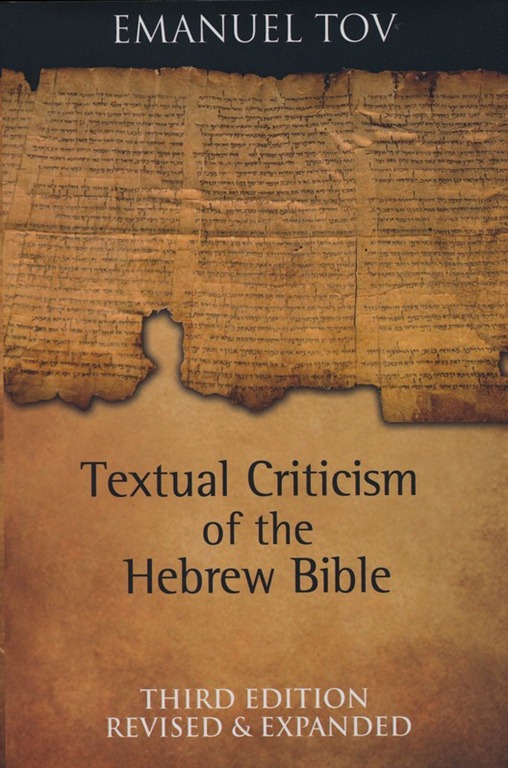 The third edition (marked “revised and expanded”) of Emanuel Tov’s classic Textual Criticism of the Hebrew Bible (hardcover, Fortress Press, Amazon price $56.70) is now out, and I just received my copy moments ago.
As most readers of the blog probably know, Tov is the J. L. Magnes Professor of Bible at Hebrew University and also the Editor in Chief of the Dead Sea Scrolls Publication Project.
Unlike the rather disappointing minimal changes to the second edition, it appears that the changes to this edition are extensive.
The preface to this new volume begins:
This edition, the third in English, is formally a sequel to the second edition (2002). However, in many ways, it is a rewriting of the first edition (1992) since, in preparation of the second edition, I needed to limit myself to the existing camera-ready page format, thereby not permitting extensive omissions or additions. Thus, for the present edition, I covered two turbulent decades of research in an area that is developing very rapidly. When reviewing the literature of these twenty years, I was amazed by the number of studies written on each of the areas covered by the umbrella term “textual criticism of the Hebrew Bible.” The many studies quoted in this book that date between 2005 and 2011 bear witness to this abundance. The study of Greek Scripture is a prime example of the advancement in learning. During these two decades, the publication of the biblical Judean Desert scrolls has been completed and their impact is felt in almost every chapter of Textual Criticism of the Hebrew Bible. The description of the scrolls (ch. 21C) has been greatly enriched and, equally important, the status of the Masoretic Text, the Samaritan Pentateuch, and the Septuagint is now much clearer in the wake of the new discoversies. the newly found scrolls also greatly enriched the description of the technical aspects of the textual transmission in ch. 4B, necessitating a complete rewriting.
At the same time, I also had to cover two decennia of my own evolving views on large and small matters. I can safely say that no stone was left unturned. Even if the book appears to resemble the previous editions due to only slightly modified tables, a closer perusal of the text will reveal many changes in every paragraph, including their expansion or even deletion, as well as completely novel sections, and, in one case, a new chapter. Six plates were altered, while most have been improved. The larger scope of this edition is not immediately obvious as many sections are presented in a smaller font.
Some obvious changes include a new glossary (words are marked in the text), a new didactic guide, major overhauls especially to chapters 2, 3, and 9, (chapter 9 on “Scholarly and non-Scholarly Editions” in particular has grown from 9 to 35 pages) and a new chapter 10 on “Computer-Aided Tools for Textual Criticism.”
The text overall seems to have decreased its focus on the Masoretic text in several places, and increased its coverage of the Dead Sea Scrolls, Septuagint, and Samaritan texts.
All-in-all, it looks like this standard handbook has been greatly improved, and I am looking forward to reading it cover-to-cover.
Elie Kaunfer: Core issues in prayer (part 1)
Elie Kaunfer last month offered a remarkable series of lectures (the last lecture being offered by Joey Weissenberg), Core Issues in Jewish Prayer. Although these lectures were given in a Jewish context, I believe that the fundamental issues he addresses are more universal (thus I have dropped the adjective “Jewish” in my blog title of this transcription.)
These lectures deserve further attention, but Kaunfer is a rapid speaker and it is sometimes tedious to listen to recorded lectures, rather than read them.
I have transcribed the first ten and half minutes of Kaunfer’s first lecture (with handouts here) and as time and interest allows, I may transcribe further sections of the lecture series and post them on this blog as part of an irregular series. I have slightly edited the text for grammar. Here is Elie Kaunfer:
———————————————-
OK, welcome everybody. I am excited to see you all here. Welcome to Mechon Hadar’s Fall series, our Elul series, entitled “Core Issues in Jewish Prayer.” My name is Elie Kaunfer. Let me make a few introductory remarks, including a roadmap for these three lectures, and then we’re going to dive into the issue of hand tonight, which is really a discussion of the words of prayer.
I want to start by welcoming our full-time fellows who started their day here at Yeshivat Hadar. These people who are with us for the next nine months to do learning and davening (praying) and community outreach and we’re so excited to have you all here. So, thank you. And I also want to welcome the alums of our program, both our full-time programs and our executive seminars – it is good to see you all back. And welcome to all of the new faces in the room.
OK, I am going to start by putting all of my cards on the table and speak a little about why I think it is important to talk about prayer. Prayer is a core part – if not the core part – of what it means to be a religious person. It is the expression of what it means to be a Jew standing in covenantal relationship with God. And it is nothing short of Judaism’s answer to connecting to the divine. Or, in the words of Abraham Joshua Heschel, a teacher that I am going to quote repeatedly tonight and next week,
Source 1: “To live without prayer is to live without God, to live without a soul.” (Abraham Joshua Heschel, Man’s Quest for God, p. 59)
Prayer when taken seriously is miraculous, and I want to point to a couple of miraculous features of prayer. It has the power to elevate us. It has power to put God at the center of our experience and to refocus our connection away from worldly things towards the Divine, hopefully impacting our experience in the world itself. It also has a miraculous potential for intensity. The Baal Shem Tov said famously: “The great chesed (gift – loving kindness) from God is that people survive the hour of prayer. “ When you take that seriously you can see the true miraculous of what a prayer could offer.
And yet, we’re so often far from that experience. Instead, we are living in a period that is animated by a “crisis of prayer,” to use another term of Abraham Joshua Heschel. This can be attributed to many factors. It could be related to a lack of prayer role models. It could be related a deficit of inspiration, to an inability to focus. But if I was going to pick one, I would say it is the following: cynicism. Cynicism is really the ultimate roadblock in my opinion that prevents us from experience that moment of prayer life. The cynic in us, the cynic in me, always maligns the possibility of prayer. We talk, we joke, we read, we cross our legs, we fold our arms, we don’t really believe that there is any deep power in prayer. And so we mock the people who think that there is a possibility of prayer, even if those people are not even alive anymore.
The goal of this series is to say: forces of cynicism do not always have to win. If we meet head on the difficulties in davening (praying), then we are at least taking seriously the potential in what it means to pray. It is my intention to examine this difficulties head on, together with you, to open up new pathways in prayer.
Before I move further to laying out the structure of this series, I just want to take a moment to acknowledge some of my teachers in some of my thinking. I’ve learned a tremendous amount about what it means to pray and what it means to study the text of prayer from a number of teachers including Rabbi Ebn Leader, Dr. Devora Steinmetz, and my own parents, Rabbi Alvin and Marcia Kaunfer. I also want to take a moment to credit my colleagues who are my fellow travelers in what it means to study and live a prayerful life. Both the leaders of Mechon Hadar, Ethan Tucker, Shai Held, Avital Hochstein, and to all those people in the extended Hadar community, stretching all the way back to Kehilat Hadar’s founding, who really opened up the possibility of what it means to pray full without having to check a part of myself at the door.
This series is divided into three parts. Tonight we are going to focus on the words of prayer, and explore a particular approach to interpretation. Next week, we will move beyond the word, turning our attention to the aesthetics of prayer. And finally in the third session, led by my colleague Joey Weisenberg, we are going to explore the connection to music and the possibilities unlocked through singing and prayer.
But tonight I want to focus on the issue of the text of prayer, and ultimately describe a methodology of interpreting prayers that is service of increasing the religion quotient in the analysis of texts of prayers. That is to say, there are many ways of considering the texts of prayers. But for my purposes, unless they lead to a religious end, they are of little use in solving the “crisis of prayer.” In the academic study of liturgy, there have been three major approaches to encountering the text of prayer. I am going to briefly describe them here, and then I am going to contrast these approaches with the one I am going that I am suggesting here tonight, which I will term the literary-intertext approach. Then we will this put this methodology, the literary-intertext methodology, to the test, first with a fairly uncontroversial line from the Havdalah prayer, and perhaps if time allows, to a line from the Amidah prayer.
So, onto the academic models. One of the first modern scholars of the scientific study of Judaism, Leopold Zunz, pioneered one approach to dealing with words and specifically words in prayers. Zunz’s approach, known as philology, is reflective of the academic spirit of his age in the 1800s. By studying the variants and history of the text, he claimed to be able to uncover the earliest recession of the prayer. Zunz and his intellectual heirs, including scholarly giants such as Ismar Elbogen, Daniel Goldschmidt, Ezra Fleischer, and the contemporary scholar Uri Ehrlich, believed that such an original text can be uncovered. You can find the first text of the Amidah, let us say, or any particular blessing. And many in this school also tried to connect to some political explanation to tie to the original text. If we could derive the original text, then let us think about what the political motivations for why someone might have written the text were. The most famous example is the Curse Against Heretics (the Blessing of the Heretics) in the Amidah prayer, which people have tried to connect to actual political events on the ground some two thousand years ago.
Joseph Heinemann represents the teacher of the second approach in the academic study of liturgy, known as form-criticism. And here he takes a page out of the extent of Biblical textual approaches, by saying that essential that there is no such thing as an ur-text, there is no original text; texts arose at the same time in tandem. There is no way of identifying what the number one original text was, even if there were such a text, we could not identify it. His theory is basically that these were multiple expressions of the same idea that happened together, and there was no rabbinic central authority that had controlled over saying “this is the text,” that then got edited later. So instead of having one text that splits, there were many texts that perhaps got funneled into one. What did Heinemann do then, if we cannot find an original text? He tries to classify texts, not by their age, but by their institutional origin. So he takes something like the Bar’chu prayer, and he says he noticse something about the Bar’chu parayer – it is in the second person. Right? “Bar’chu” means “you bless.” It is a command. “You should bless.” So who is speaking to me? Who is speaking to the worshiper? Heinemann identifies that with the priestly institutional locus, where priests were telling other Jews how to worship, or to worship in this moment. That is contrasted with something that comes out of, let’s say beit midrash origin, a study hall origin, where he connects something like the Kaddish prayer. For Heinemann, it was not the idea of the original form of the Kaddish prayer, but to say that the Kaddish prayer and the Bar’chu prayer are totally different because they arise out of different institutional origins.
The final academic approach I am going to just briefly touch on is one pioneered by Larry Hoffman in his book entitled Beyond the Text, which was published back in 1988. Hoffman is a scholar at Hebrew Union College, and if you are interested in those previous two approaches, the philology approach and the form-criticism approach, he also writes about those in his book. But Hoffman basically recognizes that praying is much more than texts, and as a result he introduces what he calls the holistic approach. In his words, this approach is meant to argue from texts to people. Hoffman is not interested in the text ultimately; he is interested in what the text can tell us about the people who were saying the text. In service of that goal, he employs a holistic approach, that is to say a multi-disciplinary approach, trying on the ideas of anthropology and linguistic theory to say something significant about the people who were saying the text. Now Hoffman is surely right when he states
Source 2: “Prayers are unique human cultural extensions of those who pray them, indistinguishable as prayers, in fact, as long as they are separated from the act of praying…. Liturgy is not a literary matter in the first place.” (Larry Hoffman, Beyond the Text, p. 6)
Hoffman stresses his holistic approach when he says “liturgy is not literary matter in the first place.” That is a fairly bold claim. In other words, as the title of his book suggests, he is moving beyond the text; he does not care about the text as an end in itself, he cares about the people who said it.
But while there is much appeal in Hoffman’s approach, tonight I am not really prepared to move fully beyond the text, because truly the word or wordiness of prayer, for the cynics among us, either provides an opportunity for blockage or in a best case scenario a way in. That is to say, what ultimately connects me to praying? It is the words. And I want to offer an interpretive approach that hopefully can connect us to those words in a deeper way, and that is what I am calling literary-intertext approach.
(Part 2 continues here.)


 BLT
BLT 