For abecedarians in 2011

You be the judge: Part II, “Esther” translations
Practice is to Judaism what belief is to Christianity. That is not to say that Judaism doesn’t have dogma or doctrine. It is rather to say that for Jews, the essence of the thing is a doing, an action. Your faith might come and go, but your practice ought not waver.
— Lauren F. Winner, Mudhouse Sabbath: An Invitation to a Life of Spiritual Discipline
If, as [Leo] Baeck claims, the New Testament can justly be considered a Jewish book, it must be ranked as one of the strangest Jewish books ever written. This is a “Jewish book” that holds the Jews responsible for murdering the beloved son of God. It vilifies the rabbis as hypocrites and liars, and has served as the pretext for centuries of abuse and persecution of the Jewish people. It is a book most Jews neither own nor read. What can it possibly mean to call the Christian scripture a Jewish book?
—Julie Galambush, The Reluctant Parting: How the New Testament’s Jewish Writers Created a Christian Book
[There are] subtly negative images of Jews that have unconsciously become the daily bread of perfectly well-meaning Christians. Take, for example, Luke’s parable of the tax collector and the Pharisee. Both enter the temple to pray, but the tax collector seeks God’s forgiveness while the Pharisee indulges in self-congratulation. As a child [taught in a Christian home], I quickly learned that I was supposed to act like the tax collector and not like the Pharisee. For me, however, this lesson included an unconscious assumption that the tax collector, who modeled the correct relationship toward God, was a Christian; only the smug old Pharisee was a Jew. Sometimes reading [the New Testament] with Jewish eyes means opening one’s eyes to layers of anti-Judaism within the Christian tradition.
–Julie Galambush, The Reluctant Parting: How the New Testament’s Jewish Writers Created a Christian Book
I’m starting this post with three epigraphs. They are statements written respectively by one who has converted from Judaism to Christianity (i.e., Lauren Winner) and by one who has converted from Christianity to Judaism (i.e., Julie Galambush). I would like us to consider again Adele Berlin’s statements about the Greek Septuagint being more Jewish than the Hebrew Masoretic Text. Would you now be the judge?
Whether it is the New Testament or the Septuagint (that Greek translation of the Hebrew scriptures quoted by the writers of the NT), it seems peculiar to refer to these texts – used by Christians – as Jewish. It’s even stranger to call them more Jewish than the Hebrew texts. Berlin’s statements, which I quote again below, are not particularly common ones in the history of Jewish biblical scholarship. The usual understanding of the LXX, expressed in the Talmud, has been that the day the Torah was rendered into Greek “was as difficult for the Jewish people as the day when the Golden Calf was made.” And even the Jewish translator of Ecclesiasticus into Greek noted that “what was originally expressed in Hebrew does not have the same force when it is in fact rendered in another language.” So what does Berlin say, in particular?
Berlin suggests that, for the book of Esther, the Greek LXX is less sparse than the MT and is actually richer in terms of literary narrative. Berlin also says that, in the Greek translation of Esther, “the Jewish characters are more religious, for it is religious practice that defines one as a Jew.” She goes on: “The Septuagint has made Esther into a pious Jewess of the Hellenistic (early rabbinic) period, who disdains marriage with a non-Jew, eats only kosher food, and does not drink wine used for libations to pagan gods (yein nesekh).” Thus, Berlin asserts, “the Septuagint sought to make the book sound more biblical.”
So how might you judge this? Theophrastus suggests this test:
“If one sits down and reads two equivalent translations of MT Esther and LXX Esther (for example, in the NRSV translation, where the two works are translated independently to similar standards) at least I cannot help but feel that the Hebrew version is superior.”
With this post, we will do this. You be the judge. Here are NRSV English translations produced by the consistent standards, translations of the same Esther passages, but translations of the passages respectively from Hebrew into English and from Greek into English. In other words, what you find below are verses from the MT and the LXX, both translated into English, one presented right after the other. (I have not included the longer “Additions,” passages only found in Greek but not in Hebrew.)
By your definitions, which is more Jewish, which more literary?
ESTHER NRSV MT FOLLOWED BY NRSV LXX
Chapter 2:
15When the turn came for Esther daughter of Abihail the uncle of Mordecai, who had adopted her as his own daughter, to go in to the king, she asked for nothing except what Hegai the king’s eunuch, who had charge of the women, advised. Now Esther was admired by all who saw her. 16When Esther was taken to King Ahasuerus in his royal palace in the tenth month, which is the month of Tebeth, in the seventh year of his reign, 17the king loved Esther more than all the other women; of all the virgins she won his favor and devotion, so that he set the royal crown on her head and made her queen instead of Vashti. 18Then the king gave a great banquet to all his officials and ministers—“Esther’s banquet.” He also granted a holiday to the provinces, and gave gifts with royal liberality. 19When the virgins were being gathered together, Mordecai was sitting at the king’s gate. 20Now Esther had not revealed her kindred or her people, as Mordecai had charged her; for Esther obeyed Mordecai just as when she was brought up by him. 21In those days, while Mordecai was sitting at the king’s gate, Bigthan and Teresh, two of the king’s eunuchs, who guarded the threshold, became angry and conspired to assassinate King Ahasuerus. 22But the matter came to the knowledge of Mordecai, and he told it to Queen Esther, and Esther told the king in the name of Mordecai. 23When the affair was investigated and found to be so, both the men were hanged on the gallows. It was recorded in the book of the annals in the presence of the king.
15When the time was fulfilled for Esther daughter of Aminadab, the brother of Mordecai’s father, to go in to the king, she neglected none of the things that Gai, the eunuch in charge of the women, had commanded. Now Esther found favor in the eyes of all who saw her. 16So Esther went in to King Artaxerses in the twelfth month, which is Adar, in the seventh year of his reign. 17And the king loved Esther and she found favor beyond all the other virgins, so he put on her the queen’s diadem. 18Then the king gave a banquet lasting seven days for all his Friends and the officers to celebrate his marriage to Esther; and he granted a remission of taxes to those who were under his rule. 19Meanwhile Mordecai was serving in the courtyard. 20Esther had not dislosed her country – such were the instructions of Mordecai; for she was to fear God and keep his laws, just as she had done when she was with him. So Esther did not change her mode of life. 21Now the king’s eunuchs, who were the chief bodyguards, were angry because of Mordecai’s advancement, and they plotted to kill King Attaxerxes. 22The matter became known Mordecai, and he warned Esther, who in turn revealed the plot to the king. 23He investigated the two eunuchs and hanged them. Then the king ordered a memorandum to be deposited in the royal library in praise of the goodwill shown by Mordecai.
Chapter 4:
5Then Esther called for Hathach, one of the king’s eunuchs, who had been appointed to attend her, and ordered him to go to Mordecai to learn what was happening and why. 6Hathach went out to Mordecai in the open square of the city in front of the king’s gate, 7and Mordecai told him all that had happened to him, and the exact sum of money that Haman had promised to pay into the king’s treasuries for the destruction of the Jews. 8Mordecai also gave him a copy of the written decree issued in Susa for their destruction, that he might show it to Esther, explain it to her, and charge her to go to the king to make supplication to him and entreat him for her people.
5Then Esther summoned Hachratheus, the eunuch who attended her, and ordered him to get accurate information for her from Mordecai. 7So Mordecai told him what had happened and how Haman had promised to pay ten thousand talents into the royal treasury to bring about the destruction of the Jews. 8He also gave him a copy of what had been posted in Susa for their destruction, to show to Esther; and he told him to charge her to go in to the king and plead for his favor in behalf of the people. “Remember,” he said, “the days when you were an ordinary person, being brough up under my care – for Haman, who stands next to the king, has spoken against us and demands our death. Call upon the Lord; then speak to the king on our behalf, and save us from death.”
Chapter 6:
On that night the king could not sleep, and he gave orders to bring the book of records, the annals, and they were read to the king. 2It was found written how Mordecai had told about Bigthana and Teresh, two of the king’s eunuchs, who guarded the threshold, and who had conspired to assassinate King Ahasuerus. 3Then the king said, “What honor or distinction has been bestowed on Mordecai for this?” The king’s servants who attended him said, “Nothing has been done for him.”
That night the Lord took sleep from the king, so he gave orders to his secretary to bring the book of daily records, and to read to him. 2He found the words written about Mordecai how he had told the king about the two royal eunuchs who were on guard and sought to lay hands on King Artaxerxes. 3The king said, “What honor or dignity did we bestow on Mordecai?” The king’s servants said, “You have not done anything for him.”
Chapter 8:
15Then Mordecai went out from the presence of the king, wearing royal robes of blue and white, with a great golden crown and a mantle of fine linen and purple, while the city of Susa shouted and rejoiced. 16For the Jews there was light and gladness, joy and honor. 17In every province and in every city, wherever the king’s command and his edict came, there was gladness and joy among the Jews, a festival and a holiday. Furthermore, many of the peoples of the country professed to be Jews, because the fear of the Jews had fallen upon them.
15Mordecai went out dressed in the royal robe and wearing a gold crown and a turban of purple linen. The people of Susa rejoiced on seeing him. 16And the Jews had light and gladness 17in every city and province wherever the decree was published; wherever the proclamation was made, the Jews had joy and gladness, a banquet and a holiday. And many of the Gentiles were circumcised and became Jews out of fear of the Jews.
xkcd on Christmas songs

The Science of Sexists: where its heart isn’t
Suzanne’s post has me asking, Why is Denny Burk a Complementarian? I ask it again reading Burk’s blogpost where he says how he reads (and shows how he fails to read) Scot McKnight’s very brief ebook,

I do know why. Here is Burk’s hang up that prevents him from seeing his wife and women in his congregation as equal with himself. He says:
“At the heart of McKnight’s argument … is a critical weakness….
The bottom line issue [that McKnight ostensibly has not refuted well] is Junia’s relationship to the apostles [Junia, who was not a man and her non-inclusive relationship with the apostles, who were men and were inherently not women].”
In another post, I could go on showing all the particular blindspots of Burk with respect to McKnight’s newest publication. However, in this post, I want to try to offer my answer to that question, Why? There is no relationship of Junia, a woman, among the apostles, men, according to Burk. Rather, there is God-ordained separation. I understand this line of thinking well.
I was startled today to see it beyond my own religious upbringing and still in very objective science. Let me mention that at the end of this post. Let me first suggest why so profoundly I understand Burk’s position.
My own father was a Complementarian. It was a position he believed the Scriptures taught. It was a position he practiced. It was a position he argued for in his evangelical Christian missionary work. (Like Burk, my father was an ordained and practicing pastor; they belong to the same denomination.) Complementarianism was a position that my father exercised in our family. My mother was his help-meet. In the early 1960s, another woman, an African American woman, was The Help in our household.
My father would have agreed with Denny Burk’s statement: “There’s no Complementarian cover-up—just a difference over interpretation, a difference with profound implications for the life of the church.” My father, who knows logic and used it well, was on guard for the profound implications.
The last time I remember being in the same room with him as he publicly presented his Complementarian case was at my dissertation defense. My mother, my wife, and one of our daughters was also there, in the audience. But, after the faculty members on my committee had asked all of their questions, and after I had answered them, my father was the one who, from the audience, questioned the findings of my research and challenged the implications. In my dissertation, and for its defense, I had been examining the sexist principles of Aristotle, the science that seemed to lead him to his view that females are faulty and abnormal and unnatural beings in any species.
Quite predictably, the science of sexists relies on this simple (if complex and not at all simplistic) principle:
Objectively observable difference in nature is hierarchically ordered.
(Yes, I know. The logical fallacy of “begging the question” abounds here. But there is a definite and precise logic here anyway. If you observe the “other” as different from you in terms of sex – which could mean biology difference, or psychology difference, or sociology difference, and maybe compounded by race difference and by class difference and by nationality difference and by education difference and by language difference and by gender difference and so forth – if you are born male, then you are normal and superior. Power and position depends on these innate and/or God-given differences.) We struggle with precision, and this was exactly the point of issue for my father at my dissertation defense. He needed “difference,” real and precise difference, the sort that so much of Aristotle’s science depended on. I don’t know if I can paraphrase this any better than in the language of Nancy Mairs who says, “The fundamental act of sexists is to bifurcate with precision.” Well, to be precise, Mairs actually wrote that this way:
In order to get what he wants, then, the father must have power to coerce those around him to meet his demands. To have power is to alienate oneself, however, because power is always power over and the preposition demands an object. The fundamental structure of patriarchy is thus binary: me/not me, active/passive, culture/nature, normal/deviant, good/bad, masculine/feminine, public/private, political/personal, form/content, subjective/objective, friend/enemy, true/false. . . . It is a structure, both spatial and temporal, predicated upon separation, not relation. It demands rupture, the split into halves engendered by the abrupt erection of the phallus: those who have and those who have not. It speaks the language of opposites. . . [in] a dimorphic world.
To be fair, Complementarians — who say that God assigns higher roles to husbands than to wives, and higher positions to men generally in his organization of his people than to women, and positions of ownership of other humans to masters of slaves – can be kind people. Abuse is not advocated, if the slave obeys and if the master is loving. Hence, there’s co-operation and complement. Difference can be kind, and yet the “others,” the ones who are under in the hierarchy, must be silent or must be silenced. Pockets of silence have existed, as Cheryl Glenn rather precisely puts it, for “the past twenty-five hundred years in Western culture.” This morning, I was quite shocked to learn of yet another pocket of silence, in science. One more little note before I get to that, because there is, I think, hope for change, if there’s work to do.
Now, the rest of the story for my father is that he got a death sentence. Literally. He has a disease that his physicians have called terminal. It is just amazing to watch him change. He is calling his Complementarianism unfounded; he is apologizing for all of his many abuses; he preaches to his family now only “unconditional, unselective love”; he practices that too; he refers to his spouse now as his equal, as created in God’s image, as his best friend and his soul mate. Because of his health, he is much dependent on her leadership, on her help; but he does not think of or treat my mother as his helpmeet. He encourages his daughters in law as much as his sons; he champions his granddaughters as strongly as he does his grandsons. I can only imagine what you might be thinking as you read this. “Well, isnt’ that nice?” Or “So what? What’s that got to do with me?” Or, “I wonder if the sexism in science that this blogger was referring to really is real?”
If so, then let me try to startle you the way Barbra Streisand startled me this morning. I was reading her Huffington Post essay on medicine and science, but how still sexist it is, this late in human history. You might really value science and medicine, as I do. What if at the heart of it, figuratively and literally, there is sexism there? Streisand says, “a boys club still exists in the medical sciences.” Why? It’s a good question. Now ask it as you read or listen to what she tells us. What are the “profound implications for the life” of any of us when our healthcare for females is lesser than it is for males?
Denny Burk’s Complementarian Cover-up
Denny Burk is happy to acknowledge that Junia is a woman. But he makes no progess whatsoever in resolving the fundamental controversy. It is simply this. Two pieces of information regarding Junia have been misrepresented to the reading public.There has been a cover-up.
First, the Nestle Aland 1927 text of the Greek New Testament accented the name Junia as if it were masculine when not even one manuscript had ever displayed this accent pattern. Not even one. The form of Junia in the NA 1927 text was a complete fabrication ex nihilo.
Second, the data used by Burer and Wallace to create what they called a “parallel” construction to Romans 16:7, never was parallel, never will be parallel. Here is the data as presented by Burer and Wallace,
In Pss. Sol. 2:6, where the Jewish captives are in view, the writer indicates that ‘they were a spectacle among the gentiles’ (ἐπισήμῳ ἐν τοῖς ἔθνεσιν). This construction comes as close to Rom 16:7 as any we have yet seen.
But this is the citation from Pss. of Sol. 2:6.
οἱ υἱοὶ καὶ αἱ θυγατέρες ἐν αἰχμαλωσίᾳ πονηρᾷ,
ἐν σφραγῖδι ὁ τράχηλος αὐτῶν, ἐν ἐπισήμῳ ἐν τοῖς ἔθνεσινThe sons and daughters were in harsh captivity
their neck in a seal, with a mark among the nations
Psalm of Solomon 2:6 NETS
I hope that it is clear that in the phrase as presented by Burer and Wallace, episemos is treated as an adjective which modifies a personal noun. But in the original passage episemos is either a noun itself, or it is an adjective modifying an elided impersonal noun (At least this latter suggestion was made to me by Mike Burer.)
In Pss. of Solomon 2:6 episemos is contained within a prepositional phrase, forming an entirely different construction from that found in Romans 16:7. One has to ask why Dan Wallace did not disclose this fact in the article. I am disappointed that there has never been an adequate response from either Mike Burer or Dan Wallace and to this day the note for Romans 16:7 in the NET Bible, which provides Pss. of Solomon 2:6 as a parallel for Romans 16:7, stands uncorrected.
Denny Burk says,
There’s no Complementarian cover-up—just a difference over interpretation,
The error in the NA 1927 text has been corrected. The footnote for Romans 16:7 in the NET Bible has not been corrected. The translation of Romans 16:7 in the ESV (well known to the apostles) has not been corrected. Until this is done, there is most certainly a complementarian cover-up. This must be addressed and trust must be reestablished. At this point, I do not trust the NET Bible notes, or the ESV, since there has been no attempt to deal with the inaccurate information regarding Romans 16:7 .
It doesn’t much matter to me what the word apostle is supposed to mean in this passage. What matters to me is that the information regarding episemos is misrepresented. This is a cover-up.
In closing, let me note that Denny Burk often moderates me out of discussions on his blog. On Parchment and Pen, Mike Patton states clearly,
Do not call authors out for debate. You must count the cost (Lk. 14:31). You don’t want to get whipped up on anyway.
I seem to remember being moderated out of the discussion there after Dan Wallace called into question a perfectly accurate Latin citation that I provided. In any case, Patton never allowed the topic of Junia to be raised with Dan Wallace. It was never open for discussion. That’s a cover-up. There really is no way to engage these men on the basics of Greek grammar.
The origin of the thanks from the “Chinese Restaurateurs Association” to “the Jewish People”
You probably have seen the following photograph:

It is pretty clearly a hoax, referring to the nearly universal Jewish-American custom of eating Chinese food on December 25th (see, for example here or here). But, to my surprise, its origin seems to lie with no less than David Mamet, who last year penned the following comic for Tablet Magazine.

(I’m not quote sure whether the leaving out the third “s” in “insists” in the first image was deliberate – to make it seem more like broken English – or accidental.)
The Catholic ESV Lectionary?
It now seems that the Roman Catholic Churches in Ireland, Britain, and Australia are heading towards using a modified version of the ESV for their new lectionary.
How did this happen? Here is the story:
In 2003, The Catholic Conferences of Australia, England, Scotland, Wales, and Ireland formed an International Commission for the Preparation of an English-language Lectionary (ICPEL) to prepare a new lectionary. The plan was to adapt the the NRSV, a translation that had substantial Catholic involvement. Passages that appeared in lectionary would need to be adapted to the to the 2001 Vatican instruction called Liturgiam Authenticam. This adaptation is no small matter. Among the requirements of Litugriam Authenticam:
- “If the biblical translation from which the Lectionary is composed exhibits readings that differ from those set forth in the Latin liturgical text, it should be borne in mind that the Nova Vulgata Editio is the point of reference as regards the delineation of the canonical text. Thus, in the translation of the deuterocanonical books and wherever else there may exist varying manuscript traditions, the liturgical translation must be prepared in accordance with the same manuscript tradition that the Nova Vulgata has followed.” (This is no small matter, because the Neo-Vulgate’s Deuterocanon has a very different textual basis than most other translations.)
- “The effort should be made to ensure that the translations be conformed to that understanding of biblical passages which has been handed down by liturgical use and by the tradition of the Fathers of the Church, especially as regards very important texts such as the Psalms and the readings used for the principal celebrations of the liturgical year; in these cases the greatest care is to be taken so that the translation express the traditional Christological, typological and spiritual sense, and manifest the unity and the inter-relatedness of the two Testaments.” (The NRSV’s translation is based on the original Hebrew text, and is not necessarily “Christological.”)
- “In many languages there exist nouns and pronouns denoting both genders, masculine and feminine, together in a single term. The insistence that such a usage should be changed is not necessarily to be regarded as the effect or the manifestation of an authentic development of the language as such. Even if it may be necessary by means of catechesis to ensure that such words continue to be understood in the “inclusive” sense just described, it may not be possible to employ different words in the translations themselves without detriment to the precise intended meaning of the text, the correlation of its various words or expressions, or its aesthetic qualities. When the original text, for example, employs a single term in expressing the interplay between the individual and the universality and unity of the human family or community (such as the Hebrew word ’adam, the Greek anthropos, or the Latin homo), this property of the language of the original text should be maintained in the translation. Just as has occurred at other times in history, the Church herself must freely decide upon the system of language that will serve her doctrinal mission most effectively, and should not be subject to externally imposed linguistic norms that are detrimental to that mission.” (In other words, gender-neutral language is not permitted.)
Now as onerous as this task might seem, it has been successfully done with the NRSV. The (Anglophone) Canadian lectionary is based on the NRSV, and has received the approval of both the Vatican and the NRSV copyright owner, the National Council of Churches (NCC).
However, the Australian-British-Irish effort has hit some significant snags. Mark Coleridge, Archbishop of Canberra and Goulburn, who chairs the ICPEL, writes:
Some years ago, I was asked to chair a commission which would prepare a new English-language Lectionary, using a modified form of the NRSV and a revised Grail Psalter. That seemed straight-forward enough, and the expectation was that the new Lectionary would be ready for publication at the same time as the Missal.
However, we struck problems with the copyright holders of the NRSV and have had some difficulties in our dealings with the Holy See. All of this so becalmed the project that there is now no hope that the Lectionary or any part of it will appear at the same time as the Missal. In fact, we have decided to move away from the NRSV and to prepare the Lectionary using a modified form of the English Standard Version (ESV), still with the revised Grail Psalter.
On this new basis, the project has progressed well; and the hope now is to have at least the first volume of the Lectionary (Sundays and Solemnities) ready for publication as close as possible to the appearance of the Missal.
Now this is remarkable on several points.
First, note the the tyranny of copyright. While the Vatican is mentioned, the major blame is put on the NCC, which has not kept silent about its distaste for changes being made to the NRSV which run contrary to the fundamental translation philosophy of the NRSV. Each of the items (1,2, and 3) listed above conflicts with a fundamental translation principle of the NRSV. It seems that in this case, the NCC took a principled stand against those modifications, with the result that the ICPEL project could not move forward with the NRSV. Nonetheless, one wonders: why was a compromise possible for the Canadian lectionary, and not for the ICPEL lectionary?
Second, this is quite a snub to Ignatius Press, which has long pushed a modified version of the RSV (which it calls the RSV-2CE). This revision of the RSV (which partly eliminated archaic “thou/thee” language) was designed to conform with Liturgiam Authenticam, and in fact, Ignatius claims that the Antilles Catholic Conference received Vatican permission to use this translation for its lectionary. (Note that Ignatius remaindered its remaining stock of the lectionary to a church scheduled to become an Anglican Ordinariate church on January 1st. The Anglican Ordinariate has approval to use the RSV (rather than the US lectionary, which is based on the New American Bible, NAB.)
Third, and this is most surprising, the ICPEL has apparently chosen a translation that had no Catholic involvement at all. The ESV (which some jokingly call the Evangelical Standard Version or the Elect Standard Version) had a strictly Protestant (and largely Calvinist) translation team. (The Translation Oversight Committee and Translation Review Scholars were also all male.) The RSV Apocrypha was adopted by Oxford University Press and four male Protestant scholars to form the ESV Apocrypha. The ESV has never received approval as a Catholic Bible (as opposed to a Catholic Lectionary), and it is hard to imagine how it could be approved as Catholic Bible under Canon law 825. However, lectionaries are governed under a different Canon law (838), which is why in most jurisdictions (including the US) approved Bibles have different text than approved lectionaries.
If the ICPEL proposal receives Vatican approval and moves forward, it could prove to be one of the most surprising events in the Bible translation wars.
Update 11 Aug 2013: Rumors are floating about that the ESV Lectionary project is on hold. See this post.
Was I too hard on Stephen Mitchell when saying (in scare quotes) that he has “translated” the Iliad? You know, he’s lopped out from the Greek epic what he felt is unnecessary, and he’s made his own Helen call herself by the word, bitch. (What Homer said Helen said was κυνῶπα, or κυν ῶπα /kun opɑ/, or something like, “dog eyed.”) Was Theophrastus too harsh when “dismissing” Mitchell’s sample version of Iliad as “horrible”? Was Craig wrong to judge it to be “clunky and decidedly unpoetic”? (Their statements are in comments here.) Was translator Herbert Jordan justified in asking the following of Mitchell’s method of translating: “Isn’t this … at minimum a sham claim of ‘translation’”? (Jordan asks here.)
I confess I feel a little bad making and perhaps fostering so much criticism. Let me show you my own translation, then, and open myself to judgment, your judgment please, and even judgment from Mitchell himself if he cares. (I’ll give my translation of Homer’s Iliad, just the bit, below.)
But first, let me grapple with judgment a bit more. In an email, translation practitioner and theoretician and professor, David Bellos, wrote to me, and rather pointedly:
I’m delighted that you and other contributors to the BLT blog have read my book—and read it very attentively!
But I have to insist: I am a translator and a teacher, not a guru or high priest. I don’t issue fatwas either.In fact, one of my strongest wishes in writing Is That a Fish in Your Ear? was to move “translation studies” away from always dubious judgments about “which translation is better” or which translator should be put in the stocks or have nails stuck into his effigy. I’ve tried to show that there is another way of doing translation studies that is much more interesting than the sniping that is such a large part of the tradition of translation commentary. See my chapter 30!
Well, I did go back to read Bellos’ chapter 30, and saw his wonderful statement again: “A translation is more like a portrait in oils.” I’ve thought about that a long time. This notion of Bellos reminded me of Adele Berlin’s wonderful statement: “Above all we must keep in mind that narrative is a form of representation. Abraham in Genesis is not a real person any more than the painting of an apple is real fruit.” (And I really do think of Bible translation as a painting, as re-presentation, as something that needs to be judged very, very carefully, if it can be appreciated for its creativity as well as for its messages.) Now, I am glad David Bellos doesn’t issue fatwas. But I’m also glad, reading his book, to see that he can be critical nonetheless. I think evaluation is important, and I think the judgment that Bellos makes is right.
In my email reply, I had to ask Bellos about his judgement of one certain translation as “not better.” In his chapter 12, for example, he writes how Vladimir Nabokov had attempted to translate a few “stanzas of Onegin into English verse in the 1950s” but how he nevertheless just gave up. Bellos certainly didn’t wish for Nabokov to translate Alexandr Pushkin’s verse into English verse in any which awful way. And Bellos actually does not evaluate Nabokov’s verse translation of bits of Eugene Onegin. What Bellos is rightly critical of is Nabokov’s eventual method by which he tries to show (unsuccessfully) that translation, especially verse translation, is full of “mathematical impossibilities.” Nabokov then produces what Bellos also rightly calls a “pseudo-literal translation” of Puskin’s novel. Here are two other phrases Bellos uses to judge Nabokov’s would be “portrait in oils”: first, “Nabokov’s own nonrhyming translation of Pushkin’s novel” (benignly descriptive enough); but second, “Nabakov’s appropriation of it through his inflated peritext.” Clearly, in Bellos’ view, Nabokov’s translation is hardly a good re-presentation of Pushkin’s original.
So, using Bellos’ analogy of translation being like a portrait, I want now to consider Leonardo da Vinci’s famous Mona Lisa. (And then I’ll let you take a more critical look at my translation of Homer’s Iliad.) I saw the portrait when I visited the Louvre and must say there are many dimensions to consider before one would attempt to re-paint, or even to photograph (if that were allowed), what da Vinci painted. What is he “saying” to us onlookers? What is the “message” she tells us? How might we re-mediate that so that viewers could understand? Maybe we want to emphasize the very clear fact that she is smiling. Mad Magazine has done this in several ways:

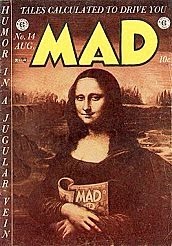

And here’s a 3-D painting in legos. Look at that smile:

Clearly, what we can see is that not all of the Mona Lisa background and even not all from the painted face is necessary! Like Stephen Mitchell’s truncation of Homer’s Iliad (not all brushstokes are necessary), we can truncate Mona just to capture and to convey that most important message of her smile:

Who says Leonardo intended those eyes of hers to be important? What does one Professor Florein Hustler care?
And what should we care about Helen? Why not make her a bitch rather than Homer’s dog-eyed woman? Is what Homer wrote, and how he painted her, really all that important to our message?
I think Homer’s Greek really is important, that he wrote in verse. So I tried to translate in English verse. Now, obviously his Greek particles (the ones that stand out to me as I have them below, in red font) seem to me to be important brush strokes. And I’ve imposed, using them, a bit of paragraphing, some formatting of the written Greek to emphasize, perhaps, the sung and spoken pauses. But I’m stuck with a different language (English) and will try to follow what I can in a variant verse. You’ll see how I use double-rhymed fourteeners to form stanzas. And obviously, there’s lexical and phonological wordplay (some of which Craig noticed when reading Homer for the first time, all of which I mark below in blue font, not much of which I match with English). What I’m really hoping to match as much as I can is how Homer’s verse builds the tension until, rising out of Helen, she exposes Aphrodite and her ploys. Please, you be the judge. Without further ado, this bit of Homer’s Iliad and my translation:
……………………………..τὸν δ᾽ ἐξήρπαξ᾽ Ἀφροδίτη
ῥεῖα μάλ᾽ ὥς τε θεός, ἐκάλυψε δ᾽ ἄρ᾽ ἠέρι πολλῇ,
κὰδ δ᾽ εἷσ᾽ ἐν θαλάμῳ εὐώδεϊ κηώεντι.
αὐτὴ δ᾽ αὖ Ἑλένην καλέουσ᾽ ἴε: τὴν δὲ κίχανε
πύργῳ ἐφ᾽ ὑψηλῷ, περὶ δὲ Τρῳαὶ ἅλις ἦσαν:
χειρὶ δὲ νεκταρέου ἑανοῦ ἐτίναξε λαβοῦσα,
γρηῒ δέ μιν ἐϊκυῖα παλαιγενέϊ προσέειπεν
εἰροκόμῳ, ἥ οἱ Λακεδαίμονι ναιετοώσῃ
ἤσκειν εἴρια καλά, μάλιστα δέ μιν φιλέεσκε:
τῇ μιν ἐεισαμένη προσεφώνεε δῖ᾽ Ἀφροδίτη:
‘δεῦρ᾽ ἴθ᾽: Ἀλέξανδρός σε καλεῖ οἶκον δὲ νέεσθαι.
κεῖνος ὅ γ᾽ ἐν θαλάμῳ καὶ δινωτοῖσι λέχεσσι
κάλλεΐ τε στίλβων καὶ εἵμασιν: οὐδέ κε φαίης
ἀνδρὶ μαχεσσάμενον τόν γ᾽ ἐλθεῖν, ἀλλὰ χορὸν δὲ
ἔρχεσθ᾽, ἠὲ χοροῖο νέον λήγοντα καθίζειν.
ὣς φάτο, τῇ δ᾽ ἄρα θυμὸν ἐνὶ στήθεσσιν ὄρινε:
καί ῥ᾽ ὡς οὖν ἐνόησε θεᾶς περικαλλέα δειρὴν
στήθεά θ᾽ ἱμερόεντα καὶ ὄμματα μαρμαίροντα,
θάμβησέν τ᾽ ἄρ᾽ ἔπειτα ἔπος τ᾽ ἔφατ᾽ ἔκ τ᾽ ὀνόμαζε:
δαιμονίη, τί με ταῦτα λιλαίεαι ἠπεροπεύειν;
————–
…………………….She snatched him Aphrodite did
So easy for a god; up in the stratosphere she hid
Him past the esplanade, where in the deep, the smells are sweet.
Then Helen she did call. She leaves and finds her, stays discrete,
There, at the tower ball, surrounded there by Trojanettes.
She grabs with hand her gown, and shakes ’til she her notice gets.
A hag, she seems, worn down, quite old, and aged when she talks.
A weaver of the wool, she seems, from Deity-Towne-Squawkes.
Renowned for spinning wool, she is, that one beloved dear,
Or so she seemed to her, until, spoke Aprodite clear:
Come: Alexandros stirs; you’ll see, to home he’s calling you.
He’s in the deep he is, in bed, round, beautiful, in view,
Those shiny covers his. You should not call him “man of war”
But “dancer boy” instead. He seems no member of the corps;
Since to the dance he’s fled, or quit, just sitting on the stage.
So she to her thus spoke. Then rises, in her bosom, rage,
This rising her awoke: a god is She, in beauty’s skin,
With bosom’s sure allure, with eye appeal, shines from within,
A startling couture. Then rising from her comes The Name:
O Deity, O Demoness, Why me for Thy charm’d game?!
Tintin like bin-bin?
 I am a native American English speaker. I like to think that I speak most vocabulary correctly according to the standard American English dialect.
I saw a trailer for the upcoming 3-D movie The Adventures of Tintin. The problem was that it was pronounced as if the named rhymed with “bin-bin,” or as if Hergé’s protagonist was related to the dog Rin Tin Tin.
But I always grew up pronouncing his name “tahn-tahn.” I wonder, is that the standard English pronunciation of the name?
(I can see I am not the first person to consider this issue.)
My childhood hero: Jacob Bronowski
 What do you want to be when you grow up?
I remember being asked that question when I was four or five years old, and answering: I want to be like Jacob Bronowski. It made the adult asking that question laugh, because she could not imagine a small child who knew of Bronowski, much less one adopt him as a personal hero.
But in retrospect, I must say, the child Theophrastus had excellent taste. Today it strikes me that among the public intellectuals of the 1970s-2000 period, he was one of the most responsible, most interesting, and most articulate. Despite being (unfairly and unreasonably) blackballed by the British establishment, and facing considerable snobbery, he made contributions in chess, in the study of literature, in mathematics, in the application of mathematics, in poetry, in international affairs, in biology, in popularization of science, in writing college level textbooks, and as a spokesman for the life of the mind.
Many of his excellent books are still in print today (such as The Origins of Knowledge and Imagination, The Western Intellectual Tradition, A Sense of the Future, and Science and Human Values.)
His role in helping to found the Salk Institute helped to change the institution of science in the late 20th century.
Sure there are more important intellectuals and scientists than Bronowski. But some of the most brilliant and articulate are difficult (or impossible) to admire as people, and I can think of none as well-balanced as Bronowski.
For at least one small child (and the adult he grew into), Bronowski is a role model. You can keep your Dawkins and Hitchens and Chomsky and (Thomas) Friedman and Habermas and Krugman and (Steven) Pinker and (Jared) Diamond and Rorty and Fukuyama and (Niall) Ferguson and (Brian) Greene. I still like Bronowski.
Submit your comments on 6 Iliad translations
Making books attractive
Today the New York Times features a story entitled “Selling Books by Their Gilded Covers.”
It discusses several books that we have discussed in recent posts – namely Murakami’s 1Q84 and Stephen Mitchell’s version of the Iliad, and a book I plan to discuss in a future post, Stephen King’s 11/22/63.
The article begins:
Even as more readers switch to the convenience of e-books, publishers are giving old-fashioned print books a makeover. Many new releases have design elements usually reserved for special occasions — deckle edges, colored endpapers, high-quality paper and exquisite jackets that push the creative boundaries of bookmaking. If e-books are about ease and expedience, the publishers reason, then print books need to be about physical beauty and the pleasures of owning, not just reading. “When people do beautiful books, they’re noticed more,” said Robert S. Miller, the publisher of Workman Publishing. “It’s like sending a thank-you note written on nice paper when we’re in an era of e-mail correspondence.”
Here is what the article said about 1Q84:
The eagerly anticipated 925-page novel by Haruki Murakami, 1Q84, arrived in bookstores in October wrapped in a translucent jacket with the arresting gaze of a young woman peering through…. There are indications that an exquisitely designed hardcover book can keep print sales high and cut into e-book sales. For instance, “1Q84” has sold 95,000 copies in hardcover and 28,000 in e-book — an inversion of the typical sales pattern of new fiction at Knopf.
Here is what the article said about 11/22/63:
A new novel by Stephen King about the Kennedy assassination, 11/22/63, has an intricate book jacket and, unusual for fiction, photographs inside…. Scribner, an imprint of Simon & Schuster, published 11/22/63. “We hoped that a handsome object would slow the migration to e-book for King and, in fact, we are now in our fourth printing,” said Nan Graham, the senior vice president and editor in chief at Scribner.
Here is what the article said about Stephen Mitchell’s Iliad:
Some editions can command higher prices, like the $35 list price of a new translation of The Iliad by Stephen Mitchell that has a red silk placeholder, deckle edges, embossing and an extra-heavy paper stock…. Martha K. Levin, the executive vice president and publisher of Free Press, the imprint of Simon & Schuster that published The Iliad, said the presentation sent “the message that even if you’re buying 90 percent of your books on your e-reader, this is the one that you want to have on your bookshelf.”
The article included this photograph including Stephen Mitchell’s Iliad along with a book by Jay-Z and others.:

The article ends by quoting Julian Barnes:
In October, the British novelist Julian Barnes underscored that point when he accepted the Man Booker Prize for The Sense of an Ending by urging publishers to pay attention to aesthetics. “Those of you who have seen my book, whatever you think of its contents, will probably agree that it is a beautiful object,” Mr. Barnes told the black-tie crowd in London. “And if the physical book, as we’ve come to call it, is to resist the challenge of the e-book, it has to look like something worth buying and worth keeping.”
I have post some preliminary thoughts on book design here.
Netanyahu cancels controversial ad campaign
I commented earlier on Jeffrey Goldberg’s reports on a controversial Israeli ad campaign that insulted American Jews. Goldberg commented:
I don’t think I have ever seen a demonstration of Israeli contempt for American Jews as obvious as these ads.
In response, one Israeli minister flew off the handle:
Israeli Minister of Immigrant Absorption Sofa Landver is furious. How can anyone not like the campaign aimed at bringing back emigrant Israelis? How can anyone not understand its true motivation and meaning? Yes, she heard that there’s a growing amount of criticism directed at this campaign…. Landver later calls the criticism … “out of touch”, and “tzimmes”, and talks about a “journalist with zero understanding”. As I’ve said, she is angry. Every journalist, she tells me, “needs to have some intelligence”.
But more sober minds prevailed, and no less than Benjamin Netanyahu, the prime minister of Israel, has ordered a back-down:
"The Ministry of Immigrant Absorption’s campaign clearly did not take into account American Jewish sensibilities, and we regret any offense it caused," Michael Oren, Israel’s ambassador to the United States, said in a statement. "The campaign, which aimed to encourage Israelis living abroad to return home, was a laudable one, and it was not meant to cause insult. The campaign was conducted without the knowledge or approval of the Prime Minister’s Office or of the Israeli Embassy in Washington. Prime Minister Netanyahu, once made aware of the campaign, ordered the videos immediately removed from YouTube, and he ordered that the billboards be removed as well. The prime minister deeply values the American Jewish community and is committed to deepening ties between it and the State of Israel."
If the simple goal of translation is to communicate the message of a text or a speech, then much will be sacrificed. And much will be sacrificed unnecessarily. Such is the case with the New Century Version, the version of the Bible that Theophrastus mentions here. The publisher has touted it as “the easiest-to-understand translation,” because of the translators’ goal to “make the language clear enough for all people to read the Bible and understand it for themselves.” Never mind the logical fallacy here, the begging-the-question presumptions that reading depends on clear language in the first place, that clear language causes understanding, that the intended audiences for all of the Bible is “all people,” and that all other Bible translations must be less clear and therefore less easy to understand.
I’d like to give three other, non-biblical examples of translation to support the idea that more gets understood by readers and listeners when the translator’s goal is not merely the simple transmission of a message. First, there’s the newest English translation of Le Deuxième Sexe by Simone de Beauvoir; second, there’s the Hollander and Hollander translation of Dante’s Inferno; third, there’s Vicente Fox’s English translation of his own Spanish this week. Notice how the translators, in each case, regard the critical and difficult issues of the original and how readers and listeners get more then.
First, listen to what Constance Borde and Sheila Malovany-Chevallier, the translators of the second English translation of The Second Sex, say in an interview with Louise Maher that she shared online yesterday. Here’s my transcription (in part) with my emphasis:
What were the criticisms of the first translation [of Simone de Beauvoir’s mammouth, two-volume more-than-800-pages work, The Second Sex]?
Mind you, we did not base our translation on that first translation… There were errors in it. The main error was… it was… dumbed down….
Another failing is that [translator] H. M. Parshley, because of the pressures from the publisher, actually had to cut out 15 … to 25 percent of the book, including all of the stories of the history of women – women generals, women physicists, women mathematicians, poets, writers, and saints – they were just eliminated because probably he hadn’t heard of them. But we don’t like to complain about him. He was put in a difficult situation by the publisher.
So how did you start then? You went back to the original text?
Oh, yes. We translated directly from the original text, and the original text does have a very different kind of development, even the syntax, because she has a very philosophical way of approaching the question of women. She wasn’t writing as a feminist, you know. She was writing as a philosopher [in a rather intentional way, using intentional forms and language], taking a look at, observing, what it means to be “other” in society.
Does it make it harder for lay people to understand what she was trying to say?
No. On the contrary, it actually makes it easier [to understand with the difficult syntax and philosophical development] because you can follow the development now. Yes, remember that when it came out, shop workers and factory girls were reading it. Everybody was reading it. It was a best seller in French, so thinking that only philosophers and intellectuals can read it is really condescending to the ability of people to read something hard, difficult, demanding, but you can do it. And you should. And people tell us now that when you read it [as we’ve translated it, not making its language easier or even clearer than the original French], it does make more sense, because there’s nothing left out in the development of her ideas.
Second, read what Tim Parks challenges us to do. He cautions us to reconsider whether clarity and easy-access to literature may actually rob us of the richness of this literature. He says (my emphasis) that the “belief in World Literature [through easy-to-read translations] could actually create a situation where we become more parochial and bound in our own culture, bringing other work into it in a process of mere assimilation and deluding ourselves that, because it sounds attractive in our own language, we are close to the foreign experience.” At the end of his thought-provoking post, “Translating in the Dark,” Parks asks a question and then gives us an experiment by which to answer it:
So why is it imperative that we believe in World Literature? It seems we must imagine that no literary expression or experience is ultimately unavailable to us; the single individual is not so conditioned by his own language, culture and literature as not to be able to experience all other literatures; and the individual author likewise can be appreciated all over the globe. It is on this premise that all international literary prizes, of which there are now so many, depend. The zeitgeist demands that we [by easy-to-read, dumbing-down translation] gloss over everything that makes a local or national culture rich and deep, in order to believe in global transmission. There must be no limitation….
Try this experiment: …. dip into the 1939 prose translation [of Dante’s Inferno] by the scholar John Sinclair. There is immediately a homogeneity and fluency here, a lack of showiness and a semantic cohesion over scores of pages that give quite a different experience [than much easy reading in English might]. To wind up, look at Robert and Jean Hollander’s 2002 reworking of Sinclair. Robert Hollander is a Dante scholar and has cleared up Sinclair’s few errors. His wife Jean is a poet who, while respecting to a very large degree Sinclair’s phrasing, has made some adjustments, under her husband’s meticulous eye, allowing the translation to fit into unrhymed verse. It is still a long way from reading Dante in the original, but now we do feel that we have a very serious approximation and a fine read.
I think the point here is not whether to get hung up on whether some translations of Dante might be better than others but to question whether the drive for easy access to a message can be ultimately achieved when translators attempt to clarify the original for readers in translation.
Third, follow how what former President of Mexico, Vicente Fox, said. He was here on the campus where I work this week (and some colleagues of mine, our students, and I enjoyed the priviledge of eating lunch with him and former First Lady Fox). At lunch, he said some very difficult and challenging things in English to us. At a public address, our Provost introduced the President, reminding the audience that one of Mr. Fox’s campaign slogans had been “‘Hoy, Hoy, Hoy’ or ‘Today, Today, Today’ but that his talk to us would focus on tomorrow, on the leaders of tomorrow.” Fox began, then, by acknowledging the introduction and by saying in English, “‘Tomorrow, tomorrow, tomorrow.’ I don’t have to explain to you the difficulties of the Spanish word in Mexico, ‘Mañana, Mañana, Mañana‘. But I don’t want to procrastinate today. I want to speak with you about being tomorrow’s problem solvers.” Many in the audience, he knew, were high school and even junior high school students. He did not condescend to the young people, and he did not feel the need to make what he had said in Spanish easy to understand. During the Q&A, several students, some asking questions in English and others in Spanish, indicated they got the speaker’s message just fine (despite the fact, or probably more likely, because it was nuanced and different and difficult and culturally rich).
You need a coach
Atul Gawande says that you need a coach, even if you are highly experienced at your profession.
I’ve been a surgeon for eight years. For the past couple of them, my performance in the operating room has reached a plateau. I’d like to think it’s a good thing—I’ve arrived at my professional peak. But mainly it seems as if I’ve just stopped getting better.
During the first two or three years in practice, your skills seem to improve almost daily…. As I went along, I compared my results against national data, and I began beating the averages. My rates of complications moved steadily lower and lower. And then, a couple of years ago, they didn’t. It started to seem that the only direction things could go from here was the wrong one.
Maybe this is what happens when you turn forty-five. Surgery is, at least, a relatively late-peaking career. It’s not like mathematics or baseball or pop music, where your best work is often behind you by the time you’re thirty. Jobs that involve the complexities of people or nature seem to take the longest to master: the average age at which S. & P. 500 chief executive officers are hired is fifty-two, and the age of maximum productivity for geologists, one study estimated, is around fifty-four. Surgeons apparently fall somewhere between the extremes, requiring both physical stamina and the judgment that comes with experience. Apparently, I’d arrived at that middle point.
It wouldn’t have been the first time I’d hit a plateau. I grew up in Ohio, and when I was in high school I hoped to become a serious tennis player. But I peaked at seventeen….
One July day a couple of years ago, when I was at a medical meeting in Nantucket, I had an afternoon free and went looking for someone to hit with…. I asked the club pro if I could use it to practice ground strokes. He told me that it was for members only. But I could pay for a lesson and hit with him…. With a few minutes of tinkering, he’d added at least ten miles an hour to my serve. I was serving harder than I ever had in my life.
Not long afterward, I watched Rafael Nadal play a tournament match on the Tennis Channel. The camera flashed to his coach, and the obvious struck me as interesting: even Rafael Nadal has a coach. Nearly every elite tennis player in the world does. Professional athletes use coaches to make sure they are as good as they can be.
But doctors don’t. I’d paid to have a kid just out of college look at my serve. So why did I find it inconceivable to pay someone to come into my operating room and coach me on my surgical technique?…
The coaching model is different from the traditional conception of pedagogy, where there’s a presumption that, after a certain point, the student no longer needs instruction. You graduate. You’re done…. Coaching in pro sports proceeds from a starkly different premise: it considers the teaching model naive about our human capacity for self-perfection. It holds that, no matter how well prepared people are in their formative years, few can achieve and maintain their best performance on their own.
Gawande goes on to discuss coaching in medicine, music, and teaching; discussing the significant advantages of coaching. I am not certain I am convinced by Gawande’s argument, but his premise if fascinating (and, unlike many assertions about learning, it is actually testable.)
I think that this article has relevance for most everyone who reads this blog (but if you doubt that, consider the following question: do professional translators need coaches?)
Jeffrey Goldberg on official Israeli contempt for American Jews
Jeffrey Goldberg on official Israeli contempt for American Jews:
The Jewish Channel, which broke the story of what it calls a "semi-covert national campaign," suggests that the Ministry does not differentiate between the "dangers" of marrying American Jews, and American non-Jews, and I have to agree….I don’t think I have ever seen a demonstration of Israeli contempt for American Jews as obvious as these ads.
November 2011 Biblical Studies Carnival
Deane Galbraith has the latest “Biblical Studies Carnival” up and links to a number of interesting articles. He’s kindly included some links to a few BLT articles; thanks!


 BLT
BLT 