Thomas and Ruth Roy: “we own the copyright on saying ‘humbug’ ”
We’ve had some blog posts recently on Charles Dickens’s amazing book Christmas Carol. the familiarity of television and stage adaptations of this tale take away from Dickens original accomplishment. But the character of Ebenezer Scrooge remains funny and original and stark, even as he has achieved iconic cultural status.
In a derivative attempt to exploit Dickens character, Thomas and Ruth Roy designated December 21st as “National Humbug Day,” and even got a write-up in Time on it:
Their instructions say you’re allowed 12 free humbugs on December 21st. Today’s the day to curse all things Christmas – overpriced toys, endless lines at the post office, and, of course, the havoc-wreaking snow across much of the country.
However, the Roy’s also claim to own copyright on saying humbug:
Dec 21 Humbug Day — Allows everyone preparing for Christmas to vent their frustrations. Twelve humbugs allowed.
Please note! All holidays created by Thomas & Ruth Roy, under the name of Wellcat Holidays & Herbs, are, indeed, copyrighted. If you wish to make use of them in any fashion, for profit, we respectfully request that you contact us for appropriate contract arrangements. If, on the other hand, you wish to use them in some non-profit fashion, we still would request you contact us, to ensure permission. Please do not violate United States copyright laws!
I’m sorry for printing that in boldface, but I was just literally copying the Roy’s text – where they seem to assert that you must receive permission from them to say “humbug.” (Apparently, the Roy’s have never heard of section 107 of the Copyright Code, the “fair use” provisions.) Moreover, one would think that since Christmas Carol has been in the public domain for decades, they would hesitate before claiming copyright on the word and its use around Christmas.
The only guess I can give to their bizarre behavior is that they are feeling some guilt, because at some point in their lives they once recorded a football game (or even talked a game with their friends) without the express written consent of the National Football League.
A Christmas Carol: A Riposte to Malthus
From the new bestseller Grand Pursuit: The Story of Economic Genius,by Sylvia Nasar,
A Christmas Carol, argues the economic historian James Henderson, is an attack on Malthus. 19 The novel is bursting with delicious smells and tastes. Instead of a rocky, barren, overpopulated island where food is scarce, the England of Dickens’s story is a vast Fortnum & Mason where the shelves are overflowing, the bins are bottomless, and the barrels never run dry. The Ghost of Christmas Past appears to Scrooge perched on a “kind of throne,” with heaps of “turkeys, geese, game, poultry, brawn, great joints of meat, sucking pigs, long wreaths of sausages, mince-pies, plum-puddings, barrels of oysters, red-hot chestnuts, cherry-cheeked apples, juicy oranges, luscious pears, immense twelfth-cakes, and seething bowls of punch, that made the chamber dim with their delicious steam.” “Radiant” grocers, poulterers, and fruit and vegetable dealers invite Londoners into their shops to inspect luscious “pageants” of food and drink. 20
In an England characterized by New World abundance rather than Old World scarcity, the bony, barren, anorexic Ebenezer Scrooge is an anachronism. As Henderson observes, the businessman is “as oblivious to the new spirit of human sympathy as he is to the bounty with which he is surrounded.” 21 He is a diehard supporter of the treadmill and workhouse literally and figuratively. “They cost enough,”he insists, “and those who are badly off must go there.”When the Ghost of Christmas Past objects that “many can’t go there; and many would rather die.” Scrooge says coldly, “If they would rather die, they had better do it, and decrease the surplus population.”
Happily, Scrooge’s flinty nature turns out to be no more set in stone than the world’s food supply is fixed. When Scrooge learns that Tiny Tim is one of the “surplus” population, he recoils in horror at the implications of his old-fashioned Malthusian religion. “No, no,” he cries, begging the Spirit to spare the little boy. “What then?” the Spirit replies mockingly. “If he be like to die, he had better do it, and decrease the surplus population.”22 Scrooge repents, resolves to give his long-suffering clerk, Bob Cratchit, a raise, and sends him a prize turkey for Christmas. By accepting the more hopeful, less fatalistic view of Dicken’s generation in time to alter the course of future events, Scrooge refutes the grim Malthusian premise that “the blind and brutal past” is destined to keep repeating itself.
The Cratchit’s joyous Christmas dinner is Dicken’s direct riposte to Malthus, who uses a parable about “Nature’s mighty feast” to warn of the unintended consequences of well-meaning charity. A man with no means of support asks the guests to make room for him at the table. In the past, the diners would have turned him away. Beguiled by utopian French theories, they decide to ignore the fact that there is only enough food for the invited guests. They fail to foresee when they let the newcomer join them that more gatecrashers will arrive, the food will run out before everyone has been served, and the invited guests’ enjoyment of the meal will be “destroyed by the spectacle of misery and dependence.”23
The Cratchit’s groaning board, wreathed with the family’s beaming faces, is the antithesis of Malthus’s tense, tightly rationed meal. In contrast to Nature’s grudging portions, there is Mrs. Cratchit’s pudding- “like a speckled cannon-ball, so hard and firm, blazing in half of half-a-quartern of ignited brandy, and bedecked with Christmas holly stuck into the top” – not large enough for seconds perhaps, but ample for her family. “Mrs. Cratchit said that now the weight was off her mind, she would confess she had had her doubts about the quantity of flour. Everybody had something to say about it, but nobody said or thought it was at all a small pudding for a large family. It would have been flat heresy to do so. Any Cratchit would have blushed to hint at such a thing.”24
The Christmas spirit was catching. By the story’s end, Scrooge had even stopped starving himself. Instead of slurping his customary bowl of gruel in solitude, the new Scrooge surprises his nephew by showing up unannounced for Christmas dinner. Needless to say, his heir hastens to set a place for him at the table.
Dickens’s hope that A Christmas Carol would strike the public like a sledgehammer was fulfilled. Six thousand copies of the novel were sold between the publicaton date of December 19 and Christmas Eve, and the tale would stay in print for the rest of Dickens’s life – and ever since.25 Dickens’s depiction of the poor earned him satirical labels such as “Mr. Sentiment.”26 but the novelist never wavered in his conviction that there was a way to improve the lot of the poor without overturning existing society.
One candle
Nice or not nice? You decide.
When You will have prepared the slaughter
for the blaspheming foe,
Then I shall complete with a song of hymn
the dedication of the Altar.
לעת תכין מטבח מצר המנבח
אז אגמור בשיר מזמור חנכת המזבח
December ghost stories
There is nothing like the holidays to bring out the ghosts.
The dominant holiday of the season, Christmas, has all sorts of spooky origins. It goes back to instructions in 601 from Pope Gregory to have St. Austin to adapt the local winter Druid feast, and the resulting holiday seems to mix features from Saturnalia, Yule (the Saxon feast for the return of the sun, in honor of Thor), the Druid holiday, and Advent. This weird mixture of religions certainly attracted criticism over the centuries, perhaps reaching it high point under Oliver Cromwell and the Puritans, and the Roundhead Parliament succeeded
- 1642: a law prohibiting the performance of holiday plays
- July 3, 1647: a law that the nativity feast could not be celebrated with other holy days
- December 24, 1652: a law that “no observance shall be had of the five and twentieth of December, commonly called Christmas day; nor any solemnity used or exercised in churches upon that day in respect thereof.”
Even after the Restoration, Christmas was in poor standing. Some claim that it was a ghost story that revived it: Charles Dickens’s Christmas Carol – one of our best-known ghost stories – reportedly created a Christmas-boom that is reverberating today. (Let me say right here that Christmas Carol is one Dickens best works: a book of tremendous black humor:
Old Marley was as dead as a door-nail. Mind! I don’t mean to say that I know, of my own knowledge, what there is particularly dead about a door-nail. I might have been inclined, myself, to regard a coffin-nail as the deadest piece of ironmongery in the trade. But the wisdom of our ancestors [this is a sarcastic barb at Edmund Burke’s pomposity] is in the simile; and my unhallowed hands shall not disturb it, or the Country’s done for. You will therefore permit me to repeat, emphatically, that Marley was as dead as a door-nail.
You must admit, even if you don’t get the sarcasm of the “wisdom of the ancestors” line, that this is first-rate satire. I also want to say that in my reading of Dickens, it is also a genuinely terrifying piece of horror, full of spectral images and horrid ghosts. Funny and frightening.) Other Christmas stories are equally horrific: such as E. T. A. Hoffman’s Nussknacker und Mausekönig, with its seven-headed mouse king, the assault and slashing of Marie’s flesh, the infanticide campaign of the mouse king and resulting revenge by the mouse queen, the extortion of Marie – that’s scary stuff. It, of course, was adapted by Dumas (Marie became Clara), and then again by Tchaikovsky to become the Nutcracker ballet. (I won’t even get into the practices of the Saturn worshipers, the Thor worshipers, and the Druids).
The bottom line is that Christmas and ghosts just naturally go together. So allow me to make some book suggestions for the season of horror (limiting myself to a few works in English):
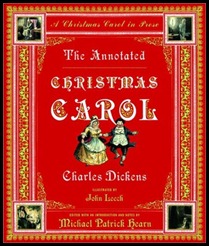 The Annotated Christmas Carol (annotated by Michael Patrick Hearn). Hearn’s annotated edition of Dickens’s Christmas-horror novel was originally published in 1976 and then extensively revised in 2004. It includes a 114 page introduction, hundreds of lengthy annotations, Extensive illustrations are included, all of the original John Leech illustrations (and many dozens more), 8 color plates, and hundred page appendix on Dickens’s public readings of his book.
The John Austen edition of Hamlet. Of course, no ghost story is English can quite compare with Hamlet. It starts out with a ghost and reaches a fever pitch of unpredictability that results in a rampage of violence and horror that leaves almost all of the main characters dead. We can watch this work in the theater, but most textual editions are somewhat cold, filled with 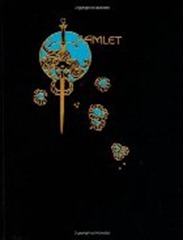 tedious notes pointing out English usage and conveying little of the absolute terror of this tragedy. The celebrated illustrator John Austen manages to convey the grotesque and frightening parts of his story in his illustrated edition of Hamlet, now reprinted in a deluxe hardcover format by Dover Publication’s up-scale imprint, Calla. However, the book is still a bargain – currently it is $16.50 at Amazon. The work has illustrations on every page, but no tedious notes to distract the reader from the action. Reading this edition is arguably as close as one can get to a performance experience as a reader. (Yes, I realize the contradiction between my praise for an annotated edition of one book that is usually unannotated (A Christmas Carol) and now my later praise for an unannotated edition of another book that is usually annotated (Hamlet).
 Doctor Faustus with the English Faust Book (edited by David Wootton). This is, of course, mostly a book about Lucifer and Mephistophilis, but it has some ghosts in it! Plenty of sheer horror, with the added of fun of trying to figure out whether Christopher Marlowe was a Calvinist or not. This Hackett paperback edition has the A-text together with the English Faust Book, and plenty of commentary. It is cheap and smart and fun and frightening.
A Boxful of Ghosts. For $20 you could certainly do worse than this boxed set of four mass paperback-sized books. The box is rather nice (with cloth bottom and a padded cloth top, and the individual books each have a cloth ribbon, dust jackets, and gilded edges. The four individual volumes are
 Irish Ghost Stories (edited by David Stuart Davies, 582 pages): Sheridan Le Fanu: The Room in Le Dragon Volant, Madam Crowl’s Ghost, Squire Toby’s Will, The Child that went with the Faries, An Account of Some Strange Disturbances in Aungier Street, Ghost Stories of Chapelizod, The Vision of Tom Chuff; W. B. Yeats: The Curse, Hanraham’s Vision; Bram Stoker: The Judge’s House, The Secret of the Growing Gold; Oscar Wilde: The Canterville Ghost; Fitz James O’Brien: Who was It? The Pot of Tulips; Thomas Crofton Croker: The Haunted Cellar; Jeremiah Curtin: St. Martin’s Eve; Daniel Corkery: The Eyes of the Dead; Rosa Mulholland: The Haunted Organist of Hurly Burly, The Ghost at the Rath.
 - Best Ghost Stories (edited by Marcus Clapham, 380 pages): Sir Walter Scott: The Tapestried Chamber; Charles Dickens: The Signalman; M. E. Braddon: The Shadow in the Corner; Sheridan Le Fanu: Strange Events in the Life of Schalken the Painter; Robert Louis Stevenson: The Body-Snatcher; Rudyard Kipling: The Phantom Rickshaw; Edith Nesbit: Man-Size in Marble; M. R. James: Canon Alberic’s Scrapbook; Arthur Conan Doyle: The Brown Hand; John Buchan: The Watcher by the Threshold; M. R. James: “Oh, Whistle, and I’ll Come to You, My Lad”; F. Marion Crawford: The Screaming Skull; Saki: Laura; M. R. James: The Tractate Middoth; Amyas Northcote: Brickett Bottom; E. F. Benson: Naboth’s Vineyard
- Ghost Stories by Charles Dickens (edited by David Stuart Davies, 384 pages): The Queer Chair, A Madman’s Manuscript, The Goblins who Stole a Sexton, The Ghosts of the Mail, Baron Koëlwethout’s Apparition, The Haunted Man and the Ghost’s Bargain, To be Read at Dusk, The Ghost in the Bride’s Chamber, The Haunted House, The Trial for Murder, The Signalman, Christmas Ghosts, The Lawyer and the Ghost, Four Ghost Stories, The Portrait Painter’s Story.
- Complete Ghost Stories by M. R. James (edited by David Stuart Davies, 592 pages): Canon Alberic’s Scrapbook, Lost Hearts, The Mezzotint, The Ash Tree, Number 13, Count Magnus, “Oh, Whistle, and I’ll Come to You, My Lad,” The Treasure of Abbot Thomas, A School Story, The Rose Garden, The Tractate Middoth, Casting the Runes, The Stalls of Barchester Cathedral, Martin’s Close, Mr. Humphreys and His Inheritance, The Residence at Whitminister, The Diary of Mr. Poynter, An Episode of Cathedral History, The Story of a Disappearance and an Appearance, Two Doctors, The Haunted Dolls’ House, The Uncommon Prayer-Book, A Neighbour’s Landmark, A View from a Hill, A Warning to the Curious, An Evening’s Entertainment, There was a Man Dwelt by a Churchyard, Rats, After Dark in the Playing Fields, Wailing Well, The Experiment, The Malice of Inanimate Objects, A Vignette, Stories I have Tried to Write
Everything here is widely available, but it is nice to have these stories wrapped up so neatly and conveniently. Even with the duplicates (Signalman, Canon Alberic’s Scrapbook, The Tractate Middoth, and “Oh, Whistle, and I’ll Come to You, My Lad”) this is still a worthwhile collection.
Happy haunting. And I hope that Thor sends the sun back.
Umberto Eco: “How school teaches us not read books”
Umberto Eco explains how school teaches us not to read books:
This is an excerpt from a longer program at the New York Public Library, here is the full presentation:
Eric Gritsch: “Martin Luther’s Anti-Semitism”
Yesterday, I noted the “bizarre defense” of Martin Luther’s (and Søren Kierkegaard’s) anti-Semitism in the Danish state church’s official newspaper – including the equating of the moral responsibility of the “Jews” as “Christ killers” with Hitler and the Holocaust. (“See how closely lies and murder are connected with each other – both with the Jews and with Hitler. The lies of the Jews crucified Christ. Hitler’s lies murdered six million Jews.”)
I was pleased to see the announcement of what promises to be a more sober Lutheran evaluation of Martin Luther’s attitude towards the Jews, Eric Gritsch’s (Lutheran Theological Seminary) Martin Luther’s Anti-Semitism: Against His Better Judgment. (I presume that the ambiguity of “His” in the title is deliberate.) Gritsch describes his book as follows:
My new book, Martin Luther’s Antisemitism, investigates a contradiction in Luther’s life and thought: his intensive hatred of Jews and his invincible faith in Jesus Christ, a born Jew. This contradiction has created intense debate through five centuries of Luther research, and it has divided those who admire his great fame as a mover and shaker of world history.
Fortunately, the very long period of anti-Jewish hatred, known as “anti-Semitism,” in Western culture is subsiding. But those who hated Jews used Luther to justify the actions born of their cruel prejudice, ranging from legalized persecution by church and state in the centuries after the Reformation to the racist program of extermination of Jews in the death camps of the German dictator Adolf Hitler in the 1940s. The church persecuted Jews as the unrepentant killers of Christ, as lost souls stubbornly unwilling to convert. The German racist state killed Jews as an inferior race that had no right to exist. Both found support in the writings of Martin Luther. That is why Luther’s picture dominates not only in Protestant churches, where he is praised as the great pioneer of freedom from ecclesiastical tyranny, but also in museums commemorating Hitler’s Holocaust — his massive systematic destruction of Jews.
Admirers of Luther claim that his hatred of Jews was the result of frustration caused by his failure to convert Jews — as well as by painful medical issues affecting his stomach, kidneys, and heart. That, they say, is why he produced his most hateful writings against the Jews in the final years of his life.
In the book, I take a critical look at what Luther said and did regarding Jews during his long career as a Bible professor in a cruel anti-Jewish Christian culture. It is the story of one of history’s most renowned Christians wrestling with academic pride and cultural prejudice, with the Old Testament — the Jewish Bible — and with the ever-present Christian campaign against unconverted Jews. It is the story of a man who ignored even the warning of his biblical hero, the Apostle Paul, to be patient with the Jews as “the people of God” who would one day, perhaps in the final day of the world, join Christians to celebrate the one and only covenant God made with human creatures, beginning with Abraham and ending with Jesus.
It is said that big men make big mistakes. Readers will be able to recognize Luther’s mistakes as links in a chain that pulled him further and further away from an attitude of respect and toleration for Jews as the biblical people of God. Martin Luther’s Anti-Semitism depicts Luther as a famous example of the intensive struggle with the enduring question of Christian-Jewish relations. It is a great historical tragedy that he, of all people, fell victim to the error of anti-Semitism — albeit “against his better judgment.”

Handwritten Chinese translation of the Qur’an: the earliest, found

“Muslim culture researchers in China have found the earliest Chinese version of the Koran in the country’s northwestern Gansu province.”
“The Quran, found among old archives by researchers with the Muslim Culture Institute of Lanzhou University, is believed to have been translated into Chinese by Sha Zhong and Ma Fulu, two noted imams and Arabic calligraphers in Lanzhou, Ding Shiren, head of the institute said. Sha and Ma began translating the Koran in 1909 and completed their work in 1912, Ding said.”
The Junia Evidence: V
All except one of the Greek examples so far have supported the notion that Junia is one of the apostles. In these examples, the person referred to as episemos is a member of the group of people who are the object of the preposition en. Andronicus and Junia episemoi en tois apostolois fits that pattern, these two are members of the group. However, it is usually the case that prominent people are also well known to the group of which they are members. So it is rather difficult to find examples where the people are prominent in their group, and not well known to their group.
There is one exception, It is found in Euripides’ Hippolytus, 428 BC, and refers to Aphrodite,
σεμνή γε μέντοι κἀπίσημος ἐν βροτοῖς.
Yet she’s revered and famous among mortals.
This one example fits in with another case where laws are honoured among the people. In these examples, the referent of episemos cannot possibly be a member of the group, so there is no need to disambiguate by using another construction. I am, however, not convinced that the native Greek reader of Romans 16:7 would question whether Andronicus and Junia were members of the group. In fact, we know that they did not.
Here is what Chrysostom had to say about Junia,
“Greet Andronicus and Junia … who are outstanding among the apostles”: To be an apostle is something great. But to be outstanding among the apostles – just think what a wonderful song of praise that is! They were outstanding on the basis of their works and virtuous actions. Indeed how great the wisdom of this woman must have been that that she was even deemed worthy of the title apostle. (In ep. Ad Romanos 31.2).
There is not one mention in Greek literature of Andronicus and Junia not being among the apostles. There is, however, one reference to Junia being masculine. This was made by Epiphanius, a writer who also made Prisca masculine, so it is rightly disregarded. Although the Greek Orthodox Church does not ordain women, they do recognize Junia as a woman, and the co-worker of Apostle Andronicus.
What is important here is that Greeks thought that Romans 16:7 said that Andronicus and Junia were apostles. Their theology on women is not really an issue. We know that they don’t ordain women, but that did not affect the way they read the text. When the Archbishop Vamva came to revise the New Testament for a contemporary audience in the 19th century, he wrote unambiguously,
᾽Απάσθητε τὸν ᾽Ανδρόνικον καὶ ᾽Ιουνίαν τοὺς συγγενεῖς μου καὶ συναιχμαλώτους μου, οἵτνες εἴναι ἐπίσημοι μεταξὺ τῶν ἀποστόλων οἵτνες καὶ πρὸ ἐμοῦ ἦσαν εις τὸν Χριστόν
The witness of Greek literature is unequivocal. Romans 16:7 ought to be translated in such a way that we can understand that Andronicus and Junia were members of a group of apostles.
In addition to knowing that the Greek Orthodox Church honoured Junia as among the apostles in an unbroken tradition, we can also trace the history of the translation of Romans 16:7.
qui sunt nobiles in Apostolis Vulgate
noble among the apostles Wycliffe
insignes inter apostolis Erasmus Calvin
of note among the apostles KJV
If it is not clear how this was interpreted, we can read Calvin’s commentary on Erasmus Latin translation. He wrote,
In the third place, he calls them Apostles: he uses not this word in its proper and common meaning, but extends it wider, even to all those who not only teach in one Church, but also spend their labor in promulgating the gospel everywhere. He then, in a general way, calls those in this place Apostles, who planted Churches by carrying here and there the doctrine of salvation; for elsewhere he confines this title to that first order which Christ at the beginning established, when he appointed the twelve disciples. It would have been otherwise strange, that this dignity should be only ascribed to them, and to a few others. But as they had embraced the gospel by faith before Paul, he hesitates not to set them on this account before himself.
Luther fully accepted that the two people named in Romans 16:7 were apostles so he translates welche sind berühmte Apostel, “which are famous apostles.” However he changes Junia’s name to Junias, masculine. As far as I know there is no Bible translation predating this century which translates in the sense of “well-known to the apostles.”
The question ought not to be “Can a woman be an apostle?” but rather “On what basis do we abandon a long-standing interpretation in the Bible?”
Junia is not alone
Junia Is a Woman, and I Am a Complementarian
Denny Burk’s Complementarian Cover-up
The Junia Evidence: I
The Junia Evidence: II
The Junia Evidence: III
The Junia Evidence: IV
Was Junia Really An Apostle by Burer and Wallace
Linda Belleville’s article
Michael Burer Enters the Junia Debate
Reassessing Junia: A Review of Eldon Epp’s Junia: The First Woman Apostle
Due Diligence on Junia and Apostleship
Matt Colvin on Junia and Apostleship
Some Lengthy Thoughts on Women’s Leadership
A Closer Examination of Junia, The Female Apostle
Peter Tudvad on Kierkegaard’s anti-Semitism
 There has reportedly been a hot controversy over the last year in Denmark, thanks to Peter Tudvad’s book examining the anti-Semitism of Kierkegaard. Below is a transcript of an interview that M[arilyn] G. Piety (Drexel) had with Peter Tudvad, as published in her blog (parts 1, 2, 3).
(HT: Alan Brill and Alan Brill)
Piety: Not much is known in the English-speaking world about the controversy over your new book. Can you give a brief summary of it?
Tudvad: That might be difficult as the row lasted for about two months, and was very intense. A newspaper, Berlingske Tidende, published an interview with me about three weeks before the book was actually published. The reporter was shocked by the quotations I had included in the preface, which I let him see, such as Kierkegaard writing that the Jews were typically usurers and as such bloodthirsty, that they had a penchant for money (due to an abstract character, as Kierkegaard supposes), and that they dominated the Christians. As I told the reporter, Kierkegaard was of the opinion that the Jews would eventually kill the European Christians – something which he wrote in an entry in his diary, but which was omitted from the Hong’s translation, I guess on purpose – and that they had an extraordinary sexual appetite and thus many children. They were, according to Kierkegaard, mundane and had no real spirit, no quest for the eternal bliss.
Never mind, the former head of the Søren Kierkegaard Research Center at the University of Copenhagen, Niels Jørgen Cappelørn, was interviewed too for the very same edition of the newspaper, and he actually agreed with me that what Kierkegaard had said about the Jews was something which we today must term anti-Semitism. He agreed, too, that the reason that we have seldom discussed this aspect of his theology might be that we were afraid of damaging his image, his reputation, thus losing the prostrate respect many have for one of the few internationally renowned Danish authors. Nevertheless, the day after, in another newspaper, Cappelørn said the opposite. Many other people seemed to be offended by my labeling Kierkegaard as an anti-Semite and began polemicizing against me without ever having read my book. Especially theologians were eager to make the case smaller than I think it is, saying that it was only in entries in Kierkegaard’s private diary that he wrote bad things about the Jews – which, by the way, is not true, even though I don’t see why we should not discuss his “private” anti-Semitism, when we have discussed so many other “private” aspects of his thoughts. His diaries have always been considered a key to the understanding of his published works, so if one, for example, with the help of his entries can link his anti-Semitism with his theology, and vice versa, I think we really ought to discuss the problem seriously.
Piety: Your new book, Stadier på Antisemitismens vej: Søren Kierkegaard og Jøderne is not simply about Kierkegaard. It’s a comprehensive look at attitudes toward Jews and Judaism in 19th century Denmark. Are there other books that do this, or is yours the first?
Tudvad: As I far as I know, this is the first comprehensive look at the way people – theologians, philosophers, politicians, publishers, authors, etc. – described the Jews in the so-called Golden Age in Denmark (i.e., Danish romanticism). Of course you may find quite a few articles about aspects of this topic, e.g. the “eternal” or “wandering Jew” as a literary figure, but I’m quite sure that until now nobody tried to see all of it as parts of one single question, the Jewish question (even though it was seldom addressed in exactly this way, there certainly was a continuous discussion in Denmark of the Jews and their position in the Danish society, in particular in relation to the church and Christianity as the dominant religion).
I try, in my book, to trace the sources of the question in order to identify possible agendas which might reveal things like that, for example, a political discussion, underneath the surface, is in fact a cultural or theological one. The best work on some of these matters is no doubt professor Martin Schwarz Lausten’s thorough study of the relation between the Christians and Jews in Denmark from 1814 to 1849, i.e. from the formal equation of Christians and Jews in civic matters until Jews were accorded full civil rights in the first free constitution. I rely naturally very much on this excellent work.
Piety: Reviews, or at least articles about the book began to appear before the book did itself. How did people get word of the book’s appearance? Did the publisher send out review copies in advance of the book’s release?
Tudvad: As I just told you, a newspaper published an interview with me about the book about three weeks before the book appeared. Shortly after that, a PDF file of the book was sent to the major newspapers and handed over to the reviewers. We had some troubles with the printing of the book, thus a copy of the book itself was not posted until about a week before the publication on Nov 9. The reviewers naturally did not interfere in the row, which would have discredited them as reviewers. Nobody among the many persons who spoke out on the case had had the opportunity to read the book, except one who – if I am not wrong – all of a sudden stopped commentating on it, after he had received it, Niels Jørgen Cappelørn. I made the publisher send him a copy in advance although he was naturally not supposed to review it. I just thought that he might change his mind if he took a close look at the book, i.e. return to his original point of view.
Piety: Do you think Kierkegaard was anti-Semitic? If so, in what sense?
Tudvad: Yes, I do. Sure he was not a kind of anti-Semite as the Nazis. He hated any kind of collectivism, and he would certainly not have participated in the pogrom in 1938. Nevertheless, I published my book on November 9, i.e. on the anniversary of the Kristallnacht in 1938, but my point was, that anti-Semitism and pogroms are not exclusively a German phenomenon. We had one, a pogrom, in Denmark in 1819 too, which was so severe that the king had to declare Copenhagen, his capital, in a state of emergency. The city was under a curfew for several weeks, and the military patrolled the streets of Copenhagen. Nobody was killed, thanks to the king and the military, but many Jews were injured, their houses vandalized, and a lot of rioters sentenced to prison. Before the pogrom in 1819 we had experienced a long period of literary attacks on the Jews, something which, so to speak, fertilized the ground for the physical attacks. My point is, that Danes are not less disposed to anti-Semitism than Germans, Poles, Russians or any other peoples, and that words are not harmless. So, Kierkegaard’s words are not harmless either. Some Danish Nazis actually referred to him in 1940 as their ally against the Jews.
Piety: Were there anti-Semitic remarks in Kierkegaard’s published works or only in unpublished ones such as his journals?
Tudvad: Most of his anti-Semitic remarks are in his journals but quite a few can be found in his published works too. But I don’t think that it is really appropriate to distinguish between these to parts of his authorship as he himself did not doubt that his diaries too would be published after his death. He even had a title for them: “The Book of the Judge”.
Piety: Has anyone advanced an argument that Kierkegaard was not anti-Semitic that is based on anything other than the claim that Kierkegaard’s remarks have to be placed in their historical context?
Tudvad: Yes, several have argued that anti-Semitism is a notion which was not defined until a couple of decades after Kierkegaard’s death, thus, he can not be labeled an anti-Semite. Others have argued that anti-Semitism is a purely racist concept, and that Kierkegaard almost never defines the Jews as a race. But today, in dictionaries of contemporary Danish, you do not define anti-Semitism as something purely racist, but rather as a hostile attitude towards Jews.
Piety: The English theologian George Pattison actually admitted in his article “Søren Kierkegaard was neither better nor worse than his times” that he had not read your book. Is that right?
Tudvad: Yes. – ”Neither better nor worse!” He was surely not worse than some people, and surely not better than quite a few liberal politicians, the ones who fought at the same time for a free constitution that would guarantee freedom of religion. Now, is it really a relevant argument that somebody, and especially one who is considered a genius and far ahead of his contemporaries, was neither better nor worse than his times? Would you excuse somebody living in Germany in the 1930’s or 1940’s the same way?
Piety: How many other people who published articles claiming that Kierkegaard was not anti-Semitic had actually read your book? How many admitted that they had not read it?
Tudvad: Until recently none of my critics had read the book but nobody did – without being explicitly asked – admit that they had not read the book. That does not mean that they pretended they had read the book, only that nobody seemed to care about having read the book or not. The conclusion was given: Kierkegaard was not an anti-Semite. So why read the book?
Piety: What do you think was the biggest problem that critics of the book had with it?
Tudvad: That I made clear a tight link between Kierkegaard’s theology and his anti-Semitism. People seemed to be surprised that anti-Semitism as such has it’s origin in Christianity. Maybe they are sincere, but if they are, they certainly do suffer from a heavy suppression of a historical fact. The Nazis did not invent anti-Semitism, did they?
Piety: Is there anything else you would like to say on this controversy to Anglo-American readers?
Tudvad: Yes, I’m very sad that I was not born in the US, where I could have raised this discussion without being met by so much ignorance and prejudice, so much unwillingness to discuss a rather important aspect of western civilization and the Christian religion.
 In resulting controversy, the official newspaper of the newspaper of the Danish state church has published a defense claiming that even Luther’s “On the Jews and Their Lies” (and presumably, the Nazi holocaust which used Luther’s essay as its blueprint) was not anti-Semitic. Piety reports:
Just when you thought the debate surrounding Peter Tudvad’s book Stadier på antisemitismens vej: Søren Kierkegaard og Jøderne (Stages on the Way of Anti-Semitism: Søren Kierkegaard and the Jews) (Rosinante, 2010), had probably died down, it’s actually flared up again. Ole Jørgensen published what has got to be the most bizarre defense of Kierkegaard yet. Jørgensen’s article, “Sjusk med ord. Søren Kierkegaard var ikke antisemit” (Linguistic carelessness. Kierkegaard was not an Anti-Semite) appeared in Monday’s edition of Kristeligt Dagblad (Christian Daily News). The title might lead one to suppose that Kristeligt Dagblad is a relatively obscure paper. It isn’t. Remember, Denmark has a state church. The Danish Lutheran Church is the official church of the Danish people. This undoubtedly explains why Jørgensen took it upon himself to defend not only Kierkegaard, but also Martin Luther against the charge of anti-Semitism. Luther, he asserts, merely “chastens the Jews in his book On the Jews and their Lies.” One might be tempted to conclude from that remark that Jørgensen hasn’t actually read Luther (or Tudvad either since Tudvad quotes extensively from Luther’s works where they bear on the Jews).
It’s not clear whether Jørgensen has seriously studied Luther on this issue. What is clear, however, is that Jørgensen has what one could charitably call a rather idiosyncratic understanding of what constitutes anti-Semitism. He observes, for example, that far from being an anti-Semite, “Kierkegaard even had a Jew in his employ for several years: Israel Levin, who […] was thus able to advance himself, in the manner Jews are so good at, both economically and socially.” That is, Jørgensen apparently does not see the generalization that Jews are particularly good at advancing themselves economically and socially as in any way anti-Semitic, which is bizarre given such a generalization buys into stereotypes concerning Jews and money, and that there is hardly a worse crime in the eyes of the Danes than social climbing.
Jørgensen observes that “[o]ne should use some other word than ‘anti-Semitism’” to apply to Kierkegaard. “[I]t was more Kierkegaard’s [religious] zeal,” he continues, “that led him to rein in [lægge mundbidslet på] these occasionally mischievous [frække] Jews.”
It wasn’t merely Kierkegaard, or even Luther, who felt it necessary, according to Jørgensen, to “rein in,” or “chasten” the Jews. Christ himself, observes Jørgensen, “pulls no punches” (lægges der virkelig ikke fingre imellem) when he “says to the Jews: ‘You are of your father the devil and your will is to do your father’s desires. He was a murderer from the beginning, and has nothing to do with the truth, because there is no truth in him. When he lies he speaks according to his own nature, for he is a liar and a father of lies’” (John 8:44).
“See how closely,” asserts Jørgensen, “lies and murder are connected with each other–both with the Jews and with Hitler. The lies of the Jews crucified Christ. Hitler’s lies murdered six million Jews.” Jørgensen’s digression on what he claims is the connection between lies and murder is not merely a stylistic flaw in his piece; his attempt to use this purported connection to draw an analogy between the Jews and Hitler suggests he may be suffering from some sort of cognitive disorder. How could anyone trot out the stereotype of the Jews as “Christ killers” (a stereotype so offensive that even the pope was forced recently to officially repudiate it) in an article that purports to defend someone, anyone, against the charge of anti-Semitism?
“Søren Kierkegaard was not an anti-Semite,” concludes Jørgensen, “That’s a careless us of language and an [attempt to] exploit Kierkegaard’s good name for personal gain.” That is, Kierkegaard was no more an anti-Semite than Luther was, or than Jørgense’s “careless use of language” make him appear to be. Wow, that puts a whole new spin on the expression “damning with faint praise.” It makes the textbook example of “For a fat girl, you don’t sweat much,” seem positively considerate!
Poem: “Estrangement” by Vaclav Havel
Vaclav Havel died today, December 18, 2011.
Here is his poem “Estrangement” from around the time of the Prague Spring. In Czech, “já” is the first person pronoun (“I”).
The Junia Evidence: IV
The purpose of this post is to respond to evidence put forward by Mike Burer after Belleville, Epp, Bauckham and myself took exception to the original article by Wallace and Burer. As I have mentioned, their article continues to provide the basis for many modern Bible translations. I also present my own counter proposal for understanding Pss of Solomon 2:6 and 17:30.
First, Burer wanted to defend the use of Pss. of Solomon 2:6 in the Junia article, claiming that episemos was an adjective meaning “visible among the gentiles” and supports the translation Andronicus and Junia, well-known among the apostles. He presents the citation in the following manner,
οἱ υἱοὶ καὶ αἱ θυγατέρες ἐν αἰχμαλωσίᾳ πονηρᾷ ἐν σφραγῖδι ὁ τράχηλος αὐτῶν
ἐν ἐπισήμῳ ἐν τοῖς ἔθνεσινthe sons and the daughters in painful captivity, their neck in a seal,
in (a place) visible/notable/prominent/infamous among the gentiles
(or: with a mark among the gentiles)
For my part, I believe that episemos, in this verse, is a noun meaning “mark” or “brand”, and this is translation Greek, representing a Hebrew Vorlage, where episemos is in parallel with the Greek word for a “seal” and refers to bondage. But Burer argues otherwise. He claims that episemos is an adjective modifying an elided noun meaning “place.”He draws a comparison with this verse in Pss. of Sol. 17:30,
καὶ ἕξει λαοὺς ἐθνῶν δουλεύειν αὐτῷ ὑπὸ τὸν ζυγὸν αὐτοῦ
καὶ τὸν κύριον δοξάσει ἐν ἐπισήμῳ πάσης τῆς γῆς
καὶ καθαριεῖ Ιερουσαλημ ἐν ἁγιασμῷ ὡς καὶ τὸ ἀπ’ ἀρχῆςAnd he will have gentile nations serve him under his yoke
and he will glorify the Lord in (a place) visible from the whole earth
and he will cleanse Jerusalem to be as holy as she was from the beginning (literally, he will cleanse Jerusalem with sanctification as even [at] the beginning)
My argument once again, is that episemos refers to a “mark” or “brand”, and is in a parallel construction with the Greek word for “yoke” and once again refers to the bondage of the whole earth. I do not agree with the translation “in (a place) visible from.”
I would like to draw your attention to the way that the scholarly and literal New English Translation of the Septuagint has rendered these two verses.
The sons and daughters were in harsh activity,
their neck in a seal, with a mark among the nations.He shall have the peoples of the nations to be subject to him, under his yoke
And he shall glorify the Lord in the mark of all the earth,
And he shall purify Ierusalem in holiness as it was at the beginning
(in the sight of)
(While the NETS adds this note, I see it as simply trying to make something comprehensible out of this. It does not represent an accepted way to translate episemos.) Burer suggests that “in the mark” just doesn’t make sense, but the author of “To the Reader” for the NETS translation of the Psalms of Salomon treats this book as a translation of a lost Hebrew Vorlage that has produced at times, a stilted, awkward and problematic Greek text. He adds that the “Greek text also contains renderings in which the translator apparently attempted to express the meaning of the Hebrew at the expense of achieving a clear Greek reading.”
I am convinced that in the first instance, in Pss of Solomon 2:6, episemos refers to a mark of bondage, perhaps a brand on the forehead, and is in parallel with “seal;” and in Pss. of Solomon 17:30. episemos, a mark of bondage, is in parallel with “yoke.” This seems to be the obvious solution. It doesn’t seem to make sense in Greek because it is a translation from Hebrew.
However, Burer did not consider this option and introduced several other examples which he felt would further his claim that episemos is an adjective modifying an elided noun “place.” These are examples from the Oxyrhynchus papyri.
P.Oxy. 1408 “the most important [places] of the nomes” τοῖς ἐπισημοτάτοις τῶν νομῶν
P. Oxy. 2108 “the most conspicuous places in the villages” τοῖς ἐπισημοτάτοις τόποις τ[ῶ]ν κωμ[ῶν]
P. Oxy. 2705 “the well-known places of the nome” τ[οῖς ἐπι]σήμοις τοῦ νομοῦ τόποις
The editor of these documents notes that the elision of the word for “place” in P.Oxy. 1408 was likely a mistake made by the writer and does not represent a known Greek idiom. We are then left with the fact that there is no recognized idiom in Greek in which the word “place” is elided after episemos, and Burer’s suggestion that this has happened in Pss. of Solomon 2:6 and 17:30, and thus the construction forms a grammatical parallel for Romans 16:7, must be disregarded.
Burer continues to claim that because the partitive genitive ocurrs in the three examples from the P. Oxy. that therefore, en plus the dative must contrast with this, and not be partitive or indicate membership. However, we have seen that these two constructions – genitive and en plus dative – normally act in a synonymous manner after an adjective. Surely Burer is aware of these parallel verses. The genitive does not contrast with en plus dative.
ὁ δὲ μείζων ὑμῶν Matt. 23:11 (genitive)
the greatest among youὁ μείζων ἐν ὑμῖν Luke 22:26 (en plus dative)
the greatest among you
Burer’s argument at this point has become too twisted to trace and should simply be put to rest without further ado. It is disappointing to see that Pss. of Solomon 2:6 remains in the NET Bible notes, and forms the basis of the ESV and HCSB translation for Romans 16:7.
Burer had let me know by email that he would be working on this issue and intended to defend the Junia hypothesis when he had time. However, he has since published this review of Eldon Epp’s book on Junia, but it is notably lacking in any evidence to defend the original article by Wallace and Burer. Burer notes the critiques of the article by Belleville, Epp and Bauckham, and then he responds,
My schedule has not permitted me time to develop an in-depth response to any of these reviews. What I can say at this point is that I have not read anything in any of them that has dissuaded me from the viewpoint Wallace and I advanced in the original article. (In the next few years I hope to develop a suitable response to these critiques.)
It is almost impossible to believe that, given this remark, the NET Bible note has not been revised to indicate that “well-known to” has tentative status only. I despair of honestly regarding exegesis relating to women in the Bible in certain circles.
Junia is not alone
Junia Is a Woman, and I Am a Complementarian
Denny Burk’s Complementarian Cover-up
The Junia Evidence: I
The Junia Evidence: II
The Junia Evidence: III
Was Junia Really An Apostle by Burer and Wallace
Linda Belleville’s article
Michael Burer Enters the Junia Debate
Reassessing Junia: A Review of Eldon Epp’s Junia: The First Woman Apostle
Due Diligence on Junia and Apostleship
Matt Colvin on Junia and Apostleship
Some Lengthy Thoughts on Women’s Leadership
A Closer Examination of Junia, The Female Apostle
The Nazis on Arnold Schoenberg
My previous post gave me a chance to talk about Arnold Schoenberg’s Moses und Aron, and also to talk about the Jean-Marie Straub and Danièle Huillet film of that opera. But you may notice that in that post, I did not talk about any Jewish aspect of the opera or film. However, of course, Arnold Schoenberg was Jewish and the opera is on a Jewish theme. (And the involvement continues with those involved in the film: Günter Reich was an Israeli baritone who escaped from Germany in 1934; Michel Gielen was of Jewish birth and escaped from Germany in 1938.)
One reason for not mentioning these is that the work seems to me to belong to world culture, not a particular religious culture. But is that right? Let me turn to two sources.
First, the filmmaker Straub himself (from an interview with Joel Rogers):
QUESTION: What were [Schoenberg’s] intentions in composing [Moses und Aron]?
STRAUB: I think it’s simple enough. He wanted to provoke and rally the audience. Such a work in 1930 or 1932 was an incredible provocation. At that time of course anti-Semitism was institutionalizing itself. It’s an old Story, that goes from Paris to Vienna, and from Vienna to Germany, a story the Jewish bourgeoisie has always refused to believe. They refuse to believe in an explosion of anti-Semitism and violence. They always felt that they would be able to find shelter, that anti-Semitism would only affect Jews of other classes. Given this attitude, Schoenberg has written a work that is intended as a provocation and rallying force. From the point of view of an artist, it is important to understand that. He wanted to make an equivalent for the Jewish people of what The Passion of Saint Matthew is for Christians. At least that’s my impression.
Before he wrote Moses and Aaron, Schoenberg had attacked anti-Semitism violently. That’s shown by the two letters to Kandinsky in 1923 that we have cited (in Introduction to a Cinemagraphic Accompaniement by Arnold Schoenberg …[a short with the DVD release of the Moses and Aaron]). That was a pretty rare thing. There was no other Jew that attacked like that at that time. To the contrary, the Jews at that time practiced what they called the “politics of the ostrich,” saying to themselves, “Maybe it’s not true, and even if it is true, it won’t touch us. We’re respectable people, and the Christians with when we share every day by a pact of class, are not going to eliminate us. So if the Jews are exterminated, it will only be the poor schmucks who get it.”
And there were many artists at the time who thought that “because we are artists we will be spared.” For example we heard from Michel Gielen, the director of the orchestra for the film, about what happened to his father. His father was a theater director, quite famous and respected. And his mother was Jewish. It was not until 1938 that the family fled Germany, which is very very late. And they left so late because he thought his position as an artist would protect him. He was Herr Professor, and he had friends in high places, even near Goebbels. The crematories came late, in ‘42. The anti-Semitism up until 1938 had only reached to the small merchants and craftsmen and so on. Those were the people they were taking. Not world renowned artistes. And so he thought until the end that he would be spared.
This attitude of, “No, not us, they won’t take us,” was common to the entire class of bourgeois Jews, and it was against this that Schoenberg was an exception. After the first letter to Kandinsky, Kandinsky replied and said, “Well, of course, you’re unique, Schoenberg. You know that. We respect you. You’re not like the other Jews.”
And Schoenberg declares in the second letter that he doesn’t want to be anything other than a Jew. In refusing to be an exception, he was unique. The letters to Kandinsky were not all he did of course. At a time when most Jews were afraid even to defend themselves, Schoenberg openly attacked the bourgeoisie. This was through the ‘20s, and then in 1930 he goes on to write Moses and Aaron. He was very aware of what he was going. It was an immense provocation.
That seems powerful enough, but in the end, Straub-Huillet were famously political, and one might argue that they are exaggerating the Jewish aspect of the film.
So next, let us turn to the Nazis themselves. They were hardly neutral on Schoenberg. Here is a (painful) excerpt from a Nazi Dictionary of Music, published in the late thirties, and translated by Monica Weisauer. (You can find this excerpt in the appendix to this article.) The tone and content of this article are repulsive, but it is important to read – to remind ourselves just how total the Nazi worldview was. The Nazis were not simply a despotic political party and agents of genocide – their uncompromising worldview of “Germanity” applied to every aspect of life:
… Schoenberg began his career as composer initially as an epigone of Wagner (string sextet: “Verklärte Nacht” [“Transfigured Night”], “Gurrelieder” [“Songs of Gurra”], etc.) only to depart increasingly in the later course of his development from the traditional principles of all musical forms and creativity and finally—from his piano pieces op. 11 onwards—consciously dispensed with them completely. “Thereby he upsets,” as is stated in the comprehensive publication Die Juden in Deutschland [The Jews in Germany], “the concepts of consonance and dissonance and thus our entire harmonic system, arrived at through a millennium-long development. In place of our occidental harmony, which is derived from the triad, he later, in a harmonic theory, seeks to establish theoretically his pettily contrived system of dissonance.” The so-called “twelve-tone music” invented by Schoenberg is also discussed here.
“This twelve-tone music means in music the same thing as Jewish egalitarianism does in all other spheres of life: the 12 tones of the piano should be, under all circumstances, mutually and fully equal, they all must appear in equal frequency, and none is permitted to assume priority over the others. That represents, however, the total overthrow of the natural order of tones in the tonal principle of our classical music.” With these words Karl Blessinger characterizes in a brief outline Schoenberg’s principle of composition, one which from the Jewish viewpoint was praised as a great revolutionary invention in the area of music.
The biased historical account which was perpetuated by Jewry, especially in the case of Schoenberg, is most clearly shown by drawing a comparison between the edition of the Riemann Music Lexicon, which was published by Riemann himself and the 11th edition (1929) which was edited by the Jew Alfred Einstein. Thus, Schoenberg is characterized by Riemann as “a composer who by the extravagances in the invoice of his newest works provokes protest”; his “harmonics” are called “a peculiar hodgepodge of theoretical backwardness and ultramodern negation of theory.” Further, Riemann in particular denounces Schoenberg’s tendency to negate everything which has existed up until now—the Jewish tactic of long standing, which was always used when it was necessary to destroy the cultural values of the host-nation and to replace them with their own (which they saw as the only valid ones). Riemann concluded his reflections with the ascertainment that “the artistic work which Schoenberg pretends to teach, today, thank God, is still strange to the collective sensibility.”
With Einstein everything is now reversed. Here Schoenberg appears as “the typical representative or rather exponent of the new music.” The Jew Sigmund Pisling similarly wrote that “Schoenberg is by disposition similar to Columbus. He opened a new world of expression for music. Half-repressed melancholy, stammered apprehensions, presentiments which open the eye to the point of bursting, hysterics with which we all live, the multitude of spasms: they become tones.”
Contrary to this, it must be established that Schoenberg’s appointment in Berlin has raised the greatest opposition in non-Jewish circles. In 1925 the renowned musicologist Dr. Alfred Heub [the late publisher of Zeitscrift für Musik (Journal of Music)] wrote that “the position of Arnold Schoenberg as head of one of the three master’s classes for composition at the Prussian Academy of Arts in Berlin signifies a blow against German music which at this time is unsurpassed as a provocation …The time of Schoenberg’s hysterical spasms and shivers in music is now passed … And now, when German music is just beginning to recover, one dares reward this man’s false doctrines with the highest national honors, to emphasize his supposed greatness, showing that one is concerned with neither the development nor the growth of German music. This means a challenge and, if honestly considered, a trial of strength between Germanity and specifically Jewish spiritual conceptions of music.”
Also, it should be noted, that Schoenberg, after his emigration from Germany, was soon forgotten—a quick, but just sentence of history.
Martin Walsh, who gives this excerpt in his article, concludes, “This excerpt from the Nazi Dictionary demonstrates quite precisely one perspective from which Schoenberg’s work is indeed of revolutionary importance.”
So does Schoenberg’s Judaism matter? As a listener in 2011, I am not sure. But, it seems it mattered to Straub-Huillet in the 1970s. And it seems it mattered to the Nazis in the 1930-40s.
Moses und Aron by Straub and Huillet
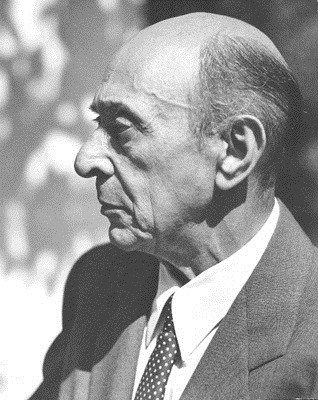 If you asked me what my favorite (Western) opera was, I’d have to think a long time before answering. But if you ask what my favorite (Western) opera-movie is, I’ll answer with no hesitation – Jean-Marie Straub and Danièle Huillet’s version of Arnold Schoenberg’s Moses und Aron.
I saw the film a while after it first appeared. It was playing at a repertory theater, and in fact, it was the film I saw on the first date I was ever on. I was a nerdy teenager, and I suggested it a friend. We went together, and she w as even more affected by the film than I. The movie Moses und Aaron is certainly not what most people would think of as a date flick, but I must say, it made my date swoon. Years after she saw the film with me, she claims that it had a great impact on her thinking.
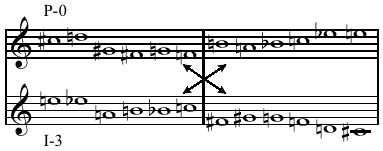
The film is quite a good version of the Schoenberg opera. The opera is constructed from a single tow row:

which is combinatorially combined with itself so as to be a perfect twelve-tone serial composition:
The film features Günter Reich as Moses, and the music is conducted by Michael Gielen. Because of the need to present Moses as a stutterer, the role is challenging. Reich played the roles in a number of different performances (including a well-known recording by Boulez) by I think the Gielen performance is the strongest. It is available on a CD release from Brilliant, and “the High Pony Tail” has made declicked MP3 and FLAC versions from the original LP.
Because Schoenberg never composed music for the third act, the film represents the third act with a single shot as Moses recites a monologue (with no music) based on Schoenberg’s notes.
New Yorker Films has finally released a US DVD version (with English subtitles). Here is a clip from the film (I cannot embed this video in our WordPress blog.) Here are some stills from the film (which was filmed in Egypt and Italy):

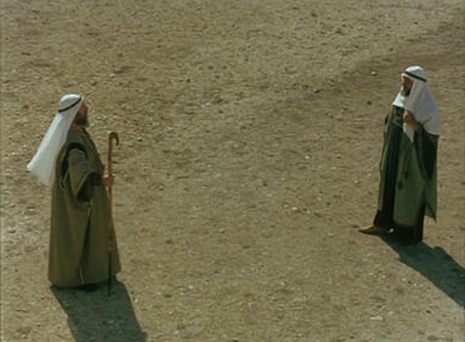

(I wanted to link to an even more dramatic still from the film, but that film has some nudity and may offend some readers. If you would like to see it, you can find it here. That same still is the basis of the DVD’s cover.)
In the November/December 1975 issue of Film Comment, Manny Farber wrote
Ultimately there is only examination of cracked walls, parched ground, wool, paralleling the same intense physicality of the musical sounds…. The delicious and joyful Moses and Aaron, however, is a very sensual experience, from its voluptuous 360-degree pan around the oval-shaped Roman arena in the Arbuzzi mountains to the Cézanne-like sculptural insistencies which make every crack in the arena’s walls seem extraordinary, a physical reality that reverberates in the mind.
Richard Brody of the New Yorker has nice things to say about the film, but writing in October 2011, he seemed unaware that the film was being released in this month. He wrote about the movie
[It] brings to life, on location in the desert, a reinterpretation of several crucial episodes of Biblical history—Moses’s presentation of God’s covenant to his chosen people, his recruitment of his eloquent brother Aaron to preach to them on his behalf, and Aaron’s weakening during Moses’s forty-day sojourn on Mount Sinai, resulting in the worship of the Golden Calf and Moses’s breaking of the tablets bearing the Ten Commandments. The brothers’ conflict—between word and image, idea and emotion—is also the directors’ argument for their own radically austere style over popular methods. Here, their rarefied aesthetic coheres perfectly with the opera to come off as a kind of twelve-tone filmmaking which, like Schoenberg’s music, reclaims a classical ideal in a progressive way that owes nothing to nostalgia. Oblique angles, long takes, and static tableaux allow Straub and Huillet to go straight to the drama inherent in the story and the composition. They respond to every nuance of the opera and reveal both the complex modern music and their own stark images to be as passionate and engaging as they are profound and beautiful
Martin Walsh has a provocative, lengthy, and detailed analysis of the film here.
The DVD package is quite nice, with a 40 page booklet that contains the full libretto in English and German, essays by Michael Gallope (University of Chicago) and Allen Shawn (Bennington College), and a list of Web resources. (However, I have a bit of frustration because it is claimed that one can download PDFs of A Work Journal of the Straub/Huillet film Moses and Aaron and Huillet’s Notes on Gregory’s Work Journal from the DVD publisher’s web site; but I have been unable to find them.) Also included is the film Einleitung zu Arnold Schoenbergs Begleitmusik zu einer Lichtspielscene,
I recommend this DVD to all those who enjoy 20th century music, or who are interested in how Biblical stories have been translated to film. While I cannot promise that you will find, as I did, that this is a great date film, I think you will find a fascinating artifact.
This review also gives me a chance to quote the Nazi reaction to Arnold Schoenberg, in my next post.
Illustrated with no illustrations?
[Please allow me push the boundaries of this blog a bit further. I consider cookbooks to be a type of literature….]
I like to cook as much as the next fellow (in the genderless sense of “fellow.”) And I’ve long been a fan of Cook’s Illustrated very empirical approach to cooking (although I regard with some suspicion their approval of pre-made foods, frozen foods, etc.) So I bought the ballyhoo-ed new Cook’s Illustrated Cookbook.
Cook’s Illustrated magazine is, in fact, illustrated. However, from my brief perusal of Cook’s Illustrated Cookbook, it appears not to be illustrated (or very sparsely illustrated.) Now here is my question: Do you find an unillustrated cookbook entitled Cook’s Illustrated Cookbook to be confusing? False advertising? Or would you expect no illustrations because the name Cook’s Illustrated has become a common noun (in the same way that one might not expect a book entitled The Very Best of LIFE to be a living creature.)
Update (12/17): As I mention in the comments below — I had only briefly looked at the cookbook after I received it. I was in a rush to post and move on — and that was a big mistake. I should have spent more time reading the cookbook before posting.
In particular, my description of it above is not correct — the cookbook is, in fact, illustrated, although somewhat sparsely (not nearly as completely as in the magazine, for example.) I would say that roughly one out of forty recipes has a line illustration. I apologize for mischaracterizing the book.
The Junia Evidence: III
Here is a list of some of the recent posts on the topic of Junia and apostleship. It does not in any way exhaust the field.
Junia is not alone
Junia Is a Woman, and I Am a Complementarian
Denny Burk’s Complementarian Cover-up
The Junia Evidence: I
The Junia Evidence: II
Was Junia Really An Apostle by Burer and Wallace
Due Diligence on Junia and Apostleship
Matt Colvin on Junia and Apostleship
Some Lengthy Thoughts on Women’s Leadership
A Closer Examination of Junia, The Female Apostle
I perceive this issue to be important because it sheds light on how Bible translation decisions are made. I do not intend to discuss the ordination of women, or of anybody else in this series. But it is crucial for us to understand what information impacts on different Bible translations.
In brief, the NET, ESV, HCSB and CEV all interpret Romans 16:7 as if Junia was only well-known to the apostles on the basis of material presented in the article by Burer and Wallace. I have argued in my first two posts called The Junia Evidence, that the evidence does not fit the conclusions of the article. I shall continue to do this. Many other Bibles have reassigned Junia’s gender, without a text base for this, and only a very few list Junia as “among the apostles” – KJV, NIV 2011, and NRSV.
I continue to support the notion that there is a cover up on the issue of Junia and apostleship. Denny Burk, a spokesman for CBMW, reinforces the position that the Burer and Wallace article provide the scholarly basis for modern translations. He writes,
there are serious and weighty arguments in favor of the translation that Junia was not one of the apostles but that she was “well known to the apostles” (ESV, NET). In 2001, for example, Daniel Wallace and Mike Burer defended the translation “well known to the apostles,” and the results of their research were published in “Was Junia Really an Apostle? A Re-examination of Rom 16.7,” New Testament Studies 47 (2001): 76-91. McKnight relies on Epp’s response to the Wallace/Burer proposal, but Burer has recently responded to Epp’s book and has shown the continuing strength of his and Wallace’s original thesis that Junia was “well known to the apostles.” Wallace and Burer’s argument cannot be easily brushed aside.
I will argue further here that Burer and Wallace’s argument ought to be brushed aside, and ought not to form the basis of any Bible translation. In their article they write about evidence for ἐπίσημος,
The inscriptions can likewise be examined quickly. An idiom noticed in several inscriptions is even more relevant. In TAM 2.905.1 west wall. coll. 2.5.18 we read the description of a man who is “not only foremost in his own country, but also well known to the outside population” (οὐ μόνον ἐν̣ τ̣ῇ πα̣τρίδι πρώτου, ἀλ̣λὰ καὶ ἐν τῷ ἔθνει ἐπισή̣μου *).54 Here the person who is ἐπίσημος is called such only in relation to outsiders (πρῶτος is used in relation to his own countrymen). It is not insignificant that evn plus the dative personal noun is used: the man is well known to a group of which he is not a member.
I need to note first that this inscription was a reconstructed fragment and is found as the following,
οὐ μόνον ἐ]ν̣ τ̣ῇ [π]α̣τρίδι πρώτου,
ἀλ̣λὰ [καὶ ἐν τῷ ἔθ]νει ἐπισή̣μου
Burer and Wallace translate this as,
not only foremost in his own country,
but also well known to the outside population
But we can see from New Testament usage what these two phrases mean. First, ἐ]ν̣ τ̣ῇ [π]α̣τρίδι, and then [καὶ ἐν τῷ ἔθ]νει ,
εἶπεν δέ· ἀμὴν λέγω ὑμῖν
ὅτι οὐδεὶς προφήτης δεκτός ἐστιν
ἐν τῇ πατρίδι αὐτοῦ. Luke 4:24And he added, “I tell you the truth,
no prophet is acceptable
in his hometown. NET Bibleτὴν μὲν οὖν βίωσίν μου [τὴν] ἐκ νεότητος τὴν ἀπ’ ἀρχῆς γενομένην
ἐν τῷ ἔθνει μου ἔν τε Ἱεροσολύμοις
ἴσασιν / ἴσασι πάντες [οἱ] Ἰουδαῖοι Acts 26:4Now all the Jews know the way I lived from my youth,
spending my life from the beginning among my own people
and in Jerusalem. NET Bible
In fact, we can see that en plus the dative does refer to being a member of the group, of one’s own hometown, or one’s own people. There is no justification for Wallace and Burer’s translation which goes,
not only foremost in his own country,
but also well known to the outside population
A much better translation, supported by usage and translation found in the NET Bible, would be,
not only first in his hometown,
but also prominent among his own people
In fact, it appears that the translation of patris as “own country” is not well-founded at all, and not a very good translation of the Greek. It seems to be a simple misunderstanding that patris means home country in Greek instead of hometown. This does not look like an error that someone who is familiar with Greek would make.
In my view, anybody who has any level of competency in Greek, would recognize that this article ought not to influence a Bible translation. The fact that several Bibles still reference it for their translation of Romans 16:7 is highly irregular. I am not sure if this is really a cover up, or simply an indication of a massive failure of scholarship in evangelical circles, but it is clearly inappropriate. This calls into question the fidelity of the NET, ESV, HCSB and CEV.
Google Translate: redefining translation
We’ve referenced Google Translate or GT (here), and Theophrastus has used it for a post (here). The wonderful translation book (Is That a Fish in Your Ear?) by David Bellos has much to say about GT including that it’s “an automatic-translation tool that is unlike all others.” And GT is changing faster than the wikipediaists can keep up: they’ve only announced the “25th stage (Launched July 2011). Now you can rate the translations.”
For users, GT is actually redefining translation by offering what might be more precisely called transposition. In other words, speech now gets converted into text, not only the written form of the first language for also the script of the second language. Here, for example, are some screenshots (HT iTunes store) from the iPhone showing the transliterated output from English speech into various languages. This speech-to-text function has been around for some time now (relatively speaking) and the text-to-speech function even longer.

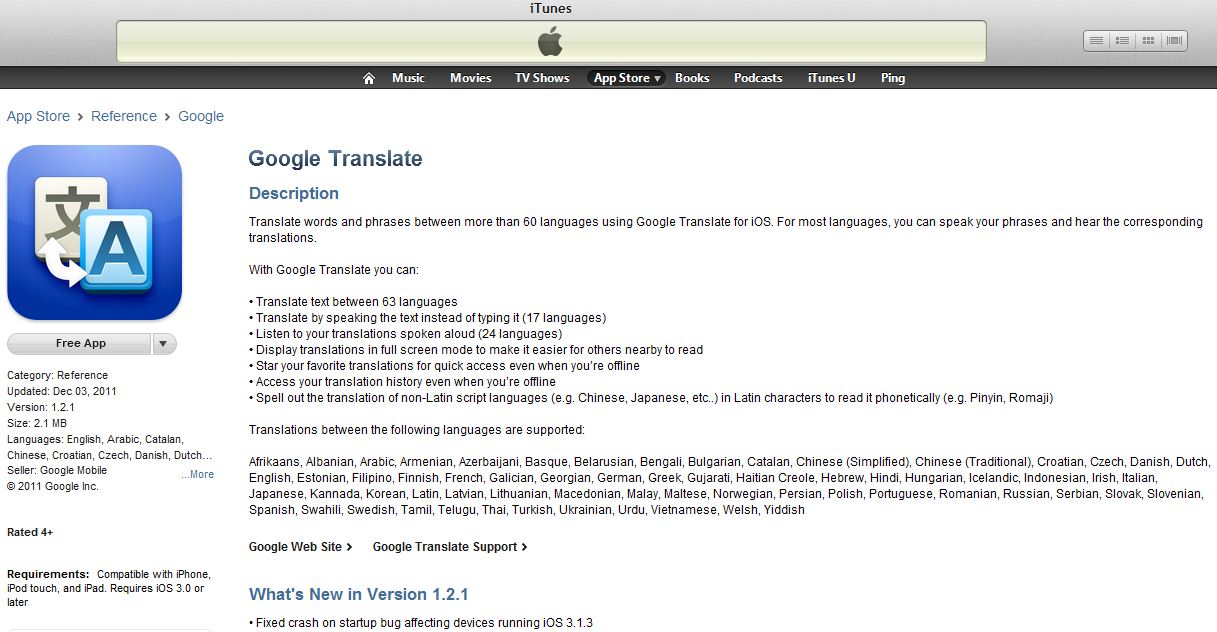
This week, GT has added an additional feature that makes what we mean by tranlsation even richer. Handwriting recognition is a function of the GT app for android devices. It’s available in seven languages so far: Chinese, English, French, German, Italian, Japanese, and Spanish. (ht Cameron Summerson.) For those of us who have Apple devices, it appears we’re going to have to wait, as the most recent version of the GT app for iPhones and iPads still looks like this:
But here’s how that looks for anyone going to the Android market:

For Chinese and Japanese handwriters, it’s not entirely clear yet whether the function is only for Mandarin and only for Kanji. And yet, for users this is an incredibly helpful feature when translating. Who knew translation meant handwriting a Chinese character and hearing a transposition into Mandarin phrase and a transposed-translation into an English phrase (and getting the English also written and the Chinese re-written)?
Spacing after periods
Last night I was re-reading my favorite work by Karl Popper, The Open Society and Its Enemies. I have the paperback 1971 (5th) edition published by Princeton University Press. Popper’s work (which made its way onto the Modern Library’s list of the hundred best non-fiction works of the twentieth century) is profound in many ways and deserves careful criticism.
I’m not going to do that here, though. I’m going to talk about something fairly trivial. I’m going to talk about spacing after periods. You’ve probably heard about the debate between “double-spacers” (who put double spaces after periods) and “single-spacers” (who put single spaces after periods).
The Internet has allowed the rise of a certain type of zealot; one who makes dubious pronouncements with absolute certainty. The question of spacing after periods is one sort of issue that loves to attract attention on the Internet, and a certain Farhad Manjoo has ridden the issue to Web-dom celebrity by absolutely saying “double-spacers” are wrong.
As far as I can tell, Farhad Manjoo has no background in typography, but he is willing to make absolute statements on this issue.
Can I let you in on a secret? Typing two spaces after a period is totally, completely, utterly, and inarguably wrong. And yet people who use two spaces are everywhere, their ugly error crossing every social boundary of class, education, and taste…. Felici writes that typesetters in Europe began to settle on a single space around the early 20th century. America followed soon after. Every modern typographer agrees on the one-space rule. It’s one of the canonical [sic] rules of the profession.
Manjoo was not content to simply spew misinformation in his Web columns, but he also felt it was necessary to appear on NPR’s Fresh Air program to continue his campaign of misinformation. What Manjoo was not willing to do, apparently, was to actually pick up some books and see how typesetting actually was done in the 20th century.
Here is a sample fragment from the 1971 edition of Popper’s book (which certainly qualifies as a major publication from a major publisher):
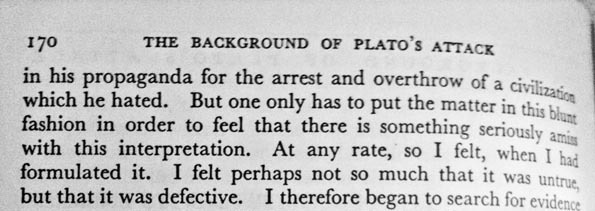
As you will notice, the text clearly has double spacing after the period. For example, look at the word “hated” in the second line, followed by a period. Notice how large the spacing after that period is compared with the other words in that same line.
So, here we have a famous book, published in the second half of the 20th century, while Manjoo claims that since the early 20th century “Every modern typographer agrees on the one-space rule. It’s one of the canonical [sic] rules of the profession.”
Of course, Popper’s book is hardly the only book that violates Manjoo’s supposed “canonical [sic] rule.” I am quite certain that if you take several volumes off your bookshelf, you will have no trouble finding works that use the double-space rule.
Of course, this point is rather minor (and distracts me from doing what I really want to do, which is to post some thoughts about the content of Popper’s book – as opposed to typography.) And I cannot say that those who use the single-space rule instead of the double-space rule are “wrong.” But I still think it is worth pointing out Manjoo’s error as a reminder that we should not believe everything we read on the Internet, no matter how vehemently it is stated.
On this same theme of not trusting everything we read on the Internet, Nina Zumel gives the following example on her Multo (Ghost) blog. She first reprints this xkcd cartoon:

And then she suggests:
Try it yourself. Type “legend of the three crowns of east anglia” into Google (or whatever your search engine of choice may be). You should see a page full of references to the following sentence:
The device refers to an old legend of the three crowns of East Anglia, and the blue colour represents the Anglo-Scandinavian heritage of much of East Anglia.
“Citation needed,” scolds Wikipedia. Citation needed indeed, because (and any M.R. James scholars who stumble over this, please correct me if I’m wrong) there is no legend of the three crowns of East Anglia. M. R. James invented it, in his 1925 short story “A Warning to the Curious.” His legend tells of three crowns, each buried in a different place off the coast of Great Britain to keep foreign invaders at bay.
James was a medieval scholar, an expert on older manuscripts, and folklore seems to have been a special interest of his. He had the right kind of knowledge to invent a convincing “ancient legend.” I can easily imagine the story making its way into the stream of local lore; but still. James’ ghost stories are reasonably well known, and 1925 really wasn’t that long ago, on a historical scale — especially in Great Britain.


 BLT
BLT 
