Updated: Beit Shemesh
Update: The original video report from Israel has been replaced with one with subtitles. (HT: Michael Pitkowsky)
 From Haaretz:
In recent weeks, the central Israel town of Beit Shemesh has seen increased violence by ultra-religious men, attacking women and girls, who they feel have been dressed in an immodest manner.
These men have resorted to cursing, spitting, and even rock-throwing. Signs have been hung in the town center instructing women not to “dally in the street.”
The situation in the town was brought to the forefront of Israeli public discourse this weekend in a Channel 2 exposé, aired this Friday, about a 8-year-old girl who is afraid to go to her school – located a mere 300 meters from her house – because of the violence she had experienced by men, who felt the religious girl’s attire was not modest enough.
Here is the Channel 2 news story now with English subtitles. It is worth watching to see what qualifies as “immodest dress” (at 0:52) and “modest dress” (at 4:37):
Five candles
Nice or not nice? You decide.
… The truth is, the Jesus story is the ultimate political drama. Imagine it: a radical firebrand, whom the powerful want to silence and shut down. But the threat is not only external. He also faces a hidden challenge from within his own inner circle, a traitor in his midst.
I admit that I brace myself when I come to hear the story told again, whether through radio drama, rock opera or, say, some BBC experimental production on the streets of Manchester. I worry: will this version blame the Romans or the Jews? Of course it’s always best when Pilate, the Roman occupier who gave the order, is the bad guy; certainly better than any suggestion, coded or otherwise, that it is the Jews who should bear the weight of guilt.
I like to think Jesus himself would understand this nervousness on my part. After all, and this is remembered less often than it might be, he was Jewish too.
(HT Tzvee)
Previous posts: One candle, Two candles, Three candles, Four candles.
Best Online Bibles!
You are going to love this! These facsimile Bibles are free to view. Here you can view what is arguably the most influential Bible translation in the history of the English Bible. Erasmus Greek-Latin New Testament was used by both Luther and Tyndale to translate into German and English. Tyndale’s translation also  had an diglot English-Latin edition. This translation is my usual go to translation when looking at the history of interpretation. Sadly, this site does not offer a Pagninus translation of the Hebrew Bible. Some day ….
Offensive Words and Ways in December
This December, in the Netherlands in particular, there are expressed concerns about customs and language that offend many, especially Americans. The offensive ways are related to Christmas; the insulting words are related to a muscian; and it all smacks of racism (and sexism). Here are three reports.
First, this week, Esquire online reposts the David Sedaris piece (from December 2002) in which the author recounts his education from his Dutch guide Oscar, who tells about Christmas lore in Holland. The focus (as per the title of the piece, “Six to Eight Black Men”) is on the Dutch Santa’s “helpers”; Sadaris describes what his acquaintance tells him this way:
The six to eight black men were characterized as personal slaves until the mid-fifties, when the political climate changed and it was decided that instead of being slaves they were just good friends. I think history has proven that something usually comes between slavery and friendship, a period of time marked not by cookies and quiet times beside the fire but by bloodshed and mutual hostility. They have such violence in Holland, but rather than duking it out among themselves, Santa and his former slaves decided to take it out on the public. In the early years, if a child was naughty, Saint Nicholas and the six to eight black men would beat him with what Oscar described as “the small branch of a tree.”
What Oscar and David Sedaris are talking about, of course, is Zwarte Pieten.
Second, then. If you go to wikipedia to read about Zwarte Pieten in the legends, then you find a very recently updated entry. The bit that gets at the racism is in the section labeled “Current Affairs.” That reads this way (with all the wikipedia hyperlinks removed below):
During recent years the role of Zwarte Pieten has become part of a recurring debate in the Netherlands. Controversial practices include holiday revellers blackening their faces, wearing afro wigs, gold jewellery and bright red lipstick, and walking the streets throwing candy to passers-by.
Foreign tourists, particularly Americans and Brits, often experience culture shock upon encountering the character (to dress in blackface is considered offensive in the United States, the United Kingdom and other countries). Since the last decade of the 20th century there have been several attempts to introduce a new kind of Zwarte Piet to the Dutch population, where the Zwarte Pieten replaced their traditional black make-up with all sorts of colours. In 2006 the NPS (en: Dutch Programme Foundation) as an experiment replaced the black Pieten by rainbow-coloured Pieten, but in 2007 reverted to the traditional all-black Pieten.
The tradition continues to be popular in the Netherlands, though some activists have been moved to protest against it. Four people wearing t-shirts saying “Zwarte Piet is racist” were arrested in the second weekend of November 2011.
The largest Sinterklaas celebration in Western Canada, slated for 3 December 2011 in New Westminster, British Columbia, was cancelled for the first time since its inception in 1985 after clashes of opinion surrounding the traditional character Zwarte Piet or “Black Peter”. Rather than leaving out Zwarte Piet, the organizers decided to cancel the festivities as a whole, because, as spokesperson Tako Slump of the organization said:
“We got a lot of replies back from our customers in the Dutch community,” he said. “It became pretty clear to us that we love Sinterklaas and we can’t have it without Black Peter. Those two go together,”
Third, reporter Maike Winters, for the English language section of Radio Netherlands Worldwide online, has this story:
“This week Dutch fashion magazine Jackie published an article on Rihanna” in which the “singer and fashion icon” was referred to by an offensive racist and sexist English phrase. Winters discusses the debate and posts a minute-long video in which a “Dutch TV correspondent in US explains why you can’t use the word.” The video is in Dutch with English captions. And Winter’s own title for his article begins with the offensive phrase [which I omit], and ends this way: “____ ____ incident: lost in translation?” (Readers of this blog must go here to read this and to watch this video.)
I’m just going to end this post (as another English speaker, as another traveller of the world, in America, in December, the night before Christmas) with one of David Sadaris’s lines:
One doesn’t want to be too much of a cultural chauvinist, but this seemed completely wrong to me.
Frederica Mathewes-Green on feminism and abortion
Denny Burk has cited Frederica Mathewes-Green on abortion and given his post the title Why Abortion is the Sacrament of Feminism. So I would like to cite further from Mathewes-Green, pointing out that she recognizes the early feminists, whose goals were to enable women to earn a living wage and provide for their children. She writes,
Earlier strains of feminism saw this issue more clearly. Susan B. Anthony called abortion “child murder” and called for “prevention, not merely punishment…[of] the dreadful deed.” The nineteenth-century feminists were unanimous in opposing abortion. Elizabeth Cady Stanton grouped it with infanticide, and proclaimed that if it was degrading to treat women as property, it was no better for women to treat their own children as property. Perhaps their colleague Mattie Brinkerhoff was clearest when she likened a woman seeking abortion to a man who steals because he is hungry.
For the question remains, do women want abortion? Not like she wants a Porsche or an ice cream cone. Like an animal caught in a trap, trying to gnaw off its own leg, a woman who seeks an abortion is trying to escape a desperate situation by an act of violence and self-loss. Abortion is not a sign that women are free, but a sign that they are desperate.
How did such desperation become so prevalent? Two trends in modern feminism, both adapted from the values of the masculine power structure that preceded it, combine to necessitate abortion. Re-emerging feminism was concerned chiefly with opening doors for women to professional and public life, and later embraced advocacy of sexual freedom as well. Yet participation in public life is significantly complicated by responsibility for children, while uncommitted sexual activity is the most effective way of producing unwanted pregnancies. This dilemma–simultaneous pursuit of behaviors that cause children and that are hampered by children–inevitably finds its resolution on an abortion table.
If we were to imagine a society that instead supports and respects women, we would have to begin with preventing these unplanned pregnancies. Contraceptives fail, and half of all aborting women admit they weren’t using them anyway. Thus, preventing unplanned pregnancies will involve a return to sexual responsibility. This means either avoiding sex in situations where a child cannot be welcomed, or being willing to be responsible for lives unintentionally conceived, perhaps by making an adoption plan, entering a marriage, or faithful child support payments. Using contraceptives is no substitute for this responsibility, any more than wearing a safety belt gives one the right to speed. The child is conceived through no fault of her own; it is the height of cruelty to demand the right to shred her in order to continue having sex without commitment.
Second, we need to make continuing a pregnancy and raising a child less of a burden. Most agree that women should play a part in the public life of our society; their talents and abilities are as valuable as men’s, and there is no reason to restrict them from the employment sphere. But during the years that her children are young, mother and child usually prefer to be together. If women are to be free to take off these years in the middle of a career, they must have, as above, faithful, responsible men who will support them. Both parents can also benefit from more flexibility in the workplace: allowing parents of school-age children to set their hours to coincide with the school day, for example, or enabling more workers to escape the expenses of office, commute, and childcare by working from home. We must also welcome women back into the workforce when they want to return, accounting their years at home as valuable training in management, education, and negotiating skills.
Women’s rights are not in conflict with their own children’s rights; the appearance of such a conflict is a sign that something is wrong in society. When women have the sexual respect and employment flexibility they need, they will no longer seek as a substitute the bloody injustice of abortion.
I have been reading in Nasar’s Grand Pursuit, how feminism rose out of the same social and economic conditions as those that caused Malthus to formulate his explanation of poverty, that population incresases geometrically and the means of subsistence only increases arithmetically. For Malthus, starvation of the surplus population was inevitable unless marriage was delayed or restricted to only some adults and not all. In the first half of the 19th century, infant mortality rose, the average adult height ( and thereby nutrition) decreased, and breastfeeding was at its all time historic low. Women rallied around the need to earn a living wage, so they could feed their children without resorting to prostitution.
Studies today show that France and many European countries have a fraction of the North American abortion rate. This study suggests that in addition to health care, education, childcare and economic opportunity; a major difference is that in Europe women are typically older, in a stable relationship, and working before they get pregnant. They see age, relationship and career as markers of adulthood and preparation for parenthood; whereas in the USA, bearing a child in and of itself is seen as a marker of adulthood. This suggests that detaching childbearing from a woman’s self worth, and replacing it with the common goals of a mature and stable lifestyle, including a job, as most important, would delay both pregnancies and abortions. There is no known positive corelation between anti-abortion laws and the abortion rate.
In my own experience, the more education a girl aspired to, the less likely it was that she would have an early or unplanned pregnancy. Let’s encourage our young women to aim high, and become fully responsible adults, ready to parent children at a later age.
The Greek and Romans considered abortion to be an appropriate way to keep the population in line with the means of subsistence, and the only illegal abortions were those a woman had without her husband’s permission. However, a husband could impose an abortion on his wife.
So who said that abortion was the sacrament of feminism – not Frederica Mathewes-Green. I could not trace the phrase back to anyone other than Denny Burk. But Florynce Kennedy, likely refering to the Catholic Church, did say, “If men could get pregnant, abortion would be a sacrament.”
Mathewes-Green explains that a flexible workplace in which women could establish a career, take time off work and return to work, benefits women and enables them to best bear children and provide for them.
The Woodmans
I hope you saw The Woodmans last night (we talked about it here.)
If you missed it, you can watch it online for a while here on the Independent Lens website.
On the Independent Lens Facebook page, the producers say the film was “a divisive one.”
What did you think?
Néojaponisme on 1Q84
As part of its wrap up of 2011, Néojaponisme offers a rather complete survey to the English translation of 1Q84 (which we talked about here). Just one teaser paragraph:
In October, some American bookstores held midnight release parties, and one New York bookstore even bought tacos and beer for customers who had pre-ordered the novel. The critical response to the 900+ page mammoth arrived quickly thanks to review copies that had been issued months earlier. 1Q84 has been included on all of the year-end best of lists by default (Amazon, New York Times, Barnes and Noble, The Economist), and many have lumped it together with Stephen King’s 11/22/63 and George R. Martin’s A Dance With Dragons, celebrating the return of the epic five-pound novel.
(Unfortunately, Daniel Morales, the author of this post, was not very careful: the free tacos and beer were given out at Green Apple Books, a bookstore in San Francisco, not New York.)
Boola Boola holiday recipes from Babylonia
Yale University Library has a holiday e-card for you with recipes (page 1, page 2).
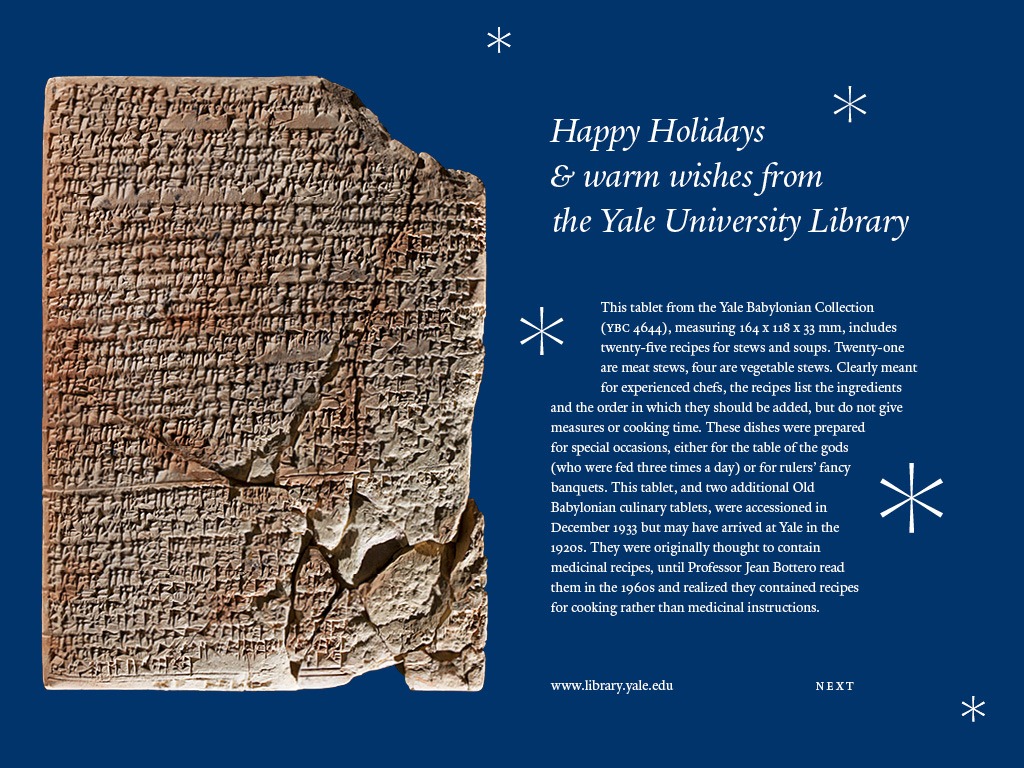
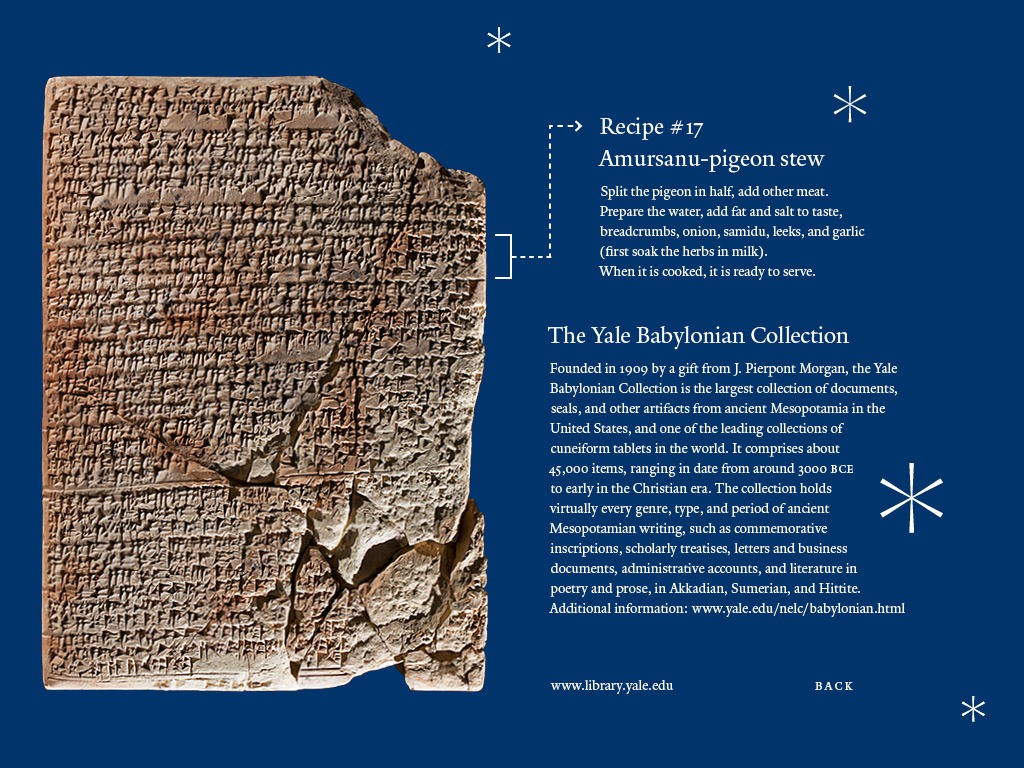
Here is the text from the card:
Happy Holidays & warm wishes from the Yale University Library
This tablet from the Yale Babylonian Collection (YBC 4644), measuring 164 x 118 x 33 mm, includes twenty-five recipes for stews and soups. Twenty-one are meat stews, four are vegetable stews. Clearly meant for experienced chefs, the recipes list the ingredients and the order in which they should be added, but do not give measures or cooking time. These dishes were prepared for special occasions, either for the table of the gods (who were fed three times a day) or for rulers’ fancy banquets. This tablet, and two additional Old Babylonian culinary tablets, were accessioned in December 1933 but may have arrived at Yale in the 1920s. They were originally thought to contain medicinal recipes, until Professor Jean Bottero read them in the 1960s and realized they contained recipes for cooking rather than medicinal instructions.
Recipe #17 Amursanu-pigeon stew: Split the pigeon in half, add other meat. Prepare the water, add fat and salt to taste, breadcrumbs, onion , samidu, leeks, and garlic (first soak the herbs in milk). When it is cooked, it is ready to serve.
Unfortunately, my local grocery store is out of samidu (although People magazine says “Don’t feel too bad about not finding them. Most Babylonians couldn’t get them either.”) If you’d like more information on the recipes, they are discussed in Gwendolyn Leick’s The Babylonian World.
(But please note Julia Child’s comments on the recipes: “They must have had strong stomachs.” It is not clear to me whether Child was referring to the Babylonians or the Yalies.)
Four candles
Nice or not nice? You decide.
Bah, Hanukkah
The holiday celebrates the triumph of tribal Jewish backwardness.
High on the list of idiotic commonplace expressions is the old maxim that “it is better to light a candle than to curse the darkness.” How do such fatuous pieces of folk wisdom ever get started on their careers of glib quotation? Of course it would be preferable to light a candle than to complain about the darkness. You would only be bitching about the darkness if you didn’t have a candle to begin with. Talk about a false antithesis. But at this time of year, any holy foolishness is permitted. And so we have a semiofficial celebration of Hanukkah, complete with menorah, to celebrate not the ignition of a light but the imposition of theocratic darkness.
Jewish orthodoxy possesses the interesting feature of naming and combating the idea of the apikoros or “Epicurean”—the intellectual renegade who prefers Athens to Jerusalem and the schools of philosophy to the grim old routines of the Torah. About a century and a half before the alleged birth of the supposed Jesus of Nazareth (another event that receives semiofficial recognition at this time of the year), the Greek or Epicurean style had begun to gain immense ground among the Jews of Syria and Palestine. The Seleucid Empire, an inheritance of Alexander the Great — Alexander still being a popular name among Jews — had weaned many people away from the sacrifices, the circumcisions, the belief in a special relationship with God, and the other reactionary manifestations of an ancient and cruel faith. I quote Rabbi Michael Lerner, an allegedly liberal spokesman for Judaism who nonetheless knows what he hates, “Along with Greek science and military prowess came a whole culture that celebrated beauty both in art and in the human body, presented the world with the triumph of rational thought in the works of Plato and Aristotle, and rejoiced in the complexities of life presented in the theater of Aeschylus, Euripides and Aristophanes.”
But away with all that, says Lerner. Let us instead celebrate the Maccabean peasants who wanted to destroy Hellenism and restore what he actually calls “oldtime religion.” His excuse for preferring fundamentalist thuggery to secularism and philosophy is that Hellenism was “imperialistic,” but the Hasmonean regime that resulted from the Maccabean revolt soon became exorbitantly corrupt, vicious, and divided, and encouraged the Roman annexation of Judea…. When the fanatics of Palestine won that victory, and when Judaism repudiated Athens for Jerusalem, the development of the whole of humanity was terribly retarded.
And, of course and as ever, one stands aghast at the pathetic scale of the supposed “miracle.” As a consequence of the successful Maccabean revolt against Hellenism, so it is said, a puddle of olive oil that should have lasted only for one day managed to burn for eight days. Wow! Certain proof, not just of an Almighty, but of an Almighty with a special fondness for fundamentalists. Epicurus and Democritus had brilliantly discovered that the world was made up of atoms, but who cares about a mere fact like that when there is miraculous oil to be goggled at by credulous peasants?…
The display of the menorah at this season … has a precise meaning and is an explicit celebration of the original victory of bloody-minded faith over enlightenment and reason. As such it is a direct negation of the First Amendment and it is time for the secularists and the civil libertarians to find the courage to say so.
Christopher Hitchens (2007)
Previous posts: One candle, Two candles, Three candles.
Ancient Board Games
Dr. Claude Mariottini has a couple of posts on board games as an elite passtime in the ancient Near East and in the Bible. I also highly recommend his blog as a source of new and fascinating information, and innovative analysis on things relating to the Hebrew Bible.
Whose is the most Christmasy Christmas Card?
By Governor Sarah Palin’s public standards for Christmas cards, which of the cards show below is the most Christmasy for an American president? Which is the least Christmasy?
The standards by which to judge how Christmasy for the White House: “American foundational values illustrated and displayed on Christmas cards and on a Christmas tree,” values such as “family, faith and freedom.”
Which is liberal Democrat President Barack Hussein Obama’s card? Which is conservative Republican President George W. Bush’s card? Which is most-conservative Republican President Ronald Reagan’s card? [Hint: the most Christmasy will include the word, Christmas, on it. The least Christmasy will have a picture of the “First Dog(s)” on it.]


Answer: none of the three really show those requisite “American foundational family-faith-and-freedom values.” From top to bottom, the cards are respectively from President Reagan, President Bush, and President Obama.
[HT Joel Watts]
know your scriptures, name your religion
about Junia and Andronicus: what more should we say?
First, read Suzanne’s series on evidence for Junia and each of the related posts she links to therein. Now, we see there’s much old and contemporary agreement that Junia is a woman; but there’s a relatively new claim that Paul must be saying she is not marked among the apostles with Andronicus as one of the apostles but is excluded from that group and is only “well known to the apostles.”
What more should we say? Well, we should say that Paul is recognizing Andronicus and Junia as τοὺς συγγενεῖς μου. Should we then say that he’s writing that they are Jewish? The man Andronicus and the woman Junia are Jews, like Paul is a Jew?
And if it makes a difference that Paul has marked not only a man but also a woman as “among the apostles,” then what difference would his claim that they are born into the same race with him make?
To make things a little murky, as we ask the question, we know this much. We know that the name Andronicus is a Greek one and that Junia a Latin one. We also know that in 2 Maccabbees (which mentions Hannukah by the way) an Andronicus is there, and he causes tremendous unhappiness both to Jews and Gentiles (οὐ μόνον Ιουδαῖοι, πολλοὶ δὲ καὶ τῶν ἄλλων ἐθνῶν) and is justly punished for his crimes (2Mace.4.35-38). What difference might it make if Paul claims to be a Jew and further marks Andronicus and Junia in Rome as his fellow Jews?
To help ponder the question, here are a few things that others are saying:
Against Christian feminists who see the apostle as sexist and placing restrictions on women as a result of his rabbinic training, Amy-Jill Levine (1956–) points out the anachronism of the charge: that Paul belonged to no rabbinic school, and that the rabbinic literature is of a much later date. She further suggests that Paul would have been familiar with women leaders in Diaspora synagogues, and thus recognized women leaders in his churches (e.g., Phoebe the deacon and Junia the apostle [Rom 16]). One might even begin to talk of a sort of Jewish reclamation of the Jewish Paul. [page 551]
— Mark D. Nanos, “Paul in Jewish Thought,” The Jewish Annotated New Testament
and
In Acts, as in Romans, it is clear that Christianity – Gentile as well as Jewish – was well-established in Rome (soon to be the most important church of all) quite independently of Paul. Though Paul had worked with some of those Christians in Rome whom he especially mentions in Romans 16 (verses 3-4, 7, 13), it is notable that all these — Prsica and Aquila, Andronicus and Junia, Rufus and his mother (cf. Mark 15:21) — had been Christians before they met Paul. The two latter pairs must have been very early members of the Jerusalem church. [page 267]
In our list of New Testament Jews with Latin names, there are seven names which are probably to be understood as sound-equivalents
5. Iunia – Joanna?
6. Iustus – Joseph
7. Iustus – Jesus (Yeshu’a)
12. Paulus – Saul
14. Rufus – Reuben
15. Rufus – Reuben
16. Silvanus – Silas [page 375]
There is no longer any need to demonstrate that the name which appears in the accusative as Ἰουνίαν in Romans 16.7 is the Latin female name Junia, not the postulated but unrecorded male name Ἰουνιᾶς, which would be a Greek hypocoristic form of Julianus. This woman, probably the wife of her fellow-apostle Andronicus, is the only Jewish woman known to have borne the name Junia, which was the female version of the nomen of a prestigious Roman family. Freedmen and freedwomen often adopted the nomen gentilicium of their patron, and [Geoffrey W. H.] Lampe [in “Iunia / Iunias” and in Die Stadtrömischen] therefore argues that Jews used the names Julius and Julianus becuase they were sound equivalents of Judah. So there is no need to postulate any connexions of the Jewish Christian Junia with the gens Junia. What has not been suggested before is the possibility that Junia in this case was chosen because it could serve as a sound-equivalent for the Jewish name Joanna. [page 381]
She adopted a Latin name, in her case a close sound-equivalent to her Hebrew name Joanna, when she needed a more user-friendly name in the diaspora, in her case especially Rome. It becomes rather probable taht the Junia of Romans 16.7 is the same person as Luke’s Joanna (Lk. 8.3; 24.10; and cf. Acts 1.14), a wealthy woman disciple of Jesus and wife of Chuza, Herod Antipas’s ‘steward’ (meaning either manager of a royal estate or manager of the estates and finances of Antipas’s whole realm). Perhaps Chuza (a Nabatean name) adopted the Greek name Adnronicus for the same reason his wife adopted the name Junia, or perhaps Andronicus was her second husband. We should also note that in Palestine Chuza and Joanna were members of Herod’s court at Tiberias, the most romanized place in Jewish Palestine, where we have already located some of the rare Palestinian instances of Jews with Latin names. Joanna might have adopted the sound-equivalent and appropriately aristocratic name Junia already in Tiberias. When she and her husband decided to become Christian missionaries in Rome, she may already have had, not only the means to support herself and a degree of acculturation to Roman ways, but also even a Roman name. [page 387]
How many of these Jews with Latin names were Roman citizens? [E. A.] Judge [in “The Roman Base of Paul’s Mission”] distinguishes the three kinds of Latin names in this respect. The Latin names that were widely adopted as Greek personal male names were the praenomina, and so persons bearing these names in the New Testament would normally not be Roman citizens. Judge therefore agrees with my statement that those Jews in the New Testament who bore these names — Marcus and Lucius — would almost certainly not be Roman citizens. The nomen, however, being the inherited family name, ‘clearly marks a person as a Roman citizen by birth.’ In the case of a woman, this would be her only name. So Judge says, of the three women ‘around Paul’ who bear a Roman nomen (Junia [Rom 16:7], Julia [Rom 16:15], Claudia [2 Tim 4:21]) that the ‘feminine form’ is ‘decisve’ for their identity as Roman citizens. However, as we have already noted, he does not seem to recognize that Junia is Jewish. We shall return to the significance of this sortly. [page 390]
In Acts 13:9 the reason [two different names for the same person are given] is that Luke is marking the point at which Saul, known by his Hebrew name in Palestine and Antioch, switched, as he embarked on his mission to Gentiles as well as Jews in the diasporea, to [Paul] his Roman name as his common usage.
In Romans 16 Paul evidently saw no need to refer to any of the persons he greets by two names, but this does not mean that none of them had an alternative name. In the case of Rufus, whom [E. A.] Judge [in “The Roman Base of Paul’s Mission”] thinks must be a Roman citizen becuase he bears a Latin cognomen and no additional, non-Latin name, we are justified in suspecting that he was Jewish precisely because Rufus was a popular name among Jews, used because of [sic] it was heard as a sound-equivalent of Reuben. The Latin and Hebrew names would be considered alternative forms of the same name, and naturally, addressing him in Rome, Paul uses the Latin version. Thus, if he was Jewish, Rufus need not have been a Roman citizen, though, like Paul/Saul, he might have been.
Finally, we return to the case of Junia. Since only the female Latin names were nomina, a Jewish woman (or her parents) wanting to adopt a Latin name could only give her a nomen. Since Junia was undoubtedly Jewish and since Paul need not have called her by both her names, if she had an additional name, we cannot tell whether she was a Roman citizen or not. With the nomen of a Jewish woman, we are in the same position as with the ccognomen of a Jewish man: we cannot tell whetehr these people were Roman citizens or not. These cases introduce a further element of uncertainty as to the real significance of the large proportion of people ‘around Paul’ who bore Latin names.[page 390]
— Richard Bauckham, The Jewish World Around the New Testament
and
Romans 16 also confirms the existence of a Jewish Christian community in Rome. In v.7, Paul writes: “Greet Andronicus and Junia, my fellow countrymen and my fellow prisoners; they are people of note among the apostles, and they were in Christ before me.” Andronicus and Junia are thus linked with earliest Jewish Christianity. As “apostles,” they will therefore have shared in the Jewish church’s mission “to the circumcision” (cf. Gal. 2:7-9), for Paul knows of no apostle other than himself (and perhaps Barnabus) who is sent to the Genitles. For Paul, being an apostle implies, first, that one has seen the risen Lord, and second, that one has founded a congretation (cf. 1 Cor. 9:1-2), and it is therefore plausible that Paul regards Andronicus and Junia as founders of the original Jewish Christian congregation in Rome. Their status as apostles no doubt makes them the most imporant and influential members of the Jewish section of the Roman Christian community; Paul must gain their favor if his aim of uniting a currently divided community is to be achieved. [page 185]
— Francis Watson, Paul, Judaism, and the Gentiles: Beyond the New Perspective
and
Junia
“a woman of the gens, or clan, Junius”; Latin
(Rom 16:7)
In Rom 16:7, Paul greets Andronius and Junia as “prominent among the apostles.” Paul describes them as relatives and states that they were in prison with him and had come to belief in Christ before he did. “Relatives” could mean fellow Jews or could denote actual blood relation, but according to either interpretation, Junia and Andronicus were Jews. We do not know their relationship to each other.
Since Junia fulfilled the Pauline criteria for apostleship (see 1 Cor 9:1), she must have claimed to have seen the risen Christ and have been engaged in missionary work. As a Jewish Christ-believer before Paul was converted, Junia may have lived in an eastern province of the Roman Empire and been among those who brought the message of Christ to the Roman Jewish community. Perhaps the Romans imprisoned Junia and Andronicus because of conflicts about this missionary work.
— Bernadette J. Brooten in Carol L. Meyers’s, Toni Craven’s, and Ross Shepard Kraemer’s Women in Scripture: A Dictionary of Named and Unnamed Women in the Hebrew Bible, the Apocryphal/Deuterocanonical Books, and the New Testament
and
Romans 16 has been cited by most interpreters as a decisive passage proving that a significant portion of the Roman congregations was Jewish. Paul’s Jewish co-workers Prisca and Aquila (Acts 18:2) are present. Further, Paul had referred to his fellow Jews as “compatriots” (συγγενής) in Rom 9:3 and employs the same word in Rom 16 for Andronicus, Junia (v.7), and Herodion (v.11)…. Interpreters have concluded that at least five of the people mentioned in Rom 16:1-16 must be Jewish: Prisca, Aquila, Andronicus, Junia, and Herodion. [pages 90-91]
Other evidence may suggest a Jewish identity for Andronicus, Junia, and Herodion. Paul describes Andronicus and Junia as “in Christ” prior to himself. The timing of their conversion during the early stages of the Christian mission increases the likelihood that they were Jewish. On the other hand, the possibility of a mission to the gentiles prior to Paul denies any firm conclusion. [page 100]
If Andronicus and Junia were apostles in the narrower sense of having seen and been commissioned by the Lord [Jesus Christ], they were likely Jewish. [page 98]
— A. Andrew Das, Solving the Romans Debate
and
Paul, like Walt Whitman, loved to contradict himself. In the same book of 1 Corinthians, he permits women to give sermons and prophesy in the church, provided they wear a veil. More telling, Paul speaks frequently of many women as his founding companions in the churches, his most trusted collaborators; he appoints women to keep new missions in order; and in Romans he notes that he has asked Phoebe (Rom. 16.1) a deacon (an ordained minister) in the church located in Cenchrea, an eastern port of Corinth, to carry his letter to the Romans to Rome. Deacon Priscilla (Rom. 16.3) is associated with the same [Corinthian, Cenchrean] church, and he promotes one of his colleagues to his own missionary status, saying about Junia, later Saint Junia, that she and her companion Andronikos are “outstanding among the messengers [apostles]”:
Greet Andronikos and Iounias [189],
Who were in prison with me, Oustanding
Among the messengers, even before me
They were working furiously for the Mashiah.
–ROM 16.7
From Paul’s time, and in large part because of Paul, women were ordained to preach and hold high administrative offices. Those were his [pro-woman Jewish] actions nearly two thousand years before anything like them was beginning to be permitted in Protestant churches, and more frequently in Jewish synagogues. But insofar as Paul contributed to silencing and separating women, he was following the practice of not only earlier Jewish temple customs but also Hindu, Buddhist, and later Muslim hierarchies. [page 628]
189. Junias from the Greek Ἰουνιᾶς (Iounias). Junias may be Junia or Julia, and the pair a couple. It is said the Junias was a Christian Jew and Andronikos a gentile, and both were imprisoned for their faith. [page 694]
–Willis Barnstone, The Restored New Testament: A New Translation with Commentary, Including the Gnostic Gospels Thomas, Mary, and Judas
And, so, if it makes a difference that Paul has marked not only a man but also a woman as “among the apostles,” then what difference would his claim that they are born into the same race with him make?
Three candles
Nice or not nice? You decide.
From the Talmud Blog, a post by Ophir Münz-Manor (Open University of Israel):
Hanukkah begins today and since I have been working for some years now on Hebrew liturgical poems for this feast, I thought it would be nice to share with the readers of the Talmud Blog some interesting bits and pieces of these verse compositions. Here is the first installment.
Late antique piyyutim for Passover elaborate on the Exodus, those for Shavuoth on the giving of the Torah at Sinai, those for Purim on the story of Esther and Mordecai, and those for Hanukkah… on the inauguration of the Tabernacle! Neither the Maccabees, nor the Seleucians are mentioned; rather, one finds lengthy descriptions of the desert dwelling and the sacrifices that were brought on the occasion of its inauguration.
Is this another example of the ‘had the nation and the rabbis caused to forget the Hasmoneans’ (the name of a famous essay by the late Jewish historian, Gedalia Alon) syndrome? Well, no. Simply put, the piyyutim follow the liturgy, and since the reading of the Torah during Hanukkah focuses on the inauguration of the Tabernacle as narrated in the book of Numbers, the poets followed that lead. It is no coincidence, of course, that this biblical episode is read at the synagogue. In the absence of a canonical book that relates the Hasmonean revolt, the rabbis and the payytanim chose the closest biblical episode to the historical event that they could find. Indeed, once the so-called Scroll of Antiochus (מגילת אנטיוכוס) was introduced to Jewish culture in the early Gaonic period, the piyyutim were filled with “historical” description of the battles of the Hasmonean against Antiochus Epiphanies.
But at least in once case we find a payytan from late antique Palestine who sought to (re)collect some “historical” data concerning the Maccabees, and this payytan is no other than the by-now Talmud Blog favorite, Elazar Birabi Qilir. Here is one interesting and somewhat amusing example of what the Qiliri came up with. In one place he writes:
קינאו חמישה / להקים דת חמישה / כממים נימשה // רצו עד מודעית / יוונים שם להבעית / על נקמת שביעית
The five [sons of Matityahu] were zealous / and sustained the law of the five [books] / like the one whom from the water was drawn [=Moses] // They ran all the way to Modi’in / in order to terrify the Greeks / and to take revenge of the seventh [land (= Israel)]
But why does the Qiliri indicate that the Maccabees had to run all the way to Modi’in, the place in which one of the major battles against the Seleucians took place? This mystery is solved in the next couplet:
ארבעת ראשי נמר / ריצצו פרחי אימר / בגזירת שומר // לבשר בחוצות יבנית / כי קיצצה חנית / כל לשון יוונית
The flowers of Immer / smashed the four headed tiger [=the Greeks] / by the decree of the Guard [=God] // To announce in the streets of Yavnit / that the spear chopped / every Greek tongue
According to the Qilir, the Maccabees were part of the priestly division called Immer that dwelled in a village called Yavnit (יבנית). Already in the Bible the Israelite priests were said to be divided into twenty four divisions, Immer being one of them. Interestingly, according to Josephus (and other historical sources) the Maccabees belonged, in fact, to the Yehoyariv order that was located in Judaea. But as was mentioned above the order of Immer dwelled in the Galilee. So now we can begin to appreciate the finesse of the Qiliri: the name of the village is pronounced almost the same as the Hebrew adjective for Greek (יוונית), and the Qiliri brilliantly plays on this similarity in the last verse quoted above. But this complicates things for the Qiliri, geographically-wise. If the Maccabees dwelled in the Galilee surely they had to rush all the way to Modi’in, which is located in Judaea, and of course soon thereafter to rush back north in order to bring back the happy news to their Galilean hometown.
Much more can be said about these verses (and those of you who read modern Hebrew can read this Ha’aretz article on this piyyut by Joseph Yahalom) but let me conclude with the following quote from Aristotle’s Poetics, part four:
It is, moreover, evident from what has been said, that it is not the function of the poet to relate what has happened, but what may happen, what is possible according to the law of probability or necessity. The poet and the historian differ not by writing in verse or in prose. The work of Herodotus might be put into verse, and it would still be a species of history, with meter no less than without it. The true difference is that one relates what has happened, the other what may happen. Poetry, therefore, is a more philosophical and a higher thing than history: for poetry tends to express the universal, history the particular.
So who do you prefer – Josephus or Elazar Birabi Qilir?
Previous posts: One candle, Two candles.
Solstice
And this was, as thise bookes me remembre,
The colde, frosty seson of Decembre.
Phebus wax old, and hewed lyk laton,
That in his hoote declynacion
Shoon as the burned gold with stremes brighte;
But now in Capricorn adoun he lighte,
Where as he shoon ful pale, I dar wel seyn.
The bittre frostes, with the sleet and reyn,
Destroyed hath the grene in every yerd.
Janus sit by the fyr, with double berd,
And drynketh of his bugle horn the wyn;
Biforn hym stant brawen of the tusked swyn,
And “Nowel” crieth every lusty man.
Aurelius in al that evere he kan
Dooth to this maister chiere and reverence,
And preyeth hym to doon his diligence
To bryngen hym out of his peynes smerte,
Or with a swerd that he wolde slitte his herte.
Geoffrey Chaucer, The Franklin’s Tale
I believe in toys
I don’t buy many gifts or shop much at Christmas, prefering to let my daughter shop for herself on my card. However my son insists on a toy. Over the years we have built a Duplo town and railway, a set for the novel Heidi out of Brio and a stack of pillows, we built models and jigsaw puzzles, Lego, then a Puzz 3D for 5 or 6 years straight. The dining room table would be cleared for action as the turkey and dressing were wrestled into the fridge and the last sliver of pecan pie was slipped onto the tongue. The fire was left to burn low, candles snuffed and the lights turned up as the real work of Christmas began.
This year we celebrated Christmas early so I can already relate it. After dinner the table was slid over to the wall and the carpet cleared, chairs stored on the periphery and sleeves rolled up for the Lego Excavator. Instructions were duly laid out, a control centre for small parts was set up, and a pathway for making it to the outside door or other necessities was duly marked out. The women were eventually relegated to a supervisory role only with some latitude for commentary and appreciative remarks. The batteries were bought, and the pillows stacked as the various actions and capabilities of this toy were tested.
Please enjoy with me The Man Who Saved Christmas.
Lots of other points of interest, as the characters test an early dictaphone.
Frank Kelly’s Christmas Countdown
I thought this Frank Kelly/Hugh Leonard novelty song was amusing when it came out in 1982, and I still think it is amusing today. It is a fine commentary on December commercialism.
talking about Deaths in December
This December, in our blogging so far, we have mentioned several who have passed away. We are “remembering” Francesca Woodman, “who ‘committed suicide’ at age 22.” We said “goodbye” to George Whitman. We started reading the obituaries for Christopher Hitchens just after he “died.” And we noted that Vaclav Havel “died.” I believe we missed mentioning that “Paula E. Hyman, a social historian who pioneered the study of women in Jewish life and became an influential advocate for women’s equality in Jewish religious practice, including their ordination as rabbis, died on Thursday [December 15, 2011] at her home in New Haven”; and we say now that she will be missed.
At the end of a year, it seems, there’s often talk of death. People die. We talk. How we express ourselves is something that I’d also like to talk about.
In a rather academic way, this week, Victor Mair gets right into whether those in the East (particularly those who write and who speak Chinese, Japanese, and Korean) talk about death in a less direct way than we do in the West. Actually, Mair is not really so self-reflective or as comparative as I’m making him sound. Rather, he’s asked: “Kim Jong Il: did he “die” or “pass away”?”
In a rather journalistic way, this week, the news about the news of Kim Jong Il was broken. And listeners and viewers, especially in the West, were called on to react to the reactions: here and here.
Death is a somber subject to talk about. My main observation about all of that is that we’d rather be the observer, wouldn’t we? However we talk about passing away, we much prefer still to be doing the talking and the remembering.
Two candles
Nice or not nice? You decide.
All who have ever read the Book of Psalms – be it out of sheer interest, or be it as prayer, making the verses sing their song – will in all probability have found strange dissonance in several of its chapters.
Let us take Psalm 104 as an example. The exultation of the spirit and wonderment at the work of creation, making one feel the beauty of its harmony, steadily build up to ever greater excitement over the perfection in God’s works. Suddenly the idyllic mood in which this psalm puts us is disturbed by a passage that jars our senses. We have just read, “May my meditation be pleasing to Him, for I rejoice in the Lord,” and without any preparation whatsoever and out of context, follows the verse, “Let sinners be consumed from the earth, and let the wicked be no more!”…
This is not the only passage that leaves us with such a disturbing impression. We see a similar phenomenon at the end of Psalm 63…. Rather than end on a note that is the main theme of this psalm, we read, again without warning, “But those who seek to destroy my life shall go down into the depths of the earth.” Here also we ask ourselves, what purpose does the mention of evildoers serve at a point where they seemingly have no relation whatsoever to theme of the psalm? Similarly, in Psalm 139, the deep feeling of attachment to God, of seeing His Presence fill the universe, and of the great thirst for coming closer to Him, all stand in sharp contrast to the strange and surprising ending: “Do I not hate them that hate thee, O Lord?”…
When the psalmist looks upon the wonderful harmony in the world, when he examines all of God’s works, he is moved and impassioned by the mystical unity and by the order and perfection found everywhere. Nevertheless, in this peaceful melody that encompasses the whole world, we do hear a grating sound – those people who do not live by His supreme and holy order, the evil doers. The psalmist would have liked to end on a note of inner peacefulness, but he could not ignore those humans who are a blemish on the perfect beauty of this picture that is creation. For that reason, out of a feeling of deep pain at seeing the conflict between the world in its perfect state and those who seek to disturb this perfection, the psalmist’s reaction is natural. He curses and cries out against the evildoers, feeling that were only that blot erased, everything would return to its original state of perfection….
Adin Steinsaltz, The Strife of the Spirit, pp. 77-79
Previous posts: One candle.


 BLT
BLT 