Barry Moser vs. Aubrey Beardsley: Salome
Text need not be the only part of translation. Illustrations can matter too.
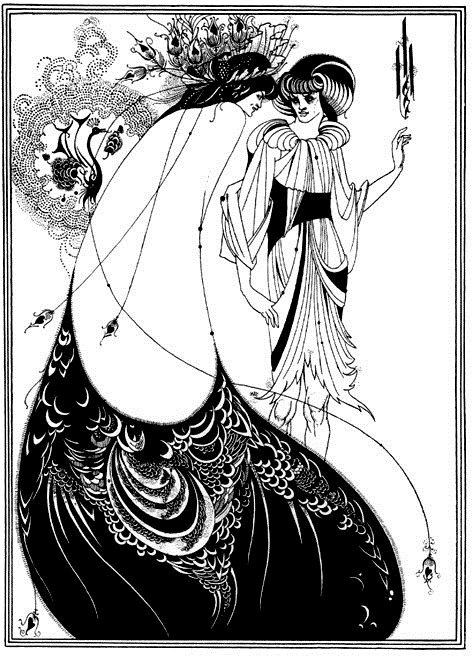
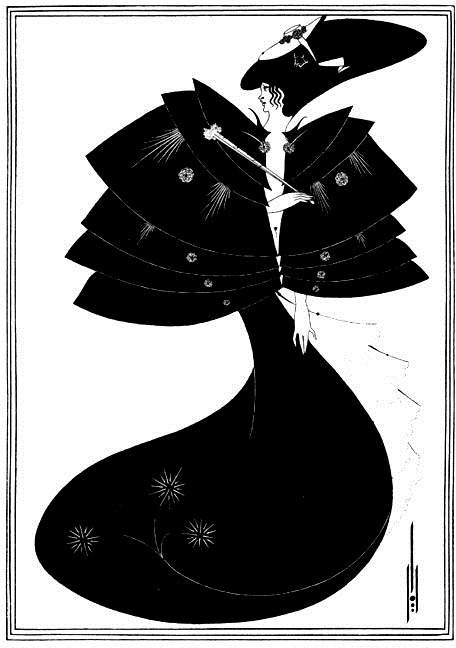
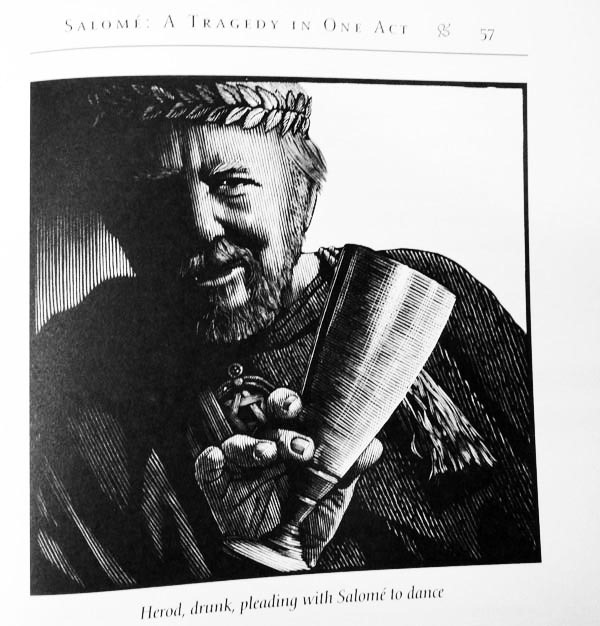
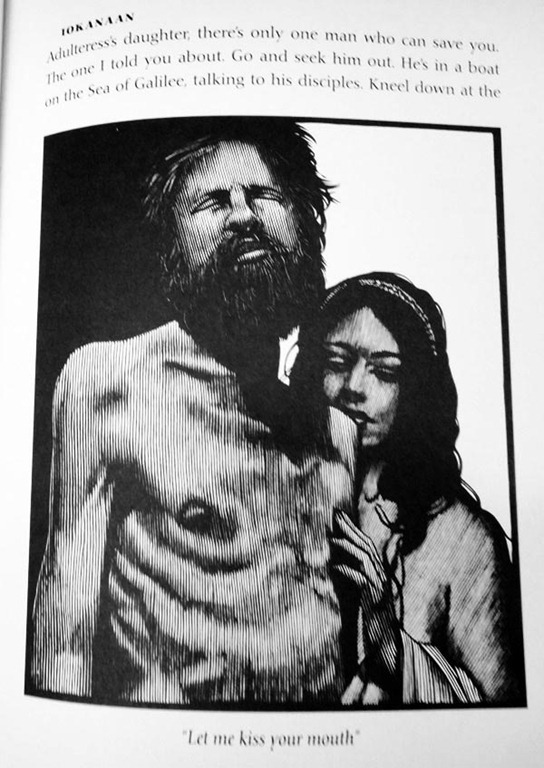
University of Virginia Press last month issued a new translation (by Joseph Donohue) of Oscar Wilde’s Salome with illustrations by Barry Moser. The more familiar version of Salome was an amateur translation done by Wilde’s boyfriend, Alfred Douglas, with illustrations by Aubrey Beardsley.
Here is the story as related by Joseph Donohue:
In June of [1892], while Lady Windermere’s Fan was still running and well before Salome was published, the famous French tragedienne Sara Bernhardt and her company were rehearsing a French-language production of Wilde’s tragedy, as a kind of epilogue to her current London season at the Royal English Opera House. Before it could open, the performance was barred by the Lord Chamberlain on the advice of his censor, E. F. Smyth Pigott, the Examiner of Plays, officially on the grounds of a long-standing prohibition against biblical characters on the English stage. Unofficially, in a note to a colleague, Pigott had condemned the play as “a miracle of impudence, … half-biblical, half-pornographic.” Pigott would later be described by Bernard Shaw as a “walking compendium of vulgar insular prejudice,” but for the moment the damage had been done ….
Under these less-than-propitious theatrical circumstances, the translation of Salome into English … by a young post-Oxford student, Wilde’s friend and clandestine lover Lord Alfred Douglas, appeared in print [in] 1894…. Notorious from the moment of its existence, thanks to the unsavory reputation of the French original, Douglas’s English version was accompanied by a series of illustrations by Aubrey Beardsley that sensationalized Wilde’s play even further and effectively mischaracterized it as well. Wilde’s own view was that Beardsley’s illustrations had transformed something quintessentially Byzantine into something oddly Japanese….
A new translation should be complemented by its own set of illustrations. At the very least, these illustrations should have nothing in common with those very “Japanese” pieces Beardsley had contributed to the first English translation, published more than a hundred years ago. It also seemed crucially important that they be more in keeping with the style and subject matter of Wilde’s original play than were those earlier, curiously arch images, the product of a coy insider, suggestive primarily of Beardsley’s own eccentric, self-conscious brilliance and his knowing take on contemporary salon life. Who might achieve such insight? I knew of no one more likely to capture the spirit of Wilde’s play than the American artist and illustrator Barry Moser. Barry’s immediate expression of interest was all that I needed to put my speculations to the test.
I wanted to use this post as a chance to compare the vastly different illustration strategies of Wilde and Beardsley, but when I looked again at Beardsley illustrations, I have to say I was scandalized. Even to a 2011 viewer, they push the envelope. (If you wish to view them, though, you can find them here.) I found a pair of Beardsley Salome illustrations that were somewhat less prurient, and show them here juxtaposed with Barry Moser’s illustrations:

Here is Donohue on his translation strategy:
In its own day, Douglas’s rendering of Wilde’s French Salome created a text, at once wooden and rarefied, reminiscent of Swinburne’s Atalanta in Calydon and other pseudo-Shakespearean closet dramas of the Victorian age and which now, to our ears, seems rendered in a moribund language having in common with Wilde’s oracular prose….
As I contemplated the frequent republication of the Douglas translation and its seemingly inevitable choice as the basis for revivals of the play, I continued to wonder what might happen if a translation more attuned to the English spoken in the United States in the late twentieth century or (as time went on) the early twenty-first were prepared…. One purpose of the experiment was to find out whether or not an up-to-date, colloquial yet spare English translation of Wilde’s consciously stylized French – an invented dialect permanently at odds with the the lofty standards of the Académie française – required a King James biblical lexicon to do it justice….
In its time Douglas’s intentionally archaic language, so familiar, so safe, had the effect of shielding his audience behind a certain protective bulwark of cultural comfort, masking to an extent the radical tendencies of the drama. The more colloquial, familiar, up-to-date idiom I sought to achieve would sure close off that kind of convenient esthetic refuge, forcing my audience into direct confrontation with some vividly unorthodox characters – most especially the strong-willed teenage princess of Judea – and with some unwelcome, uncomfortable, or even intolerable truths, as well.
For example, consider the point later on in the play were Wilde’s exasperated, desperate Herod, completely out of patience with his wife Herodias’s incessant interruptions, says to her, “Taisez-vous. Vous criez toujours. Vous criez comme une bête de proie. I l ne faut crier comme cela. Votre voix m’ennuie. Taisez-vous, je vous dis.” Douglas’s stilted, overly repetitive, colorless rendering – “Peace! You are always crying out. You cry out like a beast of prey. You must not cry in such a fashion. Your voice wearies me. Peace, I tell you!” – badly needed replacement by something much more peremptory and blunt, while also capturing the audible undertone of Herod’s weakness and ineffectuality. Wilde’s deliberately repeated “criez/criez/crier” works in French but proves awkward in English….
My answer, then, to the challenge of effectively rendering Herod’s speech reads as follows: “Stop it. You’re always mouthing off. You sound like a predatory animal. You just can’t talk like that. Your voice makes me crazy. Stop it, I’m telling you.” This approach replaces the awkward repetition of Douglas’s “crying/cry/cry” with the more natural, anglophone variety implicit in “mouthing off/sound like/talk like” while still capturing a certain more subtle repititiousness in “You’re/You/You/Your” and “like/like,” and also surround these locution with the peremptory, coda-like repetition of “Stop it/Stop it.”
In Terms of Words, 2011 a Revolutionary Year
Indeed, some words that originated in the spontaneous and unorthodox social media have been finally accepted by the Oxford English Dictionary (OED), which is by far the most formal dictionary of the English language.
First, don’t miss Theophrastus’s post/link, “2011: the year in language.” Now, how many of these words do you use or know? Here’s the beginnings of a list (and do you know the new meanings of the last four words?) —
LOL
OMG
“abatement notice”
“adaptive expectations”
“adult child”
“cyber-bully”
“worried well”
“zero emission”
“cyberfriend”
“cyberlover”
“cybersnob”
“abhuman”
“adulticide”
“abundante cautela”
“abuela”
“abuelo”
“gordita”
“bruising”
“charger”
“speculate”
“warrant”
Do you know where the milk is?
Yesterday we talked about Michael Dummett.
Here is Dummett recounting his first and only meeting with Ludwig Wittgenstein: “Do you know where the milk is?” (audio recording 1 minute 27 seconds)
Here is Dummett explaining the importance of Gottlob Frege. (audio recording 13 minutes 20 seconds)
(HT: Philosophy Bites)
Michael Dummett dead
 One of my personal heroes died yesterday, Michael Dummet (Oxford). Not only was Michael particularly important in my own philosophical development, but I greatly admired the way he fought tirelessly against racism, his commitment to religion, and his commitment to family (he was married for 60 years.) Some of my comments about backward causation were inspired by Dummett’s interest in the subject.
From the Guardian obituary:
Sir Michael Dummett, who has died aged 86, was one of the greatest British philosophers of the 20th century. He was also an international authority on tarot cards, a campaigner for racial justice and a devoted family man. His wife, Ann, was a co-worker in his fight against racism and collaborated with him on a number of publications on the subject.
Dummett was a staunch advocate of analytic philosophy, the fundamental tenet of which he took to be that “the philosophy of language is the foundation of all other philosophy.” He also once characterised it as “post-Fregean philosophy,” the 19th-century German philosopher Gottlob Frege having done as much as anyone to treat the philosophy of language in this way. Much of Dummett’s own work was accordingly devoted to the interpretation and exposition of Frege’s ideas, and he will be as well remembered for his exegesis of Frege as he will for his own seminal contributions to analytic philosophy.
Frege held that the way in which the words in a sentence combine reflects the structure of the thought that the sentence expresses. In the sentence “Michael smokes,” a proper name combines with a verb so as to express the thought that a particular person, Michael, indulges in a particular activity, smoking. This thought is true if Michael does in fact smoke, and false otherwise.
On this apparently innocuous and simple basis, Frege erected an elaborate set of ideas that have had an immense influence. Nevertheless, Dummett believed that Frege made certain assumptions concerning truth and falsehood that could be called into question. Frege allowed for the possibility of a thought that was neither true nor false. An example would be the thought that Father Christmas smokes. Given that there is no such person as Father Christmas, then neither is there anything to make this thought true or false. But Frege was not in the least reluctant to admit that a thought could be true or false without our having any way of telling which. An example might be the thought that Plato would have enjoyed smoking. This is what caused Dummett to pause.
He did not see how we could understand a sentence without having some way of manifesting our understanding. And he did not see how we could manifest this without being able to tell whether the thought expressed was true or false. So the assumption that a given thought could be true or false even though we had no way of telling which – an assumption that Dummett called “realism” concerning the thought – was immediately problematical.
Not that Dummett flatly denied this assumption; his point was only that it needed justification. He was issuing a challenge. Although the challenge was something close to a lifelong crusade, he undoubtedly retained a sympathy for realism. It was as if he was engaged in a continual internal struggle with himself. Furthermore, it is hard to escape the feeling that this in turn had something to do with his deep religious convictions, many of which may well have had a realist cast which the philosopher in him found problematical.
It is certainly true that, although he rarely made explicit contributions to the philosophy of religion, what he did write was often motivated by religious concerns. One topic about which he wrote a great deal, for example, was the possibility of backward causation. Certainly, his interest in this derived from an interest in the efficacy of retrospective prayer.
No one who witnessed Dummett engage in debate could fail to be struck by the passion with which he upheld his philosophical views. Nor could anyone who came into professional contact with him fail to be struck by the passion with which he defended all that was precious to him in academia. In 1984, for example, he resigned from the British Academy, partly because of his belief that it had failed in its duty to defend universities against funding cuts.
Indeed, Dummett seemed to be constitutionally incapable of undertaking anything half-heartedly. Not only was similar commitment manifest in the way he lived out his Christianity (he converted to Catholicism when he was a young man) and in the tireless way in which he opposed racism in all its forms, there was even evidence of it in his recreational interest in the history of card games.
Dummett was uncompromising in his convictions. This often led to bruising encounters with opponents. But although his opposition to another person’s views could occasionally spill over into opposition to that other person, his sole motivation was a desire to see truth prevail.
He also took great pleasure in the good things in life, and had a wonderfully infectious sense of humour. He was always a generous and inspirational teacher. He never lectured twice on exactly the same material, preferring to maintain as much freshness as possible in his delivery. It was impossible to hear him lecture and not to have a profound sense of thought in action. He would pace up and down, cigarette in hand, pausing periodically to formulate in his own mind how best to proceed, referring only occasionally, if at all, to his notes. The upshot would always be a beautifully structured and wonderfully conceived argument in which ideas about the most abstract topics were seamlessly woven together.
In supervisions with his graduate students, he was similarly intent on the issues, but with an additional determination to see what his students were getting at. He inspired not only great philosophy but great affection….
Dummett’s many non-philosophical publications included books on immigration, Catholicism, tarot cards, and voting procedures (he devised the Quota Borda system of voting), as well as Grammar and Style for Examination Candidates and Others (1993), the culmination of his relentless fight against low standards of literacy.
That fight occasionally found amusing expression in his other work. His last book on Frege included a delicious footnote in which, having forestalled a possible misunderstanding of one of the sentences in the main text, he went on to lament the fact that the only reason for the note was that few writers or publishers nowadays “evince a grasp of the distinction between a gerund and a participle.” He continued, with characteristic tetchiness: “People frequently remark that they see no point in observing grammatical rules, so long as they convey their meaning. This is like saying that there is nothing wrong with using a razor blade to cut string, so long as the string is cut. By violating the rules, they make it difficult for others to express their meaning without ambiguity.”…
The Junia Evidence: VI and the reliability of software
I have found that Junia is not only an interesting topic of research herself, but that she is also a handy person around which to organize other thoughts and principles. I hope that my upcoming posts on Junia will contain enough new material, of general application, to be found useful to the reader. So this post is going to be about the reliability of Bible software.
To summarize the preceding posts, the evidence that Junia is among the apostles is based on
1) the unbroken witness of Greek literature from the New Testament era up to the present
2) the unanimous tradition of translating Andronicus and his partner as “among the apostles” in all Bible translations until the 21st century
3) the near universal agreement that Junia was a woman (I will touch on this in a future post)
4) the overwhelming weight of grammatical evidence that the person in the grammatical construction. translated in the KJV as “noted among the apostles,” was a member of the group. There is one exception to this, which suggests to me that the dialogue on Junia could continue into the future.
What is striking about this case, is that the article on which the reading “Junia …. well-known to the apostles” is based, cannot be defended. Therefore, the reading “well-known to the apostles” has no published scholarly foundation.
I have thought a lot about how something like this could happen, and I think it would be worthwhile picking apart more of the argumentation on this issue. In 2006, Wayne Grudem wrote a response to a comment of mine on the Wallace and Burer article. I had written,
“It is now well-known that Wallace and Burer misquoted Psalm of Solomon in their article. They actually mistook a noun for an adjective. In fact, Dr. Grudem’s entire section on Junia is riddled with factual errors.”
(First, let me just say that when I used the phrase “riddled with errors” I was engaging in the time-honoured game of pingpong. I was returning Grudem’s serve. “Riddled with errors” was a phrase that Dr. Grudem used several times for the work of other respected scholars in his book Evangelical Feminism and Biblical Truth. I was just picking the phrase out of his book and offering it back to him, in, what seemed to me at the time to be allowable irony. I now regret responding to him in kind, but I admit that that is what I did.
But here is the point. Wallace and Burer did cite episemos as an adjective in their article. However, in the New English Translation of the Septuagint it is considered to be the noun episemon. I hold to that view. But this difference of opinion was not mentioned in the W & B article. And in Mike Burer’s discussion in this post, he fell short of providing adequate rationale for considering episemos an adjective. (See note below. ) So why did Dr. Grudem, and Wallace and Burer, consider episemos to be an adjective in Pss. Solomon 2:6? Here is a clue. Dr. Grudem put it like this,
4. Bible Works parses episemos in Psalms of Solomon 2:6 as an adjective, which makes most sense in the context. This gives Burer and Wallace’s meaning, that the Jewish captives were “a spectacle visible among the gentiles.” This argues that McCarthy is wrong to say “they mistook a noun for an adjective.” Did Bible Works also mistake a noun for an adjective?
Now it is five years later. I can only say that, on reflection, “Yes, I believe that Bible Works mistook a noun for an adjective.” That is my assessment. And there is a world of students out there using software – to learn Greek, to understand the Bible better, and to defend their choice of Bible Version. I mention this because, in my view, reliance on software needs to be rolled back. Who wrote the software? Think about it. That person is a fallible human being, just like anyone else. There is no Bible verse “Software who art in code, hallowed be thy text.”
I’ll demonstrate another case where software falls down. On this site, there is a clickable lexicon for each word. The meaning for diakonos, the word used for Phoebe in Romans 16:1, is listed in this way,
διάκονος,n \{dee-ak’-on-os}
1) one who executes the commands of another, esp. of a master, a servant, attendant, minister 1a) the servant of a king 1b) a deacon, one who, by virtue of the office assigned to him by the church, cares for the poor and has charge of and distributes the money collected for their use 1c) a waiter, one who serves food and drink
Nothing wrong with that. It is gender inclusive and concise. But at the side of this entry one can read “Case A, Number S, Gender F.” This means that the word is accusative case, singular and feminine. I have often seen the argument that since the word used for Phoebe’s office is feminine, that means that she was filling a feminine role.
I was puzzled about this for a long time because I was not aware that the word diakonos was feminine. Why not? Because I was more familiar with an entry like this, from Thayer’s Lexicon – “masculine/feminine noun.” The word is considered to be of common gender, and there is no lexical difference between the feminine and masculine forms of the word. There is only one form, which may be modified by a masculine or feminine adjective, depending on the gender of the person referred to. The entry on Greek Bible would not make that information available to the reader. Consequently, I have often read posts about women being “deaconesses”, that mention the fact that this word is feminine. I conjecture that this may be another software-derived misunderstanding. While you can parse the word diakonos as functioning grammatically like a feminine noun, the lexical entry ought to record that it is a noun of common gender.
Note:
For those who still wonder why I persist in claiming that episemos is a noun in Pss. of Solomon 2:6, let me offer Mike Burer’s explanation. He wrote about this citation (τοῖς ἐπισημοτάτοις τῶν νομῶν),
The phrase in P.Oxy. 1408 is governed by ἐν, and the word τόποις is not in the text of the papyrus (although the editors do suggest that its omission was a mistake on the part of the original author of the papyrus); this is a nice parallel to the text in Ps. Sol. 17:30. Thus there appeared to be an idiom in Hellenistic Greek which allowed the adjective ἐπίσημος when it referred to a place to stand alone, the noun τόπος being elided. This makes a great deal of sense when applied to Ps. Sol. 2:6: “their neck with a seal in a [place] well-known to the nations.” Understanding this idiom to be in play allows one with warrant to interpret ἐπισήμῳ in that text as an adjective, not as a noun, even though it is preceded by ἐν.
How can one possibly say that “thus there appeared to be an idiom” (which allowed the adjective episemos to stand alone, with the noun topos elided), just after admitting that the editor of the text thinks that the word topos was elided as a mistake? This makes no sense to me. I don’t know how such an argument can be used in the undertaking of Bible translation. It just seems speculative and iffy. It feels as if one has wandered into an alternate reality.
Junia is not alone
Junia Is a Woman, and I Am a Complementarian
Denny Burk’s Complementarian Cover-up
The Junia Evidence: I
The Junia Evidence: II
The Junia Evidence: III
The Junia Evidence: IV
The Junia Evidence: V
Was Junia Really An Apostle by Burer and Wallace
Linda Belleville’s article
Michael Burer Enters the Junia Debate
Reassessing Junia: A Review of Eldon Epp’s Junia: The First Woman Apostle
Due Diligence on Junia and Apostleship
Matt Colvin on Junia and Apostleship
Some Lengthy Thoughts on Women’s Leadership
A Closer Examination of Junia, The Female Apostle
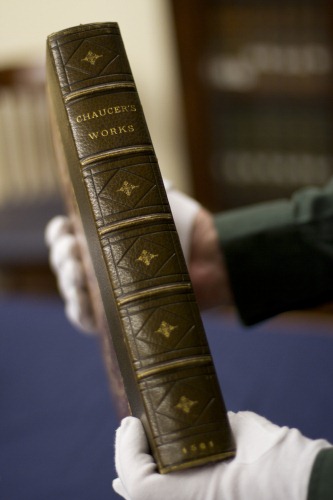
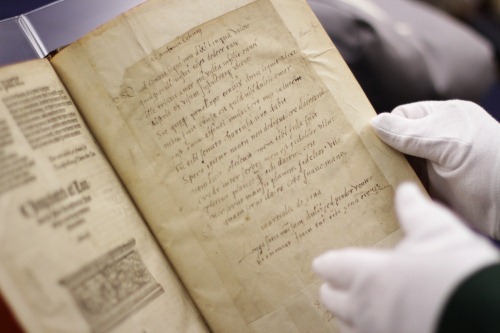
Racy love poem found in 1561 edition of Chaucer
Chaucer is a definite hero at the BLT blog, as he was a translator, the “father” of English literature, and frequently quoted and adapted the Bible. But as a bonus to readers of Chaucer, there is always the possibility of coming across a racy love poem.
Translated from Latin:
To Anthony Cooke
The goodbye I tried to speak but could not utter with my tongue
By my eyes I delivered back to yours.
That sad love that haunts the countenance in parting
Contained the voice that I concealed from display,
Just as Penelope, when her husband Ulysses was present,
Was speechless—the reason is that sweet love of a gaze.
Then afterwards Ovid sends greeting muses to the absent,
Just as to you, distant, I have sent my small note.
I hope then that silent Dacre will not be scorned by you
For the mind has suffered and held fast in faithfulness to you.
Believe that among servants there is not any more faithful:
As Plancus Plotinus thus will Dacre be to you.
I remain your servant Plancus, more faithful than any;
To this servant Dacre, you remain sweet Coke.Epigram written by Martial, ‘Of the girdle’
Long enough am I now; but if your shape should swell under its grateful burden, then shall I become to you a narrow girdle.
The story is told here, here, and here:
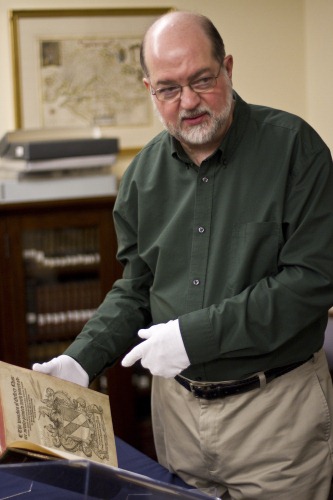
Florida State University Professor Elaine Treharne was giving a lecture at West Virginia University when she visited the university’s rare book collection. She happened to open a 1561 edition of works by Geoffrey Chaucer and saw a Latin poem pasted in the back of the book….
The poem was written by Elizabeth Dacre, née Leybourne, a Catholic noblewoman, probably sometime after 1555, when she married her first husband Thomas Dacre at age 18 or 19. Its [Protestant] recipient [Anthony Cooke], the tutor of King Edward VI (and possibly also Elizabeth’s tutor), would have been significantly older than Elizabeth—and in exile, after a short stay in the Tower of London in 1553 under Mary I.
Not much more than that is known: Did the two have an affair? Did Dacre ever send the poem? Did she love Cooke, or was the poem simply an "academic exercise"? Treharne thinks Dacre’s feelings were genuine: “I actually do really genuinely believe that she was really in love with her tutor,” she told the WVU communications department. “It has that level of intimacy and playfulness about it. At the very least it’s cheeky, and it’s much more likely to be an indicator of a very, very personal and illicit—totally illicit—relationship.”
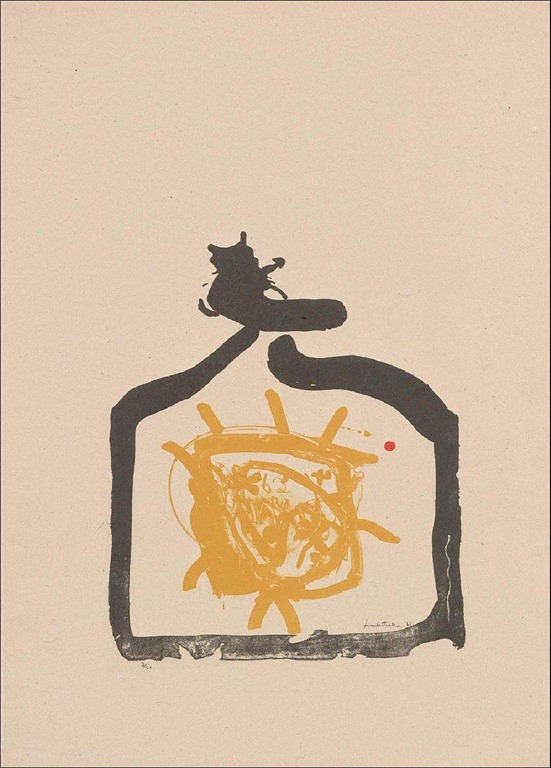
Goodbye Helen Frankenthaler
I am particularly saddened by the death of Helen Frankenthaler, one of my favorite abstract expressionist artists.
You can read her obituary here – I’d rather show some pictures of her and her art work.







Mountains and Sea (1952, National Gallery of Art, Washington DC)
May 26, Backwards (1961, Smithsonian American Art Museum)

Canyon (1965, The Phillips Collection)

Savage Breeze (1974, Museum of Modern Art, New York)

Desert Pass (1976, Smithsonian American Art Museum)

Essence Mulberry (1977. Museum of Modern Art, New York)
Eight candles
Nice or not nice? You decide.
From Hiruhim-Musings:
Chanukah is less an orphan holiday than Shavuos but it still received little attention in ancient rabbinic literature. Lacking classical texts — the books of Maccabees are outside the Jewish canon and the Talmud discusses the holiday only briefly — contemporary rabbis have to be creative in crafting discussion material for the holiday. Sermons and lectures generally focus on the limited topics of the “Al Ha-Nissim” prayer, the Rambam’s description of the holiday and minutia of candle lighting. One issue that has captured rabbinic imagination is what has become known as “the Beis Yosef’s question.”
R. Yosef Karo, in his Beis Yosef (Orach Chaim 670), asks why we celebrate Chanukah for eight days. According to the Talmudic explanation of the holiday (Shabbos 21b), when the Jews reconquered the Temple they found a single, sealed bottle of pure oil that would last for only a day but miraculously lasted for eight days until more pure oil could be manufactured and delivered. R. Karo asks why we celebrate Chanukah for eight days, since no miracle occurred on the first — only on the subsequent seven days.
R. Karo offers three answers to this question but subsequent thinkers have challenged them and offered alternatives. His is the question that launched a thousand sermons. In 1962, R. Yerachmiel Zelcer published his Ner Le-Me’ah, a collection of 100 answers to the Beis Yosef’s question. Many of the answers are similar and some do not withstand scrutiny, which R. Zelcer is quick to point out. They occasionally enter esoteric topics such as the purity of utensils and sacrificial rites, and frequently offer unsupported historical speculations. Yet the true joy of the book is the thrust and parry of proofs and counterproofs, the debates spanning centuries into which R. Zelcer takes readers, frequently offering his own critiques and insights. I would have written the book differently, focusing less on Chasidic texts and organizing the chapters more topically. Additionally, the 100 chapters do not directly correspond to 100 answers — some have more than one and some have none. However, these are less criticisms than a statement of personal preferences.
What follows are extremely brief summaries of 25 answers from R. Zelcer’s enjoyable book. The first three are offered by the Beis Yosef and the rest by others. I include the chapter number in the book for reference:
- They divided the oil into eight parts and used one-eighth each night (ch. 1)
- After they filled the menorah each night, the bottle of oil was miraculously refilled (1)
- On each morning, they found the menorah refilled with oil (1)
- Not all the oil burned the first day so a little would remain on the second, because a blessing/miracle can only impact an existent item – Taz (3)
- One day of Chanukah celebrates the military victory – Pri Chadash (4)
- The first day commemorates the rededication of the Temple by the Hasmoneans – Shiltei Giborim (5)
- The eight days correspond to the eight days of circumcision, which the Greeks outlawed – Sefer Ha-Itim (5)
- The receptacles used as a menorah were broken and could not contain a full day’s amount of oil but still miraculously burned for a full day – Maharsha (6)
- The first day commemorates the dedication of the Second Temple when it was built – R. Yaakov Emden (7)
- Finding the bottle of pure oil was in itself a miracle – Eshkol (8)
- The Geonic work She’eiltos has a different version of the Talmudic passage (as it often does) which reads that they did not even have enough oil for one day (although the Netziv argues it is a copyist’s error in the She’eiltos) (9, 17)
- There was only enough oil for the first night but the menorah must be lit all day also – Birkei Yosef, Cheishek Shlomo (9)
- They were forbidden to extinguish the fire on the morning of the first day in order to conserve oil yet the oil continued burning through the eighth evening – Zayis Ra’anan (10)
- The eighth day is celebrated out of doubt, as all holidays are observed outside of Israel – Birkei Yosef, Toldos Ya’akov Yosef (both reject this) (11)
- They planned on using multiple wicks dipped in the oil but the original wicks miraculously lasted all day – Chasam Sofer (12)
- They lit in the courtyard rather than the inner chamber. The greater wind created a need for more oil – Chasam Sofer (13)
- The month of Kislev was short that year but is now long (29 vs. 30 days). We still observe the holiday from 25 Kislev through 2 Sivan even though it is now eight days rather than the original seven – Chasam Sofer (14)
- On the first day, after they found the bottle with only enough oil for one day, it miraculously became enough for eight days – R. Yaakov of Lissa (15)
- There was enough oil for lighting the menorah but not for relighting the western light in the morning, as it was each day – Chemdas Shlomo (16)
- They thinned the wicks so they would only use 1/8th of the oil. The miracle was that the flame was as strong as if they used full wicks – Chidushei Ha-Rim (19)
- The bottle only had enough for one light for one day but it lasted for all seven lights for eight days – Chidushei Ha-Rim (20)
- They lit the menorah before dark on the evening of 24 Kislev, so the miracle also applied to the end of the first day – Chidushei Ha-Rim (21)
- We are not allowed to make a replica of Temple utensils. We therefore celebrate for eight days so the menorah will have eight branches, rather than seven like the Temple menorah – Sho’el U-Meishiv (23)
- Eight days like Sukkos – Bnei Yissaschar (27)
- The miracle was not in the quantity of oil but the quality, that it burned eight times slower than normal, which also occurred on the first day – R. Yosef Engel, R. Chaim Soloveitchik (36, 25)
Some wag claimed that Chanukah was not so much a festival as a siege. If you want to relieve this siege, previous posts are here: One candle, Two candles, Three candles, Four candles, Five candles, Six candles, Seven candles.
Rabbi Marmur writes clearly “through a glass darkly”
In his post, “Can the word of God be translated?,” Dow Marmur “rabbi emeritus” at Toronto’s Holy Blossom Temple concludes:
Apparently, whether or not they approve of the KJV neither believer nor detractor has been able to do without it.
Apparently, even though Rabbi Marmur seems to be a detractor of the King James Version of the Bible, he himself ironically has not been able to do without it. In the middle of his essay, he writes:
Perhaps it’s to eliminate such issues that the synagogue insists on reading scripture in the original. It seems that every translation, however seemingly impressive and ostensibly accurate, will only allow access to the text as if through a glass darkly. Knowledge of Hebrew has, therefore, become a fundamental requirement in Jewish education.
He would be quoting Saul/Paul’s Greek phrase to Korinthian readers — βλεπομεν γαρ αρτι δι εσοπτρου εν αινιγματι (blepomen gar arti di esoptrou en ainigmati) — if he weren’t quoting the KJV phrase from “1 Corinthians 13:12” — “For now we see through a glass, darkly.” (Here’s the oped article.)
Downton Abbey
I must have been in deep isolation, not to have become familiar with the series of year. Yesterday I watched 6 straight hours of the first season of Downton Abbey, and this morning I found season 2 online. I have been interspersing episodes with chapters of Grand Pursuit and have found this makes both more meaningful and enjoyable. Labelled on Amazon “An addictive blend of suds and social commentary” it does not disappoint. I soon found that many of the negative reviews derive from one brief early interaction between homosexual lovers. This was not nearly as odd as the scene where a particularly handsome young man dies – off screen – as he attains satisfaction with his love object. The first scene works into the plot in a plausible way, and becomes just one more of the many twists and turns in the plot. The second is simply awkward, and one wonders if a more likely means for the main character to lose her virtue could not have been provided. In retrospect, it is best to regard that scene as burlesque humour. Overall, the series is very satisfying and Maggie Smith is her usual dominant and articulate self.
From Wikipedia,
Reception of the programme was predominantly positive; ratings were extremely high for what is usually considered a “genre” show, and the first series picked up a number of awards and nominations after its initial run. It has subsequently become the most successful British costume drama since the 1981 television serial version of Brideshead Revisited,[1] and in 2011 it entered the Guinness Book of World Records as the “most critically acclaimed television show” for the year, becoming the first British show to be so recognised.[2]
The plot hinges on the same problem as that in Pride and Prejudice. Lord Grantham has only daughters, and cannot break the entail of the property for financial reasons. The eldest daughter, Mary, might have been able to attract the affections of the heir and distant cousin, Mathew, who is no Collins, but a modest and hardworking lawyer. However, she botches it early on and the cousin withdraws his proposal. Mary and Mathew, thrown together socially, and both concerned with the welfare of the estate, maintain a relationship of alternating distrust, cousinly affection and sexual attraction, creating one of the romantic tensions in the series. Much of the action and further romances take place among the servants, where the inequalities of the class system and gender intermingle. In the second season, Mathew is sent to France and World War I dominates.
Big in Japan: Polya’s How to Solve it

 In a memorable post on 2011 in the Japanese book industry, Néojaponisme (Matt Treyvaud) mentions that a big seller this year was the 1975 Japanese translation of George Polya’s mathematics book How to Solve It. I had trouble believe it at first. I read this book (in English!) when I was a kid, but it is fairly dated these days; and it seems unlikely to become a best-seller based on a 36 year old translation.
Nonetheless, Néojaponisme is undoubtedly correct:
Rank of How to Solve It on Amazon.com: #13,612
Rank of いかにして問題をとくか on Amazon.jp: #380

 I have to wonder if this is a spin-off of the recent math boom in Japanese books (as typified by the unexpectedly strong sales of the math romance series 数学ガール(the first volume has been translated into English as Math Girls.) The premise that math is a good way to for high school boys to find romance seems rather tendentious, but it is enough to propel Hiroshi Yuki through four novels and three comic books.
Here is a memorable quote from Néojaponisme’s post on technology and books:
Was the New Yorker‘s story on keitai shōsetsu (mobile phone novels) really published in 2008? It feels like only yesterday that commentators were either hailing or denouncing the arrival of a new genre — Shōnagon-meets-Chikamatsu, crowd-sourced to a million young women on commuter trains. Where is our god now? (Spoiler: On Twitter.)
While tempting to give the iPhone credit for the fall of the mobile phone novel, clamshell cellphones and carefully managed sub-internets are far from dead in Japan. Despite what was generally perceived as a rocky start in the Japanese market, however, it’s hard to deny that the iPhone is an influential presence here now too. The app-ification of everything is putting serious pressure on 1999-vintage online services, and why labor over yet another tale of high-school agony when you have dozens of Twitter followers waiting to hear about the much more involving topic of yourself? It’s probably too early to declare keitai novels dead altogether — they still have their own section at most bookstores — but they have certainly lost their luster, as has the cousin genre of “manga essays.”
So what were people reading instead? Well, Twitter.
Anniversaries in 2012
I love celebrating anniversaries of births. In 2011, we had a big one – the 400th anniversary of the King James translation.
Here are some forthcoming anniversaries of famous writers who I have read (in the original or translation):
- 100th anniversary: Jorge Amado, John Cheever, Lawrence Durrell, Jacques Ellul, Gil Evans, Alexis Kagame, Mary McCarthy, Kim Philby, Joseph Stein, Julian Symons, John Toland, A. E. van Vogt, Patrick White
- 150th anniversary: O Henry, Mary Kingsley, Mori Ogai, Arthur Schnitzler, Edith Wharton
- 200th anniversary: Charles Dickens
- 300th anniversary: Edward Moore
- 350th anniversary: Matthew Henry
- 400th anniversary: Samuel Butler, Thomas Killigrew
- 600th anniversary: Joan of Arc (I have not read any work that was actually written by Joan of Arc, but I have many read many works attributed to her – by Shakespeare, Schiller, Voltaire, Verdi, Tchaikovsky, Twain, Brecht, Shaw, etc.)
(Demographics: Australia 1; Austria 1; Brazil 1; Britain 8; Canada 2; France 2; Japan 1; Rwanda 1; Soviet Union 1 [I am counting Philby as a Soviet and not a Brit]; US 6; 20 male; 4 female)
Will we see Evangelicals celebrate Matthew Henry’s birthday (or even better – have a Samuel Butler-Mathew Henry fighting match?) Will we see a Dickens revival (there are entire bookstores that solely devoted to Dickens – I mean actual bookstores that one can walk in browse in, not “online bookstores.”)
Several of these writers are especially meaningful to me and I hope to post on this blog about them.
I found this site invaluable in searching birthdays.What anniversaries are important to you in 2012?
Seven candles
Nice or not nice? You decide.
(HT: Frum Satire)
Previous posts: One candle, Two candles, Three candles, Four candles, Five candles, Six candles.
the status of Jamaican Patois: a “comparison” of a new New Testament with CUSS-CUSS by Louise Bennett-Coverley?
The BBC’s Robert Pigott reports that
Many … see the elevation of patois as a backward step for Jamaica, in a globalised world demanding English.
The presumed “elevation of patois” that Pigott is reporting on is a new New Testament translation project. In his article “Jamaica’s patois Bible: The word of God in creole,” Pigott gets at the fears that Patois will replace not only English but also Patois-English bilingualism. The government is promoting use of English as a language of wider communication. A group of NT translating linguists at the University of the West Indies in Kingston is creating a phonetic writing system and grammar that might give the status of a legitimate language to the creole.
What Pigott only hints at is that Patois already has status, that it already empowers its users, that it doesn’t necessarily threaten the use of English, that feminist-poet-educator Louise Bennett-Coverley started much.
The BBC reporter includes in his article a couple of videos of contrasts: one video is of a discussion about the New Testament translation (with mostly and finally a male – a clergyman? – doing the talking) and the other video is of “[t]wo girls from St. Richard’s Primary School in Kingston Jamaica, [who] perform the Patois poem Cuss Cuss by Jamaican poet and activist Louise Bennett.”
An excerpt from “Luke, chapter one, verses 26-28” is given from the newly-transcribed Patois:

But in Pigott’s article, neither an English version of the Luke passage nor any written version of Bennett-Coverley’s poem “CUSS-CUSS” is provided. Please find these below.
Here’s the New International Version in English 1984 [with the little update of 2011 inserted below in brackets]:
26 In the sixth month [of Elizabeth’s pregnancy], God sent the angel Gabriel to Nazareth, a town in Galilee, 27 to a virgin pledged to be married to a man named Joseph, a descendant of David. The virgin’s name was Mary. 28 The angel went to her and said, “Greetings, you who are highly favored! The Lord is with you.”
Now here is Bennett-Coverley’s Patois poem:
Gwan gal yuh fava teggereg,
Ah wey yuh gwine goh do?
Yuh an yuh boogooyagga fren
Dem tink me fraid o’ yuh?
Goh wey, yuh fava heng-pon-nail,
Is me yuh want fe trace?
Me is jus de one fi teck me han
An leggo pon yuh face.
Fe me han noh jine chu ch an me naw
Pay licen fe me mout’,
Me wi tell yuh bout yuh–se yah
Gal noh badda get me out.
Me noh know is wat kine o’ chu’ch
Fe yuh mout’ coulda jine,
Yuh lip dem heng dung lacka wen
Mule kean meck up him mine.
Gwan, me an yuh noh combolo,
Yuh foot shapeless an lang
Like smaddy stan far fiing dem awn
An meck dem heng awn wrang.
Fe yuh foot fava capital K,
Koo pon yuh two nose-hole!
Dem dis big an open out like
Miss Tane outsize fish bowl.
Goh wey, yuh kean bwile sof egg
But still yuh want get ring,
Noh man na gwine fe married yuh
Wen yuh kean do a ting.
Is grudge yuh grudgeful, me kean cook
But me ben goh dah good school,
Me got intelligency yuh
Illiterated fool !
Me sorry fe de man yuh get
De po’ ting hooden nyam
When you ackebus him salt-fish
An bwilivous him yam.
Now below are English translations of “CUSS-CUSS” (from respective bloggers here and here):
Not to be confused with Kas-Kas, this poem re-stages a tracing match (i.e. a quarrel) between two Jamaican women. Common cuss-words like “boogooyagga” (low-grade) “heng-pon-nail ” (bedraggled) are here liberally used. Opponents are sometimes subjected to the most unexpected similes as ” Yuh lip dem heng dung lacka wen Mule kean meck up him mine”.
—
Get away from here! you look like a vagabond!
What do you think you’re going to do?
You and your ragamuffin friends
assume I’m afraid of you?Get out of here! You resemble clothes on a stick.
‘Tis me you really trying to disgrace?
I’m just the one to use my hand
and let it fly into your face.My hands aren’t members of any congregation,
and I pay no license to communicate.
I will tell you about your — look here…
You better not get me irrate.I don’t know which church
your mouth could have joined,
your lips hang off your face
like a mule that can’t make up his mind.Go away, you and I aren’t friends!
Your legs are shapeless and long
as if someone threw them from a distance
and attached them quite wrong!Your feet look like a capital K,
and just look at those nose holes!
they are big and wide,
just like Miss Tane’s oversized fish bowl.Get out of here! You can’t even boil an egg
and yet you want a wedding ring?!
No man will want to marry you
When you can’t do a thing!You’re too envious. I can’t cook
but I definitely go to a good school.
I have high intelligence
you illiterated fool!!I’m so sorry for the man you get.
The poor soul would never eat a thing
when you ‘obliterate’ his rice,
and ‘illiterate’ his chicken wing.
Is the new NT translation really “elevating” Patois by giving this language a wider use? Does the fact that students, particulary girls, in Jamaican schools know Louise Bennett-Coverley and her poetry by heart already give a status to Patois and an agency to these young people? Is the translation project a continuation of the sorts of language promotion and education and feminist efforts of Bennett-Coverley? Will there be the sort of embracing of the Patois New Testament as there was for this poet and her works?
Wikipediaists note her reception:
In 1974, she was appointed to the Order of Jamaica. On Jamaica’s Independence Day 2001, the Honorable Mrs. Louise Bennett-Coverley was appointed as a Member of the Jamaican Order of Merit for her invaluable and distinguished contribution to the development of the Arts and Culture. She wrote her poems in the language of the people known as Jamaican Patois or Creole, and helped to put this language on the map and to have it recognised as a language in its own right, thus influencing many poets to do similar things.
Now, the BBC has reported:
The New Testament has been completed by a team of translators at the Bible Society in Kingston. They intend to publish it in time for the 50th anniversary of Jamaica’s independence from Britain on 6 August next year.
Given this timing, what are the political implications? What other long term changes, intended or not, might the new NT in Patois bring? Has the BBC suggested that the Bible Society is doing for the first time some of the things that Bennett-Coverley is known for? Is Pigott’s comparison of the Patois NT verses with lines from “CUSS-CUSS” really an inadvertant contrast? What do you think?
The Radical Camera
The Jewish Museum (New York) and the Columbus Museum of Art have put together what sounds like a very interesting photography exhibit: The Radical Camera: New York’s Photo League, 1936-1951.
It is reviewed in the New York Times, which tells something of the history of New York’s Photo League:
One of many artistic casualties of the McCarthy-era blacklists was the Photo League, a New York school and salon for amateur and professional photographers. Progressive in its politics and uncompromising in its aesthetics, the league was the place to be if you had a hand-held 35-millimeter camera and a left-leaning social conscience — and particularly if you believed, to borrow a bit of contemporary parlance, that photography was fine art for the 99 percent….
The Photo League had roots in the workers’ movement, though by the 1950s it was hardly the political center the blacklist made it out to be. The league evolved from an organization called Workers International Relief, founded in 1930, which produced an illustrated journal that was modeled on European Communist weeklies like The Worker’s Illustrated Newspaper.
By 1933 this coterie had started to focus on moviemaking and rechristened itself the Workers Film and Photo League, turning out Depression-era newsreels like the one excerpted at the beginning of “Radical Camera.”
Titled “Workers Newsreel Unemployment Special,” the film shows protesters gathering in Union Square to demand government assistance for the jobless. These timely visuals are accompanied by even timelier text: “In the richest country in the world, two billion dollars of relief for the bankers and industrialists … but no help for the unemployed.”
In 1936, the group’s photographers split off from its filmmakers, and the Photo League was born. But the social-documentary impulse of the group’s earlier incarnations remained….
By [1945] the league was a fully functioning school and exhibition space. It was also a social organization, a place where young men and women (many of them first-generation Jewish-Americans) could mingle at lectures and parties. It held popular “photo hunts,” sending members all over the city on wacky assignments, and fund-raisers called “Crazy Camera Balls.” (A cheerful flier for one of these reads, “Come dressed as your favorite photograph!”)
Just a few years later, though — on Dec. 5, 1947, to be precise — the league appeared on a list of organizations considered “totalitarian, fascist, communist or subversive” by the United States Attorney General. It responded with an open letter and a 1948 retrospective exhibition, “This is the Photo League.” But it was dealt a fatal blow during a 1949 trial of alleged Communist Party officials, when a league member turned F.B.I. informant called the Photo League a Communist front and singled out its leading teacher, Sid Grossman, as a party recruiter.
Membership became too dangerous. Newspapers and magazines snubbed league-affiliated photographers; photojournalists couldn’t get passports. In 1951, the Photo League closed its doors….
Here are some photographs from the exhibition:

Marvin E. Newman, “Halloween, South Side” (1951)
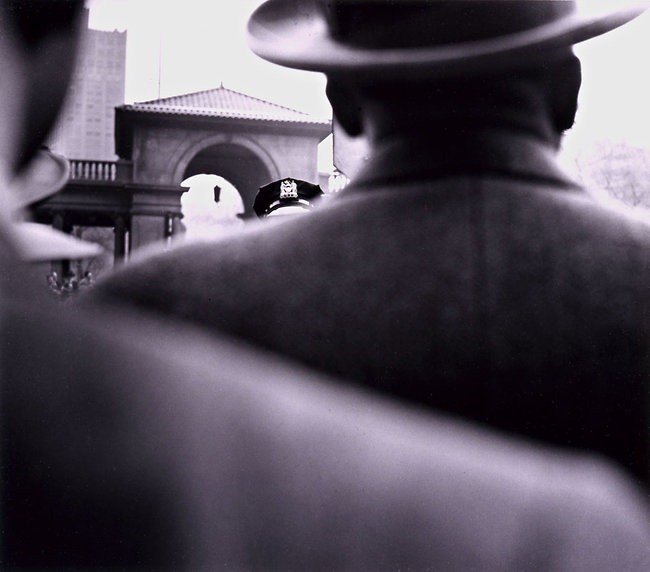
Jerome Liebling, “May Day” (1948)

Morris Engel, “Harlem Merchant” (1937)

Bernard Cole, “Shoemaker’s Lunch” (1944)

Elizabeth Timberman, “Easter Sunday” (1944)
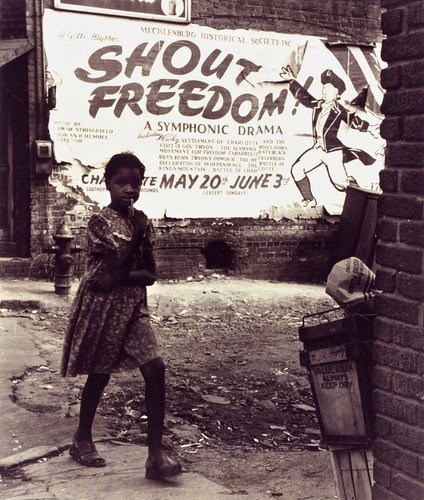
Rosalie Gwathmey, “Shout Freedom” (1948)
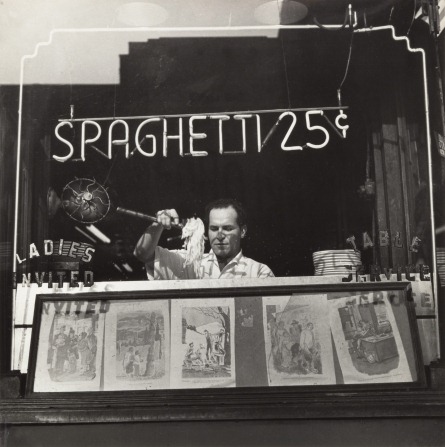
Ida Wyman, “Spaghetti 25 Cents” (1945)
I’m not certain that I will be able to attend this exhibition in person, but on Tuesday, Yale University Press is releasing the catalogue of the exhibit (currently priced on Amazon at $31.50.) Many more of the photographs are available online from the exhibit’s “artist” page.
Six candles
Nice or not nice? You decide.
And all the
Subway cars were hallelu-lelu-leluing
Hallelujah
Welcome back the baby king, the baby king
All the believers they were smiling
And winking at each other
I could honestly say I was
Scared for my life!They said:
All the non-believers, they get to eat dirt
And the believers get to spit on their graves
All the non-believers, they get to eat dirt
And the believers get to spit on their graves
All non-believers
All non-believers
All non-believers
All non-believers
All non-believers
All non-believersBelieve!
Believe!
Believe, believe, believe!
Believe!
Believe!
Believe, believe, believe!
Believebelievebelievebelievebelievebelievebelievebelievebelieve
Believe…
(HT: Kurk)
Previous posts: One candle, Two candles, Three candles, Four candles, Five candles.
Remembering Catherine Clark Kroeger and her study Bible
 Catherine Clark Kroger (Gordon Conwell Theological Seminary) died on Valentine’s Day of this year. She profoundly influenced Christian Evangelism in her tireless struggles against domestic abuse, her writings and teachings on equality, and through her forming organizations supporting these ideals include: Christians for Biblical Equality (CBE), Peace and Safety in the Christian Home (PASCH), and Men Women and God(MWG). At that same time, her work strongly followed in the footsteps of her mentor John Stott; as an example of her conservatism, she constantly was hostile towards gay rights.
 Perhaps as a Christmas gift, Amazon is currently selling one of Kroeger’s masterworks, her Oxford University Press The Women’s Study Bible, at 61% off, for a mere $13.65. This work is a fine introduction to issues of gender as they arise in the Bible – it is most certainly not an “advice for women” style Bible as most similarly titled works are. It is popularly written, but with reference to scholarship. At this price, it is a bargain.
Other Kroeger books include:
- No Place for Abuse: Biblical & Practical Resources to Counteract Domestic Violence;
- I Suffer Not a Woman: Rethinking I Timothy 2:11-15 in Light of Ancient Evidence;
- Refuge from Abuse: Healing and Hope for Abused Christian Women;
- The IVP Women’s Bible Commentary;
- Women, Abuse, and the Bible: How Scripture Can Be Used to Hurt or to Heal
- Healing the Hurting: Giving Hope and Help to Abused Women
- Responding to Abuse in Christian Homes: A Challenge to Churches and Their Leaders
- Beyond Abuse in the Christian Home: Raising Voices for Change
- The Goddess Revival: A Biblical Response to God(dess) Spirituality
- Reflections: Biblical and Otherwise about Sexuality
(I have not read most of the books on this list; the only Kroeger books I have read are I Suffer Not a Woman and The Woman’s Study Bible.)
I cannot admire Kroeger unreservedly – and her worldview is too different from mine for me to fully appreciate her contributions; but within her community, she was undoubtedly a real force. Given the ease with which a certain type of conservative Christianity is willing to turn a blind eye towards domestic abuse, I think voices such as Kroeger are important.
thought provoking manger scenes


HT James F. McGrath, who writes: “HT Daniel Florien. Please note that if this cartoon offends you, you are probably… ”

David Hayward, aka “nakedpastor, graffiti artist on the walls of religion,” draws this cartoon and writes, “Merry Christmas everyone!”

HT Jane Stranz (via facebook, another one from David Hayward, which he feels the need to clean up some in his G rated version here.)


 BLT
BLT 