Tomi-Ann Roberts: popular media and girls
Tomi-Ann Roberts (Colorado College) has been studying how popular media teaches girls to think of their bodies as sexual objects. She is a member of the American Psychological Association Task Force on the Sexualization of Girls (you can read a recent report by them here.)
In this 20 minute video, she gives a brief lecture on her findings. Quite an interesting presentation.
She says:
Girls are not passive recipients of these cultural messages. Girls are active agents. We know from developmental cognitive psychology that young boys and girls, once they know what their gender is, are very motivated to be the best example of their gender. And if the examples of femininity around you are a sort of tarted up, pornographied sexuality, then that’s what you’re psyched to be.
(This post is taken from a long and rambling comment thread elsewhere on this blog. See also the comments here.)
Apologies for all the temporary posts
I want to apologize for all the temporary posts in the last hour on this blog. I had some technical difficulties.
I would like to briefly explain the problem for the benefit of others who might have them.
I use Windows Live Writer to prepare most of my posts. That’s a great tool, and I highly recommend it. However, last night, for reasons that unclear, the font size changed in Windows Live Writer. This blog has a default font of Georgia in size 9.7, but it suddenly jumped to size 12.9.
To reset it, I tried to have Windows Live Writer automatically re-detect the correct blog font size. Unfortunately, those efforts did not work, and they generated a large number of temporary posts.
I tracked down the problem with this post by Noah Coad. For reasons that are unclear, some application tampered with my registry and changed the default size parameter. To change it back, I followed the instructions given by Noah:
Ever notice the text or font in applications that use an embedded Internet Explorer just isn’t the right size? Either too small or large? I’ve encountered this in a number of apps including Microsoft HTML Help Control (for .chm files), Windows Live Writer, and others.
Since I couldn’t find the answer online, I used my MS resources to track down this issue. It warrants a blog post to help anyone else investigating this. What’s going on here is that there is a registry key that defines the default text size for IE6 and earlier. IE7 kept the old key for embedded browsers but uses a new one for full instances of IE. Some apps (like Product Studio, an internal MS app) change the regkey without setting it back. The result is that embedded browsers across your PC now look wrong, and there isn’t an easy way to fix it since embedded browsers don’t usually present a text size option.
HKEY_CURRENT_USER\Software\Microsoft\Internet Explorer\International\Scripts\3
Change IEFontSize to “02 00 00 00” for a Normal Font Size
Again, sorry about all the temporary posts.
Poetry 시 (Shi)
 The women and few men sitting at their desks in the film “Poetry”have open faces and smiles. They’re good pupils, these older people who have come to the cultural center to learn. Perhaps because they have chosen to be there, they don’t have the look of sullen resentment and cultivated boredom that glazes the faces of the high school students glimpsed now and again. Instead these latter-day bards gaze at the man who has come to say something to them about art and maybe life. Instead he holds up an apple and talks about seeing.
The importance of seeing, seeing the world deeply, is at the heart of this quietly devastating, humanistic work from the South Korean filmmaker Lee Chang-dong. Throughout the story, the teacher, a bespectacled man with an easy manner, will guide the students as each struggles to write a single poem, searching memories and emotions for inspiration. “Up till now, you haven’t seen an apple for real,” he says in that first class, as the film cuts to a student, Mija (Yun Jung-hee), sliding into a seat. “To really know what an apple is, to be interested in it, to understand it,” he adds, “that is really seeing it.” From the way the camera settles on Mija it’s evident that he could substitute the word apple for woman — or life.
For Mija, a 66-year-old raising her only grandson, Wook (Lee David), in a cramped, cluttered apartment in an unnamed city, the pursuit of poetry becomes a pastime and then a passion and finally a means of transcendence. At first, though, it’s a pleasant distraction from an otherwise mundane existence, if also a way to exercise a mind that, as a doctor tells Mija early on, has begun to slip slowly away from her. Out of fear or confusion, she keeps the diagnosis to herself and almost from herself, telling neither Wook nor his mother, who lives in another city. Instead she dons the poet’s cap. “I do have a poet’s vein,” she says, chattering into her cellphone. “I do like flowers and say odd things.”
She seems so unremarkable, this woman with her white hats, tidily arranged scarves and vanity. But like this subtle, transfixing film, she draws you in. Crucial in this respect is Ms. Yun’s performance, a tour de force of emotional complexity that builds through restraint and, like Mr. Lee’s unadorned visual style, earns rather than demands your attention. (His earlier features include “Secret Sunshine.”) The shabby rooms and ordinary streets in “Poetry” are shown without fanfare, more like statements of facts than pieces of an evolving narrative. Yet it’s the prosaic quality of this world, its ordinariness, that makes the story’s shocks reverberate so forcefully, beginning with the revelation that Wook and five friends, all boys, have been implicated in the death of a classmate, a girl first seen floating face down in a river in the opening scene.
There’s a mesmerizing quality to that sequence, which begins with an image of rushing water, partly because — like the young child on the riverbank whose viewpoint you share — you initially can’t make out what it is that you’re looking at until the body floats into the frame in close-up. The corpse belongs to a teenage girl who accused some classmates of having serially raped her. On the most brutal level, her body introduces a mystery. Yet there’s more to the opening, including the children clustered on the riverbank, ominously doubled by the teenagers who helped put that body in the water and whose indifference suggests that, for them, this death wasn’t cataclysmic, just play that got out of hand.
This cruelty doesn’t exist in isolation, as becomes obvious when the father of one of the other accused rapists contacts Mija and sweeps her off to an afternoon meeting at a restaurant. Together, he and four other fathers have decided — with the school’s blessing — to give the dead girl’s mother a large sum of cash, a bribe for her silence. What’s done is done, one man more or less says, as another pours the beer. (“Ladies first,” he says, offering Mija a glass.) “Although I feel sorry for the dead girl,” a father says, “now’s the time for us to worry about our own boys.” Her face empty, Mija sits wordlessly. And then she drifts outside, opens her little notebook and begins writing: “Blood … a flower as red as blood.”
Out of pain, Mija finds a way to see, really see the world, with its flowers, rustling trees, laughing people and cruelties, and in doing so turns reality into art, tragedy into the sublime. It’s an extraordinary transformation, one that emerges through seemingly unconnected narrative fragments, tenderly observed moments and a formal rigor that might go unnoticed. Yet everything pieces together in this heartbreaking film — motifs and actions in the opening are mirrored in the last scenes — including flowers, those that bewitch Mija outside the restaurant and those in a vase at the dead girl’s house. The river that flows in the opening shot streams through the last image too, less a circle than a continuum.
At one point, Mija asks her poetry teacher with almost comic innocence, “When does a ‘poetic inspiration’ come?” It doesn’t, he replies, you must beg for it. “Where must I go?” she persists. He says that she must wander around, seek it out, but that it’s there, right where she stands. In truth, there is poetry everywhere, including in those who pass through her life, at times invisibly, like the handicapped retiree (Kim Hira) she cares for part time, a husk of a man whom she will at last also see clearly. The question that she doesn’t ask is the why of art. She doesn’t have to because the film — itself an example of how art allows us to rise out of ourselves to feel for another through imaginative sympathy — answers that question beautifully. NY Times
Mike Lacher’s tale of adventure
Why settle for an ordinary life when your day-to-day activities can be the stuff of legend?
Mike Lacher’s tale of adventure begins like this:
Lo, in the twilight days of the second year of the second decade of the third millennium did a great darkness descend over the wireless internet connectivity of the people of 276 Ferndale Street in the North-Central lands of Iowa. For many years, the gentlefolk of these lands basked in a wireless network overflowing with speed and ample internet, flowing like a river into their Compaq Presario. Many happy days did the people spend checking Hotmail and reading USAToday.com.
But then one gray morning did Internet Explorer 6 no longer load The Google. Refresh was clicked, again and again, but still did Internet Explorer 6 not load The Google. Perhaps The Google was broken, the people thought, but then The Yahoo too did not load….
But with the dawn of the feast of Christmas did a beacon of hope manifest itself upon the inky horizon. Riding in upon a teal Ford Focus came a great warrior, a suitor of the gentlefolks’ granddaughter. Word had spread through the kingdom that this warrior worked with computers and perhaps even knew the true nature of the Router….
You’ll have to click through to see how it ends.
Bertrand Russell: First Media Academic?
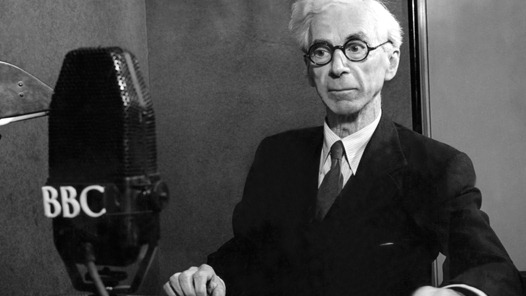
Alexandre Borovik points to this BBC Radio 4 broadcast. Just the title Bertrand Russell: First Media Academic? seems to capture something very true about Russell – a man who undoubtedly thrived on popular attention. Indeed, it is surprising that the majority of Russell’s books are so accessible to the public. (Did he secretly campaign for his 1950 Nobel Prize in Literature? One wonders.)
Unfortunately, I missed the chance to hear this broadcast; but fortunately, many of Russell’s BBC broadcasts are still easily downloadable. I suppose as good a place to start as any is with Russell’s 1948 BBC Reith Lectures. (These can also be downloaded from the Reith Lectures podcast page).
This also reminds me of the Richard Posner’s study with its highly judgmental title: Public Intellectuals: A Study of Decline.
The full blurb from the BBC:
Bertrand Russell was one of the greatest thinkers of the last century. His contributions to the field of mathematics and philosophy are still widely acknowledged as some of the most important of their kind. But, as Robin Ince discovers, he was also arguably one of the first great media academic stars, who brought his own brand of rationalism and intellect to an audience far beyond the academic and political circles he routinely mixed with. His relationship with the BBC goes back almost to the beginning of its own history, and his many broadcasts and appearances on radio, in particular, brought his ideas to a whole new audience. He delivered the very first Reith Lectures back in 1948, and was a regular panellist on the hugely popular The Brains Trust. His thoughts on themes ranging from education, through to nuclear armament and religion, were regularly broadcast on the BBC, right up to the end of his life. Robin Ince takes a listen back to some of Russell’s great contributions to broadcasting and looks at the life of arguably the first great media academic.
In the unlikely chance that any of this blog’s readers might have a lead how I might be able to hear Bertrand Russell: First Media Academic?, could I ask you to leave a comment below? My thanks in advance.
Update: I would like to express my sincere thanks to Tom Stanley of the Bertrand Russell Society Library, for giving me this link to the BBC broadcast in the comments below.
The five books that inspire the most tattoos
I read this Publishers Weekly story with growing fascination and horror.
We spent an untold number of hours combing the Internet’s two most extensive literary tattoo sites: Contrariwise: Literary Tattoos and The Word Made Flesh, then cross-checking the most frequently occurring tattoos with Google searches and Google image searches, all to get to the bottom of what books inspire the most tattoos and why. And though this isn’t a scientific ranking, it’s the closest anyone’s come to tabulating which books inspire the most tattoos, given the Internet’s evidence. What you’ll find below shows a fascinating effect: as you look past the superficial design, you’ll find a wholly specific reason, wholly specific to the individual. It’s why one person can have an “I am nobody” tattoo from Sylvia Plath and someone else can have an “I am I am I am” tattoo from Sylvia Plath–it shows how we all treat stories and writing differently.
You can read the story for images of the tattoos and more details, but the PW study shows these are the top five tattoo inspirations:
5. Fight Club by Chuck Palahniuk
4. The Little Prince by Antoine de Saint-Exupéry
3. Where the Wild Things Are by Maurice Sendak
2. Alice’s Adventures in Wonderland by Lewis Carroll
1. Slaughterhouse-Five by Kurt Vonnegut
Why William Maldon taught himself to read
It is hard not to be moved by the story of William Maldon, an illiterate living in the reign of Henry VIII who decided to learn to read English so that he could have direct access to the Christian Scriptures. You can read his story in Alfred W. Pollard’s Records of the English Bible: The Documents relating to the Translation and Publication of the Bible in English, 1525-1611.
Thomas More famously teased Tyndale for the deficiencies of his vocabulary (Tyndale had to invent a fair amount of language in his translation) by saying “all England list now to go to school with Tyndale to learn English.” Maldon was one who did “go to school with Tyndale.”
At age 15, Maldon’s experience as he wrote down a short time later (modernized spelling):
Divers poor men in the town of Chelmsford in the county of Essex where my father dwelt and I born and with him brought up, the said poor men bought the New Testament of Jesus Christ and on Sundays did sit reading in lower end of church, and many would flock about them to hear their reading, then I came among the said readers to hear them reading of that glad and sweet tidings of the gospel, then my father seeing this that I listened to them every Sunday, then came he and sought me among them, and brought me away from the hearing of them, and would have me to say the Latin matins with him, the which grieved me very much, and thus did fetch me away divers times, then I see I could not be in rest, then thought I, I will learn to read English, and then I will have the New Testament and read thereon myself, and then had I learned of an English primer as far as patris sapientia and then on Sundays I plied my English primer, the Maytide following I and my father’s apprentice, Thomas Jeffary laid our money together, and bought the New Testament in English, and hid it in our bedstraw and so exercised it at convenient times.
What a time – when an illiterate youth would secretly teach himself to read, because he was so excited by Tyndale’s translation!
This is the 3rd part in a series on how the Greek translator of the Hebrew Bible strays from his literal rendering of the original. It’s our look at how he adds what English translator Albert Pietersma calls “interpretive spins” and “literary sparks” in Hellene, spins and sparks that have seemingly less to do with the first Semitic purposes of the text and more to do with Greek literature before it. This post is on a spin and a spark in the 23rd Psalm.
This Psalm may be the most well known today. (But since it was my missionary evangelical Christian parents who paid me to memorize it and since it was quoted so much so often as I was growing up, maybe I’m just projecting its popularity on everybody else now.) See how it has its own wikipedia entry, and see the King James translation of the Hebrew with the accompanying painting to depict the scene of this Psalm:

In Greek (as the 22nd Psalm) it starts out with a title: Ψαλμὸς τῷ Δαυιδ. That can mean something like: A Strumming to David’s Rendition.
Then in verse 3, those “paths of righteousness” are these kinds of paths in Hellene: ὡδήγησέν [Odegesen].
This sounds a little like a hearkening to the wordplay of the Iliad (Book III) and Odyssey (Book XXII). Some of that goes like this:
οὐ τότε γ’ ὧδ’ Ὀδυσῆος ἀγασσάμεθ’ εἶδος ἰδόντες.Τὸ τρίτον αὖτ’ Αἴαντα ἰδὼν ἐρέειν’ ὃ γεραιός· (225)
ἦ γούνων λίσσοιτο προσαΐξας Ὀδυσῆα.ὧδε δέ οἱ φρονέοντι δοάσσατο κέρδιον εἶναι,γούνων ἅψασθαι Λαερτιάδεω Ὀδυσῆος. (339)
Οὖτις ἔμοιγ’ ὄνομα: Οὖτιν δέ με κικλήσκουσι (366)


“it would have been your libation had you taken pity and sent me home.”
“and he answered me in pitiless spirit.”
μεθύσκον ὡς κράτιστον
When a democracy which is thirsting for freedom has evil [κακῶν] cupbearers presiding over the feast, and has drunk too deeply of the strong wine [ἀκράτου αὐτῆς μεθυσθῇ] of freedom, then, unless her rulers are very amenable and give a plentiful draught, she calls them to account and punishes them, and says that they are cursed oligarchs.—Why, when a democratic city athirst for liberty gets bad [κακῶν] cupbearers for its leaders and is intoxicated by drinking too deep of that unmixed wine [ἀκράτου αὐτῆς μεθυσθῇ], and then, if its so-called governors are not extremely mild and gentle with it and do not dispense the liberty unstintedly,it chastises them and accuses them of being accursed oligarchs.
Nor yet again is the boldness of the sanguine the same thing as Courage. The sanguine are confident in face of danger because they have won many victories over many foes before. They resemble the courageous, because both are confident, but whereas the courageous are confident for the reasons already explained, the sanguine are so because they think they are stronger [κράτιστοι] than the enemy, and not likely told come to any harm. [14] (A similar boldness [implied κράτιστοι] is shown by men who get drunk [οἱ μεθυσκόμενοι], for this makes them sanguine for the time being.) When however things do not turn out as they expect, the merely sanguine run away, whereas the mark of the courageous man, as we have seen, is to endure things that are terrible to a human being and that seem so to him, because it is noble to do so and base not to do so.
Among the unrestrained themselves, the impulsive1 sort are better than those who know the right principle but do not keep to it; for these succumb to smaller temptations, and they do not yield without deliberation, as do the impulsive; the unrestrained man [ὁ ἀκρατής] is like people who get drunk quickly [τοῖς ταχὺ μεθυσκομένοις], and with a small amount of wine, or with less than most men. [3] That Unrestraint is not strictly a vice (though it is perhaps vice in a sense), is clear; for Unrestraint acts against deliberate choice, Vice in accordance with it. But nevertheless in the actions that result from it it resembles Vice: just as Demodocus wrote of the people of Miletus— “Milesians are no fools, ’tis true. But yet they act as fools would do.”
The [Church] Fathers imagine the Jewish translators as passive channels of God’s [clear] message to the world;
The [Church] Fathers imagine the Jewish translators as passive channels of God’s [clear] message to the world; in the [contrastive] talmudic account God works to keep certain things [only very clear and just clearly] between the Jews and himself [i.e., away from the Greek and the Egyptian worlds], not only sanctioning Jewish conspiracy but taking the role of conspirator-in-chief. In this regard, the talmudic rewriting of the [Christian] patristic Septuagint legend is a trickster text: the [Jewish] translator is a trickster, who in folklore ‘represents the weak, whose wit can at times achieve ambiguous victories against the powers of the strong.’
The comparison between the status of Homer’s text and the LXX as ‘scripture’, that is, a ‘standardized’ text [page 188].
As soon as the translation is completed, the Jews of Alexandria are called to a gathering and the new text read out to them…. The reading is follwed by the acclamation of the Jews — either the Jewish community of Alexandria, or the Jewish people: the dual layer of meaning is to be read into this section too. Then the leaders of the Jews stand up and make the following statement: ‘Since this was translated rightly and reverently, and in every respect accurately, it is good that it should remain as it is, and that there should be no revision.’… There follows a malediction uttered by the whole people against anyone who might make any addition or change to the text….As [Harry] Orlinsky has convincingly shown, the successive elements in this scene correspond in an accurate manner to the ‘biblical procedure in designating a document as official and binding, in other words, as divinely inspired, as Sacred Scripture.
Thy mercy also shall follow me all the days of my life:
and my dwelling [shall be] in the house of the Lord for a very long time.
And your mercy shall pursue me all the days___of my life,_and my residing in the Lord’s hours is for___length of days.
Ozu filmography on DVD and Blu-ray
One of my favorite filmmakers is Yasujiro Ozu. He is certainly in my top three, and on some days, he is number one. Because his films have not been systematically released in the West, I wanted to make a filmography of his surviving films as available on DVD and Blu-ray.
This is not a complete list. I have only listed releases I know of (including planned releases) from the UK, US, Japan, Hong Kong, and Australia. The DVD and Blu-rays from UK, US, Hong Kong, and Australia have English subtitles; but the Japanese DVDs do not. I have not listed every release from Japan, but only the major box sets (or, for Ozu’s Toho and Daiei releases, individual DVDs.)
So how are we doing? Not so bad. All of Ozu’s films have been released on DVD in Japan. All of Ozu’s sound films (except The Munekata Sisters, a Daiei release) are available on DVD with English subtitles. All but six of Ozu’s surviving silent films are available on DVD with English subtitles (for the title cards). Of those silent films that are not available, one is a short film, another only survives in fragments, and third one, Kagamishishi, does not require translation at all.
So, in the end, only four major films remain require subtitling on DVD.
Update: As I was doing a little more web research, I saw this announcement that suggests BFI is due to release almost all surviving Ozu films by the end of 2012. By my count, they are more than halfway there already.
The DVD/Blu-ray era has been a paradise for film collectors, and for Ozu lovers, it has been especially good. Now, if only Kenji Mizoguchi and Mikio Naruse could get equivalent treatment.
| Year | Japanese title | Romanized title | English title | DVD, Blu-ray availability |
| 1929 | 若き日 | Wakaki hi | Days of Youth | Japan, UK, Hong Kong |
| 1929 | 和製喧嘩友達 | Wasei kenka tomodachi | Fighting Friends: Japanese Style [FRAGMENT ONLY] | Japan |
| 1929 | 大学は出たけれど | Diagaku wa deta keredo | I Graduated, But … [FRAGMENT ONLY] |
Japan, UK |
| 1929 | 突貫小僧 | Tokkan kozō | A Straightforward Boy [SHORT] | Japan |
| 1930 | 朗らかに歩め | Hogaraka ni ayume | Walk Cheerfully | Japan |
| 1930 | 落第はしたけれど | Rakudai wa shita keredo | I Flunked, But … | Japan, UK |
| 1930 | その夜の妻 | Sono yoru no tsuma | That Night’s Wife | Japan |
| 1931 | 淑女と髯 | Shukujo to hige | The Lady and the Beard | Japan, UK |
| 1931 | 東京の合唱 | Tokyo no gasshō | Tokyo Chorus | Japan, US |
| 1932 | 生まれてはみたけれど | Umarete wa mita keredo | I Was Born But … | Japan, US, UK Blu-ray+DVD |
| 1932 | 青春の夢いまいづか | Seishun no yume ima izuka | Where Now are the Dreams of Youth? | Japan, UK |
| 1933 | 東京の女 | Tokyo no onna | Woman of Tokyo | Japan |
| 1933 | 非常線の女 | Hijōsen no onna | Dragnet Girl | Japan, Hong Kong |
| 1933 | 出来ごごろ | Dekigokoro | Passing Fancy | Japan, US, Hong Kong |
| 1934 | 母を恋はずや | Haha o kawazuya | A Mother Should Be Loved | Japan, Hong Kong, UK Blu-ray+DVD |
| 1934 | 浮草物語 | Ukigusa monogatari | A Story of Floating Weeds | Japan, US, Hong Kong |
| 1935 | 鏡獅子 | Kagamishishi | Kagamishishi [KABUKI DOCUMENTARY] |
Japan |
| 1935 | 東京の宿 | Tokyo no yado | An Inn in Tokyo | Japan, Hong Kong |
| 1936 | 一人息子 | Hitori musuko | The Only Son | Japan, US, UK Blu-ray+DVD, Hong Kong |
| 1937 | 淑女は何を忘れたか | Shukujo wa nani o wasureta ka | What Did the Lady Forget? | Japan, Hong Kong, UK Blu-ray+DVD |
| 1941 | 戸田家の兄弟 | Toda-ke no kyōdai | The Brothers & Sisters of the Toda Family | Japan, Hong Kong, UK Blu-ray+DVD |
| 1942 | 父ありき | Chichi ariki | There Was a Father | Japan, US, UK Blu-ray+DVD, Hong Kong |
| 1947 | 長屋紳士録 | Nagaya shinshi roku | Record of a Tenement Gentleman | Japan, UK, Hong Kong |
| 1948 | 風の中の雌鳥 | Kaze no naka no mendori | A Hen in the Wind | Japan, Hong Kong, UK Blu-ray+DVD |
| 1949 | 晩春 | Banshun | Late Spring | Japan, Japan, US, US Blu-ray, UK Blu-ray+DVD, Australia |
| 1950 | 宗方姉妹 | Munekata shimai | The Munekata Sisters | Japan |
| 1951 | 麦秋 | Bakushū | Early Summer | Japan, Japan, US, UK Blu-ray+DVD, Australia |
| 1952 | お茶漬けの味 | Ochazuke no aji | The Flavor of Green Tea over Rice | Japan, Japan, UK, Australia |
| 1953 | 東京物語 | Tokyo monogatari | Tokyo Story | Japan, Japan, US, UK Blu-Ray+DVD, Australia |
| 1956 | 早春 | Sōshun | Early Spring | Japan, Japan, US |
| 1957 | 東京暮色 | Tokyo boshoku | Tokyo Twilight | Japan, Japan, US, Hong Kong |
| 1958 | 彼岸花 | Higanbana | Equinox Flower | Japan, Japan, US. UK Blu-ray+DVD, Hong Kong |
| 1959 | お早う | Ohayō | Good Morning | Japan, Japan, US, UK Blu-ray+DVD, Australia |
| 1959 | 浮草 | Ukigusa | Floating Weeds | Japan, US, US, Australia |
| 1960 | 秋日和 | Akibiyori | Late Autumn | Japan, Japan, US, UK Blu-ray+DVD |
| 1960 | 小早川家の秋 | Kohayakawa-ke no aki | The End of Summer | Japan, US |
| 1962 | 秋刀魚の味 | Samma no aji | An Autumn Afternoon | Japan, Japan, US, UK Blu-ray+DVD, Australia |
In putting together this list, I heavily used this web page from Jonathan Delacour and this Wikipedia page. Also useful is the Ozu-san site.
James Naughtie’s King James radio documentaries
I finally got around to listening to James Naughtie’s BBC Radio 4 documentaries on the history of the King James Bible. They are surprisingly good, with atmospheric effects from his recordings at Hampton Court Palace (when the Bible was commissioned, as it turns out, almost as an afterthought), the Bodelian Library at Oxford where scholars labored over the translation, Stationer’s Hall in London where the translation was revised for publication, and then into a pub to talk about the impact of the translation. Naughtie’s conclusion?
Today in churches it is the RSV, NIV and Good News that reign supreme; the King James is like the best china which is only brought out for special occasions.
The KJB has become one among many, serving a consumerist society. What is important to Christians now is not the elegance of the language but the ability to understand. People want a Bible which is suitable for them.
So where is the support for the King James Bible today? Rather surprisingly its keenest proponents today are secularists. They praise it for the beauty of language, extol its place within our culture and vehemently campaign for it to be taught in schools and universities but as a work of literature rather than a work of God.
Here is the summary of the documentaries in more detail:
The Commission
Synopsis
The King James, or Authorised, Version of the Bible remains the most widely published text in the English language. It has been called the "noblest monument of English prose" and has been recognised for centuries as both a religious and literary classic.
In the first of three programmes marking the 400th anniversary of its publication, James Naughtie tells the story of how and why King James VI of Scotland and I of England decided on a new translation of the Bible.
The programme is recorded at Hampton Court Palace. A conference here in early 1604 led to the commissioning of the King James Version. The Chief Curator at the palace, Lucy Worsley and James Naughtie walk the palace grounds, scene of so much Tudor and Stuart frivolity, and a refuge from the plague. Before the earnestness of the January conference there had been masques and feasting and Shakespearean drama. England was still revelling in its new monarch after the stultifying later years of Elizabeth’s reign and breathing a sigh of relief that the accession had been a smooth one.
The Chapel Royal provides a fitting setting for James to discuss the position of the monarchy in Jacobean England with Professor Pauline Croft. The King sat in the Royal Pew, high above his bishops and clergy. James had written about his ideas of divine kingship in "Basilikon Doron," addressed to his young son.
In The Great Watching Chamber we hear about the religious background to James’ reign. Elizabeth’s death had lifted the lid on the tensions between the godly (Puritans) and the conformists (Anglican bishops). The godly had presented a petition to James on his journey from Scotland to London demanding the end to religious practices they found beyond the pale; wearing vestments, making the sign of the cross, the exchange of wedding rings, the power of the bishops. It was to address these concerns that James had called the conference.
We follow in the footsteps of the conference delegates through the palace and into the Kings state apartments. James Naughtie learns about the key characters at the conference – the pugnacious puritan-basher Bishop of London, Richard Bancroft, the great preacher and conformist Lancelot Andrewes and the leader of the Puritan delegation, John Rainolds. The Puritans had a delicate line to pursue, criticising the establishment and the episcopacy without undermining royal supremacy. But James was having none of it – "No Bishops, no King!" It was an ill tempered conference, with James harrying the protagonists on both sides. He was a brilliant theologian himself, and in him some of the most learned men in the country met their match.
The suggestion for a new translation of the Bible was made by John Rainolds. He was hoping to undermine the authorised Bishops Bible and elevate the Geneva version favoured by Puritans. James acceded to the request because he agreed that all the various translations on offer had their faults. A victory for Rainolds? Not so. James singled out the Geneva Bible, with its controversial marginal notes, as the worst of them all.
After the conference, Bancroft drew up the rules for translation, had them approved by the king, and brought together six companies of translators based in Oxford, Cambridge and Westminster.
Work began at once. Barely a year later the Gunpowder Plot traumatised England. It turned out to be one of James’ finest moments as a statesman, and it gave impetus to his vision of a new translation of the Bible that could unite the country’s church and people.
The Translation
Synopsis
In the second of two programmes marking the 400th anniversary of the publication of the King James Bible, James Naughtie tells the story of how six companies of men produced a new translation of Bible which has come to be regarded as one of the greatest works of English literature ever produced.
The programme opens in the main quadrangle of the Bodleian library. A statue of King James stands high over the courtyard, books in hand. The King loved the Bodleian. In a visit there in 1605 he said that he would love to spend his life chained alongside the library’s chained books.
The translators in London, Cambridge and Oxford drew on several earlier translations of the Bible as they went about their work. In the chapel at Hertford college, Oxford, Jim sees a stained glass window of William Tyndale, the first man to translate the Bible into English directly from Hebrew and Greek. The translators drew heavily on his work. Many of the phrases that come to mind when we think of the King James Bible are in fact those of Tyndale. The translators had several other Bible translations at their disposal too. Each had their own agenda; the Great Bible with its frontispiece depicting the idea of Royal Supremacy; the Puritans’ Geneva Bible which challenged that very idea.
One of the Oxford companies of translators worked in the Tower room at Corpus Christi college. It looks much as it did in the 17th century with the crests of the Oxford colleges embossed around the ceiling and wooden panelling. This was the room of John Rainolds, the college president and one of the "godly." It was Rainolds who as head of the Puritan faction had initiated the new translation at the Hampton court conference. The company met there because Rainolds suffered from gout. He died in 1607 – but most of his company’s work was already complete.
James is shown two extraordinary documents which reveal how the translators worked. One, a 1602 copy of the Bishops Bible, contains annotations made by the scholars suggesting alternative translations. The other is a copy of notes made by one which reveals the mind of the revision committee which met to review the translations of all the companies.
James Naughtie goes to Stationers Hall in London where that revision committee met. It’s here that the King James Bible would have been read out loud for the first time. As James hears the opening words from Genesis, he reflects on the achievement of the translators in giving a version of the Bible which has come to be our "national epic.".
The Legacy
Synopsis
The King James Bible is everywhere. We see it in hair commercials, film titles, novels, music, even in the way we speak. It is lauded with praise as "The great monument to English Prose." But how and why has it achieved such a status? What is its significance in the English speaking world? In the final programme to mark the 400th anniversary of its publication, James Naughtie assesses the legacy of the King James Bible.
He begins in the pub. James meets linguist and Renaissance scholar Gordon Campbell, the Jamaican poet Kei Miller and Rachel Holmes from the Southbank centre to discuss the surprising and unusual places we hear of the King James today. "Salt of the earth", "skin of their teeth", "Apple of his eye" are all phrases that have come into the English language through the King James Bible, but do any of the drinkers in the pub know this?
The King James Bible became part of our everyday speech because of the role that Christian belief and practice has played in our national story. Jim will meet Giles Fraser at St. Paul’s Cathedral to discuss the central place of the Bible and Christianity within British culture. For 300 years the King James Bible reigned supreme. Nearly everyone went to church and the King James Bible was the only translation to be used. Preachers would draw crowds of over a thousand and the words of the King James gradually worked their way into the bloodstream of all those in the country.
Today most people don’t attend church, but they will come across the King James in one of the most famous pieces of music the world has ever known, Handel’s Messiah.
Handel and Charles Jennens, who composed the libretto for Messiah, were accused of blasphemy for staging a sacred work in the immoral world of the theatre. They had moved the Bible away from its original place and purpose and reinvented it for a changing audience. But today Handel keeps the King James Bible in our hearts and minds like no other artist. His oratorios are the conduits through which the Bible comes to us.The KJB was the book of the Empire. Where the empire spread, the Bible spread and that Bible was the KJB. Back in the OBE chapel at St. Pauls, James discusses the spread of the King James Bible through the Empire.
It was used both to defend and challenge the slave trade. When slaves learnt to read, they read the Bible in a whole new way. They read the story of the Exodus and the Sermon on the Mount and changed the way the world thought. The KJB would be used in the abolition addresses of Abraham Lincoln, in the famous speeches of the civil rights movement and in the writings of African-American authors. The tool of oppression became the tool of liberation.
In the late 19th Century the demand for a more accurate and a more accessible translation of the Bible became apparent. This led to the publication of The Revised Version in 1881. Keeping very much in the tradition of the King James Bible, it posed no immediate threat but it did open the flood gates for numerous translations which appeared throughout the 20th Century. Today in churches it is the RSV, NIV and Good News that reign supreme; the King James is like the best china which is only brought out for special occasions.
The KJB has become one among many, serving a consumerist society. What is important to Christians now is not the elegance of the language but the ability to understand. People want a Bible which is suitable for them.
So where is the support for the King James Bible today? Rather surprisingly its keenest proponents today are secularists. They praise it for the beauty of language, extol its place within our culture and vehemently campaign for it to be taught in schools and universities but as a work of literature rather than a work of God.
Knowledge of the King James Bible may be waning, but its place in our culture is secure. It can still be used for religious devotion but its impact is far wider reaching. It has a great power to challenge and subvert but also to amuse and entertain. It constantly reinvents itself for new audiences and situations. The KJB is very much alive today and pops up in the most surprising of places.
Even those these documentaries are over a year old, they are listenable from the links above. Alternatively (and I highly recommend this), you can use Radio Downloader (reviewed here) to download them to MP3.
Yes, Dr. Summers, There is a Virginia
So, when Kurk asserts that we are swimming in Aristotelianism, I want to respond that we are lucky if we are able to save the memory of Aristotle’s name.
— Theophrastus, my BLT co-blogger
What will the legacy of Lawrence Summers be, say, in twenty-three or four centuries? What water will the educated and the uneducated be swimming in then? And how? When my friend Theophrastus makes it clear how “Summers mocks the study of Thucydides” by having us read the ideas of Dr. Summers in his very own words, then I would say that somebody has begun to help save the memory of the former Harvard President. And how.
But is the name of Aspasia of Miletus saved? Pericles and Socrates learned so very much from her, and students of Plato and Xenophon and Aeschines Socraticus and Antisthenes were lucky enough by their teachers to be reminded of her. Fortunately, the memory of her name was then still fresh, and she was yet at that time on the very very very short list of women philosophers and scientists.
Guess whose list Aspasia is not on? Yes, you guessed it. She’s not on Larry Summers’ list. And guess what? She’s not on Aristotle’s list either. Why wouldn’t Aristotle save the memory of this teacher from the City State of Miletus? He did recall Sappho, the poet from the nearby Mytilene; Aristotle did provision this intellectual, named Sappho, a “nod” notices Cheryl Glenn, and Sappho is honored in her town, notices Aristotle, “though she was a woman.” And yet is Aspasia dead? In all of his many writings and speeches, Summers mentions her not even once. Likewise Aristotle.
But are we lucky enough to save the memory of Hypatia’s name? Hypatia of Alexandria, of the namesake city of that Great student of Aristotle. Remember Alexander the Great? Remember Hypatia? She has the misfortune or perhaps the good fortune of being on that very very very short list of women mathematicians. Like Dr. Larry Summers, Hypatia, was the head of a school. No, not quite Harvard, but Plato’s Academy. Remember? There she taught and promoted the teachings of Plotinus. She loved math but also taught Plato’s philosophy. Furthermore, she worked to keep alive the memory of Aspasia’s name.
There she even remembered and taught Aristotle. She said: “One needs to know Aristotle…. One needs it desperately…. Must! I mean desperately… if one is to be at ease anywhere.” What if we forget everything he taught? And how? These are statements and questions that others — even poets like the honored-though-woman Sappho and like Maya Angelou — have made and have asked. “If one is to be at ease anywhere,” especially if one’s body is sexed “female” and if, therefore, one is not male, then there is a desparate need to know Aristotle. Know this: “A female’s good character really comes from a body with a good large figure, but also from a personality with ‘wise submissiveness’ and affection for work without preoccupation from freedoms.” And know that: “Just as the young of mutilated parents are sometimes born mutilated and sometimes not, so also the young born of a known female are sometimes female and sometimes male instead. The female is, in fact, a mutilated male, like the poisonous flower, the pereromia, if beautiful, then deadly still.”
And remember well that females have “retentive memory.” So it may be females and feminists and grown women who are most responsible for our now having, so regretfully, to ask, “Is Aristotle Dead?”

Let’s move on. Maybe if we separate things, understand the Nature of things, then we can remember (or, as Aristotle did with Aspasia, forget):
life / death;
logic / logos;
male / female;
logic / dialectic with it’s antistrophos rhetoric;
master / slave
logic / sophistry
Greek / barbarian
logic / parable and fable
Nature / nurture
logic / poetics
normal skin / dark skin
logic / listening rhetorically
See how easy that is?
But wasn’t it easy for Edward Douglas to abandon his pregnant wife, Virginia O’Hanlon, and to finally bury her name? Somebody had told her when she was but eight years old that Santa Claus was dead. Fortunately, she had a father who listened to her, who encouraged her. And fortunately there was an editor of a newspaper, one Francis Church, who considered her and her question. “Yes, Virginia, There is a Santa Claus,” he wrote in the Sun — not with much logic at all — that a spirit alive with a name meant that a whole mentality of giving and of generosity, by whatever name, need not die.
And once formalized, especially by syllogisms and by logic and by math, mentalities die hard. What Aristotelianism are we naming?
It seems that it must have been hard for reporters to pin down, with any particular logic at all, just exactly what Dr. Summers had said so very very long ago. Remember? Who knew what he had been taught about women, and whose teachings and whose methods had Summers been taught that he was teaching?
Is Summers just a man of our time? Or a man of another greater man’s time?
Or was he propagating and formalizing in various treatises, unique and logical and scientific writings, a sort of scientific based sexism that would live on beyond him in pervasive ways for centuries and millinnea ?
The Globe‘s reporter, from Boston “though she was a woman”, did manage to write something. But Ms. Marciella Bombardieri could only get this:
Summers spoke during a working lunch. He declined to provide a tape or transcript of his remarks, but the description he gave in an interview was generally in keeping with what 10 participants recalled. He said he was synthesizing the scholarship that the organizers had asked him to discuss, and that in his talk he repeated several times: ”I’m going to provoke you.”
He offered three possible explanations, in declining order of importance, for the small number of women in high-level positions in science and engineering. The first was the reluctance or inability of women who have children to work 80-hour weeks.
The second point was that fewer girls than boys have top scores on science and math tests in late high school years. ”I said no one really understands why this is, and it’s an area of ferment in social science,” Summers said in an interview Saturday. ”Research in behavioral genetics is showing that things people previously attributed to socialization weren’t” due to socialization after all.
This was the point that most angered some of the listeners, several of whom said Summers said that women do not have the same ”innate ability” or ”natural ability” as men in some fields.
Asked about this, Summers said, ”It’s possible I made some reference to innate differences. . . I did say that you have to be careful in attributing things to socialization. . . That’s what we would prefer to believe, but these are things that need to be studied.”
Summers said cutting-edge research has shown that genetics are more important than previously thought, compared with environment or upbringing. As an example, he mentioned autism, once believed to be a result of parenting but now widely seen to have a genetic basis.
In his talk, according to several participants, Summers also used as an example one of his daughters, who as a child was given two trucks in an effort at gender-neutral parenting. Yet she treated them almost like dolls, naming one of them ”daddy truck,” and one ”baby truck.”
Now, to be clear, Summers didn’t mention Aristotle once, not that Bombardieri could get witnesses to recall such a mention anyway. And Summers himself doesn’t teach Aristotelian economics, thankfully. He didn’t even know that Aristotle was convinced that his daughter — remember her name? — also played with boy toys like a girl.
We, the 1% (education-wise), have read Aristotle. The rest only greet him in the diluted form of the “Western tradition.” Theophrastus rightly reminds.
But whether among that 1% or the rest, anyone who explains why there must be so few female mathematicians can still show how Aristotelian mentality is alive and well today.
Anne Carson reminds, “The celebrated Greek virtue of self-control (sophrosyne [σωφροσύνη]) has to be defined differently for men and for women, Aristotle maintains. Masculine sophrosyne is rational self-control and resistance to excess, but for the woman sophrosyne means obedience and consists in submitting herself to the control of others. [See Aristotle’s clear description of this defined division of his, in his Politics, Book I, 1260a]”
This is the Nature of females and things, wrote Aristotle. See:
Can you name the female mathematicians?
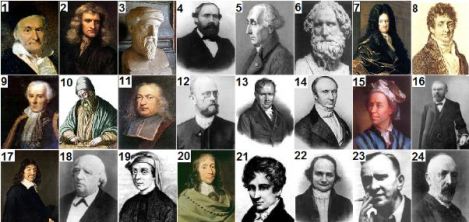
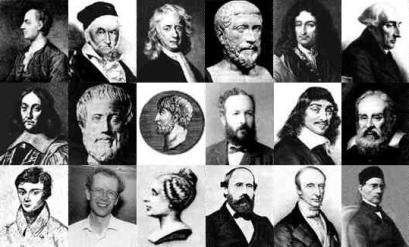

But is Aristotle really dead to woman mathematician Danica McKellar? [UPDATE: feel free to read the comments below for an explanation why I’m deleting an image here. I’m not saying Aristotelianism is still alive because of McKellar! And I don’t consider images of McKellar that she uses, of herself as a math teacher with young ladies’ bare bodies as their math text and chalk and chalk board and ambiguous formulas as pornographic necessarily. But I don’t want anyone to be offended looking at them. If you must, then click on the link above to the humorous “cracked” site.]
Kellar’s written three New York Times bestsellers on math, specifically “to show girls that math is accessible and relevant, and even a little glamorous” and to begin to overcome the “damaging social messages telling young girls that math and science aren’t for them.” She herself studied mathematics at UCLA, where she graduated summa cum laude. With a classmate (Brandy Winn) and one of their profs (Lincoln Chayes), she proved a new math theorem, named the “Chayes–McKellar–Winn theorem.” In addition to tv acting and dancing (i.e., The Wonder Years, etc.), she’s written, directed, and acted in her own film (and has done a few movie roles for others’ films). She’s bilingual (French/ English); and, with her husband of a few years, is a parent. We dare imagine that she’s keeping Aristotle alive.

Is Aristotle dead?
Kurk writes:
I think we, in the West, swim in Aristotelianism and methods and syllogistic conclusions to such an extent that we are blind to how big his contributions have been and still are.
Maybe. But high school students don’t usually read Aristotle. Nor Plato. Nor Homer. Nor Aristophanes. Nor Sophocles. Nor Herodotus. Nor Euripides. There is only one Greek writer which almost every college-bound high school student studies (perhaps not by name, but pretty much in the original fashion in which he wrote): Euclid.
(If the students come from a religious Christian family, they perhaps encounter another set of Greek writers, but likely in a way [e.g., an NLT-style translation] that completely hides the “Greek” qualities of those writings.)
No one but classicists study Aristotelian logic. Go into a logic class and you’ll learn about Frege and Boole and Cantor and Hilbert and Gödel and Turing and Russell, but if you hear mention of Aristotle, it will only be to point out how limited and incorrect Aristotelian logic is.
We have rationed Aristotle. We, the 1% (education-wise), have read Aristotle. The rest only greet him in the diluted form of the “Western tradition.” Perhaps knowing Aristotle is a little like knowing whether the fork goes on the right or the left: a now obsolete marker of socio-economic status.
Here is how Stephen Hawking began his latest popular book:
We each exist but for a short time, and in that time we explore just a small part of the total universe. But humans are a curious species. We wonder, we seek answers. Living in this vast universe that is by turns kind and cruel, and gazing at the immense heavens above, people have always asked a multitude of questions: How can we understand the world in which we find ourselves? How does the universe behave? What is the nature of reality? Where did all this come from? Did the universe need a creator?… Traditionally these are questions for philosophy, but philosophy is dead. Philosophy has not kept up with the modern developments in science, particularly physics. Scientists have become the bearers of the torch of discovery in our quest for knowledge.
Hawking goes on to outline M-theory as the answer to the question of the origin of the universe.
If you think that Hawking is just plugging his own books by being outrageous, then consider former Harvard President Larry Summers’s view of what education should look like – he believes students should be watching “video of the clearest calculus teacher or the most lucid analyst of the Revolutionary War rather than having thousands of separate efforts” and that “English’s emergence as the global language, along with the rapid progress in machine translation and the fragmentation of languages spoken around the world, make it less clear that the substantial investment necessary to speak a foreign tongue is universally worthwhile.”
Summers mocks the study of Thucydides:
Gen. George Marshall famously told a Princeton commencement audience that it was impossible to think seriously about the future of postwar Europe without giving close attention to Thucydides on the Peloponnesian War. Of course, we’ll always learn from history. But the capacity for analysis beyond simple reflection has greatly increased (consider Gen. David Petraeus’s reliance on social science in preparing the army’s counterinsurgency manual). As the Moneyball story aptly displays in the world of baseball, the marshalling of data to test presumptions and locate paths to success is transforming almost every aspect of human life.
While I think that Summers has some points, I beg to differ with his view that study of foreign languages, history, and other traditional subjects is obsolete . But it seems to me that Summers, not a completely ignorant man, has captured a certain zeitgeist in the general culture and even in higher education. So, when Kurk asserts that we are swimming in Aristotelianism, I want to respond that we are lucky if we are able to save the memory of Aristotle’s name.
Harpagmos IV: Ralph Martin’s Carmen Christi
Ralph Martin’s Carmen Christi had already proposed that the equality with God that Christ refused was not the same as Christ being in the form of God, and yet Martin defended Christ’s equal authority with God. Martin’s position was somewhat different from previous traditional views, and similar to Burk’s in terms of syntax, but remained fully orthodox. Here is a brief review of traditional translation options first.
The Vulgate had “non rapinam arbitratus est esse se æqualem Deo:” translated as “Who, being in the form of God, thought it not robbery to be equal with God,” and Erasmus and Calvin had the same. John Owen also defends this position. This was the firm opinion of the Latin Fathers, as well as Chrysostom. This is the one which we usually hold to be orthodox, the armor against Arianism and heresy.
But in the 19th century, and possibly earlier, alternatives appeared. Thayer’s Lexicon had “a thing to be seized upon or to be held fast, retained,” and variations on this theme appear in many translations today, RSV, ESV, NASB, NET, NIV 1984, to name a few. Of course, this could be understood as seizing on something one does not have, or, conversely, retaining something that one does have. The Liddell, Scott, Jones Lexicon had “robbery, rape” and “prize to be grasped.” These are different possibilities that appear legitimately in many Bible translations.
While the traditional translation, “robbery” was grafted into the collective consiousness as an unequivocal armament against heresy, later translations became open to multiple interpretations. Was Christ “not seizing” something that he had no right to, or “not retaining” something he had every right to? I can find no commentator, previous to Denny Burk, who claims that Christ was grasping for something he had no right to and who is also within the orthodox tradition. Of course, this is why Burk says that he is opening the way to a new intepretation. However Ralph Martin defends the view that “equality with God” is not the same as “in the form of God” and therefore precedes Burk in this respect.
Ralph Martin’s position is described by Wright in this way, The Climax of the Covenant, 1993, pages 65-68,
Christ existed eternally in the form of God, but refused to snatch at the further honour of world sovereignty (‘being equal with God’), choosing instead to receive it as the result of obedient suffering and death.
His view is that Christ was always in the form of God, but that he did not yet possess equality with God. Refusing to snatch at this hgher state, he attained it instead by the path of humble suffering and death.
But in Martin’s own words, he still retains belief in the original orthodox interpretation as well. Martin writes, (cited from Wright)
His installation as Kyrios betokens that “equality with God” which he refused to aspire to in His own right. Yet it properly belonged to Him;
He had the equality with God as His Image, but refused to exploit it to His personal gain.
Ultimately, it seems that Martin’s view is not so different from the traditional. However, he wants to emphasize, not the right of Christ to equality with God, but the path of suffering and death leading to sovereignty. The important thing is that Martin agrees with Burk’s grammatical point, but disagrees with Burk on the sovereignty of Christ. For Martin, Christ is sovereign Lord, a position attained through the path of suffering. For Burk, Christ is eternally and immutably subordinate to God, causing him to be the one in the Trinity who must suffer.
Martin concludes, Carmen Christi, page 237 (unfortunately I have used an electronic version for the first citation that does not exactly match the edition I link to. I hope the sense is the same. )
In the light of verse 11, the supreme name is that of ‘Lord’. The root meaning of this term (kyrios), used in the LXX to translate the divine name Yahweh, though with a possible Christian influence at work, denotes rulership based upon competent and authoritative power, the ability to dispose of what one possesses. In view of its special connection with the name of God in the Old Testament the giving of the name in this context declares that Jesus Christ is installed in the place which properly belongs to God himself as Lord of all creation. Of this fact there are, according to the subsequent verses, two outstanding proofs.
He continues still on page 237,
The train of argument is that Christ in his pre-existance, declined to grasp what might have been his possession, viz. equality with God. At the close of His mission He returns to His Father’s presence and is given the exact counterpart of what proved the substance of His choice. He is exalted to the rank of dignity of God as God’s equal, exercising the very authority which God alone may properly exercise.
My understanding is that for Martin, ἐν μορφῇ θεοῦ ὑπάρχων and τὸ εἶναι ἴσα θεῷ, are considered to refer to two different things. In this Martin agrees with Burk. But in his theological implications, Martin is orthodox regarding Christ’s authority.
Contrary to my expectation, I truly cannot find any commentator that I have ever heard of, at any rate, who suggests that Christ was being commended in this passage for not grasping at something which he had no right to. That doesn’t mean that this does not exist, but at least that it is not well known, or was never commonly accepted, or I simply can’t find it.
In writing this post, I have taken a bit of an excursion to read passages of Martin’s Carmen Christi, 2005, and also his A Hymn of Christ: Philippians 2:5-11 in recent interpretation & in the setting of early Christian worship, 1997. In the latter, on page lxx in the preface to the 1997 edition, Martin responds to the very paragraph in N. T. Wright’s article* that Burk also takes exception to. While Burk wrote his entire paper in 2000 on the articular infinitive, Martin was able to summarize the argument in a footnote. He writes,
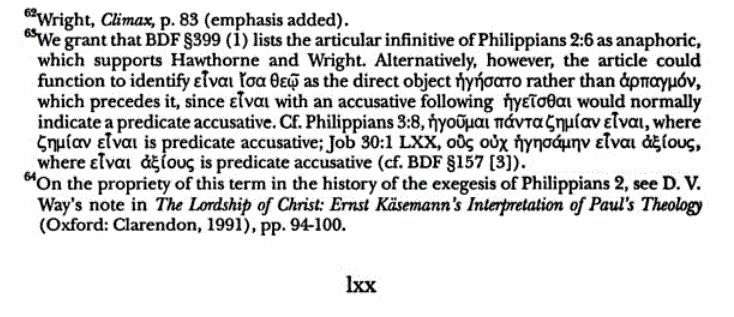 I don’t actually understand why Denny Burk did not cite Martin or why he presented his paper as if it contained new information. It appears to me, having spent many hours reading about ten scholarly papers and articles on this topic, it is not a dicusssion of substance. To my eyes, Burk’s entire thesis is summed up in Marin’s footnote. However, Martin draws from it opposite conclusions regarding the sovereignty and authority of Christ.
Compare Burk’s conclusion with Martin’s footnote,
Likewise, the article in the articular infinitive in Philippians 2:6 functions to distinguish the grammatical object from the accusative complement. Indeed, the article is required in this case in order for the clause to be grammatically intelligible. Notice the word order in Philippians 2:6, oujc aJrpagmoVn hJghvsato toV ei ai i[sa qew’/. Without the article, by virtue of word order we would naturally be more inclined to consider aJrpagmovn as the grammatical object instead of the infinitive. In such a scenario, there would be some confusion as to how to view the object aJrpagmovn in relationship to the infinitive. The infinitive would not be the complement, but the neuter plural i[sa would. Of course this would make almost no grammatical sense as aJrpagmovn is singular and i[sa is plural. The syntactical confusion that would accompany the absence of the article in such a hypothetical situation illustrates the necessity of the article’s presence in this clause. In Phil 2:6 we have an example of a reversed order object-complement construction. Therefore, the article serves to mark the accusative infinitive phrase (toV ei ai i[sa qew’/’) as the grammatical object of the finite verb (hJghvsato), thereby distinguishing it from the accusative complement (aJrpagmovn).
For this reason, the syntactical use of the article as a function marker is the primary reason for the article’s presence in Philippians 2:6. Indeed it is a necessity. Thus, certainly in this situation it is clear enough that the grammatical/structural significance of the article is far more prominent than any supposed semantic significance. Whereas there is really no evidence to attribute a semantic force to the article, there is every reason to attribute a syntactical one to it. This being said, we should not equate equality with God (toV ei ai i[sa qew’/’) with form of God (morfh’/ qeou’) simply because of the presence of the article. If one is going to equate these two phrases, he/she must argue for this identification on other grounds. The presence of the accusative article simply does not support equating the two phrases.
Now compare their conclusions regarding the authority of Christ. Burk writes,
On the one hand, Millard Erickson writes that the Son’s “equality with God” is a reference to the Son’s “equal authority” with the Father—“something he already possessed” in his preincarnate state. On the other hand, Wayne Grudem writes that “equality with God” refers to the Son’s “equality in glory and honor in heaven, which Christ gave up in coming to earth.” For Erickson, the Son temporarily laid aside his “equal authority” with the Father in the incarnation in order to submit to the Father during his earthly life only. The Son’s equal authority was restored to him after the resurrection. Thus in Erickson’s view, there would be no eternal subordination in role of the Son to the Father. For Grudem, the text still allows for the Son to be submitted to his Father from all eternity.
And Martin writes,
The train of argument is that Christ in his pre-existance, declined to grasp what might have been his possession, viz. equality with God. At the close of His mission He returns to His Father’s presence and is given the exact counterpart of what proved the substance of His choice. He is exalted to the rank of dignity of God as God’s equal, exercising the very authority which God alone may properly exercise.
Gong Xi Fa Cai: Getting rich
This weekend marks the beginning of the Chinese Lunar year, the year of the dragon.
The standard greeting is 恭喜發財, which is pronounced in Mandarin as Gong Xi Fa Cai and in Cantonese as Gong Hey Fat Choy. A word by word translation would be “wish happiness make money.” A more dynamic translation would be “I wish you a happy and prosperous New Year.”
In the expression, though, it is clear that money is the end goal of the greeting. A year is good if we are in the black and making money. The notion that there are other types of wealth (good health, adventure, creative ideas, love, friends, etc.) doesn’t really come into the expression. Perhaps all of those things are simply believed to come when the money rolls in.
I would like to wish all of you a New Year that is prosperous in exposure to new ideas and beauty, greater understanding, and new insights. And I hope you get rich money-wise too.
Happy New Year.

(Image credit: Joyce Wan)
Interpretive Spins in the Ψαλμοὶ: part ii, Music of Hades
I will sing you an answering song,
the Asian strain, the barbarian dirge,
mistress, the melody used
in lamentation,
dirges for the dead, the song that is sung
by Hades, no peal of triumph.
—— Chorus, “Iphigeneia in Tauris,” by Euripides
———–(trans. by Richmond Lattimore from Greek to English)
1 A Psalm. Of an Ode of the dedication of the house. Pertaining to Dauid.
2(1) I will exalt you, O Lord, because you upheld me
———–and did not gladden my enemies over me.
3(2) O Lord my God, I cried to you,
———–and you healed me.
4(3) O Lord, you brought up my soul from Hades;
———–you saved me from those that go down into a pit.
—— David, “Psalm 29(30),” trans. by anon from Hebrew to Greek
———–(further trans. by Albert Pietersma from Greek to English)
Could it be that the Psalms provide literary sparks and interpretive spins that have been lost in English translation? And what’s up with the post title and the epigraphic, literary allusions to “Hades”?
Before we answer and especially before we get to any possible spark from “Hades,” here’s a bit of background on the Psalms. I’m talking about the Psalms, or the the Ψαλμοὶ (or Psalmoi), as the original translation of ancient Hebrew poetry known as Tehillim, תְהִלִּים, or “praises” in the Hebrew Bible. What I mean by “original translation” is this: it’s that first and most unique rendering of the Hebrew songs of praise into Hellene, or Greek, by now-unknown and perhaps-always anonymous diaspora Jews living in Egypt again, in the namesake city of Alexander the Great (or Alexandria); their translating started around the year 250 BCE, not even a century after the death of the Greek conqueror, who was tutored by the considerably political Greek language prescriptivist, Aristotle. (An important history of the legend of this translation is written by Sylvie Honigman, and some critical theories of just what the translators of the translation might have been up to is written by Naomi Seidman; but the wikipedia entry for the “Septuagint” or LXX, or  , or G does fine for an introduction.)
The Ψαλμοὶ do offer interpretive spins and literary sparks in Greek, and we will get to Hades soon enough. (This is the second post in now a series. In the first post, we looked at the Greek clause/phrase that means “to throw to the crows” and saw how a playwright like Aristophanes had used it and then viewed the very few and very marked uses of the same by the LXX translator[s]. These few uses were Greek literary sparks and interpretive spins in a translation of the Tehillim that otherwise basically just gave Greek glosses of the Hebrew words to get at the Semitic language meanings in a fairly literal and inter-linear way.) Let’s now review what Albert Pietersma says about LXX translator and his choice in the name, the title, the Greek word, Ψαλμοὶ (or Psalmoi):
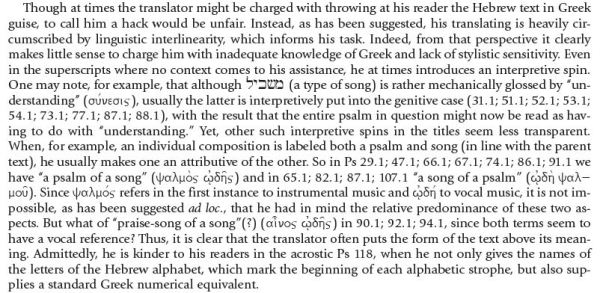
Pietersma has done a wonderful thing by noting the “interpretive spins” of the translator as rare as they are. He does note that they are “titles,” that is, considerably prominant and extremely conspicus words and phrases. Rather candidly, nonetheless, he admits that to him some of these titular tropes “seem less transparent” in what is meant by or intended with them. With his NETS English translation of the Greek translation, he has “a psalm of song” and “a song of a psalm” and a “praise-song of a song.”
Hopefully, we can approach a good bit more transparency in this post. To approch just a little more transparency, first let me transliterate with English letters the Greek phrases Pietersma matches with his English: (for ψαλμὸς ᾠδῆς) psalmos odes = “a psalm of song”; (for ᾠδὴ ψαλμοῦ) ode psalmou = “a song of a psalm”; and (for αἶνος ᾠδῆς) ainos odes = “praise-song of a song.” What’s clear is that the English “song” is the match for the Greek “odes” and “praise-song” is for “ainos” but that “psalm” is for “psalm.”
Now, I’d like to suggest additional nuance and meaning for the English glosses from the NETS:
- An Ode (ᾠδή), for the Greeks, was a song often used in what Aristotle classified as epi-deictic rhetor-ic (or show-y speech-acts). In other words, odes were typically songs to accompany public praise or public shaming at events such as funerals (where there were dirges and eulogies) or victory parties (in which accolades were sung to heroes and in which blame and disdain was musically heaped upon enemies).
- An Ainos (αἶνος) was a song sung usually to express — in the form of poetry or as a ballad — praise but often communicate a taunt, or despair, or dread. The direct or secondary use of an Ainos could be used in political (or deliberative) communications, another species or genre of rhetoric for Aristotle. For example, in his Athenian Constitution (12.5), Aristotle himself — for political purposes — quotes a poem by Solon, a forefather of Athenian democracy, in which the latter complains of an Ainos — in verb form — as an action in subjunctive mood; Henry Rackham translates that thusly:
And again in his [Solon’s] taunting reply to the later querulous complaints of both the parties:
“If openly I must reprove the people,
Never in the dreams of sleep could they have seen
The things that they have now . . .
While all the greater and the mightier men
Might praise [αἰνοῖεν, ainoien] me and might deem me as a friend;
- A Psalm (ψαλμὸς) was not just a “psalm.” Nor was it always or primarily even singing or poetry or a song. Rather, a psalm basically was a strum, a pluck, a pick, a twitch, or a twang of the strings of a musical instrument. One could perform an Ode or an Ainos by PS-al-ING or PS-alM-ING, by STR-um-ING, by PL-uck-ING, by P-ick-ING, by TW-itch-ING, or by TW-ang-ING. I suspect the Greek word was, and is, an onomotopoeia. It sounds like what it is, and makes noise that descriptively does what it does.
A description of this method of stricking or plucking the strings is offered in Problems (Bekker page 919b), a treatise Aristotle ostensibly wrote. Here is the English translation by William David Ross and John Alexander Smith [with Aristotle’s Greek and a transliteration and my “translation” in bold font within brackets at certain points]:
Why is hypate double nete? Is it because in the first place, when half the string is struck [ψαλλομένη, PS-al-LO-me-NE, is “twanged”] and when the whole string is struck an accord in the octave is produced? So too with wind instruments, the sound produced through the middle hole and that produced through the whole flute give an accord in the octave. Again, in the reed-pipe an accord in the octave is obtained by doubling the length, and this is how flute-makers produce it. Similarly they obtain a fifth by means of a length in the ratio of 3 to 2. Again, those who construct Pan-pipes [σύριγγας, SYR-in-GAS, or “pipe”] stuff wax into the extreme end of the Ayjpate-reed, but fill up the nete-reed to the middle. Similarly they obtain a fifth by means of a length in the ratio of 3 to 2, and a fourth by means of a length in the ratio of 4 to 3. Further, hypate and nete on triangular stringed [ψαλτηρίοις, PS-al-TER-iois, “twanged”] instruments, when they are equally stretched, give an accord in the octave when one is double the other in length.
In Genesis, in the Greek translation of the Hebrew first book, there’s the first introduction of such “twanged” instruments. The English translation of Genesis 4:20-21 (by Robert J. V. Hiebert for the NETS) goes like this [with similar interpolations by me]:
And Ada [the first wife of Mathousala] bore Iobel; he was the ancestor of cattle-raisers living in tents. And his brother’s name was Ioubal; he was the one who introduced the [ψαλτηρίοις, PS-al-TER-iois, “twanged instrument”] harp and the [κιθάραν, ki-THAR-an, “guitar”] lyre.
Aristotle’s Problems (Bekker page 922b), also mentions what Ross and Smith translate into English as a “lyre.” The exact Greek phrase is κιθαρ-ῳδικωτάτη, ki-THAR Odiko-TAte, or a “guitar to accompany odes, for public oratory.” Clearly, this Ioubal, the Greek version of Jubal, played two twanged or strummed instruments. For whatever reason, this was an important literary spin for the LXX Genesis translator since in the Hebrew Bible this character played just one stringed instrument and something else like a flute or like a Pan’s pipe, mentioned in the longer quotation of Problems (919b) above. Why this change? Why have this character forgo the pipe only to introduce the different twanging instruments, one perhaps more like a harp and the other more like a guitar?
The LXX translators do not use Psalms (ψαλμοι) or any such twanged things until the stories of Saul and of David, the first two kings of Israel. NETS translator Bernard A. Taylor renders the Greek variants of the words for twanged instruments that David plays for Saul as the “English” word, “cinyra.” Cinya is actually ostensibly a “Semitic word for lyre” — so the Greek meaning is lost (unless one is to think of the allusions to “Kinyra, the king of Paphos, … grandson of Aphrodite, son of Apollo, priest of Aphrodite and father of Adonis, the lover of Aphrodite, born from the tragic and incestuous love with his daughter Myrra.”). Taylor’s footnotes on each of his uses of this peculiar word cinyra suggests he’s wanting readers to read his English not as Greek but as an earlier Hebrew: ” = Heb kinnor = lyre.” Why? This English loses all connections to the Greek “harp” and nearly all connection to the Greek “lyre” that is introduced in LXX Genesis 4:21. More than that, Taylor’s English renderings and footnotes make absolutely no connection between the TW-ang-ing and the ψαλ–μ-ing of David here (in the Greek 1 Samuel or ΒΑΣΙΛΕΙΩΝ Α or “1 Reigns” as the NETS) and in the book of Psalms, that book of Greek-language STRumings and Twangings.
In 2 Reigns (at the first verse of chapter 23), Taylor and NETS translator Paul D. McLean make David’s last words like this: “and fitting are Israel’s melodies.” Lancelot Brenton’s English translation of the Greek seems closer to the Greek: “and beautiful [are] the psalms of Israel.” The Greek translation of the Hebrew goes like this: καὶ εὐπρεπεῖς ψαλμοὶ Ισραηλ. Here again the psalms refer to PLuckINGs of strings on musical instruments, in essence, in Greek. One thing that the David of the Greek translation of the Hebrew Bible is known for is his music made by Strummings.
Unfortunately, at this blogging moment, I only have time to discuss one of the Psalms or Ψαλμοὶ (or Psalmoi), that Pietersma mentions as a literary spark. It’s Psalm 29(30), that I started this post with, following the bit from “Iphigeneia in Tauris,” by Euripides. (If we had more time, then I’d show you Psalms or lots more STrummings and PLuckings and TWangings in various plays by Euripides. The one you have here is one that, like this Psalm you have, also has a mention of Hades.) I believe if I just put back in the Greek now [with the transliterations and my translations also in brackets] you will see the literary connections and perhaps the sparks. The thing to remember is that an Ode (ᾠδή) is for music and songs for praise or for shame typically. So here we go again with the interpretive spins spun also into English and the literary sparks now lit up just a bit more:
I will sing you an answering song
[ἀντι-ψάλμους ᾠδὰς, anti-PSalmous Odas, “a TWangING-against, a disparaging Song“],
the Asian strain, the barbarian dirge,
mistress, the melody used
in lamentation,
dirges for the dead, the song that is sung
by Hades [Ἅιδας, Haidas, “Netherworld Wrong“], no peal of triumph.
—— Chorus, “Iphigeneia in Tauris,” by Euripides
———–(trans. by Richmond Lattimore from Greek to English)
1 A Psalm. Of an Ode
[ψαλμὸς ᾠδῆς, PSalmos Odes, “TWangING of a Song“]
of the dedication of the house. Pertaining to Dauid.
2(1) I will exalt you, O Lord, because you upheld me
———–and did not gladden my enemies over me.
3(2) O Lord my God, I cried to you,
———–and you healed me.
4(3) O Lord, you brought up my soul from Hades [ᾅδου, Hadou, “Netherworld Wrong“];
———–you saved me from those that go down into a pit.
—— David, “Psalm 29(30),” trans. by anon from Hebrew to Greek
———–(further trans. by Albert Pietersma from Greek to English)
Could it be that the Psalms provide literary sparks and interpretive spins that have been lost in English translation? Could it be that the Greek changes from the Hebrew are suggesting that a STRummed Song of EpiDeictic Showy Rhetoric is a way to tell off the Greek empire in Alexandria, Egypt? Could it possible be that the Greek word for Song might be a near rhyme to the Greek word for Netherworld? Is it wrong to try to bring some of that out in English? Could the lines of Psalm 29 with the Greek title be a way to flaunt the accusations of the Greeks that everyone else was StamMerING BarBarIANs? Could it be that Greek literature put further eastern and barbarian strains of music in Hades, but could it be that the Jewish Greek literature rescues it out of Hades?
Would ancient Hebrew poetry have communicated in Alexandria if these Semitic lyrics were not retitled as Hellene songs, so brash and so instrumental?
What do you see and hear?
Harpagmos III: Burk’s Articular Infinitive
Here is the core of Denny Burk’s work on the articular infinitive. He rightly demonstrates that the article τὸ in the following phrase does not prove that “to be equal with God” necessarily relates back “being in the form of God.” There is no internal necessity from the presence of the article for these two phrases to be synonymous.
ὃς ἐν μορφῇ θεοῦ ὑπάρχων οὐχ ἁρπαγμὸν ἡγήσατο τὸ εἶναι ἴσα θεῷ,
Who, being in the form of God, thought it not robbery to be equal with God:
Wright had made the claim,
A further reason, not usually noticed, for taking to einai isa thew in close connection with os en morfh theou uparchwn is the regular usage of the articular infinitive (here, to einai) to refer ‘to something previously mentioned or otherwise well known.
Burk correctly responds with a complex grammatical analysis, which I have read, and don’t have any points of discussion with at this point. He writes in his student paper,
For this reason, the syntactical use of the article as a function marker is the primary reason for the article’s presence in Philippians 2:6. Indeed it is a necessity. Thus, certainly in this situation it is clear enough that the grammatical/structural significance of the article is far more prominent than any supposed semantic significance. Whereas there is really no evidence to attribute a semantic force to the article, there is every reason to attribute a syntactical one to it. This being said, we should not equate equality with God (to einai isa thew) with form of God (morfh theou) simply because of the presence of the article. If one is going to equate these two phrases, he/she must argue for this identification on other grounds. The presence of the accusative article simply does not support equating the two phrases.
It is worth mentioning at this point that Hoover’s article is only briefly mentioned by Burk in a footnote, and it contains substantial grounds for arguing that harpagmos refers to something that one already has. (I have just finished reading Hoover’s paper and I will write about it soon.) However, Burk does not elaborate on the fact that there already exists other grounds for identifying “being equal to God” with “being in the form of God.”
In his student paper, Burk then goes on to say,
I propose that if the author had intended to equate the two phrases he could have simply stated, although He existed in the form of God, He did not regard being in the form of God as a thing to be grasped for (ejn morfh’/ qeou’ uJpavrcwn oujc aJrpagmoVn hJghvsato toV ei ai ejn morfh’/ qeou’/). However, the very fact that the author chose to use different phraseology indicates that he wishes to denote differing realities, not synonymous ones.
This particular argument does not reappear in any of Burk’s later revisions of this paper, so I assume that he does not intend to defend it. Therefore I will not argue against it.
In the2004 version in the Tyndale Bulletin, Burk writes only,
What I have shown is that this link has little grammatical basis and should be discarded. The exegetical result is that it is grammatically possible to regard ‘form of God’ and ‘equality with God’ not as synonymous phrases, but as phrases with distinct meanings. Therefore, if N. T. Wright and others want to link these two phrases as two ways of referring to the same thing, they will have to do so on other grounds.
In the paper as it was recently posted on the CBMW website, Burk writes,
The primary theological implication of this exegesis is that we have removed any grammatical basis for a necessary semantic link between “form of God” and “equality with God.” In the absence of an explicit link between these two items and in the absence of evidence showing that they are linked on other grounds, we should not assume too quickly that the two phrases are synonymous. There is no prima facie basis to regard them as synonymous, and it is therefore possible that they refer to two separate realities.
What Burk has done is open up the possibility that “being equal to God” may not be the same thing as “being in the form of God.” What Burk has not done is demonstrate that it is more likely that these two refer to separate realities. In fact, previous exegetes had not relied on the grammatical argument that the article made the second phrase refer back to the first. Wright introduced this notion, only as a brief addition to other arguments that are substantial.
In additon to this, Burk does not acknowledge the work of Ralph Martin, who also believes that “being equal to God” does not refer to “being in the form of God.” However, Martin certainly does not come to the same theological conclusions as Burk. Therefore, Burk’s theological implications do not necessarily flow from his grammatical argument. He opens up the grammatical possibility, and then leaps straight into an assumption that Christ is subordinate.
In the papers that I read, Burk has not engaged with Hoover’s article, or with any commentary other than with one paragraph of Wright’s paper. He has, in my view, responded to an argument of Wright’s which comprises no more than a drop in the bucket of Wright’s overall treatment of the topic. Burk may open up a way to argue his point for a subordinate Christ, but he does not address the substantial literature on this verse which spans 2000 years.
I find it odd that he was able to progress to the conclusions that he did in his student paper and in his paper on the CBMW website. Those two papers, with their discourse on the subordinate Christ and the obedient wife, are merely a case of preaching to the converted. Burk is defending the possibility that Christ is subordinate, but he does not prove Christ’s subordination. The more restrained article published in the Tyndale Bulletin, does no more than it should in concluding with “The exegetical result is that it is grammatically possible to regard ‘form of God’ and ‘equality with God’ not as synonymous phrases, but as phrases with distinct meanings.” It ends there, as it should.
Yes, I agree, it is grammatically possible. This does not necessarily support the sweeping theological implications that Burk sets forth. More on Hoover and Martin later.
Geekier than thou
So, I wanted to watch 3D movies.
I wanted to watch 3D movies but I hate going to movie theaters.
It seems that every time I go to a movie theater, the fellow next to me needs to take a call on his cell phone. And I find the smell of movie theater junk food slightly nauseating. But it is more than that: the real problem is that the 3D image quality at movie theaters is lousy.
I’m a bit of a nut about stereoscopic images. I won’t bore you with all my stereoscopic craziness, but I once bought a ridiculously fancy View-Master Viewer so I could see View-Master reels in enlarged image quality. (Here is something that I learned after buying that expensive viewer: I wasted my money. Most View-Master reels suffer from defects that only become apparent when the images on the reel are magnified.)
A big problem is cross-talk – the polarized filters in movie theater 3D glasses are not perfect: each lens lets in some of the image that is meant for the other eye. As a result, there is a “ghosting” effect: one sees displaced images. Maybe this doesn’t matter for cartoonish 3D movies, but now there are actually good 3D movies coming out, from directors like Martin Scorsese and Werner Herzog.
One solution would be to buy a 3D television, but those have problems too. They also suffer from ghosting, and active 3D glasses have numerous practical problems. A more serious issue is that to obtain a full 3D effect, one needs a large display. Unless one sits up close to a monitor, a screen only occupies a small field of view. This leads to some rather absurd recommendations, about minimizing distance from the screen. That’s not going to work for me.
So, I decided to take the plunge and buy a Sony HMZ-T1. Here is how Mat Horan starts his review:
I’m already living the Philip K. Dick life. I’ve got the communicator, the tablet computer, the everywhere Internet. All I need now is a deadly government conspiracy and an immersive 3D environment that lets me jack in and walk around. Oh, that’s here now too! At least the immersive 3D environment part. Sort of. Sony’s new HMZ-T1 Personal 3D Viewer is a gleaming bit of headgear that lets you have your 3D and wear it too, you gigantic nerd.
The bottom line is that the picture on this Sony visor is supposed to be better than any other 3D movie viewing option. (Does that theory hold up in practice? Ask me after I have a bit more experience with the device.)
But I have to admit it, the thing is creepy, and not just because it looks so strange. (Thank goodness that by its very design, when one wears this headset, one cannot look in the mirror.) No, the problem is that it seems downright anti-social to wear one of these things.
I own a number of headphones, and they have always made me feel a bit strange. It is not so much that I’m bothered by the illusion of sound originating from inside my head (a bit of technology can solve that problem nicely) as it is that headphones appear to be the first step towards total alienation. One takes a social activity (e.g., listening to a concert) and makes it into a completely individual experience. Indeed, one measure of headphone specifications is called “isolation” and refers to the ability to cut off outside sound.
For human contact, it is a disaster. But perhaps the problem started when we moved from oral literature to written literature – whoever first wrote down those marvelous words of Homer was starting a trend of moving group-social contact to a world of private consumption of information. As an early adopter of a 3D helmet, I’m just following in the scribe’s footsteps. Or, umm, hat-brim.
Even Sony’s own commercial for the device makes it look awkward:
SOPA/PIPA
The US Congress is currently considering an anti-piracy bill (known as SOPA in the House and PIPA in the Senate) that would dramatically alter the way US citizens access information over the Internet. Many web sites today are engaging in “black outs” to illustrate their concern. News reports claim that over 25,000 WordPress blogs are engaged in black outs, and a stunning 4.5 million people have reportedly signed a Google petition opposing SOPA-PIPA
BLT, like many blogs, is censored in China, Iran, Syria, and several other countries. Besides being an offense to free expression, this censorship directly hampers us from discussing issues of translation with native speakersof Chinese, Farsi, and Arabic in those countries. I deplore this censorship and I am proud that the United States and European Union have adopted a policy of actively encouraging Internet Freedom and free expression.
However, the passage of SOPA-PIPA in their current forms would impose restrictions on the Internet that would in some ways parallel what is done today in China, Iran, Syria, and other countries that restrict free speech. According to media reports, many in Congress view SOPA-PIPA as “a relatively obscure piece of legislation.” It should not be.
BLT was not blacked out today. But I would nonetheless like to encourage our US readers to inform themselves about SOPA-PIPA and to express their opinions to their representatives; and for our non-American readers to express their opinions to the US State Department. The bill is currently scheduled for a test vote on January 24th, so time is of the essence. You can find out more information here, or by googling SOPA or PIPA
Twenty translations of Job part 4: is Job a fairytale? (1:1)
The opening of Job immediately places severe challenges on the translator. A split among translations is evident in the first few words, between those translators who view this story as a fairytale or parable (and try to translate the idiomatic Hebrew beginning of the story) and those who translate the prologue to the story as straight narrative. A further split occurs in the notes in folk etymologies of the name “Job,” between those who view Job as an originally Hebrew story and those who think of it as a translation from another language.
Who is Job? Where is he? When is he? What sort of story is this?
As part of my ongoing series examining the translations of the book of Job, here is a look at how different translators have rendered the opening words of the book.
One view is that Job is a non-Israelite and that this story is a folk-tale. Alter discusses some of the issues here:
These initial words signal the fable-like character of the frame-story. The opening formula, “A man there was,” ish hayah, resembles the first words of Nathan’s parable of the poor man’s ewe in 2 Samuel 12, “Two men there were in a single town,” shney anashim hayu be’ir ahat. The more classical formula for starting a story in Hebrew narrative is “there was a man,” wayehi ish, the order of verb and subject reversed and the converted imperfect form of the verb used.
Uz: Many scholars have located this land in Edom, across the Jordan from the Land of israel. But it is really a never-never land somewhere to the east, as befits the fable and the universalizing thrust of the whole book. In this regard, the fact that uts in Hebrew means “counsel” or “advice” invites one to construe this as the Land of Counsel.
On the other hand, Gordis believes he may be a real character:
Increasingly contemporary research in folklore and literary history attributes a high measure of credibility to the nucleus of fact underlying such epics as the Iliad and the Song of Roland. Such legendary figures as King Arthur, Robin Hood, and Dr. Faustus are no longer dismissed as figments of the imagination. These trends strengthen the likelihood that there originally was a historical figured named Job who became the nucleus of a folk-tradition which was later utilized by the poet.
And Driver similarly argues that Job may have at least some real historical basis:
The unique character of the combination of prose and poetry in the book has sometimes been treated as the result of the origin of the book, of the existing material which the author utilized. What was this? That the book is a report of facts of history, the exact record in prose of the actual fortunes of a particular individual and of the words spoken in verse by him and others, is a view that was long maintained or accepted, though not even in earlier times without occasional suggestions that the book is fiction. It is unnecessary to repeat here the arguments against a view which has become entirely antiquated. But if the book is not history, and the speeches not the ipsissima verba of speeches reported verbatim, it need not be pure invention; the story with which it opens and closes may be, and in part almost certainly is, based on or derived from popular tradition or literature; and, indeed, this is quite certain, if the book is rightly inferred to have been written after the Exile (see § 42 ff.), for Ezk. 14:14, 20 refers to Job along with Noah and Daniel, as a conspicuously righteous man. Among those—and they are all but all who have discussed the subject—who admit that the author has utilized tradition or popular story, there is, however, wide difference of judgment as to how much he has derived from thence, some holding that he owes nothing more to tradition (and that in the form of popular oral tradition) than that there was once a righteous man named Job, others that the entire prologue and epilogue were excerpted by him from a book containing the popular story (a “Volksbuch”). Between these two extremes it is possible to hold as a middle view that the fundamental elements of the story—the righteousness of Job, his endurance under trial, etc.—the scene in which it is laid and the names of the persons are some or all of them derived from tradition; if this were so, it might offer some suggestions as to whence the story came.
Some translations (IBFET, Mitchell) immediately try to set the tone of a folk tradition by beginning with the English formula “Once upon a time”; Driver (parenthetically), NRSV, and Scheindlin inserts a “once” to give it a fairytale feel. NJB explicitly states in a footnote: “In this prose narrative the author has preserved the flavour of a folk tale.”
On the other hand, NABRE, NEB, and REB work against this effect by changing the word order, bringing Job’s “blameless and upright” characteristics as modifiers of his name. The Message uncharacteristically translates the opening as straight history: “Job was a man who lived in Uz.” The NET similarly plays down the folk tale aspect of the story with the note “The Hebrew construction is literally “a man was,” using אִישׁ הָיָה (’ish hayah) rather than a preterite first. This simply begins the narrative. ”
Pope elaborates on the strange beginning of the book:
The book does not begin with the regular formula for historical narrative, which would have been wayěhî ʾîš, “there was a man,” but rather with ʾîš hāyāh, “a man there was.” This formula is used to indicate a clear-cut beginning without connection with any preceding event, like Nathan’s parable, 2 Sam 12:1, and the story of Mordecai, Esther 2:5. The principal witnesses of LXX begin the Samuel story in this way, 1 Sam 1:1, as against the MT which has the regular formula.
But the central paradoxes are perhaps best stated by Eisemann, who (surprisingly for an Orthodox Jewish translation) notes that Ibn Ezra considered the story to be of non-Jewish origin:
The stark featurelessness of this statement – nothing is said which would place Iyov in any known time-frame or familiar setting – seems to mark him as timeless and super-historical. our phrase perhaps means to say that Iyov is a mashal, parable. Make no attempt to place him in any known period, among any known people. He is too big to be contained in this or that context. Do not diminish him by placing the limitations of time or place upon him. It is true that at [Babylonian Talmud] Bava Basra 15a a number of attempts are made to place Iyov in a particular historical context. But Ramban [Maimonides] in Moreh Nevuchim [Guide of the Perplexed] thinks that the very fact that such disparate time-frames are suggested – they range from patriarchal times to the return from the Babylonian exile – argues for the assumption that Iyov is not a historical figure…. In the land of Utz: [If] Iyov was not a historical figure … consequently, he ought not to be tied to a particular time or place. Why, then, the identification of the place in which he lived. Indeed, Bava Basra 15a asks this very question on the Sage who had suggested that Iyov was not a historical personage. No answer is given. It is possible that even a mashal [parable] might assign a fictitious place, either as a simple fleshing out … or, because it evokes certain associations …. [Iyov]: if the name is a Hebrew one, then the root would be “to be hostile to.”… However Ibn Ezra … suspects that the saga had its origins in a different language and that it was translated into Hebrew. If so, the name need have no significance. (Daas Mikra points out that although the name does not occur anywhere else in Scripture, there is arcaheological evidence that it was common in patriarchal and pre-patriarchal times.) This may indeed be the meaning of the passage in [Babylonian Talmud] Bava Basra where Iyov asks God whether He had become confused … between the name Iyov and the Hebrew word for enemy. Iyov, as we assume throughout this commentary, was a non-Jew and his name was therefore without any significant connotation. Accordingly, he may well have meant to ask the following question of God: Have You forgotten that I am not Jewish, that within the duties which are expected of me as a non-Jew I have performed well. Do you see me as a Jew, whose name, derived from the Hebrew, would connote enemy, and therefore deem me to have fallen short of my obligations?
Gordis makes an observation about Job’s unusual name as evidence for the non-Jewish origin of the story:
The name “Job” is totally different [than the names of the later identified Friends]. While it has early Oriental analogues and is referred to in Ezekiel, chap. 14 together with Noah and Dan’el, it does not occur in early Hebrew literature. This observation lends support to the the view, though it obviously does not prove it, that the poet utilized an ancient Oriental folk tradition about Job, in which the Friends played no part, as framework for the poetry….
The JSB views the message as universalist:
Even a non-Israelite like Job can be God-fearing. The reason for Job’s fear of God soon be question by the Adversary. A Talmudic tradition considers Job to have been more virtuous than Abraham because only the fear of God is ascribed to Abraham and Job’s other virtues are not.
And Scheindlin similarly views the story as being “unrelated to … covenantal theology.”
The name [Uz] probably refers to a place in or near Edom, the territory to the southeast of the Dead Sea, in what is now the northern part of the Kingdom of Jordan. The exact location is less important for the literary appreciation of the book than the fact that it is non-Israelite territory. By making Job a foreigner, the author hints from the start that the story will treat a theme of universal interest, unrelated to the covenantal theology that occupies so much of the Bible
Pope focuses on Uz’s location using Septuagintal hints, but considers a wide variety of alternatives:
There are two conflicting lines of evidence for the location of Job’s homeland. The one points to the Hauran and the other to Edom. Josephus (Antiq. I.6.4) says that Uz, one of the four sons of Aram (cf. Gen 10:22, 23; 1 Chron 1:17), founded Trachonitis and Damascus. Uz was also the name of the oldest son of Abraham’s Aramean brother Nahor, Gen 22:21, thus making the Aramean connections of the name very strong. Byzantine and Arab tradition place Job’s homeland in the Hauran near Nawā and Sheikh Meskīn. According to Abulfeda (Historia anteislam, p. 26), the whole of Bethenije, a part of the province of Damascus, belonged to Job as his possession. The monastery Deir Ayyub near Damascus is another witness to this tradition. The appendix to LXX places Job’s homeland on the borders of Edom and Arabia and names his city as Dennaba, the modern Dhuneibeh between Deraʿ and Sheikh Meskīn. Etherius (ed. Geyer, p. 56) further identifies Job’s city Dennaba with Carneas, i.e., Qarnayim (the Qarnini of the Assyrian records), mentioned in Amos 6:13. Qarnayim has been identified with the conspicuous mound Sheikh Saʿad in the Hauran, about twenty-three miles east of the Sea of Galilee. Qarnayim was an important city in the first two millennia B.C. A badly weathered stela of Ramses II with a relief of a deity and a worshiper and a dedication in hieroglyphic to the Semitic deity Lord of Zaphon found at Sheikh Saʿad became known as the Job Stone because of the Arab traditions connecting the patriarch Job with this place (cf. ANET, p. 249, n. 6).
The Edomite connections of Uz are equally strong. Dishan the Horite chief of Edom had a son named Uz, Gen 36:28. Jeremiah mentions the kings of the land of Uz in connection with those of Egypt, Philistia, Edom, Moab, and Ammon, Jer 25:19–20. Edom and the land of Uz are plainly identified in Lam 4:21. A. Musil has proposed identification of Uz with el-ʿIṣ some three kilometers south southeast of eṭ-Ṭafīle (Arabia Petraea, II, 1907, book 1, pp. 337, 339, n. 6). The mention of the raid of the Sabeans, vs. 15, suggests a still more southerly location. Dhorme, however, would identify these Sabeans not with the great South Arabian kingdom whose celebrated queen paid a visit to Solomon but with the Sheba mentioned along with Tema in 6:19. Dhorme would find a reminiscence of this Sheba in the name of the wadi es-Saba in the territory of Medina. Tema is also mentioned in Jer 25:23 along with Dedan and Buz. Dedan is identified with the oasis el-ʿUla directly south of Medain Saliḥ and for Buz Dhorme suggests a location between Jauf and Tema, thus fixing the land of Uz in the vicinity of Edom and western Arabia. The location of Buz, however, is uncertain. Albright would place it on the east of the Arabian peninsula in the hinterland of the island of Dilmun, modern Bahrein (W. F. Albright, “Geschichte und Altes Testament,” in Festschrift A. Alt, 1953, p. 8, n. 2).
It appears impossible to reconcile the conflicting evidences and opinions as to the exact location of Uz. Tur-Sinai’s reminder that the names Aram and Edom may be confused in several places in the OT (because of the resemblance of the letters dāleṯ and rēš in various stages of the Hebrew-Aramaic script) does not help to solve the problem. Delitzsch suggests that the term ʿuṣ/ʿiṣ (the Arabic name of Esau is el-ʿiṣ) may have been applied collectively to the northern part of the Arabian desert, extending northeast from Edom to Syria. This covers a lot of territory, but one still not vast enough to encompass the widely separated locales proposed for Job’s homeland. An inscription of Shalmaneser III mentions tribute from a certain Sasi, “a son of the land of Uṣṣa,” (D. D. Luckenbill, ed., Ancient Records of Assyria and Babylonia, I, 1926–27, No. 585, p. 201) presumably our Uz, but unfortunately gives no indication of its location.
While NET seems to view Uz as being a real place:
The term Uz occurs several times in the Bible: a son of Aram (Gen 10:23), a son of Nahor (Gen 22:21), and a descendant of Seir (Gen 36:28). If these are the clues to follow, the location would be north of Syria or south near Edom. The book tells how Job’s flocks were exposed to Chaldeans, the tribes between Syria and the Euphrates (1:17), and in another direction to attacks from the Sabeans (1:15). The most prominent man among his friends was from Teman, which was in Edom (2:11). Uz is also connected with Edom in Lamentations 4:21. The most plausible location, then, would be east of Israel and northeast of Edom, in what is now North Arabia. The LXX has “on the borders of Edom and Arabia.” An early Christian tradition placed his home in an area about 40 miles south of Damascus, in Baashan at the southeast foot of Hermon.
The name Job suggests many different possibilities – it is very similar to oyev (enemy) in Hebrew, as Scheindlin notes:
Job: in Hebrew, Iyyov. the name is known from ancient Semitic inscriptions, and Ezekiel (14:14, 20) mentions it together with the those of Noah and Danel (not the Biblical Daniel) as that of an ancient religious hero. Although there is no certainty as to the meaning of the name, it is so similar to the common Hebrew word for enemy, oyev, that ears trained in Hebrew hear it as meaning “a person who is object of enmity.” This meaning is so appropriate to Job’s role in the story that it may well have dictated the choice.
Pope goes into detail on the New Eastern parallels to the name:
It has been thought that the name was constructed, ad hoc, to characterize the hero of the story. Accordingly, attempts have been made so to interpret it. The name has been assumed to be connected with the root ʾyb which carries the sense of “enmity, hostility.” The common word for enemy in Hebrew is the simple active participle of this root, ʾôyēḇ. The form of the name ʾIyyôḇ, however, appears to correspond to the nominal pattern which in the Semitic languages regularly designates a profession, or a habitual or characteristic activity. Accordingly, the meaning would be “inveterate foe,” or the like. This form of the root ʾyb, however, is otherwise unknown. If the name was understood as meaning “enemy,” it may have been chosen to symbolize the principal’s attitude toward God, his adverse reaction to the suffering inflicted on him. Some of the rabbis made puns on the name, connecting it with “enemy.” According to Rabbah (TB, Baba Bathra 16a), or Raba (Niddah 52a), Job blasphemed when he used the term “tempest” in 9:17, meaning, “Perhaps a tempest passed before Thee which caused the confusion between Job (ʾiyyôḇ) and “enemy” (ʾôyēḇ).” For some reason, the translator of the Wisdom of Jesus Ben Sira was subject to the same confusion in Ecclesiasticus 49:8–9 where the Hebrew of the Cairo Genizah text reads “Ezekiel saw a vision and described the features of the chariot; he also mentioned Job, who maintained all [the ways of ri]ghteousness,” but the translator rendered the latter verse, “For he remembers the enemies in rain, / To do good to those who made their ways straight.” The idea of enmity has been taken in the passival sense, i.e., that the name is intended to designate one who is the object of enmity or persecution rather than the agent. This sense would be quite appropriate for the victim of such cruel treatment by God and unfair criticism by his friends. There is, however, very scant philological evidence to support this explanation of the name.
It has been suggested further that the name is to be explained by the Arabic root ʾwb, “return, repent.” Accordingly, the meaning would be “the penitent one.”
In recent decades it has become clear that the name ʾIyyôḇ was not simply an invention of the author of the book. In one of the Amarna Letters (No. 256), dating from about 1350 B.C., the prince of Ashtaroth in Bashan bears the name ʾAyyāb, an older form of the biblical name. Still earlier, about 2000 B.C., in the Egyptian Execration Texts there is mention of a Palestinian chief named ʾybm, which is almost certainly to be vocalized Ay(y)abum (with the nominative ending -um which was later dropped). The name Ayyab-um also appears in the Akkadian documents from Mari and Alalakh dating from the early second millennium B.C. W. F. Albright has explained the name Ay(y)ab-um as contracted from ʾAyya-ʾabu(m), “Where is (My) Father?” Similar names occur with other relatives in place of ʾabu, “father,” such as Ay(y)a-ʾaḫu, “Where is (My) Brother?”, and Ay(y)a-ḫammu/ḫalu, “Where is the Paternal/Maternal Clan?” The name Ayyab is apparently shortened from a longer form, such as we have attested in Ayabi-sharri, “Where is My Father, O King?”, and Ayabi-ilu, “Where is My Father, O God?” Cf. W. F. Albright, “Northwest Semitic Names in a List of Egyptian Slaves from the Eighteenth Century B.C.,” JAOS 74 (1954), 223–33. The Ugaritic version of the name also occurs in a list of personnel from the palace of Ugarit in the form ayab (Mission de Ras Shamra VII/Le Palais Royal d’Ugarit II, 1957, text 35 reverse, line 10). In the same text (obverse column II, line 6) occurs the name ayḫ, a variant of the fuller form ayaḫ (spelled in Akk. a-ya-a-ḫi), with the element aḫ “brother,” rather than ab, “father,” and exhibiting already the elision of the intervocalic glottal stop. The Ugaritic name thus might have been written ayb to reflect the pronunciation ʾay(y)ābu from an original ʾayya-ʾabu.
The name Ayyāb>ʾIyyôḇ is thus well attested as a fairly common name among western Semites in the second millennium B.C. The name may have been chosen for the hero of the story simply because it was an ordinary name. It may be, however, that some ancient worthy bearing that name actually experienced reversals of fortune and became the model of the righteous sufferer. The mention of Job (Ezek 14:14, 20) along with Noah and (the Ugaritic hero) Danel suggests a hero of great antiquity.
NET, in its more literal reading, talks about the etymology of “Job,” but also strangely holds that perhaps it is irrelevant:
The name “Job” is mentioned by Ezekiel as one of the greats in the past – Noah, Job, and Daniel (14:14). The suffering of Job was probably well known in the ancient world, and this name was clearly part of that tradition. There is little reason to try to determine the etymology and meaning of the name, since it may not be Hebrew. If it were Hebrew, it might mean something like “persecuted,” although some suggest “aggressor.” If Arabic it might have the significance of “the one who always returns to God.”
The REB-OSB (and similarly the NEB-OSE) simply states:
The name Job occurs widely in the ancient world meaning “where is my father?” It may also mean “inveterate foe” or else the “penitent one,” thus indicated the role of Job and the content of the book.
The NABRE has:
The name probably means “Where is the (divine) father?” In Hebrew it is almost a homonym with the word “enemy.”
And IBFET simply states:
Job means “hated” or “persecuted.”
Below I give the various translations of the opening of Job 1:1. I have not quoted the notes, but indicate in the table where I quote the notes in my discussion above.
|
Translation |
Job 1:1 opening |
| Alter | A man there was in the land of Uz – Job, his name. [See note above.] |
| CEB | A man in the land of Uz was named Job. |
| Driver | There was (once) a man in the land of Ūṣ, whose name was Job. [See note above.] |
| Eisemann | There was a man in the land of Utz, Iyov was his name. [See note above.] |
| Gordis | There lived a man in the land of Uz, who name was Job. [See note above.] |
| IBFET | Once upon a time, in the land of Uz, there lived a man named Job [See note above.] |
| KJV | There was a man in the land of Uz, whose name was Job |
| Message | Job was a man who lived in Uz. |
| Mitchell | Once upon a time, in the land of Uz, there was a man named Job. |
| NABRE | In the land of Uz there was a blameless and upright man named Job,…. [See note above.] |
| NEB | There lived in the land of Uz a man of blameless and upright life named Job,… |
| NET | There was a man in the land of Uz whose name was Job. [See note above.] |
| NETS | There was a certain man in the land of Ausitis, whose name was Iob,… |
| NIV11 | In the land of Uz there was a man whose name was Job. |
| NJB | There was once a man in the land of Uz called Job [See note above.] |
| NJPS | There was a man in the land of Uz named Job. |
| NRSV | There once was a man in the land of Uz whose name was Job. |
| Pope | A man there was in the land of Uz, Job was his name. |
| REB | There lived in the land of Uz a man of blameless and upright life named Job,…. |
| Scheindlin | A man once lived in the land of Utz. His name was Job. [See note above.] |
Whose Old? Mine, Yours, Theirs?
This post will center around the famous and ubiquitous optical illusion of The Young Lady or the Old Lady? However, I’d like for us to focus on something different. And by different, I wonder if it’s not really just the same old thing. What a conundrum, I hope you’ll see.
First, let’s look at the illusion(s), at the artist’s intended ambiguity. Then, let’s look at the question of old, of sex, of fe-male. And then, let’s look at ourselves looking at all of this.
THE ILLUSION
Supposedly, if you believe what you see on the Internet, the following is the original:

and usually there’s this sort of description:
The picture originates from 1888 in Germany & was first seen public ally on a postcard for the “Anchor Buggy Co” with a caption that reads “You see my wife, but where is my mother in Law?”
Sometimes there’s attention given to the framing visually, to show how context changes things:


Hill version that now – with the original – frames the framed Anchor version
And with that there’s more detail and explanation given, not only about the origin of the illusion, with the framing around it, but purportedly how it works:
A famous perceptual illusion in which the brain switches between seeing a young girl and an old woman (or “wife” and “mother in law”). An anonymous German postcard from 1888 (left figure) depicts the image in its earliest known form, and a rendition on an advertisement for the Anchor Buggy Company from 1890 (center figure) provides another early example (IllusionWorks). For many years, the creator of this figure was thought to be British cartoonist W. E. Hill, who published it in 1915 in Puck humor magazine, an American magazine inspired by the British magazine Punch (right figure). However, Hill almost certainly adapted the figure from an original concept that was popular throughout the world on trading and puzzle cards.
And the different versions now abound, we see. Sometimes the artist is helping out those who have trouble seeing, by making different versions so as to focus on the difference, the sameness, the ambiguity? Are these the same illusion? The same but just different variations for different purposes? Sometimes the artist is obscuring again? Sometimes the artist is playing even more?
Look:

young, then both, then old

old man or young man?

young lady or old lady or old gentleman?

more color?

different color and changed direction for other dimensions?



Oh, and there are so many different variations and twists, some nice and some naughty.
THE QUESTION OF OLD, OF SEX, OF FE-MALE
Sometimes, in classes of English language learners who are from lands where other mother tongues are spoken, we will consider this. I’ll take a black and white version of the optical illusion and print it out and cut off the corners, cut the whole thing into a circle so that there’s no square or rectangle left. I want there not to be any easy reference as to what is top and what is bottom and what is right or left. Then I crumple up the circle paper, and I toss it to an ESL student in one of my classes. “What do you see?” I’ll ask.
Here’s exactly the sort of thing the student sees (and for you I’ve put it on top of a colored shawl, which you may see is a garment that a woman or a man, old or young, may wear anywhere).

Most of the time the student has seen the illusion before, but sometimes not. Is a late 19th century German ambiguous image of German-styled females something that non-Germans and non-Europeans and non-Westerners readily recognize? Well, oftentimes Yes, but sometimes No. What is most common is how the fe-male is so re-markable, how linguistically and how visually marked s-he is. Once seen as an ambiguous drawing of a wo-man, of wo-men, people always laugh, and one suspects it’s as much because of the illusion discovered as it is laughter at the question of the even more marked “old” lady.
The whole concept of females and age, of girls becoming older human beings, of young ladies becoming old hags, is something universal it seems. And visual imagery is what’s key here, the focus on the body. In Mineke Schipper‘s wonderful and wonderfully researched book, Never Marry a Woman with Big Feet: Women in Proverbs from Around the World, the prolific author and professor writes (on page 2):
“Proverbs about women also tend to reflect the old habit of setting ‘us’ against ‘them’, not in terms of culture but in terms of sexual embodiment. It is true that today [by 2004] for the first time in history men and women are being equally educated and doing the same jobs, but this truth holds only for the happy few, globally speaking. And we have to be aware of the numerous impediments invented and cherished over the centuries, and all over the world, to prevent this from happening. It is quite significant that many proverbs tend to sketch equal access to education and roles as a most unwelcome or even nightmarish scenario.”
It’s not surprising, then, how sexual embodiment, the “us” vs. “them,” gets characterized and caricatured in the optical illusion we’ve been looking at. Yes, there are variations; and yet there are stereotypes. Schipper finds and presents proverbs that disparage old women and aged females. Three examples (of many from many cultures and languages) follow (from page 153):
“A man feels only as old as the woman he feels. (Irish)”
“A man is as old as he feels: a woman as old as she looks. (Widespread in Europe)”
“A woman is as old as she looks. A man is when he quits looking. (English, USA)”
Now, there are many other proverbs that turn this disparagement around in various ways. Sometimes the proverbs (again across many languages and many cultures) favor old women (as noted on page 150 [with Schipper’s own brackets following the third one here, below]):
“Wives and pots and kettles are better when old. (Japanese)”
“Wives and shoes are better when old. (Japanese)”
“One can curl up like a dog if one cannot stretch out like a dog; there is yet more if one has relations with an older woman. [Put up with what there is and be happy] (Tibetan)”
There are enough such proverbs around the world in various tongues that Schipper has to organize her book into large and meaningful sections. The first two chapters are “The Female Body” (75 pages) and “Phases of Life” (111 pages) including a 13 page sub-chapter on “Old Age.” Now I’d just like us to consider whether what Schipper has found with her research is the same or different from what Mary Bray Pipher has found with her research.
Pipher, on pages 25 and 26 of her important book, Reviving Ophelia: Saving the Selves of Adolescent Girls, has discovered this (and she’s seen it some from her own experience as a girl and some from counseling work with girls):
Women often know how everyone in their family thinks and feels except themselves. They are great at balancing the needs of their coworkers, husbands, children and friends, but they forget to put themselves into the equation. They struggle with adolescent questions still unresolved: How important are looks and popularity? How do I care for myself and not be selfish? How can I be honest and still be loved? How can I achieve and not threaten others? How can I be sexual and not a sex object? How can I be responsive but not responsible for everyone?
As we talk, the years fall away. We are back in junior high with the cliques, the shame, the embarrassment about bodies, the desire to be accepted and the doubts about ability. So many adult women think they are stupid and ugly. Many feel guilty if they take time for themselves. They do not express anger or ask for help.
We talk about childhood-what the woman was like at ten and at fifteen. We piece together a picture of childhood lost. We review her own particular story, her own time in the hurricane. Memories flood in. Often there are tears, angry outbursts, sadness for what has been lost. So much time has been wasted pretending to be who others wanted. But also, there’s a new energy that comes from making connections, from choosing awareness over denial and from the telling of secrets.
We work now, twenty years behind schedule. We reestablish each woman as the subject of her life, not as the object of others’ lives. We answer Freud’s patronizing question “What do women want?” Each woman wants something different and particular and yet each woman wants the same thing-to be who she truly is, to become who she can become.
Many women regain their preadolescent authenticity with menopause. Because they are no longer beautiful objects occupied primarily with caring for others, they are free once again to become the subjects of their own lives. They become more confident, self-directed and energetic. Margaret Mead noticed this phenomenon in cultures all over the world and called it “pmz,” postmenopausal zest. She noted that some cultures revere these older women. Others burn them at the stake.
If we look again and re-read that last paragraph from Pipher’s quotation above, we notice a cultural universal: that from pre-adolescence to post-menopause, there is something the same for girls that’s marked, that is different from boys. The girls are sexualized, tend to be viewed and marked as objects of sex, until they are old. That may, in fact, lead to what Mead did notice: it is the looking at her that makes a girl, once young, once old, ambiguously an object.
LET’S LOOK AT OURSELVES LOOKING AT ALL OF THIS
Now, we might speculate or even protest that the artist drawing the original German Old Lady or Young Lady optical illusion never intended this sort of visual and sexist separations by viewers. Nonetheless, if one is the “viewed,” then the speculations hardly matter that much, do they? What does it mean when one is old and not young? The title of this post is not Who’s old? It’s Whose Old? And I know you can see if not hear the difference. Whose old? Mine, yours, theirs?


 BLT
BLT 
