Errata to the New Cambridge Paragraph Bible
In response to my query about changes between the 2005 and 2011 editions of the New Cambridge Paragraph Bible, the publisher sent me the following document, which I have formatted into HTML
The New Cambridge Paragraph Bible
Errors of the press and of editorial judgement are corrected in the revised edition
of The New Cambridge Paragraph Bible published in 2011
Table of corrections and amendments
|
Location |
2005 Edition |
2011 Edition |
| P. xvi, 3 down | perpetuated desire of accomplishing | perpetuated desire of the accomplishing |
| P. xviii margin | calmniated | calumniated |
| P. xxxi, 12 up | nder | under |
| P. xxxiii, note 1 | Epistulam | Epistolam |
| Gen. 6:5 | God | GOD |
| Gen. 10:30 | Sephar | Sephar, |
| Gen. 13:13 | wicked | wicked, |
| Gen. 13:14 | art | art, |
| Gen. 14:17 | after… him, | (after… him) |
| Gen. 18:1-2 | day; 2 and | day. 2 And |
| Gen. 22:16-18 | and said, ‘By myself have I sworn,’ saith the Lord, ‘for because… obeyed my voice.’ | and said, ‘“By myself have I sworn,” saith the Lord, “for because… obeyed my voice.”’ |
| Gen. 28:16 | awaked | awoke |
| Gen. 38:25 | man, | man |
| Gen. 40:6 | and, behold | and behold |
| Exod. 7:25 | fulfilled, | fulfilled |
| Exod. 18:16 | me. | me, |
| Lev. 11:35 | ranges for pots, they shall be 36 | ranges for pots, they shall be broken down; for they are unclean, and shall be unclean unto you. 36 |
| Lev. 11:47 | To | to |
| Num. 14:28 | live, saith the LORD, as | live,” saith the LORD, “as |
| Num. 16:28 | mine own | my own |
| Num. 23:13 | utmost | outmost |
| Deut. 22:14 | I took this woman… not a maid: | “I took this woman… not a maid”: |
| Deut. 30:4 | thy | thine |
| Deut. 32:22 margin | burned | burnt |
| Deut. 33:5-6 | together. 6 ‘Let |
together.
6 ‘Let |
| Deut. 33:7 |
and he said, |
and he said, ‘Hear |
| Josh. 2:10 |
when ye came |
when you came |
| Josh. 24:11 | And you went | And ye went |
| Judg. 4:22 | And, behold | And behold |
| Judg. 14:8 | and, behold | and behold |
| Judg. 16:14 | awaked | awoke |
| Judg. 18:9 | the land and behold | the land, and behold |
| Judg. 20:22 | Israel, encouraged | Israel encouraged |
| 1 Sam. 5:4 margin | fishy | filthy |
| 1 Sam. 10:2 | and, lo | and lo |
| 1 Sam. 26:12 | awaked | awoke |
| 1 Sam. 30:3 | and, behold | and behold |
| 2 Sam. 1:10 | lord. | lord.’ |
| 2 Sam 1:11 | him.’ | him. |
| 2 Sam. 13:12 | aught | ought |
| 2 Sam. 13:34 | and, behold | and behold |
| 2 Sam. 21:17 | swore unto him, saying, Thou shalt… light of Israel. | swore unto him, saying, ‘Thou shalt… light of Israel’. |
| 1 Kgs 3:7 | instead | in stead |
| 1 Kgs 14:12 | thine own | thy own |
| 2 Kgs 3:15 | minstrel’. | minstrel.’ |
| 2 Kgs 17:8 | And | and |
| 2 Kgs 19:33-4 | city, saith the LORD. 34 For | city,” saith the LORD. 34 “For |
| 2 Kgs 21:22 | And | and |
| 2 Kgs 22:19-20 | thee, saith the LORD. 20 Behold | thee,” saith the LORD. 20 “Behold |
| 1 Chr. 21:2 | knowit | know it |
| 2 Chr. 11:21 | Absalom, | Absalom |
| Ezra 6:5 | God. | God.’ |
| Esther 2:17 | instead | in stead |
| Job 23:9 | On | on |
| Job 28:14 | sea saith, ‘It is not | sea saith, “It is not |
| Job 33:17 | That | that |
| Job 38:9 | When | when |
| Ps. 3:5 | awaked | awoke |
| Ps. 12:4 margin | Heb, | Heb. |
| Ps. 42:4 | day | day. |
| Ps. 50:5 | Gather sacrifice. |
‘Gather sacrifice.’ |
| Ps. 50:7 | Hear | ‘Hear |
| Ps. 50:15 | glorify me. | glorify me.’ |
| Ps. 55:17 | Evening, and noon, will |
Evening and noon will |
| Ps. 55:22 | he shall never | he shall never |
| Ps. 55:23 margin | half | halve |
| Ps. 60:6 | I will rejoice | ‘I will rejoice |
| Ps. 60:8 | of me. | of me.’ |
| Ps. 71:18 | this generation | this generation |
| Ps. 78:22 | Because | because |
| Ps. 78:65 | awaked | awoke |
| Ps. 81:6 | I | ‘I |
| Ps. 81:11 | But | ‘But |
| Ps. 81:13 | O | ‘O |
| Ps. 81:14 | adversaries. | adversaries.’ |
| Ps. 89:3 | 2 ‘I | 3 ‘I |
| Ps. 89:4 | generations”’. | generations”.’ |
| Ps. 94:15 margin | Heb | Heb. |
| Ps. 95:8 | ‘harden | ‘Harden |
| Ps. 99:4 | king’s | King’s |
| Ps. 113:6 | earth! | earth? |
| Ps. 119:14 | have rejoiced | I have rejoiced |
| Ps. 139:11 | me: me’. |
me’: me. |
| Ps. 144:2 | My | my |
| Ps. 148:12 | young men, old men, |
young men old men |
| Prov. 16:1, 2, 6, 9, 20, 33, 17:3, 15, 18:22, 19:3, 14, 21, 20:10, 12, 22, 21:1, 2, 3, 30, 31, 22:2, 14, 23:17, 25:22, 28:5, 25, 29:13, 25, 26, 31:30 | Lord | LORD |
| Prof. 23:7 | For | for |
| Prof. 23:35 | And | and |
| Prof. 24:29 | I will do work. |
‘I will do work’. |
| Prov. 25:9-10 | another:
10 lest |
another: 10 lest |
| Prov. 26:24 | him; | him. |
| Eccles. 12:2 | stars, | stars |
| Isa. 5:29 | Their | their |
| Isa. 7:4 | heed, | heed |
| Isa. 7:14 | conceive, | conceive |
| Isa. 9:6 | Peace | peace |
| Isa. 9:12 | mouth. For |
mouth: for |
| Isa. 16:2 | be, that | be that |
| Isa. 17:8 | groves, | groves |
| Isa. 28:24 | ploughmen | ploughman |
| Isa. 30:1 | spirit | Spirit |
| Isa. 35:10 | And | and |
| Isa. 43:22 | But | ‘But |
| Isa. 51:19 | desolation, famine, |
desolation famine |
| Isa. 60:15 | has | hast |
| Isa. 63:19 | barest | borest |
| Isa. 64:11 | fire; | fire, |
| Isa. 66:24 | And… flesh. | ‘And… flesh.’ |
| Jer. 2:13 | For | ‘For |
| Jer. 4:9 | wonder’. | wonder.’ |
| Jer. 18:12 | words.’ | words’. |
| Jer. 22:18 | glory”: | glory”. |
| Jer. 22:19 19 he | 19 he | He |
| Jer. 31:9 | rivers of waters in a straight way, wherein |
rivers of waters, in a straight way wherein |
| Jer. 31:26 | awaked | awoke |
| Jer. 32:6 | ’The | ‘The |
| Jer. 33:10 | place, which… beast, | place (which… beast) |
| Ezek. 11:15 | wholly | wholly, |
| Ezek. 17:5 | 5 he | 5 He |
| Ezek. 20:4 | 4 Wilt | 4 ‘Wilt |
| Ezek. 21:8 | LORD”, | LORD,” |
| Ezek. 30:6 | sword’ | sword,’ |
| Ezek. 33:10 | Israel; thus “If… live?” |
Israel, “Thus ‘If… live?’” |
|
Ezek. 36:27, 37:14, 39:29 |
spirit |
Spirit |
| Dan. 7:14 | dominion, and glory | dominion and glory |
| Dan. 9:2 | reign | reign, |
| Dan. 10:8 margin | vigor | vigour |
|
Dan. 10:16, 17 (twice), 19 |
lord |
Lord |
| Dan. 11:10 | overflo | overflow |
| Hos. 1:2 | wife of whoredoms | wife of whoredoms, |
| Hos. 13:14 | eyes. | eyes.’ |
| Hos. 13:15 | 15 ‘Though | 15 Though |
| Hos. 14:3 | mercy. | mercy.’ |
| Joel 2:28, 29 | spirit | Spirit |
| Joel 3:4 | Tyre, | Tyre |
| Joel 3:5 | things: | things. |
| Joel 3:10 | say,‘ I | say, ‘I |
| Amos 4:13 | earth, | earth: |
| Amos 5:3 | ten, | ten |
| Amos 5:14 | good, | good |
| Amos 5:16 | Alas! alas! | “Alas! alas!” |
| Amos 6:9 | 9 And | 9 And |
| Jonah 1:11 | wrought, | wrought |
| Micah 1:15 | Adullam | Adullam, |
| Hab. 1:5-11 | 5 Behold ye… his god. | 5 ‘Behold ye… his god.’ |
| Hab. 3:4 | hand: | hand, |
| Haggai 2:23 | LORD, and | LORD, “and |
| Zech. 2:5 | For | for |
| Zech. 4:1 | waked | woke |
| Mal. 1:10 | Who | ‘Who |
| 1 Esdras 3:3 | awaked | awoke |
| 1 Esdras 8:26 | counsellers | counsellors |
| 1 Esdras 8:46 margin, note b | Nethimims | Nethinims |
| 1 Esdras 9:52 | For | for |
| 2 Esdras 5:14, 11:29, 12:3, 13:13 | awaked | awoke |
| 2 Esdras 8:60 | But | but |
| 2 Esdras 10:25 | shined | shone |
| Tobit 1:22 | intreating | entreating |
| Tobit 6:5 | roasted, | roasted |
| Rest of Esther 11:6 | And | and |
| Rest of Esther 13:3 | counsellers | counsellors |
| Wisdom 6:17 margin | dicipline | discipline |
| Wisdom 6:25 | worlds | words |
| Wisdom 8:9 | counseller | counsellor |
| Ecclus. 6:1 | Instead | In stead |
| Ecclus. 6:6 | counseller | counsellor |
| Ecclus. 10:24 | potentates, | potentates |
| Ecclus. 18:32 | expence | expense |
| Ecclus. 21:5 | god | God |
| Ecclus. 33:16 | awaked | awoke |
| Ecclus. 41:18 | Of | of |
| Ecclus. 45:12 | Holiness | holiness |
| Ecclus. 51:2 | For | for |
| Baruch 5:4 | the peace… God’s worship. | ‘The peace… God’s worship’. |
| Bel 13 | entered it | entered in |
| 1 Macc. 2:29 | wilderness, | wilderness |
| 1 Macc. 4:6 | shewed | showed |
| 1 Macc. 8:4 | And | and |
| 1 Macc. 10:39, 44, 45 | expences | expenses |
| 1 Macc. 11:4 | shewed | showed |
| 2 Macc. 4:45 | But | but |
| 2 Macc. 14:4 | Came | came |
| Matt. 17:6 | whe n | when |
| Matt. 17:27 margin | silver | silver, |
| Matt. 22:13 | darkness, | darkness; |
| Matt. 27:8 | Blood | Blood, |
| Mark 9:21 | child’. | child. |
| Mark 9:22 | us. | us.’ |
| Mark 12:36 | LORD | Lord |
| Mark 16:7 | Galilee, | Galilee: |
| Luke 1:4 | things, | things |
| Luke 12:57 | Yea | ‘Yea |
| Luke 13:3 | perish.’ | perish. |
| Luke 20:42 | LORD | Lord |
| John 1:35 | after | after, |
| John 1:39 margin | about: or, that was two hours before night | about: that was two hours before night |
| John 3:26 | barest | borest |
| John 8:7 | her.’ | her’. |
| John 11:16 | fellow-disciple | fellow-disciples |
| John 21:20 | supper and said | supper, and said |
| Acts 1:11 | heaven’. | heaven.’ |
| Acts 2:29 | Men | ‘Men |
| Acts 2:31 | before | before, |
| Acts 2:34 | LORD | Lord |
| Acts 9:11 | for, | for |
| Acts 12:5 margin | prayer or | prayer: or |
| Acts 15:17 | Lord, ‘who doeth all these things’”. | Lord, who doeth all these things”. |
| Acts 24:19 | they had ought | they had aught |
| Acts 25:7-8 | prove. 8 While | prove, 8 while |
| Rom. 1:6 | Christ:, | Christ: |
| Rom. 1:7 | Grace | grace |
| Rom. 16:10, 11 margins | friends | friends |
| 1 Cor. 2:12 | spirit which is of God | Spirit which is of God |
| 1 Cor. 15:37 | bore | bare |
| 2 Cor. 11:12 | desire occasion | desire occasion, |
| Col. 1:16 | created, | created |
| 2 Thess. 1:1 | the the | the |
| Titus 1:14 | men, | men |
| James 2:23 | Friend | friend |
| 1 Pet. 3:21 | whereunto even baptism doth | whereunto, even baptism, doth |
What Luke Learned: from Aristotle
Some bloggers on the Christian Bible speculate about the differences between the four canonical gospels. Recently, for example, Victoria Gaile Laidler, J. R. Daniel Kirk, and Brian LePort have so posted.
Other bloggers specifically attribute the unique characteristics of the gospels to “rhetoric.” For instance, Scot McKnight wrote a post last year entitled, “Gospel and Rhetoric.” Mike Duncan, (who’s also a professional rhetorician) of the blog “Bad Rhetoric,” has asked a question about the introduction to the gospel of Mark and answered it, in part, with “rhetoric.” And Joel Watts, in the midst of a rhetoric study of Mark’s gospel for a graduate degree, blogs frequently on the New Testament, especially through the lens of rhetorical criticism as articulated by George A. Kennedy, one of the leading scholars on ancient rhetoric in the world today.
That all seems awfully technical. And yet I want to post now about something similar but a topic even more technical. This little blog essay is intended to “show and tell” just a bit of the rhetoric that the gospel-writing Luke learned. His rhetoric comes not only from the old Roman art and even older Greek art of rhetoric in general but more specifically from the treatise On Rhetoric written by Aristotle.
Let me start with the “show” before the “tell.” Let me show you how Aristotle and Luke start. This is how they start the Rhetoric of Aristotle and the Gospel of Luke respectively. It’s all Greek to us, at this point, so there’s a bit of color highlighting just to show off the common words:

See that? Fine. Now let me “tell” a bit.
When I called the highlighted Greek words of Aristotle and of Luke “common,” what I meant was these words are “in common” to the respective writers. In particular, they are in common to the respective and specific openers to the respective texts of the respective writers.
Maybe I should have called these words “technical.” In fact, the word διήγησις (diēgēsis) in Luke’s gospel Chapter 1 and Verse 1 only appears there and nowhere else in the whole entire New Testament. And among the Greek philosophers, only Plato uses it (for Socrates speaking in the Phaedrus once and in the Republic eight times) much; and then Aristotle (just twice in the Poetics though ten times in the Rhetoric) as an important term in good rhetoric. Aristotle is the one who gives definition to the word. Kennedy usually translates it “narration.” I need to tell you more, don’t you think?
Before we get into the technical meaning of this word for Greek rhetoric, let’s hear what Kennedy has to say about these two text openers by Aristotle and by Luke. About the start of Aristotle’s Rhetoric, Kennedy (on pages 26 and 27, more or less at the start of his English translation of Aristotle’s Rhetoric) says:
The first chapter of Book 1 was written for students in Aristotle’s philosophical school who had completed a study of dialectic and who perhaps had little practical knowledge of rhetoric, though they may have been aware of the existence of handbooks on the subject and probably also of Plato’s strictures on rhetoric in the dialogues Gorgias and Phaedrus. Thus they would be interested to hear what Aristotle had to say in reaction to those works. The chapter as a whole is very Platonic and contains echoes of several of Plato’s dialogues…, but neither here nor elsewhere in this work does Aristotle criticize Plato by name…. After discussing the similarities between dialectic and rhetoric, Aristotle criticizes (sections 3 – 11) the Arts, or handbooks, of previous writers, which he finds unsatisfactory in several ways.
About the start of Luke’s gospel, Kennedy (0n page 107, in a chapter on “The Rhetoric of the Gospels,” in his work of rhetorical criticism applied to the NT) says:
Luke opens his Gospel with a fine periodic sentence, immediately reassuring to an educated speaker of Greek. His addressee is the unknown Theophilus, apparently a person of some influence (kratiste, 1:2) and bearing a Hellenized name. What Luke promises to provide is a version of the gospel which differs from the many others (pollo, 1:1) in existence by its orderly narrative (kathexes, 1:3) and its exactness of detail (akribos, 1:3; asphaleian, 1:4). He is writing for those already converted who want to know more. The words “that you may know the truth” (1:5) are somewhat misleading in the Revised Standard Version. Luke is not saying that the other gospels are not true, only that he will follow a more rigorous narrative method and be more specific.
The similarities between the self-described purposes of Aristotle and of Luke should be apparent. Both writers are starting in with other writers on their respective topics. Both are straightening out the problems or are tightening up the loosenesses of other writers. Both are writing for and to people who are eager to learn more than the perhaps little they have only begun to learn.
Now I want to tell you that Aristotle and Luke are doing something else. True, they are teaching and/ or preaching, correcting and propagating ideas respectively. Nonetheless, they are practicing rhetoric. In Aristotle’s case, he is practicing what he’s teaching. In Luke’s case, he’s practicing what he’s learned of Aristotelian rhetoric.
In general, the rhetorical practice of a good opener of a rhetorical text of prose involves the “canon” or standard of rhetoric called “arrangement.” Well, you know that “arrangement” is English. The Latin technical term dispoitio comes well before the English word arrangement as its technical translation; and the Greek rhetorical-technical term that arrives before that Latin is one that Luke uses. Let’s look at this set, and then we’ll come back to Aristotle’s and Luke’s respective rhetorical and technical terms in their openers.
Let’s do some “show and tell” on this now. Here’s from Gideon O. Burton‘s wonderful online reference on rhetoric, called Silva Rhetoricae: The Forest of Rhetoric; it’s Burton’s page on “arrangement”:
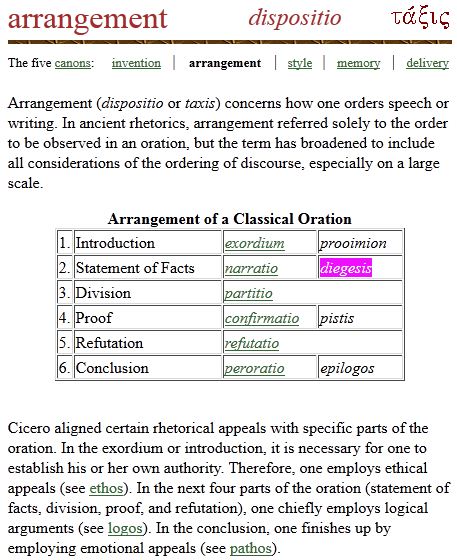
Although Burton has referred explicitly to the Roman rhetorician Cicero, he has synthesized for us the corresponding Latin, English, and Greek terms. And Aristotle is really Burton’s frame for us here, as Aristotle was for Cicero. Though Cicero developed Roman rhetoric, he always credited Aristotle for the start to or foundation of all the divisions and genres and canons of rhetoric.
Now we can more closely look at the terms Aristotle and Luke chose and used to arrange their texts right in the introduction. Aristotle writes in Section 9:

Kennedy translates that as follows with his own brackets around his italicized transliterations:
“the introduction [prooemion] or the narration [diēgēsis]”
Luke writes in Verse 1:

We might translate that Kennedy style as follows:
“to set up an arrangement [anataxasthai] for a narration [diēgēsis]”
Luke’s is the only use of either of these two technical rhetorical terms in the whole entire New Testament. And Aristotle’s use of his terms here is highly instructive and very technical. Both writers are arranging their material, introducing their topics, stating their facts.
Luke is trying to persuade his readers, namely Theophilus, and any others wanting to know more of the facts of the gospel. Aristotle is attempting to get his learners grasping the elements and the forces and the purposes of persuasion. As I’ve already said but want to reiterate: both of these writers use rhetoric rhetorically. In fact, Kennedy makes a big big deal out of this; at the 1992 Biennial Conference of the Rhetoric Society of America, the orator Kennedy contended:
All too many students of Aristotle are, in their hearts, Platonists. I am not only content, but delighted, when Professor [Thomas] Farrell proclaims that I am [as Aristotle is] not a Platonist…. My suggestion to the philosophers … is that instead of reading the Rhetoric as a work of philosophy they should try reading Aristotle’s major treatises on other subjects as rhetorical constructs.
What Kennedy is arguing is that Aristotle is more of a rhetorician, by his own rhetorical constructs, than he is a scientist or a syllogist or a logician or a philosopher. When Aristotle preaches his rhetoric, when he writes the Rhetoric (and all of his other works, says Kennedy), then he practices what he preaches, he is being rhetorical, he is acting to persuade by his available means. He is carefully arranging his argument, is defining enthymemes only enthymematically (which drives us all nuts now), and is eminently aware of his impact on his listeners and/ or his readers. (If we had time, we’d look at each of Aristotle’s uses of his term for narration [diēgēsis], and we could track how this explicit word does for him what he describes it as doing. We’d explore more how it is Kennedy can call Aristotle’s opener to his Rhetoric “very Platonic” on the whole but how it is Kennedy will agree with rhetorician Ferrell that Aristotle is not a platonist but rather is and is being a rhetorician. The remarkable thing about Aristotle’s rhetoric in the Rhetoric is how implicitly and explicitly rhetorical it is.)
Luke takes note, and so learns. It’s not just the what of the gospel, but for this writer, it’s also the rhetorical how. Verses 1 – 4 are only the beginning, only just the start.
Skin deep: an essay in images
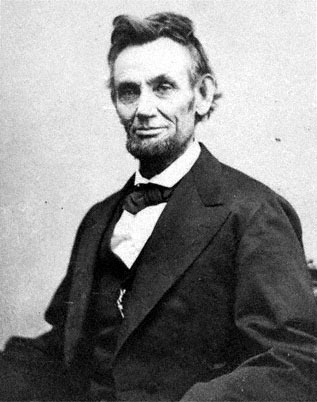
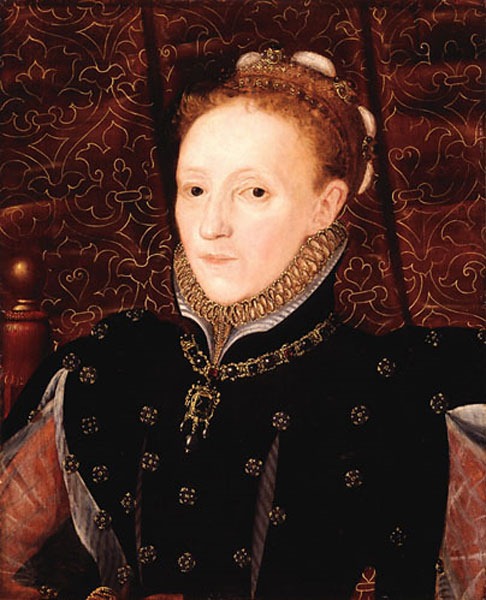
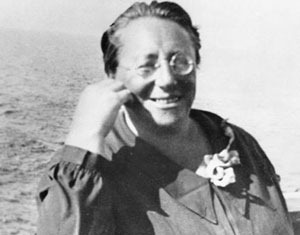
President Kennedy’s sexual addiction: a review of Michael O’Brien’s latest biography
This post has to be about two stories, the first about John F. Kennedy’s sex addiction and the second about whether, why, and how this first story needs to be told in the first place. I’m just going to focus on the second story. This is a review of a book by Michael O’Brien, historian and Emeritus Professor at the University of Wisconsin-Fox Valley (Ph.D. University of Wisconsin-Madison).
Let’s get to the bare facts:
- O’Brien’s book is entitled, John F. Kennedy’s Women: The Story of a Sexual Obsession.
- It’s very inexpensive ($2.99).
- It’s very short and is only available in eb0ok formats (from “Now & Then: Digital Publishers of Serious Nonfiction Books”) through the usual distributers (iTunes, Amazon, B&N.com).
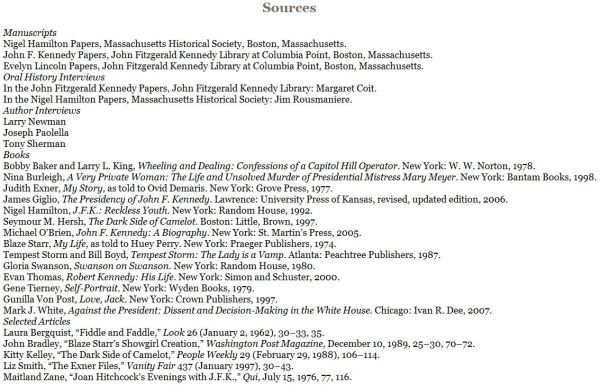
- Its sources are noted as follows:
- One of O’Brien’s sources for this book is one of his other books – John F. Kennedy: A Biography [992 pages] – which has been favorably reviewed as a substantial history that “brings balance to the life” of Kennedy, that “offers a serviceable consideration of JFK that’s as much a survey of the literature as it is a biography”, that “favors providing reliable information about events over speculating on emotions or the effects of various relationships”, and that “takes a more holistic approach” than do many earlier histories of the President.
Now, my read of this little book is that it’s an expansion of a chapter — “14. Married Life and Other Women” — in the big biography. Does O’Brien need to tell “The Story of a Sexual Obsession”? Do readers need to hear this story? Is there anything new? Or is the focus, as the main title would suggest, rather more on women, the story of women? On “John F. Kennedy’s Women”?
I do feel the main title is misleading, even if the publisher’s blurb begins to make it clear that the book is rather to chronicle “John F. Kennedy’s womanizing” and then to make some sense of that for us. Here are the sorts of questions that O’Brien’s little book answers or begins to provide some answers for:
- Which of Kennedy’s parents may have been most responsible for his eventual philandering? (As you can see from the publisher’s preview, O’Brien gets into this question very early: “Like many Irish-American women, Rose Kennedy, John’s mother, was exceptionally chaste, even within marriage; but her husband, Joseph P. Kennedy, became a notorious philanderer, and his behavior profoundly influenced his second son.” If you’ve read O’Brien’s John F. Kennedy: A Biography, then you may remember how he’s dealt with this question there.)
- How did John F. Kennedy view his brother’s commitment to marriage? How did he attempt to protect his sister from being pursued by philandering men?
- How and when did he lose his virginity? What were his sexual concerns, his fears and his proclivities?
- Who all did he sleep with, and who did he attempt to sleep with? Which woman associated with Adolf Hitler (actually photographed with the German leader)? Which Pulitzer Prize-winning author? Which Hollywood actresses? How did these women describe him?
- What did Jackie Kennedy know? What did his presidential staff know? Which philandering federal government men and which lobbiests worked with him? Who knew what?
- Why? Why did he do it? Was he a sexual addict? “In some ways Kennedy’s compulsive pursuit of women was similar to addictions to drugs and alcohol, but not completely,” writes O’Brien. How was Kennedy unlike the typical addict? If you don’t want to read the book, then you may want an answer to this question anyway. O’Brien suggests that JFK really may have been addicted to sex, which is why he starts the book looking at his early life, his family life, the influences of his parents, their religion, and their respective responses to the teachings of the Church. (In O’Brien’s substantial biography, he gets into the issue of Rose Kennedy’s Catholicism as it related to the sexual views and practices of Catholics then.)
Reading the book, we might then decide how to view President Kennedy’s sexual addition.
However, we might decide to do something else. We might listen to those to whom O’Brien seems to have referred to as John F. Kennedy’s Women. We might just change the title of this post, to note that the biography of Kennedy can only be understood well if the perspective of women around Kennedy is taken into account. O’Brien does do this, but like the title of my post his publisher and his subtitle make prominent, The Story of a Sexual Obsession. This is the weakness of this little work. It’s not entirely clear what O’Brien, writing a second biography of Kennedy, is trying to do with this expanded focus.
—
The best thing about O’Brien’s book is that it works in a few ways to give “John F. Kennedy’s Women” agency.
Rose Kennedy, for example, about whom her son John (or “Jack”) seemed to discredit publicly as a parent, is defended as the stronger, the better of his two parents. And O’Brien gives perspective to the views of other women such as Kathleen Kennedy, Jacqueline Bouvier, Marilyn Monroe, Judith Campbell, Marrietta Tree, and many others such as Mary Pitcairn, who when reflecting on John F. Kennedy’s behaviors and misbehaviors asked, “What kind of object is a woman?” Furthermore, if you look back to the “source” list above, then you’ll note the names of writers who O’Brien believes tried to blow the whistle on the womanizing of JFK. Nina Burleigh (for Mary Meyer), Judith Exner, Blaze Starr, Tempest Storm, Gloria Swanson, Gunilla Von Post, Laura Bergquist (about Fiddle and Faddle), Kitty Kelley, Liz Smith, and Joan Hitchcock (discussed by Maitland Zane) are women whose histories O’Brien gives some credence to.
O’Brien concludes his book by suggesting that Kennedy’s “scandals” made the American public distrust “politics and politicians” in general and caused the American press to enable such “[male] presidential misbehavior” as normal. He suggests that “the situation persists.” And yet earlier in the book, O’Brien seems to look for change, to ask why a book like his needs to be written. He looks both to women and to men as those who might have been (and therefore might still be) complicit in the problem of such “presidential misbehavior.” What may be needed is for more light to be shined, for more knowledge to be shared, for the ugly side of stories and of histories to be told. No more gentleman’s understandings ought to be tolerated, suggests John F. Kennedy’s Women: The Story of a Sexual Obsession; or, at least by reading the book, this is what one might infer from several women:
Maxine Cheshire noted that “In Washington, women all too often lie about their relationship with famous men—to get publicity, to even a score, to enhance their power.” From the era of Franklin Roosevelt the media had adhered to a gentleman’s understanding not to pry into the president’s personal life. As much self-protective of the press corps as the president, the attitude was, “If we’re going to blow the whistle on this guy, are we going to start telling about each other?” Still, the main reason the press didn’t investigate Kennedy’s womanizing is that most reporters were unaware of his private behavior. The columnist Betty Beale asserted that “the press was totally in the dark. I mean totally. The idea of the President having an affair with Marilyn Monroe or anyone else . . . well, it was just inconceivable.” UPI White House correspondent Helen Thomas agreed. “I was right there every day,” Thomas said, “and I didn’t know a thing. Period.”
Whose Sancho Panza? Mine, Yours, Theirs?
Depending on who you are, this post is also entitled, “Whose Persona? Mine, Yours, Theirs?”
What you will find below are five or six paragraphs from a book. These are translated from French into English by Edwin Hudson. The book is one I found on my father’s bookshelf this weekend, a book I had never read, a book in which my father had made marginal notes and had underlined some time between 1956 and 2012. Like the author, my father is an orphan. This fact immediately separates their personage and mine. This is something my orphan father and his son with a father (i.e., he and I) discussed, as he’s been tell me the story of his life after his father’s life and before mine.
“I was three months old when my father died,” writes the author of my father’s book; and he continues: “so that I know him only from the biography written by one of his friends, from obituary notices, from the poems he left, from articles, letters, photographs, and from stories about him, told me long afterwards.” The writer goes on: “And yet, when a man describes to me his father — a father with whom he spent his whole childhood, I cannot be sure that the portrait he paints is any more faithful than the one I have of mine.” With all that in mind, you now may read the five paragraphs from the Swiss scientist and medical doctor, Paul Tournier (and the underlinings are the first of my father’s in this book Le Personnage et la Personne translated into English as The Meanings of Persons).
Day after day men and women of all ages and conditions, the healthy as well as the sick, come to see me in order to learn to know themselves better. They tell me the story of their lives. They take great trouble to get the details absolutely right. They are seeking to know the person that they themselves really are, and they feel that everything we are setting out to do together may well be compromised if they are not scrupulously sincere in all they say.…
In the same way, we learn as much about humanity from legends as from historical reports. They are a different reality, but a reality nevertheless. Indeed, they are much more a reliable document than the most learned history book. If we wish to understand man it is as important to read the Iliad, the Odyssey, the Aeneid, the Bhagavad-Gita, or even Grimm’s fairy-tales, as philosophical, sociological, physiological or psychological treatises.
Nothing relies on convention more than the theatre. The play that we see there is in fact a ‘play’ of personages. And yet one tragedy by Sophocles contains as much authentic truth about humanity as the most accurate biography. The actors are playing a part, and yet it is the human person itself that we apprehend in their gestures and their words, as surely as if we were watching a man living his real life. The very word person owes its origin to the masks worn by the actors to amplify their voices (sonare … per).
Professor C. G. Jung uses the Latin word persona to express not what we mean by the word ‘person’, but rather ‘personage’, in the sense in which I shall be using it in this book. These linguistic complications are not fortuitous; they testify to the complexity of the problem I am grappling with: the way in which the personage is inextricably bound up with the person, in spite of the fact that we always tend to think of the role we play as different from what we are in reality….
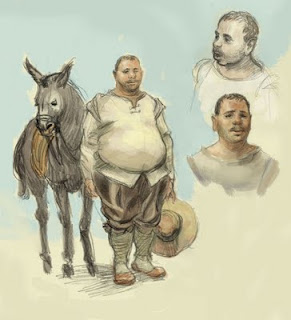
Even Sancho Panza is not identical for everybody; my idea of him is not the same as yours, or as that of Cervantes. For me he is a personal image which the reading of the Quixote has awakened in me, and which my own mental associations and experiences have also helped to fashion: he is my Sancho Panza. He depends therefore on my own person and the history of my own life, on the conscious and unconscious resonances aroused in my mind by the Cervantes’ story.


Movies about ideas: the 30th anniversary of My Dinner with Andre
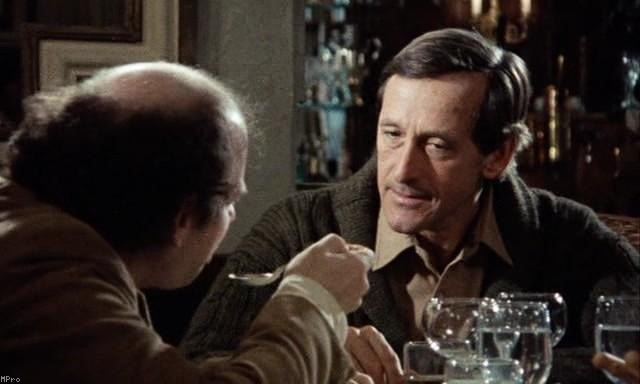 The Louis Malle-Wallace Shawn-Andre Gregory film My Dinner with Andre was released almost exactly 30 years ago today: its nationwide release was on January 20, 2012.
The movie was exciting for many different reasons – it featured splendid acting, remarkable dialogue, gave an introduction to the radical theater theories of Jerzy Grotowski, and showed that there was a fresh, new, direct way to approach film. Roger Ebert wrote:
Someone asked me the other day if I could name a movie that was entirely devoid of clichés. I thought for a moment, and then answered, My Dinner With Andre. Now I have seen the movie again; a restored print is going into release around the country, and I am impressed once more by how wonderfully odd this movie is, how there is nothing else like it. It should be unwatchable, and yet those who love it return time and again, enchanted.
Ebert focuses on the comic aspects of the film
“They taped their conversations two or three times a week for three months,” Pauline Kael writes, “and then Shawn worked for a year shaping the material into a script, in which they play comic distillations of aspects of themselves.’” Comic? Yes. Although the conversation is often despairing (Gregory speculates that the 1960s were “the last burst of the human being before he was extinguished”), the material is given a slight sly rotation toward the satirical. There is a lot to think about in the torrent of ideas, but also a saving humor. Gregory plays a man besotted by the ideas of the new age; he almost glows when he tells Shawn about an agricultural commune in Britain where instead of using insecticides, “they will talk to the insects, make an agreement, set aside one vegetable patch just for the insects.”
In an interview, Ayad Akhtar credits My Dinner with Andre and Akhtar’s subsequent studies with Andre Gregory and Jerzy Grotowski with defining much of his life (read the full interview here):
I got particularly fascinated with Andre after My Dinner with Andre because of that question of authenticity. You know, the central conceit of My Dinner with Andre is that this very successful theater director drops out of life and goes on a quest to discover who he really is and how to live authentically, and in the process, you know, studies with this famous, mysterious, Polish figure, director, Jerzy Grotowski, in a Polish forest and has these amazing experiences. And I think that – well, I don’t think. I know that watching that movie gave me a fascination for the figure of Grotowski. And I began to study Grotowski in college, you know, writing research papers about him and trying to understand what it was that he was getting at. And as I understand it – or as I understood it before going to work with him – it had to do with the search for how to be true. It’s a question that actors have to ask on stage. You have to feel real in order to convince anybody else that you’re real.
 My Dinner with Andre is ultimately a film about ideas. Hollywood doesn’t usually do so well with films about ideas; complicated theories simply do not translate well to the film. However, there are exceptions, such as Bennett Miller-Brad Bitt-Jonah Hill film Moneyball. Moneyball dramatizes sabermetrics, and is as close as anyone has gotten to making a film illustrating the theories of Bill James. It might have seemed inconceivable before the film that one could make a compelling movie about statistical theories in baseball, but Moneyball manages to achieve that.
The truth is that movies or audio recordings about ideas can be gripping. Let me give two examples:
 Plato’s writings are generally set in the form of a dialogue or script. We tend to downplay that aspect of their writings even though the dramatic form is often essential to understanding and appreciating them (e.g., The Symposium). I once gave a good friend of mine heading off on a road trip a CD copy of Bruce Alexander’s abridged reading of Thomas Griffth’s translation of Plato’s Republic. He looked at me like I was crazy, but I urged it on him, and he listened to it. When I next saw him, he was fulsome in praise for CDs – he had not expected them to be so entertaining.
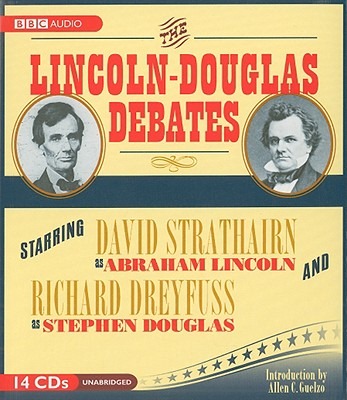
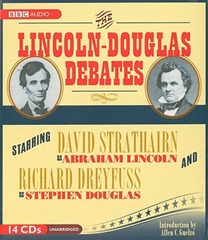 Most Americans are aware at some level that we should all read the 1858 Douglas-Lincoln debates; but I think that few of us actually do. Amazingly, the BBC has seen an opportunity here and released a recording of the complete debates (featuring Richard Dreyfuss and David Straithairn). Not only do they make a credible job of the likely accents and cadences of Douglas and Lincoln, but the recording is actually gripping. Exactly because Douglas and Lincoln were engaged in passionate back and forth over the course of their debates makes them ripe subjects for presentation in audio format.
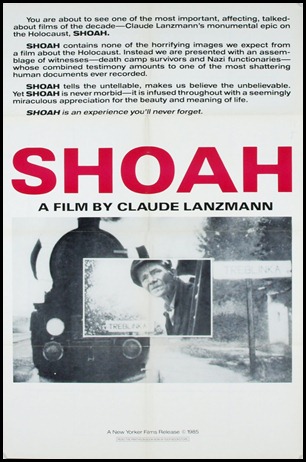
Turkish public television shows Claude Lanzmann’s “Shoah”
 From the Associated Press:
An epic French documentary about the mass murder of Jews under the German Nazi regime has appeared on Turkish television to mark international Holocaust Remembrance Day — the first time the film has been aired on public television in a majority-Muslim country. State television TRT’s documentary channel showed the first episode of filmmaker Claude Lanzmann’s Shoah late Thursday — the eve of the day of remembrance of the victims of the Holocaust. The film has been subtitled into Arabic, Farsi and Turkish by the Paris-based Aladdin Project as part of its campaign to promote understanding between Jews and Muslims and to fight Holocaust denial….
It was the first showing of Shoah on a public television channel in a Muslim country. The director said he hoped more Muslim countries would follow suit. “It is a historical event,” Lanzmann, 87, said in a telephone interview with The Associated Press from his home in Paris. “It is extremely important that it is being shown in a Muslim country. The Turks are engaged in a pioneering work and I am sure it (the showing) will be followed by other Muslim countries,” he said….
The most important issue before voters?
So, let me get this right. This is arguably the week most likely to decide of the Republican nomination for president, and Newt Gingrich gives a speech supporting the moon becoming a US state. (However, Gingrich opposes statehood for the District of Columbia.)
Maybe it is a folk etymology: lunar → looney.

Calvin out of print in hardcover?
Christianbook’s academic blog reports that the hardcover (1960) McNeil-Battles’s translation of Calvin’s Institutes of Christian Religion is going out of print. This means that the only hardcover edition in print will be the cheap reprint of the 1845 Henry Beveridge version. The 1561 Thomas Norton translation has long been out of print – a pity, since Norton’s translation was quite good. (Norton was the son-in-law of Thomas Cranmer.) John Allen’s 1813 translation is also long out of print.
I have to admit that I find it stunning that such an important and influential thinker in religious thought could go out of print in hardcover in English.
“Personal-size edition” of the New Cambridge Paragraph Bible
Although this is now the 401st anniversary year of the King James Bible, we are still enjoying the fruits of the quadricentennial celebration, as works continue to trickle out that were originally meant to appear last year.
Among them is a new printing of David Norton’s extensive critical edition of the New Cambridge Paragraph Bible was rightly hailed for being the best edition of the KJV we have to date. Some people claimed that the original volume was too bulky (particularly for worship use); I do not agree, but Cambridge University Press let it go out of print soon after it appeared – and then waited six years to reprint this new edition.
The new edition is in a more compact format called “personal size” (Amazon reports its dimensions as 8.6 x 6.9 x 1.7 inches) which is 5/6ths of the original page size. It comes in four formats:
- Hardcover with Apocrypha
- Calfskin with Apocrypha
- Hardcover without Apocrypha
- Calfskin without Apocrypha
I have copies of the first two, apparently hot off the printing press. The format used for these volumes is nearly identical to the original 2006 printing, but with a reduced page size. In particular, the volume include both the “Epistle Dedicatory” and the not-so-often-reprinted “The Translators to the Reader.” The volume includes the original translation notes of the KJV, printed, unfortunately, in the inside margins.
(Many annotated books, such as those in the “Harvard Annotated” series or the “Norton Annotated” series have notes printed on the outside margin. This permits the reader to add his own notes easily – when notes are printed on the inside margin, the bend of book pages and the gutter prevent one from writing notes. )
The layout of the book is, arguably, the most beautiful I have ever seen. The edition is, true to its title, in paragraph format rather than the verse format often used for reprinting the KJV. This means that text read normally, rather than starting new paragraphs at the beginning of what are often arbitrary verse divisions. Poetry is presented in scansion. The italics used in the KJV to denote words not in the original language are printed in normal font. The font is particularly elegant (the font was 10/12.5 point Swift; in this edition it was reduced to 87% of its original size so it is approximately 8.7/10.9 point). The line length (single column) is just perfect. Interline spacing makes the books highly readable. And Cambridge reminds us that the “Rights in the Authorised (King James) Version of the Bible are vested in the Crown,” reprints it lion and unicorn crest, and informs us that “this edition is printed and published by Cambridge University Press, The Queen’s Printer, under Royal Letters Patent.” (I’m a republican [in the sense of being an anti-monarchist] myself, but am still amused – even though I normally pooh-pooh everything involved with British royalty. So, even though I was deeply annoyed by the attention given to the so-called “royal wedding” in April 2011, I still find this acceptable — maybe I’m more tolerant because this book is nice to hold.)

One of the main advantages of this edition is rather complete matching Textual History of the King James Bible, essential for understanding the changes and typographical errors that have accumulated in KJV editions.
Among the defects of the volumes: in addition to having the notes on the inside margins, the pages have a slight bleed-through (or, more correctly, ghosting) property – this is particularly noticeable on pages laid out as poetry. The hardcover has no ribbon. And the cover of the hardcover (once the dust-jacket is removed) looks a little yucky: the designers were trying to achieve some sort of subtle marbling effect, but instead, the covers just look dirty.
Norton writes (using the British spelling of “judgment”): “Errors of press and of editorial judgement are corrected in this edition of The New Cambridge Paragraph Bible. Most of the corrections had already appeared in the Penguin and Folio Society editions. A list of the corrections is available from Cambridge University Press.” I am writing to Cambridge today to see if they will send me the errata.
Update: the publisher did send me the errata, which I formatted and put here.
A note on the hardcover and leather editions: I prefer hardcover editions in general. The hardcover edition is certainly a lot more affordable than the leather edition, and it appears to be reasonably well-bound.
A few weeks ago, Mark Bertrand, of the invaluable Bible Design Blog, wrote of another translation and edition, that “this looks like the one we’ve been waiting for.” I disagreed with that opinion, and it seems to me that this edition of the New Cambridge Paragraph Bible gets much closer to the ideally designed Bible.
My principle reservation in recommending this Bible is that I suspect that the forthcoming Norton Critical Edition of the English Bible, now scheduled for a March release, will soon dominate the academic market for the KJV. I have not seen a copy of the Norton editions yet, but I’ve heard from others that they are quite good. If money is tight, it might be worth waiting until March to decide which version to buy.
The Englishing of Targum Onkelos and Septuagint Pentateuch
Of the several ancient translations of the Pentateuch, perhaps the two most important are the Septuagint Pentateuch (a translation into Koine Greek) and Targum Onkelos (a translation into Aramaic). It is instructive to see how they have been treated by their respective communities.
The main part of this post is a review of the newly completed Drazin-Wagner Onkelos on the Torah – but the theme of this post is to compare how poorly the Septuagint translation has been treated (be relegated, in the Western churches, almost solely to scholars), while another translation continues to be consulted by lay members of a religious community.
Septuagint Pentateuch
Septuagint Pentateuch was originally a Jewish translation, but with the demise of Alexandrian Jewish community (and its subsequent vilification by Jews for its neglect of Hebrew), Septuagint Pentateuch was largely adopted by the Christian community. In the Western churches, it has largely been neglected in favor of the Vulgate or translations directly from the Hebrew. I am only aware of one paper English diglot edition of Septuagint Pentateuch: a 160 year-old translation by Lancelot Brenton which is still in print. (Brenton, an English Protestant, inherited a Baronet from his father, a vice-Admiral in the British navy and a contemporary of Nelson, although ironically, Lancelot was a pacifist). Although many Eastern Orthodox (particularly Greek Orthodox) nominally should Septuagint Pentateuch as their Scripture, it took until 2008 for a major publisher to release an Orthodox Study Bible which includes a translation of Septuagint Pentateuch (but not the original Greek). The Orthodox Study Bible was patterned after the style of the NKJV translation. However, the Orthodox Study Bible has been heavily criticized by several prominent Eastern Orthodox Bible bloggers (see here, here, and here for links). As part of the NETS translation, a 2007 academic translation of Septuagint Pentateuch (again, published in English only with no Greek) was produced and published by Oxford University Press under the leadership of Albert Pietersma, patterned after the style of NRSV. We have frequently commented on this translation here on BLT, see here and here.
Targum Onkelos
In contrast, Targum Onkelos, an Aramaic translation, has never stopped being part of the Jewish tradition. Based on an instruction in the Talmud (Berachos 8a), Jews are obligated to read the weekly lectionary (parsha) twice in Hebrew and once in the Targum: שנים מקרא ואחד תרגום (shnayim mikra ve-echad targum). Later authorities concluded that a substitution of the commentary of Rashi was acceptable (or even better a combination of Rashi and Targum Onkelos) or, in some cases, a translation into a contemporary vernacular language. However, Rashi and the other medieval Pentateuch commentators regularly reference Targum Onkelos.
As a result, Targum Onkelos (and the commentary of Rashi) is regularly printed with the the Pentateuch as part of chumash. For example, the Artscroll chumash includes the Hebrew Pentateuch text, Aramaic Onkelos, Hebrew Rashi, an English translation of the Hebrew Pentateuch, and English commentary, and the Artscroll Rashi chumash edition includes the same elements, together with an English translation of Rashi (the English commentary in the latter edition is a meta-commentary on Rashi rather than on the Hebrew.) Since traditional Jewish education includes training in both Hebrew and Aramaic (the latter necessary to read the Talmud), the inclusion of Onkelos makes sense. Of course, a Rabbinic Bible must include Rashi. Mossad HaRav Kook’s Rabbinic Bible edition of the Pentateuch (which is arguably the most accessible edition in print) includes, in addition to the Hebrew text, Targum Onkelos, Saadia Gaon, Chananel, Rashi, Rashbam, Ibn Ezra, Radak, Nachmanides, Maharam, Chizkuni, Sforno, and the entries from Sefer HaChinuch
However, not everyone knows Aramaic as well as he or she should, and in any case, the Aramaic demands commentary. The question is: where does the Aramaic differ from the Hebrew and what does it mean?
After ten years, Israel Drazin and Stanley M. Wagner have finished their five volume, 1534 page edition of Onkelos on the Torah for Gefen Press. Amazon is currently selling the set for $146. The pages are large format 11 by 8.5 inches (the books are still handy to hold since they are not too thick, and each volume features a ribbon), and the page format features a large, vocalized version of Onkelos, an English translation, the Hebrew text and Rashin in Hebrew, and a commentary on the English translation of Onkelos. The commentary discusses linguistic and theological issues raised in the text as well as points where Onkelos varies from the Hebrew. The commentary is claimed to draw upon some lesser known French commentaries, those of Joseph Bechor Schor and Joseph ibn Kaspi), as well as commentaries by Maimonides, Ibn Ezra, Rashi, Nachmanides, Radak, Rashbam, Sforno, Chizkuni, “and others, and the Targums of Neophyti, Pseudo-Jonathan, the Greek Septuagint, and the Samaritan Bible).” The commentary is based on the Onkelos texts determined by Abraham Berliner (Targum Onkelos) and Alexander Sperber (The Bible in Aramaic). However, the actual Aramaic text printed in the volumes is slightly different – the authors blame technical reasons (I suspect that those technical problems include copyright protection and the unavailability of the Berliner and Sperber texts in electronic form.) The commentary typically takes up about half the page, but is set in smaller type, so there is a great deal of annotation.
Phy
The text includes extras: The table of contents is annotated, with a summary of each parshah given in paragraph format. Front matter includes an author’s note, publisher’s note, preface, a longer introduction to Targum Onkelos for that biblical book, and an “introduction to ‘beyond the text,’” a set of advanced questions indicated in stand-alone boxes in the text. Each chapter ends with a summary of the chapter. The volumes include the lectionary readings from the Prophets and Writings of the Hebrew Bible, featuring extended introductions, Hebrew, and an English translation from the Targum text (not the Hebrew). This is followed by by 50-70 pages of appendices, a glossary, and a bibliography. The commentary itself tends to be moderately theologically based, and can hardly be called critical, but does cover the key linguistic issues and fully covers differences between the Hebrew and Aramaic.
What can we learn by contrasting the treatment of Septuagint Pentateuch and Targum Onkelos? In one way, the comparison is unfair – the Pentateuch is a secondary religious text for Christians while (in Hebrew) it is the primary religious text for Jews. On the other hand, the English-speaking Christian community is so much larger than the English-speaking Jewish community that one would expect that this factor would be outweighed by sheer demographics. Indeed, a strong argument that if our measure is accessibility and availability to a wide popular audience in both Greek and English: the classical Greek writings (including some relatively minor volumes) have been better treated (say, by the green volumes in the Loeb Classical Library) than the Septuagint has.
How did this come to pass? How did the Protestant and Catholic religious communities, both of which have often emphasized scholarship, come to treat the Septuagint so shabbily? Is there any hope that things might change in the near future?
Smithsonian and Monticello exhibitions on Jefferson’s slaves
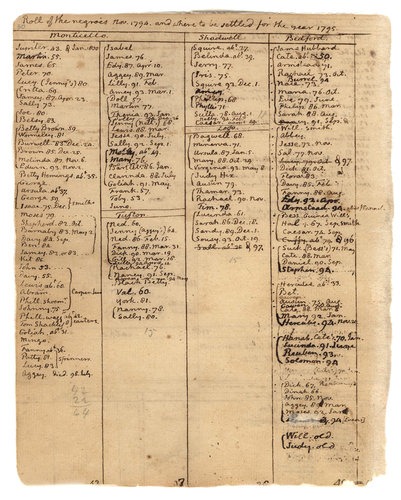 One of the great paradoxes of American history is Jefferson’s ownership of slaves. How could a man so emblematic of the American Revolution and American Enlightenment,a strong political and moral opponent of slavery, so easily have kept 600 (!!) slaves? (How could 12 of the first 18 American presidents have been slave-holders?)
I see an announcement in the New York Times of a new pair of exhibitions on Jefferson’s slaves: the first, at the Smithsonian National Museum of American History (together the new National Museum of African American History [the museum building for the NMAAH is at least three years away] and Culture and the Thomas Jefferson Foundation) and the second, a new expanded permanent exhibition at Monticello. The Smithsonian exhibition has just opened and the Monticello exhibition opens in February, so I have not yet seen them, but they sound fascinating and important. Edward Rothstein writes:
We enter the show’s 3,000-square-foot space seeing a life-size statue of Jefferson (created by StudioEIS in Brooklyn), standing in front of a red panel on which are inscribed the names (when known) of some 600 slaves who worked on his estates during his lifetime. In front of the display is the lap desk on which Jefferson wrote the Declaration of Independence, a desk that was probably constructed by John Hemmings, Jefferson’s enslaved cabinetmaker (who used that spelling of his name), part of the now-renowned Hemings family (one of whom, Sally, is thought by many historians to have had a special relationship with Jefferson and borne him children).
The contradictions in notions of liberty could not be more graphically presented. The intention is not to turn a great man into a villain but rather to examine just how those contradictions expressed themselves. Jefferson called slavery an “abominable crime,” we are told, but also felt unable to extricate himself from what he called its “deplorable entanglement.”
We learn of his practical efforts to restrict slavery, including his introduction of a Virginia law in 1778 prohibiting the importation of slaves, and signing, as president, a national version of that law in 1807, just weeks before Britain outlawed the slave trade. We read too that in 1788, he wrote, “Nobody will be more willing to encounter every sacrifice” in order to abolish slavery.
Clearly, though, he was not so willing. He also harbored some condescending racial views (partly contradicted by other writings). And Jefferson inherited his father’s plantation and slaves; at one point he was one of the wealthiest men in Virginia (though to pay his enormous debts after his death, Monticello and “130 valuable negroes” — as the advertisement put it — were auctioned).
As the exhibition also emphasizes, he was a man of the Enlightenment represented by his books (Homer, Livy, Shakespeare), his scientific apparatus (including a telescope) and his devotion to the powers of reason and the value of skepticism (his inkwell here is in the shape of Voltaire’s head).
But we do not learn of these passions in order to have them dismissed. Gradually, as we work through the central gallery, we see them haltingly, falteringly applied, affecting the enslaved communities at Monticello. Displays are organized around a series of slave families, many of whom were at the estate for generations — the Hemingses, of course (as many as 70 family members were at Monticello), but also the Fossett family, the Grangers and the Hubbard brothers. (Perhaps no other plantation has such extensive documentation of its slaves.)…
The most remarkable phenomenon is evident in the last gallery: Many descendants of Monticello slaves became community leaders. A project interviewing them began at Monticello in 1993; it discovered, we are told, a tradition of dedication to education, faith, family and freedom.
Peter Fossett, a descendant of the blacksmith Joseph Fossett , for example, became a minister active in the Underground Railroad and founded the First Baptist Church in Cumminsville, Ohio, in 1870. Another Fossett descendant, William Monroe Trotter, founded the Niagara Movement with W. E. B. Dubois in 1905, declaring that “all men were created free and equal, with certain inalienable rights.” One of the Hemings descendants, Frederick Madison Roberts, became the first black member of the California legislature.
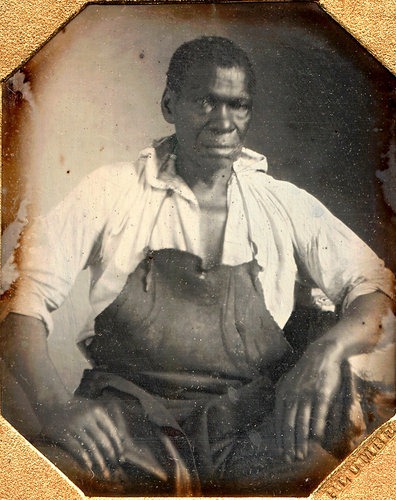 I plan to visit these exhibitions soon. There is a companion book, and the Washington Post also has coverage of the exhibits.
Wolters on Authentein
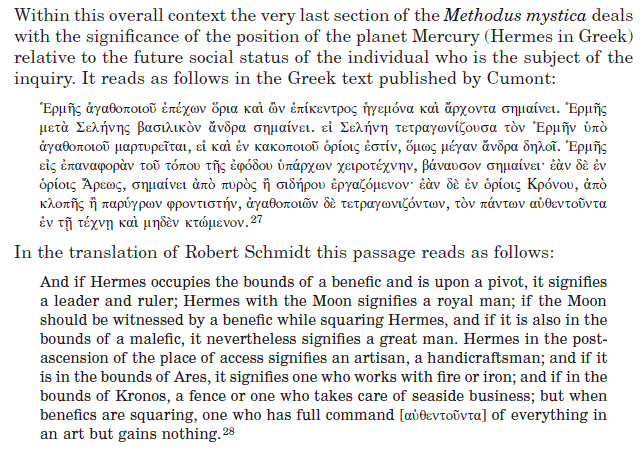
Al Wolters has published a new article on authentein in 1 Tim. 2:12 in the ETS December 2011 issue. It is not available yet but Al has sent me a copy and I am citing the relevant new data from this article. Wolters always produces exciting new detective work on ancient documents and this does not disappoint. He brings to our attention a previously overlooked ocurrence of authentein in the literature contemporary with the NT.
In this case he derives a new meaning for authentein, concluding,
The verb essentially means “to be master,” to be superior to another in prestige, authority, or skill.
I have some hesitancy in acepting this new meaning, but I do appreciate the detail and care with which this citation is presented, including a lot of surrounding context.
I don’t feel that this is a challenge to my understanding of the word authentein, that contemporary with the NT writings, it was not used in a non-pejorative sense for the rule of one person over another. This meaning is not presented here.
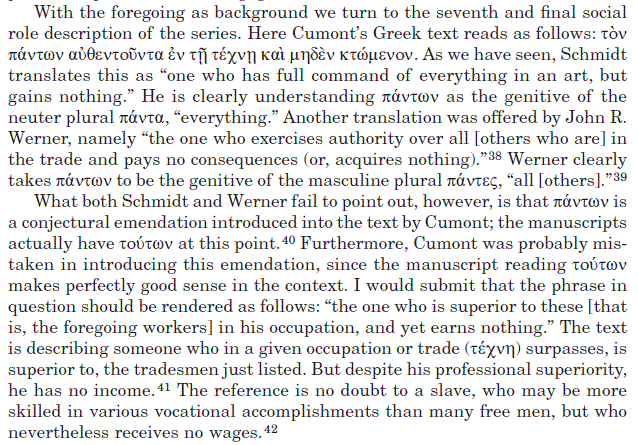
In a comment thread on Denny Burk’s blog I have been asked if it is not an anachronism to translate authentein with “usurp authority” since all rule by women would have been considered usurpation. This may have been true for Calvin, but Elizabeth was the supreme governor of the Church of England. I also feel that the meaning of “to have/exercise authority” was adopted in the 20th century to provide a bulwark against women’s expanding roles. This does not seem like an appropriate reason to emend a translation.
Many thanks to Dr. Wolters for providing me with a copy of his paper.
John Henry Newman is not only an intellectual giant; he is especially interesting because his spiritual thought developed over time. The story of Newman’s spiritual evolution has been elegantly told by Newman himself in Apologia Pro Vita Sua: Being a History of His Religious Opinions, a work that demands to be read. (I read the Norton Critical Edition which has the advantage of notes and extensive additional material reflecting the debates in the Oxford Movement and writings that show his extraordinarily vicious clash with Charles Kingsley.) But Apologia has a serious failing: it is a reconstruction of the movement of Newman’s mind – and thus is a bit too neat in parts. In contrast, Newman’s Oxford University Sermons – a selection of fifteen sermons preached at Oxford between 1826 and 1843 – has “the immediacy of a journal.”
Newman wrote to his friend J. R. Hope on 3 February 1843 (around the time of its publication) that the Oxford University Sermons as “the best, not the most perfect, book I have done. I mean there is more to develop in it ….” The joy in reading in these sermons is not simply watching Newman’s development from “noetic liberalism” to what he called “Apostolic Catholicism” to the threshold of Roman Catholicism. The joy is also in seeing a young man of 25 develop his intellectual powers, his powers of expression, until they reached full flower in his mid-30s and approached his now familiar voice in his early 40s. These sermons are not merely a proleptic Apologia but snapshots of a growing mind – and a distinctive style.
They sermons are certainly appreciated by later readers. In 1973 (The Survival of Dogma) Avery Dulles claimed that “perhaps the useful analysis of the relationship between faith and reason, for our time, remains that of Newman in his Oxford University Sermons.” In 2002, in his intellectual biography of Newman, Dulles claimed that the “personalist apologetic” of Newman’s fifth sermon“Personal Influence: The Means of Propagating the Truth” (1832) would ensure that “Newman stands with Origen and Augustine, Aquinas and Pascal, as one of the great apologists of all time.”
And, even if we know how the story ends, there is a palpable excitement in these sermons because at the time they were given, Newman could not know how they would turn out. As Newman writes in his thirteenth sermon (1840):
The mind ranges to and fro, and spreads out, and advances forward with a quickness which has become a proverb, and a subtlety and versatility which baffle investigation. It passes on from point to point, gaining one by some indication; another on a probability; then availing itself of an association; then falling back on some received law; next seizing on testimony; then committing itself to some popular impression, or some inward instinct, or some obscure memory; and thus it makes progress not unlike a clamberer on a steep cliff, who, by quick eye, prompt hand, and firm foot, ascends how he knows not himself, by personal endowments and by practice, rather than by rule…. It is not too much to say that the stepping by which great geniuses scale the mountains of truth is as unsafe and precarious to men in general, as the ascent of a skillful mountaineer up a literal crag. It is a way which they alone can take ; and its justification lies in their success.
[Jean Guitton recognized in 1933 that this passage was a self-description of Newman: “il s’est peint lui-même tout entier” in La Philosophie de Newman.]
The modern reader of Newman’s sermons faces two challenges: Newman’s academic sermons, unlike his Parochial and Plain Sermons are rigorous and demanding in terms of language, theological concepts, and philosophy. As if that were not enough, we are more challenged by our distance from the academic controversies that swirled around Oxford and in the Oxford Movement in the last days of the Georgian era and the first days of the Victorian era. For this type of reading, an annotated version is mandatory.
James David Earnest and Gerard Tracey (the latter died in 2003, before this volume was completed) address this need with an overflowing volume published by Oxford University Press. Their annotations include an analytical 118 page introduction and front matter, 26 pages of appendices, and 155 pages of editors notes (because the latter are set in small type, the editorial matter dominates Newman’s original text, which only extends for 235 pages). The only serious fault I find with this volume is its price (Amazon lists it for $170 – I was fortunate to find a copy being sold for far, far less than that.) The elegance and immediacy of Newman’s language, combined with the annotations explaining each point of contemporary interest to Newman’s original listeners, has the effect of transporting one back to the early days of Queen Victoria’s reign, when Newman delivered these lectures to his Oxford audience.
I would still put Newman’s Apologia and his Essay in Aid of Grammar of Assent as higher priority reads by Newman. But if you happen to find this Earnest-Tracey edition of the Oxford University Lectures on sale, please do not hesitate to snatch it up.
Curious George
Where the Wild Things Are is all very well, but my favourite books were Curious George, and my picture is up in my school library holding a Curious George book. I have seen this name in several contexts lately, but only recently, due to the internet, did I read the story of his creator, H. A. Rey,
Hans Augusto Rey was born on September 16, 1898, in Hamburg, Germany. He grew up there near the world-famous Hagenbeck Zoo, and developed a lifelong love for animals and drawing. Margarete Elisabeth Waldstein (who would be known to most of the world as Margret Rey) was also born in Hamburg on May 16, 1906. The two met briefly when Margret was a young girl, before she left Hamburg to study art. They were reunited in 1935 in Rio de Janeiro, where Hans was selling bathtubs as part of a family business and Margret was escaping the political climate in Germany. Margret convinced Hans to leave the family business, and soon they were working together on a variety of projects.
Hans and Margret were married in Brazil on August 16, 1935, and they moved to Paris after falling in love with the city during their European honeymoon. It was there that Hans published his first children’s book, after a French publisher saw his newspaper cartoons of a giraffe and asked him to expand upon them. Raffy and the Nine Monkeys (Cecily G. and the Nine Monkeys in the British and American editions) was the result, and it marked the debut of a mischievous monkey named Curious George.
After Raffy and the Nine Monkeys was published, the Reys decided that Curious George deserved a book of his own, so they began work on a manuscript that featured the lovable and exceedingly curious little monkey. But the late 1930s and early ’40s were a tumultuous time in Europe, and before the new manuscript could be published, the Reys—both German Jews—found themselves in a horrible situation. Hitler and his Nazi party were tearing through Europe, and they were poised to take control of Paris.
Knowing that they must escape before the Nazis took power, Hans cobbled together two bicycles out of spare parts. Early in the morning of June 14, 1940, the Reys set off on their bicycles. They brought very little with them on their predawn flight — only warm coats, a bit of food, and five manuscripts, one of which was Curious George. The Nazis entered Paris just hours later, but the Reys were already on their way out. They rode their makeshift bicycles for four long days until reaching the French-Spanish border, where they sold them for train fare to Lisbon. From there they made their way to Brazil and on to New York City, beginning a whole new life as children’s book authors.
Curious George was published by Houghton Mifflin in 1941, and for sixty years these books have been capturing the hearts and minds of readers throughout the world. All the Curious George books, including the seven original stories by Margret and Hans, have sold more than twenty-five million copies. So popular that his original story has never been out of print, George has become one of the most beloved and recognizable characters in children’s literature. His adventures have been translated into many languages, including Japanese, French, Afrikaans, Portuguese, Swedish, German, Chinese, Danish, and Norwegian.
Although both of the Reys have passed away — Hans in 1977 and Margret in 1996—George lives on in the Curious George Foundation. Established in 1989, this foundation funds programs for children that share Curious George’s irresistible qualities—ingenuity, opportunity, determination, and curiosity in learning and exploring. Much consideration is given to programs that benefit animals, through preservation as well as the prevention of cruelty to animals. The foundation supports community outreach programs that emphasize the importance of family, from counseling to peer support groups.
Do Arizonans need to understand Australian English?

From the New York Times, a story about Alejandrina Cabrera who attempted to run for City Council in a border town:
Like many other states, Arizona has long required politicians at all levels to speak, read and write English, but the law fails to spell out just what that means. Is grade-school knowledge enough? Must one speak flawlessly? Who is to decide?
“I do feel this opening a box of Pandora, and we don’t know where it’s going to lead,” said Mayor Juan Carlos Escamilla, who filed a legal challenge of Mrs. Cabrera’s English ability.
He acknowledged on local television that his own English was far from perfect. “I feel I don’t dominate 100 percent, but I can still get by,” said Mr. Escamilla, who graduated from the same Arizona high school as Mrs. Cabrera. “I can write, read and understand it very well.”…
On Jan. 13, Judge John Nelson of the Yuma County Superior Court ordered a linguist to evaluate Mrs. Cabrera….
In his report, which was detailed in a court hearing on Wednesday, William G. Eggington, a professor of English and linguistics at Brigham Young University in Utah, said that based on interviews and tests he conducted with Mrs. Cabrera, she had “basic survival level” English that fell well below that needed to participate in city business….
But Mrs. Cabrera said the fact that Professor Eggington was from Australia led to at least one misunderstanding during the assessment. He asked her about “summer,” which she said he pronounced “summa.” That is the nickname for the community of Somerton, prompting her to be utterly confused.
The Court in this case did make the decision to disqualify Cabrera.
The Wild Rumpus: Colbert interviews Sendak (and translation notes)
If you missed the two-part interview of Maurice Sendak by Stephen Colbert on his Colbert Report, then you can view it below. Sendak, of course, has written Where the Wild Things Are, which has the distinction of 3rd place in the top 5 books of all time that have inspired tattoo art. The first interview, I should warn you, gets into interpretations of “the wild rumpus” in the book. Furthermore, the interview subtitle and subject “tags” noted at colbertnation.com/the-colbert-report should serve as an additional viewer advisory. The subtitle begins “Author and illustrator Maurice Sendak contemplates the complexity of children and the simplicity of ….” Some of the subject tags are as follows (but I’m omitting the most offensive ones that refer to race and sex classes and to body parts): “Maurice Sendak, appearances, on location, books, literary references, kids, Newt Gingrich, Vin Diesel, money, business, celebrities, fans, dreams, murder, pregnancy, censorship, movies.” The second interview is subtitled, “Maurice Sendak considers the state of children’s literature and gets ….” with some of these tags (but again I’m censoring the potentially offense sex and sin references), “Maurice Sendak, appearances, on location, books, literary references, monkeys!, Curious George, kids, injuries, animals, celebrities, polls, flags, North Pole, skiing, songs, technology, let’s move on.”
(Here is an aside, some parenthetical notes, several related to translation.
- Sendak’s most famous book is the favorite book of the President of the United States of America, so says he in a speech to the American Library Association:
- This same book was was banned by my son’s Christian preschool in Southern Virginia, USA, once upon a time. So again think twice before you watch those interviews below.
- My son went to preschool with his buddy from Finland. Would the Finnish translation be censored in the same Christian preschool? Would it ever be banned anywhere in Finland?
- Finnish linguist, Riitta Oittinen looks at Sendak’s book in translation “as rereading and rewriting” since “every time a book is translated, it takes on a new language, a new culture, and new target-language readers.” She confesses something subjective, something very personal:
“The reasons why I take such a special interest in translating picture books are twofold: cultural and national as well as individual. In Finland, we translate a lot: 70-80% of all the books published for children annually are translations.”
- You can read Oittinen’s essay linked here: “Where the Wild Things Are: Translating Picture Books.”
- Here are “four different ASL [American Sign Language] translations by Charles Katz.“
- Here are the titles and covers of the French, German, Hebrew, Japanese, Spanish, and English versions:


- Here are transpositions of the children’s book: a film version directed by Spike Jonze, produced by Sendak, and written by Dave Eggers; Eggers’ novel version, adapted from his screenplay; a children’s movie storybook picture version by Barb Bersche and Michelle Quint, adapted from the film; and other adapations, including animations and take-offs for animated tv and translated animated versions and operas.)
Now, if you still think you must watch (again) the interviews of the author, then here’s that wild rumpus with fair warning:
| The Colbert Report | Mon – Thurs 11:30pm / 10:30c | |||
| Grim Colberty Tales with Maurice Sendak Pt. 2 | ||||
| http://media.mtvnservices.com/mgid:cms:item:comedycentral.com:406902 | ||||
|
||||
Interpretive Spins and Literary Sparks in the Ψαλμοὶ: pt 4, translating a “rendering”
In this 4th post of a series, I’d like to imagine how the first translator of the 23rd Psalm rendered the Hebrew into Hellene. I’d like you to imagine with me the context.
The empire of Alexander the Great is established. The King of Egypt is helping to make Alexandria the greatest and most cosmopolitan city of the conquered world. Imagine the setting, the beauty of the coastal scenery, the bustle of the port.


http://www.ancientvine.com/alexandria_egypt.html
See how it’s a light to the world. Now, imagine the specter of the military.
As welcoming as the victors are, there’s a shadow of death. The city wasn’t surrendered easily. And the cultures clashed.
Who the real barbarians were was renegotiated, redefined. But in many ways it was as it always had been, and would continue to be.
Somebody gave the orders, and somebody else obeyed. And at one point in the history of this place came the order from Somebody to have all books, all the libraries in foreign tongues, brought into the civilized language, the language of the world, the language of Alexander, the Great Greek language.
And the Jews, some of them back in Egypt, were ordered to translate their sacred and holy and high Hebrew scriptures. To make them accessible to Greek readers, to the Nations. One Greek speaking Jew, a citizen of Alexandria all of his life, said: Anathema! And this meant ἀνάθεμα!!
And yet the legends tell us that, despite any protest to the contrary, in that City, the translators, as if making bricks with straw they had to gather themselves, complied. Faithfully they translated, so the stories go. And to this day, Albert Pietersma who has studied their Greek translation talks of it being a literal translation, a consistent one. These Jewish translators were no Greek language hacks. But then Pietersma notices something else. Did the Greeks and the Egyptians notice? Did they read Hebrew? How would they know? There are spins of interpretation, and sparks of the literary. Did the Greeks and the Egyptians notice? Well? Didn’t they know the plays performed? Didn’t they study Aristotle? Thanks to Alexander, and to Theophrastus. Didn’t they remember Homer, and regard Plato? Well, yes. So who’s reading this translation? Or should we call it, would they know? Should we call it instead a rendering? A rendering can be a bringing across of meanings. A rendering can also be a rending, a tearing. So let’s try to imagine together the 23rd Psalm in a place where there were few shepherds and many sailors, where there was strong drink, and many soldiers, where there was slavery, and many intellectuals, where there were gods and goddesses and stronger Greek gods and goddesses, but there was a Jewish Master, one God for a few. Who would speak the Name aloud? Who would translate all that was said and sung?
So maybe the Greeks and the Egyptians and the Jews, coexisting more or less at least in the markets, would have read the same text the same way. And yet. And yet, perhaps the translator, the renderer of High Holy Hebrew into Official Hellene left something for his fellows, for the insiders, that the outsiders didn’t always get. A mixture, yes, interpretive spin on the Hebrew, yes, a literary Hellene spark here and there, a mixing, a rendering.
Imagine:
Ψαλμὸς τῷ Δαυιδ
A Strumming, to David’s rendition
Κύριος
ποιμαίνει με,
καὶ οὐδέν με ὑστερήσει.
Master he
Shepherds me
Naught to me is lacking.
εἰς τόπον
χλόης
ἐκεῖ με
κατεσκήνωσεν,
ἐπὶ ὕδατος
ἀναπαύσεως
ἐξέθρεψέν με,
Into a place
Of green
There to me
Was pitched the tent,
Upon waters
Of rest
He suckled me.
τὴν ψυχήν μου
ἐπέστρεψεν.
ὡδήγησέν με ἐπὶ
τρίβους δικαιοσύνης
ἕνεκεν τοῦ ὀνόματος αὐτοῦ.
That soul of mine
Was tossed upon,
Odyssey’d me on
Tributaries of Dame Justice,
That for HaShem
ἐὰν γὰρ καὶ πορευθῶ
ἐν μέσῳ σκιᾶς θανάτου,
οὐ φοβηθήσομαι κακά,
ὅτι σὺ μετ’ ἐμοῦ εἶ·
ἡ ῥάβδος σου καὶ ἡ βακτηρία σου,
αὐταί με
παρεκάλεσαν.
Should indeed I also go
To the middle of a shadow of a death,
There’s no fear of an evil,
For you, there with me, are.
That rod of yours also that staff of yours,
They, beside me,
Call along
ἡτοίμασας
ἐνώπιόν μου
τράπεζαν ἐξ ἐναντίας
τῶν θλιβόν των με·
ἐλίπανας ἐν ἐλαίῳ
τὴν κεφαλήν μου,
καὶ τὸ ποτήριόν σου
μεθύσκον ὡς κράτιστον.
Prepared before
This face of mine:
A table made to face against
Those who would enslave me.
Anointed in oil:
This head of mine.
And this cup of yours:
a drunken drunk drink, of stout.
καὶ τὸ ἔλεός σου
καταδιώξεταί με
πάσας τὰς ἡμέρας τῆς ζωῆς μου,
καὶ τὸ κατοικεῖν με
ἐν οἴκῳ κυρίου
εἰς μακρότητα ἡμερῶν.
And this mercy of yours:
It’s chasing after me
Each of the days of this life of mine,
And home to me is to be
In the household of Master
Into those farthest away days.
In praise of shtenders

I knew it, I knew it, I knew it. iPads are bad for your health. There is a study from the Microsoft (and Harvard) that says so (and Microsoft would never say anything unfair about Apple, right?)
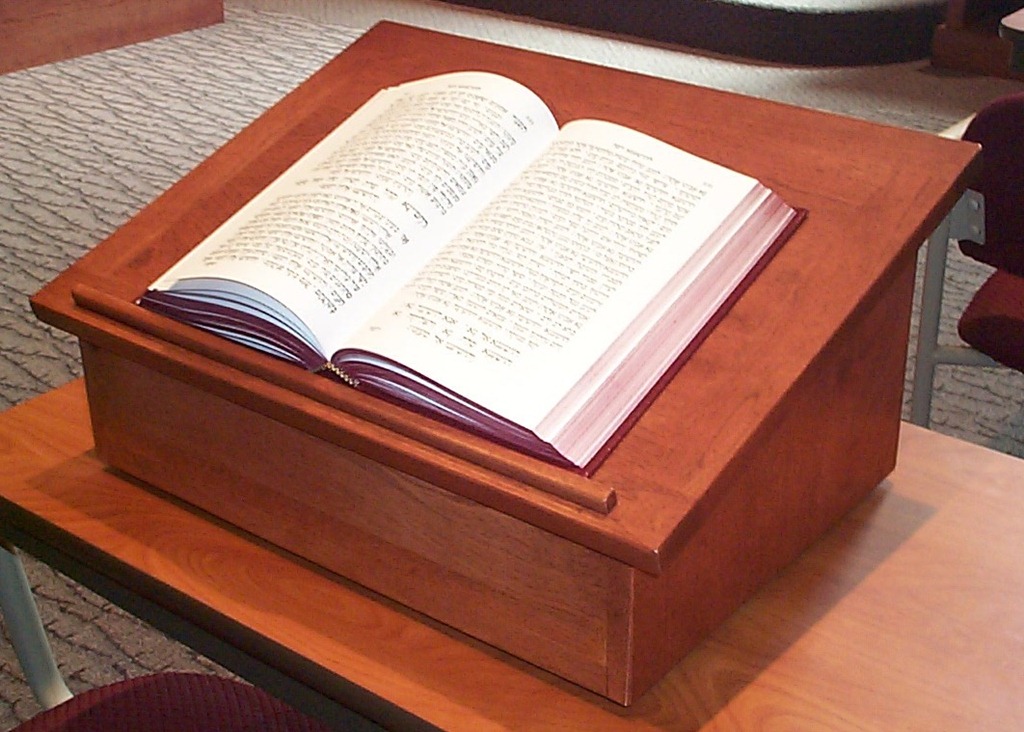
But I was amused that the solution is to find “a good case that allows you to prop up your tablet at the most comfortable angle.” That’s been known at least since the 18th century – at least if you’ve ever heard anyone talking in Yiddish. Why doesn’t everyone use a shtender (שטענדער)?



The Vatican and the Internet
Timothy’s excellent Catholic Bibles blog had a wonderful posting recently – a portion of Benedict’s post-synodal exhortation Verbum Domini.
The post is particularly interesting because it seems that the Pope has taken several different positions on the Internet over time. Even in his last major statement, I think that the he expressed ambivalence.
As an example: the Pope attracted controversy after he lifted the excommunication of Richard Williamson, the Holocaust-denying SSPX Bishop. When critics pointed out that a simple Google search should have revealed warning signs about Williamson, the Pope famously remarked:
In future at the Holy See, we must pay more attention to that source of news.
Things got even more complicated this month. As the Italian media has extensively covered, the Vatican apparently used cut-and-paste clippings from Italian Wikipedia to provide biographies for twenty-two new cardinals – quite a departure from the usual careful and scholarly pronouncements that we expect from Rome.
As I try to understand how this could have happened, I have to come to the conclusion that even in the Vatican there is a difference among generations – between younger people who are comfortable using the Internet and relying on Wikipedia – and more senior scholars, including the Pope himself, who prefer to rely on more traditional sources of information.


 BLT
BLT 