NHK’s Mt. Imo and Mt. Se
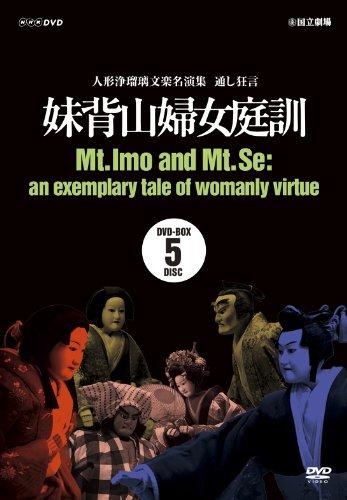 NHK has been releasing on DVD complete sets of bunraku (Japanese puppet theater) performances. It is quite unusual to be able to watch a complete performance; and indeed, each of these sets is a compilation – one act might be from a recent production, another act might be drawn from an archive copy going back as far as the 1950s.
So far the following sets have been released:
- 菅原伝授手習鑑: Sugawara and the Secrets of Calligraphy (you can find an English translation of the script here). [NSDX-13208]
- 義経千本桜: Yoshitsune and the Thousand Cherry Trees (you can find an English translation of the script here). [NSDX-14507]
- 仮名手本忠臣蔵: Treasury of Loyal Retainers (you can find an English translation of the script here). [NSDX-15156]
- 妹背山婦女庭訓: Mt. Imo and Mt. Se: An Exemplary Tale of Womanly Virtue (you can find an outline of this play and a partial English translation of the script here). [NSDX-16733]
Each of these box sets is wonderful, with some of the best performances from the last six decades. It is true that sudden switch from act-to-act is a little disorienting at first (a little like watching the late Raul Ruiz’s La vocation suspendue.) But the sets are generous, and each set contains a copy of the yukabon-shu (the Japanese narration read by the gidayu [narrator]).
Sadly, however, while the first three sets contain English subtitles, the latest set omits them. (It makes up for it partly by including a CD of the Iruka palace scene.)
It is hard to know what NHK was thinking, though, in releasing the set in this form. They have English on the box set title, and the DVDs have no region lock, and all their other bunraku releases have included English subtitles. It is difficult for native Japanese speakers to follow 18th century sung Japanese (just as many English speakers have trouble following English opera) which is why the yukabon-shu is included. And the play itself, with its morbid themes and abstract dialogue and antiquated language is hard difficult for many bilingual speakers to translate in real-time. (Frankly, although I have strong Japanese skills, I struggled a bit with yukabon-shu.)
So I am posting this note in the hope that someone at NHK will read it – or at least potential buyers of this disk will be forewarned. I note that Jan Paris has made similar notes in her Amazon Japan review (albeit in broken English):
Like the whole series of NHK about traditional Japanese theatre, video is very well, but unlike all the other volumes this one WITHOUT ENGLISH SUBTITLES!!!!!! I ordered this volume because I have also the others, and expected english subtitles. You can guess my deception. This should have been stated in description of item!! So after I bought a book with description of the story of this beautiful play. Also NHK a bit stupid: it would not take so much extra effort to put the subtitles in such a production… why not?
Gerstle, Inobe, and Malm include a summary of the play in their book. They analyze in detail the mountain scene. (The cassette tapes included with that Gerstle’s study are probably inadequate – the same recording appears to be available on this CD).
(If you have no access to Gerstle’s book – which after all has long been out of print – then you may get some help from this web page and its links.)
A haggadah is #7 bestseller on Amazon?
Last month, I blogged on an interview with Nathan Englander on his new “hyper-literal” New American Haggadah translation.
In response, co-blogger J. K Gayle wrote:
Given Englander’s inability to articulate what he is doing, and what he thinks he means by “literal” and then by “hyper-literal,” I find him somewhat to be a real-life version of Foer’s character Alexander “Alex” Perchov in Everything is Illuminated.
Since then, the publicity machine for the New American Haggadah has been in overdrive, including a puff piece in the New York Times that begins with Barack Obama and the White House rejecting it as liturgy:
Mr. [Jeffrey] Goldberg [of Atlantic magazine] reached into his briefcase and handed the president an advance copy of the New American Haggadah, a new translation of the Passover liturgy that was edited by Jonathan Safran Foer and contains commentary by Mr. Goldberg and other contemporary writers. After thumbing through the sleek hardcover book, Mr. Obama looked up and asked wryly, “Does this mean that we can’t use the Maxwell House Haggadah anymore?” […]
In the end, the White House decided to stick with the Maxwell House next month.
Notice that Nathan Englander is nicely avoided in that little quote, and it was Foer, not Englander, who hawked the volume on Stephen Colber’s show.
But now to the punchline. All this marketing has apparently paid off, because the Foer-Englander volume is now #7 at Amazon. See for yourself:
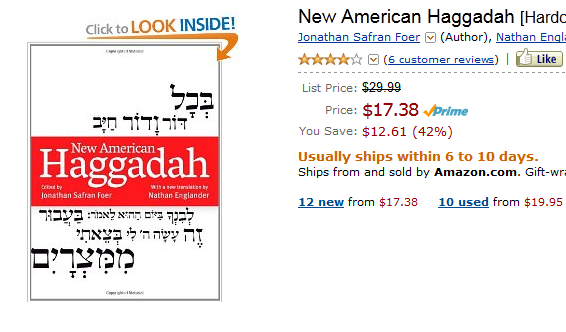
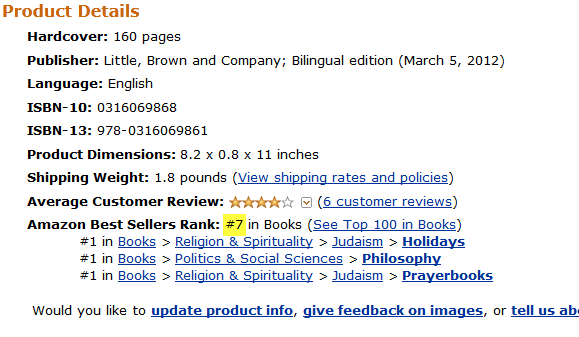
I have to admit, I had a copy on pre-order that arrived on February 29, and I hope to post a review at some point.
Anthrophagy and the doctrine of resurrection
From the Los Angeles Review of Books, a review by Steven Shapin (Harvard) of Cătălin Avramescu’s An Intellectual History of Cannibalism (Princeton 2009, I have not read this book):
While the cannibal was a prize specimen for theories of the state and human nature, he also posed a grave problem for doctrines of Christian salvation. Supposing that a wolf tore off a strip of your flesh and ate it: What were the consequences for the Christian doctrine of resurrection, when the “dead shall be raised incorruptible”? We are promised that we shall be raised entire, but how can God distinguish, disentangle, and accurately reassemble the bits of human flesh that have become the flesh of beasts? These were difficulties enough, but they were nothing compared to the problems posed by cannibalism for the Christian promise of resurrection. In order to save the doctrine of physical resurrection, “an entire arsenal of theological and philosophical concepts” was mobilized against the cannibal. A starving man eats the flesh of another, whereupon the flesh of the eaten is transformed into that of the eater. At the Resurrection, how will the bodies of each be made whole and rise up entire? If this problem could not be satisfactorily addressed, one Church Father wrote, critics could rightly “draw the conclusion that the resurrection cannot take place, because it is not possible for two men to be resurrected with the same flesh at the same time.”
Solutions to this problem exercised some of the greatest theological, philosophical, and scientific minds of the period from early Christianity to the Enlightenment. One response was just to deny the existence of cannibalism completely, since, if the practice didn’t exist, there was no special difficulty for the doctrine of resurrection. Supposing, however, that reports of cannibalism were true, the trouble it made for the resurrection of the body might be dealt with by invoking God’s absolute power: Just because we can’t see how species of flesh could be sorted out, that did not mean that God couldn’t do it. But that seemed to some a dodge too far, and theories of the digestion and assimilation of foodstuffs were then enlisted. You could deny that what cannibals, or man-eating beasts, took into their guts ever became part of their own substance, and thus there was no disentangling to do. Not everything that was eaten was nourishing, and Divine Providence had intended only certain foods to be transmutable into certain sorts of flesh.
A year later: a surprising apology

Keep Calm and … you know the rest
Here is a surprisingly gripping short video about the almost-lost but now-ubiquitous “Keep Calm and Carry On” poster. It raises questions of how an unused wartime poster has had such resonance with a mass public.
Tina Strobos
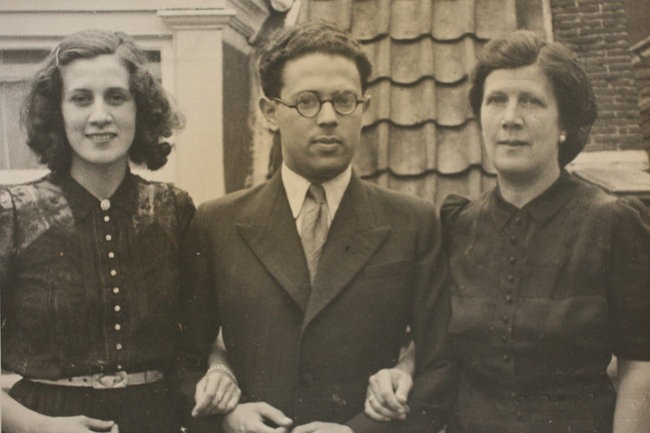
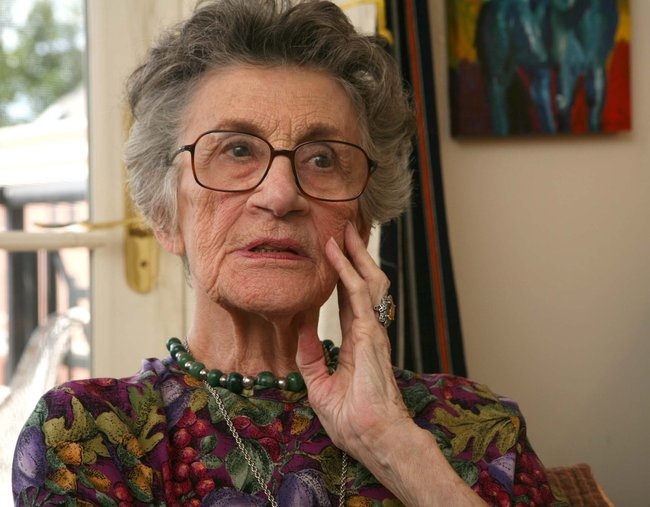
Tina Strobos died at the age of 91 last week. She is on the left in that photo above, her then fiancée Abraham Pais (a well-known physicist, Strobos also helped rescue him from the Nazis) and her mother. From her obituary:
During the German occupation of the Netherlands, between 1940 and 1945, Dr. Strobos and her mother, Marie Schotte, set up a sanctuary in their three-story rooming house at 282 Nieuwezijds Voorburgwal, behind the Royal Palace in the heart of Amsterdam. With the help of the Dutch resistance, they had a secret compartment built to hold up to four people behind a hard-to-spot door in the attic. […]
The Gestapo searched the rooming house several times. But Dr. Strobos, a tall, soft-spoken woman, beguiled the Germans with her fluency in their language and her cool, ingenuous pose. Among the Jews she helped hide was a close friend, Tirtsah Van Amerongen; an Orthodox couple with five children who brought their own kosher food; and her fiancé for a time, the particle physicist Abraham Pais.
Dr. Strobos rode her bicycle for miles outside the city to carry ration stamps to Jews hiding on farms. She transported radios to resistance fighters and stashed their guns. She created fake identity cards — ones that were not stamped with a J — either by stealing photographs and fingerprinted documents from legitimate guests at the boarding house or making deals with pickpockets to swipe documents from railway travelers.
She was cold and hungry when she took those risks and was interrogated nine times by the Gestapo. Once, she was left unconscious after an official threw her against a wall.
”It’s the right thing to do,” she said when asked why she had taken such gambles. ”Your conscience tells you to do it. I believe in heroism, and when you’re young you want to do dangerous things.”
Tina Strobos later earned her medical degree, studied psychiatry with Anna Freud, and became a family psychiatrist.
She tells her story in a lengthy 1985 interview which is full of thrilling and daring escapes from the Nazi occupiers – you can read that here (seven pages long). I do recommend reading it – it is quite exciting.
Abraham Pais gives his own interview here (two pages long) and Erica van Hesteren adds to the story. A general description of the Jewish situation under the German occupation of Holland is here.
Bible Ladino for Homer: Moshe Ha’elyon’s Odyssey
Homer’s Greek Odyssey can now be read in Ladino (or judeo-español) and in Shephardic Hebrew in a single volume thanks to Moshe Ha’elyon.
Ha’elyon is a native of Thessaloniki, Greece, where as a boy he studied Ancient Greek in school to read the Odyssey and the Iliad. There, from the mid 1920s up to the early 1940s, he also spoke Ladino in his home and with others in his community. Then, in July 1942, his community and his family were rounded up by the Nazis and taken to Auschwitz. Nir Hasson for Haaretz reports today, “Most of his family was killed on the day they arrived,” and Moshe “was the sole survivor in the family”; he “survived 21 months in Auschwitz, two death marches and a number of Nazi concentration camps.” Hasson compares Ha’elyon to the epic Greek hero, and we see a comparison to the epic Greek poet Homer as well: “Odyseus was the only survivor of a shipwreck. Ha’elyon tried to reach this country on an illegal immigrants’ ship and was caught by the British. He was also wounded in the War of Independence when the jeep he was riding turned over. In recent years, having retired, he wrote his own odyssey in the form of an autobiography and epic poems.”
As if his own story isn’t incredible enough, here’s the story of Ha’elon’s passion and practice of translation of the Odyssey. Isn’t it fascinating how his Ladino epic finds some of its language in the Bible in Ladino translation?
[H]e divides his time among Holocaust survivors’ commemoration groups and writing in Ladino.
The idea to translate “The Odyssey” was given to him by Ladino scholar Avner Peretz. “He said he hadn’t finished high school because the war started, but he admitted that he studied ancient Greek, and the seed was planted,” Peretz said.
Ha’elyon actually began with “The Iliad,” but stopped because the text was longer and “a little more difficult.”
The translation took Ha’elyon almost four years, dealing with numerous difficulties along the way. “Ladino is a spoken language. Suddenly I had to find words from realms that don’t have words, like agriculture, seafaring, names of trees, etc.”
He found the words in Peretz’s Hebrew-Ladino dictionary and in the Bible in Ladino, among other books.
“I didn’t make up any words. I have documentation for everything,” he says.
He also had the challenge of maintaining the rhyming and rhythm of Homer’s original. During translation, and even when reading it now, Ha’elyon said he drums his fingers, which helped him maintain the cadence – Dactylic hexameter, lines of six (“hexa” ) feet, each of which is a “dactyl” – i.e., finger-shaped, with one long part, or syllable, and two short ones.
Ha’elyon placed Peretz’s translation of “The Odyssey” into Hebrew alongside his Ladino one, which make his work not only the first-ever translation of “The Odyssey” into Ladino, but also the first into Sephardic Hebrew.
Now Ha’elyon plans to return to his Ladino translation of “The Iliad.” “I learned how to work; from now on, every line I write, I won’t need to touch,” he says.
This week is the launch of the first of the book’s two volumes, at the Castel Museum in Ma’aleh Adumim. The book is dedicated to Israel’s fifth president, Yitzhak Navon [the Founder and Chair of the Ladino Culture Authority], on his 90th birthday.

You can find the rest of Hasson’s report on Ha’elyon and this project here.
Clever New Yorker cover
While the New Yorker magazine, a mainstay of middlebrow culture, has certainly seen its ups and downs in recent years, its cartoons remain a strength. The Bob Staake cover of this week’s New Yorker is clever and funny on multiple levels, although it requires a certain awareness of how the US Republican primaries have been covered in the US to appreciate (in particular, details about the unusual way that Mitt Romney took his pet with him on a trip to Canada.)

From the Wall Street Journal:
U.S. Warns Apple, Publishers
Justice Department Threatens Lawsuits, Alleging Collusion Over E-Book Pricing
By THOMAS CATAN And JEFFREY A. TRACHTENBERG
The Justice Department has warned Apple Inc. and five of the biggest U.S. publishers that it plans to sue them for allegedly colluding to raise the price of electronic books, according to people familiar with the matter.
Several of the parties have held talks to settle the antitrust case and head off a potentially damaging court battle, these people said. If successful, such a settlement could have wide-ranging repercussions for the industry, potentially leading to cheaper e-books for consumers. However, not every publisher is in settlement discussions.
The five publishers facing a potential suit are CBS Corp.’s Simon & Schuster Inc.; Lagardere SCA’s Hachette Book Group; Pearson PLC’s Penguin Group (USA); Macmillan, a unit of Verlagsgruppe Georg von Holtzbrinck GmbH; and HarperCollins Publishers Inc., a unit of News Corp. , which also owns The Wall Street Journal.
Spokespeople for the five publishers and the Justice Department declined to comment. Apple, which introduced a new version of its iPad tablet Wednesday, declined to comment.
The case centers on Apple’s move to change the way that publishers charged for e-books as it prepared to introduce its first iPad in early 2010. Traditionally, publishers sold books to retailers for roughly half of the recommended cover price. Under that “wholesale model,” booksellers were then free to offer those books to customers for less than the cover price if they wished. Most physical books are sold using this model.
To build its early lead in e-books, Amazon Inc. sold many new best sellers at $9.99 to encourage consumers to buy its Kindle electronic readers. But publishers deeply disliked the strategy, fearing consumers would grow accustomed to inexpensive e-books and limit publishers’ ability to sell pricier titles.
Publishers also worried that retailers such as Barnes & Noble Inc. would be unable to compete with Amazon’s steep discounting, leaving just one big buyer able to dictate prices in the industry. In essence, they feared suffering the same fate as record companies at Apple’s hands, when the computer maker’s iTunes service became the dominant player by selling songs for 99 cents.
As Apple prepared to introduce its first iPad, the late Steve Jobs, then its chief executive, suggested moving to an “agency model,” under which the publishers would set the price of the book and Apple would take a 30% cut. Apple also stipulated that publishers couldn’t let rival retailers sell the same book at a lower price.
“We told the publishers, ‘We’ll go to the agency model, where you set the price, and we get our 30%, and yes, the customer pays a little more, but that’s what you want anyway,’ ” Mr. Jobs was quoted as saying by his biographer, Walter Isaacson.
The publishers were then able to impose the same model across the industry, Mr. Jobs told Mr. Isaacson. “They went to Amazon and said, ‘You’re going to sign an agency contract or we’re not going to give you the books,’ “ Mr. Jobs said.
The Justice Department believes that Apple and the publishers acted in concert to raise prices across the industry, and is prepared to sue them for violating federal antitrust laws, the people familiar with the matter said.
The publishers have denied acting jointly to raise prices. They have told investigators that the shift to agency pricing enhanced competition in the industry by allowing more electronic booksellers to thrive.
William Lynch, chief executive of Barnes & Noble, gave a deposition to the Justice Department in which he testified that abandoning the agency pricing model would effectively result in a single player gaining even more market share than it has today, according to people familiar with the testimony. A spokeswoman for Barnes & Noble declined to comment.
Prior to agency pricing, Amazon often sold best-selling digital books for less than it paid for them, a marketing stance that some publishers worried would make the emerging digital-books marketplace less appealing for other potential retailers. The publishers’ argument that agency pricing increased competition hasn’t persuaded the Justice Department, a person familiar with the matter said. Government lawyers have questioned how competition could have increased when prices went up. Amazon declined to comment.
It isn’t clear if the talks will lead to a settlement or how many of the parties would sign on. One publishing executive familiar with the situation said that the talks have been going on for some time and “negotiations have taken many turns.”
A second publishing executive said that “a settlement is being considered for pragmatic reasons but by no means are we close.” This person said that there are significant legal costs associated with the probe. “You have to consider a settlement, whether you think it’s fair or not,” the person said.
Contracts such as Apple’s prevent publishers from selling books to other buyers at a cheaper rate. Such terms, known as “most favored nation” clauses, have drawn the scrutiny of the Justice Department in recent years in the health-care industry because they can sometimes be used to hamper competition.
One idea floated by publishers to settle the case is to preserve the agency model but allow some discounts by booksellers, according to the people familiar with the matter.
Among the issues that the Justice Department has examined is the effort by three publishers involved in the probe to “window” e-books in late 2009, according to people familiar with the matter. That December, Simon & Schuster, HarperCollins and Hachette said they would delay the electronic publication of a certain number of titles for a limited time after the publication of the hardcover edition.
At the time, the publishers expressed concern that $9.99 digital best sellers represented a long-term threat to the future of the publishing business. The windowing efforts, however, gradually faded away.
The European Union has said it is also investigating the allegations. Several class-action lawsuits have been filed and consolidated in a New York federal court. Apple moved to dismiss the case this month, arguing it didn’t coordinate with any publishers. “Apple’s entry created new competition in eBook distribution and a vastly larger pool of eBook consumers,” it wrote in its motion.
For publishers, digital-book revenue is still the fastest-growing segment of the business at a time when the sale of physical books is in decline. E-book sales more than doubled to $970 million in 2011, according to a survey of 77 publishers conducted by the Association of American Publishers. As more consumers migrate to dedicated e-readers and tablet reading devices, the number of consumers reading digitally will likely increase.
At the same time, there are fewer bookstores in which to sell physical books, highlighted by the liquidation last year of Borders Group Inc., once the country’s second-largest book chain. In addition, the nation’s largest bookstore chain, Barnes & Noble, has increasingly dedicated more of its space to nonbook-related items such as its popular line of educational toys and games.
It isn’t the first time the Justice Department has taken action against Apple for allegedly colluding with other companies. In 2010, several technology companies agreed to settle Justice Department allegations that they colluded to hold down wages by improperly agreeing not to poach each other’s employees.
The evidence that surfaced in that case, as well as an ongoing private class-action lawsuit that followed, showed Mr. Jobs as a prime mover behind that antipoaching agreement. Apple didn’t admit to any wrongdoing.
Women Reading and Women Writing the Megillah

Commenting on a psychologist’s assertion that “girls like to climb trees because they want to be like boys”, Simone de Beauvoir suggests, “It never occurs to him that they like climbing trees.” Women participate in mitzvot in order to build a relationship with God and with other human beings; they do not sanctify Shabbat because men do, but because they must; they do not read the Megillah because men do, but because they must.
Lindsay Simmonds – “Why women are raising their voices on Purim: What lies behind the growing trend of Orthodox women’s Megillah readings”
A number of ahronim write that women are disqualified from writing the Megillah. These include the Ma’aseh Rokeah, R. Me’ir Pearles, R.Akiva Eiger, R Yosef Messas, Melekhet Shamayim, and the Sha’arei Teshuvah.
Yet there is a strong trend in halakhah to validate a Megillah written by a woman. The Derishah goes further, regarding women as eligible to write a sefer Torah as well; and while the Shulhan Arukh and all other rishonim disagree with the Derishah, they fail to mention women among those who are disqualified from writing a Megillah. The omission is glaring, given that the gemara and rishonim all explicitly disqualify a woman from writing Torah scrolls, tefillin, and mezuzot. This silence along with strong theoretical arguments, lead a large number of major ahronim to rule either in principle or in practice that scrolls of Esther written by women are valid. These ahronim include R. David Oppenheim, the Hida, the Peri Megadim, the Teshuvah mei–Ahavah, the Matteh Yehudah, the Keset ha–Sofer, the Sedei Hemed, the Arukh ha–Shulhan, the Avnei Nezer, the Beit Oved, and the Tsits Eliezer. Given the number, stature, and compelling reasoning of these ahronim, it seems that the weight of the halakhic discussion inclines toward regarding women as eligible to write scrolls of Esther for communal ritual use provided that they are competent in the requisite halakhot.
Rabbi Ross Singer – “Women and Writing the Megillah“
New Esthers
A seasonal post rounding up some Esther volumes:
- Perhaps the big entry this year is Norman Lamm’s (former president of Yeshiva U.) Megillah: Majesty & Mystery – which contains Esther in Hebrew and English and Lamm’s commentary (as extracted by Joel Wolowelsky, who took it from various sermons and essays). There are also essays about some other minor Jewish holidays and even the American holiday of Thanksgiving. I have to admit being disappointed with this volume: because it was made by an editor and not by Lamm himself, it suffers from some shallowness and inconsistency.
- The Kol Menachem Megillas Esther actually came out in 2011, but sold out so quickly that I only obtained a copy three months ago. This is another Hebrew-English edition that features annotations drawn from talks (sichos) by the Lubavitcher Rebbe. As such, it tends to feature a somewhat more mystical approach to the text. I personally like this edition, which is quite attractive.
- The Kleinman Midrash Rabbah: Ruth/Esther – this is another volume that came out in 2011, but that I only bought recently. Artscroll has launched on a project to translate all of Rabbah in 16 volumes – very much in the style of their Babylonian Talmud translation. Rabbah, The effect is arguably the closest thing in English to a traditional havrusa (partner-based) study session. The Hebrew side of the page features the text, and core commentaries (Rashi, Matnos Kehunah, Eitz Yosef, Maharzu, Eshed HaNechalim) while the English side of the page repeats the Hebrew phrases followed by English translation and footnotes. If you are unfamiliar with this layout, some page samples may best illustrate it. Frankly, just the Hebrew pages in this book alone make it worthwhile. Of course, this is a natural to read with Artscroll volume of Tractate Megillah.
- The Hidden and the Revealed: The Queen Esther Mosaics of Lilian Broca – the closest thing to a feminist entry on this list. Besides containing Broca’s mosaics, it has a foreword by Judy Chicago and essays by Broca, Sheila Campbell, and Yosef Wouk, as well as the full Esther in an appendix with notes.
- Here is one I do not plan to buy – it is just too expensive and not in my style to collect. Taschen has sponsored a facsimile reproduction of the Hanover Leibniz Library’s 1746 Esther Scroll. From the image on Amazon, it seems that this scroll is a bit over the top – and not quite my style, but I am sure it will find its market. The text is apparently in German.
- The always interesting Tzvee Zahavy mentions a nice free PDF with Hebrew and English with Rashi interpolated. This PDF includes spoken dialogue “human or Divine” (I do not remember any spoken divine dialogue in Esther, though!) specially formatted. The translation is the Judaica Press translation.
Two alternative trinity books
In the ongoing flood of Amazon deliveries arriving at the Theophrastus bunker, there arrived not one, but two alternative trinities this week.
One is Daniel Boyarin’s The Jewish Gospels: The Story of the Jewish Christ – which appears to be a popularization of his earlier Border Lines: The Partitioning of Judaeo-Christianity. Boyarin’s basic thesis is that the basic tenets of Christianity: a man-God, the messiah as a divine entity, the trinity, universalism, etc., are all Jewish. (Disclaimer: I know Boyarin personally.) Boyarin’s work is always interesting to read, although I disagree with most of his conclusions. It is all too easy to find antecedents to almost any philosophical or religious world view in any diverse community. (Thus, neo-Platonists can find Plato in Christianity [or in Judaism]; Gnostics can find Zoroastrianism in the Christianity; Marcus Borg, Thich Nhat Hanh, and other can find Buddha in Christianity; etc.) Boyarin at times mixes his different historical strains of Judaism, and fails to consider alternative hypotheses that could explain the parallels he finds. Further, Boyarin is willing to accept, seemingly without question, heterodox Jewish thinkers as representatives of Judaism in general.
Boyarin is willing to toss off statements (this really is a random example — I found this just now rather arbitrarily looking at page 138 – which I chose because I looked up Philo in the index) such as “According to the Mishna, Sanhedrin 7:5, it is mentioning the name of God that constitutes blasphemy. Both Josephus and the Community Rule of Qumran precede the Mishna in this determination.” Now, strictly speaking, it is true that Josephus and the Community Rule precede the final redaction of the Mishnah, but of course, the Mishnah is clearly based on an oral tradition that predates Josephus and the Community Rule, as Boyarin elsewhere seems to acknowledge. This sort of casual treatment of facts reflects a disturbing lack of care.
The best part of Boyarin’s book is his analysis of Mark, but here he is largely indebted to previous scholars, particularly the amazing Adela Yarbo Collins and her spectacular commentary on Mark. (He mentions Collins six times in the index, her husband an additional five times, and calls both of them out as helping “enormously” in his acknowledgement.) The book is slim and has large print, so it is really an extended essay.
The second book actually has “alternative Trinity” in its title: A. D. Nuttall’s The Alternative Trinity: Gnostic Heresy in Marlowe, Milton, and Blake. This book has one of the most impressive put downs I have seen as a back cover blurb – from the late Frank Kermode writing in the London Review of Books:
full of intellectual energy and novelty . . . Much of the pleasure offered by this agreeably argumentative and learned study derives from the author’s own power of scholarly fantasy.
It also features a damnation by faint praise quote – a review from Choice:
offers some engaging expositions of familiar material and some useful citations of less familiar lore
Someone at Oxford University Press must have simply hated Nuttall. (Nuttall wrote one of the most entertaining scholarly books I have read: Dead from the Waist Down: Scholars and Scholarship in Literature and the Popular Imagination – studying how scholarship was transformed from being sexy and dangerous in the 16th century [think Faust] to being ossified and dull by the 19th century [think Mr. Casaubon in George Eliot’s Middlemarch.])
Nuttall’s alternative trinity features the Serpent in the Adam and Eve story as Christlike character. While it is commonplace to read Blake as a gnostic, it is much more shocking to find Milton cast in that role. Nuttall’s analysis of Milton is almost certainly wrong (although Nuttall has lots of fun with Blake’s view of Milton as reflected by Blake’s poem eponymously named after the subject Milton) but the fun comes from finding where Nuttall’s analysis fails.
(Hmm, although I have not read Kermode’s review of Nuttall, this blog post sounds more and more like Kermode’s book blurb on Nuttall’s book.)
For me, one of the most surprising things about the Christian Apocrypha is that Plato is among its authors: among the manuscripts found at Nag Hammadi was an excerpt from The Republic. To me this suggests a broad view of apocrypha that potentially encompasses the entirety of ancient literature. To the degree that Nuttall thesis has merit, we may perhaps add the works of Marlowe, Milton, and Blake to the gnostic apocrypha.
To begin to grasp the scope of Nuttall’s scholarly sources, one may simply begin to recite from his index:
- Abanus, Petrus de
- Accommodation, Theory of
- Acheson, Arthur
- Ackroyd, Peter
- Acts of Peter and Paul
- Adam
- Adamas
- Adamites
- Adamson, J. H.
- Addison, Joseph
- Adoration of the Lamb
- adversarial Trinity
- Aeschylus
- aetiological myth
and that only carries us through “ae….” Altogether, a stunning work.
Actor, Neuroscientist, Parent, Author

A TV actress with a PhD in neuroscience, Mayim Bialik, 36, takes on a third career as book author with Tuesday’s publication of “Beyond the Sling: A Real-Life Guide to Raising Confident, Loving Children the Attachment Parenting Way” (Touchstone). Bialik, best known for her starring role in the ’90s sitcom “Blossom,” is a regular on CBS’ Caltech comedy, “The Big Bang Theory,” where she plays nerdy neuroscientist Amy Farrah Fowler. Bialik, who earned her neuroscience degrees at UCLA, is married to her college sweetie, Michael Stone; they have two sons — Miles, 6½, and Frederick, 3½.
The Sunday Conversation: Mayim Bialik
The ‘Big Bang Theory’ actress, who has a doctorate in neuroscience, talks about her new book on parenting.
By Irene Lacher, Special to the Los Angeles Times
March 4, 2012
Euripides’ violent gendered metaphor
Re-reading Anne Carson‘s Grief Lessons: [Carson’s translation of] Four Plays by Euripides got me reading for the first time Heather McHugh‘s Euripides: [McHugh’s translation of] Cyclops. Both Carson and McHugh not only translate the Greek of Euripides’ plays but they also provide commentary. In this post, I want to share some of what is noteworthy to these two translator poets. They attend to the wordplay in the plays. They see the language of the plays acting. They understand the violence, the particularly gendered violence in the phrasing, in the use of metaphor by Euripides.
Carson and McHugh are not the only ones to notice the peculiarity of Euripides and his Greek. For example, F. A. Wright, in his Feminism In Greek Literature From Homer To Aristotle (page 202), says: “Euripides and Plato are almost the only [male] authors who show any true appreciation of a woman’s real qualities, and to Euripides and Plato, Aristotle, by the whole trend of his [sexist, bigoted] prejudices, was opposed.” And Louis Markos, in his From Achilles to Christ: Why Christians Should Read the Pagan Classics (page 168), says this:
The “sentimental” Euripides is a self-conscious artist who cannot ignore his own age to sweep his reader off to a mythic neverland. He was keenly aware of the injustices of his day–the brutalities of war, the subjugation of women, the ill treatment of foreigners and illegitimate children–and he projected these contemporary issues and struggles back into the legendary settings of his tragedies, rather as Arthur Miller’s The Crucible projects the dangers of McCarthyism back into the ‘legendary’ days of Puritan New England. That the plays of Euripides make their points without sinking into polemic or allegory is a tribute to the complex and subtle artistry of their maker. They are a tribute as well to his insight into human nature and his gift for giving dramatic voice to the mental anguish and internal rage of the dispossessed.
What is noticed by these our contemporary readers of Euripides is how skilled he was as a socially-conscious playwright. What Wright and Markos suggest is how he used his plays to draw attention to the plight of women in Greece.
Now, the brilliant thing about Carson and McHugh is that they read and also translate the Greek of Euripides. And they see the wordplay with an astuteness that not all do or perhaps so easily can. I’d like us to see that.
Here, then, is McHugh in her “Translator’s Forward” pages 26-27 (and further on into the post you’ll see Carson):
The eye that matters [in Euripides’ Cyclops at a particular moment], is the mind’s eye, eye of empathetic imagination. Even when Odysseus is free from the cave, he can’t stop seeing the plight of his friends and so is driven by imagination (the mind’s eye) to return to their aid. By contrast, the chorus solicits prurient details about the rape of Helen and all the sensational particulars of the torments of Odysseus’ friends (as something sufficiently bestial in contemporary folk is drawn to highway carnage or the most predatory particulars of the dirty-movie channel). The chorus does not possess the solitary eye of the Cyclops: theirs is the compound eye of the voyeur. Moral blindness has everything to do with the action of this play.
McHugh invites David Konstan to write the Introduction to her translation, and in doing so here’s how he similarly notices (on page 16) what she does:
Neither Silenus nor Polyphemus exhibits a comparable restraint [i.e. Odysseus’ restraint from drinking wine]. Further, both the Cyclops and the satyrs have an inordinate interest in sex. Polyphemus threatens to rape old Silenus; the chorus of satyrs draw a lubricious inference from the Greeks’ recovery of Helen, imagining that her liberators must have taken turns screwing her. Odysseus, in this play, has not time for such monkey business.
McHugh and Konstan are both aware of the language of Euripides and how the metaphors of eye and of seeing and of looking and of rape are word plays to valorize the humanitarianism of the hero and to mock the violence and sexism of the villains.
So let’s look at an example from the playwright of the wordplay. At lines 280 – 281, he has the one-eyed Cyclops Polyphemus asking the self-restrained and fully observant Odysseus rhetorically:
ἦ τῆς κακίστης οἳ μετήλθεθ’ ἁρπαγὰς
Ἑλένης Σκαμάνδρου γείτον’ Ἰλίου πόλιν;
Now, here are various ways different translators have rendered this into English:
Are ye the men who visited on Ilium, that bordereth on Scamander’s wave, the rape of Helen, worst of women?
— E. P. Coleridge, 1891
Oho! Are you the lot that went to punish Troy, that city by the river Scamander, for having stolen that nasty bitch Helen?
— George Theodoridis, 2008
So you’re the ones who went to punish Ilium
for kidnapping that good-for-nothing, Helen?
— Heather McHugh, 2001
What I like about McHugh’s translation is how it uses verse, and how this lines up Ilium with Helen visually and vertically suggesting the appositive relationships one might view suggested by Euripides’ line 281: Ἑλένης Σκαμάνδρου γείτον’ Ἰλίου πόλιν.
To more literally show what Euripides has effected, as McHugh reads it, we might translate his Greek into our English this way:
So are you, as we’re discussing the disgusting, those who went, because of that rape,
to Helen, to Skam-Ander’s banks [to the banks of Man–Pit River], to Ilium, to the Polis?
— J. K. Gayle, 2012
Here the Cyclops is expressing his unrestrained rather prurient interest in sex, in violence. And my translation tries to leave to the monster and to us his listeners all of the ambiguities that Euripides might have intended. Euripides is expressing the suggestion that this rape of a woman, she the prize of the Hellenes, is similar to their sacking of Troy. Of course, the audience members have to decide if they’re hearing and seeing everything. Whose side are they on? And is this just a contest between Polyphemus and Odysseus? Or is there the perspective of an-other and others of value on stage?
Now, I want to let a long quote by Carson end this post. She is commenting on a different play by Euripides but is noting similar wordplay. She is also translating. In the “Preface” (page 8), she’s already generally introduced Euripides as one “also concerned with people as people–with what it’s like to be a human being in a family, in a fantasy, in a longing, in a mistake.” Now Carson (pages 94-95) gets us looking at how the playwright translates his concerns into wordplayful Greek, even the use of violent, gendered metaphor that would have listeners and viewers imagine, rather, innocence in the polis where men and women might be equal, where neither mistreated the other:
Hekabe’s language has something of this rotted-away quality. Victors and victims carve at one another in a sort of exhausted endgame bereft of fine phrasing. Verbs are savage. Adjectives minimal. Figures rare. When Euripides does allow himself to unfold a metaphor, he does so in such a way as to decline it to bare fact. For example, in the third choral ode, he introduces the oldest metaphor in the Greek tradition for the ruin of a civilization: rape. In Greek poetry cities were figured as female and the same word was used to denote the battlements or towers of a city and the headdress, veil or bindings that cover a woman’s head. These bindings were not optional for women: to keep the head properly covered in public was a mark of civic status and sexual respectability. Within this social code, within this ancient metaphor, the integrity of women, cities and civilization is all bound up together. To rape a city is to pull off its headbinding, to wreck its crown of towers. Such a city will be as polluted as a fallen woman. Its honor is over. But of course rape is not just a metaphor in wartime. Nor would the women of the chorus of Hekabe be strangers to it. They are captives, about to head off into a lifetime of systematized rape as slaves of the Greek commanders. They begin the ode by addressing Troy’s violated condition, then go back to the night before it all began (875-896/905-926):
You O Troy
will no longer be called one of the unsacked cities.
Such a cloud of Greeks covers you,
rapes you, spear by spear.
Shorn of your crown of towers.
Stained black with fire.
Sorrow!
I shall not walk your ways again.
Midnight my ruin began.
Supper was over, sweet sleep drifting down,
after songs and dances and sacrifice
my husband lay in our chamber,
his spear on its peg.
He was not watching
for Greek sailors
to come walking into Troy.
I was doing my hair,
I was binding my hair,
staring down into the bottomless lake of my mirror,
before I fell into bed—
a scream cut the town,
a roar swept the street…
There is something very moving in the words “I was doing my hair, I was binding my hair” – image of a woman, a night, a city, a world prior to violation. A fact still innocent of metaphor.
Jack Miles on reading Matthew 23 carefully
From Jack Miles’s foreword to Daniel Boyarin’s The Jewish Gospels: The Story of the Jewish Christ:
Now to the personal example. On October 30, 2011, I heard the following Gospel passage read in my church (Church of the Messiah, Santa Ana, California):
Then Jesus said to the crowds and to his disciples, “The scribes and the Pharisees sit on Moses’ seat; therefore, do whatever they teach you and follow it; but do not do as they do, for they do not practice what they teach. They tie up heavy burdens, hard to bear, and lay them on the shoulders of others; but they themselves are unwilling to lift a finger to move them. They do all their deeds to be seen by others; for they make their phylacteries broad and their fringes long. They love to have the place of honor at banquets and the best seats in the synagogues, and to be greeted with respect in the marketplaces, and to have people call them rabbi. But you are not to be called rabbi, for you have one teacher, and you are all students. And call no one your father on earth, for you have one Father—the one in heaven. Nor are you to be called instructors, for you have one instructor, the Messiah. The greatest among you will be your servant. All who exalt themselves will be humbled, and all who humble themselves will be exalted. Mathew 23:1-12; New Revised Standard Version)
Jesus was surely one of the greatest polemicists of all time. It is thanks to him that the very word “Pharisee” has as its second definition in Webster’s College Dictionary “a sanctimonious, self-righteous, or hypocritical person.” And it’s clear isn’t it, in this passage from the Gospel of Matthew that the sanctimonious, self-righteous, hypocritical persons whom Jesus has in his crosshairs do call one another “rabbi.” But all texts, including scripture, are read through the filter of what one “already knows.” […]
Most Christian interpreters slide with equal ease past Jesus’ injunction: “The scribes and the Pharisees sit on Moses’s seat; therefore, do whatever they teach you and follow it.” I myself have read and heard this passage for years but only on October 30, 2011, thinking about my draft of this foreword, did I really lock on to do whatever they teach you and follow it. Post-Boyarin, I can only read this passage as a defense of un-sanctimonious, un-self-righteousness, un-hypocritical adherence to the Law of Moses against sanctimonious, self-righteous, hypocritical exploitation of it.
Publishing in the Internet retailing age
From Carlos Bueno:
… Let me tell you about another book, “Computer Game Bot Turing Test”. It’s one of over 100,000 “books” “written” by a Markov chain running over random Wikipedia articles, bundled up and sold online for a ridiculous price. The publisher, Betascript, is notorious for this kind of thing.
It gets better. There are whole species of other bots that infest the Amazon Marketplace, pretending to have used copies of books, fighting epic price wars no one ever sees. So with “Turing Test” we have a delightful futuristic absurdity: a computer program, pretending to be human, hawking a book about computers pretending to be human, while other computer programs pretend to have used copies of it. A book that was never actually written, much less printed and read.

The internet has everything.
Harpagmos V: what it means to faith
I had not intended to just let the series on harpagmos drift off, and I still plan to write about Roy Hoover’s article in the near future. It is one of those pieces of writing which needs to become better known so it can serve as a paradigmatic example of how to do exegesis. A lot of the focus on this word, harpagmos, has fallen back onto N. T. Wright’s work, whereas, it was Hoover who transformed the approach to Phil. 2:6. It was disappointing to me that Denny Burk’s paper on harpagmos did not take on Hoover at all, but responded rather to a minor point in a paper by N. T. Wright. Often it is the more popular works which draw fire, which become important contributors to debate, rather than the papers which produce the most significant and relevant new research.
As a reminder, here is Phil. 2:6 as it appears in the Greek, Latin and KJV, three versions which underly our theological thinking on this verse.
ὃς ἐν μορφῇ θεοῦ ὑπάρχων οὐχ ἁρπαγμὸν ἡγήσατο τὸ εἶναι ἴσα θεῷ,
qui cum in forma Dei esset non rapinam arbitratus est esse se aequalem Deo
Who, being in the form of God, thought it not robbery to be equal with God
For now, here is a well thought-out passage written as a personal testimony to the importance of this verse to one’s faith and life. Thanks to Bill Grover for this, I have reformatted the paragraphs, and added bolding to the passage outlining Hoover’s contribution.
The Esoteric and Our Faith
Within **Evangelicalism** today ,(NOT in its conflict with liberalism, I mean within itself!), there is a debate re the Person of Christ and His role within the Trinity! There is a debate , I am saying, about the God we love!
Let the reader understand: The Evangelical Church ITSELF DOES NOT agree on the relationswhips of the Persons of the Trinity and on the Person of Christ Himself! Now I, for one, think this is very important! IMO, this is quite important enough to research and also relates, at least in my own case, and I explain why shortly, to “getting on with living”! Many Christians are not aware of this conflict over belief about something so central to Christianity, however, it should not be “esoteric” since it is central to our faith! If the discussion is “esoteric” perhaps the fault is in the Church not in the discussion.
The Esoteric , Evangelical Views on Christ
One position following the ancient belief of the Church expressed by such as Tertullian and the Nicene Creed, includes modern writers as Kitano,Berkhof, Wiley, Shedd, Williams, Lewis, Demarest, and Dahms in both ThM theses, systematics, journal articles, book reviews, and so forth . These take the position that as the “Person” or “essence” or “hupostasis” of the Son is eternally, unendingly, and necessarily generated by the Father, God the Son is therefore, because of that process, immanently and eternally in second place IN RANK. The Father is eternally “the Boss” of the Son–they say.
These mainly base their eternal generation doctrine on John’s several applications of the adjective monogenes to the Son which the KJV renders “only begotten.” My dissertation also discusses that adjective which only John applies to Christ, but that discussion too likely would be deemed too esoteric for any any practical good –even though it is about an inspired word! There is, these think, a relational hierarchy IN God (as opposed to economic,outward relations only) because the Father orders the Son about due to the Father causing the Son’s existence (but not in time).
Such literature may be “esoteric” in the sense that only a small portion of the Church reads it. Yet, the subject these discussions IS important because it is about the God of the Bible Whom we say we are to love! It relates to living because it is about the One we live with and for!! These evangelicals are talking about God the Son and what the Bible says about Him! The Son, it is thought by them, does not have life in the same manner as does the Father, neither has He knowledge, neither He has sovereignty as does the Father!! In other words, one Trinal Person has divine attributes the Other does not.
I don’t agree with that. IMO attributes reside in essence ,and as each “Person” in God has the identical essence, it follows that Each has the identical attributes. While such thoughts may be “esoteric,” that does not IMO mean that they SHOULD BE esoteric. Esoteric means read by few! That few in the Church consider these ideas important is not a measure of the worth of these ideas. It is instead a measure of the doctrinal instruction , or the lack of it, in the Church IMO Christians need to think about God, and Christians need to understand the Scriptures about Him– not just “Get on with living” !!
A second position expressed by such as Grudem is that while the Son is not eternally generated by the Father, the Son nevertheleass is eternally role subordinate to the Father. The earthly submission of Jesus is but a prolongation of God the Son eternally flittering around the emptiness of precreation carrying out dutifully the will of the Father. One effect of this notion is that it would then appear that in God there are multiple faculties of will since the will of one Trinal Person is subservient to the will of the Other. I don’t agree with that. IMO there is only one faculty of will in God.
A third position, taken ,in general, by Erickson , Buswell, Bilezikian, Derickson, Feinberg, Giles, BB Warfield, and me in my dissertation, is that the obedience of the Son began in His incarnation. The Son is not eternally and immanently role subordinate but only temporally and economically so.
I go possibly in this third position a bit further than some and say , following such as the Antiochenes, Theodoret, Leo, Chalcedon (IMO) , the Damascene, and Anselm that only the human nature in Christ is role subordinate not the divine.
Application of the Esoteric to My Living
I think Jesus is fully human with a human mind and will , and that in these He obeyed– not in His nature as God. In God, IMO, there only can be equals, and in God there can only be one mind and one will. Now as for me, this DOES have to do with my living for God, and the issue of harpagmos being an idiomatic expression relates to this. I’ll try to explain:
Were harpagmos in Phil 2:6 taken, as do Wallace in his Grammar, and Burk in his paper to the ETS, and Martin in Carmen Christi, NOT to indicate that the Son has the “equality with God,” then support is given to the position that the Son’s incarnational obedience is simply an unbroken prolongation of the Son’s eternal obedience and is carried out by the Son’s divinity through His humanity–not BY the humanity!
But Hoover’s research instead gives strength to the idea that the Son has both the form AND equality with God because harpagmos with some verbs is idiomatically used and indicates possession of the object (in this case equality) of the verb . Hoover’s research is a piece in a Christological puzzle that scholars deal with, and that I attempt to assemble in my dissertation. But that piece also has practical importance.
To me, it is practically important, despite it being “esoteric,” that the Son has equality with the Father in His form of God. That would imply,then, that it is in His humanity that Christ is obedient. Then, no hierarchy of authority IN God is necessary. Then, in Philippians 2, the Son additionally takes the form of a Servant to God. I think this “form of a Servant” is TRUE Man including human mind and will. IMO HERE is where Christ’s obedience occurs–not in the form of God. Obedience IMO is accomplished BY His humanity NOT by His deity through whatever His humanity may be.
Now this distiction of “by the humanity” vs. “through the humanity” may be “esoteric,” but it much relates to who and what Christ (the One we love) is:
1) Is Christ God working through mere human behavior patterns as say Buswell, and IMO Athanasius and Cyril too ,
OR,
2) Is Christ TRUE Man (who also is God) experiencing as TRUE Man the human condition including temptation as say such as Hodge and Clark?
[in case Hoover’s findings in all of this has not been noticed, or understood, that ‘harpagmos point’ supplies the premise that in His deity the Son is EQUAL to God, and therefore just as sovereign as the Father]
How is all this practical to me so that I can “GO ON LIVING”?? How does help me to “LOVE” Christ?
In this manner:
If Christ is true man (Jo 8:40; Acts 2:22) made like His brethren, ie, made like me (Heb 2:14,17) who grew in knowledge (Lk 2:52) , and if Christ in His humanity earned my salvation (Rom 5:15) and if it were in His humanity that He resisted temptation( Heb 2:18 ;4:15) , THEN, indeed, is He my example (Phil 2:5; 1 Pet 2:21) .
BUT if Christ is REQUIRED by the generated and/or submissive nature as Son to obey the Father, if the earthly obedience of the Son merely is an unbroken prolongation of an immanent and necessary Trinal relationship, if Christ obeyed AS GOD , then IMO my example is lost! I cannot attempt to resist temptation as God does as God cannot even be tempted!
I love Christ for that: because He is LIKE ME in His humanity , free (sidestepping predestination now) to chose obedience as Man, and He has experienced some of what I do, genuine temptation, yet He was without sin.
Hoover’s research is related to this, don’t you really see?
I’m sorry that my theological exploration of these issues ,and my exegetical research on releated texts , is deemed unprofitable by some who only need to “go in with living.”
alla ekenosen heauton,
Bill
February 2012 Biblical Studies Carnival
Duane Smith has the latest “Biblical Studies Carnival” up, which he specifies as the “March 1, 2012, Biblical Studies Carnival covering blogging activity during February”; he links to a number of interesting articles, which he sees as “abnormally interesting stuff.” We’d like to thank him for linking to some BLT articles!


 BLT
BLT 