The Challenges of World Book Night
Judith Rosen describes the challenges of giving away free books on World Book Night (when publishers call on volunteers to distribute books to people who do not ordinarily read much). Apparently, people in New York are suspicious of those giving away books, and many readers have already switched over to a Kindle. In one case, Rosen made a mistake, accidentally giving a book to a woman who was already a “reader.”
Kris Merino talked about World Book Night last month on her blog; I hope she updates us on her experiences.
Hindus Urge Pope to Reconsider Ordination of Women Priests
This doesn’t seem to have generated much notice in the press, but I found it interesting nonetheless. Hindus are urging the Vatican to change its mind on the ordination of women priests in Roman Catholic Church, according to The Chakra, an online Hindu-interest newspaper.
In the article, Rajan Zed—a distinguished Hindu statesman, chaplain (he gave the first Hindu prayer to open the Senate in 2007), and commentator, not to mention the president of the Universal Society of Hinduism—was quoted as saying that women could disseminate God’s message as skillfully as men and deserved equal and full participation and access in religion.
He said that as women were equal partners in society, so they should be equal partners in religion as well. He urged the Vatican to be “kinder” to Roman Catholic women, since the exclusion of women from conducting religious services, just because they were female, was very unfair and ungodly.
Quoting the Hindu scriptures, he said, “‘Where women are honored, there the gods are pleased.’ Men and women are equal in the eyes of God and religions should respect that,” adding that the time has now come for the women priests and bishops. He pointed out that the Catholic Church, being the largest religious organization in the world, should show exemplary leadership on the equality of women to the rest of the world.
According to the article, Zed suggested that theologians and canonists of the Church needed to address this issue urgently, and re-evaluate Church doctrine, theology, male hierarchy, and history. Women should be ordained to priesthood and should perform the same functions as male priests—it is clearly a case of discrimination promoting gender inequality.
Zed’s remarks came in the wake of the Vatican’s reprimand of a group of Catholic nuns for promoting “radical feminist themes incompatible with the Catholic faith”—a reprimand Zed called “unfortunate.”
Jane Schaberg, Professor of Religious Studies and Women’s Studies at the University of Detroit Mercy, passed away last week. Bloggers Kathy Schiffer, Mark Goodacre, and Jared Galloway have written respective brief tributes here, here, and here. I just wanted to let some of Schaberg’s wonderfully alive and perceptive thoughts on translation and on biblical text speak on.
Here are Schaberg’s last words of her final appendix of her 2004 book:
“[A]nother picture has imposed itself upon the foreground. It is the figure of a man; some say, others deny, that he is Man himself…. He is called in German and Italian Fuhrer or Duce; in our own language Tyrant or Dictator.” — Woolf, Three Guineas
….
For kebar enash in Dan 7:13 … the Aramaic phrase [translated into English]…, A. Y. Collins argues that translation should depend on the translator: if the aim is historical accuracy, then gender-exclusive language [i.e., “Son of Man”] should be used; if the aim is “to serve the process by which an ancient text becomes living Word for the worshiping community and to foster equality,” then gender inclusive language [i.e., perhaps “Di Lella’ “one in human likeness” or “one like a human being”] is appropriate and is “in line with the primary intention of the tradition in which these texts stand, to overcome”…. Her aim is historical accuracy in her essay, “The Influence of Daniel on the New Testament”; there she uses “Son of Man” “in part because the masculine terms were probably significant in the historical contexts in which the relevant phrases were used and in part because of [our own present and contemporary] scholarly tradition.”
She is right that a translation should not prejudge or ignore historical and interpretative issues. But I see these texts, beginning with Daniel, as having a horizontal “intention” as well: to overcome certain divisions among humans. Later traditions about the Maccabean war, during which Daniel 7, 12 was written pay attention to the courage and suffering of women. 1 Macc 1:60 – 62 mentions women…. In 2 Maccabees 7, seven brothers are arrested with their mother…. cf 4 Maccabees 14 – 17 for praise of this mother…. The figure of kebar enash …. the Human One depict it as a male (cf. 1 Enoch 71; 4 Ezra 13), but it stands for more than an individual.
I think that in the Christian Testament… Son of Man traditions strain to become expressions of full humanity, inclusive of men and women. But the fact remains that the word used is “son,” not “child” because only a male figure “could function rhetorically as a general or universal type. Modern inclusive translations from Daniel and 1 Enoch on into the christian and “gnostic” texts challenge this rhetorical custom in the name of alerting us to a possible ideal.
In a sense the Human One has no face. This figure, I think, can and should be understood by a woman to refer to herself. Surely it was — and is — more difficult for a man to understand it to refer to a woman. And most difficult for all to understand it as wo/man. As both Tyrant and the Human One are “us,” both can be changed.
So what? A priest wins a trophy, a second place trophy no less, for body building. So what, right?
Well, the priest is an episcopal. So what?
Well, this Episcopal priest is the Rev. Richter, who pastors the congregation at and is rector of St. Anne’s Church in Annapolis, Maryland. So what?
Well, this Reverend is also Dr. Richter, who also teaches Biblical Studies for the Ecumenical Institute of Theology of St. Mary’s Seminary & University in Baltimore (after earning an M.T.S. from Harvard’s Divinity School; an M.Div. from Princeton’s Seminary; and a Ph.D., from Marquette University). So what?
Well, this Rev. Dr. Richter also has a book coming out this year, Enoch and the Gospel of Matthew (Wipf & Stock), and has just written in the New York Times about coming in second place in a “physique competition” for having strong and rather ripped “front double biceps,” “side triceps,” and a “back lat spread.” Again so what? Really, so what?
Well, Rev. Dr. Richter is Amy E. Richter. Oh. A woman?
Yes, that’s right. She
has heard this before, and she
writes about it in the New York Times this weekend. Here’s some of what she writes:
A parishioner told me that he thought I was a great priest, but that if I became pregnant, it would be too weird for him to see me at the altar. Merely holding hands with my husband, even when I am not in clerical clothes, has elicited the comment “Can you do that? I mean, in public?” Another parishioner told me I was too petite to be a priest. I’m 5-10. I have never been called “petite.” I think he meant “female.”
What about when a priest wears a bikini? What if she complicates the picture by having sizable biceps or well-defined lats? Can “buff” and “holy” go together? “Ripped” and “reverend”? If the “reverend” is a woman?
This is the big, So what! So she
has to write.
[I]t seems there’s still something unnerving about a priest who is a woman. It has to do with having a woman’s body.
What does she, the Rev. Dr. Amy Richter, tell people she won her trophy for? Well, you can read her “So what” here, and maybe we all should read what she so eloquently writes since it might say as much about her as about any of us.
Soul Loss
Many cultures make distinctions between the parts of the self: body vs. mind, body vs. soul, mind vs. emotions, soul vs. spirit. Sometimes the distinctions are less dualistic and more tripartite: body, soul, and spirit; soma, psyche, and pneuma; basar, nephesh, and ruach; corpus, anima, and spiritus.
The problem is, these distinctions are not terribly solid. In Hebrew, nephesh is sometimes “the soul”: the part of us that lives on, spends time in Sheol, lies at rest in Abraham’s bosom, or reincarnates, depending on who you’re listening to at the time. But nephesh is also “a life,” the way we might say, “Over 1500 souls were lost when the Titanic sank.” Genesis says God blew the breath (ruach) of life into Adam’s nostrils, and he became a living soul, a living being (nephesh). Nephesh is more about the living, breathing person than about the eternal soul whose fate many preachers worry over.
Of course, nephesh and ruach both mean breath, though ruach can also mean wind or spirit. And you have the same sort of muddiness in other languages. If mind is synonymous with soul, as it pretty much is in the Greek concept of psyche, where are the emotions? Are they a subset of the soul? Or do they stand in apposition to the mind (as they often do in my life)? Aren’t both my heart and my intellect parts of my psyche?
I’ve been learning lately about Chinese philosophy. They had a whole lot of different and conflicting models of the nonphysical self, but most talk about a hun, which is separable from the body but is the person’s dominant spiritual self, and nearly what we might call the soul; and the po, when is the animal and sentient side of a person, the tangible consciousness—what we might call vigor or spirit—which dissolves upon death.
Then there’s the physical energy of the body, which Chinese philosophy calls the Three Treasures: essence (or jing), which is inherited and constitutional; qi, which is the flow of energy throughout the body, our bioelectric field, comparable to the Sanskrit word prana; and shen, which seems closest to thought or consciousness: ephemeral, lightning-fast, able to direct and move qi, etc.
Shamanic cultures often see “soul” as quantitative. Someone who experiences great trauma, whether physical or emotional, often has “soul loss,” which makes him or her seem dispirited, depressed, not “all there.” Someone with a great deal of passion has, as even our language puts it, a lot of soul. Or a lot of spirit, further confusing things. This type of “soul” doesn’t seem to be immortal; it’s the strength and depth of the self—and that won’t last when we’re no longer alive.
I guess the reason all this is coming to mind right now is that within the last eight months, three friends lost their spouses (two to cancer, one to sepsis after heart surgery). All three were “too young” to die, and all three suffered a great deal before they died. I’m not entirely sure why their deaths have hit me so hard. It could be the vicissitudes of middle age—that having several people die in quick succession makes each new death harder to bear, and thoughts of my own death more insistent. It could be the pain of loss in general, the impossible demand to embrace the impermanence of existence. It could simply be Weltschmerz, world-woe, or perhaps wanting to bear some of the pain my friends are feeling, as if to lighten their load somehow. But it has caused me to think of the soul, the spirit, the afterlife: is it all just wishful thinking? Who wants to believe that our brief time here is all we’ll ever get, and all the world will ever see of us?
What is it at work in near-death experiences, or when we see the tunnel of light? So many who die and are revived give very similar reports. Why the commonality? Biologists talk about it as signals the brain receives as it is dying, the last firings of our neurons and such. I have no problem with that as a description of the mechanism, but I don’t think it helps with the meaning of it all. I think there is clearly a nonphysical part of us, and everything I’ve seen and experienced tells me that what is uniquely us doesn’t simply stop when the body does.
In the end, there can be no objective certainty, but I’m not entirely sure it matters. What we humans care about is having enough meaning for ourselves that we can get through life peacefully and productively. Yes, we’d like to be “right,” but we won’t know that for sure until we die—if then!
Then again, Buddhists talk about the soul as being both inside and outside of us, rather like plunging a pitcher of water into a lake: is the water inside the pitcher, or outside of it? It’s indistinguishable, of course. Modern physics has taught us that the body is not a container so much as is a locus of slower-moving energy, that we are waves of energy moving at different speeds. If that’s the case, and if the law of the conservation of mass is true—that matter cannot be created or destroyed, only rearranged—then yes, I think we can say that we live on. Whether it’s as a discrete unit, or more as a pitcher of water tossed into the ocean, I’m less certain.
Nun Better
Yesterday, the Vatican reprimanded the Leadership Conference of Women Religious (LCWR)—with over 1,500 members, they’re the largest and probably the most influential group of Catholic nuns in the country—because they have challenged the church’s teaching on homosexuality and the male-only priesthood, and promoted “radical feminist themes incompatible with the Catholic faith.”
The sisters were also reprimanded for making public statements that “disagree with or challenge the bishops, who are the church’s authentic teachers of faith and morals.” (This last was mainly over their support of the Patient Protection and Affordable Care Act of 2010—that is, the big health care overhaul that everyone has been arguing about for years—because they supported it and a bunch of bishops opposed it for political and religious reasons.)
The group was formed in 1956 at the Vatican’s request, but of course this was during the period of significant church reform that led to the Second Vatican Council (1962–1965).
Another group of Catholic nuns—Network, a social justice lobby—was also reprimanded by the Vatican for focusing its work too much on poverty and economic injustice, while keeping “silent” on abortion and same-sex marriage. I know a number of these nuns, and worked with them on several issues in the past; I would agree with the Vatican’s assessment that they are indeed passionate about poverty and economic injustice, though while they may not have made public statements about abortion and gay marriage, in private many of them are less than happy about the Vatican’s heavy-handed suppression of social justice issues.
Certainly health care reform was one of those issues, since they feel that poor people will always receive the dregs when it comes to health care. Sister Simone Campbell, Network’s executive director, said, “I would imagine that it was our health care letter that made them mad. We haven’t violated any teaching; we have just been raising questions and interpreting politics.”
So the Vatican appointed an archbishop and two other bishops to “reform” LCWR: they have five years to revise LCWR’s statutes, approve every speaker at the group’s public programs, and replace a handbook the group used to facilitate dialogue on matters that the Vatican said should be settled doctrine. The trio of bishops will also review LCWR’s links with Network and another organization, the Resource Center for Religious Institutes—a particularly dangerous nonprofit because it gives its members financial and legal resources.
You may recall that Pope Benedict XVI was Prefect of the Congregation for the Doctrine of the Faith (formerly the Roman Inquisition) back when he was Cardinal Joseph Ratzinger, but long after he was a member of the Hitler Youth and the Luftwaffenhelfer. (I’m sorry if that sounds like an ad hominem attack on the pope. If anyone would like to discuss his doctrinal positions instead of his personal history, I’d be happy to do that, too.)
In 2009, when the Vatican’s investigation of the LCWR was being conducted, the New York Times ran a story that suggested it was indeed a doctrinal inquisition:
Some sisters surmise that the Vatican and even some American bishops are trying to shift them back into living in convents, wearing habits or at least identifiable religious garb, ordering their schedules around daily prayers and working primarily in Roman Catholic institutions, like schools and hospitals.
“They think of us as an ecclesiastical work force,” said Sister Sandra M. Schneiders, professor emerita of New Testament and spirituality at the Jesuit School of Theology at Berkeley, in California. “Whereas we are religious, we’re living the life of total dedication to Christ, and out of that flows a profound concern for the good of all humanity. So our vision of our lives, and their vision of us as a work force, are just not on the same planet.”
One last tidbit: while the Vatican was investigating the LCWR, it was also conducting a separate, widespread investigation of all women’s religious orders and communities in the United States. That inquiry, known as a “visitation,” was concluded last December, but the results of that process have not been made public. I’m thinking the nuns’ observations from 2009 will prove prophetic.
A. S. Byatt’s “Ragnarok: The End of the Gods”
I’m awfully busy these weeks (and thus my paucity of posting). Indeed, this week for me is something of a perfect storm of deadlines, mediating conflicts, and various day-to-day frays.
But I’m never too busy to steal a few minutes reading a book. I thought I’d jot a few comments on an (admittedly slim) volume that I recently read – before I must plunge back into less enjoyable tasks.
Recently, I enjoyed reading A. S. Byatt’s Ragnarök: The End of the Gods (it appeared in February in the US and in 2011 in Britain.) Byatt’s Ragnarök is elaborately written in the form of an autobiography a young girl in wartime Britain who simultaneously is reading Asgard and the Gods and Bunyan’s Pilgrim’s Progress. The central story is told as a retelling of the Norse Ragnarök (Twilight of the Gods) with reference to Wagner’s Götterdämmerung. The simultaneous retelling of this Northern tale, together with the World War II war references, and discussion of ecological apocalypse (which is less sermonizing that it might seem – after all, the original “Twilight of the Gods” features a series of natural disasters finalized by the almost complete destruction of the world in flood – except for two human survivors.
Byatt’s rendition is not really about the story of Ragnarök as much as it is about the many ways in which myth is presented, and a meditation on religion and belief. She explains part of her rationale in an elaborate (and slightly heavy-handed) afterword, which is also the basis for her Guardian essay that appeared last Fall. In both her afterword and her newspaper essay, she writes:
Myths are often unsatisfactory, even tormenting. They puzzle and haunt the mind that encounters them. They shape different parts of the world inside our heads, and they shape them not as pleasures, but as encounters with the inapprehensible – the numinous, to use a word that was very fashionable when I was a student. The fairy stories were in my head like little bright necklaces of intricately carved stones and wood and enamels. The myths were cavernous spaces, lit in extreme colours, gloomy, or dazzling, with a kind of cloudy thickness and a kind of overbright transparency about them. I met a description of being taken over by a myth in a poem my mother gave me, WJ Turner’s "Romance".
When I was but thirteen or so
I went into a golden land,
Chimborazo, Cotopaxi
Took me by the hand.My father died, my brother too,
They passed like fleeting dreams.
I stood where Popocatapetl
In the sunlight gleams.I dimly heard the master’s voice
And boys far-off at play –
Chimborazo, Cotopaxi
Had stolen me away.I walked in a great golden dream
To and fro from school –
Shining Popocatapetl
The dusty streets did rule.I walked home with a gold dark boy,
And never a word I’d say,
Chimborazo, Cotopaxi
Had taken my speech away.I gazed entranced upon his face
Fairer than any flower –
O shining Popocatapetl
It was thy magic hour:The houses, people, traffic seemed
Thin fading dreams by day;
Chimborazo, Cotopaxi
They had stolen my soul away!I recognised that state of mind, that other world.
The words in my head were not Chimborazo and Cotopaxi, but Ginnungagap, Yggdrasil and Ragnarök. And in later life there were other moments like this. Aeneas seeing the Sibyl of Cumae writhing in the cave. "Immanis in antro bacchatur vates." Or Milton’s brilliant snake crossing Paradise, erect upon his circling folds.
In the end, Byatt seems to use Ragnarök as a guide also to her own writing. What we have here, in fictional format, is Byatt’s interpretive guide to the use of myth in her several novels.
While Byatt’s comparison of Ragnarök to early stories in Genesis may be, perhaps, a bit too pointed for some readers, she has firm control of her material and presents a work that demands attention. And, in the year of the predicted Mayan apocalypse, 2012, it seems like a timely read.
….
Whether it is our dead in Old Testament robes,
Or a door opening onto the roiling infinity of space.
Whether it will bend down to greet us like a father,
Or swallow us like a furnance. I’m ready
To meet what refuses to let us keep anything
For long. What teases us with blessings,
Bends us with grief. Wizard, thief, the great
Wind rushing to knock our mirrors to the floor,
To sweep our short lives clean. How mean
Our racket seems beside it. My stereo on shuffle.
The neighbor chopping onions through a wall.
All of it just a hiccough against what may never
Come for us. And the kids upstairs still at it,
Screaming like the Dawn of Man, as if something
They have no name for has begun to insist
Upon being born.
— from “The Universe As Primal Scream” by Tracy K. Smith
in her collection of poems, Life On Mars,
which won the 2012 Pulitzer Prize for poetry, today,
her birthday.
(To watch and hear Smith reading these lines of hers, click here.)
For the first time in this century, “No Award” was given in the Fiction category of the Pulitzer Prize, as winners in other categories were announced today.
The Jury for Fiction was comprised of the following people:
Susan Larson, former book editor, The Times-Picayune and, host, “The Reading Life”, WWNO-FM (Chair)Maureen Corrigan, critic in residence, Georgetown University and, book critic, “Fresh Air,” NPRMichael Cunningham, novelist [and 1999 Pulizter Fiction winner for his novel The Hours, which beat out Cloudsplitter by Russell Banks and The Poisonwood Bible by Barbara Kingsolver] New York, NY
Train Dreams, by Denis Johnson (Farrar, Straus and Giroux), a novella about a day laborer in the old American West, bearing witness to terrors and glories with compassionate, heartbreaking calm;Swamplandia! by Karen Russell (Alfred A. Knopf), an adventure tale about an eccentric family adrift in its failing alligator-wrestling theme park, told by a 13-year-old heroine wise beyond her years; andThe Pale King, by the late David Foster Wallace (Little, Brown and Company), a posthumously completed novel, animated by grand ambition, that explores boredom and bureaucracy in the American workplace.
- Johnson’s work was a re-issue of what first appeared in the Paris Review in 2002 to later win the 2003 O. Henry Prize, a “favorite” of two of the three jurors for that prize that year.
- Russell’s work was longlisted for the 2012 Orange Prize just last month.
- Wallace’s work was actually unfinished, found in 2008 by the author’s wife and by his literary agent, after the author committed suicide; he had been working on the manuscript for more than a decade it seems, and his friend and editor compiled it in a publishable form one year ago. It was one of Salon’s “Best Fiction of 2011” winners.
- So we ask and read the answer:
- Why in some years was there no award given in a particular category?
-
According to The Plan of Award “If in any year all the competitors in any category shall fall below the standard of excellence fixed by The Pulitzer Prize Board, the amount of such prize or prizes may be withheld.”
.
So we ask about this year. Do you think Larson, Corrigan, and Cunningham were just being too picky? Or do you think that whoever selected the nominees just didn’t look hard enough for previously unrecognized and/ or excellent works of fiction? Couldn’t the jury have decided to go with a work other than those nominated, as the Jury in 1984 did? What would you have nominated? Whose fiction would you have nominated or awarded the 2012 Pulitzer to if you had been on the jury or the board?
John Connelly’s From Enemy to Brother
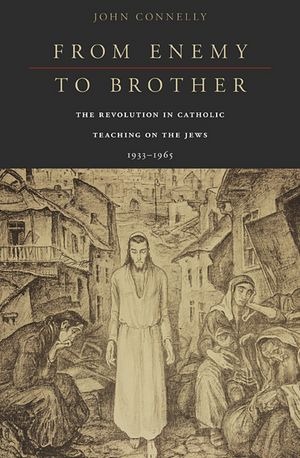 John Connelly (UC Berkeley) has written a focused and important book – From Enemy to Brother: The Revolution in Catholic Teaching on the Jews 1933-1965 (Harvard University Press, 2012). This book addresses the question of how the Catholic Church went from it tradition teaching (that the Jews were cursed by God) to Nostra Aetate, which states that the Jews were loved by God. What could cause such an apparent turn-about in the (unchanging) teachings of the Catholic Church?
One thing that happened, of course, is the Holocaust. This book does tell the story of how the Catholic Church reacted to the Holocaust, before, during, and after. But more than that, it talks about forces within the Catholic Church – particularly, Johannes Oesterreicher (a convert from Judaism) and Karl Thieme (a convert from Protestantism). And there lies the remarkable nature of this story, as Connelly summarizes it:
Why the activists surrounding Johannes Oesterreicher got involved in fighting Nazi racial antisemitism is a question of personal biography that we ultimately cannot answer. yet one fact stands out in their histories: they were converts. This trend did not begin 1933. From the 1840s until 1965, virtually every activist and thinker who worked for Catholic-Jewish reconciliation was not originally Catholic. Most were born Jewish. Without converts the Catholic Church would not have found a new language to speak to the Jews after the Holocaust. As such, the story of Nostra Aetate is an object lesson on the sources but also the limits of solidarity. Christians are called upon to love all humans regardless of national or ethnic background, but when it came to the Jews, it was the Christians whose family members were Jews who keenly felt the contempt contained in traditional Catholic teaching. A group called Maici Israel, which emerged in the 1920s at initiative of Dutch convert Franziska van Leer, demanded an end to liturgical references to Jews as perfidious and a halt to efforts to “convert” the Jews.
The story of the change is not merely one of secular and ecclesiastical politics, but it is also a question of the focus of scriptural interpretation.
In our day […] Catholics lack guidance on how to relate the teaching of Vatican II to other sources for thinking about the Jews, especially scripture. What about the section in Matthew 28 where Christ enjoins his followers to bring the Gospel to “all nations,” baptizing them in the name of the Father, Son, and Holy Spirit? That does not seem to exclude the Jews, and indeed supports the idea that Catholics should – at the very least – pray that Jews accept Jesus Christ as Messiah. Yet in 1965, despite insistent urging from the personal theologian of Pope Paul VI, the drafters of Nostra Aetate refused to say that the church must conduct a mission to the Jews, or that Jews must turn to Christ. In the statement that the bishops overwhelming accepted and Paul VI promulgated as authoritative church teaching – teaching that cannot be rescinded by later popes – the drafters likewise ignored other sections of scripture suggesting the Jews were responsible for Christ’s death (Acts 3:15) and lived under a curse (Matt. 27:25) and that the covenant God had made with the Jews was obsolete (Heb. 8:13). Instead they shifted the church’s understanding of its relations to the Jews to three chapters of Paul’s letter to the Romans, which contain the Apostle’s most mature reflections on the Jewish people.
This shift was possible because the church’s teaching authority – the magisterium – reserves to itself the right to interpret scripture according to the needs of a particular time, though in conversation with the church’s tradition. But the question is why the shift happened. […]
[The drafters of Nostra Aetate] found themselves drawn to St. Paul because chapters 9 through 11 of his letter to the Romans directly refuted claims made by the racist antisemites. According to Paul, if the question was “race,” then Jews actually stood above “Aryans” (Gentiles) in their predisposition to lead faithful lives. And far from being permanently lost and contaminated – as the racists claimed – the Jews remained “most dear to God” – the very phrase that wen into the Vatican II statement. In fact, St. Paul proclaimed, at the end of time, all Israel would be saved. He had no such certainty about the Gentiles (Aryans).
While this book is primarily history (and sharply written, engaging, gripping history at that), this book is far from dead history.
Like all history, this book is not about a dead past. The past does not die. Because Catholics fail to appreciate the change that took place in the 1960s, they continue to return to pre-revolutionary patterns of thought without knowing it. The church of our day claims to understand the Jews in the terms provided by Nostra Aetate, but its leaders keep reverting back to the pre-Vatican II period in their pronouncements. In Nostra Aetate, the church was content to think of reconciliation of humankind by God in an indistinct future, with no compulsion for Jews to turn to Christ, yet the pope recently enjoined Catholics to pray for the Jews, “that God our Lord should illuminate their hearts, so that they will recognize Jesus Christ, the Savior of all men.” Even more recently, American bishops asserted that Catholics must look forward to the inclusion of the “whole people of Israel” in the church: something the bishops of Vatican II were careful not to proclaim.
The latter references are to the Good Friday prayer for the conversion of the Jews (formerly “Oremus et pro perfidis Judaeis”: “Let us pray for the perfidious Jews”) partially restored by Summorum Pontificum (without the reference to “perfidious”); and to the US Conference of Catholics Bishops’ “A Note on Ambiguities Contained in ‘Refelections on Covenant and Mission.’”
This is fascinating history, well-told, and relevant to Judeo-Christian dialogue today.
my filmy Easters
First read this wonderful post, Ends and beginnings, by Theophrastus. And also read the inspired and inspiring, personal comments of Victoria and Courtney. Here’s my own response.
My wife and I have grown up in the Southern Baptist tradition, her father a preacher, a “home missionary” from Texas to Washington state and then California, and my dad also a preacher but a “foreign missionary” from the USA to South Vietnam and Indonesia. We both were raised going to church Sunday mornings for the worship service and for Sunday school, Sunday evenings for [her] Girls Auxiliary and [my] Royal Ambassadors [for boys], Wednesday evenings for prayer meeting, and Friday evenings for fellowship time. At Christmas time, our fathers focused sermon series and lessons around the baby Jesus and the Great Commission for the Lottie Moon Christmas offering to support the Cooperative Program for worldwide missions. At Easter time, the focus was on the post-passion resurrected Jesus, who preached the Great Commission.
At any rate, we saw Jesus films. Last night, we were watching television, flipping through the channels, and I came upon The Passion of the Christ, one of the most gruesome of the many bloody scenes. But I kept going. My wife asked, rhetorically, poking at deep feelings within me that Southern Baptist preachers kids and missionary kids share: Are you really going to flip through this sacred scene to that comedy show? I’ve seen the Jesus film in the village at Easter enough, I think, I said.
The Jesus film is based on the Book of Luke. Here’s from the website of that film so familiar to me:
Based on the Gospel of Luke, the “JESUS” film has now been translated into more than 1,120 languages, with new languages being added every month. This allows God’s Word to speak to people in more than 200 countries in languages they know and understand.
and
Every eight seconds, somewhere in the world, another person indicates a decision to follow Christ after watching the “JESUS” film.
Every eight seconds… that’s 10,800 people per day, 324,000 per month and more than 3.8 million per year! That’s like the population of the entire city of Pittsburgh, PA coming to Christ every 28 ¼ days. And yet, if you are like many people, you may have never even heard of it.
There’s this assumption, right or wrong, that if you just get someone to watch, then they will in all likelihood perpetuate this 1 decision per every 8 seconds. And at Easter, that rate might just increase additionally and exponentially.
What bothers me about this as much as anything is the suggestion that film watching is all one should do, that the film will capture the essence of Easter, that the response that must be right is this “decision to follow Christ.” The assumption that a film will push anyone into any decision is bothersome, like propaganda is.
And yet, learning about Passover or Easter or Pentecost might better involve the literary rather than just the evangelical Christian missionary filminess. The warning to Bible readers, who feel pushed by cultural Bible pushers, may nonetheless be this: you might stop reading the Bible for the wrong reason, just to avoid being pushed around. So please do read anyway and please just be prepared to be surprised without expectation. I just love the title of Theophrastus’s post we just read: “Ends and beginnings”! Why must there be the finality of this one decision as if that’s it and that’s the only tradition that counts?
Well, I just read Annie Dillard again. I’m compelled after reading Dillard’s reading of one of the gospels, her essay entitled “The Book of Luke”, on this Good Friday, to end this post with it. It’s in some ways a beginning for me, another reading from my own experience. Let it be, perhaps, a beginning for some of you, as you like.
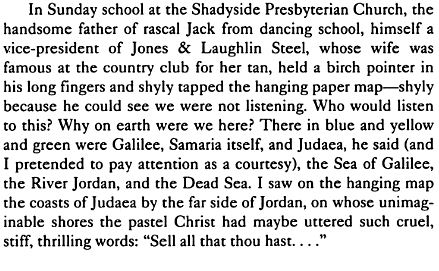
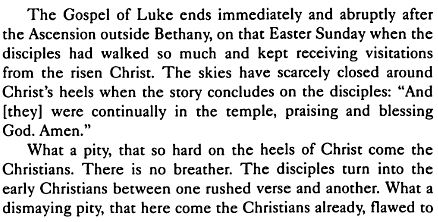
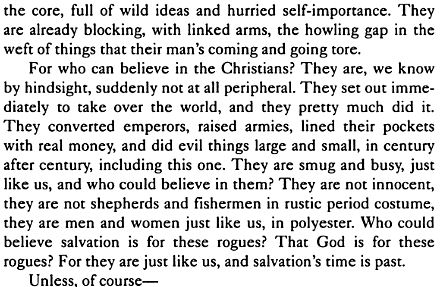
Here is an early excerpt and then her final two pages of her essay propelling some of us to keep on reading (and my apologies for just putting in images at the end, since I’m running short on time, as I get ready for my mother coming to visit for Easter):
Historians of every school agree – with varying enthusiasm that this certain Jewish man lived, wandered in Galilee and Judea, and preached a radically spiritual doctrine of prayer, poverty, forgiveness, and mercy for all under the fathership of God; he attracted a following and was crucified by soldiers of the occupying Roman army. There is no reason to hate him, unless the idea of a God who knows, hears, and acts – which idea he proclaimed – is itself offensive. In Luke, Jesus makes no claims to be the only Son of God. Luke is….
* * *
When I was a child, the adult members of Pittsburgh society adverted to the Bible unreasonably often. What arcana! Why did they spread this scandalous document before our eyes? If they had read it, I thought, they would have hid it. They did not recognize the lively danger that we would, through repeated exposure, catch a dose of its virulent opposition to their world. Instead they bade us study great chunks of it, and think about those chunks, and commit them to memory, and ignore them. By dipping us children in the Bible so often, they hoped, I think, to give our lives a serious tint, and to provide us with quaintly magnificent snatches of prayer to produce as charms while, say, being mugged for our cash or jewels.
Ends and beginnings
In a sense, Passover and Easter seem like a culmination. Easter is of course the most important holiday in the Western Christian calendar – the culmination of the extended Lent period. Passover is one of three pilgrimage festivals in Judaism (although, with the temporary absence of the Temple, the pilgrimage requirement is suspended – except for the Samaritans who make the pilgrimage to Mt. Gerizim), and a holiday that requires extensive preparations of cleaning – to remove any scraps of leaven.
And, after the holidays, it all seems a bit like a letdown. But of course, it is not.
Indeed, on the second day of Passover, the counting of the omer begins. This ancient tradition, mandated in Leviticus 23:15-16, counts the seven weeks (forty-nine days) between Passover and Shavuos (“the festival of weeks”) – another pilgrimage festival. And the Christian calendar has preserved that tradition through the period of Eastertide. The Greek name for Shavuos was Pentecost (“the fiftieth day”), and it is by this name that Christians celebrate their version of this holiday.
Passover was the day of freedom from oppression; Shavuos is the day on which the Torah was received. In the present day, the holiday is celebrated with continuous study – an all-night vigil. It seems as if it were foreshadowed by the episode in the Haggadah, where Rabbis Eliezer, Yehoshua, Elazar ben Azarya, Akiva, and Tarfon were discussing the Exodus at a Passover seder in Bnei Brak. They became so absorbed that their students finally had to interrupt them and tell them that it was time for morning prayers. The study connections go further than that. Rabbi Akiva is said, by tradition, to have begun studying very late – at the age of 40, and yet became one of the major figures of the Talmud (according to some accounts, he is even the star of the Talmud.) And it is a widespread custom that a chapter of Pirkei Avos, “The Ethics of the Fathers,” (a portion of the Talmud [Mishnah]) is studied each week between Passover and Shavuos.
In Christian tradition, of course, Pentecost became a mystical holiday – one where the barriers of language were suddenly transcended. There are a wide variety of Christian traditions, but it is often the case that study is also a focus: many Christians participate in spiritual retreats in preparation for the holiday. Perhaps my favorite literary reference to the holiday is from Romeo and Juliet: Capulet and his cousin discusses how long it has been since he last danced (with a reference to mumming and dancing):
Capulet:
Welcome, gentlemen! Ladies that have their toes
Unplagu’d with corns will have a bout with you.
Ah ha, my mistresses! which of you all
Will now deny to dance? She that makes dainty,
She, I’ll swear, hath corns. Am I come near ye now? […]
A hall, a hall! give room! and foot it, girls.
More light, you knaves! and turn the tables up,
And quench the fire, the room is grown too hot.
Ah, sirrah, this unlook’d-for sport comes well.
Nay, sit, nay, sit, good cousin Capulet,
For you and I are past our dancing days.
How long is’t now since last yourself and I
Were in a mask?Capulet’s Cousin:
By’r Lady, thirty years.
Capulet:
What, man? ‘Tis not so much, ’tis not so much!
‘Tis since the nuptial of Lucentio,
Come Pentecost as quickly as it will,
Some five-and-twenty years, and then we mask’d.
For me, even the “endedness” of this season is overwhelmed by the promise of an even more exciting season – one in which everyone – regardless of education or background – engages in study and learning. The cyclic nature of this study – ever spiraling towards greater understanding, recalls to my mind Vico’s New Science (standing in juxtaposition to Cartesian theorizing – synthesis versus analysis) with its endless circular structure so famously in captured in Joyce’s “riverrun”:
A way a lone a last a loved a long the
[the book restarts here]
riverrun, past Eve and Adam’s, from swerve of shore to bend of bay, brings us by a commodius vicus of recirculation back to Howth Castle and Environs.
So, on the threshold of these two great holidays – from two religions so tied together in history and animosity and also love – allow me also to wish you a happy beginning – a happy counting to Shavuos or Pentecost.
Maundy, pun in translation
Maundy Thursday to everyone!
The common understanding of our sanctified English word maundy is that it is derived from Latin, either mendicantem or mandatum, for “beggar” or “command.” Below are respective, related, entries from http://www.etymonline.com.
- late 14c., from L. mendicantem (nom. mendicans) “beggar,” prp. of mendicare “to beg,” from mendicus “beggar,” originally “cripple” (connection via cripples who beg), from menda “fault, physical defect” (see mendacious).
- mid-15c., from M.E. maunde “the Last Supper,” also “ceremony of washing the feet,” from O.Fr. mandé, from L. mandatum “commandment” (see mandate); so called in reference to the opening words of the church service for this day, Mandatum novum do vobis “A new commandment I give unto you” (John xiii.34), words supposedly spoken by Jesus to the Apostles after washing their feet at the Last Supper.
French wikipedians make me like the second possibility best, although they manage to combine it with the first possibility. They say:
Il y avait un jeu de mot entre « mandét » et « commandét » comme entre« mandatum novum » et « commandantum ».
« Le lavement des pieds, le mandatum peuperum, ainsi appelé parce que l’antienne du Jeudi-Saint commence par : Mandatum novum do vobis, se traduisit en Mandé ; on disait le mandé, pour désigner cette cérémonie qui se liait à une quête faite au profit des pauvres. La mande, manda, employée pour recueillir l’aumône, rattache probablement son étymologie à cette fête et à son nom. »
In other words:
There’s punning between the Old French phrases “mandét” and “commandét” just as there is a pun between the Latin “mandatum novum” and “commandantum.” An engraving in the Louvre in Paris has this note:
“The washing of feet is called the ‘mandatum peuperum’ because the antiphon, the liturgy of Holy Thursday, begins with ‘Mandatum novum do Vobis’ from which our French ‘Mandé’ (for ‘Commandment’) is derived. This describes the binding commandment to make a search for the poor. The commandment, ‘manda’, used for collecting alms, is probably related to this etymology for the festival name.”
All of you French speakers will know that I’ve not gotten that quotation quite right. Not at all. But then this is what happens with translations, and transliterations, of translations.
I guess what I really wanted to say is that the Latin and Old French translations of John 13:34 find something not in the original. The Latin puns as does the later French. The original Greek does not pun. It goes, instead, like this:
Ἐντολὴν καινὴν
δίδωμι ὑμῖν,
ἵνα ἀγαπᾶτε ἀλλήλους·
Then again, we can’t presume that Jesus was speaking Greek, can we? And we can see that the odd gospel Greek probably adds a literary something, some alliteration and some rhyme that was not in the real “spoken” original. Seems that, as old as all of this literary and sanctified language is, much of it, if just in wordplay, can be original and “new.”
Here are five poems I’ve found recently. They’re each “Annie Dillard” poems. Let me let her explain.
Annie Dillard, in her Annie Dillard Reader, includes a section on “Poems.” The first two poems there are her own; the last are “Four Found Poems.” Let me briefly mention the four and then I’ll post below Dillard’s second poem in the chapter, since it requires explanation.
Dillard, introducing the “Four Found Poems,” begins: “Poems seldom require explanation, but these do. I did not write a word of them.” Her explanation is offered particularly as so, to explain generally why “They differ, however, from what we usually think of as found poems.” What she says is just fascinating, but it’s what she doesn’t say that I want to point out. Dillard doesn’t explain that these poems, in English, are not originals. She does not explain the poems as unconventional, as poems in translation. Rather, it’s only in the brief titles and dates and bylines, that I reproduce below, that Dillard offers us her readers the fact that they are, indeed, translated poems:
Dash It
— MIKHAIL PRISHVIN, NATURE’S DIARY, 1925, TRANS. L. NAVROZOV
I Am Trying to Get at Something Utterly Heart-Broken
— V. VAN GOGH, LETTERS, 1873-1890, ED. I. STONE, TRANS. JOHANNA VAN GOGH
An Acquaintance in the Heavens
— MARTHA EVANS MARTIN, WHO SEEMED LONELY IN THE FRIENDLY STARS, 1907, REV. DONALD HOWARD MENZEL, 1964
The Sign of Your Father
— E. HENNECKE, NEW TESTAMENT APOCRYPHA, VOL. I, ED. WILHELM SCHNEEMELCHER, ENGLISH TRANS. ED. BY R. MCL. WILSON, 1963
What I’m trying to stress here is that we, Dillard’s readers, get the fact that these poems that she reproduces on pages 256, 257, 258, and 259 are poems that are found in translation. But we get no explanation of the fact that they are translated poems.
We get no explanation except, perhaps, from the fact that Dillard already gave us an earlier, original, poem on pages 254 and 255. Perhaps that earlier poem is setting us up to read the rather unconventional poetry in translation. The prior poem is one Dillard had written in 1971 and had found published on page 279 of Volume 42 of the journal, The American Scholar. The prior poem then appears before Annie Dillard reproduces and “explains” the “Four Found Poems,” those found in translation. So how might that explain anything? And what’s that prior poem? Here it is.
But let me offer a bit of an explanation first. The prior poem is Dillard’s response to Jorge Luis Borges’s response to C. K. Chesterton’s response to Robert Browning, whom Chesterton has written an entire book about. Chesterton had written, rather prosaically, the following about Browning:
He delighted, with a true poetic delight, in being conventional. Being by birth an Englishman, he took pleasure in being an Englishman; being by rank a member of the middle class, he took a pride in its ancient scruples and its everlasting boundaries. He was everything that he was with a definite and conscious pleasure — a man, a Liberal, an Englishman, an author, a gentleman, a lover, a married man. This must always be remembered as a general characteristic of Browning, this ardent and headlong conventionality.
But this bit is not what Borges remembers of what Chesterton had written about Browning, about his conventionality. Rather, in an interview with César Fernández Moreno, in Spanish, Borges remembered something that Chesterton, about poetry, had written, again rather prosaically, in English:
Poetry deals with primal and conventional things — the hunger for bread, the love of woman, the love of children, the desire for immortal life. If men really had new sentiments, poetry could not deal with them. If, let us say, a man did not feel a bitter craving to eat bread; but did, by way of substitute, feel a fresh, original craving to eat brass fenders or mahogany tables, poetry could not express him. If a man, instead of falling in love with a woman, fell in love with a fossil or a sea anemone, poetry could not express him. Poetry can only express what is original in one sense — the sense in which we speak of original sin. It is original, not in the paltry sense of being new, but in the deeper sense of being old; it is original in the sense that it deals with origins.
Dillard reads what Borges has said originally in Spanish as translated into written English, and she responds to the conventionality of these men, rather originally, rather poetically. So here is that original poem by Annie Dillard (which might just serve also as her fuller explanation of those “Four Poems Found”):
.
Chesterton tells us that if someone wished to feed exclusively on mahogany, poetry would not be able to express this. Instead, if a man happens to love and not be loved in return, or if he mourns the absence or loss of someone, then poetry is able to express these feelings precisely because they are commonplace.
–Borges, Interview in Encounter, April 1969
Not the man who wishes to feed on mahogany
and who happens to love and not be loved in return;
not mourning in autumn the absence or loss of someone,
remembering how, in a yellow dress, she leaned
light-shouldered, lanky, over a platter of pears-
no; no tricks. Just the man and his wish, alone.
That there should be mahogany, real, in the world,
instead of no mahogany, rings in his mind
like a gong-that in humid Haitian forests are trees,
hard trees, not holes in air, not nothing, no Haiti
no zone for trees nor time for wood to grow:
reality rounds his mind like rings in a tree.
Love is the factor, love is the type, and the poem.
Is love a trick, to make him commonplace?
He wishes, cool in his windy rooms. He thinks:
of all earth’s shapes, her coils, rays, and nets,
mahogany I love, this sunburnt red,
this close-grained, scented slab, my fellow creature.
He knows he can’t feed on the wood he loves, and he won’t.
But desire walks on lean legs down halls of his sleep,
desire to drink and sup at mahogany’s mass.
His wishes weight his belly. Love holds him here,
love nails him to the world, this windy wood,
as to a cross. Oh, this lanky, sunburnt cross!
Is he sympathetic? Do you care?
And you, sir: perhaps you wish to feed
on your bright-eyed daughter, on your baseball glove,
on your outboard motor’s pattern in the water.
Some love weights your walking in the world;
some love molds you heavier than air.
Look at the world, where vegetation spreads
and peoples air with weights of green desire.
Crosses grow as trees and grasses everywhere,
writing in wood and leaf and flower and spore,
marking the map, “Some man love here;
and one loved something here; and here; and here.”
Michael Pitkowsky and Howard Friedman point to a new article on SSRN (to appear in the Cardozo Law Review). Here are the details:
“The Cultural Analysis Paradigm: Women and Synagogue Ritual as a Case Study”
Roberta Rosenthal Kwall (DePaul University)
Abstract:
This Article develops an original cultural analysis paradigm with significant implications for understanding the relationship between law and culture. It also illustrates how this relationship should inform the normative application of areas of law in which tensions exist between modern sensibilities and traditional practices steeped in cultural perspectives form other times. Indeed, the negotiation between preservation and change confronts all ancient cultural traditions in modernity. The specific application invoked in this Article concerns the issue of women being called to read publicly from the Torah, a subject of serious academic debate among observant Jews. The analysis demonstrates that the virtually unanimous practice of excluding women from participation in public Torah reading exists despite long-standing ambiguity in the strictly legal realm of the tradition. This reality reveals that the prevailing practices and legal justifications have been markedly influenced by cultural considerations. Thus, the story of women and public Torah reading provides the ideal subject for exploring the synergies between law, culture, and tradition. This story also serves as a model for how cultural analysis can inform the discourse on a broad range of issues in which settled law confronts cultural shifts,
Linguists behaving badly
Tom Bartlett’s Chronicle of Higher Education article over the Daniel Everett-Noam Chomsky linguistics war over recursion has everything: Christian missionaries, Bible translation, super-vicious academic fights, smear campaigns, television, charges of racism, native peoples, and, of course, linguistics.
The article is currently not behind a paywall, and I recommend reading it – it is well written and goes much deeper than the few excerpts I quote below:
[Daniel Everett,] a Christian missionary sets out to convert a remote Amazonian tribe. He lives with them for years in primitive conditions, learns their extremely difficult language, risks his life battling malaria, giant anacondas, and sometimes the tribe itself. In a plot twist, instead of converting them he loses his faith, morphing from an evangelist trying to translate the Bible into an academic determined to understand the people he’s come to respect and love.
Along the way, the former missionary discovers that the language these people speak doesn’t follow one of the fundamental tenets of linguistics, a finding that would seem to turn the field on its head, undermine basic assumptions about how children learn to communicate, and dethrone the discipline’s long-reigning king, who also happens to be among the most well-known and influential intellectuals of the 20th century.[..]
It’s worth asking whether Everett actually has it right. Answering that question is not straightforward, in part because it hinges on a bit of grammar that no one except linguists ever thinks about. It’s also made tricky by the fact that Everett is the foremost expert on this language, called Pirahã, and one of only a handful of outsiders who can speak it, making it tough for others to weigh in and leading his critics to wonder aloud if he has somehow rigged the results.
More than any of that, though, his claim is difficult to verify because linguistics is populated by a deeply factionalized group of scholars who can’t agree on what they’re arguing about and who tend to dismiss their opponents as morons or frauds or both. Such divisions exist, to varying degrees, in all disciplines, but linguists seem uncommonly hostile. The word “brutal” comes up again and again, as do “spiteful,” “ridiculous,” and “childish.”[…]
The language Everett has focused on, Pirahã, is spoken by just a few hundred members of a hunter-gatherer tribe in a remote part of Brazil. Everett got to know the Pirahã in the late 1970s as an American missionary. With his wife and kids, he lived among them for months at a time, learning their language from scratch. He would point to objects and ask their names. He would transcribe words that sounded identical to his ears but had completely different meanings. His progress was maddeningly slow, and he had to deal with the many challenges of jungle living. His story of taking his family, by boat, to get treatment for severe malaria is an epic in itself.
His initial goal was to translate the Bible. He got his Ph.D. in linguistics along the way and, in 1984, spent a year studying at the Massachusetts Institute of Technology in an office near Chomsky’s. He was a true-blue Chomskyan then, so much so that his kids grew up thinking Chomsky was more saint than professor. “All they ever heard about was how great Chomsky was,” he says. He was a linguist with a dual focus: studying the Pirahã language and trying to save the Pirahã from hell. The second part, he found, was tough because the Pirahã are rooted in the present. They don’t discuss the future or the distant past. They don’t have a belief in gods or an afterlife. And they have a strong cultural resistance to the influence of outsiders, dubbing all non-Pirahã “crooked heads.” They responded to Everett’s evangelism with indifference or ridicule.[…]
The Pirahã language is remarkable in many respects. Entire conversations can be whistled, making it easier to communicate in the jungle while hunting. Also, the Pirahã don’t use numbers. They have words for amounts, like a lot or a little, but nothing for five or one hundred. Most significantly, for Everett’s argument, he says their language lacks what linguists call “recursion”—that is, the Pirahã don’t embed phrases in other phrases. They instead speak only in short, simple sentences. In a recursive language, additional phrases and clauses can be inserted in a sentence, complicating the meaning, in theory indefinitely.[…]
His paper might have received a shrug if Chomsky had not recently co-written a paper, published in 2002, that said (or seemed to say) that recursion was the single most important feature of human language. “In particular, animal communication systems lack the rich expressive and open-ended power of human language (based on humans’ capacity for recursion),” the authors wrote. Elsewhere in the paper, the authors wrote that the faculty of human language “at minimum” contains recursion. They also deemed it the “only uniquely human component of the faculty of language.”
In other words, Chomsky had finally issued what seemed like a concrete, definitive statement about what made human language unique, exposing a possible vulnerability.[…] It’s been said that if you want to make a name for yourself in modern linguistics, you have to either align yourself with Chomsky or seek to destroy him.[…]
Because the pace of academic debate is just this side of glacial, it wasn’t until June 2009 that the next major chapter in the saga was written. Three scholars who are generally allies of Chomsky published a lengthy paper in the journal Language dissecting Everett’s claims one by one. What he considered unique features of Pirahã weren’t unique. What he considered “gaps” in the language weren’t gaps. They argued this in part by comparing Everett’s recent paper to work he published in the 1980s, calling it, slightly snidely, his earlier “rich material.” Everett wasn’t arguing with Chomsky, they claimed; he was arguing with himself. Young Everett thought Pirahã had recursion. Old Everett did not.
Everett’s defense was, in so many words, to agree. Yes, his earlier work was contradictory, but that’s because he was still under Chomsky’s sway when he wrote it.[…] But now, after more years with the Pirahã, the scales had fallen from his eyes, and he saw the language on its own terms rather than those he was trying to impose on it.[…]
Critics haven’t just accused Everett of inaccurate analysis. He’s the sole authority on a language that he says changes everything. If he wanted to, they suggest, he could lie about his findings without getting caught. Some were willing to declare him essentially a fraud. That’s what one of the authors of the 2009 paper, Andrew Nevins, now at University College London, seems to believe.[…]
In 2007, Everett heard reports of a letter signed by Cilene Rodrigues, who is Brazilian, and who co-wrote the paper with [MIT professor David] Pesetsky and Nevins, that accuses him of racism. According to Everett, he got a call from a source informing him that Rodrigues, an honorary research fellow at University College London, had sent a letter to the organization in Brazil that grants permission for researchers to visit indigenous groups like the Pirahã. He then discovered that the organization, called FUNAI, the National Indian Foundation, would no longer grant him permission to visit the Pirahã, whom he had known for most of his adult life and who remain the focus of his research.[..]
Chomsky hasn’t exactly risen above the fray. He told a Brazilian newspaper that Everett was a “charlatan.” In the documentary about Everett, Chomsky raises the possibility, without saying he believes it, that Everett may have faked his results.[…]
And what if the Pirahã don’t have recursion? […] Chomsky’s preferred response is to say that it doesn’t matter. In a lecture he gave last October at University College London, he referred to Everett’s work without mentioning his name, talking about those who believed that “exceptions to the generalizations are considered lethal.” He went on to say that a “rational reaction” to finding such exceptions “isn’t to say ‘Let’s throw out the field.’” Universal Grammar permits such exceptions. There is no problem.[…]
Except the 2002 paper on which Chomsky’s name appears. Pesetsky and others have backed away from that paper, arguing not that it was incorrect, but that it was “written in an unfortunate way” and that the authors were “trying to make certain things comprehensible about linguistics to a larger public, but they didn’t make it clear that they were simplifying.” Some say that Chomsky signed his name to the paper but that it was actually written by Marc Hauser, the former professor of psychology at Harvard University, who resigned after Harvard officials found him guilty of eight counts of research misconduct. (For the record, no one has suggested the alleged misconduct affected his work with Chomsky.)[…]
Geoffrey Pullum, a professor of linguistics at the University of Edinburgh, is also vexed at how Chomsky and company have, in his view, played rhetorical sleight-of-hand to make their case. “They have retreated to such an extreme degree that it says really nothing,” he says. “If it has a sentence longer than three words then they’re claiming they were right. If that’s what they claim, then they weren’t claiming anything.” Pullum calls this move “grossly dishonest and deeply silly.”
In an effort to settle the dispute, Everett asked [Ted] Gibson, who holds a joint appointment in linguistics [and cognitive sciences] at MIT, to look at the data and reach his own conclusions. He didn’t provide Gibson with data he had collected himself because he knows his critics suspect those data have been cooked. Instead he provided him with sentences and stories collected by his missionary predecessor. That way, no one could object that it was biased.
In the documentary about Everett, handing over the data to Gibson is given tremendous narrative importance. Everett is the bearded, safari-hatted field researcher boating down a river in the middle of nowhere, talking and eating with the natives. Meanwhile, Gibson is the nerd hunched over his keyboard back in Cambridge, crunching the data, examining it with his research assistants, to determine whether Everett really has discovered something. [However, Gibson has largely disagreed with Everett’s observations.] For example, [Gibson has] confirmed that Pirahã lacks possessive recursion, phrases like “my brother’s mother’s house.” Also, there appear to be no conjunctions like “and” or “or.” In other instances, though, he’s found evidence that seems to undercut Everett’s claims—specifically, when it comes to noun phrases in sentences like “His mother, Itaha, spoke.” That is a simple sentence, but inserting the mother’s name is a hallmark of recursion.[…]
Everett thinks what Gibson has found is not recursion, but rather false starts, and he believes further research will back him up.[…]
As for Universal Grammar, some are already writing its obituary. Michael Tomasello, co-director of the Max Planck Institute for Evolutionary Anthropology, has stated flatly that “Universal Grammar is dead.” Two linguists, Nicholas Evans and Stephen Levinson, published a paper in 2009 titled “The Myth of Language Universals,” arguing that the “claims of Universal Grammar … are either empirically false, unfalsifiable, or misleading in that they refer to tendencies rather than strict universals.” Pullum has a similar take: “There is no Universal Grammar now, not if you take Chomsky seriously about the things he says. Gibson puts it even more harshly[…] “The question is, ‘What is it?’ How much is built-in and what does it do? There are no details,” he says. “It’s crazy to say it’s dead. It was never alive.”[…]
March 2012 biblical studies carnival
Jim West has the latest “Biblical Studies Carnival” up and links to a number of interesting articles. We’d like to thank him for linking to a few BLT articles.
Odd Gospel Greek: Jesus as a Jew – ἐκ τῶν Ἰουδαίων
“Jew, Judeans, and Commas” is a recent blogpost from J. R. Daniel Kirk. The post reconsiders the interpretation and translation of a Greek phrase that is almost always considered anti-Semitic and that “will almost invariably be translated ‘Jew’.” Kirk notes how David Matson suggests a different reading “1 Thessalonians 2:14-15, one of the most challenging texts in the Pauline corpus, especially for Christian/Jewish relations.” In these couple of Greek verses is the phrase ὑπὸ τῶν Ἰουδαίων. Matson suggests, “those in Judea” as a reasonable and even helpful translation of ὑπὸ τῶν Ἰουδαίων. Kirk adds that calling “Ioudaioi” … “‘Judean‘ … might be more like saying, ‘American‘,” that is, “those who share a common geographically determined heritage.” And he gives this map:

I’m still musing over this possibility, and now I’m also interested in the same phrase (ἐκ τῶν Ἰουδαίων) in the gospel of John.
We read this in John chapter 4, where Jesus and the unnamed woman – a Samaritan from Samaria – are talking. To be sure, this gospel and even John 4:22 are as controversial as 1 Thessalonians 2:14-15. Willis Barnstone, who’s translated the New Testament Greek into restored Hebraic English, calls both passages late interpolations by anti-Semitic, Christian editors. Julie Galambush, who’s written The Reluctant Parting: How the New Testament’s Jewish Writers Created a Christian Book, considers the difficulties and asserts: “Consummately sectarian literature, [the gospel of] John was written to be obscure, arcane, even offensive” (page 271). Galambush adds: “While it is true that nearly all of those whom John portrays ‘coming to the light’ are Jewish (John’s is the only gospel that apparently includes no gentile converts), ‘the Jews’ in John’s gospel are firmly on the side of darkness, evil, and the devil” (page 272). In that context, John the gospel writer is also John the translator of the characters in his gospel. The Greek there is fascinating with respect to how it would class people as they talk to and about one another.
Let’s look and listen. Here’s John 4:9 for a bit of context and then John 4:22, where the Samaritan woman is talking and thereafter comes the reply of this man, Jesus. I’m giving the King James [with the odd gospel Greek inserted]:
Then saith the woman of Samaria unto him, How is it that thou, being a Jew [Ἰουδαῖος], askest drink of me, which am a woman of Samaria? for the Jews [Ἰουδαῖοι] have no dealings with the Samaritans.
Ye worship ye know not what: we know what we worship: for salvation is of the Jews [ἐκ τῶν Ἰουδαίων].
What is a bit odd about the plural Ἰουδαῖοι in verse 9 is that there is no article as there is in verse 22. The King James translators might have left the article “the” out just fine in that first verse, but I’m not sure the meaning really changes so very much one way or the other.
What is notable is how Barnstone, like Galambush, sees the convert, the woman from Samaria, as Jewish too (and not a gentile). Barnstone asserts in a footnote that “the Samaritans, from Samaria, were Jews among the main sects of Jews, which included Hasid, Essenes, Sadducees, and Pharisees, among whom, as suggested here with regard to Jerusalem Jews and Samaritan Jews, there was much instense rivalry” (page 462). Thus, Barnstone keys in on the sectarianism but not the geographical identities of the sects. He translates as follows:
The Shomron woman said to him, “How can you a Jew [Ἰουδαῖος] ask to be given a drink by me, a Shomroni? Jews [Ἰουδαῖοι] have no dealings with Shomronim.
You worship what you do not know.
We worship what we do know.
Since salvation is from the Jews [ἐκ τῶν Ἰουδαίων].
But what if the odd gospel Greek is putting it this way?
That woman, the Samaritan [ἡ Σαμαρ.ε.ῖτις], said to him:
How do you, a Judean [Ἰουδαῖος], from me, ask for a drink? From a woman, a Samaritan [Σαμαρ.ε.ίτιδος]?
None of them, in fact, do business with any of those others, no Judeans [Ἰουδαῖοι] with any Samaritans [Σαμαρ.ε.ίταις].
.
You all worship one not known. We all worship the One known because salvation is there, birthed from the Judeans, yes it is [ἐκ τῶν Ἰουδαίων ἐστίν].
Any way it’s read, this is odd gospel Greek because it is one of the very few instances in which Jesus is identified, regionally, racially, and/or religiously as Ἰουδαῖος, of Ἰουδαῖοι, of τῶν Ἰουδαίων.


 BLT
BLT 