David Wasserstein’s “How Islam Saved the Jews”
David Wasserstein (Vanderbilt) is the co-author of one of my favorite books, The Legend of the Septuagint. Wasserstein teaches medieval Jewish and Islamic history, and has written several strong works on Islamic Spain. He previously taught at Tel Aviv University and University College, Dublin.
On May 14-17, David Wasserstein gave a series of lectures at the University of London’s School of Oriental and African Studies – the audio from each of the lectures is available:
Here is the text of Wasserstein’s opening lecture as published in the Jewish Chronicle.
Islam saved Jewry. This is an unpopular, discomforting claim in the modern world. But it is a historical truth. The argument for it is double. First, in 570 CE, when the Prophet Mohammad was born, the Jews and Judaism were on the way to oblivion. And second, the coming of Islam saved them, providing a new context in which they not only survived, but flourished, laying foundations for subsequent Jewish cultural prosperity – also in Christendom – through the medieval period into the modern world.
By the fourth century, Christianity had become the dominant religion in the Roman empire. One aspect of this success was opposition to rival faiths, including Judaism, along with massive conversion of members of such faiths, sometimes by force, to Christianity. Much of our testimony about Jewish existence in the Roman empire from this time on consists of accounts of conversions.
Great and permanent reductions in numbers through conversion, between the fourth and the seventh centuries, brought with them a gradual but relentless whittling away of the status, rights, social and economic existence, and religious and cultural life of Jews all over the Roman empire.
A long series of enactments deprived Jewish people of their rights as citizens, prevented them from fulfilling their religious obligations, and excluded them from the society of their fellows.
Had Islam not come along, Jewry in the west would have declined to disappearance and Jewry in the east would have become just another oriental cult
This went along with the centuries-long military and political struggle with Persia. As a tiny element in the Christian world, the Jews should not have been affected much by this broad, political issue. Yet it affected them critically, because the Persian empire at this time included Babylon – now Iraq – at the time home to the world’s greatest concentration of Jews.
Here also were the greatest centers of Jewish intellectual life. The most important single work of Jewish cultural creativity in over 3,000 years, apart from the Bible itself – the Talmud – came into being in Babylon. The struggle between Persia and Byzantium, in our period, led increasingly to a separation between Jews under Byzantine, Christian rule and Jews under Persian rule.
Beyond all this, the Jews who lived under Christian rule seemed to have lost the knowledge of their own culturally specific languages – Hebrew and Aramaic – and to have taken on the use of Latin or Greek or other non-Jewish, local, languages. This in turn must have meant that they also lost access to the central literary works of Jewish culture – the Torah, Mishnah, poetry, midrash, even liturgy.
The loss of the unifying force represented by language – and of the associated literature – was a major step towards assimilation and disappearance. In these circumstances, with contact with the one place where Jewish cultural life continued to prosper – Babylon – cut off by conflict with Persia, Jewish life in the Christian world of late antiquity was not simply a pale shadow of what it had been three or four centuries earlier. It was doomed.
Had Islam not come along, the conflict with Persia would have continued. The separation between western Judaism, that of Christendom, and Babylonian Judaism, that of Mesopotamia, would have intensified. Jewry in the west would have declined to disappearance in many areas. And Jewry in the east would have become just another oriental cult.
But this was all prevented by the rise of Islam. The Islamic conquests of the seventh century changed the world, and did so with dramatic, wide-ranging and permanent effect for the Jews.
Within a century of the death of Mohammad, in 632, Muslim armies had conquered almost the whole of the world where Jews lived, from Spain eastward across North Africa and the Middle East as far as the eastern frontier of Iran and beyond. Almost all the Jews in the world were now ruled by Islam. This new situation transformed Jewish existence. Their fortunes changed in legal, demographic, social, religious, political, geographical, economic, linguistic and cultural terms – all for the better.
First, things improved politically. Almost everywhere in Christendom where Jews had lived now formed part of the same political space as Babylon – Cordoba and Basra lay in the same political world. The old frontier between the vital center in Babylonia and the Jews of the Mediterranean basin was swept away, forever.
Political change was partnered by change in the legal status of the Jewish population: although it is not always clear what happened during the Muslim conquests, one thing is certain. The result of the conquests was, by and large, to make the Jews second-class citizens.
This should not be misunderstood: to be a second-class citizen was a far better thing to be than not to be a citizen at all. For most of these Jews, second-class citizenship represented a major advance. In Visigothic Spain, for example, shortly before the Muslim conquest in 711, the Jews had seen their children removed from them and forcibly converted to Christianity and had themselves been enslaved.
In the developing Islamic societies of the classical and medieval periods, being a Jew meant belonging to a category defined under law, enjoying certain rights and protections, alongside various obligations. These rights and protections were not as extensive or as generous as those enjoyed by Muslims, and the obligations were greater but, for the first few centuries, the Muslims themselves were a minority, and the practical differences were not all that great.
Along with legal near-equality came social and economic equality. Jews were not confined to ghettos, either literally or in terms of economic activity. The societies of Islam were, in effect, open societies. In religious terms, too, Jews enjoyed virtually full freedom. They might not build many new synagogues – in theory – and they might not make too public their profession of their faith, but there was no really significant restriction on the practice of their religion. Along with internal legal autonomy, they also enjoyed formal representation, through leaders of their own, before the authorities of the state. Imperfect and often not quite as rosy as this might sound, it was at least the broad norm.
The political unity brought by the new Islamic world-empire did not last, but it created a vast Islamic world civilization, similar to the older Christian civilization that it replaced. Within this huge area, Jews lived and enjoyed broadly similar status and rights everywhere. They could move around, maintain contacts, and develop their identity as Jews. A great new expansion of trade from the ninth century onwards brought the Spanish Jews – like the Muslims – into touch with the Jews and the Muslims even of India.
All this was encouraged by a further, critical development. Huge numbers of people in the new world of Islam adopted the language of the Muslim Arabs. Arabic gradually became the principal language of this vast area, excluding almost all the rest: Greek and Syriac, Aramaic and Coptic and Latin all died out, replaced by Arabic. Persian, too, went into a long retreat, to reappear later heavily influenced by Arabic.
The Jews moved over to Arabic very rapidly. By the early 10th century, only 300 years after the conquests, Sa’adya Gaon was translating the Bible into Arabic. Bible translation is a massive task – it is not undertaken unless there is a need for it. By about the year 900, the Jews had largely abandoned other languages and taken on Arabic.
The change of language in its turn brought the Jews into direct contact with broader cultural developments. The result from the 10th century on was a striking pairing of two cultures. The Jews of the Islamic world developed an entirely new culture, which differed from their culture before Islam in terms of language, cultural forms, influences, and uses. Instead of being concerned primarily with religion, the new Jewish culture of the Islamic world, like that of its neighbors, mixed the religious and the secular to a high degree. The contrast, both with the past and with medieval Christian Europe, was enormous.
Like their neighbors, these Jews wrote in Arabic in part, and in a Jewish form of that language. The use of Arabic brought them close to the Arabs. But the use of a specific Jewish form of that language maintained the barriers between Jew and Muslim. The subjects that Jews wrote about, and the literary forms in which they wrote about them, were largely new ones, borrowed from the Muslims and developed in tandem with developments in Arabic Islam.
Also at this time, Hebrew was revived as a language of high literature, parallel to the use among the Muslims of a high form of Arabic for similar purposes. Along with its use for poetry and artistic prose, secular writing of all forms in Hebrew and in (Judeo-)Arabic came into being, some of it of high quality.
Much of the greatest poetry in Hebrew written since the Bible comes from this period. Sa’adya Gaon, Solomon Ibn Gabirol, Ibn Ezra (Moses and Abraham), Maimonides, Yehuda Halevi, Yehudah al-Harizi, Samuel ha-Nagid, and many more – all of these names, well known today, belong in the first rank of Jewish literary and cultural endeavor.
W here did these Jews produce all this? When did they and their neighbors achieve this symbiosis, this mode of living together? The Jews did it in a number of centers of excellence. The most outstanding of these was Islamic Spain, where there was a true Jewish Golden Age, alongside a wave of cultural achievement among the Muslim population. The Spanish case illustrates a more general pattern, too.
What happened in Islamic Spain – waves of Jewish cultural prosperity paralleling waves of cultural prosperity among the Muslims – exemplifies a larger pattern in Arab Islam. In Baghdad, between the ninth and the twelfth centuries; in Qayrawan (in north Africa), between the ninth and the 11th centuries; in Cairo, between the 10th and the 12th centuries, and elsewhere, the rise and fall of cultural centers of Islam tended to be reflected in the rise and fall of Jewish cultural activity in the same places.
This was not coincidence, and nor was it the product of particularly enlightened liberal patronage by Muslim rulers. It was the product of a number of deeper features of these societies, social and cultural, legal and economic, linguistic and political, which together enabled and indeed encouraged the Jews of the Islamic world to create a novel sub-culture within the high civilization of the time.
This did not last for ever; the period of culturally successful symbiosis between Jew and Arab Muslim in the middle ages came to a close by about 1300. In reality, it had reached this point even earlier, with the overall relative decline in the importance and vitality of Arabic culture, both in relation to western European cultures and in relation to other cultural forms within Islam itself; Persian and Turkish.
Jewish cultural prosperity in the middle ages operated in large part as a function of Muslim, Arabic cultural (and to some degree political) prosperity: when Muslim Arabic culture thrived, so did that of the Jews; when Muslim Arabic culture declined, so did that of the Jews.
In the case of the Jews, however, the cultural capital thus created also served as the seed-bed of further growth elsewhere – in Christian Spain and in the Christian world more generally.
The Islamic world was not the only source of inspiration for the Jewish cultural revival that came later in Christian Europe, but it certainly was a major contributor to that development. Its significance cannot be overestimated.
(HT: Alan Brill)
Odd Gospel Greek: or is it Hebrew? or Latin?
Thanks again to Theophrastus for directing us all to Yair Furstenberg’s review of Daniel Sperber’s new book Greek in Talmudic Palestine. In his introduction, Sperber takes us directly to a tale in the “Mishna in Avoda Zarah 3:4”; after presenting the text to us, Sperber concludes that it “reflects second-century sitz im leben, in which Jews and Gentiles, even most distinguished Jewish individuals, could bathe together naked in a Romano-pagan bathhouse, which apparently constituted a meeting place for the social intercourse of people from radically different walks of life.” The intercourse, of course, was mediated by the people’s language(s), and so Sperber concludes rather playfully with this rhetorical question:
“And presumably they could converse together in Greek; or was it in Hebrew or Aramaic?”
When one reads the odd gospel Greek of the a-syn-optic account of the life of Jesus, then there comes this sense of word-playfulness.
For example, John in the 12th chapter presumes to let his readers hear the voice of God. His readers are listening to an agonizing prayer by Jesus to his heavenly father (reading in Greek), in which he concludes, exclaiming publicly: “Father, glorify thy name.” The response, John writes, is this:
καὶ ἐδόξασα καὶ πάλιν δοξάσω.
John’s Greek readers hear it but he tells them that Jesus’s and his father’s eavesdroppers don’t. They hear βροντή, or so they think: βροντή, thunder. Did it sound like Hebrew or Aramaic, or Greek? Or some understand the voice to be an ἄγγελος, an angel. What language do the angels speak? Greek like the voice one reads does sound like an angel? Does it sound like Hellene poetics, with Hebraic repetitions retained? Would it only sound like thunder to barbarians? How does God sound? When he speaks audibly to a human, what does he speak, and what if one uses Greek to translate that?
καὶ ἐδόξασαai
καὶ πάλιν
δοξάσω.
John chapter 19 especially gives the feeling of multi-lingual social intercourse. Now the conversation is not to and from heaven, but it’s all on the ground, between humans. And this comes all in the context of the gospel’s narrating (in Greek alone) speech between Jews and Romans and Greek speakers all. What languages are they speaking all to one another when they speak? John writes to his readers in Greek, so we can’t always be sure. Imperial Greek talk? Official Latin perhaps? Common Greek (koine)? Holy Hebrew? More casual Aramaic?
One is reading Greek sure enough, but there’s odd gospel Greek in chapters 18 and 19. There’s transliterated (i.e., Greek-lettered) Hebrew Aramaic perhaps, as if Greek is the translation.
The character βαρ αββᾶς is introduced to the Greek readers as a thief, and probably those reading aloud knowing Aramaic would get this name as meaning “Daddy’s Son.” (In a variant text of Matthew 27:17, this same character is identified as another “Jesus,” so the emphasis on the Son-Father relationship is somehow implicit, perhaps?) The day of σάββατον is approaching, and all Greek readers get the alpha-beta spelling of that week end.
In this a-syn-optic gospel, these are Greek author notes, Greek reader asides. John writes sometimes directly (verses 13 and 19) to those who read Greek but who can also hear Hebrew Aramaic, as if spelling things out more explicitly:
Ἑβραϊστὶ δὲ Γαββαθᾶ· /in “Hebrew” however is Gabbatha /
λέγεται Ἑβραϊστὶ Γολγοθᾶ· /it’s called in “Hebrew” Golgotha /
And for those who hear Latin, the Greek writer does something similar. Writing in Greek the narrator gives in Greek letters what sounds like Latin names:
τὸ πραιτώριον is the Praetorium (where, starting in chapter 18, the trial begins)
Καῖσαρ, of course, is for Caesar.
Πιλᾶτος presumably is for Pilatus.
and
τίτλος is something else surely as recognizable to most Greek readers in this mutilingual milieu. Maybe it’s a borrowing, something like my milieu in the previous sentence. This is not Greek, or if it is we have to say it’s odd gospel Greek, then we must understand it as Greek-sounded-out Latin. The Greek writer only goes so far as to explain what is on this Roman Latin τίτλον; he only writes it for his readers in Greek.
At this point, the Greek readers have no trouble believing that what he has written only in Greek Pilatus has had written in Ἑβραϊστί, Ἑλληνιστί, Ῥωμαϊστί /in Hebrew or Aramaic, in Hellene, and in the Latin of Rome /.
The Greek writer’s biggest challenge seems to be to get his multi-lingual readers of his Greek to πιστεύω, or to follow and to be persuaded by his Greek rhetorical proof. Right here as Jesus is finally dead on the cross, the writer insists (in verse 35) that his Greek argument is alive, that readers conversing together in Greek, or was that in Latin?, or Hebrew?, or Aramaic?, must get it. Perhaps it’s first-century near-Palestinian sitz im leben. Surely by our twenty-first-century standards it’s some odd gospel Greek.
Odd Gospel Greek: Jesus’s Coffer, Judas’s Coffin
The gospel of John uses some very odd Greek. English translators usually don’t know what to make of it, and nowhere in the text is this clearer than in the case of “the bag” that Judas had (in John 12:6, King James Version, Richmond Lattimore, Robert Young’s “literal”). Or did Judas keep more specifically “the moneybag” (ESV, GOD’S WORD®), or “the purse” (Duay-Rheims)?
Or can’t translators just skip over whatever-it-was to simply say as if with some more natural English dynamic equivalence to John’s Greek clause, that “Judas had charge of the money” (John 13:29, NIV) or that “Judas was their treasurer” (NLT)? Should English readers understand, as Ann Nyland does, that the odd Greek of John’s gospel has “Judas being in charge of the money”?
Or was Judas “keeper of the money box” (as Willis Barnstone restores it in our century)? And isn’t this attune to the Greek idiomatic idiom here when the “modern speech” New Testament (of Richard Francis Weymouth with some help from Ernest Hampden-Cook) earlier, at the turn of the 19th century in London, renders it as follows: “Some, however, supposed that because Judas had the money-box Jesus meant, ‘Buy what we require for the Festival,’ or that he should give something to the poor”?
The odd gospel’s odd Greek here is peculiar indeed. It is a compound noun, γλωσσό-κομον, which means something like “tongue-care.” Henry George Liddell and Robert Scott, in their Greek-English Lexicon, find very few uses of this phrase anywhere. When they do, they suggest it “most frequently” means “case, casket,” and that it is particularly for a “case to keep the reeds or tongues of musical instruments,” but “generally, casket.” These two lexicographers seem to agree with Albert Barnes‘s Notes on the Old and New Testament, in which he says:
Had the bag – The word translated “bag” is compounded of two words, meaning “tongue,” and “to keep or preserve.” It was used to denote the bag in which musicians used to keep the tongues or reeds of their pipes when traveling. Hence, it came to mean any bag or purse in which travelers put their money or their most precious articles. The disciples appear to have had such a bag or purse in common, in which they put whatever money they had, and which was designed especially for the poor, Lu viii. 3; Mat xxviii. 55; Ac ii. 44. The keeping of this, it seems, was intrusted to Judas; and it is remarkable that the only one among them who appears to have been naturally avaricious should have received this appointment. It shows us that every man is tried according to his native propensity. This is the object of trial – to bring out man’s native character; and every man will find opportunity to do evil according to his native disposition, if he is inclined, to it.
Well, okay. There’s a Greek compound noun that could be clearly referring to “any bag or purse.” Who cares if this is absolutely a very very rare Greek phrase (not in Homer, Hesiod, Sappho, neither in Plato, Isocrates, or Aristotle, never anywhere else anywhere in John’s gospel and not in Mark’s gospel or Matthew’s or Luke’s, not in Acts, not in Hebrews or in Revelation or in any of the epistles of Paul or any of the others)? Most generally, we’ve been told, the compound noun refers to a casket, to a coffin.
But neither Barnes nor Liddell and Scott observe something that the odd gospel Greek may be signaling. The New Testament text may be pointing readers to very odd Septuagint Greek.
If γλωσσό-κομον is only twice used as odd gospel Greek (i.e., John’s two references to this thing that Judas had), then the same phrase is only thrice used in one short context in all of the LXX.
This is also odd indeed. It’s also odd because the translators of the Hebrew Bible in Alexandria, Egypt some 250 years before Jesus and Judas in Jerusalem had more common Hellene phrases to use for this short context (which we’ll get to shortly). The Hebrew word in question was aron (אָרוֹן). When Joseph dies and his body in Egypt is put into one of these (in Genesis 50), then the LXX translators say he was put into a σορός, or a common Hellene word for a cinerary urn or coffin or some such container of human remains. When God tells Moses (in Exodus 25) to have his people make one of these, then the LXX translators say this ark-like thing was a κιβωτός, or a box, a chest, a coffer, a ship. Those are the common Hellene nouns for this not uncommon biblical Hebrew noun. But then we come to 2 Chronicles 24.
The LXX translators of the thrice used Hebrew phrase aron (אָרוֹן) in 2 Chronicles 24, thrice use an odd Greek term (not σορός, for coffin, or κιβωτός, for coffer). No, they choose γλωσσό-κομον, and this is the only place the Septuagint uses this odd and rare Hellene. In fact, earlier in the same text, in 2 Chronicles 8, the Hebrew phrase is rendered as κιβωτὸς. But not in chapter 24.
Lancelot Brenton translates this Hellene γλωσσό-κομον (in “2 Chronicles 24“) into English as “box”; and (for the NETS, “2 Supplements“) English translator S. Peter Cowe let’s it be a “chest.”
The story goes that young King Joash decides to repair the house of the Lord. He commands the priest and the Levites, “Go out unto the cities of Judah, and gather of all Israel money to repair the house of your God from year to year.” When they dally, he says (according to the LXX translators as further translated by Brenton), “Let a box [γλωσσό-κομον] be made, and let it be put at the gate of the house of the Lord without.” Or (according to the Septuagint translators as read by Cowe), “Let there be a chest [γλωσσό-κομον], and let it stand outside the gate to the Lord’s house.” And it was into this thing that the people, day by day, put their money, the money by which the materials were purchased and the workers were paid to rebuild the house of the Lord. Why did the LXX translators call this thing here a “tongue-keeper”? Was it in Alexandria, Egypt at that time already some sort of something (a bag or a purse or the like; or a box for instrument reeds) in which people were dropping and / or keeping their money? Who knows!? What we do know is that this is very very odd Greek in any case.
And what we do know is that the odd gospel Greek that has Judas having this thing seems to point Greek readers back to this story in ΠΑΡΑΛΕΙΠΟΜΕΝΩΝ Β (or 2 Chronicles aka 2 Supplements). It was Joash’s coffer, then it’s Jesus’s coffer. But it was the negligent priests and Levites’s lack. And in the context of the odd gospel, where Jesus is getting anointed (figuratively for burial) by Mary while dining with the resurrected Lazarus at the protest of Judas, it seems oddly somehow to symbolize Judas’s negligence, and the γλωσσό-κομον becomes perhaps a symbol to readers, a symbol perhaps of his figurative casket or coffin.
In 2011, the US Bishops sharply criticized Elizabeth Johnson’s Quest for the Living God: Mapping Frontiers in the Theology of God. Elizabeth Johnson is a nun (C.S.J.) and a professor at Fordham. In a contentious back and forth after the censure, the Committee on Doctrine of the US Catholic Bishops Conference wrote:
The book […] clearly advocates the replacement of traditional masculine language in certain unspecified, but evidently important, contexts. The problem is that there is no recognition of the central role that the names of “Father,” “Son,” and “Holy spirit” play in the divine revelation given to us about the relationship of the three Persons of the Trinity.[…] The concern of the Committee was […] the insinuation that traditional language based on divine revelation, such as “Father,” obscures the truth about God. Certain language belongs to the deposit of divine revelation and may not be replaced, even if human reason might find some indication that to do so might be socially useful.
Today, the Vatican released a Notification severely criticizing Margaret Farley’s Just Love: A Framework for Christian Sexual Ethics (winner of Grawemeyer Award). Margaret Farley is a nun (R.S.M.) and a professor at Yale.
Some news links:
- New York Times coverage
- National Catholic Reporter news coverage
- Analysis of the Notification
- Book review of Just Love
- Another book review of Just Love
- Academic reaction to the censure
- Margaret Farley’s reaction
- Reaction by Patricia McDermott (President of Sisters of Mercy of America)
- Reaction by James Martin (Culture Editor of America magazine)
- Column by Jamie Manson
Ironically, the publisher of both books is Continuum, which is using the criticism as an opportunity to promote the books. As of this afternoon, Just Love, is back ordered for 1-3 weeks from Amazon.
Daniel Sperber’s Greek in Talmudic Palestine
I was going to send this as an e-mail to J. K. Gayle, but decided to put it into a BLT post instead because it might be of interest to a broader audience.
Yair Furstenberg has an interesting review of Daniel Sperber’s new book Greek in Talmudic Palestine (which I have not yet read, and have just now ordered – Bar Ilan Press has a sale on now, but shipping to the US is a little expensive – total cost airmail delivery was US$ 51.06).
Here is a sample of an the review:
But as the examples in the book demonstrate, the issue at hand is not only in what fields were the rabbis exposed to Greek, but the nature of their proficiency. Thus, the most enjoyable examples are those which not only incorporate Greek terminology but cunningly manipulate the languages through wordplays and puns. It takes an expert to identify those, today as well as back then. Therefore, although we are not surprised to find R. Abbahu in third century Caesarea proving his competence in Greek with a clever wordplay, it is no less than astonishing to find it in other, unexpected contexts. Such is the following case, my personal favorite, (discussed on p. 136) taking us back to the presumably ancient mishnah, which records the halahkhic dispute between the Pharisees and Saduccees (m. Yad. 4:6):
The Sadducees say we cry out against you, O ye Pharisees, for ye say ‘The Holy Scriptures render the hands unclean and the writings of Homer do not.” Rabban Yochanan ben Zakkai said “Have we naught against the Pharisees save this? For lo, they say ‘The bones of an ass (עצמות חמור) are clean and the bones of Yochanan the High Priest are unclean?’”
As Sperber points out, quoting Chaim Rosen, there is much more to the comparison of texts (Scripture/Homer) to bones (High Priest/ass) than the halakhic issue of impurity: behind the word “עצמות חמור” ["the bones of an ass"] there lies a Greek expression referring to Homeric poetry itself – an expression which has been doctored in a “cacophonistic” manner for the sake of derision and disparagement – “aismat homerou” – viz. “the songs of Homer”. And we can only thank the Pharisees for purifying these bones and songs, reluctantly admitting the enduring influence of Greek language and culture.
Rhode Island, Roger Williams, and Religious Freedom
As an expat Rhode Islander, I was delighted to see this article at Religion In American History: Big Ideas in a Small State: Roger Williams and the 375th Anniversary of the Founding of Providence, Rhode Island. We Rhode Islanders take great pride in the fact that our colony’s founder, Roger Williams, was thrown out of the Massachusetts Bay Colony for religious reasons, and founded Rhode Island as a haven of religious freedom as a result.
In matters of religion, during the colonial period Rhode Island never had a witch trial, never conducted a blasphemy trial, and never hanged (or even whipped, supposedly) anyone for their religious beliefs. Rhode Island also boasts the country’s oldest library building (Redwood Library and Athenaeum in Newport), the nation’s oldest Baptist church (Providence, 1638), the oldest Jewish Synagogue (Touro, in Newport; 1763), and New England’s oldest Masonic Temple (Warren).
Apparently there’s something of a revival going on in the area of Roger Williams studies over the past few years, and BLT readers may be particularly interested in one recent development:
In the vast holdings of the John Carter Brown Library on Brown’s campus is an enigmatic book. Actually, it is not so much the book itself that is of interest; it is the pages upon pages of chicken-scratch shorthand that fill every square inch of white space in the margins and front and back of the book. The book—and the shorthand in it—has long been assumed to be Roger Williams’, but for decades, if not centuries, no one was able to crack the shorthand. Enter a group of incredibly optimistic and hardworking Brown undergrads, led by Simon Liebling and Chris Norris-LeBlanc. Compiling a small cadre of undergrad historians, linguists, and mathematicians, the team read widely on the history of shorthand and toyed with high-tech ways of discerning patterns. In the end, however, the solution was deceptively simple: they found a seventeenth-century shorthand textbook that provided an almost instant key to Williams’ scrawlings.
The code was cracked.
Decoding the shorthand led them to another discovery: most of the the shorthand was simply a hurried summary of the contents of another book, Peter Heylin’s “Cosmographie in Four Books,” published in 1654. Nonetheless, there is a central section of the shorthand that seems to be Williams’ own thoughts in which he references people like John Eliot, a Puritan minister and missionary in Massachusetts. Liebling and Norris-Leblanc have attracted the interest of the Brown Daily Herald and the Providence Journal so far. But Williams’ shorthand is in yet another book that the team also hopes to decode: Williams’ personal copy of the so-called Eliot Bible, which was a translation of the entire Bible by John Eliot and some Indian servants into the Massachusett Indian language in 1663.
Next year is the 350th anniversary of the 1663 Rhode Island Charter, and the Newport Historical Society will be holding a series of events about religious toleration, including an academic conference next fall that will widen its focus beyond Roger Williams to include other religious dissident Rhode Islanders such as John Clarke and Anne Hutchinson.
June 1 Eerdmans All Over
Wm B. Eerdmans Publishing Co. has published their latest “Eerdmans All Over” linking to a number of interesting articles mentioning Eerdmans’ books. They have kindly included a link to a BLT article; thanks!
Artscroll versus Koren: censored text
As I am continuing to look at the English Koren Talmud, I was started to find that it had restored text censored from the Talmud.
Near the top of Berachos 17b, the text is commenting on Psalms 144:14 “Our leaders are laden, there is no breach and no going forth and no outcry in our open places.”
The Koren translates a portion of the gemara as follows (bold text indicates that this is part of the literal translation, non-bold text indicates that this is interpolated text):
“In our open places”; that we should not have a child or student who overcooks his food in public, i.e., who sins in public and causes other to sin, as in the well-known case of Jesus the Nazarene.
Now, here is the note that appears to that text:
As in the well-known case of Jesus the Nazarene — כְּגוֹן יֵשׁוּ הַנּוֹצְרִי: In standard vesions of the Talmud, this story appears without the name Jesus the Nazarene, which was removed by censors due to the sensitivity to the Christian society in which they lived.
Another example appears in tractate Sota (47a), where Rabbi Yehoshua ben Peraḥya is depicted as one who pushed aside Jesus the Nazarene with both hands. The Gemara relates that Yehoshua ben Peraḥya was returning to Jerusalem following his flight to Alexandria in Egypt, together with his student, Jesus the Nazarene. When they stopped in an inn and were treated well, Yehoshua ben Peraḥya mentioned to Jesus that the service was good. Jesus responded that the innkeeper was unattractive. This response led Yehoshua ben Peraḥya to ostracize Jesus. Yehoshua ben Peraḥya was unable to bring himself to revoke the ostracism until it was too late and Jesus turned away from traditional Judaism.
It should be noted, however, that the story of Yehoshua ben Peraḥya , who was driven from Jerusalem by the Hasmonean King Alexander Yannai, could not have taken place any later than 76 BCE. Consequently, the reference to Jesus the Nazarene cannot be connected with the individual surrounding whom the Christian faith was established. Many commentaries suggest that all talmudic references to Jesus refer to another person, or perhaps there was more than one person with that name who lived during the time of the Mishna.
The Artscroll simply omits the reference altogether. The Soncino does also, although it includes a brief note mentioning with an abbreviation denoting the Munich codex followed by “like the Nazarene.”
Now, I am not claiming that the Koren is particularly scholarly, but at least it mentions briefly the issues with this well-known censored text, and in a fairly even-handed way – pointing out that the references cannot actually match up with the historical Jesus. Instead, the Artscroll simply pretends the issue does not exist. So, I think the Koren wins this example.
Note however that the Koren English language for the text does not exactly flow smoothly – e.g., awkward constructions like “the reference to Jesus the Nazarene cannot be connected with the individual surrounding whom the Christian faith was established.” Since Steinsaltz is such a fluent writer of Hebrew, it is a bit of a disservice to translate him in such awkward English.
(See also this post).
Rare audio of a Gershom Scholem lecture (1975)
Alan Brill writes about audio from a Gershom Scholem lecture from 1975. It was news to me, and is, to the best of my knowledge, the only audio freely available on the Web from Scholem.
It is thrilling to hear Scholem’s voice, but it is a busy day for me, so I only listened to a few minutes and I cannot speak to the entire recording. Here are some excerpts from Alan’s description (go to his post for more details):
This lecture was delivered at the Panarion conference, 1975, an annul Jungian conference held in Los Angeles.[…] The topic was the Tzelem- the astral body.[…] One gets a good sense of Scholem in the 90 minutes.
He opens with […] two interesting autobiographical statements. First, that research into kabbalah is research into the hidden recesses of the mind. Second, that Scholem in his turn to kabbalah was searching beyond the Talmud. It is interesting that even after 60 years in Israel his accent is still entirely German even when pronouncing Hebrew..[…]
Now to the lecture itself, which Scholem claimed was really two lecture. The first half of the lecture on the personal confrontation with the soul and the second half on Tzelem. One sees how much Scholem was interested in psychological explanations.[…]
Here is a comment on Alan’s post from Alan Jay Weisbard:
Alan, I think I may have been in attendance at that lecture, or perhaps a similar one given a year or two prior at B.U. While my field was not Jewish studies, I had spent time in Israel by then and done a fair amount of reading of Judaica, including a number of Scholem’s essays on various topics. I certainly knew of his stature as a scholar and didn’t want to miss the opportunity to be in his presence.
As I remember, the (large) lecture hall was packed, and it was very difficult to hear Scholem clearly, particularly with his strong accent and the frequency of terms from a variety of languages. To be honest, I found the lecture somewhere between impenetrable and incomprehensible, as did my wife, who had been a graduate student in Jewish History at Harvard (and for a year at Hebrew U.) and had German and far better Hebrew than I. There have been very few lectures in my career as an academic that I understood less well.
Oh well.
I’ve done considerably better with Scholem’s published work in English translation.
I am curious how Scholem’s students found him as a teacher (as distinct from a scholar), and how Israelis did with his public lectures in Hebrew.
In the same issue of The New Republic that includes Peter Schäfer’s attack on Daniel Boyarin, there is a review of John Connelly’s excellent book, From Enemy to Brother: The Revolution in Catholic Teaching on the Jews, 1933-1965 by Peter Gordon (Harvard University). (We previously looked at this book at BLT in this post.)
The entire review is insightful, but I especially enjoyed the last part:
What is a border, and how much of one’s identity is retained in the crossing? When rabbis would introduce John Oesterreicher to their congregation as a “former Jew,” he would object on the grounds that Jews were his “blood brothers” and that he was himself a Jewish-Christian. But this is a nuance that he embraced only after years of struggle. As late as 1960 he vehemently rejected the suggestion from Thieme that he could “represent the Jewish point of view in the church.” Although he readily acknowledged his Jewish heritage, Oesterreicher insisted that his efforts to dismantle Catholicism’s tradition of anti-Jewish prejudice represented the genuinely Christian vision.
But it is the major thrust of Connelly’s book that this was not so: Christian empathy toward Jews did not spring spontaneously from Christian sources, he argues, nor did it spring from Judaism. It emerged instead only from the experience of crossing, such that the other could persist within the new self. The Church, Connelly suggests, would not have been capable of coming to this vision without the curious doubling of identity that was brought into its sacred walls from those who, by birth or by faith, would have once been considered outsiders. And if this is true, then the facts of Oesterreicher’s biography hold stronger explanatory weight than his own statements to the contrary. The transgression of borders may leave marks that even the transgressor will not care to acknowledge.
The Catholic saint Edith Stein, a convert from Judaism who took holy orders and became Sister Teresa Benedicta, and had once studied under Edmund Husserl, is best known beyond Catholic circles as a philosopher of empathy. In 1933, she wrote an urgent plea to Pius XI: “For weeks now not only the Jews, but also many thousands of loyal Catholics in Germany—and I believe the entire world—are waiting for the Church to raise its voice…. Is not this war of destruction against the Jews a cruel insult to the most holy humanity of our savior?” Her question was not answered, and the plea that that Vatican effect a total rupture with the Third Reich was never realized. Stein herself died in the gas chamber at Auschwitz, the victim of a policy that, in retaliation for a Dutch Catholic statement against Nazism, specifically targeted Jewish converts to Christianity. Her entreaty to the pope stands as a model of the empathy that she raised into a subject of philosophical speculation.
The phenomenon of border-crossing raises vexed questions of human psychology that a historian—even one as gifted as Connelly—cannot be expected to resolve. They are questions more properly left to the domain of the moral philosopher. What are the true limits of empathy? What are the conditions for its possibility and its growth? How can its boundaries be made to extend beyond the narrow circumference of one’s own family, one’s own nation, one’s own faith? It was the third-century bishop Saint Cyprian of Carthage who first proclaimed the ambivalent truth extra ecclesiam nulla salus, “Outside the Church there is no salvation.” All such doctrines betray the ideals that they proclaim, reserving the ultimate promise of human salvation for a single community of belief.
One is tempted to agree with Freud (another figure from the Moravian land of border-crossing) who observed that the injunction “Thou shalt love thy neighbor as thyself” imposes an impossible demand: if the neighbor is truly a stranger to me and if he occupies no place whatsoever in my emotional life, then I will find this commandment in conflict with the jealousy and instinctual aggression that lie at the very core of my own psychic constitution. True love, for Freud, was therefore always entangled with narcissism: it is not the other whom I love but myself, or at least it is only that quality in the other which resembles me or resembles the person I once was. Connelly has written an important book, an extraordinary work of history, although it is sobering to think that its argument may depend on an original sin in human psychology: that the imperative of empathy resists its universal application and collapses back upon itself, darkening its own promise like an imploding star.
First impressions of the Koren English Talmud
I’ve had my copy of Tractate Berachos in the new Koren English Talmud for all of about fifteen minutes now. It is a translation of Adin Steinsaltz’s Hebrew version of the Talmud, and we first discussed it here on BLT. Obviously, I haven’t been able to read it length, but I do have some initial impressions that I would like to share:
- The volume is laid out beautifully. But I still prefer the layout of the old Random House translation of Steinsaltz’s volume more. The old Random House edition had much better paper, gilded edging, but in terms of content, it had the Aramaic (with nikkud vowelization), a literal translation, Steinsaltz’s expanded translation (with the “original words” being highlighted in bold and “elucidation” not highlighted), and notes of many types (halacha, personalities, background, other notes, etc.) The new English Koren volume includes most of these elements but omits the “literal translation.” That’s a very great pity, and I regret it.
- On the other hand, the English Koren volume is much more compact – Tractate Berachos goes through amud 64A (125 folio pages in the original) and the translation fit into xviii+419 pages. The Koren is a single volume, compared with Artscroll’s two volumes.
- The English Koren is a bargain. The current Amazon price is $29.22 (even cheaper for the Daf Yomi edition, which may have print that is too small to read and certainly lacks color) but it also includes a coupon for a $10 rebate (expiring August 31, 2012). Let me repeat that point because I wanted to make it clear to those who might skim this post:
The volume includes a coupon for a $10 rebate.
-
The English Koren has color illustrations. This turns out to be very nice, and not at all tacky as I feared. On the other hand, the translucent color dustjacket is certain to be ripped soon, which is a pity, because it is so beautiful.
-
Unlike the Artscroll, the contributors to the volume are explicitly named. I was interested to see that there were women involved in the production of the volume (e.g., the translators include an “Amy Fay Kaplan Benoff” and a “Eliana Kinderlehrer Silver”; the editors include a “Sally Mayer” and the language consultant for Greek and Latin was a “Dr. Stephanie E. Binder.” “Dr. Shai Secunda,” of The Talmud Blog was the Persian language consultant. (Other than Binder and Secunda, no one else with the honorific “Dr.” is listed as being involved with the production of this volume, although there fourteen people with the title “Rabbi” (sixteen if one counts one who assisted with “images” and another who assisted with the “digital edition.”)
-
The haskamos (rabbinical approbations/endorsements) are a bit misleading. They are from Moshe Feinstein (died 1986), Menachem Mendel Schneerson (died 1994; also recall that Adin Steinsaltz is a follower of the Lubavitcher Rebbe), Moshe Zvi Neria (died 1996), and Mordechai Eliyahu (who died in 2010, but the haskama is dated 7 Tishrei 5754 = 22 September 1993). In other words, none of the haskamos are current – they are all for the Hebrew version – although it is clear that a significant amount must have changed between the Hebrew and English version.
-
No Ashkenazi pronunciation here – everything is transliterated in Modern Israeli Hebrew pronunciation; although I found it interesting that the Kaddish to be said at the siyum (printed on page 418) of this volume included both the Nusach Ashkenaz and Nusach Sephard variation; the Artscroll only gives the Ashkenazi version.
-
The blessing (including the line “may I not stumble in a matter of law and cause my colleagues to rejoice over me”) printed on the inside covers of the Artscroll are missing here – which is a good thing, in my opinion. (Actually, this line is from Berachos 28b, so I looked it up in the Koren gemara – there it is expressed as “rejoice in me”
-
The Hebrew part is de-emphasized compared to the Artscroll. For example, look at the long quote from Deuteronomy on p. 119 (at the start of Perek (Chapter) III). There is no Hebrew, and even the book name Deuteronomy is not transliterated as Devarim. Also sadly missing is the mixed Hebrew/English style of the Artscroll, which very much resembled a classical shiur presentation (the lecturer first reading the Hebrew and then translating it.)
-
The introductions are much more concise than the Artscroll introductions, and the notes contain less information (although, arguably, the information in the English Koren is better organized). This certainly looks like a simpler volume to read than the Artscroll, and I can almost imagine reading it as pleasure reading.
-
There are some poor design decisions. Most pages have three columns: notes, Hebrew/Aramaic (with nikkud vowelization) and English translation. These columns vary in width (compare the width of the notes on p. 121 and p. 123, for instance). The print is a bit small, and the decision to print the notes in a small san-serif font is especially regrettable – while it makes the notes easy to recognize, it also makes them hard to read.
-
Especially welcome are the many indices in the back of the Koren – the “Index of Background,” “Index of Language,” and “Index of Personalities.” (The indices are bilingual but arranged in Hebrew alphabetical order.) On the other hand, the Artscroll has a (somewhat useful) glossary and a Scriptural index.
-
The Vilna layout is not nearly as convenient in the English Koren as it is as the Artscroll. The Artscroll opens like a Hebrew book, and each double page contains one side the Vilna layout and on the other side the Hebrew-English explanation. Since in most cases the English goes on for several pages for each Vilna page, that means there are multiple reproductions of each Vilna page, and highlighting in the margin indicates where one is on the Vilna page. In contrast, the English Koren opens from both sides – if one opens it up as an English book, one gets the main part of the text. When one opens it up as a Hebrew book one gets the Vilna text. This means that going back and forth is not nearly as convenient – one needs to keep on flipping pages. That is made somewhat easier by page cross references both in the main part of the book and on the Vilna pages
-
However, the Vilna text has nikkudos (vowels) – not only for the main Mishna/Gemara, but also for the Rashi (which is printed in Rashi script, but with nikkudos). Tosafos still appears without any vowels.
-
The page layout of the Vilna edition on the book pages is a bit weird – the margin at the top is super small (less than a quarter of an inch). On the other hand, this allows room for the cross reference indexing on the bottom. The main part of the text is very comfortably laid out, and there is plenty of margin room to add notes.
-
The Koren volumes have two ribbons (red and blue) which is necessary – one to keep one’s place in the main text, the other to keep one’s place in the Vilna pages. Artscroll volumes only have one ribbon (but arguably, only need one ribbon.)
-
Based on a very small sampling of the English Koren text, it is considerably less hectoring and has fewer weird-Haredi-isms compared to the Artscroll. (This is not to say that the Koren is in anyway a “liberal” translation; but it seems well matched to the general Modern Orthodox orientation of Koren.) It is also nicely self-contained.
-
On the downside, the English Koren text has relatively little about later interpretations – these only appear in the halachic notes, and then mostly refer to very standard sources such as Rambam and Shulchan Aruch.
-
Sadly, my favorite volume in the entire Steinsaltz Talmud, the Reference Guide, appears to be missing entirely form the English Koren translation. It is out of print with Random House too, although it is available used.
-
Both the Artscroll and the new English Koren are scheduled to be released soon in digital versions for platforms such as the iPad.
-
Overall, my initial impression is that English Koren is much more user-friendly text than the Artscroll, and is especially well suited to those who are not expert or who have to struggle a bit to keep up with the daily “Daf Yomi” reading schedule. I think Artscroll has some serious competition on its hands.
I hope to soon post a more detailed comment about the relative content of the English Koren and the Artscroll editions.
I’ve very much been enjoying blog posts by Tony Burke (York University) on his course on the Christian Apocrypha. I’ve been trying to follow along with the reading he mentions as well. So far, he has made the following posts:
- 2012 “New Testament Apocrypha” Course
- New Testament Apocrypha Course: Week 1
- New Testament Apocrypha Course: Week 2
- New Testament Apocrypha Course: Week 3
- New Testament Apocrypha Course: Week Four
(Yes, I know, he is inconsistent in using digits or spelling out numbers, but you Emerson’s old saw about the “hobgoblins” and all.)
Today’s post included some exposition of the idea that the Fourth Gospel was compiled from multiple early Christian groups:
Taking a page from Gregory Riley and Helmut Koester, we looked at the possibility that characters in John are intended to represent other Christian groups with which John’s community was in conflict. Doubting Thomas, therefore, represents the group behind the Gospel of Thomas (which too seems to “doubt” physical resurrection) and Mary Magdalene represents the group behind the Gospel of Mary (which seems to portray Mary as a visionary).[…] As many scholars maintain, John was constructed in layers with the primary layer being a “Signs Gospel.” Like Q, this text no longer exists and is not included in the NT and therefore is non-canonical, but it is preserved in a sense through John’s use of it, which makes it canonical. Another source for John is the story of the Woman Caught in Adultery. This story is not original to the text, and even shows up in the Gospel of Luke (and, incidentally, according to a note in one manuscript of John, it ultimately derives from a “Gospel of Thomas”). Technically, this is a non-canonical story—text critics should argue for its removal from John (like Romans 16:24, which can be tricky to find in many Bibles)—but it is a treasured story so it remains canonical.
(To be clear, Burke clearly states that he’s “not entirely convinced by the Riley-Koester argument.”)
But things got very interesting in the next paragraph.
The other aspect of John related to orthodoxy and heresy deals with John’s relationship to the Synoptic Gospels. I had the students read an article by D. Moody Smith (“The Problem of John and the Synoptics”). In the article, Smith discusses the assumptions made about apocryphal gospels—they are late, derivative of canonical texts, and contain bizarre embroideries and expansions of canonical texts. By such a definition, John looks like an apocryphal gospel. Matthew and Luke seem to consider Mark “scriptural”—it is clearly an authority for them and they follow its structure and style. But John does not. Also John is not featured as prominently as the Synoptics in the Apostolic Fathers, and its esteem among non-proto-orthodox groups made orthodox writers suspicious (the Muratorian Canon features a lengthy justification for its inclusion in the list; Hippolytus wrote a defense of John against Gaius who wanted it eliminated because it disagreed with the Synoptics). In essence, Smith is saying that John is apocryphal because it does not follow Mark, but its inclusion in the NT makes it canonical.
I’m not sure exactly which publication Burke is referring to here, because D. Moody Smith wrote several works with similar titles, but I think it is “The Problem of John and the Synoptics in Light of the Relation between Apocryphal and Canonical Gospels” in Denaux’s John and the Synoptics (although Smith seems to cover many of these themes in his book John Among the Gospels as well.)
In any case, Burke’s posts make for concise and interesting reading, and I can recommend them.
Fine tuning Google translate
From Google’s announcement:
So today, we’re launching a new experimental feature (in beta) that lets you customize and improve the way the Website Translator translates your site. Once you add the customization meta tag to a webpage, visitors will see your customized translations whenever they translate the page, even when they use the translation feature in Chrome and Google Toolbar. They’ll also now be able to ‘suggest a better translation‘ when they notice a translation that’s not quite right, and later you can accept and use that suggestion on your site.
Oh, lots of opportunity for pranking here! I wish we could try it here on BLT, but we are restricted by WordPress.com’s restriction on using Javascript. Perhaps the next time we have a BLT bloggers summit, we’ll need to consider hosting the blog ourselves.
Peter Schäfer slams Daniel Boyarin–scholarly brawl
Peter Schäfer, a Christian expert on Judaism (Princeton, where he is the Perelman Professor of Jewish Studies and Director of Princeton’s Program in Judaic Studies) is just furious at Daniel Boyarin, (UC Berkeley, where he is the Taubman Professor of Talmudic Culture). Disclaimer, I know both of them, although I know Boyarin rather better.
The catalyst for Schäfer’s anger is Boyarin’s new popular book, The Jewish Gospels (which we discussed on BLT here and here.)
When Schäfer is mad, he doesn’t hold back. Schäfer lets it fly in the pages of the New Republic. Here is a sampling of his prose:
Boyarin’s book leaves the reader irritated and sad. It has very little that is new to offer—and what appears to be new is wildly speculative and highly idiosyncratic. Even judged by its commendable intentions—to win over dogmatic defenders of the perfect uniqueness of Christianity or Judaism—it is disappointing. As the younger Talmud professor in the acclaimed Israeli movie Footnote says to his hapless student, “There are many correct and new aspects in your paper—only what is new isn’t correct and what is correct isn’t new.”
Now, let’s step back for a moment. I watched the movie Footnote, and that scene was supposed to be a parody of academic life and scholars behaving inappropriately. For a senior scholar to fail to recognize this as a parody, and instead adopt it as his motto for smearing an equally senior colleague is over the top. (And particularly unfair since Boyarin already was mocked a little bit in that movie).
Schäfer continues his vicious attack, using phrases like “questionable thesis” and “dubious” and “completely ignores the most important evidence” and “frustrating.”
Boyarin’s essentially explores Jewish origins in aspects of Christianity, arguing (somewhat tendentiously) for a Jewish notion of a human-god messiah. Boyarin draws on the “Ancient of Days” vision in Daniel 7, although Boyarin largely builds on a traditional exegesis given by Akiva in the Babylonian Talmud.
Schäfer complains that Boyarin is merely repeating well-known scholarly theories, e.g.
Then there is the chapter called “Jesus Kept Kosher,” which offers a new interpretation of the controversy between Jesus and the Pharisees about eating with defiled hands. Boyarin argues that Mark is not referring to kashrut, but to laws of purity that the Pharisees tried to impose on their fellow Jews; and that Jesus railed not against keeping kosher as such but against these Pharisaic innovations. No serious New Testament scholar would doubt the former part of this argument (Jesus did not want to do away with the laws of kashrut); and the latter part (Jesus quarreled with the Pharisaic concept of ritual purity) is heavily indebted to the work of the young Israeli scholar Yair Furstenberg.
or that he is reading things so generally that he can read anything into anything
Boyarin also invokes the Canaanite gods El and Ba‘al, the former being the ancient sky god and the latter his younger associate, whom the Bible tried—not always successfully—to merge into one God in order to accomplish its idea of a strict monotheism. The notion of a duality within God, he argues, is present in the Hebrew Bible itself. Fair enough—nobody would want to disagree with him here: that duality was a condition that the Bible sought not to affirm but to overcome. Yet with such a broad perspective on origins, almost anything that later emerges in Christianity could be traced back to the Hebrew Bible.
For Schäfer, trinitarianism and the scandal of Jesus’s death on the cross is the dividing line – the unique contribution that Christianity brought to the table:
The binitarian idea of two divine powers does not constitute a definite line of demarcation between the faiths—but the Trinitarian idea of three divine powers does. The vicarious suffering of the Messiah, or even his death, does not constitute an impassable boundary—but the scandal of his death on the cross, so much emphasized by Paul, does. As for the dead redeemer’s resurrection: Boyarin is confident that it also belongs to the pre-Christian, Jewish storehouse of traditions, but he provides no evidence to support his view. Instead he resorts to the murky statement that “Perhaps his [Jesus’s] followers saw him arisen, but surely this must be because they had a narrative that led them to expect such appearances, and not that the appearances gave rise to the narrative.”
Finally, Schäfer has a speculative thesis of his own – the major developments in post-Second Temple Judaism were really drawn from Christianity!
It turns out, for example, that the old binitarian idea of two divine figures, presaged in Second Temple Judaism and adopted by the New Testament, lived on in certain circles in rabbinic Judaism, despite its ever more sophisticated formulation in Christian theology with its climax in the doctrine of Trinity. The most prominent example of rabbinic Judaism’s ongoing preoccupation with—and its struggle against—binitarian ideas within its own fold is the elevation of the prediluvian patriarch Enoch to the highest angel Metatron, enthroned in heaven next to God and granted the title “Lesser God.” This is a concept that seems to come directly out of the New Testament playbook.
Scholars have long tried to dismiss such ideas as the products of some crazy heretics, or at least to relegate them to the fringes of normative Judaism—but it has become ever more apparent in current research that they were taken seriously by certain rabbis, and all the more fervently attacked by those who would come to form mainstream Judaism. Yet the incontrovertible fact remains that they were discussed within rabbinic Judaism.[…] And we must not forget a later complication, or irony: some of these “heretical” ideas, suppressed by Talmudic Judaism, would return to Judaism ever more vigorously in what is commonly called Kabbalah.
And sometimes Schäfer just seems confused:
Worse, Boyarin completely ignores the most important evidence of the vicarious suffering of the Messiah Ephraim in rabbinic Judaism, in the midrash Pesiqta Rabbati, where the notion of the Messiah’s vicarious expiatory suffering returns to the Jewish tradition. These texts have been thoroughly discussed in recent scholarship, and it has been argued that they most likely belong to the first half of the seventh century C.E. and may well be a rather late response to the Christian usurpation of the Messiah Jesus’s vicarious suffering. If this interpretation is correct, then there is clearly not a single unbroken line of tradition leading from Isaiah 53 through of all places Daniel 7—to the New Testament and the subsequent rabbinic literature. Instead what we encounter here is the rabbinic re-appropriation of a theme that is firmly embedded in the Hebrew Bible, was usurped by the New Testament Jesus and therefore largely ignored or better suppressed by most rabbis, only to make its way back later into certain strands of rabbinic Judaism.
So Schäfer attempts to turn the old claim on its head – if a few Jews claim that Christianity was merely derivative of Judaism, then Schäfer is there to say that Judaism is derivative of Christianity. What’s really going on here is that Schäfer has his own popular book out, The Jewish Jesus: How Judaism and Christianity Shaped Each Other which argues some themes very similar to Boyarin’s book. But Schäfer’s book has been a bust (#107,387 on Amazon) while Boyarin’s book has been relatively successful (#7,102 overall, and #1 in Judaism-Theology, #4 Judaism-History of Religion, and #24 in books on Jesus). Sour grapes.
My own opinion is that Boyarin and Schäfer are reaching here. Certainly, the way both religions defined themselves distinctly differently shortly after the growth of Christianity. I think that Schäfer has a valid point with his argument that with “a broad perspective on origins, almost anything that later emerges in Christianity could be traced back to the Hebrew Bible.” And yet his attempts to tie Judaism as derivative from Christianity would seem to subject to the same criticism, for example, as Alan Brill writes (regarding this same review in the New Republic):
Methodologically, [Schäfer] is willing to acknowledge that many of these Second Temple ideas close to Christianity reemerged in kabblalah, yet in a medievalists eyes they were already there in the rabbinic texts. And how he can claim Pesikta as Christian influenced but Kabbalah as authentic Second temple is not sound. Each passage in both collections needs its own genealogy.
In fact, I think that despite some ancient references that may be interpreted as binitarian, mainstream Judaism throughout most of its written history, at least, has clung firmly to a unitarian, monotheistic idea of God, while Christianity has always distinguished itself with its view of a trinitarian vision of God. Despite Boyarin’s references, I do not think Judaism could accept the idea of human-god figure or a divine messiah.
Nonetheless, I do think Schäfer went well over the line with his invective and kvetching against Boyarin – Schäfer walks a thin line between valid scholarly criticism and ad hominem attacks. To again quote Brill (whose own comments are well worth reading): “Rather than a discussion of method by two senior scholars, we get Schafer himself acidly writing about Boyarin.”
Elizabeth II Commemorative Bibles
I must confess that I bought a few King James 400th commemorative Bibles (although, much to my annoyance, the version that I really want to read is still not available for purchase). But forget that – now the excitement is on for Elizabeth II commemorative Bibles.
Looking at the script for Elizabeth’s coronation, we can see that a Bible was presented to her with pomp:
V. The Presenting of the Holy Bible
When the Queen is again seated, the Archbishop shall go to her Chair; and the Moderator of the General Assembly of the Church of Scotland, receiving the Bible from the Dean of Westminster, shall bring it to the Queen and present it to her, the Archbishop saying these words:
Our gracious Queen:
to keep your Majesty ever mindful of the law and the Gospel of God
as the Rule for the whole life and government of Christian Princes,
we present you with this Book,
the most valuable thing that this world affords.
And the Moderator shall continue:
Here is Wisdom;
This is the royal Law;
These are the lively Oracles of God.
Then shall the Queen deliver back the Bible to the Moderator, who shall bring it to the Dean of Westminster, to be reverently placed upon the Altar. This done, the Archbishop shall return to the Altar.
Perhaps, as a memory of the sixtieth year of Elizabeth’s reign, you would a souvenir. Good news – a version “inspired” by it is being produced:
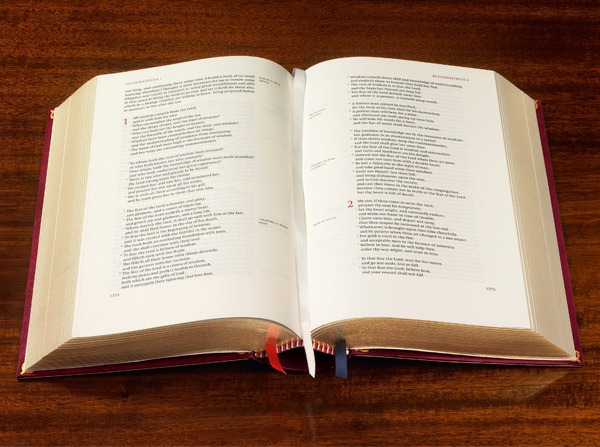


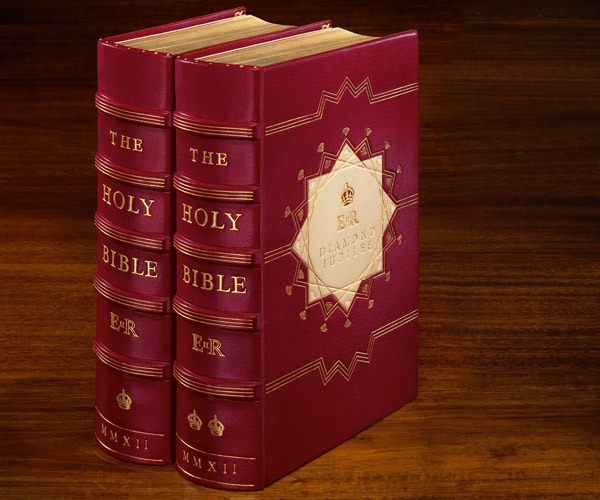
Some of the details:
The Diamond Jubilee Bible
At her coronation, Queen Elizabeth II took her oath on a Bible created especially for the ceremony. The commission fell to the illustrious bookbinder, Sangorski & Sutcliffe, which – 60 years on – remains at the pinnacle of fine bookbinding. The Folio Society is delighted to present a new edition by Sangorski & Sutcliffe: the Diamond Jubilee Bible. Inspired by the design of the Coronation Bible, it is hand-bound and limited to 60 numbered copies.
The Folio Society was approached by Robert Shepherd, the owner of Sangorski & Sutcliffe, about the creation of this commemorative Bible. The book would be produced to exacting standards, using all the skills, and indeed the tools, employed for the Coronation Bible. There would be hand-sewn sheets, and silk head- and tailbands. The binding would be in the finest vegetable tanned goatskin, hand-tooled with gold leaf. Asked for his thoughts on a suitable edition of the Bible to be bound in this way, The Folio Society’s Production Director Joe Whitlock Blundell showed Robert a copy of our limited edition of the King James Bible, of which we still held some unbound sheets. He agreed that they would be ideal for the purpose.
Thanks to this involvement, Folio Society members are among the very few people invited to secure a copy of this exquisite and rare edition.
The Coronation Bible
The Coronation Bible came from a limitation of 26, two of which were bound specifically for the Queen. The first was used in the coronation ceremony and is housed in Lambeth Palace; the second was presented to the Queen by the publisher, Oxford University Press. The remaining copies were given to leading dignitaries who attended the coronation. None were sold, but a very few did find their way onto the open market and have become highly prized by collectors.
Francis Sangorski and George Sutcliffe met as apprentices at the Central School of Arts and Crafts in London in 1896. The two men were employed by their tutor, Douglas Cockerell, before setting up their own business in 1901. In the years that followed, Sangorski & Sutcliffe became renowned for jewelled bindings, among the more famous of which were an illuminated manuscript of Romeo and Juliet and an elaborate copy of The Rubáiyát of Omar Khayyám that sank with the Titanic.
For the design of the Coronation Bible, Sangorski & Sutcliffe employed the distinguished artist Lynton Lamb. He too had studied under Cockerell, whose influence can be seen in Lamb’s design for the Bible. He wrote in 1953, ‘if one has taken a great deal of care over sewing the sheets to the cords, rounding the back, and making the boards true, one does not want to break down these effects by a contrary scheme of decoration’. The design he created works in perfect harmony with the spine structure, the raised bands of the spine leading to gold-tooled music staves. Using some 32 distinct skills, Sangorski & Sutcliffe hand-bound the Bible in red levant goatskin and created a cream inlay tooled in gold and black.
The Diamond Jubilee Bible
For the Diamond Jubilee Bible, produced with the approval of the Lord Chamberlain’s Office, Sangorski & Sutcliffe is following the same principles of hand-binding and sound structure. The tools used 60 years ago are being employed to create the lettering and Royal Insignia. This Bible is in two volumes, with bindings inspired by Lamb’s original design. Here, the central lozenge has been repeated and rotated to create a diamond at the centre of the front and back boards, tooled in gold leaf with onlays of fair calf leather. Surrounding each diamond are 30 smaller, conical diamonds, cut by the binder’s gold finisher using a tool specially created for this edition. As a final touch, each volume is enclosed in an elegant leather-trimmed slipcase. The result is an edition both imposing and graceful – a fitting celebration of a rare and momentous occasion.
Only 60 copies will be printed, each one numbered by hand on a special limitation page.
The bad news? This Bible may set you back a little – it is priced at $7,995 (or £5,000.00). (Thank goodness it is not $8,000.) I’m afraid that is outside my price range, but I hope to see a review on Mark Bertrand’s blog.
If you want a tchotchke that is more reasonably priced, you can pick up the Trinitarian Bible Society version for a mere $11.50 (or £6.95):

On the other hand – if you actually want to buy a KJV to read, rather than to collect I can recommend the Penguin version of the New Cambridge Paragraph Bible (or for the original translator notes, the New Cambridge Paragraph hardcover). And, maybe, who knows, someday the Norton Critical Edition may actually appear.
PS: I wish Elizabeth a long and healthy life. But I also hope that she is the last monarch of Britain – and that Britain can someday soon become a republic.
Jacob Glatshteyn’s “Our Teacher Moses”
A discussion in one of our many discussion threads raised the issue of “religious literature for women” which caused me to think of that remarkable document, the Women’s Yiddish Bible (also called Tseno Ureno, Tzenah Urenah, and צאנה וראינה). It has a Wikipedia entry.
That in turn reminded me a remarkable poem by Jacob Glatshteyn (also called Yankev Glatstein, Gladstone) which mentions the Women’s Yiddish Bible. I’ll share his biography with you below, but I would like you to read this poem. It dates from a collection from 1953 (five years after the founding of the state of Israel), My Father’s Shadow.
Here it is in Yiddish:
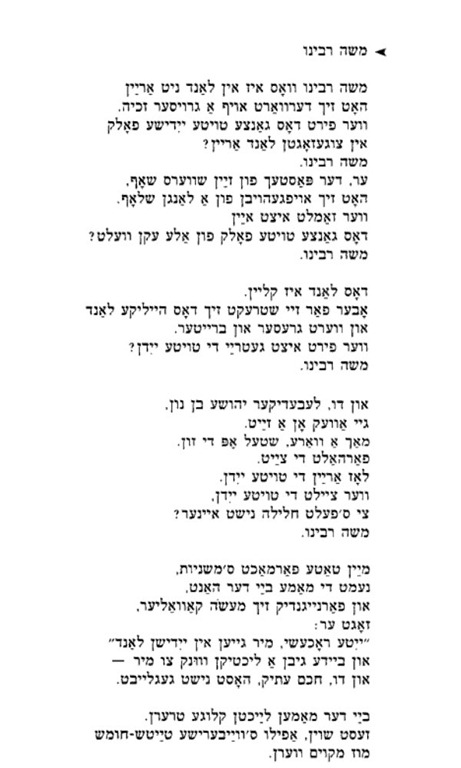
And here is an English translation by Benjamin and Barbara Harshav:
Our Teacher Moses, who didn’t get into The Land,
Was awarded a great honor.
Who leads the whole dead Jewish people
Into the Promised Land?
Our Teacher Moses.
He, the shepherd of his father-in-law’s flock,
Woke up from a long sleep.
Who gathers now
The whole dead people from all corners of the world?
Our Teacher MosesThe land is small.
But at their feet the Holy Land spreads
And grows bigger and wider.
Who now faithfully leads the dead Jews?
Our Teacher Moses.And you, the living Joshua Ben-Nun,
Stand aside.
Make way, stay the sun.
Stop time.
Let in the dead Jews.
Who is counting the dead Jews,
Lest one be missing?
Our Teacher Moses.My father closes his Mishnah-book
Takes mother’s arm,
And bowing gallantly,
He says:
”Yitte-Rokheshi dear, we are going to the Jewish Land”
And both wink at me, with a spark –
And you, wise guy, didn’t believe.Clever tears gleam in my mother’s eyes.
You see, even the women’s Yiddish Bible
Must come true.
Now before I give you a little background on Glatshteyn, let me mention that the phrase “Our Teacher Moses” is just the translation of a typical title given to Moses: Moshe Rabbeinu. The translation above (and the biographical sketch below) are from Benjamin and Barbara Harshav’s book, American Yiddish Poetry: A Bilingual Anthology.
Now, let me give you some background on Glatshteyn. (You can also read his Wikipedia page or this bio.) Here is the Harshavs’ sketch:
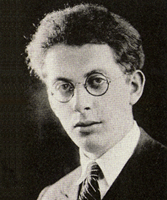 After the Holocaust, Jacob Glatshteyn was the most celebrated “national” Yiddish poet. Readers found in his poetry a response to the catastrophe and evocation of Jewish historiosophical awareness. When the critics lauded the later Glatshteyn as a great “national” poet, A. Leyeles challenged them, arguing that for Introspectivists, Glatshteyn had always been a great poet. Indeed, without the development of Glatshteyn’s sophisticated, individualistic, and ironic style, sparkling with wit and innovations of language, the achievements of his Holocaust poetry would have been impossible. Glatshteyn’s nationalistic poetry was deceptively simple; between the 1920s and 1950s, the Yiddish reader also grew into accepting Modernist poetry and free verse.
Clearly, the catastrophe in Europe brought Jewish themes into the center of Glatshteyn’s poetry. In earlier poems such as “Autobiography” and “Jewish Kingdoms” (1929), Glatshteyn still dissociated himself from his Eastern-European past or looked at it with amazement, but the events of the late thirties brought him back to the Jewish ghetto. In 1938 and early 1939, Glatshteyn was among the first to sense the coming disaster. In such poems as “A Hunger Fell Upon Us,” “On the Butcher Block,” “Here I Have Never Been,” and the celebrated “Goodnight, World,” he gave forceful expression to a sense of Jewish isolation in the face of the approaching catastrophe, although only its first signs were apparent at the time. It was only after the Holocaust that he was able to re-create from a certain distance of tragic tranquility the pious world of his parents and his childhood.
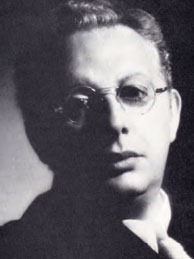 His first book, entitled Jacob Glatshteyn (1921), was a celebration of moments in the present, a bewildered individual’s attempt to make some sense of the “world tangle” (velt-plonter), with some traces of New York in the background and no sign of history. It was also the first book in Yiddish poetry written entirely in free verse. Glatshteyn went on to write a dozen mature books, very American in their sensibilities, only to announce himself in 1966, in the very title of his book, as A Jew from Lublin.
Glatshteyn was born in Lublin, Poland, then under Russian rule, to an Englightened religious family. He received a traditional education until the age of sixteen, studying the Bible, the Talmud, and later commentaries, as well as secular subjects with private tutors. His father introduced him to modern Yiddish literature.
In 1914, he immigrated to America to join an uncle, and in the same year published his first short story in the anarchist Yiddish newspaper, Di Fraye Arbeter Shtime. After 1918 he studied law at New York University, but abandoned it for the career of a Yiddish writer.
At first, Glatshteyn felt that poets should refrain from journalism, but after some years he relented, making a living through the only Yiddish medium with a mass audience, the newspaper. In 1926 he became a regular contributor to one of the three New York Yiddish dailies, Morgen-Zhurnal, and participated actively in other Yiddish journals. In 1945 he began writing a regular column for the weekly Yiddisher Kemfer, entitled “In Tokh Genumen” (The Heart of the Matter), publishing until 1957 some six hundred essays – primarily literary criticism, reviews of new books, and discussions of Jewish cultural problems. Some of these essays were masterpieces of Yiddish style and of concise, sensitive, and personal literary criticism.
In 1940, Glatshteyn received the Louis Lamed Prize for his two volumes of masterly prose, When Yash Went and When Yash Came [revised English translation now available as The Glatstein Chronicles], which reflected the author’s confrontation with the Old World during a voyage to Europe in 1934. He received the Lamed prize again in 1956 for a volume of his collected poems, From All My Toil (which was arranged in reverse chronological order).
 Glatshteyn always believed in experimentation in poetry and in the need for the poet to create his own individual language. In his poems, he laid bare the unique properties of the Yiddish language, articulating the interplay of the source languages of Yiddish, using the wealth of Yiddish idioms for new poetic metaphors, and weaving the intonations of colloquial folk Yiddish into the measured sentences of a modern intellectual. The interplay of invention and stylistic parody reached a virtuoso culmination in pieces such as “If Joyce Had Written in Yiddish” (an emulation of the style of Finnegans Wake) and especially in his book, Yiddishtaytsh (here translated as Exegyddish), which is one of the most brilliant achievements of Yiddish poetry, and for the most part untranslatable.
Exegyddish appeared in 1937, just a year before Glatshteyn’s first Holocaust poems, which, though replete with irony, shifted to a blunt, straightforward style. Glatshteyn’s experiments with language – the fresh turn of phrases, the effective interplay with dialects, the archaisms or Hebrew allusions – are at work in his later period as well, though naturally subordinated to the “theme” imposed by the intrusion of history. In the last thirty years of his life, Glatshteyn’s poetry became an incessant internalized conversation on Jewish history, the lost world of European Jewry, the birth of Israel, assimilation in America, the tragic demise of the Yiddish language, and the loneliness of the poet.
If you are interested in reading Glatshteyn, I suggest starting with the excellent American Yiddish Poetry bilingual anthology and The Glatstein Chronicles. Other English books of interest include Selected Poems of Yankev Glatshteyn, Emil and Karl, and the bilingual I Keep Recalling: The Holocaust Poems of Jacob Glatstein.
The Women’s Jewish Bible is reported adapted in this two volume set, although I have not read this adaptation.
Funny quote on language
One of my friends, Geoff Nunberg, periodically gives brief essays on language for a public radio program. In his latest essay (on the AP Stylebook‘s relaxation on usage of the word “hopefully”) he was at the top of his game, with intentionally ironic (and hilarious) statements such as
A usage can be really, really irritating
He ended his presentation by saying:
There will be grousing from the defiant one-percenters. But hopefully, my dear, we won’t give a d***.
WordPress.com just broke our formatting!
I’m sorry to say that some change at WordPress.com – apparently within the last hour – has caused our blog theme (Vigilance) to render wrong. I notice we are not the only blog with this problem! Currently, the entire text is flooded in a difficult to read brown color.
We’ve complained to WordPress (and I think many users have) and I hope we’ll see a fix soon. In the meanwhile, apologies for the strange (and difficult to read) presentation.
—————————————————————
Update: the formatting problem has been fixed, but there is still an ugly hovering bar now at the bottom of our main page advertising the “Vigilance” theme, as part of the WordPress switch to “infinite scrolling” on all of their themes.
We are working on the problem and hope to address it shortly.
—————————————————————
Second update: This has been a problem for a number of WordPress users — see this blog post.
Gender in medieval and modern Jewish translation of Exodus 19:3 — House of Jacob and Children/Sons of Israel
Exodus 19:3 contains an interesting doubling:
וּמֹשֶׁה עָלָה, אֶל-הָאֱלֹהִים; וַיִּקְרָא אֵלָיו יְהוָה, מִן-הָהָר לֵאמֹר, כֹּה תֹאמַר לְבֵית יַעֲקֹב, וְתַגֵּיד לִבְנֵי יִשְׂרָאֵל.
And Moses went up unto God, and the LORD called unto him out of the mountain, saying: “Thus shalt thou say to the house of Jacob, and tell the children of Israel: (JPS 1917)
and Moses went up to God. The LORD called to him from the mountain, saying, “Thus shall you say to the house of Jacob and declare to the children of Israel. (NJPS)
I want to focus on that doubling בֵית יַעֲקֹב (House of Jacob) and בני ישראל (Children/Sons of Israel) (although notice the verbs used to address these two groups are different as well). This doubling posed (and poses) a major issue for medieval and for modern translators and commentators. The problem of course is that Jacob and Israel refer to the same person in the Bible, so how should exegetes understand this doubling? The responses have a great deal to say about perceptions of men and women in different cultural times and societies.
Probably the oldest classical source is Mekhilta de-Rabbi Ishmael (date uncertain – between 2nd century CE and 4th century CE) which writes:
תאמר לבית יעקב אלו הנשים ותגד לבני
ישראל אלו האנשים. דבר אחר כה תאמר לבית
יעקב בזכות יעקב ותגיד לבני ישראל בזכות
ישראל. דבר אחר כה תאמר לבית יעקב אמור
בלשון רכה ראשי הדברים לנשים ותגד לבני
ישראל ותדקדק עמהם.Shalt Thou Say to the House of Jacob. That is, the women. And Tell the Sons of Israel. That is, the men. Another Interpretation: Thus Shalt Thou Say to the House of Jacob—because of the merit of Jacob. And Tell the Sons of Israel—because of the merit of Israel. Another Interpretation: Thus Shalt Thou Say to the House of Jacob. Tell the women the main things in a mild tone. And Tell the Sons of Israel. And be strict with them.
Michael Carasik in his magisterial translation of the Rabbinic Bible gives a number of medieval commentators who interact with each other:
Rashi (1040-1105): Thus. In these words and in this order. Say to the house of Jacob. These are the women"* speak gently to them. Declare to the children of Israel: These are the men; explain the punishments and the details to them “declare” (taged) to them things that are as bitter as wormwood (gidin).
*Footnote by Carasik: Some rabbinic writings understand a man’s “house” or “household” as a euphemism for his wife
Ibn Ezra (1089-1164): The house of Jacob … the children of Israel. Some take these two phrases to refer to the women and the men, respectively. But why would the women be mentioned first? Anyone who thinks the word “house” refers to women cannot have read “O house of Aaron, bless the LORD” (Psalm 135:19) where “house” refers to males.
Abarbanel’s Questions (1437-1508): What is the point of saying “the house of Jacob” as well as “the children of Israel” and why is “the house of Jacob” never mentioned again?
Abarbanel’s Commentary (1437-1508): The house of Jacob. Since the Torah was to be given to all, “the house of Jacob” referred to the sneakier ones and the “children of Israel” to the more honest. Or perhaps the “the house of Jacob” was the mass of Israelites and the “the children of Israel” the special individuals among them.
Here are how some modern Jewish translations deal with this portion of the verse (ranging roughly from egalitarian translation and commentary to strong gender-based translation and commentary):
Robert Alter: Thus shall you say to the house of Jacob, and shall you tell to the Israelites:
Alter commentary: The perfect poetic parallelism, both semantic and rhythmic, of this sentence signals the lofty, strongly cadenced language, akin to epic in its grandeur, of the entire episode.
Martin Buber and Franz Rosenzweig (“Die Schrift”):
So sprich zum Hause Jaakobs,
melde den Söhnen Jissraels:
Everett Fox: Say thus to the House of Yaakov,
(yes,) tell the Children of Israel:
David Stein (“Contemporary Torah [JPS]”): Thus shall you say to the house of Jacob and declare to the children of Israel
Aryeh Kaplan (“The Living Torah”): This is what you must say to the family of Jacob* and tell the Israelites:
*Footote by Kaplan refers to note at Exodus 16:31: Or, literally, “the house of Israel.” Some say that this deisgnates the women (Hirsch; Targum Yonathan, Mekhilta, Rashi on 19:3).
Artscroll (“Stone Edition”): So shall you say to the House of Jacob and relate to the Children of Israel
Artscroll commentary: The word תֹאמַר, say, implies a mild form of speech. When Moses spoke to the House of Jacob, which refers to the women (Mekhilta), he was to express the commandments in a manner suited to their compassionate, maternal nature. Women set the tone of the home and they are the ones responsible to inculcate love of Torah in their children, a task to which their loving nature is best suited. Because of this role, a mother should pray when she kindles her Sabbath candles that in the merit of the Sabbath flames, her children should merit the illumination of Torah, which is also likened to flames. The word וְתַגֵּיד, and relate, implies firmness or even harshness for when Moses spoke to the Children of Israel, which refers to the men, he was to teach the commandments in a firm manner. The implication of firmness is derived because the Hebrew וְתַגֵּיד is spelled with a י which alludes to the word גֵּיד, a bitter tasting root (R’ Bachya).
Chaim Miller (“Gutnick Edition”): You should say the following to the house of Ya’akov (i.e., the women) and tell (the same thing in a more explicit manner, stressing the punishments and fine details) to the sons of Israel (i.e., the men):
As a footnote to this post, I would like to recommend those interested in medieval Jewish exegesis to refer to a Rabbinic Bible. My favorite Hebrew edition of a Rabbinic Bible is the one published by Mosad Rav Kook (it is very clearly printed and includes block print rather than Rashi script). My favorite English translation of the Rabbinic Bible is by Michael Carasik (and published by the Jewish Publication Society); to date Exodus, Leviticus, and Numbers have appeared. There are other more detailed sources available, but these are great starting points.


 BLT
BLT 