Khan’s, Obama’s, and Streep’s Rhetoric of Compassion
January 10, 2017
We might agree that there’s much persuasive power in the ethos of a Gold Star Mother, of the First Lady of the United States of America, and of the recipient of the Cecil B. DeMille Award. And then there’s their logos, their eloquent effective “argument”: respectively, the written explanation for one’s rhetorical silence, a stump speech in a battleground state to win both the electoral and the popular votes of one’s political party’s candidate, and the public address having to be written to be, in part, read aloud to the Hollywood Foreign Press Association at its annual Golden Globes Awards Ceremony to express gratitude for the prestigious recognition of one’s “outstanding contributions to the world of entertainment.”
And yet there’s the pathos, the passion driven by the concern of and for “the other” and “the othered,” that may be the most potent, most compelling, most moving aspect of the rhetoric of Ghazala Khan, of Michelle Obama, and of Meryl Streep. Shall we read and listen again?
Because without [my] saying a thing, all the world, all America, felt my pain. I am a Gold Star mother. Whoever saw me felt me in their heart.
Donald Trump said I had nothing to say. I do. My son Humayun Khan, an Army captain, died 12 years ago in Iraq. He loved America, where we moved when he was 2 years old. He had volunteered to help his country, signing up for the ROTC at the University of Virginia. This was before the attack of Sept. 11, 2001. He didn’t have to do this, but he wanted to.
When Humayun was sent to Iraq, my husband and I worried about his safety…. He died trying to save his soldiers and innocent civilians.
That is my son. Humayun was always dependable…. Walking onto the convention stage, with a huge picture of my son behind me, I could hardly control myself. What mother could? Donald Trump has children whom he loves. Does he really need to wonder why I did not speak?
Donald Trump said that maybe I wasn’t allowed to say anything. That is not true. My husband asked me if I wanted to speak, but I told him I could not. My religion teaches me that all human beings are equal in God’s eyes. Husband and wife are part of each other; you should love and respect each other so you can take care of the family.
And
This week has been particularly interesting for me personally because it has been a week of profound contrast.
See, on Tuesday, at the White House, we celebrated the International Day of the Girl and Let Girls Learn, and it was a wonderful celebration. It was the last event that I’m going to be doing as first lady for Let Girls Learn. And I had the pleasure of spending hours talking to some of the most amazing young women you will ever meet, young girls here in the US and all around the world. And we talked about their hopes and their dreams. We talked about their aspirations. See, because many of these girls have faced unthinkable obstacles just to attend school, jeopardizing their personal safety, their freedom, risking the rejection of their families and communities.
So I thought it would be important to remind these young women how valuable and precious they are. I wanted them to understand that the measure of any society is how it treats its women and girls. And I told them that they deserve to be treated with dignity and respect, and I told them that they should disregard anyone who demeans or devalues them, and that they should make their voices heard in the world. And I walked away feeling so inspired, just like I’m inspired by all the young people here – and I was so uplifted by these girls. That was Tuesday.
And now, here I am, out on the campaign trail in an election where we have consistently been hearing hurtful, hateful language about women – language that has been painful for so many of us, not just as women, but as parents trying to protect our children and raise them to be caring, respectful adults, and as citizens who think that our nation’s leaders should meet basic standards of human decency.
The fact is that in this election, we have a candidate for president of the United States who, over the course of his lifetime and the course of this campaign, has said things about women that are so shocking, so demeaning that I simply will not repeat anything here today. And last week, we saw this candidate actually bragging about sexually assaulting women. And I can’t believe that I’m saying that a candidate for president of the United States has bragged about sexually assaulting women.
And I have to tell you that I can’t stop thinking about this. It has shaken me to my core in a way that I couldn’t have predicted. So while I’d love nothing more than to pretend like this isn’t happening, and to come out here and do my normal campaign speech, it would be dishonest and disingenuous of me to just move on to the next thing like this was all just a bad dream.
This is not something that we can ignore. It’s not something we can just sweep under the rug as just another disturbing footnote in a sad election season. Because this was not just a “lewd conversation”. This wasn’t just locker-room banter. This was a powerful individual speaking freely and openly about sexually predatory behavior, and actually bragging about kissing and groping women, using language so obscene that many of us were worried about our children hearing it when we turn on the TV.
And
I love you all. You have to forgive me, I have lost my voice in screaming and lamentation this weekend and I have lost my mind sometime earlier this year so I have to read.
Thank you, Hollywood Foreign Press. Just to pick up on what Hugh Laurie said, you and all of us in this room really belong to the most vilified segments of American society right now. Think about it: Hollywood, foreigners and the press.
But who are we and, you know, what is Hollywood, anyway? It’s just a bunch of people from other places. I was born and raised and educated in the public schools of New Jersey, Viola was born in a sharecropper’s cabin in South Carolina, came up in Central Falls, R.I. Sarah Paulson was born in Florida, raised by a single mom in Brooklyn. Sarah Jessica Parker was one of seven or eight kids from Ohio, Amy Adams was born in Vicenza, Veneto, Italy and Natalie Portman was born in Jerusalem. Where are their birth certificates?
And the beautiful Ruth Negga was born in Addis Ababa, Ethiopia, raised in Lon — no, in Ireland, I do believe, and she’s here nominated for playing a small-town girl from Virginia. Ryan Gosling, like all the nicest people, is Canadian. And Dev Patel was born in Kenya, raised in London and is here playing an Indian raised in Tasmania. So Hollywood is crawling with outsiders and foreigners and if we kick them all out, you’ll have nothing to watch but football and mixed martial arts, which are not the arts.
They gave me three seconds to say this, so. An actor’s only job is to enter the lives of people who are different from us and let you feel what that feels like. And there were many, many, many powerful performances this year that did exactly that, breathtaking, compassionate work.
But there was one performance this year that stunned me. It sank its hooks in my heart, not because it was good, it was — there’s nothing good about it. But it was effective and it did its job. It made its intended audience laugh and show their teeth.
It was that moment when the person asking to sit in the most respected seat in our country imitated a disabled reporter, someone he outranked in privilege and power and the capacity to fight back. It, it kind of broke my heart when I saw it and I still can’t get it out my head because it wasn’t in a movie. It was real life. And this instinct to humiliate when it’s modeled by someone in the public platform, by someone powerful, it filters down into everybody’s life because it kind of gives permission for other people to do the same thing.
Disrespect invites disrespect. Violence incites violence. When the powerful use their position to bully others, we all lose. OK, go on with that thing. OK, this brings me to the press. We need the principled press to hold power to account, to call them on the carpet for every outrage.
If you are in Washington DC, I would highly recommend your taking a couple of hours to visit “the only major museum in the world solely dedicated to recognizing women’s creative contributions.” This is the “National Museum of Women in the Arts” which “brings recognition to the achievements of women artists of all periods and nationalities by exhibiting, preserving, acquiring, and researching art by women and by teaching the public about their accomplishments.”
Of course you can visit the website here. And let me share with you two of the works that most struck me as I toured the museum. These are a sculpture by Sarah Bernhardt in the permanent collection and a painting by Cecily Brown in the special exhibit, “No Man’s Land: Women Artists from the Rubell Family Collection“:


My apologies for poor quality photos. Hopefully this encourages all the more to see the works with your own eyes without mediation.
My own commentary is that these two artists are re-mediating the dominant male artist male art. The art historian notes on the wall, for instance, tip us off to the fact that Bernhardt is riffing off of Michelangelo’s work (which happens to be one I’ve seen and appreciate very much). Rather than a holy high church piece of an adult mother grieving the death of an adult child, the Son of God, however, this other sculpture is from a woman artist ambiguously drawing attention to a horrific experience of a different mother, with the artist herself as witness, encouraging our empathy.
And Brown paints a woman nude. This seems cliche perhaps, when a male artist does this. And yet this female is lying stomach down, not exposed, her genitals not available to the male gaze at all. Then look closer, at the other “objects” in the painting. Are they birds? Angels? Look again. What if they are the male anatomy? Look again. Why do works of art have to take the human sexual form and draw attention that way? Look again. See the effect, the sensation of being awkward when female when gazed upon as an object?
Why Craig’s Bible translation is remarkably among Marg’s best
October 2, 2016
Marg Mowczko, at her Blog New Life, is responding to the question, Which Bible translation is best? She understands this question asked by some as meaning, Which English Bible translation is least “biased towards men when, in fact, the intended meaning of many passages is gender-inclusive (i.e. they apply to men and to women)”?
She gives us her blog readers a bit of a guessing game test:
[C]an you tell which of the following verses [in older translations] are addressed to men only (in the Greek text), and which verses are gender non-specific? The answer may surprise you. (I’ve underlined the masculine terms to highlight them.)
I want men everywhere to lift up holy hands in prayer, without anger or disputing. 1 Timothy 2:8 (NIV 1984)
If a man’s gift is prophesying, let him use it in proportion to his faith. If it is serving, let him serve; if it is teaching, let him teach; if it is encouraging, let him encourage; if it is contributing to the needs of others, let him give generously; if it is leadership, let him govern diligently; if it is showing mercy, let him do it cheerfully. Romans 12:6-8 (NIV 1984)
The things which you have heard from me in the presence of many witnesses, entrust these to faithful men who will be able to teach others also. 2 Timothy 2:2 (NIV 1984) (More about this verse here.)
. . . if a man desire the office of a bishop, he desireth a good work. 1 Timothy 3:1 (KJV) (More about this verse here.)
Therefore if any man be in Christ, he is a new creature . . . 2 Corinthians 5:17 (KJV)
And she helps us look next at verses in newer translations:
Compare the following translations of Philippians 2:7b-8a (I have underlined the masculine words):
. . . being made in human likeness. And being found in appearance as a man . . . NIV
. . . being born in the likeness of men. And being found in human form . . . ESV
. . . being made in the likeness of men. Being found in appearance as a man . . . NASB cf. KJV
. . . being born in human likeness. And being found in human form . . . NRSV cf. CEB1 Timothy 2:3b-5 is another passage that I believe has been poorly translated in some Bibles. The NIV 1984 edition translated it like this:
. . . God our Savior, who wants all men to be saved and to come to a knowledge of the truth. For there is one God, and one mediator between God and men, the man Christ Jesus. 1 Timothy 2:3b-5 (NIV 1984, underlines added)
The ESV has one less “man/men” word.
. . . God our Savior, who desires all people to be saved and to come to the knowledge of the truth. For there is one God, and there is one mediator between God and men, the man Christ Jesus, (ESV, italics and underlines added)
The NIV translates it slightly more inclusively.
. . . God our Savior, who wants all people to be saved and to come to a knowledge of the truth. For there is one God and one mediator between God and mankind, the man Christ Jesus, (NIV 2011, italics and underlines added)
1 Timothy 2:3b-5 is translated faithfully in the NRSV and CEB with inclusive words such as “people”, “humanity”, and “human” (instead of “man/men”).
. . . our savior, who wants all people to be saved and to come to a knowledge of the truth. There is one God and one mediator between God and humanity, the human Christ Jesus, (CEB, italics added)
Now I want to do what our BLT co-blogger Theophrastus did by noting how remarkable what our BLT co-blogger “Craig has given us his translation of Kaddish.” I just want to show, here, what Craig Smith has given us with his translation of the Bible.
Compare the translations Marg has shown with Craig’s Bible translation of these various verses:
Therefore, I want people everywhere to lift their hands up reverently in prayer, without anger or dissention. 1 Timothy 2:8
We have gifts that differ according to the grace given to each of us. If your gift is prophecy, use it in proportion to your faith. If your gift is ministry, use it for service, If you are a teacher, use your gift for teaching. If you are good at preaching, then preach boldly. If you give to charity, do so generously; if you are a leader, exercise your authority with care; if you help others, do so cheerfully. Romans 12:6-8
Everything that you’ve heard me teach in the presence of many witnesses–pass it on to trustworthy people, so that they, in turn, will teach others. 2 Timothy 2:2
… whoever wants to be a bishop aspires to a noble task. 1 Timothy 3:1
And for anyone who is in Christ, there is a new creation. The old order has passed away; now everything is new! 2 Corinthians 5:17
and too on the image of oppressed humankind:
born into the human condition,
found in the likeness of a human being. Philippians 2:7b-8a. . . God our Savior, who wants everyone to be saved and to reach full knowledge of the truth. For there is only one God, and there is only one mediator between God and humankind–Christ Jesus, who… 1 Timothy 2:3b-5
ἀποστροφή in Oedipus at Colonus (1473), LXX Genesis (3:16)
September 29, 2016
Our co-blogger Victoria Gaile Laidler this week considers Genesis 3:16 in Jerome’s Latin here. And some of us some years ago considered Genesis 3:16 in the LXX translators’ Hebraic Hellene here.
And that made me wish to compare ἀποστροφή in Oedipus at Colonus (1473) with LXX Genesis (3:16) in my own poetic formatting and in translation here: apostrophe-by-sophocles-lxxtranslators-rendered-by-j-k-gayle.
There’s lots to consider here, and I believe there’s considerable lexical and semantic overlap between the two very short Greek passages, don’t you?
Crossway: “Permanent ESV a mistake”
September 28, 2016
September 28, 2016
We desired for there to be a stable and standard text that would serve the reading, memorizing, preaching, and liturgical needs of Christians worldwide from one generation to another.
We have become convinced that this decision was a mistake. We apologize for this and for any concern this has caused for readers of the ESV, and we want to explain what we now believe to be the way forward. Our desire, above all, is to do what is right before the Lord.
In the sufficiency of God’s grace,
Lane T. Dennis, PhD
President and CEO
Crossway
[excerpted from https://www.crossway.org/blog/2016/09/crossway-statement-on-the-esv-bible-text/]
For, Against, or Absent? Gen 3:16 and the Case of the Missing Desire
September 27, 2016
After reading a few posts here and elsewhere, and especially after reading About That Desire over at Women In Theology, I decided to check the Vulgate to see how the preposition in question was translated there. Whatever its flaws, the Vulgate was extremely influential in the Western church for about a thousand years, so I often check it out for an early Catholic perspective.
Given that the discussion of the Hebrew focused on “desire for or towards” as the dominant and traditional English translation; and given the prevalence in Catholic thought that things are ordered towards certain teloses (ends, purposes), I fully expected to see a nice little ad in the Vulgate.
Not only didn’t I find ad, I didn’t find desire!
Here’s the Latin, per the Blue Letter Bible:
mulieri quoque dixit multiplicabo aerumnas tuas
et conceptus tuos in dolore paries filios
et sub viri potestate eris
et ipse dominabitur tui
To the woman he said,
I will greatly multiply your pain in childbirth,
and in sorrow you will bear children
and under the power of the man you will be
and he will have dominion over you
There’s no desire in this passage. None. There’s no reference to the woman’s agency at all, in fact: she is the passive object, not the active subject, of the last half of the verse.
As our coblogger Suzanne wrote:
The Vulgate was basically Jerome and Paula’s translation from the Hebrew, made while they were living in Bethlehem in the 4th century with the aid of local Jewish scholars which they were able to smuggle into their convent from time to time. Jerome made a point of saying that it was translated from the Hebrew in contrast to the Old Latin versions, which were translations of the Septuagint.
So what happened to the desire?
Did Jerome, or Paula, censor it from their translation? It was unusual enough that Jerome was collaborating with a woman. Perhaps they feared that a translation that openly discussed sexual desire would have pressed the bounds of propriety too far.
Is it hidden, implicit, in that “under his power”? Are we meant to read that as if the woman’s sexual desire for the man is so strong that it controls her, so that she has sex again and again despite the pain of pregnancy and childbirth? (And if so, is it possible there’s more than a little fantasy, wish fulfillment, self-aggrandizement going on here on Jerome’s part here?)
Was it omitted from the text, along with the woman’s agency, to double down on the patriarchy? As Kurk has written, Jerome certainly seems to have had sexist views of at least some women (unsurprisingly for a man of his time and place).
Or might “desire” actually have been absent from the Hebrew text they were using? Jerome’s Vulgate was translated from the Hebrew text several centuries before the Masoretic Text, which is the source text for most modern translations of the Hebrew Bible, was written down. The second half of the verse has power and dominion, potestate and dominabitur, in a parallel construction typical of the Hebrew scriptures: that’s awfully suggestive.
What do you think?
Suzanne McCarthy on Genesis 3:16
September 27, 2016
Well before the ESV Permanent text announcement and the blogging around the peculiarity of the new and now-final rendering of Genesis 3:16, Suzanne McCarthy had a few things to say.
Rather, she asked a few things and engaged in research and conversation. For example, in one reply to one commenter, she said:
My main purpose in this post, is to ask if Pagnini and so on used a translation that was pejorative to women.
This post about which there was the discussion is the one here, called Rashi, Pagnini, Zwingli and a woman’s desire.
When she wrote that, she had already puzzled a good bit of the questions. And a couple of years earlier she showed that when writing, Pagnini and Bushnell.
She clearly did not agree with Catherine “Kate” Bushnell on everything, and especially not simply because she also was a woman. And yet Suzanne did list her with other notable scholars in this post she entitled, Female Biblical Scholars Meme.
These years, when she was engaging others in talk about Genesis 3:16 and how the Hebrew had been translated, Suzanne was acutely aware how male translation bias, particularly how “complementarian” man-superiority, entered into Bible translations such as the ESV. Here is the entire concise post that gets right to this, with links to others, including to two of us who would become with her BLT co-bloggers right here (and if you follow the comments afterwards you’ll find a third eventual BLT co-blogger in the mix):
No women Bible scholars?
Apparently, according to the ESV Study Bible, there are no women qualified to write commentary on the Bible. This came up in a comment on my post a couple of days ago. Marg has taken up this point in her own post. I also found her story of moving towards biblical equality to be very compelling – and amusing. Thank you, Marg.
What do you think Suzanne would make of how the Hebrew grammar and syntax goes now, and how it forever like that goes on, for Genesis 3:16?
The Makings of a Racist, Sexist, Colonialist
September 25, 2016
White supremacy reigned and the other side of white supremacy is black inferiority. We were taught, as reasonably well bred white Southerners, to behave decently, but the whole racial etiquette that governed the way black and white interacted with each other, all of those customs and folk ways that were part of the Jim Crow South I absorbed. And the word I use in the book [The Making of a Racist] is osmosis. A lot of it, you didn’t have to be told. You just looked as a child growing up…. So you just absorb this stuff, and you’re told over and over again, this is best for both races.
— Charles Dew to Diane Rehm and Isabel Wilkerson (and to my white American mother-in-law, who grew up in Florida when he did)
Not long ago on a road trip with my mother-in-law we listened to historian Charles Dew.
We then began sharing in the car with one another our own experiences as children, growing up.
Hers and those of Charles Dew overlapped substantially, she also being born in the 1930s and of having her first memories and her first interactions as supposedly superior white people with supposedly inferior black people. Her account, she confessed, is also a recollection of the making of a racist.
Here is my own confession, a recollection of the making of a racist, a sexist, and a colonialist.
My very first memories are during the Jim Crow era in a little city where my white father was the pastor of the large Southern Baptist church. It was 1964. While my white mother was in the hospital giving birth to my younger sibling and then not long after for an operation, elsewhere, at home my elder sibling and I were being raised by “the help,” our own “Calpurnia,” our “maid,” whom we called by her first name, Nancy. When my maternal grandparents visited, my grandfather called her by the n-word. They also brought me and my elder sibling presents, “Indian headdresses.” When my father’s adopted parents visited, they also brought presents, “Indian headdresses,” and my memories of these are very specific because the feathers and size and colors of these gifts born to me were different.
There are three things I’d like to add about these my earliest memories. First I do not recall ever hearing Nancy’s family name until half a century later, when my father was dying of cancer. In the final stages his brain was riddled with tumors which for some strange reason helped him recollect memories he’d never spoken to us about before. Apparently there was something going on in his diseased brain that allowed him to remember more clearly than ever with great specificity far back in his life. And at the same time there was a hospice nurse in his home, whom he was referring to both by first and last name and calling her his “first African American friend.” So I thought it would be a good time to see if he recalled Nancy’s last name. My mother didn’t remember Nancy’s family or family name, and I confirmed that by asking her first. Without hesitation, my father knew exactly what Nancy’s full name is. For all of those fifty years of my life our family had never spoken this name, and until that day I had never heard the family name of my other mother, Nancy. Second I do have a really good memory and can recall difference, such as my grandfather’s use of the N-word and the various different colors and types of “Indian headdresses” (if I have no clue as to why “Indian” tokens made good gifts for grandchildren). Third these earliest memories of mine on this planet were in Corsicana, a place in Texas USA, named after the colony Corsica, the birthplace of the father of the privileged colonist who gave the town its name. The legacy of my first memories, then, is a heritage of a superior race, by superior fathers, white men from superior places.
One year after these earliest memories of mine, my Southern Baptist father took his wife and three children with him to South Vietnam. My earliest memories there are of living in a French colonial home on a hill where my new surrogate mother was nicknamed Chị Năm. I never met her family nor did I learn her family name or her given name until my father was dying of cancer, tumors there ostensibly helping him to recall her name. My Vietnamese mother would take me with her to the open air market in Đà Lạt (a former resort city for the French colonists). There in the market she was subject to ridicule for her privilege of working for the American missionary. And I was called her little Amer-Asian, her bastard, half-breed son, which implied an adulterous relationship or worse some sort of sexual subjugation of hers to my father. The term was Mỹ lai. It literally means Beautiful mongrel. The first part, Mỹ, happens to be the Vietnamese word for America. The two parts together also happen to be the Vietnamese name for the place where the American massacre of innocents in the war took place, Mỹ Lai, the village of the “Mỹ Lai Massacre.” Well, that atrocity was not to occur for another three years. When I heard this term for the first time, and when it referred to me, my white face was being pinched pink by the women in the market mocking Chị Năm. My skin was a different color from theirs. My body sex was a different sex from theirs. My father’s country was a different place from theirs, closer in class and in religion to the French fathers who had been there before us.
What I absorbed in my earliest memories were separations of race, of sex, of place all of which placed me and mine as superior to them and theirs. These experiences were the makings of a racist, sexist, colonialist.
About that Desire: Eve and the ESV Bible Controversy
September 25, 2016
“In any case, the triumph of traditionalist gender politics in the new ESV Permanent Text is devastating for egalitarian evangelicals—it is complementarianism’s most dramatic power play yet.”

Co-Winners of the 2015 Willis Barnstone Translation Prize
September 20, 2016
For the 14th annual Willis Barnstone Translation Prize, there are co-winners. Congratulations go to Khrystyna Mykhailiuk and to Spring Ulmer.
The announcement came relatively late this year (compared with announcements of previous years arriving in March or April). Just yesterday (September 19, 2016) the following letter showed up in my mailbox (dated two weeks earlier):
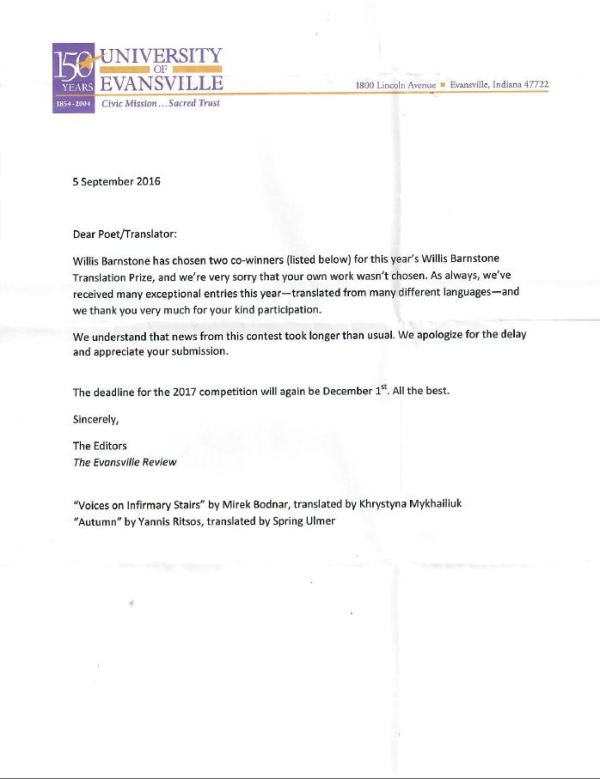
Lest anyone is interested I submitted an English translation of the poetry known as the first two chapters of Genesis, itself a translation.
The ESV “contrary to” Syntax
September 15, 2016
Here‘s the English Standard Version syntax for Genesis 3:16 –

Here‘s the MT Hebrew syntax for Genesis 3:16 –
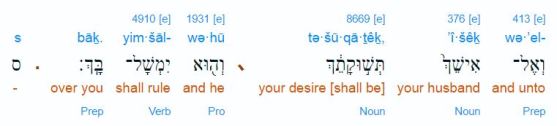
Here‘s the Isaac Leeser English syntax for Genesis 3:16 –

Here‘s the Julia Smith English syntax for Genesis 3:16 –

Here‘s the Everett Fox English syntax for Genesis 3:16 –

Here‘s the Robert Alter English syntax for Genesis 3:16 –

Here‘s the ESV Translation Philosophy with respect to syntax –
Translation Philosophy
The ESV is an “essentially literal” translation that seeks as far as possible to capture the precise wording of the original text and the personal style of each Bible writer. As such, its emphasis is on “word-for-word” correspondence, at the same time taking into account differences of grammar, syntax, and idiom between current literary English and the original languages. Thus it seeks to be transparent to the original text, letting the reader see as directly as possible the structure and meaning of the original….
Therefore, to the extent that plain English permits and the meaning in each case allows, we have sought to use the same English word for important recurring words in the original; and, as far as grammar and syntax allow, we have rendered Old Testament passages cited in the New in ways that show their correspondence. Thus in each of these areas, as well as throughout the Bible as a whole, we have sought to capture the echoes and overtones of meaning that are so abundantly present in the original texts.
Could all the men (and only men) translating the ESV have decided to have their “plain English” somehow “capture the precise wording” and somehow also “capture the echoes and overtones” of the original author(s) of the original Hebrew of the MT with respect to the original syntax of Genesis 3:16?
In other words, let’s ask whether the ESV syntax for Genesis 3:16, using exactly the words of “the previous text,”could be thus –
For your husband shall be your desire,
and he shall rule over you.”
or
For your husband your desire shall be,
and he shall rule over you.”
or even
For your husband shall your desire be,
and he shall rule over you.”
And let’s also ask whether the ESV syntax for Genesis 3:16, using exactly the words of “the permanent text,”could be thus –
Contrary to your husband shall be your desire,
but he shall rule over you.”
or
Contrary to your husband your desire shall be,
but he shall rule over you.”
or even
Contrary to your husband shall your desire be,
but he shall rule over you.”
Our answer really can be “yes” in all six instances. The English Standard Version English syntax is no less strange, no less plain, no less forbidding when “your husband” is fronted.
Plain English permits “Your desire” to be fronted as much as plain English also permits “For your husband” to be fronted. And “Contrary to your husband” may be fronted in plain English with ESV standard permission too.
The failure to “front” the prepositional phrase “For your husband” – and also the failure to front the phrasal prepositional phrase “Contrary to your husband”- is a failure of the ESV Translation Philosophy to emphasize the “‘word-for-word’ correspondence” between the original Hebrew and the ESV plain English. It is a failure “to capture the precise wording of the original text and the personal style of [the Genesis 3:16] Bible writer.” It is not “letting the reader see as directly as possible the structure and meaning of the original” and, again, a failure “to capture the echoes and overtones of meaning that are so abundantly present in the original texts.”
So what? Why should the translation team of men (and only men) be held accountable to the explicit principles of their published Translation Philosophy?
Well, for one thing, their readers who buy the Crossway Bible called the ESV are now stuck with one-and-only-one permanent reading of the text of Genesis 3:16.
And, had the men translating the ESV and those making the final few changes actually followed their own principles of translation, then the Hebrew syntax might have guided them to the Hebrew meaning.
And –
Contrary to your husband shall be your desire,
but he shall rule over you.”
– may have just seemed, in its meaning because of its syntax, just a little too blatant an overtranslation, more clearly a male-supremacist man-only sexist interpretation.
(But tucking the “contrary to” further away in the sentence permanently is a little more subtle since the correspondence, or mis-correspondence, between the Hebrew and the ESV plain English words is hidden in perpetuity by the mis-matched syntax.)
Two ESVs after “the Permanent Text of the ESV Bible, unchanged forever, in perpetuity”
September 14, 2016
Like the stone tablets Moses brought down from Sinai long ago, this web page recently went up on the English Standard Version Bible site:
http://www.esv.org/about/pt-changes/
There is declared this:
ESV Permanent Text Edition (2016)
Word Changes (52 Total)
Beginning in the summer of 2016, the text of the ESV Bible will remain unchanged in all future editions printed and published by Crossway—in much the same way that the King James Version (KJV) has remained unchanged ever since the final KJV text was established almost 250 years ago (in 1769)….
It is within the framework of this commitment, then, that we are pleased to provide the following list of the final changes to the ESV Bible text, thereby establishing the Permanent Text of the ESV Bible, unchanged forever, in perpetuity:
Permanent Text Verses Previous Text Verses Genesis 3:16 Your desire shall be contrary to your husband, but he shall rule over you. Your desire shall be for your husband, and he shall rule over you. Genesis 4:7 Its desire is contrary to you, but you must rule over it. Its desire is for you, but you must rule over it.
Then Sarah Eekhoff Zylstra posted on 9/11/2016 an article in the Theology section of Christianity Today entitled, “After Tweaking 29 Verses, Bible Translation Becomes Unchanging Word of God: The new permanent ESV echoes the example of the KJV.”
And Anugrah Kumar reported this for readers of the online Christian Post an article entitled, “ESV Bible Is Now ‘Permanent,’ to Remain Unchanged in Future Editions Like KJV.”
Then Scot McKnight wrote the very next day for his blog Jesus Creed a blog post entitled, “The New Stealth Translation: ESV.”
And Kyle Roberts wrote for Patheos a blog post entitled, “Why There’s No Such Thing as a ‘Permanent Text’ of the Bible.”
And Claude Mariottini wrote for his blog a blog post entitled, “The Permanent Text of the ESV. ”
And Gene Vieth wrote the very next day after that for Patheos a blog post entitled, “ESV makes its final changes.”
Here we post the very next day after that only just for a couple of reasons, to point us readers to the two variants of ESV in 2016 that will continue “in perpetuity” perhaps. One of these variants is in current post-summer 2016 editions and may be also in “future editions printed and published by Crossway.”
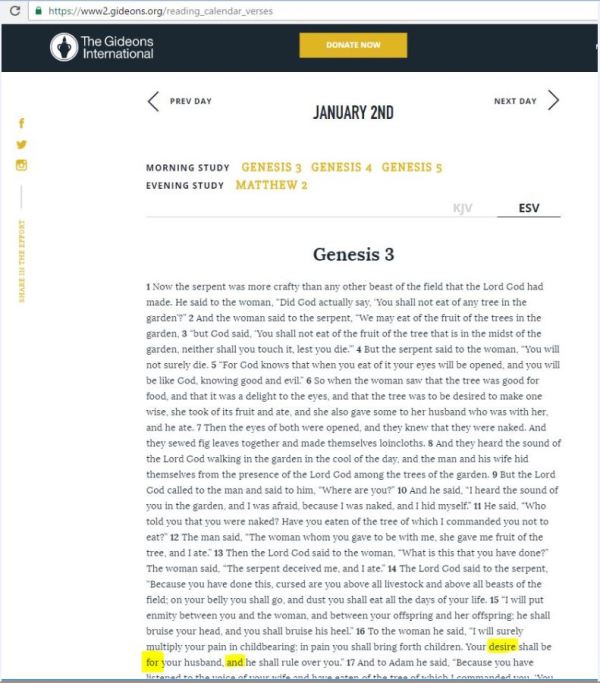
The other is one that Theophrastus at this blog in a blog post some time ago already pointed us to, “The odd Gideons Textus-Receptus ESV.” That Gideons ESV is published in print and also is available in perpetuity digitally. The digital versions are online, here:
and in your favorite app (store), like so:
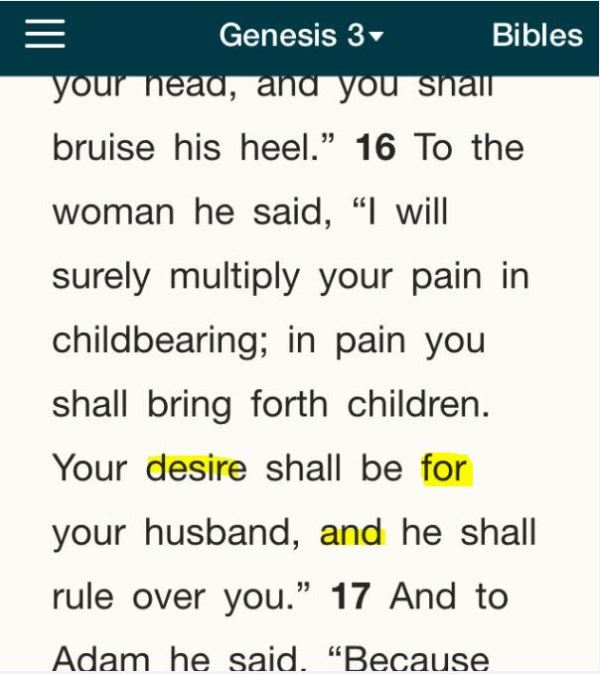
The astute reader can see the old ESV, not the 2016 permanent ESV, in the (highlighted) words there. This is that second perpetual variant ESV, published by Gideon Bibles with the consent of Crossway.
The first ESV variant I mentioned earlier is published by Crossway. If we go to all the ESV Bibles being sold (here https://www.crossway.org/bibles/?all=on), then we can find these 2016 versions, for example:
ESV Reader’s Bible
Top Grain Leather, Black
Availability: In Stock
Retail Price: $109.99
About the ESV Reader’s Bible
The ESV Reader’s Bible was created for those who want to read the books of Scripture precisely as they were originally written. Verse numbers, section headings, and translation footnotes are helpful navigational and interpretive tools, but they are also relatively recent conventions. In the Reader’s Bible they have been removed from the Bible text, and the result is a new kind of Bible-reading experience in a volume that presents Scripture as one extended storyline.
On the top of each page a verse range is included for orientation. Other features include a single-column text setting, readable type, and a book-like format. The Reader’s Bible is a simple but elegant edition, and is perfect for devotional reading, for extended Bible reading, or for focusing on the overarching narrative of the Bible.
- Black letter text, with no verse numbers or footnotes
- Single-column, paragraph format
- Two ribbon markers
Specifications
Format: Top Grain Leather Page Count: 1,840 ISBN-10: 1-4335-5336-8 ISBN-13: 978-1-4335-5336-3 Trim Size: 5.25 in x 7.75 in Weight: 35.07 ounces Published: September 30, 2016 Type Size: 9.5 Page Layout: Single Column Additional Features: Sewn Binding
Maps
Lifetime Guarantee
Ribbon
Gilded edges
Words of Christ Black
This September 30, 2016 ESV has this:
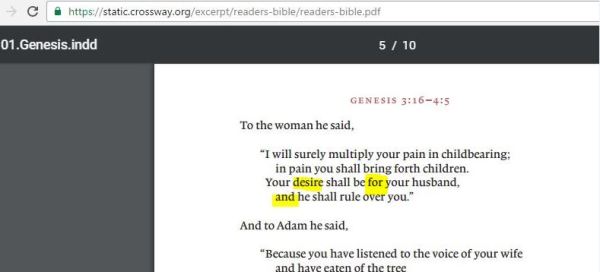
And there’s also another September 30, 2016 ESV for sale that’s not the Permanent ESV:
ESV Large Print Thinline Reference Bible
Hardcover, Berries and Blooms
Availability: In Stock
Retail Price: $54.99
About the ESV Large Print Thinline Reference Bible
The ESV Large Print Thinline Reference Bible combines the popular Thinline Bible features with larger type and cross-references in a highly readable Bible for all uses. Though the Bible text is presented in generous 10.5-point type, the Large Print Thinline Reference Bible is close to one inch thin. In addition, cross-references are located in the bottom corner of each page, making this Crossway’s most affordable large print reference edition.
- Double-column, paragraph format
- Concordance
- More than 80,000 cross-references
Specifications
Format: Hardcover Page Count: 1,248 ISBN-10: 1-4335-5331-7 ISBN-13: 978-1-4335-5331-8 Trim Size: 6.125 in x 9.125 in Weight: 36.17 ounces Published: September 30, 2016 Type Size: 10.5 Page Layout: Double Column Additional Features: Sewn Binding
Maps
Cross-references
Concordance
Ribbon
Words of Christ Black
Crossway provides potential purchasers a free downloadable excerpt of that one as well. It reads like this:
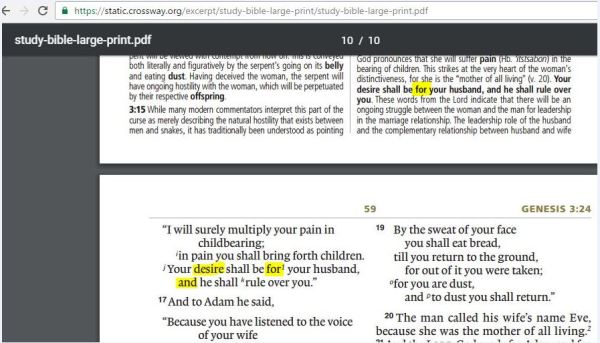
It is quite possible that the website folks at Crossway.org have not yet quite caught up with the permanent change. In other words, it may be that these digital excerpts to help buyers are actually in need of updating to the new Permanent ESV, presuming that the paperbound editions (The September 30, 2016 ESV Reader’s Bible and the September 30, 2016 ESV Large Print Thinline Reference Bible) that the purchasers buy are actually correctly now the changed English Standard Version Permanent Text Edition (2016) text version.
At any rate, this news has given us all another look at the ESV and what the men on the team who translated it and those who publish and sell it seem to want from it.
godly distanced/ stonesounds: Beautiful Afrikaans, Beautiful un-English
September 9, 2016
One of my children is an adult learner of Sepedi in South Africa where for a year she’s been teaching English to school children. Before living in the rhythms of the people of her new language she started reading Antjie Krog in the USA in English.
This blogpost of mine is my catching up. Pardon me if many of you here already have read Krog and her now much-reviewed and highly-praised work Skinned. I just read this now two-year-old interview in which she talks of translation. If you also missed it enjoy this excerpt (below) and go to her fuller conversation with Rauan Klassnik (linked after the excerpt, his interview of her which he posts on his blog, that is going away next month):
RK: In addition to making the original versions of these poems in Afrikaans, your native tongue, you also translated most of them into English yourself. In the “Acknowledgements” section of “Body Bereft” (which released in 2006 ), you wrote that in some cases the “translation process required creative solutions, which in their turn opened up other possibilities in the poems.” Can you give us a sense of what’s it like to wear the two caps of original author and translator? And could you give us details of a particularly memorable example (or two!) of a “creative solution” and the possibilities this led to?
AK: I recently attended a very interesting conference on writers who translated themselves (Brodsky, Beckett, Arendt, etc) and the problems were multi-full but also obvious. The writer’s effort goes into the heart/essence of the poem, the translator’s into trying to capture that heart in the new language. As a writer one often doesn’t have the patience or skill for the capturing process and sometimes prefers to write a new heart in the new language.
Another factor is that when somebody else translates me I often find the work feels too English. When I translate, I try to stay within the Afrikaans rhythm. The work must maintain its from-elsewhere-ness. Then there is also the truth that I know what a cliche is in Afrikaans; I don’t necessarily in English, so the poet as translator can often translate his work in a way which sounds old-fashioned in the new language.
Lastly, some things that are beautiful in one’s language do not work in another, unless distorted. In the jpeg below you will see an example of an Afrikaans poem, then the translation by a good translator and then my own literal translation trying to capture the full nuance of the Afrikaans, but the end result is un-English.
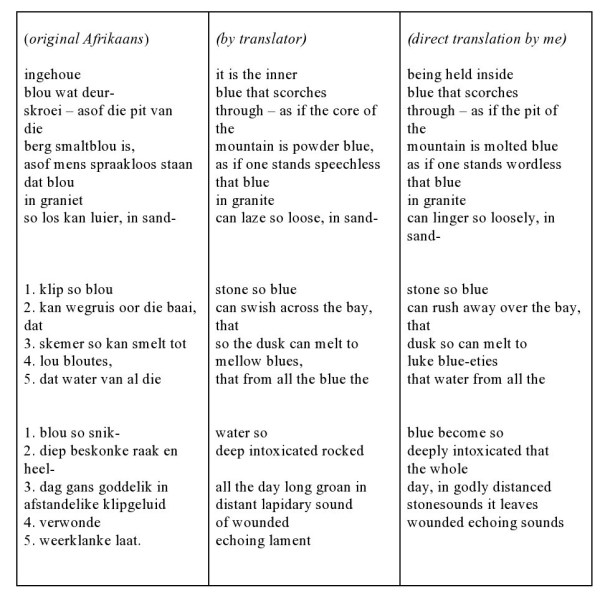
http://htmlgiant.com/author-spotlight/skinned-an-interview-with-antjie-krog/
Invisible Wordplay in Hebrews 12
August 23, 2016
The last verse of the second reading in the Roman Catholic lectionary this weekend caught my attention, because the wording (from the NABre, Heb 12:5-7, 11-13) seemed so odd:
So strengthen your drooping hands and your weak knees.
Make straight paths for your feet,
that what is lame may not be disjointed but healed.
Disjointed? What an odd word to use there. Do people’s lame wrists and knees become dis-jointed if they are not strengthened by exercise? I’m imagining dislocated shoulders here; can wrists and knees become dislocated? What an odd image to use in a reading that is mostly about discipline, trials, and training.
So of course I went off to compare translations. The NKJV does say dislocated; NIV disabled; several translations say “put out of joint”, and several say “turned aside” or “out of the way”.
What does the Greek say, though? Ektrepo, ἐκτρέπω, which looks like it means out-something, or out-of-something. It’s G1624 in Strong’s lexicon, with a root word of G5157, trope, τροπή, which means “turning”.
It seems this is a word with both a literal medical meaning of dislocated, and a figurative meaning of being turned out or turned aside. What a perfectly apt word choice in a passage that is using the metaphor of physical training for spiritual discipline. It resonates with and sheds new light on the gospel passage that follows, Luke 13:22-30, in which those who have not practiced spiritual discipline are, indeed, turned aside by the master of the house, turned out from the kingdom of God.
Why Silence? Anita Hill, Lani Guinier, Joycelyn Elders, Hillary Clinton, Ghazala Khan
August 1, 2016
This post starts with the epigraphs from Cheryl Glenn’s essay on the rhetoric of silence in the American political realm. She examines primarily the silences and the silencing of Anita Hill, Lani Guinier, Joycelyn Elders, and Hillary Clinton. The post ends with two recent statements of Ghazala Khan on her silence. A male who seems not to have read either Glenn’s essay or her Qu’ran had demanded the following of her, saying, “If you look at his wife, she was standing there. She had nothing to say. She probably — maybe she wasn’t allowed to have anything to say. You tell me.”
The silences, the empty spaces, the language itself, with its excision of the female, the methods of discourse tell us as much as the content, once we learn to watch for what is left out, to listen for the unspoken, to study the patterns of established science and scholarship with an outsider’s eye. -Adrienne Rich
Because everything would be unsayable. Speech consists above all in silences. -Jose Ortega y Gassett
I was going to die, if not sooner then later, whether or not I had ever spoken myself. My silences had not protected me. Your . silence will not protect you. -Audre Lorde
I speak, but I cannot be heard. Worst, I am heard but I am not believed. Worse yet, I speak but I am not deemed believable. -Jacqueline Jones Royster
I have come to believe over and over again that what is most important to me must be spoken, made verbal and shared, even at the risk of having it bruised or misunderstood. -Audre Lorde
The Hill-Thomas hearing … was about finding our voices and breaking the silence forever. -Anita Hill
The liberatory voice … is characterized by opposition, by resistance. It demands that paradigms shift-that we learn to talk-to listen-to hear in a new way. -bell hooks
Everything we write will be used against us or against those we love. These are the terms, take them or leave them. -Adrienne Rich
It doesn’t matter what you think. Words are found responsible all you can do is choose them or choose to remain silent. -Adrienne Rich
I have been compelled on too many occasions to count to sit as a well-mannered Other, silently, … while colleagues who occupy a place of entitlement … have comfortably claimed the authority to engage in the construction of knowledge and meaning about me…. -Jacqueline Jones Royster
It is not the case that a man who is silent says nothing. -Anonymous
Silence is a game of dodgeball at dusk A matter of time ’til someone knocks you out Of the circle of bodies. -Robin Becker
Silence and obedience to authority were not rewarded. -bell hooks
When you are silent, it speaks; When you speak, it is silent. -Tseu
Moving from silence into speech is for the oppressed, the colonized, the exploited, and those who stand and struggle side by side, a gesture of defiance that heals, that makes new life and new growth possible. -bell hooks
Let a woman learn in silence with all submissiveness. I permit no woman to teach or to have authority over men; she is to keep silent. – [neither the Qur’an nor the Hadith but rather the Christian New Testament’s] I Tim. 2:11-12
The last time I spoke to my son was on Mother’s Day 2004. – Ghazala Khan
Because without [my] saying a thing, all the world, all America, felt my pain. I am a Gold Star mother. Whoever saw me felt me in their heart. – Ghazala Khan
Here’s Glenn’s essay, “Silence: A Rhetorical Art
for Resisting Discipline(s)”: http://www.jaconlinejournal.com/archives/vol22.2/glenn-silence.pdf
Here’s Khan’s essay, “Trump criticized my silence. He knows nothing about true sacrifice.”: https://www.washingtonpost.com/opinions/ghazala-khan-donald-trump-criticized-my-silence-he-knows-nothing-about-true-sacrifice/2016/07/31/c46e52ec-571c-11e6-831d-0324760ca856_story.html
Here’s Khan speaking on her silence: https://www.youtube.com/watch?v=qqZirz12x-8
Here’s Khan’s country’s Constitution: http://fortune.com/2016/08/01/constitution-amazon-khizr-khan/
Here’s Khan’s Qu’ran:
https://quran.com/
The American Heritage of a Few deciding for the Others
July 31, 2016
Not long after [white man] Thomas Jefferson wrote the “Declaration of Independence,” a free black [man] wrote Jefferson asking if the “all men are created equal”phrase applied to blacks [that is, to black men, to black women, and to black children]. Jefferson replied that slavery [of black children, of black women, and of black men] embarrassed him but … The [white men] Quakers spoke out against slavery during the colonial period but … [The white men] Anglicans worked among the [black men and women and children] slaves and attempted to Christianize them [as if they were white men]. [The white men of] Mainline Protestantism tried early on, but… In 1784, the [white men] Methodists voted to expel [white men] members who bought and sold [black men, women, and children] slaves but… [White men] Methodists found such statements unenforceable and they withdrew them. [White men of] Kentucky’s Elkhorn Baptist Association tried to draft a resolution against [African person] slavery in 1791 but… In 1818, [white man] George Bourne, a fiery anti-slavery preacher, insisted on [African person] slavery’s cessation. Bourne’s Presbytery [of whites] felt his attitudes degraded the minister’s office and they [the white men] removed him. Bourne appealed to the General Assembly [of white men]. Pro-slavery men [white men] loaded the [all white, all male] Assembly and saw Bourne expelled…. In 1844, the Georgia Baptist Convention appointed [white man] James Reeves, a [black man, black woman, black children] slave owner, as missionary to the [non-white, non-Christian] Cherokee Indians. When his petition for approval came to the General Convention [of white men] it was rejected. In 1845, southern [white men] Baptists withdrew to form the [white man] Southern Baptist Convention in Augusta, Georgia…. When [white man] John C. Calhoun gave an address in [the white man] Congress in support of the Compromise of 1850, he said American religious [white men] bonds were broken and he pleaded that the [white man] nation’s political bonds remain united. The fact that [white man] churches could not get along indicated no one else [of the white men] could either. Church division [among white men] over slavery [of black children, black women, and black men] predicted the Civil War.
http://www.christianchronicler.com/history1/slavery_and_the_churches.htm
In 1776, Abigail Adams wrote to her husband, John Adams, who was one of the men writing the Constitution, to ask him “in the new Code of Laws which I suppose it will be necessary for you to make I desire you would Remember the Ladies, and be more generous and favorable to them than your ancestors. Do not put such unlimited power into the hands of the husbands. Remember all men would be tyrants if they could. If particular care and attention is not paid to the ladies, we are determined to foment a rebellion, and will not hold ourselves bound by any laws in which we have no voice or representation.”
But even though John Adams loved his wife very much and asked her for advice all the time,….
Like the women, Jews also saw in the idea of the rights of man the possibility of getting equal rights for themselves. Haym (Chaim) Solomon, in 1784, asserted that, “I am a Jew; it is my own nation; I do not despair that we shall obtain every other privilege that we aspire to enjoy along with our fellow-citizens.” Some of the Constitution writers, like Thomas Jefferson, agreed with Solomon that “”neither Pagan nor Mohammedan nor Jew ought to be excluded from the civil rights of the Commonwealth because of his religion.” (This is Jefferson quoting John Locke). Washington also assured the Jews in 1790 that, “All possess alike liberty of conscience and immunities of citizenship… for happily the Government of the United States, which gives to bigotry no sanction, to persecution no assistance, requires only that they who live under its protecture, should demean themselves as good citizens.” The Jews did get some protections: the Bill of Rights says that the government can not make any law about religion, and from the beginning non-Christians could vote in the United States. But…
http://quatr.us/northamerica/after1500/government/excluded.htm
Peacemakers (before the sermon on the mount)
July 30, 2016
Men, Spartans:
In your foreign post, I am not alone. Father to father to father it’s been held, given to generations.
I wish to make this clear to you all also. The City State holds all of us to this final goal. Yes, when there is war, she has had to raise us up as generals. Still, when longing for calm, she sends us out as peacemakers.
I myself have twice already traveled for her to destroy war. In each of these two ancient assignments I have acted effectively. And this is for you all, also for you all, for peace.
Still, now this third time I’m travelling, leading out for full social justice now should dialogue be achieved.
ὦ ἄνδρες Λακεδαιμόνιοι,
τὴν μὲν προξενίαν ὑμῶν οὐκ ἐγὼ μόνος, ἀλλὰ καὶ πατρὸς πατὴρ πατρῴαν ἔχων παρεδίδου τῷ γένει.
βούλομαι δὲ καὶ τοῦτο ὑμῖν δηλῶσαι, ὡς ἔχουσα ἡ πόλις διατελεῖ πρὸς ἡμᾶς. ἐκείνη γάρ, ὅταν μὲν πόλεμος ᾖ, στρατηγοὺς ἡμᾶς αἱρεῖται, ὅταν δὲ ἡσυχίας ἐπιθυμήσῃ, εἰρηνοποιοὺς ἡμᾶς ἐκπέμπει.
κἀγὼ πρόσθεν δὶς ἤδη ἦλθον περὶ πολέμου καταλύσεως, καὶ ἐν ἀμφοτέραις ταῖς πρεσβείαις διεπραξάμην καὶ ὑμῖν καὶ ἡμῖν εἰρήνην:
νῦν δὲ τρίτον ἥκω, καὶ ἡγοῦμαι πολὺ δικαιότατα νῦν ἂν διαλλαγῆς τυχεῖν.
Xenophon, Hellenica (6.3.4) with English translation by J. K. Gayle
Repost: The “Feminization” of the Church
April 16, 2016
I’m reposting this in its entirety from my own blog, to give my take on the issue of why there are more women than men in most Christian churches, and what conclusions are most reasonably drawn from this. [Note: since I first wrote this article I have moved from an Independent Church of Christ to a Methodist church, not least because women are allowed to be, and a woman is, senior pastor of the church.]
So here’s the post:
In recent years a lot of people have been talking about why in most Christian churches there is an approximately 60-40 ratio of women to men. This 2006 Biola Magazine article puts it like this:
There are generally more women than men in every type of church, in every part of the world. . .A traditional explanation is that women are more spiritual than men. But the leaders of [a new masculinity] movement suggest that the church’s music, messages and ministries cater to women. . . The result of this feminization is that many men, even Christian men, view churches as “ladies clubs” and don’t go — or they often go to please their wives.
The phrase almost always used to describe this phenomenon is “feminization.” In other words, the presence of a higher percentage of women in churches is not simply a higher percentage of women– it represents that the church is, or has somehow become, feminine.
The Council for Biblical Manhood and Womanhood has this to say about “feminine Christianity”:
Walk into the average evangelical church in America, and you will likely sing lyrics such as “I want my life to be a love song for you, Jesus” and “I want to fall in love with you.”
Then you might hear a sermon encouraging Christians to be “intimate” with Jesus and attend a “care group” where everyone is expected to share their feelings.
Such tactics might appeal to women, but they are at least partially unbiblical and push men away from Christianity, according to Randy Stinson, executive director of The Council on Biblical Manhood and Womanhood (CBMW) and assistant professor of gender and family studies at The Southern Baptist Theological Seminary (SBTS).
“Where are the men in our churches today?” Stinson said in a lecture sponsored by the SBTS theology school council March 29. “We have a crisis going on in the local church. Number one, men aren’t coming. And number two, when they are coming, they’ve [sic] marginalized, they’re being passive, they’re being pushed to the side.”
Christianity Today summarizes it like this:
Today a growing body of literature is leveling its sights on the church, suggesting that men are uninvolved in church life because the church doesn’t encourage authentic masculine participation.
The same article quotes controversial pastor Mark Driscoll:
In Driscoll’s opinion, the church has produced “a bunch of nice, soft, tender, chickified church boys. … Sixty percent of Christians are chicks,” he explains, “and the forty percent that are dudes are still sort of chicks.”
The article also quotes David Murrow, author of Why Men Hate Going to Church(Thomas Nelson, 2004):
“[W]omen believe the purpose of Christianity is to find “a happy relationship with a wonderful man”—Jesus—whereas men recognize God’s call to “save the world against impossible odds.” . . . While the church was masculine, it fulfilled its purpose. But in the 19th century, women “began remaking the church in their image” (and they continue to do so), which moved the church off course.
Needless to say, this line of thinking isn’t exactly complimentary to women! It implies that whatever is “feminine” encapsulates everything that’s gone wrong with the church. A popular book on the subject even goes so far as to take the title The Church Impotent – because apparently a majority of women in the church means the church is emasculated, and therefore powerless and ineffectual. Even though men still hold the vast majority of the leadership positions.
There are several things that need to be addressed here. First, what might be some objective reasons why there are more women than men in most churches? Second, what does it mean to say the church is “feminine,” and is that a helpful or accurate assessment? Third, what is the best way to address this situation?
Why are there more women than men in most churches?
One reason that is often given (and one that is less denigrating to women) is that women are just naturally more religious than men. However, if that were true, then a similar female-to-male ratio ought to hold true in other major world religions. But it doesn’t. Christianity is the only major world religion where female attendance is higher than male attendance. As this United Kingdom study states:
Christian women reported slightly higher levels of religious activity than did the men, while among the other three religious groups, levels of reported religious activity were markedly lower among women than among men. How can we explain these gender differences in reported religious observance? Among the Jews and Muslims, there were marked differences between women and men, in keeping with observations about the roles of women and men in these traditions. These differences are also consistent with the view that men’s prescribed religious activities in traditional religion are more prestigious, and thus more likely to be engaged in. Hindu men also reported greater levels of religious activity than did Hindu women.
The fact is that most of the time in the other world religions (with the exception, perhaps, of some reformed branches), women are actively barred from full participation in many of the everyday practices of religion. They are often kept separate from the men, hidden behind screens or walls, or required to keep silent. Perhaps, then, another question we ought to be asking, instead of why there are relatively fewer men participating in Christianity, is what is it about Christianity that encourages so many women to participate? As this article on religion in the United Kingdom in The Telegraph says:
One possible reason why the Church has always attracted so many women is that the theological education on offer on a Sunday is the same for both sexes. Men and women (generally speaking) have always sat together in Church and are expected to participate equally in the liturgy and in prayer. It’s perhaps unsurprising, then, that the only other religious denomination anecdotally reported as having rising numbers of women is Reform Judaism. Its congregations are mixed whereas in Orthodox synagogues the men and women sit separately and only boys receive the rigorous schooling in the Hebrew scriptures. . . .
An often-ignored fact in all of the hand-wringing about fewer men in church is that the early church in Roman times apparently also attracted more women than men. As this Huffington Post article on The Power and Presence of Women in the Earliest Churches states:
Some readers may find it surprising to learn that a woman shortage blighted the ancient world, with about 130-140 men for every 100 women. This is so because many female infants were left to die of exposure and because of the mortal risks associated with pregnancy and childbirth. Yet both Christians and their critics observed a marked overrepresentation of women in the early churches, a fact the critics used to their advantage: “What respectable group caters to women?” Why, one wonders, did so many women find the churches appealing if women’s contributions were not valued?
The answer is, simply, that the early churches did value women’s contributions.
This article on women in the early church from the Christian History Institute corrorobates this:
Celsus, a 2nd-century detractor of the faith, once taunted that the church attracted only “the silly and the mean and the stupid, with women and children.” His contemporary, Bishop Cyprian of Carthage, acknowledged in his Testimonia that “Christian maidens were very numerous” and that it was difficult to find Christian husbands for all of them. These comments give us a picture of a church disproportionately populated by women. . . It is no surprise that women were active in the early church. From the very start—the birth, ministry, death and resurrection of Jesus—women were significantly involved. . .The involvement of women continued in the first few decades of the church, attested by both biblical and extra-biblical sources.
The fact is that a major appeal of Christianity at its inception was that it valued and uplifted those who were marginalized in their own societies. The same Celsus quoted above also said that Christianity was “a religion of women, children and slaves.” As Paul indicated in his first letter to the Corinthians:
Brothers and sisters, think of what you were when you were called. Not many of you were wise by human standards; not many were influential; not many were of noble birth. But God chose the foolish things of the world to shame the wise; God chose the weak things of the world to shame the strong. God chose the lowly things of this world and the despised things—and the things that are not—to nullify the things that are, so that no one may boast before him. 1 Cor. 1:26-29
A similar phenomenon appears to be occurring in the rise of Christianity in places where it has not had a long-standing, traditional hold, such as in China. Christianity continues to grow rapidly in China, with up to 70% of the new converts being women. In this Christian Post article, the reason given is similar to what was going on in the early church in Roman times:
The Chinese Academy of Social Sciences said on its website that Christianity mainly attracts people with low social status, including the poor, the women and older people.
It said that while half of Christians had completed their primary education, only 2.6 percent of them attained a college degree or higher.
Christianity’s attraction of the marginalized is one of its strengths, not one of its weaknesses. On the other hand, this factor probably doesn’t fully explain why there is a greater percentage of women in modern Western churches today– especially since many branches of Christianity are now seen by society as limiting women, not empowering them. An important question to ask, though, is how long this female-male ratio has been occurring. The idea that this is a recent phenomenon, rising with the advent of feminism, is certainly false. The Biola Magazine article I quoted earlier states:
The gender gap began as early as the 13th century, according to some church historians. Others say it began during the Industrial Revolution. . . Industrialization forced men to seek work away from home, in factories and offices, which created a split between the public and private spheres of life. The public sphere became secularized through the new values of competition and self-interest, and the private sphere came to represent the old values of nurturing and religion. . . Thus, religion came to be seen as for women and children and not as relevant to the “real” world of business, politics and academia, she said. Soon, in churches, women began to outnumber men. . . So, male pastors began to adapt churches to their female demographic.
The rise in the “two spheres” concept popularized in Victorian times may be a factor, but the disproportionality of women in the church, at least in some kinds of congregations, has certainly been documented earlier than that. American colonial preacher Cotton Mather wrote about it in the 1600s, for instance, though not all colonial churches had this issue. The book Under the Cope of Heaven by Professor Patricia U. Bonomi offers an interesting theory: that male attendance decreased in American colonial churches in inverse proportion to the increase in the role of clergy at the expense of laity:
As the ministers’ rising professionalism led them to reduce the laity’s power in church government, laymen proved less amenable to a a more passive role than did laywomen. . . [Therefore] Feminization appears to be linked less to the secularization of the masculine sphere than to the loss of power by lay males to a professionalizing clergy.
If this is true, then the Encyclopedia Brittanica’s entry on clergy and laity in Eastern Orthodoxy could help explain why there is a more equal sex ratio in these churches:
The emphasis on communion and fellowship as the basic principle of church life inhibited the development of clericalism, the tradition of enhancing the power of the church hierarchy. The early Christian practice of lay participation in episcopal elections never disappeared completely in the East. In modern times it has been restored in several churches, including those in the United States. Besides being admitted, at least in some areas, to participation in episcopal elections, Orthodox laymen often occupy positions in church administration and in theological education. In Greece almost all professional theologians are laymen. Laymen also frequently serve as preachers.
This would also explain why, in my own church (an Independent Church of Christ), where laywomen and laymen alike participate in teaching (both in children’s ministry and adult bible studies), baptizing, serving communion, collecting and counting the offering, greeting, ushering, and giving short teachings prior to the main sermon, I see roughly half men and half women when I look around the pews on any given Sunday morning. My own church (though I have not done an actual count) doesn’t seem particularly “feminized.”
But this doesn’t explain why in some churches where lay participation is high, there is still a higher percentage of women. This study from 1990 states that in American Pentecostal churches the female-male ratio was at that time as high as 2 to 1, while in Baptist churches it was 3 to 2. (This study, however, concludes that women are simply more religious for various reasons, failing to take into account that this is a Christianity-only issue, so I won’t be quoting it further here.)
But there is another cause that I think is, and has been, very prevalent in Western churches for a long time, and is likely more prevalent in Baptist and Pentecostal and similar churches, because of their strict limitations on women’s roles. It’s a self-perpetuating stigma that, once established, is very hard to defeat: the stigma known as “gender contamination.” This Forbes article defines”gender contamination” as the idea that when something is perceived as being a women’s thing, men want nothing to do with it. It’s the reason why men won’t drink “diet” soda and have had to have differently-named low-calorie versions marketed specially to them. It’s the reason why men resist using lotions and moisturizers even if they have neutral, non-flowery scents, and why some companies advertise their products by denigrating competitors with such words as “precious” and “princess.” In short, in our “male mystique” focused society, boys who believe girls have cooties still believe deep-down, when they grow into men, that women have cooties too.
There are still some very deep-rooted misogynistic elements in modern Western culture– and this, I think, has a lot to do with why evangelicals like Mark Driscoll and the Council for Biblical Manhood and Womanhood are so distressed at the idea that churches are “feminized.” If churches have more women in them, then churches themselves have cooties, and it’s up to the biblical manhood movement to remove the stigma by masculinizing the church. Just as soda advertisements now insist that certain brands are not for women, and certain body washes emphasize how very manly their scents are, the answer in the minds of these Christians is to re-market the church as a manly institution.
The Christianity Today article I linked to earlier puts it this way:
These authors . . . suggest that the solution is to inject the church with a heavy dose of testosterone. In other words, allowing women to create Jesus in their image has emasculated him; thus, regaining a biblical image of Christ is as simple as re-masculating him. The masculinity movement’s solution assumes that Jesus came to model genuine masculinity. . . imply[ing] that when the church adopts the supposedly male psyche, it fulfills its purpose, but when it conforms to the supposedly female psyche, it becomes aberrant.
Which leads me to my second question:
Are these categories of “masculine” and “feminine,” when applied to churches and church services, helpful or accurate?
Jeffrey Miller, in the Christian Standard‘s Nov. 2011 article Common Sense on “The Feminization of the Church”, discusses two of the main proposals for masculinizing the church: first, that churches sponsor “manly” and challenging group activities such as hiking or kayaking, and second, that church services discard or at least strictly limit “feminine” songs about love and intimacy with Christ in favor of “masculine” songs about God’s power and authority. Here’s what he discovered regarding sponsoring “manly” activities through his own church:
I wanted to test the theory that men are more interested than women in rigorous and even dangerous recreation, so I devised a stealthy experiment and formed a hiking group. Anyone is welcome to join this group, but all who express interest are told we do not take leisurely jaunts. Instead, each outing has some significant challenge, the most common being distance—our longest hike, for example, exceeded 26 miles. Other obstacles have included bitter windchills, steep climbs, sheer descents, black bears, yellow jackets, and two territorial rattlesnakes.
I sent invitations to an equal number of men and women. The list has grown and now consists of 20 men and 20 women. I tell people we hike to stay in shape, rise to the challenge, enjoy God’s creation, and get away from it all. While all these are true, I haven’t till now shared one other important goal of mine: to track the ratio of female to male participants. After 19 monthly hikes, having invited an equal number of men and women to join in rigorous outdoor adventures, 33 men and 57 women have taken up the challenge. Surprised? Me too! I thought the ratio would drift toward 50-50.
And with regards to “manly” music, here’s his response:
Christian Copyright Licensing International (CCLI) lists the 100 most frequently used songs in its database. If contemporary praise music is problematically feminine in both lyrics and tone, as the Driscoll-Murrow crowd avers, we should expect the top 100 list to be dominated—or at least infiltrated—by women. In fact, however, the list includes 145 male and 16 female composers. Thus more than 90 percent of the composers writing today’s most popular praise songs are male!
Moreover, some of the most “masculine” songs are written by women (and some of the most “feminine” songs are written by men). Consider Twila Paris’s “He is Exalted,” Jennie Lee Riddle’s “Revelation Song,” and Brooke Fraser’s “Desert Song,” all of which employ metaphors of power. In contrast, Lenny LeBlanc and Paul Baloche’s “Above All” and Martin Nystrom’s “As the Deer” both feature elegant melodies and calming images from nature.
Going back to the 19th century, Fanny Crosby’s lyrics are not predominantly what we would call “feminine.” And William Bradbury’s melodies are not especially “masculine.” In search of a nonscientific test for these statements, I asked my mom for her five favorite Fanny Crosby songs and my dad for his five favorite William Bradbury songs. . . My mom’s favorite Fanny Crosby songs are “Blessed Assurance,” “To God Be the Glory,” “Praise Him! Praise Him!” “Redeemed!” and “Draw Me Nearer.” My dad’s favorite William Bradbury hymns are “Savior Like a Shepherd Lead Us,” “Jesus Loves Me,” “The Solid Rock,” “He Leadeth Me,” and “Sweet Hour of Prayer.” Judge for yourselves, but I believe the list of hymns by Crosby is more vigorous and Bradbury’s list is more intimate.
I conclude, therefore, that a central problem with the manly music argument is that men both write and perform the overwhelming number of songs that Driscoll, Murrow, and others consider too feminine. If anyone is guilty of feminizing the church’s music, it’s not women!
In short, the categories of “masculine” and “feminine” are cultural constructs that often have very little to do with the actual proclivities of real men and women. Women don’t necessarily focus on relationship and men on power in worship, nor do only men enjoy rigorous and challenging physical activity.
Thomas G. Long’s article Why Do Men Stay Away? in The Christian Century finds these categories insulting to both men and women:
Why are men and the church often at odds? Sadly, many of the answers are as insulting as they are misguided. . .They argue that men, loaded as they are with testosterone, have a proclivity to impulsive, risk-taking, occasionally violent action—exactly the behavior disallowed in the soft world of worship. Given this theory, what enticements can the wimpy church possibly offer us men when we compare it to the joys of hiding away in a man cave, stuffing our maws with pizza and beer as we watch Da Bears and heading out after sundown to rip off a few wheel covers and rumble in the Wal-Mart parking lot?
Others propose a more political and historical explanation, namely that centuries of male control of the church have yielded to an ineluctable force of feminization. Pastel worship, passive and sentimental images of the Christian life, handholding around the communion table and hymns that coo about lover-boy Jesus who “walks with me and talks with me” have replaced stronger, more masculine themes. . .
Really? The feminine erosion of the church? As David Foster Wallace said in a different context, this is an idea “so stupid it practically drools.” Even sillier are the proposed masculine remedies. One website suggests “Ten Ways to Man Up Your Church,” beginning with obtaining “a manly pastor” who projects “a healthy masculinity.” This patently ignores strong women clergy, of course, but it also denigrates the capacity of men to recognize and respond to able leadership regardless of gender or stereotypes.
Categories of masculinity and femininity that reduce men to biceps and women to clinging vines are hardly biblical. None of the heroes and heroines of the faith presented in the pages of Scripture acted this way. Nor do the Scriptures uphold these stereotypical behaviors as virtuous or godly. On the contrary, the fruit of the Spirit from Galatians 5:22-23, ” love, joy, peace, patience, kindness, goodness, faithfulness, gentleness, self-control” include both typically “masculine” and typically “feminine” virtues that are for men and women alike.
And there’s a real problem when traits associated with women are denigrated as a kind of sickness that is weakening the church. As Jeffrey Miller put it in his Christian Standard article:
If the church manifests feminine characteristics, and if it does so more than it once did, then why would this make the church impotent? Such a claim is not only illogical, but offensive. Surely it is ungentlemanly to say to women that the problem with the church is that it’s becoming more and more like them.
How fair is it to assign categories to women that you then belittle and blame them for? Surely it’s possible to attract more men to our churches without communicating to women that they shouldn’t exist?
So what is the best way to address this problem?
The church is not a product like a soda or a moisturizer, that you can market to men by claiming that it’s not for women. Nor is it helpful to bifurcate church experience so that the women get all the comfort and love while men get all the challenging calls to discipleship. Men and women are real people, not stereotypes. Men often need comfort and love, and women have no less need for challenge. Jesus wasn’t speaking only to men when He said “Deny yourself, take up your cross and follow Me (Luke 9:23).” Nor was He talking only to women when He said, “Come to Me. . . and you will find rest for your souls; for My yoke is easy and My burden is light. (Matthew 11:30).”
Brownyn Lea recently wrote a guest post on Preston Yancey’s blog entitled What Women Want: the Jesus of the Gospels. She said:
Jesus is a comforter, a healer, a Savior. “Gentle Jesus, meek and mild”, the suffering Servant, the loving rescuer. That Jesus rightfully and perfectly holds all these titles is proof that those nurturing qualities do not belong exclusively to the female domain. Jesus IS the epitome of love, of care, of welcome.
However . . .what I want from church is this – a robust preaching of the Jesus of the Gospels. I want to hear about the Jesus who demanded loyalty, who commanded authority from storms, sinners and satanic forces, who said vexing and frustrating and wild things. I want to hear preaching which is not just faithful to His words but to His TONE: of comfort but also of rebuke, of welcome but also of warning. I want to hear His dares, His call to come and die, His challenge to make hard choices. I want the Jesus of the gospels who does not just meet our needs, but who calls us to bold and courageous adventure, to self-sacrifice, to taking risks. I want the Jesus who promises huge rewards for huge sacrifices, who embraces fiesty Peter and wayward Mary and touchy-feely John.
I want the Jesus who welcomed the little children, but also the Jesus with eyes like a flame of fire, with feet of burnished bronze and a sharp two-edged sword coming out of his mouth. Whatever that wild imagery means, I want to grapple with it. I want the Jesus who inspires my awe and calls forth my worship: a gospel from The Gospels. That’s the Jesus I want. That’s the Jesus I need: the one who is worthy of the honor, adoration and allegiance of men and women alike.
It’s a woman who is saying these things, articulating the need that Christian men and women alike feel for the whole Jesus– neither a masculinized prize-fighting caricature nor a feminized weepy-and-wimpy caricature. And if we don’t want our Jesus to be a caricature, we ought not to be caricaturing His male and female followers.
Thomas G. Long’s Christian Century article hits the nail on the head, I think:
Perhaps a clue can be found in a Christian group that attracts men and women in roughly equal numbers: Eastern Orthodoxy. . . The finding of religion journalist Frederica Mathewes-Green [is] that Orthodoxy’s main appeal is that it’s “challenging.” One convert said, “Orthodoxy is serious. It is difficult. It is demanding. It is about mercy, but it is also about overcoming myself. . .”
Yes, some churchgoers are satisfied with feel-good Christianity, but I think many Christians—women and men—yearn for a more costly, demanding, life-changing discipleship. Perhaps women are more patient when they don’t find it, or more discerning of the deeper cross-bearing opportunities that lie beneath the candied surface.
Why do more women than men go to church in modern Western Christianity? Perhaps most women don’t really care all that much for sterilized, feel-good niceness in the church either– but women are usually the ones responsible for getting their kids to church, so they deny themselves, pick up their crosses and get out the door. Maybe Christian leaders ought to be applauding their commitment rather than blaming them for what’s wrong with the service.
Maybe rather than capitulating to worldly gender-contamination and male fear of female cooties, publicly visible male Christian leaders should stop maligning femaleness and trying to market Jesus and the church as masculine. In fact, maybe they should stop trying to market the church at all. Paul said in 1 Corinthians 2:1-5:
And when I came to you, brethren, I did not come with superiority of speech or of wisdom, proclaiming to you the testimony of God. For I determined to know nothing among you except Jesus Christ, and Him crucified. I was with you in weakness and in fear and in much trembling, and my message and my preaching were not in persuasive words of wisdom, but in demonstration of the Spirit and of power, so that your faith would not rest on the wisdom of men, but on the power of God.
Ultimately, “feminization” isn’t the real problem. Women aren’t the problem. Let’s face it, in the vast majority of churches the decisions aren’t getting made by women– but Adam’s tendency to blame “this woman You gave me” for his choices is still visible in male church leaders today.
I firmly believe that if churches will just preach the gospel of the kingdom of God, both its comfort and its challenge– Christ will take care of the rest. Men will rise to the challenge to pick up their crosses and endure the stigma of gender contamination in order to identify with Christ. And this will in time erase the notion that church is a “women’s thing.”
Finally, churches do need to pay attention to who they’re reaching and who they’re not. But perhaps we ought to be concentrating less on the ratio of females to males and start focusing more on attracting people of other races and economic situations. Perhaps the real problem is not so much that there are 60 percent women and 40 percent men, but that all of them are white and middle class.
In the end, the Holy Spirit is the one who can help us most. Let’s humble ourselves and ask.
from Alexndria at WIT -> “Between the Binary: Is ‘Effeminacy’ Really an Issue in Evangelical Church Culture?”
April 3, 2016

“It must be noted again that even at the cultural/collective level, notions of femininity are fluid and socially constructed, just as they are for individual persons. There is nothing inherently masculine or feminine about the public or the private, morality or rationally, for we all have dealings with these domains during the course of our lives. So, while the Middle Ages considered men to be more spiritual and thus morally superior, the 19th century conversely considered women to be morally and spiritual superior, and this total inversion attests to the arbitrariness of assigning spiritual/non-spiritual attributes to gender. Thus it seems that the feminine perception of the church began to take shape well before women started to outnumber men in evangelical church congregations. Certainly, then, the decline of church growth in modern times is entirely unrelated to a ‘surplus’ of women as [Dave] Murrow suggests.”
— Alexandria, at the blog “Women In Theology”
“They may be misplaced, forgotten, or misdirected, but in the heart of every man is a desperate desire for a battle to fight, an adventure to live, and a beauty to rescue.” – John Eldredge, Wild at Heart: Discovering the Secret of a Man’s Soul
In recent times, contemporary evangelicalism has witnessed serious tensions within its ranks on the gender front. These tensions are numerous and complex, but usually have to do with whether women can serve in positions of leadership as pastors, ministers, elders, or executive board members. The issue of women in leadership is fiercely debated by progressives and fundamentalists, and often hinges on academic disputes about the “correct” way to interpret scripture. Others have suggested that the desire for gender parity at the leadership level is simply a manifestation of a larger “problem” in which the advent of feminism is responsible for Christianity’s “feminization,” and some…
View original post 2,201 more words
Gender and religion
March 23, 2016
The Pew Research Center yesterday released a new report on gender and religious participation. It found that in many countries in the world, and especially among Christians, there is a wide gender gap. Section 6 of the report is entitled: “In the U.S., religious commitment is high and the gender gap is wide.”
I’m afraid I may not have time to fully digest the report until next week, but I wanted to bring it to the attention of BLT readers.
(If the full report is too long to read in full, please at least consider reading the summary which is on the first web page here.)


 BLT
BLT 