Visual metaphor for social media?

(Source)
Juneteenth and the newly named Great Commission Baptists
No, the wounded man thought, Oh no! Get back to that; back to a bunch of old-fashioned Negroes celebrating an illusion of emancipation, and getting it mixed up with the Resurrection, minstrel shows and vaudeville routines? Back to that tent in the clearing surrounded by trees, that bowl-shaped impression in the earth beneath the pines? . . . Lord, it hurts. Lordless and without loyalty, it hurts. Wordless, it hurts. Here and especially here. Still I see it after all the roving years and flickering scenes: Twin lecterns on opposite ends of the rostrum, behind one of which I stood on a wide box, leaning forward to grasp the lectern’s edge. Back. Daddy Hickman at the other. Back to the first day of that week of celebration. Juneteenth. Hot, dusty. Hot with faces shining with sweat and the hair of the young dudes metallic with grease and straightening irons. Back to that?
. . . . And him beginning:
On this God-given day, brothers and sisters, when we have come together to praise God and celebrate our oneness, our slipping off the chains, let’s us begin this week of worship by taking a look at the ledger. Let us, on this day of deliverance, take a look at the figures writ on our bodies and on the living tablet of our heart. The Hebrew children have their Passover so that they can keep their history alive in their memories — so let us take one more page from their book and, on this great day of deliverance, on this day of emancipation, let’s us tell ourselves our story.
— Juneteenth, by Ralph Ellison
History will show that the United States of America’s largest Protestant group, the Southern Baptists, at their Convention of 2012, elected their first African-American president, on Juneteenth. Yesterday, then, there were lots of news reports, a few critical of the language and the legacy, of the celebrations of the USA’s “Emancipation Day.”

And, then, there are the reports how in New Orleans, the “Rev. Fred Luter Jr. wiped away tears Tuesday.”

The report in my local newspaper runs further, like this:
“I’m absolutely floored,” Luter said at a news conference later. “This is a moment I will never forget. I thank God for the confidence Southern Baptists are putting in me.”
Many called it a watershed moment for the Southern Baptist Convention, founded in 1845 in a split with northern Baptists over slavery.
Luter, 55, pastor of the Franklin Avenue Baptist Church in New Orleans, said he would work hard to make sure his election is not just a symbolic act to improve the Southern Baptist image.
“This is a very historic moment,” Luter said. “The Southern Baptist Convention was founded over slavery. And now they’ve elected an African-American president. We’ve all done things in the past that we’ve regretted. I’ve done things I’ve regretted.
“To God be the glory, for the great things he has done. God bless you,” an emotional Luter said.
Outgoing President Bryant Wright, pastor of Johnson Ferry Baptist Church near Atlanta, put his arm on Luter’s shoulder and prayed, “We thank you for this historic moment. As we think about our beginnings and how far we’ve come, we thank you for Fred Luter, who will carry this mantle of leadership beginning Wednesday night.”
The Rev. Dwight McKissic, pastor of Arlington’s Cornerstone Baptist Church, a predominantly African-American congregation, said, “This is a major symbolic step in the right direction.”
“We’re very excited and thankful for this major symbolic step, but it must be followed by substantial action in hiring African-Americans as entity heads. That’s when real progress will be made,” he said.
Frank Page, a former pastor of Fort Worth’s Gambrell Street Baptist Church who is now CEO of the Southern Baptist Convention, said Luter’s election was much more than symbolic. It’s a sign, he said, that Baptists are moving ahead with real diversity.
“I can’t think of a Baptist seminary that doesn’t have an African-American professor,” he said. There are 10,000 Southern Baptist churches whose members are predominantly ethnic minorities, he said.
Page said he is working with African-American, Hispanic and Asian advisory groups to “deepen their involvement in every aspect of Southern Baptist life.”
The Rev. Terry Turner, an African-American pastor from Mesquite who is president of the Southern Baptists of Texas, one of two Baptist state conventions, said Luter’s election was a “great step” many had long awaited.
“Any time you have ethnics in leadership, it changes the face of the denomination,” he said.
Luter said that in the last 25 years he has seen the denomination purposely work to eliminate its racist image, including an action at its 1995 national convention apologizing for its racist heritage.
The passage marks another step in the predominately white Christian denomination’s efforts to become more diverse and inclusive. . . .
Leaders of ethnic Southern Baptist congregations and churches outside the South said it would be helpful to have a different way of describing themselves in order to have broader appeal.
Some said the convention’s ties to slavery upon its founding in 1845 posed a barrier for growth. Southern Baptists split from the First Baptist Church in America in the pre-Civil War days over slave ownership.
The African American pastor Fred Luter Jr. was not President of the Southern Baptist Convention for even a full day, on Juneteenth. On that same Juneteenth, later in the day, he became the first president ever of the Great Commission Baptists, given the narrow vote to adopt this new name. (In an earlier post, or at least in the conversation of comments following it, I’d alluded to the most recent proposal for this name change.)
The day after Juneteenth 2012, the question is how far the Great Commission Baptists with their new leadership can go. One report starts this way: “A day after electing their first African-American president, Southern Baptists were considering a resolution Wednesday opposing the idea that gay rights are the same as civil rights.”
The day after Juneteenth, the day after emancipation day, we recall, then, how not too long ago one Keith Boykin, then President of the National Black Justice Coalition, a black gay and lesbian civil rights group, asserted that some of the words Ralph Ellison wrote “still apply to blacks who are gay.” Boykin repeated what Ellison had written, once upon a time, of African Americans in general: “I am an invisible man. . . . I am invisible, understand, simply because people refuse to see me. . . . When they approach me, they see only my surroundings, themselves, or figments of their imagination, indeed everything and anything, except me.”
And so, the political and religious and literary United States of America lurches forward as we look backwards.
A bit of wordplay in Chrysostom?
I’m reading some of the homilies of St. John Chrysostom on the Pauline epistles as part of my summer project on Paul, and came across this line near the close of his homily on Romans 6:19-7:13 which, in English translation, comes across as a rather earnest figure of speech:
Taking then all this into consideration, let us flee from the abyss of a little mind, and take refuge in the port of patient endurance, that here we may at once “find rest unto our souls” (Matt. xi. 29)
But fortunately, the version I’m reading reproduced the key Greek words here:
Taking then all this into consideration, let us flee from the abyss of a little mind (μικροψυχίας), and take refuge in the port of patient endurance (μακροθυμίας), that here we may at once “find rest unto our souls” (Matt. xi. 29)
Look at that micro/macro contrast, the assonance, and the final rhyme – doesn’t that give it a much lighter feel?
I’m not sure what psychia and thymia connoted to Chrysostom or his audience, but I’d guess they had more in the way of parallelism and contrast than “mind” and “endurance” do in English.
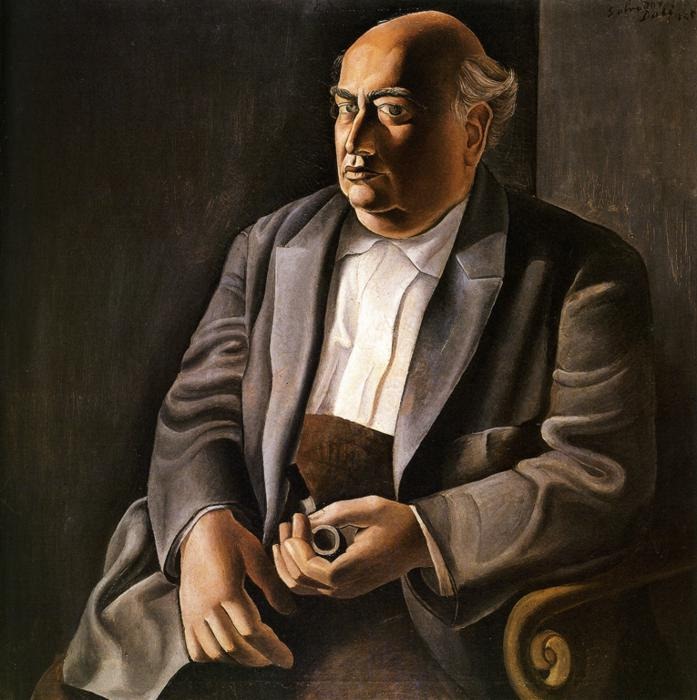
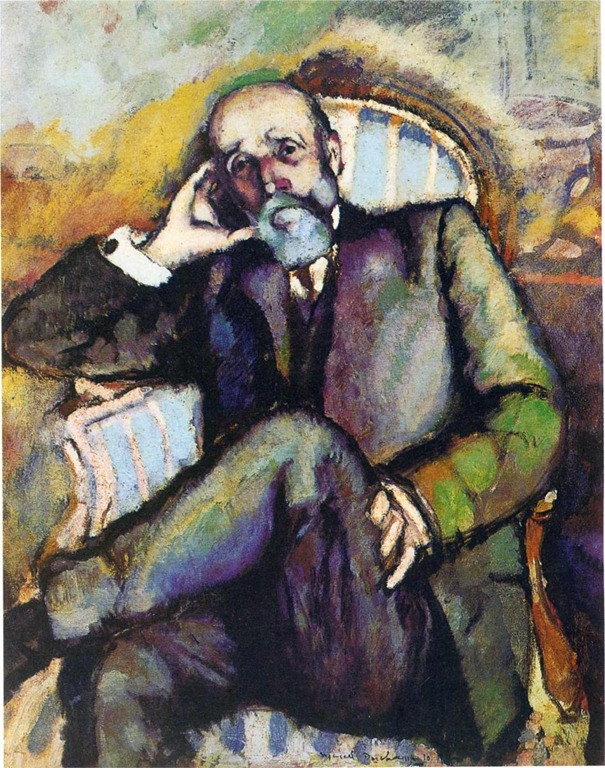
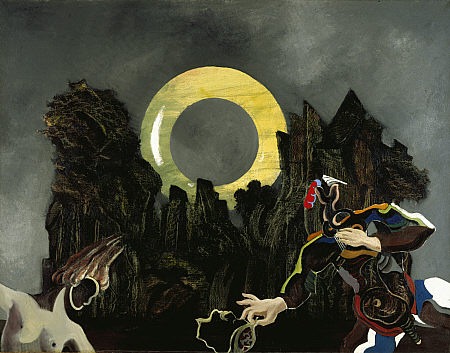
Fathers of painters
Here are several artists’ portraits of their fathers. You can click on most of these images and see a larger copy of the painting.
Gustave Courbet

Salvador Dali
Marcel Duchamp
Albrecht Dürer

Max Ernst (“Max Ernst Showing a Young Girl the Head of His Father”)
M. C. Escher
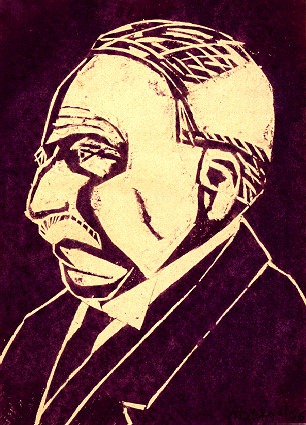
Lucian Freud

Frida Kahlo

Rembrandt

(This post was cribbed from the excellent biblioklept blog.)
Six Canaletto books and one rainy Jubilee
Well, the Queen’s Jubilee (which is only a 60th anniversary and not a 75th as you might think) weekend is all over now, except for the commemorative DVD. The high point was supposed to be a Jubilee pageant along the Thames – a special honor for a queen and her spouse who are known to love things nautical (so much so that when the Labor government forced her to decommission her royal yacht, she reportedly burst into a rare display of public tears.)
But things never quite turn out the way one plans, do they? It rained and husband Philip got so sick he had to be hospitalized. Television coverage was so bad that it got the Jon Stewart treatment. Back in Britain, the BBC (which had terrible production values) saw fit to make a special report exploring commemorative Jubilee vomit bags with an image of the queen. In the special church service to honor the queen, one speaker could not even find the correct page from which to read. While I solidly favor Republic government over Monarchial government, I have to admit that I felt empathy for Elizabeth’s likely embarrassment.
I was interested to see that Britons are apparently just as bad at British history as Americans – with the BBC reporting on a royal milliner who “made Nelson’s hat for Waterloo.” (As BLT readers all know, Nelson was an admiral – not a general – and he died at the Battle of Trafalgar in 1805 – while the Battle of Waterloo took place in 1815.) As a result of considerable confusion the rather interesting inspiration for the Royal Pageant got muddled in the discussion. It was the pageant held for Charles II, during the Restoration. as recorded for example in Samuel Peyp’s diary. But media reports conflated it with an amazing painting by Canaletto. Here it is (click on the image to see it larger format):

It is a rather wonderful painting with the title in the standard catalogue raisonné (e.g. W. G. Constable’s edition) of “London: The Thames on Lord Mayor’s Day, looking toward the City and St. Paul’s Cathedral.” (In several media reports, this painting was described as depicting a royal pageant.) In fact, as part of the Jubilee celebrations, a seemingly rather wonderful exhibition is being held at the National Maritime Museum. I have not seen the exhibition, but only the catalogue, which is a lot of fun. There are six Canaletto paintings and two sketches, and the reproduction of the above picture is over a fold-out spread. The information on Canaletto is somewhat thinner than I might want, but that is made up for by the serendipity of finding so many outstanding paintings, sketches, and photographs of tools, costumes, and other interesting items. It also acts a brief review of the decline of the monarchy from the Tudors to the present day. It is not as academic as I prefer (the guest curator was David Starkey) but it is a handsome volume that I think most would like. It is certainly the nicest item I have seen related to the Diamond Jubilee.
For a special interest in Canaletto’s images of the Thames, one is much better off looking at the catalogue Canaletto in England: A Venetian Artist Abroad, 1746-1755, which is ironically an American exhibition from the Yale Center for British Art (the catalogue is published by Yale University Press.) This provides an excellent overview of Canaletto’s time in England, the London Art World of the mid-eighteenth century, and with many details featured. It is simply a stunning book.
The best general treatment of Canaletto that I have read is the volume by J. G. Links; which I own in hardcover. This is an older volume (1982) and most of the illustrations are in grayscale, but it has by far the most information on the artist. (Links revised the Constable catalogue raisonné). If you are interested in the Venice period of Canaletto, I can recommend the catalogue from the National Gallery which nicely puts Canaletto into context (the title of the exhibition: Venice: Canaletto and his Rivals.) Alternatively, and somewhat less spectacularly, one can look at the catalogue of the Memphis Brooks Museum exhibit Venice in the Age of Canaletto. But if you just want to look at pretty pictures, the cheapest option is undoubtedly the volume from Phaidon’s Color Library. This latter volume has very nice reproduction, and the images are relatively large, despite its low price.
For me, seeing Canaletto’s paintings – even as reproduced in museum catalogues – was far more thrilling than seeing web video coverage of the recent Royal Pageant. Canaletto’s eye was far better in the eighteenth century than the flawed technical production of the BBC cameras in the twenty-first century.
Happy Bloomsday!
June 16 is the biggest literary day on my annual calendar: Bloomsday!
June 16, 1904 is the date on which the action happens in the book Ulysses by James Joyce, which has as its “hero” the character Leopold Bloom.
I won’t be posting tomorrow, but to help get you into the celebratory mood, here are some posts from BLT that mention James Joyce:
- Joyce Freedom From Copyright
- James Joyce Set Free
- New Year Day’s Reading and Listening
- Goodbye, George Whitman
- Samuel Beckett, the Resistance, and the Jews
- Was Gertrude Stein a Poseur?
- What Must We Think About Eugene Nida?
A very incomplete listing of Joyce events is here, but many communities will have some sort of James Joyce-themed event. (Here are some events in Los Angeles, New York, and San Francisco.)
There are streaming broadcasts from BBC Radio 4 (all day long), WBAI, KPFK, and KPFA and from Symphony Space in New York. (With a little effort , it is fairly straightforward to listen to all these recordings after the fact if you act within a week. For capturing the BBC action, I recommend the free tool RadioDownloader – when you open the application, look under BBC broadcasts at “James Joyce’s Ulysses. Or, more easily, there is a podcast here. You can find WBAI archives here and KPFK archives here.) More unusually, you can listen in German at SWR.
There is a celebratory web site and a blog, a new iPhone app, and ruminations here, here, and here. All sorts of multimedia work is going on at the liberateUlysses web site. The Rosenbach Museum and Library has all sorts of interesting online exhibitions (including selections in Joyce’s hand of his original drafts.)
If you’d like to here a recording of Ulysses (listening to it can provide great insights into the book), my favorite recording is by the Irish broadcaster RTE (available for free on the Web, or on CD or MP3 format.) The free Librivox version is above average, and there is a second one in progress here and here. There are also some fine readings from Naxos (if you just want a reading of Molly Bloom’s Soliloquy, look here) and an OK one on Recorded Books.
There is plenty of ancillary material as well: Frank Delaney is working his way through the novel with plenty of down-to-earth comments at his podcast; BBC has interesting ancillary programs on Saturday Live, James Joyce’s Playlist, and in Melvyn Bragg’s In Our Times; and RTE has its recording of Joyce Songs.
If you want a more exotic experience, listen to a complete recording of Finnegans Wake (which I liked, but some rather disliked) – or this abridged recording.
Or, if you don’t want to go out on Saturday and don’t want a multi-media experience, you can always read the book.
What is news? (“Game of Thrones” and Bush’s head)
Well, it has hit the news cycle.
In the DVD commentary finale to the first season of the television show Game of Thrones, David Benioff and D. B. Weiss (executive produces and scriptwriters) mentioned that they used a George Bush head in some of the decapitation scenes:

The DVD/Blu-Ray commentary says:
George Bush’s head appears in a couple of beheading scenes. It’s not a choice, it’s not a political statement. We just had to use whatever heads we had lying around.
Now here’s the thing – that DVD/Blu-Ray was released three months ago, on March 6. There must have been tens of thousand of people who have heard that commentary (including me). And suddenly it becomes news. Why? Because someone mentioned it on Reddit.
Benioff and Weiss suddenly apologized:
We use a lot of prosthetic body parts on the show: heads, arms, etc. We can’t afford to have these all made from scratch, especially in scenes where we need a lot of them, so we rent them in bulk. After the scene was already shot, someone pointed out that one of the heads looked like George W. Bush.
In the DVD commentary, we mentioned this, though we should not have. We meant no disrespect to the former president and apologize if anything we said or did suggested otherwise.
And HBO promised to censor all future releases:
We were deeply dismayed to see this and find it unacceptable, disrespectful and in very bad taste. We made this clear to the executive producers of the series who apologized immediately for this inadvertent careless mistake. We are sorry this happened and will have it removed from any future DVD production.
Now, how can something that DVD/Blu-Ray – that was widely released in March – that has been heard by countless people – all of the sudden become news? It is not as if these were remarks that were in anyway hidden or secret. HBO advertised this disk. HBO produced this disk. This is something that many fans of the show knew.
Now, certainly, this was in poor taste. But it does not seem that Benioff and Weiss are very sorry: they apologize for mentioning it on the commentary track, not for using the former president’s head in decapitation scenes. I even more surprised by the mendacious statement by HBO – again, the author (for copyright purposes) and producer of the DVD. But I reserve my greatest scorn for the news media – how is this news? And since when is the US news agenda defined by Reddit?

From Futurama, as noted here.

David Mason: “I’m a Mormon, Not a Christian”
A fascinating op-ed in today’s New York Times:
I’m a Mormon, Not a Christian
By David V. Mason
THANKS to Mitt Romney, a Broadway hit and a relentless marketing campaign by the Church of Jesus Christ of Latter-day Saints, Mormons seem to be everywhere.
This is the so-called Mormon Moment: a strange convergence of developments offering Mormons hope that the Christian nation that persecuted, banished or killed them in the 19th century will finally love them as fellow Christians.
I want to be on record about this. I’m about as genuine a Mormon as you’ll find — a templegoer with a Utah pedigree and an administrative position in a congregation of the Church of Jesus Christ of Latter-day Saints. I am also emphatically not a Christian.
For the curious, the dispute can be reduced to Jesus. Mormons assert that because they believe Jesus is divine, they are Christians by default. Christians respond that because Mormons don’t believe — in accordance with the Nicene Creed promulgated in the fourth century — that Jesus is also the Father and the Holy Spirit, the Jesus that Mormons have in mind is someone else altogether. The Mormon reaction is incredulity. The Christian retort is exasperation. Rinse and repeat.
I am confident that I am not the only person — Mormon or Christian — who has had enough of the acrimonious niggling from both sides over the nature of the trinity, the authority of the creeds, the significance of grace and works, the union of Christ’s divinity and humanity, and the real color of God’s underwear. I’m perfectly happy not being a Christian. My Mormon fellows, most of whom will argue earnestly for their Christian legitimacy, will scream bloody murder that I don’t represent them. I don’t. They don’t represent me, either.
I’m with Harry Emerson Fosdick, the liberal Protestant minister and former pastor of Riverside Church in Manhattan, who wrote that he would be “ashamed to live in this generation and not be a heretic.” Being a Christian so often involves such boorish and meanspirited behavior that I marvel that any of my Mormon colleagues are so eager to join the fold.
In fact, I rather agree with Richard D. Land, the president of the Ethics and Religious Liberty Commission of the Southern Baptist Convention, who calls Mormonism a fourth Abrahamic religion, along with Judaism, Christianity and Islam. Being set apart from Christianity in this way could give Mormonism a chance to fashion its own legacy.
Christianity, you’ll recall, had to fight the same battle. Many early Christians grew up reading the Torah, living the law, observing the Sabbath and thinking of themselves as Jews. They were aghast to find that traditional Judaism regarded them as something else entirely.
In addition, these Christians had to defend their use of additional scripture and their unconventional conception of God and explain why they were following a bumpkin carpenter from some obscure backwater. Early Christianity’s relationship with non-Jews was even worse. Roman writers frequently alluded to rumors about the cannibalistic and hedonistic elements of early Christian rites. One after the other, Christians went to the lions because they found it impossible to defend themselves against such outrageous accusations. They did eat flesh and drink blood every Sunday, after all.
Eventually, Christianity grew up and conceded that it wasn’t authentic Judaism. Lo and behold, once it had given up its claim to Judaism, it became a state religion — cannibalism notwithstanding — and spent the next 1,700 years getting back at all the bullies who had slighted it when it was a child.
Eventually, Mormonism will grow up. Maybe a Mormon in the White House will hasten that moment when Mormonism will no longer plead through billboards and sappy radio ads to be liked, though I suspect that Mr. Romney is such a typical politician that, should he occupy the Oval Office, he’ll studiously avoid the appearance of being anything but a WASP. This could set back the cause of Mormon identity by decades.
Whatever happens in November, I hope Mormonism eventually realizes that it doesn’t need Christianity’s approval and will get big and beat up all the imperious Christians who tormented it when it was small, weird and painfully self-conscious. Mormons are certainly Christian enough to know how to spitefully abuse their power.
David V. Mason, an associate professor of theater at Rhodes College, is the author of “Theatre and Religion on Krishna’s Stage: Performing in Vrindavan” and “My Mormonism: A Primer for Non-Mormons and Mormons, Alike.”
What is the most expensive Bible in print? Let me set some ground rules for determining this:
- The Bible needs to be in print – or have been in print recently. No fair nominating Guggenheim Bibles (that would put the price in $25 million range).
- The Bible should be printed – not hand written.
- The Bible should be produced in multiple copies – not just a single unique copy.
Now, given these constraints, perhaps the most expensive Bible in English is the Saint John’s Bible Heritage edition – which costs a cool $145,000. These are reproductions of a handwritten, illuminated Bible (NRSV) made under the direction of Donald Jackson by a group of calligraphers, illuminators, and Benedictine monks.
While you can peruse the official website, I prefer the description at the Library of Congress’s online exhibition of this Bible (from which I quote freely below):

Creation: The structure of this illumination reflects the seven-day progression of the Bible’s Creation story, with seven vertical strips, one for each day. On the first day, fragmented shapes explode from the primordial void, expressed by the Hebrew words “tohu wabohu” (chaos). A vertical gold line marks the moment in the story when God ordered, “Let there be light.” Day three contains satellite pictures of the Nile Delta, suggesting the division of land and water and the beginnings of vegetation. The creation of human beings on the sixth day is represented by images from aboriginal rock paintings in Africa and Australia. The snake implies dangers to come, in the Garden of Eden. The golden seventh day is given over entirely to the contemplation of the spirit. The raven flying across the composition is the traditional carrier of God’s message to Saint Benedict.
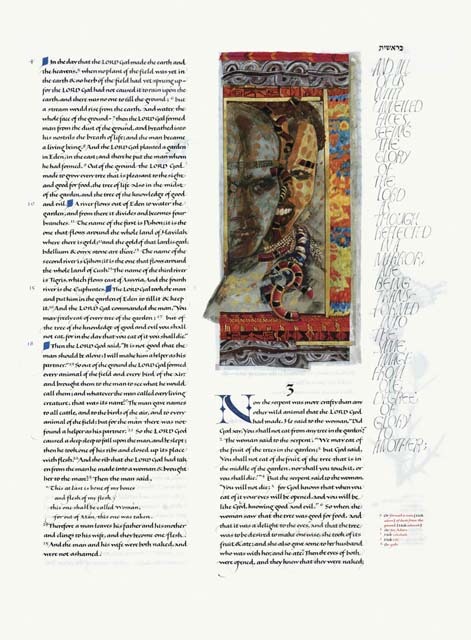
Adam and Eve: Adam and Eve are presented as an African man and woman surrounded by patterned fabrics from various ancient cultures. Photographs of Ethiopian tribes-people influenced Jackson’s design. He wanted to link the notion of the Bible’s first man and woman with current archaeological and anthropological theories that humankind originated in Africa. The decorative framing around Adam and Eve includes African tapestry patterns and, on the right, a Peruvian feather cape. The horizontal stripes are details of Middle Eastern textiles and of white body painting on black skin. The poisonous coral snake, also depicted in the Creation and Garden of Eden illuminations, appears between Adam and Eve. Jackson’s use of a gold bar framing Adam and Eve is meant to suggest God’s presence as a framework for human life.
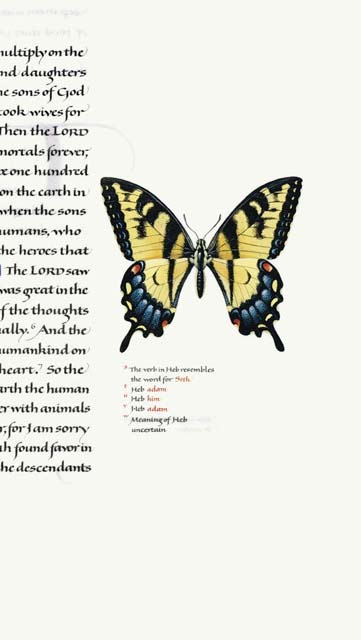
Tiger Swallowtail Butterflies
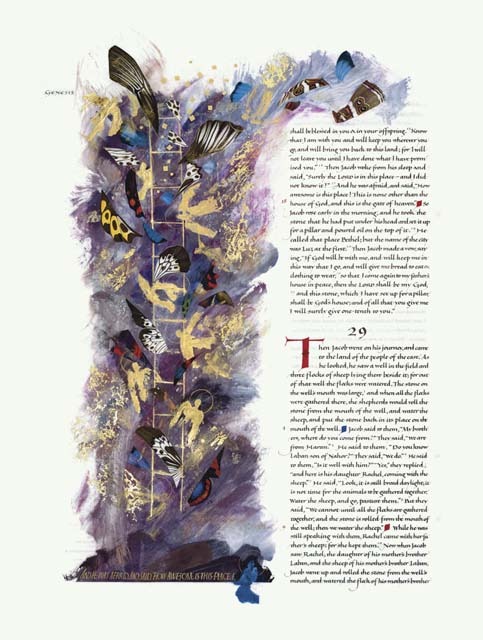
Jacob’s Ladder: This image evokes the surreal wonder of Jacob’s dream about angels ascending and descending a ladder that reached from earth to heaven. According to the Bible, in that moment when heaven and earth were briefly joined, Jacob realized his special relationship with God. Accompanying the abstract gold angels are fragments of realistic butterfly wings. They echo the angels’ wings, becoming an earthly analogy for angels and also a metaphor for the fleeting nature of Jacob’s vision. The butterflies appear against a lacy pattern of gold, a gossamer presence. The quotation along the bottom, which can be linked with words from the preceding verse — “Surely God is in this place” — refers to Jacob’s powerful and moving experience.

Damselflies

The Ten Commandments: The theological brief from the Committee on Illumination and Text required the artist to combine five different passages from Exodus into a single illumination. Since the committee’s brief also suggested that the giving of the Ten Commandments represented a new creation, they were chosen to create the principal image around which to group the others. Depicted along the top of the composition are the burning bush, the first Passover, the crossing of the Red Sea, and the twelve pillars, representing the twelve tribes of Israel, erected at the foot of Mount Sinai. The lower half of the page contains the Ten Commandments, overlapping and dissolving the colored background. Instead of writing the words, the artist stenciled them, using the typeface Stone Sans to emphasize the authoritarian nature of God’s words.
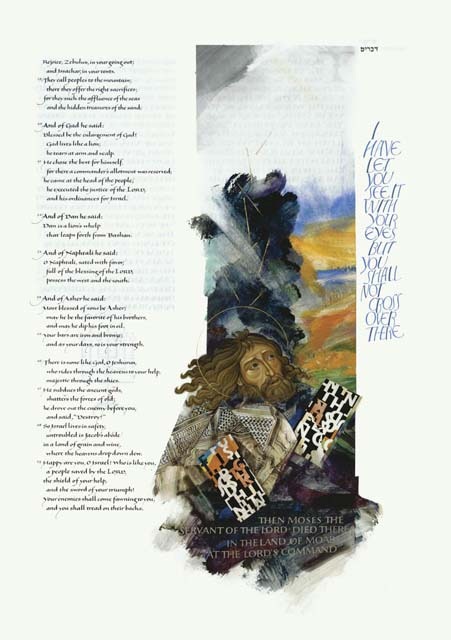
Moses is shown with fragments of the tablets of the Ten Commandments and a prayer shawl patterned after a traditional Middle Eastern design. Mount Nebo is depicted in the background. According to the Bible, God led Moses to the top of Mount Nebo, from where he could see the Promised Land. However, Moses was not allowed to enter the Promised Land because of a momentary lack of trust in God. He died on the mountain.
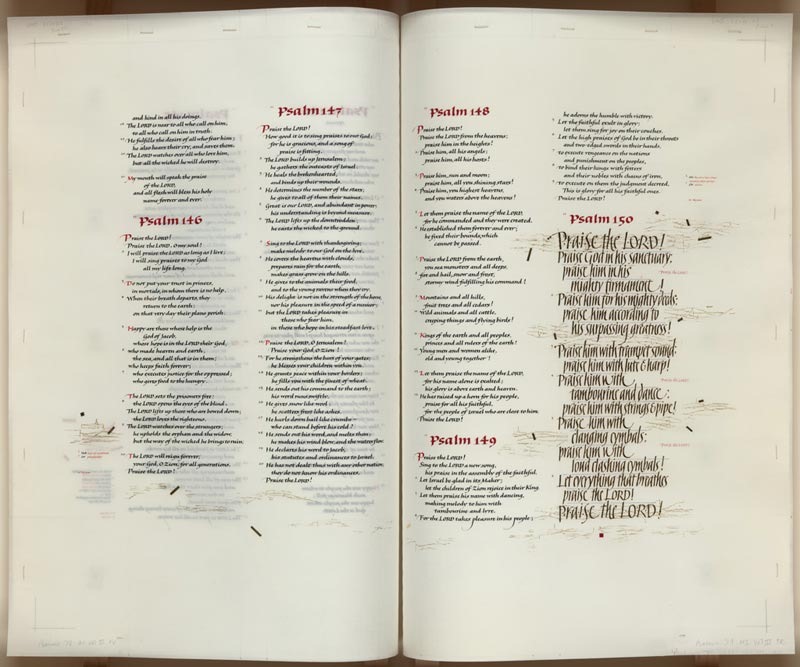
Special Treatment, Psalms

Matthew Frontispiece: The Gospel of Matthew begins with the genealogy of Christ. Reaching back into the Old Testament scriptures to Abraham, progenitor of the Hebrew nation, Matthew lists the names of succeeding generations, culminating in the birth of Christ. This illumination is a family tree structured as both a tree of life and a menorah, the Jewish seven-branched candelabra. Placed at the beginning of the first gospel, the menorah serves as a bridge between the Old and New Testaments. A mandala-like cosmic image near the base is common to several religions and implies the universality of the search for a supreme being. The intricate gold medallions above the menorah were inspired by illuminations from the Koran. Reflecting our own time, patterns of DNA double helixes between the outer branches emphasize the connectedness of all humanity. The ancestral names flank the base of the menorah/tree and climb between the innermost branches. Abraham’s name appears in English and Hebrew, with that of his wife, Sarah, from whom these generations arose. Named in both Arabic and English is Hagar, Sarah’s handmaiden, with whom Abraham fathered Ishmael, the ancestor of the prophet Muhammad, founder of Islam. At the very top is the name of Jesus, in the same lettering style as Abraham, David, Mary, and Joseph.
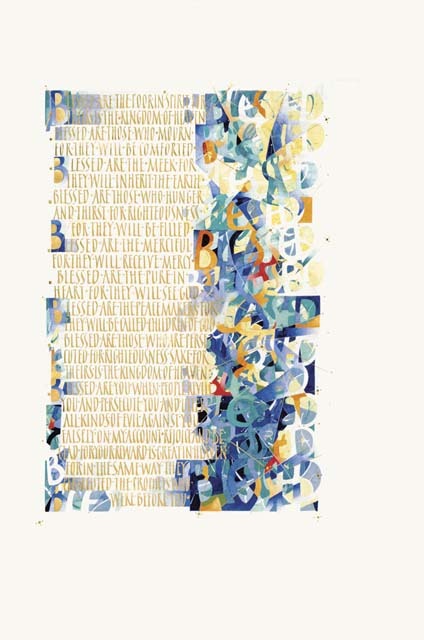
Beatitudes: The letters of the word “blessed” are scattered randomly in a multicolored pattern, here and there reuniting to form the word. The overall effect recalls mosaic decoration, a traditional artistic medium dating to pre-classical times in the Near East.
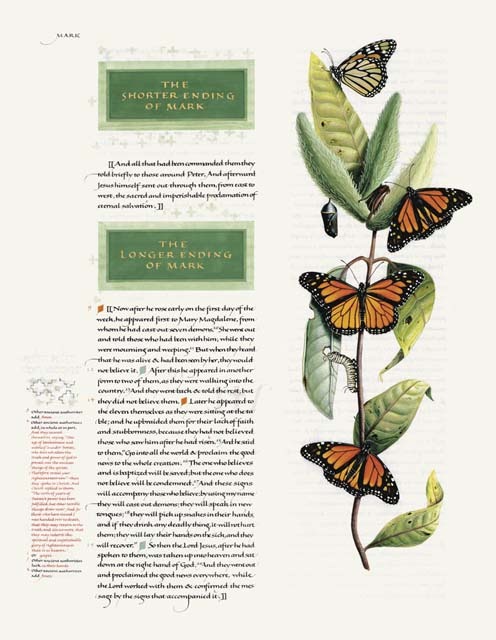
Monarch Butterflies: The margins of medieval Bibles were often decorated with plants and animals that had symbolic meanings. In Christian art the butterfly symbolizes resurrection. The three stages of its life–caterpillar, chrysalis, and butterfly– correspond to life, death, and resurrection. In The Saint John’s Bible, all the species of flora and fauna depicted in the margins are native to the Minnesota woods surrounding Saint John’s University or to the Welsh countryside near Donald Jackson’s home. Chris Tomlin, a specialist in botanical and nature illustration, came to Minnesota to research subjects for marginalia, and these monarch butterflies help root this Bible in the community of Saint John’s Abbey and University in Minnesota.
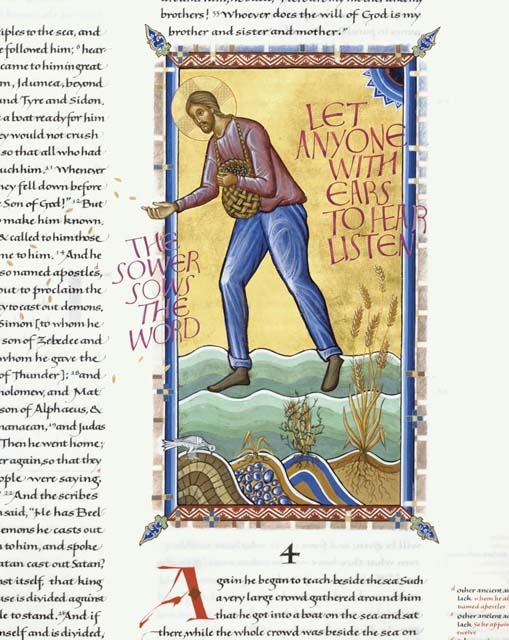
The Parable of the Sower and the Seed (Mark 4:3-9): In this icon-like image, the sower’s halo, with its cross, identifies the figure as Christ sowing the word of God. His contemporary Western work clothes indicate that this image is a metaphor, in which the sacred message is revealed through a mundane action. The four small hills along the bottom signify the four kinds of soil on which the sower’s seed falls. According to the Bible parable, the hard path, where the seed cannot take root and is eaten by birds, signifies the closed mind that refuses to hear God’s word. The rocky ground, where the sprout is short-lived, represents shallow people who accept the word of God but do not let it take root in their inner being and fall away when they are persecuted. The thorny ground corresponds to people who understand God’s word but let material things choke their spiritual belief. The good soil, where the wheat has taken root and thrives, represents those who act upon the word of God and share it with others. 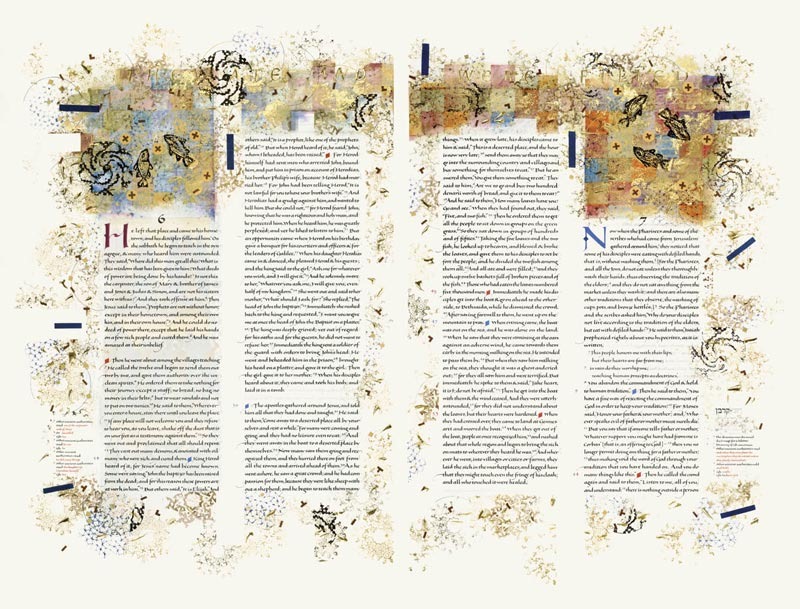
The Multiplication of the Loaves and Fishes (Mark 6:30-44, 8:1-10): In the Gospel of Mark he narrates twice the story of Christ providing food for multitudes of people, probably giving two versions of the same event. This illumination accompanies the first version, in which Christ miraculously multiplied five loaves and two fishes to feed five thousand people, with twelve baskets of leftovers. Tradition locates this event at Tabgha, on the west side of the Sea of Galilee. In this image, the stamped images of fish derive from a mosaic in Tabgha and the circular loaves, marked with a cross, prefigure the bread of the Eucharist (Communion). The baskets (shown partially) have geometric designs based on ancient Native American Anasazi basketry, acknowledging the American origin of this Bible and the coexistence of other beliefs.

Luke Anthology: In this image five parables and one story unique to the Gospel of Luke are illustrated in diagonal bands that read in descending order from left to right. The three “parables of the lost” are about God seeking and finding lost sinners. The image of Christ at the top right figures in all the scenes.
Parable of the Lost Coin (15:8-10): Scattered coins represent the boundless joy of a woman who has turned her house upside down to find her lost coin. Parable of the Lost Sheep (15:4-7): A bedraggled sheep, alone in the dark, looks toward the golden light streaming from Christ and his angels, which promises rescue and return to the fold.
Parable of the Good Samaritan (10:29-37): Quotations from the text spell out the triumph of love over sectarianism and over adherence to doctrine at the expense of compassion.
Parable of the Lost Son (15:11-32): The erring son leaves the pigs he has tended and returns to his father, who runs to meet him and forgive him. The twin towers of the World Trade Center point to the need for forgiveness in our time and for seeking alternatives to revenge.
Parable of Dives and Lazarus (16:19-31): Dives (“wealthy one”) feasted while Lazarus begged at his door. The scene shows them after death, separated by a chasm: Lazarus, carried by angels, rests with Abraham, while Dives suffers the fiery torments of hell.
Martha and Mary (10:38-42): The sisters look toward Jesus, who approved Mary’s listening to his teaching and rebuked Martha’s unneeded acts of hospitality.
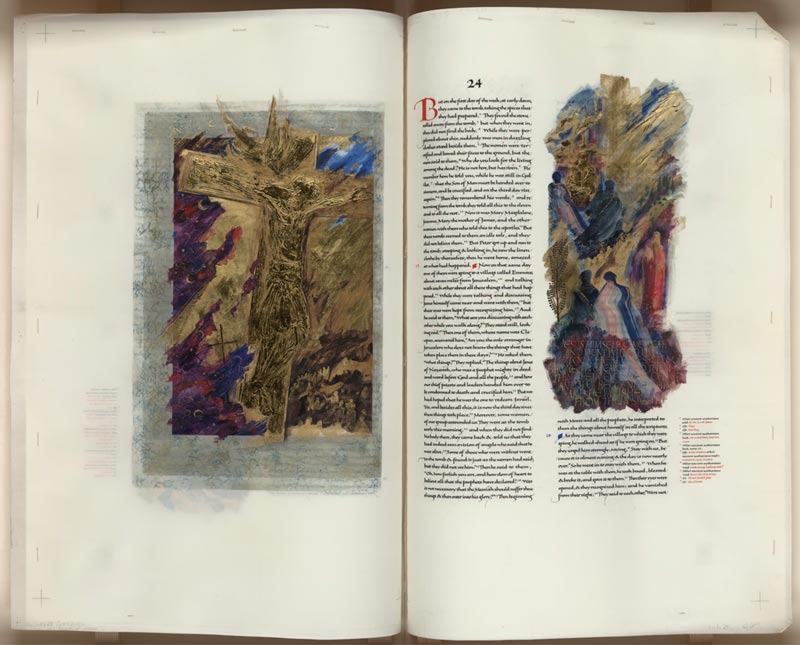
The Crucifixion (Luke 23:44-49): Rendered in raised and burnished gold, the crucified figure of Christ dominates this composition. Luke’s Gospel recounts that upon Christ’s death darkness covered the earth for three hours, indicated here by the night sky, and that the curtain of the temple, shown as shreds of purple, was torn in two. The contrast of pain with the glory of gold relates this image to current theological discussions concerning the meaning of the Crucifixion in the contemporary world. The delicate gray border was printed with English lace, contributing to the recurring theme of textiles in The Saint John’s Bible illuminations.
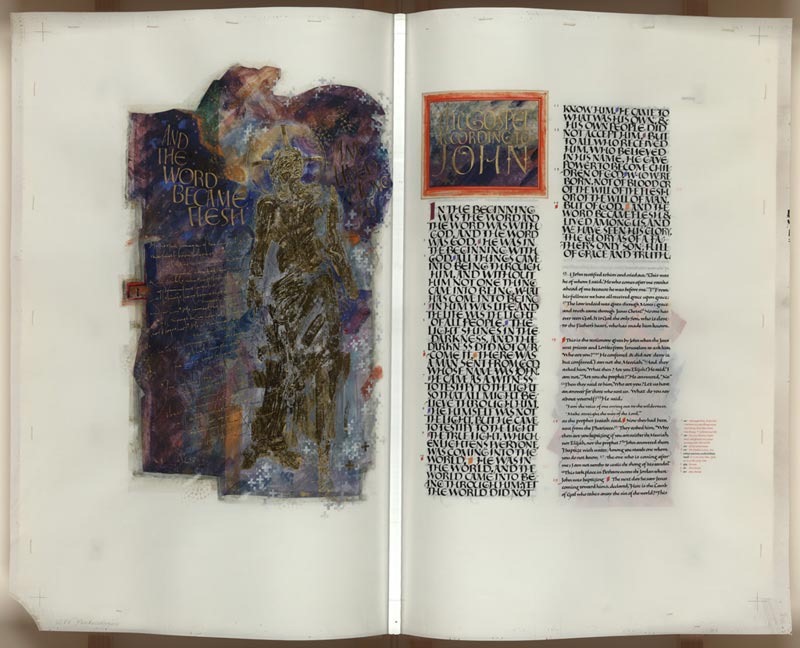
John Frontispiece: The Word Made Flesh (John 1:1-14): Stepping out of darkness, which alludes to the chaos that precedes Creation in the Bible, the golden figure of Christ brings light and order. Words in golden script, from Colossians 1:15-20, link the figure of Christ with the words “And lived among us” at the upper right. A keyhole jutting into the left margin recalls the tradition of locked and hinged manuscripts in securing, protecting, and holding the “key” to the Word of God.
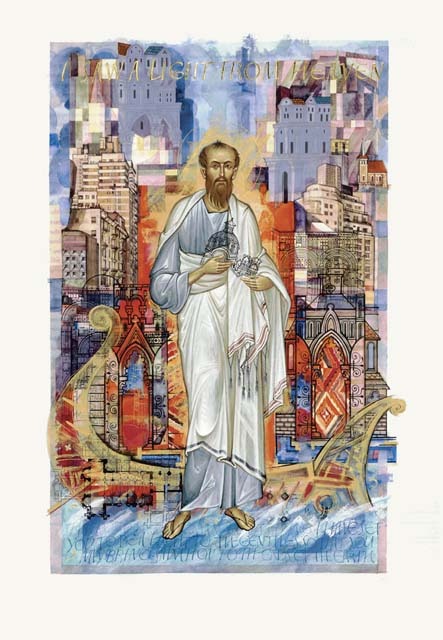
The Life of Paul (Acts): Paul was the apostle to the Gentiles, and he traveled as a missionary throughout the Near East. He is posed here in the manner of classical Greek statues. A prayer shawl draped over his shoulders indicates his upbringing as a devout Jew. Surrounding him are secular and sacred buildings from nearly every historical period of the last two thousand years. Because he made several sea voyages and was once shipwrecked, Paul stands before a Greco-Roman sailing vessel. An energetic church builder, he holds a model of a church that recalls Saint Peter’s Basilica in Rome, the city where he was martyred under the emperor Nero. The words at the top, “I saw a light from heaven” (26:13), refer to Paul’s conversion to Christianity. Those across the bottom proclaim his divine mission: “The Lord has commanded us, saying, ‘I have set you to be a light for the Gentiles, so that you may bring salvation to the ends of the earth’ ” (13:47).

Luke frontispiece: The Birth of Christ (Luke 2:1-20): Gold is used throughout The Saint John’s Bible to indicate the divine. Here a brilliant shaft of light, executed in gold leaf, rises from the child’s crib, making the Christ Child the focal point of this scene, although he is not pictured. His mother, Mary, gazes tenderly on the infant. The shepherds are women and girls, which was probably the case at the time of Christ. Between the viewer and the unseen infant, the animals form a protective barrier. The ox is modeled on one of the Neolithic cave paintings of great aurochs at Lascaux, France. The upper text is the angels’ song. The central text refers to this child’s role as “light to those who sit in darkness,” and the lower text anchors the entire illumination in a metaphor of divine light.
The process of making the handwritten original is quite extraordinary:
Quill Curing: The scribes require quills that are both strong and supple. The best ones come from mature turkeys, swans, and geese. Before they can be used for writing, the quills must be cured, cut, and trimmed. Curing is a hardening process. A studio assistant begins by removing the ends with a quill knife and leaving the quills to soak for twenty-four hours. The next day the assistant takes out the internal membrane and pours warm sand (which has been heated in a frying pan) over each quill while rotating it. When the barrel (shaft) of the quill turns from milky to clear, the sand is removed, and the hardened quills are stored in a jar. Next, the long barbs on one side of the quill are stripped away. A series of three scooping cuts with a quill knife, a slit, and a final trim to the point quickly turn the quill into a responsive writing tool. Now the quill is ready for writing.
Vellum Preparation: The skins used in The Saint John’s Bible come from a vellum factory, where they have been prepared to a certain extent. However, a studio assistant must do the final preparation to ensure a perfect writing surface, a job referred to at the scriptorium as “scrutching.” The skins are rubbed down with abrasives to achieve the right texture. First, the skin is placed on a smooth table and rubbed with relatively coarse sandpaper to raise the nap and to work in and flatten the veins, evening the surface. An infinitesimally fine layer of the skin is rasped off. The next step is the addition of gum sandarac, a resin that has been ground with a mortar and pestle and put in a fine-weave linen bag. Dusting the skin with the bag sifts the gum sandarac evenly across the surface. Then, using a finer grade of sandpaper and a circular motion, the assistant rubs down the skin again, stopping often to check the result. As the work proceeds, the assistant rubs ever more gently, until the finish becomes soft and velvety.
Graphics Layout: On a computer, the project’s graphic designer/typesetter devises the precise layout of every page. This allows the scribes to work simultaneously, since they know in advance exactly how each page will begin and end. Using a typeface that closely approximates the script Jackson designed for the Bible, the graphic designer/typesetter determines the space for each letter based on raw digital text of the New Revised Standard Version, which follows prescribed guidelines. Paragraphing and spacing between paragraphs are integral parts of the translation, and a special dictionary establishes acceptable word breaks. Printouts are created to be used by the scribes, illuminators, and proofreaders.
Ruling Up: When a page of vellum has been prepared, pencil lines are ruled on it for the scribes to follow. A dummy page shows where space should be left for illuminations and how many lines are needed. A line guide placed on the side of the drawing table, with marks for each text and note line, ensures uniform ruling on all the pages. To mark the column widths, a ruling guide is centered on the page and holes the correct distance apart are pricked at the bottom and the top. Vertical pencil lines are then drawn along a metal ruler laid between the holes.
Gilding: In every illumination, gold is the first design element placed on the page. Three types of gilding are used in The Saint John’s Bible: powdered gold, acrylic medium, and gesso. Gesso gilding is the most technically demanding and produces the most spectacular result. Gesso usually consists of plaster, white lead, sugar, fish glue, and a bit of powdered color. It is prepared in advance and kept as small dried cakes until needed. The gilder wets the gesso with water and glair, a liquid drained from beaten egg whites. The rather thick gesso is laid on with a quill or a brush. When dry, it is scraped and smoothed with a sharp knife. Then it is covered with gold leaf – incredibly thin sheets of 24-karat gold. On a suede gilder’s cushion, the gold leaf is cut into small pieces, which the gilder applies one at a time with a finger (the skin’s natural oil attracts the gold leaf). Moisture from the gilder’s breath, delivered gently through a bamboo tube, activates the glue in the gesso. When the application is complete, the gold is covered with a silk cloth and burnished. The slightly raised contours, typical of gesso gilding, reflect light and enhance the gold’s effect.
Tools and Materials: This selection of tools and materials used by the scribes and illuminators includes hand-carved stamps, antique inks and powdered pigments, a mortar and pestle, quills and brushes, penknives, packets of gold leaf squares, a gilder’s cushion and gilder’s knife, burnishers, practice samples of vellum, and an antique drafting set.
The Bible is available commercially in two reproductions. The Heritage Edition is the fancy one:
The Heritage Edition of The Saint John’s Bible is a fine art reproduction of the original. Its creation has engaged the finest printing experts and binders to ensure faithful representation of the original manuscript. A world-class team of scribes, artists, and craftspeople have guided its development from the ink first touching the vellum to the creation of the Heritage Edition—each of which brilliantly maintains the awe-inspiring artistic intent of the original. Each of the 1,150 pages and 160 illuminations has been scrupulously compared to its original counterpart to guarantee accurate reproduction.
Monadnock Paper Mills, a family-owned paper mill in Bennington, New Hampshire, and the oldest continuously operating paper mill in the United States, is supplying the paper for the Heritage Edition of The Saint John’s Bible. It is custom-made of 100 percent cotton with no artificial whiteners or brighteners, coatings or fillers. This archival paper will last for generations.
The Benedictines of Saint John’s Abbey, who place a high value on sustainability and reverence for the earth, are also pleased with the ecological awareness of this partner. Monadnock has achieved carbon neutral status and has been actively involved in caring for their near-pristine New Hampshire environment for nearly 50 years.
The Heritage Edition’s fidelity with the beauty of the original masterpiece is achieved through multiple techniques.
Inks: Fade-resistant, permanent ink is applied through a special printing technique using ultraviolet light. The depth of the images is a testament to the quality of this process.
Foils: Gold and silver foils are applied to the illuminations to capture the stunning effect of gold and platinum leaf in the original. In ancient manuscripts, it’s the presence of gold that qualifies a manuscript as truly “illuminated.”
Translucent Effect: The translucent vellum pages of the original make “show-through” an integral part of the artwork. This is recreated on the cotton pages by printing—in reverse—a light watermark of the adjacent page.
The search for printing vendors for the Heritage Edition began in 2004. Options were explored in England, Switzerland, Austria and Italy, but ultimately it was three companies in Minnesota who were contracted to do the work. John Roberts Company in Minnesota had been working with color management techniques in digital-to-print technologies and invested in a rare, high-tech Heidelberg XL-105 press. They already had partnerships with ColorMax of Paynesville, just 20 miles from Saint John’s University, that initiated the digital imaging of the original pages. Since then the imaging has moved in-house to the Hill Museum & Manuscript Library. Finally, McIntosh Embossing in Minneapolis provide the silver and gold embellishments.
Each volume of the Heritage Edition goes through a rigorous process of color correcting and press checks at every stage. Donald Jackson oversees production, aided by international printing consultant, John Parfitt, Donald Jackson’s studio manager and Sarah Harris.
The Heritage Edition of The Saint John’s Bible is being produced in the same seven volumes as the original. Following the intensive printing process, the pages travel to Phoenix, Arizona, for binding at Roswell Bookbinding. The volumes are bound in rich, handcrafted, embossed red leather. The spines are imprinted with the volume title and number in gold foil. Each volume is finished with an ornamental silver clasp.
There are a number of copies available on public display across the US and Europe. I’ve seen it, and it is spectacular. The volumes are huge.

Mark Dimunation, chief of rare books and special collections at the Library of Congress, apparently claims that the Heritage Edition is “the finest manuscript reproduction the world has ever known.” (I note that I am not the only person to note that this Bible is likely “the most expensive Bible in the world.”)
Not only does this Bible cost $145,000, but even the recommended stand costs $20,000.

(But, if you are tapped out after spending $145,000, you can buy a budget stand for a mere $5,000.)

Now, if that is too much money for you, there is a somewhat less spectacular “standard” version produced in seven volumes by Liturgical Press.
This lovely, accessible edition of The Saint John’s Bible from Liturgical Press offers the complete text and illuminations in a 9 ¾" x 15" hardcover format with dust jackets. Perfect for exploring the text and illuminations and following the progress of the project.
Here are the volumes and current Amazon prices:
Pentateuch ($47.12)
Prophets ($46.79)
Psalms ($37.77)
Wisdom Books ($43.25)
Historical Books ($53.85)
Gospel and Acts ($43.38)
Letters and Revelation ($36.42)
I suspect that for most BLT readers, the Heritage Edition will be something that they can only see in a museum. But given the standard edition is a fine alternative for those who want to explore this impressive work, and far more accessible.
Also worth noting are the volumes in the “Art of the Saint Johns Bible” series (volume 1, volume 2, volume 3), a book of “prayers and wisdom,” a “making of” volume, and a making-of DVD.
(Hat tip to co-blogger Gaudetetheology for posting a comment that led to an exchange suggesting this post.)
The Cone Sisters
This is the visual advertising for the Cone Collection. This piece of art is recognizable. It is a Matisse – known as either the Large Reclining Nude, or the Pink Nude, in contrast with his Blue Nude. A large reproduction of this painting on the outside of the gallery drew people in. This exhibition provided a rare opportunity for me to see the works of Gauguin, Picasso, Matisse, Renoir and Van Gogh in my hometown. I had stayed in the building which housed Picasso’s studio when I holidayed in Paris and I am not ashamed to admit that I have seen Midnight in Paris more than once. I also recently read The Paris Wife which recounted that same period and place from the perspective of Hemingway’s first wife.
But the exhibition had as its focus the life and times of the Cone Sisters who put together this amazing collection. Gertrude Stein is well known for fostering aspiring writers and artists in Paris at the beginning of the last century. But the Cone Sisters were also tremendously influential, supporting artists through their frequent acquisitions of early works. Here is the story,
“It took a lot of gall – guts – to paint it,” Henri Matisse was known to have said about his once-controversial Fauve-period paintings, “but much more to buy it.” So recalled his grandson, Claude Duthuit, in a November, 2010, interview, a few months before Duthuit’s death.
I love that. It is a great tribute to those who have made great art possible through their attention, encouragement and wealth.
Among those who had the guts were Claribel and Etta Cone, Baltimore sisters who during the early 20th century amassed an extraordinary collection, which included more than 3,000 works, including about 500 by Matisse. In the end, the Cones amassed the largest and most comprehensive private collection of Matisse and struck up an important friendship with the artist.
Works from their renowned collection (which also includes 114 works by Picasso, as well as paintings by van Gogh, Cézanne, Gauguin, Renoir, Pissarro and others) are part of this summer’s major show at the Vancouver Art Gallery, Collecting Matisse and Modern Masters: The Cone Sisters of Baltimore, which opens May 26.
While the art is remarkable, so is the story of these sisters’ lives.
Born to German-Jewish immigrants (the family name was originally Kahn) in 1864 and 1870 respectively, Claribel and Etta Kahn were women ahead of their time: intellectually curious and accomplished (Claribel was a medical doctor), and self-taught but prescient in their collecting habits.
“Some of it was luck and friendship, but as they began their collection and started to move forward, their eyes became better and their selections became better. They certainly, for women collectors in the United States, put together one of the greatest modern collections this country had ever seen at that point,” says Katy Rothkopf, senior curator of European painting and sculpture at the Baltimore Museum of Art, where she is responsible for the Cone collection.
Long before they were buying art, the women held Saturday night gatherings that became well-known among Baltimore’s smart set. Among those who attended were the avant-garde writer Gertrude Stein and her brother Leo, who lived in Baltimore for a time. It’s likely that the Steins derived the idea for their legendary Saturday evening Paris salons from the Cone sisters, according to an essay by Karen Levitov, associate curator at the Jewish Museum in New York, which created the exhibit.
The sisters bought their first works of art in 1898. Their father had died the previous year and their eldest brother gave Etta $300 to spruce up the family home. Instead of spending it on traditional décor, she bought five paintings from the estate sale of the American impressionist Theodore Robinson.
The Cones’ collecting began in earnest a few years later in Europe, where the sisters were able to travel regularly thanks to the stipend they received from their brothers, whose textile empire became a major supplier of denim and other materials to Levi Strauss & Co., and, during the First World War, to the U.S. armed forces.
In Paris, the Steins introduced the Cones to important art – and artists. On Oct. 18, 1905, they attended the Salon d’Automne, an alternative to the conservative official Salon. It was groundbreaking, but also controversial; that year, one critic famously compared the art to the work of wild beasts (fauves) – which led to the moniker Fauvism. The work was shocking and even Leo Stein called Matisse’s Woman with a Hat “a thing brilliant and powerful but the nastiest smear of paint I had ever seen.” A few days later, he bought it.
A few weeks later, Gertrude brought Etta to the rundown studio of Pablo Picasso, then virtually unknown, and Etta bought several drawings. More Picassos would follow, including a portrait of Claribel and – a surprise sent in the mail to Baltimore – a pen and ink self-portrait with the words “Bonjour Mlle. Cone” written across the top.
The following January, they met Matisse, and Etta bought two drawings and shortly thereafter her first Matisse oil painting: the Fauve-period work Yellow Pottery from Provence. By the end of that year-and-a-half stay in Paris, Etta had acquired 28 works.
“I think once they sort of got hooked, a lot of the appeal was because they became friends with many of the artists, particularly with Matisse and to a lesser extent with Picasso,” Rothkopf says. “And I think the other thing that really hooked them was that these were souvenirs from time spent abroad. Most of the collection was put together with works bought out of the country. … I think it was sort of part of being in a place that was more fun and more exciting and more thrilling than life back in Baltimore.”
While the relationship ultimately waned, Stein was an important friend and, for Claribel, perhaps more (a diary entry hints at possible intimacy). Etta typed the manuscript for Stein’s Three Lives, and Stein wrote about the sisters in a word portrait, Two Women: “There were two of them, they were sisters, they were large women, they were rich, they were very different one from the other one.”
(Incidentally, the exhibition The Steins Collect: Matisse, Picasso, and the Parisian Avant-Garde is currently installed at the Metropolitan Museum of Art in New York.)
The art hung in their adjacent apartments in Baltimore. Claribel had amassed such a huge collection that she ultimately moved to a different apartment on another floor. Her art stayed – even after her death.
Claribel collected to the end, literally. She purchased her last painting – Gustave Courbet’s The Shaded Stream at Le Puits-Noir – on September 20, 1929, the day she died.
The following year, Matisse, who was in Philadelphia doing work for the Barnes Foundation, travelled to Baltimore to offer his condolences to Etta, and stayed overnight in her guest room. In the apartments, he was confronted by the reality of the Cone collection and what it could mean for his artistic legacy.
“He was completely amazed by what they had been able to put together,” Rothkopf says. “Up to that point, I think up he thought they were important collectors, there’s no question. But after he saw what they had done, I think he really realized that if he played his cards right, he could have a major presence in a major east coast museum.”
Matisse then began making work with Etta Cone in mind: aware of the collection’s public destiny.
As he created Large Reclining Nude over a six-month period, he photographed its progress, mailing 22 pictures to Etta documenting its various stages. She ultimately bought the work, hanging it in Claribel’s apartment across from the tremendous Blue Nude, which had formerly been in Leo Stein’s collection.
The last Matisse oil that Etta bought was Two Girls, Red and Green Background.
Matisse was right to bet on the Cones: When Etta died in 1949, she bequeathed her collection (which included Claribel’s art) to the Baltimore Museum of Art, along with $400,000 to build a Cone Wing.
Rothkopf believes the Cone sisters were more than simply wealthy patrons for Matisse.
“It wasn’t just a financial thing,” Rothkopf says. “Particularly after having seen what she put together in 1930, he wanted her to have some of his best things and really there’s some beautiful letters back and forth between them that are really quite illuminating. They were both very good for each other. He didn’t take commissions, she didn’t do commissions. … He would make things that I think he knew that she would love.”
The collection highlighted more of the sisters life than is represented here. Claribel graduated as a medical doctor and spent the years spanning WWI in Germany doing research on pathology. Etta spent more time in Paris. They both loved shopping. They also kept in touch through regular correspondance and housed their collection in their joint apartments in Baltimore. The exhibit includes photographs and letters of the sisters and their circle.
The paintings of Matisse and the story that goes along with the collection presents an unusually vivid contrast between the two types (a gross and deliberate simplification) of women that artists associated with and benefitted from. On the one hand, there were the wives, lovers, models and odalisques painted lovingly and with great detail. In the case of Matisse, his incorporation of pattern and texture from Oriental fabrics into the paintings delight the feminine observer. On the other hand, there were the patrons, the Cone Sisters and Gertrude Stein, dressed demurely in long dark wool suits, in the mannish style of the first couple of decades of the last century.
What are we to make of this art, collected by women, composed of exquisite line drawings, abstract paintings and scuptures of the female nude? We admire their courage and foresight in supporting this art when few others appreciated it. We can look on with tenderness at the pathos of the nude models in some of the more representational pieces. But we have to admit that the relationship of male and female in real life is complex, not so easily reduced to a binary. What do you think?
Weird Bibles 4: Digital Handwritten Bible
The People’s Handwritten Bible was created by the Bible Society (England and Wales) and the Scottish Bible Society. It claims to “create a unique legacy for future generations.”
It’s your chance to write the Bible by hand – starting at the book of Genesis, right through to the book of Revelation.
You’ll get to write at least two verses. The project is unique because everyone who chooses to write a verse will be asked to do so with a digital pen. So there’ll be a new paper copy of the Bible and also an online archive of everyone’s verses you can show to your friends.
The project will begin at Edinburgh Castle on 19th June 2011, the anniversary of the birth of King James VI/I at the castle in 1566. It will end at Westminster Abbey on 16th November 2011.
Celebrity verses were contributed by Charles Windsor (whom you may know as “Duke of Wales”), Rowan Williams, John Rhys-Davis (who has terribly uncultured handwriting), David Cameron, and a guy who won some television game show called “Big Brother” (what an awfully Orwellian name!)
The King James is mostly complete (although plenty of searches indicate “We have been experiencing some technical problems and are trying our best to resolve them. We would like to apologise to those people whose verses are not yet available to view on the website. Please bear with us. The verse has been written, but the image is not yet online.”)
It is particularly spotty in the Apocrypha. The search page also indicates that the Good News Bible, y Beibl Cymraeg Newydd (“the Revised New Welsh Bible”), and the New Gaelic Bible, are present, but outside the KJV, coverage becomes particularly unreliable.
(I am most annoyed that the KJV is identified as “Old English” and the Good News Bible is identified as “New English.” If you want to talk about Old English Bibles, then we can talk about the West Saxon Gospels or Paris Psalter or Vespasian Psalter or Lindisfame Gospels.)
All-in-all, a pretty pointless site, and one that I doubt that will be available in a decade – let alone “a unique legacy for future generations.” But still, mildly amusing.
(HT: Brad Taliaferro)
Previous posts:
Weird Bibles 3: Playful Puppies Bible
Weird Bibles 2: Etymological New Testament
Weird Bibles 1: Archaic Aramaic script
An Orthodox translation
Online Concordances?
A quick question for my distinguished co-bloggers and other BLT readers: What concordances do you use and recommend, and why?
In particular, I’m looking for a unified concordance of the Greek New Testament and Old Testament that’s usable by persons without much Greek, so that I can, for example, look up a verse in the NT, and click through from the particular English word to a concordance entry for the corresponding Greek word that will cover both the NT and the Septuagint. Paul is frequently riffing on, alluding to, and quoting from the Law, the Prophets, and the Writings, and I really want to check some of his key terms in the Tanakh.
I normally use http://blueletterbible.com for its built-in concordance, but that is based on Strongs and works for either the Hebrew OT or the Greek NT. But that shows you the kind of interface I’m used to and hoping for.
Any suggestions?
The Translators to the Reader
One of the most interesting parts of the King James Bible is the statement by the translators (written by Myles Smith, who would become Bishop of Gloucester the next year) entitled “The Translators to the Reader.” This statement sets forth what the objectives of the translators were, why the translation is justified, answering objectives from both Catholics and Calvinists who object to a new translation, and explaining the translation philosophy of the authors.
Unfortunately, it is also a dense piece of academic prose, that freely mixes English with Latin and Greek, and has long, complicated sentences. Opening my copy at random, I find this single sentence, for example:
But the difference that appeareth between our Translations, and our often correcting of them, is the thing that we are specially charged with; let us see therefore whether they themselves be without fault this way, (if it be to be counted a fault, to correct) and whether they be fit men to throw stones at us: O tandem maior parcas insane minori: they that are less sound themselves, out not to object infirmities to others. [Horat.]
One gets the general sense of the sentence, but following it in detail is difficult. For example who is Horat.? (It turns out it is a quote from Horace’s Satirae 2.3.326, although it is an incorrect quote juxtaposing two words; Horace wrote O major tandem parcas, insane, minori “O greater one, spare, I pray, the lesser madman.”) Further, what is the background that would explain a hostile statement like this? It seems like strong writing, but what does it mean in plain English?Indeed, anyone who thinks that dense academic prose is a twentieth and twenty-fist century affliction can find a seventeenth century practitioner in “The Translator to the Reader.”
And it name drops like crazy: Cato the Elder, Gregory the Divine (Gregory of Nazianzus), Plutarch, Justinian, Theodosius, Suidas, S. Aurelius Victor, Eusebius, Augustine, Jerome, Cyril, Tertullian, Justin Martyr, Hephaestus, Clement of Alexandria, Cicero,, Nicolas I, Michael III, Aquilla, Efnard (a misprint for Einard!), Trithemius, Bede, Alfred, Methodius, Aventinus, Valdo Bishop of Frising, Beatus Rheananus, Cporbinian, Valdes, Charles V, Beroaldus, Richard II, Johhn Trevisa, Widminstadius, Augustinus Nebiensis, Postel, Ambrose Thesius, Potken, Cromwell, Radevil, Ungnadius, Clement VIII, Pius IV, Henry VIII, Edward VI, Aristotle, Timotheus, Ptolemy Philadelphus, Epiphanius, Ambrose, Pamelius, Radulphus de Rivo, Pius V, Valla, Stapulensis, Erasmus, Vives, Leo X, Pagnini, Trent, Paiva, Vega, Hieronymus ab Oleastro, Isidorus Clarius, Thomas a Vio Cajetan, Hentenius, Sixtus V, Demaratus of Corinth, Xanthopolulos, Chrysostom, Ireney, Theodotion, Symmachus, Ebionites, Epiphanius, Cataline, Nero, Origen, Sophocles. Now, probably you know some of these names, but I doubt you know all of them!
And then there are the archaic words: glout, panary, and portess. Perhaps these words will cause some to go to the dictionary.
And this density is unfortunate, since the style of the King James Bible itself is rather simple and accessible. Because “The Translators to the Reader” is so difficult, most Bibles omit it (or, if they print it, they print it without the original notes and Greek quotations). And that is doubly unfortunate, because it is quite an interesting document and presents great insights into the philosophy of the translators.
(Instead, Bibles generally reproduce the “Epistle Dedicatory” fawning to the monarch, which has much less interest unless one collects obsequious literature .)
Fortunately, the American Bible Society has produced a marvelous short book (only 85 pages, although the page size is 8.5 x 11 inches) entitled The Translators to the Reader: The Original Preface of the King James Version of 1611 Revisited edited by Erroll Rhodes and Liana Lupas. The format of the book is simple – it contains four sections:
- A brief history of “The Translators to the Reader” and outline of its argument.
- A facsimile of the “The Translators to the Reader” from the 1611 edition (it is the small print of the facsimile that necessitates the large page size, although I still needed to use a magnifying glass to read the marginal notes from the original.)
- A transcription of “The Translators to the Reader” in modernized spelling, with extensive annotation (206 notes, with the word count of the annotation apparently exceeding the word count of the original.)
- A slight rewriting of “The Translators to the Reader” into modern syntax. This is done rather tastefully, with minimal rewording. For example, the sentence quoted above becomes:
But the difference that appear among our translations, and our frequent corrections of them, is what we are charged with specifically. Let us therefore see whether they themselves are without fault in this respect (if it is a fault to make corrections), and whether they are qualified to throw stones at us: “they that are less healthy themselves ought not to point out the infirmities of others.” (Horace)
The most valuable section to me is the third one; with its extensive annotation. I had thought before that I had understood the nuances of “The Translators to the Reader,” but now that I have read this edition, I realize that I did not understand them nearly as well as I could have. I can also imagine that the fourth section will prove valuable to many readers, since the prose in “The Translators to the Reader” is difficult. The other two sections, the overview and the facsimile, are also useful.
All in all, this is a book I would heartily recommend to anyone who is attempting to understand the historical context or translation philosophy of the King James Version. I would think that any Bible translator would find it interesting (it is an interesting counterpart to the theories of Eugene Nida, for example.) At less than twelve dollars at Amazon, it is a bargain.
The Rashomon world of Gillian Evans and the boys
 The famous Akira Kurosawa film Rashomon, based on Ryunosuke Akutagawa’s short story “In a Grove,” presents a related set of events from three different perspectives, each of which reveals different aspects. In the spirit of Rashomon, here are three different stories about Gillian Evans. To the best of my knowledge, all of the statements in this post are correct. All of the quotations and assertions I make in this post are easily verifiable from Web documents, and I have given links to my sources of information. (While I have heard comments about her privately from colleagues, I do not repeat them here.)
I
Gillian Evans is a retired professor at University of Cambridge in the field of Medieval Theology. But it was no easy task for her to earn that position. She faced substantial institutional pressure and sexism within her university. She grew up in a working class family – her parents had left school at age 14. But she went on to earn a degree in history at Oxford and a certificate in education, and then a doctorate at Reading University. She was then appointed a lecturer at Bristol University and finally an assistant lecturer at Cambridge.
After winning a prestigious research readership from the British Academy in 1986 (there can be up to twenty offered each year, but that year there were only six) and writing thirty-four books (many of these were anthologies, though) and 140 refereed articles, Evans raised the question of a promotion with her University – to a readership or even better a professorship. However, despite her repeated requests, she was denied over and over again.
Sexism might have been the proximate cause here – Cambridge has a poor record in promoting women. The facts are these: in 1997, only 13 out of 247 academic staff at Cambridge at the professor rank were women. An independent panel (set up at the demand of an appeals court) resulted in seven outside academics who wrote to the Cambridge’s vice-chancellor, arguing that Evans had “top marks for teaching” and objecting to bias against Evans. Her college voted a recommendation for promotion in 2001, but again, the Cambridge administration turned it down. A 2000 independent audit “found that Cambridge’s predominantly white, male leaders were propagating a macho and intimidating culture and were largely blind to the needs of female, ethnic minority and disabled colleagues.” While women accounted for 14.7% of Cambridge’s academic staff, they were only 6.25% of the professors.
Sexual harassment seems to have been part of the picture too. One male professor told her it was “quite nice having a doll among us.” Nonetheless she does not attribute her failure to be promoted to sexism, but rather to just ordinary university power politics. However, she pointed out that she was the subject of attempted groping: “I was chased around a table once by an amorous don. I got away. I think it is, and was, an abuse of power and no one should have to put up with being pawed to get inspirational teaching.” (Rather incredibly, this led her colleague Mary Beard to become oddly wistful for the days when university sexual affairs were permitted; Beard wrote about the same perpetrator: “But one also – honestly – can’t help feeling a bit nostalgic for that, now outlawed, erotic dimension to (adult) pedagogy.”)
She sued the university (even earning a distance learning law degree in the process) and won at the initial stages, but lost in 2002 High Court when a judge deemed her complaint to be a contractual one that was not under its jurisdiction. However, in light of the embarrassment caused by the court case and attendant publicity (and to doubtlessly avoid further court action), Cambridge University reversed itself and offered her a professorship (skipping over the intermediate step of a readership) in 2002. The Times Higher Education Supplement exclaimed that
Dr Evans was uncharacteristically coy when she admitted her promotion would "polarise" the academic community – while some hail her as a hero, fighting a David and Goliath-style battle against the establishment, some academics no longer try to disguise their contempt, accusing her of paralysing Cambridge’s governance machine and draining the university’s coffers with her interventions, complaints and legal cases.
Her professorship will silence the critics who whispered she was driven only by ego and her inability to accept that she was not of the right academic calibre to join the highest tables at Cambridge. One of the first things she did on hearing the news was to declare that she would now be able to "press on with the battle to get fair treatment for all the university’s staff and students".
Indeed, as part of her campaign to remove artificial limits on the number of possible promotions, she executed a parliamentary maneuver that forced the university to submit the campus budget to the faculty – which in effect meant that the university could no longer sign make any payments. The Guardian characterized it this way:
When she arrived, Dr Evans says the system was entirely based on patronage, with an artificial cap on numbers. After campaigning, the university introduced a set of procedures, which Dr Evans calls "a triumph". She also got the cap lifted, meaning promotion was based on merit. Prior to this competition for professorships often pitched a linguist against an astrophysicist.
Dr Evans admits her campaigners used "blackmail" to achieve their aim. They called for a vote to sanction the budget, which effectively paralysed the university as it was unable to sign cheques. She chuckles when she tells this story.
Her eventual promotion might have been a case of the squeaky wheel getting the grease, but her academic record certainly exceeded many professors at Cambridge.
II
Gillian Evans is a retired professor at University of Cambridge in the field of Medieval Theology. But she is also an unusually sloppy researcher. Her books are full of errors. This is apparent in many reviews of her books, but even in the letters to the editor in the paper. Thus, Donald Welbourn, a member of the engineering faculty at Cambridge, managed to take a peak at an article she published in a book:
I recently read The Oxford Illustrated History of the Bible. I was brought up short in the chapter "The Middle Ages to the Reformation", where G. R. Evans writes about the loss of Latin as the language of normal exchange in the West. "It gradually became the language of the ‘learned’ and so the text of scripture and these old sermons could not be understood by ordinary people in parishes. Largely uneducated clergy concentrated on the liturgy, and left out sermons altogether."
When did the "ordinary people in parishes" speak Latin? In this country they probably still spoke Anglo-Saxon, with perhaps a little Norman French. If this is the level of Evans’s scholarship, some people may have doubts about voting for her to have a chair.
Welbourn continued as reported in this account:
Mr Welbourn returned to the attack yesterday, quoting from critical reviews of some of Dr Evans’s books published in scholarly journals here and in the United States. He said her work had been described as "not deeply perceptive", "flawed" and having "serious shortcomings".
Evans responded in possibly the least effective way – with an ad hominem attack:
Dr Evans brushed aside the criticism and said she stood by what she had written. "In the Middle Ages, people did understand Latin in the pews," she said. "Can you imagine the Oxford University Press publishing it if I was wrong?
"Mr Welbourn is an ignorant, spiteful, 86-year-old engineer who knows nothing about medieval history."
But, of course, Evans was wrong – and her strange defense of her claim that Latin was widely used in Britain completely incorrect. This was even reported in the press:
Dr John Blair, an Oxford University historian who is an expert on the period, said: "There was never a time when more than a minority could understand Latin fluently. There is no way that an average medieval peasant, or even townsperson, could have understood a Latin sermon. There was a lot of preaching in English from the 10th century onwards."
Most recently, Evans got in trouble for a book that she wrote for InterVarsity Press, The Roots of the Reformation. (I actually own this book, but have not yet read it.) Carl Trueman, a faculty member at Westminster Theological Seminary with a chair in church history, wrote a devastating review:
The Reformation section is unfortunately replete with errors of historical fact, some of which are very serious, even if a few are possibly the result of typos. The sheer number of these errors renders the book a liability in the classroom and undermines its stated purpose as a textbook.
Here are the errors which I found on a single reading:On p. 178, Evans has Huldrych Zwingli discussing his common place book with Heinrich Bullinger in 1534. The only problem is that Zwingli was killed on the battlefield of Kappel in 1531, as Evans correctly notes on p. 333.
On p. 249, Evans describes Johannes Reuchlin as just a friend of the Melanchthon family. He was actually Phillip Melanchthon’s uncle, as Evans correctly states on pp. 264 and 273.
On p. 291, Evans incorrectly gives Andreas Bodenstein von Karlstadt’s middle name as Bodenheim.
Evans’s treatment of the Diet of Worms on pp. 292-93 is wrong at numerous points. She claims that Luther was summoned to Worms by the Edict of Worms. In fact, the Edict of Worms was the key piece of anti-Luther legislation promulgated at Worms. Before Worms, Aleander (the papal nuncio) and others had engaged in intense legal and procedural debate about how, or even if, an excommunicated man could be summoned to an imperial diet; but the Edict was not the summons to the Diet but rather a decree of the same. This confusion will make classroom discussion of subsequent imperial enforcement of the Edict (crucial in understanding the subsequent shape of Reformation Europe) incomprehensible.
On the same page, Evans identifies John Eck at the Diet of Worms with John Eck the scholar with whom Luther and Karlstadt debated at Leipzig in 1519. In Evans’s narrative Worms thus becomes Round Two of an ongoing Ali-Frazier kind of rivalry. In fact, these Ecks are actually two different people. The Eck of the Leipzig debate was Johann Maier von Eck a university scholar; the Eck at Worms was Johann von der Ecken, an employee of the Archbishop of Trier. This is precisely the kind of confusion against which teachers of the Reformation are always warning their students; it does us no favours to have it enshrined in a textbook.
The Landgrave of Hesse, Philip, organised the Marburg Colloquy, not the Margrave as claimed on p. 317.
On p. 318, Evans’ treatment of the Book of Concord is so superficial as to give no real information or insight into the rather complicated development of post-Luther Lutheranism and, in fact, to be thoroughly misleading. No mention is made of the brutal struggle within Lutheranism between the Philippists and the Gnesio-Lutherans, nor of the role of the two versions of the Augsburg Confession (invariata and variata) in this. The Book is not so much about general Christian unity as it is a sign of the triumph of the Gnesio party within Lutheranism.
On p. 319, Evans claims that early English Reformer Thomas Bilney had ‘extreme reforming opinions.’ In fact, while Bilney was undoubtedly a huge influence on a generation of significant English Reformers, he himself was so equivocally and mercurially Protestant in his thinking that even John Foxe shows some embarrassment about his theology in his account of Bilney’s life and martyrdom in Acts and Monuments.
On p. 323, we are told Wolsey died in prison. He did not. He died while travelling to face trial.
On p. 334, we are told that Zwingli was handing out sausages at the Lenten Fast in 1522. This is unlikely. Zwingli was certainly present at the breaking of the Lenten Fast by the printer, Christoph Froschauer (and his men) in 1522. This event did, indeed, involve the consumption of a sausage but Zwingli’s role in the event seems to have been cautious: he did not eat the sausage and I do not think that there is any evidence he was handing such out. Even if he did, the significance of the event lies in the alliance it demonstrates between Froschauer and the reformist party in the early days of the Zurich Reformation, yet Evans does not mention the printer at all.
On pp. 343-45, there is major confusion concerning Calvin and Geneva. On p. 343, for example, the narrative is muddled but the most natural reading of what Evans writes is that Farel persuaded Calvin to take up residence in Geneva in 1532. Calvin did not come to Geneva until 1536. The impression is also given that it was here that he published the first edition of the Institutes in 1536. Calvin was actually in Basel at the time of its publication.
Calvin did return to Geneva in 1541, as Evans notes on p. 344, but this was not (as she claims) at the invitation of Farel. Farel had left Geneva as an exile with Calvin in 1538. It was the city who invited him back (as Evans correctly notes on the very same page in a strange contradiction of the earlier claim). Calvin also stayed in Geneva until 1564, when he died, not only until 1549, as Evans claims.
On these same pages there is also considerable weirdness in the discussion of the role of the Libertines. On p. 344, the impression is given that the Libertines never wanted Calvin to return; this is not the case. Some of those Calvin later labeled as ‘Libertines’ were among those who were most keen to engineer his return in 1541. Given that this is supposed to be a textbook, it would also have been helpful for Evans to note that ‘Libertine’ was an unfair polemical term used by Calvin to make it look as if the issues between him and his opponents were moral and theological rather than personal and ethnic. Evans failure to highlight the importance of French immigration to Genevan politics and to Calvin’s changing relationship to those he later labels as Libertines is a very serious lacuna here, given that this is supposed to be a textbook.
The weirdness continues on p. 345 where the impression is given that the Libertines caused trouble for Calvin in his prosecution of Servetus. The comment is enigmatic and no detail is given as to what this trouble might have been. I was, however, left with the impression that this trouble might actually have been the condemnation and burning of Servetus, as if Calvin was not supportive of these. If so (and, again, the vagueness of the text is lethal in a textbook), this is not correct: Calvin was, of course, the key prosecutor and clearly wanted Servetus to die for his crimes (as did the Lutherans and the Catholics, for that matter); he did try to get the sentence changed to death by beheading but that was the extent of his disagreement with the verdict.
On p. 346 we are told that the last edition of Calvin’s Institutes was published in 1558. It was not. The final Latin edition was published in 1559.[…]On p. 359, Evans describes the Scottish Book of Discipline of 1560 as reflecting ‘the peculiarly repressive and punitive flavor of Scottish Calvinism.’ No evidence is provided to demonstrate why the provisions of the book were so notably harsh in comparison to other similar documents of the time. No mention is made of the fact that it was never formally ratified by Parliament, or of the function of Reformation theology and polity within the internal political struggles in Scotland at the time. (This is actually a weakness of the entire Reformation section: material factors such as politics, economics and technology play no significant part in Evans’s narrative).
On p. 360, Evans dispatches the Westminster Assembly in a single paragraph and refers incorrectly to the Larger Catechism as ‘the Longer Catechism.’On p. 362, Evans claims Edward VI wrote the preface to the first Book of Homilies. This is not correct. It certainly had royal approval but Edward was only ten at the time of its publication.
On p. 376, Evans is confused over the relationship of Presbyterians, Puritans and Separatists to the vestiarian controversies of the Elizabethan church. This is too complicated for me to untangle here. Suffice it to say that discussions of the respective powers of church and state, and the extent of the Bible’s practical normativity for ecclesiastical practice meant that the issues of polity and vestments had been intertwined from the moment they first arose in the Edwardian reformation twenty years earlier.
On p. 415, Evans makes the statement ‘Whitgift did not regard the Calvinists as a threat in the way Richard Bancroft did.’ This is odd. Of course, how one reads this particular statement depends upon how one defines ‘Calvinist’ but, if you take it in its usual theological sense, then Whitgift was himself a thoroughgoing Calvinist and the statement is redundant. He was, after all, the author of the vigorously anti-Pelagian, Calvinist Lambeth Articles which were later embodied in the Irish Articles. What Evans actually appears to mean by ‘Calvinists’ is either ‘Presbyterians’ or, to use the broader category, ‘Puritans’. Unfortunately, given the state of scholarly literature, this is a confusing use of the term. Indeed, Evans uses terms such as Calvinist, Puritan, Presbyterian and Separatist without defining them or connecting to the massive scholarly literature which discusses these concepts. It is, of course, unreasonable to expect the writer of a general history to have acute knowledge of every area upon which she touches, but some knowledge of the contours of current scholarly discussion is surely vital in a textbook. Evans’s failure to grasp how contemporary Reformation scholars use such important terms leads to a most unhelpful and misleading treatment of the Anglicanism of the late sixteenth and seventeenth centuries. This will simply confuse, not enhance, classroom discussion.
There are other problems in the book. In addition to the lack of discussion of the material factors as noted above, there are other significant omissions. There is no mention, for example, of the role of eschatological expectation in the late Middle Ages and its influence on the Reformation. Thus, Evans never addresses Savonarola’s life and influence, nor Luther’s attitude to the Jews, both of which connect to this eschatological perspective. There is no discussion of the Geneva Bible, which is odd given the space devoted to the King James Version. One cannot understand why the King James Version was even written without knowing about the Geneva Bible. Further, the later chapters lack any real structure and have a rambling, anecdotal, superficial quality which leads to some strange moments: why, for example, is Samuel Taylor Coleridge quoted on p. 442?
Then there is the mercurial scholarly apparatus: the website of Still Waters Revival Books Newsletter is not a scholarly resource for the text of the Scottish Confession of 1560 (p. 413). The citation should be from the collection of E.F.K. Müller, or even those of Schaff or Dennison, not an eccentric website. There are also repeated confusing references to the confession of faith of one Emmanuel Baptist Church and even to a couple to Chick Tracts. These are not explained; indeed, they are left to stand as if somehow they represent mainstream Reformation Protestantism in the present. I found these references superfluous and confusing.
This single review led IVP to withdraw the book and demand a rewrite. IVP apologized:
Recently, concerns have arisen among some of our readership in response to a review by Carl Trueman, regarding inaccuracies and inconsistencies within certain sections of Gillian R. Evans’s The Roots of the Reformation: Tradition, Emergence and Rupture.
Professor Evans’s work is an important and valuable contribution to historical understanding. We strongly affirm the integrity of everyone involved in this project, from the editors to the endorsers, and we also want to express our firm commitment to the scholarly integrity of this project.
But the issues Trueman points out clearly do not represent the academic standards we as a publisher hold ourselves to. Unfortunately, these issues were not caught during our standard, thorough review procedures. The presence of such oversights in manuscripts is common in the publishing process, however, especially with large and complex texts.
Nonetheless, we as the publisher take full responsibility for them. Therefore, as of the beginning of June, IVP has taken The Roots of the Reformation out of print and will no longer be shipping orders of this edition. Our goal is to publish a carefully revised second edition of the book by the end of August, in time for Fall semester classes. Further, IVP will offer a complimentary copy of the second edition, including free shipping, to everyone who has already purchased the current edition.
We hope that this underscores the abiding value of Professor Evans’s book, one that a number of internationally respected scholars have recommended as a masterful investigation of the Reformation’s roots from the early church through the medieval era.
III
Gillian Evans is a retired professor at University of Cambridge in the field of Medieval Theology. She has been widely acknowledged as an expert and her books have been praised by major figures. However, one sometimes wonders whether those praising her have actually read her books, or are rather simply giving her support because of her institutional and confessional affiliations.
Conservative Reformed blogger Justin Taylor mentioned her book in his blog taking particular note of the endorsements:
“The Roots of the Reformation is a book which does not just give an account of the Reformation but sets it in the context of earlier church history, showing where there is continuity and where there is radical change. This will be a welcome addition to the textbooks available.”
—Anthony N. S. Lane, Professor of Historical Theology, London School of Theology
“Far too many students have tried for too long to understand the Reformation in isolation from the long history that preceded it. Cambridge medievalist G. R. Evans has attempted to correct that unfortunate shortsightedness by placing the history of the Reformation in the larger context of its place in the unfolding story of early and medieval Christianity. Her informative book illuminates what is traditional and what is genuinely new about early Protestantism and reintroduces Protestant Christians to their own roots. Essential reading for any student of the Reformation.”
—David C. Steinmetz, Kearns Distinguished Professor Emeritus of the History of Christianity, Duke University
“G. R. Evans is one of our finest scholars, and she has written a superb book placing the story of the Reformation in the wider context of Christian history. Comprehensive, well researched and readable.”
—Timothy George, general editor, Reformation Commentary on Scripture
“Briskly and breezily, but very efficiently, medievalist Gillian Evans here surveys Western Europe’s changing and clashing views of Christianity from the fourteenth century through the seventeenth century. This large-scale introduction is certainly the best of its kind currently available.”
—J. I. Packer, Regent College
But after reading Trueman’s review, Taylor backpedaled, issuing what he called a “mea culpa,” leading another conservative blogger, Danny Pierce, to say:
Was Packer right when he said the book is “the best of its kind currently available?” Are the other options so awful that Evans’ book is, in fact, better? I highly doubt it. The better question is: did Packer read the book? Or, perhaps, is Packer qualified to write an endorsement for a book on the Reformation?
Same goes for Timothy George. He said this book is ‘well researched.’ Did George read the book? Is he qualified to make such a claim about the book?
[…] The only real explanation for their high praise is probably the simplest: they didn’t read the book carefully.[…] If you can’t trust J I Packer and Timothy George, then who can you trust?
Other bloggers, including Nick Norelli and Esteban Vazquez joined in the chorus.
Trueman also struck a bitter note – he commented that Evans’ book “well produced, sporting jacket commendations from a stellar cast of Reformation scholars,” but “Pace the stellar jacket commendations from some of the most learned Reformation scholars alive, I cannot recommend it other than as a salutary lesson in what happens when one writes too quickly and too confidently outside of one’s own field of expertise. “
So, what is one to make of endorsements from senior scholars of Reformed Christianity such as J. I. Packer and Timothy George? Are they willing to endorse a book merely based on the church or university affiliations of the author, without actually reading the book carefully? And, if that is the case, what is one to make of the many statements endorsing Evans’s academic production in whole?
The women were clearly also scholars from what was said about them, but we do not have any of their writings. We can’t easily assimilate into our own thinking how these couples operated, since it seems that class, gender, wealth and faith created a context at that time that we cannot replicate today.
— Suzanne, “Melania the Elder“
In our own context today, where some Christian men would use Paul’s writing in the New Testament as their proof text so that they may point to gender difference in order to perpetuate patriarchy (in which their natural, God-given position in the hierarchy of the church and of the home is over women because of their sex), it is important to look for the sources of the sexist marginalizations. Blogging sometimes helps. Rachel Held Evans, for example, last week posted and encouraged a number of others to post on mutuality of men and women (vs. the marginalization of women by men). One of her most important posts is the one in which she asks, “Is patriarchy really God’s dream for the world?” There she questions what the man Denny Burk promotes as “counter-cultural,” as his Christian work against “the feminist spirit of the age,” as “the biblical ideal.” Suzanne then writes a post on mutuality, “Melania the Elder,” and gets us all looking at a few “couples in the early church [who] defy our present [sexist] framework [that Burk would perpetuate] for male-female relationships.”
To be clear, by “sexist” I mean, as per the Oxford English Dictionary, “A person who advocates or practises sexism; esp. a man who discriminates against women on the basis of sex.” There may be additional bases for discrimination: “class, gender [i.e., John Piper’s notions of masculinity, femininity], wealth and faith.” These additional reasons for discrimination against women are those, Suzanne notes, that Jerome seems to have had against Melania the Elder.
In this post, I’d like to suggest that Jerome’s discrimination against Melania the Elder was also a form of racism. He marginalized her, it seems, tried to silence her because of her teachings, not only because of her sex but also because of her skin color.
The other thing I’d like to contend is that Jerome’s view of the Scriptures colored his view of race. I’m sure we might argue that it was his racism, rather, that influenced his view of the Bible. It’s hard to tell which comes first sometimes. But there was a definite genesis to the sexist racism. My point is to say – along with Rachel and Suzanne and so many others now – that men’s view of what religious writings must mean (whether Jerome’s view of the Hebrew Scriptures or Denny’s view of the New Testament writings of Paul) does have beginning. Sexist “ideals” and those doubly-marginalizing sexist racist “ideals” don’t just appear out of thin air. They are constructed by men writing and speaking exclusively. They are constructed by men who would denigrate the writings and speech and teachings of women as lesser than the writings and speech and teachings of men. (It’s little surprise that all we know most directly about the deacon, the woman St. Olympias, is through the letters of the man St. John Chrysostom. We know nothing about her from her own writings nor him from anything she wrote. And this sort of silencing had a start in patriarchy, in sexist constructs that we might do well to trace.)
History tells us that Jerome literally began to denigrate the name of Melania the Elder, once he started disagreeing with her concerning her views on Origen. For example, Tim Vivian gives us a little bit of what Jerome said. This is in a little footnote in Vivian’s introduction to his translation of Four Desert Fathers: Pambo, Evagrius, Macarius Of Egypt, And Macarius Of Alexandria: Coptic Texts Relating To The Lausiac History Of Palladius. He translates Macarius of Alexandria calling her “Melania, queen of the Romans”; and, in that introduction, he chronicles Melania’s great positive impact on Evagrius. There, in the footnote to associate Melania “with Egypt and Origenism, and thus with the Anthropomorphite controversy,” the translator-historian Vivian points us to the following, concerning Jerome’s negative statements about her:
Jerome calumnied Melania, cuius nomen nigredinis testatur perfidiae tenebras (“whose black name testifies to the darkness of her perfidy”); Epistle 133/3 (CESL 56.246).
In this statement, Jerome is using her Greek name negatively to denigrate Melania’s reputation. At first glance, her sex and her race may not seem what’s in focus. And yet, there are apparent attitudes in Jerome elsewhere that might, without too much of a stretch, seem to color his views of her views. Again, I hope this post can show the source, some of the beginnings of such sexist racism.
So now, let’s turn to the very important work, The Image of the Black in Jewish Culture: A History of the Other, written in 2002 by Abraham Melamed, and translated from Hebrew into English in 2003 by Betti Sigler Rozen. On page 63, there’s the discussion of particular points “in Hellenistic-Roman culture” when “negative expressions make their appearance” concerning “dark skin” and “black skin.” The historian continues, on page 64, noting what happened at certain points in early Christianity:
Early Christianity was much influenced by these [Hellenistic-Roman racist] images. An outstanding example is the series of homilies on ‘the black bride’, from the Song of Songs, ‘I am black and comely’. Like the Sages and apparently following them, the church fathers present ‘black’ as a metaphor for paganism and evil-doing, which ‘comely’ was a metaphor for becoming a Christian, i.e., choosing to do good. St. Jerome translated the Song of Songs into Latin accordingly in the fourth century. Earlier, the Septuagint Greek translation followed the Hebrew faithfully (melania eimi kai kale), and Origen’s second-century Latin translation was still nigra sum et. speciosa, black but comely. St. Jerome’s Vulgate version, however, is nigra sum sed formosa, black but comely: despite being black, I am still beautiful. Beauty no longer parallels black skin but exists in spite of this totally negative feature, just as in rabbinic literature. The Song of Songs, then, underwent ‘racist’ transformation along stereotypic skin-colour lines in the course of its translation into Latin, obviously because of the accepted standards of beauty in Jerome’s time. It is a fact that the Septuagint, translated into Greek [according to the legend] by seventy Jewish elders, faithfully follows the [Hebrew] Scriptures, which in this case shows a neutral if not a positive attitude towards dark skin, while the Christian translation into Latin [by Jerome] displays a clearly ‘racist’ position. Some twelve centuries later, this rendition influenced the King James Version’s ‘I am black but comely’, and the classic English translation of the [Hebrew] Scriptures adopted the stereo-typic approach to the black dating back to the church fathers.
The “reading” or translation of the Scriptures by St. Jerome appears to be a sexist racist interpretation. He seems to have adopted his attitudes from patriarchal and race-dominant views of the later Hellenists and the Romans. These prejudices extended not only to his disagreements with and his mistreatment of the woman Melania but they also seem to have continued on to the English translators of the Bible commissioned by King James. Maybe “we cannot replicate today” the context of Melania back then. I’m afraid, however, we may still be struggling in it to some degree.
Please know that we need not invariably confuse classism with sexism, or sexism with racism, or biblicism with any of these sorts of discrimination of one against the other as if the one is inherently over the other. But sometimes one form of discrimination will reinforce the other. In the case of Melania, she was multiply marginalized by Jerome, it seems. This may not be the case for our own present day context, where all women are invariably silenced in church or in their home because of Scriptural interpretations that use different differences to put them down. Nonetheless, we do get suspicious when the ones with voice, with power, use their own position to tell everybody else what the Bible must now mean, when it has to mean simply that the interpreter’s interpretation gives him privilege. Bible translators and teachers who are fathers and church fathers like St. Jerome did, and perhaps still do, exercise their privilege, so it seems. Such sexist racism does have a beginning point in history. The hope is it can have an ending point too.
I just want to end this post, then, with Paul Celan’s lines that contrast the color, the races, of two women in his poem, Todesfuge. The ending lines seem to get at the later racism in the discriminatory ideal of one kind over the other:
dein goldenes Haar Margarete
dein aschenes Haar Shulamith
In English translation, by John Felstiner, the attention given to race difference might start:
your golden hair Margareta
your ashen hair Shulamith
And Anselm Kiefer’s paintings portray the difference of the one higher than the other:

Dein goldenes Haar, Margarethe (1981)
Anselm Kiefer

“Dein Aschenes Haar Sulamit,” (1981)
oil on canvas, 51 by 67 inches
Anselm Kiefer

Dein aschenes Haar, Sulamit (1981)
Anselm Kiefer

Shulamith, 1990.
Book made from soldered lead, with female hair and ashes
64 pages, 101 x 63 x 11 cm.
Anselm Kiefer
May to June 2012 Biblioblog Carnival
Rod of Alexandria, of the blog Political Jesus, says: “I going down to the Biblioblogs, Gonna have myself a time. Friendly faces everywhere, Humble folks without temptation.” And so begins his South Park themed Biblioblog Carnival for June 1, 2012 covering a number of very interesting, some important topics. We would like to thank him for linking to a few BLT posts.
Les Perelman’s robo-graded essay
The New York Times reports on a competition to develop the best automated essay grading software. The idea is that students taking an essay test (such as the SAT) could have their essays graded by computer instead of a human teacher (or jointly, both by computer and human).
One prominent example of this type of automated grading software is the Educational Testing Service’s (E.T.S.) e-Rater. In fact, E.T.S. claims this grading software is used today, with human raters, to grade GRE and TOEFL examinations, and without human raters in various practice tests.
I am deeply skeptical of the ability of electronic grading software to give meaningful answers. I’m not the only one with this suspicion. Les Perelman of MIT has shown that it is possible to game this software by writing an essay that has a certain form, even though the content of the essay is nonsense. He submitted the following essay to demonstrate his point, and received the best possible grade by E.T.S. The essay is hilarious:
Question: "The rising cost of a college education is the fault of students who demand that colleges offer students luxuries unheard of by earlier generations of college students — single dorm rooms, private bathrooms, gourmet meals, etc."
Discuss the extent to which you agree or disagree with this opinion. Support your views with specific reasons and examples from your own experience, observations, or reading.
In today’s society, college is ambiguous. We need it to live, but we also need it to love. Moreover, without college most of the world’s learning would be egregious. College, however, has myriad costs. One of the most important issues facing the world is how to reduce college costs. Some have argued that college costs are due to the luxuries students now expect. Others have argued that the costs are a result of athletics. In reality, high college costs are the result of excessive pay for teaching assistants.
I live in a luxury dorm. In reality, it costs no more than rat infested rooms at a Motel Six. The best minds of my generation were destroyed by madness, starving hysterical naked, and publishing obscene odes on the windows of the skull. Luxury dorms pay for themselves because they generate thousand and thousands of dollars of revenue. In the Middle Ages, the University of Paris grew because it provided comfortable accommodations for each of its students, large rooms with servants and legs of mutton. Although they are expensive, these rooms are necessary to learning. The second reason for the five-paragraph theme is that it makes you focus on a single topic. Some people start writing on the usual topic, like TV commercials, and they wind up all over the place, talking about where TV came from or capitalism or health foods or whatever. But with only five paragraphs and one topic you’re not tempted to get beyond your original idea, like commercials are a good source of information about products. You give your three examples, and zap! you’re done. This is another way the five-paragraph theme keeps you from thinking too much.
Teaching assistants are paid an excessive amount of money. The average teaching assistant makes six times as much money as college presidents. In addition, they often receive a plethora of extra benefits such as private jets, vacations in the south seas, a staring roles in motion pictures. Moreover, in the Dickens novel Great Expectation, Pip makes his fortune by being a teaching assistant. It doesn’t matter what the subject is, since there are three parts to everything you can think of. If you can’t think of more than two, you just have to think harder or come up with something that might fit. An example will often work, like the three causes of the Civil War or abortion or reasons why the ridiculous twenty-one-year-old limit for drinking alcohol should be abolished. A worse problem is when you wind up with more than three subtopics, since sometimes you want to talk about all of them.
There are three main reasons while Teaching Assistants receive such high remuneration. First, they have the most powerful union in the United States. Their union is greater than the Teamsters or Freemasons, although it is slightly smaller than the international secret society of the Jedi Knights. Second, most teaching assistants have political connections, from being children of judges and governors to being the brothers and sisters of kings and princes. In Heart of Darkness, Mr. Kurtz is a teaching assistant because of his connections, and he ruins all the universities that employ him. Finally, teaching assistants are able to exercise mind control over the rest of the university community. The last reason to write this way is the most important. Once you have it down, you can use it for practically anything. Does God exist? Well, you can say yes and give three reasons, or no and give three different reasons. It doesn’t really matter. You’re sure to get a good grade whatever you pick to put into the formula. And that’s the real reason for education, to get those good grades without thinking too much and using up too much time.
In conclusion, as Oscar Wilde said, "I can resist everything except temptation." Luxury dorms are not the problem. The problem is greedy teaching assistants. It gives me an organizational scheme that looks like an essay, it limits my focus to one topic and three subtopics so I don’t wander about thinking irrelevant thoughts, and it will be useful for whatever writing I do in any subject.1 I don’t know why some teachers seem to dislike it so much. They must have a different idea about education than I do. By Les Perelman
One of Les Perelman’s most basic observations is that longer writing invariably receives better grades. Big words are better than short words. (“ ‘Egregious’ is better than ‘bad.’ ”) And the ways that one can corrupt a grader are almost limitless (“Mr. Perelman takes great pleasure in fooling e-Rater. He has written an essay, then randomly cut a sentence from the middle of each paragraph and has still gotten a 6.”)
E.T.S. responds:
E.T.S. officials say that Mr. Perelman’s test prep advice is too complex for most students to absorb; if they can, they’re using the higher level of thinking the test seeks to reward anyway. In other words, if they’re smart enough to master such sophisticated test prep, they deserve a 6[…]
As for good writing being long writing, Mr. Deane [Principal Scientist at E.T.S.] said there was a correlation. Good writers have internalized the skills that give them better fluency, he said, enabling them to write more in a limited time.
If you are a potential graduate student who is taking the GRE examination, you may want to pay attention to Perelman’s advice. After all, your essay will be graded by a machine.
Melania the Elder
Melania`s feast day was June 8 so I have missed it by two days. However, I didn’t know about her two days ago so this will have to suffice. Melania, the Elder was the grandmother of Melania the Younger so no church office is intended by this title. Melania was a desert mother, one of the ascetic monks, nuns and scholars who inhabited Egypt and Palestine in the 4th century. She lived from 325 to 410 CE. She was born in Spain and married at the age of 14, bore 3 live children, two of whom died in infancy, and was widowed at the age of 22. She traveled to Rome where she became a Christian and after some years of study, she left her son with a guardian, escaped her relatives and traveled to Alexandria to study. According to some biographers, she collected and copied books.
She used her wealth to support monks who were persecuted by Arians, even to the point of disguising herself as a male slave and visiting them in prison. She eventually traveled to Jerusalem where she set up a convent for women and provided for a monastery for monks. Throughout her life she wrote letters, mentored men, and attempted to heal relationships broken by religious controversy.
Her companion for most of her life was Rufinus, a scholar and translator, also originally a friend of Jerome. However, Rufinus and Jerome fell out late in life when Rufinus recorded in a preface to his translation of a work by Origen that Jerome was an admirer of Origen. This was too much for Jerome, who felt at that time that Origen was of questionable orthodoxy and the rift was never healed.
Judging from the places that Melania traveled and from the number of people she supported, one can assume that she was both courageous and wealthy. She and Rufinus traveled together, established convents in Palestine and entertained Paula and Jerome. Both of these couples were comprised of a woman who was considered the “protectress” and who provided for the man in the couple. Paula and Jerome were exactly the same age, but Melania was quite a bit older than Rufinus. While these men spent their teenage years studying Greek and Latin literature and rhetoric, Melania and Paula were married young, and became mothers in their mid teens.The primary male-female relationship for these women was neither father nor husband, but friend and fellow scholar.
These couples in the early church defy our present framework for male-female relationships. To the best of our knowledge these relationships were chaste (they produced no offspring, at least) but they were intimate and long-lasting. These pairs functioned socially as couples. Both men and women were recognized as spiritual leaders, but neither the men nor the women had church offices.
In every way these couples defied the complementarian adage of John Piper – “At the heart of mature masculinity is a sense of benevolent responsibility to lead, provide for, and protect women in ways appropriate to a man’s differing relationships.”
These men were dedicated scholars who had women provide for and protect them, much as happened with the apostle Paul. The women were clearly also scholars from what was said about them, but we do not have any of their writings. We can’t easily assimilate into our own thinking how these couples operated, since it seems that class, gender, wealth and faith created a context at that time that we cannot replicate today. It is not obvious to me whether these couples never married because of the influence of Christian ascetism, restrictions created by class boundaries, or simply because these women were done with marriage and childbearing.
Another similar couple are Chrysostom and Olympias. Olympias was also an extremely wealthy woman who rejected remarriage and was a strong agent and participant in the church. I can easily imagine that these women were rejecting not only further child-bearing but also the risk that remarriage would deprive them of control of their wealth. However, they were clearly women who deeply loved men – although not willing to enter again into a marriage in 4th century terms.
My best wishes to Rachel Held Evans and her week of mutuality.
In this post, we’re going to consider Plato’s and Paul’s teachings against loud men and loud women. We’ll be looking at Plato’s Republic (aka his Politeia, or his Πολιτεία). And we’ll be looking at Paul’s first letter to Timothy.
——-
HOMEWORK
Want some homework before you read the post? Then I’d recommend Eric Havelock’s Preface to Plato: History of the Greek Mind and Rachel Held Evans’s “For the sake of the gospel, let women speak.”
In the former, you’ll see, Havelock claims that, in the Republic, through the voice of Socrates, “Plato so often describes the non-philosophical [Homeric] state of mind as a kind of sleep-walking” as “truly a form of hypnosis in which emotional automatism played a large part, as doing leads to doing and image precipitates image.” The Ideal Philosopher King [a male of course] would ideally wake the Greek people from this hypnotic [woman-like] state. Now, just to be clear, I’m marking the gender here; and in a moment I’m just going to let Plato’s Socrates mark the differences he and other Greek men marked in women. Do understand, nonetheless, that Havelock shows how Socrates is working against the Homeric state of mind, that he works against what is in “the Greek epic” of Homer. This includes the following (all noted on page 190 of Havelock’s book):
[The hypnotic] aspects conferred on the Greek epic [noted by Plato’s Socrates in the Republic included] powers of evocation, of grandeur, of psychological fulfillment, unique after their kind. They could not supply the descriptive and analytic discipline [that a Philosopher King could], but they could [merely] supply a complete emotional life. It was a life without self-examination [so was the claim], but as a manipulation of the resources of the unconscious in harmony with the conscious it was unsurpassed.
In the latter bit of homework, you’ll find that Held Evans announces the following … with the following, sure conclusion:
It’s time! Today we discuss one of the most controversial passages of Scripture: 1 Timothy 2:11-12, where the apostle Paul writes that “a woman should learn in quietness and full submission. I do not permit a woman to teach or to assume authority over a man; she must be quiet.”…. No one seems to know for sure what this passages means, and frankly, I’ve just about given up on figuring out exactly what’s going on with it. But here’s the thing: Anyone who says that Paul’s instructions regarding the women at Ephesus are universally binding because he appeals to the creation narrative to make his point can be consistent in that position only if they also require women in their church to cover their heads, as Paul uses a very similar line of argumentation to advocate that.
Held Evans is writing on these two difficult Pauline verses in the context of her weeklong blogging on mutuality, in which she’s invited others to “synchroblog.” (One of you messaged me on facebook to ask if I’d post too, then.) In my post, below, I think you’ll see that I agree with Havelock and Held Evans. Plato seems to rail against Homer’s heroes who act unconsciously, unlearnedly, and un-self-reflectively (like loud women). And Paul’s letters really are difficult to understand (and I’ve quoted C. S. Lewis, and George Steiner, and Simon Peter here and here to say that too, as loudly and as repetitively as a blogger can).
——-
MY POST FOR THE MUTUALITY WEEK SYNCHROBLOG:
1 TIMOTHY 2:11-12, — PLATO AND PAUL, TEACHING AGAINST LOUD [WOMANLY] MEN AND WOMEN
Paul, writing letters and speaking in Athens, sure seems to know his Greek. I think he’s read the Septuagint. I think he’s read Plato’s Republic. The Septuagint is as difficult as Paul’s letters. And Plato may be too (as the homework above suggested). Let’s look.
In the Septuagint, the Greek version of the Hebrew Scriptures that Paul quotes from so often, there’s a woman who has learned to be quiet (ἐν ἡμέραις ἡσυχίας μου). She’s Queen Esther, who, in the Old Greek version anyway, says, “16 You know my necessity, that I abominate the sign of my pride and glory, which is upon my head in the days of my public appearance, and detest it as a menstruous rag, and wear it not in the days of my silence.” Esther is not your typical literary hero. She’s not your typical monarch. Then again, she’s not your typical, loud woman.
Socrates discusses the typical loud woman. He does so in Plato’s Republic, (around Stephanus page 605 section d line 8). Here that is in the English translation by Joe Sachs [with Plato’s Greek in Socrates’s mouth put back in]:
“Listen on and consider. Presumably, when the best of us [men] hear Homer or any of the others, the tragic poets, imitating one of the heroes when he’s in grief and indulging in a long extended speech of lamentations, or even singing a lament and beating his chest, you know that we [men] enjoy it, give ourselves up to it, and follow along in empathy, taking it seriously, and we praise as a good [male] poet whoever puts us [male listeners or readers of this poetry] in this [emotional] position the most.”
“I do know that; how could I not?”
“But whenever sorrow comes to any of us [men] personally, you realize [man] that we [men] pride ourselves, on the contrary, if we’re able to stay calm [ἡσυχίαν] and bear it, feeling this to be what belongs to a man [ἀνδρὸς], while the other response, which we were praising before [in Homer’s male heroes], is that of a woman [γυναικός].”
“I realize that,” he said.
“Well that’s a beautiful sort of praise, isn’t it,” I [Socrates] said, “for anyone [who’s a man] not to be disgusted but to enjoy it and praise it when he sees a man of that sort [who’s responding with outspoken emotion, as a woman], when he’d consider it unworthy of himself to be like such a person [such a calm, quiet man] but would be ashamed?”
What Paul, reading Plato, clearly would see in Socrates’s analysis of male Homeric heroes is that these men act like women. In other words, the Homeric heroic men do not stay calm, but they grieve loudly and indulge in long extended speech. Such womanly men of the Greek epic literature are not like the heroine Queen Esther in Greek, who does stay unusually calm and quiet. The philosopher [male] King, also in contrast to the Homeric heroes and any other man of Greek manhood, is able to stay quiet and calm.
Being familiar with Esther’s strange manly quietness and with Socrates’s ideal man who is quiet, Paul would have no trouble writing to the Jewish-Greek man Timothy. He’d have no trouble asserting, in a letter:
“Let the woman [γυνὴ] learn in silence [ἐν ἡσυχίᾳ] with all subjection. But I suffer not a woman [γυναικὶ] to teach, nor to usurp authority over the man [ἀνδρός], but to be in silence [ἀλλ’ εἶναι ἐν ἡσυχίᾳ].”
Paul, to Timothy, in his letter, writes more. Paul himself has read more. So Timothy and Paul’s other readers too would do well to read widely: Homer, Esther in Hebrew, Esther in Greek, Plato, Aristotle, Sappho, Havelock, Held Evans, other Synchrobloggers, those who oppose them without much quietness either.
In summary, then, my post is loudly indulging in a long extended assertion that Plato and Paul (and whoever added Addition C to the Greek version of the story of Queen Esther) are promoting that men and women stay calm, that they mutually learn in quietness. Timothy, reading Paul’s letter, might have struggled with it as much as Simon Peter, or C. S. Lewis, or George Steiner, or Rachel Held Evans, or you, or I should. Dogmatists, who would say the only good woman is a silent one in a church and home position under all men who can be loud, haven’t yet learned what Paul wrote Timothy. They’ve not yet learned and have actually stopped reading.
Ray Bradbury, BACH, and Stanislaw Lem
Sad news today – Ray Bradbury died Tuesday night. The news is a bit lost in the mashup of popular culture (the headline at the Virginian-Pilot says “Author Ray Bradbury dies; Miley Cyrus engaged.”) By coincidence, this week’s issue of the New Yorker has a brief biographical essay about how Bradbury became interested in writing:
When I was seven or eight years old, I began to read the science-fiction magazines that were brought by guests into my grandparents’ boarding house, in Waukegan, Illinois. Those were the years when Hugo Gernsback was publishing Amazing Stories, with vivid, appallingly imaginative cover paintings that fed my hungry imagination. Soon after, the creative beast in me grew when Buck Rogers appeared, in 1928, and I think I went a trifle mad that autumn. It’s the only way to describe the intensity with which I devoured the stories. You rarely have such fevers later in life that fill your entire day with emotion.
When I look back now, I realize what a trial I must have been to my friends and relatives. It was one frenzy after one elation after one enthusiasm after one hysteria after another. I was always yelling and running somewhere, because I was afraid life was going to be over that very afternoon.
My next madness happened in 1931, when Harold Foster’s first series of Sunday color panels based on Edgar Rice Burroughs’s “Tarzan” appeared, and I simultaneously discovered, next door at my uncle Bion’s house, the “John Carter of Mars” books. I know that “The Martian Chronicles” would never have happened if Burroughs hadn’t had an impact on my life at that time.
I memorized all of “John Carter” and “Tarzan,” and sat on my grandparents’ front lawn repeating the stories to anyone who would sit and listen. I would go out to that lawn on summer nights and reach up to the red light of Mars and say, “Take me home!” I yearned to fly away and land there in the strange dusts that blew over dead-sea bottoms toward the ancient cities.
While I remained earthbound, I would time-travel, listening to the grownups, who on warm nights gathered outside on the lawns and porches to talk and reminisce. At the end of the Fourth of July, after the uncles had their cigars and philosophical discussions, and the aunts, nephews, and cousins had their ice-cream cones or lemonade, and we’d exhausted all the fireworks, it was the special time, the sad time, the time of beauty. It was the time of the fire balloons.
Even at that age, I was beginning to perceive the endings of things, like this lovely paper light. I had already lost my grandfather, who went away for good when I was five. I remember him so well: the two of us on the lawn in front of the porch, with twenty relatives for an audience, and the paper balloon held between us for a final moment, filled with warm exhalations, ready to go.
I’d helped my grandpa carry the box in which lay, like a gossamer spirit, the paper-tissue ghost of a fire balloon waiting to be breathed into, filled, and set adrift toward the midnight sky. My grandfather was the high priest and I his altar boy. I helped take the red-white-and-blue tissue out of the box and watched as Grandpa lit a little cup of dry straw that hung beneath it. Once the fire got going, the balloon whispered itself fat with the hot air rising inside.
But I could not let it go. It was so beautiful, with the light and shadows dancing inside. Only when Grandpa gave me a look, and a gentle nod of his head, did I at last let the balloon drift free, up past the porch, illuminating the faces of my family. It floated up above the apple trees, over the beginning-to-sleep town, and across the night among the stars.
We stood watching it for at least ten minutes, until we could no longer see it. By then, tears were streaming down my face, and Grandpa, not looking at me, would at last clear his throat and shuffle his feet. The relatives would begin to go into the house or around the lawn to their houses, leaving me to brush the tears away with fingers sulfured by the firecrackers. Late that night, I dreamed the fire balloon came back and drifted by my window.
Twenty-five years later, I wrote “The Fire Balloons,” a story in which a number of priests fly off to Mars looking for creatures of good will. It is my tribute to those summers when my grandfather was alive. One of the priests was like my grandpa, whom I put on Mars to see the lovely balloons again, but this time they were Martians, all fired and bright, adrift above a dead sea.
Bradbury was a member of the BACH quartet of writers (Ray Bradbury, Isaac Asimov, Arthur Clarke, and Robert Heinlein) often credited with making science fiction mainstream. But in today’s New York Times obituary, a fifth name is added: Stanislaw Lem.
By many estimations Mr. Bradbury was the writer most responsible for bringing modern science fiction into the literary mainstream. His name would appear near the top of any list of major science-fiction writers of the 20th century, beside those of Isaac Asimov, Arthur C. Clarke, Robert A. Heinlein and the Polish author Stanislaw Lem. His books have been taught in schools and colleges, where many a reader has been introduced to them decades after they first appeared. Many have said his stories fired their own imaginations.
The inclusion of Stanislaw Lem is a bit controversial though – controversial since Stanislaw Lem was first offered an honorary membership in the Science Fiction Writers of America, and then had it revoked after Lem wrote an unflattering article about the society. While it is a bit a digression, I’d like to reprint Lem’s critique and wonder how Bradbury felt when he read it.
Lem’s article first appeared in Frankfurter Allgemeine Zeitung, was translated in the Atlas World Press Review (August 1975), and then reprinted in the journal Science Fiction Studies 4:2:
Looking Down on Science Fiction: A Novelist’s Choice for the World’s Worst Writing
by Stanislaw Lem
Some 500 authors who share membership in the Science Fiction Writers of America (SFWA) annually publish some 100,000 pages of fantasy in books and magazines. They can count on some 200,000 steady readers, scattered across the globe from New Zealand to Europe and Canada. These sci-fi fans—known as “fandom” — are not only great book buyers; they also publish specialty magazines known as “fanzines” which are published in limited editions of fifty to 500 copies. The pages of these periodicals warrant the attention of sociologists, for they carry a high proportion of letters to the editor which suggest that fandom is largely made up of frustrated individuals estranged from society.
Together with the authors, they constitute a kind of Anti-Establishment challenging the hegemony of “normal” literature, derisively or enviously referred to as the “mainstream.
They have, however, taken on some of the trappings of the mainstream literature, including science fiction prizes—the Nebula, awarded by authors, and the Hugo, voted by readers. The books so honored can count on sharply increased sales.Just as the “normal” literary world has its congresses and PEN Club conferences, sci-fi also has its conventions. Since the prize-winning books are very bad, the conventions are largely devoted to costume dances, parties, and mutual flattery. The whole phenomenon would not be worth further discussion were it not that sci-fi appears to have been elevated to a level of both kitsch and mystification that make it a force to be reckoned with. By kitsch I mean a literary form that claims to be a mythology of technological civilization while in fact it is simply bad writing tacked together with wooden dialogue.
Kitsch is promise without delivery, drivel in the form of an intimate, self-satisfied ego trip. And while kitsch is the artistic ballast of sci-fi, mystification is the stuff of its intellectual pretensions. Science fiction tackles sociological, anthropological, and philosophical problems, insofar as it does not avoid them entirely, on an elementary level, in the form of adventure.
For years I suffered from the optimistic delusion that I had now plowed through enough of the bad books to get at the truly great ones. I wrote “critiques” in the “fanzines,” on the naive assumption that I could alert readers to how awful the writing was, how hackneyed were its stereotypes, and how many opportunities are missed by the authors of this art form. As a result, judging by the fans’ irate responses in letters columns, I have become something of a pariah.
Actually, my efforts were wasted since the readers are fans of science fiction and not literature; the very things they cherish are the ones most likely to make me ill. My actions were hopeless because the value judgments I was rendering were based on the worth of literary achievement unknown to the fans. Someone who had not read War and Peace might presume that Margaret Mitchell’s Gone with the Wind is the definitive work on war and peace. Hence it would be impossible to make clear to him in theoretical terms that this was not the case. Similarly someone who has never loved might assume that the acme of this experience is in genital contact. The analogy is reasonable since most science fiction is to authentic scientific, philosophical, or theological knowledge as pornography is to love.
To me pornography is not evocative of erotic stimulation but of gynecology and anatomy, which I once studied. Similarly science fiction does not convey to me the fate of man trapped in his own devices but rather removes itself from human concerns through deceptive ballyhoo. I have nothing against entertainment, even if it is nonsense. But idiocy that passes itself off as Faustian mythology is a cultural cancer.
A year ago I was voted an honorary membership in SFWA. I accepted the honor because I had not given up on working toward reform from within. Now I wonder why I ever bothered trying. Possibly because to this day the phenomenon of science fiction fascinates me. After all, the Americans are not stupid, nor could the market affect all of them with opportunism. That said, I am amazed at a situation for which no word but “terrible” will do.
Today science fiction is even taught in American universities, virtually without criticism. I can sympathize with irrational yearnings in the lap of an all-too-rational civilization. I can justify the anti-scientific attitude of both the culture and the counter culture that make possible a sort of escapism. I can even see the need for fantasy in a world that has lost much of its faith. But I simply cannot understand why scientific fantasy should be anti-scientific — why it should spawn the most patent foolishness and find the greatest response among those who understand it least.
In search of answers to these questions I read the SFWA bulletins. Poul Anderson, a noted sci-fi author, gives his colleagues some advice in the latest issue: “Think of Heinlein’s warning—we are competing for our readers’ beer money.” He goes on to write that unless we clear away every barrier that would block the reader’s understanding and pleasure he’ll say “to hell with it” and head for the corner bar. Robert Heinlein, an author of the older generation, is a legendary figure, a classical sci-fi writer who lives on in “fandom” through anecdotes about him and dedications to him of bibliographies and monographs.
We Europeans shouldn’t smile too smugly at this. We had better admit that in a sense Heinlein and Anderson are right, especially when we consider that the corner bar now also has a television set that shows, among other things, football games. Which of us literati, Shakespeare included, could hold a candle to a championship game? In this light the question is no longer to choose this book or that, but books vs. bar. And if that is the choice then we are all beaten.
Of course one could justify Anderson’s thesis in sociological terms; put simply, sci-fi readers are neither snobs, experts, intellectuals, bookworms, nor sophisticates. They are part of the mass culture market, a portion of which is captured by sci-fi along with beer and championship games. Put this way, one can either accept or reject the thesis. How can space, the silent, endless void that Pascal so feared, survive as a literary theme and prevail victorious in a contest with beer? It can’t unless it is painted over and propped up as some sort of ludicrous imitation. Only an artificial cosmos can compete with beer.
If in the past all authors had accepted the suggestions of the two Americans, we would have no literature worth mentioning. We would have none of the literary heritage of which we are so proud if every author worried about publishers, critics, censors, readers, public opinion, sales potential, and the like. My rebuttal to Anderson’s thesis, then, is that marketing prospects or official approval or similar concerns have no business intruding in that narrow gap between the author’s eyes and the blank piece of paper. That the muse cannot be pursued over a bottle of beer goes without saying. In short, honest literature can never conform to external pressures or exigencies. To do so would be its death.
Finally, the history of literature shows that authors rarely had an easy time of it. There is nothing in the equation of literary worth that permits us to discount an author’s creation—so much for trash, so much for lies, so much for nonsense—simply because he has a wife and children. Of course it is embarrassing to learn that publishers still pay 2 cents a word—the same as in 1946—while books have doubled in price during the same period, along with the salaries of editors, printers, and all others on the production end with the exception of the authors. These data I gathered from the SFWA Bulletins. Unfortunately a bad standard of living is no excuse for bad literature.
I wonder if Ray Bradbury took a position on this matter at the time (mid-seventies). Most of those involved with this matter chose to keep their names anonymous – one significant exception was Ursula Le Guin, who strongly supported continued membership for Lem.
Indeed, I think that Ray Bradbury lived a bit of a double-life in this regard – as he reports in his biographical essay above, he loved popular science fiction – from the “John Carter of Mars” stories on. On the other hand, in his writing, Bradbury was clearly aiming for something that went beyond entertainment and instead aspired to be art. Did he secretly sympathize with Lem’s position?
We are fortunate, at least, that Bradbury lived a long life, and that many of his works remain in print. Thanks Ray.


 BLT
BLT 