Robben Island Bible
Robben Island was the site of notorious prison in South Africa primarily used to house political prisoners from the 17th century until the 1990s.

Political prisoner Sonny Venkatrathnam, under intense pressure from hard labor and absolute tedium, requested a book. He was told that he could only have one book, a Bible. He smuggled in a copy of the complete works of Shakespeare under the guise of it being a Bible. Here is part of his story:
[Sonny Venkatrathnam described life on the island:] “All we did was break stones… big stones to small stones and at the end of the day the water would wash it away. It was senseless.”[…] Venkatrathnam asked the warders for access to books and was told that he could purchase just one. “My problem was what to buy to last me a long time.” It also had to be the kind of book which could be read “over and over” again, he said. He chose The Complete Works of William Shakespeare.[…]
With the decision made, his wife Theresa, now forced to be a single mom of three children in Durban, managed to scrape together the money and buy the book and send it to the island.
But as conditions in the prison worsened his book was taken away. Then one Sunday, when services were held at the prison as usual, Robertson, known as the most racist warder on the island, told Sonny to get his Bible. Sonny replied that he had left it in the storeroom. He was allowed inside the storeroom and grabbed his book from the shelf, telling the warder: “See the bible by William Shakespeare.” His audacious plan had worked, but now he had to devise a means of keeping the book in his possession.
“I felt guilty that I lied,” he said. According to Venkatrathnam, by calling it his Bible the warders would not touch it. “The one thing the Afrikaner is scared of is God and a lawyer,” he said with a chuckle. And so the Robben Island “Bible” was born. His fellow inmates then came up with a plan to protect his “bible”.
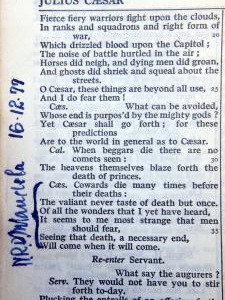
His family, who were Hindu, had sent him Deepavali greeting cards and Venkatrathnam and his inmates covered the “Bible” with the Deepavali cards, depicting Hindu gods, and plastic to disguise it. The book was read by many of the inmates and when he was due to be released Venkatrathnam sent it to his comrades and friends in prison and asked then to sign the passages which they found most meaningful or enjoyed the most.
Nelson Mandela, Mac Maharaj, Raymond Mhlaba, Billy Nair, Govan Mbeki, Mobbs Gqirana, JB Vusani, Frank Anthony and Andrew Masondo are among those who signed the book. There are 32 signatures in total.
Here is Sonny with the Robben Island Bible:

Reportedly, thirty-two passages are marked as favorites in the book: Billy Nair marked Caliban’s lines in The Tempest which begin “This island’s mine”, and Walter Sisulu chose Shylock’s speech in The Merchant of Venice which includes ”for sufferance is the badge of all our tribe.” Nelson Mandela picked these lines from Julius Caesar:
Cowards die many times before their deaths:
The valiant never taste of death but once.
Of all the wonders that I yet have heard,
It seems to me most strange that men
Should fear…
Seeing that death, a necessary end,
Will come when it will come.
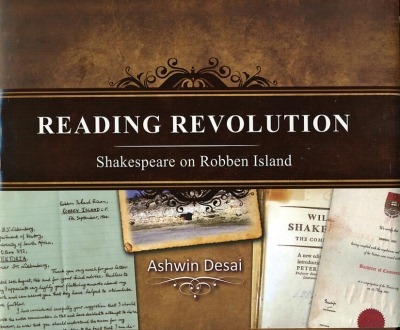
On Tuesday, as part of a special World Shakespeare Festival in Britain, the Southbank Centre is showing a play based on the story of the Roben Island Bible. As part of the same national Festival, the British Museum will have a special exhibition starting later in July called “Shakespeare: Staging the World” which features the Robben Island Bible. (It was the excellent accompanying book for this exhibition that brought the Roben Island Bible to my attention.) And a promising book by Ashwin Desai, Reading Revolution: Shakespeare on Robben Island reportedly tells the story of the Robben Island Bible in detail. (I have not yet read the Desai book, but have it on order.)
Hyperbole
From Politico:
In a closed door House GOP meeting Thursday, Indiana congressman and gubernatorial candidate Mike Pence likened the Supreme Court’s ruling upholding the Democratic health care law to the Sept. 11 terrorist attacks, according to several sources present.
As I previously mentioned on this blog, I lost two people on 9/11, a relative and a professional colleague, so I of course appreciate the Congressman’s sensitive remarks.
One can only suppose that nowhere will the tragedy be greater than in Texas, which has the dubious distinction of having the largest fraction of the population without health insurance of any state in the Union: 25%. So what are they doing in Texas? Well, I am happy to tell you that the Republican Party in Texas has announced a bold new plan for education:
We oppose the teaching of higher order thinking skills, critical thinking skills, and similar programs that are simply a relabeling of Outcome-Based Education (OBE) (mastery learning) which focus on behavior modification and have the purpose of challenging the student’s fixed beliefs and undermining parental authority.[…] Every Republican is responsible for implementing this platform.
I think we can all agree that higher order thinking skills and critical thinking skills should absolutely be abolished. Thanks, Texas Republican Party, for leading the way. We all eagerly anticipate watching every Republican implement that platform.
PS: Mike Pence apologized. The Texas Republican Party said that its platform “was a mistake, but it will remain in place until 2014.”
Face Recognition: God, Barbie, and Friends
One of my very best friends has this photo for her facebook cover pic:

For a number of reasons, this is very funny to me. First, we all know this is Barbie and not my friend. Second, it’s aging Barbie, whom we all know is the 50-year-old version of the plastic doll whose face is never supposed to change, is to remain always Barbie, is never to change.
Third, we all know the fear that machines and computers and artificial intelligence are someday going to outdo us in recognizing who we are, who is who, and so forth. For example, facebook – that rather faceless corporation – is looking to buy up face.com, just as Gil Hirsch, CEO, tries to reassure all of us in the public about KLiK, saying, “It’s not like you can point this at someone on the street and make it work.” It seems Photo Tag Suggest just wasn’t doing the trick and the Google+ Find My Face just may still be a competitive threat. So, we really are getting to the point where our software and phone apps might help us all recognize the face of Marissa Mayer telling us, “Don’t be afraid of us.” Us, of course, is Google again, and her face is one of their faces we should now recognize. And we are all less afraid because face recognition software promises to tell us not only Mayer’s name but also her gender and also her age too even if it can’t yet decide or decipher for us whether she at her age is happy or sad. I don’t have any real proof, but she at her age in that video we’ve linked to really doesn’t look afraid, does she? No, I’m not saying you must decide. But we all recognize and decide on our own anyway, don’t we? Funny.
Fourth, maybe we all recognize this face of Barbie, female, 50, perhaps happy, as that younger Barbie. And the younger Barbie is still the March 9, 1959 commercial invention of Ruth Handler. And this face of this new Barbara Millicent Roberts is really the face of the 1958 movie star, “Lilli — ein Mädchen aus der Großstadt (Lilli — a Girl From the Big City).” On the screen we recognize her face as the same face as the doll of August 12, 1955, Reinhard Beuthien’s invention, or is she his reinvention? Do we recognize what the wikipediaists tell us when we read about her? We cannot recognize their faces, but they say, “Ariel Levy refers to her as a ‘sex doll’ in Female Chauvinist Pigs and in interviews on the Lilli-inspired Barbie doll, Eve Ensler refers to Lilli (without elaboration) as a ‘sex toy’[1].” In June 1952, her face is just a “filler,” and her face is then, we might all recognize, the sweet face of a “cute baby.” Her sweet baby face is originally a cartoon face, a “Bild,” a cartoon strip picture face of a baby. You recognize her, don’t you, this very good friend of mine?



You recognize her face, her name, her race, her class, and of course her gender, her age. It’s her face and such for people, of a certain age, of a certain gender, men, young and middle aged and old, who like to read but don’t really so much like to read, because they like pictures. Her face is the face of Barbie, toy for young girls, plastic, never changing, even if we all recognize her aged, as 50 something in the photo my very good friend has for us to recognize as her facebook cover pic.
So what? What’s the point of this blogpost? Why God in the subtitle? Well, I’m still musing over the question of how St. Anselm in his Monologion came to recognize the Trinity, how sexist he makes Them, how sexist he makes Him.
And yet there’s something, without such terse proof and clear truth, that Anslem recognizes. He recognizes the face of God as something he must seek. He must pray.
In his 20th meditation, he does pray, lamenting his own soul’s “estrangement from Thy all-lovely Face.”
Without telling God or anyone how he recognizes the face of God as “all-lovely,” he meditates. He talks to himself: “Say therefore, O my soul, to thy Maker, to Father, Son, and Holy Ghost, one God, ‘I have sought Thy Face; Thy Face, O Lord, will I seek out’.” And we all recognize this as St. Augustine confessing to himself, or the Psalmist David as humming and strumming to himself. Yes, the face of God he recognizes as “all-lovely” and as the Face of “one God,” addressed with second person personal pronouns in relation (i.e., “thy Maker” has “Thy Face”), is the singular Face of three persons. And still Anselm recognizes the face of God in its unrecognizability, “the Presence of Thy Face” in the face of the torturous “cruel bitter absence of God’s Face”:
“Have mercy on me, O Lord, have mercy on me. In season, out of season, will I cry to Thee, and never let Thee rest until Thou gladden me with the Presence of Thy Face; and refuse myself all comfort; and punish myself with simply mourning over the absence of Thy Face. O Face of God, all glory! O Countenance, all light! So long as I see Thee not, so long shall my soul re main in gloom. But how long, O cruel bitter absence of God’s Face, how long wilt thou torture me?”
His very next meditation, the 21st, continues the very same way, we all recognize:
“And then say, O my whole heart, say at once to God, ‘I seek Thy Face; Thy Face, O Lord, will I still seek.’ “
God’s face to Anselm, as we all recognize, is not plastic.
I suppose, then, you recognize this post as being about how we recognize faces. How we teach our computers and smart phones to recognize faces says something about how we think we recognize faces. Babies, adults tell us, recognize the faces of their mothers and fathers very early on. And they don’t stop, regardless how old they grow to be, no matter the gender, despite sexual orientation, without regard for race, or class. And they all pursue happiness, seek it, in the faces of their friends.
This post, I’m sure you’ve recognized on the face of it, is about how dogma and dogmatism and formalism and machinery and logic that would separate people and their Creator by “difference” and technology can’t and won’t replace some of the most interesting facets of what it means to be human. It’s about how we seek and know and recognize many things.
“Dewey Defeats Truman”

(Source)
A court in Cologne has apparently ruled that circumcision – required in Jewish and Muslim religious practices – is illegal. The decision has resulted in a rare alliance of the German Bishops’ Conference, the German Central Council of Jews, the ZMD (German Central Council of Muslims), the TGD (Turkish Community in Germany – representing secular interests) denouncing the decision.
Bundestag President Norbert Lammert was reported as saying:
“This is a clash between the law and freedom of religion, but I’m not worried,” Lammert said. “The German court has yet to say its final word on this matter.
Based on a 1999 decision allowing Muslim and Kosher butchering practices, there is some optimism that a German high court will overturn the ban on circumcisions.
Now you know: Talmud responsible for world drug problem
Apparently, this is part of a new Iranian “Just say no … to Talmud” campaign.
This is an actual official Iranian News Release – I can’t make this kind of stuff up.
VP Blames Zionists, Talmud for Growing Drug Trade in World
TEHRAN (FNA)- Iranian First Vice-President Mohammad Reza Rahimi condemned Zionists for inciting global drug trade and addiction in a bid to annihilate non-Jewish communities in accordance with Talmudic teachings.
Addressing a ceremony on the occasion of the International Day of Drug Abuse here in Tehran on Tuesday, Rahimi stated that prevalence of narcotics and drug-addition throughout the world finds its roots in the wrong teachings of the Zionists’ religious book, Talmud.
The Talmud (Hebrew: "instruction, learning") is a central text of mainstream Judaism in the form of a record of rabbinic discussions pertaining to Jewish law, ethics, philosophy, customs and history.
"The book teaches them how to destroy non-Jews so as to protect an embryo in the womb of a Jewish mother," Rahimi stated.

So the next time you hear an article about poppy growers in Pakistan and Afghanistan, or marijuana growers in Mendocino county, or meth labs in Alaska, or the Columbian drug cartel – just think about how much Talmud they must be studying.
Update: From the New York Times:
Iran’s Vice President Makes Anti-Semitic Speech at Forum
By THOMAS ERDBRINK
Published: June 26, 2012
TEHRAN — Iran’s vice president delivered a baldly anti-Semitic speech on Tuesday at an international antidrug conference here, saying that the Talmud, a central text of Judaism, was responsible for the spread of illegal drugs around the world.
European diplomats in attendance expressed shock. Even Iranian participants in the conference, co-sponsored by Iran and the United Nations, privately wondered at their government’s motive for allowing such a speech, even given its longstanding antagonism toward Israel. More than 25,000 Jews live in Iran, and they are recognized as a religious minority, with a representative in Parliament.
The speech by Vice President Mohammad-Reza Rahimi seemed bound to isolate Iran further just days before a new set of onerous Western economic sanctions, notably a European embargo on Iranian oil, is set to be enforced because of the longstanding dispute over Iran’s nuclear program. Iran says the program is peaceful, and Western nations and Israel suspect it is a cover to develop the ability to make nuclear weapons.
Mr. Rahimi, second in line to President Mahmoud Ahmadinejad, said the Talmud teaches to “destroy everyone who opposes the Jews.”
The “Zionists” are in firm control of the illegal drug trade, Mr. Rahimi said, asking foreign dignitaries to research his claims. “Zionists” is Iran’s ideological term for Jews who support the state of Israel.
“The Islamic Republic of Iran will pay for anybody who can research and find one single Zionist who is an addict,” Mr. Rahmini said. “They do not exist. This is the proof of their involvement in drugs trade.”
What made his remarks even more striking is that Iran’s fight against illegal drugs is one of the few issues on which the Islamic republic can count on Western sympathy. Iran’s battle to stop the flow of drugs coming in from neighboring Afghanistan has often been mentioned as a potential field of cooperation during negotiations over the country’s nuclear program.
Several Iranian ministers gave politically neutral briefings on the impact of the drug trade on the country. Antonio De Leo, the United Nations Office on Drugs and Crime representative in Iran, praised the Islamic republic as a “key strategic partner in the fight against drugs.”
Mr. Rahimi, who spoke after Mr. De Leo, told stories of gynecologists’ killing black babies on the orders of the Zionists and claimed that the Bolshevik Revolution in 1917 was started by Jews, adding that mysteriously, no Jews died in that uprising.
He also said the Talmud teaches Jews to think that they are a superior race. “They think God has created the world so that all other nations can serve them,” he said. Halfway through his speech, Mr. Rahimi said there was a difference between Jews who “honestly follow the prophet Moses” and the Zionists, who are “the main elements of the international drugs trade.”
A European diplomat said afterward: “This was definitely one of the worst speeches I have heard in my life. My gut reaction was: why are we supporting any cooperation with these people?”
But the diplomat, who declined to be identified by name or country, defended his presence at the conference. “If we do not support the United Nations on helping Iran fight drugs, voices like the one of Mr. Rahimi will be the only ones out there,” he said.
New anthology with Craig Smith’s translation?
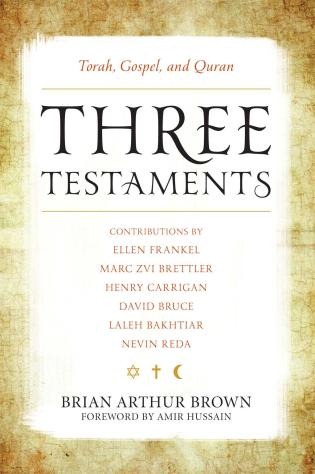 While co-blogger Craig Smith’s excellent Inclusive Bible is now only in print in paperback (I am glad that I stocked up with multiple copies of the hardcover), it looks like his work is going to be featured in a new anthology published by Rowman & Littlefield: Three Testaments.
Here is the blurb for the book:
From disagreement over an Islamic Center in New York to clashes between Christians and Muslims in Egypt, tension between the three Abrahamic faiths often runs high. Yet for all their differences, these three traditions—Judaism, Islam, and Christianity—share much in common. Three Testaments brings together for the first time the text of the Torah, the New Testament, and the Quran, so that readers can explore for themselves the connections, as well as the points of departure, between the three faiths.
Notable religion scholars provide accessible introductions to each tradition, and commentary from editor Brian Arthur Brown explores how the three faiths may draw similarities from the ancient Zoroastrian tradition. This powerful book provides a much-needed interfaith perspective on key sacred texts.
Here are the Table of Contents:
Foreword by Amir Hussain
Prologue: The People of the Book
Book One: Torah
Preface by Ellen Frankel
Chapter 1: Also Sprach Zarathustra
Chapter 2: Monotheism
Chapter 3: Zoroaster and Zorobabel
Chapter 4: Israel’s Redeemer
Introduction to the Torah by Marc Brettler
Translator’s Notes by David Stein
Torah Text: The TanakhBook Two: Gospel
Preface by Henry Carrigan
Chapter 5: Gospel and Torah
Chapter 6: Gospel and Wisdom
Chapter 7: Gospel and Avesta
Chapter 8: Gospel and Quran
Introduction to the Gospel by David Bruce
Translator’s Notes by Joe Dearborn
Gospel Text: The Inclusive BibleBook Three: Quran
Preface by Laleh Bakhtiar
Chapter 9: Zoroastrians in the Quran
Chapter 10: Torah in the Quran
Chapter 11: Gospel in the Quran
Chapter 12: Avesta in the Quran
Introduction to the Quran by Nevin Reda
Translator’s Notes by Laleh Bakhtiar
Quran Text: The Sublime QuranEpilogue The Book of the People
It appears from this table of contents that the translations being used are David Stein’s Contemporary Torah, Craig Smith’s Inclusive Bible, and Laleh Bakhtiar’s Sublime Quran, or close adaptations thereof. (Although the Inclusive Bible was translated by Craig, it is officially connected to a group connected by Joseph Dearborn. It is strange that the book includes comments from him, since he died on February 1, 2011.)
You can find a number of blurbs on the book’s website. I found these two blurbs addressing the inclusive nature of the translations particularly interesting:
Three Testaments is appropriately inclusive in many ways. The use of inclusive scripture is especially appropriate for the twenty-first century, both scholarly and evocative. To leave women out of the scripture in our time would be to distort the message entirely.
Sister Joan Chittister, author of Called to Question; columnist in National Catholic Reporter
Three Testaments: Torah, Gospel and Quran invites readers to study the interdependence of the Scriptures claiming the tradition of Abraham, Sarah and Hagar as their heritage. I especially appreciate the use of inclusive language and the voice of wo/men scholars in part I and III introducing the progressive edge of Jewish and Muslim Scriptures. This volume is a very unique and helpful resource for introductory Scripture courses and interreligious dialogue. I highly recommend it.
Elisabeth Schüssler Fiorenza, Krister Stendahl Professor, Harvard Divinity School
Paul’s own “nation”
Ethnos is a word of extraordinary difficulty to translate. Even in English, “nation” it has many meanings. In Canada, we are a nation, but Quebec is also a nation, as are First Nations. Here is the entry from Liddell, Scott, Jones,
2. after Hom., nation, people, τὸ Μηδικὸν ἔ. (γένος being a subdivision of ἔθνος) Hdt.1.101; ἔ. ἠπειρογενές, μαχαιροφόρον, A.Pers.43, 56 (anap.), etc.; “τῶν μηδισάντων ἐθνέων τῶν Ἑλληνικῶν” Hdt.9.106.
b. later, τὰ ἔ. foreign, barbarous nations, opp. Ἕλληνες, Arist.Pol.1324b10; ἔ. νομάδων, of Bedawîn, LW2203 (Syria); at Athens, athletic clubs of non-Athenians, IG2.444, al.; in LXX, non-Jews, Ps.2.1, al., cf. Act.Ap.7.45; Gentiles, τῶν ἐθνῶν τε καὶ Ἰουδαίων ib.14.5, etc.; used of Gentile Christians, Ep. Rom.15.27.
c. at Rome, = provinciae, App.BC2.13, Hdn.1.2.1, PStrassb.22.19 (iii A. D.), D.C.36.41, etc.: so in sg., province, “ὁ τυραννήσας τοῦ ἔθνους” D.Chr.43.11; ὁ ἡγούμενος τοῦ ἔθνους the governor of the province, POxy.1020.5 (iii A. D.).
3. class of men, caste, tribe, τὸ Θετταλῶν . . πενεστικὸν ἔ. Pl.Lg.776d; “ἔθνος κηρυκικόν” Id.Plt.290b; οἶσθά τι ἔ. ἠλιθιώτερον ῥαψῳδῶν; X.Smp.3.6; δημιουργικὸν ἔ. Pl.Grg.455b, cf. Arist.Ath.3; “ἔ. βραχμάνων” D.S.17.102; τὰ ἱερὰ ἔ. the orders of priests, OGI90.17 (ii B. C.); trade-associations or guilds, “ἔθνη καὶ ἐργαστήρια” PPetr.3p.67 (iii B. C.), al.; class in respect to rank or station, “οὐ πρὸς τοῦτο βλέποντες . . ὅπως . . ἕν τι ἔ. ἔσται διαφερόντως εὔδαιμον” Pl.R.420b, cf. 421c, D.21.131.
5. part, member, Hp.Loc.Hom.1.
So what is Paul saying in this verse and how is it best translated?
Τὴν μὲν οὖν βίωσίν μου τὴν ἐκ νεότητος τὴν ἀπ’ ἀρχῆς γενομένην ἐν τῷ ἔθνει μου ἔν τε Ἱεροσολύμοις ἴσασι πάντες Ἰουδαῖοι,
My manner of life from my youth, which was at the first among mine own nation at Jerusalem, know all the Jews; KJV
And my life indeed from my youth, which was from the beginning among my own nation in Jerusalem, all the Jews do know:D-R
“My manner of life from my youth, spent from the beginning among my own nation and in Jerusalem, is known by all the Jews. ESV
“The Jewish people all know the way I have lived ever since I was a child, from the beginning of my life in my own country, and also in Jerusalem. NIV 2011
All the Jews know how I lived from the earliest days of my youth with my own people and in Jerusalem. ISV
First, is it better to translate ἔθνος as “country”, “nation” or “people.” And should τε be left untranslated, translated as “and” or “and also?” Is Paul referring to all the Jewish people, Judea, Cicilia, the Jews in Cicilia? I tend to think it is better without the “and” but I am not sure.
Carved in stone
From Allan Metcalf in today’s Lingua Franca blog at the Chronicle of Higher Education:

A century ago, when the Latin and Greek classics still were closely associated with a college education, the graduating Class of MDCCCCX at the University of California at Berkeley decided that its graduation gift to the university would be provided with a suitably dignified Latin inscription, memorializing its own benefaction and that of Phoebe Apperson Hearst, a member of the Board of Regents of the university and incidentally also mother of William Randolph Hearst.

The gift was a big arch by a little bridge over a little brook, Strawberry Creek, that runs from the Berkeley hills through the campus toward the bay. They asked Professor William Merrill, a distinguished scholar who is said to have read almost everything extant in classical Latin, to provide the inscription. It reads:
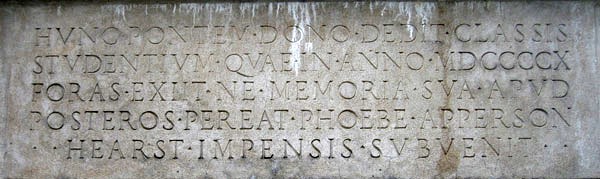
Hanc pontem dono dedit classis studentum quae in anno MDCCCCX foras exiit ne memoria sua apud posteros pereat. Phoebe Apperson Hearst impensis subvenit.
For the benefit of classmates who took the Bachelor of Letters degree instead of the Bachelor of Arts and thus were not schooled in Latin, this translates approximately as:
The student class which in the year 1910 went forth has given as a gift this bridge so that its memory will not perish among posterity. Phoebe Apperson Hearst assisted with the expense.
And so those Latin letters were duly inscribed on the arch, beginning with “hanc pontem,” meaning “this bridge.”
That would be the end of the story, except for a grammatical anomaly. As we all know, “hanc” is the accusative singular of the determiner translated as “this.” The accusative case indicates that along with “pontem,” it’s the object of the verb “dedit.” And “hanc” also indicates that “pontem,” the noun “hanc” modifies, belongs to the feminine gender.
Oops!
As it turns out, even a novice in the study of Latin can learn from her or his dictionary that “pons” and its various inflections, including “pontem,” is a masculine noun. So instead of the feminine “hanc,” it should be the masculine “hunc pontem.”
And once the arch was up, it didn’t take long for someone to notice. According to Professor Joseph Fontenrose in his memoir Classics at Berkeley: The First Century 1869-1970, “At once his error was pointed out, and someone said that this was the only feminine bridge in the world.”
But what could anyone do? The word was set in stone. And Professor Merrill did what any great scholar would do: He defended his choice. After all, he had read almost everything of classical Latin. Fontenrose continues:
“Merrill defended the gender as written, having found feminine pons in some late ancient or early medieval writings (perhaps in Hisperica Famina, which has female bridges).”
The problem eventually came to the attention of Benjamin Ide Wheeler, president of the university from 1899 to 1919 and himself a professor of Latin and Greek. Finally he could stand the embarrassment no longer. According to Fontenrose, “As the last act of his administration (so I have heard) Benjamin Ide Wheeler had the A of HANC changed to V. The repair is still visible.”
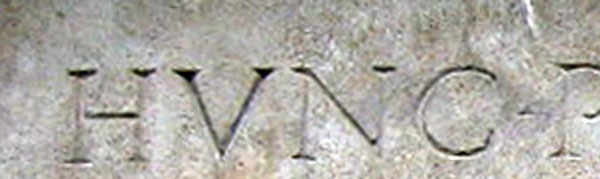
(In classical Latin there is no distinction between U and V, and V is used for inscriptions. It’s easier to chisel.)
And the moral of this story? Errare humanum est. Or better yet that famous line of Virgil, Forsan et haec olim meminisse iuvabit. For those of you with B.L.’s who don’t quite understand the Latin, it translates something like this: “Perhaps even this, one day, it will be pleasant to remember.”
When is it sexism and other knotty questions
This question comes up over and over. The other question which I wrestle with all the time is when we consider something a primary source. The two go together since one has to ask why information regarding women in the Bible is so frequently misrepresented. Do people not consult primary sources? I ask myself this constantly.
This is not as easy to do as it seems. For example, no electronic source is a primary source. But there are better and worse electronic sources. A digital image or a photograph is a fairly reliable source especially if we can think of no motive that anyone could have for photoshopping the image. So I do think that the photos of the Opramoas inscription were reasonably reliable. Next to that, a text copy of an inscription for which the original is still extant is relatively reliable. So the text on Junia Theodora was relatively reliable. It can be cross-checked. After that, reliability goes downhill somewhat, as we shall see.
Now back to sexism. I will proceed with a familiar example.
In Romans 16:1 and 2 Paul writes about Phoebe,
Συνίστημι δὲ ὑμῖν Φοίβην τὴν ἀδελφὴν ἡμῶν,
οὖσαν καὶ διάκονον τῆς ἐκκλησίας τῆς ἐν Κεγχρεαῖς,
2 ἵνα αὐτὴν προσδέξησθε ἐν κυρίῳ ἀξίως τῶν ἁγίων,
καὶ παραστῆτε αὐτῇ ἐν ᾧ ἂν ὑμῶν χρῄζῃ πράγματι,
καὶ γὰρ αὐτὴ προστάτις πολλῶν ἐγενήθη καὶ ἐμοῦ αὐτοῦ.16:1 Now I commend to you our sister Phoebe,
who is a servant1 of the church in Cenchrea,
16:2 so that you may welcome her in the Lord in a way worthy of the saints
and provide her with whatever help she may need from you,
for she has been a great help to many, including me.
This is the NET Bible translation. I will leave aside the fact that diakonos has been translated as “servant” since a note is provided. However προστάτις is translated as “great help” in spite of the fact that we have evidence, as seen in the letters of recommendation for Junia Theodora, that prostasia was something which typically received official recognition from government bodies, and for which an individual could be offered a crown, the right to wear purple or other privileges. Prostasia, that is patronage, was a role which required public recognition in the ancient world. Paul chose to recognize Phoebe in this way. The translator does not provide a note to this effect. Is this sexism?
The next issue in this chapter relates to the gender of Junia’s name. There are still quite a few people out there in blogland who are very confused about this. Here is the verse in Greek,
7 ἀσπάσασθε Ἀνδρόνικον καὶ [g]Ἰουνίαν τοὺς συγγενεῖς μου καὶ συναιχμαλώτους μου, οἵτινές εἰσιν ἐπίσημοι ἐν τοῖς ἀποστόλοις, οἳ καὶ πρὸ ἐμοῦ [h]γέγοναν ἐν Χριστῷ. SBL
And here is what Dr. Wallace wrote originally about the text issues relating to the name Junia,
If Iounian should have the circumflex over the ultima ( Iounia’n)then it is a man’s name; if it should have the acute accent over the penult ( Iounivan) then it is a woman’s name. For help, we need to look in several places. First, we should consider the accents on the Greek manuscripts. This will be of limited value since they were not added until the ninth century to the NT manuscripts. Thus, their ability to reflect earlier opinions is questionable at best. Nevertheless, they are usually decent indicators as to the opinion in the ninth century. And what they reveal is that Iounian was largely considered a man’s name (for the bulk of the MSS have the circumflex over the ultima).1
First off, there is the possibility that even if there were an acute accent over the penult it could hypothetically be a masculine name – if one could attest to the existance of a male name Iounias at all. Al Wolters is the only one who offers this solution, but even he does not make a strong recommendation to this effect. However, I mention this to point out a faulty presentation regarding accents in the first sentence of this paragraph.
Next, Wallace mentions the manuscripts. He does not cite his source. Since he is someone who has an enormous interest in NT manuscripts, one might expect him to actually consult digital images if not original manuscripts. According to Swanson, 2002, there is not even one NT manuscript where Iounian has a circumflex over the ultima. What are we to make of Wallace’s statement at the end of the paragraph? Obviously he did not look at any manuscripts. Fair enough! If he had provided a citation for his secondary source, we could evaluate this statement and consider whether he was simply misinformed or sexist. He suggests that he is familiar with ninth century manuscripts, but in fact, he had not looked at even one. It is the disregard not the error which is so telling. Because of Dr. Wallace’s ongoing role in preserving NT manuscripts, many people who read his articles, like this one, then feel that they can cite the article as if it were reliable.
The NET Bible, on the other hand, provides no note with regard to the manuscript tradition for Junia’s name. A brief note explaining that when accents were added to the text, for Junia’s name, the accent was always on the penult and not on the ultima, would have been a very helpful as a corrective to Wallace’s earlier article. I have several times in the last couple of years been in dialogue with seminary professors and others who have completely misunderstood this information. Perhaps they trusted Wallace’s earlier article.
Now that I have expressed my disappointment over what the NET Bible note does not say about Junia’s name, I will show you what it does say,
The feminine name Junia, though common in Latin, is quite rare in Greek (apparently only three instances of it occur in Greek literature outside Rom 16:7, according to the data in the TLG [D. Moo, Romans [NICNT], 922]). The masculine Junias (as a contraction for Junianas), however, is rarer still: Only one instance of the masculine name is known in extant Greek literature (Epiphanius mentions Junias in his Index discipulorum 125).
How significant is the rate of occurence in the TLG and what is the TLG.
The Thesaurus Linguae Graecae (TLG) is a research center at the University of California, Irvine. Founded in 1972 the TLG has collected and digitized most literary texts written in Greek from Homer to the fall of Byzantium in AD 1453.
The TLG includes literary texts and not personal letters and inscriptions (epigraphy.) That is why Junia (Iounia) Theodora, about whom much has been written in the last 10 years, (in English even) was not mentioned in the text note, or in either of the articles which Wallace wrote about Junia. Linda Belleville, however, found at least 10 inscriptions in Greek mentioning Iounia, not counting Junia Theodora. There was no suggestion from her that this was an exhaustive search. Ten seemed like enough. The descriptor ” quite rare” in the NET Bible note is hardly suitable and the TLG is not a particularly helpful source of information on the rate of occurence of the Greek name Iounia. The layperson is likely not aware of this.
The note continues with a mention of a completely fictional name “Junianas.” This name is also found in Wallace’s article. It is a completely unattested name, found nowhere. He may have intended to write “Junianus” but in this discussion, with the fine level of detail required, and reproduced in the NET Bible, the error is reprehensible. The implication that there actually was a Greek or Roman name Junias, as a contraction for Junianus (if that is what he meant) is also off base, since that also is completely unattested. If there had been a contraction in Greek, it would have been Iounas and not Iounias. The only occurence of a masculine Greek name Iounias is in Epiphanius, where it is clearly a corruption of Iounia, since Epiphanius also masculinizes Prisca. It is not in any way related to either the Latin name Junianus, or to a Greek equivalent, or to the fictional name Junianas.So why is this argument presented in the NET Bible note?I have no idea. Can this note not be edited for accuracy?
The note comes back to the possibility of Junias a few sentences later,
In Greek only a difference of accent distinguishes between Junias (male) and Junia (female).
However the name Junias in Latin or its equivalent in Greek were unknown. You can’t present, as if it existed, something for which there is no evidence. It confuses people. They might think that the Greek name Iounias actually existed. Even though the NET Bible note finally concludes that the name Junia is feminine, the notes are so rife with misrepresentation that one wonders how anyone could conclude anything from them.
When it comes to the note that says that Junia is only well-known to the apostles, there is another list of misrepresentations.
The term ἐπίσημος (epishmo”) is used either in an implied comparative sense (“prominent, outstanding”) or in an elative sense (“famous, well known”).
This is a hypothesis put forward by Dr. Wallace and is not an agreed upon categorization of the uses of the word episemos. Dr. Wallace tried to establish this and failed.
The key to determining the meaning of the term in any given passage is both the general context and the specific collocation of this word with its adjuncts. When a comparative notion is seen, that to which ἐπίσημος is compared is frequently, if not usually, put in the genitive case (cf., e.g., 3 Macc 6:1 [Ελεαζαρος δέ τις ἀνὴρ ἐπίσημος τῶν ἀπὸ τής χώρας ἱερέων “Eleazar, a man prominent among the priests of the country”]; cf. also Pss. Sol. 17:30).
True enough. Frequently, if not usually. And the rest of the time? Then en plus the dative is used. So this tells us nothing new about the phrase episemos en tois apostolois.
When, however, an elative notion is found, ἐν (en) plus a personal plural dative is not uncommon (cf. Pss. Sol. 2:6).
It is highly debatable whether episemos is an adjective in this citation. Howver, we now read about ” en plus the dative” that it is “not uncommon.” Since the first construct is “frequent if not usual”, and the second is “not uncommon”, what is this note telling us. Absolutely nothing. Which is a good thing because Pss. of Solomon 2:6 is in no way parallel to Romans 16:7.
Although ἐν plus a personal dative does not indicate agency, in collocation with words of perception, (ἐν plus) dative personal nouns are often used to show the recipients.
There is no word of perception in the Greek phrase episemos en tois apostolois, so this is irrelevant.
From Wallace and Burer’s more recent article on Junia,
An idiom noticed in several inscriptions is even more relevant. In TAM 2.905.1 west wall. coll. 2.5.18 we read the description of a man who is ‘not only foremost in his own country, but also well known to the outside population’ (ou monon en th patridi prwtou, alla; kai en tw ethnei epishmou). Here the person who is epishmos is called such only in relation to outsiders (prwtos is used in relation to his own countrymen). It is not insignificant that en plus the dative personal noun is used: the man is well known to a group of which he is not a member.
In this inscription, the person referred to, either Opramoas or his father Apollonius, (there is a break in the inscription at this point) was the president of the Lycian nation. He was first in his own home town (en th patridi), as well as prominent in the nation as a whole. To suggest that he was well known to a population of which he was not a member is on a level with claiming that President Obama is not American. The authors of the article have much better access than I do to primary sources. Why don’t they use it and view the context for this citation?
Ten years ago that was some remote chance that this conglomeration of misrepresentations was not due to sexism. But now, with our knowledge of Greek manuscripts and inscriptions, with our expectation that sources be cited and errors be corrected, with our expectation that digital resources like the NET Bible be maintained and corrected, this is inexcusable.
The question remains as to whether all the NET Bible notes are a shambles like these, or if only the notes relating to women are in this shape. Because of the lack of attention to detail and to correcting long-standing errors with regard to Junia, even when the opportunity provided itself, I am going to speculate that there are other errors in the NET Bible notes, not relating to women. But I could be wrong.
One further consideration is that the authors of the article cannot prevent themselves from using the phrase “biblical gynecology” – just in case women forget that it is all decided based on what we have below the waist. I cannot recommend the NET Bible to anyone for any use. For some reason some poor soul wrote to me this week asking me to donate for him to buy a NET Bible audio copy. I don’t know how that happened. So sorry – can’t do it.
I don’t know whether this is sexism or extreme sloppiness or both, but I don’t find these notes in any way excusable. There needs to be some sense that primary sources are appropriatedly used. I find these notes fall short in terms of their use of primary sources. Would you recommend a textbook with this many errors?
Orange on the seder plate
 How did the custom of the orange on the Passover seder plate begin? It turns out that the story we remember hearing is not quite true.
Here is the account from the woman who started this modern custom – from a Haaretz interview with Susannah Heschel (Dartmouth), daughter of the famous biblical scholar, theologian, and civil rights activist Abraham Joshua Heschel:
For her part, Heschel the younger has made her political mark in the feminist arena. She is the author of the book On Being a Jewish Feminist, but her real claim to fame comes from a tradition she created of putting an orange on the seder plate. The popular story behind the ritual is an urban legend, suggesting she did it because a rabbi once told her, “A woman belongs on the bimah [pulpit for reading a Torah scroll] like an orange belongs on the seder plate.” In truth, the idea occurred after a visit to a university where some students had been putting bread crusts on the seder place as a symbol of protest against the exclusion of women, gays and lesbians. Excited by the idea, but not the execution, Heschel proposed an alternative that did not bring hametz [leaven, strictly forbidden to possess during the Passover holiday] onto the seder table. The orange was to be consumed and the seeds spit out – representing the rejection of homophobia.
She also has many acidic comments about liberal Judaism in the US, which she says leaves “little time left for spiritual and intellectual rigor,” and features a “lack of warmth and human connection.” (She mentions an example – when she was teaching five hours away at Dartmouth and her mother was ill, she called up the Jewish Theological Seminary – where her father had been employed for 22 years – and asked them to send a student across the street with food for her ill mother. The seminary refused.) Instead she prefers the outreach ethos of Chabad and Hasidic teachers.
Steinsaltz on Steinsaltz v. ArtScroll
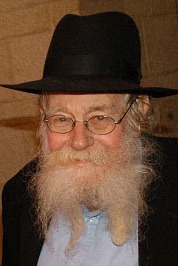 Elliot Resnick has a fascinating interview with Adin Steinsaltz in The Jewish Press. The interview covers quite a few controversies: Steinsaltz’s opinion of Artscroll, his relationship with the Lubavitcher Rebbe and the mysterious name change, his reaction to the criticism of his book Biblical Images (e.g., when he called Samson a “ruffian”), his relationship to the heavily criticized “New Sanhedrin,” and future projects. The entire interview is worth reading – here are some excerpts:
Why should someone buy the Steinsaltz Talmud over ArtScroll’s immensely popular Shas?
Rabbi Steinsaltz: Look, it’s not the same. I would put it in the following way: When you learn from my Gemara, I hope that you get a kick to learn further, and that you don’t feel that you know everything and that all the problems are answered.
Does the ArtScroll Shas not do that as well?
I think ArtScroll gives too much in a way. Everything is in there. I’m trying to have it in a way that you study and want more.
Basically I want, not just that you will look at the Gemara, but that you will get involved in it. You cannot learn Gemara completely passively. You have to be a participant.
There are two parts to what Hillel HaZaken said about kol haTorah kulah. One part is always quoted – “What you don’t want done to you, don’t do to others.” But the other part – “And all the rest go and learn” – is no less important.
I hope to have people who will learn and say, “We want to know more, we have more questions.”[…]
In the original editions of the Steinsaltz Talmud, you changed the traditional look – the tzuras hadaf – of the pages, for which you were heavily criticized. For the new edition of the Hebrew and English Steinsaltz Talmud, however, you restored the old look. Why did you originally change it and why did you restore it?
Look, in the beginning, it just couldn’t be done. All the additional material couldn’t be put on the old pages. I tried twenty-odd formats, and found out that if I used the traditional page, it would be at least two and a half times as big, which wouldn’t be usable. So the question is: What do you do – duplicate the page as ArtScroll did or cut it?
What I originally did in my Hebrew Gemaras was cut it. About 150 years ago in Poland, an edition with exactly the same kind of half pages was published. They made notes about why this was needed and [said] there was nothing holy about the other format. The traditional page is after all just a page. Even sifrei Torah can be written in different ways; surely Gemaras can be done differently too.
Why, then, did you restore the traditional page and move your commentary to the back of the book in the new editions of your Gemara?
For some people it has sentimental value. There are all kinds of people who are sentimental, and sometimes you give the people who are sentimental their sentiments.
The new Gemaras have the name “Rabbi Adin Even-Israel Steinsaltz” on the front cover. Most people know you as “Rabbi Steinsaltz.” Where did “Even-Israel” come from?
It’s a long story, but it’s connected with the Lubavitcher Rebbe. He wanted me to change my name for some time. He didn’t give me any explanation.
And he picked the name “Even-Israel”?
[We picked it] together in a way.
How many years ago was this?
Twenty-odd years.[…]
Fast forward 40 years: In 1989, many leading haredi rabbis in Israel banned your books, partially because they objected to your portrayal of biblical figures in some of your writings as human beings with human feelings and frailties rather than saints…
…I don’t want to go into the details. Some of it was not nice, but not on my side.
On my side, I tried to do one thing, and that was to keep quiet. I could have said lots of things, but I tried to keep quiet because I didn’t want to besmirch anybody and it wouldn’t have done any good.
Basically, people don’t really have any questions, except that they may not like my face. Otherwise, when it comes to any real point, there’s nothing in it.
What about the argument that you portrayed the avos and imahos as human beings with human faults?
Look, take Rashi or the Ibn Ezra or the Ramban or any of the commentators – all of them do the same thing. It’s just pure nonsense what you are saying. I depicted the avos and imahos as they are found in every Jewish source. I just put them together, and all the rest is just a combination of am ha’aratzos and some dislike.
Getting back to contemporary times: In 2004, a group of Israeli rabbanim attempted to revive the ancient semicha ritual and reestablish the Sanhedrin. At the time, you accepted the position of nasi of the Sanhedrin. You resigned, however, in 2008. Why did you join and why did you resign?
I thought it could be a good beginning for something, but it didn’t work out.
What do you mean by “work out”?
Working out means more and more people get involved. If it doesn’t get more people – and more important people – involved, it means it didn’t somehow cut through the right place. And whatever you do, if it doesn’t work, so it doesn’t work.
So you would suggest that the rabbis still involved in this project let it die?
I never make a denouncement because I see good people with good intentions involved. But somehow it hasn’t taken off.[…]
What projects are you currently working on?
We are going to publish a new edition of Mishnayos. We are also working on an edition of the Rambam with a commentary by me and others that makes a better connection between the Rambam and the Shulchan Aruch. And I’m also doing a project about the commentary on the Bible, and other things as well.
Junia Theodora
Junia Theodora is not considered to have any connection to the Junia mentioned in the Bible. However, she was a wealthy citizen of Corinth, and a benefactress who also had an inscription of letters in her honour. The Greek text can be read online in the Bulletin de Correspondance Hellenique, 1959. 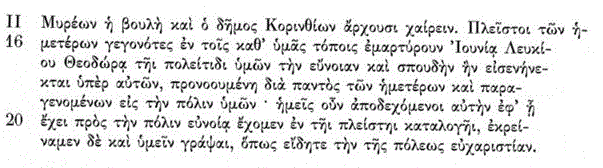
The Council and people of Myra to the rulers of Corinth, greetings. Many of ours being in your territories testify to Junia Theodora, daughter of Lucius, citizen of yours, for the goodwill and effort that she made on their behalf, occupying herself continually on behalf of ours, at the time of their arrival in your city. According her our approval for her goodwill to the city, we hold her in the greatest esteem, and have decided to write to you in order that you may know of the gratitude of the city.
This inscription was not discovered until 1954 and contains five letters of recommendation for Junia Theodora, who, according to St. Paul’s Corinth: Text and Archaeology was a native of Lycia, a citizen of the city of Corinth and a Roman citizen. She aided the Lycians financially, with hospitality and with influence on the authorities of Corinth. This inscription has brought awareness that Junia (IOUNIA in Greek) was the name of a well-known woman of Corinth, and that this woman was an important patron of her people. The Greek word προστασια was used in reference to the support which she offered the Lycians travelling to Corinth. This is related to the word used to refer to Phoebe in Romans 16 – προστατις. The Lycian Federation sent her a gold crown in recognition of her deeds.
finding the original David Psalm and e. e. cummings poem
Reading the Psalms this week, I found something perplexing, perhaps. Just beautiful is one of David’s Psalms, Psalm 27, and particularly verse 8. However, translators seem to struggle with the original. As David originally pronounced it, of course, the lines go exactly and unmistakeably like this:

You understand that I’m being sarcastic, silly even. How could we know how David’s original pronunciation sounds? And if we could hear them, then how would it matter to us who might listen to appreciate them or might hear the phrasing to sing it?
We’d best listen in English then.
But then we would do well to see the phrasing, to see whether form and formatting might suggest what’s on the face of these poetic, lyrical, strummed phrases. We might learn how to pronounce the Psalm originally, more or less.
Here’s how Robert Alter’s wonderful translation presents it to us readers:

Or is it more helpful to understand, to have the Hebrew explained to us? What if in English we heard it this way?
27:8 My heart tells me to pray to you, 24
and I do pray to you, O Lord. 25
and
24 tc Heb “concerning you my heart says, ‘Seek my face.’” The verb form “seek” is plural, but this makes no sense here, for the psalmist is addressed. The verb should be emended to a singular form. The first person pronominal suffix on “face” also makes little sense, unless it is the voice of the Lord he hears. His “heart” is viewed as speaking, however, so it is better to emend the form to פָּנָיו (panayv, “his face”).
25 tn Heb “your face, O Lord, I seek.” To “seek the Lord’s face” means to seek his favor through prayer (see 2 Sam 21:1; Pss 24:6; 105:4).
Well, that clear explanation — here from the NET Bible online — “makes little sense” unless, of course, the NET Bible online tells us what sense the new English makes more than the Hebrew. I’m being silly and sarcastic again. The NET Bible here may be committing what Alter calls the “heresy of explanation.”
Of course, the Psalm is not non-sense. It could be, but just assuming the translator has all of the meaning there is to be had, leaves little for listeners and readers to seek. But is that the point of the song of David?
And yet our translators approach the song it seems, as if the point is to solve it like a riddle, to explain it, to stop all seeking. Ironically, in fact, a whole line up of English translations, and of commentaries, offers little help on how to hear, how to see the face of, this original. Take a look for yourself here. We see what the Psalm means, but there’s so little agreement about what this verse means.
I’d like to suggest that David’s Psalm perhaps is not one that “makes no sense” or even that “makes little sense.” Can’t it be that David’s original pronunciation and his original grammar and his original phrasing for Psalm 27:8 are meant to involve the listener and the reader in making meaning about seeking meaning?
I wonder about another poet I may know a little better. I wonder about this poet and one of his poems as I read David’s original and all of the English translations, as I read my co-blogger Theophrastus’s post on “The Original Pronunciation Movement: KJV and Shakespeare.” The poet I wonder about is e. e. cummings. His poem that makes me wonder is “somewhere i have never travelled,gladly beyond.”
This poem “somewhere i have never travelled,gladly beyond” somehow reminds me of Psalm 27:8. Isn’t it about meanings sought and found, not in obvious in-your-face ways?
Well, here it is:
somewhere i have never travelled,gladly beyond
any experience,your eyes have their silence:
in your most frail gesture are things which enclose me,
or which i cannot touch because they are too near

your slightest look easily will unclose me
though i have closed myself as fingers,
you open always petal by petal myself as Spring opens
(touching skilfully,mysteriously)her first rose

or if your wish be to close me, i and
my life will shut very beautifully ,suddenly,
as when the heart of this flower imagines
the snow carefully everywhere descending;

nothing which we are to perceive in this world equals
the power of your intense fragility:whose texture
compels me with the color of its countries,
rendering death and forever with each breathing

(i do not know what it is about you that closes
and opens;only something in me understands
the voice of your eyes is deeper than all roses)
nobody,not even the rain,has such small hands
How much sense, if any at all, does it make to attempt rhyme, or free verse, or sonnet form or punctuation or a line break that depends on what the reader might see, or hear? Would it help for us to hear these lines in Cummings’s original pronunciation, somehow in his own voice? How did he originally pronounce “travelled,gladly”?
Does it help to hear a British speaker tell someone he loves to read it, and then to watch her reading silently in her American English? If so, how’s this (from the Woody Allen film Hannah and Her Sisters)?
What does our heart tell us to seek here? And how does the psalmist or the poet help us find it, from the original?
When others were calling him “Father Anselm,” the one we all know now as St. Anselm wrote something sexist. What’s more, he wrote it in a sexist way. That is, he wrote intentionally in such a way that, much later, past modern times, in what we have been calling “postmodern” philosophy in our day, critics might easily deconstruct his argument and his argumentation as, what they call, phallogocentricism. All I want to do in this post is to show what Father Anselm wrote in his own words in his own way. He does not need the Bible, he says. All he needs is something that looks suspiciously like Aristotle’s powerful, syllogistic rationalism, or Cicero’s. By this, he develops his Trinitarianism. By it, he makes it sexist. By his Monologion, Anselm starts in this way. Notice how he tries to blame it on his brothers (my own emphases):
Certain brothers have frequently and earnestly entreated me to write out for them, in the form of a meditation, certain things which I had discussed in non-technical terms with them regarding meditating on the Divine Being and regarding certain other [themes] related to a meditation of this kind. For the writing of this meditation they prescribed—in accordance more with their own wishes than with the ease of the task or with my ability—the following format: that nothing at all in the meditation would be argued on Scriptural authority, but that in unembellished style and by unsophisticated arguments and with uncomplicated disputation rational necessity would tersely prove to be the case, and truth’s clarity would openly manifest to be the case, whatever the conclusion resulting from the distinct inquiries would declare. They also desired that I not disdain to refute simple and almost foolish objections which would occur to me.
What I’ve emphasized, above, is the very method of proof and of proving that Father Anselm purports to use. I would get ahead of myself, or digress too quickly, if I suggested that some today still follow this Aristotelian or Cicerone-an logic to make their claims, to use logic to construct conclusions. Whoever it is doing it, whenever, whatever century, they still follow a few similar steps. First, the first and foremost necessary presuppositions are identified. Second, the secondary premises are brought forward. Finally, in conclusion, the word brings forth Truth. So Father Anselm starts with steps like these. For example, early on in the Monologion, he writes (with my emphases again):
Moreover, if anyone considers the natures of things, he cannot help perceiving that they are not all of equal excellence but that some of them differ by an inequality of gradation. For if anyone doubts that a horse is by nature better than a tree and that a man is more excellent than a horse, then surely this [person] ought not to be called a man. So although we cannot deny that some natures are better than others, nonetheless reason persuades us that one of them is so pre-eminent that no other nature is superior to it.
What is pre-supposed is that there are natures, that Nature inflexibly makes obvious, difference. Difference, then, pre-supposes inequities. Only the ignorant can avoid the perception that, in Nature, the species are different, that some are less equal than others. Famously, in his Prologion, Father Anselm extends his argument to prove that there is a god, the God. Here, nonetheless, he’s just beginning to establish his argument and his line of argumentation.
Late in the Monologion, he makes the argument he calls, QUOD ALTERIUS VERISSIME SIT ESSE GENITOREM ET PATREM, ALTERIUS GENITUM ET FILIUM. Jasper Hopkins translates that as follows (with my emphases [but Hopkins’ own brackets and bracketed text to note what he infers from the Latin]):
CHAPTER FORTY-TWO
It is most truly characteristic of the one to be begetter and father, and of the other to be begotten and son.I would now like to infer, if I can, that the Supreme Spirit most truly is father and that the Word most truly is son. Yet, I think I ought not to by-pass [the following question]: is the appellation “father and son” or the appellation “mother and daughter” more befitting for them?, for there is no sexual distinction in the Supreme Spirit and the Word. For if the Supreme Spirit is suitably [called] father and its offspring suitably [called] son because each is spirit, then why is it not suitable, by parity of reasoning, for the one to be [called] mother and the other to be [called] daughter because each is truth and wisdom?1 Is it [preferable to call them father and son] because among those natures which have a difference of sex it is characteristic of the better sex to be father or son and of the inferior sex to be mother or daughter? Now, although this is by nature the case for many [beings], for others the reverse holds true. For example, in some species of birds the female sex is always larger and stronger, the male sex smaller and weaker. But, surely, the Supreme Spirit is more suitably called father than mother because the first and principal cause of offspring is always in the father. For if the paternal [cause] always in some way precedes the maternal cause, then it is exceedingly inappropriate for the name “mother” to be applied to that parent whom no other cause either joins or precedes for the begetting of offspring. Therefore, it is most true that the Supreme Spirit is father of its own offspring. But if a son is always more like a father than is a daughter, and if no one thing is more like another than this offspring is like the Supreme Father, it is most true that this offspring is a son, not a daughter. Therefore, just as this Spirit has the distinguishing property of most truly begetting and this offspring of most truly being begotten, so the former has the distinguishing property of being the most true begetting one and the latter of being the most true begotten one. And just as the one is the most true parent and the other the most true offspring, so the one is the most true father and the other the most true son.
1“Spirit” is in Latin a masculine noun (“spiritus”); “truth” and “wisdom” are feminine nouns (“veritas,” “sapientia”).
Well, I nearly emphasized, with the bold font, the whole argument. It is so very tight, and each step, each bit of logic, is part and parcel of the argument. I’ve found most interesting the rhetorical questions, Father Anselm’s answers, and, finally, his sure conclusion.
The paternal always comes first and foremost. God, as Father Anselm constructs Him from such logic and not from any Scripture, is the Trinity. Last, there cannot be divine mother or nor divine daughter therein.
(As mentioned, I’ve used Jasper Hopkins‘s very interesting English translation of St. Anselm’s work. Hopkins finds very interesting the translating of Anselm by Gertrude E. M. Anscombe. Perhaps more should be said about their approaches in another post some day. Until then, you may be interested in reading Anselm’s own words here at the Logic Museum, where yet another English translation is offered, side by side with his Latin. I think all of the English translations bring across the extra-biblical [that is, the not-from-Scripture], sexist logic and sexist conclusions just fine.)
The Opramoas Inscription

Instead of acquiring software, I have enjoyed using online databases for research. This has just become my habit. I am not saying that it is better. It would be nice to do both. However, here is one amazing online database, the Packard Humanities Searchable Greek Inscriptions. I have used TAM 905 from this database in the past and I wanted to find out more about it. This epigraphy consists of letters and documents carved in stone on the mausoleum of Opramoas in Rhodiapolis, Lycia, Turkey. Starting five letters in, and five rows from the bottom, it reads, (the Λ and Κ in ΛΥΚΙΩΝ are quite chipped and an alternate form of the letter omega is used. In a few places letters are run together.)
Λυκίων τὸ κοινὸν καὶ ἡ βουλὴ ἐτείμη-
σεν Ὀπραμόαν Ἀπ̣ολλωνίου δὶς τοῦ Καλλι-
άδου Ῥοδιαπολείτην καὶ Κορυδαλλέα, ἄν-
δρα καλὸν καὶ ἀγαθὸν καὶ εὐγενῆ καὶ μεγαλό-
φρ[ο]να, πορφύρᾳ διὰ βίου καὶ προεδρίᾳ καὶ
The League and Council of Lycia honoured
Opramoas (son) of Apollonios, twice (great?? grandson) of Calliades,
of Rhodiapolis and Corydalla, a man noble and good
and well born and generous, with the right to wear purple for life
and with front row seating and …

The content of this epigraphy is described in the American Journal of Archaeology Vol. 6, available as an ebook here with a review of a book published in German on the Opramoas inscription. By far the most important writing on epigraphy is in German. 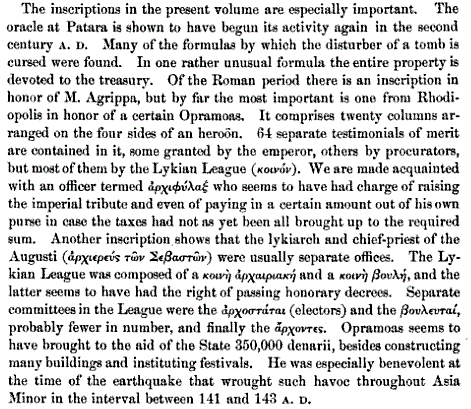 in a review of Petersen and Von Luschan. Reisen in Lykien, Milyas und Kibyratis. 1889. This is from the review.
According to wikipedia Opramoas was one of the best known euergets (do gooders) in the ancient world. Here is why I like him – “…apart from his gifts of games and a mass of civic buildings, we have recently found him offering to pay for the primary schooling if all the citizen-children at Xanthus, boys and girls alike”…”he gave funds for burial to people in need and paid the dowries of poor families’ daughters”[3] (In a curious translation aside, wikipedia has a page on euergetism which can only be explained by being an electronic translation of a page in another language. That’s my guess but I can’t find a wikipedia page in another language which matches this.)
Opramoas is an example of an extremely wealthy and influential benefactor. He served time as both ruler – Lyciarch – and high priest for the Lycian League, or the Federation of Lycia, in Turkey, and at that time a province of Rome. While much of the background literature on Jerome, Chrysostom and other church fathers focuses on the patronage of wealthy widows, the typical benefactor in the ancient Near East was a wealthy family man of the ruling class. Opramoas held office, was a ruler and a civic benefactor. He lived in the first half of the second century AD, in what was essentially a pre-Christian province of the Roman Empire.
Christian patrons were following in the footsteps of an established and honourable custom of the ancient world. In fact, some of the Christian patrons were highly problematic because they gave away land and wealth outright, rather than maintaining estates as ongoing sources of income and future endowments, which was so essential to social stability and economic development. We know that Opramoas both gave away estates and maintained estates while managing and endowing the income. In the inscription in his honour his family line and citizenship in both his father’s city and, according to Danker, 1982, in “all Lycian cities.” Family, citizenship and patronage were a tightly woven fabric.
It was important to identify the membership of a benefactor in a certain community in order to lay claim to the ongoing patronage of the family. Regarding Opramoas, documents are careful to establish his membership in the home town of his father, Rhodiapolis, the home town of his mother Corydalla and his leadership in the province of Lycia as a whole, since he was the benefactor of cities and people throughout Lycia. He had citizenship not only in his own home town, but also in cities throughout Lycia.
Here are some of Opramoas’ accomplishments,
- Was promoted to prominent posts from 110-155 AD and acted as an administrative, military and religious leader in the Assemby of the Lycian Federation and in important cities of the region. He was honoured many times in the Assembly of the Federation, many of which were approved by the Roman emperors.
- Donated much money for the rebuilding of more than 30 Lycian cities following the catastrophic earthquake in 141 AD in which many cities were demolished.
- Donated money for civic building, such as baths and certain oracular shrines.
- Distributed wheat to needy citizens and donated money for the education and nourishment of needy children
- Provided dowries for some government employees and young girls and funeral expenses for some elderly
- Assisted in the funding of festivals and ceremonies organized in honour of the gods and emperors and held festivals in his name every four years to help pay for these expenditures.
- Owned lands in many Lycian cities, some of which he donated directly for charitable purposes and others from which he donated the income.
Although I have not seen a translation of this epigraphy, Google Books offers a fragmentary glance at Benefactor: epigraphic study of a Graeco-Roman and New Testament semantic field by Frederick Danker, 1982.
I hope to follow up with what this epigraphy can tell us about Paul, Junia, prominence, alms, citizenship and ethnicity in the New Testament.
Nachum Segal’s JM in the AM radio show on WFMU had a nearly hour-long interview with Adin Steinsaltz, the translator of the (Hebrew) Steinsaltz Talmud, and Tzvi Hersh Weinreb, the general editor of the Koren (English) Steinsaltz Talmud on June 12. Lots of interesting stuff.
One part I enjoyed was Steinsaltz’s discussion of why he didn’t like the Random House translation (he felt that it was too comfortable, and would not inspire serious study) or Weinreb’s discussion of the merits of making notes in religious books.
There is also some discussion of translation philosophy (HT Gil Student):
Every translation is to some extent a commentary.[…] However, I think a good translator has to know not to give too much of his own ideology or his own commentary. Commentary is necessary to explain the text but a good translator gives over the text, the flavor of the text, with just enough extra commentary to make it clear and the rest is up to the student. What we’ve tried to do in this whole project is to allow the student to study and ask. It’s designed to provoke discussion and to provoke questions, not to provide answers but to open things up.
You can listen to the interview here in Real Audio. Here is an MP3 version of the radio interview.
The Original Pronunciation Movement: KJV and Shakespeare
The pox of such antic, lisping, affecting fantasticoes—these new tuners of accent! “By Jesu, a very good blade! a very tall man! a very good whore!” Why, is not this a lamentable thing, grandsir, that we should be thus afflicted with these strange flies, these fashion-mongers, these pardona-me’s, who stand so much on the new form that they cannot sit at ease on the old bench? O, their bones, their bones!
Romeo and Juliet Act 2 Scene IV, Mercutio
There is a growing movement to perform Elizabethan and Jacobean works in original pronunciation:
- The British Library has released a recording of Shakespearean excerpts in original pronunciation (sample tracks are available here).
- Chandos releases next week a new recording of William Byrd’s “The Great Service in the Chapel Royal” in original pronunciation
- David Crystal has up a large web site on original pronunciation
- David Crystal also has a short book out entitled Pronouncing Shakesepare: The Globe Experiment
- The Shakespeare OP Company is devoted to pronouncing Shakespeare in original pronunciation
- Hilary Crystal is selling online extracts of the KJV in original pronunciation (unfortunately, my attempt to purchase an extract resulted in me being charged $1.45 and then being sent a link to a file that did not exist!)
- Kansas University has a free video of excerpts of its original pronunciation performance of A Midsummer’s Night Dream, and an mp3 recording for sale.
- University of Nevada is reportedly releasing a DVD of its original pronunciation performance of Hamlet later this year.
- There are over a dozen performances in original pronunciation in the last eight years
What does original pronunciation sound like? Well, here is an mp3 file of the Lord’s Prayer in Original Pronunciation, here is Hamlet’s soliloquy (“to be or not to be”), and you can find more examples here.
Here is Open University’s video introducing original pronunciation
Advocates of original pronunciation say that it allows us to capture original rhyming passages which do not today rhyme in modern English. The British Library recording gives us the following examples from Shakespeare’s sonnets:
- Sonnet 71: moan/gone
- Sonnet 116: love/remove, come/doom, proved/loved
- Sonnet 154: warmed/disarmed, thrall/perpetual, by/remedy, prove/love
Indeed, the claim is made that 96 of the original 154 sonnets have couplets that fail to rhyme in modern English.
Advocates also claim that original pronunciation allows us to recapture original wordplay. Some examples:
- In As You Like It, Jacque gives the following speech (emphasis added), leaving open the question of why Jacque laughs for an hour. One possibility: “hour” and “whore” are homonyms in original pronunciation, so this is a pun:
A fool, a fool! I met a fool in the forest,
A motley fool; a miserable world!
As I do live by food, I met a fool
Who laid him down and bask’d him in the sun,
And rail’d on Lady Fortune in good terms,
In good set terms and, yet, a motley fool.
‘Good morrow, fool,’ quoth I. ‘No, sir,’ quoth he,
‘Call me not fool till heaven hath sent me fortune:’
And then he drew a dial from his poke,
And, looking on it with lack-lustre eye,
Says very wisely, ‘It is ten o’clock:
Thus we may see,’ quoth he, ‘how the world wags:
‘Tis but an hour ago since it was nine,
And after one hour more ’twill be eleven;
And so, from hour to hour, we ripe and ripe,
And then, from hour to hour, we rot and rot;
And thereby hangs a tale.’ When I did hear
The motley fool thus moral on the time,
My lungs began to crow like chanticleer,
That fools should be so deep-contemplative,
And I did laugh sans intermission
An hour by his dial. O noble fool!
A worthy fool! Motley’s the only wear.
- In Henry V’s “Once More Unto the Breach” speech, there is a reference to “mettle of your pasture” – but this may be a pun in original pronunciation playing on pasture/pastor.
- In Comedy of Errors Act 3 Scene 2 when Dromio says “I am an ass, I am a woman’s man and besides myself,” there may be an original pronunciation pun on woman/woe-man.
Original pronunciation advocates claim that trying to understand Shakespeare in original pronunciation is no more difficult than trying to understand Shakespeare in a regional dialect. I have to say that I am not entirely convinced – for audience members who hear Shakespeare for the first time, it may be difficult to follow Shakespeare’s intricate wordplay and linguistic structures even in contemporary English pronunciation. I am not sure that they can track original pronunciation in real time and both capture the puns and perform the mental translation of original pronunciation. I wonder if original pronunciation is not perhaps best for those who are following along with a written script.
After hearing the examples above, what do you think? Does original pronunciation unlock new layers of meaning for you? Or does it add a new layer of complexity in understanding Shakespeare?
endangeredlanguages.com, Google’s collaborative project to protect global linguistic diversity
Kirsten Winkler has a post up entitled, “Introducing Google’s Endangered Languages Project.” She reports:
When visiting the official Google blog today I learnt about their new Endangered Languages Project.
It might sound a little funny that a company who is largely benefiting from English as de facto official language of the Internet, now wants to be on the forefront of fighting the extinction of languages in the World. But Google was also known for their “do no evil” credo and they apparently reminded themselves of it and take social responsibility.
According to an estimate, only about 50% of the languages that exist today will still be spoken by 2100, in other words approximately 3000 languages. The website is designed to
“find and share the most up-to-date and comprehensive information about endangered languages”.
How does the Endangered Languages Project work?
Want to know how? The post is here.
Want to see?

Want to participate?


 BLT
BLT 
