ETS and the trinity: Luther on potestas
This can’t help but become tediously long. It’s hopeless. No wonder it will never be sorted out and we will never communicate with one another on this. Here is Luther, from Luther: Lectures in Romans, on the topic. Notice that he wrote in German about the different Latin words for “power.” There were enough Latin words, although he notes that they have been used interchangeably. The problem is that virtus, potentia, potestas, and autoritas, which Luther does not mention, are all translated into English as “power.” 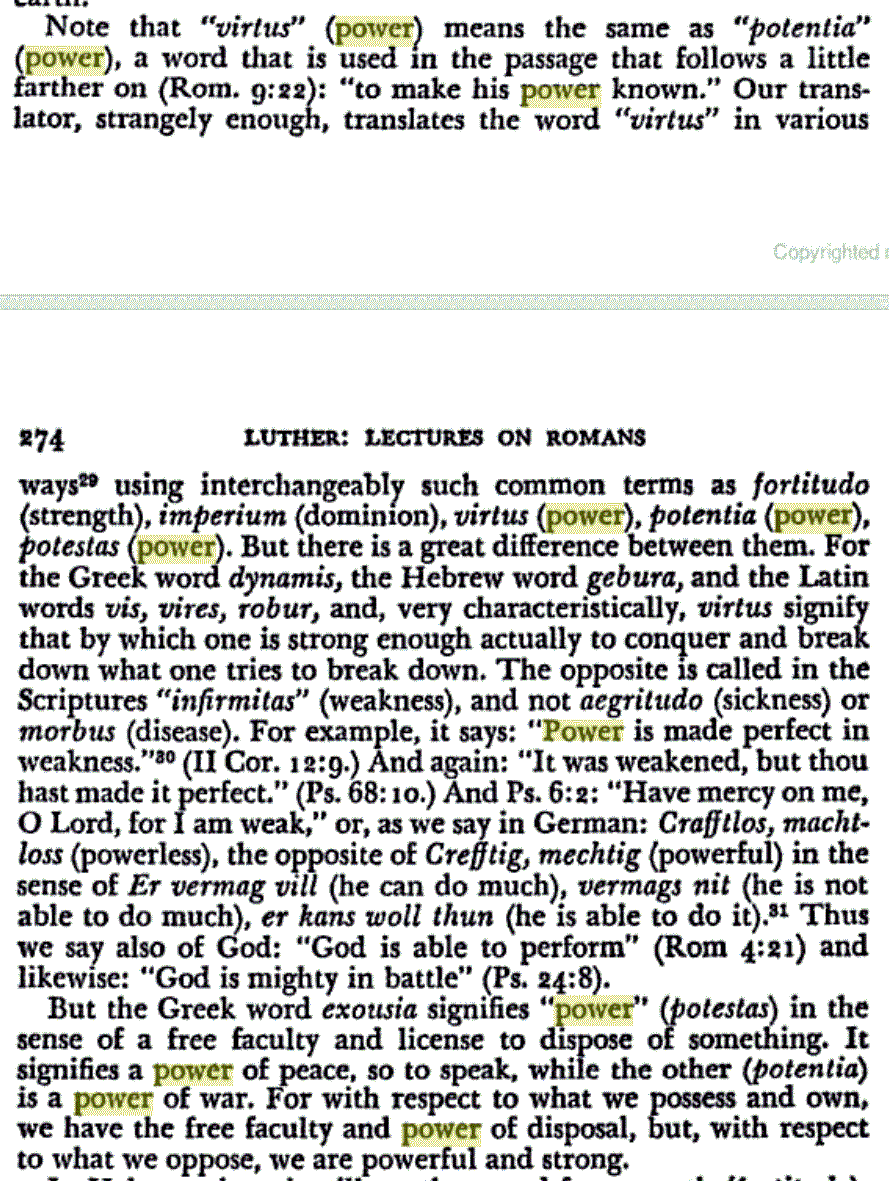
It seems that it will be futile to speculate further on the meaning of the English doctrinal basis of the ETS. The phrase “equal in power” could have referred to either virtus, potentia, potestas or autoritas. We do know that the Westminster Catechism was translated into Latin using the word potentia, so it is best to run with that.
More on whether the Son is equal in potestas to the Father tomorrow. To access all posts in this series click on the tag for ETS.
ETS and the trinity: the case for potestas
I did not foresee that this would be a series. To access all posts on this topic, click on the tag at the top for “ETS.” I should know by now that any linguistic investigation is limitless, bounded only by the amount of free time and energy one has at any given time.
Regarding potentia and potestas, there are two possibilities. The first is that they are roughly equivalent and not distinguished in historic church doctrine. In this case “power” and “authority” are indivisible. If the Son is equal in power, he is also equal in authority to the Father.
The second possibility is that these two words are used with different meanings, potentia for power (might), and potestas for power (authority). In that case, we seek affirmation that the Son is equal to the Father in both, while complementarians say that the Son is equal to the Father in power (might), but not in power (authority.)
The doctrinal statement of ETS includes the statement that Father and Son are equal in power. While this phrase comes from the Westminster Catechism, which was written in English, it was subsequently translated into Latin as equal in potentia.
My best guess is that the use of the word potentia was not intended to exclude or contrast with potestas; these two were not regularly differentiated and contrasted, according to others. Here are potentia and potestas in the Lewis and Short Lexicon. The proverb “knowledge is power” is derived equally from ipsa scientia potestas est and scientia est potentia (also sapientia est potentia.) When the two were contrasted, in Hobbes and Spinoza, they are often both translated into English by the word “power,” one as power and the other as Power.
However, it we return to the notion that the two are distinguishable, then we can consider the rough equivalencies, exousia is translated into Latin as potestas (later autoritas), and into early English translations as “power.” Dunamis is translated into Latin as virtus and and later potentia, and into English as “power.” Erasmus notes that potentia is better for dunamis and potestas for exousia. The Westminster Catechism was written in English and used the word “power” which could mean either power (might) or power (authority) or both. But in 1660, it was translated into Latin as potentia.
Now, the question remains whether historic Christianity claimed that the Father and Son are equal in potestas (authority, exousia.) Here are the occurences I have found so far.
First, Augustine wrote,
non secundum imparem potestatem uel substantiam uel aliquid quod in eo patri non sit aequale missus est, sed secundum id quod filius a patre est, non pater a filio. Verbum enim patris est filius, quod est sapientia eius dicitur.
According to Augustine, the Son was not unequal to the Father in potestas (authority). This, of course, is always translated into English as “power” but it means “power (authority)” and not “power (might).”
Second, the creed of the Synod of Toledo 675 includes the phrase,
una est majestas sive potestas,
nec minoratur in singulis, nec augetur in tribus. Swainson, page 242
one majesty and power (authority)
not less as one, not greater as three
Third, there is a canon from the 7th to 9th century, the canon of Autun, existing in several manuscripts, which contains the following line. This line is found in other creeds and manuscripts as well.
tres itaque Personae sed una potestas Swainson. 273
In a 12th century exposition on the Athanasian creed, which I include here,
there are three phrases of interest:
unus Deus, una potestas, una majestas
one God, one power(authority), one majestyuna deitas, aequalis potestas, una coaeternitas
one deity, equal power (authority), one coeternityuna natura, una divinitas, una majestas, una gloria et potestas
one nature, one divinity, one majesty, one glory and power (authority)
Finally, in 1570, a Latin version of Chrysostom’s works were published. In Vol. 5, p 609, Paris edition, translated by Erasmus, is this phrasing from his Homily on the Creed,
Patri coaequalis in deitate, Dei et Deus: sed tamen non duo Dii, sed unus Deus.
In potestate una potestas, in esse una essentia, una virtus, una majestascoequal in deity with the Father, God of God, yet not withstanding there are not two Gods, but one God
in potency, in essence, in substance – one power [authority], one essence, one virtue, one majesty. Hopkins. 297
We are left with two options. Either “power” in the creeds means both “power” and “authority” and these are indivisible, or, the meanings are separate, but throughout church history, basic creeds were understood to be saying that the Son was equal to the Father, or one with the Father, with respect to both “power” and “authority.” I don’t see a third option, in which the Son is under the potestas (authority) of the Father. I do not see this expressed in any of the creeds or expositions on the creeds before complementarianism. I will write more on this tomorrow.
To access all posts on this topic, click on the tag at the top for “ETS.”
Hopkins, John Henry. The primitive creed, examined, explained. 1834.
Swainson, Charles Anthony. The Nicene and Apostles’ Creeds: their literary history ; together with an account of the growth and reception of the sermon on the Faith, commonly called “the Creed of St. Athanasius” 1875. London. Murray.
ETS and the trinity cont: potentia and potestas
I realize now that my approach to the ETS doctrinal basis has been overly simplistic. I really don’t know what anyone who assents to it believes, but I am now considering alternatives. First, let me review and build on my case.
This is the doctrinal basis of the ETS,
The Bible alone, and the Bible in its entirety, is the Word of God written and is therefore inerrant in the autographs. God is a Trinity, Father, Son, and Holy Spirit, each an uncreated person, one in essence, equal in power and glory.
I am concerned here about the meaning of just one word. Other aspects of this statement are equally open to investigation, but I have not come anywhere close to sorting out what “power” means in this statement. On the one hand, I think it means the same as “authority” and it establishes equality of authority, that is, egalitarian relations, in the trinity, but others disagree.
This doctrinal basis is derived from the Westminster Shorter Catechism, question 6, which includes these words, written first in 1646, in English and translated into Latin later,
There are three persons in the Godhead; the Father, the Son, and the Holy Ghost; and these three are one God, the same in substance, equal in power and glory.
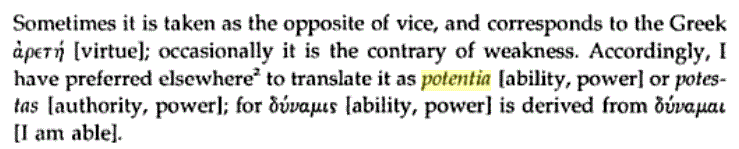
The Westminster Catechism was translated into Latin and Greek, as well as other languages. I don’t have to the other languages but we can confirm that the Latin translation of “power” was potentia and this was indeed a translation for dunamis in Erasmus’ Latin translation of the New Testament. Erasmus writes in his Annotations on Romans 1:4, regarding using the Latin word virtus for the Greek dunamis,
To set this in the larger picture, here are some of the equivalencies for exousia and dunamis over the millenia,
Vulgate – exousia > potestas, dunamis > virtus
Erasmus – exousia > autoritatis, dunamis > virtus or potentia
Tyndale – exousia and dunamis > power
KJV – exousia > power or authority, dunamis > power
From Erasmus’ notes, the case seems settled, that exousia is potestas, and dunamis is potentia. In that case, the complementarians are correct in saying that they can sign the doctrinal basis of ETS, confessing that the Son is equal in power to the Father, and still believe that the Son is unequal in authority. It seems that they have won this round.
However, the difficulty is that now we must take potestas as meaning authority. And here complementarians are stuck. Augustine was emphatic that Christ was not unequal in potestas (authority) to God.
Here is Augustine,
He was not sent in respect to any inequality of power, or substance, or anything that in Him was not equal to the Father; but in respect to this, that the Son is from the Father, not the Father from the Son; for the Son is the Word of the Father, which is also called His wisdom.
In another translation,
For he was not sent in virtue of some disparity of power or substance or anything in him that was not equal to the Father, but in virtue of the Son being from the Father, not the Father being from the Son.”*
And in Latin,
non secundum imparem potestatem uel substantiam uel aliquid quod in eo patri non sit aequale missus est, sed secundum id quod filius a patre est, non pater a filio. Verbum enim patris est filius, quod est sapientia eius dicitur.
And this is what Bruce Ware has written in regard to this quote from Augustine,
Augustine affirmed, the distinction of Persons is constituted precisely by the differing relations among them, in part manifested by the inherent authority of the Father and inherent submission of the Son.
If the “Son” is sent by the “Father,” and if the “Son” comes to do the will of the “Father,” does it not stand to reason that God wishes by this language to indicate something of the authority and submission that exists within the relationships of the members of the immanent trinity?
It appears that Ware has fundamentally misunderstood Augustine. If, according to Erasmus potentia is power (ability) and potestas is power (authority) then Augustine is clearly saying that the Son has no disparity in authority from the Father. Further, in De Trinitate, Book II, chapter 5:9, Augustine rebutts Ware’s thesis and writes,
For perhaps our meaning will be more plainly unfolded, if we ask in what manner God sent His Son. He commanded that He should come, and He, complying with the commandment, came. Did He then request, or did He only suggest? But whichever of these it was, certainly it was done by a word, and the Word of God is the Son of God Himself.
Wherefore, since the Father sent Him by a word, His being sent was the work of both the Father and His Word; therefore the same Son was sent by the Father and the Son, because the Son Himself is the Word of the Father. For who would embrace so impious an opinion as to think the Father to have uttered a word in time, in order that the eternal Son might thereby be sent and might appear in the flesh in the fullness of time?
So Augustine is clearly denying that the fact that the Son was sent by the Father means that there is a disparity in authority. The Son was sent by both the Father and the Son. They are equal in authority.
Now, it does not matter to me whether Ware agrees with or disagrees with Augustine or the Westminster Catechism. But it seems odd to me to read this work of Ware’s in which he persistently claims to derive from Augustine the exact opposite of what Augustine wrote. Ware appears to be saying that it is orthodox to say that the Son is inferior in authority to the Father because of what Augustine wrote. But if Augustine did not say that the Son was inferior in authority, then is there other evidence that this belief was held to be orthodox at any time in church history? This is not at all clear.
In summary, complementarians hold that the Son is equal to the Father in power, but unequal in authority. This is usually paraphrased as “equal in essence, and unequal in function.” This has the advantage, in the first part, of agreeing with the letter of the Westminster catechism, but the second part cannot be confirmed explicitly from any earlier church documents that I have seen so far. Egalitarians, on the other hand, affirm that the Son is equal to the Father in both power and authority, thus agreeing with both the Westminster Catechism, and Augustine on the trinity. There is no indication that at some earlier time, anyone in the orthodox lineage of the church differentiated between the authority and power of God in such a way that the persons of the trinity are seen to be “equal in power, unequal in authority.”
A closer look at the history and usage of potentia and potestas would indicate that the difference was not universally perceived to be clear, and potentia and potestas were often considered to be synonyms meaning “power,” as both ability and authority. At the time that the Westminster Catechism was written, the KJV was in use, and in that translation “power” was a transation for both exousia (Erasmus authoritas) and dunamis (Erasmus potentia). Lexicons routinely list potentia and potestas as synonyms, and exousia as both “power” and “authority” so that is no help. All in all, egalitarians have no difficulty affirming the creeds on the trinity as they have been recorded throughout history. Complementarians are in a somewhat less clear position.
[ex|homo]ousia ?
Suzanne’s recent post on exousia = potestas = power reminded me of a question I’ve had since encountering this Greek word for the first time in Paul’s letters this summer. Etymologically, this word looks clearly related to that other very important word in Trinitarian theology and the Nicene Creed, homoousious = consubstantialem = of the same substance, translated into English as “one in being” or “consubstantial”.
(As opposed, of course, to homoiousious = of similar substance: thereby* giving rise to the phrase “not one iota’s worth of difference”. Which is such a delightful bit of wordplay that I don’t much mind the new “consubstantial” translation in the Catholic missal. But onward.)
So my question is, is it reasonable to interpret the meanings of these two Greek words in light of their apparent morphological relationship? If homoousia means “same substance”, then does exousia in some sense connote “out of the substance”? If so, it sheds some interesting light on the source and interpretation of this “power” as something that is neither acquired (like a learned skill) nor conferred (like a civic office) nor instrumental (like a whip in the hand of an overseer), but arises from one’s very being.
And furthermore, getting back to Suzanne’s point about gender issues, if Jesus was, by virtue of his dual nature, homoousious not only with the Father, but also with us humans (a point made by some of the patristic writers I read for my Trinity class that had never previously occurred to me), does that suggest anything about the difference, or lack thereof, in exousia between women and men?
What do you think? Is this a reasonable path, or am I being misled by etymological fairy tales?
*This is the etymology I learned, but when I looked for a source to cite, I found some sources that took it for granted, and others that argued about whether or not it was a myth.
ETS, the trinity and basic literacy
Amanda has mentioned that Leslie, here and here, is blogging on the trinity and ETS. Both women would like to see more women attend ETS. I probably won’t attend partly because I am not in academia. However, I would like to outline my major difficulty with attending ETS. It is simply this. Many members of ETS appear to be unaware of the meaning of the doctrinal statement of ETS. They do not hold to the statement in any real way. That just irks me.
Here is the ETS doctrinal basis,
The Bible alone, and the Bible in its entirety, is the Word of God written and is therefore inerrant in the autographs. God is a Trinity, Father, Son, and Holy Spirit, each an uncreated person, one in essence, equal in power and glory.
However, Bruce Ware, former president of ETS has written a book on the teaching that the Father has eternal authority over the Son, and the Son is eternally under the authority of the Father.
My problem with this is that “power” and “authority” have been used indiscriminately throughout church history until very recently to mean the same thing. Within historic Christianity, the Son cannot be both “equal in power to” and “eternally under the authority of” the Father.
The way this came about is that the Greek exousia was translated into Latin in the Vulgate as potestas, and by Erasmus as autoritatis. In early English translations, Tyndale and following, exousia was translated into English with the word “power” and in the KJV, exousia was sometimes translated into English as “power” and sometimes as “authority.” In the English Revised Version and the Revised Standard Version, the there is a continuing transition toward translating exousia as “authority” and dunamis as “power.” Then in the ESV exousia is translated only as “authority.” The transition is now complete.
However, the creeds are supposed to represent Christian belief dating back to the early church era. If the early church fathers used the word potestas for the Greek exousia and that was later translated into English as “power,” then we can have the equivalency of exousia > potestas > power, and we also have the equivalency of exousia > autoritatis > authority.
So, once again, how can a group of contemporary Christians hold passionately to the belief that the Son is equal to the Father in power, but eternally subordinate in authority? To our minds these may seem to be two different things, but historically, they are not.
When Augustine wrote,
He was not sent in respect to any inequality of power, or substance, or anything that in Him was not equal to the Father; but in respect to this, that the Son is from the Father, not the Father from the Son; for the Son is the Word of the Father, which is also called His wisdom.
the Latin says,
non secundum imparem potestatem uel substantiam uel aliquid quod in eo patri non sit aequale missus est, sed secundum id quod filius a patre est, non pater a filio. Verbum enim patris est filius, quod est sapientia eius dicitur.
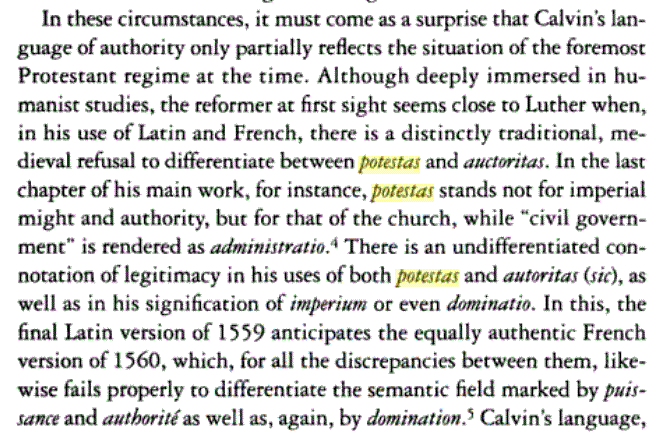
Since potestas translates exousia in the Vulgate, we must assume that Augustine meant that the Son was not in any inequality of exousia/authority. Here is one author who got it right, writing about the Reformers views on authority,

There is one thing I do know for sure. You cannot convince any man who wants to use his beliefs about the trinity to shore up his belief in male authority over the female, that Augustine said that the Son was not unequal to the Father in authority. Its impossible.
It is impossible to explain to many that the difference between power and authority is a modern nuance. Since I haven’t been in dialogue with anyone associated with these doctrines who is prepared to discuss the Latin, the conversation is over before it begins.
July 2012 Biblical Studies Carnival
Phillip J. Long has posted the July 2012 Biblical Studies Carnival at the blog Reading Acts. He has posted many very good links to various blogs and is kind enough to mention several posts on BLT.
Phil announces that he will be organizing the carnival calendar the rest of the year, and he says more:
I will be taking over for the second half of 2012. Jim West has graciously volunteered to host the August Carnival at Zwinglius Redivivus; Tim Bulkeley will cover September; BLT (Bible, Literature, Translation) will cover October.
We at BLT are honored to be invited to host. More on that soon enough. In the meantime, back to that July 2012 Biblical Studies Carnival, and happy reading!
Travel in the Roman Empire
Science News reports this week on the work of Elijah Meeks, a digital humanities specialist at Stanford, in creating
A new interactive map of the Roman Empire that includes roads, rivers and hundreds of sea routes [that] allows users to calculate the travel time and costs for traversing the ancient empire.
(Geeky admission: My first thought was “what a terrific tool for understanding how Christians and their letters moved around!” My second thought was “what a terrific tool for developing a role-playing game set in the Roman Empire!” 😉 )
The project includes travel by road (on foot or otherwise) or sea, including the seasonal effects of wind and currents.
The researchers also incorporated travel costs, based on prices stipulated by an edict issued by the Emperor Diocletian in 301 that imposed price caps on more than 1,000 products and the charges for delivering them, whether by ship, donkey, camel or wagon. As is true today, the preferred route can vastly differ if time is the priority rather than expense.
The project is called ORBIS, and there’s plenty of information about it at the project website about how it was built, how to use it (including both instructions you can read and a video tutorial), and how to cite it in your research. A new interface, ORBIS|via, is a “situated perspective” of the network, is also available to play with, to get an interactive, traveller’s eye view of journeying through the Empire.
The developers note on the home page that
ORBIS is work in progress and your comments are invaluable in helping us improve our site. Feedback is welcome at orbisproject@stanford.edu.
So head on over & check it out!
Sisters of Sinai
Three years ago Evangelical Text Criticism posted on Sisters of Sinai. At the time I read the original book by Agnes Smith Lewis, In the shadow of Sinai: A story of travel and research from 1895 to 1897 (Cambridge : Macmillan & Bowes, 1898). It wasn’t until this summer that I took time to read Sisters of Sinai by Janet Soskice. Here is an excellent review.
This book puts into perspective the unusual accomplishments of Agnes Smith Lewis and her twin, Margaret Smith Gibson. Their wealthy father gave the twins an outstanding education in languages, promising a trip to every country whose language they learned, initially France, Germany, Spain, Italy and Greece. While these women were At first considered amateurs, they eventually met and surpassed most academic achievements in the field of Syriac studies. They remained in some sense outside of formal academia as they lived in Cambridge, where it was not possible for women to be granted university degrees.
Several important themes emerge from this book. First, the women learned Greek not only as an ancient language, but also as a modern language, and were able to communicate in modern Greek. This was the key to their ability to spend time and confer with the members of the St. Catherine’s monastery in the Sinai, who were all native Greek speakers. They also remained lifelong language learners. At no time did they cease to learn new languages, going from Greek and Hebrew to Syriac and Arabic in their publishing endeavors.
They also struggled with their relationship with the leader of the monastery. The Codex Sinaiticus had been removed from the St. Catherines monastery not long before, under dubious circumstances, and after residing in Russia, is now at the British Library. The manuscript which the women discovered had been long forgotten and the pages were stuck together. So the issue is whether it was right or savvy to describe the monastery staff as negligent or in some way uneducated regarding or uncaring of their own manuscripts.
Throughout the book we read of the increasingly successful efforts of the women to engage with others, with the Greek orthodox monks, with Arabs and with Jewish rabbis, respectfully. They were aware that they had said culturally insensitive things, they were scolded for this and they did adjust their manner of interacting. Since the English speaking world maintains its hegemony, it is still instructive to observe how these women learned to converse in Middle Eastern languages and dialogue as equals with others. It is simply not something that comes naturally, not then and not today!
Second, the sisters took photographic equipment with them, took several hundred photographs, and developed them themselves. It was 1893, not 50 years after Tiscendorf has removed the Codex Sinaiticus from the monastery. However, the twins pioneered the use of photography in manuscript research. This meant that the manuscript that they discovered, Syriacus 30, the gospels in Old Syriac, remains to this day in the monastery.
As it happened, this manuscript is a palimpsest; the text was written over in the 8th century. The photographs did not offer enough definition, so the sisters returned to Sinai with a bottle of reagent to darken the underlying text, and a team of linguistic experts to transcribe the text word for word. Nonetheless, a new pattern was established by these women, using technology to duplicate a text and leaving the original in situ. A review of the importance of the Sinai documents is here.
Third, Agnes and Margaret worked for years on Greek, Syriac and Arabic translations and publications. They did receive honorary degrees from many institutions but never from Cambridge where they lived and founded a Presbyterian seminary, Westminster College. They were important patrons of this college in Cambridge in spite of the vote by Cambridge not to give degrees to women. The sisters also donated property and funds for neighbourhood shelters, supported the vote for women, and maintained an athletic lifestyle. Among their other publications is the 8th century text on top of the Old Syriac, Select Narratives of Holy Women.
This discovery was one of the most significant in the history of text criticism, as it brought to light a very early translation of the gospels that was previously unavailable in its entirety. These women were theologically conservative, orthodox Presbyterians, working to defend the integrity of the Greek text of the New Testament.
Incidentally, their work is also important in relation to a feminist perspective on early Christianity. Not only did these two women pioneer a new technology and take the lead in an important discovery, but the text that they discovered demonstrates that the Holy Spirit was feminine in gramatical gender in the Old Syriac, but was, at some later date, altered to the masculine in the Peshitta. In addition to this, the narratives of holy women recounts a strong tradition of women refusing marriage, and dressing and living as men.
This is a story of two women with a conservative approach to the text, who interacted in a positive way with men who were Greek Orthodox, Bedouin, Egyptian, Jewish and Arab, and were indiscriminately interested in the ancient literature of Middle East. They exercized on the parallel bars and loved technology and language learning. Naturally their careers were not without intrigue as there was constant plotting and back-stabbing, or imagined back-stabbing. For example, one expert wrote that Agnes took “a few” photographs – what a way to describe 400 self-developed photos! Another wrote that the sisters “stumbled on” the manuscript when it was used for a butter dish. In fact, Agnes could speak to the head of the monastery in his own language – Greek, asked specifically to see the manuscripts in a certain cupboard, had studied Syriac and could identify that she was looking at an early translation of the “separated” gospels, that is the four gospels, as opposed to the Diatessaron, a single gospel narrative. And no, the manuscript had never been used as a butter dish, and the sisters never ate breakfast with the members of the monastery, but ate breakfast in their own tent. More about the Saint Catherine’s Library here.
The Sisters of Sinai is a fun read. These women were truly eccentric and the academic intrigues are not to be missed!
Six Eight Months Later*
(*I meant to write this after six months, but life’s been busy!)
Well, it’s been six eight months now since we bade farewell to the ICEL translation of the Roman Missal and started using the new, so I thought I’d write about what it’s like to pray this missal, now that the initial shock of the transition has subsided.
I’ve gotten the hang of “And with your spirit” now, and haven’t oopsed there in a long time.
The new confiteor text is one where I make adjustments:
Read the rest of this post over at Gaudete Theology.
A few days ago, Theophrastus wrote about to-day:
As a day of mourning, study of religion is strictly prohibited – because it is said that study of Torah brings joy. But, in fact, there is a beautiful liturgy that day – the Kinnos (lamentations) – incredibly beautiful and tragic poems of lamentation. In many communities, this is supplemented by the book of Lamentations (one of the most beautiful, albeit tragic, books in the Hebrew Bible) and among some Sephardic Jewish groups, the book of Job (widely considered to be the most literary book in the Hebrew Bible.) Some groups have extensive study groups on the Kinnos – and since the holiday is considered to be “post-biblical” (e.g., not taught in the five books of Moses), one can find many of these lectures streamed online.
This paragraph in particular got me thinking of the “post-biblical” Psalm which we find numbered in the Hebrew Bible today as Psalm 78. The Psalm is identified at the start as a משכיל, a “maskil,” of which scholar / translator Robert Alter says: “This is clearly a category of song, but its precise nature remains unknown.” Alter takes readers to Amos 5:13 to say that a maskil “would appear to be a joyous song, though not all the occurrences in Psalms substantiate that connotation.” He notes, for example, Psalm 32, where “there may be a punning reference to a homonym that means ‘discerning person’ or ‘giver of instruction'” and where the “word translated as ‘let me teach you’ in verse 8 employes the same root.” (See page 110 of Alter’s translation of the Psalms.) I wonder how much joy is evoked – or was ever meant to be brought out – by studying Psalm 78.
What is very interesting about Psalm 78 is that more clearly it would seem to be a hearkening to and a real study of תורה, or Torah.
Alter starts his English translation this way:
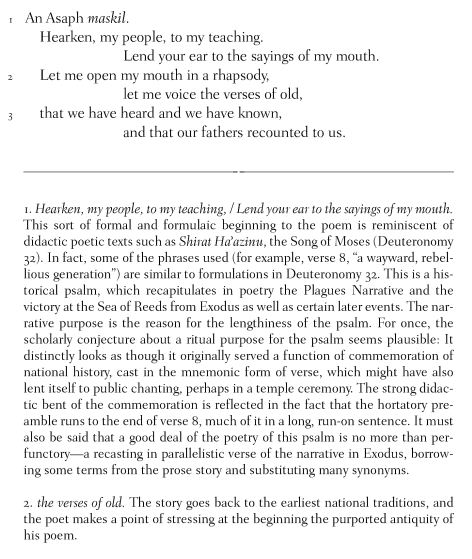
The clear allusions to Exodus and Deuteronomy in the Psalm and in Alter’s footnote make rather obvious that the “teaching” in verse 1, right at the start, is “Torah.” Verse 30 of Psalm 78 bases its language on Numbers 11, verses 20 and 33, says Alter. And verse 13 of the Psalm, Alter observes, “is a direct quotation [of the Hebrew] from the Song of the Sea, Exodus 15:8.” So more than just a study of Torah, this Psalm seems to be a study of the Hebrew language of Torah and a bit post-Biblical borrowing of Torah.
But I want to move forward and elsewhere. I’d like us to see some of the interpretive spins in this Psalm and around 250 BCE. According to some legend, the Jews living in Alexandria, the namesake city of Alexander the Great, were translating the scriptures into Greek. This translation had been commissioned by the monarch of Egypt, right there in Egypt. Now, the legend says that Torah was translated into Greek in Alexandria, Egypt by a very specific number of some of the Jews there. Perhaps the post-Torah literature of what we know today as the Hebrew Bible was also so translated. Perhaps some of that was this Psalm, Psalm 78.
What is interesting about this Psalm in particular (now numbered in the Greek translation, the Septuagint version, as Psalm 77) is how it in multiple verses references and names and recalls Egypt. The Greek translation of these references in Hebrew is not so interesting, nonetheless. As NETS Septuagint translator and scholar Albert Pietersma put it, the Psalms rendered into Greek are very typically and predictably “heavily circumscribed linguistic interlinearity.” No where is this more apparent than in the verses in Psalm 77(78) that mention Egypt. There’s no mistaking what the Psalm is saying about Egypt whether in Hebrew or in Greek.
And yet, the Psalm starts of somewhat differently in Greek than it does in Hebrew. From the beginning, the reader, especially the bi-lingual insiders who get both language, understand the interpretive spin. Pietersma has acknowledged these spins and what he calls “literary sparks” as translator deviations from the norm of “heavily circumscribed linguistic interlinearity.” Nonetheless, his English translation of the Greek translation of the Hebrew sometimes does not so well highlight the “spin” or the “spark.” Again, I think the Greek translation of what Alter calls “the hortatory preamble” of this Psalm 78 is a somewhat different start to the Psalm than what we read in the Hebrew poetic original. So let’s take a look at how Pietersma translates the Greek in English, but let’s look a bit more at the Greek to see what might be going on for the bi-lingual translators and readers in Egypt.
Here’s what Pietersma does with the Greek, rendering it into English (and the first 3 verses will suffice to illustrate what I’m trying to show):

Now, if we read this in Greek again, then we notice the following phrases:
τὸν νόμον
παραβολαῖς
φθέγξομαι προβλήματα ἀπ’ ἀρχῆς
We could easily read the first phrase as a reference to Torah. The Jewish readers of this Hebraic Hellene would get this, and yet to call Torah “nomos” takes the idea of “instruction” more firmly into the overdetermined Greek notions and disputes about legalities and law. Greek readers in Egypt who had less of an understanding of Torah, of the Hebrew scriptures, would not so much associate the start of this Psalm with “teaching” as they would with politics in the context of imperial Egyptian-royal pan-Hellenism.
The second phrase is a reference to, what in Greek is, “fables.” For Pietersma to transliterate as “parable” (and his footnote has “parables” to allow for the plural meaning) is to make us think of what we have come to think of in English as something Jesus told. But in Greek literature up to Alexander, parables were stories told that were pure fables, didactic stories, like those of Aesop, which Aristotle in his Rhetoric theorizes and some disparages also as something non-Greeks, the barbarians, would use. Parables, for the teacher of Alexander, were not particularly useful, not particularly pure Greek in their power. So the Greek reader of the Psalm as a Jewish outsider may misunderstand this word as a “rhapsody,” which is how Alter renders the Hebrew into English. Rather, it seems the Hebraic Hellene translators were offering an ambiguity here but possibly were marking this Psalm as a teaching not at all purely Greek or elegant according to the Greek canon of rhetoric. (This translation does set up the phrase for the Christian canonical gospel writers, who try to describe Jesus’ mode of teaching, i.e., in Mark 4. And it’s very interesting to see other Greek words later in this Psalm — I just don’t have time now to blog about them — that are picked up by the gospel writers. But my main point in this post is that some of the beginning Greek words of this translated Psalm are interpretive spins that offer more to the bilingual Hebrew-Hellene readers in Alexandria, Egypt than to the Greek colonizers of the peoples living there.)
The third Greek phrase above might be translated as follows: “I’ll sing songs as Problems from the Beginning.” What I want to emphasize is something Pietersma notices: the Septuagint translators were not Greek “hacks.” There’s good evidence that they knew Greek literature. We could argue how well they knew Aristotle, if they knew his works at all. But even if the translators didn’t have access to any of Aristotle’s writings, the forceful conquest of the learned Alexander would very likely have sent Greek imperial educational shockwaves through all the world, especially into this cosmopolitan Polis where the translation was under way. “Problems” were something that Aristotle and that Alexander were studied in.
For example, in his Politics, Aristotle specifically and explicitly writes of the universal problems of forms of constitutions in democracies. Around 1284a and 1284b, Aristotle addresses “the universal problem” (τὸ πρόβλημα καθόλου) of this form of politics, with illustrations from the fable of Antisthenes in which “the hares made speeches in the assembly and demanded that all should have equality” especially with “the lions”; and with illustrations from the mythologies of the Argonauts; but much more so with real solid historical illustrations from “the Athenians” in dealings with “the Samians and Chians and Lesbians” and with real solid historical illustrations from “the king of the Persians” who had to deal with “the Medes and Babylonians and the other races that had waxed proud.” And, in the Aristotle corpus, there is what is commonly understood as a pseudo Arisotelian treatise called Problems. This points to a Greek literary tradition of theorizing προβλήματα, and for Jewish translators of Hebrew who were not hacks with Hellene to use this phrase at the beginning of this Psalm is rather fascinating. The start of this now-Greek Psalm takes readers back to the problems at the Beginning, at the start of Torah, to the ἀρχῆς. There, there’s not only the opener “ἐν ἀρχῇ ἐποίησεν ὁ θεὸς τὸν οὐρανὸν καὶ τὴν γῆν” (Genesis 1:1 in Greek); but there’s also the ambiguity of the phrase ἀρχῆς as a prince, or a ruler, or a regular, as it appears in the same context as “καὶ ἐποίησεν ὁ θεὸς τοὺς δύο φωστῆρας τοὺς μεγάλους τὸν φωστῆρα τὸν μέγαν εἰς ἀρχὰς τῆς ἡμέρας καὶ τὸν φωστῆρα τὸν ἐλάσσω εἰς ἀρχὰς τῆς νυκτός καὶ τοὺς ἀστέρας” (Genesis 1:16 in Greek). What I’m hoping we’ll see is the richness of this third Greek phrase at the beginning of the translated Psalm. In monolingual Greek, there’s quite a set of meanings. But to bilingual Greek-Hebrew readers, the Greek reads as an insider Jewish translation, one that suggests that Torah study addresses problems in very creative ways.
It’s just hours away from a day of world remembrance. How many of us, nonetheless, forget. Or we feel as though, especially if we’re not Jewish, it’s none of our business. No, I’m not talking about the Olympics or the International Olympic Committee refusal to remember, the IOC refusal to remember even for a minute, in London in 2012 the horror in Munich only 40 years ago in 1972. I am talking about Tisha b’Av. But since we do have the Olympics on our minds anyway, did anyone else in America listening to the commentary during the opening ceremonies last night notice how there was discussion about Ramadan and how Islamic athletes were having to decide whether to observe or postpone the observance of fasting during the games? And didn’t we all notice the play on the movie, Chariots of Fire, in which the Christian athlete was more observant of his sabbath (i.e., his decision not to run on Sunday) than any of the others including the Jewish athlete? So wasn’t it a glaring omission for the same commentators not to say a thing about Tisha b’Abv and the decision some athletes in London will have to make about their participation in the games from sunset July 28, 2012 to sunset July 29, 2012, when there are many ways one may mourn though these might negatively affect performance? I am talking about the observance of Tisha b’Av now as a universal need, a human need.
When explaining Tisha b’Av, Theophrastus, one of the BLT co-bloggers, has written:
It is the anniversary of the destruction of first and second Temples, but is also celebrated as the day of commemoration for many events ranging from sin of spies in the Promised Land (Numbers 13-14), the razing of Jerusalem in 70 CE, the failure of the Bar Kochba revolt, the expulsion of Jews from Spain in 1492, and for some Jews, the Holocaust.
We might note how helpfully he writes, “some Jews.” This speaks to the diversity within the community of Jews, the communities of Jewish peoples all around the world and through different points of history. What I’m trying to say, additionally, is that whether one is a Jewish person of any group or is one of the Greeks who walked first into the Olympic ceremonies last evening, Tisha b’Av has implications for you. If you are breathing on planet earth, Tisha b’Av has implications. It’s a day of remembering, of mourning, precisely because of someone’s violent and destructive Othering of a class or a race or a religion of peoples.
This doesn’t mean that everyone is Jewish. But Tisha b’Av does get us all thinking of our relationship to Othering, to violence, to destruction, Othering because somebody else is not like we are. It might prompt a blog commenter to say to a non-Jew writing about Tisha b’Av: “i always knew you were Jewish!” Such is the case here, after Bob Cargill’s blog post, Remembering Tisha b’Av (The 9th of Av). A hat tip to blogger Brian LePort, also a non-Jew, who points us to Cargill’s post in his own, The temple in the Book of Acts.
So here I want to take a turn in my own post. In talking about Tisha b’Av, it seems that we always have to draw the line between Jews and non-Jews. I mean, Brian LePort asks, “it is preventing the Jews from realizing the universality of their God’s reign?” The implication is that Luke, writing the book of Acts, and Stephen, written of by Luke in the book of Acts, are men acting out a rather non-Jew perspective (if “the Jews” are necessarily the ones who are prevented “from realizing the universality of their God’s reign”). In other words, Brian LePort finds more in common, as a non-Jew, with Luke and Stephen than with “the Jews” so ostensibly prevented. Now, I’m just trying to track the blogger’s language here, the separations that are implicit in the statement here about “the Jews” in contrast to everybody else, including the blogger.
Something similar is going on in the language of respective blogposts of non-Jew bloggers, Nick Norelli and Rachel Held Evans. Please do click the following links and read the quotes I’m excerpting here in their full contexts. But do notice the language about the Jews in relation to the Bible and how it is read by Jewish people. Nick Norelli in one sentence writes:
Just as Jewish exegetes used these creation accounts to bolster their views of God’s uniqueness as Creator and sovereign Ruler and how they relate creation to eschatological hopes of salvation that is to be accomplished through God’s word or wisdom, so John uses these accounts to say many of the same things about Jesus.
To be fair, and clear, the blogger is writing about “Second Temple Jewish exegesis” as another writer (non-Jew Masanobu Endo) writes about this in his book, Creation and Christology: A Study on the Johannine Prologue in the Light of Early Jewish Creation Accounts. Look, nonetheless, at how non-Jew-ish this language makes John and Jesus.
Likewise, Rachel Held Evans is reading and writing about what a couple of other non-Jew writers (Peter Enns and John Walton) are writing. She writes (her bold font):
… I’ve been blessed to encounter Christian scholars like Peter Enns and John Walton, along with Jewish interpretations of Scripture that have shifted my perspective. I love how, when folks in the Jewish community confront Scripture, they don’t freak out over its conflicts and tensions, but rather engaged them—and with enthusiasm! I’ve learned from Christian scholars more about the historical contexts that influenced the way different scriptural texts were written. And I’ve gone back to my English major roots which have helped me see Scripture as a collection of various genres—from poetry to history to stories to philosophy to law. I’m still struggling to make sense of much of Scripture, particularly the violent stories of the Old Testament, but this new perspective has helped me engage difficult texts with more heart and integrity.
According to Enns, we would do well to learn a few things from the Jewish readers of Scripture whose emphasis in engaging the holy text is “not on solving the problems once and for all but on a community upholding a conversation with Scripture with creative energy.” In contrast, “the history of modern evangelical interpretation exhibits a strong degree of discomfort with the tensions and ambiguities of Scripture,” says Enns. “The assumptions often made are that Scripture should have no tensions and that any such tensions are not real but introduced from the outside, namely, by scholarship hostile to Christianity…It is a great irony that both the critical and evangelical options (as distinct from the Jewish model) take part in the same assumption: God’s word and diversity at the level of factual content and theological messages are incompatible.”
Now, I have no problem with where Rachel Held Evans is going. She’s moving her blog readers toward more open, liberal ways of reading the Scriptures. But notice her language, how implicit the separations between “the Jewish readers” and others. She does mention “the Old Testament,” but she does imply that the New Testament is less violent and less tense and less discomforting and less ambiguous, perhaps not-Jew-ish.
Well, let me return now to that post by Theophrastus, the Tisha b’Av post. There he’s calling it “The strange religious holiday when study is ‘prohibited’.” And I couldn’t help but return to what he wrote when this weekend I was reading the New Testament, the book of Acts, in an English translation of the Aramaic version, the Peshitta. Here that is (with the Aramaic first, followed by John W. Etheridge’s English translation, then James Murdock’s, then George Lamsa’s):
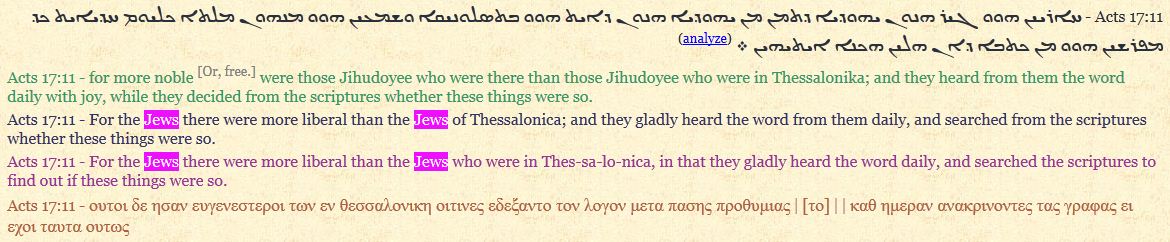
You will want to click on the image above to study it. What you’ll see is how I’ve highlighted for you “the Jews” in the English translations of the Aramaic. Notice how the English translations go like this:
For the Jews there were more liberal than the Jews of Thessalonica; and they gladly heard the word from them daily, and searched from the scriptures whether these things were so.
Now click the image again to read Luke’s Greek language, his account (in the “Westcott-Hort 1881 combined with Nestle-Aland 27th variants”). The King James Version in English (based on the “Stephens’ 1550 Textus Receptus”) is not so different in that it goes like this:
These were more noble than those in Thessalonica, in that they received the word with all readiness of mind, and searched the scriptures daily, whether those things were so.
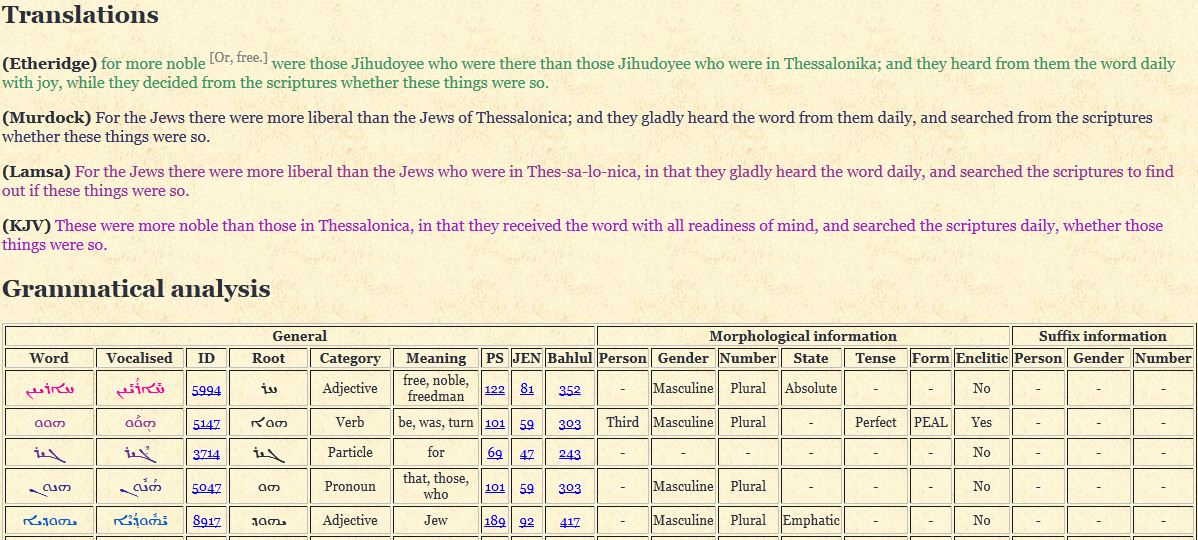
(Here is where you can find and read the Aramaic, the English, the Greek. Here is another look at some of that:
)
What the Aramaic spells out much more than the Greek, from the Greek, is that the Bereans and the Thessalonians were all the Jews. “Some Jews” were “more liberal” than others in reading the Scriptures of the Jews, i.e., the Hebrew Bible and/ or its translation into Greek, outside of Jerusalem before 70 CE. Paul is one of “the Jews.” The book of Acts, then and there, is largely about various ones of “the Jews.” This particular passage is about the necessary Jewishness of the Bible, the Jewishnesses of its readings, of all sorts.
Now I’m going to conclude this post by suggesting that the “the Jew” and the “the non-Jew” binary is the particular problem that Tisha b’Av must remember. Sometimes the problem is as subtle as our language. Unfortunately, more often the problem of Othering, of classifying a group of people into a narrow and tight and “different-from-me” category is a problem that has led to violence and to destruction that endures, regretfully, and universally, to this very day. There is a universal, human need for the observance of Tisha b’Av for all of us. And isn’t it also necessary to understand the variation in what we all know as the Jewishness of the Bible?
Two summer flicks
In the suite of  the 50 shades kerfuffle, I went to see Hysteria. In spite of its story line – the invention of the vibrator – it is relatively prim and proper, a Victorian chick flick, with a good dollop of early feminism. The sexual theme is tempered with concern for the homeless and getting the vote for women. It is light humour, a film to see with your sister! Lots of chuckles! One tiny detail. It is only very loosely related to historic events.
But can’t one also draw a serious lesson from this film, as one does from 50 shades? If, according to some, the prevalence of BDSM demonstrates that God intended man and woman for authority and submission, then what does the invention of the vibrator teach us about God’s intentions? I would love to hear some of our favourite preachers on this topic. One last question – isn’t that the same tie?
Earlier this summer I saw The Intouchables. This is also a comedy, but in this case, very closely based on real life.
Based on a true story, it’s the feel-good tale of an unlikely friendship between a rich, paraplegic man, Philippe (veteran French actor François Cluzet), and Driss (breakout star Omar Sy), a young black man from the ghetto who is hired to take care of him. The movie has had audiences rolling in the aisles since Day One.
I realize that this movie caused a lot of controversy in the USA, but it was wildly succesful in France. Some felt it sugar-coated being paraplegic, and others that the black star was miscast. For me there was too much humour and affection, sheer joie de vivre in spite of circumstance, for these concerns to spoil my enjoyment of this wonderful film.
Well, the intensive phase of my summer independent study is done, and — after taking a week off because my brain went on strike — I have managed to get myself organized for the research paper for final stage. Since what I’m really interested in is how Paul is perceived and preached differently in different Christian traditions, I decided to pick out a few key passages in Romans (since the Reformed and Lutheran traditions, at least, hold Romans up as the jewel of the gospel, and it is the primary scriptural foundation for the understanding of justification by faith alone) that looked likely to be interpreted differently by Catholics and Protestants.
I first thought I’d compare citations to Romans in the Council of Trent’s Decree on Justification and the article on justification from the Augsburg Confession, since they seem to be documents of similar confessional weight. But Trent is far more detailed in its citations than Augsburg. So, following a footnote in Michael Horton’s View on justification, I turned to the sections of Calvin’s Institutes that treat the subject. I also checked out the Catholic Catechism and my notes from the reading I’ve been doing.
So here are the passages I’d like to look at:
Constantine Lascaris’ division of vowels and consonants

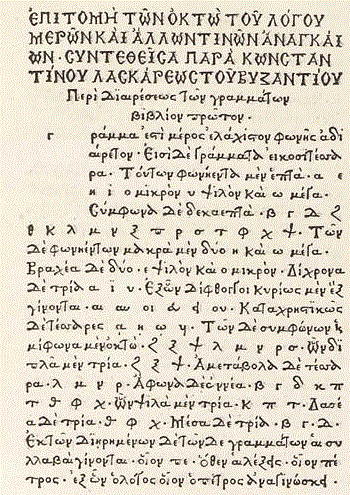 This is the first page of the first European printed Greek grammar and as such is a fundamental text of both the Renaissance and the Reformation. This page is from the 1476 edition printed in Milan. The author, Constantine Lascaris came to Italy after the fall of Constantinople and became a teacher of Greek. He wrote this grammar for his student, the young Ippolita Szforza. Ippolita later married the son of Ferdinand I and became a patron of humanist scholars, but died young at the age of 38.
In 1495 a bilingual Greek Latin edition was printed by the Aldine press with a translation by Johannes Crastonus Placentinus.
For years, I had wondered about the history of arranging the Greek alphabet according to distinctive features. For example, consonants are organized by voiceless stops, voiced stops, aspirates, liquids, and so on.
Although the fundamental principle of presenting vowels and consonants by their classification is found in each, the latter text is far more organized. This raises a lot of questions for me, as to whethe the Greek alphabet was always conceived of in this way, and how much its presentation shifted over time.
This also points to the often overlooked fact that the first generation of humanists and Bible translators learned Greek from native speakers of Greek, and Hebrew from Jewish rabbis.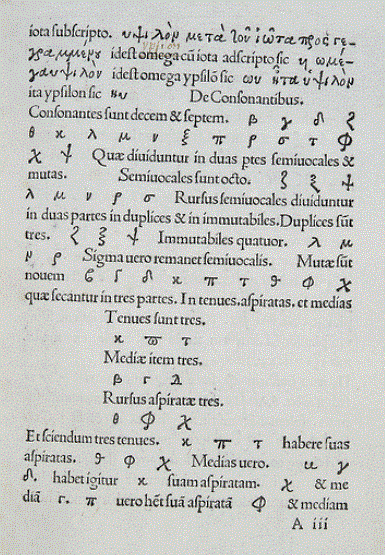
This is the first book printed in Greek and so determines the style of font. The first Greek fonts involved ligatures, abbreviations, and variant forms of the same letter. The font was created in order to imitate manuscript Greek handwriting.
Sex, Submission and 50 Shades of Grey
I want to open by thanking all those men and women who have spoken up against the outrage of Jared Wilson’s original post. These posts are linked to by Kurk, Rachel, and James among others. I especially appreciated Eric’s response and thought that it best articulated my own reactions.
I have read enough of Douglas Wilson’s book, available through Google books, and spent enough time with complementarians – most of my life – to know that this is not about physical rape or violence. This is about having an authority and submission relationship in marriage in which the husband performs headship over the female, and she in return seeks to please him in every way and deny her own self. It is a pathology. However, the husband may be sexually demanding, quite average, or incredibly cold and withholding, not necessarily violent or oversexed. But the overarching feature is that sex takes place within a hierarchical arrangement and this is what our society deplores.
There are sanctions against sexual intercourse within the following relationships, teacher/student, doctor/patient, clergy/parishioner, adult/child, employer/employee and so on. In fact, within any relationship of boss and subordinate, sexual intercourse of any kind is considered to be highly irregular. So why is marriage taught as a relationship of authority and submission? Why should women permanently live within a 24/7 situation of performing sexually within an authority and submission framework?
I disagree that Douglas Wilson in any way promotes physical dominance over women, or is an outlier in this respect. He is an outlier in his use of language and that’s about it. All and every single male in the church who has ever preached the authority of the husband over his wife, and the obedience and submission of the wife to her husband is responsible for promoting the deplorable practice of sex in a hierarchical arrangement.
The good thing is that most complementarians are, in effect, egalitarian, and invoke male authority on special and infrequent occasions, if they want to keep the peace. So I am not attacking all complementarians. I am saying that every single preacher and theologian out there who promotes sex within hierarchy is guilty of just that, promoting sex within hierarchy. So, no, I don’t think Wilson and Wilson are promoting rape and violence, but they are promoting sex within hierarchy. Another pathology.
I can’t say much more without losing my equanimity. I left. I am glad I left.
Does this mean I am rejecting the Bible? Hardly! It contains enough narrative of husbands and lovers gently lying between their lover’s breasts. And to carry this metaphor further, didn’t Jesus allow a dear friend to lean on his breast, doesn’t the child rest on the parent’s breast, and the Son on the Father’s? (Unless you have a Bible that has edited this out.) If we need to use metaphors, can’t we use the metaphors of biblical poetry, of tenderness and love, rather than the metaphors of “penetration and colonisation?”
review of the novel “Fifty Shades of Grey” impact
I’d already not been able to miss E. L. James being interviewed on a tv talk show, and I’d already read where Belinda Luscome with other editors for Time Magazine had named James one of “The 100 Most Influential People in the World” in 2012, already in the first quarter of 2012, because of her Fifty Shades of Grey triology. And then this past weekend, when my wife and I visited a very popular and crowded diner in Fort Worth, Texas, USA, I had to compete with a copy of Fifty Shades of Grey for the cashier’s attention; she didn’t blush even one shade when she finally looked up from those riveting pages of that book finally to accept our payment for our breakfast. This sort of lapse in attention to customers, you might need to know, is very uncommon in these parts.
If you came to this post for a review of the book, let me say that nobody in my family including me has yet read it. So I don’t have a review of it here, not yet. The wikipedia entry seems pretty good, nonetheless. Reading it, I note how the author has chosen the names Christian and Anastasia for the names of her protagonists. How very literary, I think to myself, to have allusionary names for characters, and how very clever that they are “Christian.” Well, you see how I’m reading this: Christian seems at first glance to hearken to the religion, especially when the Greek name Anastasia is in relationship so closely, the latter word being Greek for what English-speaking Christians call Resurrection.
But in this post, I’m only just wanting, however briefly, to review some of the impact of this book. In particular, I’m wanting to follow some of the ripple effects it’s seemed to have caused among bloggers who self-identify publicly as Christian bloggers.
For instance, there’s this one post by a Christian at the Gospel Coalition with the following title: “The Polluted Waters of 50 Shades of Grey, Etc.” It’s by one Jared C. Wilson, who quotes four paragraphs from a book by one other Christian also named Wilson, one Douglas Wilson. So to set that up, the one Wilson compares the book by the other Wilson to James’ impactful book in this way:
This passage from Douglas Wilson’s book Fidelity: What it Means to be a One-Woman Man was written 13 years ago, but I found it especially relevant in the wake of the success of 50 Shades of Grey and other modern celebrations of perverted sexual authority/submission. It is found in the chapter in the book on Rape, and Wilson argues that this sort of sexual pathology is a perverted version of good, God-honoring, and body-protecting authority and submission between husbands and wives.
I suppose it’s rather unfortunate that the blogger Wilson does not quote from the book by the author James. Perhaps, nonetheless, it’s even more unfortunate that the blogger Wilson does quote from the author Wilson’s book, and even more unfortunate than that how both men, the two Wilsons, come into the many comments to defend this quotation. The later, confesses, eventually that he assumed that E. L. James must have been a man for writing the erotic novel. At any rate, some of the unfortunate and unfortunately “defended” quotation of the one Wilson’s book includes this bit (now here an excerpt of an excerpt):
When we quarrel with the way the world is, we find that the world has ways of getting back at us. In other words, however we try, the sexual act cannot be made into an egalitarian pleasuring party. A man penetrates, conquers, colonizes, plants. A woman receives, surrenders, accepts. This is of course offensive to all egalitarians, and so our culture has rebelled against the concept of authority and submission in marriage. This means that we have sought to suppress the concepts of authority and submission as they relate to the marriage bed.
But we cannot make gravity disappear just because we dislike it, and in the same way we find that our banished authority and submission comes back to us in pathological forms. This is what lies behind sexual “bondage and submission games,” along with very common rape fantasies. Men dream of being rapists, and women find themselves wistfully reading novels in which someone ravishes the “soon to be made willing” heroine. Those who deny they have any need for water at all will soon find themselves lusting after polluted water, but water nonetheless.
The defense that both men, these Wilsons, make for these words is that they are misunderstood by all the commenters commenting after the blogpost while they themselves acknowledge that they have not understood E. L. James’s book or understood that she writing it was not a man like them.

At any rate, there’s the rippling effect now, the aftershock of comments, and the blog posts in response, and the calls for such. I’d recommend the reading of these:
“Oh? I couldn’t tell the different between the GC and 50 Shades” by Joel Watts
“50 Shades of Douglas Wilson’s Racism and the Gospel Coalition @TGC” by RodtRDH
“Sex as colonization?” by Abram K-J
“The Gospel Coalition, sex, and subordination” by Rachel Held Evans
—
update – a few other posts:
“Is it 2011? The Gospel Coalition and Rob Bell have our attention, again.” by Brian LePort
“Sexual Conquering is Rape” by J. R. Daniel Kirk
“Doug Wilson, The Gospel Coalition, and Sanctified Rape Culture” by Grace
“50 Shades of Stupid” by Phillip Winn
“The Writer’s Burden” by Dianna E. Anderson
“Equality Forces Rape Culture?” by the Author at http://www.theundergroundrailroad.ca
“Let’s just call it what it is – rape” by Joel Watts
“If This is What Christian Sex Is Like, No Thank You” by Hemant Mehta (not self-identifying as a Christian)
“Take it Down” by Scot McNight
“The Only Thing Worse than a Church Full of Women Reading 50 Shades of Grey Is a Church Full of Men Reading Fidelity: What It Means to Be a One-Woman Man” by Wade Burleson
“With no small amount of trepidation…” by Chris Hubbs
“take it down, jared” by jonathan
“50 shades of BLAH” by the writer at The Blog bites better than the Bullet.
“Fidelity and Shades of Grey” by Mara Reid
“Gender Roles, Submission, and the Image of God: Choose your words carefully” by Bekah Mason
“Roles Reversed” by Hank
“Just some words of encouragement and peace…” by Rachel Held Evans
—
And “My Review of Fifty Shades of Grey” by Joel Watts
Women, IQ and complementarianism
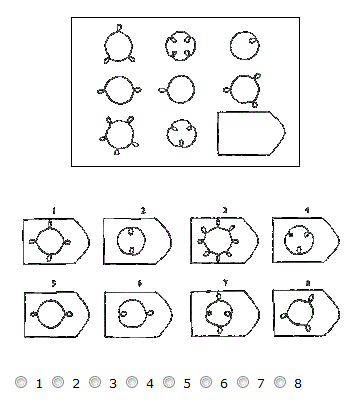 I am going to be completely predictable. Can’t help it. Having lived my entire life with the teaching that women are not logical enough to make their own decisions, I feel it! There was even a poor chap who visited my home blog a while ago and insisted for about 100 comments that he knew men were more logical than women because he was more logical than his wife.
So …. here is the Raven’s test. It is a test of non verbal logical reasoning. This is the test which Jim Flynn used to compare the IQ of men and women, and found women have pulled up alongside men. (A little past actually, but I am trying to be too polite to say that. It’s meaningless.) Here are a few details,
The author of the study, James Flynn, a New Zealand-based researcher known as an IQ testing expert, said that over the past century, women have lagged slightly behind men in IQ testing scores, at times by as much as five points. But now, Flynn said women have closed the gap and even inched ahead in this battle of the intelligent sexes.
“Over the last 100 years, everyone in the developing world has been gaining about three IQ points, but women have been gaining faster,” Flynn told ABC News. “This is the result of modernity. In every country where women have an equal chance of modernity, women have caught men [in IQ testing].”
Flynn has not yet published the results of his study, saving that for a book he will publish in September. But he told ABC News that he collected data from Australia, New Zealand, South Africa, Estonia and Argentina on scores on a standard IQ test, called the Raven test. Each country tested at least 500 men and 500 women, most between the ages of 15 and 18, Flynn said.
Now here is the basis of complementarity of men and women, first, according to Wayne Grudem,
This explanation seems to me to best suit the wording in 1 Timothy 2:14. Paul is saying that women should not teach or have authority over men in the congregation of God’s people for two reasons: (1) Because God gave Adam a leadership role when He created him first and Eve second (v. 13), and (2) God gave men, in general, a disposition that is better suited to teaching and governing in the church, a disposition that inclines more to rational, logical analysis of doctrine and a desire to protect the doctrinal purity of the church, and God gave women, in general, a disposition that inclines more toward a relational, nurturing emphasis that places a higher value on unity and community in the church (v. 14). Both emphases are needed, of course, and both men and women have some measure of both tendencies. But Paul understands the kinder, gentler, more relational nature of women as something that made Eve less inclined to oppose the deceptive serpent and more inclined to accept his words as something helpful and true.
To say this is not at all to say that men are better than women or that women are inferior to men. That would be contrary to the entire biblical testimony. But if in fact God has created us to be different, then it is inevitable that women will be better at some things (in general) and men will be better at other things (in general).
To take an obvious example, women are better at bearing and nursing children than men (for men cannot do these things!). This does not make women better than men, but it does make them better than men at some things. Similarly, because of their size and strength, men (in general) are better boxers and wrestlers and football players, for no women are able to compete against men at a professional level in these sports. This does not mean that men are better than women, but they are better at some things than women. Similarly, academic achievement tests regularly show that women (in general) are better than men in verbal skills, while men (in general) are better than women in mathematical skills and skills having to do with spatial concepts. While there are numerous exceptions, these things are true of men and women in general, and they say somethingabout our nature. Similarly, men tend to be more aggressive and to gravitate toward positions of leadership and dominance, and women tend to be more relational and to gravitate toward community and cooperation. These things are neither “better” nor “worse,” but they are different. In the same way, it seems that 1 Timothy 2:14 is saying that men are better suited for the task of governing and of safeguarding the doctrine of the church. This does not mean that women could not do this task, and do it well, at least in certain cases. But it does mean that God has both established men in that responsibility and has given inclinations and abilities that are well suited to that responsibility.
Yet we must be cautious at this point. We should not say, “Since Paul’s reasoning is based on different general tendencies in men and women, there will be some unusual women who can be elders because they don’t fit the generalizations but reason and relate more like men.” We should not say that because Paul does not say that; he prohibits all women from teaching and governing the assembled congregation, not just those with certain abilities and tendencies.12 And he does so first because of the order in which God created Adam and Eve (v. 13), and second because he sees something in Eve that is representative of womanhood generally (v. 14) and therefore applies broadly and in principle to all women as they are representatives of womanhood as well. Grudem. Evangelical Feminism and Biblical Truth. page 73.
And according to Tom Schreiner,
God’s order of creation is mirrored in the nature of men and women. Satan approached the woman first not only because of the order of creation but also because of the different inclinations present in Adam and Eve. Generally speaking, women are more relational and nurturing and men are more given to rational analysis and objectivity…appointing women to the teaching office is prohibited because they are LESS LIKELY to draw a line on doctrinal non-negotiables, and thus DECEPTION AND FALSE TEACHING WILL MORE EASILY ENTER THE CHURCH…” (pg. 71; quote itself taken from Thomas Schreiner’s “Interpretation of 1 Timothy 2:9-15, pp. 145-146). (Upper case thanks to this post.)
Can we be friends now? Now that women are not, as a group, less capable of logic, rationality and objectivity, can we stop telling women that they are “too emotional.” Maybe this will free men up to express more emotion – hey, if logic and emotion can inhabit the same human body without displacing each other, maybe we don’t have to fear it, mock it, or whatever. Let’s be relational and rational – together.
Let’s communally ditch the ideas that women are less logical, and, while we are at it, have less need for respect than men, and are given less responsibility for their own families than men. Let’s ditch these really bad ideas.
Some same sex blessing history
I wrote recently some personal thoughts on how those who do not approve of same sex blessing might consider responding in a positive way just the same. When I wrote that post I had not read about the US Episcopal convention and the authorization of a same sex blessing rite in the United States. I have just finished reading Amanda’s well researched and informative post on this topic and would like to respond.
I was a long term member of the congregation which initiated the dissent against the same sex blessing in the diocese of New Westminster in Canada. I was closely involved and originally in great sympathy with the clergy, including Dr. Packer, who attended the same congregation. However, as I became more informed, and watched from close hand how things came to pass, my views shifted, and I found that I could no longer remain in sympathy with the group protesting same sex blessing. Here are a few of my thoughts.
First, the clergy who resisted same sex blessing held views that were at odds with the Anglican Church of Canada when they first came into the diocese. The Anglican Church of Canada had ordained women since the 1970’s. The first woman ordained in the Anglican Church worldwide was ordained during the second world war in China – Li Tim Oi. The Anglican Church of Canada followed in a worthy tradition of ordaining women who were already recognized spiritual leaders. I respected this position, although at that time I was not an advocate of inclusive ordination.
The clergy who later resisted same sex blessing, had already expressed their views to the bishop that a woman should not be in a position of authority within the diocese. They held these views concerning women prior to coming to Canada and yet willingly as Anglicans immigrated here and accepted positions in the ACC, knowing that they were at odds with the ACC position on the ordination of women. There was already a sense of broken fellowship from their original dissent on this issue. I could not feel that it was appropriate to have Dr. Packer, in effect, protest the ordination of Li Tim Oi and the many women who followed.
Second, the translators of both the Today’s New International Version and the English Standard Version were in our community. Dr. Packer, in our congregation, signed a statement that the TNIV was not a trustworthy Bible. This also was, in my view, a cause for broken fellowship. The ESV was proposed as the new pew Bible in the church, although I do not know whether action was ever taken on that. The ACC of Canada had been using the NRSV, but those clergy who resisted same sex blessing, also did not believe that an inclusive Bible was an appropriate vehicle of worship. This is the second way that the clergy were at odds with the ACC in general.
From my own background in biblical languages, and translation history, I was well aware that the KJV and Luther’s Bible included the phrase “children of God,” and I could not believe that the phrase “sons of God” was more efficacious language for the salvation of women. I was not able to assent to this point, and felt at odds with the clergy on this.
Third, I had a growing concern about the sermons on the submission of wives. I inquired about whether there were any resources for abused wives, and I was told that there were none, since there were no abused wives in our congregation – that was not our demographic. However, I knew for a fact that this was not so, there were, and that in a congregation close to a thousand in membership, it was likely. I felt that this was negligent on the part of the clergy and lead to unnecessary suffering on the part of certain individuals.
In continuing to investigate the attitude of the clergy regarding women, I found that they were committed followers of the Council of Biblical Manhood and Womanhood. I was surprised to learn that their basic go to manual on matters relating to women was written by Piper and Grudem. There was also a public association with Bruce Ware. I could not agree with this theology. And yet, I need to add that many of these views on women were expressed by the clergy only with some reticence. This is only my opinion, but I felt that the clergy knew that the ACC, the diocese and the congregation, did not have the same commitment to end the ordination of women that the clergy had. Unity coalesced around resistance to same sex blessing. For the clergy this was part of their broader belief in the restricted function of women. For the congregation – I am not so sure.
Fourth, the dissenting clergy were not forced to officiate for same sex blessings, but only to tolerate the fact that it was happening in other congregations. From my perspective, they made a choice to leave the ACC based on a complex foundation of views that were at odds with the ACC. I attended the service of licensing with the Southern Cone, as a friend. I strongly believe that it was a choice for these clergy to leave the ACC, a church which they had never been in solid agreement with.
Fifth, I am not entirely certain that it was a useful way to spend money for the congregation to sue the diocese for the property. The whole thing is a bit of a mess, and I do not feel that the clergy who dissented on same sex blessing have the moral high ground. I don’t know if there is a moral high ground considering all the details.
In the end, I felt that knowing what I did, I could not go along with the dissenting clergy even though I had originally supported them. I considered them as friends. But I don’t agree with the way they have handled many issues and I had to respond to that. It’s not easy, but I needed to withdraw and deal with the disappointment that I experienced, that this church which I considered home, had not been in accord with the diocese and fellow Anglicans on the matter of women, and Bible versions. In view of this, I reassessed my views on same sex blessing. My strong reaction was that even if I had continued to dissent from this (which I didn’t) but even if I had, nothing could convince me to stay in a congregation where the politics regarding women, and regarding Bible translation, were in my view, very inappropriate and not examples of Christian conduct.
Finally, I have since been attending a local Anglican church which has been recognized by the city for a strong Neighbourhood ministry with street people. I have not regretted my decision to leave my former church. I am also relieved to read of the recent decision of the Episcopal Church.
The semantics of benefaction in First Clement
I can’t seem to find anything written on this, but perhaps I have missed it. if so let me know. What follows is a list of some of the vocabulary used in the First Epistle of Clement which relates to God and Christ as our benefactor.
καὶ ταῖς μεγαλοπρεπέσι καὶ ὑπερβαλλούσαις αὐτοῦ δωρεαῖς τῆς εἰρήνης εὐεργεσίαις τε κολληθῶμεν 19:2
and let us cleave to the glorious and excellent gifts and benefits of his peace. Hoole
And cleave unto His splendid and excellent gifts of peace and benefits LightfootὉ οἰκτίρμων κατὰ πάντα καὶ εὐεργετικὸς πατὴρ 23:1
The Father whose mercies are over all things, who loveth to do good, Hoole
The father, who is pitiful in all things, and ready to do good Lightfoot
The all-merciful and beneficent Father KleistἸησοῦν Χριστόν, τὸν ἀρχιερέα τῶν προσφορῶν ἡμῶν, τὸν προστάτην καὶ βοηθὸν τῆς ἀσθενείας ἡμῶν. 36:1
Jesus Christ, the high priest of our oblations, the champion and defender of our weakness.36 Hoole
Jesus Christ, the High Priest of our offerings, the Guardian and Helper of our weakness Lightfoot
Jesus Christ, the High Priest who offers our gifts, the patron and helper in our weakness Kleistπροετοιμάσας τὰς εὐεργεσίας αὐτοῦ, πρὶν ἡμᾶς γεννηθῆναι. 38:3
having prepared beforehand his benefactions, even before we were born. Hoole
having prepared His benefits aforehand ere ever we were born Lightfoot
Where he had prepared His benefits before our birth Kleistὑπὲρμαχος καὶ ὑπερασπιστής 45:7
champion and defender Hoole
champion and protector Lightfoot
champion and shield Kleistμόνον εὑρέτην πνευμάτων καὶ θεὸν πάσης σαρκός 59:3
the only benefactor of spirits, and God of all flesh Hoole
who alone art the Benefactor of spirits and the God of all flesh Lightfoot
who alone are the Benefactor of spirits and the God of all flesh Kleistἀξιοῦμέν σε, δέσποτα, βοηθὸν γενέσθαι καὶ ἀντιλήπτορα ἡμῶν. 59:4
We ask thee, Lord, to be our helper and assister Hoole
We beseech thee, Lord and Master, to be our help and succour Lightfoot
We beg thee, O Master, to be our Helper and Protector Kleistσοὶ ἐξομολογούμεθα διὰ τοῦ ἀρσιερέως καὶ προστάτου τῶν ψυχῶν Ἰησοῦ Χριστοῦ 61
to thee do we give thanks through the high priest and protector of our souls, Jesus Christ Hoole
We praise thee through the High Priest and Guardian of our souls, Jesus Christ Lightfoot
We render thanks and praise through the High Priest and Ruler of our souls, Jesus Christ Kleist
The three translations are Hoole, Lightfoot and Kleist. Some of the vocabulary is not difficult to translate. We find the common terms of father, creator, shepherd, king, saviour and high priest. But other terms are more abstract.
προστατης – champion, guardian, patron, protector, ruler
βοηθὸς – defender, helper
εὑρετής – benefactor
ἀντιλήπτωρ – assister, succour, protector
In fact, of all these terms, only “father” is essentially masculine. Curiously, the term “patron” derived from “father” is used for Phoebe and other women patrons. According to Richard Fellows, about half of the patrons in the Christian scriptures are women. In spite of the Latin etymology, there is no need to be male to be a patron. As we have always known, there is no need to be male to be an imitator of Christ. Rather than balancing out God our father with God our mother, it is perhaps more useful to think of God our benefactor.


 BLT
BLT 
