A Real “Clobber Passage” (a translation of Romans 2:1-4)
It’s always been a fascination to me that, whoever Paul of the New Testament was, he chose to use Greek (and not Latin) to write his letter sent to readers in Rome. His readers may have been, like him, real Roman citizens. That Paul used Greek as the language of his communication to Rome may speak some to the fact that the government there could not easily govern by this official language alone (and even the Emperors would slip back from time to time into the rhetoric and poetry of educated and even common Hellene). What’s more fascinating is how Paul addresses his readers in Rome as Jews first and also as Greeks (and he seems to hint that those in Rome otherwise were mere barbarians). The context of Rome and of its citizens is just fascinating in Paul’s time. And this may help contextualize better for us Greek readers today one of the so-called “clobber passages” of the New Testament.
“Clobber passage” refers to a decontextualized passage that is used to clobber someone whose sexual practices is other than ones own. For a couple of years now, I’ve seen a number of bloggers using the phrase related to Christian readings of scripture and of Paul’s writings in some cases. At Huffington Post last year, John Shore looked at a number of “clobber passages,” including one from the initial sentences of Paul’s letter to Rome (i.e., Romans 1:26-27). Shore, fortunately, not only provides this passage but he also gives some of the Rome context in which Paul writes. He says,
In the times during which the New Testament was written, the Roman conquerors of the region frequently and openly engaged in homosexual acts between older men and boys, and between men and their male slaves. These acts of non-consensual sex were considered normal and socially acceptable. They were, however, morally repulsive to Paul, as today they would be to everyone, gay and straight.
What got me looking at this again is the fact that one of my own children is leaving for Rome and Athens this week for a college course on the history and religion of the ancients. In preparation, she’s been reading one of Mary Renault’s books which imaginatively recalls the same-sex practices of the ancient Greeks, practices which Paul seems to address in his letter to readers of Greek in Rome. There’s allusion to Socrates.
And when I re-read Romans 1 and 2 in Paul’s Greek this morning, I saw a possible allusion to The Apology. It comes as a turn, as an anti-strophe (from Romans 1 to Romans 2). I apologize in advance if not everyone would agree that Paul’s first readers might have seen this. Nonetheless, it seems, to me anyway, that Paul was being poetic, being rhetorical with his Greek. He is being persuasive. He is writing a real clobber passage. The rhetoric of Romans 2:1-4 sure seems to clobber anyone and everyone who might use Romans 1:26-27 as their clobber passage. This is brilliant ancient deconstructionism, well before modernism or postmodernism.
Well, without further ado, here’s that Greek and below that a translation:
διὸ ἀν απολόγητος εἶ,
ὧ ἄνθρωπε πᾶς
ὁ κρίνων• ἐν
ᾧ γὰρ κρίνεις
τὸν ἕτερον, σεαυτὸν κατα κρίνεις,
τὰ γὰρ αὐτὰ πράσσεις
ὁ κρίνων.
οἴδαμεν δὲ ὅτι τὸ κρίμα
τοῦ θεοῦ
ἐστιν κατὰ ἀ λήθειαν
ἐπὶ τοὺς τὰ τοιαῦτα πράσσοντας.
λογίζῃ δὲ τοῦτο,
ὦ ἄνθρωπε
ὁ κρίνων
τοὺς τὰ τοιαῦτα πράσσοντας
καὶ ποιῶν αὐτά,
ὅτι σὺ ἐκ φεύξῃ τὸ κρίμα
τοῦ θεοῦ;
ἡ
τοῦ πλούτου
τῆς χρηστότητος
αὐτοῦ
καὶ
τῆς ἀν οχῆς
καὶ
τῆς μακρο θυμίας
κατα φρονεῖς,
ἀ γνοῶν
ὅτι τὸ χρηστὸν
τοῦ θεοῦ
εἰς μετά νοιαν
σε ἄγει;
So “The Apology” is a no,
O Everyman,
O Judge.
Oh, that judgment
Of the Other, is that judgment, Of Yourself,
Practically the Same-Shame Practices,
O Judge.
As we all know “The Judgment”
Of God
is no Cover-up
Of those of these Practices.
Oh say can you,
O Human,
O Judge
Of those of these Practices,
Poetically the Same-Shame,
Oh can you flee from “The Judgment”
Of God?
Or might your judgment
Of this wealth
Of that kindness
Of his
Of this “No Fury”
Of that “Far-off Rage”
Be slighted by your opinions?
Oh? You have no understanding
Just how that kindness
Of God
Might be Open Mindedness
Delivered to you?
Nunberg on “ ‘The data are’: How fetishism makes us stupid”
[My 2013 anniversaries post is coming soon – but this is too good not to mention here ….]
Geoff Nunberg has a new post at Language Log on out-of-control copy editing. It begins this way:
Pedantry, Dr. Johnson said in the Rambler, is the unseasonable ostentation of learning. And learning is never so unseasonable as when its display impedes the workaday business of making sense. Take the sentence from The Economist that I ran across when I was writing my word-of-the-year piece for Fresh Air on "big data":
Yet even as big data are helping banks, they are also throwing up new competitors from outside the industry.
You can see what happened here—the copy editor (it had to be a copy editor, since nobody competent to write about big data would dream of treating the phrase as anything but singular) saw data followed by a singular pronoun and a singular form of be, and corrected them to plurals. The problem is that if you construe big data as a plural then it has to denote a collection of large things, in the same way that big elephants denotes a set of elephants that are each large, not a large set of elephants of any size. In that case, I suppose big data would have to be a collection of facts like this:
π = 3.1415926535897932384626433832795028841971693993751…
rather than, say
π > 3
which is a little bitty datum. If you took the sentence at face value, that is, it would be what we grammarians term “idiotic.” But I doubt whether the Economist’s copy editor gave a toss, as they lot say. Sense, shmense—he or she wasn’t about to get caught out treating data as a singular noun.
It gets even better. Read it all here.
Anniversaries of 2012 redux
About a year ago, I wrote about the anniversaries of 2012. Remarkably, I saw was very little attention to those anniversaries in the last years, (with the exception of Charles Dickens [more on Dickens 2012 in a separate post] and a BBC Radio 4 program on “Forgetting” Lawrence Durrell.)
Perhaps most surprising to me was the lack of attention, in the United States at least, to the two hundredth anniversary of the War of 1812. (I understand that our Canadian friends are making a much bigger deal of it: link 1, link 2, link 3, link 4.) We cannot say that the United States, Britain, or Britian’s Canadas really won that war; it largely reinforced the status quo. However, we can definitely say that the war was disastrous for the Shawnee, Potawatomi, Ojibwa, Muscogee Creek, Seminole, Choctaw, Cherokee and Chickasaw nations.
Perhaps we will see an uptick of interest when we come to the anniversaries of the battles that led to the two great American historical songs: the 1814 Battle of Fort McHenry (which led to Francis Scott Key’s “Star Spangled Banner”) or the 1815 Battle of New Orleans (which led to the eponymous song sung by Johnny Horton that is the all time top-selling country song.)
There was a small continuing flood of US Civil War material during its 150th anniversary, although since Civil War books are always being published, it is hard to say whether it was an uptick or not. The New York Times’ Disunion Blog continues to be the best Internet presence of the anniversary.
The Civil War did generate one of the worst movies of the year, Abraham Lincoln, Vampire Hunter.
Fortunately, that was counter-balanced by one of the best movies of the year:: Steven Spielberg’s (and Tony Kushner’s) Lincoln. (Doubtlessly with Speilberg’s and Kushner’s names attached to the films, and favorable commentary in the press from the likes of David Brooks, Ruth Marcus, Rebecca Keegan, and Philip Zelikow, anti-Semites were driven to insanity by this film.)
All-in-all, 2012 was only a fair year for celebrating anniversaries. But, coming up in my next post, the literary anniversaries of 2013.
Happy Year End Carnival!
Abram K-J has posted the “Biblical Studies Carnival” at “Words on the Word [to]be among the first to wish you and yours a Happy New Year! … with a recap of what went on in the so-called biblioblogosphere in December 2012.” He links to a number of interesting articles. And we’d like to thank him for linking to a few BLT articles. A great way to start 2013!
Happy 2013!
Happy 2013 to all of the members of the BLT community: bloggers, commenters, readers! We’ve had a thoroughly engaging years of discussion here in 2012, and with a little luck, 2013 will bring more excitement.
I wish all of us success and good health in 2013!
Tonight for me: Italian food, opera arias, and a late-night theater performance beckon. But I will also be daydreaming about this cottage (the post is dated 2011, but I just found it yesterday). Now, a plan to build something like this would be a fine New Year’s Resolution!
I doubt that I have the talent and capability to build a cottage like this, but it is fun to daydream about.

















“Soft peddle” and the Professors of Peevage
The Professors of Peevage at Lake Superior State University are at it again with yet another of their tedious lists of words they feel should be banned. But this post is not about going to be about concocted ersatz outrage from third tier institutions. Rather, I want to talk about an interesting misspelling.
In the CNN article by Thom Patterson about the list, my friend Geoff Nunnberg is quoted:
"Journalists always like cliffs," Nunberg jokes. "There’s more pressure to use phrases like that, because if you soft peddle things, nobody’s going to read the story."
Now, I am certain that Geoff did not “say” the words “soft peddle,” – I’ve found Geoff to be precise in his articulation, and without doubt he correctly pronounced “soft pedal,” rather than its near homonym “soft peddle.”
So why did and Patterson (and his editor) get it wrong? Well, the phrase “soft pedal” refers to muted voice – a piano’s voice when the “soft pedal” (e.g., the celeste) is depressed, or con sordino. But maybe Patterson heard the phrase in contrast to “hard sell,” suggesting the incorrect “soft peddle.” To be fair, Patterson is not alone in this error – Google indicates that this error is not uncommon – and now it has been endorsed by CNN.
Simple knowledge of phrasal etymology could prevent this error, but this new false etymology suggests an incorrect spelling. While some might think that this represents a certain decline in literacy (and a far more serious than the entries on the Professors of Peevage’s list – there is, after all, nothing misspelled in the phrase “fiscal cliff”), I prefer to look on the bright side – thanks to the work of CNN, we now have an excellent justification for teaching etymology when we teach new words.
Translating Translations: no pound of raisins for Екатерина Лобкова
Not long ago, I found on a translation competition website how Екатерина Лобкова (Ekaterina Lobka) translated into Russian how David Bellos translated into English the following Chinese “shunkouliu” exactly a dozen different ways:

Lobka also translated what Bellos wrote to introduce these twelve translations. He wrote:
Chinese people love to pass around shunkouliu on oral grapevines. These are satiric rhythmical sayings, often consisting of quatrains with seven-syllable lines. The regularity of the form is audible and also visible in writing, because each Chinese character corresponds to one syllable. Here’s a jingle of that kind […]
Compact, patterned, dense, allusive, bitter, and humorous … translating a shunkouliu is a tall order. So why bother to try? Yet despite the odds, this barbed rhyme about New China’s old guard can be tailored into a pleasing and meaningful shape in a language completely unrelated to its original tongue. Here’s how it can be done, step by step.
And so she wrote:
Китайцы любят передавать из уст в уста shunkouliu на злобу дня. Это ритмизованные сатирические высказывания, часто состоящие из четверостиший, в каждой строке которых семь слогов. Регулярность этой формы слышна и видна на письме, поскольку каждый символ китайской письменности соответствует одному слогу. Вот один из таких стишков […]
Компактный, узорный, насыщенный, иносказательный, горький, юмористичный… Перевести такой shunkouliu – не фунт изюму. Зачем и пробовать? Но, несмотря на сложности, этот колкий стишок о старой гвардии Нового Китая можно перекроить в изящное и глубокомысленное произведение на языке, совершенно не родственном языку оригинала. Вот как это можно сделать, шаг за шагом.
And so I’d like you to note: Bellos’s “a tall order” is matched by Lobka’s “не фунт изюму“!
What’s “a tall order” mean in English anyway? Click here to read some English readers musing about the phrase.
And what’s “не фунт изюму” mean in Russian anyway? Click here to read in English what this Russian idiom (literally “no pound of raisins”) might mean.
Now enjoy all of the different ways of translating that both Bellos of the shunkouliu and Lobka of Bellos and of shunkouliu have been able to demonstrate. These can be found at “the Custom Cuts: Making Forms Fit – Индивидуальный пошив: подгоняем по фигуре.”
Does a Russian translation of an English translation of the Chinese “shunkouliu” have more political ramifications?
What’s involved in translating translations that is more of a tall order than just translating an original?
What are the implications for Bible translation, especially passages that must be translations of translations?
Les Misérables: Julie Rose’s Victor Hugo
With the spectacular film version of the major Broadway musical adaptation of the English translations of the French novel playing in theaters worldwide, there’s a renewed interest in Victor Hugo’s Les Misérables.
Julie Rose – the writer/translator who wrote in 2007 “the first full original unabridged translation of Victor Hugo’s epic novel” – is back on the talk-show circuit. She has spoken recently with Australia Broadcasting Company’s Margaret Throsby. If you listen to the podcast, then you hear Rose repeat how the translator finds herself in a relationship with the original author that is much like a marriage. She finds herself needing to be “faithful.” And in the Translator’s Preface, Rose says so.
The refreshing thing is that Rose does more than just remain faithful like a wife to a husband. In the same Preface to her translation, she claims she’s out to prove Hugo wrong in certain ways. Here’s a clip from the amazon.com preview (my highlighting):
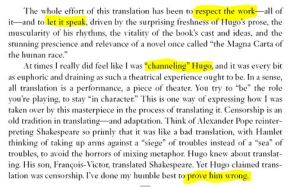
The month after Rose’s translation came out, Rick Kleffel of NPR quoted her as confessing not wanting to follow the author in how he himself turned out. Here’s the humorous line:
I was very worried about losing my hair and becoming fat which Hugo did, you know, by the time he was writing it. You almost go into a trance-like state to be able to sustain [Les Miserables].
The year after Rose’s translation was published, Ron Hogan began corresponding with her and blogged some of her translation philosophy and practice (see also here). She made clear that she doesn’t always exactly faithfully follow Hugo. Her Napoleon and his are a little different (and I know this is something she’s taken some flack for — blogger Saki thinks Rose “misfires” there); nonetheless, she expresses some original authorial/translational intention:
Adding, subtracting, multiplying, dividing: maybe translating is also doing math, musical math. If so, additions need to be kept to a minimum according to the requirements of intelligibility, subtractions even more so, but the chopping up of syntax and the multiplying of sentences is often essential.
With Victor Hugo’s monumental Les Misérables, I felt the need only very occasionally to add, for reasons you may well imagine, but never to subtract. In the description of the Battle of Waterloo, for instance, when Napoleon refers to his nemesis, the Duke of Wellington, as ‘ce petit anglais‘, I couldn’t stop my Napoleon from adding a noun: ‘that little British git’. Call me a jaded modern Australian, but for me, ‘that little Englishman’ just didn’t get the withering contempt with which the mere descriptive ‘anglais’, coloured by the ‘petit’, was charged in the Hugo. The Victor Hugo I came to know, a man with a great sense of humour, would have laughed, I like to think.
Translators of Hugo traditionally never add, they subtract—and rather cavalierly at that. Certainly the exact nature of Hugo’s feel for the idiosyncratic and the particular, his celebration of sheer excess, is lost in the process. That’s the conclusion I reached as I read the two best-known English translations—Charles Wilburs’ 1862 version and Norman Denny’s from 1976—while I was working through the first and second drafts of my Misérables (precisely to make sure I left nothing out).
That she’s intent on not leaving anything out and that she adds sometimes actually does not mean that Rose’s translation is unwieldy or even necessarily longer than the translations of others. Here’s Kleffel’s side by side comparison of one passage:

Here’s the original from Victor Hugo (1862):
Charles Myriel, nonobstant ce mariage, avait, disait-on, beaucoup fait parler de lui. Il était bien fait de sa personne, quoique d’assez petite taille, élégant, gracieux, spirituel; toute la première partie de sa vie avait été donnée au monde et aux galanteries.
Those of us reading Rose’s translation are happy how she’s come to know Hugo and has shared him with the rest of us this way.

Appetite and Desire
One of my favourite topics! When is it desire, and when is is appetite? This is the original puzzle,
Et ad virum tuum erit desiderium tuum
And to your man will be your desire Gen. 3:16
Et in te erit appetitus eius
And to you will be his appetite Gen. 4:7
These two citations are translations of teshuqah. It is in translation that the chasm opens between “desire” and “appetite”, not in Hebrew. This is the Latin of Pagninus, who brought this meaning of teshuqah into the European tradition.
So, now to Isaiah and psyche, as a translation of nephesh, also possibly “desire” and “appetite.” But I don’t find any illumination in the Latin translations of nephesh – it is simply translated as anima (soul.) Some, including Alter, suggest that this is wrong-headed, that all would be solved if we translate nephesh as “throat.” In my view, this does not solve the problem. There is a double meaning in the Hebrew that we cannot reproduce in English, and could not be done in Greek either. Here is Ecc. 6:7,
כָּל-עֲמַל הָאָדָם, לְפִיהוּ;
וְגַם-הַנֶּפֶשׁ, לֹא תִמָּלֵא.
πας μοχθος του ανθρωπου εις στομα αυτου
και γε η ψυχη ου πληρωθησεται
All the labour of man is for his mouth,
and yet the appetite is not filled. JPS
In this passage, we really want to read nephesh as “throat.” How simple! A neat parallel between “mouth” and “throat”- “the labour of a man is for his mouth, and yet his throat is not filled.” But what about Ecc. 6:9?
טוֹב מַרְאֵה עֵינַיִם,
מֵהֲלָךְ-נָפֶשׁ;
גַּם-זֶה הֶבֶל,
וּרְעוּת רוּחַ
αγαθον οραμα οφθαλμων
υπερ πορευομενον ψυχη
και γε τουτο ματαιοτης
και προαιρεσις πνευματος
Better is the seeing of the eyes
than the wandering of the desire;
this also is vanity
and a striving after wind. JPS
Is it possible to translate nephesh as “throat?” “Better is the seeing of the eyes than the wandering of the throat?” Oh help! And afterall, what is wrong with this?
All the labour of a human is for the mouth,
and yet the soul is not satisfied.
Better what is seen with the eyes
than where wanders the soul,
this is futile
and chasing the wind.
Believe me, my soul wanders, but my throat stays at home. The duality of the Hebrew is hard to translate into English, or Greek or Latin. My throat has appetite, but it has no desire. But what is the author speaking of – the throat or desire. I choose desire. Even death has desire, it seeks and consumes, that is the image, just as crouching sin desires Cain. I accept that this is the poetry of Hebrew. Sheol desires us. This is central to the Hebrew Bible.
Update: Here is an example of the Greek word psyche being used for appetite, in Cyropaedia, by Xenophon,
οἱ δ᾽ αὖ τεταγμένοι, ἐπεὶ ὥρα ἦν,
δεῖπνον παρετίθεσαν:
τῷ δὲ ἡ ψυχὴ σῖτον μὲν οὐ προσίετο,
διψῆν δ᾽ ἐδόκει, καὶ ἔπιεν ἡδέως.And then again, when the hour came,
those whose office it was set dinner before him.
But his soul had no desire for food,
but he seemed thirsty and drank with pleasure.
Surely here his “soul” refers to his literal appetite.
Interpretive Spins in the Ψαλμοὶ: the enthymeme
When I began classical studies of rhetoric at the doctoral level, I was astounded by how technically appropriated many of the Greek phrases were in this exciting discipline. The phrases were interpreted not at all as one might get at them when reading either, say, Homeric literature or when reading the Septuagint and the New Testament.
For example, ἐνθύμημα, enthumēma, is one of the key terms of Greek rhetoric. Aristotle, especially, made this term key. In his major treatise on rhetoric, he starts The Rhetoric by correcting other writers, who have gone on and on; and he rightly notes: “And yet they say nothing about enthymemes which are the body of proof, but chiefly devote their attention to matters outside the subject.” But all that Aristotle himself goes on to say about an ἐνθυμημάτων as σῶμα τῆς πίστεως is fittingly defined rather enthymematically. And this gives contemporary scholars of rhetoric fits. So as I studied, I made a hobby out of collecting declarations of contemporary scholars about how rhetorical Aristotle was with all of such technically appropriated terms. Here’s a very short collection, for example.
Given the centrality of the enthymeme (as Father William M. A. Grimaldi, S. J., rhetoric scholar, puts it), one might suspect that writers of the New Testament, like Matthew, would employ it. (Of course, we wouldn’t necessarily think that Homer or Hesiod or Sappho would use that rhetorical Greek term the way that Aristotle does and the way he wants other rhetoricians to say more about it. And these older Greek Homeric and poetic texts, so central to much of Greek culture in its various manifestations in the later plays and lore and such, do use the phrase but not as some sort of rhetorical syllogism. Rather, it’s more as a passion of the inner heart, and so forth.) When we come to the Septuagint, then we have to wonder. Are the Jewish translators of the Hebrew text choosing to give a technical, rhetorical interpretation? Are they just letting the older Greek meanings work?
Or is there some interpretive spin or literary spark that is more rhetorical? In the first post of a series on such, we read how NETS Psalm translator, Albert Pietersma, mentions very briefly that there are spins and sparks.
When Pietersma encounters the Greek word ἐνθύμημα in Psalm 118(Hebrew119):118, he translates it as follows:

Yes, “notion.” The footnote on this is “aOr reasoning.” Pietersma saw that Brenton much earlier translated this Greek with the English “inward thought.”
So what do we think or reason about the Greek translation of the Hebrew? The Hebrew phrase תָּרְמָה (tormah) is rather consistently translated by the KJV translators as “deceit.” So, if that’s more what the Hebrew means, then why the Greek ἐνθύμημα?
Could it be that the LXX translator(s) of the Psalmoi were thinking of Greek rhetoric?
ἐξουδένωσας πάντας
τοὺς ἀποστατοῦντας
ἀπὸ τῶν δικαιωμάτων σου,
ὅτι ἄδικον τὸ ἐνθύμημα αὐτῶν.
You shun all
Who stand away
From those Just persuasions of yours,
Because unJust is that Rhetorical Syllogism of theirs
Whatever the logic of this Greek translation of the Hebrew, it sounds enthymematic – a little like an inside joke in which those telling and those hearing share something not entirely stated but if indeed understood.
Oxford’s out of print parallel psalter
Today I found myself again consulting Oxford’s wonderful parallel psalter with:
- the Hebrew (BHS ) including apparatus,
- English translation of the Hebrew (RSV),
- English translation of the Greek psalter (NETS),
- Greek psalter (Rahlfs) with an extensive cross-reference
This is an incredibly useful volume (as are some of Oxford’s other parallel Bibles, including the Precise Parallel New Testament [NA27 Greek, KJV, Rheims, NIV, NRSV, NASB, NAB, Amplified], Complete Parallel Bible [NRSV, NAB, REB, NJB] and Parallel Apocrypha [Greek, Douay, KJV, NRSV, NAB, NJB, Good News, Knox]).
I’ve asked this question before, but it bears repetition: why did Oxford allow all of these volumes to go out of print with no replacement? They continue to be quite useful today.
The Enthymeme (a translation of Matthew 9:1-8 NA28 Greek)
He embarked onto a craft
He passed over
He entered into his own city-state
Dear reader, look:
They bore to him a cripple
Upon a cot discarded
He looked:
Joshua at their credibility
He said to the cripple
Be audacious, child,
Be forgiven, your sins.
Dear reader, look:
Some of the Scripturemen
They said,
Entangled in themselves,
Behold he profanes
He looked:
Joshua at their enthymeme in themselves
He said
Why do you enthymeme such crimes
In those hearts of yourselves
Is it a lighter load to carry
If I’d said
Be forgiven, your sins
Or’d said
Rise and commence with the Peripatetics
Yet do look:
You at the exercise of authority of
The Son of Mortals
Upon the Earth to forgive sins
— therefore: this statement to the cripple —
Rise, bear your cot,
So get along into that household of yours
So he rose and entered into that household of his.
They looked yet:
The crowds so awestricken
So they gave glory to God
Who’d given this authority to mortals.
ΚΑΤΑ ΜΑΘΘΑΙΟΝ 9
1 Καὶ ἐμβὰς εἰς πλοῖον
διεπέρασεν
καὶ ἦλθεν εἰς τὴν ἰδίαν πόλιν.
2 καὶ ἰδοὺ
προσέφερον αὐτῷ παραλυτικὸν
ἐπὶ κλίνης βεβλημένον.
καὶ ἰδὼν
ὁ Ἰησοῦς τὴν πίστιν αὐτῶν
εἶπεν τῷ παραλυτικῷ•
θάρσει, τέκνον,
ἀφίενταί σου αἱ ἁμαρτίαι.
3 Καὶ ἰδού
τινες τῶν γραμματέων
εἶπαν
ἐν ἑαυτοῖς•
οὗτος βλασφημεῖ.
4 καὶ ἰδὼν
ὁ Ἰησοῦς τὰς ἐνθυμήσεις αὐτῶν
εἶπεν•
ἱνατί ἐνθυμεῖσθε πονηρὰ
ἐν ταῖς καρδίαις ὑμῶν;
5 τί γάρ ἐστιν εὐκοπώτερον,
εἰπεῖν•
ἀφίενταί σου αἱ ἁμαρτίαι,
ἢ εἰπεῖν•
ἔγειρε καὶ περιπάτει;
6 ἵνα δὲ εἰδῆτε
ὅτι ἐξουσίαν ἔχει
ὁ υἱὸς τοῦ ἀνθρώπου
ἐπὶ τῆς γῆς ἀφιέναι ἁμαρτίας
– τότε λέγει τῷ παραλυτικῷ•
ἐγερθεὶς ἆρόν σου τὴν κλίνην
καὶ ὕπαγε εἰς τὸν οἶκόν σου.
7 καὶ ἐγερθεὶς ἀπῆλθεν εἰς τὸν οἶκον αὐτοῦ.
8 ἰδόντες δὲ
οἱ ὄχλοι ἐφοβήθησαν
καὶ ἐδόξασαν τὸν θεὸν
τὸν δόντα ἐξουσίαν τοιαύτην τοῖς ἀνθρώποις.
—
Notes:
2 Joshua is used (not Yeshua), since this is a Greekified transliteration of the name given to Moses’s assistant in the Septuagint. The Greek phrase πίστιν is rhetorical, is the proof, the certitude, the credibility, or incarnated or embodied by the enthymeme according to Aristotle.
4. ἐνθυμήσεις and ἐνθυμεῖσθε are taken as forms of the rhetorical enthymeme – a rhetorical syllogism with implied or even missing premises. The reader looking should just understand. The enthymeme works somewhat like an inside joke. To explain it publicly for all is to ruin it. To “get it” as one of the insiders (wink wink) is half the fun.
5. περιπάτει. This is Matthew’s play against παραλυτικὸν. In other words, someone who walks around is not someone who cannot walk as a cripple. And I’ve transliterated it as Peripatetics, since it’s how Aristotle’s students came to see things he taught them. They learned as they followed him, literally, walking around his academy with him. Matthew’s readers would have gotten this. Well, if they didn’t, then they do now (don’t we?).
6. and 8. ἀνθρώπου and ἀνθρώποις – I’ve translated these as “mortals” because the context shows these “on these earth” and in relation with τὸν θεὸν (God) who is above and has power and authority.
This poem and this post rely on some of the information in the previous post, where I discussed the NA28 Greek and the enthymeme of the German Bible Society that has made it so freely available as the Word of God.
The Rhetoric of NA28©: “Do You Really Expect God’s Word for Free?”
We are as excited as J. R. Daniel Kirk, Larry Hurtado, and Jared Calaway that the 28th edition of the Nestle-Aland Greek New Testament is available for purchase both in English versions (for the critical apparatus and such) and in German. And as excitedly, we give a hat tip to Joel Watts for announcing yesterday – “Read the NA-28 online. You can read it here” and to Abram K-J for noting the “New NA28 Greek New Testament text is free online…. The full text of the new NA28 Greek New Testament is available online for free. No critical apparatus (that will probably be for-pay only), but it’s nice to be able to easily access the text now. You can go here to do that.” We give the same tip of the hat to Jared for giving the news yesterday too – “You can now read the newest Nestle-Aland Greek New Testament (number 28) online here. The only problem is that it does not show the critical apparatus on the bottom of each page nor the cross-references in the margins.”
I just wanted to say a couple of things about the public announcement of the online NA28©. First, that announcement by the German Bible Society (aka Deutsche Bibelgesellschaft) is quite rhetorical both in the German and in the English versions. Second, the rhetoric is to manage our expectations on a number of scores.
Let’s look at the announcement as it’s expressed in the initial paragraph of Lizenzrechte or the Licensing Policy.
The German reads as follows:
Gottes Wort ist ein Geschenk für die Menschheit, von dem viele erwarten, dass es kostenlos zu sein hat. Allerdings ist die Erforschung der biblischen Texte zeitintensiv und teuer. Das Novum Testamentum Graece in der 28. Auflage (NA28) ist das Ergebnis langjähriger Arbeit vieler Wissenschaftler. Deshalb ist der Text durch das Urheberrecht geschützt. Das gilt sowohl für den Haupttext als auch für alle anderen Teile der Ausgabe wie den wissenschaftlichen Apparat.
The English reads (exactly the same if slightly differently) as follows:
The Word of God is a free gift to everyone. But research and development are expensive. The Novum Testamentum Greace (Nestle-Aland) is the result of lengthy and painstaking work by many scholars. This is why their work is protected by copyright. This applies not only to the base text (also called the ‘initial text’) but also to all other parts of the edition such as the textual apparatus.
Both versions of this announcement seem to start the first sentence with the exact same subject: Gottes Wort and The Word of God. But the rhetoric has already begun as we readers read these words. There is presumption. There are unstated assumptions. These, in fact, are what the German and English writer(s) of this announcement are beginning with. The first assumption is that we all agree what Gottes Wort must be, what The Word of God is. Certainly “it” is inclusive of Das Novum Testamentum Graece, that is, of The Greek New Testament. And, moreover, in addition, we would then all likely agree that “Das Novum Testamentum Graece in der 28. Auflage (NA28),” or “The Novum Testamentum Greace (Nestle-Aland)” in this 28th edition, is actually the Greek New Testament that is The Word of God. So, if you and I can be very clear about this together, we are finding that there are unstated assumptions, that there is some presumption.
Now, let’s get technical about this. Contemporary scholars of classical rhetoric call what the writers of the announcement of the online NA28 are doing the construction of an enthymeme. What’s called an enthymeme is also called a rhetorical syllogism. As rhetoric scholar George A. Kennedy defines what Aristotle defined, “the rhetorical syllogism” is not a “dialectical syllogism.” No. The latter “consists of a major premise, a minor premise, and a conclusion.” But the former, the rhetorical logic, merely consists of premises that simply “are usually probable rather than certain, and one premise often be assumed as known to the audience.” Kennedy, with Aristotle, goes on: “An enthymeme thus often omits one premise.” Here’s that in fuller context from the 57th page of A New History of Classical Rhetoric:
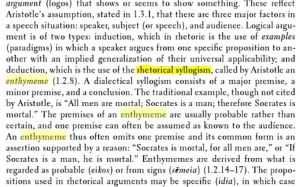
That fuller context might be helpful because it gives the classical “dialectical syllogism” example of “All men are mortal; Socrates is a man; therefore Socrates is mortal.” And it also contrasts this with “rhetorical syllogism” versions of that: “‘Socrates is mortal, for all men are,’ or ‘If Socrates is a man, he is mortal.'”
So, with all of that out of the way, let’s go back to that initial sentence of the first paragraph of the online announcements of the Licensing Policy of the online NA28©.
Gottes Wort ist ein Geschenk für die Menschheit, von dem viele erwarten, dass es kostenlos zu sein hat.
The Word of God is a free gift to everyone.
Now we see that in German there is more than there is in English. The German gets right into the assumption (erwarten) by many in all humanity that The Word of God is without cost (that is, Gottes Wort – many of all mankind expect – is to be kostenlos). The English elides these more explicit presumptions. The English is slightly more rhetorical. At least the English translation makes more of an enthymeme. All men (and all women) are given a gift that is free. [You, dear reader, are included in “everyone”]. Therefore, you yourself get this very free gift [that you are expecting, as many others of the everyone of Humanity does.] [You would think that The Word of God is your very own free gift given also just to you.]
And then, of course, there’s the next premise to counter the rhetorical-syllogistic bundle of presumptions of the first premise. In German, it begins with “Allerdings.” In English, it begins with “But.”
Allerdings ist die Erforschung der biblischen Texte zeitintensiv und teuer.
But research and development are expensive.
Again, the German is a little more explicit (if Erforschung is also understood as not only research but also development); the German translates into English more explicitly as something like this: “Mind you, it’s the effort of the study of biblical texts that is time consuming and expensive.” The English version provided, nonetheless, just makes the assumption that the writer and readers will agree: “[All kinds of] research and development are expensive” [“Biblical New Testament Greek Text research and development is one kind of R&D] [Expense = time & money]
Then the next and presumably final premise – in both German and English – draws out or at least somewhat touches on or counts on the unstated assumptions of the previous premise. The final premise reads as follows, of course:
Das Novum Testamentum Graece in der 28. Auflage (NA28) ist das Ergebnis langjähriger Arbeit vieler Wissenschaftler.
The Novum Testamentum Greace (Nestle-Aland) is the result of lengthy and painstaking work by many scholars.
The German writer and readers presumably agree that langjähriger includes not only length of time but also the painstaking lengths of the many (i.e., the vieler). The pre-conclusion point is driven home: [there is much time, much expense, much long time, much lengthy expensive work done by many many many people, and not only regular people either, educated ones, specialists, not only artists but also scientists, real scholars doing the work that not many of you readers could do, real specialized work done for you, Divine and Holy work, work with God’s Word, the very Word of God, yes to you, to everyone, to all humanity, “free” … Allerdings].
Therefore, we are prepared for the definitive conclusion. The rhetoric is finally persuasive. We are likely to agree:
Deshalb ist der Text durch das Urheberrecht geschützt.
This is why their work is protected by copyright.
There is more, of course. Another qualifying sentence to close the paragraph, another set of paragraphs of other enthymemes and syllogisms and rhetoric and logic. The point to this point, the point of this conclusion, nonetheless is that what you and I freely get in NA28© is Gottes Wort or The Word of God online with certain costly restrictions shared. The implied Rhetorical Question of the online NA28©: “Do you really expect God’s Word for free?”
(PS – Here’s a little parenthetical Post Script on this blog post. By it, I’m sharing my own mere conclusion, stated at the end.
On the very same PC by which I’m reading the new online NA28, I’m reading a KindlePC version of the NA27 alongside the ESV with a little more generous allowance of copying by the copyright. That Kindle version cost me around $8 US. For the free online NA28, of course, we’ve read this permission statement — which gives more free freedom to members who work as missionaries (my emphases below):
Small portions of the text (up to 100 consecutive verses) can be quoted without requesting a licence. They should just be accompanied by the following notice:
Greek Bible text from: Novum Testamentum Graece, 28th revised edition, Edited by Barbara Aland and others, © 2012 Deutsche Bibelgesellschaft, Stuttgart.
If you intend to use larger parts of the text or even the entire New Testament, you need written permission prior to publication. All requests should be sent to:
Mrs Beate Schubert
German Bible Society
Balinger Strasse 31 A
70567 Stuttgart
GermanyEmail: schubert(at)dbg.de
All licence requests are treated equally. However, special terms are available to members of the United Bible Societies which require the text for missionary activities.
Now, here’s that NA27/ESV statement, in some freeer contrast (again with my emphases):
Nestle-Aland, Novum Testamentum Graece, 27th Revised Edition, edited by Barbara Aland, Kurt Aland, Johannes Karavidopoulos, Carlo M. Martini, and Bruce M. Metzger in cooperation with the Institute for New Testament Textual Research, Münster/Westphalia, © 1993 Deutsche Bibelgesellschaft, Stuttgart. Used by permission. Permissions notice: The ESV text may be quoted (in written, visual, or electronic form) up to and inclusive of one thousand (1,000) verses without express written permission of the publisher, provided that the verses quoted do not amount to a complete book of the Bible nor do the verses quoted account for 50 percent or more of the total text of the work in which they are quoted.
Publication of any commentary or other Bible reference work produced for commercial sale that uses the English Standard Version (ESV) must include written permission for use of the ESV text. Permission requests that exceed the above guidelines must be directed to Crossway, Attn: Bible Rights, 1300 Crescent Street, Wheaton, IL 60187, USA. Permission requests for use of the anglicized ESV Bible text that exceed the above guidelines must be directed to: HarperCollins Religious, 77-85 Fulham Palace Road, Hammersmith, London
Crossway is a not-for-profit publishing ministry that exists solely for the purpose of publishing the Good News of the Gospel and the Truth of God’s Word, the Bible. A portion of the purchase price of every ESV Bible is donated to help support Bible distribution ministry around the world.
Now, my own simple opinion is just this: to speak of one’s version or translation or textual apparatus or collection of texts as “God’s Word” and then to call it God’s gift, God’s free gift, and then to require payment for it beyond certain arbitrary if legal free sharing allowances – to speak this way – requires rhetoric.)
The whole six yards
The New York Times has a fun article about research into the origin of the express “the whole nine yards.” Here are some of the relevant paragraphs:
Some lexicographers thought the evidence was creeping closer to a World War II-era origin, and possibly some connection to the military, though there was still no hard evidence for the popular ammunition-belt theory. Then, in August, Bonnie Taylor-Blake, a neuroscience researcher in North Carolina who had been searching for variants of the phrase via Google News Archive and Google Books for five years, posted a message on the e-mail list of the American Dialect Society noting a 1956 occurrence in an outdoors magazine called Kentucky Happy Hunting Ground, followed in September by a more startling twist: a 1921 headline from The Spartanburg Herald-Journal in South Carolina reading “The Whole Six Yards of It.”
The somewhat cryptic headline, atop a detailed account of a baseball game that did not use the phrase, initially caused some head scratching among the society’s members. One person asked whether the headline referred to the ball fields, or “yards,” of the six teams in the league discussed in the article.
But then Mr. Shapiro, searching in Chronicling America, a Library of Congress database of pre-1923 newspapers, found two 1912 articles in The Mount Vernon Signal in Kentucky promising to “give” or “tell” the “whole six yards” of a story. Ms. Taylor-Blake also found another instance from 1916, in the same paper.
Now to me, here is the interesting part of the story – many of the key players in this search for the origins were amateurs, and they were simply using publically available databases. In a world when when so much is online, anyone can make discoveries!
personal language for the Patriarchy and our father
Yesterday was our first Christmas without my father. My mother is being refreshingly open about him with us her children and grandchildren, and she has been since he passed on earlier in the year. In the final days of their lives together, the final months, the final years even, their relationship was increasingly sweeter and — may I even characterize it as — more and more egalitarian. We all saw how he stopped referring to her as his “helpmeet” and started calling her his best friend and God’s greatest gift to him and his soul-mate. “But he was not always easy to live with,” my mother recalls. She encourages me, her son, to be a husband, a father. My mother has been studying such words more. As presents this week, she gave me a book on the names of God (for Christmas) and a Bible translated in a way that makes explicit the names of God (for my birthday, a day some months away now, which will in the new year mark the anniversary of my father ‘s death). When my mother led our family in prayer before the Christmas dinner she cooked us all, our mother began “Our Father.”
I’ve been thinking carefully and considerably about our personal language. (My mother and my father were Southern Baptist Christian missionaries for many many years. As you read here, this may be an important if personal detail.) Our personal language is not so unrelated to language for the Patriarchy, to language for God, to language even from the Bible. Whether the Bible includes the New Testament or not is not important in this consideration. One might rightly argue that the Western and Eastern, the ancient Greek and the ancient Jewish notions overlap and influence our personal notions and language substantially.
For example, many of us in the blog and facebook worlds have been reading the Septuagint’s Isaiah and have come across words such as ὀρφανοῖς and χηρῶν for the Hebrew יתום and אלמנה, for the concepts of fatherlessness and husbandlessness in the very first verses. Not far into the same book is the notion of πατρὸς and of אב and of father. Looking ahead, we come to the calling upon God by name, in chapter 64, to the very personal familial and fatherly language: κύριε πατὴρ ἡμῶν σύ for יהוה אבינו אתה, which many English translations have as “O LORD, you are our Father.”
This is the language of the gospels as also put into the mouth of Jesus (aka Joshua, aka Yeshua) as he starts our “Lord’s Prayer” – Πάτερ ἡμῶν, “Our Father.” What are we to do with such? Well, I wanted to share in this post a couple of longer quotations from discussions of God language, of theology.
The first quotation is one that seems to be endorsed by student of theology and blogger, Kait Dugan. The second is one that is spoken and then written by a theologian, the late James B. Torrance. (Both happen to be discussing Christian language for the Trinitarian concept of God; but I’m mostly interested here in how they view the language put in the mouth of Jesus as he addresses God as Father). Without further ado, here are the quotations. But I would love to hear and to read your thoughts on these too!
Our language of God (theo-logy) is forged in the wake of the Word made flesh in Mary’s womb and shares in his endeavor to foster wholeness and newness in world where action is shaped by language. Jesus spoke of his Father in his own, distinctive human voice — the voice of a Jewish man raised on the Jewish scriptures with the love of a Jewish mother in a Jewish community on whose lips and in whose hearts were placed love of and faithfulness to a God they knew as Father. The tenor of Jesus’s voice was one of affection, adoration, and willing, loving submission as he addressed God as ‘Father’. His own father was Joseph who trusted the angel’s word in a dream and who risked his own good name to marry a woman who was pregnant not by him, and raised Jesus as his own son. ‘Father’ in Jesus’s community and ‘father’ in Jesus’s family never carried the tenor of fear in Jesus’s voice. The Word made flesh spoke that word as he had always known it: intimately, trustingly, lovingly. Our own voice revocalizes Jesus’s words, the phrases he used in order that we too might know God intimately, trustingly, lovingly — the ‘we’ not born from the bosom of the Father. That not all of us can do so to the same personal effect is precisely why we have Jesus at all. Our language of God is meant to cultivate in us the love of God that Jesus knows as the son of God. Our language of God is also to do for our neighbors what Jesus’s language did for his neighbors — heal, challenge, strengthen, encourage, in short: love. That we orient ourselves towards God in Jesus at all puts us in contact with Jesus’s heart and before the eyes of Jesus’s Father. As we speak, we seek to conform to Jesus not only in our language but also in our own voice’s tenor, having its own particular history of speech and soundings. For the women in my class, they were doing just that–addressing God [as Our Mother] in their own voices from their own histories. Whether we find we can use the language of ‘Father’ for God or not, we can acknowledge that Jesus used such language and that the language we use and its resonance in our bodies is to set our lives in the trajectory of his life, both in how we know and love ourselves and in how we know and love one another.
-mwMel – That might be the single best comment I’ve ever gotten on a blog [here after the post “The Trinity and Gender Inclusive Language“].
.
What did Athenasius understand the task of theology to be? In Matthew 23:8, Jesus is recorded as saying to the disciples, “Do not call anyone on earth ‘father,’ for you have one Father, and he is in heaven…. The greatest among you will be your servant.” What is our Lord saying? He is recognizing that the word “father” is a patriarchal, sexist one in a culture where men dominate women and often use them simply as servants or sex objects. Jesus is saying that God is not like that! He is evacuating the word of all male, sexist, patriarchal connotations in calling God “Father.” He says elsewhere: “Anyone who has seen me, has seen the Father.” “No one knows the Son except the Father, and no one knows the Father except the Son and those to whom the Son chooses to reveal him” (Mt 11:27). Jesus alone truly knows the Father, and his mission from the Father is to make the Father known. He does so by taking the form of a servant and by living a life of loving obedience, going to the cross. Fatherhood is then defined for us by Jesus on the cross,. We are not thrown back on ourselves to project our biological, sexist images of “father” onto God — to “mythologize.” The Christian church has never simply called God “Father,” but Father from whom his whole family in heaven and on earth derives its name” (Eph 3:14ff). In [Christian, Trinitarian] theology our knowledge of God as Father is derived from his self-revelation in Jesus Christ. [from “Gender, Sexuality, & the Trinity” – from pages 99 – 100 – in Worship, Community and the Triune God of Grace by Torrance]
She spoke yet – Miriam did (a translation of Luke 1:34-38)
She spoke yet –
Miriam did, to the angel:
How on earth is this to go?
When did a man I ever know?
And it retorted, that angel did –
it spoke to her:
Breath of Dedication is to come upon you,
Power of Heights is to shade you,
Hence the Birthed child so Dedicated
is to be called
Son of God.
So Gaze –
El-Ishiva, that birth relative of yours,
She is with child, a son in that womb of hers,
This month, this sixth is hers,
She the one called
Sterile.
There is to be no
powerlessness of God
Given every utterance.
She spoke yet –
Miriam did:
Gaze – GirlSlave of the Master!
May this birth be to me,
By that Utterance of yours.
And it went away from her, that angel did.
εἶπεν δὲ Μαριὰμ πρὸς τὸν ἀγγελον,
Πῶς ἐσται τοῦτο,
ἐπεὶ ἀνδρα οὐ γινώσκὼ;
καὶ ἀποκριθεὶς ὁ ἀγγελος εἶπεν αὐτῇ,
Πνεῦμα ἀγιον ἐπελεύσεται ἐπὶ σέ,
καὶ δύναμις ὑψίστου ἐπισκιάσει σοι·
διὸ καὶ τὸ γεννώμενον ἀγιον
κληθήσεται,
υἱὸς θεοῦ.
καὶ ἰδοὺ
Ἐλισάβετ ἡ συγγενίς σου
καὶ αὐτὴ συνείληφεν υἱὸν ἐν γήρει αὐτῆς,
καὶ οὗτος μὴν ἑκτος ἐστὶν αὐτῇ
τῇ καλουμένῃ
στείρᾳ·
ὁτι οὐκ
ἀδυνατήσει παρὰ τοῦ θεοῦ
πᾶν ῥῆμα.
εἶπεν δὲ Μαριάμ,
Ἰδοὺ ἡ δούλη κυρίου·
γένοιτό μοι
κατὰ τὸ ῥῆμά σου.
καὶ ἀπῆλθεν ἀπ’ αὐτῆς ὁ ἀγγελος.
What graphic novels do you recommend?
In this academic break, I’m going to try to catch up on reading in a genre I have long neglected – English graphic novels. Sure, I read Maus and MetaMaus, and when I studied Japanese and Chinese I read a huge number of Asian-language graphic novels; but I’ve largely neglected the field.
I realize that this is a massive genre, but I want to at least read some of the super-hits.
Here is what is currently on my reading list:
- Complete Sandman
- Watchmen (actually, I read this years ago – but rereading it now)
- Dark Knight Returns
- The Invisibles Omnibus
- New X-Men Omnibus
- Complete Bone
- Building Stories
What are your favorite graphic novels? I’m particularly interested in work that is intelligent, cinematic, and heavily engaging.
Nittel Nacht
Tonight is the famed Jewish holiday of “nittel nacht” – Christmas Eve to most of you – on which Torah study was forbidden. The holiday has no theological basis – rather it was a reflection of a time in which Jews lived in fear of violence of Christians. Since that today is mostly not the case (with a few exceptions, such as East Jerusalem) it is a holiday that desperately cries out to be deprecated – but it is still fun to read about.
So far all the readers who celebrate Christmas: a happy holiday. And for those who do not: I hope you enjoy some really tasty Chinese food on the 25th.
Christmas Angel
I was at a concert a few days ago, of an all male choir, the Chor Leoni. It was amazingly beautiful, gentle and sweet. The baritone, Steve Maddock sang Christmas Angel, composed by a Vancouver songwriter.
I can’t find a version on the internet of Steve singing this song. It is there somewhere because I have listened to it. Available here. However, I can guarantee that it is as sweet and beautiful as this version, sung by a woman. This post rates as “egalitarian” in that the voices of an all male or an all female choir, makes a complete choir. There is no need for women to “complete” men. They are intact in and of themselves, and women also have to right to non-contingency. Let’s just love each other. Let men and women be whole.
This is also a tribute to Diane Loomer, who founded and directed this choir for many years, and composed the music below. She died last week, a few days before the Christmas performance.


 BLT
BLT 