Childshippe
I remember being told by my pastor how much easier it was to teach the gospel with the words “adoption as sons” for the Greek word uiothesia, than “adoption as children.” He explained to me about Roman laws regarding inheritance and so on. A lot of people could see his point. In fact, in the TNIV, Gal. 4:5 was translated as “adoption to sonship,” just so that this version could be used to explain salvation, in spite of otherwise using inclusive language like “brothers and sisters.” Sonship was a very important word. Women are saved through sonship and being under headship. It takes two ships to save a woman.
And as one evangelist explained about Matt. 5:9,
Actually, the TNIV appears to be a move not toward greater accuracy but away from it. One example: In the Sermon on the Mount, Jesus says, ‘Blessed are the peacemakers, for they shall be called sons of God.’ (Matt. 5:9). The TNIV changes sons to children. But the Greek word huios in its plural form means ’sons,’ not ‘children. ‘My Latin Bible translates it ’sons’ (filii). My German Bible, my Dutch Bible, and my French Bible translate it ’sons.’ Likewise, every English Bible I own translates it ’sons.’ Indeed, from the first century until today, the whole world has understood what the Greek says.
I had never made a serious investigation into finding out which Bibles translated Matt. 5:9 using “children” once I knew that the KJV and Luther used “children” or the linguistic equivalent. But eventually, my curiosity got the better of me and I decided to line up six verses for investigation. They are Matt. 5:9, Romans 8:15, 8:23, Gal. 4:5 and Eph. 1:5. Here are the verses in the ESV using “sons.”
Blessed are the peacemakers, for they shall be called sons of God. Matt. 5:9
but you have received the Spirit of adoption as sons, by whom we cry, “Abba! Father! Romans 8:15b
we wait eagerly for adoption as sons, the redemption of our bodies Romans 8:23b
so that we might receive adoption as sons. Gal. 4:5b
he predestined us for adoption as sons through Jesus Christ Eph. 1:5
The preface to the ESV says of “adoption of sons,” “it was used as a legal term in the adoption and inheritance laws of first-century Rome.” Yes, the term was used when a man with no heir adopts a free male citizen with no father, and that adopted son is under the authority of his adopted father until the father dies, and then the adopted son inherits and carries on the family name. The adopted son was not free nor did he inherit until the adopted father was dead. Not much comparison with Paul’s epistles. However, that is the explanation.
In any case, here are the translations I have picked, Tyndale, Coverdale, Bishop’s Bible, Geneva Bible, KJV, Luther and Calvin’s French Geneva Bible, 1588. I feel that this covers the Reformation fairly well. I will simply list the terms used in each of these 5 verses in the various Bibles.
Tyndale: chyldren, adoption, adopcio, naturall sons, heirs
Coverdale: chyldren, adopcion, childshippe, childshippe, as children
Bishop’s Bible: chyldren, adoption, adoption, adoption as chyldren, adoption as children
Geneva Bible: children, adoption, adoption, adoption of sons, adopted
KJV: children, adoption, adoption, adoption of sonnes, adoption of children
Luther: kinder, kindschaft, kindlichen, kindschaft, kindschaft
Calvin: enfans, adoption, adoption, adoption d’enfans, adopter
Following the use of “adoption” all these translation used the word for “children” or the linguistic equivalent, except for the 3 cases I have noted. I would like to note further that all these translations use “children of God” in Matt. 5:9, and Luther, Calvin and Coverdale, three significant Bibles of the Reformation use “children” and “adoption as children” throughout.
Continuity with the Reformation seems important to some people, and I wonder if they would like continuity with Reformation Bibles. Afterall, these were the Bibles which influenced so many for salvation, for doctrine, for literary and secular purposes as well. These are the recognizable Bibles. How does the TNIV stand up to this,
TNIV: children, adoption to sonship, adoption, adoption to sonship, adoption to sonship
Clearly this correctness overall did not affect the acceptance of the TNIV. It was doomed for including women on any level, in spite of the inclusive tradition of the Reformation Bibles. How about the NIV 2011?
NIV 2011: children, adoption to sonship, adoption to sonship, adoption to sonship, adoption to sonship
Well, I have no statistics to say that “adoption as sons, or to sonship” as saved more people than just plain adoption, or adoption to childshippe, I just don’t know. But I do know that if we want to connect with our heritage, we need a few more children. I know which ship I want to be on.
“Ask Questions”: Healthy modes of spirituality
In her blog post How to create (and perhaps uncreate) a scared-stiff fundamentalist, Crystal St. Marie Lewis examines the language of religious fundamentalism and its hierarchical familial and ecclesial structures (with helpful diagrams! so do click through to read it), and the fearful, infantilized adult believers they produce. Finally, she advocates a remedy:
We are even taught to view these structures as natural, beautiful and holy. However, there is nothing “beautiful” or “spiritual” about “training” people to forgo their capacity for self-advocacy in favor of blind obedience to another human or institution. The most powerful and important thing that we can teach both children and adults is to ASK QUESTIONS of their authority figures. Lots and lots of questions. Uncomfortable questions. Inconvenient questions. It is my opinion that this — the question-asking — is how we will accelerate the demise of religious fundamentalism in our society.
I desire to live in a world where influential religious figures who promote responsible and healthy modes of spirituality are celebrated, while those promoting harmful forms of spirituality are held accountable without apology.
In this context, I always find it helpful to remember that according to the first chapter of the gospel of Luke, even the Blessed Mother (Mary of Nazareth, the Virgin Mary) asked questions of the angel Gabriel.
But Mary said to the angel, “How can this be, since I have no relations with a man?”
And the angel said to her in reply, “The holy Spirit will come upon you, and the power of the Most High will overshadow you. Therefore the child to be born will be called holy, the Son of God.
(Oddly, this often seems to be overlooked by those, especially in the Roman Catholic tradition, who would hold up Mary as the epitome and model of meek feminine obedience, to be particularly imitated by women obeying men.)
If Mary could ask an angel questions — and be answered! — it seems clearly right and just that all of us may, indeed, ask questions of our human religious leaders.
Why words?
Even though the landscape is familiar, these poems are meditations on the attributes and value of words.
I sat by the lake,
under the hemlock,
flat needles carpeting the ground,
the familiar smell
mingled with close-by cedar.
The wind blew down
from the dry pine ridge,
over the alders below,
bordering the lake.
A lone fir tree towered
on the right,
a lonely sentinel.
We had scrambled up
a short rocky path,
rough steps set
in a pile of boulders,
tossed downhill by the last ice age
and rounded a small bog,
rimmed with hardhack,
blooms turned to brown.
Then over a slight rise in land,
and down to the small lake,
surrounded by rock bluffs
and mountains in the distance.
False box and oceanspray
lined the path,
but when I lay on the mossy ground,
and looked at the sky,
a huckleberry bush
hung over me,
ripe with tiny fruit,
and the sharp spurts of tart juice
wakened my mouth.
Words bring yesterday’s reality
Back to life in the mind
For those of us
Who don’t paint.
Also on words, Email to a Friend 2006 and Before I came to Write 2006.
Tim Keller, Allender and Longman need a refresher course in biology.
This passage is from the Redlands Community Church When You Say “I do” pamphlet by Timothy Keller and Jeffery White, 2009, page 48. They cite Allender and Longman’s book, Intimate Allies, 1995. So, first off, I want to admit that this is a little dated. But it does closely represent the attitude of Larry Crabb in recent interviews from this past summer. BTW, I think these men identify more closely with egalitarians, so they might not realize the effect of what they are writing. Nonetheless, it is out there and needs to be dealt with.
Allender and Longman’s analysis are helpful: Men tend to reflect more of God’s power, strength and holiness. Women reflect more of God’s tenderness and mercy. A man often moves into chaos to create order, while a woman tends to shape order into a connected beauty that reflects the relational heart of God.
Their sexual acts reflect these tendencies. A man is a planter. A woman is a receiver. A man tends to see the chaos in the world and enter it in order to create, shape and form. He enters the world with strength and courage that form a new being. A woman is created with the physical and internal makeup to receive, gestate, and shape relationships out of the beauty of form.
“A man is to plant his stamp on ideas, objects, and institutions. A woman is to incubate relationships. She is to make connections. A man takes chaos and forms it into a distinct, different, ordered idea, object, or institution; a woman takes his work and draws it into a context that honors the higher principle of love. A man courageously creates, and a woman creatively shapes his creation into a lovely, relational enhancing beauty.”
Women are warriors of relationship. While men certainly desire relationship and are called to cultivate it, women are more likely to cultivate relationship both inside the marriage with their spouses and as a couple with other people.
This was written by Keller and White, citing Allender and Longman. Clearly, they have missed a basic point in biology. The man does not “form a new being.” He does not create a life form that he places in the woman so she can incubate it and gestate. This seems to be Keller’s view of sex, encouraged by Allender and Longman. Women do not exist on earth to take the work that a man had done and shape it into a thing of beauty. Women are not magicians for one thing!
Basic, freshman biology teaches us that the woman has an ovule and the man has sperm, and the sperm fertilizes the ovule so that it becomes a new life form. We can talk about the relationship between men and women in three ways:
1. Men plant the form in the woman and she incubates it.
2. Men fertilize the form which already exists in the woman, and she is then able to bring it to life.
3. The ovule and the sperm fuse to create a new life form.
Clearly, I think only the third is acceptable, although the second one is close. But none of these are an analogy for Christian community. Many all female or all male groups have done wonderful things. Many single women and single men have created works of art, beauty and utility. It does not take both a male and a female to produce material or spiritual forms or make them beautiful. It takes a male and a female to reproduce physically, and ideally, to raise a family, so each child has a parent of both sexes to attach to.
Not only am I concerned about the alienation of women from work and creativity, but also the alienation of men from beauty.
Larry Crabb’s contribution to this, is that not only does he remark on women as “capable of being entered”, but he also constrains women in very awkward ways. He writes, when asked if he is egalitarian or complementarian,
That question doesn’t lead one to be either egalitarian or complementarian but it does lead me toward recognizing that the opportunities for a woman are not limited, other than by her relational style. And the opportunities for a man are not limited, other than by his relational style.
I think my relational style is feminine, but what if it isn’t? What if I don’t make myself all soft and inviting and nourishing. I don’t feel like nourishing men. So then what?? What if I don’t want to be entered by a man? This language is sexual harassment already.
What is needed here is a guide book and sensitivity sessions, put on by Christian publishing houses for authors, men or women, writing about women. We are not boxes with a hole bored in the lid, we are not incubators and gestators, we are not planted by the male with a new being, we do not exist for the single and dedicated purpose of nurturing men, and shaping their creations. Something is desperately needed here. Even Dan Allender admits this need, as he writes about women, in a work pamphlet for his course,
Dan mentions one of the biggest challenges women sometimes experience is failure to utilize their voice, becoming silent in the midst of conflict or to the other extreme, becoming cruel.
How on earth can a woman do anything else, when confronted by the notion that she exists purely to shape male creations while the man makes order out of chaos, and puts his stamp on ideas, objects and institutions? And if a woman does not accept this, she is not relationally feminine?
There are very serious problems about the way these men have expressed themselves in the past about women. Someone needs to let them know that it is time to send out signals that they recognize that women are fully human, just like them. The work a woman does is as important as the work a man does. (For goodness sake!) Its sad because there should not be this enormous, gaping chasm between men and women in the Christian community. But there is. (Except here on this blog, of course, where we all love each other!)
Soon it will be time for women to make a case of sexual harassment against men who write in this way. I feel my whole body recoil as I read this kind of thing. If these men have progressed in their thinking recently, and no longer hold these views, that would be great. I hope they let us know.
What’s in a word?
So here is one thing that I have been thinking over. “Everlasting,” and “forever” have the same meaning as “eternal,” but they lack an association with an abstract noun, so they are limited in transferring to a philosophical discussion of “eternity.” In Hebrew, the adjective often is the noun itself, in a form bound to another noun. So, no problem, the adjective is a noun. But in English, some adjectives dead end. For example, “beauty” leads to “beautiful” but “handsome” leads only to “handsomeness.” Therefore, it is thought that women possess a quality of “beauty” that men don’t, and men don’t have a comparable quality. They have “other” qualities. But historically, it has been important that men be beautiful. Look at David, in Florence, for example. Look at David in the Bible. He was beautiful, as was Joseph, also Saul, and David’s favourite son, Absolom, who was the most beautiful of all men in Israel.
So, does it matter if we use “eternal” rather than “everlasting” for God? Does it help us extend our thinking? How important is it the word we use is connected to a wider network of words that helps to develop the idea. Does this matter in Bible translation and do translators ever consider this?
The Eternal One in The Voice
The Voice is one version, at least, in English that uses “Eternal” for God. I think someone has mentioned others. I forget. 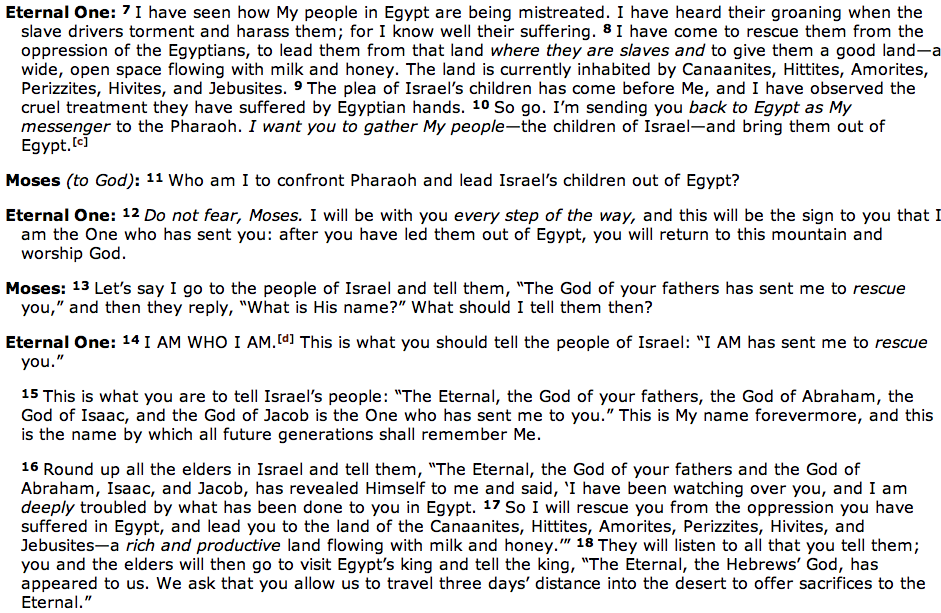
Transcendence and Immanence
Some of the things that I have been blogging about this fall are the trinity, and really trying to understand Augustine’s Book on the topic. I find the current teaching on the trinity to be very upsetting. I always hear it like this. “God sent his Son to do his will, to redeem humanity by dying on the cross, and blah, blah, blah, etc., this is a model for the marriage relationship, for how husbands should treat their wives.” That is how it sounds. So Augustine is quite a relief to me. Augustine makes it clear that there is no difference in authority between Father and Son, nor is the trinity a model for human relationships.
Second, blogging about the Eternal One, as in Adon Olam , has finally made the meanings of “transcendent” and “immanent,” relating to God, sink in. God is the one who existed before the material universe and will exist afterword. God is outside of matter, and all that is mortal. God is also supposed to be “present with us.” This is what Rosenzweig wrote in the early decades of this century. What does that mean, given the holocaust? This is the dialogue I am having with theology this fall.
Sale alert: Alter’s Job, Proverbs, and Ecclesiastes
“Alert” is an anagram of “Alter” – and Robert Alter’s meritorious translation and commentary of Job, Proverbs, Ecclesiastes is currently on sale in hardcover for $14 exactly on Amazon – cheaper than Amazon’s price for the corresponding paperback.
Top news stories of 2013?
I’ve scanned a number of lists of “top news of 2013,” but to my surprise, none of the ones I looked at included what was undoubtedly one of the most important stories of 2013: the discovery of Richard III’s remains under a parking lot in Leicester.
Seriously, this story will undoubtedly become a staple of books on British history. How can any future history of the War of the Roses – or of British middle ages – not include the story of the discovery of his remains in Leicester?

Now maybe this showed up on some “top stories of 2013” list, but how did it miss most of the lists?
Adon Olam: Lord of Eternity
This is a very familiar liturgical hymn for Jews, dating back to the 15th century liturgies, and supposed to be from the 11th century or perhaps much earlier. The first line has often been translated “Lord of the Universe” since olam can mean either “eternity” “a very long time” or “the universe/world.” The transition from “eternity” to “world” happened some time in the last two millennia. So, in modern terms, “Lord of the Universe” but in the biblical sense, and in the sense of the poem itself, “Lord of Eternity.” Update: This is a translation by Esther Hugenholtz. And here it is in Hebrew script.
Adon olam asher malach
Lord of Eternity Who reignedb’terem kol yetzir nivra
before anything was createdLe’et na’aseh b’cheftzo kol
In the hour of Creation, He willed allazai melech shemo nikra
and so His Name is known as KingV’acharei kichlot hakol
And after all is completedlevado yimloch nora
only He will reign in awesomenessV’hu hayah v’hu hoveh
He was, He isv’hu yihyeh betifarah
and He will be in splendourV’hu echad v’ein sheni
He is Alone, there is no secondlehamshil lo lehachbirah
to rule Him in fellowshipB’li reishit, b’li tachlit
Without beginning, without endv’lo ha’oz v’hamisrah
and His power is not sharedV’hu eli v’chai go’ali
Yet He is my God, He is my life and my Redeemerv’tzur chevli be’et tzarah
my rock in vanity in my hour of needV’hu nisi u’manos li
He is my banner and my sheltermenat kosi beyom ekra
He is my Cup [of salvation] on the day I callBeyado afkid ruchi
In His hand I place my spiritbe’et ishan v’a’ira
in the hour of my sleep and wakingV’im ruchi geviyati
And with my spirit and bodyAdonai li, v’lo ira
the Eternal is with me, I shall not fear
Here are two arguments for “Master/Lord of the Universe.” There is a conservative/liberal split in Judaism on whether this prayer/hymn should open with “Lord of the Universe” or “Eternal Lord.” A bit complicated. I have my own issues with Artscroll.
However, we do know that in the Hebrew Bible El Olam means Everlasting/Eternal Lord. In French and German this was translated as “Eternel” and “Ewige” which are equivalent to “Eternal.” They morph easily into a name for God. In English, “Everlasting God” has not become a popular name for God. Here are various translations for El Olam in Genesis 21:33,
בְּשֵׁם יְהוָה, אֵל עוֹלָם.
the name of the LORD, the Everlasting God.
το ονομα κυριου θεος αιωνιος
nomen Domini Dei aeterni
le nom du Seigneur, Dieu éternel
dem Namen des HERRN, des ewigen Gottes.
I can’t help feeling that in Greek, Latin, French and German, the use of the word for “eternal” lead to using this as a name for God, in a more popular way than in English. “Eternal” is easily abstracted to “eternity” and the quality of being “eternal” in a way that “everlasting” is not. In any case, I don’t think that Olivétan really brought about a paradigm shift in using “L’Eternel” for the name of God. He had access to a great deal of material, scholarly and rabbinical works for his translation.
In short, this poem emphasizes that God existed before matter, a Platonic position, rather than an Aristotelian one. God shares power with no one at all. God is one. God is represented by many metaphors that somewhat represent the nature of God, but none that exactly represent this eternal being who existed before matter. God cannot be anthropomorphized. God relates to humans today. God is redeemer and sustainer of life.
Positioning God before the creation of matter, outside of the beginnings of mortality, distances God from sex. Sex is created for the necessity of continuing the propogation of mortal species. God exists entirely outside of that. However, the Kabbalah, deeply dependent on this tradition, did develop a strong gender theology, sometimes very negative to women and sometimes not so much. It seems that there is a strong human tendency to anthropomorphize God, and to make God in the likeness of humans. Such is life.
If you click on the tag “Eternal” at the top right of this post you should get all 7 posts in this series.
Books about Women: old and new
Here is a selection of books, old and new, that are about women, by women, and about participation in the world of ideas, institutions, wars, market economy, art, exegesis and life in general.
Elizabeth Gaskell – 19th century, any movies or books (Kindle Editions $2.00 or under some free) “North and South” “Mary Barton” “Wives and Daughters.” “Cranford” and many more.
Middlemarch by George Elliot 19th century (Kindle Edition is $1.06)
The Golem and the Jinni by Helene Wecker, 2013, an ingenious tale of moral and philosophical dilemmas, takes place in the Jewish and Syrian neighbourhoods of 19th century New York.
Spymistress by Jennifer Chiaverini, 2013- a true story of Elizabeth Van Lew, a woman who ran a spy network during the Civil War.
Certain Women by Madeleine L’Engle, 1993, an adult novel, fully secular and fully exegetical, unique, – a woman writing exegesis by novel.
Invisible Women: Forgotten Artists of Florence by Jane Fortune, 2009
The Creation of Eve by Lynn Cullen, 2011, about Sofonisba Anguissola, Renaissance artist
The Memoirs of Gluckel of Hameln, trans. by Marvin Lowenthal, 1987, a Jewish woman merchant of the 17th century
The Life of Christina of Markyate by Fanous, Leyser, Talbot, 2010 about an 11th century determined young women who becomes a spiritual director. Lots of plot twists in her true life.
Riddle of the Labyrinth: The Quest to Crack an Ancient Code by Margalit Fox. 2013, The true story of deciphering Linear B, the Mycenean written language, with emphasis on Alice Kober’s ground breaking work.
The Age of Münter, Gontcharova, and Duchamp
On exhibit at the Kimball Art Museum in Fort Worth is show of art called “The Age of …”; here, today I took a photo from the outside in (since photography isn’t permitted within).
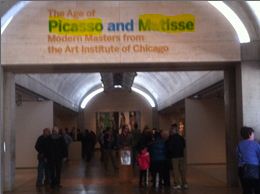
Once inside, I studied carefully the 107 pieces, mostly paintings and some sculptures. I’d read the brochure, one paragraph of which I’ll also share with you:
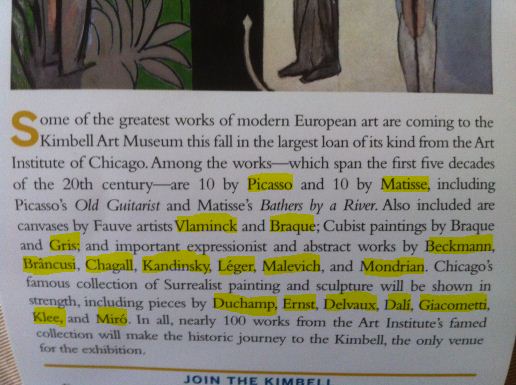
Now, I guess you noticed that the one name I’ve highlighted for you is ambiguous: “Would that be, Marcel Duchamp?,” you ask. Well, yes, his works were there too.
But what if I told you this work was there (which I’ve copied from the webpage of the Art Institute of Chicago)?
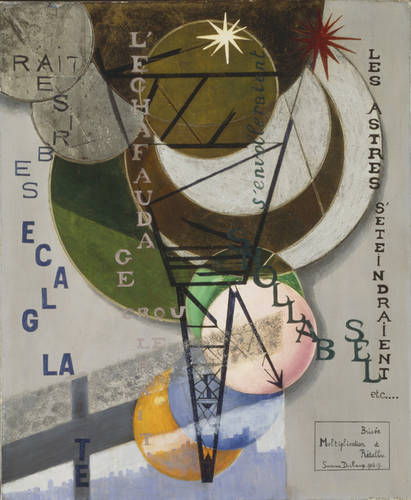
Yes, you’re right. It’s by Marcel’s little sister, Suzanne Duchamp-Crotti. And her piece was there with his pieces.
But the following is not one of his, or his, or his, or his, or his, or his, or his, or his, or his, or his, or his, or his, or his, or his, or his, or his, or his, or his, or his either.
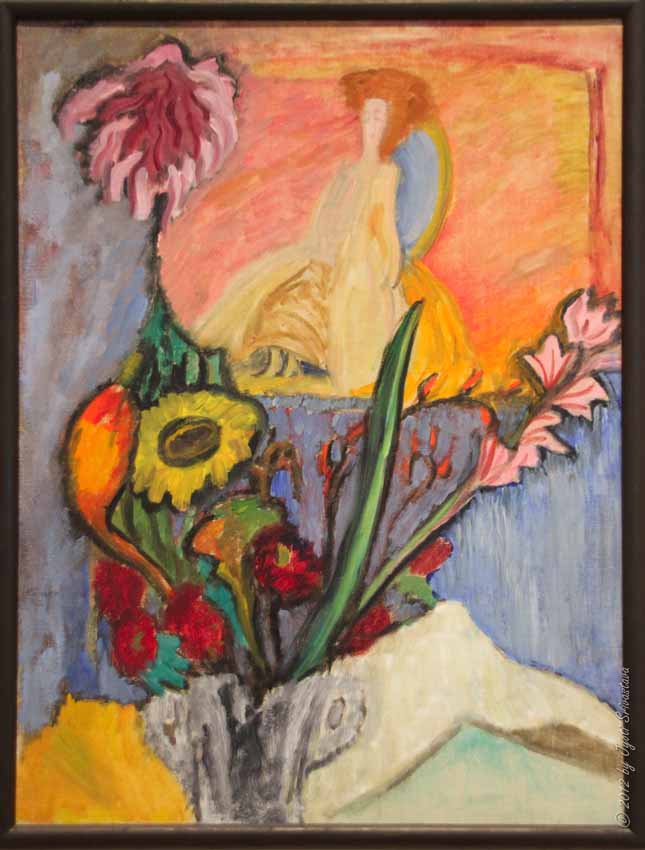
That one you may recognize is the single piece in the exhibit by Gabriele Münter.
Then there’s this one. Who’s it by? Well, I don’t blame you if it takes you a while given all those named on the brochure and those for whom the exhibit is prominently named. Yes, not one of those guys. Rather, this third piece of the one hundred and seven works of art shown is the one by Nathalija Gontcharova.
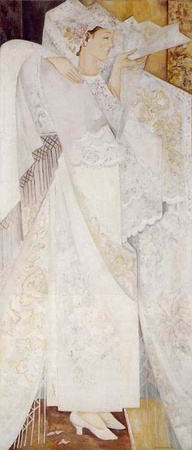
(I’d gone with my son to the exhibits at the Modern Art Museum across the street. Not much different. We saw two pieces by women, as I recall. All the other hundreds of pieces of modern art displayed were by men. Now, my son is a professional artist and one of my daughters is a painter and a college student, who, by the way, just did her own home improvement project last evening by tiling a bathroom floor. I’m just not sure what the implicit message by the art museums is here, are you? We pay money to see art, and we see art predominantly produced by men. There are token pieces by women, but don’t they belong to their age and to ours in equal measure?)
Writing in place
I read this with great interest and sympathy, China of my Mind . I to0 have many aunts and uncles, in laws and outlaws, who were in China, one being the first Brit to transverse China from ocean to India, another starting a boarding school, some incarcerated during the war and so on. We too had Chinese vases and embroideries. We had students from different parts of China living with us for many years, as well as a Chinese penpal from an orphanage in Hong Kong.
I also have a sister who lived in Hong Kong, Shanghai and Beijing for years, writing letters home to Mother every week. She has published her autobiography and is a celebrated Sinologist. I have even been to China. But could I write about it?? I don’t think so. But I haven’t read this book so perhaps it is well done. I can’t say.
When I write, all senses are engaged. Here are the Beechwoods, and you can compare this with Fully Adam or Last Christmas. Could I write this if I hadn’t been there?
I had never walked in a Beech Wood before,
The bright emerald green in the sunlight
And the rustling sound of the wind,
the large simple shape of the leaves
and the majesty of solid trunks and solidarity among the trees.
In winter the skeletons all show against the sky
and the leaves on the ground have rotted into the earth
I walk not on Beech leaves, but on the rough leather of
intermingled undecayed alder and oak leaves, red, white, pin,
and the smell of pungent balsam and fir is absent,
like a live thing that I had thought would walk through
these woods with me. But it isn’t there. I didn’t realize.
No needled scent from the ground rises up to my nostrils
and beckons me down to that rich aroma of dirt and duff
I lift my eyes instead to the sky
and float among the dark interlaced and spindled branches
thrown into relief against the dying lemon yellow sky
of a fast approaching winter night.


 BLT
BLT 