translating the woman’s “NO to War”
The story translated below is part of the information Isfahani offers about the acclaimed pre-Islamic poet Zuhair bin Abi Sulma. One of the latter’s most beautiful and best-known poems – and indeed one of the most famous exemplars of the early Arabic qasida (metrical ode ) – praises the generosity of Harith bin ‘Auf and Harim bin Sinan of the Bani Dhubyan tribe. The two undertook to pay a large sum of blood money as compensation for the deaths of members of a rival tribe, thereby putting an end to a bloody war of four years, which had originally broken out between the two tribes because of a horse race.
The story translated here from “The Book of Songs” is not about Harim bin Sinan – the philanthropist who joins up with the protagonist of the story, Harith bin ‘Auf – but rather about his brother, Harija bin Sinan. In any case, the following translation is dedicated to the woman in the story, Bahisa, who in her own way resisted stubbornly and said no to war.
— Ilana Hammerman
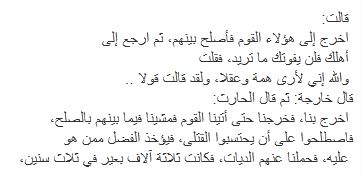
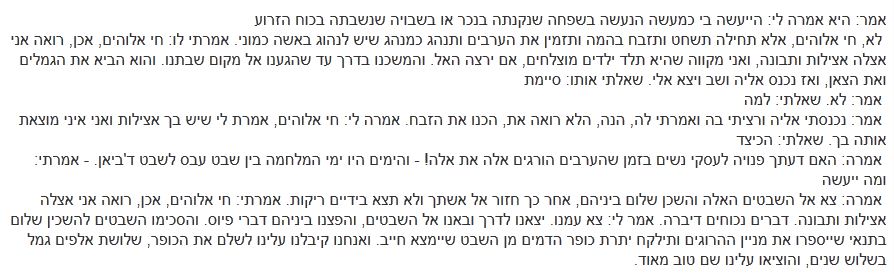
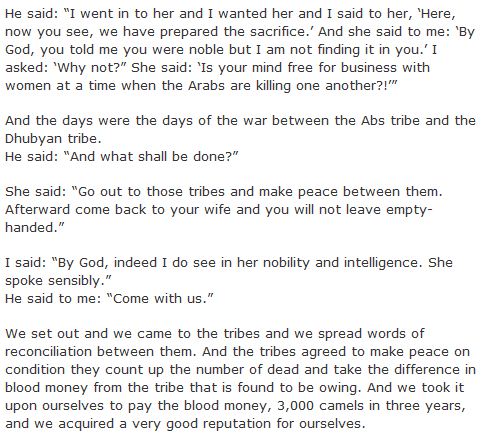
Let me start this post with a spoiler alert. Here is the way the story ends, the story of the peace-making Bahisa. First, you’ll read the final lines in Zuhayr‘s Arabic, where Bahisa speaks that mother tongue. Next, you’ll find the same in Ilana Hammerman‘s Hebrew translation of that. Finally, you’ll read how the story ends in Vivian Eden‘s English translation of Hammerman’s Hebrew. Below all of that, you will have the links to pages where you may read the entire story;
Hammerman suggests that the woman’s story, Bahisa’s story, is a source of the beginning of peace.
——————————–

—————————-


 BLT
BLT 
Perhaps I am missing something, but it seems that Isfahani’s Great Book of Songs has not been translated into English (except for small fragments). It seems odd that a work considered so foundational in Arabic has apparently been little studied in English.
You are correct that this is odd. And I searched in vain for an English translation of Isfahani’s work. Perhaps somebody can help us out. Of course, Zuhair bin Abi Sulma is translated — at least his Qasida or Ode in the Al-Muʿallaqāt is: