Jewish Publication Society sold to University of Nebraska Press



From Jewish Exponent:
[Byline: Robert Leiter] Change is hardly a stranger to the Jewish Publication Society, and it’s come knocking at its doors yet again.
Founded here in Philadelphia more than 120 years ago, the venerable institution is now set to embark on the newest — and in some senses most radical — phase in its long history of publishing high-end scholarship, a famed Bible translation, biblical commentary as well as contemporary novels and poetry.
It’s about to turn over a major aspect of the publishing process to the University of Nebraska Press, which as of Jan. 1 will assume all production, distribution and marketing of JPS manuscripts, according to Rabbi Barry Schwartz, CEO of JPS.
The agreement between two well-established publishing units, said Schwartz, is the end result of a long search for an academic publishing partner for JPS that will allow the Philadelphia institution to concentrate on finding and shepherding good books into print. With Nebraska by its side, he said, JPS can also ensure these works a wider audience.
When the society was founded in 1888, Jewish books weren’t published in America, so JPS filled a considerable void.
But over the course of the 20th century, Jewish books began to be published by commercial houses and university presses, leading to criticism — especially as the 21st century dawned — that the publishing house was a dinosaur, obsolete and teetering on economic ruin.
Schwartz dismissed such criticism, even though he admitted that the partnership with Nebraska was “an economic decision.”
“Economics propelled us,” he said, but this was a move motivated as much “by the enormous changes taking place throughout the publishing world right now, along with the particular circumstance of a small, not-for-profit publisher like JPS.
“This partnership will give us an expanded reach, especially in academia, but also in the Jewish and general arenas as well.”
Schwartz said that JPS chose an academic publisher because of its emphasis on scholarship.
“But the books of JPS will bear the JPS imprint solely,” he said, “and our core mission will continue uninterrupted.”
Schwartz said he understood why some might say JPS is obsolete, but he begged to differ.
“With all the competition in Bible scholarship today, I can say without hesitation that nobody comes close to what JPS has produced and will continue to produce with its landmark biblical commentaries. Nobody else would attempt these multiyear, comprehensive Bible-related projects we’ve been doing. The uniqueness of JPS as a publisher is that it takes the long view in its projects, especially its commentaries, and continues to produce them.
Far from being a dinosaur, he asserted, “we are on track to create the next great Bible for the 21st century — an electronic Bible — and with it, we will once again take the lead with a Bible presentation that will be groundbreaking.”
According to the CEO, the JPS staff will be reduced but the institution will remain in Philadelphia, at the Community Services Building where it is now housed.
Are there any thoughts about expanding the JPS list and return to publishing novels or poetry, which it ceased doing in the late 1990s?
“Our greatest strength is our biblical scholarship, but it is not our only strength,” said the CEO. “We plan to expand in the area of Jewish history and Jewish thought, though we have no plans to move into fiction or to return to children’s literature. But in the realms of history and thought, we’ll be publishing groundbreaking things from Israel, translated from the Hebrew, and from France.”
To continue JPS’ mission well into the future, said Schwartz, “we have to think of ourself — in the words of our board president David Lerman — as a 120-year-old start-up. And I couldn’t agree more.”
From Jewish Telgraphic Agency:
(JTA) — The University of Nebraska Press has purchased the entire book inventory of the Jewish Publication Society.
The university’s Board of Regents approved the agreement last Friday despite concerns that the purchase of the publication society’s 250 book titles, for $610,000, would not be profitable.
JPS, a 123-year-old publisher based in Philadelphia, reportedly has an annual revenue of $1 million to $1.5 million. Half of its sales — about 50,000 books — are of the JPS Bible, the most widely read version of the Old Testament, according to the Lincoln Journal Star.
Under the agreement, JPS would continue to find and develop new works.
The University of Nebraska Press owns nearly 3,000 titles, including 50 Jewish studies titles and Bible commentary.
(HT: Michael Pitowsky)
Book Review: Errol Morris–Believing is Seeing (Observations on the Mysteries of Photography)
One of the more remarkable documentary filmmakers of our time is Errol Morris, who I count as an acquaintance.
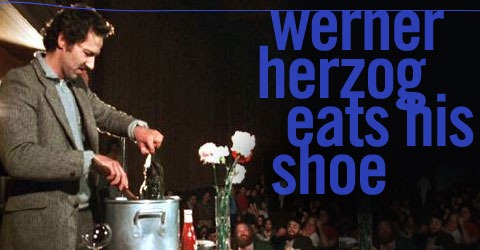
Morris’s first major film was one of the funniest documentaries ever made, the 1978 Gates of Heaven – a film that discusses … pet cemeteries. I had the pleasure of seeing Werner Herzog actually eat his shoe at the premiere of Gates of Heaven. (Herzog had foolishly claimed that if Morris made his film, Herzog would eat his own shoe – at least it was cooked by Alice Waters first.) But as Katherine Schulz wrote in a New York Times review: “Gates of Heaven … is ostensibly about pet cemeteries and includes more material on pet cemeteries than any other movie ever made (including Pet Sematary) but is, nonetheless, not really about pet cemeteries at all.”
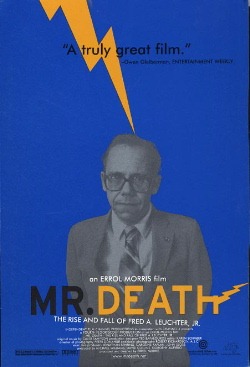
A later film which I found equally profound was Morris’s Mr. Death: The Rise and Fall of Fred A. Leuchter, Jr. a film about an electric chair technician who claimed to possess forensic evidence that there were no gas chambers at Auschwitz. This film is also fundamentally about something different than Holocaust denial.
Since 2007, Morris has maintained the blog “Zoom” at the New York Times which has addressed a wide variety of topics. He began the blog by examining photographs:
- A pair of slightly different Roger Fenton photographs of the Crimean War (according to some, Fenton was the first official war photographers)
- The Abu Ghraib photographs
- The Walker Evans-Arthur Rothstein-Dorothea Lange photographs of the Great Depression (including images from the James Agee and Walker Evan’s book, Let Us Now Praise Famous Men.)
- Photographs from Southern Lebanon of children toys amidst destroyed buildings during the 2006 Israel-Lebanon conflict.
- An early photograph (“ambrotype”) found on a dead soldier at the battle of Gettysburg.
Morris has now collected and revised these blog posts in his book, Believing is Seeing (Observations on the Mysteries of Photography). His approach is highly appealing – each of these sets of photographs represents a mystery, which Errol Morris then investigates; the bulk of the chapter being the process of investigation. This might sound tedious, but these read as marvelous blog posts – with many illustrations and digressions and jokes. (The original blog posts had even a little more – invitations to readers to submit their own theories about the photographs. However, Morris’ unfolding of his investigations of these photographs is, in its own way, something of an invitation for a special engagement with the reader, as the reader weighs the evidence and see how it first points one way, but ultimately another way.)
In her review Kathryn Schulz wrote that just as Gates of Heaven was ultimately not about pet cemeteries, Believing is Seeing is not really about photography: “Believing Is Seeing, though perceptive about photography, is fundamentally concerned with something very different: epistemology. Morris is chiefly interested in the nature of knowledge, in figuring out where the truth — in both senses — lies.”
I’m not sure that Schulz’s review, though favorable, will help sell books. Her portrayal of Believing is Seeing makes it seem as if Morris’s book is a heavy philosophical tome. This it is not. In fact, it is the record of an amateur detective, and much more akin to the Sherlock Holmes story than a philosophy book. Morris writes completely without pretense or pretension. There is no visible artifice here and this book is not a record of a lecture. Rather, it reads a bit like a careful story unwound over dinner – mystery made and mystery solved. The question of epistemology is something that you, the reader will have to find in your meditations on the book – but the total effect of the book certainly forces us to think about apparent evidentiary power of photography in a new way.
While in a way horrifying (because the topics dealt with in the photographs are inherently upsetting), this book is also fascinating, and even though I had read many of Morris’s blog posts when he originally made them, I found myself completely entranced as I read this book. I can recommend it to you without reservation.
Lore Segal’s Bible translation philosophy and practice
“A shining gift…. Mr. Baskin’s mysterious and brooding illustrations are a wonderful addition to Ms. Segal’s text.” — New York Times
“As close to the tone and cadences of the original Hebrew as English will ever come.” — Cynthia Ozick

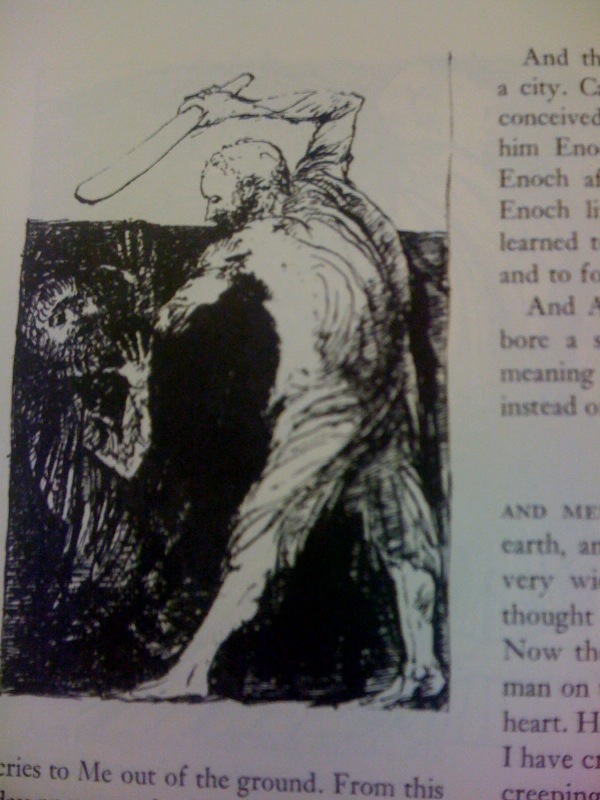
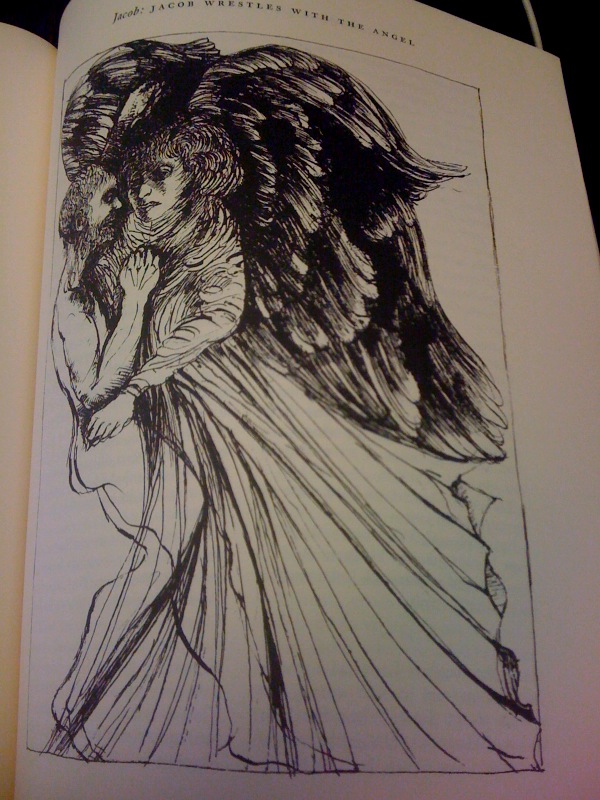
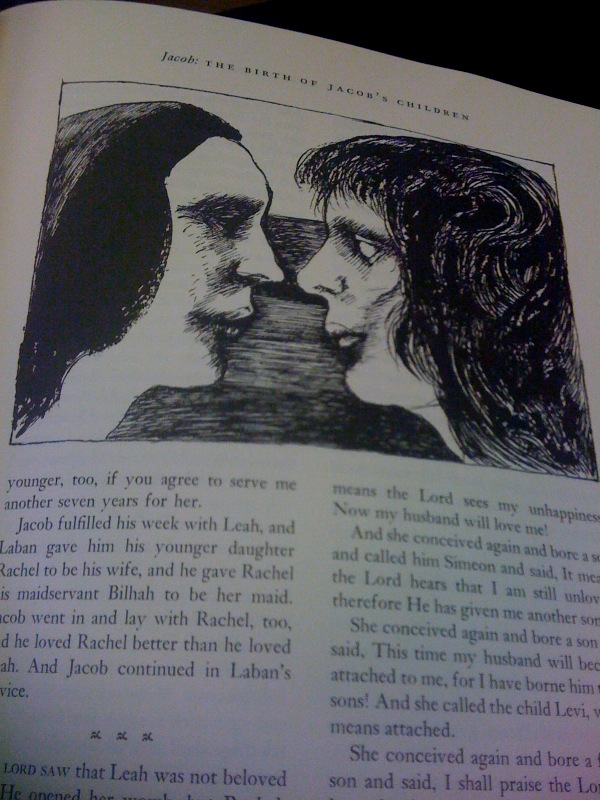
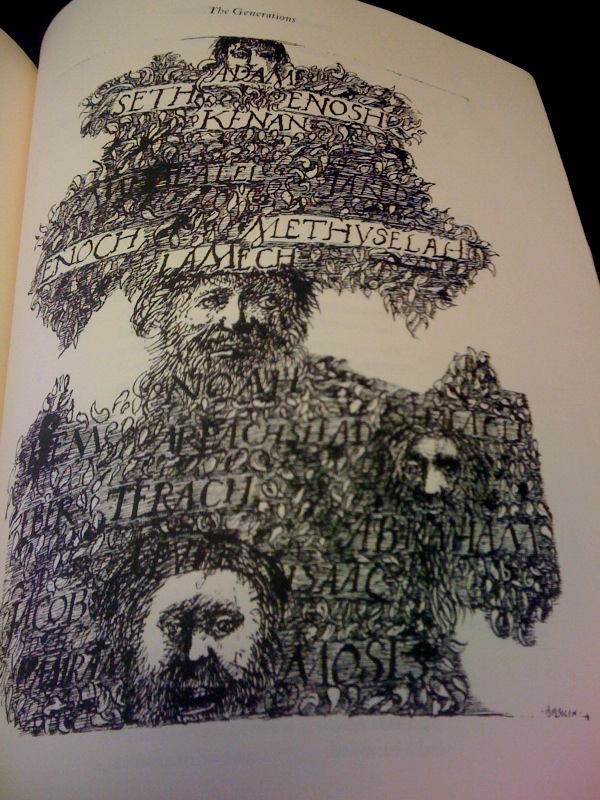
It’s no surprise, given her Bible translation philosophy and practice, that Lore Segal teamed up with illustrator Leonard Baskin for The Book of Adam to Moses. His illustrations for the work are not just mysterious and brooding and wonderful, as the New York Times reviewer observed; but they are also for the most part drawings of faces, human and sometimes divine, and are always untitled. Segal makes no effort to give captions for the illustrations either. (As you can see, below, the book sections at the top of the pages give the only clue as to what the drawing might be some sort of specified reference for.)
There’s an expectation from Segal as translator that the Bible reader, the one also gazing on Baskin’s representations, will do some of the work too. Segal and Baskin mean for their readers really to do things. Not everything is always spelled out or explained. As already noted in another blog post here, Segal has said, “And we have sacrificed some of the repetition that constitutes the Bible’s natural mode because it seems to be a roadblock to the modern reader. We mean the reader to run, afterward, and read the whole Bible.” When you read her translation, nonetheless, as Cynthia Ozick does, then you see how it’s just “some of the repetition,” only just some of the tone and cadences of the original Hebrew Bible, that Segal sacrifices. Her effect of just sacrificing some is that you and I, readers, work for more, for the whole.
Below, I’ll provide a few passages of Segal’s English for your enjoyment. First, here’s the rest of how she shares her translation method, from the book’s Preface.
In the third century B.C.E the Torah was translated into the Greek version called the Septuagint, meaning seventy. Legend says that seventy-two scholars sat in seventy-two cells and came out on the seventy-second day with seventy-two identical translations of the sacred text.
We are not so blessed. My method was to compare old and new English and German versions, taking advantage of the sophisticated modern scholarship of The Torah, A Modern Commentary, as well as the poetry of the seventeenth-century King James Bible, translated by a convocation of scholars who had the language of Shakespeare at their service. One of my two German sources was Luther’s magnificent sixteenth-century translation; it is said to have changed the German language. The other was the beautiful translations Marin Buber and Franz Rosenzweig began in the first decades of our century by returning to the original Hebrew.
Howard Nemerov has defined poetry as “getting something right in language.” Translation wants to take something that is right in one language and get it right in another. This translator wanted to perfectly render the ancient texts into perfect current English that feels inevitable, sans antique or antique vocabulary, without forced or fancy-dress syntax. Translators are like children on New Year’s Day: This time we will be perfect. But before we reach the end of the second sentence we remember — there are no synonyms; no word precisely overlaps any other. And edge of meaning has got lost, a shade not in the original has accrued. Or if the meaning is exact, there’s a missing resonance or an unwanted pun, a smidgen too much or too little weight, the wallop of slang the original doesn’t recognize. Or we’ve got one syllable too many! The rhyme is ruined!
What is more, our Bible speaks out of a world of which we are mainly ignorant. When childless Sarah offers her slave girl as surrogate mother to bear Abraham a child, might we sneak it into the text that it was the custom? No. We may not sneak. And we have made a covenant with ourselves to leave the mysteries alone: Do two or three men or angels visit Abraham in his tent?
And there are words that denote experience we do not have. When Rebekah “enquired of the Lord” why the twins struggled in her womb, she engaged in a dialogue of a sort the heavens no longer vouchsafe us. She can’t be translated to be praying to the Lord not asking nor consulting, questioning, interrogating, pumping, or sounding Him our. No thesaurus will bind us the right verb for an activity of which we have no exact concept. Why not just put that she “enquired”? Because Modern English does not let us say so.
Or, how do we translate the word the King James text renders as “behold,” Luther as siehe? Some moderns translate “look.” “Look” will do — thought we are more likely to say “listen” when one human wants another to pay attention. But “look” does not feel right when it occurs in a dialogue between God and man, in either direction. Why not leave it out, then, since it adds nothing to content? Because we would lose a looseness in the rhythm, the sense of presence, of connectedness between the divine and the human having a conversation.
And so one broods over each recurrence of each problem and keeps trying it this way and that, unable, ever, entirely, to abandon hope of, sooner or later, getting it exactly right.
And finally, I have retained the “and . . . and” construction though it may irritate the modern ear, which expects to hear “when . . . then.” A footnote in Robert Alter’s The Art of Biblical Narrative explains to me my own instinct in this matter: statements connected by “and” have equal value, whereas clauses beginning with “whereas,” “when,” “because,” “although” not only subordinate one to another but specify their logical relationship in a way the Bible generally does not. Why should we be wiser?
— Lore Segal
Here are some excerpts (and I myself am interested in these particular passages given Baskin’s untitled and uncaptioned face drawings and Segal’s emphasis on how the Bible illustrates by and through “the rhythm, the sense of presence, of connectedness between the divine and the human having a conversation”):
And God said, Let Us make man in Our image, in Our own likeness, and let them rule over the fish of the sea and the birds of the heavens, and over the cattle on the earth and over the wild animals and over every thing that creeps on the ground.
So God created man in His own image, in the likeness of God He created him, male and female he created them.
——
And the Lord God made all the beasts on the earth and all the birds in the heavens and He brought them to Adam to see what he would call them, and whatever Adam called each living creature, that was its name. But for Adam there was no companion to be with him.
And the Lord God let a deep sleep fall upon Adam. Adam slept, and God took one of his ribs and closed up the place with his flesh, and out of the rib the Lord God formed a woman, and brought her to the man.
Adam said, This is she who is bone of my bone and flesh of my flesh. She shall be called wo-man becuase she was taken out of man. That is why a man leaves his father and his mother and becomes one flesh with his wife.
And Adam named the woman Eve, meaning Life Giver, and she because the mother of all who are alive.
And they were both naked, the man and his wife, and were not ashamed.
——
And Adam lay with his wife and she bore a son and called his name Seth, meaning God has given me another child instead of Abel, whom Cain slew.
——
And Jacob called the place Peniel, meaning I have seen God face to face, and yet my life was saved!
And the sun rose above Jacob as he passed Peniel, limping because of his hip.
——
Jacob said, No, indeed! Show me your favor and accept these presents from my hands, because I have looked at your face as if it were the face of the Lord and you have been gracious to me. Accept these presents God has been so gracious as to give me! I have more than enough.
——
And Moses took up his tent and pitched it at a distance from the camp and called it the Tent of the Congregation. Whoever wanted to ask the Lord’s counsel went out to the tent. Whenever Moses left the camp, the people came and stood at the doors of their tents and watched him until he entered the tent and the pillar of cloud came down and stood at the door, and the Lord spoke with Moses, face to face, like a man speaking with his friend.
Moses said to the Lord, Look, Lord, You have told me to lead this people, but You don’t say whom You will send to go with me.
The Lord said, It is My Presence that will go before you. It will lighten your burden.
Moses said, Never let us leave this place unless Your Presence goes before us. What distinguishes us from every other people on the face of the earth is only Your Presence in our midst!
The Lord said, I will do what you ask Me to do, because you have found favor in My eyes, and I call you by your name.
Moses said, Lord, let me look upon the glory of Your Presence!
And He answered: I will let My goodness pass before your eyes and I will proclaim to you the name of the Lord. I show My favor to whom I show My favor, and My mercy to whom I show My mercy. And He said, You may not see My face. No man may see Me and live. And He said, Look! Here is a place, by Me. Stand on this rock and when My glory passes by you, I will put you in a cleft of the rock and cover you with My hand till I have passed. And I will take away My hand, and you shall see My back, but My face may not be seen.
——
And Moses, the servant of the Lord, died there, in the land of Moab. He was one hundred and twenty years old, yet his eyes had not failed and his strength had not failed. Israel wept for Moses in the plains of Moab thirty days. And no one to this day knows where he is buried. Never has there risen another prophet in Israel like Moses, with whom the Lord spoke mouth to mouth, like a man speaking to his friend.
Are women allowed to teach or study? The T-shirt edition
(Women’s T-shirts released this month from Forever 21 and J. C. Penney)

ALLERGIC =TO= ALGEBRA

i ♥ school not …
SKOOL SUCKS
A+=amazing, B=brilliant, C=cool, D=delightful, F=fabulous

I’m too pretty to do homework so my brother has to do it FOR ME
Better than the average student

This chart from the Bureau of Labor Statistics has been getting a fair amount of attention recently. It seems to suggest that the average student is not much of a student – she spends more time on “leisure and sports” than “educational activities.” Indeed, it seems likely that many readers of this blog – including those who are long past their undergraduate days, spend more time in their own educational activities (reading, attending lectures, going to museums, etc.) than the hypothetical “average student” does on her weekday.
But I do not quite buy the widely made cynical conclusions about this chart Besides the obvious point (that this survey appears to also include activities students are involved during the summer break), the notion of averaging over all full-time students seems a bit of misdirection. This time of wide averaging gives much more weight to the time spent by a student at a two-year junior college than a student at a research university. In fact, I suspect that a wide swathe of students take full advantage of their time in college to fully immerse themselves in the life of the mind.
And I don’t think it stops with graduation. Many people care about intellectual issues. For example, I suspect most people reading this blog post fall into that category. Someone is buying W. G. Sebald books, attending Shakespeare performances, listening to Mahler, writing poetry. And even wide group of people spend at least some of their time watching documentaries on PBS or listening to NPR or attending book clubs or checking books out of libraries.
It is not just secular humanists who are engaged in lifelong study. In many religious traditions, study is a central aspect of religion. This is certainly true in traditional Judaism (think of all the people who set aside two to three hours each day to follow the daily program of “Daf Yomi” Talmud study), of many forms of Buddhism, of Evangelicals and other Protestants who daily devote an hour to Bible study, of Catholics who devote themselves to scholarship (just consider all of those Jesuit schools – perhaps they are in part motivated by the quote attributed to Francis Xavier, “Give me the child until he is seven and I’ll give you the man” – but I notice that the Jesuits also educate those over seven!)
But the chart does hint at many bitter conclusions: clearly the ideal of being able to devote four years to uninterrupted study and intellectual adventure has long been replaced by the necessity of having to work while in college – working 15 hours during the weekday week (and likely more on weekends) on average. Students are also often not able to live in their college community – they spend more time commuting (traveling) than they do eating. Hard economic realities and societal expectations only rarely allow young people to achieve the ideal of college years that we collectively hope for: contrary to popular imagination, we do not give college students an uninterrupted stretch of time to devote themselves to study.
It is fun to look at a chart like this and imagine some hypothetical college student who spends her time partying. But what this chart really shows is that our hypothetical college student is forced by economic circumstances to make compromises.
My favorite blogging client software
Originally, I was going to write an e-mail to my BLT co-bloggers recommending blogging client software that are easier to use than WordPress.com’s “Dashboard” interface. But then – I thought – why not just post my list, in case someone else also finds it useful (or wants to share her experience with blogging software.)
All of the blogging software listed below is free. Since I know a majority of my BLT co-bloggers have iPhones, I particularly recommend the last item.
Windows: Live Writer
Mac and Linux: ScribeFire
iPhone and iPad: WordPress for iOS
Why Craig’s translation of Kaddish is so remarkable
In a heart-breaking post, Craig has given us his translation of Kaddish. I hope to show by example why Craig’s translation is so remarkable.
First a few words of explanation – Kaddish is the basic “separator” prayer in Jewish prayer services. Jewish prayer services are structured symmetrically, with the most elevated portion in the middle. As the “ladder” is climbed up and climbed down, different portions of the prayer are marked-off by the Kaddish prayer.
In traditional Judaism, Kaddish requires 10 males Jews (a minyan) to recite (more liberal sects allow both men and women to be counted towards a minyan.) When a minyan is present, the Shechinah (God’s presence) rests upon the worshippers, and the Shechinah is required to sanctify God’s name (the purpose of the Kaddish.) (If you are interested in the traditional reasoning for this point, you may find this more detailed explanation useful.)
There are a variety of versions of the Kaddish prayer (e.g., the half-Kaddish, the Rabbinic Kaddish, the Mourner’s Kaddish) and different denominations use slightly different Hebrew versions of the prayer. The Mourner’s Kaddish is recited for eleven months after the death of parent, and every year on the yahrzeit (annual anniversary according to the Hebrew calendar).
Now, I am going to show a variety of different translations below, ending with Craig’s translation. A few differences arise from the different source material, but mostly because they use a very different approach to the material than Craig did. I hope that by seeing these different translations in parallel, you can realize how remarkable and alive Craig’s translation is.
May His great Name grow exalted and sanctified (Cong. – Amen.) in the world that He created as He willed. May He give reign to His kingship in your lifetimes and in your days, and in the lifetimes of the entire Family of Israel, swiftly and soon. Now respond: Amen.
(Cong. – Amen. May His great Name be blessed forever and ever.)
May His great Name be blessed forever and ever.
Blessed, praised, glorified, exalted, extolled, mighty, upraised, and lauded be the Name of the Holy One, Blessed is He (Cong. – Blessed is He) beyond any blessing and song, praise and consolation that are uttered in the world. Now respond: Amen. (Cong. – Amen.)
May there be abundant peace from Heaven, and life, upon us and upon all Israel. Now respond: Amen. (Cong. – Amen.)
He Who makes peace in His heights, may He make peace upon us, and upon all Israel. Now respond: Amen. (Cong. – Amen.)
Mourner: Magnified and sanctified
may His great name be,
in the world He created by His will.
May He establish His kingdom
in your lifetime and in your days,
and in the lifetime of all in the house of Israel,
swiftly and soon – and say: Amen.All: May His great name be blessed for ever and all time.
Mourner: Blessed and praised, glorified and exalted,
raised and honored, uplifted and lauded
be the name of the Holy One,
blessed be He,
beyond any blessing, song, praise and consolation
uttered in the world – and say: Amen.May there be great peace from heaven,
and life for us and all Israel – and say: Amen.May He who makes peace in His high places,
make peace for us and all Israel – and say: Amen.
Exalted and hallowed be His great Name. (Congregation responds: "Amen.")
Throughout the world which He has created according to His Will. May He establish His kingship, bring forth His redemption and hasten the coming of His Moshiach. (Cong: "Amen.")
In your lifetime and in your days and in the lifetime of the entire House of Israel, speedily and soon, and say, Amen.
(Cong: "Amen. May His great Name be blessed forever and to all eternity, blessed.")
May His great Name be blessed forever and to all eternity. Blessed and praised, glorified, exalted and extolled, honored, adored and lauded be the Name of the Holy One, blessed be He. (Cong: "Amen.")
Beyond all the blessings, hymns, praises and consolations that are uttered in the world; and say, Amen. (Cong: "Amen.")
May there be abundant peace from heaven, and a good life for us and for all Israel; and say, Amen. (Cong: "Amen.")
He Who makes peace (Between Rosh Hashana and Yom Kippur substitute: "the peace") in His heavens, may He make peace for us and for all Israel; and say, Amen. (Cong: "Amen.")
Rabbinic Assembly translation:
May God’s great name be exalted and hallowed throughout the created world, as is God’s wish. May God’s sovereignty soon be established, in your lifetime and in your days, and in the days of all the House of Israel. And respond with: Amen.
May God’s great name be acknowledged forever and ever!
May the name of the Holy One be acknowledged and celebrated, lauded and worshipped, exalted and honored, extolled and acclaimed – though God, who is blessed, b’rikh hu is truly beyond all acknowledgment and praise, or any expressions of gratitude or consolation ever spoken in the world. And respond with: Amen.
May abundant peace from heave, and life, come to us and to all Israel. And respond with: Amen.
May the One who brings harmony on high, bring harmony to us and to all Israel [and to all who dwell on earth.] And respond with: Amen.
Joseph G. Rosenstein’s translation:
May God’s great Name be hallowed
and enhanced through all creation!
May God’s dominion soon be manifest
in our lives – and in those of all Israel! And say:[Congregation responds, reader repeats and continues:]
Amein! May God’s great Name
be blessed forever, and through an infinity of worlds and eternities.Bless God!
Praise God!
Hallow God!
Worship God!
Acclaim God!
Honor God!
Thank God!
Exalt God!Blessed be the holy God!
Blessed be God beyond all words and songs
and tributes that human beings can utter!
And say: Amein!May God provide an overflow of life and peace
to us, to all of Israel,
and to all humankind! And say: Amein!May the One who makes peace in the heaves
create peace in our world as well,
peace for us, peace for Israel,
peace for all people and peace for all peoples!
And say: Amein!
Yitgadal v’yitkadash shemai raba . . .
Great and holy is your great Name
in this world you created by your will!
May your true reign begin
in our lifetime,
in our days,
in the lives of all who Struggle—
swiftly—
soon!Let your great Name be blessed
for all ages to come—
blessed, praised, glorified, exalted,
extolled, honored, lifted up, lauded
be the Name of the Holy One,
blessed be you,
far beyond all blessings
and hymns and praises and consolations
that are spoken in the world.Let great peace descend on us from the heavens!
Let life be renewed for us and for all who Struggle!
You who make peace in the heavens,
make peace for us.Make peace for all who Struggle.
run, afterward, and read the whole Bible: Lore Segal
Lore Segal is one of my favorite authors. “The writer of children’s books?” you ask. “Well, yes,” I say, remembering reading her books to my children before they could read for themselves and appreciating as a parent and a reader all she wrote so obviously for us adults as well on the very same pages. (And I want to remind you that she’s also a good novelist, but then I should tell you she’s a Bible translator. That’s right. I used to own a copy of her translation, which sadly got lost in our move to our new home not too long ago. I wanted to read some of that with you some time. I remember what Segal’s translation of the Hebrew Bible and Leonard Baskin’s illustrations made my children and me want to do.)
And yesterday in the mail I received a gently used copy of

Here’s how Segal’s Preface begins, in 1987 some thirteen years left in the twentieth century when she wrote it, and I’m just giving you her first four paragraphs. Let’s see what it makes you (want to) do next.
There are those for whom the Bible is a God-given Book. Scholars suppose it to be a collection of oral and written traditions beginning three thousand years ago. If this archaic work survives into the twentieth century it is because it constitutes a basic strain in our thinking. That other grand strain, the Greek, has already slipped out of our general education; the Bible is slipping because, for good and sufficient reason, it is not part of the American curriculum.
The Bible is not a book of religion, laws, lessons — of the answers antiquity gave to the ur-questions. The teachings come to us in the form of incomparable stories with characters who, like ourselves, act both familiarly and incomprehensibly. On the vast stage of the new-made world they are sometimes faithful and sometimes disobedient; they get hungry, they want children; have friendships; grieve when they are unloved; they work, despair, murder, go mad. The narrative mode is subtle, devious, and double and triple. It is funny. The stories enter your life. It is no wonder the book’s been two and a half thousand years on the best-seller list. How can we bear for our children to miss this?
New versions, retranslations for children, for the general reader, for the scholar, continue to proliferate in the bookstores. Why did we undertake to do yet another [Leonard Baskin illustrating and I writing]? The excuse is every translator’s inexcusable arrogance: I can do it better.
We have told the part of the story contained in the first five of the thirty-nine books of the Hebrew Bible, which Christendom calls the Old Testament. And these are the stories the Koran tells to Islam. Most of the narrative is found in Genesis and Exodus, but we have had not qualms — or, to speak the truth, had a lot of qualms — helping ourselves to portions of the other Five Books of Moses. We have been at pains not to retell what tells itself so wonderfully well. We did not want to introduce the sort of detail we have learned to expect from modern realistic fiction, nor to simplify, nor explain, nor add or alter anything except for the alteration inherent in leaving out. We have included the Ten Commandments but not the great body of laws that instructs the children of Israel how to build their altars and dress their sacrifices and teach us human conscience and compassion. And we have sacrificed some of the repetition that constitutes the Bible’s natural mode because it seems to be a roadblock to the modern reader. We mean the reader to run, afterward, and read the whole Bible.
Saying Kaddish
Lee Garnick Tritt, a dear friend, died yesterday. The wife of Adam Byrn Tritt, one of my closest friends. She had brain cancer. From diagnosis through treatment to great suffering and then death was not quite five months.
Tomorrow we are having what her husband is calling a Memorial Slumber Party for her. From Adam’s announcement:
Lee wanted a party when she died. She will have it. People talking and having a good time. Wear comfortable clothing. You KNOW she won’t like it if you dress up. Dungarees and t-shirts are just fine. Pajamas are great. Loose and comfy. Colorful and fun. If you wear black, I swear I will take you outside with a can of spray paint! We’ll be starting at seven, but who knows how long the storytelling will go on. There’s lots to say. Anyone who wants to, as often as we like, will tell stories about her. What she did, how they met, funny stuff, strange stuff, Lee stuff. What made Lee Lee. Interspersed might be some music, a poem or two. And then more stories. Until we’ve all said what we wanted to say. Until we are storied out. We have plenty of place to sleep—cushions, floors, rugs, pillows, guestbed, sofas, lounge chairs, recliners—so no worries about staying too late. If we stay up all night regaling each other tales of Lee, that is perfect. That is wonderful. So cry if you need to, laugh and smile if you can. But think of her and be here for her. Bring your stories and we can all learn a little more about her as we send her on. Let the Tall Lee Tales commence and let them grow wide and tall and legend. And some day, maybe they’ll be big enough to match how much she meant to each of us.
Tomorrow, Lee’s daughter, Sef, will be saying Kaddish for her in the original language, and Adam will be reading my translation (not quite as literal as many you might have read…). With your permission, I’ll reprint here what I wrote in 2008—and, if I’m not mistaken, what caught Theophrastus’s eye originally and started our correspondence:
The Kaddish—that is, the so-called “Mourner’s Kaddish” that is recited for the dead in Jewish prayer services—was originally prayed by rabbis after their sermons as a sort of doxology. The prayer is in Aramaic, an offshoot of Hebrew that developed during the Diaspora and continued to be used for a dozen centuries.
My translation:
Yitgadal v’yitkadash shemai raba . . .
Great and holy is your great Name
in this world you created by your will!
May your true reign begin
in our lifetime,
in our days,
in the lives of all who Struggle—
swiftly—
soon!Let your great Name be blessed
for all ages to come—
blessed, praised, glorified, exalted,
extolled, honored, lifted up, lauded
be the Name of the Holy One,
blessed be you,
far beyond all blessings
and hymns and praises and consolations
that are spoken in the world.Let great peace descend on us from the heavens!
Let life be renewed for us and for all who Struggle!
You who make peace in the heavens,
make peace for us.Make peace for all who Struggle.
As you can see, it’s not a prayer of mourning at all. It’s a mountain of praise. It’s thanksgiving and acceptance in the face of pain and death. It’s the rebellious act of clinging to life and shouting to the heavens in the face of despair and loss.
“All who Struggle” is my translation for Yisra’el. The name probably means “God has striven,” or “God has saved.” But the book of Genesis gives a different folk etymology: “the one who wrestled with God” (yet lived to tell the tale).
Jacob’s wrestling with the angel was a symbol of each person’s lifelong struggle with God, with self, with death, with life; the angel struck Jacob in the thigh socket so he limped ever afterwards—you may survive the encounter, but you’ll never be the same.
In Leonard Bernstein’s Symphony No. 3, “The Kaddish,” the narrator confronts God, and in “a certain respectful fury,” accuses God of breaking faith with humankind, and by the end of the piece calls for both sides to “suffer and recreate each other.”
Allen Ginsberg’s “Kaddish for Naomi Ginsberg (1894-1956)” is an elegy for his mother Naomi. Invoking both “prophecy as in the Hebrew Anthem” and “the Buddhist Book of Answers,” he wrestles with her descent into mental illness, and seeks to transform her illness into sacred poetry through the recitation of the Kaddish prayer.
The Kaddish was not said at Naomi’s grave because a rabbi would not allow it to be read with Ginsberg’s Christian and atheist friends. So he wrote a Kaddish of his own. . . .
For the past week I have been chanting the Heart Sutra, the Buddhist chant or mantra that goes, simply, “Ga-te, ga-te, Pāra-ga-te, Pāra-sam-ga-te, Bodhi svā-hā.” Basically it means, “Gone, gone, gone beyond, gone completely beyond, praise to awakening.” But the grammar suggests a more accurate translation might be “Oh she who is gone!”
Some Thai Buddhist monks and a nun visited the hospice eight days before Lee died, when her suffering was very great. They surrounded her with prayers and blessings, chanting in her room, and I prayed at home in mine. Adam said her entire face changed and relaxed, her body spread out, and her breathing changed.
Tomorrow we will say the Heart Sutra again, and add our own rough-hewn prayers in the midst of our grief. “The Spirit helps us in our weakness,” says Paul: “Though we do not know how to pray as we ought, the Spirit intercedes for us with groanings too deep for words.”
Yitgadal v’yitkadash shemai raba . . .
Tamara Cohn Eskenazi & Tikva Frymer-Kensky’s Ruth Commentary finally out
 In the spirit of Nick Norelli’s “in the mail” posts . . .
I’ve been waiting all summer for Tama Cohn Eskenazi (Hebrew Union College, Los Angeles) and the late Tikva Frymer-Kensky’s (U. Chicago) commentary on Ruth – what promises to be a thoroughly sophisticated commentary by two writers who have often opined on issues of feminism. The commentary is part of the Jewish Publication Society’s Bible Commentary Series.
From the blurb:
By Dr. Tamara Cohn Eskenazi (author), Dr. Tikva Frymer-Kensky (author)
$40.00The latest in the JPS Bible Commentary series
The moving story of Ruth, with its themes of loyalty, lovingkindness (hesed), and redemption, is one of the great narratives of the Bible.
Socially, the Israelites were aware of their responsibility to protect the weak and unprotected among them. Redemption secures the life of the people as a community, not just as individuals. In this story, Boaz fills the familial obligation to marry the widow of a deceased relative who never was able to father children, both to continue the family line and protect an otherwise vulnerable woman.
The authors provide a critical, line-by-line commentary of the biblical text, presented in its original Hebrew, complete with vocalization and cantillation marks, as well as the 1985 JPS English translation. The extensive introduction places the book within its historical, literary, and critical context, discusses contemporary interpretations of the story of Ruth, and examines its major motifs and themes, among them: family, marriage and levirate marriage in biblical and ancient Israel, redemption and inheritance, hesed, and the book’s connection with the Jewish holiday of Shavuot.
About Dr. Tamara Cohn Eskenazi
Dr. Tamara Cohn Eskenazi is professor of Bible at Hebrew Union College-Jewish Institute of Religion in Los Angeles. She is the first woman appointed as professor to the rabbinical faculty in HUC-JIR’s long history. Earlier she had been on the faculty of the University of Denver, directed the Institute of Interfaith Studies, and co-founded the Jewish Women Resource Center in Denver.
Dr. Eskenazi is the Chief Editor of The Torah: A Women’s Commentary, the winner of the 2008 Jewish Book of the Year Award presented by the Jewish Book Council. She has served on the executive committee of the Society of Biblical Literature, and her numerous published articles include: In an Age of Prose: A Literary Approach to Ezra-Nehemiah (1988) and Second Temple Studies 2: Temple and Community in the Persian Period (1994). An expert in postexilic history and literature and in the Bible, Dr. Eskenazi has presented papers national and international at scholarly conferences.
About Dr. Tikva Frymer-Kensky
Tikva Frymer-Kensky was a professor of Hebrew Bible and the History of Judaism at the University of Chicago Divinity School. Her areas of specialization included Assyriology and Sumerology, biblical studies, Jewish studies, and women and religion. She was the author of Reading the Women of the Bible (which received a Koret Jewish Book Award in 2002 and a National Jewish Book Award in 2003), In the Wake of the Goddesses, and Motherprayer.
As of this afternoon, this book is “in the mail” from Amazon. I can hardly wait to read it.
Design and facades
I know that a number of us in this community are interested in issues of design. Check out this analysis of a new Apple Store by ifoAppleStore.com:
There is seemingly no limit to the manipulations that Apple store designers will make to ensure that the various elements of construction are aligned and pleasing to the eye. What looks like a simple retail storefront is actually a carefully designed, measured and constructed assemblage of glass, cement, metal and stone whose edges correspond. One of the best examples of Apple’s design craftiness is the just-opened 4th Street (N. Calif.) store, where the new sidewalk, store window panels and inside stone floor tiles all are dimensioned and positioned to present a symmetrical appearance. In this case, the master element is the stone floor tiles, which are 76 centimeters square (about 30 inches). The glass window panes are then manufactured to a multiple of that dimension. Outside, Apple routinely installs a new sidewalk in front of its street-facing stores. In this case, the sidewalk was made with contraction lines that are also multiple of the stone tile dimension. When all the painstaking design and construction work is finished, passersby and store visitors “see” the effect, but probably don’t realize why the store is so attractive.
Click on the image below to see a larger view.

to hear Arcangela Tarabotti
Arcangela Tarabotti was a feminist ahead of her time. Though forced into a convent in 17th century Venice, she wrote blistering attacks on patriarchal repressiveness in the family, the state and even the Church….
Tarabotti’s story, and in large measure her daring, may have been exceptional in European Christendom (until the 14th century, generally only nuns were taught reading and writing ). However, the Renaissance era was marked by additional female – and also male – voices that rebelled against the conventions and sought to prove that women were not, as described in the Italian translation of Aristotle, “defective males.” The female writers were from the upper-middle class – aristocrats, nuns and courtesans. They wrote fiction, poetry, philosophy and satire, and availed themselves of every literary style of the time. In Venice, too, Tarabotti was not the only defiant – and successful – female writer. Already in 1600, four years before she was born, two books were published there which are still considered milestones among women’s works on gender issues. They are “The Worth of Women,” by Moderata Fonte, who died eight years earlier in childbirth; and “The Nobility and Excellence of Women and the Defects and Vices of Men,” by Lucrezia Marinella, a contemporary of Tarabotti’s who was a prolific and very popular writer….
[Tarabotti’s] family was of Jewish origin, and had resided around Modena before coming to Venice as “conversos.” (Jews who were forced to convert to Christianity during the Inquisition).
— Michal Levertov, “Get thee to a nunnery,” haaretz.com
Today, Levertov announces a new edition:
The new annotated English version of “Convent Life as Inferno” is the work of two Italian-born scholars who teach in England: Dr. Francesca Medioli (introduction and notes ) and Dr. Letizia Panizza (translation ). Medioli, director of the Center for Italian Women’s Studies at the University of Reading, rescued Tarabotti’s manuscript in 1990 and brought about its publication in Italy. Panizza lectures in the Department of Italian at Royal Holloway College, University of London. Her annotated translation of Tarabotti’s “Paternal Tyranny” was published in 2004 in a University of Chicago Press series about women’s writing in the Renaissance called “The Other Voice in Early Modern Europe.” The series now appears under the imprint of the University of Toronto Press, which will publish “Convent Life as Inferno” in 2012.
From it, you’ll be able to read Panizza’s translation and to hear Tarabotti’s insight. Listen to her a bit now, from her Paternal Tyranny:
After the Lord had created the universe and all the animals – as I have just said – it is written, “And God saw all the things that He had made, and they were very good” (Gn 1:31). He then set about shaping the proudest animal of all; but when He had finished, He did not deem His work perfect and so did not recognize it as good. For this reason, Genesis does not add the same words as before; but foreseeing that without woman man would be the compendium of all imperfections, God said after some thought, “It is not good for man to be alone, let us make him a help like unto himself” (Gn 2:18). Thus He willed to bring forth a companion for man, who would enrich him with merits and be the universal glory of the human race (46).
As soon as His Majesty said the word “help,” He immediately added, “like unto himself,” implying that woman is of just as much value as man (50).
If he alone had the grace of free will and was superior to Eve, she would not have sinned at all, despite the serpent’s promptings and insinuations, for the simple reason that she could not have made choices without her husband’s consent (51).
Eve is deceived by the serpent’s cunning, and you place all the blame on her. Adam falls for a charming request, and you excuse him. He knew he was offending God; he was not deceived by cunning, but beseeched by an innocent and sincere creature. Have you ever heard of greater wickedness than shielding yourself against your own faults with another’s innocence (52)?
Our ancient mother set us a true example: as soon as she was created, she used her free will given by God; her first act was to gaze upon the tree that would bear the fruit of knowledge. Desire pursued her eye; overcome, she aroused the same desire in Adam. It was his excessive gullibility that deprived the whole human race of the happy state of innocence (109).
Adam alone, not Eve, was commanded not to eat the forbidden fruit – which means that his sin, not hers, brought ruin to the world. […] and for that reason the apostle Paul says, “Through one man sin entered the world […] (122).”
[sources:
http://www.haaretz.com/weekend/magazine/get-thee-to-a-nunnery-1.383496
http://sojourness.blogspot.com/2005/04/not-guilty.html
http://www.press.uchicago.edu/ucp/books/book/chicago/P/bo3625872.html
I think I’ll skip this film
From the LA Times:
Mel Gibson and Warner Bros. developing Jewish hero epic
Mel Gibson, the Oscar winner who has defended himself against accusations of anti-Semitism, is developing a film for Warner Bros. about the life of Judah Maccabee, the warrior whose ancient victory is celebrated by Hanukkah.
Gibson’s Icon Productions has closed the producing deal with Warner Bros., and Joe Eszterhas will write the screenplay. Gibson’s camp said the filmmaker will decide if he’s directing after the script is done and that he has not ruled out the possibility that he could act in the film.
Maccabee, his four brothers and his father led the Jewish revolt against the Greek-Syrian armies. The role of his father, the priest Mattathias, might be a logical one for the 55-year-old Gibson if he does opt to appear in the film.
Maccabee is a figure who has fascinated Gibson for years, and at one point he considered this as a follow-up project to The Passion of the Christ in 2004. Gibson’s camp describes the film in terms that resonate with past Gibson projects, such as Braveheart or Roland Emmerich’s The Patriot.
Gibson’s views on religion and politics made him a firebrand figure, but his standing in Hollywood was shaken by more personal controversy. A DUI arrest in the summer of 2006 became a life-changing calamity after anti-Semitic remarks he made while in custody were reported across the planet. Gibson apologized and called it “a moment of insanity” and a “public humiliation on a global scale.” . . .

James Davilla writes that Mel is “also about the right age for Antiochus Epiphanes. Just a thought.” (Also see the fake Mel Gibson blog.)
Simulacra better than originals: on First Folios and ultra-deluxe NRSVs
OK, let’s have a show of hands. Who here has personally handled a Shakespeare First Folio?
Anyone?
Well, I want to brag: I have handled one (although I was required to wear gloves). And in a sense it was an incomparable experience – to physically touch a piece of history. But it is not an experience I want to repeat. Why not? Well, although this copy was kept in museum conditions, it was ultimately a smelly, somewhat filthy, rotting book. I found myself wondering whether the gloves were to protect the book or the reader. And pages were missing.
When I want to actually read the First Folio, I read my 1996 Norton Facsimile which cost me $100. According to bookfinder.com, you can still find new or near-new copies in the $100-$200 range. The irony is that the Norton is in some ways better than the original: the Norton was compiled from multiple First Folios (did you know the publisher changed the plates in the middle of printing of the First Folio?) and unlike most First Folios, it is complete.
 I thought about facsimiles as I read Mark Bertrand’s ode to the letterpress Arion Press Lectern NRSV. (Please go and visit Mark’s post – if only to see the impressive video links that Mark gives.) Mark is clearly in love with the edition from a distance – the problem being that the price tag of $10,000 each (give or take a few thousand dollars) makes these volumes inaccessible but oh so desirable.
I have seen one of these Lectern NRSVs in person, and you can too – if you are interested in bookmaking, the the next time you are in San Francisco take the wonderful Arion Press tour and visit their gallery. They are minor works of art – in fact, I know a collector who owns one of these exquisite volumes, and while he takes pleasure in his ownership, he only uses it as an art object – not as a book.
Keeping with the art object theme, the Arion Press Gallery lives true to its “gallery” moniker – it is set up as a museum, with its treasures locked behind display glass.

Perhaps the volume that brought Arion Press its greatest fame was its 1979 edition of Moby Dick, with 100 engravings by Barry Moser. This book originally went for $1000, but today fetches up to twenty times that price. The Arion catalogue describes it glowingly:
Format: 15 by 10 inches, 594 pages. The type is handset Goudy Modern with Leviathan Titling, display capitals designed for this book. Printed in black and blue ink on dampened Barcham Green handmade paper, bearing a whale watermark, made specially for this edition. Bound in full blue Moroccan goatskin, contained in blue cloth slipcase. Edition of 250 copies, $1,000.00. Out of print.

The Arion Moby Dick is a stunning example of the typesetter’s art. And the Moser illustrations add to one’s appreciation and understanding of the text. How do I know this? Because I actually read every single page of the entire Moser-Melville volume, in a cheap facsimile edition. (Well, it was cheap when I bought it – the price has doubled since then.) Now here is the strange thing: since buying the facsimile has become mandatory for owners of the Arion Press edition (one thinks twice about throwing a $20,000 volume into one’s backpack to read at the beach), this cheap facsimile edition (and a now out-of-print limited edition “deluxe” facsimile) get displayed at exhibitions right alongside the original. Because this is the volume that collectors actually read, even the simulacra has become collectible.
Back to collecting NRSVs: Of course, any of us can buy a perfectly adequate NRSV for a mere $13 if we want. But perhaps you, like me, prefer books with pictures. If you have a yen to purchase a colorful (but tasteful) illustrated lectern NRSV there are some moderately-priced options. There is a facsimile NRSV based on the Urbino Bible printed in six colors (including gold – an impressive effect!) that was published by Ted Turner (of CNN fame). I bought mine new for under $100, and according to Amazon, copies are still available at that price in excellent condition. Or you can buy the reproduction volumes of the hand-lettered St. John’s Bible, with its amazing illustrations. The series will ultimately be seven volumes and is still in progress. The four-color commercial reproductions resemble large museum catalogues in their feel and print quality and run for $40-$50 each at Amazon.
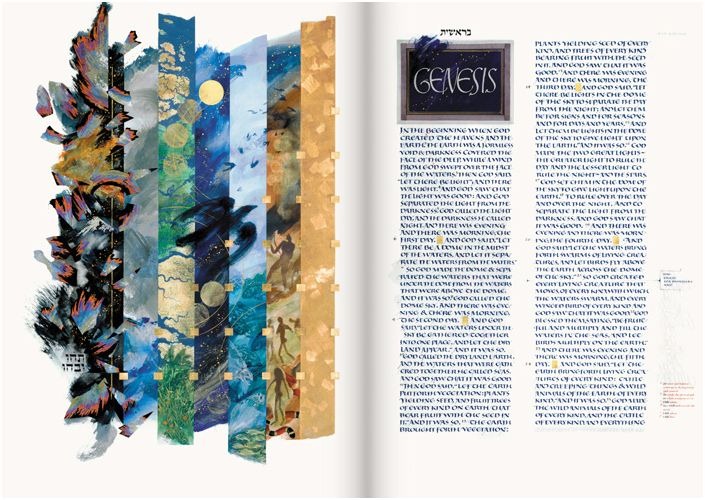
(Apologies to Baudrillard.)
Biblical Translation: Art, Science, or Politics?
Theophrastus’s question about the best translation of Ἰουδαῖος threw me for a loop. First I grappled with the question itself (you can see my rather lame conclusion here). Then I realized I wanted to get back into my long-dormant translations of Mark and John’s gospels—the most terse, tightly packed, and probably earliest gospel alongside the most florid, gnostic (in the non-technical, lowercased-g sense of the word), and historically latest gospel.
Then I decided I wanted to settle in my own mind the two Big Questions about these gospels: Was the late Morton Smith’s “discovery” of the Secret Gospel of Mark the most important find of the 20th century, or a carefully constructed fraud? And who authored the Fourth Gospel—John bar-Zebedee? John the Presbyter? John of Patmos? And, for that matter, who was the Beloved Disciple, and is he another candidate for the gospel’s authorship? I still favor the identification of Lazarus as ὃν ἠγάπα ὁ Ἰησοῦς, but I can see others’ arguments, too.
Since I couldn’t make any headway there, I started pondering what approach I wanted to take with the translation. “Starkly literal” has a certain appeal, though it makes for deucedly difficult reading. And what is “literal” anyway, when a single word can have a number of equally valid renderings? Does one list all renderings each time, to let the reader pick and choose? How then is that a translation as opposed to an interlinear apparatus? No, the translator must make the choice, and therein lies all our conundrums. Conundra. Whatever.
Every choice I make as a translator betrays my personal convictions—if not about what I want the text to say, at least about what I believe the text actually says. And that means I must somehow get inside the head of individuals (or perhaps committees), dead for millennia, who had a wildly different culture and language and worldview than mine. It’s almost as if the work of biblical translation becomes little more than a grandiose Rorschach test, revealing more about my biases and beliefs than about the original authors’.
That said, if one wants to be a translator (as I wanted to be from at least the age of 11), one must make choices. One must present, usually for an audience that doesn’t know all the ins-and-outs of grammar, etymology, and cultural context, a fairly authoritative position. Not the impossible “What do the words mean?” but the more accessible “What is the text actually saying?” and even “What is the text saying to me, and to us?”
In my discussion with Theophrastus on whether the translation of Ἰουδαῖος in John’s gospel as “the Jews”—a translation which has inflamed two millennia of anti-Semitism—is (a) accurate, or (b) necessary, knowing how it would be used by the worst segments of society, I recalled my own struggles several years ago with the translation of Leviticus 18:22 and 20:13. I desperately wanted these passages to say something that homophobes can no longer use as a tool against gay people. תּוֹעֵבָה is, of course, the big issue: these behaviors are “an abomination” or “a detestable thing,” depending which translation you read. Does tôwʻêvâh, as would be suggested from its etymology, mean “disgusting”? Or does it really mean “involving foreign religious cultic practice,” the way “unclean” really means “ritually impure”? I can see how eating snakes might make some people go “ick.” But lobster and shrimp? They, like a woman wearing pants, are similarly “disgusting.” Eating game birds, cross-breeding livestock, getting a tattoo, wearing clothes made from a blend of textile materials, and charging interest on a loan are also prohibited by the levitical code, but no one seems to care about them.
The chapter 18 version says, “Do not lie with a male as one would lie with a woman; it is tôwʻêvâh.” Men who allowed themselves to be penetrated by another man were felt to have made themselves like women—who were, of course, not valued in patriarchal cultures. The absence of a similar injunction against “a woman lying with a woman as with a man” indicates that this passage does not refer to homosexuality at all, but to the “dishonor” that one’s maleness would suffer through being penetrated.
The version in chapter 20 says, “And if a man lies with a male as one would lie with a woman, it is tôwʻêvâh: both of them must be killed, their bloodguilt be upon them!” Again, it is the dishonoring of a man’s maleness that is forbidden, with no discussion of love or of other same-gender sexual behaviors. Female homosexuality poses little threat to patriarchal cultures primarily due to the low status of women within the culture. One might even argue that female homosexuality prior to marriage supports the patriarchal culture by providing a sexual outlet yet preserving a woman’s virginity until given by her father in marriage to a man.
So if I want to communicate this information in translation rather than in a footnote, since I feel I know what the text means (if not quite what it says)—revealing cultural attitudes so foreign and, to our mind, hateful and sexist, not to mention homophobic—do I add words that are not present in the original? Do I leave the text to speak for itself, even though I risk it being used by bigots to fuel their prejudices, or worse, by people who would decide to carry out the biblical penalties spontaneously (as with Matthew Shepard) or legislatively (as with the anti-gay death penalty bill in Uganda)? Or do I soft-pedal the text, and say, “Same-sex behavior is prohibited because it is practiced by our enemies”? But is that really soft-pedaling, or is “things practiced by our enemies” a valid translation of tôwʻêvâh?
These are the sorts of questions that keep me awake at night.
Medium as Message
I’m as behind in my reading as I am in my writing, apparently, and only just found this interesting article in the September 2 New York Times. In it, Lev Grossman talks about the evolution of books into a digital format, and thinks it’s a bigger deal than we’re giving it credit for. “The last time a change of this magnitude occurred was circa 1450, when Johannes Gutenberg invented movable type. But if you go back further there’s a more helpful precedent for what’s going on. Starting in the first century A.D., Western readers discarded the scroll in favor of the codex — the bound book as we know it today.”
Leaving aside the issue of his using of “A.D.” rather than “C.E.” (a personal bête noire), I found the article fascinating, particularly the revelation that English is “littered” with words left over from the scroll age: “The first page of a scroll, which listed information about where it was made, was called the ‘protocol.’ The reason books are sometimes called volumes is that the root of ‘volume’ is volvere, to roll: to read a scroll, you revolved it.”
Then he moved to a discussion that is perhaps more germaine to our general area of inquiry:
Scrolls were the prestige format, used for important works only: sacred texts, legal documents, history, literature. To compile a shopping list or do their algebra, citizens of the ancient world wrote on wax-covered wooden tablets using the pointy end of a stick called a stylus. Tablets were for disposable text — the stylus also had a flat end, which you used to squash and scrape the wax flat when you were done. At some point someone had the very clever idea of stringing a few tablets together in a bundle. Eventually the bundled tablets were replaced with leaves of parchment and thus, probably, was born the codex. But nobody realized what a good idea it was until a very interesting group of people with some very radical ideas adopted it for their own purposes. Nowadays those people are known as Christians, and they used the codex as a way of distributing the Bible.
One reason the early Christians liked the codex was that it helped differentiate them from the Jews, who kept (and still keep) their sacred text in the form of a scroll. But some very alert early Christian must also have recognized that the codex was a powerful form of information technology — compact, highly portable and easily concealable. It was also cheap — you could write on both sides of the pages, which saved paper — and it could hold more words than a scroll. The Bible was a long book.
It was also, Grossman points out, a very different reading experience. Which is why I hate e-books so very much. It’s one thing to be able to call up a PDF of a product manual and keep it on my iPad; it’s quite another to cuddle up with a tablet of Sherlock Holmes. And if I’m doing research, I want it on my computer monitor, in a more flexible format than a tablet currently provides, with immediate access to all sorts of critical apparatuses. It may be just that I’m a dinosaur, with cavils that will not trouble a younger generation, but there is something sweet about poring through a book: its tangibility affords a pleasure that an acrylic screen in a plastic housing will never give.
Then there’s this, which made my heart leap for joy:
We usually associate digital technology with nonlinearity, the forking paths that Web surfers beat through the Internet’s underbrush as they click from link to link. But e-books and nonlinearity don’t turn out to be very compatible. Trying to jump from place to place in a long document like a novel is painfully awkward on an e-reader, like trying to play the piano with numb fingers. You either creep through the book incrementally, page by page, or leap wildly from point to point and search term to search term. It’s no wonder that the rise of e-reading has revived two words for classical-era reading technologies: scroll and tablet. That’s the kind of reading you do in an e-book.
The codex is built for nonlinear reading — not the way a Web surfer does it, aimlessly questing from document to document, but the way a deep reader does it, navigating the network of internal connections that exists within a single rich document like a novel.
Grossman, bless him, echoes my own resistance to e-books. (I also love the little dig earlier on: “Tablets were for disposable text”!) I have no doubt that they’ll one day discover my body in my home, crushed beneath a bookcase that toppled from the weight of too many books. I also have no doubt that as the volumes are pelting me like stones, sinner that I am, my last words will be, “Ah, books!”
An Orthodox translation
Mississipi Fred McDowell has posted Matthew 25 from an Orthodox Jewish translation. HT James McGrath
I met Mississipi Fred online when I wrote Abecedaria. I have a bad habit of not answering email all the time. If I think that I have something to say on a topic I may write about it in a new post. Sometimes I think about a topic for a while, intending to post, and it drops off the table. But in this case, I did work on Fred’s request.
and maybe Latin
I have just been catching up on a few posts over on Jim McGrath’s blog, here and here, and feel the need to respond. How many languages do you need to know to study the New Testament?
I hardly know where to start so let me recount my experience, and I will freely admit that I consider myself an amateur and susceptible to error.I don’t keep my linguistic skills sharpened and I am limited, but more than capable of following along and conferring with the necessary original texts, given a few of the usual aids.
I studied classical Greek, Latin, French and German for grades 10 – 13 of secondary school. (I also studied Physics, and chemistry, but did not consider myself to be a scientific whiz. I am happy that I got some background in Physics – I understand how airplanes stay in the sky, given normal conditions, but that’s about it.)
At university, I studied classical Greek, German and French for 3 years. In the last year, I signed up for a Hellenistic Greek class and was told that I had to study Hebrew concurrently, so I did. I then attended a French Bible School in Switzerland for one year. At Bible School, I read the New Testament in Greek for the first time in a formal setting. In my experience, you learn Greek first as a language, and then you read the NT in Greek, so you don’t let your prior knowledge of the English New Testament in your preferred translation gain the upper hand.
On returning to Toronto, I concentrated on French linguistics and translation methods, and went on to train as a secondary school teacher with a specialization in French.
A few years later, I attended the Summer Institute of Linguistics at the University of Washington for a couple of summers, focusing on language policy and writing systems as well as translation. After that, I spent a year in Toronto, completing an MA in Education, writing a paper on Bible translation and Cree syllabic literacy.
Now I teach special needs students in an inclusive school and interact with children whose tested IQ – who knows what their real potential is – ranges from 49 to 149 – with everything in between. I also train other educators in various types of software.
What I really notice, what absolutely leapt out at me, in the discussion on languages and the NT, was that someone in the list, (I forget who) wrote “and maybe Latin.” To this, Duane Smith responded, “and Latin.” Don’t get me wrong, I think Syriac is terribly important, and I have made a stab at it, at least looking up a few passages in the Syriac NT every once in a while.
But Latin! I disagree with Larry Hurtado. I think that if you want to understand how we have come to have the lexicon entries that we now have for the vocabulary of the Greek NT, Latin is essential. This has been one of the most baffling aspect of Bible blogging for me. For more than a thousand years, most theology was written in Latin. Vocabulary which has ended up in English and French Bible translations comes to us from Latin. While the Vulgate was the dominant Bible translation for much of European history, the Pagnini translation and Latin translations of the Reformation, exerted enormous influence on the vernacular Bibles of the Reformation. I have more or less ignored Bible software because it does not include these Latin translations – as far as I know.
How on earth can we understand what the Latin fathers meant in their theology, if we don’t know what text they were working from? How can we understand any present day doctrinal statement if we don’t know the Latin that it was originally written in. I wish I knew Latin better. It is one skill I would seriously consider going back to university for. I consider myself to be a good protestant girl, but I suggest that Latin is essential to understanding Bible translation.
Yes, I do agree that other areas of study are necessary as well. But actually, you can throw a few books of feminist or queer theory at someone and expect them to read it and interact. Languages are little trickier. A few of the social theory books that shook my biblical world are by Paulo Freire, Judith Plascow and James Cone.
Update: I forgot to mention a few courses that I have taken to keep up some languages skills. I have taken some summer courses at Regent College from Waltke and Fee, and from the Vancouver School of Theology in Midrash and Kabbalah. Perhaps the one thing I enjoyed the most was reading the Sefer Yetsira in Hebrew, and in several different translations.
Paul : Wright :: Thucydides: Woodruff
At his blog, Peter Kirk, Bible translation project coordinator and exegetical adviser, makes a suggestion for N. T. (“Tom”) Wright:
But if he is to convince people of this, he needs to offer an explicit scholarly exegesis of this Greek word [(οὐκ) ἐπιτρέπω] in its context, and not rely on what people might infer from his renderings of the verse. And there is bound to be strong resistance in certain quarters to even the strongest of arguments which might undermine deeply entrenched patriarchal understandings of the church.
The “this” that Kirk believes Wright must convince us people of is his translation of 1 Timothy 2:12. (See “Deduction and Tom Wright’s Translation of 1 Timothy 2:11-12” by Theophrastus and “not overruling the man” by Suzanne McCarthy, for more background).
While not even attempting to build an airtight case for some singular and invariable and unambiguously “explicit scholarly exegesis of this Greek word in its context” one way or another, I do want to offer something else. In this post, I’d like us to see the analogy between how Paul’s Greek comes across in Wright’s English and how Thucydides comes across in Paul Woodruff’s English. (The bit from Thucydides is out of what we’ve come to know as The History of the Peloponnesian War, an excerpt from Book II, Chapter LXXII, Section 2, Line 8, around the verb phrase οὐκ ἐπιτρέπωσιν.)
So here’s Paul and then there’s Wright with his two different renderings.
Διδάσκειν δὲ γυναικὶ οὐκ ἐπιτρέπω, οὐδὲ αὐθεντεῖν ἀνδρός, ἀλλ’ εἶναι ἐν ἡσυχίᾳ.
I’m not saying that women should teach men, or try to dictate to them; rather, that they should be left undisturbed.
I don’t mean to imply that I’m now setting up women as the new authority over men in the same way that previously men held authority over women.
Now here’s Thucydides and then there’s Woodruff.
μὴ ἐκείνων ἀποχωρησάντων Ἀθηναῖοι ἐλθόντες σφίσιν οὐκ ἐπιτρέπωσιν
once the Spartans had gone, the Athenians might come and disregard their neutrality
To give us a sense of how unusual and how deductive Wright’s translation of Paul is, Theophrastus already showed us the common sense translations. There’s the ESV, the NIV2011, and the Inclusive Bible respectively to reconsider:
I do not permit a woman to teach or to exercise authority over a man; rather, she is to remain quiet.
I do not permit a woman to teach or to assume authority over a man;** she must be quiet. [Notes: … **Or over her husband].
I don’t permit a woman to teach or have authority over a man. She must remain silent.
Now to give us a sense of how unusual and how deductive Woodruff’s translation of Thucydides is, let’s look at the common sense translations. There’s the one by Benjamin Jowett, the one by Thomas Hobbes, and the one by Richard Crawley.
When the Lacedaemonians were gone the Athenians might come and not allow them to carry out the treaty;
lest when the Lacedaemonians were gone, the Athenians should come and take the custody of it out of their hands
After his departure, what was to prevent the Athenians from coming and taking it out of their hands
Notice how the common sense translations render the Greek phrase as something like “not permit” and “not allow” and “take out of.”
Notice how Wright and Woodruff have the Greek phrase as something like “not saying” and “not mean to imply” and “disregard” so that the negative adverb in the verb phrase means less a prevention or a prohibition and more an allowance or a looking the other way. Doesn’t Paul’s Greek and doesn’t Thucydides’s Hellene allow this ambiguity? (Aren’t the histories important here, as Wright stresses it and as Thucydides maps it? If you read the fuller context of the excerpt of the latter, then you do see an expressed concern for wives and women and children.)
Steve Reich’s “WTC 9/11”– World to Come and Shmira

The terrorist attacks of 9/11 affected me more deeply than any other public event in my lifetime. I lost two people in 9/11, a professional colleague and a relative. And the aftermath of 9/11 touched nearly every part of my life. I had nightmares for a year following the event – and I still dream of it sometimes.
A number of artists have responded to 9/11, but I am particularly struck by Steve Reich’s composition “WTC 9/11”, performed by the Kronos Quartet on Reich’s new CD. You can listen to the piece in its entirety here. (Note: I know Steve Reich personally.)
What does WTC mean?
Reaching deep into the immediate chaos and accumulated pain of that day, the Pulitzer Prize-winning composer pulls out layers of meaning from the initials “WTC.” They stand for World Trade Center, but they also refer to Bach’s Well-Tempered Clavier — which Reich chose not to quote directly, but rather honor in spirit.
Inspired by a good friend, fellow composer David Lang, Reich delves into the spiritual and metaphysical dimensions of another “WTC” — the “world to come.” Reich, who is immersed in Judaism, draws in the voices of women who fulfilled the Jewish obligation of shmira, or sitting with the victims’ remains before burial, chanting Psalms and other Biblical passages to accompany the souls of the dead. But layers of anxiety about our current lives and time in history lurk in that phrase, as well. As Lang says at the piece’s conclusion, “The world to come. I don’t really know what that means.”
(Steve Reich speaks further about the piece here.)
This is a deeply unsettling piece of music, as befits a deeply unsettling event, with multiple layers of meaning, and many religious references. The “world to come” (העולם הבא) in Judaism refers to the hereafter. But even our post 9/11 future in this world is hardly clear.


 BLT
BLT 