are you going to get “Every Thing On It”?

If you read the poem above aloud, while looking at the drawing, then you get it:
“We believe … that poems [especially the ones by Shel Silverstein] need to be read out loud,” says Mitch Myers, Silverstein’s nephew. “This is one of the joys of the book [Every Thing On It], and we really were able to determine if it really worked when we said it out loud.”
Myers is talking about the newly published collection of poems by the late Silverstein. NPR’s “Morning Edition” let’s you listen to a few of the poems read here, and get a preview of some of the other poems and illustrations here.
Congratulations to Alicia Stallings and Kay Ryan
Congratulations to two brand-new MacArthur “Genius” Award recipients: Alica Stallings and Kay Ryan.
 Alicia (A. E.) Stallings is the translator of Lucretius’ The Nature of Things in a translation of heroic couplets in 14 syllable lines, in an attempt to evoke (if not strictly mimic) some of the Latin metrical features of the poetry. Here is a sample of her translation from the Hudson Review:
From Book Four: Against passion
Add this—lovers fritter away their strength, worn out in thrall.
This also—one lives ever at the other’s beck and call.
They grow slack in their duties. Good name stumbles and malingers.
Wealth, turned to Babylonian perfumes, slips through the fingers.
But you can bet that she’s well heeled, in shoes from Sicyon,
And those are genuine emeralds, the rocks that she’s got on.
The wine-dark sheets, from rough and constant use upon the bed
And drinking up the sweat of Venus, are worn down to the thread.
The father’s hard-earned fortune turns to tiaras for her hair,
Alindan silks, diaphanous gowns from Cos for her to wear.
He shells out for fantastic feasts with all the trimmings—fine
Linens, music, perfume, garlands, wreaths, free-flowing wine—
But in vain—since in the very fountain of delights, there rises
Something of bitterness that chokes even among the roses.
Perhaps it’s that remorse, gnawing at the conscience, taunts
The lover he’s thrown his life away in sloth, among low haunts;
Or else his darling wings a two-edged word at him, a dart
That smolders like a fire, and rankles in the love-struck heart;
Or else he thinks her roving eye too freely wanders after
Another, and imagines in her face a trace of laughter.And these are just the problems of a love that’s going well!
Imagine a love that’s crossed and doesn’t have a chance in hell—
Even with your eyes shut, you can grasp that the amount
Of troubles in unhappy love are more than you could count.
Best to keep eyes open, as I’ve said—don’t take the bait.
It’s easier to avoid the toils of love than extricate
Yourself once you are caught fast in the nets and to break free
From the strong knots of Venus. Yet you’re still able to flee
The danger, even if you’re tangled up, snared in the gin,
So long as you don’t stand in your own way, and don’t begin
To overlook all shortcomings in body and in mind
Of the woman you lust after. For desire makes men blind—
And generally they overlook their girlfriends’ faults, and bless
These women with fine qualities they don’t in fact possess.
That’s how it comes that we see girls—malformed in many ways,
And hideous—are petted darlings, objects of high praise.
Indeed, one lover often urges another he would mock:
“Venus has it out for you—your love’s a laughingstock.”
(Poor fool—that his delusion’s worse would come as quite a shock!)The black girl is brown sugar. A slob that doesn’t bathe or clean
Is a Natural Beauty; Athena if her eyes are grayish-green.
A stringy beanpole’s a gazelle. A midget is a sprite,
Cute as a button. She’s a knockout if she’s giant’s height.
The speech-impaired has a charming lithp; if she can’t talk at all
She’s shy. The sharp-tongued shrew is spunky, a little fireball.
If she’s too skin-and-bones to live, she’s a slip of a girl, if she
Is sickly, she’s just delicate, though half dead from TB.
Obese, with massive breasts?—a goddess of fertility!
Snub nosed is pert, fat lips are pouts begging to be kissed—
And other delusions of this kind too numerous to list.
Yet even if her face has every beauty you could name,
And she pours out the power of Venus from her entire frame,
The truth is, there are other fish in the sea. The truth is, too,
We’ve lived without her up to now. She does—we know it’s true—
Exactly the same things as all the ugly women do,
And fumigates herself, poor girl, to cover the stench after,
While her maids steer clear of her and try to hide their laughter.
But the lover, locked out, weeps, and strews the stoop with wreaths in bloom,
And anoints the haughty doorposts with sweet-marjoram perfume,
And presses his lips to the door, the fool—when if he were let in,
One whiff and he would seek a good excuse to leave again!
His long-rehearsed heartfelt lament would then come crashing down,
Right then and there he’d curse himself for being such a clown,
And for granting her perfection that no mere mortal attains.
Our Venuses are on to this—that’s why they take great pains
To hide the backstage business of life, keeping unaware
Those whom they wish to hold bound fast, caught in desire’s snare.
But all in vain, because your mind can drag everything out
Into the light, and find what all the tittering is about—
Yet if she is good-natured, never spiteful, it’s only fair
To make allowances for foibles that all humans share.
 Kay Ryan is a poet and a part-time remedial English teacher at the College of Marin and a former Poet Laureate of the Library of Congress. Here is her “Home to Roost” (you can find an audio recording of her reciting it here):
The chickens
are circling and
blotting out the
day. The sun is
bright, but the
chickens are in
the way. Yes,
the sky is dark
with chickens,
dense with them.
They turn and
then they turn
again. These
are the chickens
you let loose
one at a time
and small—
various breeds.
Now they have
come home
to roost—all
the same kind
at the same speed.

I keep the Hebrew and Greek texts in mind throughout my discussions in this book, if only to meditate on the many places where the English version surpasses the original, and those where it comes short. Tyndale’s New Testament is so vast an aesthetic improvement on the Greek text that I am perpetually delighted. The Tanakh, a far stronger original, comes even in honors with Tyndale, Coverdale, Geneva, and the KJB committees. Sometimes even Coverdale, who had little or no Hebrew, invented graces and glories beyond the ancestral text, but more frequently he crashes. Tyndale, Geneva, and the KJB company rarely fail utterly, yet when they miss, it can be (and has been) lamentable. The ongoing translations of the Hebrew Bible by Robert Alter and the marvelous notes in Herbert Marks’s Norton edition of the English Bible are exemplary antidotes.
– Harold Bloom, The Shadow of a Great Rock: A Literary Appreciation of the King James Bible (2011) [emphasis added]
(I’m jealous that Bloom already has his copy of the Norton English Bible. Mine is supposed to arrive next week.)
What do you think? Does the English Bible improve on the Greek New Testament?
The English Translations of the Qur’an: “A Critical Guide”
Abdur Raheem Kidwai lectured this summer on the English Translations of the Quran at St. Peter’s College, University of Oxford. It seems he has a new book out entitled Translating the Untranslatable: A Critical Guide to 60 Translations of the Qur’ān. The book is ostensibly an expansion of an article by the same title, available online here.
Given his previous work in orientalism, especially his collaborative effort on representations of women as minorities in Islam, A. R. Kidwai’s “critical guide” should prove to be valuable. Does the book review “The First English Translation of the Quran (Koran) by an American Woman” by Laleh Bakhtiar? I’ve looked at the publisher’s website and in online bookstores but can’t find Kidwai’s work yet. Has anyone seen it?
Whose Mockingbird? A Parable for [DE] Translators of the Bible
“Or is dynamic equivalence a theory for Bible translations only? Perhaps [Eugene] Nida felt that Catullus would be read by more sophisticated readers, while the Bible should be accessible to everyone?”
asks Theophrastus.
“On the other hand, what can we do to provide a corresponding audio (+/- visual) frame of reference for non-readers?”
asks Ernst R. Wendland, linguist, Bible translator, consultant, professor, prolific author, and developer of Eugene Nida’s Dynamic Equivalence theory.
The questions come following an earlier post. They remind me of questions which prompted a post at another blog a good while ago, a post re-published below. Would Nida want a DE translation for a novel? What if that novel was as popular as the Bible? What if the novel had a message that, in the view of the DE translator, transcended the language(s) and the culture(s) of the original? Would footnotes help the readers of the translation? Would a corresponding audio frame help non-readers? In fact, if the novel were To Kill A Mockingbird, then we can ask such questions. Last summer, when driving across the USA, my family and I listened to the audiobook narrated by Sissy Spacek. It allowed for much, for more, I’d say, than did the film and the play and the Broadway musical adaptations of the book. Nevertheless, I’m not quite sure even such a wonderful audio transposition fully gets the literary value of Harper Lee’s novel. A reader as listener can’t ponder very long the rich meanings of rare words and of cultural allusions in the book.
Why did Lee use the word corncribs, for example, to give some sort of warrant for the strong claim by one of her central characters that “it’s a sin to kill a mockingbird”? Is the name Ann Taylor for the dog of the key judge in the work so insignificant? Is “Ann Taylor” so forgotten as to be unnecessary to “the message” of the book, so that this name must be reworked by the DE translator into the heart language and culture of say, Indonesia, as a typical name? In bahasa Indonesia this may be a good English name for a human, but does it work as the name for a dog (such as Bejo, Belang, Buntek, or Gepeng)?
These were some of my questions. Here’s that post:
——-
Whose Mockingbird? A Parable for Bible Translators
Harper Lee’s novel To Kill A Mockingbird has been translated into more than forty different languages. It may serve as a parable for Bible translators.
How? Let’s look at three ways. Then we’ll consider three excerpts from one translation.
First, the story of this book is a parable for Bible translators perhaps because it’s nearly equal to the Bible in its popularity. There’s a must-read sacredness to it for many. It’s nearly as popular as the Bible for many readers in the USA and more popular than the Bible for several more readers in the UK. Claudia D. Johnson cites the following:
Using 5000 respondents, the researchers [of the U.S. Book-of-the-Month-Club and the U.S. Library of Congress’s Center for the Book in 1991] found that one of the three books “most often cited as making a difference” in people’s lives was Harper Lee’s To Kill a Mockingbird (it was second only to the Bible).
And Michelle Pauli reports:
The Pulitzer prize-winning classic has topped a World Book Day poll conducted by the Museum, Libraries and Archives Council (MLA) [of the U.K. in 2006], in which librarians around the country were asked the question, “Which book should every adult read before they die?”…. To Kill a Mockingbird heads… the librarians’ list: it is followed by the Bible.
Thus, the book is read in forty some different languages worldwide, and is in English translation considered nearly as worthy to read as the Bible in America and thought even more worthy, by most librarians polled, in Britain.
Second, the book is maybe a parable for Bible translators because its language is like the Bible’s. It’s full of Bible metaphors and biblish and biblicisms already. Like the Bible, To Kill A Mockingbird references the language of and passages in the Bible.
(For example, I just read again last night, “Let the dead bury the dead this time, Mr. Finch. Let the dead bury the dead.” There’s no explanation given for what this means, or where it comes from, just as when Luke 9:60 seems to give a quote from Matthew 8:22, perhaps from another source text even, then there’s no explanation for this riddle. And a few pages earlier there was this: “As a rule, a recess meant a general exodus, but today people weren’t moving. Even the Idlers who had failed to shame younger men from their seats had remained along the walls.” Did you catch those references? What’s an exodus and what’re the Idlers with a capital I? And why failed and why shame and how ironic and funny is it when one has failed to shame? to remain? the walls? Are these suggestions of the Hebrew Bible, some Aramaic, the Greek, late legal Latin?)
What I’m getting at in the parentheses above (in the question of biblical references) brings us to the third way To Kill A Mockingbird is a parable perhaps for Bible translators.
Third, then, to translate this novel is to position oneself outside its culture, and isn’t that important, as a parable, for Bible translators? Let me explain, and try to illustrate, this third point. The culture of To Kill A Mockingbird, as much as it speaks to EveryMan and to anybody, makes all readers today outsiders. Beyond “the South” in the United States just a few decades after the Civil War, it is very much a speaking out of the specific culture and subcultures of a little Alabama town. Most British librarians find this specific novel more important to read than the Bible, despite the fact that the book’s English is very not English at all. Nonetheless, the book is full of biblish like the difficult-to-read old English Bibles. Moreover, even American readers, those not from the South and even those from as south as South Alabama, are now some fifty years past this old English. Furthermore still, those reading the book in languages other than English of any kind are also not only linguistic but also cultural outsiders.
The moral of the parable is this: There is no shame in this outsiderness for readers or for translators. There is no effort to rid the book of its biblicisms or to upgrade it to natural English or to downgrade it to common English or to make it readable at any particular grade level. Part of the reasoning for leaving the English of the book alone may be that the book is largely written through the eyes of children who should, one might assume, speak a more common or less unnatural English. However, it turns out that a little rural girl speaks. She speaks, and thinks, in pretty sophisticated ways with quite challenging language. And there are high and low registers for her, and for several of the other characters.
So a translator is an outsider, and there’s no shame in that and no effort to make readers feel like they are reading something written just for and only to them. The story itself is a parable. And the book is safe enough already for readers. And the translator might find her own voice in it, safely. Harper Lee confronts sexism and racism and classism, and her readers borrow the eyes of a child, the ears of the child, her voices. There is injustice, and she speaks out. There is rape, some alleged rape, and she hears of it. There is a father who fails in the end, and she sees him through to the final page. I’m not giving too much away. Did I tell you she was a little girl? Most of us readers are not Miss “Scout” Jean Louise Finch from a small town called Maycomb where only men are lawyers and judges and jurors and only white men of a certain kind. None of us talks like her. Nor do we expect her to talk like us.
Now, let’s get to the illustration from a translation. It’s an Indonesian language translation. We’ll just look at three passages from the book.
(One reason I’m reading the Indonesian translation is because for four years I studied this language on Java, in Jakarta. My formal teacher was Ibu Noto, but even my English literature class teacher was a Muslim too, and so was my English writing class teacher. I’m mentioning the religion of my language teachers for four years because to them the Qur’an is much more important than the Bible. And to them To Kill A Mockingbird is also much more important than the Bible. As I read the Indonesian translation of To Kill A Mockingbird, I imagine how Mrs. Noto, and Mr. Williams [an Islam convert], and Mrs. Dali might translate it. They live on an island of prebumi, bumiputra, pure-raced natives. They live in a post-colonial nation state, where the Indonesian alphabet has been purified from its old Dutch influences, where the Chinese written language is outlawed. They live, as Muslims, in the world’s largest nation of people of Islam. They know social and legal injustices, but they are outsiders to the book and to its language. The actual translator is Ibu Femmy Syahrani,
and here are some brief reviews of her work.)
Now, let’s look at those passages. Let’s look at the three places in her book where author Harper Lee used, respectively, the English words corncribs and translation and metaphors. These are words she only uses once in this the only novel she ever wrote. Then let’s see how Indonesian translator Femmy Syahrani renders the three passages and words.
corncribs : gudang jagung
“Mockingbirds don’t do one thing but make music for us to enjoy. They don’t eat up people’s gardens, don’t nest in corncribs, they don’t do one thing but sing their hearts out for us. That’s why it’s a sin to kill a mockingbird.”
“Mockingbird menyanyikan musik untuk kita nikmati, hanya itulah yang mereka lakukan. Mereka tidak memakan tanaman di kebun orang, tidak bersarang di gudang jagung, mereka tidak melakukan apa pun, kecuali menyanyi dengan tulus untuk kita. Karena itulah, membunuh mockingbird itu dosa.”
Notice here how corncribs are something not a big part of Harper Lee’s book. How many English readers today anywhere know what they are, or were? The Oxford English Dictionary lexicographers note that this is peculiarly “U.S.” English, with two definitions: “a. A crib or manger for corn. b. A ventilated building or granary, for storing Indian corn in the ear or cob.” Is this English “natural” or “common”? Should it be? Femmy Syahrani has “gudang jagung,” which is common and natural Indonesian for a “corn warehouse” or “corn storage building.”
The Indonesian translator does something else here. She leaves in transliterated Indonesian words the English name of the mockingbird. When it’s plural in English, she does not add the plural suffix in her Indonesian version because Indonesian grammar makes clear this is a generic plural, “each mockingbird / all mockingbirds.” What is gained is italicized attention to the importance of this titular and key word. What is lost is the mimicry of mockingbirds, how they translate the songs of other birds, how readers are drawn to the fact that the black man wrongly accused of raping a white man’s daughter is like a mockingbird, is killed sinfully, like a mockingbird. “Dosa” is the Indonesian word for sin, a common word in majority Islam and in minority Christianity in Indonesia. The translator forgoes the embodied metaphor of “sing their hearts out” and loses much by using natural non-metaphorical Indonesian instead: “menyanyi dengan tulus” which means they “sing with sincerity.”
translation : menjelaskan
Jem and I were accustomed to our father’s last-will-and-testament diction, and we were at all times free to interrupt Atticus for a translation when it was beyond our understanding.
Aku dan Jem sudah terbiasa dengan diksi ayah kami yang lebih cocok diterapkan pada surat wasiat, dan kami bebas menyela Atticus kapan pun untuk memintanya menjelaskan kata-kata itu kalau ucapannya tak kami mengerti.
For Harper Lee’s metaphorical use of the technical word translation, Femmy Syahrani decides on something presumably more natural, apparently more common, and ostensibly clearer: “menjelaskan.” The word means “clarification” as in a given explanation. There is no reason at all, however, why this translator couldn’t use the Indonesian verb for “translation.” Is she hiding, minimizing her voice here?
metaphors : metafora
The second thing happened to Judge Taylor. Judge Taylor was not a Sunday-night churchgoer; Mrs. Taylor was. Judge Taylor savored his Sunday night hour alone in his big house, and church-time found him holed up in his study reading the writings of Bob Taylor (no kin, but the judge would have been proud to claim it). One Sunday night, lost in fruity metaphors and florid diction, Judge Taylor’s attention was wrenched from the page by an irritating scratching noise. “Hush,” he said to Ann Taylor, his fat nondescript dog.
Hal kedua terjadi pada Hakim Taylor. Hakim Taylor tidak ke gereja pada Minggu malam; Mrs. Taylor yang hadir. Hakim Taylor menikmati waktu Minggu malam sendirian di rumahnya yang besar, dan pada waktu kebaktian dia bersembunyi di ruang kerjanya membaca tulisan Bob Taylor (bukan saudara, tetapi sang hakim tentu bangga andai bisa mengaku saudara). Pada suatu Minggu malam, tenggelam dalam metafora berbuah dan diksi berbunga, perhatian Hakim Taylor terenggut dari lembar kertas oleh suara garukan yang mengganggu. “Sst,” katanya kepada Ann Taylor, anjing kampungnya yang gemuk.
Harper Lee’s readers catch on the to fact that this Christian is also a Judge who neglects his churchgoing. Astute readers also get that instead of being a good Christian, this judge, he reads the works of his namesake, a politician and rhetorician, full of slick rhetoric in at least two senses, the works of one “Bob” Robert Love Taylor. Femmy Syahrani’s Indonesian readers are not likely to get any of that. What is offered them, nonetheless, is that Mrs. Taylor is an American, not an Indonesian Ibu Taylor. She goes to church.
The dog is named Ann Taylor. Again, the astute readers in English would get her namesake, the English poet for children. And it’s funny that she’s fat, but even more so that she’s a “nondescript dog” poking fun again at the poetry perhaps. The Indonesian readers have no idea that she’s anything but fat, and a dog with an English name, not a nondescript one, but a kampung dog, a common village dog. Is this the translator’s voice?
So we come to the phrase “lost in fruity metaphors and florid diction.” For the English reader, this cannot be a good thing. It’s the Judge’s own reward, or punishment, for staying home from church. “Fruity” is not sophisticated (and “metaphors” stand from the Greek root as something literary and rhetorical). For the Indonesian reader, there is an eloquence that seems either, well, eloquent or mocking of eloquence: “tenggelam dalam metafora berbuah dan diksi berbunga.” It goes something like, “drowning under metaphors fruitful and diction flowerful.” At least, there is an attempt, a good one, at mimicking the silliness here; and the Indonesian adds an alliteration with syntactic flair. (“Metafora” again retains the Greek root, in transliteration, without explanation; it’s surely literary and rhetorical even in Indonesian; it’s somehow a direct equivalent of Harper Lee’s English which is somehow a direct equivalent of some ancient Greek’s Greek.) The fun, of course, is the fruit and flora as buah dan bunga.
So What? What’s the punchline, the point, the moral of the fable?
Well, that’s quite enough for now. Besides I’m out of time again. There’s much to consider when translating central words like “Mockingbird” that have such metaphorical import to a story. There’s a lot to take in when thinking about an author’s lonely words, pregnant with meaning. There’s a good bit to ponder when making choices to render such critical phrases that point to the translator’s own processes. Parables take processing, so perhaps this is a fair one for that, even a fair one for Bible translators.
Jew or not Jew
 No comment, except to note that the iPhone app discussed below is still available in the United States as is the (unaffiliated) web site Jew or Not Jew. From Jweekly.com:
Cupertino-based Apple Inc. has removed a mobile app called “Jew or Not Jew?” from its online App Store in France.
The app let users consult a database of celebrities and public figures to determine if they are Jewish or not. Its removal follows a complaint from a French anti-racism group that threatened to sue the iPhone and iPad maker.
The app, “Juif ou pas Juif?” in French, was selling for approximately $1.08 until it was cut on Sept. 14. SOS Racisme argued that the app violated France’s strict laws banning the compiling of people’s personal details without their consent.
Apple spokesman Tom Neumayr said the app did violate local law, so it was removed from the French App Store. It is still available outside France, however, and currently sells for $1.99 through Apple’s U.S. App Store.
Under the French penal code, stocking personal details including race, sexuality, political leanings or religious affiliation is punishable by five-year prison sentences and fines of up to $411,870.
Such laws were enacted in the decades following the Holocaust, which saw some 76,000 Jews deported from Nazi-occupied France to concentration camps. Fewer than 3,000 returned alive.
In a statement, SOS Racisme had called on Apple to remove the app from its online store and be more vigilant about the applications it sells.
In an interview, published Sept. 14 in Le Parisien newspaper, app developer Johann Levy said he developed the app to be “recreational.”
“I’m not a spokesman for all Jews, but as a Jew myself I know that in our community we often ask whether a such-and-such celebrity is Jewish or not,” Levy, a 35-year-old Franco-British engineer, is quoted as saying in Le Parisien.
“For me, there’s nothing pejorative about saying that someone is Jewish or not,” he said. “On the contrary, it’s about being proud.”
He said he compiled information about famous people around the world from various online sources.
Developers who offer apps through Apple’s App Store are responsible for making sure their apps are in line with local laws.
Apple has removed numerous apps from the App Store since it launched in mid-2008 for violating myriad restrictions it imposes on developers. In June, it shunned an app called “Third Intifada” following complaints that it glorified violence against Israel. Apple said it violated developer guidelines by being offensive to large groups of people.
calling or occupation?
I have felt for some time that tradition has supplied the meaning for many words in the Bible. It seems that translators infuse their own theology into their translations, and that the lexicons are subsequent to, or contingent on,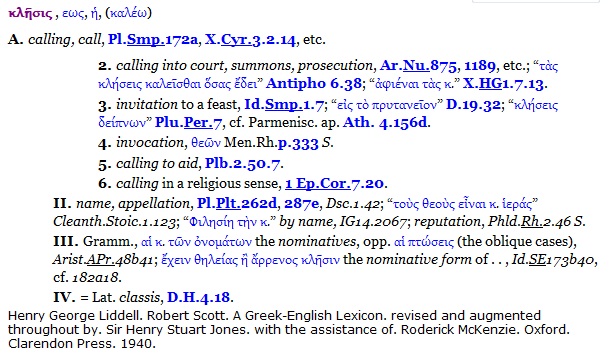 the translations. This is especially the case if the lexicon is formed within the biblical studies tradition.
Here is an excellent article by Scott Bartchy posted on Ben Witherington III’s blog. HT Darrell Pursiful Let’s look at 1 Cor. 7:20 in Greek first, and in the King James Version,
ἕκαστος ἐν τῇ κλήσει ᾗ ἐκλήθη ἐν ταύτῃ μενέτω.
Let every man abide in the same calling wherein he was called.
It seems pretty clear. Let each one stay in the same calling in which they were called. Here is the meaning of κλῆσις and you can see that 1 Cor. 7:20 is mentioned as meaning “religious calling.”
And yet, modern Bibles put quite a different twist on this. Let’s look at a few,
Each person should remain in the situation they were in when God called them. NIV 2011
Each one should remain in the condition in which he was called. ESV
Each man must remain in that condition in which he was called. NASB
Que chacun demeure dans l’état où il était lorsqu’il a été appelé. Louis Segond
Ein jeglicher bleibe in dem Beruf, darin er berufen ist. Luther
Clearly, in the Liddell Scott lexicon, κλῆσις did not have the meaning of “condition,” “state” or “situation.” Where did this come from and why is it used today? The German word Beruf typically means a trade or occupation. Where the King James Version has “calling,” Luther translated “occupation.” But was κλῆσις ever used with this sense in Greek? Bartchy argues that it was not.
So how does BDAG come to have entry number 2 “position that one holds, position, condition?” Bartchy deconstructs the examples used by the BDAG and demonstrates that κλῆσις was not used with the sense of occupation in these cases. It is instructive to find that the French Lexicon, Magnien-LaCroix did not have the added meaning supplied by the BDAG. Instead, it has only “1. appel vers soi, invitation, convocation, citation, assignation en justice, 2 invocation des dieux, appel au secours, 3 appellation, dénomination.”
Bartchy claims that it is due to Luther’s translation that κλῆσις was given a meaning in the BDAG which it never had in ancient Greek literature or in the New Testament. Here is Bartchy’s take,
But when Martin Luther translated the New Testament from Greek into German, he boldly decided to change radically Paul’s intended meaning by substituting the term Beruf (“occupation/status”) for the correct German word Ruf (“call/shoutname”).
However, anyone going to the BDAG will stand firm in their belief that the Greek word κλῆσις can correctly be translated as “condition/occupation/situation” when there is no evidence or support for this whatsoever. It is a good way, however, to have a verse which tells people to stay in the condition in which they find themselves, whether it be slavery, or some other oppressive situation. “Stay in the condition in which you were.” Something like that.
When I trace the history of translation, this is what I am looking for. If someone says that this history does not matter, as long as we know that the original languages actually meant, I can only ask how we know what the original meant without the history of translation.
The Source
The Source New Testament by Ann Nyland was originally a popular translation among evangelicals. However, when it was republished as the Study New Testament for Gay, Lesbian, Bi, and Transgender, many evanglicals rejected it. My understanding is that this is the same translation with additional notes.
There have been some questions on this blog about how The Source came by its name. Kurk commented,
(I only have her GLBT Study NT but always just assumed her “Source” NT referred to the fact that she was taking readers back to the Greek sources for the NT Greek.)
In fact, I remember distinctly when The Source was first published. It caused a definite buzz among some of us evangelical women as a translation which contained this verse,
Now I want you to know that the source of every man is the Annointed One, and the source of the woman is man, and the source of the Annointed One is God.TSNT
Instead of this verse,
But I would have you know, that the head of every man is Christ; and the head of woman is the man; and the head of Christ is God.KJV
Or this verse,
But I want you to understand that Christ is supreme over every man, the husband is supreme over his wife, and God is supreme over Christ. GNB
For some women, for many women around the world, this has been, and still is, an unspeakable cruelty. The alternative translation, that the Greek kephale meant “source” instead of “head” was put forward as a way for some to read the passages in the epistles regarding women without having to live with male supremacy. Catherine Clark Kroeger was also instrumental in promoting this understanding of kephale.
The facts offer this translation some support. Kephale was not usually used to designate a leader in either classical or Hellenistic Greek. In fact, kephale was a term used for a small raiding party and was never used for a Greek general or head of state. In the Septuagint, where a tribal leader was always called rosh (head in Hebrew), the Greek did not translate this as kephale, but rather used one of the usual words for leader in Greek. There is one exception to this, and that is in the references to Jephthah. So kephale as leader has poor support in Greek. Kephale as “source” has some support, but it is not extensive.
I have over the years subscribed to a few different interpretations for 1 Cor. 11:3. The most obvious is that kephale refers to organic unity, that Christ shares his nature with man, man with woman and God with Christ. Or to rephrase it, man shares in Christ’s nature, woman in man’s and Christ in the divine nature. An alternate interpretation is that this refers to the fact that while a woman gives birth and is the obvious parent, the father also is the parent, and his role as “source” must be respected and honoured. A third interpretation is that a man provides for his family – he is the “source”, while the woman gives birth and nurtures the children.
However, I have since come to feel that it is better not to accord this passage undue importance. In the gospels, Christ does not put such emphasis on the marriage relationship, or on differented roles between men and women in marriage. In the gospels, men leave their homes and families to follow Christ, and women provide for the disciples. In the New Testament, the most frequently referred to relationship between men and women was that of a sibling relationship. In Christ, we are brothers and sisters, friends and coworkers. This is our primary relationship in the kingdom of God.
Here are Ann Nyland’s notes on using “source” instead of “head” in 1 Cor. 11.

It does not say “intent on”
I often do a double take when I encounter another example of the circular nature of exegesis. It goes something like this. Step one, a word is translated in a certain manner. Step two, that manner is discovered to be heresy and a new translation is proposed. Step three, translators experience collective amnesia and the original translation is rediscovered as if it were entirely new, and this is touted as the new orthodoxy. But here is the catch. The step three translators are in the opposite camp doctrinally to the step one translators.
Here is the example I stumbled on today. In the Latin Vulgate, Genesis 8:21 was translated in this way,
sensus enim et cogitatio humani cordis in malum prona sunt ab adolescentia sua (Vulgate)
for the imagination and thought of man’s heart are prone to evil from his youth: (Douay-Rheims)
Erasmus defended the free will of humans in the face of evil, arguing, in On the Freedom of the Will, (De Libero Arbitrio)
The proneness to evil which is in most men does not take away free choice altogether,
to which Luther responded, in On the Bondage of the Will, (De Servo Arbitrio)
It does not say “intent on” or “prone to” evil, but “altogether evil,” and that nothing but evil is thought and imagined all his life.
Luther’s Bible and the King James Version, both based on Pagninus had,
denn das Dichten des menschlichen Herzens ist böse von Jugend auf (Luther)
for the imagination of man’s heart is evil from his youth (KJV)
cogitatio cordis hominis mala est a pueritia sua (Pagninus)
Of course, Pagninus offers a stripped down, more literal and accurate translation and this underlies the Bibles of the Reformation. This is the translation tradition which supports the doctrine of total depravity.
But what about protestant Bibles today? Don’t they remain within the Reformation tradition? That is not at all obvious! Here is what I found,
every inclination of the human heart is evil from childhood (NIV)
for the intention of man’s heart is evil from his youth (ESV)
This sounds more li ke Erasmus arguing from the Vulgate! I am wondering if Luther and Calvin would disapprove of current Bibles in the protestant tradition. Is there an effective different between “the imagination of man’s heart is intent on evil” and “the intention of man’s heart is evil?” That is what I am trying to figure out. What do you think? Has the difference between Catholic and Protestant interpretation of the Bible been greatly exaggerated? It seems like it. Certainly, Erasmus and Luther had different doctinal positions, but was their understanding of the actual words of scripture all that different, after all, or is this apparent exegetical difference merely the product of their skill at rhetoric? That is, they only make it appear as if there are two opposing interpretations for Gen. 8:21.
The image shows the passage in question, Gen. 8:21, underlined in the Pagninus Bible found in the Thomas Fisher Rare Book Library in Toronto.
Another translation matter in this passage which cannot be ignored is that the Latin translations vary in translating “from childhood,” “from infancy” and “from adolescence.” Those translators who focused on “adolescence,” often put emphasis on sexual sin, as the one which is most frequently in the imagination or thoughts of man.
Parataxis
J. K. Gayle quotes a story about French high school students who had trouble understanding a banner in Beijing that said 沒有共產黨, 沒有新中國 (“No communist party, no new China.”) (Actually Kurk’s point was completely different from where I am going in this post. I am also aware of the irony that I wrote this phrase using traditional characters rather than the simplified characters usually found in Mainland China.)
Would American high school students have had trouble with this phrase? I would like to think not. It is an example of a figure of speech called “parataxis,” and most of us learned it in high school (remember learning “Veni, vidi, vici“?) Most American high school students probably know the phrase “no justice, no peace.” And many of us have seen signs that even more closely parallel the Chinese phrase, like this flashing highway sign:

or this protest sign

These signs portray a pro-immigrant message (at the expense of trivializing the Hispanic contributions to American culture.) But we are able to parse them. Perhaps it is different among the dialect of French spoken by French high school students.
HT: Language Log
Do Seminary Greek Professors Know Greek?
In November, 2008, I presented a paper at the annual meeting of the Evangelical Theological Society on teaching Greek communicatively. As an experiment, I began my presentation by passing out a quiz for attendees to take….
Keep in mind that most of those who attend ETS are faculty at colleges or seminaries. There are also a large number of doctoral students, and a smattering of other graduate students. And, only people who currently teach Greek or hope to teach Greek would want to attend a paper on Greek pedagogy. So, my audience was made up of mostly Greek professors and doctoral-level students who had probably taken, on average, 4-7 years of Greek by now and some of whom had been teaching Greek for 20-30 years by now.
After the audience had finished, I collected their quizzes. The average “grade” was 0.4 out 10 correct. Most testees could not answer any of the questions correctly, although they tried. The highest grade was 2 out of 10. Now, this audience included many scholars who had written best selling Greek textbooks and grammars. Of course, I won’t name names!
HT: James McGrath and James Davilla (James D. claims his score was 4/11 plus the bonus question. He says “besides Jewish Hellenistic literature and some Septuagint, I’ve read a lot of Plato, Aristotle, and Neoplatonist texts. I don’t think I would have gotten [the Greek translation of the word] ‘nine’ if it hadn’t been for Plotinus.”)
A Scary Story for Teachers
The Talmud relates (at Berachos 62a) a story about Kahana, who hid under his teacher’s bed and listened to his teacher engage in foreplay and conversation with his wife. His teacher discovered Kahana and was outraged – demanding to know what Kahana was doing hiding under the bed. Kahana answered: “This too is Torah, and I must learn it.”
I thought about this aggadah (Rabbinic homiletic non-legal material) today as I talked to one of my most important teachers. I have not hidden under my teachers’ beds, but I have learned a lot from them – how they act towards their students and colleagues, how they balance their work and family lives, how they prioritize tasks. Of course, I also learned from their formal classroom material and research training, but more than anything else, I learned from their examples.
This story in the Talmud clearly explains that students learn more than just classroom material from teachers – they learn how to conduct themselves as scholars and adults. And what a burden on teachers – to not only be responsible for clear pedagogy, but also to teach through their proper behavior.
I don’t plan on finding my students hiding under the bed. But I do have to remind myself often that I am teaching all the time I am with my students – even when I am not at a chalkboard.

(Image from Talmudcomics)
Unitarian Church Address in Cambridge, Massachusetts

(This is the address to the side entrance of the First Parish Unitarian Church in Cambridge, MA. Perhaps even more ironically, the main church has the address 3 Church Street.)
The humanity of Google Translate, Perl, and a multi-lingual foodie app
For those of us who value the human touch, here are a few tidbits to remind that the best programs and machines are because of smart people. Here are quotations about Google Translate (GT), about the computer language Perl, and about a new app for anyone who loves new foods but may not yet have the human languages to order them.
something on the humanity of GT –
Translators don’t reinvent hot water every day. They behave more like GT – scanning their own memories in double-quick time for the most probable solution to the issue at hand. GT’s basic mode of operation is much more like professional translation than is the slow descent into the “great basement” of pure meaning that early mechanical translation developers imagined.
GT is also a splendidly cheeky response to one of the great myths of modern language studies. It was claimed, and for decades it was barely disputed, that what was so special about a natural language was that its underlying structure allowed an infinite number of different sentences to be generated by a finite set of words and rules.
A few wits pointed out that this was no different from a British motor car plant, capable of producing an infinite number of vehicles each one of which had something different wrong with it – but the objection didn’t make much impact outside Oxford.
GT deals with translation on the basis not that every sentence is different, but that anything submitted to it has probably been said before. Whatever a language may be in principle, in practice it is used most commonly to say the same things over and over again. There is a good reason for that. In the great basement that is the foundation of all human activities, including language behaviour, we find not anything as abstract as “pure meaning”, but common human needs and desires.
All languages serve those same needs, and serve them equally well. If we do say the same things over and over again, it is because we encounter the same needs, feel the same fears, desires and sensations at every turn. The skills of translators and the basic design of GT are, in their different ways, parallel reflections of our common humanity.
something on GT as yielding a rather human outcome –
Kira Simon-Kennedy wrote to me from Beijing that she is chaperoning 30 French high school students on their first trip to China to learn Mandarin.
Yesterday afternoon, the French students were trying to decipher the following banner at a bus stop: “没有共产党, 没有新中国.” Most of the students have already taken a couple years of lessons, so they could be classed as having reached intermediate level. They got as far in their interpretation of the sign on the banner as “There is no collective __, there is no new China.” Not bad for intermediate level learners, but the banner remained a mystery to them, if only at the lexical level because they didn’t know what 共产党 meant. However, when Kira told the students that 共产党 meant Communist Party, they were all the more puzzled. “Are they allowed to say that (‘there is no Communist Party’)?” one student asked. “Isn’t that really dangerous to deny the existence of the Party in public?”
The students thought that someone had the nerve to buy a public ad to tell the world: “There is no Communist Party, there is no New China” — superficially that’s what the sign on the banner seemed to be saying. The close grammatical parallelism of the two clauses only made such an interpretation seem all the more certain.
How to break through the impasse of a sentence that seems relatively easy to understand, but yet remains incomprehensible (i.e., it is at odds with patent reality, viz., “there is a Communist Party, there is a New China” — quite the opposite of what the sentence seems to be saying, grammatically speaking, viz., “there is no Communist Party, there is no New China”)?
We have repeatedly been disappointed by translation software, but let’s run this problematic sentence through Google Translate and Baidu Fanyi to see if they can do any better than the intermediate level students from France.
Méiyǒu Gòngchǎndǎng, méiyǒu xīn Zhōngguó 没有共产党,没有新中国 (“If there were no Communist Party, there would be no New China”)
Google Translate: Without the Communist Party, No New China
Baidu Fanyi: Without the Communist Party, there’ll be no new ChinaI’m impressed.
Let’s see how they do with the comma removed: Méiyǒu Gòngchǎndǎng méiyǒu xīn Zhōngguó 没有共产党没有新中国 (“If there were no Communist Party, there would be no New China”)
Google Translate: No new China without the Communist Party
Baidu Fanyi: There’ll be no new China without the Communist PartyI’m really impressed!
something on the humanity of Perl –
I don’t want to talk to a stupid computer language. I want my computer language to understand the strings I type.
Perl is a postmodern language, and a lot of conservative folks feel like Postmodernism is a rather liberal notion. So it’s rather ironic that my views on Postmodernism were primarily informed by studying linguistics and translation as taught by missionaries, specifically, the Wycliffe Bible Translators. One of the things they hammered home is that there’s really no such thing as a primitive human language. By which they mean essentially that all human languages are Turing complete.
When you go out to so-called primitive tribes and analyze their languages, you find that structurally they’re just about as complex as any other human language. Basically, you can say pretty much anything in any human language, if you work at it long enough. Human languages are Turing complete, as it were.
Human languages therefore differ not so much in what you can say but in what you must say. In English, you are forced to differentiate singular from plural. In Japanese, you don’t have to distinguish singular from plural, but you do have to pick a specific level of politeness, taking into account not only your degree of respect for the person you’re talking to, but also your degree of respect for the person or thing you’re talking about.
So languages differ in what you’re forced to say. Obviously, if your language forces you to say something, you can’t be concise in that particular dimension using your language. Which brings us back to scripting.
How many ways are there for different scripting languages to be concise?
How many recipes for borscht are there in Russia?
Language designers have many degrees of freedom. I’d like to point out just a few of them.
something on the humanity of the multi-lingual foodie app –
Foodie culture has sent America’s culinary adventurers into the deepest regions of their local ethnic neighborhoods in search of new delicacies. Unfortunately for more open-minded eaters, they often find themselves confronted with unintelligible menus written in an intimidating foreign language.
A new app from Purdue University helps intrepid restaurant goers overcome that language barrier by not only translating the menu, but providing instructions about food allergies in a number of different dialects.
The user types the name of a desired dish into a prompt field in the graphical user interface. The text is translated, and the best possible translations are then listed, along with other information, including pictures and ingredients. The user can then browse the multimedia database to obtain more information about the dish or the ingredients. When appropriate, information and questions for the waiter are suggested.
Sources:
http://languagelog.ldc.upenn.edu/nll/?p=3340
http://speakeristic.blogspot.com/2008/01/empowerment-of-vulgar.html
http://www.msnbc.msn.com/id/44492610/ns/technology_and_science-innovation/#.TnCmXezfTl4
(Now try reading this post, or this blog, in one of your other human languages, using GT. Here’s how it reads in one of mine.)
Riddle: what’s the only thing worse than being a W22.02XA?
Riddle: what’s the only thing worse than being a W22.02XA?
Answer: being a W22.02XD.
(Explanation: in the new ICD-10 list of medical diagnoses, a W22.02XA is “walked into lamppost, initial encounter.” A W22.02XD is “walked into lamppost, subsequent encounter.” See this searchable list of diagnoses, or see this article.)
“A work of art is useless as a flower is useless.”
In 1891, Oxford undergraduate Bernulf Clegg wrote Oscar Wilde asking him to explain his quote in the preface of The Picture of Dorian Gray that “all art is quite useless.”
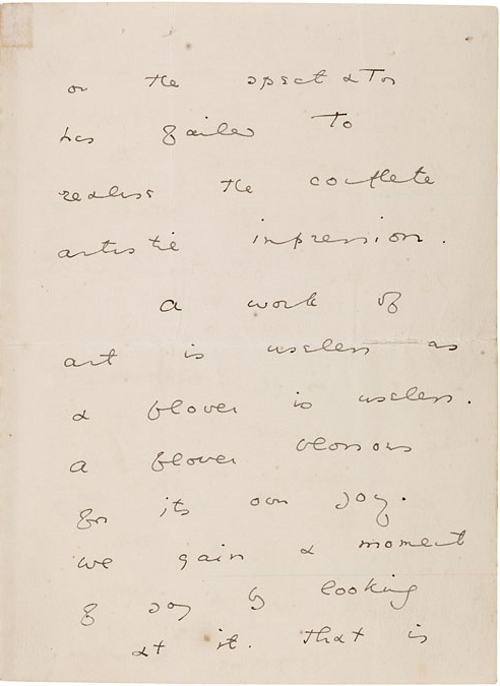
Here is Wilde’s handwritten response (which only became public in 2008 when it was given to the Morgan Library and Museum.)



16, TITE STREET,
CHELSEA. S.W.My dear Sir
Art is useless because its aim is simply to create a mood. It is not meant to instruct, or to influence action in any way. It is superbly sterile, and the note of its pleasure is sterility. If the contemplation of a work of art is followed by activity of any kind, the work is either of a very second-rate order, or the spectator has failed to realise the complete artistic impression.
A work of art is useless as a flower is useless. A flower blossoms for its own joy. We gain a moment of joy by looking at it. That is all that is to be said about our relations to flowers. Of course man may sell the flower, and so make it useful to him, but this has nothing to do with the flower. It is not part of its essence. It is accidental. It is a misuse. All this is I fear very obscure. But the subject is a long one.
Truly yours,
Oscar Wilde
Ann Nyland on publishing the GLTB Study Bible
Rachel Held Evans has made her blog a central meeting place for evangelical Christians. And she is taking on the tough questions. The most recent person in her interview series is a gay Christian. Predictably, Denny Burk questions the validity of such a term, arguing ” that Christians committed to the Bible would be wise to drop the phrase altogether.”
I would like to bring attention to the experience of Ann Nyland on this issue, here
When The Source, my New Testament translation, first came out, Christian women’s groups embraced it wholeheartedly. When my Study Bible for Gay, Lesbian, Trans and Bi came out, these very same groups were outraged, refused to stock The Source, and started hate campaigns against my work.
When The Source first came out, anti-women Christians attacked me, saying I, being a woman, put it out to suit my own agenda.
When the GLBTIQ Bible came out, I received constant hate email making statements such as, “You group of gay men will burn in hell for twisting God’s Word to suit your own perverted lifestyle.” Trouble is, I am not a group; I am not a man; I am not gay. I soon found out that not all feminists are fast to embrace social justice for others.
The truth is that we don’t live by the details of morality in the Biblical narrative. We don’t think that a girl should marry a man who has violated her, even if she is pregnant. Nor would we be shocked at a couple who divorced and later remarried each other. Onan’s behaviour is not sinful today but an accepted form of birth control in some Christian circles, but we do convict men for marrying teenage girls, especially more than one.
After reading this passage and others on abomination,
31And Joseph said unto his brethren, and unto his father’s house, I will go up, and shew Pharaoh, and say unto him, My brethren, and my father’s house, which were in the land of Canaan, are come unto me;
32And the men are shepherds, for their trade hath been to feed cattle; and they have brought their flocks, and their herds, and all that they have.
33And it shall come to pass, when Pharaoh shall call you, and shall say, What is your occupation?
34That ye shall say, Thy servants’ trade hath been about cattle from our youth even until now, both we, and also our fathers: that ye may dwell in the land of Goshen; for every shepherd is an abomination unto the Egyptians.
I have come to believe that there were, and still are, certain cultural beliefs which serve to cement a society but are of questionable moral value. There is polygamy and polyandry, male circumcision and female circumcision, the practice of dedicating young children to lifelong celibacy, or marrying off young girls without their consent. Clearly some of these practices seem more repugnant than others.
There was an especially vivid passage in Sky Burial, in which the main character, Shu Wen, realizes that the Tibetan woman in whose home she is living, has been having an affair with her husband’s brother. Shu Wen is repulsed by this behaviour and isolates herself, causing some concern to the family. Finally she is told that the woman is legally married to both men, and that this behaviour is natural and accepted. Her sense of moral revulsion retreats and she is once again at ease with the family.
She is astounded at other behaviours which are completely foreign to her but natural in this culture. For example, one of the brothers acts as midwife for their wife, and the children recognise both men equally as their fathers. The children, for all intents and purposes, have two fathers. Even more astonishing, the complex embroidery work is done by the men, whose rough hands and stubby fingers present such a contrast to Shu Wen’s own delicate hands. Shu Wen, herself a medical doctor, finds that her own hands are not strong enough for the traditional work of the Tibetan women.
Bonds of affection are functional in society, and protected by customs and taboos. People need to be in relations of affection and care, and society as a whole benefits from people being in relationship. In our society, it is acceptable for older people, those who are past childbearing, to enter into relationships for the purpose of having someone to care about, and to have someone care about them. We view this as functional even though these relationships do not produce children. They may or may not involve marriage, and they may be heterosexual, homosexual or platonic, that is, partnerships of care without sexual relations.
art, voice and gender
Suzanne’s post “translation, voice and gender” (on “the many different factors that have influenced the translation of Xinran’s … first book, The Good Women of China, … Sky Burial [and] … China Witness“) reminded me of this:

It’s a painting by Gogi Saroj Pal, who says these things:
“I don’t believe in any ‘ism’. . . . The basic premise of my art is that a woman’s reality is different from the society’s and I try to present that reality. A society has set norms and a woman is expected to play a stereotypical role. Art is all about expression. That is where the contradiction comes in. As a woman the society expects you to be a conformist, but as an artist, you aspire to be different. . . . My subject determines the medium. Sometimes, where I am placed also dictates it. If I am unwell, for instance, I will paint small paper works. I am comfortable working with different media, but if I don’t work in a particular medium for a while, I have to relearn my relationship with it. I have to break earlier formulas to evolve every time. . . . The reality of my subject is based on where I am placed. Since I live in India, I love to explore and understand the reality of the Indian woman, which varies too. The reality of the Indian rural woman, for example, is different from the reality of the urban woman. . . . Since I was a child I needed my own space to express my creativity. Painting provides me this space.”
Here’s more: “Celebrating womanhood with a brush’s stroke“
translation, voice and gender
Often discussions on translation focus on whether a translation is literal or idiomatic, formal equivalent or functional equivalent, as if this is the main feature in a translation. It is as if two literal translations would be alike, or two idiomatic translations would be alike.
So it is refreshing to read about the many different factors that have influenced the translation of Xinran’s work. While Xinran’s first book, The Good Women of China, came from her radio show, her later books draw on stories which she collected travelling in areas of China where the language was significantly different from her own, and required that she work with an intepreter to conduct her interviews. She would also record the interviews and craft them into finished narrative in Mandarin.
But this was not the end point for her. Xinran’s books are published in English. In fact, Xinran lives in England, and speaks English quite well. I heard her interviewed on the CBC recently. But she hires translators for her books; so that, of course, the translator is always translating into her own native language. The translators collaborate with Xinran, consulting with her when difficulties arise relating to unique customs or expressions. They have ongoing access to her, and she reads their translations as they work.
I find it interesting that Xinran does not work with only one translator at a time. She used two translators for Sky Burial and three translators for China Witness. It was not a matter of one translator not being knowledgeable or skilled, but a matter of comparing the translations and listening to the tone or voice. In fact, I found that Sky Burial was a beautifully written book, very emotive and quite a contrast to a book by a different author which I read in translation earlier this summer.
I should mention that having more than one translator was not her own intiative, but that her husband encouraged her to work with different translators to develop a translation that would translate her “voice,” and to work with a translator that would “feel her heart.”
In an interview published in Thinking Chinese Translation: a course in translation method, Xinran was asked,
“Would you have a man do your translation work or would you rather stay with women. because you feel that they cmpathise better?
Xinran responded,
“For me, getting a male translator? No way! The reason is that I believe, even if we try very hard to understand each other, physically and mentally we are completely different selves. If something is deep or beyond the words, you can feel that between women, and my Chinese mind and my poor English are not able to explain what it is. I got offers from seven publishers in the UK for my first book The Good Women of China. Some of them tried to give me a male team, as they thought that most female writers like male editors. I said to them, for my non-fiction books which are based on Chinese women, no. Random House got this book because they gave me a team which was all women, all the way from editor to publicity. I felt that they could understand what my book was about. That is something you cannot feel through words alone.”
Her emphatic response surprised me a bit. Is it because her books deal with the circumstances of women’s lives that she wants to work with women. The Good Women of China recounts many cases of sadness and abuse. Her recent book Message from an Unknown Chinese Mother is absolutely heart-rending, as it deals with situations in which mothers allowed their baby girls to be drowned or abandoned. Is it because this is such a gendered issue, not just from the heart of women, but because the babies also were female? Is it the subject matter which requires that the translator, like the author, and like the subjects of the book, be female?
Sky Burial is a love story, and while the main character is female, there is no sense of alienation between men and women. Both men and women in this book, are guided by passionate and enduring love, and demonstrate tenderness and care for each other. I would not think of this book as one which would require a female translator. It is a book which, in the tradition of many novels, seems to transcend gender, and be a product of an androgynous author. Xinran has given me a lot to think about.


 BLT
BLT 
