Weird Bibles 2: Etymological New Testament
Here is another weird Bible: The Etymological New Testament, by John Michael Wine.
He describes his translation as thus (grammar and punctuation unmodified from original):
The purpose of the ENT is clear: to provide insight into the text of the New Testament via literal etymology. This begins with THEOS translated as Placer. The verbal forms of this word are also rendered as "placing". Thus, in Galatians 2:21, one can see Paul’s use of both the verb and noun. "I do not un-place the grace of Placer". Through etymological translation, one can see the interesting connection between verb and noun in Paul’s claim. He did not un-god God! And, if he were to remove grace from his teaching, that’s what he would have been doing!
God as Placer! Heaven is Upward Vision! The Etymological New Testament reflects the literal Greek linguistic elements of the text. Etymology is not meaning. But it does provide fascinating insight into the origins of many New Testament words! Based on the English translation of the American Standard Version, the ENT provides a lot of ultra literal information at a glance.
As you will note, Wine has not mastered all elements of English, but he has definitely mastered use of the exclamation point.
Here is how Wine deals with the adelphos issue:
Yes, the meaning of the Greek word ADELPHOS is brother. But its etymology stems from its two component parts: "same" and "uterus". Brothers (or sisters) in Greek etymology are those who come from the "same-uterus."
Here is the first page of Wine’s translation:
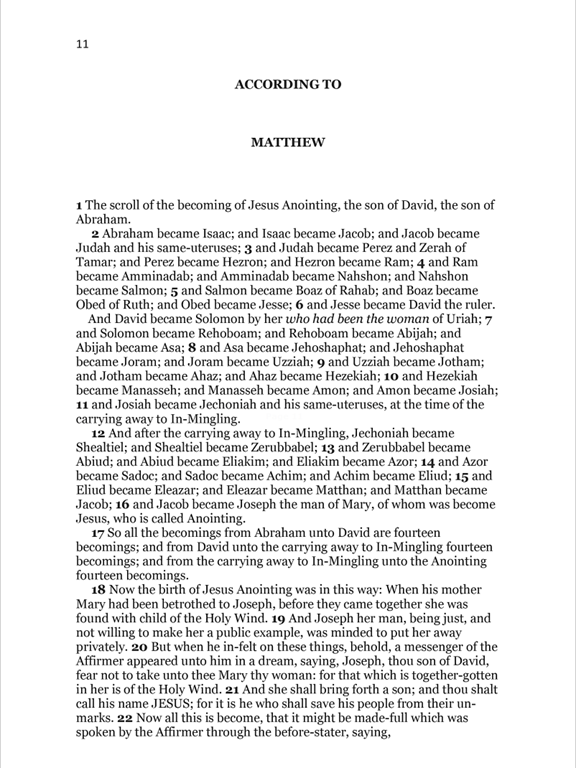
Want more? Here is Wine’s treatment of John 3:16
For Placer so loved the system, that he gave his uniquely-becoming son that whosoever is trusting into the same, should not be from-whole-loosed, but have life of unconditional-being.
And here is his justification:
The beginning of this favorite verse, in the Etymological New Testament, speaks of Placer loving the system! This Greek word, KOSMOS, is an organized system, whether of people or culture or even, as in 1 Peter, of clothing. Most often, the system refers to the organized cultural, religious, political structure that is the background of our lives. Often, in the New Testament, it is something to be resisted. But, in this verse it is the system of human beings…who are loved by Placer. In fact this love is so great that the uniquely becoming son, MONOGENES, is given. The uniqueness of Jesus and of his becoming are crystal clear in scripture and, here, with this word. The biblical message is that, yes, there are many sons and daughters of Placer, but Jesus stands uniquely as a gift to the system of all humanity.
The Etymological New Testament consistently translates PISTEUO as ‘to trust’ rather than ‘to believe’. The semantic range of the English word ‘believe’ is broader than the Greek. This allows some to think only of ‘intellectual assent’ rather than the full sense of PISTEUO in the NT. And, the good news for those who trust: not being "from-whole-loosed!" Often translated as "perish" ("destroyed" in the active sense), the Greek word is a three part word. It is a total (or whole) loosing, away from the sense of Placer. But, as we trust, we begin to experience a "life of unconditional-being!" What a thought provoking challenge and promise: to really live life unconditionally in accord with this truth.
You can read more examples on Wine’s blog. Wine’s translation is available for the Kindle or softcover (where it has one customer review – from “Sherri” who announces that she is Wine’s wife.)
(HT: Brad Taliaferro)
Previous posts:
Weird Bibles 1: Archaic Aramaic script
An Orthodox translation
Portraits in translation
Faces are special. “The human visual system appears to devote specialized neural resources for face perception.” Portrait galleries commissioned by national governments are established in Australia (Canberra), Canada (Ottawa), England (London, Denbighshire, Deberbyshire, Somerset), Scotland (Edinburgh), and the United States (Washington DC). Faces matter to us. We can recognize faces even in degraded images:

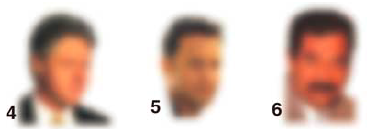

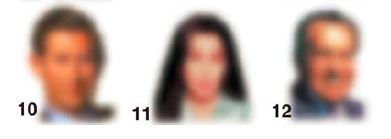
(Michael Jordan, Woody Allen, Goldie Hawn, Bill Clinton, Tom Hanks, Saddam Hussein, Elvis Presley, Jay Leno, Dustin Hoffman, Prince Charles, Cher, Richard Nixon) or stretched:
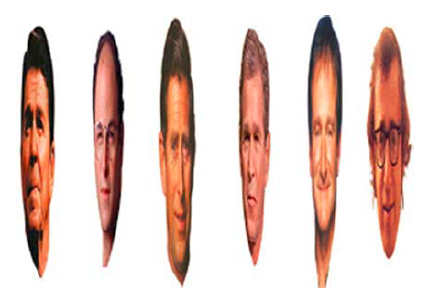
And yet, despite the universality of the importance of faces to humans, there are very distinct national styles in portrait making.
The point came forcefully to me in reading Sunmie Cho’s Great Korean Portraits: Immortal Images of the Noble and Brave, published by Dolbegae in December 2010. This book examines 50 Korean figures and their portraits, from the 13th century to 1914. (The original Korean edition apparently had 74 figures, but the English edition, which still measures in at over 350 pages, is abridged.)
The publisher Dolbegae is well known in Korea for its art books, and this is a beautifully illustrated volume, with at least one picture (and usually more) on every single page spread. (In fact, I was so attracted by this publisher’s volumes that I even bought one of their untranslated volumes, on Korean uigwe visual records of Joeson Dynasty state ceremonies, just to look at the pictures.)
The volume was translated by Kyonghee Lee, former editor-in-chief of the leading English language Korean newspaper, and has relatively elegant English, particularly compared with most Korean English-language publications.
The Korean Herald review of this volume reproduces two images from the book (but without the high quality images of the book or blow-up of details:

This portrait of Gyewolhyang was only discovered in Kyoto in 2008. The inscription reads:
In the imjin year under the Wanli emperor [1591], when the city of Pyongyang fell to Japanese forces, Gyewolhyang, a gisaeng [courtesan] affiliated to the local government, helped General Kim Gyeoong-seo enter the enemy camp so he beheaded the Japanese deputy commander. Hence people have regarded her to be righteous until today. In the summer of the fourth eulhae year since the Chongzhen emperor [1815], her portrait was painted and hung at Janghyanggak pavilion to be worshiped in memorial rites once every year.
Another portrait is perhaps the most famous portrait image in the history of Korean painting, the self-portrait of Duseo Yun:
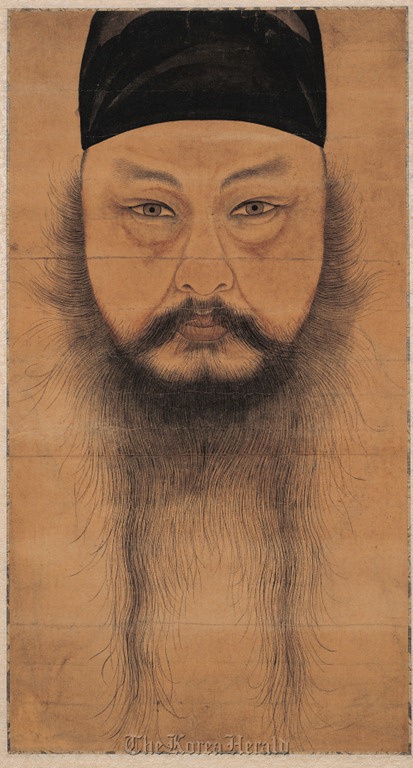
Duseo Yun was famous for declining to paint anyone he did not like, and his sharp imagery is regarded as the start of Korean realistic painting. Yun’s friend Hagon Yi wrote a poem to match this painting, contained in his book An Aescetic’s Drafts (Dutacho):
With his body less than six feet,
He attempts to cross the four seas.
With the fluttering long beard,
A face with reddish sheen,
Is he a guru, or a swordsman?
His truthful and humble airs shun
All shame for being called a gentleman.
Already I have compared his love for art,
To that of Gu Debui, the Jade Mountain,
And his excellent artistic prowess
To that of Zhao Mengfu, the master.
Anyone who truly hopes to know him
A thousand years from now would never
Need to look for ink and color again.
It is particularly illuminating to compare Yun’s self-portrait with Albrecht Dürer’s 1500 self-portrait: both have a full-frontal view, direct symmetry and realistic likeness. But while Dürer highlighted his face and body against a dark background through gradations of light and shade, Yun raises tension by focusing straightforwardly on his face in an adroit harmony of lines and light ink:
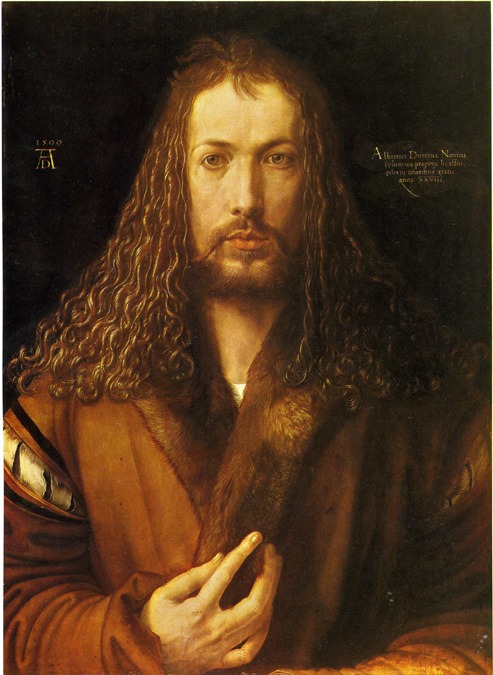
Both paintings are realistic, but there is no mistaking which is Korean and which is German. The “accent” of portraiture is clear even in a casual glance at the image.
Cho’s thesis is that Korean portraiture is distinct even from its closer Chinese and Japanese counterparts. “While Chinese portraits emphasized the subject’s social position or status and Japanese portraits tended to stress or distort the subject’s personal traits, Joseon [a Korean dynasty] portraits surpassed their contemporary counterparts in terms of realistic representation.” Further, she states that the empty background is also a distinctive feature of Joseon portraits. Unlike the Chinese and Japanese practice of adding servant boys or maids in the background of a portrait to reveal the subject’s wealth, power, and dignity, Joseon painters used no such device to reflect the person’s social status, refinement, or tastes.
This is an absolutely terrific art book, but it also hides a number of philosophical puzzles on representation. The book may require a bit of digging to order outside the United States, but it is worth it. I have found one US dealer, and you may be able to find others (the ISBN is 9788971994191).
Translation and temporary memory lapses
I noted with considerable human sympathy Rick Perry’s inability to remember which Federal departments he wished to eliminate (although I have very little political sympathy for his views.) I am outside the United States right now, so perhaps everyone has already seen the video of Perry’s gaffe; if you have not, here it is:
Separate from any political meaning that this moment might have, I think it is an interesting invitation to think about temporary memory loss. The other day, when commenting on one of my co-blogger’s posts here, I accidentally typed “vulgar language” when I meant to type “vernacular language.” (The phrase was not completely wrong, but it is certainly is less correct than I would hope.)
One of the few pieces of coverage that I saw on this gaffe that focused (at least in a shallow way) of temporary memory lapses was this piece from BBC News:
Mr. Perry’s flub was a fairly typical reaction to stress. It illustrates the potential failures of memory in high pressure situations, psychologists and neuroscientists tell the BBC. “Once he missed naming the department of energy the first time, the stress of that event strongly impaired the neural mechanisms of memory retrieval,” says John Guzowski, a professor neurobiology at the University of California at Irvine. “There is a fine line between the amount of stress that is good for memory and that which is bad for memory.”
The human mind has a limited amount of cognitive horsepower, and in stressful situations, other thoughts compete for the use of those resources, memory and cognition researchers say. Mr. Perry may have been keenly monitoring his own performance, for instance, and during the several painful seconds of the encounter he became terrifyingly aware he was making an error.
In Mr. Perry’s case, he was searching his brain for the third government agency but other thought processes intruded, says Sian Beilock, a professor of psychology at the University of Chicago, who studies the interplay between cognition and stress. “He’s worrying about screwing up, and that takes away from important resources that otherwise he could use to search his memory,” she says.
The individual thoughts – the department names – were competing at that moment to get out of Mr. Perry’s mouth like children jumping up and down to be picked for a football team, says Art Markman, a psychologist at the University of Texas, who has followed Mr Perry’s career. The first two – commerce and education – were selected while the third – energy – was not, he says. “The first two items shoved down that third one that he wanted to pull out,” says Mr Markman, author of a forthcoming book Smart Thinking: How to Think Big, Innovate and Outperform Your Rivals. “And at the same time he’s thinking about what he’s supposed to say, so he has no resources around to pull out that third one.”
Mr. Perry also may have suffered from a mental block that worked almost as an active force preventing the correct information – the name – from moving to his lips, says MIT neuroscientist John Gabrieli. When he returned to his mental search for the name “Department of Energy,” he may have been dwelling out of habit on the negative consequences of the initial memory lapse, and that drew his attention away from the information he sought, says Dr. Gabrieli. “It’s not the absence of information, but it’s the presence of the wrong thought that’s hard to clear,” he says. “Some other thought comes into your mind that’s not the right one. You know it’s not the right one. Once you get stuck on that thought, it’s an obstacle to the information that’s really in your head.”
Compounding the stress was Mr. Perry’s reputation in the media and among voters as a poor debater, which will have meant he was under self-imposed pressure to produce a good showing on Wednesday night. Research has shown that when people are aware of stereotypes about themselves or their gender or ethnic group, they tend to perform down to those stereotypes as if hampered by a weight, says Ms. Beilock. For example, in studies, when girls are reminded about negative stereotypes of girls’ performance on mathematics exams just before they are to take one, they perform worse, she says.
I suspect all of us are somewhat painfully aware of the phenomenon of temporary memory lapses. It seems that translation often triggers temporary memory lapses – and it can be quite amusing to watch a translator flail about trying to remember a word in her native language. (This is particularly interesting in the case of simultaneous translation, where one often hears a translator stuck, muttering “uh, uh, uh.”) I suspect that the practice of bilingualism puts additional stress on cognitive abilities and makes temporary memory lapse even more common than it is in unilingualism (or is it “monolingualism”? A temporary memory lapse keeps me from remembering the best term.) I would be interested to any pointers in the literature on the phenomenon of temporary memory lapses while translating..
on Hebrew Chinese translation
Reading Theophrastus’ post on Chavrusa inspired me to post this article about a former professor of mine, who I enjoyed talking to at a lecture and reception on Tuesday.
Jewish Studies is a growing discipline in China. UBC’s Robert Daum took part in the largest conference on the field ever held there.
It is thought Jews have lived in China since the early Middle Ages, arriving in Kaifeng in the central province of Henan more than 1,000 years ago.
The Kaifeng Jews built a congregation in the late twelfth century; scholars believe they trained their own Rabbis and had Hebrew prayer books and Torah scrolls needed to conduct services, which they performed till the nineteenth century when the last Rabbi died.
Today, Jewish Studies is a growing discipline in China, due largely to the efforts of Nanjing University’s Xu Xin, a renowned scholar whose work has paved the way for researchers in at least nine universities or institutes.
Last fall, Professor Xu, who has lectured all over the world on Judaism in China, organized the largest conference on Jewish Studies ever held there. The conference, which took place in the city of Nanjing in October 2004, gathered some 75 scholars from universities such as UBC, Cambridge, Shandong University, Bar-Ilan University and The London School of Economics.
Among the participants was Professor Robert Daum, Diamond Chair in Jewish Law and Ethics at UBC and one of only two Canadian scholars in attendance.
“The subjects covered in the sessions were quite diverse,” said Daum, whose research interests include Jewish law and ethics and applications of literary and rhetorical theory to ancient and medieval Hebrew texts. “The papers ranged from Biblical literature to post-Biblical rabbinic literature… to modern Hebrew literature, Jewish cultures around the world, including in Canada, Jewish life in China in the Middle Ages and in the nineteenth and twentieth centuries and Jewish studies in China.”
Impressed with the strong interest in fostering Jewish Studies in China and the strides made by scholars in the last 15 years, Daum says the experience gave him an appreciation for the long and complex history of Chinese civilization.
“The experience of Chinese culture and history, seeing archival documents, photos, visiting archaeological sites, hearing presentations from Chinese scholars about contrasts and parallels between Chinese and Jewish cultural productions showed us how much we can learn with our Chinese colleagues — both about the study of culture and religion and also about the study of Judaism in particular,” Daum said.
“This was very much an intellectual dialogue, it was not a one-way transaction. It was an exchange of ideas and I think it was very enriching to all of the participants.”
After the conference, Professor Xu led the group on a tour of historic sites. The group visited the site of the Nanjing Massacre, where the Japanese army slaughtered some 300,000 Chinese between 1937 and 1938. These events are commemorated in the Nanjing Massacre Memorial Museum, which features sculptures and reliefs depicting the suffering, as well as plaques outlining the massacre. Built on a former mass grave, the memorial was constructed in the mid-eighties.
Gesturing to a digital picture from his trip, Daum pointed to what he feels is one of the most touching aspects of the memorial. “One of the most fascinating aspects is in this picture,” he said. “These are footprints and signatures of eye-witnesses to the Nanjing massacre.”
Daum says the Chinese memorial reminded the scholars of the Yad Vashem Memorial to the Holocaust in Jerusalem. That memorial features an historical museum, an art museum, gardens and monuments dedicated to remembering. “It was quite similar in terms of the inadequate but poignant attempt to memorialize and also teach lessons,” said Daum.
After visiting the Nanjing Massacre Memorial, the group traveled to Beijing, and visited the Forbidden City and Tiananmen Square and enjoyed a Sabbath dinner with members of the Beijing Jewish community.
“A dozen of the visiting researchers had a fascinating evening discussing the nature of Jewish identity with the descendants of medieval Jewish clans from Kaifeng. Some of the scholars questioned the self-identification of these Chinese people as Jews; I realized that this same conversation could have been taking place in a Chinese restaurant in Vancouver, Tel Aviv, or Buenos Aires.”
From there they visited Xian and then headed to Kaifeng to see the former location of a synagogue that was first built in the late twelfth century. A hospital now stands on that site.
Daum says the conference opened the eyes of participants to the importance of including Chinese scholars in the study of Judaism in the last few decades.
“It left many of us with the clear sense that the absence of our Chinese colleagues in the discourse in the academic community about Jewish cultures has been a costly one,” he said. “Our Chinese colleagues come to the field with questions and perspectives similar to and different from ours. Two Chinese scholars debated the philological constraints upon translating the word ‘Talmud’ into English. Only a fraction of classical Jewish literature has been translated into Mandarin. A generation from now such translations will revolutionize the field.
“The contributions that are going to be made by the current and future generations of researchers will be enormous. I think that it will change the field in very positive ways.”
One who studies alone becomes stupid–in praise of chavrusa
Traditional Jewish study (in particular, Talmudic study) is done in a chavrusa (team) format. Here is a defense of that method from an article by Jonathan Rosenblum in The Jerusalem Post. (HT: Jim Davila)
Think Again: Talmud Study and the Liberal Arts
Put in terms of a choice between a no-nonsense course of study and what – the study of nonsense? – perhaps we should rejoice in the declining number of humanities students. The Jerusalem Post’s November 1 editorial “In praise of liberal arts” lamented the everdwindling percentage of Israeli students opting for bachelor’s degrees in the humanities….
If one key test of a liberal education is the ability to learn new skills, then talmudic learning could be an important component. True, talmudic learning will not teach one math, unless one studies the rabbis’ complex calculations of the lunar cycle; nor will it provide grounding in a specific science. But it is not irrelevant to any of these pursuits. And the combination of intellectual rigor, discipline and concentration required is unsurpassed.
The great Harvard medievalist Harry Austryn Wolfson described talmudic study as “the application of the scientific method to the study of texts.” Hypotheses are continually being formulated and either successfully defended or rejected. The Talmud says that one who studies alone grows stupid, and the battles between study partners are nothing less than the “wars of Torah.” Even when one studies alone, he must act as his own study partner, constantly asking: Does my theory fit all the facts? Is there another way to explain all the relevant data? Students must learn to follow complex arguments that proceed over pages of text, and to hold firm at each step as to whether the argument is being advanced or questioned. Ten-year-olds learn to apply, without being aware of it, the tables taught in mathematical logic to actual cases.
At every level, the student is exposed to conflict and competing views. The Tannaim of the Talmud argue with one another; the Amoraim argue with one another and over the proper understanding of the Tannaim. The Rishonim (early commentators on the Talmud) differ from one another over the principles that emerge from the debates of the Talmud, and sometimes over the text itself. Each Rishon must be understood on his own terms, and in terms of why he argues with another Rishon.
But while a single right answer can never be given in talmudic debate, it is often possible to demonstrate that a particular solution is wrong. Thus Talmud study is the antithesis of much of contemporary academia, which, in Mead’s words, “encourages mushy thinking about mushy disciplines.” One cannot just offer opinions; one must argue propositions. That itself is a healthy antidote for the young for whom the height of wisdom is: Everything, including morality, is a matter of opinion, and all opinions are equally valid – a view, incidentally, held by no great thinker of the past, no matter how greatly they differed with one another.
Though the study will not teach elegant prose style, it demands clarity of expression and the ability to structure a logical argument. Rabbi Chaim Soloveitchik, the great 19th- and early 20th-century talmudic genius, whose style of analysis dominates much of contemporary talmudic study, emphasized that there is no such thing as a concept that cannot be expressed.
Finally, the study of Talmud places one in a dialogue with many of the greatest minds in Jewish history, and grounds a Jewish student in his own culture – one in which the legal and moral realms are seamlessly intertwined.
Another review of An Akkadian Lexical Companion for Biblical Hebrew
 Suzanne pointed to one review of An Akkadian Lexical Companion for Biblical Hebrew a few blog posts ago. Here is another review from The Forward that makes this book (which is $80 in paperback and $125 in hardcover) look quite exciting:
Why We Need Akkadian: How One Semitic Language Sheds Light on Another
An Akkadian Lexical Companion for Biblical Hebrew: Etymological-Semantic and Idiomatic Equivalents With Supplements on Biblical Aramaic
By Hayim ben Yosef Tawil
KTAV Publishing House, 456 pages, $125
Reading the Tanach, the Hebrew Bible, is tough. For one thing, it’s very, very old, and not refracting the text through our 21st-century prism is difficult. For another, it’s written in two odd languages, Hebrew and Aramaic, in such a way that even those familiar — even fluent — in these tongues find that the simplest passages beg analysis.
“What’s the p’shat?” — the basic meaning of the text — is the toughest question of all.
Where does Akkadian fit into this question? What indeed is Akkadian? The word itself comes from the place name “Akkad,” which is found in the Bible and is a reference to an ancient city of Mesopotamia and also to a third-millennium BCE Mesopotamian dynasty. Akkadian, written in cuneiform — Mesopotamian wedge writing — left to right, on clay tablets, is actually a generic term for the languages spoken by the Babylonians and the Assyrians. These two peoples dominated the Tigris-Euphrates region of Mesopotamia, and far beyond, for centuries, and developed a vast literature. The narrative portions of the Tanach contain many references to Assyrians and Babylonians, mostly as enemies, and almost always in terms of wars, conquests and exiles.
From Abraham (an erstwhile resident of Ur in Mesopotamia) onward, Ashur and Bavel are a constant trope in the Hebrew Scriptures, and Akkadian, as a Semitic contemporary of biblical Hebrew and Aramaic, is a truly invaluable — and underused — resource in the understanding of biblical words, expressions, usages and concepts. Now Hayim ben Yosef Tawil’s “Akkadian Lexical Companion,” directly compares the Akkadian and biblical Hebrew in an effort to explicate difficult words, idioms, phrases and whole verses in the Bible. And the book succeeds. The paradoxical fact is that Akkadian lexicography is further advanced than that of biblical Hebrew, and Tawil exploits this discrepancy for our benefit.
A professor of Hebrew studies at Yeshiva University, Tawil has written on many aspects of the application of Semitic languages to the understanding of biblical philology; his work flows from the pioneering efforts of Moshe Held, Umberto Cassuto and William Foxwell Albright. Wearing another yarmulke, Tawil played an early leadership role in the success of Operation Esther, which facilitated the immigration to Israel of the last Jews of Yemen. With the “Akkadian Lexical Companion,” Tawil is a leader in this field, as well.
The remarkable thing about this watershed lexical companion is that such a lexicon was not done earlier. After all, serious study of Semitic languages and comparative philology — and especially of Akkadian — has been standard for almost a century, and there are scholarly dictionaries of Assyrian-Babylonian. Yet, until Tawil’s effort, there was no work that connects the dots between biblical and Akkadian usage for the purpose of elucidating the Hebrew Scriptures.
The “Akkadian Lexical Companion” is a dictionary — but not a standard one. Two features characterize it: First, the dictionary not only gives the reader Akkadian equivalents to the Hebrew words of the Bible, but offers idiomatic usages, as well. This is enormously useful in parsing the meanings of many texts. For example, the curious locution “ish lashon” (“person of language”) in “Let the ‘ish lashon’ have no place in the land” (Psalms 140:12) is clarified by the Akkadian as follows: In Assyrian historical documents, “sha lishani” is idiomatic for “slanderer” or “informer.” The Psalmist’s “Let the slanderer have no place in the land” now makes perfect sense.
Furthermore, where the lexicon is at its best, it elucidates difficult biblical passages. We learn from Akkadian, for example, that the Aramaic “even g’lal” (“great stones”) of Ezra 5:8, which the King James Version has as the building blocks of the Temple, were in fact “selected stones,” and this makes more sense in context.
The second characterizing feature of the “Akkadian Lexical Companion” is that it places the parallels of the biblical locution and the Akkadian text in the full biblical context: The book is laid out so that readers are shown not just a single word, but the entire verse, together with the source material in Akkadian.
Additionally, valuable for the scholar and casual user alike, Tawil includes a seven-page, well-crafted essay on Akkadian — its history, phonology (what the words look and sound like) and grammar. One can quibble about some details: For example, can all Semitic verbs and nouns be traced to an original tri-literal, rather than bi-literal, root, as Tawil claims? (The jury is yet out on that one.) Nevertheless, the essay is a splendid conspectus on what the history, significance and phonology of Akkadian are all about
Weird Bibles 1: Archaic Aramaic script
I collect books, and one subcategory I collect is weird Bibles. (For example, I have owned for several years a copy of Philip Goble’s Orthodox Jewish Bible: Tanakh and Orthodox Jewish Brit Chadasha that Suzanne posted about here and Mississippi Fred MacDowell posted about here – although I am happy to say that I did not pay any money for it.)
Today I added to my collection of weird Bibles, and Suzanne’s recent post on Aramaic script inspired me to write this post.
This Bible is published by the Research Institute for the Bible and Reform Theology (RIBRT) and is called the Biblia Hebraica Et Graeca (Editio princeps). (Henceforth the RIBRT-BHEG).
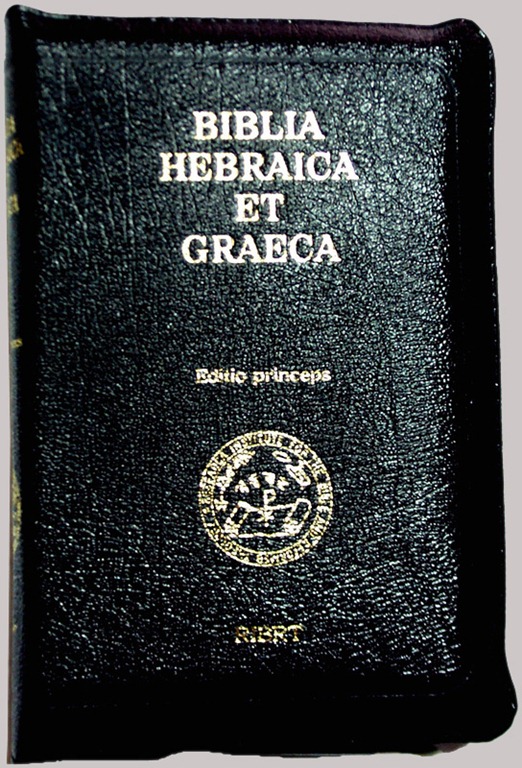
This Bible does not stop at printing the Bible in Hebrew and Greek. The editors state (and I have left the grammar and punctuation unchanged):
Our ‘Scriptura Sacra’ or ‘Biblia Hebraica et Graeca’ was attempted to return to the contemporary features of the original texts, retroactively in order to read the purest texts in all points. Although this ‘Veteris Testamenti Biblia Sacra’ depends upon the Leningrad Codex in its foundation, it was collated by old papyri of LXX, NT, and Qumran materials. The vowel signs of letters and Masoretic notes are omitted for readers to find some intrinsic features of the original texts. The original pronunciations may be now recovered by their high-creative studies on the old Semitic languages (Eblaitic, Old Akkadian, Ugaritic languages etc.).
What does that mean in practice? It means that this edition is printed using archaic Aramaic script. (And no vowelization.)
So what does this Bible look like? Here we go:
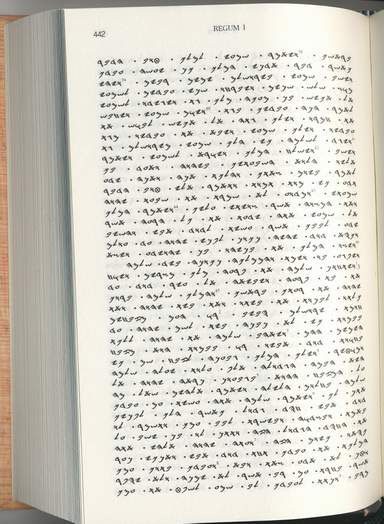

Now do you feel that brings you closer to the original? By now I think you can guess what the New Testament looks like, but why leave it to your imagination ….
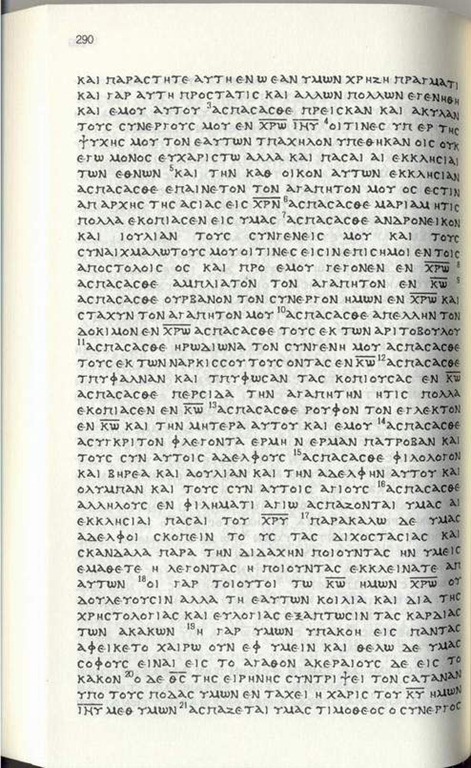
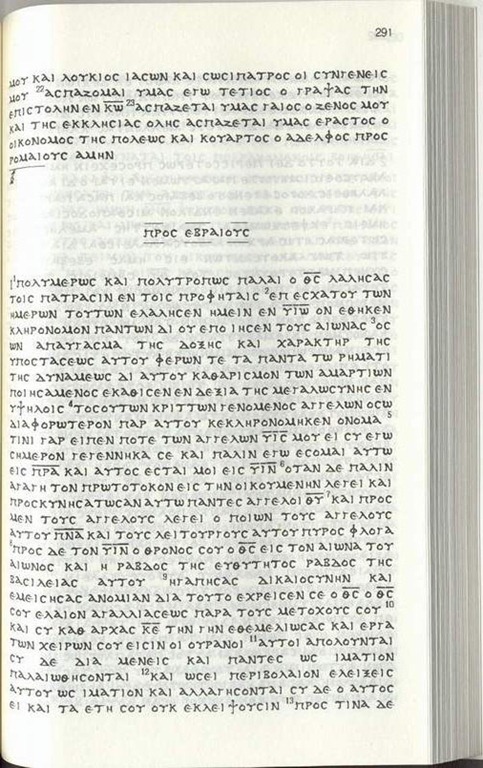
(Actually, I took these photos from the RIBRT-BHEG web site, and my edition looks different than this. My edition has the book names written at the top of the page in Latin and standard NT Greek orthography.)
Now you may be wondering why word spaces, and verse and chapter in Arabic numbers are included in the text. That’s a good question and I don’t know the answer, but if anyone from RIBRT wants to chime in, please leave a comment.
Now, here is the fun part. The RIBRT-BHEG is printed in a zipper case with a fake leather cover– you know, so you can carry it around with you everywhere you go. Let your loser friends whip out their copy of the German Bible Society Hebrew-Greek Bible – showing that they depend on modern orthography. You can carry this baby around and read the Bible in archaic Aramaic, showing those folks are just wimps.
(Even better news, there are mini dictionaries of Hebrew→English [49 pages] and Greek→English [52 pages]. However, for some reason that I do not understand, these dictionaries use standard Hebrew and NT Greek orthography.)
I can’t give you any advice on buying this volume on the Internet (except to mention that the ISBN is listed as 8989519020 – good luck tracking down this volume) – although if you are in Seoul, the Jongo branch of the Kyobo Bookstore has another copy as of tonight – on sale for 35,000 Won (about US$32). The official Korea Tourism Organization web page on the bookstore advises that after purchasing your book,
There are many streets around Kyobo Bookstore that are famous for their delicious food. If it’s traditional spirits and tasty side dishes you’re after then head straight to Pimatgol. There are many different dishes to enjoy in a comfortable atmosphere. The Chungjin-dong haejang-guk (broth to relieve hangover) street and the Mukyo-dong octopus restaurants nearby are also very famous.
I particularly enjoyed the advice about broth to relieve hangovers, because as we all know, drunk book buying is a serious social problem.
3 or 4 translation challenges
Do you know your English, your Greek, your Hebrew, your Italian? Well, here’s a fun post to offer you some translation challenges.
1st English. How might you translate the following sentence into, say, French or Italian or German or Dutch?
Ladyfingers, one of the oldest and most delicate of sponge cakes, dates from the House of Savoy in the eleventh century France.
In particular, what would you call Ladyfingers? Need a picture?  Want some wikipedia hints?
2nd Greek. Look. Listen.
………………………………………………ἐν δέ τε πολλὰ
κύματα παφλάζοντα πολυφλοίσβοιο θαλάσσης
κυρτὰ φαληριόωντα
How can this be English? like the following??
……………………………………………….the many
roiling waves of the greatly-roaring ocean
cresting, flecked with white ??
……………………………………………….and the numerous
boiling waves along the length of the roaring water
bend and whiten to foam in ranks ??
shoulders rearing, exploding foam, waves ??
surge and toss on its surface, high-arched and white-capped,
and crash down onto the seashore ??
Yes it’s Homer’s Illiad (Book 13, lines 797b, 798, 799a). Didn’t Aristotle already say something about this in his Rhetoric (1412a, about the poet Homer and his sounds)? Yes, the English translations respectively are Daniel Mendelsohn’s, Richmond Lattimore’s, Robert Fagles’s, Stephen Mitchell’s (also mentioned here), and A.T. Murray’s.
3rd Hebrew. It’s the Bible. Isaiah 54:7, with various Hebrew hints on the sounds, the parallels, the parallel sounds, the sound parallels.
בְּרֶ֥גַע קָטֹ֖ן עֲזַבְתִּ֑יךְ וּבְרַחֲמִ֥ים גְּדֹלִ֖ים אֲקַבְּצֵֽךְ׃
Take the challenge that Joel Hoffman issues here.
4th Italian. Tiramisu, who knew? Geoffrey K. Pullum didn’t apparently. My challenge for you is to compare how the inventor of this Pick-Me-Up with Lady-fingers (or of the tiramesù con savoiardi) tells his story in English and in Italian. What sounds most delectable and sweetest to you? Here are the two versions by the bilingual neologistic chef, the first Italian the second English:
E così un giorno, mettendo insieme degli elementi noti e semplici e ricercandone la migliore “porzionabilità”, è nato il dolce che è stato subito chiamato tiramesù !
Ho sempre cercato che gli ingredienti pur semplici, fossero di prima qualità’, dal caffe’ ai savoiardi, dal mascarpone e alle uova.
So, one day, I put together some simple and well-known ingredients and tried to make the whole “portionable”: this is how this cake was born. It was immediately named “tiramesù” (pick-me-up)!
The ingredients, however simple, have to be first quality: from the coffee to the ladyfingers, from the mascarpone to the eggs.
Have fun!
Literacy and writing system
The gradual demise of Akkadian and its replacement, given several centuries of biliteracy, with Aramaic as the language of empire and administration, begs the question as to whether the characteristics of the writing system were determinative. This has had enormous theoretical and practical implications for Bible translation. There has been a theory that the alphabet is the medium most suited to mass literacy, and therefore historically significant in the spread of religion. The corollary to this is the historic preference of some missionaries and Bible translators for the alphabet over an alternative writing system.
This is a huge subject, but I would like to narrow this down to the simple question of whether the characteristics of the Aramaic writing system, which we now recognize as the Hebrew alphabet, was significant in influencing Aramaic to replace Akkadian as the language of wider communication in the ancient Middle East. I won’t answer this question, but will simply provide a few starter citations. Duane Smith of Abnormal Interests has blogged on this here and here,
I date the transition in attitude regarding writing system characteristics and literacy back to the late 70’s, when I was in university. With regard to cuneiform, the first indication that things were shifting, is reflected in this passage by M. A. Powell, who expresses a negative take on the correlation between writing system features and literacy,
The inescapable conclusion is that the introduction of the alphabet, by itself, has had little effect upon the reduction of functional illiteracy, and thus, its importance in the history of human development has been overstimated, whereas that of cuneiform has probably been underestimated. Powell, 1981
Powell, M.A. 1981. “Three problems in the history of cuneiform writing: origins, direction of script, literacy.”Visible Language 15: 419-440.
The abstract presents Powell’s thesis in these terms,
“Origins” suggests that cuneiform was invented in a short period of time around 3000 BC by a citizen of the Sumerian city of Uruk and that it arises conceptually out of the token system described by D. Schmandt-Besserat. “Direction of script” agrees with S. Picchioni that cuneiform was written and read vertically down through c. 2300 BC, but it emphasizes the use of reed patterns to demonstrate the manner in which the stylus was manipulated and sees this mode of manipulation at the motivating force behind the transition to horizontal script. “Literacy” argues that cuneiform was not as difficult as usually assumed, that the alphabet had no demonstrable effect on the level of functional literacy, and that the superiority of the alphabet over cuneiform has been exaggerated.
My research on the topic indicates that this was the first explicit statement that writing system characteristics were not determinative in the succession of Aramaic (alphabet) over Akkadian (cuneiform). This is a complex topic with room for qualification.
Sculpture by the Sea
One of the aspects of Seoul I am most enjoying is the huge amount of public art in the streets – making walking in Seoul a bit like visiting a sculpture garden. Perhaps I will post some of my own photos soon, but in the meanwhile, here are some highlights from the largest of all free public sculpture exhibitions – Sculpture by the Sea, an annual (free) public art exhibition along Australian beaches: Bondi to Tamarama in Sydney. (It has launched two side exhibitions: along Cottesloe beach in Perth and Aarhus in Denmark).
- Alan and Julie Aston – Simple Black & White


- Belinda Villani – The Predators in the Park

- Bert Flugelman – Ammonite 2006

- Byeong Doo Moon – I Have Been Dreaming to be a Tree…II

- Corey Thomas – The Midget Attacks

- Faith Semiz – Isometric Trinity

- Gary Deirmendian – Do Not…

- Jane Gillings – Provenance

- Ken Unsworth – Look this Way


- Richard Tipping – Private Poetry

- Simon McGrath – Who Left the Tap On

- Steve Croquett – Heads Up


- Steve Corquett – Heads Up (with Deborah Halpern – Ship of Fools in the background)

- Steven Thomson and Jonas Allen – Message in a Bottle

More information and many more images are available at the Sculpture by the Sea web site.
Korean pansori film: Chunhyang
 I’m in Seoul this evening, and still excited from seeing a street opera along the Cheonggyechon. In honor of Korean traditional performing arts, here is a review of the 2000 film Chunhyang.
Pansori is pure emotional storytelling in song. A song (madang) is performed by a singer (myeongchang) who uses a fan and hankerchief to act out the entire story, using singing (sori), recitation (aniri), and gesture (pallin). The singer is accompanied by a drummer (gosu) who provides an underlying rhythm and shouts encouragement (chuimsae) to the singer.
Only five pansori madangs survive: Heungbuga, Simcheongga, Chunhyangga, Jeokbyeokga, and Sugungga. Perhaps the most famous of the pansori is Chunhyangga, which normally takes eight hours in its full performance. (You can buy a CD recording here – one of my goals while in Korea is to buy this very performance.) You can hear excerpts of Chunhyangga online here (CDs 4-7).
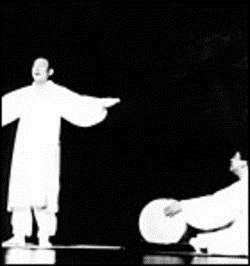 Chunghyangga has been adapted for the cinema several times – most remarkably in Kwontaek Im’s 2000 film Chunhyang – the first Korean film ever to compete at Cannes. Rather than simply dramatizing the story, Chunhyang features a pansori performance by Sanghyun Cho (singer) and Mynghwan Kim (percussion) that serves as narration for the film. The story is a classic one, with Chunghyang Sung (daughter of a prostitute) and Mongyoung Lee (son of a governor) falling in love and eloping. The marriage remains secret because it could threaten Mongyoung’s career. The son is forced to move away when is father is appointed to Seoul, and Chunghyang is chased by the new governor and imprisoned when she refuses his advances.
Pansori is not a refined form of singing – often it is closer to chant, and the sound is throaty and rough (tongseong). This acts as an emotional counterpart to the Im’s “Merchant and Ivory” style lush period photography. But it exactly because of this dissonance that Chunhyang works so well as a movie, and while the main theme of the film is Chunhyang’s story, the pansori is never far behind has his voice is constantly present and there are frequent cuts to his gesturing. Thus this film serves a document of pansori performance (alas, it is only two and a quarter hours long, and not the full eight hours.)
Elvis Mitchell wrote in his New York Times review:
This year several filmmakers have used this form — the fable — as the basis of their movies, but Chunhyang isn’t immersed in the kind of decorative smugness that lets movie audiences in on the joke. Instead the story is freshened through the use of a Korean singing storyteller, a pansori singer, to provide a narration, belting out the song from a stage in front of an audience. The pansori, or song, is performed under a proscenium arch to highlight the ritual elements of folk tales. Even though much of what the pansori tells us unfolds before the cameras at the same moment, the forcefulness of the performance lends another layer of feeling to the picture. The device is a worthy addition, because Im makes the delivery of the song as integral to Chunhyang as the story itself, and it’s a neat trick to involve the audience in such a way. Self-awareness here isn’t a cheap gambit, a way for the director to have his tongue lounge in the hollows of his cheek. The extravagance of the sets and costumes increases the theatricality; Chunhyang is an almost childlike delight for the eyes. The picture is at its best when the lovers are playing with each other and intoxicated by the newness of their flesh.
Matthew Wilder’s review was even more direct:
If there were any justice in this world, Sang-hyun Cho would win every nation’s equivalent of the Best Actor Oscar. Cho is a master of pansori, an antique Korean performance style in which a single virtuoso sings and speaks a well-known story, accompanied by a very austere drummer. If this calls to mind certain other modes of performance, such as China’s Kun Opera or some Native American storytelling styles, it suggests none of the audacity or accomplishment of Cho’s particular approach. Like a Korean Screamin’ Jay Hawkins, Sang-hyun Cho is one part cigarettes and whiskey, and one part wild-eyed abandon. He doesn’t so much tell the story as coax it, sing love songs to it, and push it brusquely on the shoulder to move it out of the way; he cries over the story, snickers behind its back, and finally lays it at our feet like a dead beloved. Cho sometimes appears entranced, but it isn’t the usual Dionysian, self-loving kind of trance that Americans are accustomed to seeing onstage: Rather, it’s the rat-a-tat fury of a Homeric story master. There are times when Cho seems to have touched the long white beard of God himself.
Sang-hyun Cho is the main event in South Korean director Im Kwon-taek’s extraordinary Chunhyang. Indeed, I don’t think I’ve seen such a spellbinding live performance on film since the first Richard Pryor concert movie. Like Pryor, Cho uses anecdotes to build a very personal and all-encompassing vision of life on earth. He doesn’t just relate the facts: He gives you the whole cosmology of his personal take on existence, and the story is just a particularly juicy means to the end. But what a story!
Im Kwon-taek is a salty dog who, over the course of three decades, has made the long journey from directing grade-Z dreck (an early Im title is The Three Zany Hunchbacks) to becoming the unofficial archivist of traditional Korean culture on film. Chunhyang is his attempt to keep the pansori flame burning. In it, Im does something so seemingly retrograde that it’s practically avant-garde. Cho tells the story–and tells it and tells it, throughout the entirety of the movie’s two hours. Intercut with Cho’s performance (which also plays out in voiceover) is a literal illustration of the classic tale of Chunhyang. And when I say literal, I mean literal: Cho says it, and we see it. If this sounds merely like a trip to the Korean kitsch store…well, yes, it does sound like that. But the plain fact is that Im has made a work of formal daring that recalls such rich and strange torments of the theatrical form as Alain Resnais’s Melo, the Straub-Huillet film Moses und Aron, and The Little Theatre of Jean Renoir. Remember that synthesis of theater and film that Robert Altman wanted to achieve in the Eighties? Im has done it. Chunhyang has the extreme formal rigor and complex structure of Altman’s Eighties work, with a key difference: Its agenda is emotional immediacy, not cerebral intake.
I remember my utter delight when I saw this film on its initial release, and now it is available on DVD. I highly recommend this film for anyone who enjoys unusual films or operatic performances.
Esther Schor annotates Emma Lazarus’s “The New Colossus”
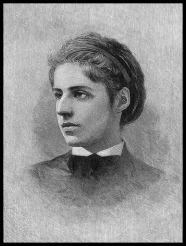 Esther Schor (Princeton) has prepared an (interactive) annotated version of Emma Lazarus’s “The New Colossus” – certainly one of the most celebrated American poems (you almost certainly know its line “Give me your tired, your poor, your huddled masses yearning to be breath free….”) Check it out.
Schor previously wrote a biography of Lazarus. You can listen to an NPR interview with Schor here (summary and three poems by Lazarus here). Here is a portion of that interview:
JACKI LYDEN (host): Emma Lazarus wrote this sonnet, The New Colossus, in 1883. While it was given an honored place at the base of the Statue of Liberty and became a part of the American credo, Ms. Lazarus, the poet, became relatively obscure.
That’s a pity. Not only because she was an iconoclast and one of the most original minds of her day, but because Emma Lazarus believed in the strength of America as a free-thinking country.
Bringing her back into our view is Esther Schor. A poet and professor of English at Princeton University, Ms. Schor has just published a biography called simply Emma Lazarus, and joins me now. Thanks very much for being here.
Professor ESTHER SCHOR (Princeton University): Thank you. It’s a pleasure, Jacki.
LYDEN: You know, you have a really nice line getting into this book. You’re talking about The Diary of Anne Frank and your own parents had given you a book and they inscribed it, Here’s a girl I want you to know. And you begin by telling us here’s a woman I want you to know. Why? Why do you want us to know her?
Prof. SCHOR: Well, I’m fortunate to have gotten to know her myself. When I began the project, I really knew almost nothing about her. In fact I had some of the misconceptions that people have when I talked to them about Emma Lazarus, that she was an immigrant, that she was a 20th century poet.
In fact she was a fourth, if not fifth, generation American Jew of Sephardic descent who spent almost all of her life in New York City. She was born in 1849 and died in 1887, which is to say she had a very short life. In fact I thought of calling this book Emma Lazarus: Half a Life.
LYDEN: At the end of her life, in this brief life – she’s 38 years old when she died.
Prof. SCHOR: Of Hodgkin’s Disease.
LYDEN: Of Hodgkin’s Disease. What was her stature then?
Prof. SCHOR: She was very well-known. She was eminent on two continents. She was well-known in the Jewish press, but of course also in the mainstream American press. She was an essayist for The Century magazine and Scribner’s, and all you have to do is look at the obituaries to see how high her stature was.
LYDEN: You have a wonderful picture that I think anybody, any mother, any daughter, any person might love, of this little girl growing up in a gilded age – literally, it was called the Gilded Age at that time…
Prof. SCHOR: Yeah.
LYDEN: …so much wealth flowing into the country and into New York – and she’s learning poetry. She’s learning what languages and how to write and which philosophers is she studying, just kind of on her own volition?
Prof. SCHOR: Well, I don’t have any sign that she ever attended a day of school in her life, and she was an intellectual. She was very erudite. She spoke several languages. But she was schooled in her father’s library like so many illustrious women that we know of.
LYDEN: One of the things that really struck me was how much paternal support she had for her great intellectual powers, that he bound her poems and distributed them to friends when she was still a teen.
Prof. SCHOR: Yes, that’s an understatement. He took paternal pride to Olympian heights. And so while we have very little evidence about her childhood, about the details of her childhood, we know for a fact that her father published her work and that it was a volume of over 200 pages, when she was a little over 16 years old. Amazing.
LYDEN: And she – she was bold girl, and she had a lot of self-confidence. She wrote to Emerson and offered him her poems, right?
Prof. SCHOR: She gave him her book when she was 18 and he was 65. She met him through a friend of her father’s. She had many different kinds of friends, from bluebloods to mountain men to Emerson to Hawthorne’s daughter to Henry and Williams James. And she – she was uninhibited and she knew she had a gift. She was translating from French and Italian in her, you know, early teens. She was also writing poems about the Civil War as a young girl.
Pretty close to the end of the war she wrote and astonishing sequence of poems written from the point of view of John Wilkes Booth, after – soon after the assassination. I’ve never seen anything like these poems. One is spoken by Booth’s mother, lamenting the fact that there’s no grave for him.
She often took a very unpredictable point of view. And later she would write a remarkable poem called Progress and Poverty, which imagines the underworld of the laborers who are supporting precisely the luxuries that she has been enjoying all her life. Would you like me to read that one?
LYDEN: Please.
Prof. SCHOR: This poem was published in The New York Times and the title is – the title, “Henry George’s Book, Progress and Poverty.”
Prof. SCHOR: (Reading) Oh splendid age when science lights her lamp. At the brief lightning’s momentary flame fixing it steadfast as a star. Man’s name upon the very brown of heaven to stamp. Launched on a ship whose iron quires mock storm and wave. Humanity sails free gaily upon a vast untraveled sea or passless wastes to ports undreamed she rides. Richer than Cleopatra’s barge of gold this vessel manned by demigods with trade of priceless marvels. But where yawns the hold in that deep reeking hell? What slaves be they who feed the ravenous monster pant and sweat nor know if overhead rain night or day?
LYDEN: Now that poem was written in 1881.
Prof. SCHOR: Right.
LYDEN: And the same year she becomes aware in detail of horrifying pogroms against the Jews of Russia. What impact did that have on her thinking, on her consciousness, on her sense of being Jewish, and her poetry?
Prof. SCHOR: She was reading all along with everyone else and it was a series of articles in The New York Times that I think was her first real open eye to this terrible turn of events. It made her feel that it was time to speak out. And with refugees fleeing by the thousands into New York Harbor, she was called on by various associates of hers in the Jewish world to write about this, to visit them, and she did. She became absolutely convinced that this was a turning point in her life, that to embrace their cause was her calling. And she did it in a number of ways. She did it in what we would now call activism and social work. Of course those two terms were not used in 1882. She taught them English. She worked in the employment office. She visited them. In fact, she saw a holding pen and it disgusted her, and she called out, very effectively I would add, for change.
LYDEN: Was she comfortable early on with being Jewish? I mean did her place in literature become more Jewish as she was awakened to oppression and persecution? And how did that square with her, you know, with her own family upbringing?
Prof. SCHOR: She was a Jew and an American. And she was firmly convinced that this was a perfectly valid identity. I mean we have to see that there was something very progressive and forward-looking about this. She didn’t leave her Judaism at home when she went into the public eye.
LYDEN: Tell us about her poem “The New Colossus” and this exciting new development in New York City, the notion of a new statue of liberty.
Prof. SCHOR: Well, it should have been more exciting, and the fact is that it didn’t excite that many people. The Americans had undertaken to contribute the pedestal and the statue was to be a gift of the French. And they had the darndest time trying to raise money for it. So there was an attempt to raise money with an exhibition in December of 1883, and someone turned to Emma Lazarus knowing of her involvement in the refugee crisis for a poem about the statue to be auctioned. They were going to simply raise money with her poem. And she at first demurred. “This isn’t what I do. I don’t write on command.” And then she did it.
And what’s amazing about the poem is that it generalizes the sense of commitment that she had to the refugee Jews into an American mission. And she later kept thinking about this and she worked out the connection to her credit and with her great intellect. And her feeling was that when you have the benefits of freedom, you had more than rights; you also had duties. And on the model of a Jewish duty to repair the world, she conceived of a mission for America, and that is explicit in the poem The New Colossus.
LYDEN: Esther Schor is a poet and professor of English at Princeton University and she’s just written a new book called Emma Lazarus. Thanks again, Esther Schor.
Prof. SCHOR: Thank you.
LYDEN: Emma Lazarus, by the way, never got to see her poem on the statue of liberty. It was not placed on the pedestal until 1903, after her death.
Akkadian Lexical Companion for Biblical Hebrew
One of the areas of burgeoning course study in Near Eastern Studies today is that of Akkadian, Assyro-Babylonian, the major language of the Middle East from 2800 BCE to the 8th century BCE, when it was gradually replaced with Aramaic. Both Akkadian and Aramaic functioned as languages of widespread communication. Akkadian literature includes mythology, philosophy, medicine, astronomy and mathematics among other areas. Increasing awareness of Akkadian as a literature should help us to view Hebrew from the perspective of its larger language family. Hebrew is significant to us for its role in Judaism, as a continuing vehicle of cutural expression, and now as the language of the nation of Israel; while Akkadian has been extinct for millenia. Neo-Aramaic, also called Syriac, is extant today as the language of several minority groups in the Middle East.
Here is a review of a recent publication on Akkadian and its influence on Hebrew,
Tawil, Hayim. An Akkadian Lexical Companion for Biblical Hebrew: Etymological-Semantic and Idiomatic Equivalents with Supplement on Biblical Aramaic
As the oldest attested Semitic language and the only well-attested member of the Eastern branch of the Semitic family tree, Akkadian is clearly important for the comparative study of the Semitic languages. Add to this the fact that Akkadian has a long and diverse literary tradition that has clearly had some influence on biblical literature, and it is evident why Akkadian is important for the study of Biblical Hebrew. The volume under review by Hayim Tawil is focused specifically on the comparison of Biblical Hebrew/Aramaic and Akkadian, using cognates and semantic/idiomatic parallels. Since the study of Akkadian has become quite widespread among biblical scholars—at the expense of Arabic, Ethiopic, and even Aramaic—there will surely be an audience for this book in the field.
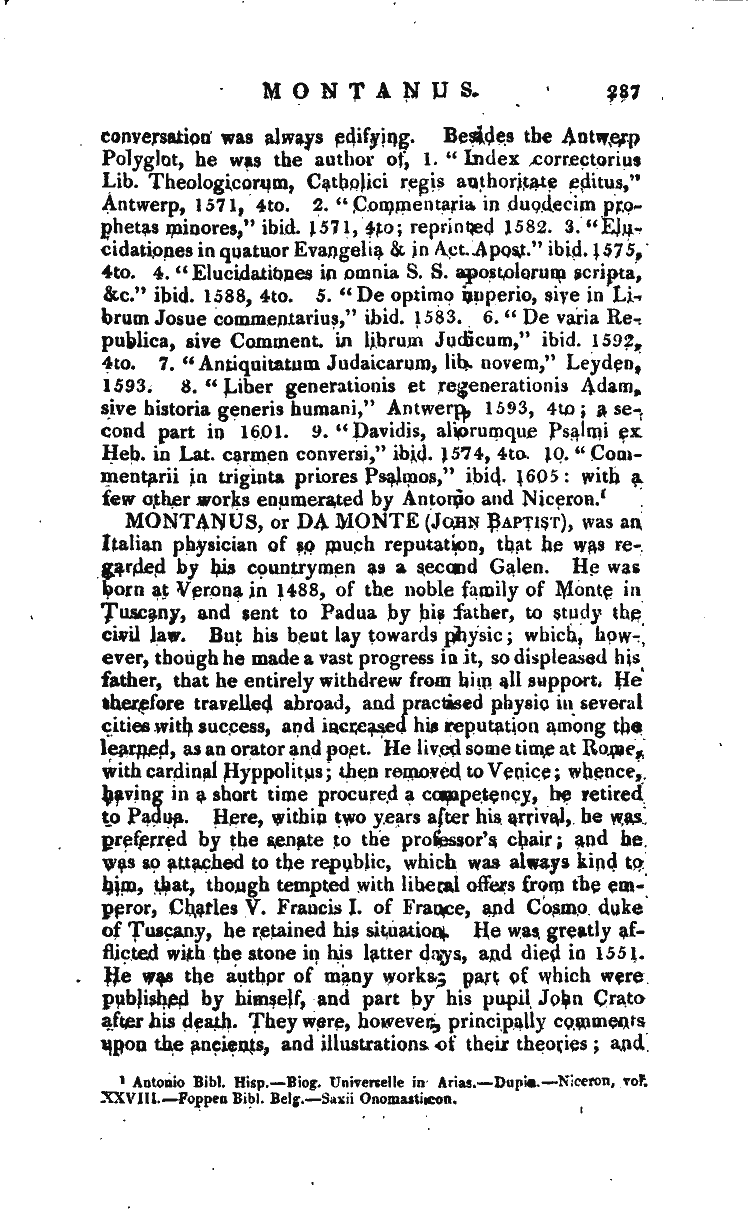
Arias Montanus
Our readers may enjoy this short biography of Arias Montanus, the editor of the Antwerp Polyglot. He was the reviser of the Latin version of the New Testament used in Johannes Leusden’s Greek New Testament, and later encorporated into the Jefferson Bible.
Arias Benedictus Montanus, a very learned Spaniard, was born at Frexenel, in Estremadura, in 1527, and was the son of a notary. He studied in the university of Alcala, where he made great proficiency in the learned languages. Having taken the habit of the Benedictines, he accompanied, in 1562, the bishop of Segovia to the council of Trent, where he first laid the foundation of his celebrity. On his return to Spain, he retired to a hermitage situated on the top of a rock, near Aracena, where it was his intention to have devoted his life to meditation, but Philip It. persuaded him to leave this retreat, and become editor of a new Polyglot, which was to be printed by Christopher Plantin at Antwerp. On this employment he spent four years, from 1568 to 1572, and accomplished this great work in 8 volumes folio. The types were cast by the celebrated William Lebe, whom Plantin had invited from Paris for this purpose. This Polyglot, besides what is given in the Alcala Bible, contains the Chaldaic paraphrases, a Syriac version of the New Testament, in Syriac and Hebrew characters, with a Latin translation, &c. While Montanus was beginning to enjoy the reputation to which his labours in this work so well entitled him, Leo de Castro, professor of oriental languages at Salamanca, accused him before the inquisitions of Rome and Spain, as having altered the text of the holy Scriptures, and confirmed the prejudices of the Jews by his Chaldaic paraphrases. In consequence of this, Montanus was obliged to take several journies to Rome, to justify himself, which he did in the most satisfactory manner. Being thus restored, Philip II. offered him a bishopric; but he preferred his former retirement in the hermitage at Aracena, where he hoped to finish his days. There he constructed a winter and a summer habitation, and laid out a pleasant garden, &c. but had scarcely accomplished these comforts, when Philip II. again solicited him to return to the world, and accept the office of librarian to the Escurial, and teach the oriental languages. At length he was permitted to retire to Seville, where he died in 1598, aged seventy-one.
Arias was one of the most learned divines of the sixteenth century. He was a master of the Hebrew, Chaldaic, Syriac, Arabic, and Greek and Latin languages, and spoke fluently in German, French, and Portuguese. He was sober, modest, pious, and indefatigable. His company was sought by the learned, the great, and the pious; and his | conversation was always edifying.
Excerpted from Chalmer’s Biography 1812.
ἄνδρες ἀδελφοί
Jim Hamilton and Rod Decker have been discussing the fact that the NIV 2011 has put selah in the footnotes instead of in the text. In yesterday’s post, I remarked that the Greek word ἁνήρ had been left untranslated 13 times in the book of Acts by several of the modern evangelical Bibles. Rod Decker provided the list in a comment on this post,
There are 13 instances of the phrase ἄνδρες ἀδελφοί which the ESV, etc. collapse to just ἀδελφοί. Here’s that list: 13x: Acts 1:16; 2:29, 37; 7:2; 13:15, 26, 38; 15:7, 13; 22:1; 23:1, 6; 28:17. I suppose one could argue that this is an idiomatic phrase, but it still a content word that is omitted.
I would like to suggest a few meanings for ἄνδρες and voice my view that it should not be left untranslated even when it is in this idiomatic phrase ἄνδρες ἀδελφοί.
The first possible reason, which Dr. Hamilton offered, is that it could mean that the speaker is addressing only adult males. However, context does not support this notion. In the first instance in Acts 1, Mary, the mother of Jesus, is with the disciples. It seems odd that a form of address which specifically excludes her would be used. Even if one could argue for that, Acts 2 poses a more difficult problem. Could the sermon at Pentecost have been addressed only to adult males? And in Acts 17, Damaris and other leading women appear to be among those who are addressed as Ἄνδρες Ἀθηναῖοι. Were they excluded from the sermon?
In fact, the lexicon and additional examples, suggest that ἄνδρες has many meanings other than that of “adult males.” It could mean “free men” rather than slaves, or “citizens” of a particular nation. It really does not seem accurate to assume that the word ἄνδρες was intended to qualify who was being addressed and exclude anyone who could not claim to be one of the ἄνδρες.
If we assume a more generous attitude on the part of the speaker then we have to say that ἄνδρες is not used to exclude part of the audience, and does not seem to add information. Perhaps it doesn’t need to be translated.
On the other hand, it would at least signify a difference in style from the epistles, in which the form of address is simply ἀδελφοί, “brothers and sisters.”
I am going to suggest that ἄνδρες ἀδελφοί could best be translated by “fellow countrymen” or some similar, but gender inclusive, phrase. It seems to be the correct form of address to use in the public sphere, and indicates respect for the audience and conveys the impression that all who hear the address are included.
The epistles are addressed to ἀδελφοί, which can be translated as “fellow Christians.” In the case of the epistles, they are addressed to Christians only, to those who have already responded to the gospel.
Surely it is of interest, surely this difference ought to be translated, so we can get a better idea of the style of address, of the public nature of the proclamation of the word in Acts, and the private and more narrowly directed epistles.
I find it discouraging that Dr. Hamilton wants to question whether the NIV 2011 is the word of God for putting selah in the footnotes. Therefore, I don’t want to criticize any translation for not translating ἄνδρες. It would be my wish that these kinds of attacks would diminish.
However, I would be very interested in hearing what others think of the phrase ἄνδρες ἀδελφοί.
The best parallel Bible of November 2011
The best parallel Bible of November 2011 is the same as the best parallel Bible of November 1820 or November 1904 – The Morals of Jesus (informally known as “the Jefferson Bible”) – first bound by Fred Mayo in Richmond, Virginia, then photographically reproduced in a single volume, then photographically reproduced by the Government Printing Office (a copy was given to each newly elected Senator, until the copies finally ran out in 1950), and now produced in a lavish volume by the Smithsonian Institute (Amazon price $21.50).
The volume is a parallel edition (Greek/Latin/French/English), meticulously cut and paste by Thomas Jefferson himself (who first began this project while he served as president). He used two copies of each (he needed two copies because sometimes he needed to paste from both sides of the page) from Wingrave’s 1794 London edition of Johannes Leusden’s Greek New Testament Testament (which also included Latin), from Jacob Johnson’s Philadelphia 1804 edition of the King James New Testament, and from a Paris 1802 edition of the Jean-Frédéric Ostervald’s New Testament.
This book is photographically reproduced to be an accurate facsimile copy on heavy alkaline paper – you can even see one of Jefferson’s tiny red hairs that got pasted in on page 7 (just above the upper left corner of English verse 15). Jefferson handwrote page numbers and notes in the margins. He made corrections as needed. Look at page 40, or more spectacularly at page 56, where Jefferson pastes in an additional verse folded over – reproduced using an exact paste in in this version. On page 64 he edits Matthew 24:38 which says in the KJV, “For as in the days that were before the flood they were eating and drinking, marrying and giving in marriage, until the day that Noe entered into the ark,” – Jefferson carefully cuts out the “as. “ Jefferson was a man who carefully read every single word of his Morals of Jesus.
Jefferson pasted in a folded over map of the Holy Land and a second of the Mediterranean, this volume carefully reproduces both, folded over – as well as Jefferson’s handwritten title page and index. (I must say that I was considerably reassured that Jefferson’s handwriting was as bad as mine.)
Jefferson’s goal in his book – his edited version drawn from the Christian gospels – was to remove all references to superstition and supernatural, producing a work of Jesus’ as a teacher and moral philosopher, but completely compatible with Jefferson’s commitment to the power of reason.
The first portion of this facsimile contains 50 pages of front material – a brief history of Jefferson’s Bible, and most fascinating of all, a detailed discussion of the conservation process. Anyone interested in old books is likely to find this fascinating. This front section contains numerous illustrations: Rembrandt Peale’s 1805 portrait of Jefferson, the original gold-tooled spine of Jefferson’s volume, Thomas Sully’s 1813 portrait of Benjamin Rush, John Trumbull’s miniature portrait of Thomas Paine, Rembrandt Peale’s portrait of Joseph Priestley, (gorgeous portraits of four of my favorite founding fathers: Paine, Rush, Jefferson, and Priestley– the book is almost worth the price for that alone), Gilbert Stuart’s 1824 portrait of John Adams, a black and white photograph of Cyrus Adler (Smithsonian librarian), a photograph of one of Jefferson’s English Testaments after Jefferson had cut it up, a photograph of microscopic examination of the volume, a photograph paste in on page 56 showing the iron-gall ink that Jefferson used, a photograph of the volume before it was restored, photographs showing challenges (adhesive failure, tearing at the ruled lines drawn by Jefferson, and the spine removal process.
Seeing this sort of facsimile edition is not only inspiring, it also makes me feel a type of closeness and understanding of Jefferson’s thought process. It is as if a museum piece had suddenly been delivered to me by Amazon.
I think this volume will appeal to anyone who is interested in American history, unusual Bible versions, or book conservation. The only reservation I have is that this volume was printed and bound in China by Oceanic Graphic Printing. OGP is known for its meticulous work, especially with art books, but I felt considerable sadness that this book – a piece of American history– was not printed in the United States; in the same way that might feel if you were given an American flag that had a “made in China” label on it.
NIV, ESV, HCSB, NET no longer the word of God?
Rod Decker blogged on the fact that the NIV 2011 has put “selah” in the footnotes,
I just noticed something in the NIV-11 that hadn’t registered before. In the Psalms, the word selah is not printed in the text. Instead there is a footnote marking the places where it occurs. This may make some traditionalists unhappy (and ruin a few sermons that hinge on that word!
), but I think this is a very good move (no pun intended). Selah is a bit mysterious, but probably is a musical notation that may have indicated a rest/pause. When reading Scripture orally, it should never be read and it should certainly not be made into a matter of exegetical or homiletical significance. (I’ve often heard it used as an indication that some statement is particularly significant: “think of that!” is the usual idea that I’ve heard.) To do so would be a bit like singing these actual words in the Hallelujah Chorus: “Hallelujah! rest Hallelujah! rest Hallelujah! rest Hallelujah! rest Hallelujah! rest.”
Jim Hamilton responded with this,
Will the ancient culture in which the Bible was written be accurately represented by the texts that come down to us from it, or will our culture be allowed to emasculate those texts and reshape them into our own cultural image? Are those ancient texts allowed to say anything that seems foreign to modern readers, or are they only allowed to say things that we already know from our own culture? If they are allowed to say things that we don’t understand from our own culture, if they are allowed to be ancient and foreign to us, why the need to remove Selah from the text and place it instead in footnotes?
I am not entirely sure why the removal of “selah” to the footnotes would line up with the emasculation of the text, but perhaps this makes sense to Dr. Hamilton. He continues,
If the NIV 2011 does not reverse itself on this issue, can we say that it faithfully presents the text of Psalms as it has come down to us? If it does not, can we regard it as the word of God? Article X of the Chicago Statement on Biblical Inerrancystates: “We further affirm that copies and translations of Scripture are the Word of God to the extent that they faithfully represent the original.”
He also wrote the following,
When I read an ancient text from a different culture, I don’t want to look into a linguistic mirror. I would like for that text to feel a little foreign, to feel a little ancient. I don’t want it only telling me what I already know. This word Selah occurs over and over all across the Psalter and into Habakkuk 3. One of the challenges of reading and understanding the Bible is paying attention to all the things the Bible says that we don’t understand, studying those things, and trying to come to a place where we begin to learn what the biblical authors were talking about and how they talked about it.
I think most of the community of this blog would agree with this last paragraph. But does that justify the threat in the former paragraph? Do we want to say that on the basis of relegating “selah” to the footnotes, a Bible translation should not be regarded as the word of God?
Dr. Decker responded here and here, asking,
If it is invalid to move a musical notation to a different location on the page (yet still retain it clearly in the translation) as does the NIV11 with Selah, what are we to think of translations that outright omit multiple instances of words that are incontrovertibly part of the original text? Translations which contain no note, no explanation at all—which just omit them altogether. If we were consistent in our argumentation at this point, then I think that we would be forced to conclude that any such translation must be judged to have violated the ICBI Chicago Statement because they have not faithfully presented the text of Scripture as it has come down to us.
rebutting Dr. Hamilton’s post with this example,
In Mark 1 there are 30 instances of sentences beginning with καί. If I counted right, there are 35 sentences in the chapter (i.e., which end with a period in UBS/NA text). So the textual data seems pretty secure and perhaps even “culturally significant” since it likely tells us something about Mark’s mother tongue.
So how do my two translations fare when evaluated in terms of their accurately reflecting every word of the Scriptural text? Translation A clearly omits any equivalent of καί four times. No note. No explicit translation. It’s just gone. If we argue that we must translate every word in order to be faithful to a high view of Scripture, then we have a problem. Four times in only one chapter Translation A has been unfaithful and omitted words from the text. That is surely grounds for suspicion. Translation A has failed to present the text faithfully. We should surely, then, not encourage the use of any such translation that is so careless and should seek a more reliable guide. Perhaps Translation B will prove more faithful. Unfortunately when B is examined, the problem is far, far worse. Translation B omits καί 23 times! In one chapter. No note. No explicit translation. It’s just gone. Surely we have now moved into dangerous territory. If Translation A evidences an unfaithful attitude toward the inspiration of every word of Scripture in the original text, then surely Translation B is obviously the product of biased, liberal scholarship which denies the inspiration of Scripture and emasculates its meaning. There must surely be some sinister plot afoot here; Translation B is certainly accommodating an evil social agenda of some sort.
And here is Dr. Hamilton’s rejoinder in the comments,
I think you’re comparing apples to oranges. As you know, there are “function words” and “content words.” The question about Selah is whether it is merely a “function word” – a musical notation – or whether it might in some way also be a “content word” that communicates meaning rather than merely facilitating the communication of meaning by serving some syntactical purpose/holding together words that communicate meaning.
I think you would agree that function words are flexible as we move from one language to another, and it seems to me that the examples you give above can all be viewed as function words.
Content words, on the other hand, ought to be represented in the translation.
—————————————————————————————————
From this interchange, I have deduced that Dr. Hamilton believes that one may be justified in suggesting that the NIV 2011 is not “the word of God” according to the Chicago statement, based on the fact that it removes to the footnotes “selah,” a content word which is of unknown meaning, but perhaps means “rest” or “pause.”
What then does Dr. Hamilton have to say about those translations which remove the word “men” from the text, or at least, to put that in other words, leave the word aner (plural) untranslated? The NIV 2011, the ESV, HCSB, and the NET Bible all leave the word aner (plural) untranslated 13 times in the book of Acts. The word aner certainly is a content word, and removing it from the text, without any mention of it at all in the footnotes, could well be said to emasculate the text.
Personally, I think that it may refer to “fellow citizens” or “friends” as an honorific, but the NET Bible note suggests that it may be intended to convey masculine semantic meaning. Here is the note for Acts 1:16,
39tn Grk “Men brothers.” In light of the compound phrase ἄνδρες ἀδελφοί (andre” adelfoi, “Men brothers”) Peter’s words are best understood as directly addressed to the males present, possibly referring specifically to the twelve (really ten at this point – eleven minus the speaker, Peter) mentioned by name in v. 13.
I can’t actually agree with this note, given that Mary, the Lord’s mother was present when this speech was made. However, the actual meaning of ἄνδρες deserves attention of some kind. Surely, if it was put into the word of God, we don’t need to leave it out, without even a mention in the footnote.
Shall we then propose that, on the basis of the practice of not translating ἄνδρες 13 times in the book of Acts, the ESV, NIV, HCSB and NET Bibles should no longer be considered the word of God?
Two Daniels (Matt and Boyarin) on Jewish creativity
Jim Davila notes that Moment magazine has a series of interviews on “The Origins of Jewish Creativity.” Several of the interviews on creativity are worth reading, but Davila mentions the following two interviews in particular (which just happen to both be of scholars named Daniel and just happen to both live in Berkeley, California):
Daniel Matt
The Zohar, the foundational text of kabbalah, is a celebration of creativity—it shows how the Torah endlessly unfolds in meaning. Jacob ben-Sheshet Gerondi, a 13th century kabbalist, said it’s a mitzvah for every wise person to innovate in Torah according to his capacity. That’s refreshing because you often hear the traditional notion, to accept what’s been handed down or to learn from the master because you’re not able to create on your own. But ben-Sheshet says (after conveying one of his innovations), “If I hadn’t invented it in my mind I would say that this was transmitted to Moses at Mt. Sinai.” He’s aware that his interpretation is new, but he thinks it harmonizes with the ultimate source of tradition—the creative work itself is somehow deeply connected to an ancient mainstream. An essential component of all creativity is tapping into something deeper than your normal state of mind.
The basic approach of the rabbis is to apply midrash to reading the Torah—the rabbis are willing to be very bold in their interpretation. It’s natural for a Jew to be bold and innovative—that’s the secret to keeping the tradition alive. The Zohar reads the very opening words of the Torah radically. Instead of “In the beginning God created,” it’s “In the beginning the Infinite created God.” It sounds bizarre to say that God is the object of creation, but I think the meaning is that what we think of as God doesn’t do justice to the true nature of God, which they call ein sof, “without end.” Going beyond traditional midrash, the Zohar employs radical creativity to make us question our current assumptions about life, about the nature of the human being, about God and spirituality. It moves through the Torah verse by verse asking probing, challenging questions. As the Zohar says, “God is known and grasped to the degree that one opens the gates of imagination,” so it’s up to our imaginative faculty to understand reality, or the reality of God.
[Daniel Matt served for 20 years as a professor of Jewish spirituality at the Graduate Theological Union in Berkeley. He is currently composing a multi-volume annotated translation of the Zohar, entitled The Zohar: Pritzker Edition.]
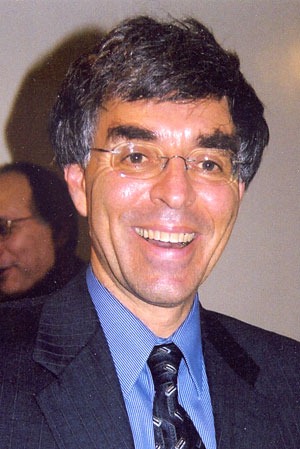
See BLT posts on Daniel Matt here and here.
Daniel Boyarin
The Babylonian Talmud is the most extraordinary creation of the Jewish people—it speaks a kind of manic energy and records that extraordinary energy and vitality from the areas where it was produced in the Babylonian Diaspora. Jews were imbued with creative energy through the intense study of this one peculiar vibrant work through the centuries. Sholom Aleichem, for example, records how the world of talmudic learning was diffused from the yeshiva throughout Jewish communities across class and gender. While the making of the Talmud was a creative act, so was the Jewish openness to many cultures: The cross-fertilization between ancient Jewish tradition and the outside world led to the taking in of new ideas and energy. Since the 19th century, much of Jewish creativity has stemmed from being in two cultures at the same time. Being in a position to observe a culture that you are also a part of is very conducive to creativity.
[Daniel Boyarin, Hermann P. and Sophia Taubman Professor of Talmudic Culture at the University of California Berkeley, has written extensively on the Talmud and gender studies.]
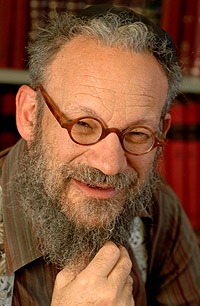
Davila mentions Daniel Boyarin’s forthcoming book The Jewish Gospels: The Story of the Jewish Christ. The book appears to be addressed to a popular audience (it will not published by an academic publisher but by The New Press and it features an introduction by Jack Miles.) the blurb on Amazon frames the as a follow-on to a quote Boyarin in a 2008 New York Times story:
In July 2008 a front-page story in the New York Times reported on the discovery of an ancient Hebrew tablet, dating from before the birth of Jesus, which predicted a Messiah who would rise from the dead after three days. Commenting on this startling discovery at the time, noted Talmud scholar Daniel Boyarin argued that “some Christians will find it shocking—a challenge to the uniqueness of their theology.” Guiding us through a rich tapestry of new discoveries and ancient scriptures, The Jewish Gospels makes the powerful case that our conventional understandings of Jesus and of the origins of Christianity are wrong. In Boyarin’s scrupulously illustrated account, the coming of the Messiah was fully imagined in the ancient Jewish texts. Jesus, moreover, was embraced by many Jews as this person, and his core teachings were not at all a break from Jewish beliefs and teachings. Jesus and his followers, Boyarin shows, were simply Jewish. What came to be known as Christianity came much later, as religious and political leaders sought to impose a new religious orthodoxy that was not present at the time of Jesus’s life. In the vein of Elaine Pagels’s The Gnostic Gospels, here is a brilliant new work that will break open some of our culture’s most cherished assumptions.
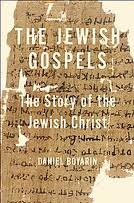
Rupert Murdoch (HarperCollins) to acquire Thomas Nelson Publishers
From the Wall Street Journal:
HarperCollins Publishers Inc. agreed to acquire Thomas Nelson Inc., significantly bolstering HarperCollins’s offerings of religious-themed titles.
Terms of the deal weren’t disclosed. It comes nearly 18 months after an investor group led by private-equity firm Kohlberg & Co. acquired a majority of Thomas Nelson’s stock. In 2006 the Nashville-based publisher had gone private in a transaction valued at about $473 million….
HarperCollins already owns a leading religious division, Zondervan, as well as the imprint HarperOne, which is best known for its health, religion/spirituality and self-help titles. Thomas Nelson has issued such best-selling titles as "Heaven is for Real: A Little Boy’s Astounding Story of his Trip to Heaven and Back," by Todd Burpo with Lynn Vincent. It also publishes leadership and personal finance works as well as bibles and works used in Christian studies.
Although Thomas Nelson doesn’t report its sales, the publishing house is estimated to generate about $200 million annually in revenue from all publishing categories, according to one industry estimate.
The Christian book market will generate about $1.4 billion in revenue this year, up slightly from sales in 2010, estimates Mark Kuyper, chief executive of the Evangelical Christian Publishers Association….
A treat, not a trick
 It is done. Jonathan I. Israel (Institute for Advanced Study, Princeton) has finally completed his 3,263 page dual history of the “radical enlightenment” (think Spinoza, Diderot, and d’Holbach) and “moderate enlightenment” (think Descartes, Locke, Voltaire and Kant). (I was already in awe of Israel’s 1300 page history of the golden age of Netherlands, which is even deeper and more persuasive than Simon Schama’s excellent history.)
Israel is a particular expert in enlightenment history, Dutch history, and Jewish history. His history consists of three volumes of continuous narrative together with a fourth volume summarizing his views as given in a lecture series:
- Radical Enlightenment: Philosophy and the Making of Modernity 1650-1750
(volume 1 in the trilogy, 832 pages) - Enlightenment Contested: Philosophy, Modernity, and the Emancipation of Man 1670-1752
(volume 2 in the trilogy, 983 pages) - Democratic Enlightenment: Philosophy, Revolution, and Human Rights, 1750-1790
(volume 3 in the trilogy, 1152 pages) - A Revolution of the Mind: Radical Enlightenment and the Intellectual Origins of Modern Democracy
(2008 Isaiah Berlin lectures at Oxford, 296 pages)
Israel denies Kant’s famous assertion:
If it is now asked whether we at present live in an enlightened age, the answer is: No, but we do live in an age of enlightenment.
He counters Kant because Kant’s age was an age of competing enlightenments: the Radical Enlightenment, the Moderate Enlightenment, and the conservative reaction Counter Enlightenment.
The Radicals (Spinoza) put forward a monist philosophical system (the universe is composed of one substance: “nature,” or if you wish “God.” ) On the one hand, the Moderates (Descartes) put forward a dualist philosophical system that was compatible with traditional Judeo-Christian conceptions of God. Finally, the Counters argued for traditional views of religion and monarchy.
We have learned to trace our intellectual pedigree to the Moderates, and thus we have the belief that the eighteenth century democratic movements were primarily influenced by Moderates with a few Counters thrown in for good measure. While this is part true (e.g., some of the American “Founding Fathers” were deists [Moderate], while others were unitarian [Radical]), Israel points out that democracy originated from the philosophy of the Radicals, who consistently argued that all men (and in the case of many Radical philosophers, women) were capable of reason. In contrast, the Moderates took what frankly must be admitted to be elitist point of view (e.g., Voltaire’s statement that “nine-tenths of mankind do not deserve to be enlightened.”)
Moderate philosophy sought to reform religious and government abuse, but did not seek to overthrow mixed religio-political government or class-based society; unlike the Radicals who sought a purely secular, democratic government.
To the extent that one buys into Israel’s thesis (which is brilliantly presented) one cannot but help wince at the American Christian-Patriotic movement, as represented for instance by that paradox of a book, the NKJV American Patriot’s Bible. Secular democracy is not based on Christian Origins at all. (For a lively discussion of the American Christian-Patriot movement, I can recommend The Annointed).
Israel’s work reminds me of Gibbon’s work in its length magisterial scope, although Israel’s work is focused more on the history of ideas than Gibbon’s and considers a considerably narrower (although no less interesting) range of time. Like Gibbon, Israel is eminently readable – so just as I wish to reread Decline and Fall of the Roman Empire every few years, I believe I will want to reread Israel as well.
 In many ways, Spinoza is the hero of Israel’s quartet, and this series will have interest for anyone who wants to deeply explore the implications of the consequences of Spinoza’s thought. (As long as I am mentioning Spinoza, let me express my delight with the wonderful Hackett anthology of his collected writings in English translation, which clearly combines his works in a single, highly readable volume.)
I do agree with the Christian-Patriot’s insistence that the intellectual origin of our democratic system matters. A conservative populist, Glenn Beck, has written a series of works in which he puts forward an alternate intellectual history of the origins of United States’ democracy. Beck’s vision is not compelling, though – while Israel’s is firmly documented and convincing. Even those who find themselves disagreeing with Israel are likely to feel challenged by his writing and in determining where they disagree with his premises.
If you have a few days of leisure, and want to embark on an intellectual adventure, I can highly recommend Israel’s quartet of books to you. And if your time is more limited, then I think you will find his shorter Revolution of the Mind engaging (although I suspect that after finishing it, you will be filled with an overwhelming desire to dive into the longer trilogy of books.)


 BLT
BLT