Christopher Hitchens dies: what he believed
The obituaries for Christopher Hitchens are being written and published now just after he died. I don’t know about you, but the obituaries that give the disceased their own voice and that connect those who’ve passed away with their parents and their upbringing seem most important. For example, here’s a bit from The L.A. Times:
He was born Christopher Eric Hitchens in Portsmouth, England, on April 13, 1949. The elder of two sons, he had a cool relationship with his father, Ernest, a commander in the British Royal Navy, but a warmer one with his mother, Yvonne. She taught him to love books and was determined that he would be the first Hitchens to attend college. “If there is going to be an upper class in this country,” Hitchens overheard her telling his father, “then Christopher is going to be in it.”….
In 1973, when he was 24 and living in London, his mother committed suicide with her lover, a defrocked vicar, during a trip to Greece.
Years later, he discovered one of her secrets: She was Jewish, which made him Jewish. “My initial reaction, apart from pleasure and interest, was the faint but definite feeling that I had somehow known all along,” he wrote in a 1988 essay, “On Not Knowing the Half of It.” But he remained anti-religion and anti-Zionist.
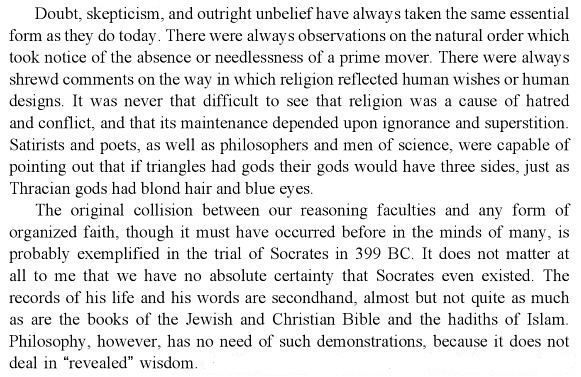
Two of my favorite paragraphs in Hitchen’s own book God is Not Great: How Religion Poisons Everything (his own voice and his own words) follows; we get the idea that he strongly believed in human agency and in voice as he told readers outright what they, like him, should believe:
Talmudic sages on reading the Apocrypha
While the Hanukkah festival is one of the best known Jewish holidays (thanks, in no small part, to Madison Avenue and the consumer-materialist culture that has introduced a gift-giving aspect that parallels the way that Christmas has been made materialist), it has almost no textual basis in canonical Jewish texts (there is a brief passage in the Babylonian Talmud that refers to the miracle of the oil when the desecrated temple was re-dedicated and the candle lighting custom, but it does not mention the military campaign of the Maccabeans against the Syrian-Greeks.)
Primary sources for military history of the Hanukkah festival lie in the First and Second Books of Maccabees, a Greek work from the Jewish Apocrypha (although it remains in the Greek Orthodox and Catholic Deuterocanons.) Later accounts, such as Josephus’s, seem to be based on the Books of Maccabees. The question is, did the Rabbinic authorities permit Jews to read the Apocrypha?
Hillel Hayyim Lavery-Yisraeli tackles this question in a fascinating essay entitled “Itʹs Greek to Them: The Apocrypha in the Eyes of the Sages.” (You will also want to read his source sheet – in fact, the source sheet is even more interesting than the essay.) Here are some excerpts from his essay:
In the Mishnah (Sanhedrin X, 1), Rabbi Akiva issues a shocking statement: one who reads “Sefarim Hitzonim” (“external books”) has no share in the world to come! While it is difficult to precisely identify what Rabbi Akiva means by the “Sefarim HaHitzonim,” it is possible that “Sefarim Hitzonim” refers to the Apocrypha or parts thereof (ἀπόκρυφα – “those hidden away” being an approximate Greek translation of the Hebrew term which means “external books” or “the books left out).” Would that mean that reading the Books of Maccabees is forbidden?…
And what about Rabbi Akivaʹs harsh statement, that one who reads “Sefarim Hitzonim” loses her or his portion in the world to come? The Babylonian Talmud (Sanhedrin 100b) asserts that this refers specifically to ʺSifrei Minimʺ – books of sectarians or heretics (at the time these were, most probably, the Gospels or early Gnostic texts – see Rashi). The Gemara then goes on to report that Rav Yosef said one is also forbidden to read the book of Ben Sira, another book found today in the Apocrypha. After some debate, Rav Yosef himself then modifies his previous statement, saying ʺthe good parts of it may be readʺ. The conclusion is that heretical books must not be read, while neutral, secular books may be read as long as it is for some benefit.
The Yerushalmiʹs understanding of the Mishnah in Sanhedrin (X, 1) differs. To the Yerushalmi, the banned “External Books” consist of the works of Ben Sira and Ben La`anah and the like. The Yerushalmi permits reading “the works of Homer and any books written thereafter.” An explanation is given: “for they were given to read, not to toil over.” It seems that the Yerushalmi permits a Jew to read Homer because it is clearly secular literature, as opposed to Ben Sira which is religious in nature and Biblical in style but not accepted into the canon….
Interestingly, the Meiri (12th century Talmudic commentator in Provence), in his commentary on the Mishnah of Sanhedrin, qualifies Rabbi Akiva’s statement that reading “Sefarim Hitzonim” disinherits one from his or her olam haba (world to come), saying that Rabbi Akiva forbids reading those in order to “follow in their ways and beliefs,” but if one reads merely “to understand and to rule” (since sometimes halakhic decisions depend on such knowledge), it is in fact permissible. Even reading “Sifrei Minim” would be permitted if done in this way….
When the Syrian‐Greeks invaded the Land of Israel, they tried to Hellenize (modernize) Judaism in a drastic way – they forbade the study of Torah and the observance of Shabbat, and placed an idol in the Temple. The Hasmoneans [the ruling dynasty established by the Maccabee family] reacted by going to the other extreme, even killing Hellenized Jews. They tried to develop a “pure” form of Judaism that kept all outside influences out…. It is ironic that had the Jews followed the Hasmoneansʹ strict rulings as recorded in [the tractate in the Talmud known as]
Sotah, we might not know about much of the story of the Hanukkah festival which they themselves instituted. Interestingly, the Jewish holiday which could be seen as celebrating religious extremism and intolerance is actually the one for which understanding it requires reliance and consulting non‐Biblical and non‐Talmudic texts. The story of those who fought against the Greeks is known to us today only because it was preserved in Greek!
Considerable irony – a principal anti-Greek Jewish document is preserved in Greek!
Goodbye, George Whitman
George Whitman, who re-founded the legendary Paris bookstore Shakespeare and Company, died yesterday. He was two days after his 98th birthday.
The obituary on the store’s web page says:
On Wednesday 14th December, 2011, George Whitman died peacefully at home in the apartment above his bookshop, Shakespeare and Company, in Paris. George suffered a stroke two months ago, but showed incredible strength and determination up to the end, continuing to read every day in the company of his daughter, Sylvia, his friends and his cat and dog. He died two days after his 98th birthday.
Born on Dec. 12, 1913, in East Orange, New Jersey, George moved to Paris in 1948 and opened his bookshop Le Mistral, later renamed Shakespeare and Company, in 1951. Packed wall-to-wall with books and beds for roaming writers, the store quickly grew to be a haven for book lovers and authors while George became an unusual Paris literary institution. In 2006 he was awarded the Officier des Arts et Lettres by the French Minister of Culture for his lifelong contribution to the arts.
After a life entirely dedicated to books, authors and readers, George will be sorely missed by all his loved ones and by bibliophiles around the world who have read, written and stayed in his bookshop for over 60 years. Nicknamed the Don Quixote of the Latin Quarter, George will be remembered for his free spirit, his eccentricity and his generosity — all three summarised in the Yeats verses written on the walls of his open, much-visited library : "Be not inhospitable to strangers / Lest they be angels in disguise."
George will be buried at the Père Lachaise cemetery in Paris, in the good company of other men and women of letters such as Guillaume Apollinaire, Colette, Oscar Wilde and Balzac. His bookstore continues, run by his daughter.
 The original Shakespeare and Company was opened by expatriate American Sylvia Beach in 1919, and it was a central focus of the "lost generation" 1920s authors. Beach is perhaps best known for publishing James Joyce’s Ulysses and for the description given in Ernest Hemmingway’s A Moveable Feast. Beach famously closed her store in 1941 rather than sell a copy of Finnegans Wake to a Nazi officer.
George Whitman, another American expatriate, opened his store in 1951, across from Notre Dame cathedral. Originally he called his store Le Mistral, but in the early 1960’s Whitman bought all of Beach’s remaining books from her, and in 1964 (the 400th anniversary of William Shakesepeare’s birth), he renamed his store “Shakespeare and Company” in honor of Beach. (He also named his only child Sylvia Beach Whitman; today she runs the store.)
Visitors associated with Whitman’s Shakespeare and Company include Henry Miller, Anaïs Nin, Samuel Beckett, James Baldwin, Lawrence Durrell, William Burroughs, Allan Ginsberg, Gregory Corso, and Lawrence Ferlinghetti (who regarded his San Francisco “City Lights” bookstore a sister shop to “Shakespeare and Co.)
I met Whitman several times when I visited his Paris bookshop. He was gruff and kind and knowledgeable about books. I miss him.
The New York Times and Washington Post have obituaries today.
The Junia Evidence: II
Denny Burk’s Complementarian Cover-up
The Junia Evidence: I
This is a continuation of the evidence that Junia was likely among the apostles. This is not intended to defend egalitarianism, but to promote the much broader goal of making us ask ourselves how grounded in scholarship modern Bibles really are. It is largely in response to the NET Bible note for Romans 16:7, rather than in response to any particular blogger. At this point, I have dialogued with few bloggers who defend the NET Bible note, but it remains immensely influential.
For example, Dan Wallace on the Bible.org writes the following about the development of the NET Bible note,
There are a few places in which the NET editors have disagreed with the present scholarly consensus on the meaning of a given text. This is never a cavalier decision, but always has some substance behind it. Take, for example, another passage from Romans. In the last chapter, the apostle almost sings a litany of greetings to several friends. In 16.7 he says, ajspavsasqe jAndrovnikon kaiV jIounivan…ejpivshmoi ejn toi’ ajpostovloi. There are two issues in this verse: (1) is jIounivan a man’s or a woman’s name? and (2) does ejpivshmoi ejn toi’ ajpostovloi mean “outstanding among the apostles” or “well known to the apostles”? There is a growing consensus on this first issue—viz., jIounivan is a feminine name. The NET Bible thus reflects this consensus and translates it as “Junia.”20 There is an even stronger consensus that ejpivshmoi ejn toi’ ajpostovloi means “outstanding among the apostles”—i.e., that Andronicus and Junia were apostles and were excellent examples of such. But the expression seemed odd: …
… two of the editors did some research in extra-NT Greek on ejpivshmo followed by (ejn +) dative and ejpivshmo followed by the genitive. Using TLG, the published volumes of the Oxyrhynchus Papyri, Tebtunis papyri, and the digitized collections of papyri from Duke University and the University of Michigan—a grand total of more than 60 million words of Greek literature from Homer to 1453 CE—an exhaustive examination of all such collocations was undertaken. And the results were startling: almost always, when ejpivshmo was followed by a personal noun in the genitive, the idea was a comparison from within (“outstanding among…”); but when ejpivshmo was followed by (ejn +) dative—as is the case in Rom 16.7, the idea was elative, with no internal comparison taking place (“well known to”).
In this case, the scholarly consensus was found to be due to an off-handed comment by J. B. Lightfoot in his commentary on Galatians (!) that was picked up by other scholars who then claimed that Lightfoot had proved the Greek idiom in Rom 16.7 to mean “outstanding among”! Because Lightfoot was a good grammatical exegete, no one questioned his opinion on that score, and no one did any research on the construction in any Greek literature, as far as we could tell. Thus, when we examined the data, we were surprised to find it so uniformly against Lightfoot’s supposition. (my emphasis)
So my examples now are simply to show that Lightfoot was well grounded in Greek and the data is not uniformly against his supposition. I would like to show that an adjective with en plus the dative typically means “among” so “among the apostles” should not seem odd.
Fortunately we can test from looking at examples from the New Testament to see if there is a significant difference between using the genitive case or en plus the dative case. Do these two make a difference of meaning, or not? Consider these instances.
ὁ δὲ μείζων ὑμῶν Matt. 23:11 (genitive)
the greatest among youὁ μείζων ἐν ὑμῖν Luke 22:26 (en plus dative)
the greatest among you
In view of these examples I cannot give credit to an argument which proposes a difference based on the fact that the adjective episemos is followed by ἐν plus dative rather than by the genitive. These two constructions can be used synonymously.
However, here Wallace asks,
would we not expect ἐπίσημοι τῶν ἀποστόλων if the meaning were “outstanding among the apostles”?
No. Here are a few examples of the comparative form of an adjective followed by ἐν plus dative.
καὶ σύ Βηθλέεμ γῆ Ἰούδα οὐδαμῶς
ἐλαχίστη εἶ ἐν τοῖς ἡγεμόσιν Ἰούδα Matt. 2:6‘And you, O Bethlehem, in the land of Judah,
are by no means least among the rulers of Judah; ESVἀμὴν λέγω ὑμῖν οὐκ ἐγήγερται ἐν γεννητοῖς γυναικῶν μείζων Ἰωάννου τοῦ βαπτιστοῦ ὁ δὲ μικρότερος ἐν τῇ βασιλείᾳ τῶν οὐρανῶν μείζων αὐτοῦ ἐστιν Matt. 11:11
Truly, I say to you, among those born of women there has arisen no one greater than John the Baptist. Yet the one who is least in the kingdom of heaven is greater than he. ESV
Ἰούδαν τὸν καλούμενον Βαρσαββᾶν καὶ Σιλᾶν
ἄνδρας ἡγουμένους ἐν τοῖς ἀδελφοῖς Acts 15:22Judas called Barsabbas, and Silas,
leading men among the brothers ESV
The Greek of the New Testament indicates that using an adjective with en plus the dative is very common for expressing when one person is among (and a member of) a group of other people, as Junia was.
There is every indication that ἐπίσημοι ἐν τοῖς ἀποστόλοις actually means “prominent among the apostles.” She is a member of the group. Here is the 19th century Greek Vamva version, also scholarly. Note the unambiguous use of metaxu. I would rather throw in with the Greeks than with a recent American interpretation.
᾽Απάσθητε τὸν ᾽Ανδρόνικον καὶ ᾽Ιουνίαν τοὺς συγγενεῖς μου καὶ συναιχμαλώτους μου, οἵτνες εἴναι ἐπίσημοι μεταξὺ τῶν ἀποστόλων οἵτνες καὶ πρὸ ἐμοῦ ἦσαν εις τὸν Χριστόν
I want to be clear that my interaction is with the Burer and Wallace article because it is the article which underlies the translation of Romans 16:7 in the ESV, CEV, and NET Bibles. It cannot stand up to scrutiny.
But what of other Bibles? The NIV 1984, RSV, NASB, all have Junias, masculine, instead of Junia. This is no longer accepted as scholarly either. Only the KJV, NRSV, NIV 2011, and HCSB have Junia among the apostles. The growing popularity of the ESV, and its endorsement in my congregation a few years ago, along with the distasteful criticism of the TNIV and NIV 2011, caused me to interact with these texts to find out which one had the most scholarly foundation. I could not agree with the ESV had used a literal or scholarly translation for Romans 16:7.
Good night – it’s my birthday! I will not be arguing the subordination of women with any of commenters on this post. I give myself the night off! Give me a present, don’t try to offer women restrictions tonight.
Thanks to Matt and Alistair for persisting in this discussion. This conversation began on Denny Burk’s blog.
שלמה שלמה שלמה שלמה שלמה–Hebrew word play
Mississippi Fred MacDowell posts the following cute Hebrew wordplay story:
[Shlomo Yitzhaki, also known as Rashi,] was traveling in a foreign land, and he was unknown. Accused of thieving, he wrote
שלמה שלמה שלמה שלמה שלמה
on the door of the home where the robbery occurred. Puzzled by this cryptic message, the stranger – Rashi – was asked to explain himself. He vocalized the five words and showed that it meant “Shelamah shalma Shlomo salma shelemah?”
[שֶׁלָמָה שַׁלְמָה שְׁלֹמֹה שַׂלְמָה שְׁלֵמָה]
or “Why should Shlomo pay for the entire [missing] garment?” From this they knew that Rashi was no thief, but a talented, profound scholar.
MFM goes on to trace variations and possible origins of this story.
Isaac Newton as an author
 What a magnificent age we live in. Cambridge University just released digital copies of Newton’s notebooks (under an inspiring subtitle taken from Newton’s undergraduate notebook: “Plato is my friend, Aristotle is my friend, but my greatest friend is truth.”) I have only just started beginning exploring them, but there are wonders fantastic in them.
We tend to think of Isaac Newton as a giant of science (even if stood on the shoulders – or feet – of others) and not as an author. What a pity! In fact, Newton’s literary output – scientific, alchemical, and theological – is fascinating in its own right.
There is a magnificent Norton Critical Edition anthology of Newton that gives real insight into the writings of Newton. It is divided into nine sections: Natural Philosophy, Scientific Method, Experimental Procedure, Optics, Rational Mechanics, Systems of the World, Alchemy and Theory of Matter, Theology, and Mathematics.
There is also an amazing translation of the Principia by Bernard Cohen (make certain that you get this Cohen translation and not one of the older, inaccurate, and incomprehensible translations.)
One might think that a year or two of college calculus and physics gives one all of Newton, but certainly that is not true – Newton’s approach to the calculus and the “mathematical principles of natural philosophy” are quite different than the way that the subject is taught today. When Nobel Laureate S. Chandrasekhar read the Principia as a faculty member, he faced a number of difficulties; and ended up writing a commentary (which is quite misleadingly called Newton’s Principia for the Common Reader – I think that S. Chandrasekhar’s idea of “common reader” goes well beyond what you and I might call a “common reader.”)
Newton was mad and creative and tormented and brilliant – and as I peruse the digital copies of his notebooks, I feel that I am almost in his presence. Remarkable work!
The Junia Evidence: I
In response to a request on this post, I provide these specific examples of episemos en plus dative meaning “among,” taken from Burer and Wallace’s own article. The phrase has a partitive or inclusive sense in these examples. “Prominent among” or “outstanding among” is a good fit in each of the following examples. These are direct citations from the article by Burer and Wallace. (Their article did not include unicode Greek so I have provided a light transliteration.)
But in Add. Esth. we read that the people are to ‘observe this as a notable day among the commemorative festivals’ (en tais heortais episemon hemeran). In this text, that which is episemon is itself among (en) similar entities. It should simply be noted that impersonal nouns are used here, making the parallel to Rom. 16:7 inexact.
It should be noted here that W & B have made the restriction themselves that episemos should be with a personal noun. As we have clearly seen, in Pss. of Solomon 2:7, it is not. (If you missed the first post, Pss. of Solomon 2:6 is also found at the bottom of this post.) The very occurence that B & W chose as the “very close parallel” is not a parallel by their own restrictions.
Lucianus speaks of Harmonides the pipe-player craving fame for his musical abilities to the extent that he wants ‘glory before the crowds, fame among the masses’ (he doxa he para twn pollwn kai to episemon einai en plethesi). He clearly sees himself as set apart from hoi polloi! … Lucianus thus shows the same patterns that we saw earlier, viz., an exclusive notion with en plus the dative
I have to disagree with this assessment. For me, a pipe player is “among the masses.” He is definitely one of the hoi polloi! In this case, the Greek is more literally translated as “and to be prominent among the masses,” and makes an exact parallel with Rom. 16:7. It is a direct parallel in favour of inclusivists, that Junia is among the apostles.
The authors continue with another example from Lucianus,
On at least one occasion his words unmistakably have an inclusive force for en plus the dative. In his work On Salaried Posts in Great Houses, he offers advice to servants: ‘… you must raise your thirsty voice like a stranded frog, taking pains to be conspicuous among the claque and to lead the chorus’ (episemos ese en tois epainousi . . .). This is the first parallel to Rom 16:7 we have seen that could offer real comfort to inclusivists. It is unmistakable, it is personal, and it is rare. We have noticed, in fact, only one other text that clearly bears an inclusive meaning with en plus dative personal substantives.
B & W accept this as a parallel for those who see Junia as among the apostles. As we have seen, it is not rare. In fact, B & W did not find a parallel themselves for their hypothesis on Romans 16:7. I also find the tone of this article to be patronising. The only comfort I need is to read this article and realize how terribly blown off course complementarianism is.
In Jos. Bell. 2.418 we read of certain leading citizens who dispatched some representatives, ‘among whom were eminent persons, Saul, Antipas, and Costobar, all members of the royal family’ (en ois esan epishmoi Saulos te kai Antipas kai Kostobaros . . .). But even this text is not a clean parallel: the relative clause is expected to consist of en plus the dative, and the adjective is almost functioning as a technical term, without any notion of comparative force. It is at least quite different from Rom. 16:7 in several important respects.
I have difficulty understanding why this is not somewhat parallel, but you be the judge this time.
Euripides speaks of the goddess Aphrodite as ‘glorious among mortals’ (kapishmos en brotois). Aphrodite is not a mortal, but her fame is certainly found among mortals. Here is an excellent illustration that has all the constituent parts found in Rom. 16:7: a personal construction with ejn plus the dative. And the meaning is obviously an exclusive idea.
This is the only example which could possibly “offer comfort” to exclusivists. However, B & W have also made the restrictions that the examples be elative and not comparative. They write,
The lexical domain can roughly be broken down into two streams: episemos is used either in an implied comparative sense (‘prominent, outstanding [among]’) or in an elative sense (‘famous, well known [to/by]’).
In this case, Aphrodite is “prominent, outstanding among” mortals in the comparative sense as well as in the elative sense. The example of Aphrodite is ambiguous, and not conclusive.
This is the example which B & W offer as the “very close parallel,”
sented by Burer and Wallace,
In Pss. Sol. 2:6, where the Jewish captives are in view, the writer indicates that ‘they were a spectacle among the gentiles’ (ἐπισήμῳ ἐν τοῖς ἔθνεσιν). This construction comes as close to Rom 16:7 as any we have yet seen.
But this is the actual citation from Pss. of Sol. 2:6.
οἱ υἱοὶ καὶ αἱ θυγατέρες ἐν αἰχμαλωσίᾳ πονηρᾷ,
ἐν σφραγῖδι ὁ τράχηλος αὐτῶν, ἐν ἐπισήμῳ ἐν τοῖς ἔθνεσινThe sons and daughters were in harsh captivity
their neck in a seal, with a mark among the nations
Psalms of Solomon 2:6 NETS
This is not a parallel of any kind. In fact, one has to wonder whether the authors every viewed this citation in its original context. The truth is that I cannot imagine how this happened.
My favourite solution for Pss. Sol. 2:6 is that this is a translation of a lost original Hebrew writing. In this case, I would guess that “in a seal” and “in a mark” are parallel constructions, with “in a mark” meaning that the captives had a mark branded on their skin.
I have many more examples to list, but they will have to wait until tomorrow. In closing, I just want to say that I am happy to blog with the some of the smartest guys in the blogosphere. That includes the guys on the BBB as well.
Update
Matt Colvin, with a Ph.D. in Greek has kindly entered the discussion and provides more Junia evidence. He writes,
The TLG results did cough up a few instances that refute Suzanne’s ostensible rule. Especially helpful is Ephraem Syrus Theol., Ad imitationem proverbiorum (4138: 006)
(“Ὁσίου Ἐφραίμ τοῦ Σύρου ἔργα, vol. 1”, Ed. Phrantzoles, Konstantinos G. Thessalonica: Το περιβόλι της Παναγίας, 1988, Repr. 1995. Page 187, line 6)
Θέλω πρακτικὸς εἶναι καὶ ἐπίσημος ἐν τοῖς ἀδελφοῖς ἢ παραβαίνειν ἐντολὰς καὶ εἶναι αὐτοῖς βδελυκτός.
“I want to be ready for action, and ἐπίσημος among the brothers, rather than to transgress the commandments and be repugnant to them.”What is nice about this example is that the parallel construction of the sentence makes clear that there is not a comparison being made, nor any partitive construction, but that ἐν τοῖς ἀδελφοῖς is parallel to αὐτοῖς in the second half, and that both indicate the subjective perceivers of the good qualities the author desires to have — precisely how Wallace and Burer think “among the apostles” should be taken in Romans 16:7.
In response, I note that “the brothers” in Greek as in many other languages, can only refer to one’s own brothers. The personal pronoun is not usually used in Greek for those things which belong to one’s own person unless there is some doubt. This really ought to be translated as “my brothers” or even “my people” so it is partitive – he wants to stand out among his own brothers, and not to some other race or group of people. ” There was no group of people at the time who, in distinction to everyone else, called themselves “the brothers.” That is why he want to be ready for action, so he can be prominent among his own band of brothers.
I find this example strengthens the case that Junia was among the apostles, rather than refuting it. Many thanks to Matt Colvin for undertaking this additional research.
iPads OK for pilots but not for passengers?
 From the NYT Bits blog:
The Federal Aviation Administration said Tuesday that pilots on American Airlines flights would be allowed to use iPads instead of paper flight manuals in the cockpit starting Friday, even during takeoff and landing. But, passengers are still required to shut down anything with the slightest electronic pulse from the moment a plane leaves the gate until it reaches an altitude of 10,000 feet….
The F.A.A. said that it conducted ”rigorous testing of any electronic device proposed for use in the cockpit as an electronic flight bag, in lieu of paper navigation charts and manuals.”
The F.A.A. did not say why the testing that has been used for pilots could not also be used to test the seating area where passengers sit, so they could use iPads and Kindles, too.
Pedagogy, J. Z. Smith style
The well-known eccentric J. Z. Smith (U. Chicago) (he doesn’t pick up the phone, has never used a computer or the Internet) is celebrated in a funny, funny interview in a U. Chicago student newspaper (published version, full version).
I would rather celebrate him by reproducing his essay on “The Necessary Lie: Duplicity in the Disciplines.”
His comments have relevance to many topics we discuss on this blog – see, for example, his comments on the King James Bible and Shakespeare in the second paragraph.
—————————————————————————————————————
 George Bernard Shaw once made a wisecrack that I think defines the academic disciplines as social entities: "I may be doing it wrong but I’m doing it in the proper and customary manner." This raises at least two questions that I would like to examine. First is the white lie, which comes up when we are self-conscious about speaking in a nondisciplinary fashion about our subject. Second is disciplinary lying, which is part of the process of initiating somebody into a discipline. Indeed, disciplinary lying may be the marker of what it is to belong to a discipline.
The white lie.—We lie, it seems to me, in a number of ways. We sometimes cheerfully call the lie words like "generalization" or "simplification," but that’s not really what we’re doing. We’re really lying, and lying in a relatively deep fashion, when we consistently disguise, in our introductory courses, what is problematic about our work. For example, we traditionally screen from our students the hard work that results in the production of exemplary texts, which we treat as found objects. We hide consistently the immense editorial efforts that have conjecturally established so many of the texts we routinely present to our students as classics, not to speak of the labors of translation that enable many of them to read these texts. Then we read them with our students as if each word were directly revelatory, regardless of the fact that the majority of the words are not in the language in which the text was written. In fact, we have a curious strategy of when and how we decide to display some of this hard work. For example, Chinese or Japanese texts in translation read like Yiddish—every third word is followed by some indecipherable foreign word in parentheses as if this would in some way enhance understanding. We are really reminding our students that this is foreign and hard to understand. In Shakespeare, we display an enormous glossary material, implying that this, too, is a foreign language that, nevertheless, can be mastered with effort. Yet the King James Bible, another Elizabethan text, is characteristically taught in God knows how many humanities courses across the country with never a single footnote indicating that the language, while simpler than the language of Shakespeare, is just as foreign and just as difficult. One would like them to note, for example, that the word "let" often means to stop somebody from doing something, and the word "prevent" at times means to let them go ahead and do it. One gets odd moral conclusions by reading the King James Bible without such footnotes, and yet our mutual lie is that it is infinitely accessible while Shakespeare is accessible with difficulty; foreign texts remain inaccessible.
 Moreover, we conceal from our students the fields-specific, time-bound judgments that make objects exemplary. We display them as if they are self-evidently significant and allow the students to feel guilty when they do not feel this self-evidence. We rarely do what some German critics have called a reception history of the object in front of us, examining why or how the object became in some way exemplary of humankind in a particular discipline. Thus, when we deal with a figure like Plato, we rarely reflect on the fact that, after all, the dialogue that was Plato for the Western world for most of its history (i.e., The Timaeus) is no longer read. Jefferson and other wise people despised The Republic thoroughly, finding it an absolutely impenetrable document. They thought Cicero—today all but dropped from the canon—was the place one went in order to think about democratic institutions. That is, we don’t introduce our students to the fact that the artifacts that we examine are scarcely blooming with self-evidence. We conceal the revisionary histories of the objects we examine. If they’re written works, we conceal their drafting and their changes. If they’re scientific objects, we conceal the history of failed experiments and the history of sheer serendipity. That is to say, we convey to our students a specious perfection of the object and a specious necessity to the history of that object.
When we conceal from our students our hard work, that which is actually the way we earn our bread and butter, we produce a number of consequences. I remember testifying once before the California state legislature and facing a legislator who wanted to know why professors should be paid to read novels, when the legislator himself read novels on the train every day. Well, that was the price of our disguising the work that goes into things. There are, I think, more serious educational consequences. If we present the work as perfect or as work without a revisionary history, then we present a work that no student could hope to emulate. Indeed it serves, if it serves at all, as a standard for how far below that standard the student falls. If we present the material without displaying the effort that goes with it, students tend to conclude that things are true or false, or alternatively, that it’s entirely a matter of their opinion whether the object is exemplary. In that case, what we have is a contrast between his or her feelings and my feelings. Thus, in the name of simplification, what we really end up doing is mystifying the objects we teach at the introductory level.
Similarly, still in the name of simplification, we treat theory as if it were fact. We treat difficult, complex, controversial, theoretical entities as if they were self-evident parts of the universe that we inhabit. Students coming out of introductory courses in the humanities know that there is such a thing as an author’s intention, and they regularly and effortlessly recover it from the text they are looking at. Students in introductory social sciences know that there is such a thing as a society that functions, and they effortlessly observe it doing so. Students in introductory sciences are wedded without their knowing it to a tradition of induction from naked facts, in what Nietzsche called "the myth of the immaculate perception." Indeed, I’ve often argued when teaching in the social science Core that, if I could only have the first week of Chemistry 101, my job would be infinitely easier because at least we would have raised the possibility that one wears eyeglasses when one gazes at these naked facts.
Despite the proud claim that we make over and over again that we teach the how rather than the what of the disciplines, we, in fact, do not; it is the theoretical conclusion that our students underline in their books. I spend a half hour with each of my students looking at what they’ve underlined, and they’ve always underlined the punch line and never anything that might be called the process that led up to it. That is to say, theoretical entities have been reduced to naked facts. The process of discussion often becomes one of show and tell for these unproblematic, now self-evident conclusions. In other words, we have skillfully concealed from our students the power of the remark once made by a mathematician, "I have my results, but I do not know yet how I am to arrive at them." Even a false generosity with respect to method conceals the process when we present this method one week, that method another week, allowing none of them to have the kind of monomaniacal power or imperialism that a good method has when we’re honest about it. Without the experience of riding hell bent for leather on one’s presuppositions, one is allowed to feel that methods have really no consequences and no entailments. Since none of them is ever allowed to have any power, none of them is ever subjected to any interesting cost accounting.
 Another way we end up reducing our students to the notion of a subject being all opinion (and we’re very angry when they assert that to us) is the way that introductory courses, whether seminar or lecture, whether of a large field of study or a small field of study, are never introductions. They are always surveys. They may be shorter surveys or longer surveys, quicker surveys or slower surveys, but nothing is allowed to be truly troublesome. It suggests that one might think that a freshman seminar devoted to a single work is probably a far better introduction than our vaunted Core. That is to say, one really ought to be able to work on a limited number of exemplary objects and to answer all the various sorts of questions that one might come up with. Though I don’t like a lot of the framework, Jeff Robinson has a book, Radical Literary Education, about a classroom experiment in which he takes the introductory English class through a reading of a Wordsworth ode for an entire semester at Colorado State. They’re into a complex unpacking and unfolding of the enterprise. I’m not terribly thrilled with the message he’d like you to get from this; nonetheless, the strategy, it seems to me, is one worth looking at.
Disciplinary lying.—The self-justified white lie is done in the name of our students, in the name of simplifying, of generalizing, of speaking to a wide and a diverse audience. However, one also has to look at the place in which lying becomes built into the structure of things, in which it becomes that which constitutes a discipline as a discipline over and against other disciplines. Here, at least in principle, we lose the excuses that go with the introductory course. One would presume a student who had been through a program of rigorous disciplinary lying would emerge at the conclusion of his or her baccalaureate experience with some measure of sophistication. Yet, when I used to do something called the dean’s seminar in which we talked about the disciplines as seniors graduated, I was struck by their lack of the sense of the conventionality that governs what we do. These seniors still sought the cost-less method, the cost-less theory, even at the end of two to three years of allegedly depth study in a field.
Fields are taken not only as self-evident but as singular, without real understanding that what’s a style for one is not a style for another. Take a simple example in my own field. If I want to publish an article in one of two general journals in the field of religion—History of Religion and The Journal of the American Academy of Religion—I have to at least redo the notes. History of Religion does the so-called humanities-style notes and The Journal of the American Academy of Religion does the so-called social science—style notes. It’s not just that it’s inconvenient; what I am doing is fundamentally altered by which of those two styles I accept. In the humanities, the footnote is exegetical, and you will accept what I say on the basis of my exegesis of that particular passage. On the other hand, when I read something that says, "Levi-Strauss 1970—83," I’m supposed to find the one sentence in a four-volume work that justifies the paragraph I have just read. That’s a very different understanding of how you justify your work. That really is an authority model, which has very little to do with any claim to exegesis. Yet, one never talks about such differences with students.
I discovered a stunning example of disciplinary lying in a book by the now late Nobel Prize winner, Richard Feynman, Surely You Are Joking, Mr. Feynman, written for no other purpose that I can determine but to make money. He writes, rather cockily, that he finds world travel a rather dull way of spending a vacation, so instead he travels to another discipline. He spent one summer working in the biology laboratories at Cal Tech, and, according to his report, his results were significant enough to interest James Watson and have him invited to give a set of seminars to biologists at Harvard. Yet when he wrote up his results and sent them to a friend in biology, his friend laughed at Feynman. As he recalls, "It wasn’t in the standard form that biologists use, first procedures and so forth. I spent a lot of time explaining things that all the biologists knew. Edgar made a shortened version, but now I couldn’t understand it. I don’t think they ever published it. I learned a lot of things in biology. I got better at pronouncing the words, knowing what not to include in a paper or seminar and detecting weak technique in an experiment."
Now, that’s really, when you stop to think about it, a rather remarkable paragraph. Consider how much Feynman is signaling when he uses the phrase, "It wasn’t in the standard form that biologists use." Feynman tells us that he did get some sense of the language domain of the field—how to pronounce the words—he did learn something of the tacit conventions—what not to say, what was not needed to say—he learned something about what counted as appropriate according to the conventions of the fields. What he could not recognize was the fictive modes of accepted disciplinary discourse. As a result, we have a Nobel Prize-winning physicist who, when he writes up an experiment, is laughed at by his biological colleagues; when they write it up "properly," he is incapable of understanding his own work.
This is what lying in the disciplines is all about. It is constructed very much as an initiatory process. As some of you may know, among the southwestern Amerindians, as well as among a number of other people, initiation consists of an act of unmasking. Certain figures wear masks and are called gods. When you reach the age of maturity, the elders take you to the other side, the figures take off their masks and show you, "hah, hah, hah, it’s just good old Uncle Joe," as if you hadn’t recognized that earlier. At least the convention is "now we unmask." A great deal of what a discipline does is initiating its neophytes, pulling rugs out from under things you thought you knew and unmasking things you thought were clear. The initiated use another kind of language, forming a set of those who are in on the joke.
When we talk about disciplinary instruction, we’re talking about creating a corporate entity arrived at through an initiation that proceeds through a rigorous sequence. Within some of the sciences, in theory at least, that sequence is carefully arranged. It’s carefully structured from elementary school to postdoctoral work as one endless and lengthy series of unmasking what you thought you knew. The ideal, often quoted in books on science and education, is the breathless individual who, when Oppenheimer was at the Institute for Advanced Research at Princeton, was asked, "What is it like to study with Oppenheimer?" and who responded, "It’s wonderful. Everything we knew about physics last week isn’t true." Well, this is what it means to be an initiated member of a discipline. The science you learned in elementary school is no good when you get to high school, which is no good when you get to the first year in college, which is no good by the second year of college, and so forth.
What, however, happens to the person who doesn’t stay the course? This notion of the delayed payoff is problematic. My son came home very depressed from high school chemistry because he said he "got an experiment wrong." I told him that you can’t have an experiment wrong. An experiment is trying to find out something. You put your two things together, and you found out something. He said, "No, no, no, it wasn’t the way it was supposed to come out." Well, then it wasn’t an experiment. If he performed the same experiment in college, they could show him twenty-eight more variables that went into the results, and he would have understood that he didn’t get it wrong. If that is his only experience with science, he’ll never have that particular idea unmasked.
In most of the fields that we teach, there is no such even rudimentary recognition of sequence or corporate responsibility. Too often the sequence listed in the course catalogue is only political, requiring one course with each professor in a department. The majority of concentration programs, or for that matter graduate programs, don’t acknowledge the underlying initiatory sense that what we knew for sure yesterday we now know as somewhat problematic.
Though I think there is something to disciplinary lying, I think there is very little to justify introductory lying. In the case of the introductory courses, we produce incredibly mysterious objects because the students have not seen the legerdemain by which the object has appeared. The students sense that they are not in on the joke, that there is something that they don’t get, so they reduce the experience to "Well, it’s his or her opinion." On the other hand, disciplinary lying—the conventions within a discipline—enables me to get moving. You have to allow me some measure of monomania if I am to get anywhere. I can’t do my work when I have to stop and entertain every other opinion under the sun. This is why such work must always be done in a corporate setting, so that the monomanias mutually abrade against, so that they relativize each other; so that the students, the initiates, are let in on the joke. I had an old teacher who, when you said something you thought was very smart, would say, "That’s an exaggeration in the direction of truth." I have always thought that was the best definition I have ever heard of the academic enterprise.
Esther’s on the rag: a change will do Jews good
God’s little gift is on the rag,
Poster girl posing in a fashion mag,
Canine, feline, Jekyll and Hyde?
Wear your fake fur on the inside.
Queen of south beach, aging blues,
Dinners at six, wear your cement shoes,
I thought you were singing your heart out to me,
Your lips were syncing and now I see.
A change, a change’ll do you good
I think a change, a a change’ll do you good
— Sheryl Crow
Addition D, which follows Addition C, is an account of Esther’s appearance before the king. It is longer and more dramatic than the account in the Masoretic Text….
We have discussed above how the Masoretic Text of Esther sought to fashion itself, in part, on the model of earlier biblical writings, now we see that principle carried further, for different effect, in the Septuagint. But “assimilation to a scriptural norm” does not account for all the differences between the Masoretic Text and the Septuagint….
The Septuagint reflects Hellenistic times in another way–in its literary style and tone. On occasion, it seems to move in the direction of the style of the later Greek novels, with emotional and psychological dimensions that are absent in the Masoretic Text. This is most obvious in Addition D, when Esther goes to the king uninvited….
This is the stuff of Greek romances (and modern ones, too), and it is in utter contrast to the sparseness of the Masoretic Text at this point in the story. So, we may conclude that the Septuagint is, on one hand, more biblical than the Masoretic Text, but on the other hand it is more Hellenistic, both in respect to Jewish identity and practice and in respect to Hellenistic storytelling.
We readers of English should be able to hear how Sheryl Crow’s lyrics (above) stress a coming and needed change. Well, Greek readers of the lines of Additions C and D in the Septuagint’s Esther ought to get something similar. In fact, the Esther who prays a private prayer to God says something Greek readers hear in public, something that’s nearly identical to the one line, “God’s little gift is on the rag.” Change is coming; it is good. Does that make you chuckle? In this post we’ll look at that. What might we make of it? Well, Adele Berlin is already a great help (as you also can read above).
Nonetheless, Berlin could be clearer: after all, she’s asserted that the Greek Esther texts are “on one hand, more biblical … but on the other hand … more Hellenistic.”
Is she describing a binary contrast? Does “more” suggest that the LXX is absolutely other than the MT in any pure sense? And, with respect to the LXX alone, does Berlin’s phrase “but on the other hand” imply two opposite characteristics of the Greek, two rival qualities?
Is either the Greek text more biblical, more Jewish sounding (in only the theological sense that Bruce M. Metzger and Herbert G. May would have it, as “partly to make the story more vivid but chiefly to supply a religious element that is lacking in the [Hebrew] canonical book of Esther”)? Or, is the Greek text in the opposing sense, more Hellenistic (in only the sense that Theophrastus has, in his earlier post, read it: as merely “influenced by the Hellenistic desire to write Biblical pastiche or emulate foreign character development approaches”)? Maybe this is what Berlin means. Or maybe, worse, she would allow us to conjoin these two extremely different and absolutely senses so that the Greek Esther texts are a weird mash-up of late Lysimachusian diasporic Alexandrian sophomoric maudlin melodrama.
Is there another possibility? Fortunately, there is. Berlin is saying both “that the early fluidity of the Hebrew [Esther] text …belong[s] to the history of early Jewish biblical interpretation” and also that “the variety of ways that the story was retold, in Hebrew or other languages, belong[s] to the history of early Jewish biblical interpretation.” And, furthermore, Berlin goes on to call the LXX “a window onto how Greek-speaking Jews of the early pre-Christian centuries read and understood the story of Esther”; and she is also calling the LXX Greek Additions to Esther, even and especially, Additions C and D, both biblical and Hellenistic.
If the LXX is “more” biblical and “more” Hellenistic than the MT, then Berlin does not necessarily imply that the MT Esther is neither Jewish nor comical and farcical. What Berlin is saying, and what’s most exciting about the book of Esther in Greek, is that it has “the added complication of diverging rather more from the Masoretic Text than do [the LXX] translations of other biblical books.” The complication, the complexity, the change is a good thing.
Berlin points her readers to Addition D. Even in her summary of the Hellene version, there’s the Hebraic farce that any good Rabbi “making prurient comments, which add to the negative characterization of the ‘villains’ (and to the lewd enjoyment of the story).” (In fact, the Greek may even beat the Rabbi to the punch line if he’s making comments like: “Vashti’s party for the women was in the king’s bedroom; she was ordered to appear naked before the king; and she was to be executed naked; Haman’s daughter dumped the contents of a chamber pot on her father’s head.” We’ll get to the Greek in a moment). Berlin’s summary goes like this:
Esther goes to the king uninvited. She entered, adorned with majesty, leaning on the arms of her two maids. Her heart was frozen with fear, and the bedazzling sight of the king, in full array, covered with gold and precious stones, was terrifying. Then:
Lifting his face, flushed with splendor, he looked at her in fierce anger. The queen faltered, and turned pale and faint, and collapsed on the head of the maid who went in front of her. Then God changed the spirit of the king to gentleness, and in alarm he sprang from his throne and took her in his arms until she came to herself. He comforted her with soothing words.
Now, let’s get to the Greek. What changes from the Hebrew? Well, Addition C elaborates how “Mordecai went his way, and did according to all Esther had commanded him” (JPS 4:17). Whether the reader was in Jerusalem reading Hebrew or was in Athens or Alexandria reading Greek, this is funny. A man does and hears a woman’s commandments, each and every one of them. (צותה) (ἐνετείλατο). And Addition C also has this woman praying to God.
The Greek readers listen in on the conversation. She comes across like Odysseus, praying to the goddess Athena, having what was naturally beautiful about him (i.e. καλὸν) disfigured, wearing the filthy rag (ῥάκος ἄλλο κακὸν) in public. (See Odyssey 13.429-438). In a show equal to Homer’s epic, the LXX translator writes:
She took off her splendid apparel and put on the garments of distress and mourning,
καὶ ἀφελομένη τὰ ἱμάτια τῆς δόξης αὐτῆς ἐνεδύσατο ἱμάτια στενοχωρίας καὶ πένθουςand instead of costly perfumes she covered her head with ashes and dung,
καὶ ἀντὶ τῶν ὑπερηφάνων ἡδυσμάτων σποδοῦ καὶ κοπριῶν ἔπλησεν τὴν κεφαλὴν αὐτῆςand she utterly humbled her body;
καὶ τὸ σῶμα αὐτῆς ἐταπείνωσεν σφόδραevery part that she loved to adorn she covered with her tangled hair.
καὶ πάντα τόπον κόσμου ἀγαλλιάματος αὐτῆς ἔπλησε στρεπτῶν τριχῶν αὐτῆςShe prayed to the Lord God of Israel, and said:
καὶ ἐδεῖτο κυρίου θεοῦ Ισραηλ καὶ εἶπεν
…
You know my necessity –
σὺ οἶδας τὴν ἀνάγκην μου,that I abhor the sign of my proud position,
ὅτι βδελύσσομαι τὸ σημεῖον τῆς ὑπερηφανίας μου,which is upon my head on the days when I appear in public.
ὅ ἐστιν ἐπὶ τῆς κεφαλῆς μου ἐν ἡμέραις ὀπτασίας μου·I abhor it like a menstruous rag,
βδελύσσομαι αὐτὸ ὡς ῥάκος καταμηνίωνand I do not wear it on the days when I am at leisure.
καὶ οὐ φορῶ αὐτὸ ἐν ἡμέραις ἡσυχίας μου.
The rag that Esther wears, of course, is different from the filthy one that Odysseus wears and later wraps around his head (See Odyssey 14.349). Esther does not specify what she wears upon her head; she just calls it “the sign of my proud position” which she wears in public. And yet she, to the Lord God of Israel, compares this thing on her head in public to the rag women wear in private. And yet, the readers hear all about this. It’s like a “menstruous” rag, “of catamenia,” καταμηνίων. As all Greek readers know after Aristotle, the subject καταμηνίων is one of Aristotle’s favorites. He writes extensively of the topic in two of his biological treatises, and he sees the issue as of supreme importance in dividing females from males. What might the LXX translator be signaling here? He’s already just let the readers know (again having us eavesdrop on Esther and the Lord) that she hates the bed of the males with foreskins uncut-around, which signals, of course, that they are not Jewish. Here again is a favorite part of anatomy that Aristotle discusses regularly, again to stress the difference between the sexes.
Which leads us Greek readers to Addition D, to the Rabbinic-like farces of the LXX translator. Let’s look at both the Old Greek text (B-Text) and the Alpha-text, as Karen Jobes translates these for the New English Septuagint Translation:
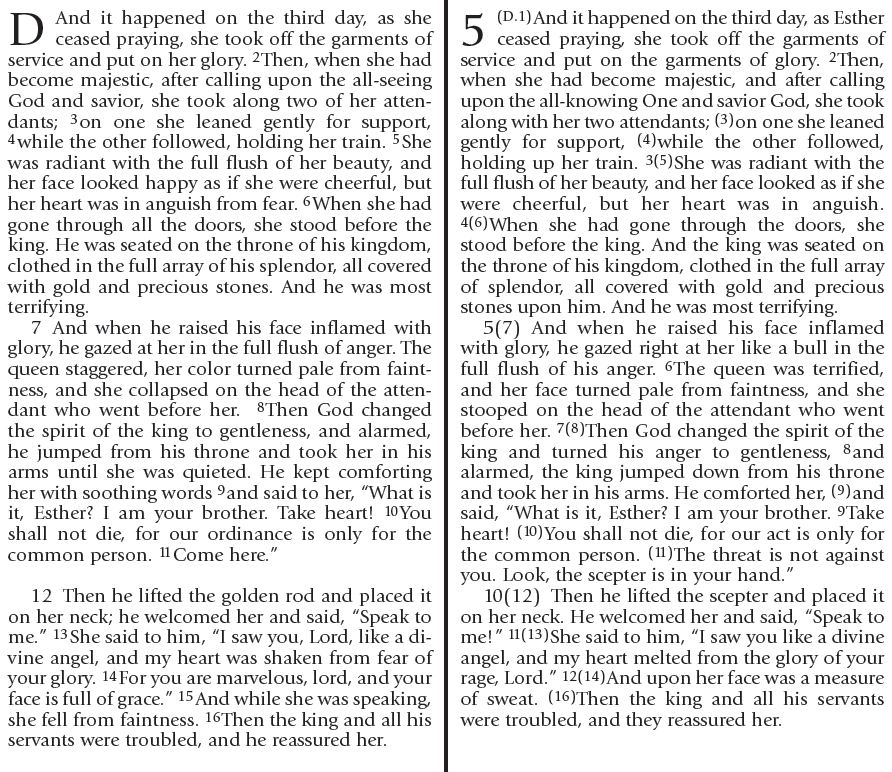
Here again, we have a woman persuading a man. This is comical in Athens, and funny in Jerusalem. She’s changed outfits, taking off what the Lord (and the readers of Addition C) saw, putting off her “garments of service” and putting on those “of glory” with the “full flush of her beauty” for the king. All the sexual overtones change, disappear, finally, at the end. The king’s heart is changed, from his “full flush of anger” – because “God changed the spirit of the king to gentleness.”
This is as fast paced as that scene from Aristophanes’ Frogs (289 – 296, Matthew Dillon’s English rendering); remember the dung? recall the lovely woman? see again the “full flushed fevered face”? notice all of the changes?
Xanthias: O horrible! it takes all kinds of shapes, / Now it’s an ox, and now a mule, and now / A lovely woman.
Dionysus: Where is she? I’ll go meet her.
Xanthias: Wait, now it’s not a woman, but a bitch.
Dionysus: Why, this must be Empusa.
Xanthias: Ah! her whole face burns like fire.
Dionysus: Does she have a leg of bronze?
Xanthias: By Poseidon, yes—and the other is cow dung, / Be sure of it.
Now we turn back to the Greek texts of Esther Addition D. He, the king, not aroused by her; he sees Esther’s appearance but is “alarmed.” He turns to her: “I am your brother,” which we all know makes him an equal and her ineligible for advances. He opens up and wants something from her: “Speak to me!” He’s asking to be persuaded by a woman, by her rhetoric, and so he is. She herself might have been Jacob, wrestling with an angel, changed forever. She grants that he’s like the Lord, “marvelous” and “full of grace” and “like a divine angel.”
The religious and the literary, more and more, come through the Jewish Greek Esther. And what good turns the story takes, for the good, as the changes are made.
Artificial languages for Hollywood … and women?
 Here is a report on a Hollywood artificial language (I have not seen the programs in question, Game of Thrones, but hope to watch them on DVD at some point.)
At his best friend’s wedding reception on the California coast, David J. Peterson stood to deliver his toast as best man. He held his Champagne glass high and shouted “Hajas!” The 50 guests raised their glasses and chanted “Hajas!” in unison.
The word, which means “be strong” and is pronounced “hah-DZHAS,” has great significance for Mr. Peterson. He invented it, along with 3,250 other words (and counting), in the language he created for the HBO fantasy series “Game of Thrones,” called Dothraki.
Some people build model railroads or re-enact Civil War battles; Mr. Peterson, a 30-year-old who studied linguistics at the University of California, San Diego, is a “conlanger,” a person who constructs new languages. Until recently, this mostly quixotic linguistic pursuit, born out of a passion for words and grammatical structures, lived on little-visited Web sites or in college dissertations.
Today, a desire in Hollywood to infuse fantasy and science-fiction movies, television series and video games with a sense of believability is driving demand for constructed languages, complete with grammatical rules, a written alphabet (hieroglyphics are acceptable) and enough vocabulary for basic conversations.
In “Game of Thrones,” Dothraki-speaking characters greet each other by saying “M’athchomaroon!” (hello) give each other commands like “Azzohi haz khogare” (put down that cask) and occasionally utter sentiments like “Vezh fin saja rhaesheseres vo zigereo adoroon shiqethi!” (the stallion that mounts the world has no need for iron chairs!) that don’t seem to make sense in any language. And this being an HBO show, there’s also a fair bit of “athhilezar” (sex).
“The days of aliens spouting gibberish with no grammatical structure are over,” said Paul R. Frommer, professor emeritus of clinical management communication at the University of Southern California who created Na’vi, the language spoken by the giant blue inhabitants of Pandora in “Avatar.” Disney recently hired Mr. Frommer to develop a Martian language called Barsoomian for “John Carter,” a science-fiction movie to arrive in March.
The shift is slowly transforming the obscure hobby of language construction into a viable, albeit rare, career and engaging followers of fantasies like “Lord of the Rings,” “Game of Thrones” and “Avatar” on a more fanatical level.
At “Game of Thrones” viewing parties in San Francisco, fans rewatched Dothraki scenes to study the language in a workshop-like setting. Last October, a group of Na’vi speakers from half a dozen countries convened in Sonoma County, Calif., for a gathering known as “Teach the Teachers.” Mr. Frommer gave attendants tips on grammar and vocabulary and fielded any questions they had about the language. The rural, wooded setting felt “almost like being on Pandora,” he said. At a question-and-answer session in July that he participated in, at least a dozen attendants rattled off their questions in fluent Na’vi….
Several scenes in the first season of “Game of Thrones” take place entirely in Dothraki with English subtitles. In one episode the shirtless tribal leader Khal Drogo delivered a monologue for two and a half minutes in Dothraki, with its subject-verb-object structure and no copula, or linking verb….
There are links to several web sites on artificial languages given in the article: Dothraki and Na’vi. More intriguing is a reference to this (rather sexist) language:
Suzette Haden Elgin created Láaden as a language better suited for expressing women’s points of view. (Láaden has a word, “bala,” that means “I’m angry for a reason but nothing can be done about it.”)
Isaac Asimov’s influence on Newt Gingrich.
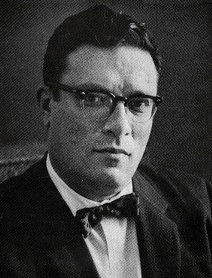
 Here is a fascinating essay by Ray Smock on the influence of Isaac Asimov’s Foundation Trilogy on the thought of Newt Gingrich. Smock was the historian of the House of Representatives from 1983 to 1995, but was fired immediately when Gingrich became House Speaker.
Gingrich has written about Asimov’s influence on him. In his 1996 book To Renew America, Gingrich wrote:
While Toynbee was impressing me with the history of civilizations, Isaac Asimov was shaping my view of the future in equally profound ways….For a high school student who loved history, Asimov’s most exhilarating invention was the ‘psychohistorian’ Hari Seldon. The term does not refer to Freudian analysis but to a kind of probabilistic forecasting of the future of whole civilizations. The premise was that, while you cannot predict individual behavior, you can develop a pretty accurate sense of mass behavior. Pollsters and advertisers now make a good living off the same theory.
Here are some excerpts from Smock’s essay (which is partisan, but interesting):
Trying to figure out Newt Gingrich has become a cottage industry now that he is running for president. He is a self-confessed revolutionary who wants to fundamentally change America. He is ambitious, power hungry, and ruthlessly focused. He is a natural for Washington, where such attributes are both feared and admired. How did Newt get this way? What makes him tick?…
If men are from Mars and women are from Venus, Newt Gingrich is from the planet Trantor, a fictional world created by Isaac Asimov in his classic Foundation series about galactic empire. Newt’s master plan for America does not come from a Republican Party playbook. It comes from the science fiction that he read in high school. He is playing out, on a national and global scale, dreams he had as a teenager with his nose buried in pulp fiction.
Newt is an avid reader of both history and science fiction. About the time he finished reading Arnold Toynbee’s A Study of History, the sweeping story of the entire human race, and Edward Gibbon’s Decline and Fall of the Roman Empire, he discovered Isaac Asimov’s three books Foundation (1951), Foundation and Empire (1952), and Second Foundation (1953). To Newt’s amazement the Foundation series was an inspired version of Gibbon’s Decline and Fall set thousands of years in the future rather than the past. Newt was more fascinated by the fictional decline of an empire of a million planets than he was the real decline of ancient Rome.
Asimov’s fiction had greater sweep than the historical works of Toynbee and Gibbon. To an impressionable young man, the fate of one planet was nothing compared to an entire galaxy of worlds. As one paperback cover of Foundation proclaimed: “In a future century the Galactic Empire dies and one man creates a new force for civilized life.” Newt liked the idea of one man shaping the destiny of entire civilizations. That fictional man, Hari Seldon, was a special breed of historian who frequented a far-off planet called Trantor. Newt found his role model not in his stern stepfather, but in a historian from another planet, a great historian and teacher who thought really big galactic-size thoughts….
Edward Gibbon saw the decline of Rome, Hari Seldon saw the decline of the galactic empire, and Newt Gingrich saw the decline of America. Newt says America’s decline began in the 1960s with liberal hippies and Lyndon Johnson’s Great Society. History and fiction seem more exciting when there is decline. This gives heroes, visionaries, demagogues, and politicians something to fix. People on Planet Earth have different views about exactly what parts of our civilization are in decay. Hari Seldon had the same problem trying to convince a commission on Trantor that things were going sour in the Galactic Empire. Newt learned that Hari Seldon could not save the Galactic Empire from decay but that he could predict its decline. Likewise, Newt alone could not save America from decline, but he could alert people to the decline and find ways to minimize it….
Scribbled in Newt’s own hand are notes he made during a 1992 meeting with a major contributor of GOPAC. He outlined his role as a visionary leader. His “primary mission” was to be an “advocate of civilization”—a “definer of civilization”—the “teacher of the rules of civilization”—and “leader (possibly) of the civilizing forces.” Newt saw his mission as “universal rather than national.”…
Newt Gingrich assumes the mantle of the history professor when it suits the occasion. Other times he plays down his academic background. When in professor mode he likes to recommend books. None carry more weight in understanding his political and personal drive and his strategy to transform America more than the science fiction of Isaac Asimov. The greatest influence on Newt Gingrich, the conservative Republican, was the liberal atheist Isaac Asimov. Many in Newt’s generation, including me, read that stuff with great gusto and fascination. It was marvelous entertainment. Newt saw not just entertainment but a master plan using the Foundation trilogy as his political handbook, a guide to how one man creates a new force for civilized life….

The entire essay is well-worth reading.
Remembering Francesca Woodman
If there is only one thing that you take from this post, I hope it is a recommendation to watch a documentary film, The Woodmans, which is being broadcast in the US on PBS (in most markets, on December 22). I have not yet seen this documentary, but I know something about the underlying story, and I must say that it is a remarkable story.
Francesca Woodman was a brilliant photographer, born into a family of artists, who committed suicide at age 22. Her work has been the subject of numerous exhibitions (a current exhibition is taking place at the San Francisco Museum of Modern Art and the Solomon R. Guggenheim Museum.) She has now been the subject of seven major retrospective catalogues of her work:
- Ann Gabhart, Francesca Woodman : Photographic Work – Wellesley College Museum – April 9 – June 8, 1986.
- Herman Lux, Francesca Woodman: Photographic Works.
- Hervé Chandès, Francesca Woodman.
- Marian Goodman Gallery, Francesca Woodman: Photographs 1975-1980.
- Isabella Pedicini, Francesca Woodman: The Roman Years Between Skin and Film.
- Chris Townsend, Francesca Woodman.
- Corey Keller, Francesca Woodman.
(The last two books are in print, easily available, and excellent).
Her notebook has been republished and a study (that I have not seen) on Francesca Woodman and the Kantian Sublime has appeared.
The blurb for the current SFMOMA/Guggenheim exhibition for Woodman puts it well:
Francesca Woodman (1958-1981) was an artist decisively of her time, yet her photographs retain an undeniable immediacy. Thirty years after her death, they continue to inspire audiences with their dazzling ambiguities and their remarkably rich explorations of self-portraiture and the body in architectural space. This retrospective, the first in the United States in more than two decades, explores the complex body of work produced by the young artist until her suicide at age 22. Together with Woodman’s artist books and videos, the photographs on view form a portrait of an artist engaged with major concerns of her era — femininity and female subjectivity, the nature of photography — but devoted to a distinctive, deeply personal vision.
Here are some of Woodman’s photographs. Woodman’s favorite subject was herself, and all of these are self-portraits.
The first was taken when the artist was 13:

Here is Self-Portrait Talking to Vince:

Here is her Polka Dots:

It seems to me that all of these photographs illustrate the concerns mentioned above, “femininity and female subjectivity [and] the nature of photography.” Many more Woodman photographs can easily be found on the Web. (You can start with an extensive set of links provided in a Wikipedia article on her. I should mention that some of Woodman’s photographs have nudity, and reviewers who are offended should avoid those photographs.)
And again, if these images or Woodman’s story has intrigued you, I encourage you to watch the upcoming PBS special on her.
On the literary merits of Hebrew Esther
Kurk has been discussing the advantages of Greek Esther (here, here, and here). I left a long pair of comments on his most recent post, but I’d like to elevate them to an actual post:
Let me tell you how I first encountered Greek Esther. It was in college, in a secular class on the Bible. We used that venerable Bible studies text; the May-Metzger RSV New Oxford Annotated Bible with the Apocrypha, Expanded Edition. This edition is still in print today, and it taught an entire generation.
In that book, Esther is presented in a translation from the Hebrew, and there is a section in the Apocrypha entitled “The Additions to the Book of Esther – translated in the order of the Greek version of Esther, but with the chapter and verse numbers of the King James Version.”
The notes for this book were by Metzger himself, who wrote:
Some of the Additions were probably introduced by Lysimachus, an Alexandrian Jew who lived at Jerusalem and who translated the canonical book of Esther about 114 BC (11.1) Other Additions appear to have been inserted several years later, either by Lysimachus or by another person.
The purpose of the Additions is partly to make the story more vivid but chiefly to supply a religious element that is lacking in the canonical book of Esther, which never mentions God or religious practices. The Additions make frequent reference to God, emphasize his choice of Abraham and Israel, and give prominence to prayer. They occasionally contradict the canonical book of Esther, and have little or no historical value.
Not a very pretty picture that Metzger paints, is it?
I mostly avoided Greek Esther after then, but sometimes ran into her, such as when Berlin’s commentary was published. From pages xlix – lii, she considers Greek Esther and Josephus; and from pages lii-liv, she considers rabbinic versions.
Now, while Berlin does not come out and say that Greek Esther is inferior to Hebrew Esther, Berlin does put a negative spin on them. In pages xvi-xxii she compares Esther to a classical comedy,
Granting that Esther is an imaginative story, the next question is: What kind of story is it? What best describes the nature of the story and the way it was meant to be read? As shall soon become clearer, it is a comedy, a book meant to be funny, to provoke laughter. The Book of Esther is the most humorous of the books in the bible, amusing throughout and at certain points uproariously funny.
(p. xvii)
Berlin more specifically describes Esther as farce, which she defines, quoting a standard dictionary of literary terms as
a type of comedy designed to provoke the audience to simple, hearty laughter…. To do so it employs highly exaggerated or caricatured character types, puts them into impossible and ludicrous situations, and makes free use of broad verbal humor and physical horseplay.
(p. xix)
Berlin gives many examples, of which these are only a few:
It cannot escape the reader that there are a lot of parties in the story — ten altogether.
(p. xxiv)
The physical movement of the characters keeps the story moving, quickening its tempo. This fast tempo is characteristic of farce, and it has the effect of making the actions seem abstract and automatic, and consequently less real.
(p. xxvi)
When it comes to the language of Esther, the medium is the message. The language, like the story, is full of exaggeration and contributes to the sense of excess. There are exaggerated numbers (127 provinces, a 180-day party, a 12-month beauty preparation, Haman’s offer of 10,000 talents, a stake 50 cubits high, 75,000 enemy dead) and long lists of unpronounceable names (the enuchs, the advisors, the sons of Haman). The language is flowery (“What is your wish? It shall be granted to you. And what is your request? Even up to half of the kingdom, it shall be fulfilled”). Also the syntax is bulky, with many relative clauses intervening (“If of Jewish stock is Mordecai, before whom you have begun to fall, you will not overcome him; you will surely fall before him.”) The rule for vocabulary, as for drinking, seems to be ‘the more the better.’ There are lots of “alls” (“all the people who lived in the fortress of Shushan,” “ever palace steward,””‘all the provinces,” “all the women,” “all the Jews,” “all the king’s servants”) and the story never uses one word if can use two.
(p. xxvii)
So how does Berlin characterize the Greek versions (and Josephus)? Well, to put it bluntly, it is a lot less funny.
The Greek versions, especially the Septuagint, have a different tone and reflect a different view of the Jewish characters from the Masoretic Text. David Clines, who believes that the religious elements were originally absent and were added in the Septuagint, has perceptively argued that the Septuagint added the religious dimension in order to “assimilate the Book of Esther to a scriptural norm.”
(p. l)
On occasion, [the Septuagint] seems to move in the direction of the style of the later Greek novels, with emotional and psychological dimensions that are absent in the Masoretic Text…. This is the stuff of Greek romances (and modern ones, too), and it is in utter contrast to the sparseness of the Masoretic Text at this point in the story.
(p. li).
So, the element of farce is decreased. The characters are more humanized; the pace is slowed down; and the story becomes laden with excessive piety, making the reader who laughs feel a bit guilty.
In contrast, the rabbinic interpretations often increased the element of farce.
The Rabbis did not shy away from making prurient comments, which add to the negative characterization of the “villains” (and to the lewd enjoyment of the story): Vashti’s party for the women was in the king’s bedroom; she was ordered to appear naked before the king; and she was to be executed naked; Haman’s daughter dumped the contents of a chamber pot on her father’s head.
(p. liv)
She gives an elaborate example later on that page and concludes
In the scene that the midrash constructs, Haman is a greater villain and fool than in the biblical study, and is degraded even more…. The midrash is funny in its own way and has its own type of bodily humor. It is carnivalesque in its own right — a fitting complement to the carnivalesque story that it interprets.
(p. liv)
Indeed, the midrashim so impress Berlin that she goes out of the way to weave it into her commentary.
Selections from the midrashim are interspersed throughout the commentary that follows. They obviously do not reflect the plain sense of the biblical story, but they enrich the reading of the story in an imaginative way.
(p. liv)
Kurk has argued above that Greek Esther is more of Athens than of Jerusalem, but I think Greek Esther is not a remarkable text; rather it is yet another maudlin Greek text. In contrast, Hebrew Esther is most close to pure Greek comedy — and can stand on its own with the classics. This fact was certainly not lost on the interpreters of late antiquity, who wrote midrashim that brought out the comic element even more. To me, the most authentically Jewish works on the subjects are less influenced by the Hellenistic desire to write Biblical pastiche or emulate foreign character development approaches, and instead responded to the bawdiness of the original text, and took it up several notches. And those midrashim are still funny today.
If tonight is a silent film festival, which movie would you select? Would you pick a Buster Keaton film or an Ernst Lubitsch film? Comedy or melodrama?
Ἐσθὴρ: An Open Window Onto the Jewish Bible
Addition C, which follows 4:17, is the prayer of Mordecai and the prayer of Esther, asking for deliverance…. As more and more scholars are coming to see, the early fluidity of the Hebrew text and the variety of ways that the story was retold, in Hebrew or other languages, belong to the history of early Jewish biblical interpretation. The Septuagint is a window onto how Greek-speaking Jews of the early pre-Christian centuries read and understood the story of Esther.
— Adele Berlin, The JPS Bible Commentary: Esther אסתר
Buch der Maccabcier … Ich bin dem Buch und Esther so feind daß ich wollte sie wären gar nicht oorhanden denn sie judenzen zu sehr und haben siel heidnische Unart … Die Juden halten vom Buch Esther mehr denn von irgend einem Propheten den Propheten Daniel and Jesaiam verachten sie … die Juden dieser zweier heiligen Propheten herrlichste Weissagung verachten da doch der eine Christum aufs Allerreich ichst und Reinest lehret und prediget der andere iber die Monarchien und Kaiserthum sampt dem eich Christi aufs Allergewissefte abmalt und be chreibt…. Indessen ist es doch erschrecklich, daß das Buch Esther bei den Juden in größerem Ansehen steht als Jesaias oder….
— Martin Luther
In his volumes (i.e., Sämtliche Werke), the Prostestant Christian reformer, Martin Luther, does not say whether he regards the Greek translations of the Book of Esther as biblical. But he does make clear that, in whatever language, he wants the Book of Esther out of the Bible because presumably Jewish people value it so highly, and they value it, he says, more than the Books of the Prophets, which, he says, point to the Christian Christ. So here we do have a point of agreement, a small agreement, between Luther and Adele Berlin: they both acknowledge the Jewish biblical importance of Esther.
In her Introduction to the JPS commentary on Esther, Berlin goes further. She asserts that the Jewish biblical importance of Esther extends to the Greek additions to the book. And she invites readers to open up the window of Addition C in particular to find particularly Jewish interpretations of the scriptures.
This post is a follow up to an earlier one that focused only on smaller additions to the Hebrew Bible made by the Jewish translators using Greek. Here we present all of the Old Greek Addition C, which was not part of the Hebrew text at all (as far as we can tell). Again, I’m giving you the NRSV English translation of the Greek, but you’ll see the Old Greek, verse by verse, following that. The only other comment I want to make is one that Karen Jobes makes when translating both the Old Greek and the Alpha Text Greek for the New English Septuagint Translation; Jobes says:
“Moreover, addition C shows influence from the Greek translation of Moyses’ intercessory prayer in Deut 9.26 LXX.”
Here’s the NRSV English translation of the Old Greek Addition C:
Then Mordecai prayed to the Lord, calling to remembrance all the works of the Lord.
καὶ ἐδεήθη κυρίου μνημονεύων πάντα τὰ ἔργα Κυρίου,
He said: “O Lord, Lord, you rule as King over all things, for the universe is in your power
καὶ εἶπεν Κύριε κύριε βασιλεῦ πάντων κρατῶν, ὅτι ἐν ἐξουσίᾳ σου τὸ πᾶν ἐστιν,
and there is no one who can oppose you when it is your will to save Israel.
καὶ οὐκ ἔστιν ὁ ἀντιδοξῶν σοι ἐν τῷ θέλειν σε σῶσαι τὸν Ισραηλ·
for you have made heaven and earth and every wonderful thing under heaven.
ὅτι σὺ ἐποίησας τὸν οὐρανὸν καὶ τὴν γῆν καὶ πᾶν θαυμαζόμενον ἐν τῇ ὑπ’ οὐρανὸν,
You are Lord of all, and there is no one who can resist you, the Lord.
καὶ κύριος εἶ πάντων, καὶ οὐκ ἔστιν ὃς ἀντιτάξεταί σοι τῷ κυρίῳ.
You know all things;
σὺ πάντα γινώσκεις·
you know, O Lord,
σὺ οἶδας, κύριε,
that it was not in insolence or pride
ὅτι οὐκ ἐν ὕβρει οὐδὲ ἐν ὑπερηφανίᾳ
or for any love of glory that I did this,
οὐδὲ ἐν φιλοδοξίᾳ ἐποίησα τοῦτο,
and refused to bow down to this proud Haman;
τὸ μὴ προσκυνεῖν τὸν ὑπερήφανον Αμαν,
for I would have been willing to kiss the soles of his feet, to save Israel!
ὅτι ηὐδόκουν φιλεῖν πέλματα ποδῶν αὐτοῦ πρὸς σωτηρίαν Ισραηλ·
But I did this so that I might not set human glory above the glory of God,
ἀλλὰ ἐποίησα τοῦτο, ἵνα μὴ θῶ δόξαν ἀνθρώπου ὑπεράνω δόξης θεοῦ,
and I will not bow down to any one but to you, who art my Lord;
καὶ οὐ προσκυνήσω οὐδένα πλὴν σοῦ τοῦ κυρίου μου
and I will not do these things in pride.
καὶ οὐ ποιήσω αὐτὰ ἐν ὑπερηφανίᾳ.
And now, O Lord God and King, God of Abraham, spare your people;
καὶ νῦν, κύριε ὁ θεὸς ὁ βασιλεὺς ὁ θεὸς Αβρααμ, φεῖσαι τοῦ λαοῦ σου,
for the eyes of our foes are upon us to annihilate us,
ὅτι ἐπιβλέπουσιν ἡμῖν εἰς καταφθορὰν
and they desire to destroy the inheritance that has been yours from the beginning.
καὶ ἐπεθύμησαν ἀπολέσαι τὴν ἐξ ἀρχῆς κληρονομίαν σου
Do not neglect your portion, which you redeemed for yourself out of the land of Egypt.
μὴ ὑπερίδῃς τὴν μερίδα σου, ἣν σεαυτῷ ἐλυτρώσω ἐκ γῆς Αἰγύπτου·
Hear my prayer, and have mercy upon your inheritance; turn our mourning into feasting,
ἐπάκουσον τῆς δεήσεώς μου καὶ ἱλάσθητι τῷ κλήρῳ σου καὶ στρέψον τὸ πένθος ἡμῶν εἰς εὐωχίαν,
that we may live and sing praise to your name, O Lord;
ἵνα ζῶντες ὑμνῶμέν σου τὸ ὄνομα, κύριε,
do not destroy the lips of those who praise you.”
καὶ μὴ ἀφανίσῃς στόμα αἰνούντων σοι. –
And all Israel cried out mightily,
καὶ πᾶς Ισραηλ ἐκέκραξαν ἐξ ἰσχύος αὐτῶν,
for their death was before their eyes.
ὅτι θάνατος αὐτῶν ἐν ὀφθαλμοῖς αὐτῶν.
Then Queen Esther, seized with deathly anxiety, fled to the Lord.
Καὶ Εσθηρ ἡ βασίλισσα κατέφυγεν ἐπὶ τὸν κύριον ἐν ἀγῶνι θανάτου κατειλημμένη
She took off her splendid apparel and put on the garments of distress and mourning,
καὶ ἀφελομένη τὰ ἱμάτια τῆς δόξης αὐτῆς ἐνεδύσατο ἱμάτια στενοχωρίας καὶ πένθους
and instead of costly perfumes she covered her head with ashes and dung,
καὶ ἀντὶ τῶν ὑπερηφάνων ἡδυσμάτων σποδοῦ καὶ κοπριῶν ἔπλησεν τὴν κεφαλὴν αὐτῆς
and she utterly humbled her body;
καὶ τὸ σῶμα αὐτῆς ἐταπείνωσεν σφόδρα
every part that she loved to adorn she covered with her tangled hair.
καὶ πάντα τόπον κόσμου ἀγαλλιάματος αὐτῆς ἔπλησε στρεπτῶν τριχῶν αὐτῆς
She prayed to the Lord God of Israel, and said:
καὶ ἐδεῖτο κυρίου θεοῦ Ισραηλ καὶ εἶπεν
“O my Lord, you only are our King;
Κύριέ μου, ὁ βασιλεὺς ἡμῶν, σὺ εἶ μόνος·
help me, who am alone
βοήθησόν μοι τῇ μόνῃ
and have no helper but you,
καὶ μὴ ἐχούσῃ βοηθὸν εἰ μὴ σέ,
for my danger is in my hand.
ὅτι κίνδυνός μου ἐν χειρί μου.
Ever since I was born I have heard in the tribe of my family
ἐγὼ ἤκουον ἐκ γενετῆς μου ἐν φυλῇ πατριᾶς μου
that you, O Lord, took Israel out of all the nations,
ὅτι σύ, κύριε, ἔλαβες τὸν Ισραηλ ἐκ πάντων τῶν ἐθνῶν
and our fathers from among all their ancestors,
καὶ τοὺς πατέρας ἡμῶν ἐκ πάντων τῶν προγόνων αὐτῶν
for an everlasting inheritance,
εἰς κληρονομίαν αἰώνιον
and that you did for them all that you promised.
καὶ ἐποίησας αὐτοῖς ὅσα ἐλάλησας.
And now we have sinned before you,
καὶ νῦν ἡμάρτομεν ἐνώπιόν σου,
and you have handed us over to our enemies,
καὶ παρέδωκας ἡμᾶς εἰς χεῖρας τῶν ἐχθρῶν ἡμῶν,
because we glorified their gods.
ἀνθ’ ὧν ἐδοξάσαμεν τοὺς θεοὺς αὐτῶν·
You are righteous, O Lord!
δίκαιος εἶ, Κύριε.
And now they are not satisfied that we are in bitter slavery,
καὶ νῦν οὐχ ἱκανώθησαν ἐν πικρασμῷ δουλείας ἡμῶν,
but they have covenanted with their idols
ἀλλὰ ἔθηκαν τὰς χεῖρας αὐτῶν ἐπὶ τὰς χεῖρας τῶν εἰδώλων αὐτῶν,
to abolish what your mouth has ordained
ἐξᾶραι ὁρισμὸν στόματός σου
and to destroy your inheritance,
καὶ ἀφανίσαι κληρονομίαν σου
to stop the mouths of those who praise you
καὶ ἐμφράξαι στόμα αἰνούντων σοι
and to quench your altar and the glory of your house,
καὶ σβέσαι δόξαν οἴκου σου καὶ θυσιαστήριόν σου
to open the mouths of the nations for the praise of vain idols,
καὶ ἀνοῖξαι στόμα ἐθνῶν εἰς ἀρετὰς ματαίων
and to magnify forever a mortal king.
καὶ θαυμασθῆναι βασιλέα σάρκινον εἰς αἰῶνα.
O Lord, do not surrender your scepter to what has no being;
μὴ παραδῷς, κύριε, τὸ σκῆπτρόν σου τοῖς μὴ οὖσιν,
and do not let them mock at our downfall;
καὶ μὴ καταγελασάτωσαν ἐν τῇ πτώσει ἡμῶν,
but turn their plan against themselves,
ἀλλὰ στρέψον τὴν βουλὴν αὐτῶν ἐπ’ αὐτούς,
and make an example of the man who began this against us.
τὸν δὲ ἀρξάμενον ἐφ’ ἡμᾶς παραδειγμάτισον.
Remember, O Lord; make yourself known in this time of our affliction,
μνήσθητι, κύριε, γνώσθητι ἐν καιρῷ θλίψεως ἡμῶν
and give me courage, O King of the gods and Master of all dominion!
καὶ ἐμὲ θάρσυνον, βασιλεῦ τῶν θεῶν καὶ πάσης ἀρχῆς ἐπικρατῶν·
Put eloquent speech in my mouth before the lion,
δὸς λόγον εὔρυθμον εἰς τὸ στόμα μου ἐνώπιον τοῦ λέοντος
and turn his heart to hate the man who is fighting against us,
καὶ μετάθες τὴν καρδίαν αὐτοῦ εἰς μῖσος τοῦ πολεμοῦντος ἡμᾶς
so that there may be an end of him and those who agree with him.
εἰς συντέλειαν αὐτοῦ καὶ τῶν ὁμονοούντων αὐτῷ·
But save us by your hand,
ἡμᾶς δὲ ῥῦσαι ἐν χειρί σου
and help me, who am alone and have no helper but you, O Lord.
καὶ βοήθησόν μοι τῇ μόνῃ καὶ μὴ ἐχούσῃ εἰ μὴ σέ, κύριε.
You have knowledge of all things;
πάντων γνῶσιν ἔχεις
and you know that I hate the splendor of the wicked
καὶ οἶδας ὅτι ἐμίσησα δόξαν ἀνόμων
and abhor the bed of the uncircumcised and of any alien.
καὶ βδελύσσομαι κοίτην ἀπεριτμήτων καὶ παντὸς ἀλλοτρίου.
You know my necessity –
σὺ οἶδας τὴν ἀνάγκην μου,
that I abhor the sign of my proud position,
ὅτι βδελύσσομαι τὸ σημεῖον τῆς ὑπερηφανίας μου,
which is upon my head on the days when I appear in public.
ὅ ἐστιν ἐπὶ τῆς κεφαλῆς μου ἐν ἡμέραις ὀπτασίας μου·
I abhor it like a menstruous rag,
βδελύσσομαι αὐτὸ ὡς ῥάκος καταμηνίων
and I do not wear it on the days when I am at leisure.
καὶ οὐ φορῶ αὐτὸ ἐν ἡμέραις ἡσυχίας μου.
And your servant has not eaten at Haman’s table,
καὶ οὐκ ἔφαγεν ἡ δούλη σου τράπεζαν Αμαν
and I have not honored the king’s feast or drunk the wine of the libations.
καὶ οὐκ ἐδόξασα συμπόσιον βασιλέως οὐδὲ ἔπιον οἶνον σπονδῶν·
Your servant has had no joy since the day that I was brought here until now,
καὶ οὐκ ηὐφράνθη ἡ δούλη σου ἀφ’ ἡμέρας μεταβολῆς μου μέχρι νῦν πλὴν
except in you, O Lord God of Abraham.
ἐπὶ σοί, κύριε ὁ θεὸς Αβρααμ.
O God, whose might is over all, hear the voice of the despairing,
ὁ θεὸς ὁ ἰσχύων ἐπὶ πάντας, εἰσάκουσον φωνὴν ἀπηλπισμένων
and save us from the hands of evildoers.
καὶ ῥῦσαι ἡμᾶς ἐκ χειρὸς τῶν πονηρευομένων·
And save me from my fear!”
καὶ ῥῦσαί με ἐκ τοῦ φόβου μου.
Doug Groothuis’s harsh book review
 Nigel Warburton (Open University) is a well known author of several philosophy textbooks. His latest book is the completely charming A Little History of Philosophy, published by Yale University Press, and intended for teenagers.
Here is the entirety of what Nigel Warburton said about Bertrand Russell and the so-called “cosmological argument” (p. 185) – note that this is just a half page of a 260 page book.
Bertrand’s non-religious “godfather” was the the philosopher John Stuart Mill (the subject of Chapter 24). Sadly, he never got to know him as Mill died when Russell was still a toddler. Reading Mill’s Autobiography (1873) was what led Russell to reject God. He had previously believed the First Cause Argument. This is the argument, used by Thomas Aquinas amongst others, that everything must have a cause; and the cause of everything, the very first cause in the chain of cause and effect, must be God. But Mill asked the question, “What caused God?” and Russell saw the logical problem for the First Cause Argument. If there is one thing that doesn’t have a cause then it can’t be true that “Everything has a cause.” It made more sense to Russell to think that even God had a cause rather than believe that something could just exist without being cause by anything else.
 Note that Warburton’s description of Russell’s thought is neutral. Warburton does not praise nor criticize Russell in this paragraph.
However, one Doug Groothuis of Denver Seminary was apparently upset that Warburton even mentioned Bertrand Russell. Groothuis had such a strong reaction that he decided Warburton’s book had minimal value, and he posted the following review on Amazon (giving Warburton the lowest possible ranking, one star):
The author, a secularist, does not bother to treat philosophical arguments for God’s existence seriously. For example, he lauds Bertrand Russell’s attack on the cosmological argument (p. 185) when, in fact, Russell created a straw man. In "Why I am Not a Christian," Russell says that cosmological arguments all fail because they depend on this premise:
P1: Everything that exists has a cause
Or order to reach this conclusion along with one more premise:
P2: The universe exists.
————-
C1: Therefore, the universe has a cause (God)But Russell claims that C1 (God) would be subject to P1. God would require a cause for God’s existence. If so, the argument fails.
This is absurd because I have never read a version of the cosmological argument (in 35 years of studying and teaching and writing about philosophy of religion) that used this argument premise. Of course, P1 will defeat a cosmological argument, but no one uses it!
For example, the kalam cosmological argument reasons this way:
P1: What every begins to exist, has a cause of its existence.
P2: The universe began to exist.
———–
C1: Therefore, the universe has a cause (God).Notice that the kalam’s P1 differs radically from Russell’s version: "Everything that exists has a cause." God, of course, did not (by definition) begin to exist, so is not subject requiring a beginning cause for God’s existence. In order words, there is no reductio ad absurdum. Neither do the Thomistic or the Lebinizian cosmological arguments rely on Russell’s manufactured premise.
One could go on about the cosmological argument (I devote 30 pages to it in my book, Christian Apologetics), but suffice to say that this book does not bother to critique the argument at its best, only at its worst.
That is a very bad sign indeed, but I find that many British secular philosophers are often dismissive of philosophical theism. Shame on them.
Wow. This Groothuis fellow has quite a temper. Not only is Warburton condemned, so are all the (secular) philosophers on his island. Groothuis even reposted his harsh review on his blob.
There is a subsequent discussion in the comments to his Amazon review in which Groothuis, again, pushes his book, Christian Apologetics. (As you read, in his original review, Groothuis claims that he devotes 30 pages to the argument in that book, but in the comments somehow Groothuis expands his claim to say that he has “answers to all this” in “hundreds of pages” in that same book.)
This is one of those book reviews that tells much more about the reviewer than about the book.
Equal means


 BLT
BLT 