A meme in the making: PayPal orders rare violin destruction
We are watching a meme being created before our very eyes.

The story begin yesterday at Regretsy with this letter from a reader:
I love your site and was thrilled to hear of your “win” against PayPal. I recently had a heartbreaking experience of my own with them.
I sold an old French violin to a buyer in Canada, and the buyer disputed the label.
This is not uncommon. In the violin market, labels often mean little and there is often disagreement over them. Some of the most expensive violins in the world have disputed labels, but they are works of art nonetheless.
Rather than have the violin returned to me, PayPal made the buyer DESTROY the violin in order to get his money back. They somehow deemed the violin as “counterfeit” even though there is no such thing in the violin world.
The buyer was proud of himself, so he sent me a photo of the destroyed violin.
I am now out a violin that made it through WWII as well as $2500. This is of course, upsetting. But my main goal in writing to you is to prevent PayPal from ordering the destruction of violins and other antiquities that they know nothing about. It is beyond me why PayPal simply didn’t have the violin returned to me.
I spoke on the phone to numerous reps from PayPal who 100% defended their action and gave me the party line.
Now the story has been picked up The Guardian, CBS, Daily Mail, QMI, The Mirror, Gizmodo, Boing Boing, and others. Look for Web saturation by tomorrow.
However, I do not think that this is the top web story of the day so far. I would give that honor to the new 50 pence coin in Britain that attempts to explains the offside rule in soccer.

Whose Impossible? Mine, Yours, Theirs?
So if you know the third verse of the national anthem of the United States of America, which is not only war-mongering but also mocks the British, then you show yourself to be a spy for the Nazis — read Theophrastus’s immediately preceding post for details. And if you pronounce the Belgian Hergé’s Tintin as “Tinn Tinn,” as Steven Spielberg does, then you may sound more Flemish than French and surely more English or American — see this Theophrastus post.
Since we’re reviewing the language of empires and of French and English, then I’d like to repost something from another blog of mine. It’s something Napoleon reportedly said in English, or was that French? Here’s the post:
Impossible n’est pas français
The French proverb that is the title of this post is both English and French, or is it just French?:
“Impossible n’est pas français”
It’s funny of course. Because the English is French and the French English. The lore is that Napoleon said it — see what “Bruno says” here from Petit dictionnaire des expressions nées de l’histoire. And the fact is that in 1899, the women of the “International Conference of Women” wrote “Si le mot impossible n’est pas français, il est encore moins féminin” to make the English-French possible as something women can do (i.e., “the impossible”).
Translators rendering the phrase in English tend not only to offer a literal expression of the French but also to provide a comparable English parable proverb as if that’s translation. “Impossible isn’t French,” is the literal. “There is no such word as can’t,” is the non-French English translation. (By my adding italics, there’s another layer of silent meaning that doesn’t come across when the translations are read aloud — in other words, the italicized words signal to the reader “this is the word as a word.” But the reader speaking the sentences can’t signal this meaning by voice).
You may have seen my earlier posts today on the translating Hélène Cixous. I’m particularly interested in some of the questions and statements there. And then I’ll end this post with some questions for me, and for you too. The bits I want to quote again here are these:
We are reminded here of Derrida’s question: can the process of transfer between texts already written in a plurality of tongues still be called translation? How to translate a text which is already infected by the multiplicity of language (Graham 1985:215)?
all languages are translations. The moment I write, I translate. I translate what I feel in this or that language, which I am going to destabilize. The encounters of my emotions in my thought with the French language, for instance, is going to de-French and re-French French — to free French… Of course the translator has to be a great poet and also a kind of mathematician of an equivalent order to displace the original to its next of kin
So here are my questions:
1. Isn’t the English-French proverb like much of the Bible, a mixture of language, of translation already? Is the process of bible translation, then, really “translation”? Does it “stabilize” meanings the way many hope translation will?
2. Which is the better English translation of the French proverb above here, after all the explaining? Is it the literal which ignores the “natural English” contexts and proverb? Or is it the English idiomatic translation which ignores the not-French English word now as French?
3. And in translating the proverb can you do even better? Can’t you? Impossible?
“No Refuge Could Save”
In Kurk’s post immediately preceding this one, he links to a newspaper article which quotes a survey claiming that 75% of the respondents didn’t know the words to “Auld Lang Syne.”
I suspect that the survey was not scientific. I am particularly skeptical that 25% of respondents could actually quote:
We twa hae run about the braes,
and pu’d the gowans fine ;
but we’ve wander’d mony a weary fit,
sin auld lang syne.
I remember a cute short story by Isaac Asimov, “No Refuge Could Save” (originally entitled “To Spot a Spy.”) Asimov turns an old World War II movie cliché on its head: the idea of ferreting out German spies by asking them “American” questions (e.g., about baseball, or the words of the national anthem.) In the story, intelligence operative Griswold is questioning a suspected spy, and Griswold asks to play a word association game. Griswold says “terror of flight” and the suspect replies “gloom of the grave.” This is proof that the subject is a spy who was trained abroad in “Americanisms,” since no one raised in the US would know the third stanza of the National Anthem (except for Griswold, who claims to know everything.) Asimov has Griswold point out that the third stanza of the National Anthem, which openly mocks the British, was particularly likely to be omitted during the “great peace-loving years of 1941 to 1945.”
I wonder how many Americans know the National Anthem. It is clear that at least one prominent American has repeatedly demonstrated that she cannot remember its words.
Whose Auld Lang Syne? Mine, Yours, Theirs?
Around this time every year, it seems that there’s new news about the song, “Auld Lang Syne.” But it turns out (and it turns out rather fittingly given what we think the song is being sung about) the news is old. For example, here are a couple of recycled topics this year:
1. “‘Auld Lang Syne’: New Year’s song has a convoluted history”
2. “Happy new year: Three-quarters of us don’t know the words to Auld Lang Syne”
Here are the questions that we hear asked and answered annually: Who wrote the poem? Which version? Who wrote the tune? Which one? What do the words really mean? Did they mean something different from what we know them to signify now? Can we just resolve to learn them this year after all? (The wikipediaists have done a fair job of gathering much of this information into one place, with web links to send us inquirers off on rabbit trails of history.)
What fascinates me more than the origin and the etymologies of the song is who claims it. For example, the Scots at http://www.scotland.org seem rightly to claim:
a. “Auld Lang Syne is one of Scotland’s gifts to the world.”
And the wikipediaists (again) note other traditions, such as national traditions:
b. “In the English speaking world” (i.e., in Canada, in Great Britain, in the USA)
c. “In non-English speaking countries” (i.e., in Belgium, in Chile, in China, in Denmark, in Finland, in France, in Greece, in Hungary, in Korea, in the Netherlands, in Peru, in Poland, in Taiwan, in Thailand, in Sudan, in Zimbabwe)
And it seems every musician and /or filmmaker wants to make it her own, or his own; here is just:
d. the “Top Ten ‘Auld Lang Syne’ videos for 2011”
One of the Top Ten is Ludwig van Beethoven’s old rendition for this new year again:
There are even non-Scottish religious appropriations of the songs and the poems (that have nothing to do with Robert Ayton [1570–1638] or Allan Ramsay [1686–1757] or Robert Burns [1759 – 1796] or James Watson [a contemporary of Ramsay and Burns]). For example, there are these religious but not Scottish remakings of the song:
e. by Amos Sutton, a Christian missionary of the American Sunday School Union, who in 1833 made the song into a hymn.
f. by Daniel Whyte III, a Christian minister and writer, likewise, in 2010, who made this — “Happy New Year Song ‘Auld Lang Syne’ Recreated for Christians”
g. by Rabbi Alex, of Temple Sinai – A Reconstructionist Synagogue in Buffalo, NY, USA, gives one of his “Torah Tidbits” on the web, that makes connections from Robert Burns to Guy Lombardo to a “custom of crossing hands” to “a very powerful ritual from the Joseph story” to see that it is “to trip us up, to make us aware as we head into the New Year that we should expect the unexpected” to “the ultimate message of the book of Genesis.”
So whose is Auld Lang Syne? Somebody else’s? Mine, Yours, Theirs? Ours together? In different ways, new ways, old ways, similar ways, ways we all understand, ways we’ve forgotten but talk about remembering every year?
Bang on a Can’s new album for free
 The contemporary classical music group Bang on a Can is giving away their 25th anniversary double album Big Beautiful Dark and Scary for free through January 25th at bangonacan25.org. I’ve only just started listening to it, but it sounds excellent.
You are asked to contribute a memory for their electronic scrapbook (so you may want to just use your first name).
The Junia Evidence: IX what the trial lawyer said
In my most recent post I thought about how Sherlock Holmes’ dictum, “when you have eliminated the impossible, whatever remains, however improbable, must be the truth” is useful. And today I noticed a post which forms a relevant next comment. Because, after all, is the Bible a murder mystery? An enigma, a puzzle to be solved?
At Cognitive Discopants, the blogger asks,
What people really want is an approach to Scripture that makes the Bible seem like a puzzle book with “Jabez Prayer”-like secrets waiting to be unlocked by the newest hermeneutical Evel Knievel.
That’s the thing! Is the Bible just waiting for us to dig up new data on Junia two millenia later? Has the truth on women in the Bible been hidden for 2ooo years, just awaiting a Sherlock Holmes of the 21st century, or maybe just an Evel Knievel? Junia has tried the patience of some, and we are ready to return to the King James Version, the Vulgate, whatever would rescue us from the Swiss army knife of Bible translation. Let us read the Bible as it comes to us, and live with the contradictions we are presented with, rather than reconfiguring the Greek language to shoe horn in some favourite interpretation, like the ugly step sister cutting off her big toe.
Here is one blogger who has seen too many permutations on Junia,who feels perhaps that she has become a pereptual choose-your-own-ending drama,
The complementarians like to shift their footings when it comes to Junia. They want to find some argument on which they can stand to diminish the significance of the woman [Junia].
First, they argued she wasn’t a woman (Junia) but a man (Junias). The evidence disproved them so thoroughly even they gave in (or most of them gave in) and so they shifted to another footing to stand their argument on…
Second, they argued she wasn’t an apostle. Don’t forget this: The only reason males in the history of the church, and the motive seems to be to diminish women leaders in the church, changed the woman Junia to the man Junias was because whoever it was was an apostle. So the complementarians decided to show she wasn’t an apostle: she’s a woman alright, but only esteemed among the (male-only college of) apostles and not an apostle herself. Then that got disproven, and Eldon Epp’s long section in his book shows that this argument that Junia was only esteemed by the apostles but wasn’t an apostle herself can’t be relied on with rigor. So they shifted to another footing…
Third, they argued she was an apostle only in conjunction with her male (probably) husband. This one just didn’t work because she’s still called an “apostle” — a pair of apostles still makes her an apostle. So they shifted to another footing…
Fourth, they now are arguing that “apostle” really doesn’t mean “apostle” — it really means “missionary,” and we all know a “missionary” isn’t what an apostle is. So we don’t have to worry about women leaders, because Junia was just a missionary. To be sure, the word “apostle” undoubtedly has a narrow meaning (the twelve, Paul, etc) and it has a broader meaning (church-planting, founding, missionary). It still means “apostle” (one sent by Christ) and not only that — this term describes the highest office for the first century Christians. And Junia is in that small and highly esteemed circle.
Really, though, we are back to the major issue: she’s a woman; she’s an apostle; and she may have been a missionary kind of apostle .. but don’t forget what Paul says — she was a great apostle/missionary.
What’s next? Will “great” now be diminished too? Will this all be seen as tongue-in-cheek by the apostle?
This gets tiresome. Let the Bible say what it says. Junia was a woman; she was an apostle; she was a great apostle. Give the woman a break and give her a big clap! Saint Chrysostom surely did.
The question to ask when evaluating someone for leadership in the local church is not “Man or woman?” but “What has God gifted this person — man or woman — to do?”
Do I have a witness?
Junia is not alone
Junia Is a Woman, and I Am a Complementarian
Denny Burk’s Complementarian Cover-up
The Junia Evidence: I
The Junia Evidence: II
The Junia Evidence: III
The Junia Evidence: IV
The Junia Evidence: V
The Junia Evidence: VI and the reliability of software
The Junia Evidence: VII and Syriac as commentary
The Junia Evidence: VII what Sherlock Holmes had to say
Was Junia Really An Apostle by Burer and Wallace
Linda Belleville’s article
Michael Burer Enters the Junia Debate
Junia: The First Woman Apostle by Eldon Jay Epp
Reassessing Junia: A Review of Eldon Epp’s Junia: The First Woman Apostle
Due Diligence on Junia and Apostleship
Matt Colvin on Junia and Apostleship
Some Lengthy Thoughts on Women’s Leadership
A Closer Examination of Junia, The Female Apostle
Remembering Mauthausen
Theophrastus wrote about remembering Mauthausen, so I want to respond with how I have remembered Mauthausen over the last few weeks. I have just finished reading these three books by Canadian authors which nourish the memory of those lost in concentration camps and killing fields.
In The Far Side of the Sky, a new novel by Daniel Kalla, the main characters, Viennese Jews, lose friends and relatives to Mauthausen before escaping to Shanghai, where they once again risk annhilation when Japanese troops enter the city. The action moves from Kristallnacht in Vienna to the massacre of Nanjing. The characters are appealing, all dealing with the difficulties of biracial identity, lost family members and forming new relationships in midlife. We cheer them on, even though Kalla’s prose does not do justice to the inner self. In fact, I almost put this book down, but when the action moved into the operating room, I became fully engaged, and enjoyed every minute thereafter of the plot-driven historical drama. No wonder, Daniel Kalla is a Vancouver emergency room doctor and writes about what he knows with satisfying clarity.
In Half Blood Blues, by Esi Edugyan, a Victoria, B.C. writer, the main character, Hiero, ends up in Mauthausen, “The very name of it gives you the shivers.”
In 1939 Berlin, Sid Griffiths, an African-American bass player, and his friend, Chip Jones, belong to a popular jazz band. Composed of African-American and German musicians, the Hot Time Swingers play the city’s clubs and cabarets. Eventually, Hieronymous Falk, a brilliant Afro-German trumpeter, joins the ensemble. He is the son of a French African soldier and a white German mother, a member of a despised population known as the Rhineland bastards. As the Nazi threat grows, Hiero’s racial heritage places him in constant danger. To make matters worse, the Nazis label jazz the degenerate music of blacks and Jews.
After the band is involved in a fatal brawl, and the Nazis deport their Jewish piano player, Chip, Hiero and Sid flee to France. In Paris, where they believe they will be safe, they audition for Louis Armstrong. It is their dream come true. But French officials have already started rounding up Germans, and after the occupation, Nazis begin rounding up undesirables. Both developments place Hiero at risk.
Edugyan illustrates how the Germans treated blacks according to their nationality. African Americans – mainly artists and diplomats – could move about with the proper documents, while Hiero, a native of Germany, is considered a despicable outsider. Globe and Mail
In The Disappeared, by Kim Echlin, the main character seeks her lost lover in Cambodia, where so many died in the killing fields.
Canadian novelist Echlin (Elephant Winter) derives a powerful, transcendent love story from the Cambodian genocide. Anne Greves, a motherless 16-year-old student, meets a Cambodian refugee, Serey, working as a math instructor amid the heady music scene of late-1970s Montreal, and they fall irredeemably in love. Serey’s family got him out of Pol Pot’s Cambodia, although he is waiting to be able to return and find them; Anne’s father, a successful engineer of prosthetics, does not approve of Anne’s exotic, older boyfriend, and when, as her father predicted, Serey leaves her, disappearing for 11 years, Anne journeys to Phnom Penh to find him. There she comes face to face with the terrible fallout of the collapsed Khmer Rouge dictatorship. The beautifully spare narrative is daringly imaginative in the details, drawing the reader deep inside the wounded capital city. Anne’s single-mindedness drives the action, although her insistence on Western values of accountability knocks hollowly against the machinery of a ruthless military state. Echlin employs some implausible romance plotting and spoils the suspense early on, yet she creates a sorrowfully compelling world.
December 2011 Biblical Studies Carnival
Jim Linville has the latest “Biblical Studies Carnival” up and links to a number of interesting articles. We’d like to thank him for linking to some BLT articles!
Vienna Philharmonic: orchestra for the concentration camps
Perhaps yesterday, like people all over the world, you watched the televised performance of the Vienna Philharmonic as part of its celebrated annual series of New Year’s Concerts. The music of the Philharmonic is light and airy. But the visuals are rather different; one thing stands out for a viewer: almost no women. No Asians or blacks. Almost no Jews. Apparently, women, Jews, Asians, and blacks just don’t know how to play classical music.
The Vienna Philharmonic has been called “unashamedly racist and sexist.” No women was allowed to join the orchestra before 1997, and since then, out of about 40 open positions, only 3 have been filled with women (making the orchestra 2% female). Before World War II, 18 members of the orchestra were Jewish. Today only two Jews are allowed as members of the Orchestra. The orchestra is almost entirely white (there is only a single half-Asian member, hired in 2001). In 1970, Otto Strasser, the former chairman of the Philharmonic, wrote:
I hold it incorrect that today the applicants play behind a screen; an arrangement that was brought in after the Second World War in order to assure objective judgments. I continuously fought against it, especially after I became Chairman of the Philharmonic, because I am convinced that to the artist also belongs the person, that one must not only hear, but also see, in order to judge him in his entire personality. […] Even a grotesque situation that played itself out after my retirement was not able to change the situation. An applicant qualified himself as the best, and as the screen was raised, there stood a Japanese before the stunned jury. He was, however, not engaged, because his face did not fit with the “Pizzicato-Polka” of the New Year’s Concert.
In 1996, Dieter Flury, a solo-flutist in the Philharmonic said:
From the beginning we have spoken of the special Viennese qualities, of the way music is made here. The way we make music here is not only a technical ability, but also something that has a lot to do with the soul. The soul does not let itself be separated from the cultural roots that we have here in central Europe. And it also doesn’t allow itself to be separated from gender. So if one thinks that the world should function by quota regulations,then it is naturally irritating that we are a group of white skinned male musicians, that perform exclusively the music of white skinned male composers. It is a racist and sexist irritation. I believe one must put it that way. If one establishes superficial egalitarianism, one will lose something very significant. Therefore, I am convinced that it is worthwhile to accept this racist and sexist irritation, because something produced by a superficial understanding of human rights would not have the same standards.
Perhaps the single most insensitive activity that the Philharmonic ever participated in was its infamous 55th anniversary concert at the Mauthausen concentration camp in 2000. (Mauthausen was a complex of concentration camps in Austria that initially focused on the extermination of ideological opponents of the Third Reich: communists, socialists, anarchists, homosexuals, professors, teachers, priests, Spanish Republicans – although especially later in the war large numbers of Jews, Roma people, and Soviet prisoners-of-war were sent to the camp. The camp contained a large quarry and practiced extermination through hard slave labor – to such a degree that civilian employees complained about having to work with so much gore in the quarry. There is no exact death toll, but it is believed that between 120,000 and 320,000 prisoners were murdered at Mauthausen. You can read more about Mauthausen here or here.)
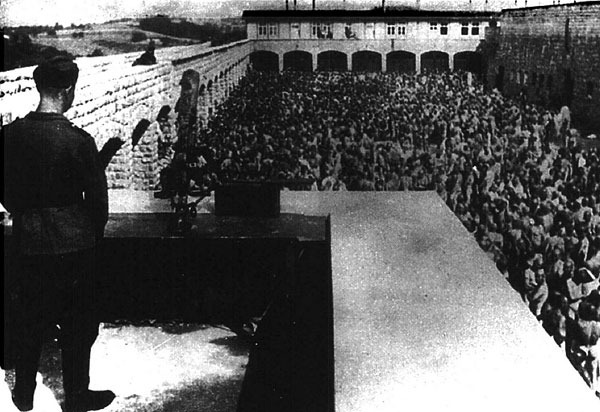
James Schmidt writes: “The presence of the Vienna Philharmonic at the ceremony also drew criticism… [Commentators] noted the orchestra’s past role as a cultural icon of the National Socialist state and current controversies involving a hiring policy that excluded women and non-Europeans from membership. The musicologist Thomas Dombrowski, observing that the orchestra’s ranks included ‘enthusiastic Nazis’ until ‘well into the seventies,’ described it as ‘the most unworthy ensemble in the world for such a task’ and sarcastically commented that it was a shame that the orchestra had been unable to obtain the services of conductors Karl Böhm or Herbert von Karajan, both of whom had been members of the Nazi party and had successful careers during the Third Reich….
“Finally, a number of critics were repelled by the very idea of a concert at the Mauthausen site. Their disgust only increased after the responsibility for planning the concert was turned over to an advertising firm that opted for the construction of a six-story orchestra shell, giant video screens (both at the camp and at remote locations in Linz and Vienna), an elaborate amplification system involving individual microphones on all the musicians, the use of colored lights on the walls of the quarry, and a satellite broadcast of the concert throughout Europe. Marta Halpert, the director of the central European office of the Anti-Defamation League in Vienna insisted, ‘Anything that changes this uniquely brutal slaughterhouse on Austrian soil into a concert house is frivolous and tasteless,’ and noted bitterly that the elaborate arrangements for the concert ensured that ‘the crescendo of the Philharmonic’s brass will drown out the screams and lamentations of the abused.’ The Viennese historian Marie-Theres Arnborn was likewise appalled by the prospect of the quarry being transformed into a ‘virtual concert hall’ in which loudspeakers would blast the ‘Ode to Joy’ over a place where ‘defenseless men were tortured to death.’ ”
I wish I could enjoy the performances of the Vienna Philharmonic; but when I hear their music, I remember Mauthausen.
James Joyce set free
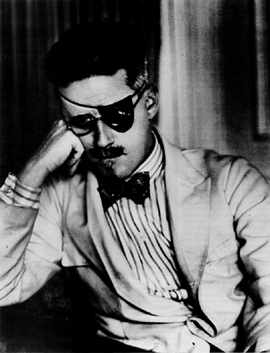 The James Joyce estate, whose primary trustee is the writer’s grandson Stephen Joyce, has notoriously been protective of Joyce’s work, and have brought numerous lawsuits against those who quote from Joyce, perform Joyce’s play, adapt Joyce, or try to put on public festivals celebrating Joyce. In fact, it made headline news when a rare exception occurred and the singer Kate Bush used portions of Molly Bloom’s soliloquy from Ulysses in her Sensual World CD.
In the past, the Joyce estate tried to shut down the 2004 Ulysses centenary Bloomsday festival in Dublin, and threatened the Government with a major suit (forcing the Irish Seanad [parliament] to pass emergency legislation) over a museum exhibit at the Irish National Library (after the Government paid €12.6 million for 500 sheets by Joyce.)
But today, copyright expired on Joyce’s works expired today in the EU, and this promises to open a whole new era of creative works and homages to Joyce. Here is the news from the Irish Times:
Copyright on James Joyce’s works in the European Union expired at midnight. From today, writings published during Joyce’s lifetime – Dubliners, A Portrait of the Artist as a Young Man, Ulysses and Finnegans Wake – are available for publication and quotation without reference or payment to the Irish author’s estate….
The end of copyright protection will enable creative artists and theatre companies to stage adaptations and re-enactments. Public broadcast will also be possible. Joyce’s solitary play, Exiles, can also be freely staged, and productions are likely. The Pan-Pan theatre company is interested in an Exiles- related project around next Bloomsday, while the play Gibraltar by Patrick Fitzgerald, which opens in the New Theatre, Dublin, tonight, draws heavily on the text of Ulysses. Another project well in train is publication of a special edition of Joyce’s short story “The Dead” by the James Joyce Centre in Dublin….
The Junia Evidence: VIII what Sherlock Holmes had to say
I have recently become aware of a new principle of interpretation. This principle has been cited to me several times and it seemed familiar enough – so it should be. Here is the principle and its original context,
when you have eliminated the impossible, whatever remains, however improbable, must be the truth
And here is its context, from The Sign of Four, chapter 6, by Conan Doyle,
“How came he, then?” I reiterated. “The door is locked; the window is inaccessible. Was it through the chimney?”
“The grate is much too small,” he answered. “I had already considered that possibility.”
“How, then?” I persisted.
“You will not apply my precept,” he said, shaking his head. “How often have I said to you that when you have eliminated the impossible, whatever remains, however improbable, must be the truth? We know that he did not come through the door, the window, or the chimney. We also know that he could not have been concealed in the room, as there is no concealment possible. When, then, did he come?”
“He came through the hole in the roof!” I cried.
Is it possible that Junia was only well-known to the apostles, however improbable? I suppose one could say yes, it is possible. It is highly improbable given the evidence and the witness of Greek literature – but possible. The next question then is whether it is possible for a woman to be an apostle. If it is impossible for a woman to be an apostle, then the improbable must be the truth. I have found this to be a common theme. Some have tried to prove to me that within the cultural context of the Bible, an apostle has authority and it is impossible for a woman to have authority, therefore a woman cannot possibly be an apostle.
However, the tradition of the early church is that certain women were “equal to the apostles.” So Mary Magdalene, the one woman who appears in every gospel to be sent by Jesus to announce his resurrection, is routinely called “equal to the apostles.” She was “sent” by Christ to witness his resurrection. Phoebe was sent by Paul to carry his letter. Although I am not claiming that she was an apostle, clearly she was only a deacon of her church, nonetheless, she was able to be the emissary of a man.

Perhaps the best example of how authority worked for women is in the story of Saint Nina (or Nino).
Nina was a relative of St. George the Great Martyr and Juvenal, the Patriarch of Jerusalem. Her parents belonged to the nobility in Cappadocia and since they both were tonsured in the monastic state, Nina was educated under the tutelage of Patriarch Juvenal. Hearing about the people of Georgia, the virgin Nina, from an early age, desired to go to Georgia and to baptize the Georgians. The All-Holy Mother of God appeared to Nina and promised to take her to this land. When our Lord opened the way, the young Nina, indeed, traveled to Georgia where, in a short period of time, she gained the love of the Georgian people. Nina succeeded in baptizing the Georgian Emperor Mirian, his wife Nana and their son Bakar, who, later on, zealously assisted in Nina’s missionary work. During her lifetime, Nina traveled throughout Georgia, mainly to convert the entire nation to the Faith of Christ, exactly at the time of the terrible persecution of the Christians at the hands of Emperor Diocletian. Having rested from her many labors, Nina died in the Lord in the year 335 A.D. Her body is entombed in the Cathedral Church in Mtzkheta. She worked many miracles during her life and after her death.
From another source we can learn that Nina was the daughter of the Roman General Zabulon, and we can read the words addressed to her by the Emperor Mirian, “O. my mother! teach me and make one worthy to invoke the name of your great God, my Saviour!”
Saint Nina, living in the 3rd and 4th century, derived her authority from the fact that she was the daughter of a general, the niece of a patriarch, the relative of a martyr, a virgin and had received a vision and message from the Mother of God. Her authority was expressed by her preaching, miracles of healing, teaching and baptising the emperor Mirian of Georgia and his family. In addition, she was addressed as mother by the emperor. While all narratives regarding Nina may be partly legendary, they do provide some insight into the extent to which it was considered acceptable for a women to bear authority and both teach and baptise men. Although these women bear the title “equal to the apostles” rather than “apostles,” I do not see this as proof that a woman cannot be counted among the apostles. I do not think that Sherlock Holmes would consider it utterly impossible for a woman to be an apostle, and we are not left with only the improbable. We can accept that the linguistically probable solution, that Junia was among the apostles, is the real solution.
Of course, some will add that the scriptures themselves forbid a woman from bearing this authority. Later.
Junia is not alone
Junia Is a Woman, and I Am a Complementarian
Denny Burk’s Complementarian Cover-up
The Junia Evidence: I
The Junia Evidence: II
The Junia Evidence: III
The Junia Evidence: IV
The Junia Evidence: V
The Junia Evidence: VI and the reliability of software
The Junia Evidence: VII and Syriac as commentary
Was Junia Really An Apostle by Burer and Wallace
Linda Belleville’s article
Michael Burer Enters the Junia Debate
Junia: The First Woman Apostle by Eldon Jay Epp
Reassessing Junia: A Review of Eldon Epp’s Junia: The First Woman Apostle
Due Diligence on Junia and Apostleship
Matt Colvin on Junia and Apostleship
Some Lengthy Thoughts on Women’s Leadership
A Closer Examination of Junia, The Female Apostle
New Year Day’s reading and listening
Joyce’s “The Dead”
One of the contender’s for “Best story ever about New Year’s” is James Joyce’s 1914 “The Dead,” the final story in his collection Dubliners. (The story is set at a New Year’s dinner dance – perhaps on the Epiphany, January 6.)
You can read a nice hypertext-annotated version online here. A high-quality production value really wonderful podcast series on the story from University College Dublin can be downloaded here. Rene Auberjonois, Fionnula Flanagan and Isaiah Sheffer (who are among the participants in a major Bloomsday production each year) have produced a two part reading for the Public Radio International show Selected Shorts: Part 1 has already been posted and Part 2 should be posted next week.
David Day’s Alice as church politics
Canadian poet and fantasy author David Day has developed a theory of Alice in Wonderland as a complex commentary on Anglican politics of his era which he explains to ABC radio (transcript , audio). Here are some quotes:
David Day: I think the breakthrough for me was when I realised that he was working on multiple levels. The breakthrough for me was with the Cheshire cat, and I sort of realised that he was working on…the ultimate puzzle is what kind of cat can smile? That’s the riddle. And I was getting closer to identifying the Cheshire cat historically as his sponsor at the university.
He got in through one of the canons of Christ Church College, the Rev Edward Pusey, and then I realised of course when Alice refers to it as, ‘Puss-cat,’ Pusey was the character. But it wasn’t just as simple as that. Dodgson was a mathematician, Lewis Carroll, and he approached it in multiple layers.
The Cheshire cat; what kind of cat can smile? In mathematical terms a catenary, as in a catenary bridge or a suspension bridge…there’s a shape which is like a curve, like a smile. It turned out that also the canon of Christ Church, this Rev Pusey, was known as a patristic catenary, which means that the chain of the fathers, and he was the expert on the fathers of the church.
Rachael Kohn: Right, the apostolic succession.
David Day: Yes. It’s not a term we use very frequently now, but at that time he was famously known as a patristic catenary.
Rachael Kohn: Yes, and so you get that arc that just hangs in the air.
David Day: And he disappears bit by bit until there is nothing left but a smile, and she says, ‘I can imagine cat without a smile but not a smile without a cat.’ And what are you left with? You’re left with a catenary.
Day also talks about his theories about Carroll’s interactions with theosophists and with the famous translator Max Müller.
Beethoven’s Ninth Symphony
Oh friends, not these sounds, rather let us sing more pleasant ones, and more full of joy.
New Year’s celebrations are particularly noted for being involved with music: whether it be New Year’s Rockin’ Eve from Times Square or the Vienna Strauss Concert or the Lincoln Center concert (this year focusing on Bernstein and Gershwin) or Vivaldi or dance music or jazz music or polka music or one of a thousand different genres.
In Japan, there is a particularly endearing custom to listen to Beethoven’s Ninth Symphony around New Year’s Eve. My attempts last night to embed a 1956 live recording of the Concertgebouw Orchestra conducted by Otto Klemperer into a posting ended up a huge mess (because of some restrictions on WordPress.com), but the recording is easily accessible from archive.org.
I was fortunate enough to hear attend a live performance of Beethoven a few days ago, and now to celebrate the New Year, I am going to have a marathon listening listening session to one of my favorite recordings of the Beethoven symphonies, Mackerras’s live recordings from the Edinburgh Festival (here is a review of the CDs; but please don’t pay list price for this – you can find this for around $25 which is a fair price.) I love the fact that these are live recordings: here is the original review of the live performance of the 9th symphony.
Mackerras died in 2010, and in May 2011, the Orchestra of the Age of Enlightenment (which frequently worked with him) had a memorial concert. Last month, the OAE finally got around to posting their pre-concert talk about Mackerras here.
One thing I really like about Beethoven’s Ninth Symphony is the inclusion of Schiller’s “An die Freude” (“Ode to Joy”) – the language is especially uplifting on New Year’s Day:
Seid umschlungen, Millionen! Diesen Kuß der ganzen Welt! Brüder, überm Sternenzelt Muß ein lieber Vater wohnen! Be embraced, millions! This kiss to the entire world! Brothers and sisters, above the starry canopy Must a loving Guardian reside.
(Source, modified translation)
The Junia Evidence: VII and Syriac as commentary
In my most recent post on the Junia evidence, I was confident that in the case of Pss. Sol. 2:6, Bible Works had mistaken episemon, the noun, for the adjective, episemos. But now I am going to turn over a new leaf, and consider whether there is a possibility that it could be the adjective episemos after all, and what that would mean. Then I am going to present evidence from the Syriac translation of Pss. Sol. to see what it can add to this. I hope that in each post on Junia I am adding new material.
In this post, Dr. Grudem provides the Brenton translation of Pss. Sol. 2:6 (I include Pss.Sol. 17:30 as well),
οἱ υἱοὶ καὶ αἱ θυγατέρες ἐν αἰχμαλωσίᾳ πονηρᾷ ἐν σφραγῖδι ὁ τράχηλος αὐτῶν ἐν ἐπισήμῳ ἐν τοῖς ἔθνεσιν
the sons and the daughters in painful captivity, their neck in a seal, in (a place) visible among the gentiles.
καὶ τὸν κύριον δοξάσει ἐν ἐπισήμῳ πάσης τῆς γῆς
and he will glorify the Lord in [a place] visible [from] the whole earth
In this case, the word episemos would be an adjective modifying an elided (omitted) noun meaning “place” . (This was not proposed by Burer and Wallace, who claimed rather that episemos was an adjective modifying the Jewish captives, which is impossible.) I had not been able to find any evidence that there was an idiom in which topos “place” is elided after episemos, and I still can’t find that. However, I did find, in the footnotes of Burer and Wallace’s article, page 87, some other phrases which may have influenced Brenton’s translation.
καὶ τεθήτω ἐν τῷ ὄρει τῷ ἁγίῳ ἐν τόπῳ ἐπισήμῳ 1 Macc. 11:37
and set upon the holy mount in a conspicuous place.
καὶ στῆσαι αὐτὰς ἐν περιβόλῳ τῶν ἁγίων ἐν τόπῳ ἐπισήμῳ 1 Macc. 14:48
and that they should be set up within the compass of the sanctuary in a conspicuous place;
It seems likely that Brenton supplied the word “place” because of the seeming similarity of the phrases, although there is no known Greek idiom where “place” is elided. However, even if we consider this to be a possibility, it still does not provide evidence that Junia was not among the apostles. According to Brenton’s translation, it appears that each place modified by episemos is found within the place referred to by the object of the preposition en. For example, the Jewish captives were in a place that was among the Gentiles. The “conspicuous places” in Maccabees were on the holy mountain, and within the compass of the sanctuary. In each case, en plus the dative indicates an inclusive use. In the case of Pss. Sol. 17:30, using the genitive case, the place that was visible from the whole earth was most likely above the earth, in the heavens or on the clouds, clearly not inclusive.
So, episemos, as an adjective with en plus dative indicates inclusive use, and episemos with genitive indicates exclusive use – at least in these examples. This is the direct opposite of what is stated in Burer and Wallace,
In sum, our examination of episemos with both genitive modifiers and en plus dative adjuncts has revealed some surprising results – surprising, that is, from the perspective of the scholarly consensus. Repeatedly in biblical Greek, patristic Greek, papyri, inscriptions, classical and Hellenistic texts, our working hypothesis was borne out. The genitive personal modifier was consistently used for an inclusive idea, while the (en plus) dative personal adjunct was almost never so used. Yet to read the literature, one would get a decidedly different picture.
After reviewing all the data in this article, I agree with Bauckham, Belleville and Epp (Epp page 77) that except for one exception, all examples with en plus dative, whether impersonal or personal, found in Burer and Wallace’s article, are inclusive. The evidence is overwhelming that with en plus dative the use is either locative or partitive, that is, inclusive, in spite of Wallace and Burer claiming “almost never so used”. With the genitive, however, episemos was also usually inclusive and Pss. Sol. 17:30 seems to be an exception.
Therefore, if one considers episemos in Pss. Sol. 2:6 to be an adjective, this confirms that with en plus dative, episemos in inclusive and Junia is a member of the group of apostles.
But Pss. Sol 2:6 and 17:30 do not need to be interpreted in the way that Brenton has done. Kurk has provided a link to Les Psaumes de Salomon, by François Martin, which seems to provide the base for the New English Translation of the Septuagint. Martin includes in the notes, the relevant Syriac translation.
Garçons et filles subisssent une captivité rigoureuse, leur cou porte un stigmate, une marque distinctive parmi les païens. (Martin, page 258)
et leur cou, le joug scellé des gentils a été placé sur lui (Syriac)
The sons and daughters were in harsh captivity, their neck in a seal, with a mark among the nations (NETS)
Il glorifiera le Seigneur a la vue de toute la terre (Martin, page 358)
with the note that this comes from the Hebrew nokah kol ha’eretz and could be similar to the Son of Man coming on the clouds of heaven.Ils glorifieront le Seigneur ouvertement dans toute la terre. (Syriac)
And he shall glorify the Lord in the mark of all the earth. Note: perhaps sight (NETS)
In this case, the Greek is assumed to be episemon, a noun, and each verse is treated as if it were a translation of a Hebrew original. However, the Syriac translation is made from the Greek, and does not reflect a known Hebrew original. It should be treated as commentary on the text, and adds insight from the Aramaic (Syriac) tradition.
In any case, whether the word in Pss. Sol. is a noun, episemon, or an adjective, episemos, there seems to be no liklihood that these examples from Maccabees or from Psalms of Solomon support the notion that Andronicus and Junia were only known to the apostles, but not among the apostles. The evidence is overwhelmingly in favour of Andronicus and Junia being members of the group of apostles, and that is how it has always been understood in Greek literature.
I do need to soften my previous approach with the understanding that Bible Works listed episemos as an adjective for the Brenton translation of Psalms of Solomon because that is how it is translated in that version. I hope that I have gained from this following up on this. I can only add that it is best not to lose touch with the wider and longer history of interpretation, including in our research works from French, German, Latin, Syriac and other relevant traditions. For me, these posts are not so much about Junia, as they are about what resources we can access when looking at a much debated exegetical point.
But regarding Junia, there does remain one single example, from classical Greek, which supports the notion that the referent of episemos may not be a member of the group. I will look at that one example next time.
Update:
I would like to add that in a recent exchange on this blog with a complementarian, he responded with this comment,
Suzanne, I hold a PhD in Greek, and I agree that the Wallace/Burer article is overreaching to try to make Pss. Solomonis 2:6 match Romans 16:7 in every respect. I agree with you that it is completely irrelevant because the word in the verse is probably the dative of the επισημον (as a Hebraic parallelism with εν σφραγιδι earlier in the verse). Thus, it is not even an instance of the construction in question.
I appreciate the fact that he was open enough to agree with me on this.
Matt continues to make a plea to reconsider Wallace and Burer’s point with different evidence, and you can follow this link. I have not cited the rest of his comment since it did not include evidence but lead to his blogging later here,
I give him full credit for this example,
Θέλω πρακτικὸς εἶναι καὶ ἐπίσημος ἐν τοῖς ἀδελφοῖς ἢ παραβαίνειν ἐντολὰς καὶ εἶναι
αὐτοῖς βδελυκτός.“I want to be ready for action, and ἐπίσημος among the brothers, rather than to transgress the commandments and be repugnant to them.”
with my own comment that surely the speaker is among his own brothers and this has to be inclusive. The long comment thread related mostly to our disagreement on this issue.
Junia is not alone
Junia Is a Woman, and I Am a Complementarian
Denny Burk’s Complementarian Cover-up
The Junia Evidence: I
The Junia Evidence: II
The Junia Evidence: III
The Junia Evidence: IV
The Junia Evidence: V
The Junia Evidence: VI and the reliability of software
Was Junia Really An Apostle by Burer and Wallace
Linda Belleville’s article
Michael Burer Enters the Junia Debate
Junia: The First Woman Apostle by Eldon Jay Epp
Reassessing Junia: A Review of Eldon Epp’s Junia: The First Woman Apostle
Due Diligence on Junia and Apostleship
Matt Colvin on Junia and Apostleship
Some Lengthy Thoughts on Women’s Leadership
A Closer Examination of Junia, The Female Apostle
Some things I want to post about in 2012
I’m so fortunate to have such talented co-bloggers here at BLT. As I aspire to catch up with their insights, and in lieu of a New Year’s Resolution, I am listing some topics I want to post about in 2012. Perhaps, the mere hubris of my listing topics will create a curse that will prevent me from posting on them, but nonetheless, I cannot resist mentioning some of the posts that are in embryonic thought-stage now:
- Chaucer’s approach to translation.
- Echoes of the Harlem Renaissance in contemporary culture.
- The Drazin-Wagner translation of Onkelos’s translation of the Pentateuch.
- Translation in the Elizabethan era.
- The myth of the gendered brain.
- Finnegans Wake as a theory of translation.
- Moses Mendelssohn as a Biblical translator, literary critic, philosopher, and peacemaker
- The Fourth Gospel and the Chapters of Rabbi Eliezer
- Chinese translations of Alice in Wonderland.
- Bible translation preference as shibboleth.
- Translation of the Writings on the Theory of Kun Qu Singing.
- Translating Kunqu operas.
- On “Sayonara Kabuki-za.”
- Handwriting and nationality.
- First Enoch.
- The genius of Artscroll’s typsetting.
- Surveys of Dickens’ major works.
- Matt’s translation of the Zohar.
- Different approaches to translating Augustine.
- Literary qualities of the King James translation of the Hebrew Bible.
- (Finishing) my transcription of the “Core Issues in Prayer” lectures.
- Ecumenism in Bible translation.
- Chess as a spectator sport.
- Ishay Rosen-Zvi’s book on the “yetzer hara”: Demonic Desires.
- A parallel review of two masters of the horror genre: Bram Stoker and Stephen King.
- The evolution of melancholy in literature.
- Dostoevsky and translation.
I realize this is a wildly ambitious list, and I’ll be fortunate to actually just make a few of these posts. But still, in the dying hours of 2011, when 2012 is pure potential – oh how sweet to plan!
(But again, please don’t worry – even though I will doubtlessly fall short of my posting goals, I know my co-bloggers will have interesting topics to discuss.
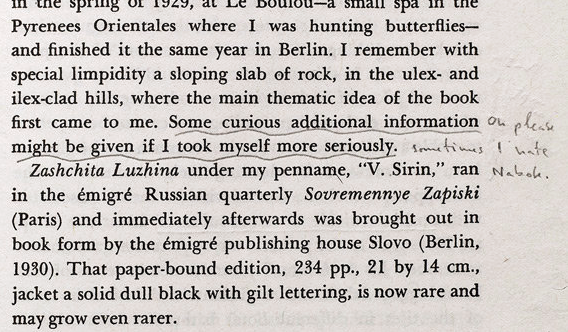
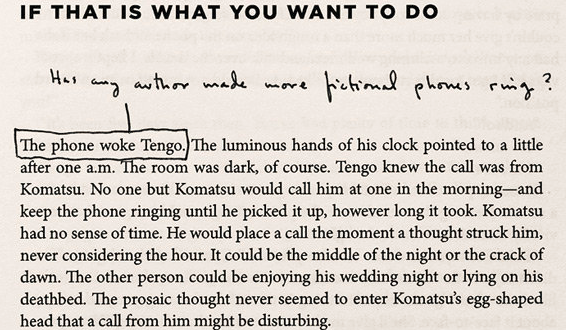
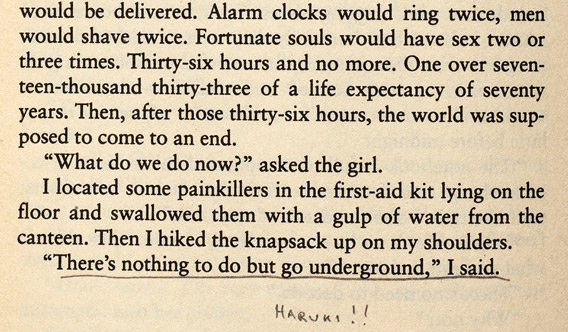
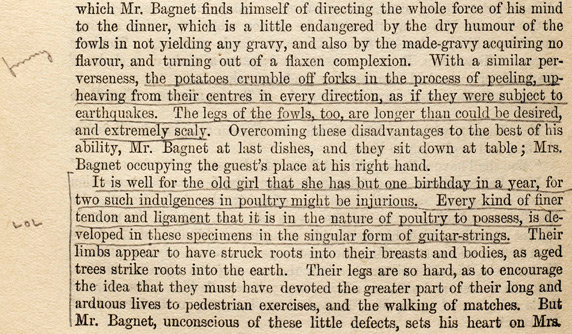
Sam Anderson’s marginal book reviews
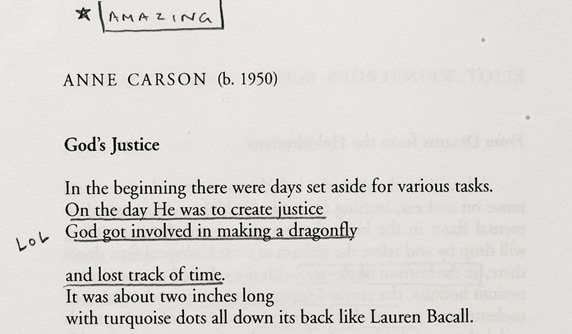
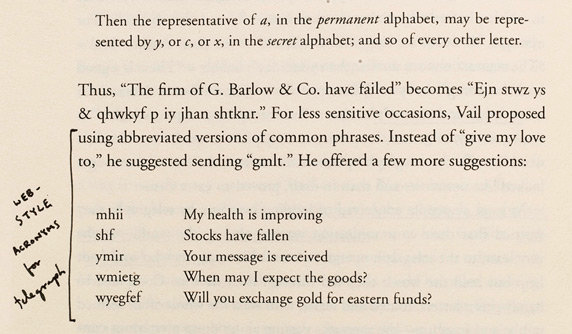
Sam Anderson has published a calendar of his marginal notes in books he read this year. It is a new (and clever) type of book review – a marginal (sometimes snarky) comment on a brief passage in a book. Here is a sample of his reviews:
January
“God’s Justice,” by Anne Carson, in Birds, Beasts and Seas: Nature Poems From New Directions, p. 160
March
The Information: A History, a Theory, a Flood, by James Gleick, p. 154 (galley)
June
The Luzhin Defense, by Vladimir Nabokov, p. 7
July
1Q84, by Haruki Murakami, p. 41 (galley)
August
Hard-Boiled Wonderland and the End of the World, by Haruki Murakami, p. 198
December
Bleak House, by Charles Dickens, p. 510
Literary Bible Translation Tops Norway’s Bestseller List
A new translation of the Bible has taken the top spot in Norway’s bestseller list, selling 75,000 copies between October publication and Christmas, according to the publisher’s figures.
The Norwegian Bible Society used a team of 30 famous literary authors as consultants on the translation, including internationally known playwright Jon Fosse, and published a literary edition without chapters and verses.
Moses Mendelssohn’s Rhetorical Use of Jesus
Mendelssohn deduced the following from Jesus’s experience:
- Jesus was a Jew who never suggested abrogating Jewish law
- Jesus advocated bearing the dual-burdens of religious fidelity and loyal citizenship: Render unto Caesar/Render unto God (NT Matthew 22:21)
- Jesus’s dilemma of bearing a dual burden (Caesar/God) also faced contemporary Jews, who would be well-advised to follow Jesus’s advice to his disciples
- If late 18th century Jews occupied the position of the early disciples of Jesus, the Prussian authorities stood in the position of the Roman authorities of Jesus’s day
Moreover:
- Jesus suffered as a Jew
- Just as early Christians were persecuted, so too present-day Jews were suffering under humiliating feudal restrictions
- Just as Jesus ought to have experienced tolerance from both his coreligionists and from his government, so should Prussian Jews (and by extension, European Jews, generally)
Read the rest from Alan T. Levenson, who also states that, “The Jewish encounter with Christianity has come full circle from medieval polemics to works such as Marc Brettler’s [and Amy-Jill Levine’s] The Jewish Annotated New Testament (Brandeis University Press, 2011)”
The new geography
“Every barrel of oil that comes out of those sands in Canada is a barrel of oil that we don’t have to buy from a foreign source,” [Rick] Perry said in Clarinda, earning a loud round of enthusiastic applause.
(Source)
Downloading BBC radio streams
BBC produces dozens of excellent radio shows each week, but they are only online for a week, and it is a pain to archive them.
Well, now that is much simpler with this excellent (Windows) application: Radio Downloader. So, if you want to make a recording of the King’s College “Festival of Nine Lessons and Carols,” (don’t forget the booklet) it is easy to do.
Dan Kois’s ode to top 10 lists
The end of the year is the time for top 10 lists, and Dan Kois satirizes the genre with his “Top 10 list of top 10 lists.” He links to some bizarre top 10 lists (“Mark Sikes’s Top 10 films hypothetically starring Ryan Gosling”) but my favorite part is his description of a top 10 classical music performance list:
Justin Davidson’s Top 10 Classical Performances (New York). So well written you’re guaranteed to feel like a jerk for missing any of the choices featured on it.


 BLT
BLT 