BLT post series
I originally was going to send this as a note to my fellow bloggers, but thought that our general readership might be interested too.
We’ve been having a lot of great series going here. One of the star series has been Suzanne’s series on Junia – may it never end, it just keeps getting better and better.
The problem is that when the series get up into the double digits, the cross-references tend overflow our “recent comments” widget. But it is important that readers can read a series from beginning to end.
To address this, I’ve added some new categories. I added a parent category “Series” and then sub-categories, currently:
for series of posts that are meant to be read in a particular order, from beginning to end. This way, when new posts show up, they can simply link to the appropriate “Series” category (which also appears to the right). If any of the bloggers wants to start a new series, she or he can simply create a new category with “Series” as its parent.
I guess we can have a long discussion about what constitutes a series, but to me, a “series” is “a sequence of posts that are both thematically linked and meant to be read in a particular order.” I would not call “translation” a series, because all of us post on translation, and there is not necessarily any preferred order to reading the posts – translation is a category. But, in my last post, for example, I started what I hope will be a long series working its way through multiple translations of the book of Job. When I get to post 23 of that series, I won’t have to link back to posts 1, 2, 3, … well, you get the idea – instead, I can just link to the “Series: Job translation” category.
I hope that this makes it easier to navigate in our blog and to read and write posts. Thanks!
Whose #$&@^’? Mine, Yours, Theirs?
“Even native speakers of English who habitually use this expression seldom think about the original meaning.”
— Victor Mairs, “Not just any sale, it’s a #$&@^’ sale”
“Even in the textual history of the Hebrew Bible a word such as šagal [שגל], close to the vulgar *“#$&@^’” (Deut 28:30; Isa 13:16; Zec 14:2; Jer 3:2), is changed to the less direct šakhab [שכב], “to lie with,” because the Masoretes (those who handed down the codices of the Hebrew Bible) thought the former verb too obscene.”
— Calum M. Carmichael, Sex and Religion in the Bible
“The etymology of שגל continues to be obscure in modern times.”
— Aron Pinker, “ON THE MEANING OF šgl,” Jewish Studies, an Internet Journal
*“#$&@^’” is a stand-in symbol for a word Victor Mairs is blogging about. Similarly, in pop culture, “Forget You” is the stand-in phrase for the vulgar one that Cee Lo Green made more popular world-wide. (Mairs should have noted that in Japan the Cee Lo Green song didn’t break into the top 50 as it did so many other places). Likewise, “the less direct šakhab [שכב]” seems to be a stand-in biblical phrase.
Questions:
1. What is the lowest word or phrase you’ve read in high literature?
2. Which are the most interesting stand-in phrases for vulgar terms that you know of?
3. Do vulgar words tend to lose their meanings when appropriated across cultures and read in the context of second-languages?
4. If you don’t live in Japan, do you also ask, “So what’s wrong with ichiban 一番 (‘number 1’) t-shirts?”
The Junia Evidence: X transgendered again
The Junia files cannot be closed without reference to this one last chapter. In view of the fact that many complementarian scholars are not able to accept grammatically that Andronicus and Junia are only “well-known to” the apostles, there has been a reemergence of the tendency to question Junia’s gender. In 2006, Bruce Waltke mentioned to me that Al Wolters was going to propose that Junia was the transliteration for a masculine Hebrew name.
Here is Al Wolters’ paper. He proposes that if Iounian (accusative case) is a transliteration of a masculine Hebrew name Yehunni, it would be first declension, having the accent over the iota, just as a feminine name would, and as is found in the miniscule manuscripts. It would be Hellenized as Iounían and still masculine. He writes,
The foregoing has argued that it is not unreasonable, from a philological point of view, to interpret IOUNIAN in Rom. 16:7 as the Greek form of a Hebrew name.
The difficulty is that by the time accents were introduced 10 centuries after the epistle was written, all icons and literary mention of Junia had already attested to her femininity. The accent over the “i” was a result of the assumption that she was feminine, it was not the cause of our assumption that she was feminine.
However, Wolters remarks that there are two attestations to a name Yehunni, which can be Hellenized as Iounias. This is in contrast to the fact that there are 250 occurrences of the Latin name Junia, which can be Hellenized as Iounia.
But up against this evidence, Wolters comments further in a footnote,
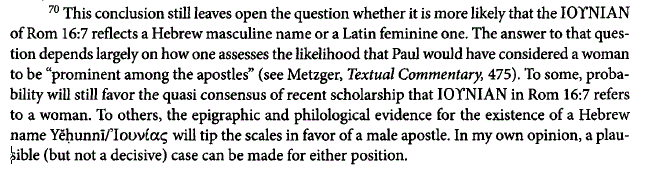
It is beyond the purview of my blogging to persuade those who consider it unlikely that Paul includes women in roles of leadership to think otherwise. I am content to present the scholarship as we know it, and to express my desire for a Bible translation based on scholarship.
However, this issue was taken up with Wolters on Richard Fellows’ blog. Wolters wrote, as his 6th point,
(6) It is my own view that the much higher incidence of Junia compared to Yehunni makes it more likely that IOYNIAN in Rom 16:7 is a woman’s name rather than a man’s. In my judgment, however, it is only marginally more likely. There are other factors (such as the preponderance of male leadership in Paul’s circle) which add weight to the other side. My article was meant to show that it is not unreasonable to defend the view that Junia/s was male. As is the case with so many exegetical questions, we need to be satisfied with degrees of probability.
And Richard responded,
(6) We do see female leaders in Paul’s circle (Prisca, Phoebe, and probably Lydia, Euodia and Syntyche). It is true that the traveling missionaries tended to be male, but we must ask why this was. I am willing to be corrected, but I suspect that it would have been hard for women to get the necessary permission from their husbands/fathers to embark on missionary journeys, and that it would have been dangerous for them to travel alone, and that they might have scandalized the very people whom they hoped to convert if they had travelled with male non-relatives. These restrictions would not have applied to Junia, who travelled with her husband (Andronicus), who was also an apostle. So the scarcity of female traveling missionaries is not necessarily an argument against Junia being one.
Even if we did not know that Junia was a female name, we would still suspect that Andronicus and Junia were husband and wife. They are greeted by Paul as a two-some and are given no separate designations. They seem to have had a long association with each other, since both were in prison with him, and both were in the faith before him. Paul greets and describes them as a two-person unit, in much the same way that he does Prisca and Aquila.
I leave the final word to Dr. Claude Mariottini who wrote,
Junia was the name of a Christian in Rome, a person whose name is mentioned in the letter to the Romans in connection with Andronicus, as being Paul’s relatives, who were in prison with him; they were prominent among the apostles and they were in Christ before he was (Romans 16:7).
However, the gender of the name is uncertain. Was Junia a man or a woman? If the name Junia is feminine, then she was probably the wife of Andronicus. However, even the various versions do not agree on how to translate the name.
Eldon Jay Epp, in his book Junia: The First Woman Apostle (Minneapolis: Fortress Press, 2005), said (p. 65) that “English versions move from a consistent feminine understanding of ‘Junia’ for the first three centuries (1526 to 1833, though the 1833 Dickinson version is an anomaly), then a second, fairly consistent masculine period of about a century (1870s to 1960s, with a few exceptions), followed by nearly three decades (1970 to 1996) of alternation between masculine and feminine, but with an increasing trend of returning to the feminine.”
According to Epp (p. 66), the following versions have adopted the feminine (Junia) reading:
Tyndale, Cranmer, Great Bible, Geneva Bible, Bishops Bible, Rheims (“Julia”), King James Version, Weymouth, Lamsa (NT), New American Bible, New King James Version, New Jerusalem Bible, New Century Bible, New American Bible, Revised English Bible, New Revised Standard Version (NRSV), Oxford Inclusive Version, New Living Translation.
In addition, other English versions not included by Epp which translate the name as feminine include the Bible in Basic English, the Holman Christian Standard Bible, Today’s New English Version, and the Webster Bible.
According to Epp (p. 66), the following versions have adopted the masculine (Junias) reading:
Dickinson, Emphasized Bible, Revised Version (1881), Rheims (American Edition), American Standard Version (ASV), Goodspeed, Complete Bible (1903), Modern Reader’s Bible, Moffatt,
Ronald Knox, Revised Standard Version (RSV), Phillips, Amplified New Testament, New English Bible, New American Standard Bible (NASB), Jerusalem Bible, Good News Bible,
Living Bible, New International Version (NIV), The Message, Contemporary English Version.In addition, other English versions not included by Epp that translate the name as masculine include the Darby Bible, the English Standard Version, God’s Word to the Nation Version, New English Translation (NET), and the Young Literal Translation.
Bruce K. Waltke, in his book, An Old Testament Theology (Grand Rapids: Zondervan, 2007), p. 241 said: “Al Wolters of Redeemer College (Hamilton, Ontario) in personal communication makes a convincing philological argument that Junia (Gr. Iounia) in Rom. 16:7 is a Jewish name; Yehunniah (“Yah is gracious”). If so, the name is masculine, not feminine.”
The basis by which Wolters and Waltke claim that the Jewish name Junia is masculine is not made explicit. The implication of their statement is that since the Jewish name Yehunniah is a theophoric name, that is, a name that includes the name of a god, then, the bearer of the name must be a man.
Although masculine names bearing the name of Yah, such as Obadiah, Isaiah, and Jeremiah, were common in the Old Testament, a few names of women also include the name of YHWH, usually shortened to Yah.
The most prominent name of a woman bearing a theophoric name in the Old Testament was Athaliah, the daughter of Omri, king of Israel (2 Kings 8:26). Another woman with Yah in her name was Abijah, the wife of Hezron (1 Chronicles 2:24). Other women with theophoric names were Jecholiah, the mother of Azariah, king of Judah (2 Kings 15:1), Michaiah, the daughter of Uriel of Gibeah and the mother of Abijah, king of Judah, and Noadiah, the prophetess (Nehemiah 6:14).
Thus, if the argument that Junia is the name of a man because the name bears the name of YHWH, then the argument is not very strong. The fact is, that recent studies have revealed that Junia is a feminine name.
In his commentary on Romans (Peabody: Hendrickson Publishers, 1992), James E. Edwards wrote (p. 355):
“Andronicus and Junias (v. 7), both Greek names, were doubtlessly Jewish since Paul calls them my relatives (literally in Greek, “fellow-countrymen”). Depending on the Greek accenting of Iounian (a form of the name which unfortunately obscures its gender), the name could be either male (Junias) or female (Junia). The name is normally presumed male (so NIV), but a recent study reveals over 250 examples of it in Greek literature, not one of which is masculine! This seems to be early incontrovertible evidence that the name is feminine (Junia), which would make the pair husband and wife (or perhaps brother and sister). If the name is feminine, then Paul’s referring to Andronicus and Junia as outstanding among the apostles, who were in Christ before I was, is very significant. It would indicate that (1) apostles refers to a group larger than the original Twelve, (2) among whom was to be counted a woman, (3) and probably a wife, (4) who had been an apostle before Paul was (emphases his).”
So, the evidence points to the fact that Junia was a woman and that Paul called her an apostle. As Peter Lampe (Anchor Bible Dictionary 3:1127) wrote:“Without exception, the Church Fathers in late antiquity identified Andronicus’ partner in Rom 16:7 as a woman, as did minuscule 33 in the 9th century which records iounia with an acute accent. Only later medieval copyists of Rom 16:7 could not imagine a woman being an apostle and wrote the masculine name “Junias.” This latter name did not exist in antiquity; its explanation as a Greek abbreviation of the Latin name “Junianus” is unlikely.”
Claude Mariottini
Professor of Old Testament
Northern Baptist Seminary
“True university … is a collection of books”
Well, I suppose you all know the quote attributed to Thomas Carlyle, “The true university of these days is a collection of books.” My question is – in how many places is that quote inscribed?
I know it is inscribed in the old San Francisco Library (now the Asian Art Museum):

And it is inscribed at the Library of Congress
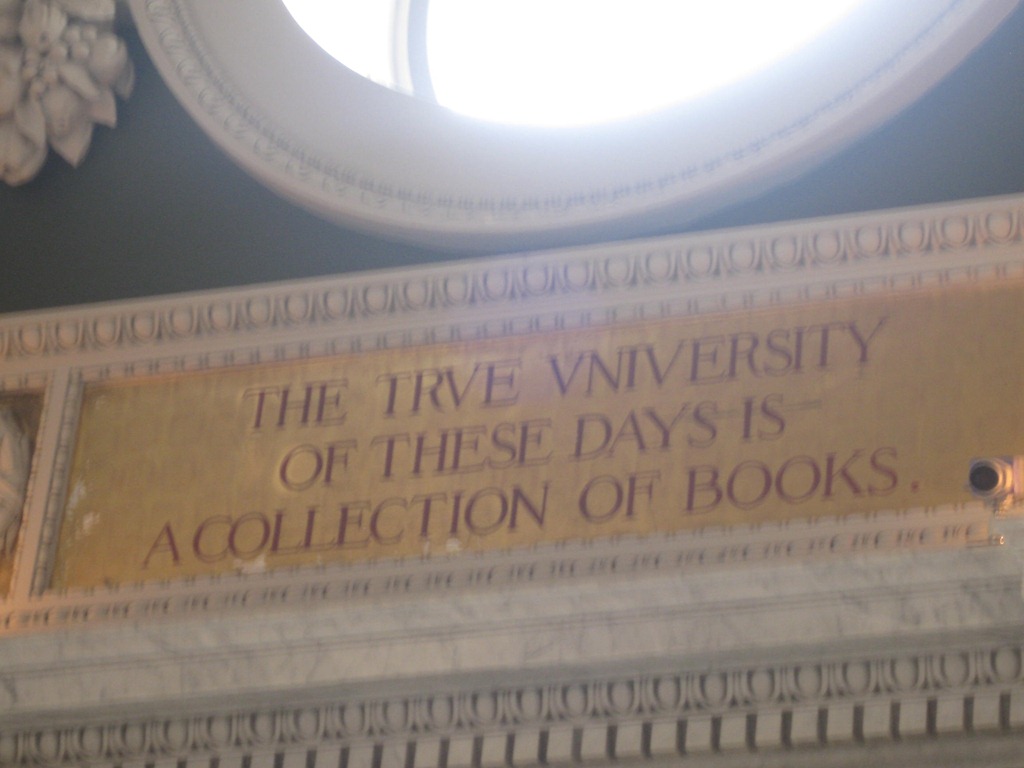
Where other libraries boast this inscription?
“the old documentary hypothesis has given way to new theories”
 I do not closely follow theories of Pentateuch redaction, but apparently the field has changed substantially from what we learned in college. Alan Brill (Seton Hall) interviews David Carr (Union Theological Seminary):
I look to documented examples of scribal revision for models of how scribes preserved or revised texts. And one main thing I find is that even scribes reproducing a virtually identical copy of a given section of text would make the kinds of changes to texts– I call them “memory variants”– that people who have memorized texts do: they would substitute a synonym of a word for another, add or subtract minor grammatical particles, switch from one phrase to a syntactic equivalent. Apparently such scribes often did not visually copy texts they were citing or reproducing, but had memorized them and wrote them out from memory.
This fluid transmission of texts means that many criteria that scholars thought they could use for linguistic dating of texts or source identification are not as firm as we once thought.
Other things these documented examples of transmission teach us are the tendency of scribes to pollute the evidence through harmonizing texts with each other, their tendency to make small additions to texts that would be undetectable without manuscript documentation of different stages, and the way scribe/authors would only preserve parts of texts that they were otherwise appropriating large portions of. Observations like this don’t mean that we can’t continue to make plausible hypotheses about the growth of biblical texts, but it means that we now need to evaluate the evidence in biblical texts differently than we once did….
Some of the terminological criteria most beloved by traditional source critics, e.g. variation in divine designation ([Tetragrammaton] versus [Elokim]) or terms for maidservant (‘amah versus shiphah) vary a significant amount in manuscripts that we have, let alone the centuries of textual transmission before our existing manuscripts. I still think there is strong enough evidence for distinguishing Priestly and non-Priestly traditions from one another. And I think there likely are very early chunks of material in the Bible, including parts of the Pentateuch. But the case for early, intertwined “J” and “E” sources (within the non-Priestly strand of the Pentateuch) is largely built on sand rather than rock. It pales in comparison to the case for the distinction between Priestly and non-Priestly strands in the Pentateuch.
The whole interview is worth reading. I’m also tempted to read Carr’s new book.
Also worth catching on Alan Brill’s blog: his interview with Daniel Boyarin (Berkeley) – especially where Boyarin states his admiration for the Satmar Rebbe and his anti-zionism.
Whose Relativism? Mine, Yours, Theirs?
“Relativism” was an absolutely bad thing when I was a little kid, growing up in the household of evangelical Bible-believing Christian missionaries, who preferred “absolute Truth,” which is what the Holy Scriptures contained. Never mind that I must use adjectives in that previous sentence to qualify — to make relative — even what must be meant by Truth and by Scriptures. However, I’m getting ahead of myself.
“Relativism” was bad because, most often, it referred to “moral relativism,” and that adjective moral was and always is really — essentially and absolutely — important. Professional philosophers for the Stanford Encyclopedia of Philosophy, who have written and revised the definitional entry on the topic stress this point, with their beginning sentence:
Moral relativism has the unusual distinction—both within philosophy and outside it—of being attributed to others, almost always as a criticism, far more often than it is explicitly professed by anyone.
I’d like to go back “outside” of philosophy again now. If you’re staying with me — are not too bored relatively speaking — I’d like to tell you a couple of my post-childhood stories, tales of conundrums of and with relativism. Before I do go back outside of philosophy to new stories, I’ll just say again how moral relativism threatened to crumble not the worldview of my parents but their sure work against those “anything goes” practices of hippies, and war protesters, and drug users, and rock and rollers, and sexual offenders of all types and sorts. Well, thinking about it all over again now, in retrospect, I guess “relativism” and even “moral relativism” was a problem in my parents’ worldview.
And this brings me to the whole question “Whose relativism”? which seems like a fantastically relative question.
My first story begins in graduate school, when I was studying linguistics. I took a seminar with a linguist who had pretty much created his own school of thought about language, a radically relatively school, I should add. Of course, any professional linguist worth his salt (whether Chomskyian or Saussurean or even Whorfian) was a relativist. But this particular linguist was relatively radical with his radical relativity, and he loved to paraphrase a phrase by professional philosopher Nelson Goodman, saying: “What we need is radical relativism within rigid restraints.” I’m quite sure I got at the time that this linguist quoting Goodman was “paraphrasing” the philosopher. I’d read the philosopher’s book, Ways of Worldmaking, and I saw that he really used the phrase “radical relativism” only three times in it, once in the forward, and once in the text of the book, and once more in the text of the book with a relative turn on the phrase. My linguistic professor was Kenneth L. Pike, and he was purporting to be Goodmanian — not philosophically so much but more linguistically. Pike was doing with Goodman what readers of the US Declaration of Independence have tended to do through the years, according to historian Pauline Maier. Here’s how R. B. Bernstein describes Maier’s description of that:
The central theme of Maier’s book is that the Declaration of Independence has become a vast “Container for the Thing Contained.” Not only does it hold far more than we conventionally associate with it–in the more than two centuries since its adoption, we have added to its contents far more than its drafters and adopters had intended.
Thanks to Theophrastus for sharing both Maier’s book and Bernstein’s review. So let me paraphrase what I just said, relatively speaking: My linguistic professor let a philosophy professor’s phrase (“radical relativism under rigid restraints”) become a vast container for relativism contained. Or perhaps Professor Pike let Professor Goodman’s statement become a relatively — not vast but — restrained controlling idea for a relatively relative theory of language. I’m not talking, as you should infer, of the particulars of the linguistic theory. Rather, I’m trying to use the English word, relativism, as a fair description of what one does with language, what my professor did with his theory of language. So I’m hoping that even though you don’t share my story, that you’ll understand my story and maybe think of one of your own that’s similar.
My second story is shorter. Some years later, when I was a professional linguist myself, I met a professional philosopher who spoke with me at great length about “relativism.” He is Harvey Siegel, who is absolutely and philosophically and professionally dead set against philosophical relativism. He was on the campus where I work, delivering a series of talks and lectures on this topic. I brought up Professor Pike’s paraphrase of Professor Goodman (as noted in the previous story I told you). Then Professor Siegel told me that “Goodman wasn’t really dealing in “relativism” proper, but rather in “pluralism.” Siegel said: “‘Radical relativism under rigid restraints’ makes for some good, perhaps poetic word alliteration; but that doesn’t make what Goodman is doing ‘relativism’.” After he returned to the campus where he works, Professor Siegel took the time, then, to mail to me an essay he’d written on the topic. It is entitled, “Goodmanian relativism,” and I still chuckle at the word “Goodmanian” as a qualification, as a an adjective, as a relativising word. (One essay he did not send me — and he’s published three now on this very topic — was the one he’d written in reply to another professional philosopher, one Catherine Z. Elgin. I’m bringing this up because I had to find on my own her substantial refutation of Professor Siegel’s refutation of Goodman’s “relativism,” that is, of “Goodmanian Relativism.” Today, I think Professor Elgin is one of the most brilliant and important philosophers, somebody who’s helped many of us understand relativism and absolutism and epistemology and epistemologies in general. You may note that Siegel considers a different professional philosopher — Israel Scheffler — to be eminently important; this is a relatively important thing to see, because even Scheffler, like Elgin, finds Goodman’s relativism useful and Scheffler, like Elgin, finds that Siegel has not understood that sort of relativism in very relative ways at all.)
Well, in this post, I didn’t mean to be so pedantic. I know I have been pedantic anyway, relatively speaking. Similarly, I didn’t initially intend to drop names, or to name drop. But I wasn’t sure how I could tell the stories without telling the names of the ones in the stories. If you’ll pardon me, I’ll just end with one of my favorite quotations of Catherine Elgin (from her book, Between the Absolute and the Arbitrary) who cautions all of us, or any of us, relatively, against using the container for the thing contained (and notice how she notices how we “name drop” sometime):
Aristotle, of course, was not named “Aristotle”; the name he went by had a different pronunciation and a different spelling. So the claim that our use continues the chain that began with his being baptized “Aristotle” needs refinement. Then there is the worry that chains that originate in a single stipulation may later diverge. In that case a term has two different reference classes despite its link to a single introducing event…. Ambiguity occurs because correction… allows for alternative continuations of the causal chain…. Each continues the chain, but the two uses of the word… are not coextensive. Nor do we always succeed in referring to what our predecessors did, even when we intend to do so.
Brief book notes
Kevin Edgecomb mentions the new book by Andrei Orlov, Dark Mirrors: Azazel and Satanael in Early Jewish Demonology. In fact I bought the book when it came out in November, but I haven’t cracked it open yet. I had better do so soon!
Kris Merino promises a review soon of Matt Kish’s Moby-Dick in Pictures: One Drawing for Every Page (which is also available online). Interestingly, Kish’s book is keyed to the Signet edition of Moby Dick, but does not contain its text. (Kish mentions a similar project, Zak Smith’s Pictures Showing What Happens on Each Page of Thomas Pynchon’s Novel “Gravity’s Rainbow” (and Smith’s illustrations are also online.)
Oxford University Press has its winter sale going on now. I ordered some books. A few months ago, I read the Oxford collection of Sophocles’s Theban plays and Aeschylus’s Oresteia plays and I very much enjoyed the approach they took to translation. Up until now I have mostly admired the Grene-Lattimore translations, but the Oxford translations are fascinating interpretations. So I decided to order the complete set of Oxford-translated Greek tragedy at 50% off (sale price: $56)
I also ordered the second and third volume in Phillip Cary’s Augustine trilogy at 65% off. (The first volume, alas, is not on sale.) Here is how I came to read Cary. I had bought his book Good News for Anxious Christians: 10 Practical Things You Don’t Have to Do. Readers, I bought Good News with impure motives: I bought the book so that I could read it and mock it. The capsule descriptions of the book led me to believe that it would be an easy target and I could make an entertaining rant about it. But, when I actually read his book, I was surprised that I found myself finding it to be rather good. So instead of mocking Cary, I decided to buy his scholarly trilogy.
I also ordered Jennifer Radden’s Nature of Melancholy: From Aristotle to Kristeva at 65% off. I bought it because I am such an admirer of Robert Burton’s Anatomy of Melancholy. This book promises to be a great resource of some of Burton’s sources and some of the reactions to Burton.
(This also reminds me of a wonderful favor that an order taker from Oxford University Press did a decade ago for me. I wanted to buy the six volume Clarendon Press annotated set of Anatomy of Melancholy [1, 2, 3, 4, 5, 6], but as you may know, it is quite expensive [The current price is $1650.] The order-taker found some special sales for me in her catalogues so I was finally able to buy it at a small fraction of the regular price. Let me tell you – the set is absolutely fantastic and really “unlocks” Burton. I’ll have to review it in detail sometime.)
Finally, I ordered a book that may be something of an embarrassment, Hoffmeier’s Israel in Egypt, which reportedly argues for a maximalist reading of Exodus. Now you might think that I bought this to reinforce certain religious views that I have, but that is not the reason. Instead, I bought it because I love books that take literature seriously. Thus, I am immediately attracted to books that treat Hamlet as a real person, and that books that treat the Trojan War as a real event, and books that treat Dracula as a real person, and books that treat Sherlock Holmes as a real person, etc. In my opinion, there is a sort of ontological argument that applies to any excellent work of literature – literature creates its own reality. Books “come alive” in our head. (Thus, when Isaac Bashevis Singer said he believed in the supernatural, I believe that statement can be taken in two ways: either he believes in them a priori, or he believes in the a posteriori, because of the stories about the supernatural are just too wonderful not be become “true” in a sense when we read them. I also take seriously his comment “I once said whenever I am in trouble I pray. Since I am always in trouble, I pray all the time.”)
Common English Bible sets record
Have we commented on this already on our blog? Sorry if I missed this. HT Better Bibles Blog.
Common English Bible Is a Bestselling Translation in Record Time
Common English BibleThe new Common English Bible is #10 on the CBA Bible Translation Best Seller list for the month of December. Since the list is based on actual unit sales in Christian retail stores in the United States through Oct. 29, 2011, the Common English Bible achieved this status after being in stores less than three months.
“We’re delighted the Common English Bible is receiving such early overwhelming support and acceptance,” says Paul Franklin, PhD, associate publisher. “We see this as confirming our decision to create an academically rigorous yet naturally understandable translation for 21st century English readers; a translation from the original Hebrew, Aramaic, and Greek that’s built on common ground.”
The best seller achievement comes at the same time the completion of the Common English Bible after four years of translation work was named one of the top 10 religion stories of 2011 as decided by leading religion journalists in the 30th annual Religion Newswriters Association survey. Read the rest here.
Whose Chaos? Mine, Yours, Theirs?
Well, I am not asking about Hesiod’s χάος at the beginning of Creation. That would be the word, of course, that the Septuagint translators considered too chaotic in the context of Genesis 1:2 and therefore decided on a different Greek term (until Micah 1:6 and Zachariah 14:4, where they render גיא as χάος).
I am asking “Whose Chaos?” anyway. And I’m asking about “The Chaos,” by Gerard Nolst Trenité, which appeared as a 146-line poem in his textbook, Drop Your Foreign Accent: engelsche uitspraakoefeningen, published in 1920. But in ESL textbooks you’ll find additional lines and on the Internet you’ll google various dates of publications and multiple renderings with different formats and sometimes find transliterations into either American English or British English via the International Phonetic Alphabet (or IPA). The wikipediaists writing the entry on Trenité tell us, “The subtitle of the book means ‘English pronunciation exercises’, but uses the pre-1947 Dutch spelling instead of current engelse.” And that adds another little ironic wrinkle to this story to be ironed out, doesn’t it?
Do we think we’re the audience for this poem? Or was the poet writing for himself first and for other English as a second language learners?
To get us answering (or asking more), here are the first letters, words, phrases, clauses, sentences in rhymes and lines and stanzas (as we may encounter them, a bit like this, on one website):
Dearest creature in creation
Studying English pronunciation,
I will teach you in my verse
Sounds like corpse, corps, horse and worse.
I will keep you, Susy, busy,
Make your head with heat grow dizzy;
Tear in eye, your dress you’ll tear;
Queer, fair seer, hear my prayer.
Pray, console your loving poet,
Make my coat look new, dear, sew it!
Just compare heart, hear and heard,
Dies and diet, lord and word.
Sword and sward, retain and Britain
(Mind the latter how it’s written).
Made has not the sound of bade,
Say–said, pay–paid, laid but plaid.
Now I surely will not plague you
With such words as vague and ague,
But be careful how you speak,
Say: gush, bush, steak, streak, break, bleak ,
Previous, precious, fuchsia, via
Recipe, pipe, studding-sail, choir;
Woven, oven, how and low,
Script, receipt, shoe, poem, toe.
Best Map of America: A Work of Art
The “38th annual Best of Show award” for the map of the USA goes… not to National Geographic, or the CIA, or the U.S. Census Bureau. Those have been the big winners in the past. But this time “the Academy Award of mapmaking” goes to an individual.
The best American map is created by somebody who compares cartography to moviemaking, to novel writing, to making music and works of art. That somebody is David Imus. He says,
I see the world as this great big tapestry of different rivers and roads and landmarks and valleys and deserts that are really a fabulous work of art. We’ve got this thing called geography that is just as rich and complex and rewarding as music and movies, and we don’t pay any attention to that. So I’m trying to change that….
Back in the old days, making maps by hand was an elaborate tracing process. I approach it the same way [but use a computer…. You ask how long — 5,000 hours. It’s like writing a novel.
Imus tells more in an interview with Mihir Zaveri, for The Oregonian.
Here’s an image of the Best of Show winning map:

Here’s a visual contrast – “Left: Imus map of Chicago. Right: National Geographic map of Chicago”:

See and read more in Seth Stevenson’s essay, “The Greatest Paper Map of the United States You’ll Ever See: Made by one guy in Oregon” for Slate.
Here’s how Imus is representing his own work:

And find more of that at imusgeographics.
Ron Paul supporters celebrate ignorance
Ron Paul supporters prepared the following advertisement attacking Jon Huntsman – because
- he is bilingual,
- he adopted a daughter who was abandoned in a vegetable market in China,
- he adopted another daughter who was left for dead on the streets in India (and to celebrate her heritage, the family celebrates Diwali),
- as US Ambassador to China, he gave interviews to the Chinese media (which – of course – is in the job description of “ambassador”).
You simply must see this advertisement to believe it:
Here is another (unbelievably stupid) advertisement teasing a Presidential candidate for speaking a foreign language:
America. Where knowing a foreign language is a disgrace.
Whose Inalienable Rights? Mine, Yours, Theirs?
I am fascinated by the reception, adaptation, and translation of The Declaration of Independence that Thomas Jefferson penned in English. Of particular interest is what might be read as the first sentence of the second paragraph,
“We hold these truths to be self-evident, that all men are created equal, that they are endowed by their Creator with certain unalienable Rights, that among these are Life, Liberty and the pursuit of Happiness.”
Of course, Jefferson didn’t write that, not exactly like that anyway. He first used the word, inalienable. See:

The first official and printed versions corrected the word to unalienable, like this:

History is recent enough and sure enough that Jefferson himself drafted this Declaration. He did sign it, as we all can see.
What’s uncertain, nonetheless, is what his authorial intention really was. What, for example, did he intend by putting “Creator” on an open letter to the Monarchy that would establish so independently the new Democracy? Did he really intend so publicly to mix government and God, as if the citizens of the one rather ironically depended on the rightful endowments of the Other? This is a question for the author, and it seems to be Jefferson’s own question. Look at these quotations of Jefferson from the history section of The Jefferson Bible, Smithsonian Edition: The Life and Morals of Jesus of Nazareth (announced here):
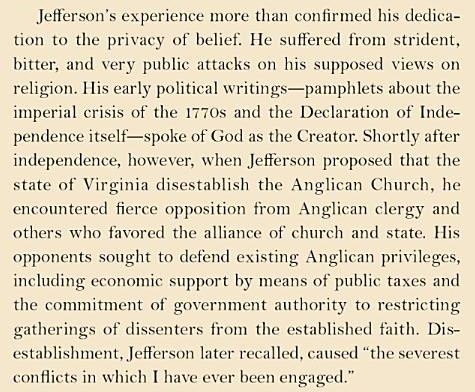
Maybe the author changed his mind and would have written the Declaration differently, excising the Creator from it, later in life. Or maybe Jefferson really mean something other than and likely more than linking Church and State.
Then there’s the question about “all Men.” Who might “all” include? And what about “Men”? Was the man Paul Jennings created equal with all Men? Was Jennings endowed by his Creator with certain inalienable (or unalienable) rights?

As you can see on this cover of the book, A Slave in the White House: Paul Jennings and the Madisons, Paul Jennings was not ever an African-American although he is a man, and he is black. He was a slave of the family of a white man, the American President James Madison. In this book, as Elizabeth Dowling Taylor quotes him (on page 7), Jennings speaks of encountering both Madison and Jefferson in close quarters together. Did they so notice him? Here’s how Dowling Taylor recounts it:
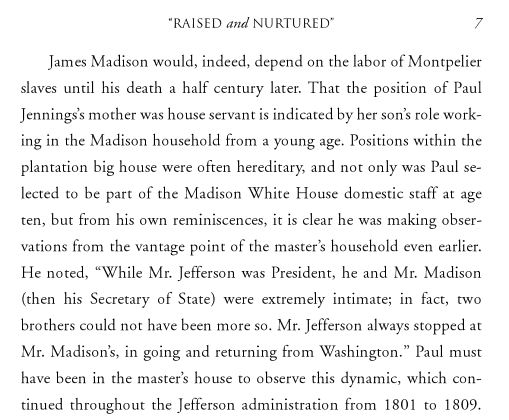
(I’m reading her book after watching her on Jon Stewart’s Daily Show. If you’re interested — and this is an aside — you can watch the video here:
)
As we all know, Madison owned this man Jennings. But Jefferson owned somebody else, not a man: Sally Hemings. And the early rumor was that the two had two children together, one named James Madison Hemings, who grew up to be a man, just not a white man endowed with “all Men” as having equal creation or equal inalienable (or unalienable) rights. But no woman at the time, it seems, was included in “all Men” either.
Thus, one of the earliest appropriations of the Declaration of Independence was by women and by men, white and black. Well, it wasn’t that early in American history. It was in 1848 that a few women drafted The Declaration of Sentiments, fashioned after Jefferson’s declaration, and a few women and men signed it. They wrote that “all men and women are created equal,” and four of them were Frederick Douglass, Amy Post, Catharine Sebbins, and Elizabeth Cady Stanton. Here’s from a page from the USA Library of Congress:
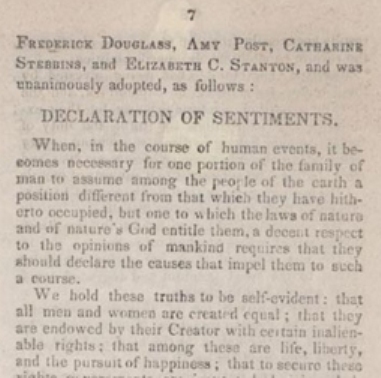
There’s much history here worth remembering today.
And yet there are so many, many more histories of interpreting and reinterpreting the text, the author, his intentions, and the intentions of readers now. Below is a sampling:
“We hold these truths to be [sacred and undeniable] selfevident, that all men are created equal and independent; that from that equal creation they derive in rights inherent and inalienables,” -perhaps Jefferson’s real original, a draft of the 28th of June 1776.
Then out of the far East, here is Fukuzawa Yukichi’s Japanese translation of 1866 (and where’s “their Creator” in this text?)

Then, in the USA, from the previous century, there are these:
“All we got to say on this proposition is this: first, you and me is as good as anybody else, and maybe a damn sight better; second, nobody ain’t got no right to take away none of our rights; third, every man has got a right to live, to come and go as he pleases, and to have a good time however he likes, so long as he don’t interfere with nobody else.” —H. L. Mencken’s “The Declaration of Independence in American,” 1921
“We think that all people are created the same and that God wants every one of us to be free and happy.” –The Declaration of Independence Translated for Kids, 2000
“As a result, we reaffirm the following to be self evident: That all men are created equal, that they are endowed by their Creator with certain unalienable rights,” —A Modern American Declaration of Liberty, 1999
Now, for our 21st century, there are these:
“Everyone can see that the following things are true: That all men are created equal; All people are created with equal rights; that they are endowed by their Creator with certain unalienable rights; God made them with rights that cannot be taken away;” –The NEW MILLENNIUM Declaration of Independence Line by Line, by “Mr. Peel’s 7th Grade Social Studies Class,” 2003
“We think it’s pretty obvious that God created every person equal, and he gave each person specific unchanging rights which should never be trampled upon. . .”–The Declaration of Independence for Dummies, Part I, 2003
Here are re-writes that get at blood rights of a Civil War and at Civil Rights for African Americans.
“. . . a new nation, conceived in Liberty, and dedicated to the proposition that all men [black and white] are created equal.” —Abraham Lincoln’s “Gettysburg Address,” 1863
“And Thomas Jefferson: ‘We hold these truths to be self evident, that all men [of any color] are created equal . . .’ So the question is not whether we will be extremists, but what kind of extremists we will be.” —Martin Luther King, Jr.’s “Letter from a Birmingham Jail,” 1963
And here is another re-write, but one that would deny rights because of race (the American Nazi translator’s attempt to make Adolf Hitler’s hatred of Jewish women and men sound like something Jefferson might pen):
“He is always the same Jew. That so obvious a fact is not recognized by the average head-clerk in a German government department, or by an officer in the police administration, is also a self-evident and natural fact.” —James Murphy’s translation of Adolf Hitler’s Mein Kampf, 1942
The following is one that was quoted in a nation where I grew up, (rather ironcially) when America was fighting “North Vietnam”:
“Hỡi đồng bào cả nước, Tất cả mọi người [each and every one, all people] đều sinh ra có quyền bình đẳng. Tạo hoá cho họ những quyền không ai có thể xâm phạm được;” —Hồ Chí Minh’s Proclamation of Independence of the Democratic Republic of Vietnam, 1945
And see how these sound to you, especially if you’re a native speaker and a fluent reader of the following languages:
“Nous tenons pour évidentes pour elles-mêmes les vérités suivantes : tous les hommes sont créés égaux ; ils sont doués par le Créateur de certains droits inaliénables;” –French (contemporary)
“Wir halten diese Wahrheiten für ausgemacht, daß alle Menschen gleich erschaffen worden, daß sie von ihrem Schöpfer mit gewissen unveräusserlichen Rechten begabt worden,” –German 1776
“Folgende Wahrheiten erachten wir als selbstverständlich: daß alle Menschen gleich geschaffen sind; daß sie von ihrem Schöpfer mit gewissen unveräußerlichen Rechten ausgestattet sind;” –German 1950
“Noi consideriamo come verità evidenti in se medesime che tutti gli uomini sono stati creati uguali; che han ricevuti dal loro Creatore certi diritti inalienabili;”–Italian 1776
“Noi riteniamo che le seguenti verità siano di per sé stesse evidenti, che tutti gli uomini sono stati creati uguali, che essi sono stati dotati dal loro Creatore di alcuni Diritti inalienabili,” –Italian 1961
“Noi riteniamo che le seguenti verità siano di per se stesse evidenti; che tutti gli uomini sono stati creati uguali, che essi sono dotati dal loro creatore di alcuni Diritti inalienabili,” –Italian (contemporary)
“Kita berpegang kepada kebenaran yang nyata ini, bahawa semua manusia diciptakan sama tarafnya, bahawa mereka dikurniakan oleh Pencipta mereka hak-hak tertentu yang tidak boleh dipisahkan;” –Malaysian, 2002
“Nós sustentamos estas verdades como auto evidentes: que todos os homens nascem iguais e que são dotados pelo Criador de certos direitos inalienáveis,” –Portugese (contemporary)
“Nosotros creemos ser evidente en sí mismo, que todos los hombres nacen iguales y dotados por su Criador de ciertos derechos inagenables:” — Spanish 1821
“Sostenemos como evidentes estas verdades: que todos los hombres son creados iguales; que son dotados por su Creador de ciertos derechos inalienables;” — Spanish (contemporary)
and here’s more, more in Japanese and Hebrew and Polish and Russian.
All men and women are created equal, so we would declare. Whose are these Inalienable Rights? Mine, Yours, Theirs?
Sex, by and for the Religious
Rachel Held Evans has written a review of a book by an evangelical pastor. She entitles it, Driscoll, “Real Marriage,” and Why Being a Pastor Doesn’t Automatically Make You a Sex Therapist.
C.K., aka “Founder of Jewlicious? Publisher?,” has written a review of one of Allison Yarrow’s report for The Daily Beast. He entitles it, Sex Toys: Kosher, Halal and Jesus Approved.

Elias Lieberman: Test me not for shibboleth
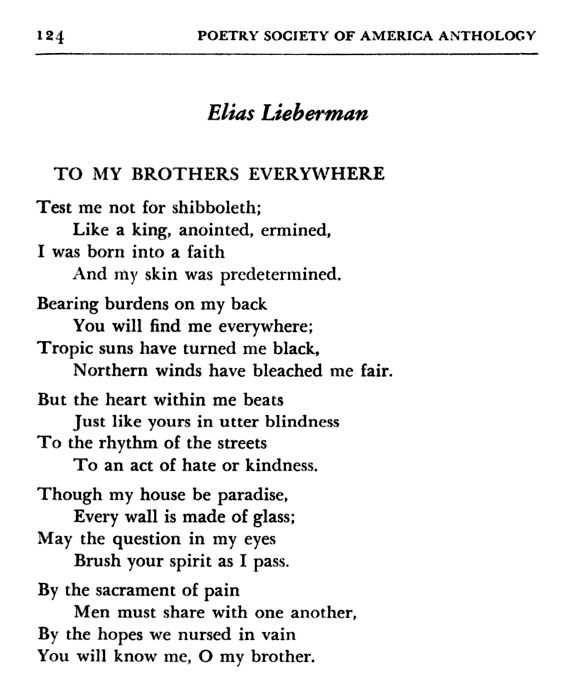

Elias Lieberman – poet; teacher; first Principal of Thomas Jefferson High School, Brooklyn; editor of Puck and of The American Hebrew
“To My Brothers Everywhere” – page 124, Poetry Society of America Anthology
Diglots: remembering the Schiff Library of Jewish Classics
Ever since I posted this morning on the new diglot publication programs of Harvard University Press, something has been nagging at me just beneath the layer of consciousness.
Finally, it came to me. The Hackmey Hebrew Classical Library which aims to print 25 Hebrew/Aramaic classics in diglot form with an English translation is an old idea. There already was an effort to do this.
The Schiff Library of Jewish Classics published a series of volumes – get this – modeled on the Loeb library classics (with similar dimensions) of Hebrew-English classics. In fact, Loeb’s sister was the one who started the series!
The publication program was an effort Jewish Publication Society (which, we must admit, has seen better days.) In fact, I own a set of Albo’s Sefer-ha-Ikkarim volumes that I picked a few years ago used (and I have to wonder why these have not been reprinted.) If I I also remember spending time with a volume that reprinted Apocrypha from the Septuangint in Greek and English that appeared to be a volume from that library. (There was some sort of connection with Dropsie University in that effort – now I want to go visit the library where I saw this volume.)
A number of those volumes were later reprinted by the Jewish Publication Society (usually in much fatter volumes – combining several of the original volumes in a single book or a double volume set.) Some examples that come to mind immediately are Hebrew Ethical Wills and Mekhilta de Rabbi Eliezer. In the introduction to the latter work, David Stern tells the story:
[This] publication was to be included in a new series entitled The Jewish Classics, whose purpose was to reproduce “in original and in the vernacular” the greatest and most important works of post-biblical Jewish literature. The idea for the series was supposedly … that of Theresa Schiff, the wife of Jacob Schiff, the wealth New York Jewish businessman and philanthropist who was perhaps the earliest and most powerful support of JPS [the Jewish Publication Society.]
How Theresa Schiff got the idea for the series is a story worth retelling. In 1910, James Loeb, Mrs. Schiff’s brother, undertook to publish new editions of all the Greek and roman classics in their original languages, with facing-page English translations, a project that eventually came to be known as the Loeb Classical library. One day, as the story goes, several of the volumes of the new Loeb Classics were lying on the table in the Schiff home. Admiring them, Mrs. Schiff turned to her husband and said, “Jack, why couldn’t you do for the Jewish classics what Jimmie is doing for the Greek and Roman?”
In fact, the idea for such a series had already been under consideration for several years, but it was Schiff’s $50,000 endowment that actually made it possible. (After Schiff’s death in 1920, his indispensible role in the creation of the library was recognized by JPS, which renamed the series the Schiff Library of Jewish Classics). The series was explicitly modeled upon the Loeb Library, whose purpose was to preserve and transmit to the modern reader the classical heritage of Western civilization. So, too, the volumes in the Schiff Library were intended to “awaken the interest and command the support of those who feel the obligation to see to it that the Jewish Classics which, with few exceptions have been unknown to English readers, shall come into their own, and take their rightful place among the classical literatures of all peoples.” According to the original plan, twenty-five volumes were to be published, covering “the entire range of Jewish literature … up to some [indefinite] point in modern times.”… Like the Loeb classics, the volumes were to be published in pocket-sized form, with an introduction, critically edited and annotated text, and facing English translation.
In the end, the Schiff Library fell somewhat short of its original ambitious goals. A number of the volumes never materialized, others were deemed unworthy of being published and, ultimately, the cost of the series proved to be too great. Nine volumes were published…
[Actually there were at least nine titles, and most of the titles were actually multi-volume sets. See this Yale Library search. However, I am fairly certain that there were more than just those nine titles; for example as mentioned above, I recall seeing a Greek-English Apocrypha volume from that series.]
The overall impact of the library was also less momentous than was originally hoped; commercially, it never rivaled the success of the Loeb Classical Library.
So now you can see what was bothering me. In the case of both the Schiff Library and the Hackmey Library, the announced goal was to publish 25 Hebrew (or Aramaic)-English titles. Both were directly inspired by the Loeb Library. Both were funded by wealthy businessmen. The parallels are uncanny.
And this, of course, raises the question: what is the secret magic that Harvard University Press hopes to bring to the publication of Hackmey Library that the Jewish Publication Society was unable to bring to the publication of the Schiff Library?
In any case, both publication programs – even if they are not successes – are likely to lead to some interesting books.
Essential (or popular) Dickens?
Here is a list of some of the major works by Charles Dickens (followed the year of completion of its original serial version) and some Dickens collections that I own; I am interested to see which Dickens novels are considered important enough to be in collections.
A = Annotated Dickens, a pair of volumes published by Clarkson Potter as part of their “Annotated series” (out of print)
P = Penguin Classic’s Major Works of Charles Dickens, a box set containing hardcover versions of some Penguin Classics editions
N = volume is contained in the Norton Critical Edition series.
B = Barnes and Noble volume Charles Dickens: Five Novels.
D = contained in DVD version in BBC collections (volume 1, 2)
Just for grins, I added up the total check marks for each major work to get a total – representing a rather unscientific popularity score.
Despite the sum not having even a shred of scientific respectability, I have to say that the totals mostly came out the same as my assessment; although I would rank Pickwick Papers rather higher than on the list.
|
|
A |
P |
N |
B |
D |
Total |
| Pickwick Papers (1837) | ✓ | ✓ | 2 | |||
| Oliver Twist (1839) | ✓ | ✓ | ✓ | ✓ | ✓ | 5 |
| Nicholas Nickleby (1839) | 0 | |||||
| Old Curiosity Shop (1841) | ✓ | 1 | ||||
| Barnaby Rudge (1841) | ✓ | 1 | ||||
| Christmas Carol (1843) | ✓ | ✓ | ✓ | 3 | ||
| Dombey and Son (1848) | ✓ | 1 | ||||
| Martin Chuzzlewit (1844) | ✓ | 1 | ||||
| David Copperfield (1850) | ✓ | ✓ | ✓ | ✓ | 4 | |
| Bleak House (1853) | ✓ | ✓ | ✓ | 3 | ||
| Hard Times (1854) | ✓ | ✓ | ✓ | ✓ | 4 | |
| Little Dorrit (1857) | 0 | |||||
| Tale of Two Cities (1859) | ✓ | ✓ | ✓ | 3 | ||
| Great Expectations (1861) | ✓ | ✓ | ✓ | ✓ | ✓ | 5 |
| Our Mutual Friend (1865) | ✓ | 1 | ||||
| Mystery of Edward Drood (1870) | 0 | |||||
| contains other short stories or Christmas stories | ✓ | 1 |
In this 200th Dickens anniversary year, what do you consider as his most important works?
Whose Shibboleth? Mine, Yours, Theirs?
One announced BLT post I’m looking forward to reading in 2012 is “Bible translation preference as shibboleth.” Pardon me, however, if I write another post on shibboleth now.
Let me just start with our English. Then we’ll see how we got it. Then we’ll see how we get it. We may be forced into translation. I know I will be forced into translation (so that will come at the end of this post).
I. How We Got It (Etymology and all)
Here’s from the Oxford English Dictionary, a good source for us English language insiders:
shibboleth, n.Pronunciation: /ˈʃɪbəlɛθ/Forms: ME s(h)ebolech, 15, 16 schiboleth, 16 schibboleth, 16–18 shiboleth, 16– shibboleth.Etymology: < Hebrew shiˈbbōleth ; in the Vulgate transliterated sciboleth.
The word occurs with the senses ‘ear of corn’ and ‘stream in flood’; in the passage now referred to the LXX and Vulgate give the former rendering; mod. commentators prefer the latter, on the ground that on this view the selection of the word is naturally accounted for, as the slaughter took place ‘at the fords of Jordan’.
1. The Hebrew word used by Jephthah as a test-word by which to distinguish the fleeing Ephraimites (who could not pronounce the sh) from his own men the Gileadites (Judges xii. 4–6).
1382 Bible (Wycliffite, E.V.) Judges xii. 6 Thei askiden hym, Seye thanne Sebolech [1535 Coverdale Schiboleth, 1611 Shibboleth],‥the which answerde, Shebolech [a1425 L.V. Thebolech, 1535 Siboleth, 1611 Sibboleth].1671 Milton Samson Agonistes 289 In that sore battel when so many dy’d Without Reprieve adjudg’d to death, For want of well pronouncing Shibboleth.1844 M. Elphinstone Hist. India II. vi. iii. 73 As some endeavoured to conceal their character, recourse was had to a test like the Jewish Shiboleth.
2. transf.
a. A word or sound which a person is unable to pronounce correctly; a word used as a test for detecting foreigners, or persons from another district, by their pronunciation.
b. A peculiarity of pronunciation or accent indicative of a person’s origin.
c. loosely. A custom, habit, mode of dress, or the like, which distinguishes a particular class or set of persons.
3.
a. fig. A catchword or formula adopted by a party or sect, by which their adherents or followers may be discerned, or those not their followers may be excluded.
b. The mode of speech distinctive of a profession, class, etc.
Draft additions 1993
Hence, a moral formula held tenaciously and unreflectingly, esp. a prohibitive one; a taboo.
ˈsibboleth, v.
rare—1.
intr. To speak with a special pronunciation.
1638 T. Herbert Some Yeares Trav. (rev. ed.) 154 At this day [it] is call’d Spawhawn (or as they Sibboleth, Sphawhawn) and by most writers differently spelled.
Now, that should explain pretty much everything.
II. How We Get It (as English insiders or perhaps as English outsiders)
Now, all of that should explain pretty much everything indeed. However, if you’re learning English as an additional language, then this is utterly complex. So, if you’re learning English as an additional language, and if your mother tongue is modern Hebrew, then you could perhaps start more easily get more this way, with flash cards:

But maybe that would be getting it backwards. Let’s go back to the source text, then.
III. Might We Be Forced into Translation?
We read the story from Judges xii. 4–6, and we infer what shibboleth is and, better, what a “shibboleth” is. We read again the OED etyomologies, English from the transliterated Hebrew shiˈbbōleth, not siˈbbōleth. And there’s English from the transliterated Latin sciboleth, not siboleth, which the OED editors wrongly attribute to the Vulgate when this is actually Pagnini. So we read from the Vulgate the transliterated Latin sebboleth, not tebboleth.
So Wycliffe’s English follows with Sebolech, not Thebolech. But Bishops has Schibboleth, not Sibboleth . But the Douai has Sebboleth, not Tebboleth. But the Geneva and the King James have Shibboleth, not Sibboleth. That’s English.
And yet, if our mother tongue is German, then we might say Danke to Martin Luther for giving us the Bible in the language of our Deustch speaking fathers and not, ostensibly, in Hebrew or with Hebraisms at all. We’d read the German story climax, then, this way:
hießen sie ihn sprechen: Schiboleth; so sprach er Siboleth und konnte es nicht recht reden; alsdann griffen sie ihn schlugen ihn an den Furten des Jordans, daß zu der Zeit von Ephraim fielen zweiundvierzigtausend.
That’s ironic, isn’t it? Luther has no insider German to replace the Hebrew by.
Then, there’s irony when we think about a pratogonist of a story, who’s a Nazi “hunter of Jews” — even in a film of historical fiction — using a Schiboleth or two:

Here’s an analysis from a blogger who’s seen such a film, which is in part German, in part French, in part Italian, in spoken English mostly, and in written English subtitles for the primary, mainly mono-lingual American English audience:
* The Jewish family’s inability to speak English seals their doom as they hide under the floorboards of the French farmer’s house, unaware that Landa is openly discussing their demise. And by pulling out a Sherlock Holmes pipe and puffing on it as he prepares to reveal that he has known all along that the farmer is hiding the family, Landa is practically telegraphing this to the farmer – but it only makes sense after it’s too late.
* British agent Lt. Hicox gives himself away as a spy first by his German accent (which, good as it may be, cannot fool an authentic German) and then by being unaware of the cultural custom of holding two fingers and a thumb up to signal the number three (rather than the more common method of simply using the main three fingers).
* At the Nazi film event, Landa can instantly detect the Basterds are spies by their poor Italian accents.
* And at the restaurant alone with Shosanna, Landa drops some shibboleth-hints to suggest he secretly knows who she really is, by making overt references to milk and cream as he grills her about her made-up identity.
And the blogger, J. S. Holland, then brings this all back to English, to English and not German shibboleths:
One of my favorite films, Inglourious Basterds, is all about the nuances of language and codes and customs and shibboleths – even its very name is a shibboleth. [Quintin] Tarantino, a devout film buff, liberally loaded his movie with film history references, some obvious, some abstract.
From the English language wikipedia entry about the film, we get a hint at why “Inglourious Basterds… – even its very name is a shibboleth”; here’s the skinny with all of the un-shibboleth hyperlinks retained, of course:
The title of the film was inspired by the English title of director Enzo G. Castellari‘s 1978 war film, The Inglorious Bastards.[17][18] When asked for an explanation of the film’s title spelling during a news conference at the Cannes Film Festival, Tarantino said, “I’m never going to explain that”.[19] When pushed on it, Tarantino would not explain the first u in Inglourious, but said, “The Basterds? That’s just the way you say it: Basterds.”[18][20] Tarantino later stated in an interview that the misspelled title is “a Basquiat-esque touch.”[21] He further commented on Late Show with David Letterman that Inglourious Basterds is a “Quentin Tarantino spelling.”[22]
And those wikipediaists, those English writing wikipediaists anyway, have noted more (in their entry on shibboleth) about how the Americans and Dutch during World War II actually turned things back around on the Nazis:
For example, during the Battle of the Bulge, American soldiers used knowledge of baseball to determine if others were fellow Americans or if they were German infiltrators in American uniform. The Dutch used the name of the port town Scheveningen as a shibboleth to tell Germans from the Dutch (“Sch” in Dutch is analyzed as the letter “s” and the digraph “ch”, producing the consonant cluster sx, while in German it is analyzed as the trigraph “sch,” pronounced [ʃ]).
But we wonder if we English readers might be missing something. Perhaps.
Note, for example, all of the Korean wikipediaists’ many and various examples of 쉽볼렛, not 씹볼렛. On the Korean wikipedia site here, there are the Dutch shibblething the Germans again (pardon my English — yes, I know the OED editors insist that the verb form is both rare and intransitive, but I believe you get what I mean); and, so on the Korean wikipedia site, there are the Finns shibblething the Russians, the Ukrainians doing the same differently, the Haitians shibblething, the Belgians shibblething, the Dutch shibblething again now tricking the French also, the Scilian Norman Frenchmen shibblething, the Barcelonans shibblething, the Brazilians shibblething the Paraguayans, and, most notably, the Japanese shibblething the Koreans.
We imagine if we read every wikipedia entry in the different languages, or if we tried and failed, then we’d surely not get all of it.
IV. All of that suggests this: I will be forced into translation, so that what I’ve heard and seen isn’t entirely gibberish or something else missed by you or by me
Once upon a time, at another blog, I told a couple of stories, examples of shibboleths, aptly enough. And then I went on to tell the Bible story again, but I considered some things gibberish, probably like a Ephramite or several tens of thousands of Ephramites. And yet I wanted to listen more like a reader of Greek, in which that Greek itself was a Hebraic shibboleth or two. If you’re interested, and if you think you can get it, then here that is (with a link to the original post at the end of this one):
So, now, there’s this story in the Bible. It’s also become a story of bible translation. This is the example of gibberish I was talking about at the beginning of this post. Sounding really important and smart, the translation usually goes like this:
Jephthah captured the shallow crossings of the Jordan River, and whenever a fugitive from Ephraim tried to go back across, the men of Gilead would challenge him. “Are you a member of the tribe of Ephraim?” they would ask. If the man said, “No, I’m not,” they would tell him to say “Shibboleth.” If he was from Ephraim, he would say “Sibboleth,” because people from Ephraim cannot pronounce the word correctly. Then they would take him and kill him at the shallow crossings of the Jordan. In all, 42,000 Ephraimites were killed at that time.
This really is one of the best translations of Judges 12:5-6 in my opinion because it forgoes the really strange English word “fords” and uses the much-clearer phrase “shallow crossings” instead. This is the New Living Translation. But, like every other translation of the Bible I’ve heard, there’s the weird “Shibboleth” / “Sibboleth” thing that seems give us English readers (especially non-Ephramites) some kind of insider track here. We’d more quickly side with the killers than the killed here.
What we don’t get by the sounds-only translation is what the Hebrew word שִׁבֹּלֶת means to some of the early readers of the story. Quite literally, it’s an ambiguous old term that can mean either “corn stalk or grain waves” or “water flood or stream.” And the Jews translating this word into Greek (in the Septuagint, “Judges A” AND “Judges B”) make the Hebrew mean either σύνθημα or στάχυς [sun-thema OR stachys]. The first Greek word is just a signal to the reader who seems to know the story well: it means something like a “theme together” or an “inside joke” (or a “password” — which is how translator Philip E. Satterthwaite moves the Greek into English in the New English Translation of the Septuagint). The second Greek word, in this context, is sometimes translated into English as “Stachys.” (And that’s exactly how English translator Sir Lancelot Brenton translates it while Satterthwaite clarifies the word to mean “Ear-of-Corn“). The Greek word στάχυς, of course, is ambiguous. Greek readers know it means “ear of corn” but it also is used for the “lower part of the abdomen.”
So if you read the story in Greek translation from the Hebrew, then it is funny because the Ephramites can’t pronounce “corn stalk” and they get stabbed in the point of their body that looks like a corn stalk: they get a sword run through the lower part of their abdomen. Or if you read the Judges A translation from Hebrew to Greek, then it’s more serious because the translator is just reminding Jewish readers how one group used a password (an inside joke) on the other group, deadly serious stuff. In both Jewish translations (from Hebrew to their Hellene), the reader never hears the Ephramites stumbling over the word (i.e., as if saying “Sibboleth”). The silence is important, I think, because the translators are giving a nod to their readers and not entirely trying to explain what would be understood if listening to the story in Hebrew. (Sylvie Honigman, the scholar in Jerusalem who’s looked at the legend of the Septuagint, says that the Greek here is in the Homeric not the Alexandrian [or Aristotelian] paradigm — that’s important to me as I look at how Aristotle abstracts language and the early Greeks refused to do that. The ancient Jews, with their scripture, are much more playful than many of our English translations today – in more straightforward ancient Aristotelian fashion – give them credit for).
And if you read the story in Hebrew translated into as playful English, then it goes something like this. And here I give apologies to my good Japanese language tutor:
So they say to him,
“So say ‘cornstalk rows like water flows’.”
So he says “colnstark lows rike watel hrows.”
So he can’t rightly get it right.
So they seize him.
So they make his blood flow at the crossing of the Jordan.
So at that time some forty two thousand fall
Now listen to the Hebrew:
וַיֹּאמְרוּ לֹו אֱמָר־נָא שִׁבֹּלֶת
וַיֹּאמֶר סִבֹּלֶת
וְלֹא יָכִין לְדַבֵּר כֵּן
וַיֹּאחֲזוּ אֹותֹו
וַיִּשְׁחָטוּהוּ אֶל־מַעְבְּרֹות הַיַּרְדֵּן
וַיִּפֹּל בָּעֵת הַהִיא מֵאֶפְרַיִם אַרְבָּעִים וּשְׁנַיִם אָלֶף׃
And hear the Greekistic translations:
Judges A
καὶ εἶπαν αὐτοῖς εἴπατε δὴ σύνθημα
[nothing’s needed here]
καὶ οὐ κατηύθυναν τοῦ λαλῆσαι οὕτως
καὶ ἐπελάβοντο αὐτῶν
καὶ ἔσφαξαν αὐτοὺς ἐπὶ τὰς διαβάσεις τοῦ Ιορδάνου
καὶ ἔπεσαν ἐξ Εφραιμ ἐν τῷ καιρῷ ἐκείνῳ δύο τεσσαράκοντα χιλιάδες
Judges B
καὶ εἶπαν αὐτῷ εἰπὸν δὴ στάχυς
[nothing’s needed here!]
καὶ οὐ κατεύθυνεν τοῦ λαλῆσαι οὕτως
καὶ ἐπελάβοντο αὐτοῦ
καὶ ἔθυσαν αὐτὸν πρὸς τὰς διαβάσεις τοῦ Ιορδάνου
καὶ ἔπεσαν ἐν τῷ καιρῷ ἐκείνῳ ἀπὸ Εφραιμ τεσσαράκοντα δύο χιλιάδες
Don’t you hear how language keeps us out? If it’s “shibboleth” and we can say it, we think we’re in. But the Jews who translating from Hebrew into their own Hellene didn’t feel the need (in either of their Greek versions) to separate out only the sounds of שִׁבֹּלֶת and σύνθημα or στάχυς. The Hebrew writer(s) of Judges will allow readers to play close attention to the interplay between the water crossing of the Jordan river and the word (i.e., water flowing like grain growing) used to trip up the Ephramites at that cross. The Jews translating the Hebrew into their Greek, similarly, remind the readers that this is word play. How it sounds can be fatal. (In somebody’s gibberish, that’s just fatalistic?)
Whose is Shibboleth? Mine, Yours, Theirs? (link: the old post with my own shibboleth stories).
Calculator languages
Kraftwerk’s song from their classic Computer World album is the soundtrack to the post:
This post is to celebrate the re-introduction of the two of HP’s “Voyager” calculators after 30 years: the HP12C 30th Anniversary Edition and the HP15C Limited Edition. These calculators are not so easy to buy – the HP15C has only been available for a few hours at a time on HP’s web site before selling out – apparently there is huge demand for it. (If you do decide to buy one of these calculators, be sure to use a coupon.)
These calculators date back to the “good ol’ days” of HP – when it was a company known for super-high quality devices rather than shoddy printers and corrupt business practices.
The “Voyager” calculators are among the most beloved calculators ever released by HP. Smaller than a modern smart phone, they featured a sideways format, an LCD display, and an elegant 39 key layout. The design of the calculator is famously tough – one site claims that “One HP-12C was used by a zoo keeper to calculate feed mixtures. The zoo keeper dropped the calculator and it was consumed by a hippopotamus. The calculator survived the hippo’s digestive process as well as the washing that followed. “ The same site claims that the battery life was exceptionally long-lived: “The record so far is 22 years on the original set of batteries and that sample is still running!”
The HP 12C business calculator is the most popular of the series – it has remained in production for 30 years in one form or another. In addition to time value of money computations, this calculator offered odd period calculations (allowing interest to accrue for some arbitrary amount of time before the first payment); bond calculations; and depreciation calculations. Why does it sell so well? Some of the theories are based on the calculators looks and rugged construction: “It’s good (and expensive) looking”; “Like all 10C series calculators, it has a nice solid built-like-a-brick feel that clamshell models can’t quite match”; “It has become part of the well-dressed business uniform – easily distinguished from cheap calculators due to its layout.”
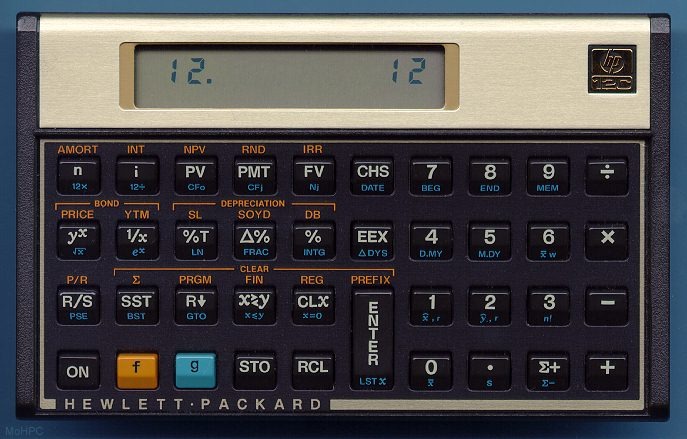
Another celebrated entry in the series is the HP 15C scientific calculator. HP produced some less capable scientific calculators (10C, 11C) as part of its Voyager line, but the 15C included features such as numerical integration, a root solver, support for complex numbers, and matrices. Later HP calculators would add even more features, but at the cost of size, complexity, and reliability.
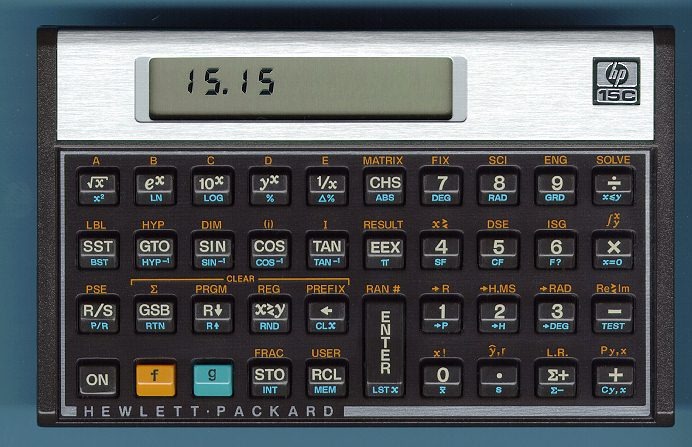
A more unusual entry was the HP 16c programmer’s calculator. This entry featured extensive ability to manipulate numbers in different base systems. Sales were reportedly poor, but this calculator has a large fan base today and good quality samples can go for several hundred dollars on eBay.
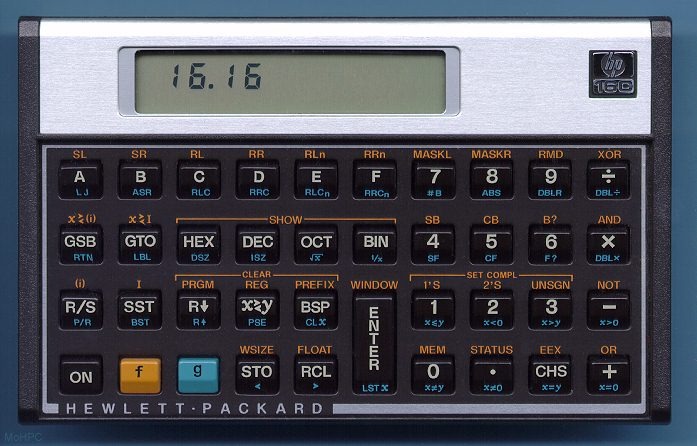
The new Limited Edition calculators mentioned above are cheaper (in real dollars) than the original releases, and they are considerably faster (reports indicate that they 30-100 times faster.) Notably, they try to preserve almost identical executable code with the old models (which somehow hit a sweet spot in a nearly perfect design). The calculators look good, and they handle fairly well too.
The new replacements are not actually made by HP – they are made by Kinpo Electronics under license from HP and sold under the HP name. Still, with these models, Kinpo has attempted to create an experience as close to the original Voyagers as is possible. One area in which that is not true is battery life. The battery life on these models is sharply reduced – batteries on the new limited edition calculators last only a couple of months, not a couple of years. A pity.
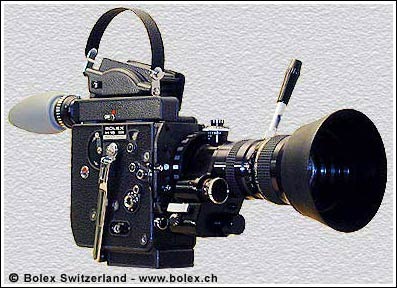
It is worth pausing just to note the growing popularity of retro-tech. Chrysler is releasing new cars for 2013 under the name “Dodge Dart.” Commodore is releasing a modern day “Commodore 64.” And you can still buy a Bolex H16 today – apparently there is a market for a high quality hand cranked motion film camera.
Now, what possible relevance could a post on pocket calculators have for a blog on language and translation? More than you might think! It turns out that each calculator comes with its own “language”, and that “language” has a lot to say about how users structure and even think about problems (yes, Sapir-Whorf really does have some application to calculator languages!) I’ll explore that topic in a future post….


 BLT
BLT 
