Throwing away Harlem Renaissance public art
The story is absolutely stunning – UC Berkeley casually sold, for $150 plus tax, a massive WPA art work valued at over a million dollars.
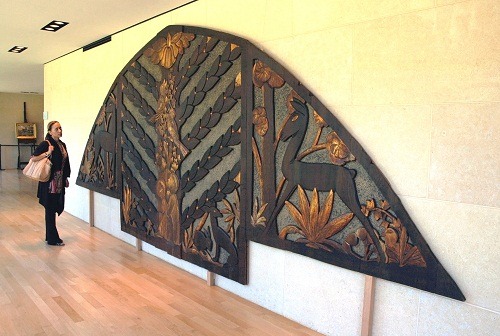
The art work was created by the Harlem Renaissance artist Sargent Johnson. How did this happen?
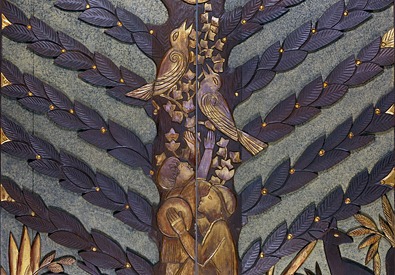
In 1937, under the auspices of the W.P.A., Johnson designed two large Art Deco redwood reliefs, one of which depicted an idealized natural world of gilded gazelles, open-beaked birds, spiky-leafed plants and a boy clapping cymbals.
Designed to cover organ pipes at the old California School for the Deaf and Blind in Berkeley, this natural-world relief was affixed to a wall until 1980, when the school moved. As squatters (and rats) took shelter there, the university, which had taken over the premises, moved any valuable property to a secure basement warehouse, and the organ relief was disassembled. But one of the organ screens was misidentified as belonging to Berkeley’s graduate schools, so when the university reopened the building three years later, only one of the two Johnson reliefs was returned to its rightful place. The other remained in storage until 2009, when the university emptied the storage space in preparation for the sale of the building and transferred the relief to the university’s surplus store.
That’s where, in late summer of that year, Greg Favors, an art and furniture dealer, came upon eight cracked but still handsome panels in a plywood bin. Mr. Favors did not know what they were or who had created them, but he thought them “amazing and cool,” he said. He paid $164.63, including tax.

Now even under these circumstances, the art should not have normally passed to private ownership: work produced under the WPA program belongs to the public. But lawyers hired by the lucky new owners found a loophole:
Movable art from the W.P.A. falls under federal jurisdiction. But according to a November 2010 e-mail from a General Services Administration lawyer to the university … the federal government does not retain ownership of W.P.A art affixed to nonfederal buildings.
Jennifer Gibson, director of the General Services Administration’s art in architecture and fine arts program, said in an interview that despite the ruling, her agency hoped Johnson’s work would go “to an institution that provides public access.”
The university tried to buy back the art work, but it could not raise the funds. It passed to a private New York art dealer who sold it to the Huntington Library.
One wonders if the claims of the artist’s friend might not be correct:
Arthur Monroe, an African-American artist and friend of Johnson’s, said that if the missing art had been by a white sculptor, “the university would have turned the campus upside down to find it.”
Gasconade, historians, and the American West
This post is honor of this year’s centennial celebrations of New Mexico and Arizona’s admissions to the Union.
Wallace Stegner’s 1954 Beyond the Hundredth Meridian: John Wesley Powell and the Second Opening of the West is an absolutely blockbuster biography – the best thing by far that I have read by Stegner. Wallace considers the good Major not as a wild adventurer who had a nearly-out of control trip down the Colorado River, but rather as a scientist; as a professor of geology and the director of bureau of ethnology at the Smithsonian Institute, whose contributions to linguistic studies and geological surveys of the American West laid the foundation for the modern scientific studies of that region. Stegner considers Powell’s major work not to be The Exploration of the Colorado River and Its Canyons but rather to be his The Arid Lands – which he argues was a work of prophecy that foresaw the Dust Bowl of the 1930s and the Water Wars of our own day. (Stegner edited The Arid Lands for republication.)
The book starts strong, with Stegner’s dedication to Bernard DeVoto, the celebrated Western historian and Harvard instructor who had a particularly flamboyant style of writing. (Stegner would later write a biography of DeVoto and edit DeVoto’s letters). DeVoto also contributed the introduction to Stegner’s biography of Powell, and I want to quote from it to indicate DeVoto’s style – and, although I think DeVoto makes his case somewhat outrageously, I think he is thinking is sound:
A book called The Growth of American Thought [by Merle Curti] was awarded the Pulitzer Prize for history in 1944. At the end of a chapter on “The Nature of the New Nationalism” the central figure [John Wesley Powell] of Mr. Stegner’s book makes a momentary appearance. A passage which all told is nearly two pages long is discussing “the discovery of the West by a group of scientists who revealed it to the rest of the country.” (They revealed it, we are to understand, primarily as interesting scenery.) A paragraph pauses to remark that at that time time these scientists made their discovery, the frontier was vanishing but it “had left distinctive traces on the American mind through its cult of action, rough individualism, physical freedom, and adventurous romance.” Here are four fixed and indestructible stereotypes about the West, all of them meaningless. No wonder that on the way to them Mr. Stegner’s subject is dismissed with a sentence which records that “the ethnologist and geologist, John Powell, who explored the Colorado River, the Grand Canyon, and the homeland of Indian tribes of the Southwest, promoted extremely important geological surveys for the federal government.”[…]
Thus “John Powell” was an explorer who embraced the cult of action, whatever that may be, and went down the Colorado and wrote an adventure story. He also had something to do with geological surveys which were “extremely important” but not important enough to be specified. Our historian perceives in them nothing that bears on the growth of American thought.[…] Because the historian of thought approaches the West with a handful of clichés, the conditions of life and society are not important. What counts is […] an “adventurous romance.”[…]
The reason historians have ignored Powell is that the preconceptions with which they have approach the area Powell figures in correspond exactly to the misconceptions with which the American people and their government approached the West. […] My part here is to explain why writers of history have for so long failed to understand the massive figure of John Wesley Powell and therefore have failed, rather disastrously, to understand the fundamental meaning of the West in American history.
One of the reasons for that failure is beyond explanation: the tacit classification, the automatic dismissal, of Western history as merely sectional, not national, history. No such limitation has been placed on the experience of the American people in New England, the South, or the Middle West. These sections are taken to be organic in the United States and cannot safely be separated from their functional and reciprocal relationships. When you write Southern history in the round you must deal with such matters as, for instance, the cotton economy, the plantation system, slavery, States’ rights, the tariff, secession, the Civil War, and Reconstruction. They are so clearly national as well as Southern in implication that it would be impossible to write about them without treating them in relation to the experience of the nation as a whole. The same statement holds for the historical study of, say, Southern institutions, Southern politics, and Southern thinking – to ignore their national context would clearly be absurd. Southerners too are acquainted with “action” if not a cult of action, and are known to value “individualism” if not a rough kind of it. We may observe, even, that the South has some awareness of “physical freedom” and “adventurous romance.” But an intellectual historian would not write a summary that implied that history need inquire no further – would not dismiss Jefferson with a sentence about his governorship of Virginia or Calhoun with one about his term in the legislature of South Carolina.[…]
The West was the latest and most adventurously romantic of our frontiers, and its history has been written, mostly, as frontier history. When the word “frontier” is used in history it has, to begin with, been raised to a tolerably high degree of abstraction. And its inherent abstractness has been almost immeasurably increased by a hypothesis which has dominated much writing about the West and has colored almost all of it, Frederick Jackson Turner’s theory of the function of the “the frontier” in American life. That theory has, I suppose, begotten more pages of American history than any other generalization. Till recently no one dreamed of writing about the West without its help. Indeed its postulate of a specific kind of “frontier” independence, which it derives from the public domain and which it calls the principal energy of American democracy, has heavily buttressed our illusions about the West. So our problem here exists in a medium of pure irony. For, to whatever degree the Turner hypothesis may be applicable to the American experience east of the 100th meridian, it fails almost altogether when applied to the West. The study of a single water war, in fact of a single irrigation district, should reveal its irrelevance.[…]
A small holding that included a water source could prevent access to the basis of life and so give its owner the usufructs of a much larger area which he could keep others from owning. Adjoining holdings along a stream could similarly dominate a much larger area. So at a small expense (and by fraud) a corporation could keep individual stockgrowers from a really vast area it did not own but could thus make use of. Or a corporation could not only charge its own price for water, that is for life, but could control the terms of settlement with all that settlement implies. Here was another powerful force making for monopoly and speculation. Clearly, that is clearly to us now, the West could exist as a democratic society only if the law relating to the ownership and use of water were changed. The changes required were repugnant to our legal system and our set of mind, and again the experience of the West produced turbulence but not understanding.
Moreover, to bring water to land at any distance from the source was an undertaking expensive beyond the ability of an individual landowner to afford. As the distance increased it would become expensive beyond the ability first of co-operative groups, then of profit-making corporations, and finally of the individual states to afford. At they heyday of “individual enterprise” elsewhere in the United States, therefore, the natural conditions of the West demanded federal action in the procurement of water. And this was repugnant not only to our set of mind but, especially, to our mystical vision of the West, the very citadel, so we insisted on believing, of “rough individualism.”[…]
These principles are described and analyzed, and most of the institutional changes necessary to bring Western society into effective accord with them are stated in Powell’s Report on the Lands of the Arid Region of the United States. In fact, they are set forth in the first forty-five pages of that monumental and astonishing book, a book which of itself opened a new era in Western and in national thinking. It is one of the most remarkable books ever written by an American. In the whole range of American experience from Jamestown on there is no book more prophetic. It is a scientific prophecy and it has been fulfilled – experimentally proved. Unhappily the experimental proof has consisted of human and social failure and the destruction of land. It is a document as basic as The Federalist but it is a tragic document. For it was published in 1878 and if we could have acted on it in full, incalculable loss would have been prevented and the United States would be happier and wealthier than it is. We did not even make an effective effort to act on it till 1902. Half a century after that beginning, we are still far short of catching up with it. The twist of the knife is that meanwhile irreversible actions went on out west and what we did in error will forever prevent us from catching up with it altogether.[…]
Any day now we may expect the appearance of a historian with a generalizing mind who is bent on achieving a hypothesis about the West in American history that will square with the facts. When someone achieves it, it will be a more realistic and therefore a more useful theory than Turner’s.
Tzvee Zahavy’s “God’s Favorite Prayers” free today (February 20, 2012)
Blogger Tzvee Zahavy has made his Kindle book God’s Favorite Prayers free for today only. Tzvee talks about his Kindle book in many, many of the posts on his blog.
Remembering Gunther Plaut’s Chumash (Pentateuch)
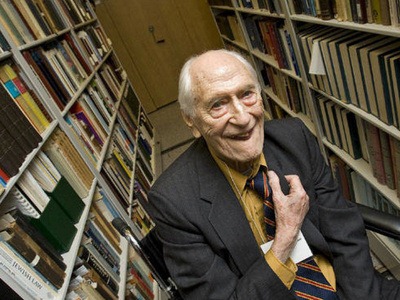 On February 8th, Gunther Plaut died at age 99, after a nine-year-long struggle with Alzheimer’s disease. He was a leading rabbi in the US and Canadian Reform Judaism movements.
There are many interesting points of his life that can be noted: his parents’ courage in running a Jewish orphanage (dissolved in 1939) in Hitler’s Berlin, his escape to the United States, his service in the US Army (as a chaplain) in 104th Infantry unit that liberated the Dora-Nordhousen concentration camp (his NY Times obituary states “though the survivors were starving, he recalled, they did not ask for food, but for religious items”), his work in rescuing a Torah nearly destroyed during Krisstallnacht, his service on the Ontario Human Rights Commission (and his decision allowing Sikh students to wear ceremonial daggers in public schools), his sermons, his newspaper columns, and his many books.
Instead I plan to focus on two of Plaut’s books: in this post, I want to talk about Plaut’s Chumash (Pentateuch). In a later post, I will talk about Plaut’s 1992 Leo Baeck Memorial Lecture:
German-Jewish Bible Translations: Linguistic Theology as a Political Phenomenon
W. Gunther Plaut is one of the great rabbis of Reform Judaism today. In 1992, he held the 36th Leo Baeck Memorial Lecture at the Leo Baeck Institute New York. Plaut analyzes German Bible translations by Jews. In order to explain why German Jews have produced such a plentitude of translations, he looks at the translations by Moses Mendelssohn, Leopold Zunz, Samson Raphael Hirsch, Simon Bernfeld, Martin Buber-Rosenzweig and Harry Torczyner (later known as Tur-Sinai). Plaut shows that the translations are in a significant measure part of the tension between Germanness and Jewishness.
Jewish Bibles are different than Protestant Bibles. At a first glance, they might seem analogous: in a typical Protestant church you expect to find pew prayerbooks, hymnals, and
Bibles; in a typical Jewish synagogue you expect to find pew siddurim (prayerbooks), tehillim (psalters), and chumashim (Pentateuchs). But open up the pew books and the similarity breaks: in particular, a Jewish chumash is likely quite different in format than a Protestant Bible. While the Protestant Bible will contain an English Bible and perhaps some cross-references, a chumash in an American synagogue will likely contain the Hebrew text of the Torah, an English translation, and either classical commentary (e.g. Rashi or Onkelos Targum) or modern commentary.
For decades in the US, the Hertz chumash reigned supreme. In many ways, the Hertz chumash was a remarkable edition. S. (who now mostly posts at the On the Main Line blog), on one of his early blogs, quotes Artscroll general editor Nosson Scherman in a Forward interview:
“The Hertz was a masterpiece in its time, a piece of literature. What he did was heroic,” said ArtScroll’s Rabbi Scherman. “He was trying to convince people that the Chumash was worthwhile. He would quote Shakespeare, church fathers and other Christian sources. Nowadays, people are offended by that. Now you have people with a yeshiva education. They want to know what the Chumash means to Jews, what the traditional sources have to say.”
If American chumashim have generally turned to the right since Hertz, the Plaut chumash (which began to be published in 1974,was completed in 1980, and was revised in 2005) was a marked turn to the left. The publisher describes the original Plaut chumash as “the first liberal Torah commentary ever produced.” I am not certain that is correct, but it was certainly set a high standard for liberal chumashim that have not yet been exceeded by other volumes. It was shocking. Instead of being organized by traditional parashah divisions, it was organized by smaller thematic units. In addition to extensive scholarly (not particularly devotional) commentary, it featured critical essays on each every section of the Torah text. But most shocking of all was its brief “gleanings” that drew from the broadest range of writers – not only Jewish sources, but non-Jewish authors like Gerhard von Rad and John Ruskin and Karl Barth and William Shakespeare and works like the Koran and the New Testament and the Enuma Elish and Giglamesh. Scholars including William Hallo and Bernard Bamberger contributed to Plaut’s chumash (and, in the 2005 revision, Adele Berlin and Carol Meyers and David E. S. Stein).
The Plaut chumash did not apologize or seem embarrassed for its position at all. It was a confident entry that clearly proclaimed a point of view. It suggested that liberal Jews – not scholars, but ordinary synagogue members – could be equally familiar with the text as their more traditional brethren who attended Orthodox services.
Moreover, the Plaut chumash opened the gateways for a large variety of later liberal text-based books; ranging from the Kravitz-Olitzky liberal commentary on Mishnaic classic Pirkei Avos (which has a foreword from Plaut!) to the Lawrence Hoffman multi-volume commentary on the Jewish prayerbook.
In producing his chumash, Plaut was not only a scholar and leader, but a great teacher. The New York Times quotes his publisher as claiming that the volume has sold more than 120,000 copies. Plaut’s chumash may be radical in many ways, but in some ways it is traditional: it is focused on teaching and devotion; it is textually based with the Hebrew text being supreme; and it is created for people of faith. Even when the Plaut chumash finally loses its supremacy in the marketplace to new entrants, it is hard to imagine that any liberal chumash would not be influenced by Plaut’s example.
The Beauty of Moses, or his Urbanity? how the Exodus puts it
Jared Calaway, in his post “The Beauty of Moses,” suggests that the New Testament considers baby Moses beautiful. I’d like to suggest something different, something significantly rhetorical. But I wouldn’t have thought about this if it weren’t for Calaway’s astute observations.
He says:
But there is another detail that I had not previously considered about Moses they share: his beauty. When Stephen begins his discussion of Moses (which takes up about half of his speech), he states:
At this time Moses was born and was beautiful (ἀστεῖος) before God. (Acts 7:20)
Similarly, in the “hall of faith” chapter of Hebrews, one reads:
By faith Moses, when he was born, was hid for three months by his parents, because they saw that the child was beautiful (ἀστεῖον). (Heb. 11:23)
I am not particularly surprised by its occurrence, in and of itself. It appears to be merely a reference to the LXX version of Exodus 2:2: “Seeing that he [Moses] was beautiful (ἀστεῖον) they sheltered/covered him for three months.” There it translates the Hebrew טוב. To see where the NT authors found the tradition of Moses’ beauty at birth, one need look no further than Exodus. Nonetheless, I think it is worth stopping and considering.
Calaway’s post, after some smart analysis, ends with questions, good questions:
So, clearly his beauty was important enough to heighten it (before God) and mention it in the sketchiest of biographies. So why recall this aspect of Moses? Put another way: why is this social memory pattern preserved? Why Moses the beautiful, Moses the urbane, Moses the lovely, Moses “of the astu” for the earliest Christians?
I’d suggest that to understand why the New Testament retains the Greek word ἀστεῖος from the Septuagint is the real question.
The real fascinating thing, the focus of my post here, is why the Septuagint translators used this description of the baby Moses in the first place. So consider the place where the Jewish translators are rendering Hebrew in the first place. It’s back in Egypt again. It’s in Alexandria, the namesake city of Alexander the Great, the great pupil of Aristotle.
The Exodus is a big book there. The people of Joseph lose their status there, they become enslaved there in the book of Genesis, of generations, of birthings. Moses leads them to liberation, to the adventurous way out, the Ex – Odys.
Greek readers of this story, this Ex – Odys, must understand. There will be no more enslavement of Jews in Egypt, not even in a Greek empire. And all Greek readers of the Odyssey get who the hero is: Odysseus. So in the Ex – Odys, there’s a hero. From his birth, his very own mother saw that this child was ἀστεῖον, that he was “urbane.” Now, in Greek, that’s extremely political. It’s agonistic. It’s the core value in the contests of states and of nations. “Beauty” is a later sense, even for this context of a little beautiful unnamed baby.
So where do the Septuagint translators look for inspiration? Not from Aristotle’s Politics, not from Plato’s Socrates’ Republic. Rather the Jews back in Egypt, in Alexander’s City now, find their inspiration from Odysseus. And Odysseus is crying like a woman.
Here’s the salient text, from the Odyssey, Book 8, lines 520 – 535. Here’s the A.T. Murray translation, but notice the political, urban emphasis, the parallels that Murray’s English retains [with the highlighted Greek words in brackets]:
This song the famous minstrel sang. But the heart of Odysseus was melted and tears wet his cheeks beneath his eyelids. And as a woman wails and flings herself about her dear husband, who has fallen in front of his city and his people [πόλιος λαῶν], seeking to ward off from his city and his children [ἄστεϊ καὶ τεκέεσσιν] the pitiless day; and as she beholds him dying and gasping for breath, she clings to him and shrieks aloud, while the foe behind her smite her back and shoulders with their spears, and lead her away to captivity to bear toil and woe, while with most pitiful grief her cheeks are wasted: even so did Odysseus let fall pitiful tears from beneath his brows. Now from all the rest he concealed the tears that he shed, but Alcinous alone marked him and took heed, for he sat by him and heard him groaning heavily.
Now compare this with Lancelot Brenton’s and then with Larry J. Perkins’ (NETS) translations of Ex-Odys 2:1-2. Is it too much of a stretch to imagine that the Greek of the Septuagint translation here is Jewish rhetoric hidden in the Hellene? In the context here of a man and a woman, a wife, a mother, concerned for a child, astute readers might hear Odysseus, like a wife, a mother, crying in the Odyssey. So listen (in Brenton’s and in Perkins’ and in the Septuagint translators’ language):
And there was a certain man of the tribe of Levi, who took to wife one of the daughters of Levi. And she conceived, and bore [ἔτεκεν] a male child; and having seen that he was fair [ἀστεῖον], they hid him three months.
Now there was a certain man from the tribe of Leui who took one of the daughters of Leui and married her. And she conceived and bore [ἔτεκεν] a male child. Now when they saw it was handsome [ἀστεῖον], they sheltered it for three months.
What may get lost a little in Brenton’s “fair” born baby and in Perkins’ “handsome” delivered male child is all that is inferred by the Septuagint translator’s ἔτεκεν ἀστεῖον.
What may be inferred is that the Hebrew baby is as urbane, as political, as Odysseus. Greek readers in Alexandria, in Egypt, should understand.
Lin-credible
L’affaire de Jeremey Lin shows that racism is well-ingrained into the American psyche. Why can’t we talk about about Lin without talking about his racial heritage? (Lin, after all, is an American: he was born in Los Angeles and grew up in Palo Alto. He is not comparable to Yao Ming at all.)
Ugly racism is all over the way we talk about Lin. Lin went to Harvard (a school that does not offer athletic scholarships) and he is smart – so in this narrow way, Lin fits a certain racial stereotype; which makes us all the more stunned when it turns out that he his a competent basketball player. We have a different stereotype that we prefer for NBA players: we expect our professional athletes to be big and not particularly articulate.
It gets worse and worse – after the loss to the Hornets, ESPN couldn’t stop racist punning about the “Chink in the Armor”:

How could anyone possibly think that this was funny? Why are certain racial epithets “humorous” and others offensive? Why can we not simply revel in the talents of a spectacular athlete?
Nathan Englander’s and Jonathan Safran Foer’s “hyper-literal” Haggadah translation?
Fiction authors Nathan Englander and Jonathan Safran Foer are publishing a new translation of the traditional Passover liturgy, the Haggadah, entitled the New American Haggadah.
(There are certainly hundreds, if not thousands of Haggados in print. I hesitate to recommend one since there are so many good ones; but one Haggadah with interesting historical commentary is the Schechter Haggadah.)
I have not seen the new Englander-Foer Haggadah yet (Amazon reports it will be published March 5th) but Nathan Englander is on the radio talk-show circuit describing the translation as “hyper-literal.” Here is a portion of what he said on one radio talk-show last week:
GROSS: This is FRESH AIR. I’m Terry Gross, back with Nathan Englander. His collection of short stories, What We Talk About When We Talk About Anne Frank, draws on his experiences growing up in an Orthodox Jewish family neighborhood and school in Long Island.
As a young man, he moved to Israel, where he quickly gave up on organized religion. So it’s kind of surprising that he spent the past two years doing a new translation of the traditional Jewish text, the Haggadah. His translation called the New American Haggadah, was edited by his friend, the writer Jonathan Safran Foer, and will be published next month.
I’ll let Nathan Englander describe what the Haggadah is.
ENGLANDER: It’s the story of Exodus. And every year on Passover, when the, you know, we all know the Red Sea getting split and the 10 plagues and all that stuff, as Jonathan Foer, who is the editor of it keeps saying, it’s, you know, probably the most popular story around. But yes, so it’s a way to commemorate the Jews, you know, freedom from slavery.
GROSS: And it’s basically a, you know, a book that is read during the Passover Seder, the dinner or it’s right before the dinner.
ENGLANDER: Right.
GROSS: Dinner’s very late.
ENGLANDER: Yeah. I was going to say, it’s the Jews like to eat – if your audience doesn’t know that – and it is the dinner with the biggest buildup of the year, I have to say. But…
GROSS: And it’s also – so you have a new translation and the book is called the New American Haggadah. It’s about to be published.
ENGLANDER: Yes.
GROSS: The editor is Jonathan Safran Foer, who I think initiated the project.
ENGLANDER: Yes.
GROSS: You did the translation. And I’m sure our listeners, who heard the beginning of this interview, are thinking why did they choose this guy? This guy used to be Orthodox then he became really secular. He rebelled against religion. So who is he to be translating a very important religious text? So why you?
ENGLANDER: I have to say that I was going to say and Jonathan’s, you know, I’ve been working on the translation for three years. I think Jonathan has been working on this project for six. But I think it’s just, I don’t think anybody else could’ve talked me into it. He really sort of knows how my synapses fire, he’s got a good read on my brain, but it was I thought it was a really bad choice on his part as well. You know, my point is, I’ve never translated before, I’ve left religion, everything you’ve said and, you know, he just made it clear – he just had a vision for this book and he really wanted me to translate it. And he just made it clear that it would be something that we’d really be proud of at the end. He was really adamant about that. And I have to say, it’s informed my writing. It’s changed the way I think. And I am having the book here, I’m really thankful for it. And it ended up being, I thought it would be, I was going, you know, I thought it would be this hipster Haggadah and take me six weeks; I have been working on it for three years.
GROSS: What language did you translate from?
ENGLANDER: Oh, well, this is the point I thought also, you know, I speak Hebrew and I’m very familiar with this text. And I, you know, so that’s it. I had the religious education and then I lived in Israel for all those years, so I’ve got old Hebrew and I’ve got old Hebrew and new Hebrew. So, yeah, it’s translated from the Hebrew and Aramaic. It’s translated from primary sources.
GROSS: And what was your ambition? What did you think needed changing? I mean why do we need a new Haggadah?
ENGLANDER: We need new Haggados and they’ll be endless. It’s sort of I think out all the traditional Jewish documents, it’s the one that’s most living. People – there’s, you know, there’s an Armed Forces Haggadah and an Alcoholics Anonymous Haggadah and an LGBT Haggadah. There are Haggadahs for everything. Some families make them new every year. People, it’s a really wonderful living document. And, you know, even Jonathan’s choice of the New American Haggadah, they’re always have a place. A very legendary one is the Sarajevo Haggadah. They’re just constantly made throughout time and he felt it was time for a new one.
But about what made the decision for me to translate it? It was really clear when I went back to think about it and look at texts, you know I’ve always used the Hebrew side of the Maxwell House, which is a really great liturgy, that is a very traditional great liturgy. The point is, I had never really looked at the English and, you know, what committed me to it is that back to loving texts, which is, the Haggadah, you should literally read it and weep. It is so beautiful. It is just such a moving document to me. And I looked at – I guess I’m always a naive, you know, back to living in Israel it’s when I think I understood that governments were run by actual people. I thought presidents and prime ministers knew more. There were these great moments and I just didn’t understand, oh my God, translators are people too, they’re human beings. I just didn’t understand that, even as someone who writes books but about religious texts. You know, that people were making decisions, you’re always making decision. And the line that I can tell you is that really clinched it for me is in Hebrew, it says, you know, “HaMavdil Bein Kodesh l’Kodesh.” And in English it was translated, which is what it means, :to differentiate between the Sabbath and the holiday.” But in Hebrew what it says is, you know, “to differentiate between holy and holy.”
And I was like someone made this decision to for clarity and understanding. It means between these two days. But to me the poetry, the metaphysical space, the space between “holy” and “holy,” for that to not be there in the English was just, it made me understand that I wanted to do, you know, it turned it from this what I thought would be a six-week project into me working with a study partner head-to-head. It’s called Havrusa style, face-to-face, we studied. You know, I don’t even want, my girlfriend says we can’t have a Mezuzah on the door but I have to come home to you with the Talmuds and haggados piled to the ceiling arguing. You know, it was like living in a study hall for her. But, yeah.
GROSS: So I’d like you to choose a passage from the New American Haggadah, which you translated. That you’re, a passage that you think is particularly beautiful.
ENGLANDER: Oh sure. My pleasure.
GROSS: And after you read it, maybe you could tell us what you changed and why you changed it from the translations that you were familiar with.
ENGLANDER: Super. This is actually – this is not just – this is from Nishmas kol chai, which is not just in the Haggadah, but it’s considered a very beautiful Hebrew passage. And so give all credit to the original.
Were our mouths were filled with a singing like the sea, and our tongues awash with song, as waves-countless, and our lips to lauding, as the skies are wide, and our eyes illumined like the sun and the moon, and our hands spread out like the eagles of heaven, and our feet as fleet as fawns. Still, we would not suffice in thanking you, lord God of us and God of our fathers, in blessing your name for even one of a thousand, thousand, from the thousands of thousands and the ten thousandss of ten thousands of times you did good turns for our fathers and for us.
GROSS: So in your translation, how different is that from ones that you knew?
ENGLANDER: I was going to say that, you know, there’s maybe – first of all, I didn’t know any and that’s the point. I literally, you know, it’s just from the Hebrew. That’s it. I have no familiarity with translation except for, you know, during the project, you know, after it’s finished, may be looking to see it, you know, other stuff. So, but yeah, so yeah, it is – sorry, I know I’m stuttering through, it seems a strange thing to say, but yes, the English is simply unfamiliar to me.
GROSS: […] Now you use the term in your translation in referring to God to “king of the cosmos.” Now I can’t say that I remember hearing the word cosmos in any services or prayers…
ENGLANDER: Yeah.
GROSS: …and or in the Bible. I mean not that I’d necessarily know.
ENGLANDER: Yeah.
GROSS: But it seems to me an interesting choice. I think I’ve heard like “king of the universe” but “cosmos”? So tell us about choosing the word “cosmos.”
ENGLANDER: You are such a generous reader, as I know both as a listener, but here I am. But, thank you. You know what? It’s been so long it just becomes part of you, these projects, but I guess I hadn’t thought about it. Those choices were the most wrestled over. You know, it’s maybe that one and also God of us for “Elokeinu.”
GROSS: Mm-hmm.
ENGLANDER: You know, it’s just, it’s always “our God.” So it’s always this idea, I think back to language, the things we don’t hear anymore. You know, it’s something like “friendly fire” or something, these things that are very loaded and they have meaning and you know the meaning, that’s how we get through life in a speedy fashion. You know, words have meanings and we already have them at the ready and we move through them. And I thought people say these things in English and I think they’re forgetting what they’re saying and it, you know, it means the world to me that you asked that question because that’s the point. You know, because you say, you read past it. But that’s what it’s saying, you know, “of the cosmos” and it makes you think and that’s it. And that was really it.
I think maybe the most dangerous choice in the whole book was “God of us” instead of “our God” because we say “our God, our God.” It’s not our God that we own like our God, our TiVo, or our lunchbox. You know what I’m saying? God, it’s, you know, it’s “our God” means “the God over us” and I really thought about that a ton, and I think that’s, you know, I’ll see how people respond. But to me, I wanted people to be thinking about what they’re saying.
If you are, you know, a lot of people – that’s the weirdest – again, this choice of me doing it. But I could not take it seriously. And Jon, I thought we were going to be ironical and sassy, you know, sassy guys. But the point is we ended up taking it so deeply seriously and I, you know, and I just felt people are going to be – because I speak the Hebrew I just always assumed have people the same knowledge base as me. I suddenly thought my God, people are going to be praying from this sincerely and I owe, you know, I owe them a debt. I better think.
GROSS: So why “cosmos” and not “universe” or “all”?
ENGLANDER: It’s – I was going to say we need a whiteboard or something. These, I can’t even tell you how many hours of arguing for things like that. But again, I think because it did make you think, A. And I think because to me, you know, just really looking at the Hebrew and thinking about what that word means and just thinking it encompassed the cosmos. And also even that, the biggest point of translation is choice. Every word you’re choosing rhythm, clarity, communication, meaning, intent. And I think maybe, you know, even that one can be feel of king of the cosmos does it justice.
GROSS: Now one of the times you used “king of the cosmos.” I’m going to do the larger reading there. Like “you are blessed, lord God of us, king of the cosmos, God, our father, our kind, our majesty, our creator, our redeemer, our shepherd, shepherd of Israel, the good king who makes good for all.”
You know, when you read something like that – when I read something like that, part of me wonders does God need to be praised that much? Like, why is there so much praise for God? Is it just a kind of thanksgiving for life, thanksgiving for, you know, whatever it is, that animating force that we call God?
ENGLANDER: Yes.
GROSS: Or is God like this egotist and we need to say, hey, man, you’re number one. You are great. You are the God of all – do you know what I mean?
ENGLANDER: Yes. I was going to say I am going to answer that question for you now but I’m sure you’ll get a bunch of emails answering it for you. But I guess this is the point of also, you know, of doing a translation of what you hear in Hebrew, exactly that it’s not cloying – that’s the point of wanting to make it sound the way it sounds in my head which to me is very beautiful.
Right? There can be over-cloying thanks. You know, that’s what we—right? Nobody wants that. Nobody even enjoys it when they get it. It’s often just acknowledging a power structure. I know what you’re saying where, like, you know, someone gives you a job. Oh, thank you. You saved my life. This is the best. You know, it’s over the top and trust me, I’m an over the top thanker.
So I know what you’re saying. But I guess I find this – you know what? This is about freedom from slavery. This is about being redeemed. This is about getting your homeland that was, you know, promised to you. This is about return. It’s actually – it is a deeply sincere text. I think it is truly thanking God for the food that we are eating, for the freedom that we have, for the, you know, for the family around us.
You know what I can tell you? This is so personal and will, you know, probably make my family cry but, you know, I remember – my brother-in-law – as I said, I’m like fourth or fifth generation and sitting there with my sister’s husband, you know, his father is an Auschwitz survivor. And, you know, he – and sitting there with him, I remember one Seder with his family.
I don’t know if they’ll remember it but this is when we all became one family. But sitting there – this is also probably, you know, fifteen years ago or more. You know, fifteen or twenty years ago. But all of us sitting together and just seeing this guy. That’s what makes it a living document. He sat there and he looked at the table and he started to cry.
And he said I have been a slave. And I thought about it. I said this man was in Auschwitz. I don’t know if I’ve ever met – he literally had been a slave and that freedom, there’s a lot of thanks for survival and freedom that goes into that.
GROSS: […] The Haggadah tells the story of the exodus of the Jews from Egypt, a story that if you don’t know the Bible, maybe you know from the movie The Ten Commandments.
ENGLANDER: Which is awesome.
GROSS: Do you like that movie?
ENGLANDER: Who does not love that movie? That and The Wizard of Oz, you know, for those of us, you know, before TiVo and all that stuff and on demand. Those were big watches for the year, were Ten Commandments and Wizard of Oz.
GROSS: Mm-hmm. Which I don’t know if they still do it, but they used to show it, like, every year on either Easter or Passover.
ENGLANDER: Exactly.
GROSS: Yeah. So one of the most famous parts of that story is when God inflicts the ten plagues on the Egyptians who have enslaved the Jews. So I would like to have you read some of that from your new translation. And then we’ll talk about it.
ENGLANDER: With pleasure. Here are the ten plagues. Everybody dip your fingers at home. “Blood, frogs, lice, a maelstrom of beasts, pestilence, boils, and hail full of fire, locusts, a clotted darkness too thick to pass, a killing of the firstborn.”
GROSS: That’s some scary stuff. “Hail full of fire”? Not just “darkness” but “a clotted darkness” – that’s C-L-O-T-T-E-D. So have you gone back to English translations? I should’ve brought one so I can compare it.
ENGLANDER: Oh. This? I was going to say, you would make an excellent rabbinical student. You sort of picked out – as I said, it’s a hyper-literal translation. There are a few chances I took in this translation and that was one of them because I thought about this section is for – it’s for adults but it’s also really for children.
I think that’s, you know, aside from, you know, hunting for the Afikomen, I think this is a huge, huge part of the Seder for children and as orthodox children we were taught – we were not, you know, yes, you’re saying them at the Seder but you’re taught this stuff in school and at shul and the ideas – we were always told, yes, the hail came but it wasn’t just hail, it was a ball of ice with…
It was fire and ice living together. There was a fiery center. Or when God made it dark it wasn’t dark, it was so thick that you couldn’t even move. Everybody was – if you were walking in the street you were frozen. And I thought when I heard those words, back to translation, if you’re asking me to be translator when I hear hail that’s what I see. When I hear darkness that’s what it means. And I decided to commit to that for the translation.
GROSS: So you’re saying this wasn’t a literal translation; this was your understanding of it?
ENGLANDER: The whole translation is hyper-literal and this one instance is what it literally means to me.
GROSS: You are no longer an observant Jew. Will you have a Seder and use your own Haggadah this year?
ENGLANDER: I was – Jonathan and I were joking about this. We’re like if we don’t find our Haggados at the Seder people are going to be in trouble. But, you know, at least our families can use them. But, yeah, I have to say of all the holidays, I really don’t do anything. I really do go to – if I can get to my family I get there or I’ve been going to a friend’s the last few years.
But, yeah, I do do the Seder every year. I really – I was going to say I don’t know if I’m softening or finding comfort or some different – my point is, it’s OK to live in conflict with yourself. That’s a nice thing that I’ve discovered. It’s OK for me to be really secular. That’s the idea, you know, people can just, you know, I’m trying to calm down.
The point is I really enjoy that holiday and, yes, I go to a Seder every year and I, you know, drive there and a keep a house full of bread and all that stuff. But I really do enjoy that meal and this book.
GROSS: What were your Seders like as a child?
ENGLANDER: As you say that, actually, it’s really rare for me to have a brain that only records – I can never remember. I only retain negative memories. It helps with my worldview.
But I can literally be like – you know, my girlfriend Becky, you were never happy in childhood? I’m like not that I recall. You know, when I see a picture of me smiling or my mother – I sort of can’t remember being happy but it’s – my grandparent’s house was happy to me. And I think, yeah, I do remember the Seders.
It’s also the idea of the work behind – you know what? What I remember more it’s the switching of dishes. You have to switch your dishes, and this idea, you know, the Old Country stuff that comes over, the dishes that survive. But it’s getting, you know, these boxes of China. You know, we ate on Corningware like everybody else did then. Good white plates that you could drop down the stairs and they’d bounce back up.
You know, but this idea, suddenly delicate plates would come up from the basement and these big sort of 1920s spoons. And really remember the stuff of it and the switching of the house. I mean, it is such a huge deal getting the house ready. I mean, it’s really obsessive, the hunt for, you know, bread.
GROSS: Well, Nathan Englander, thank you so much for talking with us.
ENGLANDER: This has been a great pleasure. Thanks so much for having me.
Whose Mark 16:9–20? Mine, Yours, Theirs?
Ben Witherington, who blogs as “one of the world’s leading evangelical scholars,” has up a post entitled, “Evidence of Mutilation and Deterioration— Mk. 16.” He gets us looking at a corner not part of this text

or of this text either

and comes to some rather final conclusions. These:
I remain utterly unconvinced by the arguments that Mark 16.8 is the original ending of that Gospel, an ending that involves all sorts of problems…. [T]he second and later century additions such as the Freer logion, or the long ending (16.9ff.) were attempts in the early church to supply an ending because the church recognized Mark 16.8 couldn’t have been the ending.
and
Of course this is bad news for the KJV only/Majority Texters, but good news for Protestants in snake handling Kentucky, as it means that those verses about snake handling and drinking poison are not an original part of the inspired text of Mark’s Gospel.
Now, I don’t know what Mark 16:9-20 is for you (despite your practices or beliefs about snake handling and poison drinking or the lack thereof). But I like to read this little Greek text rhetorically.
I find it fascinating that a presumably male author (someone like “Mark”) writing to other men, would presume to end it the way Mark 16:9-20 ends this good news. Even if it’s an attempt by “the early church” to complete this story, maybe especially if it’s such an attempt, then it’s amazing.
We have a woman who was once familiar with demons, seven of them, being the first one Jesus appears to after death. We have her as the witness, testifying to emotional, weepy and mourning men.
And like Ben Witherington, these men “remain utterly un-convinced by the arguments.”
Or, as the little bit of Greek rhetoric puts it: κἀκεῖνοι ἀκούσαντες ὅτι ζῇ καὶ ἐθεάθη ὑπ’ αὐτῆς ἠ-πίστησαν.
Then Jesus shows us himself, to two of the men, who also remain utterly un-convinced: οὐδὲ ἐκείνοις ἐπίστευσαν.
Then this final text of “Mark” has Jesus showing himself to the remaining living disciples and the author describes them to us readers as the ones who remain utterly unconvinced: τὴν ἀ-πιστίαν αὐτῶν.
And Jesus speaks a few choice rhetorical words at them because these men had remained utterly un-convinced: οὐκ ἐπίστευσαν.
Is the little addition, then, about the snake handling and the poison drinking and the ascension of the dead body now alive something we readers are to be less convinced of than we are of this implausible prior, womanly post-demonic failed rhetoric?
Happy Presidents Day–Favorite President?
Greetings to all from Theophrastus in poor-Internet-connectivity-land!
Insha’allah (Deo volente) I should resume regular posting after Presidents Day. In the meanwhile, here is a brief snippet of a conversation I had with my secretary:
Me: I hope you have a good Presidents Day weekend. My favorite president was Franklin Roosevelt – who was your favorite?
Secretary: Nixon.
If you feel like it, be sure to contribute your favorite president in the comments.
(Alternatively, you can answer Kumi Mizumi’s question to Tatsuya Mihashi [Phil Moscowitz] in What’s Up Tiger Lily: “name three presidents.”)
The Symposium: on the masculine feel
John Piper has his say on the “masculine feel” of his Christian masculine God of his Christianity. Scot McKnight looks for “a Greek word for ‘masculine’ (andreia)” in the New Testament and can’t find it.
Then Suzanne gets us thinking even more: “Andreia [in Greek] is rather a necessary quality for all men and women.” Maybe it’s time we listened.
Here’s from The Symposium of Plato. In Greek (as translated into English by Benjamin Jowett), we hear Aristophanes talking, finally taking his turn. This is about the supreme God, the masculine feel, and humans, both males and females. [Pay close attention to the Greek words]:
Aristophanes professed to open another vein of discourse; he had a mind to praise [the God of] Love [ἔρωτος] in another way, unlike that either of Pausanias or Eryximachus.
Mankind [ἅνθρωποι]; he said, judging by their neglect of him, have never, as I think, at all understood the power of [the God of] Love [ἔρωτος]. For if they had understood him they would surely have built noble temples and altars, and offered solemn sacrifices in his honour; but this is not done, and most certainly ought to be done: since of all the gods [θεῶν] he is the best friend of men [ἀνθρώπων], the helper and the healer of the ills which are the great impediment to the happiness of the race. I will try to describe his power to you, and you shall teach the rest of the world what I am teaching you. In the first place, let me treat of the nature of man and what has happened to it; for the original human nature [τὴν ἀνθρωπίνην φύσιν] was not like the present, but different. The sexes [τὰ γένη τὰ τῶν ἀνθρώπων] were not two as they are now, but originally three in number; there was man, woman [ἄρρεν καὶ θῆλυ], and the union [κοινὸν] of the two, having a name corresponding to this double nature, which had once a real existence, but is now lost, and the word “Androgynous” [ἀνδρόγυνον] is only preserved as a term of reproach. In the second place, the primeval man [ἀνθρώπου] was round, his back and sides forming a circle; and he had four hands and four feet, one head with two faces, looking opposite ways, set on a round neck and precisely alike; also four ears, two privy members, and the remainder to correspond. He could walk upright as men now do, backwards or forwards as he pleased, and he could also roll over and over at a great pace, turning on his four hands and four feet, eight in all, like tumblers going over and over with their legs in the air; this was when he wanted to run fast. Now the sexes were three, and such as I have described them; because the sun, moon, and earth are three;-and the man [τὸ ἄρρεν] was originally the child of the sun [τοῦ ἡλίου], the woman [τὸ θῆλυ] of the earth [τῆς γῆς], and the man-woman [τὸ ἀμφοτέρων] of the moon [τὸ δὲ ἀμφοτέρων], which is made up of sun and earth, and they were all round and moved round and round: like their parents [τοῖς γονεῦσιν]. Terrible was their might and strength, and the thoughts of their hearts were great, and they made an attack upon the gods [τοῖς θεοῖς]; of them is told the tale of Otys and Ephialtes who, as Homer says, dared to scale heaven, and would have laid hands upon the gods. Doubt reigned in the celestial councils. Should they kill them and annihilate the race with thunderbolts, as they had done the giants, then there would be an end of the sacrifices and worship which men offered to them; but, on the other hand, the gods could not suffer their insolence to be unrestrained.
At last, after a good deal of reflection, Zeus discovered a way. He said:
“Methinks I have a plan which will humble their pride and improve their manners; men [ἅνθρωποι] shall continue to exist, but I will cut them in two and then they will be diminished in strength and increased in numbers; this will have the advantage of making them more profitable to us. They shall walk upright on two legs, and if they continue insolent and will not be quiet, I will split them again and they shall hop about on a single leg.”
He spoke and cut men [ἀνθρώπους] in two, like a sorb-apple which is halved for pickling, or as you might divide an egg with a hair; and as he cut them one after another, he bade Apollo give the face and the half of the neck a turn in order that the man [ἄνθρωπος] might contemplate the section of himself: he would thus learn a lesson of humility [ὁ ἄνθρωπος]. Apollo was also bidden to heal their wounds and compose their forms. So he gave a turn to the face and pulled the skin from the sides all over that which in our language is called the belly, like the purses which draw in, and he made one mouth at the centre, which he fastened in a knot (the same which is called the navel); he also moulded the breast and took out most of the wrinkles, much as a shoemaker might smooth leather upon a last; he left a few, however, in the region of the belly and navel, as a memorial of the primeval state. After the division the two parts of man, each desiring his other half, came together, and throwing their arms about one another, entwined in mutual embraces, longing to grow into one, they were on the point of dying from hunger and self-neglect, because they did not like to do anything apart; and when one of the halves died and the other survived, the survivor sought another mate, man or woman [γυναῖκα καλοῦμεν] as we call them, being the sections of entire men or women [γυναικὸς —εἴτε ἀνδρός], and clung to that. They were being destroyed, when Zeus in pity of them invented a new plan: he turned the parts of generation round to the front, for this had not been always their position and they sowed the seed no longer as hitherto like grasshoppers in the ground, but in one another; and after the transposition the male generated in the female [τοῦ ἄρρενος ἐν τῷ θήλει] in order that by the mutual embraces of man and woman [ἀνὴρ γυναικὶ] they might breed, and the race might continue; or if man came to man [ἄρρην ἄρρενι] they might be satisfied, and rest, and go their ways to the business of life: so ancient is the [Love] desire [ὁ ἔρως] of one another which is implanted in us, reuniting our original nature, making one of two, and healing the state of man [ τοῖς ἀνθρώποις].
Each of us when separated, having one side only, like a flat fish, is but the indenture of a man [ἀνθρωπίνην], and he is always looking for his other half. Men who are a section of that double nature which was once called Androgynous [ἀνδρόγυνον] are lovers of women [φιλογύναικές]; adulterers are generally of this breed, and also adulterous women who lust after men [γυναῖκες φίλανδροί]: the women who are a section of the woman [γυναικῶν γυναικὸς] do not care for men [τοῖς ἀνδράσι], but have female attachments; the female companions [τὰς γυναῖκας] are of this sort. But they who are a section of the male follow the male [ἄρρενος … τὰ ἄρρενα], and while they are young, being slices of the original man, they hang about men and embrace them [φιλοῦσι τοὺς ἄνδρας], and they are themselves the best of boys and youths, because they have the most manly nature [ἀνδρειότατοι ὄντες φύσει]. Some indeed assert that they are shameless, but this is not true; for they do not act thus from any want of shame, but because they are valiant and manly, and have a manly countenance [θάρρους καὶ ἀνδρείας καὶ ἀρρενωπία], and they embrace that which is like them. And these when they grow up become our statesmen, and these only, which is a great proof of the truth of what I am saving. When they reach manhood they are loves of youth, and are not naturally inclined to marry or beget children,-if at all, they do so only in obedience to the law; but they are satisfied if they may be allowed to live with one another unwedded; and such a nature is prone to love and ready to return love, always embracing that which is akin to him. And when one of them meets with his other half, the actual half of himself, whether he be a lover of youth or a lover of another sort, the pair are lost in an amazement of love and friendship and intimacy, and would not be out of the other’s sight, as I may say, even for a moment: these are the people who pass their whole lives together; yet they could not explain what they desire of one another. For the intense yearning which each of them has towards the other does not appear to be the desire of lover’s intercourse, but of something else which the soul of either evidently desires and cannot tell, and of which she has only a dark and doubtful presentiment. Suppose Hephaestus, with his instruments, to come to the pair who are lying side, by side and to say to them, “What do you people want of one another?” they would be unable to explain. And suppose further, that when he saw their perplexity he said: “Do you desire to be wholly one; always day and night to be in one another’s company? for if this is what you desire, I am ready to melt you into one and let you grow together, so that being two you shall become one, and while you live a common life as if you were a single man, and after your death in the world below still be one departed soul instead of two-I ask whether this is what you lovingly desire, and whether you are satisfied to attain this?”-there is not a man of them who when he heard the proposal would deny or would not acknowledge that this meeting and melting into one another, this becoming one instead of two, was the very expression of his ancient need. And the reason is that human nature was originally one and we were a whole, and the desire and pursuit of the whole is called love. There was a time, I say, when we were one, but now because of the wickedness of mankind God has dispersed us, as the Arcadians were dispersed into villages by the Lacedaemonians. And if we are not obedient to the gods, there is a danger that we shall be split up again and go about in basso-relievo, like the profile figures having only half a nose which are sculptured on monuments, and that we shall be like tallies.
Wherefore let us exhort all men to piety, that we may avoid evil, and obtain the good, of which Love is to us the lord and minister; and let no one oppose him-he is the enemy of the gods who oppose him. For if we are friends of the God and at peace with him we shall find our own true loves, which rarely happens in this world at present. I am serious, and therefore I must beg Eryximachus not to make fun or to find any allusion in what I am saying to Pausanias and Agathon, who, as I suspect, are both of the manly nature, and belong to the class which I have been describing. But my words have a wider application-they include men and women everywhere; and I believe that if our loves were perfectly accomplished, and each one returning to his primeval nature had his original true love, then our race would be happy. And if this would be best of all, the best in the next degree and under present circumstances must be the nearest approach to such an union; and that will be the attainment of a congenial love. Wherefore, if we would praise him who has given to us the benefit, we must praise the god Love, who is our greatest benefactor, both leading us in this life back to our own nature, and giving us high hopes for the future, for he promises that if we are pious, he will restore us to our original state, and heal us and make us happy and blessed. This, Eryximachus, is my discourse of love, which, although different to yours, I must beg you to leave unassailed by the shafts of your ridicule, in order that each may have his turn; each, or rather either, for Agathon and Socrates are the only ones left.
The masculine feel, and the Greek
Regarding the “masculine feel” kerfuffle, Scot McKnight recently wrote,
There is a Greek word for ‘masculine’ (andreia), it never occurs in the New Testament (a word close to it occurs in 1 Cor 16:13, but seems to be addressing the whole church — and means courage). Nor does it appear once in any words quoted here of J.C. Ryle. This is a colossal example of driving the whole through a word (‘masculine’) that is not a term used in the New Testament, which Testament never says ‘For Men Only.’ Pastors are addressed in a number of passages in the NT, and not once are they told to be masculine.
I hesitate to accept andreia as a simple equivalent for “masculine” because of the way it is used in the ancient literature. Andreia is rather a necessary quality for all men and women. It typically means “brave” or “courageous” or perhaps “valiant” or “heroic.” Here are examples of how the word was used.
Γυναῖκα ἀνδρείαν τίς εὑρήσει; τιμιωτέρα δέ ἐστι λίθων πολυτελῶν ἡ τοιαύτη. Proverbs 31:10
Who can find a virtuous woman? for her price is far above rubies.Γρηγορεῖτε, στήκετε ἐν τῇ πίστει, ἀνδρίζεσθε, κραταιοῦσθε 1 Cor. 16:13
Take heed, stand fast in faith, be brave like men, and make yourselves strong.πολλαι γυναικες εδυναμωθεισαι δια της χαριτος του θεου επετελεσαντο πολλα ανδρεια. 1 Clement 55:3
Many women, waxing strong through the grace of God, have performed many manly(heroic) deedsκαὶ πάλιν διηπόρουν ἐπὶ ταῖς παρθένοις, ὅτι τρυφεραὶ οὕτως οὖσαι ἀνδρείως εἱστήκεισαν ὡς μέλλουσαι ὅλον τὸν οὐρανὸν βαστάζειν.
And again I was perplexed concerning the virgins, that delicate as they were they stood up like men, as if they intended to carry the whole heaven. Shepherd of Hermas, Parable 9.2.
Here are some of the relevant entries from the Liddell, Scott Lexicon. Andreia has some gender neutral meaning range, used for both men and women, and some male specific meaning,
ἀνδρεία , ἡ, – manliness, manly spirit, opp. δειλία, Il.cc., cf. Arist.Rh.1366b11, EN1115a6; also of women, S.El.983, Arist.Pol.1260a22; “ἀνδρεία ἡ περὶ τὰς ναυτιλίας” Str.3.1.8:—in pl., brave deeds, Pl.Lg.922a; ironically, “αἱ διὰ τῶν λόγων ἀνδρεῖαι” D.Prooem.45.
II. in bad sense, hardihood, insolence, D. Chr.12.13.
III. = ἡ τῶν ἀνδρῶν ἡλικία, Antipho.Soph.67a.
IV. membrum virile, Artem.1.45.
V. skill, LXX Ec.4.4.
In this entry, we can see that andreia is not the opposite of some Greek word for femininity, but rather it is the opposite of deilia, “cowardice.” This is in no way related to any word for female. So, andreia is in a close semantic relation with cowardice, rather than with femininity. Women clearly could also be brave without betraying a trait of the opposite sex. Part of the problem is that the original word aner, from which andreia is derived, has several meanings – male, adult, citizen, human, warrior, and so on. Some of these meanings are gender neutral.
Here are two other words derived from aner that have both male specific meanings, and gender neutral meanings,
ἀνδροφόνος – A. man-slaying, Homeric epith. of Hector, Il.24.724, etc.; of Achilles, “χεῖρες ἀ.” 18.317; homicide, Pl.Phd.114a; generally, murderous, “ἀ. τὴν φύσιν” Theopomp.Hist.217:—rarely exc. of slaughter in battle, but in Od.1.261 φάρμακον ἀ. a murderous drug:—epith. of αῖμα, Orph.H.65.4.
2. of women, murdering their husbands, Pi.P.4.252.
II. as law-term, one convicted of manslaughter, homicide, Lys.10.7, D.23.29, cf. ib.216:—hence as a term of abuse, “τοὺς ἀ. ἰχθυοπώλας” Ath.6.228c, cf. Amphis 30.
III. ἀ. Κῶνος, a landmark at Athens, IG3.61 Aii 15.ἀνδριάς , ὁ, gen. άντος (Att. ᾶντος, acc. to Hdn.Gr.1.51): (ἀνήρ):—
A. image of a man, statue, Pi.P.5.40, Hdt.1.183, 2.91, Ar.Pax1183, Th. 1.134, etc.; “ἀνδριάντας καὶ ἄλλα ζῷα λίθινά τε καὶ ξύλινα” Pl.R.515a; ἀνδριάντ ας γράφειν paint statues, ib.420c; esp. of portrait-statues, “ἀ. εἰκονικός” Plu.Lys.1; “ἀ. ὁλοσώματος” IG12(7).240 (Amorgos); “ἀ. ἔφιππος” SIG730.26 (Olbia); of female figures, Ath.10.425f, etc.; of men, opp. ἀγάλματα of the gods, Gorg.Hel.18, Plb.21.29.9; rarely of gods,
In these examples, there is clearly a use of andrias that refers to human beings. In spite of the harsh gender boundaries in ancient societies, there appears to have been an ideal of a woman of noble class, or of Christian character, who had the same qualities as noble or Christian men. Women are andreia without this contrasting with their femininity, but rather it enhances their femininity. Both men and women ought to display this characteristic, which perhaps should be translated as “valiant” as Al Wolters has done here.
For your schadenfreude reading
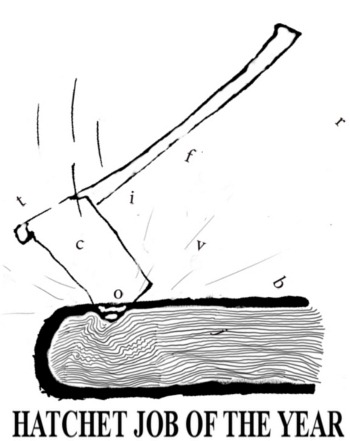
The Hatchet Job of the Year Award is for the writer of the angriest, funniest, most trenchant book review of the past twelve months.
http://hatchetjoboftheyear.com/
New directions in dance film: Wim Wenders’s “Pina”
Wim Wender’s tribute film to Pina Bausch and Tanztheater, Pina, is now in art house release in the US. This work opens new vista in the use of sterographic film (3D film) and in dance movies.
It is, easily, the best release of 2012 so far (stereographic or traditional [2D] film), and compares well to the very best stereographic films I have seen to date (Werner Herzog’s Cave of Forgotten Dreams, Hitchcock’s Dial M for Murder, and Martin Scorsese’s Hugo.)
The following preview is just in 2D – and thus loses much of the incredible magic of this film, but but it can show you how strong the thematic and dance material is.
My prediction – this film is so strong that it will revolutionize the way that dance film is made. I also predict it will win the “best documentary” film at the Academy Awards. I believe that it deserves to win the “best film” award.
Unrelated postscript: I will have limited access to the Internet for the next two weeks – but I am sure that my steadfast co-bloggers will make sure things stay exciting on the BLT blog.
“Jewish Indiana Jones” Pleads Guilty to Fraud Charges
The New York Jewish Week today posted this remarkable story. I wish I had heard the story earlier—before the rabbi’s claims had been exposed. It’s nearly as much fun as Morton Smith’s discovery (or, as his debunkers would say, his creation) of a lost fragment from Mark’s gospel buried in a previously unknown letter from Clement of Alexandria. But what I find most thrilling is that I used to shop in the rabbi’s store in Wheaton, Maryland, and spoke with him frequently. He was a really nice guy.
Rabbi Menachem Youlus, the self-styled “Jewish Indiana Jones” who turned out to be a Jewish Walter Mitty, has pleaded guilty to fraud.
Youlus’ accounts of remarkable tales of rescuing Holocaust-era Torah scrolls were contradicted by historical evidence, witness accounts, and records showing that he simply passed off used Torahs sold by local dealers who made no claims as to the scrolls’ provenance.
“I know what I did was wrong, and I deeply regret my conduct,” said Youlus, who pleaded guilty in Manhattan federal court on Thursday.
In court, the 50-year-old Baltimore resident admitted to having defrauded more than 50 victims, misappropriating some of the donations and secretly depositing them into the bank account of his Wheaton store, called the Jewish Bookstore. Youlus defrauded his charity, Save A Torah, Inc. and its donors of $862,000, according to prosecutors.
“Menachem Youlus concocted an elaborate tale of dramatic Torah rescues undertaken by a latter day movie hero that exploited the profound emotions attached to one of the most painful chapters in world history — the Holocaust — in order to make a profit. Today’s guilty plea is a fitting conclusion to his story and he will now be punished for his brazen fraud,” Preet Bharara, the United States Attorney for the Southern District of New York, said Thursday.
A January 31, 2010, Washington Post investigative report brought to light questions about Youlus’ claims.
Shortly after the Washington Post story ran, MenachemRosensaft wrote a fascinating commentary on the case. Rosensaft is adjunct professor of law at Cornell Law School, distinguished visiting lecturer at Syracuse University College of Law, and vice president of the American Gathering of Jewish Holocaust Survivors and Their Descendants. He wrote:
Some years ago, there was Binjamin Wilkomirski, the author of a purportedly autobiographical account of his years as a Jewish orphan during the Holocaust but who actually is a Swiss-born Christian clarinetist. Then there was the case of Herman Rosenblat whose heartwarming tale of a little girl tossing him an apple every day for seven months across the electrified barbed wire fence of a Nazi concentration camp turned out to be a hoax….
In 2007, on the website of Save a Torah, his 501(c)3 tax exempt organization, Youlus claimed to have found and restored “Torah scrolls hidden, lost or stolen during the Holocaust” which he then “resettled” in more than 50 Jewish communities throughout the world. On a promotional video featured on the same website, he said that “we’ve done over 500 today.” And in a recent Washington Post interview, Youlus boasted of having rescued not 50 or 500 but 1,100 such Torah scrolls.
Youlus also gave his Torah scrolls dramatic histories. Two were allegedly found buried in a “Gestapo body bag” in a Ukrainian mass-grave of murdered Jews. He supposedly discovered one under the floorboards of a barrack in the Bergen-Belsen concentration camp in Germany, a “rescue” that is described on his website’s video alongside photographs taken at the camp at the time of its liberation by British troops in April 1945. Youlus claims that he dug up yet another Torah scroll in what had been the cemetery of Oswiecim, the town adjacent to the Auschwitz death camp, and reunited it with four missing panels that Jews from Oswiecim had taken into the camp and had entrusted for safekeeping to a Jewish-born priest who eventually gave them to Youlus.
If even one of these stories seems fantastic, improbable, even incredible, the odds that any one person could have found all four of these Torah scrolls and brought them surreptitiously to the United States are, conservatively speaking, astronomical. As has been said repeatedly in connection with Bernard Madoff’s multi-billion dollar Ponzi scheme, if something sounds too good to be true, it most probably is….
It is bad enough when unscrupulous individuals rip off their marks, as it were, with variations of the proverbial Nigerian e-mail scam in which the recipient is promised part of a multi-million dollar fortune in exchange for a relatively minor up-front investment….A fake Holocaust memoir or a Torah scroll purportedly rescued from the ruins of World War II Europe is altogether different. Preying on the emotions of people overwhelmed by the memory of tragedy in order to make a buck is contemptible.
Rosensaft’s entire column is worth reading, but of note is his conclusion:
One of Youlus’s defenders argues that exposing his deception “may very well be in service of the truth but in disservice of a greater truth.” That is utter bunk.
Truth is absolute. The Holocaust was a tragedy of unfathomable proportions. Its victims, including the hundreds of thousands of destroyed and desecrated Torah scrolls and other Jewish religious artifacts, deserve nothing less than the dignity of authentic memory.
While I certainly don’t disagree, I wonder about the whole question of religious myths that are believed as being literal. While the mythic stories have great power and truth, they are rarely if ever true in an historic sense. Yet millions of believers of all faiths cling to them as if they were facts. It gives them comfort and meaning. Many times I’ve heard people say that if it were proven that Mary was not a literal virgin, or that Jesus did not literally rise from the dead corporeally, or that Moses did not receive the stone tablets and the Book of the Covenant from God on Sinai in the way Exodus recounts it, that their faith would not be able to stand.
Shmuel Herzfeld, a rabbi at Ohev Sholom in Washington, DC, was shopping at Youlus’s store when he saw a Torah scroll. Youlus told him that the Torah scroll had survived Auschwitz. Herzfeld asked Youlus if he could borrow the Torah scroll for use in his congregation one Shabbat, and Youlus agreed. When news of Youlus’s arrest broke, Herzfeld wrote, “That Shabbat in the presence of this Torah scroll I prayed with more intensity than ever before and I connected to the chanting of the Torah as I had never before connected. The very possibility that those emotional and intense feelings that I experienced can now be the result of manipulation and dishonesty overwhelms me with sadness.”
It was his faith, his emotional and spiritual attachment to a belief, that added such intensity to his prayers. Jesus frequently said, “It is your faith that has made you whole”—implying that the individual’s belief was the operative factor in the equation. So the question is, if what we believe is proven to be a lie, where does that leave whatever we have built on that faith?
A saying attributed to the Buddha may apply here: “All instruction is but a finger pointing at the moon. Those whose gaze is fixed upon the finger will never see beyond.” It doesn’t matter if the story is real or imagined; what matters is that we look not at the story, but at its meaning in our lives.
Unless, of course, you’re bilking people out of their money when you sell them the story!
What Piper said … really
The one post that I found to contain the most information on what John Piper said about Christianity having a “masculine feel” is by a woman defending Piper. Peta took the time to post extensive excerpts from Piper’s recent series on masculinity and church leadership in her reply to Rachel Held Evans. Thank you, Peta. I recommend that anyone who wants to rebut Piper start here.
I have taken one of his lesser publicized passages to respond to. According to Peta, “In commenting specifically on the style of preaching involved in his ideal ministry Piper says again:”
Again the point is not that a woman is not able to speak this way. The point is that godly men know intuitively, by the masculine nature implanted by God, that turning the hearts of men and women to God with that kind of authoritative speaking is the responsibility of men. And where men handle it with humility and grace, godly women are glad.
My sense is that much of Piper’s argument is based on male intuition. He intuitively feels that authoritative speaking is the responsibility of men. Of course, women are glad when men handle authority with humility and grace. Of course! But is turning the hearts of men and women to God with authoritative speaking the responsibility of men? This is the role of the prophet and wise person in the scriptures. Who are these people?
First, the authors of written text are for the most part men. But if we dip into the narrative, women are represented. Authoritative speaking by female prophets include Deborah, Huldah, Anna, Mary, Philip’s daughters and any other true prophet who was a woman. But some say that authoritative speaking was the role of judge and leader, not prophet. That still leaves Deborah.
But we find another class of persons rarely refered to who speak from God and give advice that is to be followed. This is the wise man or wise woman. (It is very odd that in Biblegateway, there is a search title for “wise man” but not for “wise woman” although there are just as many wise women as wise men.) Here are the wise women. In 2 Samuel 14, Joab has a wise woman approach King David and intercede for Absolom. In 2 Samuel 20, a wise woman demands to speak to Joab and gives advice to “all the people.” The wise woman also features in Proverbs. Another woman who speaks with authority is Esther.
For men, among those refered to in the context of wise men, there is Joseph and Daniel. Solomon was wise but was seduced by women and riches. Moses and Aaron shared leadership, since neither one of them possessed the necessary attributes of authoritative leadership by themselves. We don’t know what role Miriam played, but she also seems to have been necessary to the maintenance of full leadership for Israel.
I find John Piper’s appeal to male intuition fascinating. I can’t even argue against it. It is what it is, a religion based on male intuition that Christianity ought to have a masculine feel. Put that against the often female-led Salvation Army, an organization of aggressive Christianity, a vehicle for Catherine Booth authoritatively addressing men regarding issues of vice and dishonour. She did not base her ministry on female intuition, but basic human need for women to be given protection and respect by other women and by the law, and on the scripture. My sense is that Catherine Booth would want to protect women from the “masculine feel.”
Piper Picked a Peck of Pickled Patriarchies
The epigraphs above get us ready to consider again what has to be “biblical” for the Council on Biblical Manhood and Womanhood, not for the unbiblical. John Piper wants American Christianity [in his American English], not ancient Judaism. And yet he wants a “God” who gives his “Christianity” a masculine feel, not a feminine one. But maybe he forgot how the kings of the Bible, not the queens, had to circumcise the phallus. The good kings, not the bad ones, did this with a particularly masculine feel. And by good king, not bad, we understand David, not Saul. Here, then, is a biblical story, a love story of manhood and womanhood and godhood, with a rather masculine feel. It’s in the ESV:
David Marries Michal
17 Then Saul said to David, “Here is my elder daughter Merab. I will give her to you for a wife. Only be valiant for me and fight the LORD’s battles.” For Saul thought, “Let not my hand be against him, but let the hand of the Philistines be against him.” 18 And David said to Saul, “Who am I, and who are my relatives, my father’s clan in Israel, that I should be son-in-law to the king?” 19 But at the time when Merab, Saul’s daughter, should have been given to David, she was given to Adriel the Meholathite for a wife. 20 Now Saul’s daughter Michal loved David. And they told Saul, and the thing pleased him. 21 Saul thought, “Let me give her to him, that she may be a snare for him and that the hand of the Philistines may be against him.” Therefore Saul said to David a second time,[Hebrew by two] “You shall now be my son-in-law.” 22 And Saul commanded his servants, “Speak to David in private and say, ‘Behold, the king has delight in you, and all his servants love you. Now then become the king’s son-in-law.’” 23 And Saul’s servants spoke those words in the ears of David. And David said, “Does it seem to you a little thing to become the king’s son-in-law, since I am a poor man and have no reputation?” 24 And the servants of Saul told him, “Thus and so did David speak.” 25 Then Saul said, “Thus shall you say to David, ‘The king desires no bride-price except a hundred foreskins of the Philistines, that he may be avenged of the king’s enemies.’” Now Saul thought to make David fall by the hand of the Philistines. 26 And when his servants told David these words, it pleased David well to be the king’s son-in-law. Before the time had expired, 27 David arose and went, along with his men, and killed two hundred of the Philistines. And David brought their foreskins, which were given in full number to the king, that he might become the king’s son-in-law. And Saul gave him his daughter Michal for a wife. 28 But when Saul saw and knew that the LORD was with David, and that Michal, Saul’s daughter, loved him, 29 Saul was even more afraid of David. So Saul was David’s enemy continually. 30 Then the commanders of the Philistines came out to battle, and as often as they came out David had more success than all the servants of Saul, so that his name was highly esteemed.
Rewinding back in the Bible a bit, we find these two Kings called Christ. There’s something that makes them head of their household, something that makes them head of state. Yes, that’s right. King Saul (in 1 Sam. 10:1) gets crowned on his head with oil. King David does too (1 Sam 16:11-13). And this good King David is actually, literally called,
τῷ χριστῷ αὐτοῦ τῷ Δαυιδ (in LXX 2 SA 22:50-51). In other words, he is His Christ, God’s Christ, David.
Let’s rewind in the Bible a bit more. We find men only, the priests of God; individually (in Leviticus 4:5 and Leviticus 6:22 in Greek) they are called
“the Priest, the Christ”: ὁ ἱερεὺς ὁ χριστὸς. ho Hiereus ho Christos
Now, we fast forward to the Son, whom John Piper talks about. In Matthew 1:1, he is called
Ἰησοῦ Χριστοῦ, υἱοῦ Δαβὶδ. Iesou Christou Huiou Dabid Or, in the ESV translation of this Greek, “Jesus Christ, the son of David.”
So, we jump over to Luke 2:21 in the ESV and find this about this Son:
” 21 And at the end of eight days, when he was circumcised, he was called Jesus, the name given by the angel before he was conceived in the womb.”
Let’s summarize:
God revealed Himself in the Bible pervasively as king not queen; father not mother; son not daughter.
And so:
God revealed Himself in the Bible pervasively as Phallus-Foreskin circumcised not uncircumcised; Jewish-male-Christ king not commoner; Jewish-male-Christ priest not Christian theologian.
Mr. Piper is not counting as relevant the sort of phallus his God must have. For when he fast forwards to something a different Saul wrote (a Christian Saul, aka the Christian Paul), he reads something else (in Galatians 3:28, ESV):
“There is neither Jew nor Greek, there is neither slave nor free, there is no male and female, for you are all one in Christ Jesus.”
And to the same men (in Galatians 5:2, ESV), Paul writes other Christian things that seem to discount the masculine feel of this circumcised male God who would be the God of Christianity:
“Look: I, Paul, say to you that if you accept circumcision, Christ will be of no advantage to you.”
Our question then is what sort of advantage does God revealing Himself in the Bible pervasively as phallic, not feminine, give to Christianity? I think I’d rather attempt a tongue twister.
Human (Women) Questions, so far in February
It’s February, and with that annual marker comes Black History Month [the USA]. It’s such an important moment when the history of an entire community gets elevated, but also such a frustrating reminder of how every other month is white history month. When will [we humans] get past this kind of marginalization?
Despite this, it is good to be reminded to dig a bit deeper and examine the specific history of a community that has been so integral to the fabric of this [American] country. We have a lot of ground to make up for when it comes to the history we learn. In addition, the political climate has become so hostile that some states and communities are actively excluding people of color from education.
I also find it important to note Black women’s history in these moments, because sexism does impact the way Black history is told. This year’s theme has a specific focus that supports this:
This year’s theme “Black Women in American Culture and History” honors African American women and the myriad of roles they played in the shaping of our nation.

——————
So this is my question to the Anglo-Catholics: If you accept that Queen Elizabeth II, a laywoman, can appoint diocesan bishops and delegate to them authority and the right to celebrate sacraments, why can you not allow that a woman appointed by her as a bishop can appoint a male subordinate bishop and delegate to him authority and the right to celebrate sacraments?

——————
So does all of this make me a “religious poet”?

I’m sorry that seeing this picture made you uncomfortable — that was never my intention. In the communities where I pray, it’s common to see women wearing tallit and tefillin, but I know that’s not true across the Jewish world.
But I’m glad you were able to reach a place of “why not”? 🙂
— Rachel Barenblat (aka The Velveteen Rabbi)
——————
John Piper wants a “masculine Christianity.” What do you think?
“God has chosen to liken Himself to a female and we are the fruit of His womb.”
– John Calvin

Joyce freedom from copyright
Occupy Ulysses! Author Frank Delaney reads from “Ulysses” in Madison Park to celebrate Joyce’s birthday, “Ulysses” freedom from copyright
This February 2nd, to celebrate the 130th birthday of James Joyce and the 90th anniversary of the publication of Joyce’s mighty novel, Ulysses, author Frank Delaney reads from Ulysses to the public in Madison Square Park, and through video, to the world. The year 2012 has also seen the release of Ulysses into the public domain, an event much anticipated by Joyce scholars and aficionados, long hampered in their efforts by the litigious Joyce estate. Ulysses, even with copyright restrictions, has through the years inspired readings, reenactments, and even twitter events the world over, and Delaney’s reading is surely a harbinger of many inventive interpretations to come.
Delaney rails against interpretations of Ulysses that obfuscate rather than clarify the details, references, meaning, and intent of the book, and instead has shown, in his Re:Joyce podcasts, where every Wednesday he deconstructs the book sentence by sentence in episodes lasting 5-7 minutes, that Ulysses can be absorbed, understood and embraced with no loss of intellectual value. Ulysses, Delaney maintains, is a vastly enjoyable and accessible novel, “a book to get lost in…and discover each day something new.” Launched on Bloomsday 2010, The Re:Joyce podcasts have passed 300,000 downloads as of last week. They have been hailed by listeners as “the people’s Ulysses,” and have been covered by publications such as NPR, The Economist, and many more.
The Re: Joyce project is expected to take approximately 25 years, and Mr. Delaney calculates that to coordinate to that schedule, he will read approximately 37 pages each February 2nd (Joyce’s Birthday), to his Madison Square followers.
Delaney’s latest novel, The Last Storyteller (Random House, February 7th 2012) celebrates the mysteries of the ancient oral tradition as the last itinerant storytellers work their magic in 1950’s Ireland. Best known in this country as New York Times bestselling author of Ireland, Shannon, Tipperary, Venetia Kelly’s Traveling Show, and The Matchmaker of Kenmare, Frank Delaney has been a judge of the famed Booker prize and has produced countless shows for the BBC and other UK television and radio shows. He is active on twitter as @FDbytheword.
Please contact Tara Strahl at 607-287-7269 or tara@meierbrand.com with any questions about this event or interview requests for Frank Delaney.
More information: http://www.frankdelaney.com
Book review: “Psalms for All Seasons”
A new psalter, Psalms for all Seasons, features settings of the psalms from a wide variety of Christian traditions.
This psalter is intended multiple purposes: the introduction indicates use for
- corporate worship,
- daily prayer (basic liturgies for morning, noon, evening, and night are included; the psalter’s introduction claims that its supporting web site has lectionary texts, although I have was not able to find them there. There are numerous other web sites with lectionary texts),
- personal and family devotions (the psalter boldly claims that “it belongs on pianos and music stands of those with musical abilities; the texts alone provide a treasury of material for daily contemplation and prayer”), and
- as inspiration for composers.
- Of greater interest to me was the idea that this work could serve as a commentary on the psalms:
This Psalter is a resource for bible study, particularly as an anthology for courses on the book of Psalms…. [I]t could function as a commentary on the book of Psalms. Each musical setting of a psalm is, in its own way, a miniature sermon or interpretation of the psalm. Comparing the range of approaches to a given psalm offers an insightful introduction to the challenges and possibilities of the biblical psalms in guiding the Christian life.
As I discuss below, I found this potential unrealized.
The core of the book is the psalter; for each psalm the psalter includes the NRSV translation”with alternating regular and boldfaced type for responsive readings and red markings that enable the chanting of the psalm”; a “Christian prayer that responds to a theme, imagery, or basic intent of the psalm”; a footnote that has a brief commentary on the psalm and suggestions on use in worship services; settings of the psalm (mostly musical settings); and in an appendix, detailed performance notes.
For example, for Psalm 1, the NRSV text is presented, pointed for chanting, and highlighted for responsorial recitation. The Christian prayer states:
Lord our God, giver of blessing and judgment, your Son Jesus lived the only true life.
Because of him, we can know you, love you, and delight in you.
Keep us watered by your grace and rooted in your Spirit
so that our ears will hear your voice and our feet will follow your path,
giving glory to you alone. Amen.
As you will note, the prayer is somewhat uninspired and rambling, and not apparently tied to a liturgical tradition.
The note on the psalm states:
Psalm 1 describes and contrasts two pathways: righteousness and wickedness. Such imagery recurs throughout the psalms and other parts of the Bible (e.g., Jer. 17:5-8). Like Pss. 19 and 119, it celebrates the significance of God’s law as a source of wisdom and blessing. Early church theologian Jerome called this “the main entrance to the mansion of the Psalter.” Much of what follows in the Psalter either expresses or appeals to its message. Use in Worship: preparing for or responding to the reading and preaching of God’s Word.
This is then followed by six settings:
- The text from the 1912 (Presbyterian) Psalter (revised in 1985; so “The man is blest who, fear-ing God, From sin re-strains his feet,” becomes “The one is blest who, who fear-ing God, walks not where sinners meet”) with music taken from the Winchester Old Psalter (attributed to George Kirbye, 1592).
- A responsorial setting with the refrain taken from the (1986) Gia Psalms remainder of the text taken from the 2006 Evangelical Lutheran Worship.
- A version in transliterated Thai (together with translation) set to a traditional Thai melody (including notation for finger cymbals).
- “A Litany for the Renewal of Baptismal Vows” that includes reference to Psalm 1 (and Romans 6:3-4) written by one of the editors, John D. Witvliet.
- A Spanish setting “Feliz la gente” (together with English translation) with words and music by Juan A. Espinosa (1990).
- John Bell’s 1993 Iona Community setting.
Among the genres and musical styles sampled in this psalter are (the terminology is that used in this psalter on pp. 1102-1103):
- Eastern Orthodox Chant;
- Gregorian Chant and other Medieval Traditions;
- 16th century Genevan Psalter;
- Lutheran Choral Tradition;
- 17th-18th century American;
- Afro-American Spirituals;
- Traditional Hymn Tunes from England and Continental Europe;
- English and North American Cathedral Traditions;
- Recently Written Responsorial Psalmody;
- Recently Written Hymn-Like Tunes for Metrical Settings;
- Settings from Contemporary or Popular Worship Music from the 1970s and 1980s;
- Settings from Contemporary or Popular Worship Music from the 1990s and 2000s;
- Settings from the Spectrum of Afro-American Gospel Music;
- Settings from the Spectrum of Jazz Styles;
- Settings from Contemporary Communities of Prayer and Renewal;
- Settings from Latin America and Southern North American Counties (Argentina, Brazil, Caribbean, Ecuador, El Salvador, Honduras, Mexico, Paraguay, Puerto Rico);
- Settings from the Middle and Near East (Israeli, Hassidic, Other Jewish melodies, Pakistan, India);
- Settings from Eastern Europe (Czech [the psalter refers to the old country and misspells it as “Czeckoslavakia,” Latvia, Russia);
- Settings from Africa (Egypt, Ghana, Malawi, Swahili/Kiyana, Yoruba [Nigeria], Zimbabwe); and
- Settings from Asia (Indonesia, Japan, Korea, Philippines, Taiwan, Thailand).
A variety of foreign languages (sometimes transliterated, sometimes not) are included: Arabic, Chinese (, Dutch, Filipino, French, German, Greek, Hebrew, Hungarian, Indonesian, Japanese, Korean, Latin, Muscogee, Paraguayan (do they mean Guarani?), Portuguese, Punjabi, Shona, Spanish, Swahili, Taiwanese, Tamil, Thai, Urdu, and Xhosa). There are also some settings especially for children.
In addition, there are additional settings (Michael Morgan’s “Trees,” Song of Zechariah [Luke 1:68-79], Song of Mary [Luke 1:46b-55], Song of Simeon [Luke 2:29-32]), brief services (as noted above), appendices (including general refains, guitar capo charts, a chord symbol explanation, guitar chord diagrams, the Revised Common Lectionary, a list of psalms in the RCL), and indices (copyright holders; authors, composers, and sources; genres and musical style; subjects and seasons; metrical index of tunes; tune names; and first lines and common titles).
The translations mostly drawn on for this work are Book of Common Prayer, Common Worship: Daily Prayer, Evangelical Lutheran Worship, The Message, NIV, NLT, NRSV, Psalter for the Christian People, and Voicing God’s Psalms (Calvin Seerveld)
I noted numerous errors in my printing; there are frequent misspellings in the text and it appears to have been poorly proofread.
The psalter is edited by Martin Tel (Princeton), Joyce Berger, and John Witvliet (Calvin College) The psalter has its own web site, and is co-sponsored by by the Calvin Institute for Christian Worship and Faith Alive Christian Resources. This weekend there was a symposium supporting the new psalter, although very little of the program has yet been posted (perhaps the most interesting posting to date has been the program book.)
I cannot recommend this anthology. I had hoped that this it would help shed light on reception of the psalms; but it is somewhat randomly put together and focuses too much on contemporary settings. The editing is poor and insights are somewhat shallow. The general lack of reference to classical Hebrew, Greek, or Latin settings of the Psalms makes it less interesting to me. Given the wide range of academic, devotional, classical, and literary psalters of high quality, I was disappointed by this effort. Perhaps there are people for whom this book would be a valuable resource, but for me, this book is of marginal value and I will probably donate it.
February 2012 Biblioblog Carnival
Amanda McInnis has posted the February Biblioblog Carnival. She is kind enough to mention several posts on BLT.


 BLT
BLT 