Interpretive Spins in the Ψαλμοὶ: the first twists
This post just may continue a series (on how the translators of the Hebrew Bible into Hellene, into what is called the Septuagint now, used literary sparks and interpretive spins on some rare occasions in the Psalms). Unfortunately, I may not be able to interact much in comments following for some time, even though it would be wonderful if you and others wanted to so talk. So what about Psalm 1? What about what the Greek translation in Alexandria, Egypt by the Jewish community there added? What about how they added meanings? Were these Hebrew ones and perhaps politically motivated Egyptian ones and rhetorically savvy Greek ones?
Today, Brian LePort posted “Psalm 1: comments and grammar chart – Psalm 1 introduces the Psalter as Torah. We are to read and meditate upon the Psalms.” He gives his chart comparing the Hebrew and the Greek here. And he brings the whole thing forward to Christendom, saying:
The Septuagint has an interesting statement in v. 5a that makes me curious to how the early Christians would have read it. It says,οὐκ ἀναστήσονται ἀσεβεῖς ἐν κρίσει. This can be translated, “…the wicked will not arise in the judgement.” Interestingly enough ἀναστήσονται (ἀνίστημι) is the word uses for resurrection.
That took me back to a post by Suzanne McCarthy, one of my BLT co-bloggers, who (at another blog some time ago) said this:
We need to see that the Greek [Psalm 1] adds somewhat to the Hebrew in the preceding line, the wicked are “like dust that the wind flings from the face of the earth” and then these wicked people will not rise again. Whether the translator meant to communicate the meaning of “resurrect” is not something we can be sure of. Possibly not. But we do know that there was a growing belief in a resurrection at this time and anastasis was the word used to communicate this. So, later readers would see “resurrection” … in this text….
Suzanne is right that we cannot be sure of whether the Hellene translator(s) intended readers to read “resurrect” into this text. Brian is correct that reading “resurrect” into the Greek today is something that Christians, even early ones, might do.
Nonetheless, given how Brian is noticing the emphasis on Torah (and implicitly on HaShem), we might suspect other things. Genesis 9:9 is one of the first places in Torah where the LXX translators decided to use the Greek word that can also mean resurrection. In Hebrew, it goes like this:
ואני הנני מקים את־בריתי אתכם ואת־זרעכם אחריכם
In the Greek translation, that is this:
ἐγὼ ἰδοὺ ἀνίστημι τὴν διαθήκην μου ὑμῖν καὶ τῷ σπέρματι ὑμῶν μεθ᾽ ὑμᾶς
The added idea, if any, is “to stand right up (again)” the covenant between Noah and the LORD. In the RSV, for a quick English translation of the Hebrew Genesis 9:9, this goes, “Behold, I establish my covenant with you and your descendants after you.”
Why this early Torah translation is so significant, to me anyways, is that to the first Psalm it adds the bit that the LXX translators decide to insert in that Psalm (with no Hebrew correspondent at all in this initial Psalm).
The LXX translators add:
ἀπὸ προσώπου τῆς γῆς
Suzanne has translated this into English as:
from the face of the earth
If we read the LXX in Greek, that is, if we are reading “Genesis” in the “Rule” or “Law,” then we find something interesting. In the story of Noah, this Greek prepositional phrase appears thrice. It’s in Genesis 6:7 and Genesis 7:4 and Genesis 8:9. In the RSV, which I have handy here, that goes in English like this respectively:
So the LORD said, “I will blot out man whom I have created from the face of the ground, man and beast and creeping things and birds of the air, for I am sorry that I have made them.”
and
“For in seven days I will send rain upon the earth forty days and forty nights; and every living thing that I have made I will blot out from the face of the ground.”
and
Then he sent forth a dove from him, to see if the waters had subsided from the face of the ground;
In each instance, the Greek translation for the Hebrew is ἀπὸ προσώπου τῆς γῆς (which is the Hebrew the RSV English renders as “from the face of the ground“). Then, in Genesis, comes God’s establishing of the covenant with Noah after the flood: ἀνίστημι τὴν διαθήκην μου ὑμῖν
The Greek Psalm adds not only the idea of resurrection, or at least of “standing up right” a covenant. But it also adds this key Genesis phrase, tying the first Greek Psalm back to this horrific act of God on the face of the earth, leading to a new life, a new covenant. The Greek adds a spin, doesn’t it? It may be more Hebraic than we first think? It may be grounds for early or late Christian readings. Your thoughts?
Logos Bible Software/Knox program now open to women
With great fanfare, Logos Bible Software has started a joint program with the infamously conservative Knox Theological Seminary to offer a special “DMin in Preaching and Teaching.” This is a hybrid program – most of the work is done as distance education, although there are four on-site classes each year. Now here is the kicker – the program offers special discounts on Logos Bible Software (a free copy of Logos’ Portfolio edition, normally priced at $4290 plus $600 worth of student-selectable free additional add-on packages). In fact, to add sweetener, “Logos Bible Software will cover your airfare booking and costs for your first on-site class if you apply before May 30, 2012.”
Further, this is a very weird sort of Doctor of Ministry degree: the very first required course is:
Enriching Preaching through Logos Bible Software (3hrs)
To preach and teach effectively, the pastor must have a foundation of sound exegetical competence upon which to build. This course is a developmental course designed to teach pastors and teachers the latest software tools in exegetical analysis stressing proficiency in skill and efficiency in time. It is designed to show the pastor or teacher how to use Logos Bible Software as a resource for thousands of illustrations and sermon texts to enrich Biblical teaching for maximum effectiveness. The timeless principles of classical rhetoric as first identified by Aristotle, that is, the use of all available means of persuasion, are developed to give structure and force to the message.
But here’s the thing – Knox does not allow women to enroll in its D.Min. programs:
The Doctor of Ministry is a professional program for pastors, missionaries, and others actively engaged in ministry-related fields. Admission to the Doctor of Ministry program is limited to men. This admission policy derives from Knox’s commitment to operate according to the Holy Scriptures and the constitution of the Presbyterian Church in America, namely the Westminster Confession of Faith, the Catechisms, and the Book of Church Order. [Emphasis added]
Now, to be fair, Logos offers academic discounts to a wide variety of institutions (I teach at a secular university and receive a very healthy discount). And to be fair, Logos has gone to a considerable efforts to include material relevant to Jews, Catholics, non-Reformed Christians, and others. But, those academic discounts are merely discounts – they do not make the software free. They do not include $600 of free credits. They do not include free airfare.
Now I might be inclined to forgive Logos for this new “men get it for free; women have to pay” policy if Logos were to partner with other institutions as well. But as it stands, men can get Logos for free by entering this program, whereas women simply have to pay more. That doesn’t seem right to me.
Update (5/18): Knox has now rescinded its language restricting the program to men only, and Dan Pritchett from Logos software has assured us that the program will continue to be open to both men and women. I would like to thank Logos and Knox for this change.
Maurice Sendak and Melville redux: Pierre vs. Pierre
(This is a follow-up to an earlier post.)
It is commonly thought that Moby Dick is Melville’s greatest novel. A few contrarians might give that honor to The Confidence-Man (which is certainly the best novel ever set on April Fool’s Day.) But, I am so contrary that I disagree with both the accepted wisdom and the contrarians. I reserve the honor of greatest Melville novel for Pierre, or, The Ambiguities, a work of tremendous humor and subtlety.
Now this post is about the two major competing editions of Pierre – both of which were prepared by Herschel Parker (University of Deleware) – Parker’s Northwestern-Newberry edition of Pierre, and Parker’s Kraken Edition of Pierre. Parker has a theory that Pierre was changed in the middle of its writing because Melville was furious about the negative reviews of Moby Dick. The theory goes that Melville inserted gratuitous satiric material attacking the literary establishment into Pierre. In producing the “Kraken edition,” Parker removed about a sixth of the book – indicating excerptions by mere asterisks. But to make up for the excerptions, Parker persuaded Sendak to contribute some marvelous illustrations to the book. Parker explained his reasoning in this 2008 “Goodreads” thread:
The Kraken PIERRE was not not meant as an abridgment and it was not meant as a standard reading text. On one level it was simply a nonce text for Sendak to illustrate. On another level, it was a (highly controversial!) attempt to help people think about what it was that Melville took to New York City about 1 January 1852 and accepted a really devastating contract for a few days later. That is, it was an attempt to see what Melville described as his Kraken book, when he told Hawthorne he had heard of Krakens, bigger than whales. It took years for me to lay out the chronology of work on PIERRE. We were way off in what we thought we knew in the 1970s, even. But it is documented now that Melville finished PIERRE at the very end of 1851 and took it to the Harpers and it is documented that by the start of the third week of January he had greatly enlarged it, after it was grudgingly accepted. Everyone has always known the obvious–that the Pierre as author chapters were an afterthought. We had NOT known when the expansion started and had not known just why. Anyhow, the Kraken edition was meant to allow us to read something quite close to what HM thought was a great book, or what he finished after having thought early in its composition that it was a great book, or going to be a great book. The Kraken edition was just meant to help people to think freshly about a complicated situation. It did drive some people into rages! I guess they thought it was meant to replace what they had always read. Not at all–though if you want to think about Melville you would want to know what he finished, as close as you could get to that, before knowing what in his suicidal rage he added to it, knowing that 20 cents on the dollar instead of 50 cents on the dollar meant that his career might be all but over. And it was a great chance to work with Sendak, who turned 80 last month.
The story of Sendak’s involvement is told by John Bryant (Hofstra University) in his review:
[…] The Kraken project grew out [of Maurice Sendak’s] need to get these pictures out. Their genesis can be traced to the 1991 Melville Centennial Conference in Pittsfield. Previously, Sendak had contemplated illustrating Melville but was convinced that he could not satisfactorily transform Melville’s already intensely graphic language into apt visualizations. However, when a conference participant suggested Pierre as a subject, a light turned on in the night kitchen. Here was a Melville text so excessive that it could sustain equally over-the-top illustrations, which through their own excesses would obviate visual verisimilitude and yet achieve their own Melvillean aesthetic. No longer reticent, Sendak began to draw. But the following four years brought great losses. A cherished brother, a close friend, and a mentor all died. Moreover, the AIDS epidemic and America’s panicked retreat from liberalism inspired Sendak’s most political work, We Are All in the Dumps with Jack and Guy, and pushed the artist into a stronger commitment to sexuality in his work. Until now, Sendak’s orientation had not been hidden so much as warily positioned vis-à-vis homophobic America. But in illustrating Pierre, Sendak found that rendering Melville’s battened down sexual content allowed him to articulate the torment and exuberance of himself.
The exuberance corresponds to the novel’s early effusions on love and ideality. Here, Sendak’s illustrations progress beyond the childhood of Really Rosie, Where the Wild Things Are, and Sendak’s own nihilistic jeu d’esprit entitled Pierre (he actually composed this little classic with Melville in mind), as well as the eerie pre-adolescence of Outside Over There. Sendak’s Pierre is a full-blown adolescent: muscular, ecstatic, desperate, devoted, and lonely; he is the man-child invincible. So tight is his blue Superman outfit, red cape and all, that it is skin itself, concealing nothing.
[I have removed a section where Bryant discusses sexual aspects of Sendak’s illustrations rather explicitly.]
Nowhere else in the history of Melville illustration do we find such openings into the latent sexuality of Melville’s prose. Pierre’s exuberance dissolves mid-novel when he discovers that his deceased father had sired an illegitimate daughter, Isabel, to whom Pierre is suddenly incestuously drawn. Leaving behind his mother, his family, a fiancée, and his country inheritance, Pierre escapes with his half-sister to the city, where he becomes Isabel’s lover and a writer of serious fiction. Sendak himself is attracted to Isabel’s luxuriant cascading hair, and in one rosy brown nude embrace with Pierre the hair discloses her backside masculine and muscular, as Pierre sensually whispers dark secrets in her ear. Soon enough a hollow lad, Pierre is later depicted towering in despair over harsh urban buildings. His face is drawn, indeed redrawn, a portrait of Sendak himself in lankier days. The colorful cape and tights have turned ashen; the poses are more balletic than melodramatic […]. Sendak’s final drawing reveals a male nude seated on stone, crushed by clouds of stone, and tightly constrained by the plate’s claustrophobic frame: it is Pierre in his prison cell, and the stones of being bear him down. Upreaching arms hold off the crushing clouds but cover his mouth; only his eyes-knowing and bewildered-reveal the fearful silence of the artist’s voicelessness. Sendak does not illustrate Melvillean silence; he gets inside it.
A great artist illustrating a great writer is an event in and of itself, but in this case the event is not just the visualization of a text; it is an artist finding revealing explaining himself in response to a writer who was finding revealing explaining himself. Linked as these illustrations are to Parker’s text, the Kraken edition is a doubly interpretive venture. Both push the limits of a conventional Pierre[…].
Now here is the funny thing – Sendak apparently did not fully understand Parker’s intended cuts to Pierre. Bryant writes:
The integration of text and image is not entirely seamless; for instance, Sendak’s illustration of the grotesque dream-titan Enceladus has been recaptioned as Pierre in his jail cell because Parker’s text removes all mention of Enceladus.
But these two editions, prepared by the same scholar, are also a meditation on the nature of editing. For all the criticism that the Kraken edition received for its sometimes arbitrary cuts, do not all critical editions make judgment calls that are similar in nature (if much more conservative in scope)? For example, in the “authoritative” Northwestern-Newberry edition, why are the editors allowed to change the phrase “wee little bit scrap” appearing in the first edition to “wee scrap” (the editors imply that this was a typographical error.) Isn’t Parker’s Kraken edition just an extension of the same editorial prerogative here? These same questions can be raised, for example, with different synthesized versions of Shakespearian plays (think about how most editions of Hamlet or King Lear are edited together from different folio and quarto editions) or the still painful controversy over Gabler edition of Joyce’s Ulysses.
Despite the provocative philosophical and methodological issues raised by Parker, I think that his Kraken edition of Pierre is a failure as an editing experiment – it simply omits too much good writing. But Sendak’s illustrations – those are worthwhile and intensely personal (although they are somewhat “adult” in nature), and the book is worth getting if only for those illustrations.
Bar Kokhba, false messiah and national hero
Today is Lag B’omer – the 33rd day in the counting of the Omer. Despite the general tone of mourning during the counting of the Omer, Lag B’omer is celebrated joyously – according to various sources as the end of divine plague that punished Rabbi Akiva’s many students; the anniversary of the death of the Rashbi (Rabbi Shimon bar Yochai, whose school is attributed as the author of famous Jewish mystical work, the Zohar); of being the “day of Splendor in the Week of Splendor” (Hod ShebeHod) reflecting a special day of revelation; of being the day that manna first fell on the Israelites in the desert; or other traditions.
One of the more interesting traditions of Lag B’omer lies in its links with Bar Kokhba (or Ben Kosiba, as explained below), a candidate messiah (reportedly endorsed by Akiva) and leader of the revolt against Roman rule in Palestine from 132-135 CE. But Bar Kokhba remains veiled in mystery – we know very little about him – although his actions (and their aftermath) helped cement the difference between mainstream Judaism and the ethnic Jews belonging to the early Christian sect.
In a recent blog post, Michael Pitkowsky mentions three relatively recent books that discuss Bar Kokhba and his war:
- From the Cambridge History of Judaism, Volume 4: Late Roman-Rabbinic Period, the excellent essay by Hanan Eshel (Bar Ilan University), “The Bar Kochba Revolt, 132–135.” This book is currently available from bookdepository.co.uk, after application of its current 10% off coupon (APMA12), for $82.38 with free shipping worldwide. I think that this nearly 1200-page book (edited by Steven Katz, Boston University) is of interest to a wide variety of readers of this blog – here is its description: “The fourth volume of The Cambridge History of Judaism covers the period from 70 CE to 640 CE (the rise of Islam), addressing the major historical, political and cultural developments in Jewish history during this crucial era. The volume is especially strong in its coverage of the growth and development of rabbinic Judaism and the major classical rabbinic sources such as the Mishnah, Jerusalem Talmud, Babylonian Talmud and various Midrashic collections. In addition, it surveys the growth of early Jewish mystical literature and the liturgical literature of the developing synagogue.”
- Another excellent volume is the edited volume by Peter Schäfer (Princeton) entitled The Bar Kokhba War Reconsidered (partially accessible on Google Books, and perhaps available used for a reasonable price). A specialist, but interesting, essay by Ra’anan Boustan (then from Princeton, now at UCLA) from that volume addresses the Roman legislation of circumcision in the afterwath of Bar Kokhba revolt, and is available online.
- From the perspective of traditional writings, Richard Marks (Washington and Lee University) book The Image of Bar Kokhba in Traditional Jewish Literature: False Messiah and National Hero (partially accessible on Google Books) is a useful reference.
Here are some portions of the Encyclopedia Judaica (2nd edition, 2007) entry on Bar Kokhba by Samuel Baramsky (first section, University of the Negev) and Shimon Gibson (update, UNC Charlotte):
BAR KOKHBA (d. 135 C.E.), leader of the revolt in Judea against Rome (132–135 C.E.).
The Man and the Leader
Bar Kokhba is known in talmudic sources as Ben Kozevah, Bar Kozevah, or Ben Koziva (Heb. בן כוזבה, בר כוסבא, בן כוזיבא; Sanh. 93b; BK 97b; TJ, Ta’an. 4:8, 68d), and in Christian sources as Βαρχωχεβας (Eusebius, Historia Ecclesiastica, 4:6, 2). In the recently discovered contemporary letters addressed to or originating from him, he is referred to as Simeon bar Kosevah, Bar or Ben Koseva (בר כוסבא שמעון בר כוסבה, בן כוסבא, the last form being found also in a contemporary Greek letter). The name שמעון (or its abbreviation שמע), which appears on coins of the revolt, undoubtedly refers to him. His original name was probably Bar Koseva, and it is doubtful whether it was derived from a settlement in the Judean mountains or whether it indicates his father’s name or a general family name. The appellation Bar Kokhba was apparently given to him during the revolt on the basis of the homiletical interpretation, in a reference to messianic expectations, of the verse (Num. 24:17): “There shall step forth a star [כּוכָב, kokhav] out of Jacob.” Bar Kokhba was general midrashic designation for the “king messiah” […], and customarily used before the destruction of Jerusalem . Thus, in the verse “a star out of Jacob … a scepter … out of Israel” (ibid.), Onkelos renders “star” as malka (“king”) and “scepte” as meshiḥa (“messiah”), a midrashic interpretation current among the Zealots who joined in the war against the Romans. While this appellation became the popular one, his original name was retained in documents and letters. The disappointment that followed in the wake of the defeat (and perhaps even at the height of the revolt) may have led the people to give a derogatory turn to his original name of Bar Koseva by altering it to Bar Kozivah (בר כוזיבה) in a punning allusion to “a lie” (kazav). Even the homiletical interpretation of “a star out of Jacob” quoted by R. Akiva was from then on interpreted ambiguously, as evidenced by R. Simeon b. Yoḥai ‘s statement: “ ‘There shall step forth a star out of Jacob’ – Kozeva stepped forth out of Jacob” (TJ, loc cit.). Similarly, in talmudic sources Bar Kokhba coins are referred to specifically as those of Ben Koziva. “A coin of one who rebelled, such as Ben Koziva,” or “Koziva coins” (BK 97b; TJ, Ma’as. Sh. 1:1, 52d; Tosef., ibid., 1:6).
Bar Kokhba’s personality does not emerge clearly from the scant and obscure sources available, some of which, like those in the Talmud and Midrash, have legendary overtones, while later ones, such as the sparse references by Church Father Eusebius, are tendentious. The few traits of his personality that emerge from the administrative and economic documents found in the Judean Desert do not contradict the main features of his character as incidentally portrayed in the literary sources. He may be described as a leader who, in charge of both the economy and the army, ruled imperiously, concerned himself even with minor details, and did not refrain from threatening senior officers of his army with punishment or even from inflicting deterrent punishment.
Bar Kokhba’s title in documents is נשיא ישראל or ישראל הנסי על (“nasi of Israel”), the former occurring also on coins of the revolt. According to the Talmud, Akiva said: “This is the king messiah” whereupon Johanan b. Torta answered him derisively: “Akiva, grass will grow in your cheeks and the son of David will still not have come” (TJ, Ta’an. 4:8; Lam. R. 2:2, no. 4). Eusebius states that Bar Kokhba regarded himself as the savior who had come down to the Jews like a star from heaven, to deliver them from their somber troubles. Some adduce proof of Bar Kokhba’s messiahship from the Vision of Peter, a Christian work written a few years after the revolt, which refers to a deceiver who falsely represented himself as a messiah and was – according to this tendentious account – nothing but a murderer. But these are simply expressions of the Christian authors’ hatred which distorted their outlook, and are devoid of real historical value. Nevertheless, the messianic hopes which were cherished by the nation centered on Bar Kokhba. As might be expected from such a powerful, dominant personality, he himself probably had pretentions to being a redeemer and fostered these hopes. That the very appellation Bar Kokhba expresses a messianic belief in the “star out of Jacob” as an ideal ruler can be seen from apocryphal literature (Test. Patr., Levi 18:3; and Judah 24:1; and cf. Rev. 22:16; The Damascus Document, 7:19–20; and War of the Sons of Light with the Sons of Darkness, 7:5, 1). The Damascus Document states that the “star out of Jacob” will be “the nasi of the entire community” and accordingly it might be contended that Bar Kokhba’s title of nasi had a messianic allusion. But the documents contain no hint of a messianic reference, and the sway of the nasi applied to wholly mundane affairs such as the army, administration, and the economy. According to coins struck during the revolt, the nasi may have assigned in a compromise matters relating to worship and faith to Eleazar ha-Kohen (perhaps on the basis of the division between the nasi and the priesthood, as described in Ezek. 44–46). The basically authentic statement about a Sanhedrin at Bethar (Sanh. 17b) suggests that at a certain time a bet din participated in Bar Kokhba’s rule. Therefore, the title nasi may itself have indicated a more restricted role than that regarded as implicit in “king messiah.”
The aggadah which relates how Bar Kokhba’s men were selected – by having a finger cut off or by uprooting a cedar tree (TJ, loc cit.; Lam. R. 2:2 no. 4) – reflects the exclusiveness of an elite rebel army and the harshness and even cruelty of its leader. The controversies between him and the sages, and his reliance on his own powers rather than on help from Heaven, are depicted in the aggadah as self-aggrandizement against God: “When he went forth to battle, he said ‘Neither assist nor discourage us.’ ” To decide precisely the historical kernel that has been preserved in this tradition is difficult, but Bar Kokhba’s letters to his subordinates (such as to Jeshua b. Galgolah or Jonathan and Masbelah) confirm that he was a stern leader who vigorously insisted on his views and with a firm hand controlled not only the population but also his senior officers. In contrast to the situation during the Jewish War (66–70/73 C.E.), the nation was now united under the leadership of a single commander-in-chief. This is evident from documents indicating that even in the final stages of the revolt he still exercised unlimited authority over his men. Presumably the unity of the nation in this war derived not only from the nasi’s powerful personality, but also from the memory of past sufferings and the yearning for liberation. Geography, too, may have been a factor in this unity, for while the revolt spread to Galilee and Transjordan, it was mainly although not exclusively centered in Judea, making it both possible and practicable to exercise effective control.
Such was the background to the acceptance of a strong leader’s authority, unopposed apparently by the soldiers. This unanimity of the nation can be inferred from Eusebius (as from the Book of Revelation) where Bar Kokhba is described as a murderer and bandit who deceived the people. Even in later generations, despite the disappointment engendered by his defeat, his image persisted as the embodiment of messianic hopes. This is evident from Maimonides who, in referring to the “king messiah,” states: “Rabbi Akiva, the greatest of the sages of the Mishnah, was a supporter of King Ben Koziva, saying of him that he was the king messiah. He and all the contemporary sages regarded him as the king messiah, until he was killed for sins which he had committed” (Maim. Yad, Melakhim, 11:3).
The Bar Kokhba Revolt
Only sparse and fragmentary information exists, some of it late, on the Bar Kokhba revolt, its origins, course, and outcome. The main source consists of the scant statements of the Roman historian Dio Cassius in the 69th part of his history of Rome, written between 194 and 216 C.E. As for Bar Kokhba’s documents, they contain nothing specific about the war itself or about its political and military significance, being mainly economic and administrative records. The revolt most probably broke out in 132 C.E. Dio Cassius states that before it began Hadrian had established a new city in Jerusalem, called Aelia Capitolina (after his own name Aelius and in honor of Jupiter Capitolinus). He built a temple to Jupiter in the new city, thereby infuriating the Jews and provoking “a fierce and protracted war.” On the other hand, Eusebius declares that Aelia Capitolina was established after the revolt. Hadrian probably began to build Aelia Capitolina before the revolt, and its non-Jewish character inflamed the Jews against Rome, but the work was not completed until after the war (see […] “New Archaeological Finds” below, for a contrary view). During 129–132 C.E. Hadrian stayed in Ereẓ Israel and its neighborhood, and his departure for Greece in the summer of 132 was the signal for the outbreak of the revolt. There were other factors that aggravated the situation, e.g., the harsh rule of Tinneius Rufus , the new Roman governor of Judea; and the disillusionment of the Jews who had hoped that Hadrian would restore the ruins of Jerusalem, when rumors that he was rebuilding the Temple fostered messianic expectations. Their hopes, speedily shattered, were replaced by profound resentment. Agitation against Rome had, it seems, existed in Judea many years before the outbreak of the revolt, and the sages may have tried to mitigate it, as may be inferred from the account of the assembly in the valley of Rimmon at which Joshua b. Hananiah calmed the turbulent mood of the people (Gen. R. 64:10). Ultimately, however, the revolt was a continuation of the uprisings of the Jews of the Diaspora against Rome in 115–117 C.E., which included “the war of Quietus” ending in 117. Even if Hadrian intended no particular enmity against the Jews and behaved in Judea with the same degree of cultural universalism that he adopted in other places, his innovations, bearing as they did a Hellenistic-Roman stamp, provoked the vehement opposition of the Jews both against non-Jewish culture and more especially against emperor-worship.
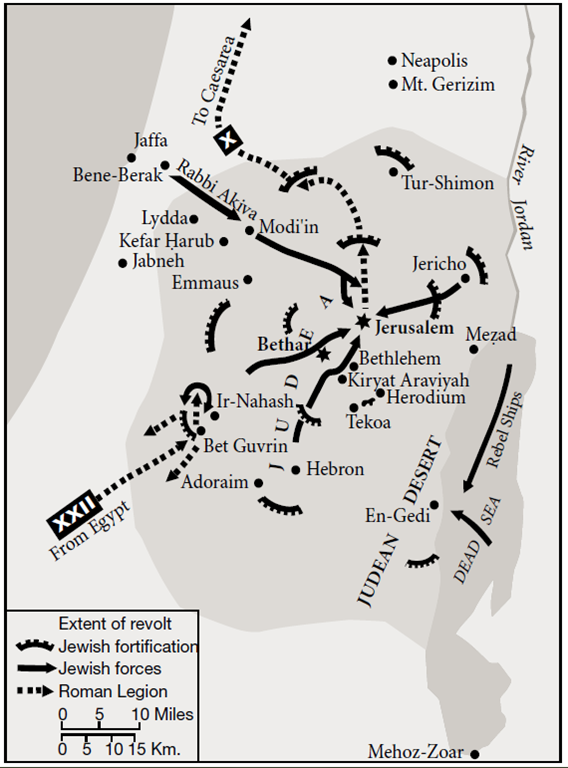
Map 1. Extent of the Bar Kokhba revolt in its first year, 132 C.E. After Y. Aharoni, Carta’s Atlas of the Bible, Heb. ed., 1966.
Dio Cassius gives a brief account of the course of the revolt. Accumulating arms by deceiving the Roman authorities, the Jews awaited a suitable opportunity, and when Hadrian left they openly rebelled. At first the Jews did not fight pitched battles. Instead they seized towns which they fortified with walls and subterranean passages. In an increasing number of clashes the rebels inflicted losses on the Romans. Hadrian was compelled to hurriedly send for one of his ablest generals, Julius Severus , who specially came from Britain to Judea. Due to the large number of the rebels and their desperate fury, Severus refrained from waging open war and preferred to surround their fortresses and hem them in to prevent food from reaching them. Gradually he succeeded in wearing down the Judean fighters, on whom he inflicted heavy blows without respite until he reduced them to a state of complete submission. Dio Cassius relates that the Romans demolished 50 fortresses, destroyed 985 villages, and killed 580,000 people in addition to those who died of hunger, disease, and fire. He adds that many Romans perished as well, and when Hadrian informed the Senate of his victory he did not begin with the usual formula: “I and my army are well.” Dio Cassius states that the insurrection, which was prepared in detail, spread until “the whole of Judea was in revolt” (he referred apparently to most of Ereẓ Israel, including Galilee and Golan). He further states that the Jews “throughout the world” supported the uprising as did non-Jews, too, and it was “as though the whole world raged.” In its scope and vehemence, the revolt assumed the dimensions of a war which constituted a threat to the empire. As usual with Roman historians, Dio Cassius cites a supernatural omen, to show that the destruction of Judea was predestined, when he states that the “sanctified” tomb of Solomon had fallen down of itself.
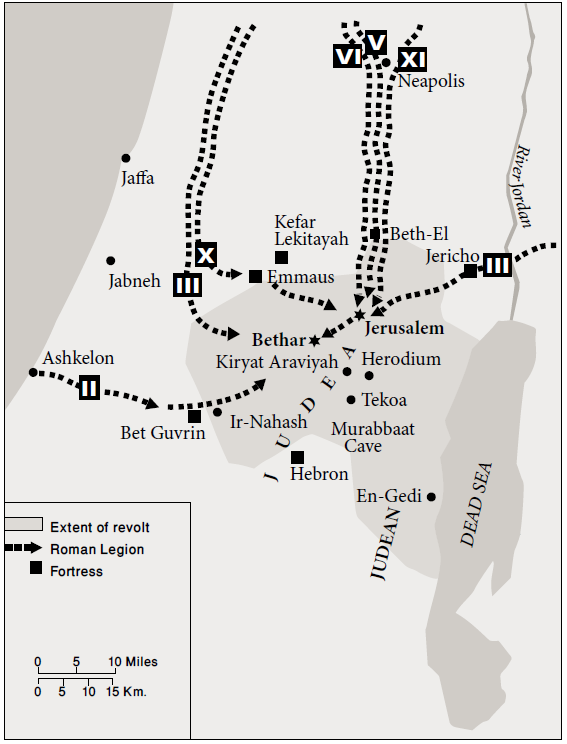
Map 2. Extent of the Bar Kokhba revolt in its third and fourth years. After Y. Aharoni, Carta’s Atlas of the Bible, Heb. ed., 1966
Greek and Roman inscriptions mention the participation in the war of detachments of legions brought from all parts of the empire, from Egypt and as far away as Britain – the Tenth “Fretensis,” the Third “Cyrenaica,” the Fourth “Scythica,” the Second “Trajana,” the Twenty-Second “Diotrajana” legions, and perhaps also the Sixth “Ferrata” legion. The Syrian navy also presumably took part in the war. Although exact figures cannot be computed since these were auxiliary troops and detachments of legions, the magnitude of the Roman army indicates the dimensions of the war. Isolated evidence – an inscription on a tomb, third-century talmudic references to the destruction of Galilee (BK 80a; TJ, Pe’ah 7:1, 20a), the remarks of Sulpicius Severus (fourth century C.E.) on the rebellion of the Jews in Syria and Palestine in the days of Hadrian – shows the revolt spread to the north of Ereẓ Israel, to Beth-Shean and Galilee. However, the main conflict took place in Judea, the Shephelah, the mountains, and finally in the Judean Desert.
The war apparently lasted about three and a half years, during which Jerusalem was taken by the rebels, as evident both from the inscription לחרות ירושלים on coins of the revolt and perhaps also from the Judean Desert documents. Appian, a contemporary of the revolt, Eusebius, in his De Theophania, and Jerome (fifth century C.E.), in his commentary on Jeremiah 31:15, all state that Jerusalem was destroyed in the days of Hadrian. It would therefore appear that Bar Kokhba captured the city and only after his military defeat did Hadrian regain control and destroy it. There may be an allusion to this in Midrashim which tell of Hadrian’s entry into Jerusalem and his desecration of the Temple Mount (Tanḥ. B., Ex. 128; Ex. R. 5:5, Deut. R. 3:13). Some maintain that the design on coins of the revolt, depicting a four-columned building surmounted by a star, symbolizes the Temple, and if the undated coins bearing the inscription לחרות ירושלים or simply ירושלים are indeed to be assigned to the third year of the revolt, Jerusalem was still in Bar Kokhba’s hands toward the end of the revolt in the third year of the war, that is, in Tishri 134 C.E. This is confirmed by one of the Judean Desert documents which is dated שנ)ת תלת לחרות יר(ו)שלים) (“the third year of the freedom of Jerusalem”). This scant evidence shows that during the Bar Kokhba revolt Jerusalem not only symbolized the yearning for freedom but also served the political expression of the consolidation of the revolt and of its sway in Judea. There is, however, no evidence that the Temple was rebuilt at that time, nor is there any proof that Bar Kokhba was about to rebuild the Temple. However, an altar may have been erected for sacred worship.
Bar Kokhba made a final stand at Bethar in the Judean Hills, but from the finds in the Judean Desert it would appear that after the fall of the last stronghold the flame of revolt continued to flicker in the desert and in the vicinity of the Dead Sea. Nevertheless, in talmudic and midrashic sources Bethar represents the fortress in which the rebels found refuge, and its fall, along with the defeat of Bar Kokhba who met his death there, symbolizes the end of the revolt. The place was apparently chosen as the rebels’ main stronghold because of its strategic situation on the edge of a mountain overlooking the Valley of Sorek and dominating the important Jerusalem-Bet Guvrin road, and possibly also because of its fertile soil. Since it was not adequately fortified, Jerusalem could not serve as a stronghold. At that time Bethar was considered a large city (kerakh; TJ, Ta’an 4:8, 69a; Lam. R. 2:2 no. 4; cf. Mid. Hag. to Deut. 28:52), perhaps because numerous inhabitants from the entire neighborhood had gathered there, as attested by Jerome (in his commentary on Zech. 8:19), who mentions that many thousands of Jews found refuge in it – Bether ad quam multa milia confugerant Judaeorum (and cf. the midrashic references to 400 synagogues in Bethar).
The actual siege of Bethar began apparently after the recapture of Jerusalem. Whether Bar Kokhba’s men had intended it from the outset to be their principal fortress or were driven there by the force of circumstances cannot be known. Even during the siege those in Bethar maintained contact with camps of fighters in the Judean Desert. One of the documents states: “Near the well of Ben Koseva, Nasi of Israel, in the camp,” referring probably to the camp of Bethar, which is not mentioned, however, in the Dead Sea documents. Severus’ strategy was to intensify the siege on the fortress, and a siege wall (circumvallatio) was built for this purpose. It was attacked by the besieged in desperate sallies, while the blockade grew tighter. A clear reminder of the Roman armies’ presence in Bethar itself was preserved in a Latin inscription which was engraved on a rock near the well of Bethar and mentions detachments of the Fifth “Macedonica” and the Eleventh “Claudia” legions. The inscription is now illegible.
Eusebius states that Bethar was besieged in the 18th year of Hadrian’s reign, that is, in 134 C.E., about two years after the outbreak of the revolt, and that its fall was caused by hunger and thirst. According to the talmudic account (TJ, Ta’an 4:8, 68d; Lam. R. 2:2, no. 4), Hadrian unsuccessfully laid siege to Bethar for three and a half years, until a Samaritan pretended that Eleazar of Modi’in (ha-Moda’i) had conspired with him to surrender the city to the Romans. Incensed at this, Bar Kokhba killed Eleazar. “Immediately Bethar was captured and Ben Koziva met his death.” Presumably great importance was attached in besieged Bethar to sages such as Eleazar of Modi’in, one of the leading rabbis of his generation, but whether he is identical with the Eleazar whose name appears on coins of the revolt cannot be determined. (In one of his letters, Bar Kokhba mentions a רבנו בטניה בר מיסה, whom he regarded as a great man.) These circumstances suggest that eventually a dispute broke out between the sages and the commander-in-chief and spread among the besieged. In any event these reports, like the statement of Eusebius, indicate that the capture of Bethar was difficult and was achieved under unusual circumstances.
The death of Bar Kokhba is enveloped in a legendary halo. The accounts of the massacre perpetrated in Bethar attest to the ferocity of the struggle (Git. 56a–b; Song. R. 2:17; cf. ARN 138, 115: “Not a soul escaped”). The sages state that on Av 15th the burial of the slain was permitted (Ta’an. 31a). Tradition has it that Bethar was taken on the Ninth of Av (ibid., 29a), and Jerome (loc. cit.) also says that it occurred in August: in hoc mense (scil. Augusto). On the basis of the latest date – the fourth year of the liberation of Israel – mentioned in one of the documents, Bar Kokhba’s rule lasted more than three years. In Jewish tradition the fall of Bethar was a disaster equal to the destruction of the First and Second Temples.
The Jewish population of Judea was largely exterminated in the period of repression which followed the fall of Bethar. The subjugation was associated with massacres and religious persecution, the sale of Jews into slavery, and uprooting of the people from the soil. The Jewish center of gravity now moved northward, chiefly to Galilee. Thus ended the final and perhaps greatest war of liberation of the Jews in ancient times. The independence of Judea had come to an end.
The Judean Desert Documents
The finds, dating from the days of Bar Kokhba and brought to light in the Judean Desert in 1952–61, contain additional facts of great importance for an understanding of the social and economic conditions prevailing during the Bar Kokhba war in 132–135 C.E. The first documents were found in 1952 in Wadi Muraba’at about 11 mi. (18 km.) southwest of Qumran . Among them are commercial contracts, letters of divorce, two letters from Bar Kokhba, and one from the administrators of the community addressed to Jeshua b. Galgolah. An archaeological expedition undertaken in the Judean Desert south of En-Gedi in 1960–61 uncovered, alongside material finds such as skeletons, linen, remnants of clothes, metal and glass vessels, and remains of food, many documents of the time of the Bar Kokhba war, chiefly in one of the caves in Naḥal Ḥever, now named “The Cave of the Letters.” The letters and economic documents in Hebrew, Aramaic, and Greek uncovered in the cave testify to the economic position in southern Judea on the eve of the revolt and at the height of the war[…].
The letters, written apparently in Bar Kokhba’s name but not personally by him, deal with everyday matters. Some of them are not entirely clear. The dates mentioned in them range from the second to the fourth year of the liberation of Israel (132–134 C.E.). The letters open with an almost identical formula:
[…] “From Simeon ben Kosevah to Jeshua ben Galgolah and the men of his fortress!”; “From Simeon to Jeshua ben Galgolah, peace!”; “Simeon bar Kosevah the nasi [‘prince’] of Israel to Jonathan and Masbela, peace!”; “From Simeon bar Koseva to the men of En-Gedi to Masbela (and) to Jonathan B(ar) Ba’ayan peace!” “Simeon to Judah bar Manasseh to Kiryat Araviyah.”
In a letter to Jeshua b. Galgolah, one of his army commanders, Bar Kokhba refers to the גללאים (gllʾym), who are to be protected and, sternly reminding his men of this, threatens them with irons: “I call Heaven to witness against me … that I shall put your feet in irons.” The actual occasion and the identity of the גללאים are not clear from the letter. In another letter to Jeshua, Bar Kokhba orders him to offer hospitality on the Sabbath to men who were bringing wheat to the camp and to provide them with accommodation until “after the Sabbath.”
In other letters found in Naḥal Ḥever, the nasi writes to Masbelah b. Simeon and Jonathan b. Bayahu, who were apparently in command of the En-Gedi front, about the wheat supply, the grain harvest, the confiscation of property, the supervision of the men, and the mobilization of the men of Tekoa on the border of the Judean Desert. His language is harsh, and he frequently threatens them with punishment if they fail to carry out his orders (“and if you will not do this, you will be punished”). In a Hebrew letter to Jonathan and Masbelah of En-Gedi, Bar Kokhba orders them to attend to the loading of a boat anchored in the harbor there. To the commanders in the rear and the population of the inhabited area of the desert, with whom he was incensed for having failed to supply food as he had commanded and who had neglected their duty, Bar Kokhba uses stern language: “You are living well, eating and drinking off the property of the house of Israel, and care nothing about your brethren.”
In an Aramaic letter to Judah b. Manasseh of Kiryat Araviyah, Bar Kokhba orders Judah to supply him with the Four Species for Tabernacles and apparently reminds him about separating the tithe: ותקן יתהן (“and give the dues from them”). Such references, made incidentally or hinted at in the letters, may indicate that Bar Kokhba’s men, even under danger, strictly and quite naturally kept the commandments of Judaism, such as the sanctity of the Sabbath, the laws of the priestly and levitical dues, and the fullest observance of festivals.
The letters and other documents uncovered in the Judean Desert contain nothing specific about the attitude of the sages toward the rule of Bar Kokhba nor is there any mention in them of Bethar and of the war there. Nevertheless it is possible to comprehend from them explicitly and at first hand about Bar Kokhba’s aggressive personality and his status, the economic straits in which the fighters of Judea found themselves, and the geographic extent of the revolt. The nasi was concerned about supply problems, food for his camp, and matters pertaining to real estate. The economic documents found in Wadi Muraba’at show that leases were made in the name and with the sanction of Bar Kokhba: “On the instructions of Simeon b. Koseva.” Apparently the land belonged nominally to the nasi, it being clearly stated in a lease, “You have leased the ground from Simeon, the Nasi of Israel.” In his name the lessors laid down the quota of grain that was to be given to them. As was to be expected in a time of war, the authorities insisted on the cultivation of the fields and confiscated the lands of those who neglected to till them. They “were dispossessed of the land and lost everything.” In effect, Bar Kokhba regarded himself as holding the authority of the Roman emperor and transferred the lands of liberated Judea to his own possession. His orders concerning leases, sales, and confiscations were grounded on a juridical succession to the Roman rule, by virtue of which he was empowered to exercise control over the lands of Judea and confiscate property for the public good. Contracts found in Naḥal Ḥever indicate that Bar Kokhba wished to prevent the concentration of the lands of En-Gedi in the hands of a few owners in order to increase the supply of food in a time of stress.
From the names of the settlements mentioned in these documents, Bar Kokhba’s men apparently controlled extensive areas, in the frontier regions of the Judean mountains, in the neighborhood of Bet Guvrin (Ir-Nahash), and in the Judean Desert, and maintained contact, it seems, with regions east and south of the Dead Sea, such as Ma’aleh ha-Luḥit in the district of Eglatin in Moab and Zoar in the Aravah. Herodium, the town of Herod about 6 mi. (10 km.) southeast of Jerusalem and mentioned in the documents, became an economic center in which the nasi’s representatives were stationed; En-Gedi was an important supply harbor for the rebels. The settlements of Tekoa and Kiryat Araviyah in the vicinity of Bethlehem are mentioned in the documents. According to the reconstruction of ב …שלים as Jerusalem, proposed by J.T. Milik who made a study of the Wadi Muraba’at documents, that city is referred to in two of them, one dating from the second, and the other from the fourth year “of the liberation of Israel” (Elul, 133 and Tishrei, 134, respectively). After the defeat, the fugitives from the war in Judea gathered in the Judean Desert, which then became the rebel center. The remains of Roman military camps found above the caves in Naḥal Ḥever show that the legions besieged the remnants of the fighters who, together with their families, had taken refuge in these hiding places. Surrounded by the Romans, there they met their death.
Update: New Archaeological Finds
Since the writing of the above in the late 1960s new archaeological information concerning the Bar Kokhba revolt has emerged as a result of the intensive investigation of hundreds of refuge caves and underground hiding complexes. Refuge caves are found mainly in the Judean Desert and in the cliffs overlooking the Dead Sea, and were used as shelters for Jewish refugees at the close of the Bar Kokhba revolt. Underground hiding complexes, however, were subterranean warrens hewn artificially under or near residential buildings within Jewish towns and villages (some 125 sites according to a recent count). They have been found in the Judean Shephela, and in the Beth-El and Hebron Mountains, and reflect the general boundaries of the area that was under Bar Kokhba’s administration. Excavations at the Abi’or Cave in the Judean Desert in 1986 and later in 1993 brought to light numerous fragments of new documents written on papyri in Greek and Aramaic. Additional finds from the cave consisted of textiles, ropes, and parts of sandals. These items were brought to the cave and hidden there towards the end of the revolt.
Excavations conducted in 1984 by Tel Aviv University confirmed that Khirbet al-Yahud (10 acres in size) is indeed Bethar , the last bastion of Bar Kokhba. Hastily erected fortifications were uncovered and the discovery of slingstones and arrowheads indicates that a battle took place there. Roman siege camps were also identified in the vicinity of Bethar (present-day Battir).
Various artifacts dating from the time of the revolt have been unearthed at a number of sites and within underground hiding complexes, notably various forms of pottery, stone vessels, and coins. An important discovery was that of a lead weight found at Horvat ‘Alim in the Shephela, bearing the name and title of Bar Kokhba, which was evidently used for administrative purposes. A signet ring bearing the name of Bar Kokhba is also reported from the vicinity of Quneitra in the Golan, and perhaps was brought to this destination by Jews fleeing persecution at the end of the Bar Kokhba revolt. A number of coin hoards have become known, many of them through clandestine digging, containing Jewish coins mixed with those produced in Aelia Capitolina. Clearly, Aelia Capitolina was founded before the outbreak of the revolt. There is no evidence that Bar Kokhba at any time held Jerusalem (see above for contrary view). Coins dating from the Bar Kokhba revolt have also begun emerging from controlled excavations, especially within the refuge caves and underground hiding complexes.
Click on this and then click the little speaker symbol under the German version.

If you wish to do this manually, here is the source text – select German as the language.
pv zk bschk pv zk pv bschk zk pv zk bschk pv zk pv bschk zk bschk pv bschk bschk pv kkkkkkkkkk bschk bschk bschk pv zk bschk pv zk pv bschk zk pv zk bschk pv zk pv bschk zk bschk pv bschk bschk pv kkkkkkkkkk bschk bschk bschk pv zk bschk pv zk pv bschk zk pv zk bschk pv zk pv bschk zk bschk pv bschk bschk pv kkkkkkkkkk bschk bschk bschk pv zk bschk pv zk pv bschk zk pv zk bschk pv zk pv bschk zk bschk pv bschk bschk pv kkkkkkkkkk bschk bschk bschk pv zk bschk pv zk pv bschk zk pv zk bschk pv zk pv bschk zk bschk pv bschk bschk pv kkkkkkkkkk bschk bschk bschk
Be sure to select the voice synthesis option for German, and not the English translation.
Maurice Sendak and Melville
We have talked about Maurice Sendak here and here (the latter in which he said about e-books: “F*** them is what I say, I hate those e-books. They cannot be the future – they may well be – I will be dead, I won’t give a s***.”) Well, this morning, Sendak did die, at the age of 83. His story was a type of rags-to-riches story – he grew up Jewish, gay, poor, and managed to become a major cultural influence in society.
If you look at the acknowledgements of the 2nd edition of the Norton Critical Edition of Moby-Dick (the 150th anniversary edition edited by Herschel Parker and Harrison Hayford) you’ll find Sendack’s name listed in the acknowledgements:
Maurice Sendak responded with heartening ferocity to tidbits (as Moby-Dick spells it) of biographical information that ended up in footnotes here.
(Cormac McCarthy’s name is also mentioned in the acknowledgments, but that is a topic for another post.)
Maurice Sendak, Melville scholar? Yes – Sendak devoted himself to a study of Melville. From an interview with Bill Moyers:
MOYERS: How do you calm your own demons? How do you find a separate peace in a world that’s so full of scary things?
SENDAK: I don’t know. I read. Like coming here today, I was anxious about this. Would I be all right? And I have a little tiny Emily Dickinson so big that I carry in my pocket everywhere. And you just read three poems of Emily. She is so brave. She is so strong. She is such a sexy, passionate, little woman. I feel better.
Art has always been my salvation. And my gods are Herman Melville, Emily Dickinson, Mozart. I believe in them with all my heart. And when Mozart is playing in my room, I am in conjunction with something I can’t explain.
I don’t need to. I know that if there’s a purpose for life, it was for me to hear Mozart. Or if I walk in the woods and I see an animal, the purpose of my life was to see that animal.
I can recollect it, I can notice it. I’m here to take note of. And that is beyond my ego, beyond anything that belongs to me, an observer, an observer.
MOYERS: Tony Kushner, your friend and collaborator, says you have a mind darkened by both fatalism and faith.
SENDAK: Faith?
MOYERS: Faith.
SENDAK: Well, okay.
MOYERS: You agree with him? He knows you.
SENDAK: Yeah, he knows me almost too well. Fatalism, yes. Yes. Having lived through the wars in Europe and having lost so many people in my family when I was a child. I didn’t even know them. Faith? Total faith in art. Total faith in art.
MOYERS: In art?
SENDAK: Herman Melville is a god.
MOYERS: Because?
SENDAK: Because I cherish what he did. He was a genius.
MOYERS: What did he do?
SENDAK: Wrote Moby-Dick. Wrote Pierre. Wrote The Confidence Man, wrote Billy Budd. And when I step into the…
MOYERS: Billy Budd, innocent, faith in the power of innocence.
SENDAK: Oh, yes. Look at him.
MOYERS: Billy Budd, the eternal child.
SENDAK: Scares the bejesus out of people and makes them hate him. Because he’s so good. Claggart has him killed in that book. Claggart has his eye on that boy. He will not tolerant such goodness, such blondeness, such blue eye. Goodness is scary.
Here is an Sendack interview with Hank Nuwer:
The artist seems irritable and phlegmatic at first meeting, no doubt a reaction to finding his workspace invaded by an interviewer. Later, hunched over a drawing board, however, he arms noticeably when conversation embraces literary and artistic concerns. He proves a more than cordial host ultimately; dispensing personal insights and philosophies the way other might serve refreshments.[…]
NUWER: Do you believe in heroes?
SENDAK: Yeah. Not many. The order of their priority is Mozart, Kleist, Melville. They’re the core group. Mozart and Kleist are both so diametrically opposed, and, yet, I know what links them together. Kleist stands for total destruction, this great big desperate need to find out why there’s a reason for living, and then, NOT to find it. He collapsed under it. The work is all a hysterical plea. It’s all so wonderful and touching, but he never succeeds. All of Kleist’s work is there as imbalance in Nature, but in Mozart, there is the most quintessential perfect balance. There is suffering and everything you expect a grown man would have experienced in life, and, yet, in a way no other creature has done it. They are the pluses and minuses in my personal algebra.
NUWER: And Melville?
SENDAK: Melville is somehow more on the side of Kleist. He is a more comprehensible Kleist, a readable Kleist, a more lovable Kleist. In a way it’s simplistic to say so, but Mozart and Kleist represent to sides of my own life. […]
NUWER: Do you owe much to any particular philosopher?
SENDAK: No, I can’t take anything in a book that isn’t by a fictional writer. If it’s by a philosopher, I reject it outhand. If it’s by Melville I’ll buy it. It’s got to be that kind of artist who teaches me. I can’t be taught by a Schopenhauer or a Kant. I can’t. Don’t ask me why. I just can’t. I can’t read things like that. But I trust artists. I don’t trust philosophers. Of course, anyone could say, “But what a mistake you’re making. They happen to be artists, too.’ Possibly. Maybe they’re just too hard to read and boring.
NUWER: When did you start reading Melville?
SENDAK: In my twenties. I started with Moby-Dick for all the obvious reasons. I thought it was a great classic to read. And in fact it really hit an imaginary chord at that stage in my life. And when I fall in love with a writer, I have to read everything. And then I went through, for a long period of years, all of Melville. I’ve since gone through them again, and I love all of them. And the only one that has stumped me is Mardi. I just did volume one. And I did that one only about four years ago. I could not make myself go on to the next one. I couldn’t stand it any more.
NUWER: I couldn’t stand The Confidence Man.
SENDAK: Oh, The Confidence Man was wonderful. I loved that!
NUWER: I read that at age twenty.
SENDAK: Too young. Too young. It’s way too young.
NUWER: Do you remember, in Moby-Dick, the character Bulkington?
SENDAK: Oh, of course. Of course. Brave, good Bulkington.
NUWER: Do you think he was a mistake?
SENDAK: No—
NUWER: —I do. I think Melville might have gotten rid of him because Bulkington wouldn’t have backed down the way Starbuck did.
SENDAK: He does get rid of him a completely arbitrary way, doesn’t he? “The Lee Shore.” That’s such a chapter, isn’t it? Wow! “The Lee Shore.”
NUWER: “O Bulkington! Bear thee grimly, demigod! Up from the spray of the ocean-perishing—straight up, leaps thy apotheosis!”
SENDAK: Yes. That’s the end of him. Well, from a technical point of view, it’s an error. But then there are no errors in that book. There just ain’t none. I mean he [Bulkington] was just there for that. If only because he had to do “The Lee Shore,” and that’s all it was worth…listen, I’m too in love with that book to be critical. I can’t worry about whether Bulkington made sense or not. I would have died without Bulkington. And Bulkington was one of his typical male fantasy heroes. Melville is full of men like Jack Chase—superman, heroes. He loved male imagery like that. It’s very peculiar.
NUWER: That might account for Melville’s falling out with Hawthorne.
SENDAK: Well, so much has been made of whether what we’re talking about is repressed homosexuality that reappears over and over and over again in Melville. And maybe that’s so. It really makes no difference particularly. I think it only makes a difference if we infer anything like that in the relationship with Hawthorne. And I don’t think you can. The nineteenth century thing was so different from the twentieth century.
NUWER: Melville strikes me as a man’s man. I think it was just pure friendship with Hawthorne.
SENDAK: It’s really hard to know. Impossible to know. Do you remember that strange chapter in Melville of touching hands in the sperm? That is so bizarre.
NUWER: Touching in the ambergris, yes. Also there’s the bed incident where the harpooner Queequeq drapes his leg over Ishmael as if they were married.
SENDAK: There is an awful lot of that. It’s just that one is tempted not to think so because everyone so quickly does it. Buy, you know, when you think of Melville’s career—and Melville was an extremely successful writer, up until his masterpiece, Moby-Dick—it was not a successful book. But nevertheless, everything that made him a genius went into Moby-Dick. Everything. Typee. Redburn. Omoo. All of them are sketches for Moby-Dick. Then he does Moby-Dick, and you know that he achieved a kind of immense balance and comprehension that is awesome in that book. But then the thing that scares me is that Pierre, the book that come right after that, is—yes, it’s a motionless book, but it’s a great and ingenious work of art. But that’s beside the point. I’m not sitting here as a critic of Melville…but he lost the balance. People say the book is a vindictive diatribe against all his critics. B***s***! He might have been mad and hurt—He must have been mad and hurt. But he wouldn’t have spent that much time on a book being just mad and hurt. He lost something vital. And Pierre is to me all about having lost. How did he lose it? That scares me.
NUWER: Right around that time he was looking to Hawthorne for inspiration. Hawthorne totally rejected his work. And I think that did have some awful effect on Melville.
SENDAK: Of course it had an effect. It’s the reason I hate Hawthorne with all my heart. I’ll never forgive Hawthorne for Herman. It’s alike…I’ll take that up with him someday. I’ll never forgive him for having so misunderstood. Mrs. Hawthorne understood better. Her journals have intuitive little things about what this poor man needed from her husband and how incapable her husband was of giving. I mean, you can’t blame Hawthorne for being incapable. That’s silly. But it’s true. But I still can’t believe that was enough to do it. That Herman Melville could have constructed everything—his whole balance of life—on this man. And that the withdrawal of that man, however cold and abrupt he was, could have meant this…maybe it did. Maybe I just am afraid to think it was that. I’m afraid. And why am I afraid? Because I identify. I go back to what I just said that between Moby-Dick and Pierre he lost everything. And that’s how quickly we can all lose everything.
I am profoundly encouraged by the Maurice Sendak – a man born on the the margins who grew up to be a cultural phenomenon. And I am encouraged that while he grew up, he remained an amateur Melville scholar, whose comments and views informed the major annotated teaching edition of Moby-Dick today. What a life well lived!
My Bibles (A Topical Introduction)
I thought I’d introduce myself a little further, by telling you about my bibles.
I expect my very first bible is somewhere in this house, but I couldn’t find it when I went looking. It was an illustrated children’s bible, a somewhat oversized hardback with a blue cover, that must have contained only a selection of bible stories.
In junior high, I got the Catholic edition of this bible, called The Way — mine looks just like this one except the soft cover is bright blue, not dark green, and it says “Catholic” on the cover. I loved this Bible. It was very readable (unlike my mother’s Douay-Rheims that lived up on the top shelf of her bookcase), and its brief introductions to each book talked about biblical themes in terms that were relevant to young people.
But best of all, it had a chart: roughly in the middle of the bible, there was this chart that suggested bible passages. “If you feel…” or “If you’re wondering about..” this or that emotion or question, down the rows, “then try reading…” this or that bible passage, across the columns. What a terrific way to start to read the Bible! So much better than the linear approach of starting from the beginning and read till the end, or the bibliomantic approach of opening the book at random and putting your finger down on a passage to see what God might want to say to you today. And especially, what a great way to encourage young people to consider what’s going on in their lives in the light of the scriptural witness: it’s something you could do (and I did) in the privacy of your own room, without the embarrassment of actually asking somebody, a parent or a priest or a teacher. The chart wasn’t just about difficult teenager-troubles, either; it included entries for if you feel happy, or thankful, too, and pointed you to rejoicing and praise texts. I don’t know why all devotional bibles don’t come with charts like that!
When I was confirmed, in high school, we were each given a paperback copy of the Good News for Modern Man New Testament that was signed with a short personal note by everyone on our confirmation prep team; and then we all signed each other’s, as well. I don’t much care for this translation, but the connection to my confirmation makes this special to me.
In college, I went on several retreats to the Abbey of the Genesee, in Rochester, NY. This was my first encounter with the Liturgy of the Hours (morning prayer, or lauds; evening prayer, or vespers; night prayer, or compline; and others). Retreatants and other visitors were welcome to participate with the monks in the chapel there, using the Abbey Psalter, which you could also buy at the gift shop there. At some point, I did that, and have used it enough over the years that it’s gotten a bit worn and dog-eared.
When I graduated from college, my namesake cousin sent me a Bible as a graduation present. This one is the NAB, paperback-sized, bound in black leather, with small print on thin pages.
I think I was in my late 30s when I first bought a bible for myself. I remember standing in Barnes & Noble looking over the shelves of bibles, trying to choose. I wanted a Catholic bible, of course; and I wanted a study bible, with footnotes to explain things. I finally chose the New Jerusalem Bible. This is far and away my favorite bible for personal use: its language is beautiful, a functional translation with a poetic sensibility; its poetry is typeset as poetry; it has both scholarly footnotes at the bottom of the page, and cross-references to other biblical texts down the side margins.
When I started grad school, I was a bit dismayed to find out that this was not considered an acceptable translation for serious exegetical work: we were told to use a formal translation, either the NRSV, the NIV, or the NAB. So I picked up the NAB Catholic Study Bible from the seminary bookstore. I figured this one would need to stand up to some hard use, so I chose the hardcover. As I paid for my purchase, a professor in line behind me commended my choice, saying it was the best study bible he’d ever seen and he used his all the time. Encouraging!
I also discovered the blueletterbible.com website that semester, which I love for its variety of translations (although not the NAB) including the Latin Vulgate and the Greek Septuagint, and its built-in concordance.
For my course on the Hebrew Bible (not actually in Hebrew, though), we used the Jewish Study Bible , the JPS translation of the Tanakh. I really like this Bible. Its footnotes and essays are very informative, and of course, informed by a purely Jewish faith perspective, as is the translation itself. This is probably the Bible I reach for most often after the NJB, when I want to understand how a text from the Shared Scriptures might have been understood by Jesus’ hearers.
During this class, I encountered the work of Robert Alter, who made me laugh out loud at bits of his really excellent Art of Biblical Narrative. So when I found he had put out a translation of the Book of Psalms, I snapped that up too.
For my course on the Gospels and Jesus, we were encouraged to bring any translation to class, even free or paraphrased translations – my professor wanted to have as many different translations of the text available to us as possible. Well, that was all the excuse I needed to finally pick up a copy of the Inclusive New Testament. We also used a parallel synopsis of the gospels, which is a very different and interesting way to approach the text.
When I got a Kindle a couple years ago, I downloaded a version of the KJV onto it, because it was the only free e-version I could find for the Kindle and I wanted to have some version of the Bible on it. I know people rave about the beauty of the King James, but I don’t hear it at all: it thuds on my ear and is hard to understand. When I’m subjected to a reading from the KJV in some worship service or other, I always have to go home and check the NJB or NAB to find out what it really said.
And most recently, I acquired a copy of the Common English Bible, that I won in a giveaway by Brant Clements over at Both Saint And Cynic. (Thanks, Brant!) It arrived a couple of weeks ago, and I’m quite favorably impressed. It’s not too heavy, sized to be easily portable, but still laid out to be very nicely readable. It’s not a study bible, so it’s missing the footnotes and cross-references I’ve become used to — and it’s a Protestant bible, so it’s missing a few books as well 😉 — but it may still become the bible I carry around to classes and discussions when I just want to have a basic bible to refer to.
So there we go: I’ve got four Catholic Bibles, one Protestant Bible, one Jewish Bible, two New Testaments, one Gospel synopsis, and two Psalters. Is that a lot? It seems like a lot. It’s certainly way more than I ever expected to have!
So how many Bibles (or other sacred scriptures) do you have? Which are your favorites, and why? Are there stories attached to any of them?
Gaudete Theology blogger now also blogs at BLT
Victoria Gaile Laidler now is a co-blogger here! Her other blog, of course, is Gaudete Theology, where many of us have enjoyed reading and dialoging with her and with one another. Just a few examples of some recent excellent posts there that you may enjoy are:
- Summarizing Mimetic Anthropology
- On Marriage
- Structural Sin and Moral Complexity
- St. Vidicon of Cathode
- Reading Revelation at Reading Acts
- How we understand the name(s) Jesus Christ
- Violence Renounced: Rene Girard, Biblical Studies, and Peacemaking
- Why go to church this Thursday, Friday, and Saturday?
- A Different Kind of Stations of the Cross
- Hildegard’s Symphonia, translated
Here is how Victoria describes what she is doing, her studies, her interests, her faith tradition, her day job, and what she reads a lot of:
I’m studying theology at the Ecumenical Institute of Theology. My primary interests are ecclesiology, ecumenism, and interfaith work, particularly Christian-Jewish dialogue. My faith tradition is Roman Catholic, and the liturgy is a primary resource and interpretive framework in my thinking, as are feminist theology and Girardian, or mimetic, anthropology.
I work as a scientific programmer at my day job, and I read a lot of science fiction and fantasy.
At this blog here, she has interacted with many you and with several of our posts. We hope you will welcome her here now. We all look forward to her BLT posts.
From alphomics to omomics
From the New York Times:
‘Ome,’ the Sound of the Scientific Universe
By James Gorman
The age of “omes” is here. It began with the genome, continued with the proteome, branched out with the memome and reached full flowering with the notion of the omome.
This probably sounds like raw material for nonsense poetry, but it’s a real biological and linguistic trend that makes sense, once you get the idea of just what an “ome” is.
The genome is the place to start. It is the totality of all the genes, whether in an organism or in something else, like a tumor. The human genome, mapped out about a decade ago, includes all the genes that make a human being.

Creating a map of the whole genome was a monumental achievement, and during work on that project and after its completion, the omification of science took off. Joshua Lederberg, a geneticist and Nobel laureate who died in 2008, and Alexa T. McCray, now an associate professor at Harvard Medical School, saw it coming, and talked about the origin of the suffix “ome” in a 2001 essay, “ ’Ome Sweet ’Omics — A Genealogical Treasury of Words,” in The Scientist.
The word “genome” was first used in 1920, by Hans Winkler, a German scientist, to mean all the material on the chromosomes in a sperm or egg, but did not become really popular until the end of the last century, when genome mapping began. Various experts had differing ideas on where the suffix came from, but it seems to be one that was made up. In any case, it clearly meant the totality of something. Dr. Lederberg, who coined a few scientific terms himself, contributed “microbiome” — all the microbes that live in and on humans — to the growing trend.
An epidemic of neologia ensued. Thus were born the proteome and the secretome and the glycome, and numerous other omes that are pretty much impossible to keep track of. Interactome. Regulome. Connectome. Epigenome. The list goes on. In fact, it goes on for about 18 pages if you go to the Omics.org site and print out its list of omes and omics.
The list could be said to be the omome, the ome of all the omes, a word which, in a moment of indulgent fantasy, I thought perhaps I had invented. Apparently not. “Omome,” or “omeome,” is on the Omics.org list, although the Web site given as a source led nowhere. Another possible inventor is Martin Krzywinski, a scientist at the Genome Sciences Center in Vancouver, British Columbia. He has created some extraordinary visual representations of genomes, and also invents new words. Among the coinings he offers on his site are “omome,” “omeomics,” “omicsophy,” which I don’t think will ever take off, and, just Thursday, “metaomomics,” which I don’t even want to think about.
I loved the idea of the omome, but I thought it needed a reality check. I called Mark Gerstein at Yale. His lab is deeply involved in bioinformatics, the use of computing to make sense of the vast amounts of information produced in pursuit of the various omes. Dr. Gerstein also has an interest in the way scientific terminology develops.
The omome, he said, was a fun idea, but he doubted anyone was making a living in omomics. Despite the humor in speculative omification, he said, the proliferation of real omic disciplines marked the spread of a “very important scientific idea.” He said, “All the omes derive to some extent from the genome,” and key to all of them is that an ome represents “the entirety of the thing being studied.”
The mapping of genomes, he said, inspired scientists to use the same approach in studying proteins, metabolites and their biochemical connections, to name a few. And as they pursued this “omic idea,” the focus of biological research shifted in the direction of studying complete systems and networks, rather than individual parts, discrete genes or proteins.
His comments reminded me of a recent conversation I had when I was reporting on the evolution of polar bears. One scientist wanted to make it clear to me that she was studying genomics, whereas another researcher was studying only genes. Only genes, I thought? What a difference an ome can make.
“Vocation of the Business Leader”
There has been a lot of buzz about a new pamphlet just out from the Pontifical Council on Justice and Peace: Vocation of the Business Leader.
As John Allen notes, this document is quite different from many official Catholic texts:
One distinct note is the text’s rather lofty conception of the business enterprise: “When businesses and market economies function properly and focus on serving the common good,” it says, “they contribute greatly to the material and even the spiritual well-being of society.”
As Samuel Gregg observed for National Review Online, that’s a powerful corrective to “the essentially condescending view of business often adopted by some clergy.” In effect, the document acknowledges that business doesn’t just fill bellies or line coffers; properly practiced, it also cultivates virtue.
Among other things, the document says that ethically responsible business is a “vehicle of cultural engagement” and a force for “peace and prosperity,” that it has “a special role to play in the unfolding of creation,” and that through creative work, people don’t just “make more” but “become more.”
The document also says something out loud which might seem stunningly obvious, especially to Americans raised on the capitalist creed, but which hasn’t always appeared so in official Catholic teaching — that financial profit is a perfectly legitimate aim of business, albeit not the only one.
“If financial wealth is not created,” the document says, “it cannot be distributed and organizations cannot be sustained.”[…]
Perhaps the most striking element of the text, however, comes in its appendix. There one finds a “Discernment Checklist for the Business Leader,” composed of thirty questions which amount to an examination of conscience informed by Catholic social teaching.
Some are fairly broad (yet still packing a punch), such as, “Have I been living a divided life, separating Gospel principles from my work?” and “Am I receiving the sacraments regularly and with attention to how they support and inform my business practices?”
Others are more concrete, and with real bite. For instance:
- Am I creating wealth, or am I engaging in rent-seeking behavior? (That’s jargon for trying to get rich by manipulating the political and economic environment, for example by lobbying for tax breaks, rather than by actually creating something.)
- Is my company making every reasonable effort to take responsibility for unintended consequences [such as] environmental damage or other negative effects on suppliers, local communities and even competitors?
- Do I provide working conditions which allow my employees appropriate autonomy at each level?
- Am I making sure that the company provides safe working conditions, living wages, training, and the opportunity for employees to organize themselves?
- Do I follow the same standard of morality in all geographic locations?
- Am I seeking ways to deliver fair returns to providers of capital, fair wages to employees, fair prices to customers and suppliers, and fair taxes to local communities?
- Does my company honor its fiduciary obligations … with regular and truthful financial reporting?
- When economic conditions demand layoffs, is my company giving adequate notifications, employee transition assistance, and severance pay?
Human nature being what it is, not every business professional is likely to take these questions seriously, or to answer them honestly. Yet if even a handful were to do so, the result could be a new moral depth in what has long been regarded as a basically amoral realm.
Vocation of the Business Leader may thus be that rarest of Vatican texts: Something that isn’t just dissected by vaticanisti and other denizens of the church’s chattering classes, but actually used out in the field.[…]
[T]he real novelty of Vocation of the Business Leader is that it manages to bring Catholic social teaching down to earth without actually floating a single concrete policy proposal. Instead, it asks hard questions and trusts people of intelligence and good will to figure out the right answers.
Socrates would be proud.
One aspect of this document that is especially interesting to me is that it is making stirs outside the Catholic community. Alan Brill, a prominent Jewish rabbi and professor, says “I can already see the potential Al Het sheets for Yom Kippur that can-be based on this.” Brill focuses on passages such as this:
When managed well, businesses actively enhance the dignity of employees and the development of virtues, such as solidarity, practical wisdom, justice, discipline, and many others. While the family is the first school of society, businesses, like many other social institutions, continue to educate people in virtue, especially those young men and women who are emerging from their families and their educational institutions and seeking their own places in society.
Chief among these obstacles at a personal level is a divided life, or what Vatican II described as ‘the split between the faith which many profess and their daily lives.’ The Second Vatican Council saw this split as ‘one of the more serious errors of our age.’
Brill goes on to comment on this passage, referencing Samson Raphael Hirsch, the prolific Frankfurt rabbi who was perhaps the most important forerunner of of the Modern Orthodox movement in Judaism:
This message was the original message of [Samson Raphael] Hirsch in his Bible commentary in dozens of places. We have to let the eternal values guide our everyday actions, when guiding means does it increase dignity, virtue, and help our education of how to act in that situation. It is not a bifurcated view where once something is permitted then I can become Mr. Hyde for the rest of the time. The extension here is that a well-run business is spoken of like a family. Business educates “people in virtue” therefore it should not stop when people are out of day school. The business does not only exist for profit but is at the heart of a just society. Right now, we imagine that we have justice in our home community and project our own vices onto the outside world.[…]
The interesting moral call is not to give back to your religious community but to give back to your work environment.[…] It is not free enterprise supply side nor socialist, rather social responsibility- leaving enough room for interpretation.
Vocation of the Business Leader is an unusual and challenging document in many ways. I hope it finds a wide readership.
From UC Berkeley News Center:
Highly religious people are less motivated by compassion than are non-believers
“Love thy neighbor” is preached from many a pulpit. But new research from the University of California, Berkeley, suggests that the highly religious are less motivated by compassion when helping a stranger than are atheists, agnostics and less religious people.
Study finds highly religious people are less motivated by compassion to show generosity than are non-believers
In three experiments, social scientists found that compassion consistently drove less religious people to be more generous. For highly religious people, however, compassion was largely unrelated to how generous they were, according to the findings which are published in the most recent online issue of the journal Social Psychological and Personality Science.
The results challenge a widespread assumption that acts of generosity and charity are largely driven by feelings of empathy and compassion, researchers said. In the study, the link between compassion and generosity was found to be stronger for those who identified as being non-religious or less religious.
“Overall, we find that for less religious people, the strength of their emotional connection to another person is critical to whether they will help that person or not,” said UC Berkeley social psychologist Robb Willer, a co-author of the study. “The more religious, on the other hand, may ground their generosity less in emotion, and more in other factors such as doctrine, a communal identity, or reputational concerns.”
Compassion is defined in the study as an emotion felt when people see the suffering of others which then motivates them to help, often at a personal risk or cost.
While the study examined the link between religion, compassion and generosity, it did not directly examine the reasons for why highly religious people are less compelled by compassion to help others. However, researchers hypothesize that deeply religious people may be more strongly guided by a sense of moral obligation than their more non-religious counterparts.
“We hypothesized that religion would change how compassion impacts generous behavior,” said study lead author Laura Saslow, who conducted the research as a doctoral student at UC Berkeley.
Saslow, who is now a postdoctoral scholar at UC San Francisco, said she was inspired to examine this question after an altruistic, nonreligious friend lamented that he had only donated to earthquake recovery efforts in Haiti after watching an emotionally stirring video of a woman being saved from the rubble, not because of a logical understanding that help was needed.
“I was interested to find that this experience – an atheist being strongly influenced by his emotions to show generosity to strangers – was replicated in three large, systematic studies,” Saslow said.
In the first experiment, researchers analyzed data from a 2004 national survey of more than 1,300 American adults. Those who agreed with such statements as “When I see someone being taken advantage of, I feel kind of protective towards them” were also more inclined to show generosity in random acts of kindness, such as loaning out belongings and offering a seat on a crowded bus or train, researchers found.
When they looked into how much compassion motivated participants to be charitable in such ways as giving money or food to a homeless person, non-believers and those who rated low in religiosity came out ahead: “These findings indicate that although compassion is associated with pro-sociality among both less religious and more religious individuals, this relationship is particularly robust for less religious individuals,” the study found.
In the second experiment, 101 American adults watched one of two brief videos, a neutral video or a heartrending one, which showed portraits of children afflicted by poverty. Next, they were each given 10 “lab dollars” and directed to give any amount of that money to a stranger. The least religious participants appeared to be motivated by the emotionally charged video to give more of their money to a stranger.
“The compassion-inducing video had a big effect on their generosity,” Willer said. “But it did not significantly change the generosity of more religious participants.”
In the final experiment, more than 200 college students were asked to report how compassionate they felt at that moment. They then played “economic trust games” in which they were given money to share – or not – with a stranger. In one round, they were told that another person playing the game had given a portion of their money to them, and that they were free to reward them by giving back some of the money, which had since doubled in amount.
Those who scored low on the religiosity scale, and high on momentary compassion, were more inclined to share their winnings with strangers than other participants in the study.
“Overall, this research suggests that although less religious people tend to be less trusted in the U.S., when feeling compassionate, they may actually be more inclined to help their fellow citizens than more religious people,” Willer said.
In addition to Saslow and Willer, other co-authors of the study are UC Berkeley psychologists Dacher Keltner, Matthew Feinberg and Paul Piff; Katharine Clark at the University of Colorado, Boulder; and Sarina Saturn at Oregon State University.
The study was funded by grants from UC Berkeley’s Greater Good Science Center, UC Berkeley’s Center for the Economics and Demography of Aging, and the Metanexus Institute.
I’ve looked at the original paper and believe that the headline to this article misrepresents the results. Religious people, according to all three experiments/studies, showed substantially more “pro-social behavior” (which in these experiments basically was the same thing as charity) than the non-religious. However, religious people were more consistent in engaging in charity regardless of the degree of their personal “compassion” level (the measurement of which, as you might imagine, is somewhat tricky). This is, to a degree, what one would expect. All major religions preach charity, and the study shows that generally, those who take religion seriously act according to these teachings.
Among the non-religious, charity varied considerably. In these individuals, “compassion” was closely linked with charity. But isn’t this exactly what one would expect? Indeed, for those who do not feel a moral or religious obligation to engage in acts of charity, one would almost expect that the best measure of “compassion” would be the tendency to give “charity” given. In other words, this is not a surprising statistical result, is a definitional tautology!
The headline to this story seems to play up the atheist angle, suggesting that the non-religious are more likely to act on feelings of compassion. But, in fact, I think the most accurate framing of these results is this: religious people consistently engage in charity regardless of their personal psychological state; while non-religious people only engage in charity according to their personal psychological state.
To the degree we agree as a society that charity is a good thing (something that Social Darwinists and libertarians dispute), then this study argues that religion is a good thing, since it consistently generates, in the words of the study, “pro-social behavior.”
this book may be for You: How Would you Read It?
I’ve been wondering about this book for some time now. How would I read it?
The book is The Grace of Sophia: A Korean North American Women’s Christology (Pilgrim P, 2002; Wipf & Stock P – February 2, 2010).
The author, in her CV, has this short description. It some gets at the authorial intent, and it very specifically identifies her audience, developing what is already so descriptive in the subtitle:
The Grace of Sophia reaches out to Korean North American women, including former victims of severe religious and cultural suffering in Korea and current casualties of racism, classism, and sexism in North America. By sharing her own views on racism, the patriarchal Korean society, and multifaith understandings of wisdom, Kim offers strength for the journey to empowerment and hope in the search for a liberative Korean North American women’s Christology.
The Grace of Sophia is by Grace Ji-Sun Kim. Dr. Kim (Associate Professor of Doctrinal Theology and the Director of the MATS program at Moravian Theological Seminary in Bethlehem, Pennsylvania) is the author; if you find and read her CV, or her biographies, then you see that she herself is included in her audience. It seems to be a book also for her, and to her, and for and to her sisters who also are women, but who are Korean women, who are Korean American women, but who are North American women, who are Korean first; and they are Christians. This language is important.
I do not know if the book is yet translated from North American English into Korean, but these adjectives, the modifiers, the specific descriptors are intentional. They are, therefore, important. They are self-descriptors in an overlay of cultures that tend to use the descriptors as objectifiers, as markers of subjects being studied. To read the book in Korean, in the East, or to read the book as a woman in any language anywhere in the third world necessarily has to get at some of the problems that Dr. Kim is trying to get to. To read the book as not a Christian but as someone interested in Christology from some other or some a-religious commitment may also get at some of the solutions that Dr. Kim is hoping to get to. We have to, whoever we are, see how she, writing this book, avoids the powerful and astute critiques of narrowly marginalized women.
Chandra Talpade Mohanty, for example, is a woman writing in the south, from a southern hemisphere vantage. She also self identifies as one from the East, particularly from the “third world.” And she has said:
[E]ven though I am dealing with feminists who identify themselves as culturally or geographically from the “West,” what I say about these analytic strategies or implicit principles holds for anyone who uses these methods, whether third world women in the West, or third world women in the third world writing on these issues and publishing in the West. (I am not making a culturalist argument about ethnocentrism; rather, I am trying to uncover how ethnocentric universalism is produced in certain analyses, and in the context of a hegemonic First/Third World connection, it is not very surprising to discover where the ethnocentrism derives from.) As a matter of fact, my argument holds for any discourse that sets up its own authorial subjects as the implicit referent, i.e., the yardstick by which to encode and represent cultural Others. It is in this move that power is exercised in discourse.
Kim, writing in the First World, in the North, would at first glance seem to be one whom Mohanty would want to critique. And yet Kim’s own authorial subject and her yardstick and her cultural Other seems to be herself. To me, this is fascinating. The explicit subjectivity defies the problems of Western objectivity of the sort that tends to Objectify the Other.
I think, in some ways, this is like the texts of the Bible. By this, I mean both the The Grace of Sophia and also the issues of insiderness and outsiderness for the author and her readers.
Two readers, I see, are not Korean North American women. One is not even a woman. He is Bruce Reyes-Chow, who self-identifies as a “native Northern Californian and 3rd generation Chinese/Filipino [in the USA].” Well, I just suppose he’s read Kim’s writings because he lets her write on his blog, in a guest post, “to expose new/different voices to a larger audience.”
The other reader I want to mention who is not a Korean North American woman is another Grace: Grace Yia-Hei Kao. She self-identifies as a member of “both the Taiwanese American and larger Asian American community” and discusses these identities in her friend’s father’s public terms – “台灣之光 美國之寶 (tái wān zhī guāng, měi guó zhī bǎo)—a phrase that loosely translates as ‘the glory of Taiwan, the treasure of America'” and that is, to her, “hyperbolic accolade” which causes her to blush; these identities and descriptions she mentions in her blog post entitled, “Getting Tenure, Part II: On Being the First of My Kind.”
It was Kao’s recent blog post, “The Boldness of Grace,” that got me wanting to read Grace Ji-Sun Kim’s The Grace of Sophia: A Korean North American Women’s Christology. Kao says there, the following:
The two things that shocked me about the book when I first read it still do not fail to amaze me now. In the first case, Dr. Kim unabashedly champions a concept that many believe is hopelessly laden with negative connotations—syncretism. In the second, Dr. Kim not only writes from her particular social location (as many feminists and other contextualists are wont to do), but devotes her book (only) to the same niche demographic—Korean North American women.
Well, I’ve made a big deal already out of the fact that Kim’s book is particular, particular in its authorial intention and particular in its intended audience. And I’ve suggested or at least imagined to myself that this particularity is complicated by an Eastern-and-Western and Northern-and-Southern and First-World-and-Second-World location; it defies Mohanty’s anti-colonial and anti-orientalism critiques, and yet it remains very particular even in North America, in Christology. To Kao’s great surprise, the author “not only writes from her particular social location (as many feminists and other contextualists are wont to do), but devotes her book (only) to the same niche demographic.” And I’ve wondered if this is what Bible text authors and perhaps insider translators of the Bible have done.
So now I’d like to make a big deal out of the other thing that shocks Kao: Kim seems to give a positive spin on what’s normally seen as negative, on “syncretism.” How can Christology not be heretical if it is mixed with ideological and theological substances that are not, well, not particularly Christological? Kim has written a second book that seems more to get at and seems more to engage in syncretism. The book is also described in her CV; it’s described as follows:
The Holy Spirit, Chi, and the Other: A Model of Global and Intercultural Pneumatology, New York: Palgrave Macmillan, 2011.
One task of Christian theology is to embrace the Other and overcome the problems of Orientalism and difference so that the relationship between the self and the Other will not become destructive and debilitating, but rather welcoming and accepting. Therefore, Christian theology needs to reconceive itself so that theology will nurture and enhance the understanding and respect for the Other. A step towards this reconception will be to examine the notion of the Spirit as understood in Eastern traditions and religions, as well as in Christianity, in an attempt to widen the scope of theological discourse and be inclusive of Others and embrace them as we stand on common ground.
http://www.amazon.com/Holy-Spirit-Chi-Other
Intercultural/dp/023012030X/ref=sr_1_4?ie=UTF8&qid=1302009205&sr=8-4
For Christian theology, which embraces not only Christology but also Pneumatology, Kim suggests that the notion of the Other (not to mention Chi also) is the key to the mix. The shockingly narrow and self-identified particularism of The Grace of Sophia broadens into a general inclusivity. This book too is written in the West, but includes the East, the Globe, the cultures inter-mingling. Again I wonder about reading now. I wonder about reading the Bible as an outsider, who appreciates its authors’ perhaps intended embrace of a wide audience on the outside. How does one’s text retain the particularities of one’s culture(s), of one’s self/selves, and still invite readers in, Others?
Now you’ve read this blog post. It’s interesting to discuss from the outside looking in. If you, like me, are not a Korean North American woman christologist, then would you read The Grace of Sophia by Grace Ji-Sun Kim? how?
What counts as a translation/adaptation and what counts as an original play?
Translations and adaptations have a hard time with the Tony awards. Case in point: One Man, Two Guvnors which opened at the National Theater in London (and which was broadcast over National Theater Live to movie houses all over the world on September 15) and has been playing for two weeks at that the Music Box Theater on Broadway.

One Man, Two Guvnors is a direct adaptation of Carlo Goldoni’s commedia dell’arte classic Arlecchino Servitore di due Padroni (Servant of Two Masters) written in 1743 and revised in 1753. Wikipedia has a plot summary:
The play opens with the introduction of Beatrice, a woman who has traveled to Venice disguised as her dead brother in search of the man who killed him: her lover, Florindo. Her brother forbade her to marry Florindo, and died defending her honor. Beatrice disguises herself as him so that she can collect dowry money from Pantalone, the father of Clarice, her brother’s betrothed. She wants to use this money to help her lover escape, and to allow them to finally wed. But thinking that Beatrice’s brother was dead, Clarice has fallen in love with another man, Silvio, and the two have become engaged. Interested in keeping up appearances, Pantalone tries to conceal the existence of each from the other.
Beatrice’s servant, the exceptionally quirky and comical Truffaldino, is the central figure of this play. He is always complaining of an empty stomach, and always trying to satisfy his hunger by eating everything and anything in sight. In one famous scene, it is implied that he eats Beatrice’s beloved cat. When the opportunity presents itself to be servant to another master (Florindo, as it happens) he sees the opportunity for an extra dinner.
As Truffaldino runs around Venice trying to fill the orders of two masters, he is almost uncovered several times, especially because other characters repeatedly hand him letters, money, etc. and say simply "this is for your master" without specifying which one. To make matters worse, the stress causes him to develop a temporary stutter, which only arouses more problems and suspicion among his masters. To further complicate matters, Beatrice and Florindo are staying in the same hotel, and are searching for each other.
In the end, with the help of Clarice and Smeraldina (Pantalone’s feisty servant, who is smitten with Truffaldino) Beatrice and Florindo finally find each other, and with Beatrice exposed as a woman, Clarice is allowed to marry Silvio. The last matter up for discussion is whether Truffaldino and Smeraldina can get married, which at last exposes Truffaldino’s having played both sides all along. However, as everyone has just decided to get married, Truffaldino is forgiven. Truffaldino asks Smeraldina to marry him.
The most famous set-piece of the play is the scene in which the starving Truffaldino tries to serve a banquet to the entourages of both his masters without either group becoming aware of the other, while desperately trying to satisfy his own hunger at the same time.

The play is quite well known among fans of 18th century Italian theater; the translation I read is Edward J. Dent’s 1958 translation (currently reprinted in Eric Bentley’s Servant of Two Masters and Other Italian Classics). Richard Bean’s script tracks Goldfoni reasonably closely; it expresses its debt to Goldfoni on the cover of the published script and in the script itself; for example on page 65:
FRANCIS: So I’ve eaten. Now after a lovely big meal there’s a couple of things I just can’t resist doing. One is having a little smoke – (Drag on cigarette. Then he lifts a buttock and farts.)
And that’s the other. Beautiful. Some of you out there, who understand your commedia dell’arte, those with a liberal education, will know that this play is based on Carlo Goldoni’s two-hundred-year-old Italian comedy A Servant of Two Masters and you will now be saying to yourselves “if the Harlequin, that’s me, has now eaten, what will be his motivation in the second act.” Has anyone here said that? Perhaps in an attempt to impress a date. No. Good. Nice to know we don’t have any dicks in tonight. My character, Francis, has to find a new base motivation to drive his actions in the second half. Your job is to try and work out what that might be.

But this was not enough for the Tony Awards eligibility committee. The New York Times reports:
The eligibility committee for the Tony Awards on Friday denied a request by the producers of the Broadway comedy One Man, Two Guvnors to compete in the category of best play revival. “One Man” would have faced less competition for a Tony nomination — and perhaps a stronger chance of winning — as a revival than in the category of best play. […]
Two members of the eligibility committee disclosed in interviews that the producers of One Man, Two Guvnors had asked for it to be considered a revival, given that the script by Richard Bean is based on the 1746 play The Servant of Two Masters, by Carlo Goldoni.
A committee member, who spoke on condition of anonymity because the eligibility discussions are private, said the view among several on the panel was that the One Man producers had been trying to manipulate the categories and avoid the crowded field competing for best play nominations; the play revival category has fewer eligible shows, including Death of a Salesman and Gore Vidal’s The Best Man.

One Man, Two Guvnors, indeed, mixes commedia dell’arte with classic British music hall comedy, as Jason Zinoman explains in the New York Times:
It wasn’t until the joke about passing gas that I realized that Richard Bean’s riotous crowd-pleaser One Man, Two Guvnors is an awfully smart show.
To be clear: It’s not a particularly thoughtful take on flatulence, but when James Corden’s Francis Henshall breaks wind in the second act with a self-satisfied smile, it serves a strategic purpose.
Francis, a lovable ex-skiffle band player scrambling to work for two bosses, is setting up an uncharacteristically knowing speech about the centuries-old Italian form commedia dell’arte, a nod to the show’s source material, Goldoni’s Servant of Two Masters. It’s the only moment when the show gets ahead of the audience and appears to inflate its own significance. The joke, excuse me, lets the air out.
English comedy popular in America is generally more refined. Revivals of Wilde, Coward and Shaw are a regular part of our theatrical diet. Quick-tongued performers like Eddie Izzard, Daniel Kitson and Russell Brand wear their erudition on their sleeves. Much of the British sketch tradition emerges from Oxford and Cambridge (Monty Python, Beyond the Fringe), as opposed to the rough-and-tumble improv world that serves as the farm team for Saturday Night Live. Chicago-style, long-form improv remains rare in London.
One Man, by contrast, embraces English traditions that are more obscure here, although they occasionally show up on Broadway in finely tuned comedies like Noises Off and The Play What I Wrote. The director Nicholas Hytner, the justly celebrated artistic director of the National Theater, which produced One Man, has created an unapologetic celebration of British lowbrow comedy. Set in the seaside town of Brighton in the early 1960s, this gleefully silly production is filled with rigorously clever physical jokes, juvenile wit and an exhilarating improvisational spirit.[…]
Mr. Corden does a magnificent job evoking an ordinary bloke while exuding extraordinary charm. The show nods to farce and pantomime. But mostly what “One Man” evokes is the rambunctious music hall, a British cousin to vaudeville, where the likes of Charlie Chaplin and Stan Laurel got their start. In between scenes, a dynamite band, the Craze, nimbly mimics a variety of English pop bands, including early-’60s Beatles, right down to the way Ringo Starr bobbed his head.
These driving, joyous interludes help turn a well-made comic play into an entertainment with the lift of an exhilarating musical. This mixing of show business genres is characteristic of music hall, whose performers mocked authority, upper-class snobbery and the way a hint of sex could turn grown men into smirking children.
“In England, subversive comedy has traditionally found its form in music hall,” The New Yorker critic Penelope Gilliatt once wrote, adding that its cadences live on in things like the decades-long “Carry On” series, British comedy’s answer to Hammer Films. “Music hall may be dead, but its gags are inextinguishable,” she wrote.
Just because these traditions are relatively obscure to Americans today doesn’t make them less accessible. For one thing, physical comedy travels well. But the spirit of this show will also be familiar, since the greatest American comedians balance smart and dumb. Woody Allen obviously has affection for a Borscht Belt one-liner and a clownish spill. In her best seller Bossypants Tina Fey wrote that she tries to keep her writer’s room at 30 Rock packed with equal numbers of pointy-headed Ivy League wits and visceral improv performers who “will do whatever it takes to win that audience over.”
Comparisons between English and American humor always seem to exaggerate the differences, as anyone who has heard British sneering about our inability to appreciate irony can attest. The British Office may be more caustic than the American version, but can you really draw a sweeping conclusion about national sensibilities when that series was partly inspired by the American Larry Sanders Show, a far more biting send-up of talk show vacuity than the funny British satire Knowing Me Knowing You (with Steve Coogan as Alan Partridge)?
Still, among the English cultural elite, there does seem to be more of a history of condescension toward lowbrow, light entertainments. Shaw wrote, “One of the strongest objections to the institution of monogamy is the existence of its offspring, the conventional farcical comedy.”[…]
British insecurity about such humor can still be found in the recent HBO special “Talking Funny,” a filmed conversation involving the comedy greats Louis CK, Jerry Seinfeld, Chris Rock and Ricky Gervais. In the most contentious and hilarious exchange, Louis CK confesses to loving dumb jokes without guilt, recalling fondly a guitar-playing comic who transformed the classic Otis Redding hit “(Sittin’ On) the Dock of the Bay” into something too obscene to print in a family publication by slightly changing a few words, including “dock” and “bay.” Twenty-five years later, Louis CK said, this joke stuck with him. Mr. Seinfeld and Mr. Rock agreed it was funny, but Mr. Gervais, the British comic, mocked them, cackling, insisting the joke worked only ironically.
On the question of dumb jokes, “One Man” sides with the American stand-ups. Not once do the performers deliver gags with a “Can you believe I said that?” smile. What makes the show work is how earnestly committed the performers are, although that doesn’t mean that they won’t laugh at themselves.
At the performance I attended, Mr. Corden made a pun, paused, turned his head to the audience, his eyes expanding in anticipation. “In Britain, that would have killed,” he said. That may be true, but it got a big laugh here as well.
Yesterday, the Tony Award nominations were announced. Although One Man, Two Guvnors was nominated for seven awards, it did not receive a nomination for best play and it was ineligible for best revival. Returning to my original question: What counts as a translation/adaptation and what counts as an original play? Was One Man, Two Guvnors robbed?
Maya glyphs: language and calendar
Two wonderful and fascinating books on Maya writing have appeared in the last few months.
- A new (third) edition of Michael Coe’s Breaking the Maya Code has just appeared. This is a fascinating story of practical cryptanalysis of ancient texts. It is a gripping read; and a fascinating story of applied linguistics and archaeology. (In terms of discussion of approaches to cryptanalyzing ancient tongues, I would rank it equally high with John Chadwick’s The Decipherment of Linear B. Also of interest is Richard Parkinson’s Cracking Codes: The Rosetta Stone and Decipherment. However, the decipherment of Maya and Linear B is far more interesting than the decipherment of Egyptian hieroglyphics, since Maya and Linear B were broken based on internal analysis alone, while the Rosetta Stone allowed for relatively easy understanding of Egyptian hieroglyphics.) Coe’s book not only covers the technical aspects of deciphering Maya; he also talks about the Maya culture and especially the academic infighting that has characterized Maya studies in our time. In the end, the truth won out over academic politics. The book is accessible and fun. The new edition covers the latest (and rather brilliant) developments in the last 13 years. There is a companion volume that teaches one the basics of Reading the Maya Glyphs.

- A much lighter, but highly enjoyable book is Matthew Restall and Amara Solari’s 2012 and the End of the World: The Western Roots of the Maya Apocalypse, based on a course that they will teach at Penn State. This book is not only about Maya culture, but also about millenarianism, millennialism, chiliasm, Western apocalyptic thought, the book of Revelation, and Western appropriation, translation, and distortion of non-Western cultures. At the end, one learns that various predictions of doom on December 21, 2012, are more about Western thought than Maya thought. It is great fun and fascinating stuff – no one is such a polymath that she would know everything that this book discusses.
Adin Steinsaltz is justly famous for his work on his Hebrew translation of the Talmud, for which he won the Israel prize. The Steinsaltz Talmud is cleverly presented with (clearly marked) interpolated text that helps explain the text (the Artscroll Talmud is similarly marked) and also integrates much of the commentary from the premiere annotators of Talmud: Rashi and Tosafos.
There was an attempt by Random House (from 1989 to 2000) to translate the Steinsaltz Talmud into English, but only four tractates were translated (Bava Metzia, Ketubos, Taanis, Sanhedrin) and a wonderful introductory volume.
Now, there is a new project, directed by Koren (the publisher of the Hebrew edition of the Steinsaltz Talmud) to translate the volumes into English. Here are some sample images:

Michael Pitkowsky writes:
I wanted to add a few words about the relationship between this edition and the volumes that were published by Random House a number of years ago. This is an entirely new project and translation and it has nothing to do with the Random House edition.
Raphaël Freeman of Koren writes in a comment to Pitkowsky’s post:
The entire Talmud will be published regularly and ahead of Daf Yomi. The whole project is projected to be completed within the next 4 years.
Rabbi Steinsaltz has already started in on the interview circuit to talk about this new English translation of his Hebrew translation. Here is an interview he made for the PBS.
Here is a New York Times report from 2010 on the completion of Steinsaltz’s Hebrew translation.
Given the enormous lead that the Artscroll has on English readers and Daf Yomi studiers, it is hard to believe that the English Steinsaltz Talmud will displace the Artscroll. Still, it will be nice to have a major alternative to the Artscroll. (Other Talmud translations include the Soncino and Jacob Neusner’s translation, but neither of those are used as widely as Artscroll.)
Rachel Held Evans has written another book, this one entitled, A Year of Biblical Womanhood: How a Liberated Woman Found Herself Sitting on Her Roof, Covering Her Head, and Calling Her Husband Master.

It’s a play, of sorts, on The Year of Living Biblically: One Man’s Humble Quest to Follow the Bible as Literally as Possible by A. J. Jacobs. And both books, hers and his, are serious plays at living literally by the Bible.

Both have humor. Just the titles are humorous.
And Jacobs, for example, recalls funny anatomical situations that the literal biblical rules caused him to discuss, such as his encounter with a circumcision support group and his thoughts around that whole topic (page 318):
They called themselves RECAP, short for Recover A Penis (a rival group was called BUFF–Brothers United for Future Foreskins).
The meeting was held in the basement of a church–either an extremely liberal church or a church that didn’t know to whom it was renting space. A dozen men sat in folding chairs arranged in a circle. Some were ponytailed hippies, some resembled the Leather Dude in the Village People, a few were just plain vanilla guys who looked like they could have worked in the loan department at Citibank.
“I don’t feel whole,” said one. “I want to feel whole again.”
Another asked: “Can you imagine what it’s like to have sex with a foreskin? It must be like watching color TV.” (I never was able to confirm this, but the claim is that circumcision blunts the sensation.)
Most of the time was spent discussing homespun methods that would allow the men to regrow their foreskins. I’ll spare you the details. I’m sure the internet has plenty more information for those who are interested.
Sexual sensitivity aside, the medical aspect of circumcision remains a matter of debate. The American Academy of Pediatrics makes no recommendation either way. Circumcision may reduce penile cancer, and there’s now compelling evidence it lowers men’s susceptibility to AIDS. (After my biblical year ended, the World Heath Organization recommended medical circumcision be practiced in high-risk locales.)
So when our first son, Jasper, was born, I had mixed feelings about circumcising him. I didn’t think he’d end up in a San Francisco basement venting his anger, but why put him through the pain? There’s no rational reason for it.
It seems that Held Evans is necessarily doing things differently in her book, since she’s having to follow not only the Jewish laws, but also the Christian ones, for a year, and for a year as a Jewish and also as a Christian woman.
Blogging today she tells blog readers how she in her book wanted to “use the anatomically correct term to describe the female anatomy” in some literally biblically appropriate context. But her publisher told her “to take the word ‘vagina’ out of [her] manuscript for A Year of Biblical Womanhood in deference to the general preferences of Christian bookstores.” She then tells of the revolt and now of the reversal (her bold font and italics, for emphases):
Well, good news— last week my editor informed me that “vagina” was a go. The word is back in the book! I’m not sure how this will affect purchases from Christian bookstores, but it doesn’t really matter to me anymore. You guys have reminded me that we have more power than we think, that writers in this industry need not accept the status quo, especially when their readers really care about their work.
If you keep reading the blog post, you’ll see there’s still some questions, about sales, about Christian publishers and readers and words and biblical literality and such. The book will be out for purchase and reading soon. The blog post “A small, strange victory for vaginas everywhere…” is here.
(Oh, I just made up the phrase biblical literality; sometimes you have to get creative around taboo topics and terms.)
April 2012 biblical studies carnival
Jonathan Robinson has up the latest “Biblical Studies Carnival” and links to a number of interesting articles. He’s kindly included some links to a few BLT articles; thanks!
The Evolution (of the Translation) of “Adam”
UPDATE:
Courtney Druz and Rich, in comments below, give additional translations and where “Adam” is first explicitly named in them. Thanks! Thus, the post is now updated below as well.
—-
Peter Enns’s The Evolution of Adam: What the Bible Does and Doesn’t Say about Human Origins has prompted a good bit of discussion. In the blogosphere earlier in the year, for example, the conversation has led to what Rachel Held Evans called the
Best Debate:
Kevin DeYoung with “10 Reasons to Believe in a Historical Adam”
James McGrath with “Ten Really Bad Reasons to Believe in a Historical Adam”
Pete Enns with “Thoughts on Kevin DeYoung’s Restless Comments on the Historical Adam”
With this post, I’d like to look at how our human, our man Adam, evolves out of the Hebrew bible and into its translation. As we all know, the Hebrew אָדָם (‘adam) is a phrase used more than 500 times in the Bible. And it first appears in what we call Genesis 1:26-27.
And God said, Let us make man [אָדָם (‘adam)] in our image, after our likeness: and let them have dominion over the fish of the sea, and over the fowl of the air, and over the cattle, and over all the earth, and over every creeping thing that creepeth upon the earth. So God created man [אָדָם (‘adam)] in his own image, in the image of God created he him; male and female created he them.
There it is in relation to the Creator’s image. Next it appears in a negative fashion, in 2:5:
And every plant of the field before it was in the earth, and every herb of the field before it grew: for the LORD God had not caused it to rain upon the earth, and there was not a man [אָדָם (‘adam)] to till the ground [אֲדָמָה (‘adamah)].
The creator of the book of Genesis has there fashioned some wordplay, as we know. And from this negative context of “not a man” is formed a more positive wordplay, in 2:7:
And the LORD God formed man [אָדָם (‘adam)] of the dust of the ground [אֲדָמָה (‘adamah)], and breathed into his nostrils the breath of life; and man became a living soul.
But when does “Adam” appear? The reader of the Hebrew Bible in translation finds him evolving depending on the desires of the human translator. Here’s a list of translations and where the human, our man named Adam, appears singularly and first:
GENESIS 2:15
Tyndale – And the LORde God toke Adam and put him in the garden of Eden to dresse it and to kepe it:
GENESIS 2:16
Septuagint translators – καὶ ἐνετείλατο κύριος ὁ θεὸς τῷ Αδαμ λέγων Ἀπὸ παντὸς ξύλου τοῦ ἐν τῷ παραδείσῳ βρώσει φάγῃ,
Brenton’s translation of the Greek Septuagint – And the Lord God gave a charge to Adam, saying,
Of every tree which is in the garden thou mayest freely eat,
*Artscroll – “To Adam He said…” (but “switches to lower-case ‘the man’ when the definite article is added in Hebrew”) — and see 3:17, 3:21, and 5:….
GENESIS 2:19
Vulgate – formatis igitur Dominus Deus de humo cunctis animantibus terrae et universis volatilibus caeli adduxit ea ad Adam ut videret quid vocaret ea omne enim quod vocavit Adam animae viventis ipsum est nomen eius
Douay-Rheims translation of the Latin Vulgate – And the Lord God having formed out of the ground all the beasts of the earth, and all the fowls of the air, brought them to Adam to see what he would call them: for whatsoever Adam called any living creature the same is its name.
Wycliffe – Therfor whanne alle lyuynge beestis of erthe, and alle the volatils of heuene weren formed of erthe, the Lord God brouyte tho to Adam, that he schulde se what he schulde clepe tho; for al thing that Adam clepide of lyuynge soule, thilke is the name therof.
King James Version translators – And out of the ground the LORD God formed every beast of the field, and every fowl of the air; and brought them unto Adam to see what he would call them: and whatsoever Adam called every living creature, that was the name thereof.
NKJV – Out of the ground the LORD God formed every beast of the field and every bird of the air, and brought them to Adam to see what he would call them. And whatever Adam called each living creature, that was its name.
Amplified Bible – And out of the ground the Lord God formed every [wild] beast and living creature of the field and every bird of the air and brought them to Adam to see what he would call them; and whatever Adam called every living creature, that was its name.
GENESIS 2:20
Geneva – The man therefore gaue names vnto all cattell, and to the foule of the heauen, and to euery beast of the fielde: but for Adam founde he not an helpe meete for him.
Jewish Publication Society – And the man gave names to all cattle, and to the fowl of the air, and to every beast of the field; but for Adam there was not found a help meet for him.
New American Standard Bible – The man gave names to all the cattle, and to the birds of the sky, and to every beast of the field, but for Adam there was not found a helper suitable for him.
New Century Bible – The man gave names to all the tame animals, to the birds in the sky, and to all the wild animals. But Adam did not find a helper that was right for him.
New International Version – So the man gave names to all the livestock, the birds in the sky and all the wild animals. But for Adam no suitable helper was found.
Darby – And Man gave names to all cattle, and to the fowl of the heavens, and to every beast of the field; but as for Adam, he found no helpmate, his like.
English Standard Version – The man gave names to all livestock and to the birds of the heavens and to every beast of the field. But for Adam there was not found a helper fit for him.
New English Translation – So the man named all the animals, the birds of the air, and the living creatures of the field, but for Adam no companion who corresponded to him was found.
“The Voice” – “Adam”
GENESIS 2:21
Joseph Gaer (“The Jewish Bible for Family Reading”) – So God caused a deep sleep to fall upon the man, whom he called Adam.
GENESIS 3:8B
Coverdale – … Adam hyd him self with his wyfe, from the presence of ye LORDE God amonge the trees of the garden.
Julia E. Smith – … and Adam and his wife will hide from the face of Jehovah God in the midst of the wood of the garden.
GENESIS 3:17
American Standard Version – And unto Adam he said, Because thou hast hearkened unto the voice of thy wife, and hast eaten of the tree, of which I commanded thee, saying, Thou shalt not eat of it: cursed is the ground for thy sake; in toil shalt thou eat of it all the days of thy life;
Everett Fox –
To Adam he said:
Because you have hearkened to the voice of your wife
and have eaten from the tree about which I commanded you,
… saying:
You are not to eat from it!
Damned by the soil on your account,
With painstaking-labor shall you eat from it, all the days of your
… life.
Holman Christian Standard Bible – And He said to Adam, “Because you listened to your wife’s voice and ate from the tree about which I commanded you, ‘Do not eat from it’: The ground is cursed because of you. You will eat from it by means of painful labor all the days of your life.
New Revised Standard –
And to Adam he said, “Because you have listened to the voice of your wife,
and have eaten of the tree
of which I commanded you,
`You shall not eat of it,’
cursed is the ground because of you;
in toil you shall eat of it all the days of your life;
Aryeh Kaplan (“The Living Torah”) – “Adam”
NET Bible – “Adam” (but the footnote: “Since there is no article on the word, the personal name is used, rather than the generic ‘the man’ (cf. NRSV)”)
*Artscroll – “To Adam He said…” (“but in 3:20 are back to “The man called his wife’s name Eve…””)– and see 1:26, 3:21, and 5:….
Keter Crown Bible Chorev – Adam
GENESIS 3:20
Good News Bible –Adam named his wife Eve, because she was the mother of all human beings.
New Living Translation – Then the man—Adam—named his wife Eve, because she would be the mother of all who live.
Contemporary English Bible – The man Adam named his wife Eve because she would become the mother of all who live.
God’s Word – Adam named his wife Eve [Life] because she became the mother of every living person.
The Message – The Man, known as Adam, named his wife Eve because she was the mother of all the living.
The Inclusive Bible – Adam, or “Humanity,” named the woman Eve, or “Life-giver,” because she became the mother of all the living.
GENESIS 3:21
New English Bible – The Lord God made tunics of skins for Adam and his wife and clothed them.
*Artscroll – “And HASHEM God made for Adam and his wife…” (“and in 3:22 “Behold Man has become like the Unique One among us” and back to “the man” thereafter “) — and see 1:26, 3:17, and 5:….
GENESIS 4:1
New American Bible (Revised Edition) –
Adam again had intercourse with his wife, and she gave birth to a son whom she called Seth. “God has granted me another offspring in place of Abel,” she said, “because Cain killed him.”
New Jerusalem Bible –
Adam had intercourse with his wife, and she gave birth to a son whom she named Seth, ‘because God has granted me other offspring’, she said, ‘in place of Abel, since Cain has killed him.’
Common English Bible – The man Adam knew his wife Eve intimately. She became pregnant and gave birth to Cain, and said, “I have given life to a man with the LORD’s help.”
GENESIS 4:25
Robert Young (“Literal”) –
And Adam again knoweth his wife, and she beareth a son, and calleth his name Seth, `for God hath appointed for me another seed instead of Abel:’ for Cain had slain him.
Robert Alter – And Adam again knew his wife and she bore a son and called his name Seth, as to say, “God has granted me other seed in place of Abel, for Cain has killed him.”
David Rosenberg (The Book of J) – “Now Adam”
*Margolin Edition – Then Adam again had intimate relations with his wife…
GENESIS 5:…
*Artscroll – “This is the account of the descendants of Adam—on the day that God created Man, He made him in the likeness of God. He created them male and female. He blessed them and called their name Man on the day they were created—when Adam had lived one hundred and thirty years…” — and see 1:26, 3:17, and 3:21.
Koren – This is the account of the descendants of Adam—on the day that God created Man, He made him in the likeness of God. He created them male and female. He blessed them and called their name Man on the day they were created—when Adam had lived one hundred and thirty years…
*Margolin Edition – THIS IS THE ENUMERATION of the descendants of Man; on the day GOD created Man, He made him with a resemblance to GOD. He created them male and female, and He blessed them and named them man (Adam), on the day they were created. Adam lived one hundred and thirty years, and he then fathered [a son] resembling him [and] with his form, and name him Shes. Adam‘s days, after he had fathered Shes, were eight hundred years, and he fathered sons and daughters. All the days that Adam lived were nine hundred and thirty years, and he died.


 BLT
BLT 