Perpetua and Felicity

Stained glass window of Felicity (kneeling) and Perpetua (standing). Photo credit Wikimedia Commons
Last week in class, we studied the early Christian martyrs, and I was pleased to see that we were going to study Perpetua and Felicity as exemplars, reading the 3rd century account of their martyrdom. Except, I wasn’t exactly looking forward to reading the text itself, because who wants to read about martyrdom, right? Pain, suffering, death, possibly with gory details, ew.
I couldn’t have been more wrong. The Passion of Perpetua and Felicity is a beautiful, joyful, and moving text. Really. I entirely see why the early church treasured it and passed it down to us.
After the somewhat wordy introduction, the text describes Perpetua’s arguments with her father over her faith, her time in prison along with Felicity and several Christian men, their trial, and their death. It includes a large section that, scholars believe, really was written by Perpetua herself, while she was in prison awaiting her sentencing and death: which makes this the earliest record of a Christian woman’s voice that we have.
Read the rest over at Gaudete Theology.
Lawrence Ferlinghetti and human rights in Hungary
From Los Angeles Times:
Lawrence Ferlinghetti, poet, publisher and owner of City Lights Bookstore in San Francisco, has declined a Hungarian award worth more than $64,000, citing concerns over free speech rights and civil liberties.
It is with no small irony that the award Ferlinghetti has declined, the Janus Pannonius International Poetry Prize, is from the Hungarian division of PEN. PEN is an international organization that supports the freedom to write internationally, and often campaigns to help writers who have been imprisoned or silenced.
Ferlinghetti learned that the prize was partially funded by the Hungarian government and wrote a letter expressing his concerns. It reads, in part: "Since the Prize is partially funded by the present Hungarian government, and since the policies of this right-wing regime tend toward authoritarian rule and the consequent curtailing of freedom of expression and civil liberties, I find it impossible for me to accept the Prize in the United States. Thus I must refuse the Prize in its present terms."
Ferlinghetti, who is 93, served in the Navy in World War II. He was at the invasion of Normandy and visited Nagasaki weeks after the atomic bomb dropped there. It "was just like a couple of square miles of mulch, nothing but mulch with human hair and bones sticking out, and it was a horrible sight to see," he told PBS in 2002. The experience was the beginnings of the pacifist’s political convictions.
But Ferlinghetti is also a fighter. He put his young bookstore and publishing house, City Lights, in the center of free speech arguments in 1956 by publishing Allen Ginsberg’s "Howl." Ferlinghetti was arrested but later vindicated in court, in a key free speech ruling that found the poem was not obscene.
In rejecting the award, Ferlinghetti attempted to direct the monies to a fund to support free speech cases in Hungary, but was not satisfied with efforts by the Hungarian PEN organization to meet his requirements.
The Diocese of Sydney ratifies submission of wives
The Diocese of Sydney approved a new Common Prayer book in synod on Oct. 16, one which contains two marriage services, one including the vow of the wife to submit to her husband. The archbishop and many of the clergy are aware of the violence that can take place in the home, but they have decided not to put much emphasis on this problem, as far as I know. However, it is possible that one or two of the clergy will continue to express concern for victims of domestic violence and look into the matter in the future.
In the meantime, women who decide to make a vow to submit may fare well, or may suffer for the rest of their lives for that one moment of foolishness. For some people, authority and submission becomes an addiction and develops into a relationship of coercive control which destroys lives. Many other women are unable to engage in work of their choice, or manage their financial lives as they see fit.
We hear bad news all the time, but I my stomach is in knots over the Rotterdam Kunsthal art theft last night. I am deeply disturbed by the loss of culture from public availability – and this particular theft was a double attack on that.
Europe has been deeply troubled by art museum thefts over the last few years – I am simply amazed by the unwillingness of European museums to put into place modern security measures.
When a collector buys a painting, it usually disappears from public availability. When a thief steals a painting, it usually disappears from public availability. But in this case, the thieves apparently stole paintings that belonged to a private owner – and were being exhibited for the first time.
Now, what collector is going to be willing to ever again allow his or her collection to be exhibited at the Rotterdam Kunsthal museum – or at any European museum? Of course, these pieces must have been insured (although one wonders what insurance company is going be willing to write such policies in the future), but can money actually compensate for such wondrous works?
I hope that the thieves in this case are quickly caught and face stern punishment; but I also hope that everyone at the Rotterdam Kunsthal who was in the chain of decision making that led to the this lax security also accepts responsibility for this betrayal of trust: the trust of the lender, the trust of museum patrons, and the trust of society at large.

Feminism and a common vocabulary
I have been looking forward to working on the biblical studies carnival this month. I enjoy reading the different posts in the biblical studies blogosphere, many of which I do not comment on. Just because I usually post of issues relating to women does not mean that I am not interested in reading widely on other topics. Perhaps I don’t feel that I have much to contribute in some areas so I just read. That’s how I see it.
I really want to link to this review of Rachel Held Evan’s recent book on biblical womanhood. But what can one say about this paragraph?
As anyone who has read my blog consistently for a long time knows, I am steadfastly against so-called “complementarianism” as it is taught by leading conservative evangelicals. In a truly godly marriage there is no need of it. And it reeks of male resentment, fear and desire for control. On the other hand, I’m no fan of feminism. Of course, much depends on what “feminism” means, but far too often these days it means implicit, if not explicit, belief in female superiority and requirement for men to become like women in order to be acceptable. It too often means the total obliteration of masculinity (I’m not talking about “machismo,” but non-threatening male ways of relating).
Complementarians, by definition, believe that men and women are in a hierarchical relationship of leader and follower, or leader and supporter. Feminism, by definition, is about the equality of women. There is no place that I can find a definition of feminism as “female superiority.” If we are to take everything that is “implied” in a belief, we would never come to any agreement. We have common understandings so we can participate in community.
It will continue to be very difficult for women to participate in the biblical studies community if they cannot allow themselves to be labeled as “feminists” without having to explain that they are not advocating the “total obliteration of masculinity.” I am not sure how to move forward in a positive way in this community unless women are allowed to not believe in their own subordination without this kind of discussion.
I really don’t know how to go forward on this.
Update: Dianna Anderson has responded to Roger Olson here.
How to Make the Next Biblical Studies Carnival
Send an email to
bltcarnival AT gmail DOT com.
We are taking your suggestions, nominations, votes, recommendations, likes, hints, and so forth. Thanks to everyone who has been getting the word out. Now keep spreading the word, and send your stuff in!
When it comes to our histories of the Septuagint, we have legends and speculation. Not infrequently here at this blog, I’ve imagined and postulated with others that this is Jewish Bible Translation as Resistance, and I’ve tried to give an example or two in the Diaspora. The Greek translation of the Hebrew contains at times what expert Albert Pietersma calls literary sparks and translational spins. I’ve tried to show my readings of what these might be. Above all, they seem personal, political, rendering of common language among the highly educated and the highly holy to subvert the dominance of the powerful over the other.
When it comes to our histories of the New Testament translation of a certain Southern Baptist, then we have amnesia. It’s only been 100 years since the births of Florence Kroeger and Clarence Jordan. It’s been fewer than four score years since they met at Southern Seminary and married there, and it seems that current president of the school, Albert Mohler, would just as soon they have never been; the prolific blogger (http://www.albertmohler.com/about/) and public speaker has not remembered them. Nonetheless, four hundred people or so, including President Jimmy Carter, did honor the Jordans this summer. “Life has been transformed — secular life and Christian life — because he lived,” said Carter of Clarence Jordan, and it is reported that the one keeps the New Testament translation of the other on his desk.
The translation by Dr. Jordan, a Southern Baptist, Southern Seminary Ph.D. in New Testament Greek, was personal. It was political. It was the 1930s. It was the Bible Belt, where whites and blacks were segregated, in church, by church goers. It was a coming alongside the efforts of American Baptists Martin England and Mabel Orr England and, later, of Dr. Martin Luther King Jr. It was an effort to change.
So here’s a snippet from the gospel of Luke, his retelling in Greek of that story of the Good Samaritan that Jesus presumably told in Hebrew Aramaic. Here’s the Southern American pre-Civil Rights era English, the conclusion of the parable:
“Now if you had been the man held up by the gangsters, which of these three—the white preacher, the white song leader, or the black man—would you consider to have been your neighbor?”
The teacher of the adult Bible class said, “Why, of course, the nig—I mean, er … well, er … the one who treated me kindly.”
Jesus said, “Well, then, you get going and start living like that!”
And here’s a bit of Dr. Jordan’s own story, his practice, which seems to have some intersected with that bit of translation above. Sara M. Owens remembers:
In 1946 Clarence led a week of Study and Renewal at the Woman’s College in Greensboro North Carolina where I was BSU Secretary. The students, as always, were mesmerized -he was so clear and honest. I shall always remember a story he told out of his experience with peaceful non-violence. There was a large group of young black men who were justifiably angry because some white man had raped one of their sisters. They were on their way to “kill some white man”. Clarence asked if they knew who was guilty. They said “No, we are just going to kill somebody” Clarence said, “I understand how you feel and if any white man will do, here is one.” Whereupon he knelt before them with his head bent to receive their blow. Of course their anger came under control. Some of the students asked “But what if they had hurt you?” Clarence: “But they didn’t”.
And here’s a little note of the translation philosophy, the political personal practiced philosophy, of this New Testament Greek translator:
I readily admit, then, that my attempts to find present-day equivalents to many New Testament expressions and concepts are often strained, crude, and even inaccurate. For example, there just isn’t any word in our vocabulary which adequately translates the Greek word for “crucifixion.” Our crosses are so shined, so polished, so respectable that to be impaled on one of them would seem to be a blessed experience. We have thus emptied the term “crucifixion” of its original content of terrific emotion, of violence, of indignity and stigma, of defeat. I have translated it as “lynching,” well aware that this is not technically correct….
Likewise, there is no adequate equivalent of “Jew and Gentile.” My translation as “white man and Negro” is clear evidence of super-imposing my own personal feelings, which is the unpardonable sin of a self-respecting translator. But in the Southern context, is there any other alternative [for me]?
Read more here of the history of the Jordans, the translation, their integrated farm in segregated America. And hear Jordan read from his translation here.
Disability and Autonomy
When I first started teaching I remember that there were students that I didn’t work with, that were in special classes with special teachers. They were divided into two categories, “educable” and “trainable” mentally retarded. I cringe to write these words. I cringe at the implications of “trainable.” The notion is that the child can at least be trained to follow basic instructions and routines, but that’s it.
Today, working with children who have severe cognitive disabilities, I rejoice at the child who learns the first step of the pyramid of learning – to initiate. The child with no language must learn that he can initiate communication. This is done with pictures, accompanied by words, if and when that is possible. But here is the thing. You have to have something that the child wants badly and it has to be something that you can give him or her over and over. In my case, it is the train track. The child requests each piece, and he can also request the engine and the cars, the straight track or the curved. This is the first task of human dignity – to initiate, to want, to request, to build.
In another episode this afternoon, another child protested, “I don’t want to. Stop! I want this.” Yeah, I know, I did close that browser window and offered him something else. But, we rejoiced that he expressed his opinion, he tried to assert his autonomy. We did not view this as rebellion. It was healthy resistance. It was another aspect of being human, saying no. How important that is.
I am not unrealistic. We deal with the kicking and biting, the toileting problems, the non-compliance. But we celebrate the humanity of the child. And that is dignity, autonomy, agency, inclusion and choice. My day is varied. I typically start with half an hour of business meetings, or training the support staff in assistive and education technology and other areas of teaching. Then I work one on one with children, sometimes with other adults in the room observing. Then I read science fiction with all the restless boys in grade 6 the teacher just wants out of the class for an hour or so. The way we run it in our school, kids ask to go out for “learning assistance.” We have all the good books. Not really, but we compete quite well with the classroom.
I have to consult on kids with an IQ of 50 to 150 so the day is naturally varied. I know its hard for some people to understand how inclusion works. But it does.
Here is a great article on disability and inclusion,
Autonomy and inclusion. Choice and control. Dignity and equality. Most people take these for granted as part of their everyday life. But for many people with disabilities, these are often everyday dreams, everyday challenges, everyday struggles.
The FRA is committed to work on disability rights providing evidence-based advice to EU institutions and Member States that can help them to respect, protect, promote and fulfil the rights of people with disabilities – by documenting the impact of laws and policies on the ground, and by showing how they actually affect the daily lives of people with disabilities.
So, what does the right to independent living mean for persons with disabilities?
First: It means more autonomy and inclusion,
• Being able to make decisions about one’s own life is fundamental: a man who was under full guardianship told us “because of this I cannot vote and I cannot get married. I cannot sign an employment contract: I cannot work”,
• Equally important is to be part of the community, to feel accepted, and not to be “scared to go out the door and be in public”, as another person told us.
Second: It also means more choice and control,
• Being able to choose where to live and with whom echoing one of our participants who told us that what he really wanted was “his own key and his own front door”.
Third: It means respect of an individual’s dignity, and equality,
• Being given the same chance as others of having your voice heard so that, “when we talk about the situation of persons with disabilities, their problems are not presented by us anymore, but by them,” as one of the stakeholders said in the interview.
• And having a say in whether and how to be treated.
Read the rest here.
Sometimes, when I am lying on the floor playing with the train, when I am buying goodies for the support workers, sometimes, I fight back the pain. Why do some Christians say that women do not have the right to those things that I work every day to provide to the child who doesn’t even have language? Why are women told that their role is to submit and respond, to be lower than the so called trainable mentally handicapped? To live without what are considered basic human rights, initiating, choosing and deciding. But no, it is only for men to initiate, choose and decide, not women. I lived that pain. I live now to prevent others from living that pain. The relationship of authority and submission, the trainer and the trainee, that is a model that once was. Man and woman, human and animal, the intellectual and the handicapped, the trainers and the trainees.
If anyone ever says that being the submissive in an authority and submission relationship is of equal human dignity, tell them to flush that thought down the toilet where it belongs. I don’t treat even the ones who can’t talk as the submissives in an authority and submission relationship. We take that child, and we teach him or her, to initiate, to resist, to choose, to raise bloody hell, but please live your life as a human being with equal human dignity. Bite and kick if you have to, but don’t sit there passive wanting nothing, doing nothing.
Pew examines folk-explanations of declines in Protestant affiliation
… Pew Research Center surveys […] may help to rule out some misconceptions about the unaffiliated. For example, the surveys show that religious affiliation is declining among Americans who do not have college degrees, as well as among college graduates, which suggests that the trend is not solely a result of attitudes toward religion on college campuses. Nor, as the new Pew Research Center/Religion & Ethics NewsWeekly survey shows, are the unaffiliated composed largely of religious “seekers” who are looking for a spiritual home and have not found it yet.[…]The decline is concentrated among white Protestants, both evangelical and mainline.
It is well known, from anecdotal and statistical evidence, that Protestant denominations have faced challenged over the last few years, and have seen declines in affiliation and attendance. This has naturally led to a great deal of hand-wringing, but particularly outspoken have been the voice of conservative voices who claim that the decline has primarily touched mainline denominations (the suggestion being that policies of inclusion are at fault; e.g., acceptance of women or gay bishops), while Evangelical groups remain strong.
Another long popular conservative explanation blames US higher education for a secularizing influence; according to this explanation, American colleges are hotbeds of atheism. Yet another theory blames “New Age” spirituality for the declines.
But none of these folk-explanations stands up to critical statistical examination. In particular, the Pew Forum on Religion and Public Life has released an important survey showing that
- declines in Protestant affiliation have hit groups that Pew characterizes as “White mainline” and “White evangelical” roughly equally;
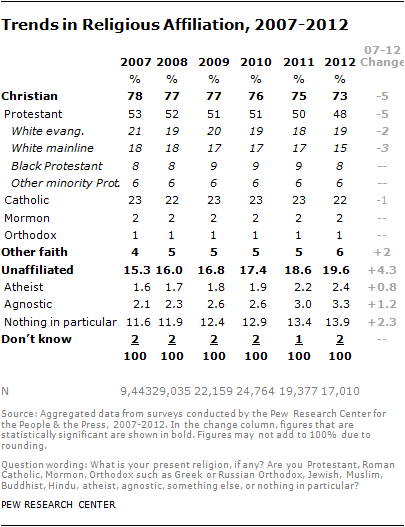
- declines in Protestant affiliation have been seen across the board in a broad variety of socio-economic classes – including a broad variety of income classes and a broad variety educational classes:
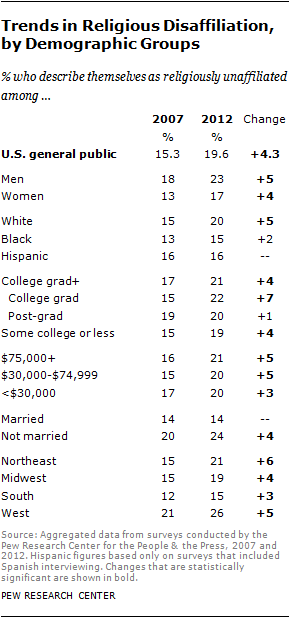
- declines in Protestant affiliation, contrary to a widely held folk belief, has not attributable to “New Age” spiritual beliefs

- declines cannot be blamed on children from families that are unaffiliated, to the contrary: “the new Pew Research Center/Religion & Ethics NewsWeekly survey finds that about three-quarters of unaffiliated adults were raised with some affiliation (74%).”
It is interesting to note that in aggregate, Catholicism remains untouched by the growth in the unaffiliated. The report claims “the Catholic share of the population has been roughly steady over this period, in part because of immigration from Latin America.”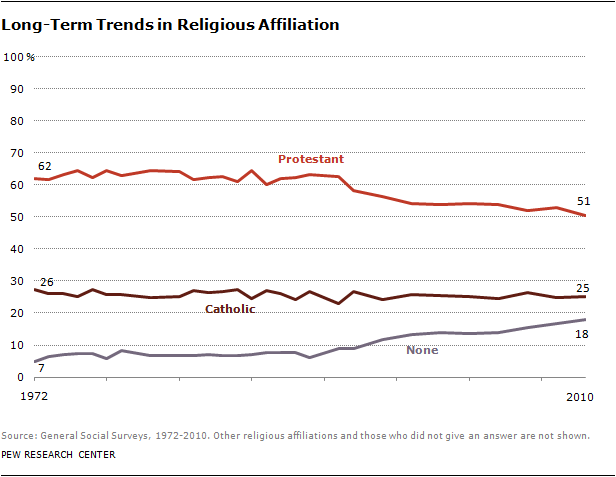
So, if New Age-ism, secular education, and Mainline religion cannot be held accountable for the decline in religion, what is at fault?
The Pew report suggests that this is partly a generational change, with younger Americans much less likely to have religious affiliations. But that is only part of the story – notice that growth in unaffiliated population has taken place in the “Older Millennial” and “Gen Xers” demographics.
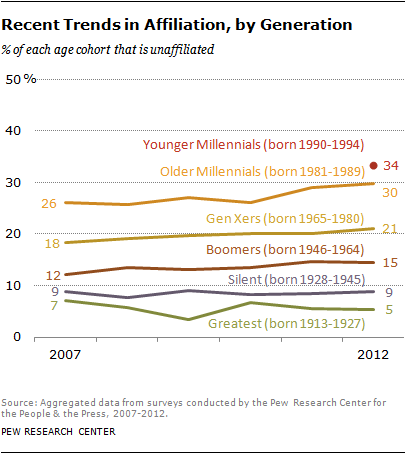
It is all too easy to make claims that issues ranging from “gay marriage” to “equality for women” are responsible for declines in religious affiliation. But contrary to the knee-jerk responses, the statistics tell another story – declines have hit not only Mainline churches, but Evangelical churches. The survey is fascinating, and I recommend reading it.
Frymer-Kensky on women in the bible
From the introduction to Reading the Women of the Bible.
The Bible, a product of this patriarchal society, is shaped by the concerns of the men of Israel who were involved in public life. As such, it is a public book, concerned with matters of government, law, ritual, and social behavior. But why, then, does this clearly androcentric text from a patriarchal society have so many stories that revolve around women? And why are there so many memorable women in the Bible? The sheer number of their stories demands an explanation: What are they doing here? Why were they written? Why were they included in this compact text?
One possible answer soon occurred to me: could the biblical stories about women have been written because of the desire of Israelite men to explore the nature of women and their role and to understand the question of gender? To explore this possibility, I analyzed the biblical stories from the perspective of gender questions: What, according to these stories, do women want? What are they like? How do they achieve their goals? The results, documented in In the Wake of the Goddesses, were unexpected.
Contrary to all assumptions – my own included – the Hebrew Bible, unlike other ancient literature, does not present any ideas about women as the “Other.” The role of woman is clearly subordinate, but the Hebrew Bible does not “explain” or justify this subordination by portraying women as different or inferior. The stories do not reflect any differences in Goals and desires between men and women that are different from those used by men who are not in positions of authority. There are no personality traits or psychological characteristics that are unique to women, and the familiar Western notions of “feminine wiles,” “the battle between the sexes,” “sisterly solidarity,” and “sex as weapon” are all absent, as are any discussions of the nature of women. There are also no negative statements and stereotypes about women, no gynophobic (“women-fearing”) discourse. The only misogynist statement in the Bible comes very late in biblical development, in the book of Ecclesiastes, and shows the introduction of the classical Greek denigration of women into Israel.
The Bible’s lack of ideas about female otherness does not make it a feminist paradise any more than the presence of memorable women does. Women were still socially disadvantaged and excluded from public power. But the Bible does not add insult to this disadvantage, does not claim that women need to be controlled because they are wild, or need to be led because they are foolish, or need to be directed because they are passive, or any other of the justifications for male domination that have been prevalent in Western culture.
The Bible’s lack of justification for social inequity can be interpreted in two radically different ways. Reading with a hermeneutic of suspicion, we might speculate that the Bible did not need to justify patriarchy, because partriarchy was so firmly entrenched, and that the Bible’s lack of stereotypes about women is simply a gender blindness that totally ignores eeryone but economically advantaged males. If, however, we follow the hermeneutic of suspicion with a hermeneutic of grace, we might conclude that even though the Bible failed to eradicate or even notice patriarchy, it created a vision of humanity that is gender neutral. Biblical thinkers treated social structure as a historical given: they sought to regulate social behavior, but not to explain or justify the social structure itself.
The Bible’s view of gender sets up a dramatic clash between theory and reality. On the one hand, women occupied a socially subordinate position. On the other hand, the Bible did not label them as inferior. This gap between ideology and social structure has a major disadvantage: it did not explain people’s lives, did not give people a way to understand why women had no access to public decision making. Such dissonance could not last forever: one of the two had to give, and the Bible’s vision of a gender-neutral humanity ulitmately gave way in the face of ongoing patriarchy. At the same time, the biblical vision had the enormous advantage of not adding prejudice to powerlessness. The biblical view understood that women were powerless and subordinate without being inferior. This insight had enormous implications for the way Israel viewed itself. Israel was always small and vulnerable in comparison to the empires surrounding it. As time went on, this vulnerability gave way to defeat, and Israel was conquered by more powerful nations. The Bible’s view of women became central to Israel’s thinking, for it provided a paradigm for understanding powerlessness and subordination without recourse to prejudicial ideas. Israel was subject to the power and authority of others on an international level just as women were subordinate within Israelite society, and the Bible’s own image of women enabled its thinkers to accept this powerlessness without translating it into a sense of inferiority or worthlessness. In this way, the Bible’s image of women was an essential element in its self-image and its understanding of Israel’s destiny.
I welcome this analysis, that the stories about women are not about women. They are about the marginalization of a people. Women are generic human beings, they represent their own nation. They are not “Other.” While I celebrate the differences in the physicality of men and women, I deplore the alienation of women by some writers.
It had been dawning on me lately, knowing that Joseph and Esther were alike “beautiful” and that men and women could also both be “valiant” that perhaps stories of women in the Bible had been vastly misread in English. We don’t so easily see the themes and threads which cross gender, drawing similiarities between men and women such as Abraham and Rebecca, both recipients of the blessing of offspring, both willing to “go.” But Frymer-Kensky is a linguist par excellence and opens up new material in each of the narratives she treats.
Mishap in the library and Tivka Frymer-Kensky
I was sneaking off to the stacks for a pleasant evening on my own, in a safe place or so I thought. The underground parking is always a concern but the stacks seemed safe enough. I had to pick up Countertraditions in the Bible by Ilana Pardes, recommended to me by Robert Daum.
I scanned the relevant shelf and decided to enjoy picking out books at random. The first book that I flicked back off the shelf was Deep Exegesis by Peter Leithart. I was shocked. Could someone who believes in the submission of women, and who paints the woman who is not submissive in the home as rebellious, actually be found in a secular university library. Here is an example of his marriage “exhortation” to young women.
To the unmarried women: Learn submission in your home. If you resist your parents’ authority, your rebellion will overflow into your marriage. If you develop habits of subterfuge and deception to avoid obeying your parents, those habits will continue into marriage, and make your marriage very unhappy.
(These kinds of accusations make my stomach churn.) I asked myself if it was the same Peter Leithart, but apparently it was. I read as far as his criticism of Richard Longenecker, one of my favourite seminary profs, and put the book back on the shelf.
The next book I picked up was in German and the first word I read in that book was weiblich, wifely. (I know you will say that it really means “female,” but it sounds like “wifely.”) So I put that book back.
Then I picked up On Freedom, Love and Power by Jacques Ellul, compiled, edited and translated by Willem Vanderberg. And the first line I read in that book was as follows,
St. Jerome did a rather poor job of translating the Hebrew Bible into Greek.
I did a facepalm then flipped to another section,
At the same time, Adam is unique (or specific to him) and different from the Hebrew isch, which means humanity, analogous to the German mann or l’homme in French.
I have no idea whether to blame this sentence on Ellul or Vanderberg. But it gets worse. About men and women and difference he writes about GEN. 3:16-18,
Here we encounter a difference between man and woman: the woman is the one who gives birth, and the man has the awareness of death.
Okay, I would be scratching my head, but then I read about his views on the hermeneutical crisis,
I do not have a bad head for these things and succeeded in mastering the issues, yet I really thought I was losing it. Hence, When this obscure material is thrown at clergy who may not be very strong intellectually, they will not be able to master it, and it will drive them crazy. These kinds of issues are best left to a dozen or so intellectuals who know this stuff well.
Oh, I am not intellectually capable of understanding his hermeneutics. I get it. All I can say is that this is a book of edited lectures, and in my view, not very well edited.We may all say odd things off the cuff but I am having trouble with this book. Back it goes!
Fortunately, my time in the library was not a dead loss. I did find Reading the Women of the Bible by Tivka Frymer-Kensky. It is by far the most scholarly book on women in the Bible that I have read so far. It contains an enormous amount of new material and should be the standard by which we judge books on women in the Bible – in my view. She saved the day for me. More about this book soon.
Half the Church, Half the Sky, Half the Human Race
Rachel Held Evans has up a post announcing a new edition of Carolyn Custis James’s book Half the Church: Recapturing God’s Global Vision for Women. She makes the comparison, if also by title, to Sheryl WuDunn’s and Nicholas Kristof’s Half the Sky: Turning Oppression into Opportunity for Women Worldwide and the film as shown on PBS, a very very necessary social movement.
In the course of human events, I’d like to take us back to where we were as the human race, in two halves. In our earlier literature, in Plato’s Laws specifically, two men were arguing over how to equitably legislate women, despite how they might resist. Below is a salient quotation:
Listen now, so that we may not spend much time on the matter to no purpose. Everything that takes place in the State, if it participates in order and law, confers all kinds of blessings; but most things that are either without order or badly-ordered counteract the effects of the well-ordered. And it is into this plight that the practice we are discussing has fallen. In your case, Clinias and Megillus, public meals for men are, as I said, rightly and admirably established by a divine necessity, but for women this institution is left, quite wrongly, unprescribed by law, nor are public meals for them brought to the light of day; instead of this, the female sex, that very section of humanity which, owing to its frailty, is in other respects most secretive and intriguing, is abandoned to its disorderly condition through the perverse compliance of the lawgiver. Owing to your neglect of that sex, you have had an influx of many consequences which would have been much better than they now are if they had been under legal control. For it is not merely, as one might suppose, a matter affecting one-half of our whole task—this matter of neglecting to regulate women,— but in as far as females are inferior in goodness to males, just in so far it affects more than the half. It is better, then, for the welfare of the State to revise and reform this institution, and to regulate all the institutions for both men and women in common. At present, however, the human race is so far from having reached this happy position, that a man of discretion must actually avoid all mention of the practice in districts and States where even the existence of public meals is absolutely without any formal recognition. How then shall one attempt, without being laughed at, actually to compel women to take food and drink publicly and exposed to the view of all? The female sex would more readily endure anything rather than this: accustomed as they are to live a retired and private life, women will use every means to resist being led out into the light, and they will prove much too strong for the lawgiver. So that elsewhere, as I said, women would not so much as listen to the mention of the right rule without shrieks of indignation; but in our State perhaps they will. So if we agree that our discourse about the polity as a whole must not—so far as theory goes—prove abortive, I am willing to explain how this institution is good and fitting, if you are equally desirous to listen, but otherwise to leave it alone.
This is the English translation of the Greek by R.G. Bury in the 1960s. Here’s the Greek and this early discussion for the improvement τῶν ἀνθρώπων γένος, by attention to half of the human race. Notice how far from that we’ve come. But please notice how much further we all have yet to go.
Christina of Markyate
I picked up Christina of Markyate recently at a used book store. I thought that reading it in Latin would benefit my language skills, but I wasn’t expecting such a good read. This story, from an 11th century manuscript, is published with the Latin original on the left and a translation on the right.
Christina was a special child from birth, and as a young girl she made a vow of virginity in order to serve Christ alone. Her first trial was attempted rape by the local bishop. Somehow Christina does not come across as a quiet saint, but as a spirited and resourceful young woman who managed to outwit the old bishop. He was so angry that she had escaped his advances that he schemes to have her married off to ensure that she loses her virginity, if not to him, to somebody, and soon.
Christina’s parents also want her married off and producing offspring. She is such a clever young woman that surely she would provide talented grandchildren for her parents! She attempts to resist their authority, or their bullying, hard to say which, but they manage to get the wedding ceremony completed. Christina pleads, reasons, and ultimately hides from her husband, who at first is understanding of the fact that she has never willingly consented to this marriage. The conversation is recorded in detail – how she will pretend to her family and friends that the marriage is consummated, to save the groom from embarrassment, and she also argues that it is not that she dislikes him, but that she has simply made a prior commitment to Christ.
Eventually she runs away and is sheltered for several years by an abbot. Over the years, they come to be friends, and he finally calls her his spiritual director.
The dialogue throughout the book consists mostly of a discussion of scripture passages relating to women and authority, but Christina each time argues that her vow to Christ releases her from any of the normal obligations to bishop, parents or husband. It is a tale of resistance to authority from first to last.
There are many Latin words which are translated into English as “authority” – potestas, auctoritas, dominium and jussio. Christina solidly argues against the claims of each and every authority in her life excepting Christ. She develops a warm friendship with the abbot, and becomes a respected spiritual adviser. She even comes across as a genuine human being. For some silly reason I was surprised that a tale from the 11th century could be such a good story. There is something very realistic about the way each of her relationships is described.

WWYD on Yom Kippur?
Last week, as many observed Yom Kippur, there were discussions among Christians about Jesus. Blogger James McGrath, for example, prompted this way in a post:
Christians, if you need some food for thought, then take a look at Paula Fredriksen’s piece in the Huffington Post entitled “Yom Kippur: WWJD?” (HT Brian LePort).
And Rod, blogging at Political Jesus, advised:
please see S. Mark Heim’s Saved From Sacrifice: A Theology of the Cross.
He explained:
This goat in Jewish mythology and the writings of the Mishnah (scholars say starting around the 2nd Temple era), represents Azazel, (“a goat that departs”), a leader of angels that rebel much like some stories of satan. Here we have a religion where every year, the ritual life of a community is centered on the victim. The story of the victim told and told year after year decenters our stories of the victors of history so that the losers have a voice. May the words of the Pharisee and apostle Paul for us “to remember the poor” as he has come to our minds. May we remember the words of the rabbi Yeshua of Nazareth whom Christians call the Messiah, that there will be a day when the goats (who still participate in the scapegoating mechanism) will be separated from the sheep (those who obey God to fight against scapegoating) expose our violent ways.
Because of my own interests in Christian appropriations of Judaism old and new, I had already found myself over at Brian LePort’s blog (to the post that McGrath had pointed out); and left this comment:
Yes, Brian, great post! Jesus was no Christian. He walked around the Temple, circumcised. Did he metaphorically also need a “circumcised heart” or not? Did he need to make sure his bread – for certain times – was rid of leaven? Was he more special than his fellow Jewish sisters and brothers? How about Paul? Last year, at another blog, we asked about whether he observed Yom Kippur: https://bltnotjustasandwich.com/2011/10/07/barnstones-saint-pauls-yom-kippur/.
So notice how Rod calls him “the rabbi Yeshua of Nazareth whom Christians call the Messiah” and see how I claim, perhaps exclaim, “Jesus was no Christian.” Let’s come back to Jesus with a capital Y, as in WWYD on Yom Kippur.
It was also interesting to see Jewish bloggers blogging how Christians and other non-Jews perceive and actually practice Yom Kippur.
My very very favorite post was the one by our BLT co-blogger, Craig R. Smith, which is mainly a “repost” of the essay by Adam Byrn Tritt entitled, “Yom Kippur as Manifest in an Approaching Dorsal Fin.” Craig entitled this post of his “Yom Tov.” Notice who wears shoes when; doesn’t it remind us of Moses on holy ground?
And blogger Rabbi Rachel Barenblat at her blog The Velveteen Rabbi had a number of Yom Kippur posts. The one entitled “One last post before Yom Kippur” gave links to a couple of past posts of hers that offered resources. One of these was “Grab-bag of Resources for Yom Kippur“; in it, she says:
Looking for personal explorations of, and engagement with, this holiday and its liturgy? You might find meaning in Laurel Snyder’s To Pardon All Our F*cking Iniquities, an essay in Killing the Buddha that’s subtitled “A half-Jew writes her own Yom Kippur prayer.” Or A Christian Observes Yom Kippur, an essay by Harvey Cox, a Christian professor of divinity who’s married to a Jewish woman. (I reviewed one of his books here a while back.) Seeing ourselves through someone else’s eyes can be a powerful and transformative experience.
On a semi-related note, perhaps the most fascinating thing I found in my searches was this: Christians in Solidarity with Jews on Yom Kippur. A group of Canadian Christian and Jewish clergy came together to create a liturgy which Christians could use on Yom Kippur to help them feel more aligned with the Jewish roots of their tradition. This site includes an explanation of that process, followed by the liturgy, which features English translations of many of the YK prayers. It’s designed for Christians, obviously, but I think it’s an interesting resource for Jews as well.
When you read these posts that Barenblat links to, then you see the Christian concerns. Synder writes of her parents (rather hypocritically) “muttering things like … ‘Jesus Christ'” when she was prohibited from saying “any of the really bad words (‘b*tch,’ ‘sh*t,’ the horrendous F word)” by the fear of the punishment of having her “mouth washed out with … mother’s green medicinal soap”; her parents (“Jewish father” and “Catholic mother”) were “both pretty unobservant” until her mom “started going to church, and … also started muttering ‘sh*t’ and ‘f*ck’ ” and nonetheless continuing to get “really upset” when Snyder let slip an “Oh, Jesus!”. Cox writes as a Christian married to someone, “who is Jewish [who with him] decided to raise their son in the Jewish faith, and to participate in each other’s religion as their respective convictions allowed.” A salient set of sentences from one paragraph to another suggest this: “Might the day come when Jews can remember that Jesus of Nazareth was also a rabbi who was martyred by the Romans? … But if Jesus Christ was a human being, as all Christians believe, then his suffering cannot be completely severed from all human suffering.” There’s this idea that observant Jews and Christians together ought to let Jesus do something on this high Jewish holiday; adds Cox: “Jesus told his followers that if, on the way to the temple to offer a sacrifice, they remember something that has undermined their relationship with a neighbor, they should first go and make peace with the neighbor and only then go and offer the sacrifice. Jesus was never more rabbinical than at this moment.” What’s the Christian Jesus have to do with Yom Kippur? is what the “Christians in Solidarity with Jews” seem to ask. They strongly caution: “This is not a Christian celebration of Yom Kippur; Yom Kippur remains a Jewish observance. To treat this event as a Christian celebration of Yom Kippur would be a glaring example of ‘appropriation,’ that is, taking as our own what belongs to another faith community and interpreting it as we please. No, in contrast to that regrettable practice, this is an invitation to ‘A Service of Christian Solidarity with the Jewish Community at Yom Kippur.'” And so the struggle for understanding of Jesus’s place in Yom Kippur continues.
Which is one reason CK’s recent post at “Jewlicious THE Jewish Blog” is so funny. It’s funny in both that Ha Ha and in that “strange” way. The exclamation in the title is, “It’s a Yom Kippur Miracle of Forgiveness!” It’s nothing at all about Jesus really, but it is about elevating “Irish blogger and political consultant Leo Traynor” as the miracle worker. It’s not really so much about the struggle between Jews and Christians over Yom Kippur and Jesus in it; rather it’s about keeping two other things in relationship. CK concludes: “And there you have it. This story is seasonally appropriate given that as I write it many of you are still fasting in commemoration of Yom Kippur. Traynor’s action was certainly merciful and magnanimous; and while some may be critical I find this story a perfect reminder that Yom Kippur is about both repentance and forgiveness. And that sometimes forgiveness is as hard if not harder than repentance.” The Irish hero of the Jewish Yom Kippur is both humorous and peculiar. It puts historical opponents as playing for the same team, as if Jesus were a rabbi leading goyim followers to join him in observing Yom Kippur.
So which team does Jesus play on? And what about Jesus on Yom Kippur?
The questions take us back to the late great Hank Greenberg. In his autobiography, Greenberg recalls:
The newspapers had gone to the top rabbi in Detroit and asked him if it would be socially acceptable for me to play on that day. The rabbi was supposed to have looked in the Talmud and he came up with the theory that since it was the start of a new year, and it was supposed to be a happy day, he found that Jews in history had played games that day, and he felt that it would be perfectly all right for me to play baseball. That momentous decision made it possible for me to say in the lineup on Rosh Hashanah, and lo and behold I hit two home runs — the second in the ninth inning — and we beat Boston 2 – 1.
Then he quotes one of those news sources:
On Yom Kippur, September 18 [1934], The New York Times wrote that the Tigers had the American League pennant all but “signed, sealed and delivered.” And that Greenberg, who was batting .338 with 25 home runs, “was the most important cog” on the team. But this time, Greenberg chose not to play.
The New York Evening Post went to Greenberg’s parents in the Bronx for another angle on the story.
And here’s where that corrective news source makes things different. The source goes on:
“We are an Orthodox family,” Mr. Greenberg was quoted as saying [to the NY Evening Post reporter]. “He [Hank] promised us when we saw him in Philadelphia on Detroit’s last trip to the East that he would not play on Rosh Hashana or Yom Kippur. He wrote us later that he was sorry he had played on Rosh Hashanah, but Mickey Cochrane said he was needed and Henry could not refuse very well.” “It’s not so terrible either,” Mrs. Greenberg cut in. “I see young men go to the temple in the morning and then maybe do worse things than Henry did.”
“Yom Kippur was different,” Mr. Greenberg said. “I put my foot down and Henry obeyed.”
So Hank Greenberg continues in his autobiography:
It was big news. I even received attention from Edgar Guest, the nationally syndicated popular newspaper poet. He wrote a poem about me concerning the Jewish Holidays.
This is how it went:
SPEAKING OF GREENBERG
by Edgar GuestThe Irish didn’t like it when they heard of Greenberg’s fame
For they thought a good first baseman should possess an Irish name;
And the Murphys and Mulrooneys said they never dreamed they’d see
A Jewish boy from Bronxville out where Casey used to be.
In the early days of April not a Dugan tipped his hat
Or prayed to see a “double” when Hank Greenberg came to bat.In July the Irish wondered where he’d ever learned to play.
“He makes me think of Casey!” Old Man Murphy dared to say;
And with fifty-seven doubles and a score of homers made
The respect they had for Greenberg was being openly displayed.
But on the Jewish New Year when Hank Greenberg came to bat
And made two home runs off Pitcher Rhodes—they cheered like mad for that.Came Yom Kippur—holy fast day world-wide over to the Jew—
And Hank Greenberg to his teaching and the old tradition true
Spent the day among his people and he didn’t come to play.
Said Murphy to Mulrooney, “We shall lose the game today!
We shall miss him on the infield and shall miss him at the bat,
But he’s true to his religion—and I honor him for that!”
It all makes us wonder how Jesus came to sound as Irish as Murphy, Mulrooney, and Dugan. Or whether Joseph and Mary might have been as involved in a repentant and obedient Yeshua’s practice of religion the way Mr. and Mrs. Greenberg were in the repentant and obedient Henry’s practice at such a critical and high profile time.
I’ll just end this post with more from Greenberg. As you read it, imagine what Jesus, or Yeshua, might have written about himself if he himself had written his own story. How important might the Jewish identity, and practice, be. Might he have observed Yom Kippur, one day, or more? WWYD?
I was a hero around town, particularly among the Jewish people, and I was very proud of it.
On Yom Kippur, my friends, a family named Allen, took me to shul [synagogue]. We walked in about 10:30 in the morning and the place was jammed. The rabbi was davening [praying]. Right in the middle of everything, everything seemed to stop. The rabbi looked up; he didn’t know what was going on. And suddenly everybody was applauding. I was embarrassed; I didn’t know what to do. It was a tremendous ovation for a kid who was only twenty-three years old, and in a synagogue no less!
People remember that I didn’t play on Yom Kippur. They remember it as every year, but in fact the situation arose only once, in 1934.
It’s a strange thing. When I was playing I used to resent being singled out as a Jewish ballplayer period. I’m not sure why or when I changed, because I’m still not a particularly religious person. Lately, though, I find myself wanting to be remembered not only as a great ballplayer, but even more as a great Jewish ballplayer…. I guess I was a kind of role model, and strangely enough, I think this may have begun in sports with Babe Ruth, though, of course, much of the interest in me had the special nature of my religion.
“The End of Men” in the Biblical Studies Carnival
This hatefulness in online social life is one reason why it troubles me to read triumphalist “end of men” and end of feminism pieces about how women are the big winners of the 21st century…. [O]nline life … seems to have unleashed or amplified misogyny. Maybe that misogyny is no worse than before, and it’s just found a new, powerful megaphone. Or, maybe the medium is the message, and the misogynistic feeling itself has fed off of new media…
— Pamela Haag, “Reports of Men’s Death are Greatly Exaggerated,” BigthinkScroll through the titles and subtitles of recent books, and you will read that women have become “The Richer Sex,” that “The Rise of Women Has Turned Men Into Boys,” and that we may even be seeing “The End of Men.” Several of the authors of these books posit that we are on the verge of a “new majority of female breadwinners,” where middle-class wives lord over their husbands while demoralized single men take refuge in perpetual adolescence. // How is it, then, that men still control the most important industries, especially technology, occupy most of the positions on the lists of the richest Americans, and continue to make more money than women who have similar skills and education? And why do women make up only 17 percent of Congress?
— Stephanie Coontz, “The Myth of Male Decline,” The New York Times
It’s just a little slice of something just a little bigger. I’m talking about the “Biblical Studies Carnival.” It’s just a sliver of “The world of biblioblogs.” Yes, we understand that somebody for the Jean and Alexander Heard Library of Vanderbilt University has created its online research guide for the Hebrew Bible that has a tab called “Blogs” that starts: “The world of biblioblogs is large and growing.” When you click the hyperlinked word biblioblogs, you go to the relatively new wikipedia entry that somebody has written. Reading what is written there, you get what is meant in the other place by “large and growing.” So, when you scroll down the Heard Library page at this site, you see a number of blogs listed that do a fair amount of blogging, biblioblogging, on the Hebrew Bible. And we a BLT are honored to be included this short, growing list. To be very clear, the short list is merely “a sampling of blogs that address the Hebrew Bible or related fields.” The maintainer of this list, furthermore, is careful to add: “Every effort is made to include only blogs which are substantially on-topic and updated regularly.” If Hebrew Bible blogs are not your normal online hangout, then please know that we’re just about to host the next “Biblical Studies Carnival.” And we want there to be a lot of useful understanding about what that means, and how welcome you might or might not feel.
So let me circle back around to the issue of the “Biblical Studies Carnival.” As with much online social life, there’s a culture to this little slice of blogging of the Bible. And you already know where I’m going with this post, since you’ve read the two epigrams above, respective statements from Pamela Haag and Stephanie Coontz. Haag and Coontz have nothing particularly to do with either biblioblogging in general or the monthly round of up blogs called the “Biblical Studies Carnival.” And yet they’re respectively speaking to the culture of sexism in “online social life” and among USA “Americans.” My co-bloggers and I have no interest baiting bullies or getting into long and laborious wranglings with those who openly or inadvertently leave people who are women out of biblioblogging or out of the fun of the “Biblical Studies Carnival.” We are not particularly hoping to review the sad cases of the past, in which female bloggers have been snubbed.
But we don’t want to forget lest we repeat the past. And we also want us all to be aware of the ongoing problems of sexism in the Bible blog listings. As we all blog and engage together in online community, we do want to be aware of the trends, the challenges, and the changes. We want only the best in the most inclusive senses of “the best.” (We want to say that we’re not interested in either the continued end of women or in the possible end of men either.)
Very soon we hope to announce an October theme as we request your nominations for the next “Biblical Studies Carnival.” Whether you are a woman bibliloblogger or a man biblioblogger, we want you to know how very much we value your insights and your voice. We’re excited about the theme, and we hope you will be too.


 BLT
BLT