Downton Abbey is soft on homosexuality
Spoiler alert. As I predicted last week, Lord Grantham’s wife and daughters will continue to love him, but they will not acknowledge his headship or submit to him. Lady Grantham has thrown in with her daughters to support the sons-in-law’s new plans for the estate. Eventually Lord Grantham does realize that they still love him, even though they will not obey him, and life goes on.
Having disposed of male headship, the series now attacks the topic of homosexuality. After an extremely convoluted plot, the issue is resolved by citing the gospel, “whoever is without sin, let him cast the first stone.” [I should clarify here that the show came as close as possible to presenting and accepting view of homosexuality, and still appear historically accurate.]
Lady Edith takes on a women’s column, and impresses her editor by making her first article about the young men who were injured in the war. Her editor flirts with her, and it turns out that he is married – his wife is in an asylum and he is not legally able to divorce her since she is not of sound mind.
I predict that the series will take on the thorny issue of divorce in the Church of England, and at some future date, abortion will also get some showtime. In the meantime, baby Sibby is being raised by her dad, and a houseful of doting aunties and grandma; and Mary and Matthew are busting a gut, so to speak, trying to make babies themselves. On a lighter note, to reward those who abandoned the superbowl last week, much of the last hour was devoted to the cricket match.
Note: All this stuff is not worth commenting on for most viewers. But I have noticed that the headship community has taken a liking to this series, and I am hoping that they will be open to the message preached clear and loud that headship is dead, along with many other nasty and oppressive beliefs.
A theology of disability: Jean Vanier
No surprise, but my own views on disability are deeply affected by Jean Vanier, whose ideas are represented here,
Sharing life with marginalized people galvanized Vanier’s understanding that to serve others well requires us to move beyond charity and tolerance. He recognized the hubris that grows when a helper imagines himself as somehow superior or separate from those he serves. He learned how much better help feels to the person in need when animated by a sense of solidarity and common humanity than help driven merely by a sense of duty. The felt distinction is between merely caring for others, and actually caring about them as people. And since you cannot legislate people to care about others, part of Vanier’s distinct contribution to our understanding of serving others well, is to demonstrate with his communities, that it is possible to create the conditions for this mutuality to develop. “Every child, every person needs to know that they are a source of joy … needs to be celebrated.” He suggests that it is only through this kind of profound acceptance that “our negative, broken self-images can be transformed.” One example is his insistence that simply being with the marginalized in solidarity and celebration, is as vital as doing practical things for them. He entreats people to cultivate “fidelity to the wonder of each day… visible in small and daily gestures of love and forgiveness.”
Vanier insists that while difficult and fraught, care relationships that are not at least on a path towards mutuality will be shallow and inadequate. Amidst the routine physics of care, he reminds us of the fundamental goal of service: “to support and love people to greater freedom.” By this of course he does not mean that one’s need or impairment disappears; but that a person should not be made to feel trapped by their need or interminably beholden to others. He points to the unbearable weight we heap onto people already living with an impairment, when we add the social burden of feeling that they are defined by their need, and have nothing to give to others.
In my own experiences with those with Down Syndrome, autism or other disabilities, i try to practice this mutuality. I play trains on the floor with children because I enjoy it, I play with the dollhouse because I enjoy it, I go for tea with an autistic adult because it means I get to sit in the tea shop, drink tea and listen to classical music with her. I practice enjoying their company and I do. It’s the only way. It is the practice of joy.
Here is a funny story about a little boy, let’s call him Jackie, who came to our grade 3 class recently from a segregated autism program. He is non-verbal, could pick out a few symbols, but his main way of communicating was squawking and slipping his hand under your sweater to pinch a nipple. Well, you get the picture! But he was great at doing jigsaw puzzles and I love puzzles. He also loved the iPad, and I was the keeper of the iPad. Now he is eating out of my hand. What a turnaround!
He spends a lot of time in my room, just next to his classroom. First, he only played on the floor with the toys, then he moved up to a low bench to play on the iPad, then one day he was sitting at the table with the iPad , with his support worker on the computer in the background. I was at the reading table with a grade 1 student, one on one reading. I noticed that Jackie was watching us. When my reading student left, I invited him to join me at the reading table, and he came over. He listened to me read, and put his finger on each word as I read. Then he stopped and looked up, first at my mouth and then directly in my eyes. I was shocked by the look of curiosity and bemusement on his face.
Now, daily, he is acquiring new skills, sorting words into sentences, looking at books, imitating speech sounds, a few here and there, as well as putting together lego kits. He loves that kind of stuff and so do I. You can’t tell me that we are not having a good time just recognizing each other as fellow creatures. I don’t know if he will ever talk, but I am convinced that he will read and write. Reading wasn’t in his original education plan, people would have laughed at that. But the principle I use is to follow the lead of the child. The child will show you what they want to do, what they can do. I know some kids are really difficult to work with, but so far, we always celebrate these children.
Pauline hapax legomena in Romans 1
James McGrath explores an interesting argument, based on an unusually high density of words that appear nowhere else in the Pauline corpus, that the clobber passage in Romans 1 is actually Paul “mimicking” somebody else’s tirade against Gentiles, perhaps from the Wisdom of Solomon 12-14.
If this stylometric evidence is convincing, he suggests it implies that Christians should set this passage aside when considering Paul’s thoughts on the issue.
This doesn’t mean that Paul disagreed with all the points, any more than it can be assumed that a Christian and an atheist, or two people of different political parties, will disagree on everything, even when they quote one another polemically or satirically. But it does mean that one ought not to use Romans 1:18-32 to determine Paul’s own views. We should rather treat this passage like we do Paul’s quotations of the Corinthians in 1 Corinthians. Those phrases may, in some instances, be ones that Paul could be happy with. But we are not always certain that is the case, and we often have reason to think that Paul himself would have preferred to put things differently.
A theology of disability: part 2
I have read some wonderful blogs, here and here, and articles in the last few hours, after posting on disability. In 2 Maccabees, the sons looked forward to a resurrection in which the limbs that were hacked off in death, would be restored. They would be restored to wholeness, which was for them, the way they had lived.
But in Leviticus 21, we can read what the law said with respect to people who live with different kinds of disabilities or impairments,
16 The Lord spoke to Moses, saying: 17 Speak to Aaron and say: No one of your offspring throughout their generations who has a blemish may approach to offer the food of his God. 18 For no one who has a blemish shall draw near, one who is blind or lame, or one who has a mutilated face or a limb too long, 19 or one who has a broken foot or a broken hand, 20 or a hunchback, or a dwarf, or a man with a blemish in his eyes or an itching disease or scabs or crushed testicles. 21 No descendant of Aaron the priest who has a blemish shall come near to offer the Lord’s offerings by fire; since he has a blemish, he shall not come near to offer the food of his God. 22 He may eat the food of his God, of the most holy as well as of the holy. 23 But he shall not come near the curtain or approach the altar, because he has a blemish, that he may not profane my sanctuaries; for I am the Lord; I sanctify them.
It’s pretty all encompassing. No foreigners, no women, and no one who has any physical blemish. How do people deal with this passage? There is an interesting, and very touching little ebook by John Piper. I highly recommend it in all seriousness, as the story is compelling. But I was disturbed by the way this passage in Leviticus was handled. John Knight, the father of a profoundly disabled child recounts this from a conference,
In the afternoon session there was a panel dis- cussion, and someone asked, “What do we do with the hard texts in the Bible?” And a Jewish rabbi very quickly grabbed that and said, “Oh, you mean like in Leviticus? Well, we just ignore those passages. We know better now.” And I was thunder- struck by that. I didn’t have a response, because I was struggling with Leviticus, but I knew that answer couldn’t be right. And so that started me on the path of discovery. page 46
Okay, so what’s in Leviticus then? God’s perfect foreknowledge, perfect power, and perfect holiness—there’s that little phrase in there, “But he may eat” (Leviticus 21:22). It’s embedded right in there as a little clause. There it is. There’s your birthright. If I give you 80 years, there’s a season that you might have to live with this, but your birthright is secure. Nobody can take your birthright away from you. You are mine.
And it was five or six years after hearing that rabbi speak, I was sitting in the Roseville library just meditating over this and tears are rolling down my face at that thought. The birthright is secure. Nobody can take that away. An uncle can’t say, “Oh, you can’t eat because of your disability or your short arm or any- thing else.” No, I can eat. It’s a promise. It’s embedded in the very words that some want to take out. The protection is right there. page 48
He also discusses the fact that physical blemishes in this passage represent moral blemish, and this is a foreshadow of a perfect, sinless Jesus. page 48
I cannot help but feel that if someone thinks that this passage has some significance for us today, they must believe that there are two classes of Christians, those who offer sacrifices, or serve in the temple, as well as eat; and those who may only eat. I can’t see it any other way. If we think this passage has some application to today, does it not completely overturn the priesthood of all believers? Are we not all of us of the same status? Surely there are no longer any foreigners, any lesser sexed, any lesser abled, with regards to our standing in the community. Of course, we are not all going to be leaders, but we shouldn’t we all be eligible depending on our gifts and abilities.
I can see how a profoundly disabled child might not ever become a worship leader or pastor. True enough. But what about a hunchback? Are we going to let this somehow represent to us moral blemish, and fall back into the myth of Richard III, that he was an evil king because of his hunchback? The entire business boggles my mind.
Would it not be better to just ignore these passages, just as we ignore the command to burn the daughter of a priest if she is a prostitute? (It turns out my great aunt was a prostitute, but a few pictures of her remain in the family albums.) Shouldn’t we take all of Leviticus 20 and 21, and perhaps the rest of it, and simply admit that they should be ignored, or at least, only used to gain insight into the historical past. I realize that this does not seem like a theologically sophisticated response, but I am very grateful that I am not obliged to live my life with theological sophistication.
A theology of disability
Not long after posting on the resurrection of the body in 1 Maccabees 7, I read this post by Brian LePort on Candida Moss’s lecture on resurrected bodies,
Where Moss made it most interesting is when she shifted the discussion to disabilities. She emphasized that in the Jesus tradition part of the coming Kingdom of God was the removal of blindness, lame limbs, and other infirmities. Moss asked if our modern understanding of resurrected bodies without infirmities is similar to ideas like the Gospel of Thomas where a perfect resurrected body must be male, or that of the creator(s) of this mosaic where if feminine, it is upper class, light skinned, equestrian bodies. While the Gospels and the Book of Acts show healing as part of the Kingdom, sometimes we make the mistake of telling people with infirmities that their bodies are somehow further from resurrected bodies than our own. We perpetuate the idea that some bodies on earth are more like resurrected bodies than other bodies on earth. How do we know this though? Might resurrected bodies be something quite unique?
Moss postulated that infirmities may be part of our identity. Christians have worried about the height, the skin color, the shape, the age, and other features of the resurrected body. Some images of the resurrected body are very muscular, very fit, but are our ideals of the body true representations of the resurrected body? If not, is it possible that someone blind on earth, or someone with a mental health issue on earth, might take that with them into their resurrected body, but because the nature of bodies has changed something like blindness doesn’t prevent true sight, and what was seen as a mental health defect in this age is proven to be something unique and beautiful in the age to come?
Amos Yong has developed this same idea in The Bible, Disability and the Church: A New Vision of the People of God, not without significant pushback. In this review, the author, himself in a wheelchair, writes,
[H]e deems disability as a difference to embrace rather than an inherently difficult situation from which we seek liberation. Yong thereby trivializes a lifetime of chronic physical pain as something to be embraced, not healed. His assertion – more emphasized in his other book, Theology and Down Syndrome – that persons with disabilities will retain their disabilities in the resurrected bodies amounts to saying that our present entrapments will remain for all eternity. This, he contends, is an understanding that focuses on redemption of disability rather than healing thereof and is thus more hopeful. In short, he considers it more hopeful to tell us that God has no intention of liberating us from these limitations.
The debate carries on in scholarly articles, a response by Ryan Mullins, and counter response by Yong here. Both of these men have siblings with Down Syndrome. The question is whether they will still have Down Syndrome in their resurrected bodies, albeit without the abnormalities in the internal organs. If those with Down Syndrome are resurrected without Down Syndrome, then they will be more different from their earthly individuality than others who are considered to retain their own basic human characteristics. However, if those with Down Syndrome are resurrected with the syndrome, will that not mean that they will continue to suffer from their disability in their resurrected being?
Down Syndrome is a particularly interesting example of a disability. Children with this syndrome often have a positive, social and outgoing personality. They can be especially engaging, enjoying social interaction. Of course, this is a stereotype, but it is how they are often perceived. It may well be relevant in considering why people would believe that those with disabilities will retain the basic nature of their disability in their resurrected bodies.
But let’s extend this to autism. About 10% of autistic children exhibit unusual abilities in some particular area, often drawing, music or mathematics. If they were cured of their autism in their resurrected bodies, would they also lose these special abilities? Aren’t these special abilities in some way related to their communicative disability?
If we set aside the entire issue of the afterlife, this question affects how we view people with disabilities in this present life. Do we see them as disabled and different in some way that sets them apart from others, or do we include them fully in the human enterprise? Do we enter into mutuality with those who are different from us in this way? I want to say “yes” to the notion of resurrected body without impairment and pain. But, I want also to say “yes” to the full humanity of those with labeled disabilities and their right to inclusion as full members of any community. In the ancient world, people believed that the resurrection body would fit an ideal, sometimes only male, or always 30 years old, always fit and perfect, and with a full head of hair. That was the ideal. But can we now honour the differences without celebrating disability?
Oddities in tonight’s LA Times
So, just for fun, I opened up the Los Angeles Times web page tonight and found all sorts of odd articles on the front web page:
- TED conference to move from Long Beach to Canada
 The TED conference to be in Monterey – which to my ear sounds much more “resort”-like than Long Beach – and now that it has become an unstoppable force, it is moving to Vancouver? Don’t get me wrong – Vancouver is a nice town (and home of when of the sharpest biblio-bloggers around, the always perceptive Suzanne) – but I don’t understand the logic here. (I can only surmise that Vancouver offered some sort of concession – there’s a reason so many films and TV series ostensibly set in the US are filmed there.) But the oddity just increased with this line: “The main conference only allows for 1,400 attendees, and organizers plan to reduce that number to 1,200 next year to make the event more intimate.” Yes, that’s exactly how I would describe a party with 1,200 attendees: “intimate.”
- Black daughter of Strom Thurmond dies at 87
 For those who do not follow politics, it is enough to know that Strom Thurmond was an outspoken extremist (white) segregationist.
 - Church mulls $200-million fundraising drive
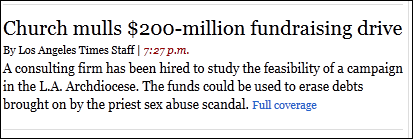 Remarkably bad timing. Here, “Church” = the Los Angeles Archdiocese, which has been in the news for the last few days after releasing documents related to sex abuse and stripping Cardinal Mahoney of all formal duties based on how he handled those incidents.
 - Southern California Tales: Anonymous artist makes Oakland his gnome town
A cute (in fact, going beyond “cute” to “saccharine”) story, to be sure. But why complain about China being expansionist – according to the Los Angeles Times, Southern California now encompasses the San Francisco Bay Area!



The end of male headship
It slipped by and was quietly buried yesterday evening. Nobody realized that it had died. Nobody will mourn. Male headship is dead. Denny Burk DVR’d the Superbowl to watch Downton Abbey, the exact episode in which mother, wife, daughters and sons-in-law take up the spade and bury male headship. Lord Grantham will not be obeyed.
A week ago, Sybil, the youngest daughter gave birth. Lord Grantham put the fashionable London doctor in charge. His wife asked the local doctor to also be present. The local doctor sensed immediately that something was wrong. Sybil had high blood pressure and suffered from preeclamspia. However, Lord Grantham overruled, following the advice of the London doctor, and Sybil was not delivered by C-section. She died giving birth.
In the meantime, the estate is going down the tubes from mismanagement. The sons-in-law are aware of this and make moves to take over management before bankruptcy ousts them all from the ancestral estate. The last straw is when Lord Grantham barges in on the ladies at a luncheon and orders them back home because the cook who served dinner is a reformed prostitute. At this point the ladies – wife, mother and daughters – rebel. They will no longer be dictated to. Sybil has died.
For those who find it fanciful – a soap opera – good. But for many women, they know the agony of the “head of the house” making medical decisions in disagreement with the female members of the family. Some women have also experienced bankruptcy through the stupidity of male headship. But we know now that Christian leaders are watching Downton Abbey on Sundays and will soon realize that there will be no resurrection for male headship. Amen.
I predict that Lord Grantham will once again be dearly loved by his lady – he will be allowed back into the bedroom. But he will no longer be obeyed.
Richard III’s remains

I am impressed not only at the breaking news that Richard III’s remains have been identified, but also that the story even is currently the “top story” on my edition of Google News.
So now, onto the forensic anthropology. I’m sure we’re all eager to find out whose view of history is more correct: Shakespeare’s Richard III or Josephine Tey’s Daughter of Time.
Shakespeare’s account is, of course, a literary masterpiece. I note that both the Arden Second Series edition of Richard III (for those who prefer the more traditional style of annotations) and the Arden Third Series edition of Richard III (for those who prefer the latest style of annotations) are available on sale at Amazon for $6.80. Although I have not yet read it, I’m sure the Norton Critical Edition of Richard III is great too (particularly since it includes major sections of Thomas More’s famous partisan account.) There is no shortage of great film versions of Shakespeare’s Richard III too – of course Olivier’s version is stunning (available in Criterion DVD, Criterion box set, and forthcoming on Criterion Blu-Ray) and the Ian McKellen version is also quite good. Al Pacino has a fun documentary that uses Richard III as a way to introduce Shakespeare to new audiences.
But I still remember my excitement as a kid when I read Josephine Tey’s Daughter of Time – it opened new vistas in my understanding of the possibility of the mystery genre. I’m not alone in my assessment; Robert McCrum mentions that it was an adolescent favorite of his and calls Daughter of Time “possibly [Tey’s] masterpiece,” and Peter Hitchens wrote that Daughter of Time was “one of the most important books ever written.” If you are really determined, you can read the description at Wikipedia for more information about the book, but I recommend reading the book first, so you can fully enjoy its surprises and twists without spoilers.
If you want to read a scholarly biography of Richard III, I can recommend Paul Murray Kendall’s 1955 biography; although it is already dated and will become even more so after the monarch’s remains are fully studied. For general context on the Lancaster-York conflict (and the defeat of Richard III by Henry Tudor) there is a promising book (II have not yet read it, but it has received some favorable reviews and it is certainly mercifully short): David Grummitt’s A Short History of the Wars of the Roses.
Finish this part of history, and you’ll be ready to tackle Hilary Mantel’s Thomas Cromwell trilogy – but that will need to be a subject for a future post ….
Update: Here is a more detailed news article about the discovery.
marginal inspiration and inerrancy in the NET Bible
Ken Schenck has been blogging about 1 Corinthians 14:34-35 and the ministry of women. He points out that although he doesn’t think that these verses are in the original, we don’t need to prove that to allow women to minister in church. At least, that’s how I read his recent post.
I finally resolved the issue in this way. Evangelical exegesis suggests that these two verses were in the margin of the text. However, they are still accepted as inspired. This, of course, causes a total shift in our view of God. He doesn’t know ahead of time what he is going to say, and needs to go back and add notes in the margin, just to deal with the sticky problem of women.
Here is the note in the NET Bible,
Some scholars have argued that vv. 34-35 should be excised from the text (principally G. D. Fee, First Corinthians [NICNT], 697-710; P. B. Payne, “Fuldensis, Sigla for Variants in Vaticanus, and 1 Cor 14.34-5,” NTS 41 [1995]: 240-262). This is because the Western witnesses (D F G ar b vgms Ambst) have these verses after v. 40, while the rest of the tradition retains them here. There are no mss that omit the verses. Why, then, would some scholars wish to excise the verses? Because they believe that this best explains how they could end up in two different locations, that is to say, that the verses got into the text by way of a very early gloss added in the margin. Most scribes put the gloss after v. 33; others, not knowing where they should go, put them at the end of the chapter.
Fee points out that “Those who wish to maintain the authenticity of these verses must at least offer an adequate answer as to how this arrangement came into existence if Paul wrote them originally as our vv. 34-35” (First Corinthians [NICNT], 700). In a footnote he adds, “The point is that if it were already in the text after v. 33, there is no reason for a copyist to make such a radical transposition.” Although it is not our intention to interact with proponents of the shorter text in any detail here, a couple of points ought to be made.
(1) Since these verses occur in all witnesses to 1 Corinthians, to argue that they are not original means that they must have crept into the text at the earliest stage of transmission.
How early? Earlier than when the pericope adulterae (John 7:53-8:11) made its way into the text (late 2nd, early 3rd century?), earlier than the longer ending of Mark (16:9-20) was produced (early 2nd century?), and earlier than even “in Ephesus” was added to Eph 1:1 (upon reception of the letter by the first church to which it came, the church at Ephesus) – because in these other, similar places, the earliest witnesses do not add the words. This text thus stands as remarkable, unique. Indeed, since all the witnesses have the words, the evidence points to them as having been inserted into the original document.
Who would have done such a thing? And, further, why would scribes have regarded it as original since it was obviously added in the margin? This leads to our second point.
(2) Following a suggestion made by E. E. Ellis (“The Silenced Wives of Corinth (I Cor. 14:34-5),” New Testament Textual Criticism: Its Significance for Exegesis, 213-20 [the suggestion comes at the end of the article, almost as an afterthought]), it is likely that Paul himself added the words in the margin. Since it was so much material to add, Paul could have squelched any suspicions by indicating that the words were his (e.g., by adding his name or some other means [cf. 2 Thess 3:17]). This way no scribe would think that the material was inauthentic. (Incidentally, this is unlike the textual problem at Rom 5:1, for there only one letter was at stake; hence, scribes would easily have thought that the “text” reading was original. And Paul would hardly be expected to add his signature for one letter.)
(3) What then is to account for the uniform Western tradition of having the verses at the end of the chapter? Our conjecture (and that is all it is) is that the scribe of the Western Vorlage could no longer read where the verses were to be added (any marginal arrows or other directional device could have been smudged), but, recognizing that this was part of the original text, felt compelled to put it somewhere. The least offensive place would have been at the end of the material on church conduct (end of chapter 14), before the instructions about the resurrection began. Although there were no chapter divisions in the earliest period of copying, scribes could still detect thought breaks (note the usage in the earliest papyri).
(4) The very location of the verses in the Western tradition argues strongly that Paul both authored vv. 34-35 and that they were originally part of the margin of the text. Otherwise, one has a difficulty explaining why no scribe seemed to have hinted that these verses might be inauthentic (the scribal sigla of codex B, as noticed by Payne, can be interpreted otherwise than as an indication of inauthenticity [cf. J. E. Miller, “Some Observations on the Text-Critical Function of the Umlauts in Vaticanus, with Special Attention to 1 Corinthians 14.34-35,” JSNT 26 [2003]: 217-36.). There are apparently no mss that have an asterisk or obelisk in the margin. Yet in other places in the NT where scribes doubted the authenticity of the clauses before them, they often noted their protest with an asterisk or obelisk. We are thus compelled to regard the words as original, and as belonging where they are in the text above.
I take this note as saying that there is no doubt that these verses were in the margin. In addition, there is no doubt that Paul wrote them. What then is inspiration? Does God inspire marginal notes? Why? Why does God deal with women in marginal notes here, and in 1 Tim. 2:12 with vocabulary not used anywhere else in the Bible? It makes me feel absolutely queasy that God would deal with women in this way. Are we not also human? No, I don’t think so, when I read notes like this. I am so tired of Christian men constantly producing scholarship which has the sole purpose of diminishing women. I always feel a little ill after reading the notes from this Bible.
Teaching urban 13 year-olds Macbeth
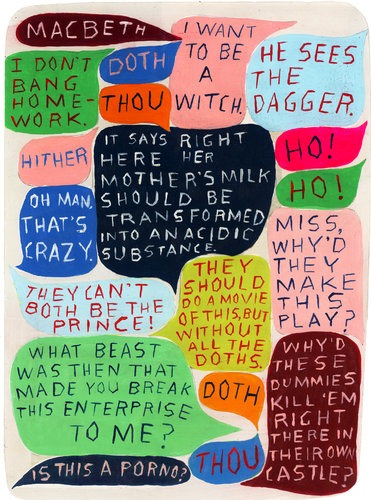
Claire Needell Hollander has a funny essay on her attempt to teach her 7th and 8th grade students Macbeth (in a Manhattan public junior high school) in accordance with the new Common Core Standards. She concludes
There’s still so much laughter, it’s after 3, and no one notices the time. I think how this exposure to the archaic text exposes the text right back. It’s noisy, a mash-up, a text slamming into the present moment, split open, banged. What does that look like in the classroom, what does that sound like? It is not anyone’s ideal. It’s rowdy, boisterous, demanding and crude. And sounds, improbably enough, a lot like Shakespeare.
I don’t think 13 (or even 12) is too young to be encountering Shakespeare.
azure, jewoman, Αββα
My co-blogger Theophrastus has asked about Andrew Hurley’s “translation technique” in rendering Bartolomé de las Casas, O. P.’s 1552 book Brevísima relación de la destrucción de las Indias. I think the adjective for that is “outrageous” since the limited use of a special old English makes for perhaps misunderstanding today. Hurley lives and works in Puerto Rico, and I think he must know what he’s doing, what he intends. And yet who knows? He may not have counted on, for instance, all of the questions we have here at this blog, whether it’s Theophrastus or Suzanne or Victoria or me, as we look at the problem of Spanish and Catholic (and protestant) and Christian missions.
When Hurley has translated Fidel Castro and Jorge Luis Borges and Rubén Darío, he has had other techniques. When translating Darío, Hurley uses “azure” instead of the English “blue,” for example, when rendering the original Spanish “azul.” And he does so because the original is actually a Spanish rendering of French.
I think the ostensible purity that we often want in our translations is just a myth. We too often want our translation language to be as pure as the original language. We want the languages contained. If Las Casas meant something by cristianos, then the translator ought not use a word, such as “Christian” since today that is much more ambiguous ostensibly than the original was surely in 1552.
But what Hurley does with with his English translation of Darío’s Spanish translation of French literature is more typical, I dare say, of translation that lets language be slippery and human, ambiguous and social.
This is what Hélène Cixous has done when translating her own French into English. Her own French, at a certain point in her original writing, she recognizes, is more ambiguous than a single reader might understand it to be. Hence, her English reflects that social wordplay, the interlingual influences, and takes the play in different directions. Here’s an example:
La question des juifs. La question des femmes. La question des juifemmes. La questione della donnarance. A questāo das laranjas. The question: Juis-je juive ou fuis-je femme? Jouis-je judia ou suis-je mulher? Joy I donna? ou fruo filha? Fuis-je femme ou est-ce je me ré-juive?
The question of the Jews. The question of women. The question of jewomen. A questāo das laranjudias. Della arancebrea. Am I enjewing myself? Or woe I woman? Win I woman, or wont I jew-ich? Joy I donna? Gioia jew? Or gioi am femme? Fruo.
Sherry Simon explains some of what we can see Cixous doing. Does Cixous do all that she intends to do as an original writer in French? Does she translate everything she intends to translate? Does she prevent us readers from reading more than she intends? Of course not.
And so when we read the Septuagint. Here’s a strange one: καὶ ὄνομα τῇ μητρὶ αὐτοῦ Αββα θυγάτηρ Ζαχαρια. It’s the last part of the Greek translation of the Hebrew 2 Chronicles 29:1. The word we might in English transliterate “Abba” is possibly a Greek transliteration of Hebrew sounds for a phrase that means Father God. But it’s a Greek word that also appears in the Greek New Testament only three times. There it’s likely a transliteration of spoken Hebraic Aramaic, a more intimate word for Father perhaps. I’m out of time, and might be able to say more later on some of this.
And yet my point is that languages are not pure, hardly original, and vary wildly through intercutural interlinguistic social interactions. Translators, good ones, are not bound to make their translations more pure or always less ambiguous and without as much play.
The Dovekeepers and the World to Come
This is from another negative review of The Dovekeepers which got me thinking,
I had several issues with the book, but probably the biggest was this–the tragedy at Masada is one of the most dramatic tales in all of history. There was no need to add witchcraft and fantastic elements. It’s clear that Ms. Hoffman did a ton of research, and I don’t expect that ancient Jews were just like contemporary ones, but I didn’t even recognize the people she was writing about as Jews. They were like some kind of weird, superstitious pagans. And this is coming from a woman with absolutely no religious faith–but apparently I have strong feelings of connection to my Jewish history. And I felt she took tremendous liberties with a story that shouldn’t have been altered out of respect. I was kind of offended.
For instance, the Jewish faith doesn’t tend to dwell on any kind of afterlife. It’s a vague concept at best. We focus on this life. However, Hoffman uses the phrase “world-to-come” 44 times in this novel! These people are obsessed with the afterlife. And there are plentiful references to ghosts, demons, magic, spells, witches, etc. I realize there is mysticism in Judaism–real Kabbalah, not the nonsense practiced by Christian celebrities–but it’s a tiny part of the religion. And yet it seems to be all Alice Hoffman is able to write about.
I have already suggested that one read Gideon Bohak on Ancient Jewish Magic, if you have the same reaction as this reviewer to the element of magic in the novel. Regarding the “world-to-come,” there is so much written about the afterlife in Judaism that it is hard to know where to begin.
So, instead, I offer a passage which was one of the first that I ever read in Hellenistic Greek. I was still in my teens, and had no awareness that there were English translations of the Septuagint. I didn’t even know that these books existed. Under Pietersma, we read through the Maccabees and many other texts, and he had the delight of knowing that we were coming with minds untrammelled by any English translation. That, of course, is hardly possible today, with the NETS online.
But I still remember vividly, as if it were yesterday, reading and slowly comprehending this horrendous story from 2 Maccabees 7,
and he ordered that the tongue of their spokesman be cut out and that they scalp him and cut off his hands and feet, while the rest of the brothers and the mother looked on. 5When he was utterly helpless, the king ordered them to take him to the fire, still breathing, and to fry him in a pan. The smoke from the frying-pan spread widely,
I had been somewhat sheltered, and up to this point, had possibly seen one or two movies and no TV, read Victorian novels only, and so on, when this story of torture and annihilation unfolded in my mind as I read it in Greek.
And a few verses lower down, here are the texts, in Greek, and in English, which still stand among the first Jewish references to the afterlife. Surely, after this, one could hardly imagine the inhabitants of Masada not focusing on an afterlife.
7 μεταλλάξαντος δὲ τοῦ πρώτου τὸν τρόπον τοῦτον, τὸν δεύτερον ἦγον ἐπὶ τὸν ἐμπαιγμὸν καὶ τὸ τῆς κεφαλῆς δέρμα σὺν ταῖς θριξὶ περισύραντες ἐπηρώτων· εἰ φάγεσαι πρὸ τοῦ τιμωρηθῆναι τὸ σῶμα κατὰ μέλος; 8 ὁ δὲ ἀποκριθεὶς τῇ πατρίῳ φωνῇ εἶπεν· οὐχί· διόπερ καὶ οὗτος τὴν ἑξῆς ἔλαβε βάσανον ὡς ὁ πρῶτος. 9 ἐν ἐσχάτῃ δὲ πνοῇ γενόμενος εἶπε· σὺ μὲν ἀλάστωρ ἐκ τοῦ παρόντος ἡμᾶς ζῆν ἀπολύεις, ὁ δὲ τοῦ κόσμου βασιλεὺς ἀποθανόντας ἡμᾶς ὑπὲρ τῶν αὐτοῦ νόμων εἰς αἰώνιον ἀναβίωσιν ζωῆς ἡμᾶς ἀναστήσει.
After the first brother had died in this way, they brought forward the second for their sport. They tore off the skin of his head with the hair and asked him, “Will you eat rather than have your body punished limb by limb?” 8He replied in his ancestral language and said to them, “No.” There- fore he in turn underwent tortures as the first had done. 9And when he was at his last breath, he said, “You accursed wretch, you dismiss us from this present life, but the King of the universe will raise us up to an everlasting renewal of life, because we have died for his laws.”
13 καὶ τούτου δὲ μεταλλάξαντος, τὸν τέταρτον ὡσαύτως ἐβασάνιζον αἰκιζόμενοι. 14 καὶ γενόμενος πρὸς τὸ τελευτᾶν οὕτως ἔφη· αἱρετὸν μεταλλάσσοντα ὑπ᾿ ἀνθρώπων τὰς ὑπὸ τοῦ Θεοῦ προσδοκᾶν ἐλπίδας πάλιν ἀναστήσεσθαι ὑπ᾿ αὐτοῦ· σοὶ μὲν γὰρ ἀνάστασις εἰς ζωὴν οὐκ ἔσται.
After he too had died, they maltreated and tortured the fourth in the same way. 14When he was near death, he said, “It is desirable that those who die at the hands of human beings should cherish the hope God gives of being raised again by him. But for you there will be no resurrection to life!”
20 ὑπεραγόντως δὲ ἡ μήτηρ θαυμαστὴ καὶ μνήμης ἀγαθῆς ἀξία, ἥτις ἀπολλυμένους υἱοὺς ἑπτὰ συνορῶσα μιᾶς ὑπὸ καιρὸν ἡμέρας εὐψύχως ἔφερε διὰ τὰς ἐπὶ Κύριον ἐλπίδας. 21 ἕκαστον δὲ αὐτῶν παρεκάλει τῇ πατρίῳ φωνῇ γενναίῳ πεπληρωμένη φρονήματι καὶ τὸν θῆλυν λογισμὸν ἄρσενι θυμῷ διεγείρασα, λέγουσα πρὸς αὐτούς· 22 οὐκ οἶδ᾿ ὅπως εἰς τὴν ἐμὴν ἐφάνητε κοιλίαν, οὐδὲ ἐγὼ τὸ πνεῦμα καὶ τὴν ζωὴν ὑμῖν ἐχαρισάμην, καὶ τὴν ἑκάστου στοιχείωσιν οὐκ ἐγὼ διερρύθμισα. 23 τοιγαροῦν ὁ τοῦ κόσμου κτίστης, ὁ πλάσας ἀνθρώπου γένεσιν καὶ πάντων ἐξευρὼν γένεσιν καὶ τὸ πνεῦμα καὶ τὴν ζωὴν ὑμῖν πάλιν ἀποδώσει μετ᾿ ἐλέους, ὡς νῦν ὑπερορᾶται ἑαυτοὺς διὰ τοὺς αὐτοῦ νόμους.
20 The mother was especially admirable and worthy of honorable memory. Although she saw her seven sons perish within the course of a single day, she bore it with good courage because of her hope in the Lord. 21She encouraged each of them in their ancestral language. Filled with a noble spirit, she reinforced her woman’s reasoning with a man’s courage and said to them, 22“I do not know how you came into being in my womb. It was not I who gave you life and breath, nor I who set in order the elements within each of you. 23Therefore the Creator of the world, who shaped the origin of man and devised the origin of all things, will in his mercy give life and breath back to you again, since you now forget yourselves for the sake of his laws.”
While this was written in Greek, and is not the origin of the expression “world-to-come”, it does establish that a belief in the afterlife existed among at least some Jews, in the 2nd century BCE. The Hebrew expression Olam Ha-Ba, “world-to-come” dates back to the Mishnah, texts collected and recorded not long after Masada.
So often we imagine the belief in eternal life to be exclusively Christian. We don’t know the history of ideas, because we stay in one track. We think that “all Christians believe” such and such, and “all Jews believe” some other such and such. In fact, all Christians do believe in an afterlife, but this was a belief inherited from an early Jewish belief. And the reason why we think of it as an exclusively Christian belief is because Jewish belief is not so univalent, so one-tracked, but multiple views on the afterlife have come in and out of popularity in different Jewish communities at different times.
This is not a thesis proposal.
It’s not even going to be one when it grows up: rather the reverse! This is the five-year, 500 page book version of the project I have in mind. But I’ve always been the kind of person who has to write all the terms of the equation on the blackboard, and then figure out which ones are negligible and can be ignored. Or to say it another way, I have to start with the comprehensively detailed description, and then figure out what to cut and how to compress.
So here is the comprehensive, nay, voluminous, prodigious, elephantine version with (almost) all the terms included:
Read the rest over at Gaudete Theology.
A plea to bloggers: put full article in feed
To bloggers everywhere:
I have a sincere request. As you may know it is possible to put differing amounts of information in blog feeds (such as RSS or Atom). Most blogs (including this one) put full articles in their blog feed, but some blogs just put short excerpts or teasers in their blog feeds. I would like to ask the owners of those blogs to please consider putting their blog’s entire articles in RSS.
Here is the reason why I care: I use different tools to read blogs, but one of the most common tools I use is a smart-phone based RSS aggregator. (FYI: the tool I use is “reeder.”) That tool pre-caches the entire RSS feed of my blog subscriptions, so that I can catch up my blog reading even when I am commuting, on an airplane, or otherwise disconnected from the Internet. In those cases, I can read articles at my leisure, and resynchronize when my smartphone once again gets into access range.
When a blog just includes a teaser in its RSS feed and not the full story, I am forced to click through to read the entire story. Even when I have Internet connectivity, this can be slow, and of course it is impossible when I do not have Internet connectivity. Many blog reading clients have this issue.
I read blogs on desktops or notebook computers less often, but when I do read them, I often use Google Reader (many modern RSS aggregators such as “reeder” sync up with Google Reader). Here, I usually have connectivity, but because of the way that Google Reader works, there is often a significant delay when I have to click through to an article.
I can understand some reasons why blog owners are motivated to require readers to click though to read articles: perhaps the most common reason is that blog owners want to get an accurate count on readers. (If a blog reader stays up to date with RSS feeds alone, it is much harder for blog owners to keep an accurate count of their readers.) However, when this happens, it makes portions of the blogosphere inaccessible (when the clients are out of range) or inconvenient.
So please, accept this pleading to put blog content in RSS and Atom feeds. Thanks!
Amazon.com as a consumer-benefit charity
Here’s an interesting perspective:
Amazon kept up its streak of being awesome this afternoon by announcing a 45 percent year-on-year decline in profits measuring Q4 2012 against Q4 2011. Not because sales went down, mind you. They’re up. Revenue is up. The company’s razor-thin profit margins just got even thinner, and in total the company lost $39 million in 2012.
The company’s shares are down a bit today, but the company’s stock is taking a much less catastrophic plunge in already-meager profits than Apple, whose stock plunged simply because its Q4 profits increased at an unexpectedly slow rate. That’s because Amazon, as best I can tell, is a charitable organization being run by elements of the investment community for the benefit of consumers. The shareholders put up the equity, and instead of owning a claim on a steady stream of fat profits, they get a claim on a mighty engine of consumer surplus. Amazon sells things to people at prices that seem impossible because it actually is impossible to make money that way. And the competitive pressure of needing to square off against Amazon cuts profit margins at other companies, thus benefiting people who don’t even buy anything from Amazon.
It’s a truly remarkable American success story. But if you own a competing firm, you should be terrified. Competition is always scary, but competition against a juggernaut that seems to have permission from its shareholders to not turn any profits is really frightening. [emphasis added]
What happened to the Brill Josephus series?
There are three major English versions of Josephus:
- the horrible 18th century translation by Whiston;
- the acceptable 13-volume translation in the Loeb Library series; and
- a projected 12 volume (although at least one of the volumes was split, so now 13 volume) major series launched by Brill to provide heavily annotated volumes of Josephus together with highly new accurate translations.
(Also worth mentioning is Betty Radice’s lively translation of Judean War.)
But the Brill series seems to have been interrupted. It was originally projected to be completed in four years after the earliest volumes appeared in 1999, and that deadline has clearly been missed. The last volume to appear in the series showed up five years ago, in 2008 (volume 1B containing book 2 of Judean War).
It will be a pity if the Brill series is abandoned since it looked to be the best version of Josephus in English; the reviews of the volumes were strong (example 1, example 2).
Herem in the New Testament: Joshua, the sword, Jesus
First, read the post “Herem: the decree of extinction (part 1)” by Theophrastus, our BLT co-blogger. Also, look for part 2 (which we’re anticipating as I post this particular post).
In this particular blogpost here, I want to consider the possibility that the writer of the New Testament book of Hebrews might have been alluding to and even encouraging, in a literary and perhaps a Greek rhetorical sort of way, a new Herem. When we get how that particular book of instruction to Jewish readers concerning Jesus as the Son of God quotes the Septuagint, then we take note how it constructs its own very difficult commandment of new devotion and new destruction perhaps.
Here’s the Septuagint version of a line from the book of Joshua (6:21) –
καὶ ἀνεθεμάτισεν αὐτὴν Ἰησοῦς
καὶ ὅσα ἦν
ἐν τῇ πόλει
ἀπὸ ἀνδρὸς
καὶ ἕως γυναικός
ἀπὸ νεανίσκου
καὶ ἕως πρεσβύτου
καὶ ἕως μόσχου
καὶ ὑποζυγίου
ἐν στόματι ῥομφαίας.
Roughly that can read this way in English –
And he did anathema it, Iesous did,
And whatsoever was
in the Polis
from man
to woman
from young
to old
to oxen calf
to yoked donkey
he dedicated/destroyed it
by the edge of the sword.
This English translation of mine is attempting to reflect some of the “devoted/destroyed” ambiguity in the verb ἀνεθεμάτισεν. This particular Greek verb, of course, in its noun form often gets transliterated as “anathema,” which is so much a New Testament and even now an English word that there’s substance enough in it for a wikipedia article on it.
But I do want the focus to get back to the Hebrew translational wordplay. The Hebrew original verb is חָרַם, or cherem or herem. And its uses in the Five Books of Moses and in the Book of Joshua are many, mainly for devotion that includes utter destruction. So the ambiguities are there before the Greek translation conveys any of that.
In the New Testament, in the Book of Acts, for example, the verb form of the ambiguous Greek gets played out rather fully. Acts 23:14 has the Jewish leaders turning on Paul, the former Jewish leader who had been enacting his own authorized “herem” against “the Way,” that is the sect of Messianic, Iesous following Jews of his day. And these leaders say: Ἀναθέματι ἀνεθεματίσαμεν. The KJV translators rendered that into English as “We have bound ourselves under a great curse.” And of course the whole verse gets at the violence: “And they came to the chief priests and elders, and said, We have bound ourselves under a great curse, that we will eat nothing until we have slain Paul.”
What we might guess is that the edge of the sword is the particular instrument of the dedication and devotion of this particular destruction.
Given all this language of herem here, we might read Hebrews 4 as rather devoted and dedicated and destructive language. And I’m calling our readerly attention again to the contrast of Joshuas, or Iesouses, in a very short context of text. Here’s the ESV –
8 For if Joshua [Ἰησοῦς] had given them rest, God would not have spoken of another day later on. 9 So then, there remains a Sabbath rest for the people of God, 10 for whoever has entered God’s rest has also rested from his works as God did from his.
11 Let us therefore strive to enter that rest, so that no one may fall by the same sort of disobedience. 12 For the word of God is living and active, sharper than any two-edged sword, piercing to the division of soul and of spirit, of joints and of marrow, and discerning the thoughts and intentions of the heart. 13 And no creature is hidden from his sight, but all are naked and exposed to the eyes of him to whom we must give account.
14 Since then we have a great high priest who has passed through the heavens, Jesus [Ἰησοῦς], the Son of God, let us hold fast our confession.
The call in this text is to distinguish two different Iesouses, the one of herem who did not bring “Sabbath rest” and the other who comes to “Hebrews” through a sword, a sort of new and New Testament herem.
Biblical Womanhood Rap | Two Friars and a Fool
Aric Clark of Two Friars and a Fool takes on complementarianism in this music video with scathing, no-holds-barred verses and a woman-affirming chorus accompanied by some lovely images. I must say, I never thought I’d hear the word “hermeneutical” in a rap!
If you don’t care for profanity, you may want to give this a miss, but otherwise do check it out! and do click through to their blog to read the lyrics.


 BLT
BLT 