Blackface Dov
Anne Carson’s Seven Ibykos translations
For a good time, check out this poem and accompanying audio: “Ibykos Translated Six Ways” (which actually has seven translations.)
I would say more, but that would just take away from your (the reader’s and listener’s) delight.
P.S.: I also wanted to make sure that J. K. Gayle wasn’t the only BLT contributor to post about Anne Carson.
P.P.S.: I only this afternoon discovered that London Review of Books had a podcast page. How did I find out? Because the New York Times had an article on a Daily Mail attack piece on transcript (published in the London Review of Books) of Hilary’s Mantel’s lecture at the British Museum. Unwinding the links, I found the “London Review Podcast” (see also here), and subsequently found Anne Carson’s piece(s). (By the way, Hilary Mantel’s lecture is well worth reading [and presumably the audio is equally good], the Daily Mail piece reads like the Daily Mail, and I can only wonder why the New York Times bothered to publish an article on a Daily Mail story.)
Good advice I need to remember
From xkcd:

The Whole Megillah?
Even after the book had been accepted as canonical by all, its religious merits continued to be a matter of dispute, with Jews tending to love the book (as its many extant copies from the Middle Ages attest) and Christians often ignoring or even disliking it. There are, for instance, no allusions to the book in the New Testament, and rarely do Church Fathers so much as even allude to it, let alone quote it. A complete commentary was not written on it until that of Rhabanus Maurus in the ninth century.
In this post, I want to examine whether the “epistle” additions in Greek Esther are translation-Greek. But let us start at the beginning:
In Hebrew, the word megillah means scroll, and when Jews talk about “HaMegillah” (The Megillah) they are talking about one scroll in particular – the Book of Esther. The book of Esther is a central focus of the Jewish holiday Purim [which starts Saturday night] where the book is read twice. (A few scholars speculate that Purim may have borrowed elements from a non-Jewish holiday, although it has clearly been identified as a Jewish holiday at least since the time of the Mishnah.)
Speaking of things happening twice, the Book of Esther is the only book in the NRSV to appear twice – once translated from the Hebrew and once translated from the Greek. Greek Esther has some differences from Hebrew Esther, including some Hebrew passages that are omitted, but by far the most obvious difference is that Greek Esther has six additions (and those Greek additions are in the Christian Apocrypha/Deuterocanon). Where did these additions come from?
Greek Esther offers a description of its own translation (all Biblical quotes in this post are from NRSV Greek Esther):
(Addition F 11:1) In the fourth year of the reign of Ptolemy and Cleopatra, Dositheus, who said that he was a priest and a Levite, and his son Ptolemy brought to Egypt the preceding Letter about Purim [that is, Greek Esther], which they said was authentic and had been translated by Lysimachus son of Ptolemy, one of the residents of Jerusalem.
But this colophon seems to apologize too much. The colophon almost seems an apology for this particular version of Greek Esther against some other competing version of Greek Esther. This naturally leads us into the question: what were the origins of the Greek Esther additions? The problem is an ancient one – Origen in Letter to the Africans 3 mentions that the additions are lacking in current Hebrew texts; and Jerome’s Latin translation places all of the additions after his translation of Hebrew Esther, and he explains in a note after Esther 10:3 that none of the Additions were found in current Hebrew texts.
I would like to turn Additions B and E now:
(Addition B) This is a copy of the letter:
“The Great King, Artaxerxes, writes the following to the governors of the hundred twenty-seven provinces from India to Ethiopia and to the officials under them:
“Having become ruler of many nations and master of the whole world (not elated with presumption of authority but always acting reasonably and with kindness), I have determined to settle the lives of my subjects in lasting tranquility and, in order to make my kingdom peaceable and open to travel throughout all its extent, to restore the peace desired by all people.
“When I asked my counselors how this might be accomplished, Haman—who excels among us in sound judgment, and is distinguished for his unchanging goodwill and steadfast fidelity, and has attained the second place in the kingdom — pointed out to us that among all the nations in the world there is scattered a certain hostile people, who have laws contrary to those of every nation and continually disregard the ordinances of kings, so that the unifying of the kingdom that we honorably intend cannot be brought about. We understand that this people, and it alone, stands constantly in opposition to every nation, perversely following a strange manner of life and laws, and is ill-disposed to our government, doing all the harm they can so that our kingdom may not attain stability.
(Addition E) The following is a copy of this letter:
“The Great King, Artaxerxes, to the governors of the provinces from India to Ethiopia, one hundred twenty-seven provinces, and to those who are loyal to our government, greetings.
“Many people, the more they are honored with the most generous kindness of their benefactors, the more proud do they become, and not only seek to injure our subjects, but in their inability to stand prosperity, they even undertake to scheme against their own benefactors. They not only take away thankfulness from others, but, carried away by the boasts of those who know nothing of goodness, they even assume that they will escape the evil-hating justice of God, who always sees everything. And often many of those who are set in places of authority have been made in part responsible for the shedding of innocent blood, and have been involved in irremediable calamities, by the persuasion of friends who have been entrusted with the administration of public affairs, when these persons by the false trickery of their evil natures beguile the sincere goodwill of their sovereigns.
“What has been wickedly accomplished through the pestilent behavior of those who exercise authority unworthily can be seen, not so much from the more ancient records that we hand on, as from investigation of matters close at hand. In the future we will take care to render our kingdom quiet and peaceable for all, by changing our methods and always judging what comes before our eyes with more equitable consideration. For Haman son of Hammedatha, a Macedonian (really an alien to the Persian blood, and quite devoid of our kindliness), having become our guest, enjoyed so fully the goodwill that we have for every nation that he was called our father and was continually bowed down to by all as the person second to the royal throne. But, unable to restrain his arrogance, he undertook to deprive us of our kingdom and our life,and with intricate craft and deceit asked for the destruction of Mordecai, our savior and perpetual benefactor, and of Esther, the blameless partner of our kingdom, together with their whole nation. He thought that by these methods he would catch us undefended and would transfer the kingdom of the Persians to the Macedonians.
“But we find that the Jews, who were consigned to annihilation by this thrice-accursed man, are not evildoers, but are governed by most righteous laws and are children of the living God, most high, most mighty, who has directed the kingdom both for us and for our ancestors in the most excellent order.
“You will therefore do well not to put in execution the letters sent by Haman son of Hammedatha, since he, the one who did these things, has been hanged at the gate of Susa with all his household—for God, who rules over all things, has speedily inflicted on him the punishment that he deserved.
“Therefore post a copy of this letter publicly in every place, and permit the Jews to live under their own laws. And give them reinforcements, so that on the thirteenth day of the twelfth month, Adar, on that very day, they may defend themselves against those who attack them at the time of oppression. For God, who rules over all things, has made this day to be a joy for his chosen people instead of a day of destruction for them.
“Therefore you shall observe this with all good cheer as a notable day among your commemorative festivals, so that both now and hereafter it may represent deliverance for you and the loyal Persians, but that it may be a reminder of destruction for those who plot against us.
“Every city and country, without exception, that does not act accordingly shall be destroyed in wrath with spear and fire. It shall be made not only impassable for human beings, but also most hateful to wild animals and birds for all time.
“Therefore we have decreed that those indicated to you in the letters written by Haman, who is in charge of affairs and is our second father, shall all—wives and children included—be utterly destroyed by the swords of their enemies, without pity or restraint, on the fourteenth day of the twelfth month, Adar, of this present year, so that those who have long been hostile and remain so may in a single day go down in violence to Hades, and leave our government completely secure and untroubled hereafter.”
Even in English translation, it is obvious that this text is of a completely different literary style than the rest of the translation from Greek Hebrew – it is florid and overwrought. In a study by C. E. Moore of these passages, he argues that these passages are fundamentally Greek in origin:
Although there are some differences between Additions B and E, for our purposes here these two letters can be treated together. As for their effect, both letters lend additional dramatic interest and a greater sense of authenticity to the Esther story. Add E also supplies some very explicit religious elements, this being a dimension lacking in the MT of Esther.
There can be little doubt that both of these letters were originally Greek compositions and not translations of a Semitic text. Such a conclusion is suggested by the external evidence: ( 1 ) those versions based on the Hebrew such as the Talmud, Targums, and Syriac do not have these additions; (2) the versions based on the Greek, i.e., the Vetus Latina (OL), Coptic, and Ethiopic, do have them; (3) both Origen (185?-?254) and Jerome expressly state that these two letters were lacking in the Hebrew texts of their day.
What the external evidence suggests about B and E being originally composed in Greek is confirmed by the internal evidence: (1) their literary style, which is best characterized as fIorid, rhetorical, and bombastic, is free of all Hebraisms and is quite unlike Greek translations of other Semitic decrees in the Bible; (2) their content and especially their literary style are quite different from the two letters recorded in the Second Targum of Esther (the Second Targum being the Semitic version that comes closest in this case to the content of the Greek version of the letters); (3) unlike the other Adds and the canonical portions of Esther, the two letters in B and E abound in grammatical constructions characteristic of “good” Greek, such as participial and infinitival constructions, genitive absolutes, and the noun and its article separated by qualifying prepositional phrases; (4) in terms of their literary style, Adds B and E are most similar to the Greek of 3 Maccabees, the latter being characterized by C. W. Emmet as “a product of Alexandrian literature, exemplifying in its extremest form the pseudo- Classicalism of the Atticists . . . artificiality and extravagance . . . obscure and bombastic … full of repetitions, and awkwardly constructed…." Such a characterization is equally applicable to Adds B and E. Nor are Esther’s parallels to 3 Maccabees confined to Greek style; so many are the parallels in plot between 3 Maccabees and the Greek Esther that A. Barucq has called 3 Maccabees “a hellenistic imitation of Esther.” (5) Finally, there are some exceedingly dose parallels between Add B and 3 Mac 3:11-29, not only in terms of tortuous and involved literary style, but also in terms of very similar thoughts, even to the point of the two letters preserving the identical sequence of those thought.
Although the Hebrew Esther clearly antedates 3 Maccabees,l6 there is nothing to preclude some later influence of 3 Maccabees on the Greek Esther, such as, for instance, the first royal letter of Esther being patterned after 3 Maccabees; 3 Mac 3: 11-29 could very well have been the model for Add B.[…]
Presumably the same individual wrote B and E. It is unlikely that it was the Lysimachus who translated Esther from the Hebrew into Greek; for one can scarcely imagine a man so enamored of producing the pseudo-classicalism of Adds B and E being able let alone content to translate the rest of the Book of Esther so simply and prosaically as Lysimachus had done.
As a method of testing the hypothesis that Additions B and E are of non-Semitic origin, we might turn to R. A. Martin’s list of 17 qualities that identify “translation-Greek” from “original Greek” (see his original article for the statistical basis of these tests):
- dia with genitive 6% – 1% as frequent as en;
- dia with all cases 18% – 1% as frequent as en;
- eis 49% – 1% as frequent as en;
- kata with accusative 18% – 1% as frequent as en;
- kata with all cases 19% – 1% as frequent as en;
- peri with all cases 27% – 1% as frequent as en;
- pros with dative 2.4% – 1% as frequent as en;
- hypo with genitive 7%-1% as frequent as en;
- kai (coordinating main clauses) 2.1% or more frequent than all occurrences of de;
- 5% or fewer articles separated from their substantives;
- 22 or more dependent genitives following the word they qualify for each such genitive preceding the word qualified;
- 9 or fewer lines of Greek text for each dependent genitive personal pronoun;
- 77 or fewer lines of Greek text for each genitive personal pronoun dependent on an anarthrous substantive;
- 35% or fewer attributive adjectives preceding the word they qualify for each such adjective following the word qualified;
- 10.1 or more lines of Greek text for each attributive adjective;
- 6 or more lines of Greek text for each adverbial participle;
- 2 or fewer datives not used as the object of en for each occurrence of en.
Here are his results (click through to see an enlarged table):
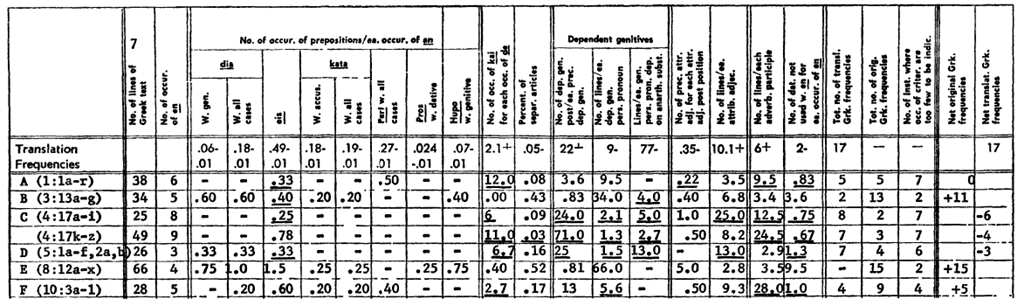
[T]he net number of translation-Greek or original-Greek frequencies was most significant. These net figures are arrived at as follows: Whenever a section has more occurrences of original-Greek frequencies than occurrences of translation-Greek frequencies, the number of occurrences of translation-Greek frequencies was subtracted from the number of occurrences of original-Greek frequencies, and the resulting number is the net occurrences of original-Greek frequencies.
Add E (66 lines in length) has 15 original-Greek frequencies and no frequencies characteristic of translation-Greek- 15 less 0 equals 15 net original- Greek frequencies.[…] Add E is clearly original-Greek; so also Add B (34 lines in length) which has 13 original-Greek frequencies and 2 frequencies characteristic of translation-Greek- 13 less 2 equals 11 net original-Greek frequencies.
What are we to make of this statistical study? I’m not sure. Martin’s criteria seem a bit ad hoc. In an earlier part of the study he “validates” the criteria by applying them to portions of Septuagint texts of more certain origin, but this is not really a statistically valid way to examine text: had Martin formulated a different set of criteria, he might have arrived at a different conclusion. Further, Martin gives each of his criteria equal weight in determining his assessment, and there is no obvious reason for that decision.
The upshot is that Martin’s study seems on shaky ground to me. Still, based purely on my own (subjective) assessment of stylistic factors, I suspect that Additions B and E were originally composed in Greek rather than being translated from a Semitic language. But I believe there is room for argument.
Goodbye, Donald Richie
Sad news: Donald Richie, one of the leading English-writing film critics, died today in Tokyo at age 88.

Richie helped introduce several generations of Americans – including me and probably many of this blog’s readers to two great Japanese directors: Akira Kurosawa and Yasujiro Ozu. If you’ve ever seen Ozu’s Tokyo Story or Kurosawa’s Kagemusha, Red Beard, or Dreams, you’ve seen Richie’s work. If you’ve listened to the commentary track on Criterion DVDs for Ozu’s Story of Floating Weeds or Early Summer; Kurosawa’s Drunken Angel, Rashomon, Lower Depths, Bad Sleep Well; or Mikio Naruse’s When a Woman Ascends the Stairs, you’ve heard Richie’s work.
Richie autographed for me a copy of his Donald Richie Reader: 50 Years of Writing on Japan. Some books of his that I can recommend are
- A Hundred Years of Japanese Film: A Concise History with a Selective Guide to DVDs and Videos
- Ozu: His Life and Films
- Tokyo Story: The Ozu/Noda Screenplay
- The Films of Akira Kurosawa
- Rashomon (Rutgers Films in Print)
- Seven Samurai and Other Screenplays
For a sampling of his film essays, I can recommend going to the Criterion blog and searching on “Richie".”

Translating film dialogue into subtitles presents special challenges, because translations are required to be short, easy to parse, but ideally should capture double meanings and puns (without the use of footnotes). I hope in a future post to illustrate how Richie tackled this problem as a translator, referring both to the original script and the subtitle translation. (Time is a bit at a premium right now, and to find such examples requires a bit of time, since one can not “scan through a film” the way one can quickly scan through a book.)
Richie was followed, in due course, by a new generation of film critics – who had better Japanese skills than he did. But their path was made easier because of Richie’s pioneering work.
So for now, I simply want to mourn his passing.
Here is a brief video interview with Richie on Robert Bresson’s Au Hasard Balthazar where you can sense Richie’s strong emotional connection with films:
(HT: Criterion)
garrulous termagants? or a platform to see the whole showing layerings and accretions through time?
I must start by saying how I admire my co-blogger Theophrastus. He’s made brilliant and compelling observations about how translators, such as Robert Alter more recently and the RSV team a bit earlier, have faced the specific problems with the Masoretic Text of Genesis 49:26 and have overcome them. And he’s provided the careful analysis all the while coming back to the longer conversation between us, concerning the value or vice of Julia Holloway’s “composite translation” of the various manuscripts of The Showing of Love of Julian of Norwich.
Through first hand knowledge of Alter (and through what Alter has written), Theophrastus shares how the translator is “familiar with both Speiser’s and Sarna’s commentaries (indeed, Alter quotes from Speiser in his introduction); and also that he consulted a Rabbinic Bible, which would contain Rashbam’s medieval commentary (indeed, Alter praises the value of medieval commentaries over modern commentaries).” He gives a “a careful analysis of the Hebrew [that] leads one to the corrected text (which happens to coincide with the Greek).” This seems to be exactly what Everett Fox also has done with his translation of The Five Books of Moses. Fox has the line “the blessings of the mountains eternal” with the footnote explaining the alternative reading: “Reading haraei for the traditional Hebrew horei, “parents” on the basis of Hab. 3:6.” Fox does not refer to the Septuagint Greek precisely because he does not need to. As Theophrastus helps us see: the corrected Hebrew text “happens to coincide with the Greek.” Of course, Alter doesn’t leave this alone. He claims very explicitly how his “English version follows the Septuagint,” and he insists, in contrast to the Masoretic Text, “the Septuagint has the equivalent in Greek of the idiomatic harerei ‘ad (‘timeless heights’).”
Why emphasize this fact that the Greek of Alexandria, Egypt sounds like the Hebrew of Moses, leading his people beyond Egypt? Well, I’m not sure this variation of language is really all that important. Only careful readers might care.
And so this is where I would agree with Theophrastus. We do not want a a garrulous termagant of a text. We don’t really care for a flattened style, “single harmonized gospel from the very different voices of the four canonical gospels.” We are not happy with an edition of the Bible that does violence to narrative plot and authorial tropes and turns that get sacrificed to some editors desire for a chronologically re-ordered text. We don’t want the story to keep going if an author writes a terminal Amen.
But the whole story of Julian of Norwich’s Showing is one of self editing, of purposeful revising, of continuing to re-write after the first ostensible end and the second. This, to me, seems to be the project that Holloway has in mind. She carefully explains:
This translation, based on the definitive edition by Sister Anna Maria Reynolds, C.P. and Julia Bolton Holloway, published by SISMEL, Edizioni del Galluzzo, Florence, 2001 (ISMB 88-8450-095-8), instead seeks to replicate as far as possible that original glory of Julian’s manuscripts [plural], indeed to present what Syon Abbey’s nuns had twice sought to have printed in England, under Henry VIII and under Elizabeth I, having prepared the manuscript for the press as we see it in the Paris Manuscript.
Now, I recall that Theophrastus in his post “Not translating Julian of Norwich” said, “we can easily read Julian from the best surviving manuscript – the Paris Manuscript.” This Paris Manuscript is also important to Holloway. It is one layer. And, indeed, she says for her composite translation, “The rubrication is that in the Paris manuscript… (the [paragraph mark in it] a convenient way then to save parchment and now to save paper).” We do not, in fact, know whether the little paragraph marks were ones that Julian, or some later scribe for her or for himself, might have supplied. Whose style was that in the Paris Manuscript, whose important decision to use this little mark? Should Holloway have neglected this layer of the text?
Well, she insists, “This translation functions as a platform from which it becomes possible [for any reader] to see [after the fact] the whole while showing the layering of texts throughout the many years of Julian’s lifework.”
Sure, her “composite translation” is to “remain as faithful to Julian’s English as possible,” to “her writing” that “[b]oth T. S. Eliot and Thomas Merton have highly praised.” And if anywhere there’s a flaw in what Holloway has done translating, then it is here. The translator could have varied the style of her translation in places where there were the different dialects in the texts [plural].
Nonetheless, Holloway’s general purpose is to build on the practices of others, in concert with them. First, there are the various scribes working with and after Julian to preserve her texts. “Reading her [Julian’s] words,” says Holloway, let us give thanks for the centuries of women and men in exile, in prison, awaiting execution, suffering from burning at the stake, drawing, hanging and quartering, and guillotining, who, in prayer to God, persevered the Showing of Love for us.”
Second, there is “what Syon Abbey’s nuns had twice sought to have printed in England, under Henry VIII and under Elizabeth I, having prepared the manuscript for the press as we see it in the Paris Manuscript.” And, third, there is the precedent set by others working on the texts of others:
Donald Frame once so edited and translated Montaigne’s Essays, showing the layers of text and their accretions through time as the Essays went into printing upon printing. Augustine’s Confessions and Samuel Beckett’s Krapp’s Last Tape similarly are self-consciously aware of the stages of the author’s life enfolded into the author’s text. The same may be seen here, where we read all Julian’s surviving texts in translation simultaneously.
Here, then, just as Alter gives an explicit nod to the variant (even Greek) text of the Septuagint as different from the Hebrew Masoretic text of Genesis 49:26 (and other passages of the Hebrew Bible), so Holloway is giving an explicit nod to variant works that coincide with Julian’s life and spirit and showings of love. And for Halloway this is that platform from which readers in a shorter moment and manageable space may view the whole, the layerings, the accretions through time.
Unflattering translations
My co-blogger J. K. Gayle and I have been having a conversation about how Julian of Norwich has been treated by different contemporary translations. Kurk has well-thought out and interesting praise for Julia Holloway’s translation of Julian’s Showings. I urge you to read his most recent post, which has great food for thought.
In that post, Kurk makes several points, but I want to just deal with one here. He compares the translation of Genesis 49:26 with Holloway’s translation. He cogently argues for similarities in translation-philosophy approach; but I want to point out the differences.
The Masoretic Text in Genesis 49:26 has problems. Speiser points out the issues and solution in his Anchor Bible commentary:
MT reads “the blessings of your father have been mightier than the blessings of my progenitors, unto the desire of the everlasting hills.” This reading is hopeless on more counts than one: (1) the poetic meter is suddenly abandoned; (2) the prosaic content is even more disturbing; (3) emphasis shifts abruptly from boons to beneficiaries; (4) the term for “progenitors” (literally “conceivers”) is without parallel in biblical Heb., the only form otherwise known being in the feminine singular (Hos 2:7; Song of Sol 3:4), and having the natural sense of “mother”; (5) the attested term for “parents” is ʾābōt; (6) the connection with the next clause is disrupted; (7) above all, the parallel text in Deut 33:15 gives hrry qdm “the ancient hills,” which is paralleled in turn by hrry ʿd (same meaning) Hab 3:6, the obvious prototype of the present h(w)ry ʿd. The only difference is the graphically slight change of r/w (in the “square” script); but the misreading was sufficient to throw the rest of the verse completely out of balance.
Now I’d like to show you how easy it is to mix up reish and vav in the Aramaic square script:

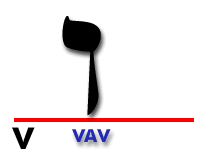
Let’s continue with Speiser’s analysis:
It remains only to restore the beginning of the verse (26). With the “parents” (hwry) of the second hemistich gone in favor of “hills,” the text’s “your father” is now all the more out of place. The received cons. text is as follows:
brkt ʾabyk gbrw ʿl—for which read (with SB)
brkt ʾabyb wgb ʿl
“blessings of grain-stalk and blossom.” The whole sequence becomes at once natural and cohesive—and an analogue to Deut 33:13 ff. There can be little doubt that this, or something very close to it, was the original wording of the passage.
Note that Speiser’s analysis was entirely based on Hebrew – and did not rely on the Septuagint (which generally supports Speiser’s analysis.) As N. Sarna points out in his commentary, this type of analysis was already well recognized by medieval Jewish commentators:
Hebrew horai is so rendered based on postbiblical usage. However, the stem h-r-h in the Bible can only mean “to become pregnant” and is, of course, solely used in the feminine. Seeing that “mountain(s)”—“hill(s)” is a fixed pair of parallel terms in Hebrew poetry, occurring more than thirty times in that order, Rashbam [the medieval exegete Samuel ben Meir, c. 1085 – c. 1158] is undoubtedly correct in connecting horai here with har, “mountain.”
Rashbam’s analysis was presumably done without reference to the Greek. As it happens, though, the Greek supports this analysis, as Sarna explains:
The Septuagint indeed reads here “ancient mountains,” joining the word to the following ʿad. The phrase harere ʿad, “ancient mountains,” appears in Habakkuk 3:6 in parallel with giveʿot ʿolam, “eternal hills.” The Blessing of Moses to Joseph in Deuteronomy 33:15 employs the same imagery, though in variant form: “With the best from the ancient mountains, / And the bounty of hills immemorial.…” Therefore, it is best to render here, “the blessings of the ancient mountains.”
The Septuagint here supports medieval Jewish criticism of the text, as well as modern Jewish scholarly commentaries (both Nahum Matthias Sarna and Ephraim Avigdor Speiser were prominent Jewish scholars.)
I do not know enough about the history of textual decisions of the RSV translators, but I am well acquainted with Alter, and I know that he is familiar with both Speiser’s and Sarna’s commentaries (indeed, Alter quotes from Speiser in his introduction); and also that he consulted a Rabbinic Bible, which would contain Rashbam’s medieval commentary (indeed, Alter praises the value of medieval commentaries over modern commentaries).
I do not know whether the RSV and Alter first proposed their variants based on consulting the LXX or (as Rashbam and Speiser did) based on pure analysis of the Hebrew, but there can be little doubt that the Masoretic Text is wrong and both a careful analysis of the Hebrew leads one to the corrected text (which happens to coincide with the Greek).
I’ve gone some length into this example to show the sort of work done here – it is a careful examination on specific words trying to be as conservative as possible in changing the original source text. This is an exemplary instance of text criticism.
Now, I want to contrast this with Holloway’s translation of Julian. Here is the example that Kurk gave in his most recent post:
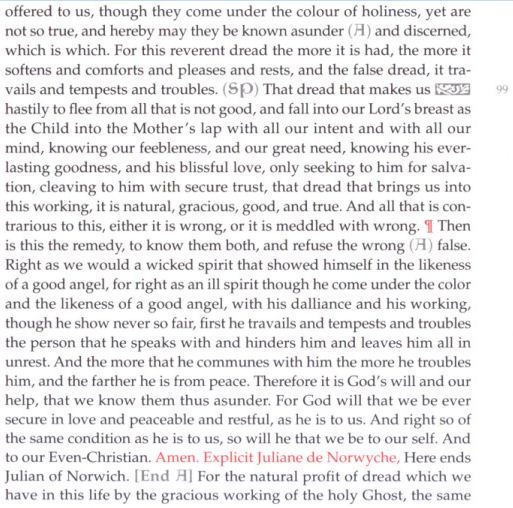
Kurk praises in particular the inclusion of “Amen” in the text, which clearly was in Julian’s “Short Text” (c. 1373) but omitted from some manuscripts of the “Long Text (c. 1393). What changed? Well, as Kurk ably relates, during this time, the persecution of the proto-Reformation Lollardy movement caused many authors to avoid being seen as translating the Bible into English.
What has Holloway done with her translation? As you can see, she has mixed several different texts together. If Holloway had simply added the "Amen," it might be considered similar to the Alter-RSV example of Genesis 29:26, which I analyze at length above. Here, however, Holloway has done something more extensive to the text. Note that in the fragment Kurk gives, Holloway has interspersed the Short Text (which is denoted by the script A) with two variants of the Long Text (the 17th century Sloan manuscript, denoted by the script S, and the earlier [but scribally more sophisticated] Paris manuscript, denoted by the script P.)
So Holloway ends up with passages like this (emphasis added):
And right so of the same condition as he is to us, so will he be to our self. And to our Even-Christian. Amen. Explicit Juliane de Norwych, Here ends Julian of Norwich. For the natural profit of dread which we have in this life by the gracious working of the Holy Ghost, the same [….]
Now, what is the image that comes to mind when you hear or read a writer who first says she has ended, gives an Amen, and then keeps on talking? It fits into that cruel and completely incorrect stereotype of a motor-mouth woman who cannot stop her windbag excretions — "and one more thing …." This type of glib figure is closer to the shrew Katherina in Shakespeare’s play about men dominating women: Taming of the Shrew. Shakespeare’s stereotype may work in his comic piece, but it hardly reflects reality, and certainly does not reflect the brilliant, insightful, and elegant writing of Julian. That is a false and libelous portrayal of the mystic Julian. Her writing is not garrulous. Instead, she ends both her Short Text and Long Text with formulae. Those closing formulae appear at the end, not in the middle of the text.
Neither is Holloway being daring or innovative in including “Amen” in a translation that includes portions of Julian’s Long Text . For example, Elizabeth Spearing, in her 1998 translation of Julian (which includes translations of both the Short and Long Texts, but done separately), has Julian end both texts with a simple, elegant "Amen."
What Spearing (adding a single word) seems akin to what the RSV and Alter did with Genesis 49:26. In contrast, what Holloway has done is akin to those authors who produce a single harmonized gospel from the very different voices of the four canonical gospels (This is an example.) Such harmonizations can be interesting and have artistic merit (thus, for example, no less a literary figure than Leo Tolstoy produced a harmonized gospel) but they necessarily lose the unique voices of the original authors – who were not only distinct personalities but separated in time.
Holloway’s integrated text (in the example that Kurk gives) also risks losing the unique voices of the existing manuscripts (the British Library Short Text is written in the Northern dialect, the Paris Long Text is in the Southern dialect) and the separation of them by time (widely believed to be about two decades). The difference in dialects is artificial (the Paris manuscript scribe appears to have already “translated” Julian’s words into the London dialect) but the difference in time seems a more formidable challenge. Speaking for myself: both my writing style and opinions have matured over the last two decades. It seems we should allow Julian the same courtesy.
This seems especially apropos because Julian was a mystic. For the sake of argument, let us suppose (as Julian did) that her visions were divinely inspired. Only she had access to those visions, and only her account can be considered as being inspired. Unless a later editor was also inspired, this argues for a healthy conservatism in editing and translating. Many “new age” translations of various religious and mystical works can be properly criticized for “dumbing down” the nuances and stylistic features of the original text. Both Kurk and I have roundly criticized any number of Bible translations on this basis. Here, I criticize Holloway in her edition of Julian for re-arranging Julian’s words, and presenting Julian as a garrulous termagant rather than a poetic mystic.
Kurk has more important things to say as well, and references a post on Sappho fragment 58 from a few months ago. I join Kurk in encouraging you to read his fascinating observations he makes in that excellent post.
Dear blog readers, At some point, our conversation around Julian of Norwich’s Showings may come to an end. And at some point again, we might just turn it into a series of posts. For now, I do hope you will read the latest from my co-blogger Theophrastus: “What might have been: Edwin Drood, Bruckner’s Ninth, Nabokov’s Laura, Wallace’s Pale King” Ellison’s Three Days, and the ‘uncensored’ Julian of Norwich.” As you’ll see, he there very clearly shows the problems of the very and perhaps too-late “efforts to complete works left incomplete by an author or composer’s death.” David Foster Wallace could not, and perhaps should not, have been awarded the 2012 Pulitzer Prize for Fiction for his posthumously completed novel The Pale King.
Theophrastus, as his post’s title suggests, deals with many more cases than just Wallace’s. He explains and shows how “various surviving manuscripts can be considered as partial notes on [a late editor’s] hypothetical super-text.” And Theophrastus persuades me that “works edited from incomplete authorial notes,” really, in general, must be “considered inferior to the author’s completed works.” I think his post will convince you as well.
What Theophrastus does very well is to test whether there is a real difference between what Bible translators and editors do with the Hebrew (and Septuagint, and if you like with the New Testament even, I’ll add) and what Julia Holloway has done with her composite translation of the manuscripts of Julian of Norwich. I’m still considering the points he’s made.
And yet I do want to show two cases that we might compare with Holloway’s. First, notice what Robert Alter does with Genesis 49:26-27. And notice what the KJV team of translators, the ESV team of translators, and the RSV team of translators respectively do with the same. If you have Alter’s Five Books of Moses, then also look at the entire footnote he makes there (which begins this way: “The Masoretic Text is not really intelligible at this point, and this English version [of mine] follows the Septuagint for the first part of the verse”).
Here’s Alter:
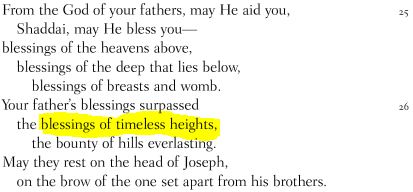
Here are the others:
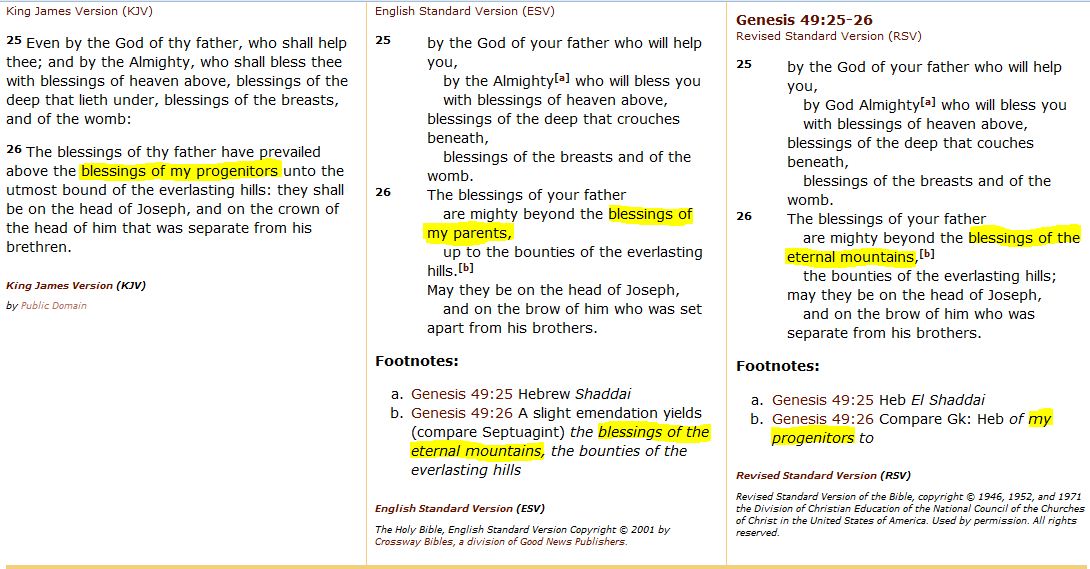
Notice how both Alter and the RSV team choose to follow the Septuagint. The ESV team follows the KJV here (although they do offer a variant translation in a footnote, one that acknowledges the reading of the Greek translation of the Hebrew Bible presumably before or somehow an explanation of the MT).
Second, look at what Anne Carson does with Sappho fragment 58. I’m going to ask that you look at this by taking some time to read through what has been presented in full already at another post. Pay attention to how Carson has to re-read Sappho, has to see the poet’s intentions in a new light, in light of the discovery of an additional fragment. And yet this new fragment gives readers, as Carson would translate it anew and in a fresh way, some of the same spirit of Sappho that Carson has presented before. This is what came to be in the end. Carson was able to imagine Sappho’s intention and to convey her verse before and after the discovery of the additional manuscript. “It is a quieter composition. But poetically indisputable in the way that Sappho’s poems are.” – Carson explains. “Sappho is not trying to startle her audience with inventions semantic or figural. Her material is facts (Tithonos is a mythic fact), not metaphor, not décor, not afterthought.” And so, “The beat goes on.”
Carson does not, in the end, startle her audience with inventions either. She’s not conjecturing “What might have been.” She is doing what Alter and the RSV team do, as they show what “Moses” writing must have said (considering the late manuscripts clearly not all his own, even if these Hellene texts were crafted back in Egypt where Moses learned his languages, his abilities to translate, and so forth). And Carson, like Alter and the RSV team, bring the late written texts into a composite with the earlier, in the English translations.
In the end, when we look at how Holloway brings in various manuscripts of Julian of Norwich’s Showings of Love, we must appreciate how she brings to the fore hidden layers of meanings. It’s a composite translation, yes. And it’s also, furthermore, a look at and a listen to the Hebrew lost at certain points and stages of Julian’s writing and revising. So let me close this post just by showing once again Holloway’s and then Julian’s “amen.”
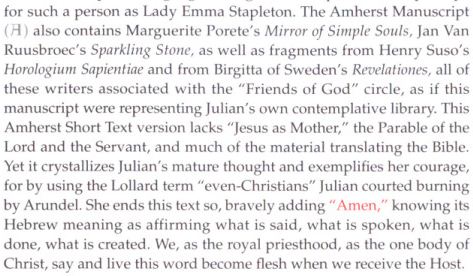
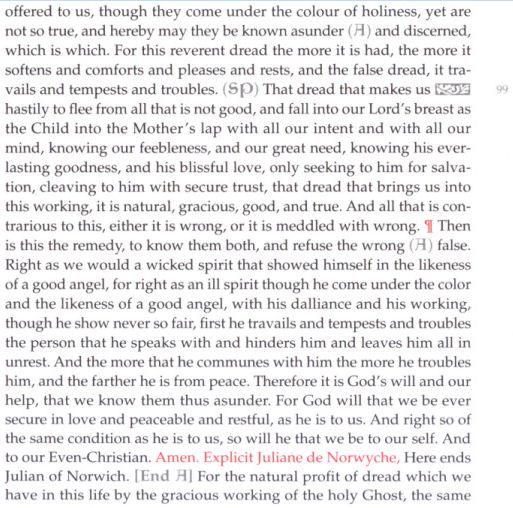
“translating” Julian of Norwich: her various “original” mss
Fortunately, we readers do not have to make a “choice between Julian of Norwich’s mystical visions directly from her” and “a long series of non-mystic intermediaries who interpreted her.” (This is something my co-blogger Theophrastus asked at the beginning of his post written in response to mine.)
First — as Julia Bolton Holloway notes — just as soon as the “brilliant crippled woman in medieval Norwich” inherited sufficient financial means in 1416, she “Julian would also have had to dramatically revise her life work, the Showing of Love.” Such a revision, with all its drama, would have been required in 1416 because — as Holloway also notes — “[e]very passage had translated passages from the Bible into English, and this was now strictly forbidden upon pain of burning at the stake as a Lollard.” One other dramatic possibility is that “Julian and Adam [Easton] may have shared the Jewish heritage of the Carmelites Teresa of Avila and Edith Stern,” and such a heritage would have put Julian in real danger. Holloway conjectures that “we do not know her real name” and “Adam Easton spelled his ‘Oeston’.” Moreover, “[t]he Westwick area … had been Norwich’s Jewry from 1144 – 1290, before their expulsion by King John. This Jewry had funded the building of Norwich Cathedral. A remnant, perhaps as converts married into Christian Norwich families, could have survived, and Julian [and Adam Oeston] may have stemmed from one of these families.” Therefore, there are signs in the community that suggest hints of the fact that Julian, whatever her real name may have been, was a Jewish Christian convert. There is less disputable evidence, nonetheless, that she and Adam were translators of the Hebrew Bible, and they were astute. Holloway explains that not all of Julian’s original texts show this:
The final, Amherst, version [of the Showing of Love] notes that painted wooden crucifixes are to be worshiped, speaks emphatically of the Pater Noster, Ave, and Credo, and removes from itself swathes and swathes of translations into English from the [Hebrew] Bible. The great sadness is that Adam Easton had translated the Bible from Hebrew into Latin, correcting Jerome’s errors; this his Bible was stolen from him. He had criticized Wyclif for being unscholarly and for translating Jerome’s Latin errors into English rather than going directly to the Hebrew. Julian too is translating from the Hebrew, not into Latin but into English, centuries before the King James Bible. Her Showings‘s “All shall be well,” said to her by Christ, translates the Hebrew shalom. The Vulgate and the Wyclif Bibles give this merely as recte and “right.” Julian and the Anglican King James Bible translators got it right.
So Julian’s originals with translating she later revised into manuscripts without any translation from the Hebrew Bible, for various reasons, as Holloway observes.
Second, it was neither just the opportunity of an inheritance nor merely the double exigencies of her translation work being forbidden and of her possible identity as a Jew (or her perhaps association with Jewry) that led this “Julian” to revise her original Shewings. Julian, for multiple reasons and purposes over an extended number of years, made revisions and reframings of her manuscripts. Let me quote Holloway again from the Preface of her composite translation of Julian’s various texts. One brief note follows:
The Slone and Paris Manuscripts contain the Long Text of Julian of Norwich’s Showing of Love. Within this form of the text she explains that her deathbed vision took place in May of 1373, and that she then contemplated upon it for from fifteen (1388) [per the Slone] to twenty years (1393) [per the Paris], performing this book of her Showing of Love, finishing the final version when she was fifty. [And this all came before she took out her translations after 1416.] These manuscripts contain all of the Westminster version of her text, boilerplating onto its theology the series of visions as narrative frame that she had when she and those with her thought she was dying. She was inclined to doubt the validity of these visions….
Julian thus begins writing the Long Text while Adam Easton is still a prisoner of his Pope. She completes it when Cardinal Adam Easton is finally able to return to Norwich….
By 1413 Julian’s situation had changed. Cardinal Adam Easton had died in 1397. Archbishop Chancellor Arundel, for political more than for religious reasons, was forbidding upon pain of death so much of what was contained in the earlier Showing of Love, the Bible and theology in the vernacular, teaching by a woman, the concentrating on the crucified Christ rather than upon wooden painted crosses…. Julian at seventy, with the help of a Carmelite scribe, … revises her Showing of Love, and it appears in abbreviated form in a manuscript forming a gathering of contemplative texts….
This Amherst Short Text version lacks “Jesus as Mother,” the Parable of the Lord and the Servant, and much of the material translating the Bible. Yet it crystallizes Julian’s mature thought and exempifies her courage, for by using the Lollard term “even-Christians” Julian courted burning by Arundel. She ends this text so, bravely adding “Amen,” knowing its Hebrew meaning, as affirming what is said, what is spoken, what is done, what is created [and what was, at one time from the Hebrew Bible, translated]….
—
Theophrastus also mentions the Norton edition of Julian (edited by Denise N. Baker). He explains how in my initial post I “mentioned Holloway and Anna Maria Reynold’s SIMSEL publication of transcripts – and that is in the [Norton] bibliography; but Holloway’s translation is not mentioned in the bibliography.”
So, I’d like to add a few things about Holloway’s translating of Julian’s translating. I’d like to show a bit more of what she’s done with her composite translation of Julian’s manuscripts.
First, let me just say what appears in another work edited by Denise N. Baker (with co-editor Sarah Salih), Julian of Norwich’s Legacy: Medieval Mysticism and Post-Medieval Reception. In the initial essay of this other work, Alexandra Barratt refers to Baker’s The Showings of Julian of Norwich in this way:
“Although this is part of the Norton Critical Edition series, textual scholars would probably regard it closer to a ‘variorum’ than a ‘critical’ edition.”
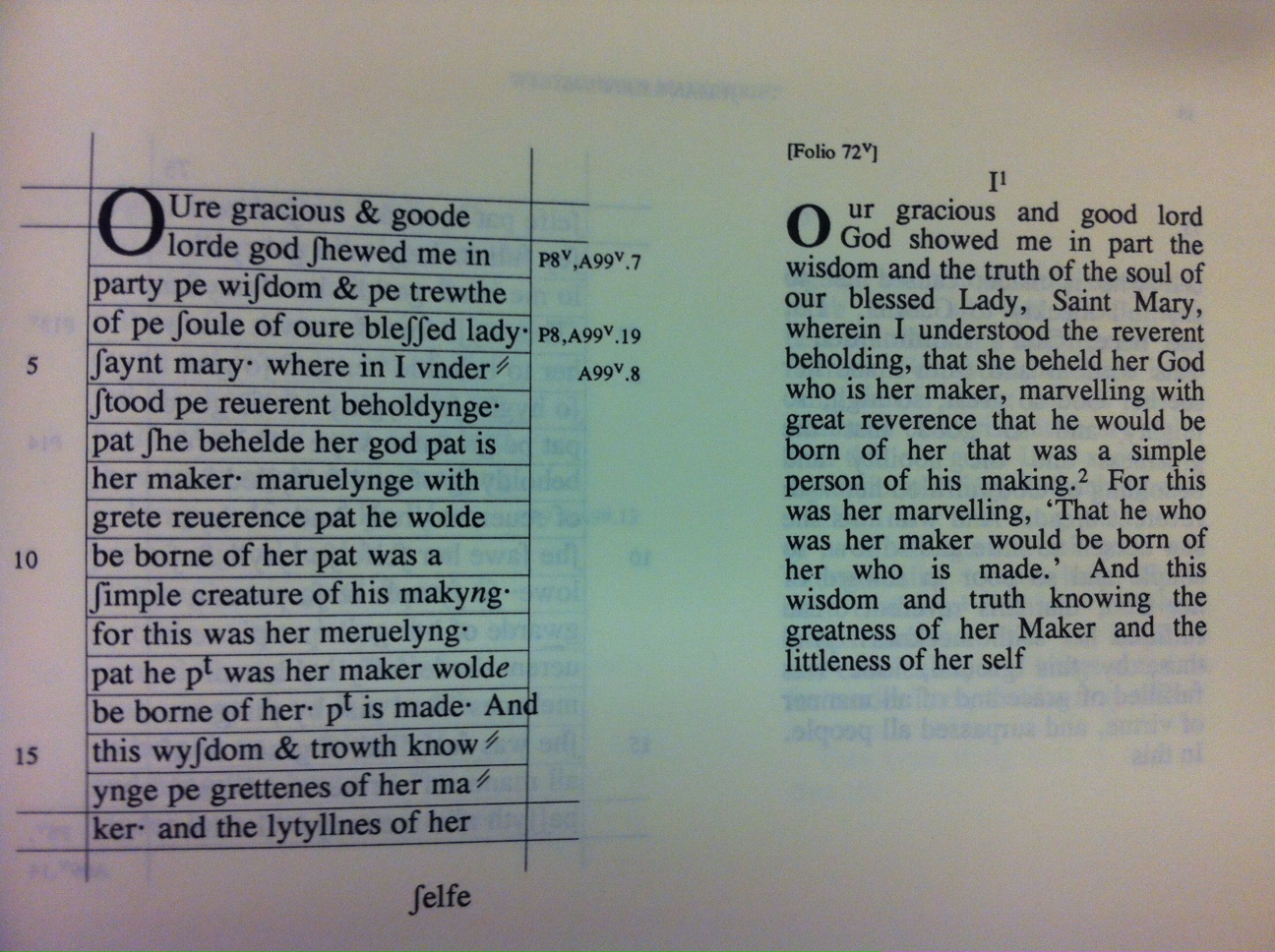
Barratt’s essay, “Julian Norwich and her Children Today: Editions, Translations, and Versions of her Revelations,” does also mention (and does describe somewhat) what Holloway and Reynolds have done. I’ll show more pages below from Reynolds and Halloway and Julian and her scribes before getting to Holloway’s composite translation, but here’s how Barratt describes what’s available to those wanting to read Julian in her originals:
There will, however, always be a place for translations for readers who cannot read Middle English. For those willing to attempt Julian’s texts in their original forms, there is now a huge choice of editions with varying editorial philosophies and extensive glosses, annotations, and/or glossaries. We could still use affordable editions with facing-page prose translations into Modern English that are not afraid to diverge quite markedly from the Middle English in order to render the linguistic nuances of the original. (Reynolds and Holloway provide modernizations, rather than translations, on the same page as “quasi-facsimile” editions of Westminster, Paris, and Amherst. [Nicholas] Watson and [Jacqueline ] Jenkins consider, and reject, the provision of translations as such, instead preferring extensive notes and paraphrase.) Such versions hardly sound like potential bestsellers, and indeed both Reynolds and Holloway’s monumental edition and Watson and Jenkin’s are expensive (190 Euros and $72 respectively), putting them beyond the reach of students or even of most general readers.
Holloway does anticipate the general and the educational needs of a more accessible edition, and this is what her paperback version with its composite translation offers. More on that in a moment. Here are the promised photos of pages of what Barratt calls “Reynolds and Holloway’s monumental edition”:
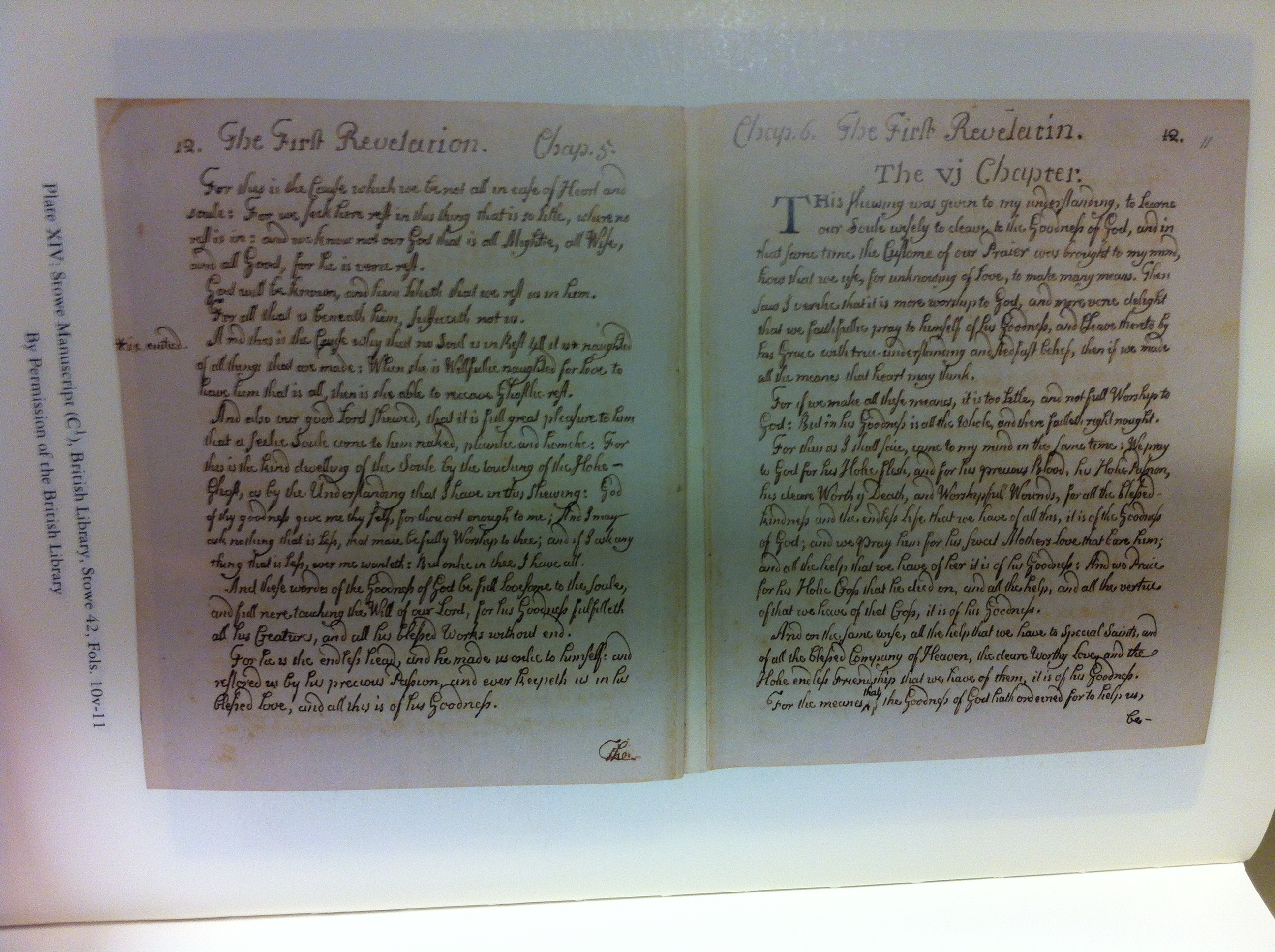
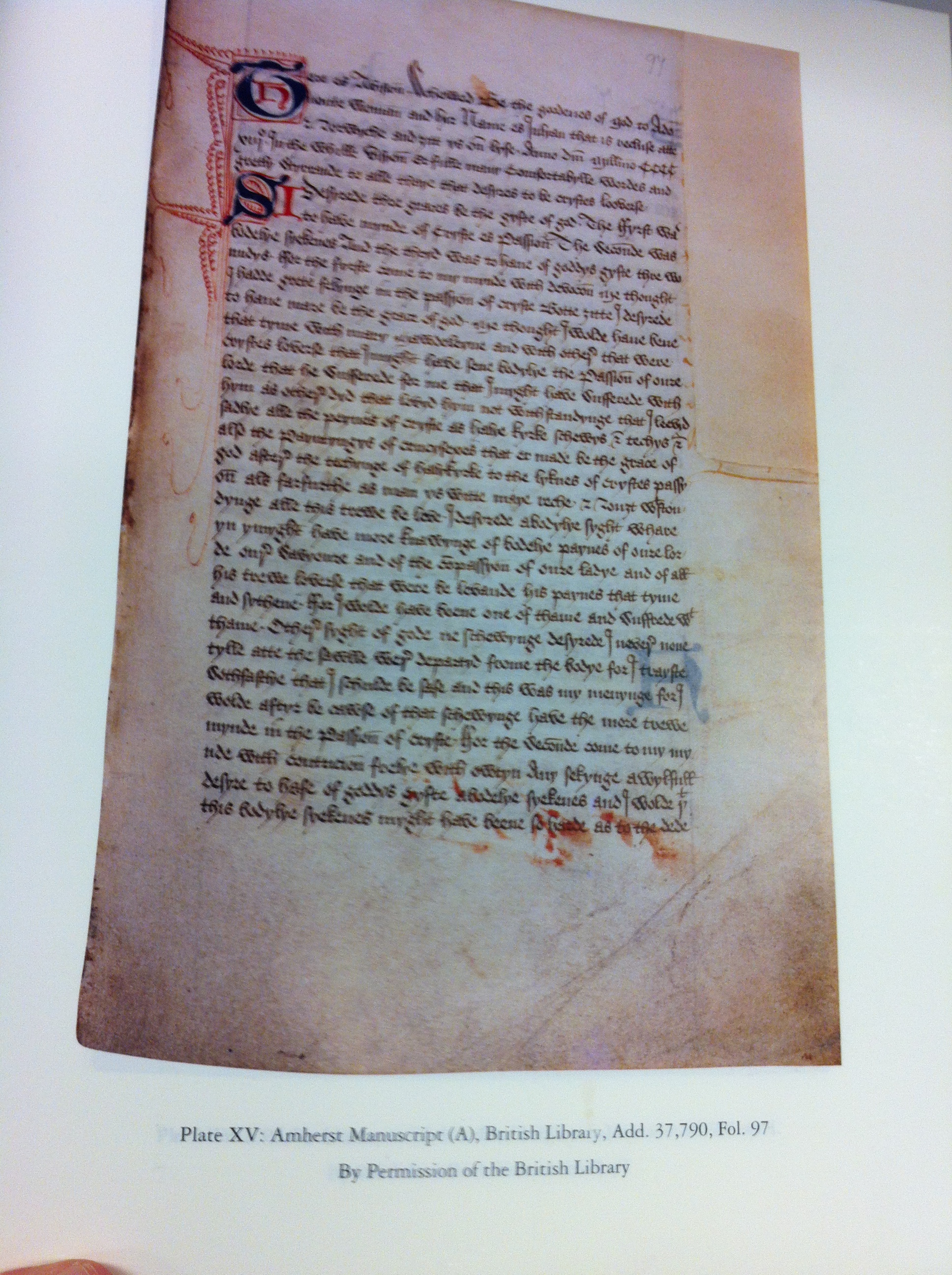
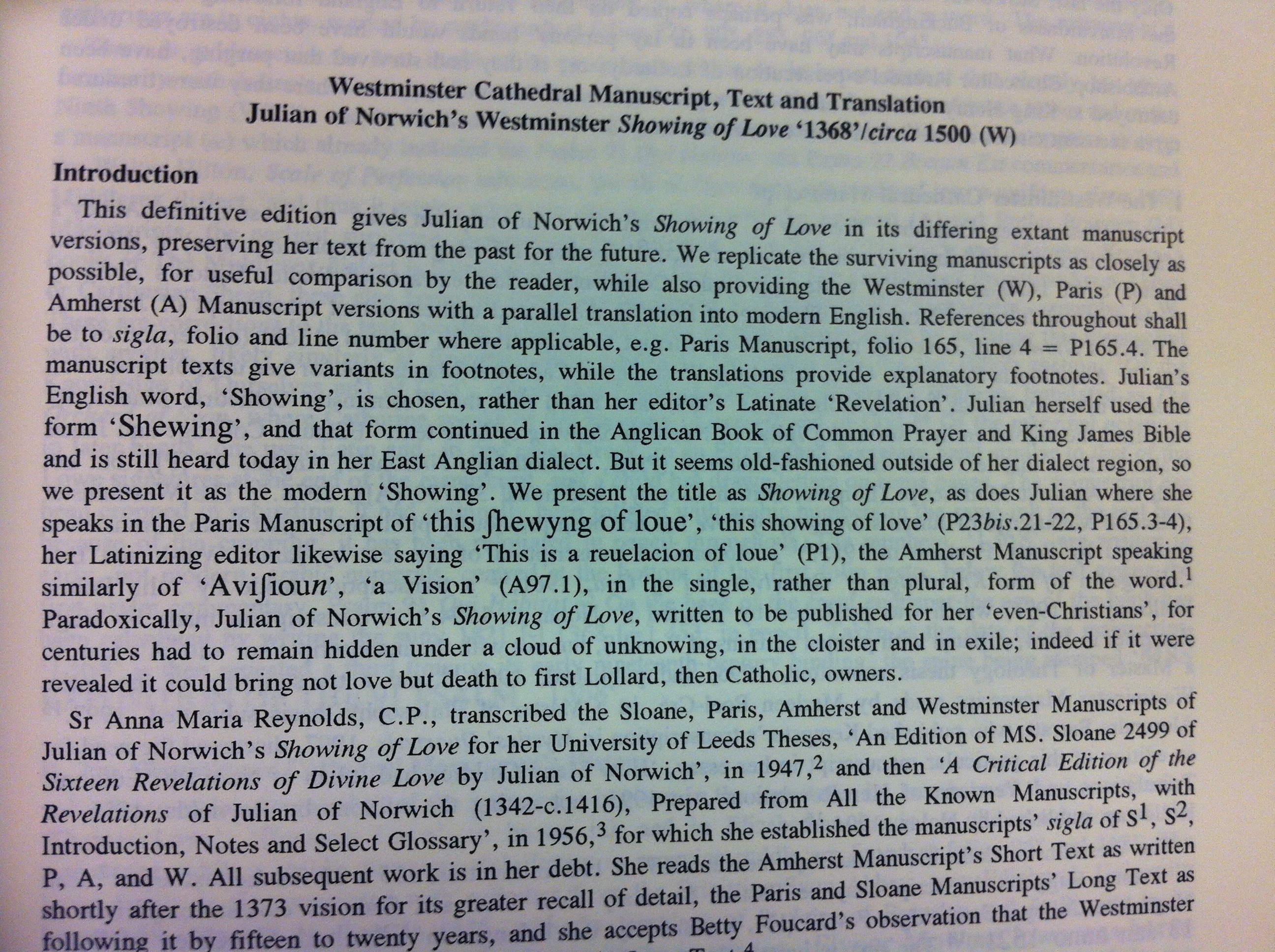
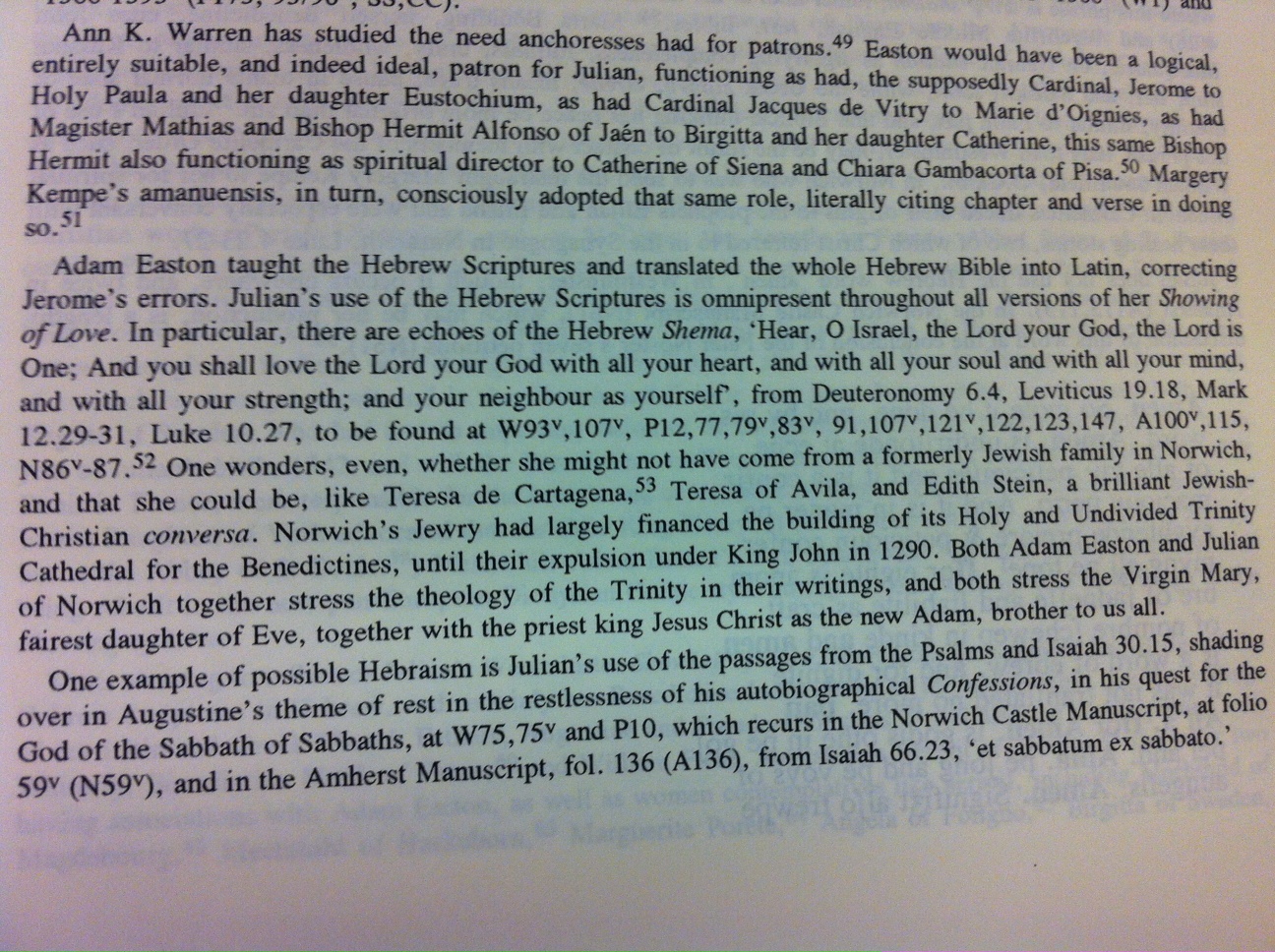
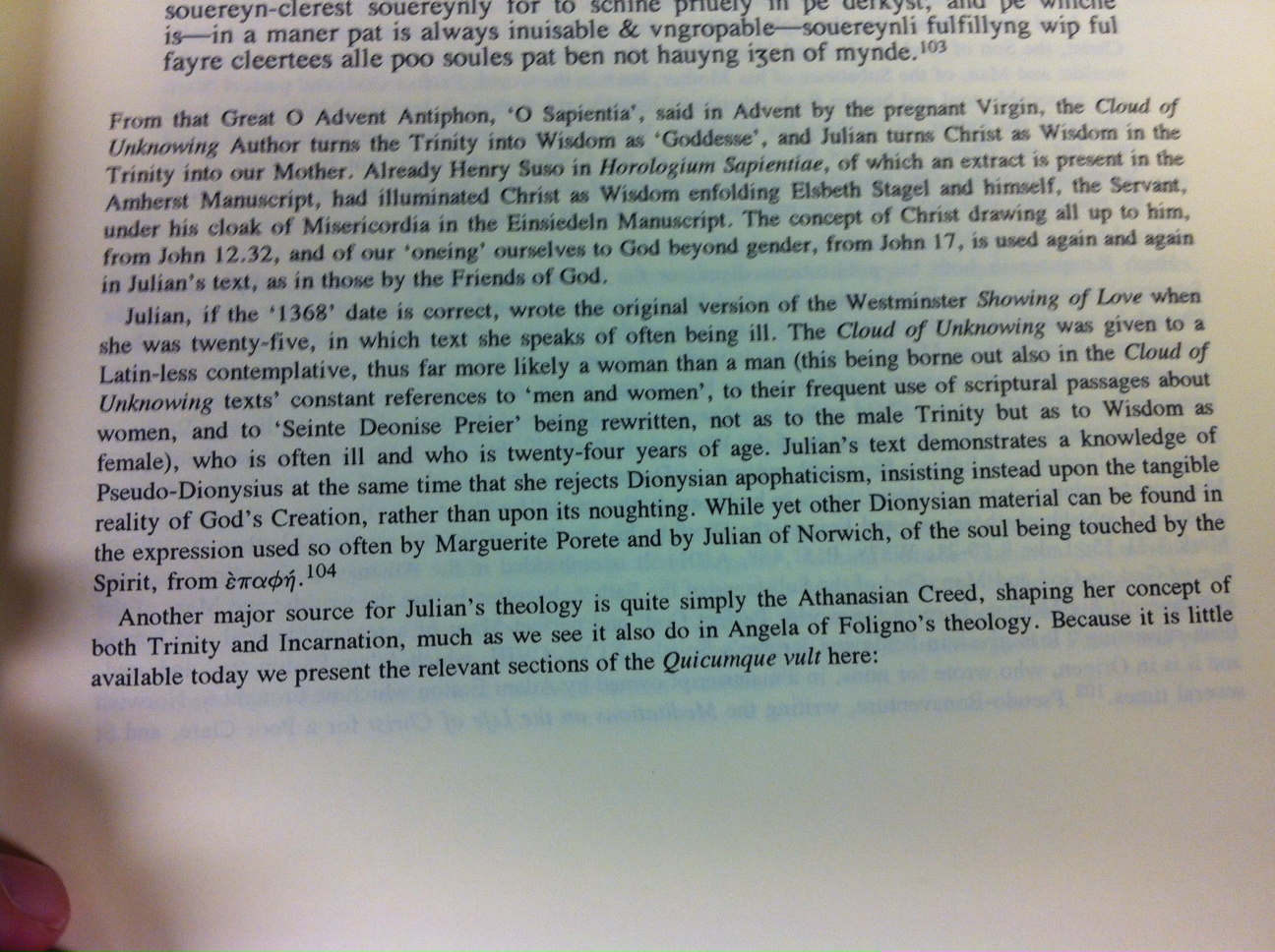
Now, because the Reynolds-Holloway-Julian volume is so inaccessible and for several other purposes, Holloway offers us readers more. In doing so, she explains what she means by “translating.”
Here’s again from her Preface to the affordable paperback and ebook formatted work, a beautiful edition I must add:
I have sought in this composite translation to remain as faithful to Julian’s English as possible. Both T. S. Eliot and Thomas Merton highly praised her writing. The manuscripts represent different dialects, Sloane being that of Julian’s own Norwich, Amherst that of the neighbouring Lincoln, Westminster and Paris being the London dialect. I have regularized these to [a] modern standard English. Grammar has shifted between her day and ours. Verbs and their agreement with nouns in Julian’s text can differ from our practices. The eighteenth century, on the model of [Aristotelian] logic, abolished the double negative as positive, requiring either one or the other, but not both. Consequently these are pruned to modern usage. In order to preserve the nature of Julian’s original text, words are translated usually into modern equivalents where they are no longer current coin, but sometimes the original word is employed to teach us what it was. We have one word for “truly,” while Julian has three, “soothly, verily, truly.” Usually I give our modern word, “truly,” but at times I employ her medieval words. I have retained her “holy Ghost” and “ghostly” for “Spirit” and “spiritual.” Her admiring male editor, who writes the Table of Contents, the chapter headings, and the elitist colophon, likes Latin words, such as “Revelations,” while Julian prefers Anglo-Saxon ones, like “Showing.” The manuscripts give “blissful, blessedful” as interchangeable one with the other. I have Amercianized some spelling, but kept her English “colour” and “honour.”
I do hope that gives readers a better sense of both what Julian translating and revising and what Julia Holloway compiling and translating Julian’s works are up to. Of course there’s more to explore of both. (Already my co-blogger Theophrastus have obviously been exploring together, in blogging, what might be the “translating” of Julian into modern English. And I hope it’s clear now that I was wanting to retain the ambiguity of the word translating, to keep all its ambiguities, as a useful term not only for Julian doing translation and then Holloway doing translation but also for all of us examining and re-exploring what we might mean by this English word, rendering older English into newer and Anglo-Saxon not so much into Latinate, for example.)
U.S. Presidents and the Flesch-Kincaid scale
In the United States, this is “Presidents’ Day” weekend. We all have our favorite presidents, but I’ll share that my favorite eight Presidents (before 1980) are Washington, Jefferson, Jackson, Lincoln, both Roosevelts, Wilson, and L. Johnson. (Ranking Presidents since 1980 seems risky, since we have not arguably had sufficient time to form a proper perspective on recent presidents.) I would argue that all of these presidents were brilliant – but according to The Guardian newspaper, they represent a general decline in the intelligence of Americans. On Tuesday The Guardian published an interactive infographic entitled: “The state our union is … dumber: How the linguistic standard of the presidential address has declined.” (The ellipsis is in the original title.)
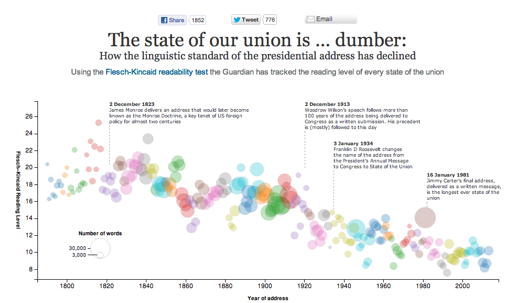
How did The Guardian reach this conclusion? It used something called the Flesch-Kincaid readability test built into Microsoft Word (you can find an online version of the test here) that purports to automatically give a grade level for text. Thus, Flesch-Kincaid argues that this very post is at grade level 14. The Guardian ran various Presidential State of the Union reports and addresses (the modern custom giving the State of the Union as a speech rather than as a written submission only gained traction with Woodrow Wilson) and noted a generally downward trend, from 22 with James Madison to 9 with George H. W. Bush.
The problem, of course, is that Flesch-Kincaid merely measures the lengths of words in a piece of prose, and the number of words in a sentence. It cannot possibly measure the complexity of the contents of a text (Flesch-Kincaid informs us, for example, that Wittgenstein’s Tractatus Logico-Philosophicus is merely on a sixth grade level) but rather, at best, measures sentence length. And, it is perhaps true, that with the growth of mass media (and thus a broader audience) that shorter sentence lengths have come into play – but one should not deduce from this that Americans are “dumber” than they were in 18th and 19th centuries. Perhaps the more correct inference would be that the Web has somehow infected journalists to report in a more shallow and outrageous fashion.
Hat tip: Popsci
Postscript: By the way, should you desire to read contemporary prose that scores artificially high on the Flesch-Kincaid scale, I can commend to you some of the writings of one of my acquaintances: Judith Butler:
The move from a structuralist account in which capital is understood to structure social relations in relatively homologous ways to a view of hegemony in which power relations are subject to repetition, convergence, and rearticulation brought the question of temporality into the thinking of structure, and marked a shift from a form of Althusserian theory that takes structural totalities as theoretical objects to one in which the insights into the contingent possibility of structure inaugurate a renewed conception of hegemony as bound up with the contingent sites and strategies of the rearticulation of power.
NOT translating Julian of Norwich
If you had the choice between Julian of Norwich’s mystical visions directly from her – or from a long series of non-mystic intermediaries who interpreted her – which would you prefer?
I want to read Julian’s words as directly as possible.
My co-blogger J. K. Gayle has produced one of his wonderful posts, and in part of the post he addresses a translation of Julian of Norwich by Julia Bolton Holloway. I have not read this translation, but given Kurk’s praise, I have little doubt that it is outstanding. In fact, I have never read a translation of Julian. Why not? Because for me – and for most native English readers – it is completely unnecessary – we can easily read Julian from the best surviving manuscript – the Paris Manuscript.
Norwich is a city in England, about 105 miles northeast of London. Julian wrote in English. To be more exact, she wrote in the Northern dialect of late Middle English – using relatively simple language. The earliest surviving complete manuscript of Julian’s long text is the Paris Manuscript, which dates from 1580. Here is an example:
Thus in oure Fader God almyghty we have oure beyng. And in oure Moder of mercy we have oure reformyng and oure restoryng, in whom oure partys be onyd and all made perfyte man. And by yeldyng and gevyng in grace of the Holy Gost we be fulfyllde. And our substaunce is in oure Fader God almyghty, and oure substaunce is in oure Moder God all wysdom, and oure substaunce is in oure Lorde God the Holy Gost all goodness. Four oure substaunce is hole in ech Person of the Trynyte, whych is one God. And oure sensuallyte is only in the Seconde Person, Crist Jhesu, in whom is the Fader and the Holy Gost. And in hym and by hym we be myghtly taken out of hell and out of the wrechydnesse in erth, and wurschypfully brought up in to hevyn, and blyssydfully onyd to oure substaunce, encresyd in rychess and nobly by all the vertu of Crist and by the grace and werkyng of the Holy Gost.
Norton famously publishes a series of critical editions of literary standards for college students – the Norton Critical Editions. The Norton edition of Julian (edited by Denise N. Baker) is based on the Paris text (albeit with modernized punctuation) is presented here (although, where appropriate, modern alphabetic substitutions are made: e.g., ȝ → gh, y or z; v → u; and j → i.) The Norton edition includes glosses, but not many are needed – most pages have between five and ten glosses (many dealing with contextual material rather than vocabulary and idiom changes) per page, and the pages are densely packed. The Norton also features “a glossary of frequently used words” but these number only about one hundred words.
Alas, this is not Julian’s original text. The Paris manuscript already features modernized 16th century vocabulary and changes Julian’s northern dialect to a southern dialect. It is likely based on a Tudor era manuscript from the 1530s – just before Henry VIII broke with Rome. As a result, Julian’s text becomes almost Early Modern English and particularly easy to read. Thus, even here, we are dealing with Julian as read by those who lived almost two centuries after her. But the text does not require further translation.
Needless to say, this text is also much easier to read than the most famous of the Middle English authors, Geoffrey Chaucer, in part because it is prose rather than poetry and does not include the extensive wordplay that Chaucer uses (not to mention his quotation and parodying of many different genres and English dialects.)
In addition to the Paris manuscript text, the Norton includes a full introduction, “contexts” (ten pages of brief excerpts from Julian’s short text, The Book of Margery Kempe, Augustine’s Trinity, Walter Hilton’s The Scale of Perfection, Aelred of Revaulx’s De Institutione Inclusarum, and Ancrene Wisse); modern commentary from Grace M. Jantzen, Lynn Staley Johnson, David Aers, Sandra J. McEntire, Joan M. Nuth, Caroline Walker Bynum, and B. A. Windeatt; and a bibliography. (Kurk mentioned Holloway and Anna Maria Reynold’s SIMSEL publication of transcripts – and that is in the bibliography; but Holloway’s translation is not mentioned in the bibliography.)
translating Julian of Norwich
The community of blogging, of reading, is just wonderful. For example, earlier in this year, my co-blogger Suzanne posted on “Women doing stuff” in which she mentioned how “Janet Soskice has written … The Kindness of God: Metaphor, Gender, and Religious Language.” Re-reading Soskice helped me recall the writings of Julian of Norwich. And recently, as my very limited spare time allows, I’ve been going to the library, looking at the wonderful works of Julia Bolton Holloway, one of the world’s leading experts on Julian of Norwich.
Holloway, co-writing with Joan Bechtold, and Constance S. Wright, has produced “Equally in God’s Image: Women in the Middle Ages … a volume of essays [by women and men] presenting the argument that with the coming of the universities women were excluded, in an apartheid of gender, from education and power.” And, fortunately, for those with online access but limited libraries or budgets to purchase such works, much of the work is online, here.
And, with Anna Maria Reynolds, Holloway has published, Julian of Norwich’s Showing of Love: Extant Texts and Translation. There’s lots to glean from this substantial volume. For instance, here’s a page showing pages from this one edition of Showing of Love:
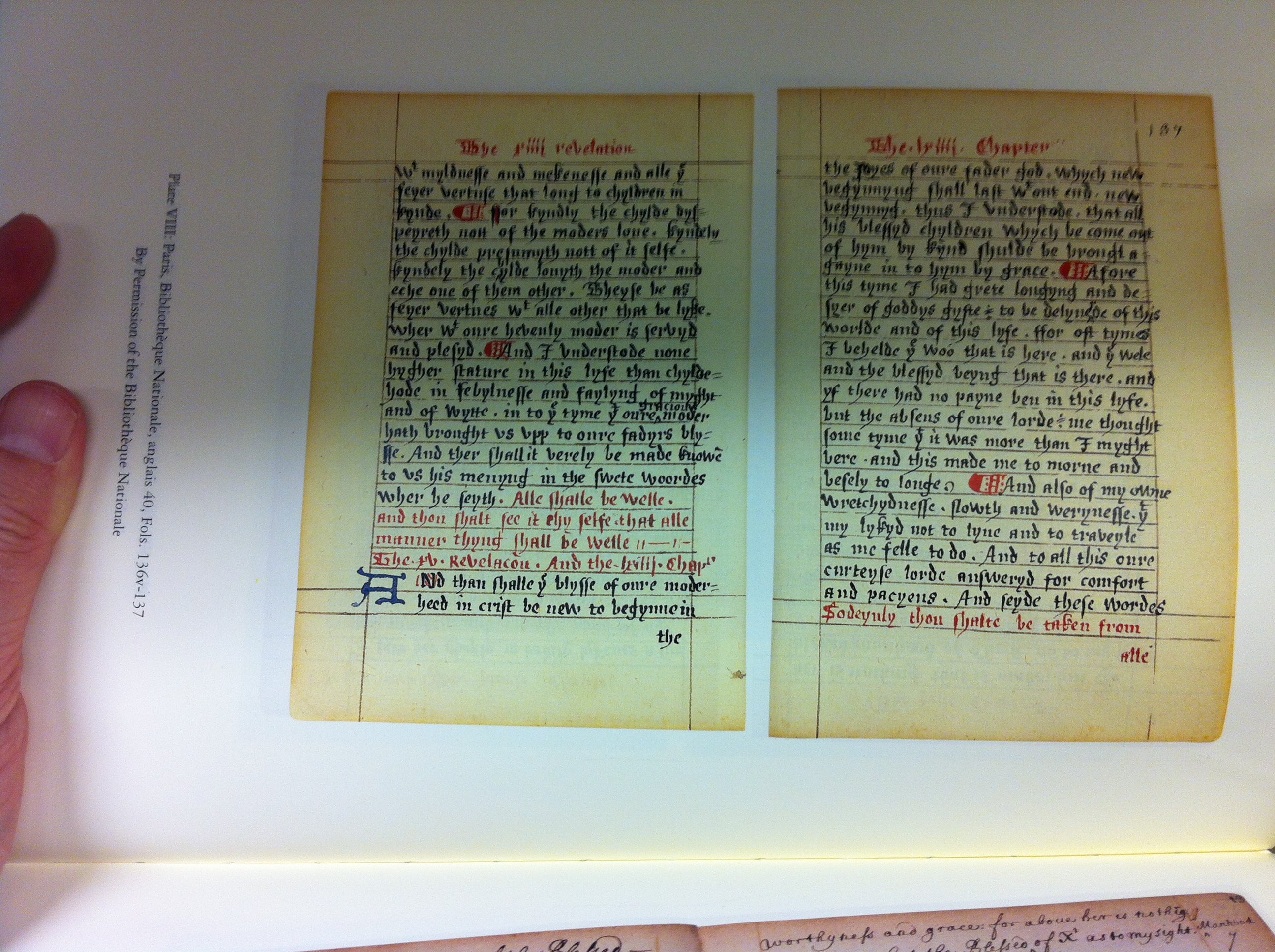
Each of the various extant manuscripts as differently edited and redacted by multiple individuals is given its own translation by Holloway.
Julia Bolton Holloway, then, gives readers a single translation of all of these various manuscripts in much more affordable and accessible book than this larger volume (shown above). In the smaller paperback version, Holloway “seeks to replicate as far as possible that original glory of Julian’s manuscripts.” She explains:
Most modern editions and translations transform a manuscript text into something new and strange, like a black-and-white photograph of what once was in reds and blues and with gold leaf upon purple, reducing it from its former glory and memorability into something ordinary and easy to forget…. This translation functions as a platform from which it becomes possible to see the whole while showing the layering of text throughout the many years of Julian’s lifework.
You can find this statement in an online google books format here. I’m about out of time, but I’d encourage you to read the whole statement VI. On This Composite Edition and Translation to the end of the preface. What I really appreciate are observations such as “In her writing she [Julian] seeks to reconcile the theologies of [Adam] Easton and [John] Wyclif; today she would seek to reconcile men and women, Jew and Christian, Ireland and England, Rome and Canterbury. We need her Apocalypse, her Revelation, her Showing of Love more than ever.”
At her websites, Holloway gives us more. She explains what she herself had been seeking when beginning to find Julian and her Showings; the work of the woman of Norwich was a translation in part, and one from the Hebrew Bible:
I was needing to study Hebrew. Elizabeth Barrett Browning, whom I was editing for Penguin, had been proficient in Hebrew as a child. At the same time, I was editing the manuscripts of Julian of Norwich in my convent. And I suddenly became aware that often in her texts Julian showed direct knowledge of that language, for instance in not translating *
shalom, ‘peace, well-being, in all things’, ‘and all shall be well’, as had Jerome, with Latin recte, or Wyclif, with Middle English ri3t, but with ‘And all manner of thing shall be well’. I then found other instances, which I discuss later in this talk. I came to suspect that she was of Jewish ancestry but I could not go to Norwich for many years to investigate whether there were conversi to Christianity who remained in that city after King John had banished all Jews from England in 1290. In 2005, I was finally able to sit in Norwich’s Library with their copy of V.D. Lipman’s The Jews of Medieval Norwich (London: Jewish Historical Society, 1967), in front of me, taking copious notes, particularly on the conversi who remained in England and in Norwich following that expulsion.
Considering Julian of Norwich’s language, Julia Holloway explains her own for the translating:
n translating Julian of Norwich’s Showing of Love in 1991 from the Syon Abbey manuscript owned by Westminster Cathedral and now on loan to Westminster Abbey, her own English words were kept, rather than translating them into our Latinate forms, her ‘oneing’ instead of our ‘uniting’, her ‘noughting’ instead of our ‘negating’, her ‘endlessness’ instead of our ‘eternity’. Somehow the Latin hides their meaning into its foreignness. The English words’ truth, though now so unusual that they seem foreign, are actually closer to what we mean. Also, Julian’s theological concepts can have a very modern ring. Computers, like brains and noughts and crosses games, generally simply ‘one’ and ‘nought’ their way through problems. Julian’s ‘oneing’ is one’s shaping oneself to that of God, ‘noughting’ the opposite of ‘oneing’, as evil, which therefore does not exist. Her ‘endlessness’ is of God, who is all time, but smaller and smaller bits of time, like death, are of ‘noughting’….
Julian thus spent her whole life writing this book. From the age of fifty on she lived as a Solitary, an Anchoress, in an anchorhold at St Julian’s Church, Norwich, probably dressed in the black of a Benedictine nun, for she may have earlier been at Carrow Priory, and she gave counsel to troubled people, like Margery Kempe from Lynn. In all these versions, except the last, Julian gives passages from the Bible in her Middle English, from Isaiah, from Jonah, from the Epistles and much else, but she dare not do so in the 1413 version when to own or use John Wyclif’ s translation of the Bible into English would have caused one to have been burnt at the stake as a Lollard heretic. Strangely she uses neither Jerome’s Latin Vulgate nor Wyclif’s Middle English, the evidence being that she has access to the Hebrew of the Scriptures, likely gained through Cardinal Adam Easton who had taught the Hebrew Scriptures at Oxford and who had translated them into Latin, correcting Jerome’s errors. But she is not an elitist scholar. Her last word in her last version is the Lollard term, one’s ‘even Christian’, one’s neighbour as one’s equal in the eyes of one’s Creator
What is of great interest to me is that Julian of Norwich would translate Hebrew, for herself, when it was so risky. What is of great appreciation to me is that Julia Holloway would translate Julian’s English not into Latinate that might make readers today more comfortable but in a more “foreign” English that is closer to us somehow:
“Somehow the Latin hides their meaning into its foreignness. The English words’ truth, though now so unusual that they seem foreign, are actually closer to what we mean. “
The horse’s mouth and the ESV
If you hear something from the horse’s mouth, you hear it directly from the person concerned or responsible. That’s what they say.
I received an email today asking, “about the claims (at WORLD Mag and by Ben Witherington) that the ESV was essentially put together to oppose aspects of the translation of the then-upcoming TNIV.”
Apparently some are puzzled since the Crossway blog records the facts on their blog, saying,
The real origin of the ESV Bible goes back to the early 1990s, long before the gender-language controversy, when Crossway’s president, Dr. Lane T. Dennis, talked to a number of Christian scholars and pastors about the need for a new literal translation. He found a hunger for a Bible that conveyed the majesty and dignity of God’s Word, a Bible both accurate and beautiful.
The ESV developed from this perceived need, not as a reaction to other Bible publishers’ doings or to meet the Colorado Springs Guidelines.
However, Jim Packer, who was the general editor of the ESV at the time that it was first published, put it this way,
James I. Packer of Regent College in Vancouver served as general editor and chair of the 12-member Translation Oversight Committee. He recently told CC.com the translation grew out of discontent with other modern translations — which, he asserted, tend to “deviate from what was said in several thousand places,” in the interests of lucidity or easy readability.
In particular, he said, there was discontent with translations such as the New Revised Standard Version (NRSV) and Today’s New International Version(TNIV) which make such deviations to achieve gender-neutral renderings.
There are also numerous posts on the Bayly blog describing the origins of the ESV. In this post, the Bayly brothers cite an email from Wayne Grudem, dated May 1997, the same month as the Colorado Springs Guidelines meeting.
Date: May 1, 1997
To: (members of the working group, including Joel Belz, Tim Bayly, etc.)
From: Wayne GrudemIn a message dated 97-05-01 14:22:49 EDT, you write:
<<Do you really think another version is possible? It is an enormously expensive and consuming ambition.>>
… Another possibility is getting permission to redo either the old RSV (by changing Thee and Thou, and maybe 5 or 10 places where OT Messianic prophecies were blurred) or the NRSV (by undoing the gender-neutral language). Bruce Metzger himself might be interested in that… The RSV copyright is owned by the National Council of Churches.
A third possibility is a new translation. But a really good one will look a lot like a sanitized RSV or a slightly more readable NASB. And the NASB has to change its name to gain acceptance in the rest of the English speaking world…
How could Wayne Grudem, Jim Packer and the other members of the team have worked on publishing a new version of the English Bible because of “discontent with” the NRSV and TNIV, but “not in reaction” to these Bibles? The Bayly brothers have posted on this topic also here, here, here, and here.
I have no idea why Packer would say that “the producers were very careful to not make extravagant claims or get into a competition with other translations.” Of course they did! The producers, that is Grudem and crew claimed that the TNIV was wrong in 3,600 different places. I find that extravagant. [And in this interview Packer also has just said that the TNIV deviates “from what was said in several thousand places.” Isn’t that an extravagant claim? Okay, this reminds me of the time my 4 year-old stole some lipstick, smeared it all over her face, and then proceeded to tell me that she had not taken any lipstick. It’s rather cute when one is 4 years old.]
After this mess, after talking the whole thing over with Jim Packer, I left the evangelical community for good. The only thing that makes it possible for the Crossway blog to say what they said is that the ESV was produced as a response to an earlier version of the TNIV, called the NIVI , published in the UK, and not the TNIV. However, Packer did not differentiate between the TNIV and the NIVI.
It is as if Crossway had fingers crossed under the table. But Grudem also denied that the ESV was in response to the TNIV. He wrote on Justin Taylor’s blog the following,
Dear Ben,
Regarding your blog about the ESV Bible on Feb. 20th, 2006, I suspect I am the “one particular scholar” to whom you refer in your second paragraph. …
But contrary to what you reported from your friend on the TNIV committee (which I think was his speculation), the ESV grew out of the appreciation of many scholars for the merits of the old RSV and a desire to see it updated, and not out of opposition to the TNIV Bible. The reason for my own involvement with the ESV was a long-standing desire to see an updated RSV, and had little or nothing to do with the TNIV controversy.
Therefore, Grudem is claiming that on the one hand, in May of 1997, he was working on a new revision of the RSV, and in the same month he headed up a campaign against the TNIV, and the drafting of the Colorado Springs Guidelines; but in fact, these things had little or nothing to do with each other. It’s hardly bearable.
This is one of those request posts!
It’s Lent Madness time again!
You may remember a couple of posts last year about Lent Madness, which Theophrastus described as
a popularity poll among famous historical Christian figures. . . structured after the NCAA Men’s Basketball “March Madness.”
Well, it’s that time again: Lent Madness started today, and it’s not too late to decide to play along. I’ll be lobbying for my favorite saints occasionally on my own blog, but figured I would mention it here to kick off the season. (And it’s not too late to vote in the first round — I’m supporting Macrina the Younger).
Although this is most definitely a light-hearted, even irreverent, activity, it also really is a Lenten devotion, as the Lent Madness Supreme Executive Committee explained with these beautiful words on Ash Wednesday:
We can learn much from those who have come before us as faithful witnesses to the Gospel. And they always seem to come back to this: “Love God, love neighbor.” Each one of these holy men and women did just that in their own time and in their own circumstances and they can inspire us to do the same in our own day. Like us, the saints weren’t perfect — but it’s freeing to remember that perfection isn’t the goal but faithfulness. Lent Madness helps make real these heroes of the faith by reminding us that they were living, breathing human beings not lifeless statues or distant figures immortalized yet immobilized in stained glass.
If you observe the season, I wish you a blessed Lent.
“Pope gives God two weeks’ notice”
Here is how the New York Post covered Benedict’s announcement.

Security of the papal election
Sincere warm wishes to Joseph Ratzinger as he prepares for the next phase of his remarkable career.
In every major election cycle, it seems that there are news releases about election fraud. As you might suspect, though, the papal election process is uncommonly good, and resilient to tampering. The major rules are set forth in John Paul II’s 23 February 1996 Universi Dominici Gregis (and were amended on 11 June 2007 by Benedict XVI’s motu propio De Aliquibus Mutationibus in Normis de Electione Romani Pontificis.
Bruce Schneier wrote a summary of the security of the papal election back in 2005; here are some excerpts:
The election takes place in the Sistine Chapel, directed by the Church Chamberlain. The ballot is entirely paper-based, and all ballot counting is done by hand. Votes are secret, but everything else is done in public.
First there’s the “pre-scrutiny” phase. “At least two or three”" paper ballots are given to each cardinal […], presumably so that a cardinal has extras in case he makes a mistake. Then nine election officials are randomly selected: three “Scrutineers” who count the votes, three “Revisers,” who verify the results of the Scrutineers, and three “Infirmarii” who collect the votes from those too sick to be in the room. (These officials are chosen randomly for each ballot.)
Each cardinal writes his selection for Pope on a rectangular ballot paper “as far as possible in handwriting that cannot be identified as his.” He then folds the paper lengthwise and holds it aloft for everyone to see.
When everyone is done voting, the “scrutiny” phase of the election begins. The cardinals proceed to the altar one by one. On the altar is a large chalice with a paten (the shallow metal plate used to hold communion wafers during mass) resting on top of it. Each cardinal places his folded ballot on the paten. Then he picks up the paten and slides his ballot into the chalice.
If a cardinal cannot walk to the altar, one of the Scrutineers – in full view of everyone – does this for him. If any cardinals are too sick to be in the chapel, the Scrutineers give the Infirmarii a locked empty box with a slot, and the three Infirmarii together collect those votes. (If a cardinal is too sick to write, he asks one of the Infirmarii to do it for him) The box is opened and the ballots are placed onto the paten and into the chalice, one at a time.
When all the ballots are in the chalice, the first Scrutineer shakes it several times in order to mix them. Then the third Scrutineer transfers the ballots, one by one, from one chalice to another, counting them in the process. If the total number of ballots is not correct, the ballots are burned and everyone votes again.
To count the votes, each ballot is opened and the vote is read by each Scrutineer in turn, the third one aloud. Each Scrutineer writes the vote on a tally sheet. This is all done in full view of the cardinals. The total number of votes cast for each person is written on a separate sheet of paper.
Then there’s the “post-scrutiny” phase. The Scrutineers tally the votes and determine if there’s a winner. Then the Revisers verify the entire process: ballots, tallies, everything. And then the ballots are burned.[…] [Bruce Scheneier here comments on the famous black or white smoke, though my recollection was that in 2005, the bells of St. Peter’s Basilica were rung instead]
[T]he rules explicitly state that the chapel is to be checked for recording and transmission devices “with the help of trustworthy individuals of proven technical ability.” I read that the Vatican is worried about laser microphones, as there are windows near the chapel’s roof.[…]
A cardinal can’t stuff ballots when he votes. The complicated paten-and-chalice ritual ensures that each cardinal votes once – his ballot is visible – and also keeps his hand out of the chalice holding the other votes.[…]
Ballots from previous votes are burned, which makes it harder to use one to stuff the ballot box.[…] [T]here’s one wrinkle: “If however a second vote is to take place immediately, the ballots from the first vote will be burned only at the end, together with those from the second vote.”[…] And lastly, the cardinals are in “choir dress” during the voting, which has translucent lace sleeves under a short red cape; much harder for sleight-of-hand tricks.[…]
The recent change in the process that lets the cardinals go back and forth from the chapel into their dorm rooms – instead of being locked in the chapel the whole time as was done previously – makes the process slightly less secure. But I’m sure it makes it a lot more comfortable.[…]
[W]hen an election process is left to develop over the course of a couple thousand years, you end up with something surprisingly good.
Tim Parks on translating Jabberwocky and the Bible
Last week, Tim Parks blogged at the New York Review of Books on translation, putting forward his theory:
[T]here is a natural tendency towards rhythm, alliteration, and assonance when one writes even the most ordinary prose, and that editing to conform to the linguistic conventions of a different culture can interfere with this. The translator gives priority to the semantic sense, but that sense was also partly guided in the original by what one might call the acoustic inertia of the language.
He points to some examples notice largely monosyllabic p’s and h’s in this sentence from Joyce’s The Dead:
It hardly pained him now to think how poor a part he, her husband, had played in her life.
or “D. H. Lawrence in Women in Love describing the combative Gudrun’s encounter with an equally combative rabbit, Bismark” (notice the parallelism between Gundrun and Bismark suggested by the repetition of the word “thrust” and how “lusty” ties them together):
They unlocked the door of the hutch. Gudrun thrust in her arm and seized the great, lusty rabbit as it crouched still, she grasped its long ears. It set its four feet flat, and thrust back.
But for his main argument, Parks points to the opening of Lewis Carroll’s “Jaberwocky”:
‘Twas brillig, and the slithy toves
Did gyre and gimble in the wabe:
All mimsy were the borogoves,
And the mome raths outgrabe.
According to Parks:
The comedy of the poem is its reproduction of a range of acoustic and rhythmic strategies that the reader immediately recognizes as typical of a certain kind of poetry, but with nonsense words. The suggestion is that all such poetry is driven to a degree by the inertia of style and convention, that the sound is as decisive as the sense in determining what gets said; indeed, when we “run out of sense” the sound trundles on of its own accord. But how could one begin to translate “mome raths outgrabe”? We have no idea what it means. The only strategy would be to find an equally hackneyed poetic form in the translator’s language and play with it in a similar way. Liberated by the fact that many of the words don’t have any precise meaning, the translator should not find this impossible, though whether strictly speaking it is now a translation is another issue. Here is a heroic Italian version by Milli Graffi:
Era cerfuoso e i viviscidi tuoppi,
Ghiarivan foracchiando nel pedano
Stavano tutti mifri i vilosnuoppi,
Mentre squoltian i momi radi invano.In general, however, what we find is a reproduction of the sense, but with a much diluted intensity of the Jabberwock effect. Contrary to Frost’s notion that “poetry is what gets lost in translation,” we might say that what we won’t find in translation is this lively, often undiscriminating, pattern of sounds, an ancient enchantment, which the best writers can integrate with their creativity and the worst simply allow to take over the show, as in the marvelously poor poetry of William McGonagall:
Beautiful Railway Bridge of the Silv’ry Tay!
Alas! I am very sorry to say
That ninety lives have been taken away
On the last Sabbath day of 1879,
Which will be remember’d for a very long time.
(If you are interested in reading the remarkable effect of McGonagall’s terrifyingly bad poetry, look here for the full poem – which has an [unintentionally ironic] title “The Tay Bridge Disaster.” Be sure to keep you eyes’s peeled “for the striking moral in the final couplet.”)
Parks finally calls out the issue of Biblical translation:
Translated texts, then, and there are ever more of them in the world today, tend to be cooler, a little less fluid—they will operate more on the rational intellect than on the rhythm-wired senses. They will deceive you less and charm you less. Of course there are notable exceptions, texts which were translated with the seduction of the reader and the beauty of the language very much in mind. Where these are old and central to our culture—the Bible, most remarkably—they can become canonical on a par with our home-grown writing. But there really are remarkably few of them.
It is clear from context that Parks is speaking here of the literary phase of Biblical translation – Tyndale and KJV – rather than the “cooler” translations contemporary translators have given us.


 BLT
BLT 