the Gender Inclusivity of Jesus in Mark
This morning, I’m reading the gospel of Mark, chapter 2, and come to this Greek translation of something Jesus said and find that this translation is gender inclusive. Some may object that the Greek gospel writer is not really translating; rather, they would correct me to say that he’s simply narrating in Hellene, using Greek to tell the story for readers to read.
At the very least, I think we might all agree that he’s at least transposing; that is, he’s putting spoken Greek into written form. And at the very least, I don’t believe anyone would have trouble thinking of the quotation attributed to Jesus as including some transliterating; that is, he’s having Jesus say a Hebrew phrase (שַׁבָּת) as if he’s pronouncing it with this Greek accent (σάββατ*). This is the very thing that the translators in Alexandria, Egypt do when translating the Hebrew scriptures, Torah, into Hebraic Hellene, the Pentateuch; this is what we all know as the Septuagint (or LXX to use the Latin numbers to describe this translation by some 70 translators, according to the lore). For example, the LXX translators made what we call Exodus 20:10 include the Hebrew sounds with Greek letters for a particular word. When we use the English Standard Version to see the meanings of the Hebrew, then that verse goes as follows:
but the seventh day is a Sabbath (שַׁבָּת) (σάββατ*) to the LORD your God.
On it you shall not do any work,
you, or your son, or your daughter,
your male servant, or your female servant,
or your livestock, or the sojourner who is within your gates.
Where the ESV translators put Sabbath, the LXX translators put σάββατα. Presumably, Moses is speaking a demotic Hebrew to the people. Presumably, Moses too has written this down in high holy Hebrew (not so demotic). So if the Masoretic Text has his words right, then what readers really hear is something the phrase already mentioned, as best as anyone can say it today: שַׁבָּת.
So we fast forward a century and, notes historian Sylvie Honigman, “[w]ith time, familiarity with the [Greek] text grew.” And she goes on, saying, “Alexandrian and Egyptian Jews would slowly come to hold the LXX as sacred – at least as sacred as the Hebrew original.”
So there are Hebraisms in the Hellene, and these are read as holy. It’s the Greek translation of the Law or the Teachings of Moses. And the little bit we already looked at is already pretty inclusive language. We’ve only really looked at it in the English Standard Version. Let’s look now at the LXX sacred version, sacred for the Alexandrian and Egyptian Jews, about one century after the translation of the Hebrew of Moses. When it’s seen as sacred, it’s probably around 160BCE. This would also be about two centuries before Mark quotes Jesus and uses Greek to do so. When Mark writes, it’s probably still sacred in Alexandria among the Jewish community there. It goes like this:
τῇ δὲ ἡμέρᾳ τῇ ἑβδόμῃ σάββατα κυρίῳ τῷ θεῷ σου
οὐ ποιήσεις ἐν αὐτῇ πᾶν ἔργον
σὺ καὶ ὁ υἱός σου καὶ ἡ θυγάτηρ σου
ὁ παῖς σου καὶ ἡ παιδίσκη σου
ὁ βοῦς σου καὶ τὸ ὑποζύγιόν σου καὶ πᾶν κτῆνός σου καὶ ὁ προσήλυτος ὁ παροικῶν ἐν σοί
So let’s just fast-forward to Jesus speaking English Standard (as translated from Mark’s Greek, which may be influenced by the LXX, which is clearly a translation of some Hebrew like the MT):
The Sabbath was made for man,
not man for the Sabbath.So the Son of Man is lord
even of the Sabbath.
What’s striking is how gender inclusive the ESV-speaking Moses is (in Exodus) but how gender exclusive the ESV-speaking Jesus is (in Mark).
When we read in Hebrew, however. When we read in Hebraic Hellene, nonetheless. When we get this in English, otherwise, then something remarkable happens. Jesus sounds as gender inclusive as Moses.
Behold. Listen:
Τὸ σάββατον διὰ τὸν ἄνθρωπον ἐγένετο
καὶ οὐχ ὁ ἄνθρωπος διὰ τὸ σάββατον·ὥστε κύριός ἐστιν ὁ υἱὸς τοῦ ἀνθρώπου
καὶ τοῦ σαββάτου.
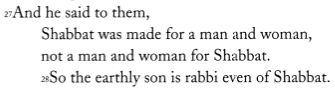
Now look. Hear as Robert Alter and then Willis Barnstone respectively render into English the words of Moses and the words of Jesus:

Then see. Give ear to how Evertt Fox and then Ann Nyland respectively translate the Mosaic scripture and the Markan gospel:
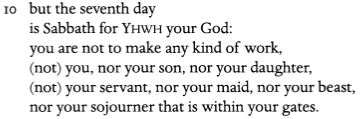

If you’ve visited this blog before, then you know how my co-bloggers and I tend to be interested in this Greek word, ἄνθρωπος /anthropos/. It shows up here in the Greek gospel of Mark, in the mouth of Jesus. The men of the ESV translation team make Jesus say “man.”
Barnstone makes him say “a man and woman” and “the earthly son.” This is to show both the inclusivity of Moses and also the inclusivity of Homer. It’s the gender inclusivity of Mark’s Jesus.
Nyland makes him say “the person” and “the Human Being.” This is to show the inclusivity of the Hebrew and of the Hellene.
Nyland, like Barnstone does, recognizes the humility of the Greek phrase ἄνθρωπος too; the writer Mark and the speaker Jesus are not referring to gods or to G-d. They’re not referring to deity until he is called “Master,” and Barnstone thinks they may even only be referring late to “rabbi.”
And so my point is that English can bring out the humanity, the maleness and also the femaleness, that Jesus is referring to when he refers to the people that “Sabbath” or “Shabbat” is made for, that he is in Mark’s gospel rabbi or Master of.


 BLT
BLT 
Trackbacks