Norwich’s entertaining history of the papacy
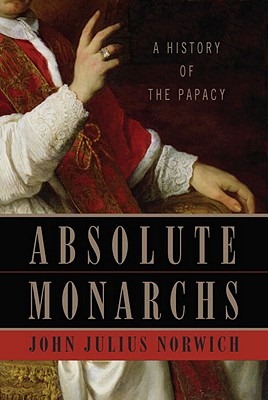 John Julius Norwich is best known as the popular author of a trilogy of histories about Byzantium. While his historical work is not scholarly (which is an advantage in many ways – it means that he does not feel obliged to offer new theories), it is entertaining and well-written. His latest book, Absolute Monarchs: A History of the Papacy is no exception to this rule. Norwich (who holds the rank of second viscount and CVO in Britain) writes as a non-Roman Catholic and a non-religious writer.
Although Norwich writes a complete overview (focusing on social and political impact of the papacy), he sometimes takes most delight in naughty stories. Thus he devotes an entire chapter to the cross-dressing “Pope Joan” who reportedly was discovered when she gave birth. He gives as evidence an account of the chaise percée reportedly developed in response to this scandal, quoting Felix Haemmerlein’s De Nobilitate et Rusticitate Dialogus:
up to the present day the seat is still in the same place and is used at the election of the pope. And in order to demonstrate his worthiness, his testicles are felt by the junior cleric present as testimony of his male sex. When this is found to be so, the person who feels them shouts in a loud voice, “He has testicles!” And all the clerics present reply, “God be praised!” Then they proceed joyfully to the consecration of the pope-elect.
Norwich goes a bit too far in his discussion of this point (he believes he may have identified the exact chair in question in the Vatican Museum) :
It has indeed a hole in the seat, cut in the shape of a huge keyhole; more curious, however, is the angle of the back, some forty-five degrees to the vertical. One would indeed sit on it “as though lying down”; it could not possibly serve as a commode. One explanation that has been put forward is that it was originally intended as an obstetric, or “birthing” chair (“closing and opening, binding and loosing”?) and that it was used in the coronation ceremony to symbolize the Mother church. It cannot be gainsaid, on the other hand, that it is admirably designed for a diaconal grope, and it is only with considerable reluctance that one turns the idea aside.
Norwich covers various schisms and anti-popes with admirable focus; and argues for the Pope as a social and political leader in the West. He gives a chilling account of Pius XII’s refusal to speak out against the Nazi’s mass murder – even during the transport of the Jews of Rome to the death camps.
Norwich’s book is serious, but also filled with entertaining passages. It is certainly a distracting weekend read.


 BLT
BLT 
I have read this book for the very passages you quote. My recent work includes my painting of Pope Joan. Thanks for your review. My series should be online early next year.
Wouldn’t including so much space about “Pope Joan” be a serious mark against the book? The stories that attest to her existance are centuries later than any proposed regnal dates (and they are inconsistent avout when she should have been pope) and historians generally view it as fictitious.
LAB — looking forward to your series.
Francesco — yes, you are right; and Norwich takes both sides — both retelling the story with glee while maintaining that it is a “hoary” tale.