Eisenstein’s Ivan the Terrible
Although vodcasts seem good in theory, who has the time to watch them? One vodcast that I do make time for is one by Richard Brody (of the New Yorker magzine): DVD of the Week. In this three-minute weekly vodcast, Brody selects a few scenes from some film available on DVD (sometimes it is a little hard to track down, though) and uses them to illustrate some point about film history or film theory. It is a little bite-sized lesson, perfect for the Internet era.
This week’s vodcast is on Eisenstein’s two-part epic: Ivan the Terrible.
In the blurb for the three minute vodcast, Brody writes:
Sergei Eisenstein’s production of movies was sharply curtailed by Stalin’s regime, but during the Second World War, when the U.S.S.R. was under horrific siege, he made “Ivan the Terrible,” which I discuss in this clip. The film is a quasi-operatic tribute to the sixteenth-century Tsar Ivan IV, a modernizer and unifier of Russia: the founder of Russia’s standing Army, commander of major military victories, and ruthless opponent of the power of the landed aristocracy. As Ivan, Nikolai Cherkassov gives one of the most colossal performances in the history of cinema. He captures the character’s audacity and his world-historical vision—and, in the second part of the film (which Stalin banned), he also captures the besieged ruler’s increasingly unhinged, paranoid, violent response to his enemies.
Eisenstein’s silent films are famous for their use of editing—which he theorized, in teachings and writings, as “montage,” a principle of association that he considered constitutive of the cinema. But far from opposing the coming of sound, he looked forward enthusiastically to the use of sound in movies. He considered that its contrapuntal application to images would once again revolutionize the art, and he wrote that the soundtrack would give rise to a new, inner dimension to filmmaking, the internal monologue. In effect, he anticipated the first-person, modernist cinema, and even if, in making “Ivan the Terrible,” he didn’t have entirely free rein to put his theories to work, the soundtrack is as notable as the graphically potent, titanic images: he created a symphony of voices, blended with original music by Sergei Prokofiev, that conjures both the deliverance and the derangement of power. The director understood them well—he was at the receiving end of both.
Action sequences. Political intrigue. Casts of thousands. Prokofiev soundtrack. Censored. Giddy color sequences. What more could you hope for in a Russian film?
Jonathan Rosenbaum describes it as “the greatest Flash Gordon serial ever made as well as a showcase for the Russian master’s boldest graphics”:
I recently had occasion to show Ivan the Terrible in a course on forties world cinema I’m teaching at Chicago’s School of the Art Institute, and found it more mind-boggling than ever. This has always been the Eisenstein feature that’s given me the most pleasure—the greatest Flash Gordon serial ever made as well as a showcase for the Russian master’s boldest graphics. But ever since I first saw it in the 1960s, this is a pleasure I’ve often had to apologize for, thanks to the vagaries and confusions of cold-war thinking. This thinking maintained that Eisenstein caved into Stalinist pressures, denounced the montage aesthetic that was central to his best work, and turned out an archaic, made-to-order glorification of a dictator.
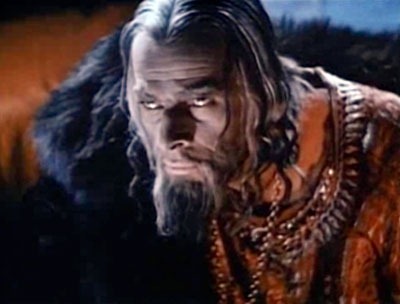
Part of the problem has been reconciling the film’s multiple paradoxes—how much it functions as Eisenstein’s autocritique and apologia as well as an attack and glorification of Stalin, meanwhile combining elements of both high and low art at virtually every instant with its tortured angles and extreme melodrama. (Though portions of Part II could be termed inferior toPart I, the moment the film switches to color, using Agfa stock seized from the Germans during World War II, it moves into dizzying high gear—see the video clip below—reminding us that Walt Disney was one of Eisenstein’s favorite filmmakers.) Some critics did take a slightly more nuanced view of things in Part II, but even a few of these writers, such as Dwight Macdonald, wound up adding homophobic invective to their charges, maintaining that Eisenstein’s homosexuality distorted his view of history—a dubious complaint that, as I later discovered, tended to oversimplify Eisenstein’s (bi)sexuality as well as the historical record. At least Orson Welles’s two mixed reviews of Part I—written in 1946, when he was a newspaper columnist and saw the film without subtitles at a special United Nations screening—placed proper emphasis on what might be called Eisenstein’s visual rhetoric, which tends to drown out most other considerations.
Thanks to the remarkably detailed scholarship of Joan Neuberger and Yuri Tsivian, … we now know that Ivan, far from being any sort of ideological collapse, was in fact Eisenstein’s most courageous gesture, above all in its highly ambivalent and often critical treatment of Stalin. Part I, which was milder overall, may have garnered the Stalin prize, but Part II, whose sexual and stylistic delirium went much further, was banned for a dozen years, following a now legendary February 1947 Kremlin meeting of Eisenstein and his lead actor, Nikolai Cherkasov, with Stalin, Molotov, and Zhdanov. It appears that Eisenstein agreed to make some cosmetic changes but then edited the film to suit himself, and died just afterward—having already vowed in his diary to work himself to death, after apparently being more appalled than pleased by Stalin’s initial endorsement of his project (according to Russian film scholar Leonid Kozlov).
Even if he never got around to shooting more than a few fragments of Part III (now lost, apart from a test), what Eisenstein left behind in the preceding two parts is surely one of the most complexly nuanced works in cinema history, simultaneously celebrating, critiquing, and analyzing Ivan, Stalin, and himself. What struck me most of all watching it this time was its shameless embrace of excess on all these fronts, registering both as a giddy kind of pop art and as a morbid exercise in medieval history. Despite its discarding of Eisenstein’s earlier montage aesthetic, I don’t think he ever made anything else in his career that was more personal or more expressive.
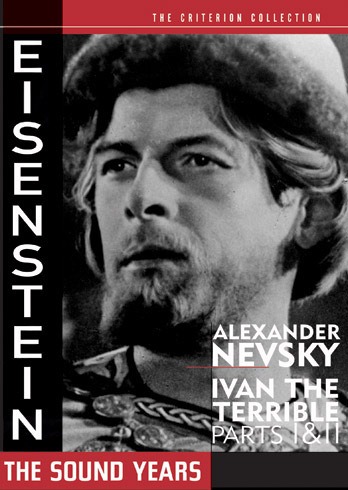
This is one over-the-top intense film. And it is available in many different versions (including free versions [1, 2] for those who have Amazon Instant Video). But my favorite version is available on a Criterion Collection box set (together with Eisenstein’s Alexander Nevsky.)
So, if you have three minutes, go take a gander at Brody’s brief visual essay and see if you don’t have a yen to watch (or re-watch) Ivan the Terrible.


 BLT
BLT 
I’ve got the Criterion set, but I have only watched Nevsky so far. Now I have to break down and watch Ivan.
Of course, as an Amazon Prime member, there are so many videos and so little time….
Chuck, I think you’ll like it.