50th Anniversary Editions of “The Phantom Tollbooth”
 Suzanne is mulling over a $1200 Sandwyk-illustrated edition of The Wind in the Willows. In a comment to her post, I noted that the Sandwyk edition of the book is available – albeit without the quarter vellum binding – for $60 new and $20 used; and that there are two attractive and inexpensive illustrated and annotated editions of The Wind in the Willows.
Mention of wonderfully illustrated children’s literature and annotated editions provides a wonderful opportunity to mention that Knopf is publishing two new editions of another children’s classic, The Phantom Tollbooth. Not the least of the points deserving praise of The Phantom Tollbooth are the remarkable illustrations by Jules Feiffer.
Tomorrow Leonard Marcus’s annotated edition appears (Amazon price $17.60), as well as a 50th anniversary edition“with a series of short essays by notable readers about the effect the book has had on their lives” (Amazon price $16.32, 5% off if ordered with annotated edition).
Adam Gopnick writes about these two editions in the New Yorker – some excerpts:
Our cult of decade anniversaries—the tenth of 9/11, the twentieth of Nevermind—are for the most part mere accidents of our fingers: because we’ve got five on each hand, we count things out in tens and hundreds. And yet the fifty-year birthday of a good children’s book marks a real passage, since it means that the book hasn’t been passed just from parent to child but from parent to child and on to child again. A book that has crossed that three-generation barrier has a good chance at permanence. So to note the fiftieth birthday of the closest thing that American literature has to an Alice in Wonderland of its own, Norton Juster’s The Phantom Tollbooth—with illustrations, by Jules Feiffer, that are as perfectly matched to Juster’s text as Tenniel’s were to Carroll’s—is to mark an anniversary that matters. (And there are two new books for the occasion, both coming out this month from Knopf: The Annotated Phantom Tollbooth, with notes by Leonard Marcus; and a fiftieth-anniversary edition, with a series of short essays by notable readers about the effect the book has had on their lives.)
This reader, from the first generation, received a copy not long after the book appeared, and can still recall its curious force. How odd the first chapter seemed, with so little time taken up with the kind of persuasive domestic detail that fills the beginning chapters of the first Narnia book or From the Mixed-Up Files of Mrs. Basil E. Frankweiler or Mary Poppins. We’re quickly introduced to the almost anonymous, and not very actively parented, Milo, a large-eyed boy in a dark shirt—a boy too bored to look up from the pavement as he walks home from school. Within paragraphs, a strange package has arrived in his room. It turns out to be a cardboard tollbooth, waiting to be assembled. Milo obediently sets it up, pays his fare (he has an enviable electric car already parked by his bed), and is rushed away to the Lands Beyond, a fantastical world of pure ideas. The book breaks the first rule of “good” children’s literature: we’re in the plot before we know the people.
It’s a commonplace of scholarship to insist that children’s literature came of age when it began to break away from the authoritarian model of the moralizing allegory. Yet The Phantom Tollbooth is an old-fashioned moralizing allegory, with a symbolic point at every turn. Milo finds that the strange land on the other side of the tollbooth is sundered between words and numbers, between the land of Azaz the Unabridged, the King of Dictionopolis, and his brother the Mathemagician, the ruler of Digitopolis. The only way to reunite the kingdoms is for someone—why not Milo?—to scale the Mountains of Ignorance, defeat the demons, and release the banished princesses of Rhyme and Reason from their prison. (They were banished because they refused to choose between words and numbers, thereby infuriating the kings.) Along the way, each new experience makes funny and concrete some familiar idea or turn of speech: Milo jumps to Conclusions, a crowded island; grows drowsy in the Doldrums; and finds that you can swim in the Sea of Knowledge for hours and not get wet. The book is made magical by Juster’s and Feiffer’s gift for transforming abstract philosophical ideas into unforgettable images. The thinnest fat man in the world turns out to be the fattest thin man; we see them both. We meet the fractional boy, divided in the middle of his smile, who is the “.58 child” in the average American family of 2.58 children. The tone of the book is at once antic and professorial, as if a very smart middle-aged academic were working his way through an absurd and elaborate parable for his kids. The reality is that when Juster wrote The Phantom Tollbooth he was a young architect in Brooklyn, just out of the Navy, unmarried and childless, and with no particular background in writing or teaching, working out a series of jokes and joys for himself alone.
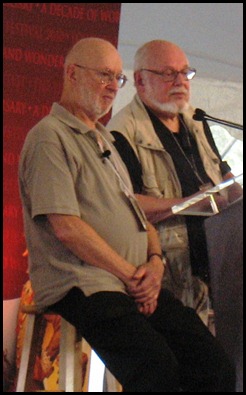
This became clear the other day, when the two creators of The Phantom Tollbooth were briefly sequestered in a Manhattan living room to talk about their work, and why it has lasted. Feiffer and Juster, both born in 1929, are like a pair of wryly benevolent uncles, with Norton the dreamy, crinkle-eyed, soft-spoken uncle who gives you the one piece of good advice you never forget, and Jules the wisecracking uncle who never lets up on your foibles but was happy to have you crash on his couch that night you just couldn’t bear going home. They interrupted, teased, and shpritzed each other as they recalled having blundered into a classic.
“Five thousand bucks you got!” Feiffer interjected.
“Was it that much? Anyway, I was up to my ass in worries and notes and couldn’t get it done. And so I took a vacation with friends, at the beach, Fire Island.”
“Probably with me!”
“No, it wasn’t you, Jules,” Juster added, though he explained that they already shared a roof. Stationed at the Brooklyn Navy Yard in 1956, Juster had found a garden apartment—“That’s what they call a basement room in Brooklyn,” Feiffer noted—in the Brooklyn Heights building where Feiffer was living, two floors up….
What does make the enduring magic of The Phantom Tollbooth? As with every classic of children’s literature, its real subject is education. The distinctive quality of modern civilization, after all, is that children are subjected to year after year after year of schooling. In the best-loved kids’ books, the choice is often between the true education presented in the book—say, Arthur’s through animals at the hands of Merlyn, in The Sword in the Stone—and the false education of the world and school. The child being read to (and the adult reading) is persuaded that self-reliance is a better model for learning than slavish obedience.
Each story of self-education has, to be sure, its period slant. Lewis Carroll’s Alice learns to resist the world’s nonsense, however seductively dressed as logic, but she also learns, Victorianly, that manners matter. In The Wind in the Willows, Mole is educated by Rat to mess around in boats and prefer the river to the burrow, but he’s also taught, as schoolchildren were in Edwardian England, to accept communality as the highest of virtues, and standing out too much, pushiness, as the worst of sins (particularly as displayed by the obviously outsider Mr. Toad). In the colonial French Babar, the elephant is educated in how to be a colonial Frenchman. In the Mary Poppins books, which first appeared in the thirties and forties, the Banks children are educated by their upright-seeming but poetic nanny in the Dionysian joys—they learn that the stars come down to go Christmas shopping, and you get the moon if you wish for it….
The Phantom Tollbooth is not just a manifesto for learning; it is a manifesto for the liberal arts, for a liberal education, and even for the liberal-arts college. (Juster, who, knowing that he had started out with a classic, went on to publish sparingly, if beautifully—his visual romance The Dot and the Line is his best-known later work—spent most of his career as an architect and as a teacher at Hampshire College.) What Milo discovers is that math and literature, Dictionopolis and Digitopolis, should assume their places not under the pentagon of Purpose and Power but under the presidency of Rhyme and Reason. Learning isn’t a set of things that we know but a world that we enter.…


 BLT
BLT 
I now have a copy of the 50th anniversary edition of The Phantom Tollbooth, and can report on its extra contents.
It has a plastic cover, which is clear on the outside and has text on the front and back flaps.
The front endpapers show a map of “The Lands Beyond” and the back endpapers have photos of Norman Juster at various points in his life. However, both endpapers seem to be monochrome (blue-white) and not “two color” as promised in the book blurb.
The book features a new introduction by Norman Juster, a 1996 “appreciation” by Maurice Sendak, and at the end of the book, brief essays (“celebrations”) by Jeanne Birdsall, Michael Chabon, Suzanne Collins, Martha Minow, Maria Nikolajeva, Philip Pullman, Pat Scales, Bev Walnoha, Mo Willems.
Physically the book seems to be a bit thinner than I remember — I’ll need to dig out my old childhood editions and see how it compares.
Overall, it is a nice purchase. The annotated edition was briefly delayed and I expect to receive it later this week.